Systems with Three Variables
2. Solving Three-Variable Systems
Learning outcomes
- I can solve systems using elimination.
- I can eliminate variables systematically.
- I can organize multi-step solutions.
- I can solve for all three variables.
- I can verify my answers.
Introduction
Many mathematical and real-world problems involve three unknown quantities connected by several relationships. These problems can be represented using systems of three linear equations.
For example, a school might need to determine the prices of three different products, a business might calculate the quantities of three items sold, or an engineer might determine three unknown forces acting on a structure.
To solve these problems, we need to find values for all three variables that satisfy every equation in the system.
One of the most effective methods is elimination.
Elimination allows us to simplify a complicated system by removing one variable at a time. We begin with three equations containing three unknowns, reduce them to two equations containing two unknowns, and then solve the resulting system.
Once two variables have been found, we substitute their values into one of the original equations to determine the third variable.
The key to success is working systematically, organising each step clearly, and verifying the final solution.
Reviewing Three-Variable Systems
A linear equation in three variables has the general form:
ax + by + cz = d
where:
-
x, y, and z are variables.
-
a, b, and c are coefficients.
-
d is a constant.
-
At least one of a, b, and c is nonzero.
A system of three linear equations may be written as:
a₁x + b₁y + c₁z = d₁
a₂x + b₂y + c₂z = d₂
a₃x + b₃y + c₃z = d₃
The goal is to determine an ordered triple:
(x, y, z)
that satisfies all three equations simultaneously.
Example
Consider:
x + y + z = 12
2x − y + z = 7
x + 2y − z = 6
The solution is:
(x, y, z) = (3, 4, 5)
Verification:
First equation:
3 + 4 + 5 = 12
Second equation:
2(3) − 4 + 5 = 7
Third equation:
3 + 2(4) − 5 = 6
All three equations are satisfied.
Why Elimination Works
Elimination uses the addition or subtraction of equations to remove a variable.
The principle is the same as in two-variable systems.
For example:
x + y = 10
x − y = 4
Adding the equations eliminates y:
2x = 14
x = 7
Then:
y = 3
In a three-variable system, we use the same idea, but we must eliminate a variable from two different pairs of equations.
This produces two equations containing only two unknowns.
We then solve that smaller system.
The elimination process
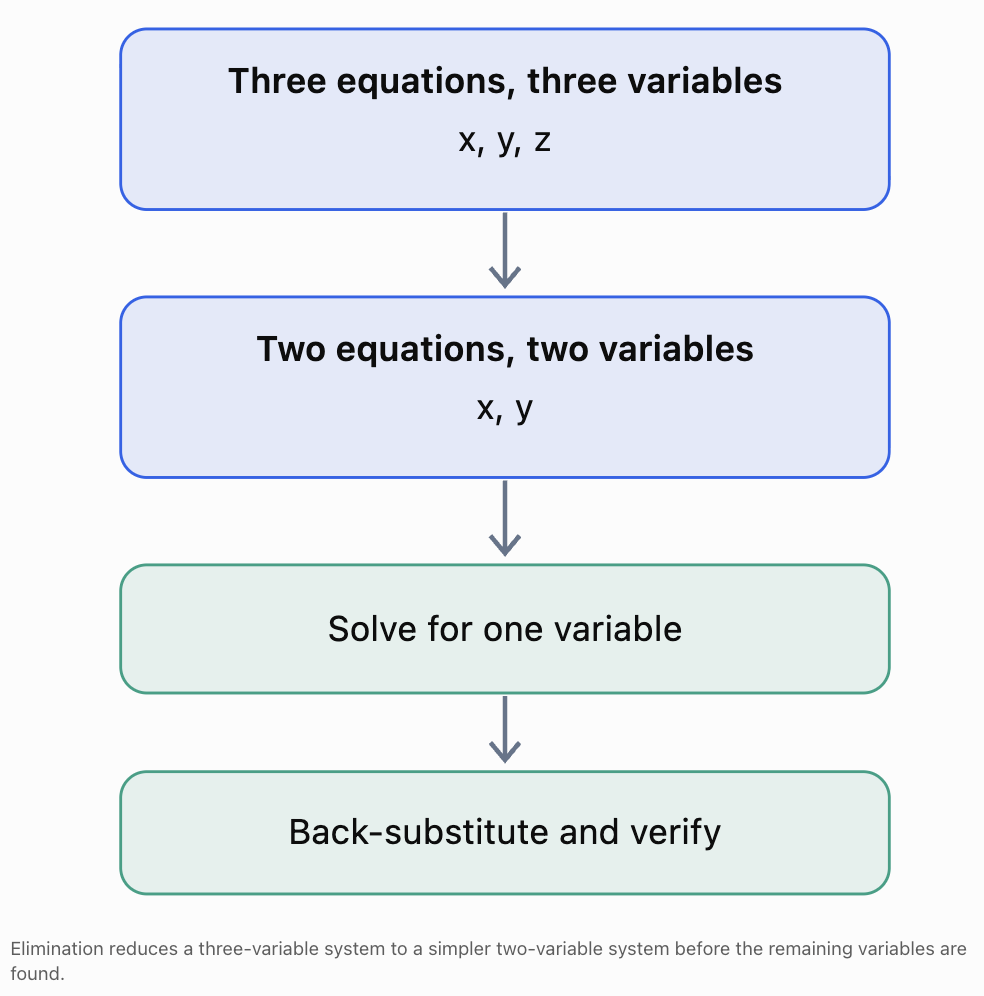
The process is sometimes called successive elimination because variables are removed in stages.
The General Elimination Method
To solve a system of three linear equations:
-
Label the original equations A, B, and C.
-
Choose one variable to eliminate first.
-
Eliminate that variable using two of the equations.
-
Eliminate the same variable using another pair of equations.
-
Solve the resulting two-variable system.
-
Substitute the known values into an original equation to find the third variable.
-
Check the ordered triple in all three original equations.
Important rule
When eliminating the first variable, use the same variable in both pairs.
For example, if you eliminate z from Equations A and B, you should also eliminate z from another pair, such as A and C.
Otherwise, the two resulting equations may contain different sets of variables and will not form the intended two-variable system.
Worked Example: Elimination Without Multiplication
Solve:
x + y + z = 12
2x − y + z = 7
x + 2y − z = 6
Step 1: Label the equations
A: x + y + z = 12
B: 2x − y + z = 7
C: x + 2y − z = 6
Step 2: Eliminate z from A and B
Both equations contain +z.
Subtract A from B:
(2x − y + z) − (x + y + z) = 7 − 12
Simplify:
x − 2y = −5
Call this Equation D.
Step 3: Eliminate z from A and C
Equation A contains +z.
Equation C contains −z.
Add the equations:
(x + y + z) + (x + 2y − z) = 12 + 6
Simplify:
2x + 3y = 18
Call this Equation E.
Step 4: Solve the two-variable system
We now have:
D: x − 2y = −5
E: 2x + 3y = 18
Multiply D by 2:
2x − 4y = −10
Subtract this from E:
(2x + 3y) − (2x − 4y) = 18 − (−10)
7y = 28
y = 4
Step 5: Find x
Substitute y = 4 into D:
x − 2(4) = −5
x − 8 = −5
x = 3
Step 6: Find z
Substitute x = 3 and y = 4 into A:
3 + 4 + z = 12
z = 5
Step 7: Verify
A:
3 + 4 + 5 = 12
B:
2(3) − 4 + 5 = 7
C:
3 + 2(4) − 5 = 6
All three equations are satisfied.
Final answer: (3, 4, 5).
Organising Elimination Work
Three-variable systems often involve many algebraic steps.
A clear layout reduces errors.
For example:
|
Stage |
Equations used |
Result |
|---|---|---|
|
Original system |
A, B, C |
Three equations in x, y, z |
|
First elimination |
B − A |
D: x − 2y = −5 |
|
Second elimination |
A + C |
E: 2x + 3y = 18 |
|
Solve smaller system |
D and E |
y = 4, x = 3 |
|
Back-substitution |
A |
z = 5 |
|
Verification |
A, B, C |
All satisfied |
Labelling equations is particularly helpful when coefficients are large or fractions are involved.
Worked Example: Multiplying Equations Before Elimination
Sometimes the coefficients of the variable we want to eliminate are not equal or opposite.
In these situations, we must multiply one or both equations by suitable constants.
Solve:
2x + 3y + z = 13
3x − 2y + 2z = 9
x + y − z = 1
Step 1: Label the equations
A: 2x + 3y + z = 13
B: 3x − 2y + 2z = 9
C: x + y − z = 1
We will eliminate z first.
Step 2: Eliminate z from A and B
Equation A contains +z.
Equation B contains +2z.
Multiply A by 2:
4x + 6y + 2z = 26
Subtract B:
(4x + 6y + 2z) − (3x − 2y + 2z) = 26 − 9
Simplify:
x + 8y = 17
Call this Equation D.
Step 3: Eliminate z from A and C
Equation A contains +z.
Equation C contains −z.
Add A and C:
(2x + 3y + z) + (x + y − z) = 13 + 1
Simplify:
3x + 4y = 14
Call this Equation E.
Step 4: Solve D and E
D: x + 8y = 17
E: 3x + 4y = 14
Multiply D by 3:
3x + 24y = 51
Subtract E:
20y = 37
y = 37/20
Step 5: Find x
Substitute into D:
x + 8(37/20) = 17
x + 74/5 = 17
x = 11/5
Step 6: Find z
Substitute into C:
x + y − z = 1
11/5 + 37/20 − z = 1
44/20 + 37/20 − z = 20/20
81/20 − z = 20/20
z = 61/20
Step 7: Verify
A:
2(11/5) + 3(37/20) + 61/20
= 88/20 + 111/20 + 61/20
= 260/20 = 13
B:
3(11/5) − 2(37/20) + 2(61/20)
= 132/20 − 74/20 + 122/20
= 180/20 = 9
C:
11/5 + 37/20 − 61/20
= 44/20 + 37/20 − 61/20
= 20/20 = 1
Final answer: (11/5, 37/20, 61/20).
This example demonstrates why fractions should be kept exact during multi-step algebra.
Rounding too early can produce inaccurate results.
Choosing Which Variable to Eliminate
Any variable can be eliminated first, but some choices make the calculation easier.
Consider:
x + 2y + z = 11
2x − y + z = 7
3x + y − z = 8
The coefficients of z are:
+1, +1, −1
These are convenient because z can be eliminated by simple addition or subtraction.
In contrast, eliminating x would require working with coefficients 1, 2, and 3.
Useful strategies
Choose a variable that:
-
Has equal coefficients in two equations.
-
Has opposite coefficients in two equations.
-
Has coefficients of 1 or −1.
-
Can be eliminated using small multipliers.
The goal is to reduce unnecessary arithmetic.
Worked Example: Choosing the Efficient Variable
Solve:
x + 2y + z = 11
2x − y + z = 7
3x + y − z = 8
Step 1: Eliminate z from the first two equations
Subtract the first equation from the second:
(2x − y + z) − (x + 2y + z) = 7 − 11
x − 3y = −4
Call this D.
Step 2: Eliminate z from the first and third equations
Add the equations:
(x + 2y + z) + (3x + y − z) = 11 + 8
4x + 3y = 19
Call this E.
Step 3: Solve D and E
D: x − 3y = −4
E: 4x + 3y = 19
Add:
5x = 15
x = 3
Substitute into D:
3 − 3y = −4
−3y = −7
y = 7/3
Step 4: Find z
Substitute into the first equation:
3 + 2(7/3) + z = 11
3 + 14/3 + z = 11
9/3 + 14/3 + z = 33/3
z = 10/3
Step 5: Verify
First equation:
3 + 14/3 + 10/3 = 11
Second equation:
2(3) − 7/3 + 10/3 = 7
Third equation:
3(3) + 7/3 − 10/3 = 8
Final answer: (3, 7/3, 10/3).
Worked Example: Eliminating x Instead of z
Elimination does not always have to begin with z.
Solve:
x + y + z = 9
x + 2y + 3z = 17
x − y + 2z = 7
Step 1: Label equations
A: x + y + z = 9
B: x + 2y + 3z = 17
C: x − y + 2z = 7
All three equations have a coefficient of 1 for x.
Therefore, eliminating x is convenient.
Step 2: Eliminate x from A and B
Subtract A from B:
y + 2z = 8
Call this D.
Step 3: Eliminate x from A and C
Subtract A from C:
−2y + z = −2
Call this E.
Step 4: Solve D and E
D: y + 2z = 8
E: −2y + z = −2
Multiply D by 2:
2y + 4z = 16
Add E:
5z = 14
z = 14/5
Step 5: Find y
y + 2(14/5) = 8
y + 28/5 = 40/5
y = 12/5
Step 6: Find x
x + 12/5 + 14/5 = 9
x + 26/5 = 45/5
x = 19/5
Step 7: Verify
A:
19/5 + 12/5 + 14/5 = 45/5 = 9
B:
19/5 + 24/5 + 42/5 = 85/5 = 17
C:
19/5 − 12/5 + 28/5 = 35/5 = 7
Final answer: (19/5, 12/5, 14/5).
Elimination with Negative Coefficients
Negative coefficients require careful attention.
Consider:
2x − 3y + z = 4
−x + 2y − z = 1
3x + y + 2z = 14
We can eliminate z by adding the first two equations.
Step 1: Add the first two equations
(2x − 3y + z) + (−x + 2y − z) = 4 + 1
x − y = 5
Call this D.
Step 2: Eliminate z from the first and third equations
Multiply the first equation by 2:
4x − 6y + 2z = 8
Subtract this from the third equation:
(3x + y + 2z) − (4x − 6y + 2z) = 14 − 8
−x + 7y = 6
Call this E.
Step 3: Solve D and E
D: x − y = 5
E: −x + 7y = 6
Add:
6y = 11
y = 11/6
Then:
x = 5 + 11/6
x = 41/6
Step 4: Find z
Use the first equation:
2(41/6) − 3(11/6) + z = 4
82/6 − 33/6 + z = 24/6
49/6 + z = 24/6
z = −25/6
Step 5: Verify
First equation:
2(41/6) − 3(11/6) − 25/6
= 82/6 − 33/6 − 25/6
= 24/6 = 4
Second equation:
−41/6 + 2(11/6) − (−25/6)
= −41/6 + 22/6 + 25/6
= 6/6 = 1
Third equation:
3(41/6) + 11/6 + 2(−25/6)
= 123/6 + 11/6 − 50/6
= 84/6 = 14
Final answer: (41/6, 11/6, −25/6).
Notice that a negative value for z is perfectly acceptable in an abstract algebraic system.
Whether negative values are reasonable in a real-world problem depends on what the variables represent.
Organising Multi-Step Solutions
Three-variable elimination can become difficult when equations are written without a clear structure.
A useful method is to label each equation and keep the reduced system separate from the original system.
Recommended layout
Original equations:
A: 2x + y − z = 8
B: x − y + 2z = 3
C: 3x + 2y + z = 14
First elimination:
D: Equation obtained from A and B
E: Equation obtained from A and C
Reduced system:
D: Equation in two variables
E: Equation in two variables
Solve:
Find the first variable.
Find the second variable.
Back-substitute:
Find the third variable.
Verification:
Check A, B, and C.
This approach makes it easier to identify where a calculation error occurred.
Worked Example: Solving a System with Larger Coefficients
Solve:
2x + 3y + 4z = 25
3x − 2y + z = 10
x + 4y − 2z = 5
Step 1: Label equations
A: 2x + 3y + 4z = 25
B: 3x − 2y + z = 10
C: x + 4y − 2z = 5
We will eliminate z.
Step 2: Eliminate z from A and B
Multiply B by 4:
12x − 8y + 4z = 40
Subtract A:
10x − 11y = 15
Call this D.
Step 3: Eliminate z from A and C
Multiply C by 2:
2x + 8y − 4z = 10
Add A:
4x + 11y = 35
Call this E.
Step 4: Solve D and E
D: 10x − 11y = 15
E: 4x + 11y = 35
Add:
14x = 50
x = 25/7
Step 5: Find y
Substitute into E:
4(25/7) + 11y = 35
100/7 + 11y = 245/7
11y = 145/7
y = 145/77
Step 6: Find z
Use B:
3x − 2y + z = 10
3(25/7) − 2(145/77) + z = 10
825/77 − 290/77 + z = 770/77
535/77 + z = 770/77
z = 235/77
Step 7: Verify
A:
2(25/7) + 3(145/77) + 4(235/77)
= 550/77 + 435/77 + 940/77
= 1925/77 = 25
B:
3(25/7) − 2(145/77) + 235/77
= 825/77 − 290/77 + 235/77
= 770/77 = 10
C:
25/7 + 4(145/77) − 2(235/77)
= 275/77 + 580/77 − 470/77
= 385/77 = 5
Final answer: (25/7, 145/77, 235/77).
This example shows that elimination remains effective even when the solution contains fractions.
Using Elimination in Word Problems
Three-variable systems are useful when a situation contains three unknown quantities and enough independent information to determine them.
Worked Example: Prices of Three Products
A school shop sells notebooks, pens, and pencils.
Two notebooks, one pen, and one pencil cost $13.
One notebook, two pens, and three pencils cost $14.
Three notebooks, one pen, and two pencils cost $20.
Find the price of each item.
Step 1: Define variables
n = price of one notebook
p = price of one pen
c = price of one pencil
Step 2: Construct equations
A: 2n + p + c = 13
B: n + 2p + 3c = 14
C: 3n + p + 2c = 20
Step 3: Eliminate p from A and C
Subtract A from C:
n + c = 7
Call this D.
Step 4: Eliminate p from A and B
Multiply A by 2:
4n + 2p + 2c = 26
Subtract B:
3n − c = 12
Call this E.
Step 5: Solve D and E
D: n + c = 7
E: 3n − c = 12
Add:
4n = 19
n = 4.75
Then:
c = 7 − 4.75
c = 2.25
Step 6: Find p
Use A:
2(4.75) + p + 2.25 = 13
9.50 + p + 2.25 = 13
p = 1.25
Step 7: Verify
A:
2(4.75) + 1.25 + 2.25 = 13
B:
4.75 + 2(1.25) + 3(2.25)
= 4.75 + 2.50 + 6.75
= 14
C:
3(4.75) + 1.25 + 2(2.25)
= 14.25 + 1.25 + 4.50
= 20
Answer: Notebook = $4.75; pen = $1.25; pencil = $2.25.
Worked Example: Three Types of Tickets
A theatre sells adult, student, and child tickets.
Adult tickets cost $15.
Student tickets cost $10.
Child tickets cost $5.
A total of 100 tickets are sold.
The total revenue is $1,050.
There are twice as many student tickets as child tickets.
Find the number of each type of ticket.
Step 1: Define variables
a = adult tickets
s = student tickets
c = child tickets
Step 2: Construct equations
Total tickets:
a + s + c = 100
Total revenue:
15a + 10s + 5c = 1050
Relationship:
s = 2c
Step 3: Eliminate a
Multiply the total ticket equation by 15:
15a + 15s + 15c = 1500
Subtract the revenue equation:
5s + 10c = 450
Divide by 5:
s + 2c = 90
Call this D.
Step 4: Use the third equation
We also know:
s = 2c
Substitute into D:
2c + 2c = 90
4c = 90
c = 22.5
Then:
s = 45
And:
a = 100 − 45 − 22.5
a = 32.5
Step 5: Interpret
The algebraic solution is:
a = 32.5
s = 45
c = 22.5
However, tickets must be counted in whole numbers.
Therefore, the original conditions have no valid whole-number solution.
This is a useful reminder that solving a system algebraically does not guarantee that its solution is realistic.
Recognising Special Cases
Three-variable systems do not always have exactly one solution.
During elimination, we may encounter an equation that reveals something important about the system.
No solution
Consider:
x + y + z = 10
2x + 2y + 2z = 25
x − y + z = 4
Multiply the first equation by 2:
2x + 2y + 2z = 20
But the second equation states:
2x + 2y + 2z = 25
Subtracting gives:
0 = 5
This is impossible.
Therefore, the system is inconsistent.
Answer: No solution.
Infinitely many solutions
Consider:
x + y + z = 10
2x + 2y + 2z = 20
x − y = 2
The second equation is twice the first.
It provides no new independent information.
From:
x − y = 2
we obtain:
x = y + 2
Substitute into the first equation:
(y + 2) + y + z = 10
2y + z = 8
z = 8 − 2y
Let y = t.
Then:
x = t + 2
y = t
z = 8 − 2t
The solution set is:
(t + 2, t, 8 − 2t)
where t is any real number.
There are infinitely many solutions.
Unique solution
If elimination produces enough independent equations to determine one value for each variable, the system has a unique solution.
Verifying Solutions
Verification is essential because three-variable systems involve several calculations and opportunities for errors.
Suppose we obtain:
x = 2
y = 3
z = 4
for the system:
x + y + z = 9
2x + y − z = 3
x − y + 2z = 7
Check the first equation:
2 + 3 + 4 = 9
Correct.
Check the second equation:
2(2) + 3 − 4 = 3
Correct.
Check the third equation:
2 − 3 + 2(4) = 7
Correct.
Since all three equations are satisfied, the solution is verified.
Why checking one equation is insufficient
A proposed triple may satisfy one or two equations but fail the third.
For example:
(3, 2, 4)
satisfies:
x + y + z = 9
because:
3 + 2 + 4 = 9
However, it does not satisfy:
2x + y − z = 3
because:
2(3) + 2 − 4 = 4
Therefore, it is not a solution to the complete system.
Checking Answers in Context
When solving real-world problems, verification involves more than substitution.
We must also consider whether the values make sense.
For example:
-
Prices should generally be nonnegative.
-
Numbers of people should be whole numbers.
-
Distances should use appropriate units.
-
Masses and volumes should not be negative.
-
Quantities should satisfy any limits stated in the problem.
A system may have a mathematically correct solution that is invalid in the original context.
Common Mistakes
Eliminating different variables from different pairs
When reducing a three-variable system, eliminate the same variable from two different pairs to obtain two equations in the same remaining variables.
Forgetting to multiply every term
If an equation is multiplied by 3, every coefficient and the constant must be multiplied by 3.
Incorrect subtraction of negative terms
For example:
5y − (−2y) = 7y
not 3y.
Losing track of equations
Label equations A, B, C, D, and E to keep the work organised.
Stopping after finding two variables
A complete solution must include all three variables.
Substituting into a reduced equation that no longer contains the third variable
To find the eliminated variable, return to an original equation containing it.
Rounding too early
Keep fractions exact until the final answer when possible.
Assuming every system has a unique solution
Some systems have no solution or infinitely many solutions.
Not verifying the result
Substitute the final ordered triple into all three original equations.
Ignoring contextual restrictions
A mathematically valid result may not make sense in a word problem.
Key Terms
-
System of equations: Two or more equations solved simultaneously.
-
Three-variable system: A system involving three unknown quantities.
-
Linear equation: An equation in which variables appear only to the first power and are not multiplied together.
-
Elimination: A method of removing variables by combining equations.
-
Successive elimination: Eliminating variables in stages to simplify a system.
-
Substitution: Replacing a variable with an equivalent expression or known value.
-
Back-substitution: Using previously calculated values to find remaining unknowns.
-
Coefficient: A number multiplying a variable.
-
Constant: A fixed numerical value.
-
Ordered triple: Three values written in a specified order, such as (x, y, z).
-
Unique solution: Exactly one set of values satisfies the system.
-
Consistent system: A system with at least one solution.
-
Inconsistent system: A system with no solution.
-
Dependent equations: Equations that provide redundant information.
-
Contradiction: An impossible statement such as 0 = 5.
-
Identity: A statement true for all relevant values, such as 0 = 0.
-
Verification: Checking that a proposed solution satisfies the original equations.
-
Constraint: A restriction on the possible values of variables.
Key Takeaways
-
Elimination is an effective method for solving three-variable systems.
-
The goal is to reduce three equations in three variables to two equations in two variables.
-
The same variable should be eliminated from two different pairs of equations.
-
Multiplication may be required to create matching or opposite coefficients.
-
Labelling equations helps organise multi-step solutions.
-
After solving the reduced system, back-substitution determines the third variable.
-
Every solution should be written as an ordered triple.
-
A system may have one solution, no solution, or infinitely many solutions.
-
Contradictions indicate inconsistency.
-
Redundant equations may lead to infinitely many solutions when the system remains consistent.
-
Verification requires substituting the final values into all original equations.
-
Contextual restrictions must be considered in real-world applications.
Check Your Understanding
Recall and Understanding
1. Explain why elimination is useful for solving systems of three linear equations.
2. Why should the same variable be eliminated from two different pairs of equations?
3. What is back-substitution, and why is it necessary?
4. What does the equation 0 = 8 indicate when it appears during elimination?
5. Explain why a solution must be checked in all three original equations.
Basic Elimination
6. Solve:
x + y + z = 12
x + y − z = 4
x − y + z = 6
7. Solve:
x + y + z = 15
2x + y + z = 19
x + 2y + z = 20
8. Solve:
2x + y + z = 13
x + y − z = 2
x − y + z = 4
9. Solve:
x + 2y + z = 14
2x − y + z = 8
x + y − z = 2
10. Solve:
2x + 3y − z = 7
x − y + z = 5
3x + 2y + z = 16
Application and Challenge
11. Solve:
2x + y + 3z = 17
x − 2y + z = 1
3x + y − z = 4
12. Determine whether the following system has a solution:
x + y + z = 9
2x + 2y + 2z = 20
x − y + z = 3
13. Determine whether the following system has one solution or infinitely many solutions:
x + y + z = 8
2x + 2y + 2z = 16
x − y = 2
14. A school shop sells notebooks, pens, and pencils.
-
Two notebooks, one pen, and one pencil cost $14.
-
One notebook, two pens, and three pencils cost $15.
-
Three notebooks, two pens, and one pencil cost $23.
Find the price of each item.
15. A theatre sells adult, student, and child tickets for $15, $10, and $5 respectively. A total of 100 tickets are sold, generating $1,050. There are twice as many child tickets as adult tickets.
Construct and solve a three-variable system to determine how many of each ticket type were sold.
Answers to Check Your Understanding
1. Elimination simplifies a three-variable system by removing one variable from two pairs of equations. This produces a two-variable system that can be solved using familiar methods.
2. Eliminating the same variable produces two equations involving the same two remaining unknowns. These can then be solved simultaneously.
3. Back-substitution involves substituting known variable values into an earlier equation to find an unknown variable. It is necessary to recover variables that were eliminated.
4. The statement 0 = 8 is a contradiction. It indicates that the system is inconsistent and has no solution.
5. A proposed ordered triple must satisfy every equation simultaneously. Checking only one or two equations does not establish that it is a solution to the complete system.
6.
A: x + y + z = 12
B: x + y − z = 4
C: x − y + z = 6
Subtract B from A:
2z = 8
z = 4
Subtract C from A:
2y = 6
y = 3
Substitute into A:
x + 3 + 4 = 12
x = 5
Answer: (5, 3, 4).
Verification:
5 + 3 + 4 = 12
5 + 3 − 4 = 4
5 − 3 + 4 = 6
7.
A: x + y + z = 15
B: 2x + y + z = 19
C: x + 2y + z = 20
Subtract A from B:
x = 4
Subtract A from C:
y = 5
Substitute into A:
4 + 5 + z = 15
z = 6
Answer: (4, 5, 6).
Verification:
4 + 5 + 6 = 15
2(4) + 5 + 6 = 19
4 + 2(5) + 6 = 20
8.
A: 2x + y + z = 13
B: x + y − z = 2
C: x − y + z = 4
Add B and C:
2x = 6
x = 3
Add A and B:
3x + 2y = 15
Substitute x = 3:
9 + 2y = 15
y = 3
Use B:
3 + 3 − z = 2
z = 4
Answer: (3, 3, 4).
Verification:
2(3) + 3 + 4 = 13
3 + 3 − 4 = 2
3 − 3 + 4 = 4
9.
A: x + 2y + z = 14
B: 2x − y + z = 8
C: x + y − z = 2
Subtract B from A:
−x + 3y = 6
Add A and C:
2x + 3y = 16
Subtract the first reduced equation from the second:
3x = 10
x = 10/3
Substitute into:
−x + 3y = 6
−10/3 + 3y = 6
3y = 28/3
y = 28/9
Use C:
10/3 + 28/9 − z = 2
z = 40/9
Answer: (10/3, 28/9, 40/9).
Verification:
A: 10/3 + 2(28/9) + 40/9 = 14
B: 2(10/3) − 28/9 + 40/9 = 8
C: 10/3 + 28/9 − 40/9 = 2
10.
A: 2x + 3y − z = 7
B: x − y + z = 5
C: 3x + 2y + z = 16
Add A and B:
3x + 2y = 12
Subtract B from C:
2x + 3y = 11
Multiply the first reduced equation by 3:
9x + 6y = 36
Multiply the second by 2:
4x + 6y = 22
Subtract:
5x = 14
x = 14/5
Substitute into:
3x + 2y = 12
42/5 + 2y = 12
2y = 18/5
y = 9/5
Use B:
14/5 − 9/5 + z = 5
z = 4
Answer: (14/5, 9/5, 4).
Verification:
A: 28/5 + 27/5 − 4 = 7
B: 14/5 − 9/5 + 4 = 5
C: 42/5 + 18/5 + 4 = 16
11.
A: 2x + y + 3z = 17
B: x − 2y + z = 1
C: 3x + y − z = 4
Eliminate y.
Subtract A from C:
x − 4z = −13
Call this D.
Multiply A by 2:
4x + 2y + 6z = 34
Add B:
5x + 7z = 35
Call this E.
From D:
x = 4z − 13
Substitute into E:
5(4z − 13) + 7z = 35
20z − 65 + 7z = 35
27z = 100
z = 100/27
Then:
x = 4(100/27) − 13
x = 49/27
Use B:
49/27 − 2y + 100/27 = 1
149/27 − 2y = 27/27
2y = 122/27
y = 61/27
Answer: (49/27, 61/27, 100/27).
Verification:
A: (98 + 61 + 300)/27 = 459/27 = 17
B: (49 − 122 + 100)/27 = 27/27 = 1
C: (147 + 61 − 100)/27 = 108/27 = 4
12.
First equation:
x + y + z = 9
Multiply by 2:
2x + 2y + 2z = 18
But the second equation states:
2x + 2y + 2z = 20
Subtracting gives:
0 = 2
This is impossible.
Answer: No solution. The system is inconsistent.
13.
The system is:
x + y + z = 8
2x + 2y + 2z = 16
x − y = 2
The second equation is twice the first, so it provides no new information.
From:
x − y = 2
x = y + 2
Substitute into the first equation:
(y + 2) + y + z = 8
2y + z = 6
z = 6 − 2y
Let y = t.
Then:
x = t + 2
y = t
z = 6 − 2t
Answer: Infinitely many solutions, given by (t + 2, t, 6 − 2t), for any real number t.
14.
Let:
n = notebook price
p = pen price
c = pencil price
The equations are:
A: 2n + p + c = 14
B: n + 2p + 3c = 15
C: 3n + 2p + c = 23
Subtract A from C:
n + p = 9
Therefore:
p = 9 − n
Substitute into A:
2n + (9 − n) + c = 14
n + c = 5
Therefore:
c = 5 − n
Substitute both expressions into B:
n + 2(9 − n) + 3(5 − n) = 15
n + 18 − 2n + 15 − 3n = 15
33 − 4n = 15
4n = 18
n = 4.50
Then:
p = 9 − 4.50 = 4.50
c = 5 − 4.50 = 0.50
Answer: Notebook = $4.50; pen = $4.50; pencil = $0.50.
Verification:
2(4.50) + 4.50 + 0.50 = 14
4.50 + 2(4.50) + 3(0.50) = 15
3(4.50) + 2(4.50) + 0.50 = 23
15.
Let:
a = adult tickets
s = student tickets
c = child tickets
Construct the equations.
Total tickets:
a + s + c = 100
Total revenue:
15a + 10s + 5c = 1050
Twice as many child tickets as adult tickets:
c = 2a
Substitute c = 2a into the total ticket equation:
3a + s = 100
Therefore:
s = 100 − 3a
Substitute into the revenue equation:
15a + 10(100 − 3a) + 5(2a) = 1050
15a + 1000 − 30a + 10a = 1050
−5a = 50
a = −10
Then:
c = −20
s = 100 − 3(−10) = 130
The algebraic solution is:
a = −10
s = 130
c = −20
Verification:
−10 + 130 − 20 = 100
15(−10) + 10(130) + 5(−20)
= −150 + 1300 − 100
= 1050
And:
−20 = 2(−10)
The values satisfy the equations, but negative ticket quantities are impossible.
Answer: The system has a unique algebraic solution but no valid real-world solution using nonnegative ticket quantities.
Final Summary
Elimination provides a systematic method for solving three-variable systems of linear equations.
By combining equations to eliminate the same variable twice, we reduce the original system to two equations in two unknowns. We can then solve the smaller system and use back-substitution to determine the remaining variable.
Clear organisation, careful handling of signs and coefficients, and verification are essential for avoiding errors.
The most important principle is to simplify the system one variable at a time while preserving the relationships represented by the original equations.