Special Systems and Applications
4. Money and Cost Problems
Learning outcomes
- I can model financial situations with systems.
- I can solve problems involving costs and prices.
- I can determine unknown values using systems.
- I can interpret financial solutions.
- I can explain my reasoning.
Introduction
Money and cost problems are among the most practical applications of systems of linear equations. Every day, people and businesses make decisions involving prices, quantities, expenses, revenue, and profit.
For example:
-
A student buys notebooks and pens but does not know the individual prices.
-
A cinema sells adult and child tickets at different prices.
-
Two companies offer different payment plans.
-
A business wants to know how many products it must sell to cover its costs.
-
A school sells two types of merchandise and needs to determine how many of each were sold.
-
A customer compares two mobile phone plans to decide which offers better value.
Many of these situations involve two unknown quantities and two relationships. By representing the information using equations, we can construct a system of linear equations and solve it.
The goal is not simply to calculate numbers. We must also understand what the numbers represent, check whether they are realistic, and explain how the mathematical solution answers the original financial question.
Understanding Financial Relationships
Before solving money and cost problems, it is important to understand several common financial quantities.
Cost
Cost is the amount of money required to purchase, produce, or provide something.
Examples include the cost of buying supplies, manufacturing products, renting equipment, or operating a business.
A business may have two main types of costs:
-
Fixed costs: Expenses that do not change with the number of products made within the model, such as monthly rent.
-
Variable costs: Expenses that change with the number of products made, such as materials and packaging.
A common linear cost model is:
C(x) = mx + b
where:
-
C(x) = total cost.
-
x = number of products or units.
-
m = variable cost per unit.
-
b = fixed cost.
Revenue
Revenue is the total money received from selling goods or services before deducting costs.
For a product sold at a constant price:
Revenue = Selling price × Quantity sold
For example, selling 40 products at $15 each gives:
R = 15 × 40 = $600
Profit
Profit is the money remaining after costs are deducted from revenue.
Profit = Revenue − Cost
If a business earns $600 in revenue and has $450 in costs:
Profit = 600 − 450
Profit = $150
If costs exceed revenue, the business makes a loss.
Break-even point
The break-even point occurs when total revenue equals total cost.
Revenue = Cost
At this point:
Profit = $0
Finding the break-even point is one of the most important applications of systems of equations in business.
Identifying Variables in Financial Problems
A financial word problem often contains two unknown quantities.
The first step is defining them clearly.
For example:
"A customer purchases three notebooks and two pens for $17. Another customer purchases two notebooks and four pens for $18."
We need to determine the individual prices.
Define:
x = price of one notebook in dollars
y = price of one pen in dollars
These definitions allow us to write equations using the quantities purchased and the total amounts paid.
Translating financial statements
|
Statement |
Equation or expression |
|---|---|
|
Three notebooks cost $12 |
3x = 12 |
|
Two pens and one notebook cost $9 |
2y + x = 9 |
|
A total of 50 tickets were sold |
x + y = 50 |
|
Adult tickets cost $15 each |
Adult revenue = 15x |
|
A fixed fee of $20 plus $5 per hour |
C = 5h + 20 |
|
Revenue equals cost |
R = C |
|
A business earns $200 profit |
R − C = 200 |
The most important skill is recognizing how the written information becomes mathematical relationships.
Constructing Systems from Purchase Problems
Suppose a shop sells notebooks and pens.
Three notebooks and two pens cost $17.
Two notebooks and four pens cost $18.
Step 1: Define variables
x = price of one notebook
y = price of one pen
Step 2: Write equations
First purchase:
3x + 2y = 17
Second purchase:
2x + 4y = 18
We now have a system of two equations with two unknowns.
Step 3: Solve using elimination
Multiply the first equation by 2:
6x + 4y = 34
Subtract the second equation:
(6x + 4y) − (2x + 4y) = 34 − 18
4x = 16
x = 4
Substitute into the first equation:
3(4) + 2y = 17
12 + 2y = 17
2y = 5
y = 2.50
Step 4: Interpret
One notebook costs $4.
One pen costs $2.50.
Step 5: Verify
First purchase:
3(4) + 2(2.50) = 12 + 5 = $17
Second purchase:
2(4) + 4(2.50) = 8 + 10 = $18
Both equations are satisfied.
Answer: Notebook = $4; pen = $2.50.
A General Method for Financial Systems
A reliable approach to financial word problems is:
-
Read the problem and identify the unknown quantities.
-
Define variables with appropriate units.
-
Translate the financial relationships into equations.
-
Solve the system using substitution, elimination, or graphing.
-
Interpret the values in the original context.
-
Verify that the solution satisfies every condition.
-
Check whether the result is financially and practically reasonable.
For example, if x represents the number of tickets sold, x should normally be a nonnegative whole number.
If x represents a price, a fractional value may be acceptable, but it should be expressed correctly in dollars and cents.
Worked Example: Ticket Sales
A school concert sells two types of tickets:
-
Adult tickets cost $15 each.
-
Student tickets cost $9 each.
A total of 140 tickets are sold.
The total revenue is $1,740.
How many adult and student tickets were sold?
Step 1: Define variables
a = number of adult tickets
s = number of student tickets
Step 2: Write the total ticket equation
a + s = 140
Step 3: Write the revenue equation
Adult ticket revenue:
15a
Student ticket revenue:
9s
Therefore:
15a + 9s = 1740
Step 4: Solve
From the first equation:
s = 140 − a
Substitute:
15a + 9(140 − a) = 1740
Expand:
15a + 1260 − 9a = 1740
Combine:
6a + 1260 = 1740
6a = 480
a = 80
Then:
s = 140 − 80
s = 60
Step 5: Interpret
The school sold:
-
80 adult tickets.
-
60 student tickets.
Step 6: Verify
Total tickets:
80 + 60 = 140
Total revenue:
15(80) + 9(60)
= 1200 + 540
= $1740
Answer: 80 adult tickets and 60 student tickets.
Worked Example: Comparing Two Payment Plans
A customer wants to compare two mobile phone plans.
Plan A charges a fixed monthly fee of $20 plus $5 per unit of additional usage.
Plan B charges a fixed monthly fee of $35 plus $2 per unit of additional usage.
At what usage level will the two plans cost the same?
Step 1: Define variables
x = number of additional usage units
y = total monthly cost in dollars
Step 2: Write the cost equations
Plan A:
y = 5x + 20
Plan B:
y = 2x + 35
Step 3: Solve the system
Set the equations equal:
5x + 20 = 2x + 35
Subtract 2x:
3x + 20 = 35
Subtract 20:
3x = 15
x = 5
Step 4: Find the cost
Substitute x = 5:
Plan A:
y = 5(5) + 20 = 45
Plan B:
y = 2(5) + 35 = 45
Step 5: Interpret
Both plans cost $45 when the customer uses five additional units.
For fewer than five units, Plan A is cheaper.
For more than five units, Plan B is cheaper.
Step 6: Verify
Both equations produce $45 at x = 5.
Answer: The plans have equal costs at five additional usage units, when each costs $45.
Graphical Interpretation of Payment Plans
A system of cost equations can be represented by two straight lines.
The point where the lines intersect shows the usage level at which the costs are equal.
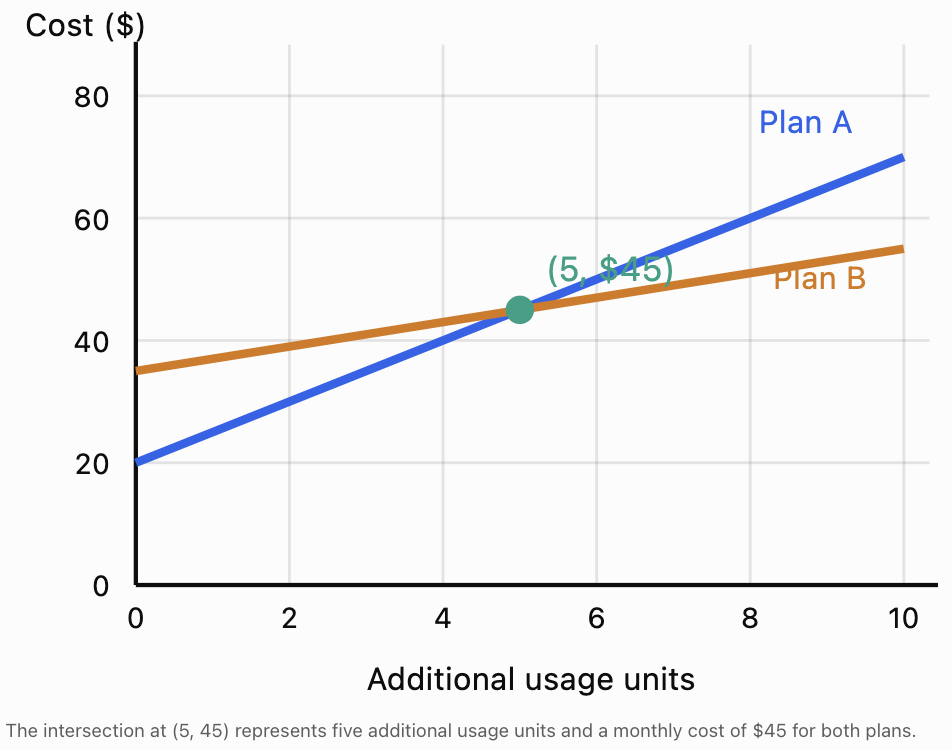
This graph also illustrates the meaning of the slope and y-intercept.
-
The slope represents the cost per additional usage unit.
-
The y-intercept represents the fixed monthly fee.
-
The intersection represents the break-even usage level between the two plans.
Worked Example: Taxi Fares
Two taxi companies charge different rates.
Company A charges a starting fee of $6 and $2 per kilometre.
Company B charges a starting fee of $3 and $2.50 per kilometre.
At what distance will the fares be equal?
Step 1: Define variables
d = distance travelled in kilometres
C = total fare in dollars
Step 2: Construct equations
Company A:
C = 2d + 6
Company B:
C = 2.50d + 3
Step 3: Solve
2d + 6 = 2.50d + 3
Subtract 2d:
6 = 0.50d + 3
Subtract 3:
3 = 0.50d
d = 6
Step 4: Calculate the fare
Company A:
C = 2(6) + 6 = 18
Company B:
C = 2.50(6) + 3 = 18
Step 5: Interpret
The taxi companies charge the same fare for a 6 km journey.
Both fares are $18.
For journeys shorter than 6 km, Company B is cheaper.
For journeys longer than 6 km, Company A is cheaper.
Answer: 6 km, at a fare of $18.
Worked Example: Business Break-Even Analysis
A small business manufactures reusable water bottles.
Its monthly fixed costs are $1,200.
Each bottle costs $8 to produce.
The selling price is $20 per bottle.
How many bottles must the business sell to break even?
Step 1: Define variables
x = number of bottles produced and sold
y = total amount in dollars
Step 2: Write the cost equation
Fixed costs:
$1,200
Variable cost per bottle:
$8
Therefore:
C(x) = 8x + 1200
Step 3: Write the revenue equation
Each bottle sells for $20.
Therefore:
R(x) = 20x
Step 4: Find the break-even point
At break-even:
C(x) = R(x)
8x + 1200 = 20x
1200 = 12x
x = 100
Step 5: Calculate cost and revenue
Cost:
C(100) = 8(100) + 1200
C(100) = 2000
Revenue:
R(100) = 20(100)
R(100) = 2000
Step 6: Interpret
The business must sell 100 bottles to break even.
At this quantity:
-
Total cost = $2,000.
-
Total revenue = $2,000.
-
Profit = $0.
Selling fewer than 100 bottles produces a loss.
Selling more than 100 bottles produces a profit under this model.
Answer: The break-even point is 100 bottles, corresponding to $2,000 in cost and revenue.
Understanding Profit Functions
Profit can be represented mathematically.
P(x) = R(x) − C(x)
For the water bottle business:
R(x) = 20x
C(x) = 8x + 1200
Therefore:
P(x) = 20x − (8x + 1200)
Simplify:
P(x) = 12x − 1200
This equation can be used to predict profit at different sales quantities.
Example: Selling 150 bottles
P(150) = 12(150) − 1200
= 1800 − 1200
= $600
Example: Selling 60 bottles
P(60) = 12(60) − 1200
= 720 − 1200
= −$480
A negative profit represents a loss.
Example: Target profit
How many bottles must the business sell to earn $1,200 profit?
Set:
12x − 1200 = 1200
12x = 2400
x = 200
The business must sell 200 bottles to earn $1,200 profit.
These calculations assume every bottle produced is sold and that unit costs and selling prices remain constant.
Worked Example: Finding Unknown Prices
A school canteen sells sandwiches and drinks.
Three sandwiches and two drinks cost $21.
Two sandwiches and five drinks cost $24.
Find the price of one sandwich and one drink.
Step 1: Define variables
s = price of one sandwich in dollars
d = price of one drink in dollars
Step 2: Construct equations
First purchase:
3s + 2d = 21
Second purchase:
2s + 5d = 24
Step 3: Solve using elimination
Multiply the first equation by 5:
15s + 10d = 105
Multiply the second equation by 2:
4s + 10d = 48
Subtract:
11s = 57
s = 57/11 ≈ 5.18
Substitute into the first equation:
3(57/11) + 2d = 21
171/11 + 2d = 231/11
2d = 60/11
d = 30/11 ≈ 2.73
Step 4: Interpret
The exact algebraic prices are:
-
Sandwich = $57/11 ≈ $5.18.
-
Drink = $30/11 ≈ $2.73.
However, these exact values are not whole numbers of cents.
If the canteen charges only whole cents, the original totals do not produce a valid exact pricing solution under that restriction.
This illustrates why financial solutions must be checked for practical reasonableness.
A revised example
Suppose the second purchase instead costs $25.
Then:
3s + 2d = 21
2s + 5d = 25
Multiply the first equation by 5:
15s + 10d = 105
Multiply the second equation by 2:
4s + 10d = 50
Subtract:
11s = 55
s = 5
Substitute:
3(5) + 2d = 21
15 + 2d = 21
d = 3
Verification
First purchase:
3(5) + 2(3) = 21
Second purchase:
2(5) + 5(3) = 25
For the revised totals, a sandwich costs $5 and a drink costs $3.
Worked Example: Finding Numbers of Coins
A student has 30 coins consisting only of 20-cent and 50-cent coins.
The total value is $9.00.
How many of each coin does the student have?
Step 1: Define variables
x = number of 20-cent coins
y = number of 50-cent coins
Step 2: Construct equations
Total coins:
x + y = 30
Total value:
0.20x + 0.50y = 9
Step 3: Solve
From the first equation:
x = 30 − y
Substitute:
0.20(30 − y) + 0.50y = 9
6 − 0.20y + 0.50y = 9
6 + 0.30y = 9
0.30y = 3
y = 10
Then:
x = 30 − 10
x = 20
Step 4: Interpret
The student has:
-
20 twenty-cent coins.
-
10 fifty-cent coins.
Step 5: Verify
Total number:
20 + 10 = 30 coins
Total value:
0.20(20) + 0.50(10)
= 4 + 5
= $9
Answer: 20 twenty-cent coins and 10 fifty-cent coins.
Worked Example: Finding Two Unknown Quantities from Revenue
A school sells T-shirts and caps at a fundraising event.
T-shirts cost $18 each.
Caps cost $12 each.
A total of 85 items are sold, generating $1,320.
How many T-shirts and caps were sold?
Step 1: Define variables
t = number of T-shirts sold
c = number of caps sold
Step 2: Construct equations
Total items:
t + c = 85
Total revenue:
18t + 12c = 1320
Step 3: Solve
Substitute c = 85 − t:
18t + 12(85 − t) = 1320
18t + 1020 − 12t = 1320
6t = 300
t = 50
Then:
c = 85 − 50
c = 35
Step 4: Verify
Total items:
50 + 35 = 85
Total revenue:
18(50) + 12(35)
= 900 + 420
= $1320
Answer: 50 T-shirts and 35 caps were sold.
Worked Example: Comparing Production Costs
Two companies manufacture the same product using different production methods.
Company A has fixed costs of $800 and variable costs of $12 per unit.
Company B has fixed costs of $1,400 and variable costs of $8 per unit.
At what production quantity will their costs be equal?
Step 1: Define variables
x = number of products manufactured
C = total production cost
Step 2: Construct equations
Company A:
C = 12x + 800
Company B:
C = 8x + 1400
Step 3: Solve
12x + 800 = 8x + 1400
4x = 600
x = 150
Step 4: Calculate the equal cost
Company A:
C = 12(150) + 800
C = 2600
Company B:
C = 8(150) + 1400
C = 2600
Step 5: Interpret
At 150 products, both methods cost $2,600.
For fewer than 150 products, Company A has lower costs.
For more than 150 products, Company B has lower costs.
Answer: 150 products, at a total cost of $2,600.
This example shows why a business might choose a production method with higher fixed costs but lower variable costs when production quantities are large.
Solving Financial Systems Using Graphs
Graphs provide a useful way to compare financial relationships.
Consider:
Company A:
C = 12x + 800
Company B:
C = 8x + 1400
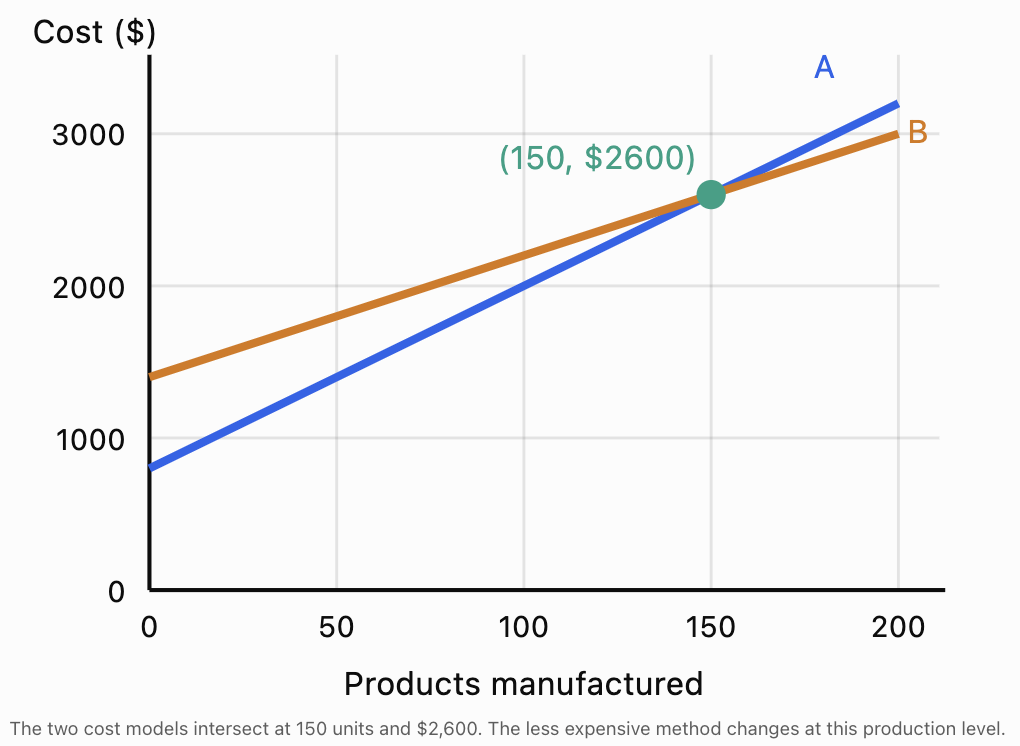
Graphing allows us to identify:
-
Fixed costs from the y-intercepts.
-
Variable costs from the slopes.
-
Equal-cost quantities from intersection points.
-
Which company is cheaper over different production ranges.
Parallel and Coincident Financial Models
Not every financial system has exactly one solution.
Parallel cost models
Consider:
Plan A:
C = 4x + 20
Plan B:
C = 4x + 35
Both plans have the same variable cost of $4 per unit.
However, Plan B has a higher fixed fee.
The lines are parallel.
There is no value of x for which their costs are equal.
Plan A is always $15 cheaper.
Coincident cost models
Consider:
Plan A:
C = 6x + 25
Plan B:
2C = 12x + 50
Simplify Plan B:
C = 6x + 25
The equations represent the same line.
The plans have equal costs for every usage level in their shared domain.
Therefore, the system has infinitely many solutions if the domain contains infinitely many possible usage values.
Financial Constraints and Reasonableness
Financial systems often have restrictions that must be considered.
Nonnegative quantities
Prices, sales quantities, and costs are usually nonnegative.
A solution requiring −5 tickets is not meaningful.
Whole-number quantities
Numbers of tickets, coins, or indivisible products must be whole numbers.
A result of 12.5 tickets is not a valid contextual answer.
Money precision
Prices are often expressed in dollars and cents.
If a solution produces a price that cannot be represented exactly in cents, additional interpretation may be required.
Realistic domains
A financial model may only apply within a certain range.
For example, a business might produce between 0 and 500 products.
An intersection at 2,000 products would lie outside the practical domain.
Simplifying assumptions
Linear financial models often assume:
-
Constant selling prices.
-
Constant variable costs.
-
Fixed costs that do not change.
-
No discounts or taxes unless specified.
-
All produced goods are sold, when revenue and production quantity use the same variable.
Real businesses may not follow these assumptions exactly.
Recognizing the limitations of a model is part of mathematical reasoning.
Explaining Mathematical Reasoning
A complete financial solution should explain not only what was calculated, but why the equations were chosen.
For example, consider a ticket problem:
"Adult tickets cost $12, student tickets cost $7, and 100 tickets generate $950."
A clear explanation would be:
Let a represent the number of adult tickets and s represent the number of student tickets.
Since 100 tickets were sold:
a + s = 100
Since adult tickets generate $12 each and student tickets generate $7 each:
12a + 7s = 950
The first equation represents the total number of tickets, while the second represents the total revenue.
We can then solve the system.
Substitute s = 100 − a:
12a + 7(100 − a) = 950
12a + 700 − 7a = 950
5a = 250
a = 50
Then:
s = 50
Verification:
50 + 50 = 100
12(50) + 7(50) = 600 + 350 = 950
Therefore, 50 adult tickets and 50 student tickets were sold.
This explanation clearly connects the equations to the original financial situation.
A General Strategy for Money and Cost Problems
Use the following process.
Identify the unknowns
Determine whether the variables represent prices, quantities, costs, time, or revenue.
Construct the equations
Use relationships such as:
Total quantity = Quantity A + Quantity B
Total cost = Unit price × Quantity
Revenue = Selling price × Quantity
Profit = Revenue − Cost
Solve the system
Use substitution, elimination, or graphing.
Interpret the solution
Explain what each value represents.
Verify
Substitute the values into the original equations.
Evaluate reasonableness
Check units, restrictions, and whether the values make financial sense.
Common Mistakes
Confusing cost and revenue
Revenue is money received from sales. Cost is money spent.
Profit is the difference between them.
Forgetting fixed costs
A cost model such as C = 8x + 500 includes both variable and fixed costs.
Using total price instead of unit price
If a notebook costs $4, then three notebooks cost 3 × $4 = $12.
Defining variables incorrectly
Be clear whether x represents the number of items or the price of one item.
Mixing dollars and cents
Convert all monetary values into consistent units before solving.
Ignoring whole-number restrictions
A solution of 12.5 coins is not valid if individual coins must be counted.
Assuming every financial model has one solution
Parallel models may have no intersection, while coincident models have infinitely many.
Confusing break-even with profit
At break-even, profit equals zero.
Failing to interpret an intersection
The x-coordinate usually represents a quantity or usage level, while the y-coordinate represents a financial amount.
Not verifying the result
A proposed solution must satisfy every original financial condition.
Key Terms
-
Cost: Money spent on goods, services, or production.
-
Fixed cost: A cost that remains constant within the model.
-
Variable cost: A cost that changes with production or usage.
-
Total cost: The sum of fixed and variable costs.
-
Unit cost: The cost of one item or unit.
-
Selling price: The amount charged for a product or service.
-
Revenue: Total money received from sales.
-
Profit: Revenue minus total cost.
-
Loss: A negative profit.
-
Break-even point: The point where revenue equals cost.
-
Financial model: A mathematical representation of a financial situation.
-
System of equations: Two or more equations solved simultaneously.
-
Variable: A symbol representing an unknown quantity.
-
Coefficient: A number multiplying a variable.
-
Slope: The rate of change of a linear relationship.
-
y-intercept: The value of a linear function when x = 0.
-
Substitution: Solving by replacing a variable with an equivalent expression.
-
Elimination: Solving by combining equations to remove a variable.
-
Intersection: A point shared by two graphs.
-
Constraint: A restriction on possible solutions.
-
Verification: Checking a solution against the original conditions.
Key Takeaways
-
Systems of linear equations can model many financial situations.
-
Variables must be clearly defined before constructing equations.
-
Total costs and revenues can often be expressed using linear functions.
-
Unknown prices and quantities can be determined using simultaneous equations.
-
Substitution and elimination are effective algebraic methods.
-
Graphs help compare costs and identify equal-cost points.
-
The break-even point occurs when revenue equals total cost.
-
Financial solutions must be interpreted using appropriate units.
-
Contextual restrictions may exclude mathematically valid solutions.
-
A complete financial solution includes equations, calculations, interpretation, and verification.
Check Your Understanding
Recall and Understanding
1. Explain the difference between fixed costs and variable costs.
2. What is the difference between revenue and profit?
3. What does the intersection of two cost graphs represent?
4. Why is it important to define variables clearly in financial word problems?
5. Explain what happens at the break-even point.
Application
6. Two notebooks and three pens cost $16. Four notebooks and one pen cost $22. Find the price of one notebook and one pen.
7. A school sells adult tickets for $16 and student tickets for $10. A total of 120 tickets are sold, generating $1,560. How many of each ticket were sold?
8. Two rental companies charge:
Company A: C = 7h + 25
Company B: C = 5h + 45
Find the rental duration when the costs are equal.
9. A business has fixed costs of $900 and variable costs of $15 per product. Each product sells for $30. Determine the break-even quantity.
10. A student has 40 coins consisting only of 20-cent and 50-cent coins. The total value is $14. Find the number of each coin.
Analysis and Challenge
11. Two companies have cost equations:
A(x) = 10x + 600
B(x) = 6x + 1200
Determine when their costs are equal and which company is cheaper at higher production quantities.
12. A school sells T-shirts for $20 and caps for $12. A total of 90 items are sold, generating $1,480. Determine how many of each item were sold.
13. A business has cost and revenue functions:
C(x) = 12x + 1500
R(x) = 27x
Determine how many products must be sold to earn a profit of $750.
14. Two companies offer identical variable costs but different fixed fees:
A(x) = 8x + 30
B(x) = 8x + 50
Explain why the system has no solution and interpret this financially.
15. A student solves a ticket problem and obtains 35.5 adult tickets and 44.5 student tickets. Explain why this answer may be mathematically correct but contextually invalid.
Answers to Check Your Understanding
1. Fixed costs remain constant within the model, while variable costs change with production or usage.
2. Revenue is the total money received from sales. Profit is the amount remaining after subtracting costs.
3. The intersection represents the quantity or usage level at which the two costs are equal.
4. Clear variable definitions prevent confusion and allow the final answer to be interpreted correctly.
5. At break-even, revenue equals cost and profit is zero.
6.
Let n = notebook price and p = pen price.
2n + 3p = 16
4n + p = 22
From the second equation:
p = 22 − 4n
Substitute:
2n + 3(22 − 4n) = 16
2n + 66 − 12n = 16
−10n = −50
n = 5
Then:
p = 22 − 4(5) = 2
Answer: Notebook = $5; pen = $2.
Verification:
2(5) + 3(2) = 16
4(5) + 2 = 22
7.
Let a = adult tickets and s = student tickets.
a + s = 120
16a + 10s = 1560
Substitute s = 120 − a:
16a + 10(120 − a) = 1560
6a + 1200 = 1560
6a = 360
a = 60
s = 60
Answer: 60 adult tickets and 60 student tickets.
Verification:
16(60) + 10(60) = 960 + 600 = $1560
8.
7h + 25 = 5h + 45
2h = 20
h = 10
Cost:
7(10) + 25 = 95
Answer: Both companies charge $95 for 10 hours of rental.
9.
Cost:
C(x) = 15x + 900
Revenue:
R(x) = 30x
Break-even:
15x + 900 = 30x
900 = 15x
x = 60
Answer: 60 products.
Verification:
Cost = 15(60) + 900 = $1800
Revenue = 30(60) = $1800
10.
Let x = number of 20-cent coins and y = number of 50-cent coins.
x + y = 40
0.20x + 0.50y = 14
Substitute x = 40 − y:
0.20(40 − y) + 0.50y = 14
8 + 0.30y = 14
0.30y = 6
y = 20
x = 20
Answer: 20 twenty-cent coins and 20 fifty-cent coins.
Verification:
20(0.20) + 20(0.50) = 4 + 10 = $14
11.
10x + 600 = 6x + 1200
4x = 600
x = 150
Cost:
A(150) = 10(150) + 600 = 2100
B(150) = 6(150) + 1200 = 2100
Answer: The costs are equal at 150 products, when each costs $2,100.
Company B has the lower variable cost, so it becomes cheaper for production quantities greater than 150.
12.
Let t = T-shirts and c = caps.
t + c = 90
20t + 12c = 1480
Substitute c = 90 − t:
20t + 12(90 − t) = 1480
20t + 1080 − 12t = 1480
8t = 400
t = 50
c = 40
Answer: 50 T-shirts and 40 caps.
Verification:
20(50) + 12(40) = 1000 + 480 = $1480
13.
Profit:
P(x) = R(x) − C(x)
P(x) = 27x − (12x + 1500)
P(x) = 15x − 1500
Set profit to $750:
15x − 1500 = 750
15x = 2250
x = 150
Answer: 150 products.
Verification:
Revenue = 27(150) = $4050
Cost = 12(150) + 1500 = $3300
Profit = 4050 − 3300 = $750
14.
A(x) = 8x + 30
B(x) = 8x + 50
Both lines have slope 8 but different y-intercepts.
They are parallel.
Setting them equal:
8x + 30 = 8x + 50
30 = 50
This is impossible.
Answer: There is no quantity for which the costs are equal. Company A is always $20 cheaper.
15.
The algebraic solution may satisfy both equations, but tickets are normally sold as whole items.
Therefore, 35.5 adult tickets and 44.5 student tickets are not valid contextual quantities.
The student should check the original information and determine whether the problem has a whole-number solution.
Final Summary
Money and cost problems show how systems of linear equations can help us make financial decisions.
By representing prices, quantities, costs, revenue, and profit mathematically, we can solve problems involving purchases, ticket sales, payment plans, production costs, and break-even analysis.
The most important skills are defining variables, constructing accurate equations, selecting an appropriate solving method, and interpreting the results in context.
A successful financial model does not simply produce numbers. It explains the relationships between financial quantities and helps us understand the decisions those numbers represent.