Special Systems and Applications
| Сайт: | Young Education |
| Курс: | Systems of Equations |
| Книга: | Special Systems and Applications |
| Надруковано: | Guest user |
| Дата: | понеділок 9 листопада 2026 16:36 PM |
1. Parallel and Coincident Lines
Learning outcomes
- I can identify parallel lines from equations.
- I can identify coincident lines.
- I can relate slopes to the number of solutions.
- I can determine whether a system has no solution or infinitely many solutions.
- I can explain these relationships graphically.
Introduction
When solving a system of linear equations, we are trying to find values of x and y that satisfy two equations at the same time.
Graphically, this means finding points that lie on both lines.
Some pairs of lines intersect at exactly one point. Others never intersect, while some lie directly on top of each other.
These three possibilities determine how many solutions a system of linear equations has.
-
Intersecting lines: Exactly one solution.
-
Parallel lines: No solution.
-
Coincident lines: Infinitely many solutions.
Understanding these relationships allows us to determine the number of solutions without always needing to draw a graph or solve the equations completely.
The key mathematical ideas involve slope, y-intercepts, and the relationship between equations representing straight lines.
Understanding Linear Equations
A linear equation in two variables represents a straight line when graphed on the coordinate plane.
One common form is:
y = mx + b
where:
-
m is the slope or gradient.
-
b is the y-intercept.
-
x is the independent variable.
-
y is the dependent variable.
The slope tells us how steep the line is and whether it rises or falls.
The y-intercept tells us where the line crosses the y-axis.
Example
Consider:
y = 2x + 3
The slope is:
m = 2
The y-intercept is:
b = 3
The line rises by 2 units for every increase of 1 unit in x and crosses the y-axis at (0, 3).
Now consider:
y = 2x − 1
This line also has slope 2, but its y-intercept is −1.
Both lines rise at the same rate, but they cross the y-axis at different points.
This creates an important relationship: two distinct nonvertical lines with the same slope are parallel.
What Are Parallel Lines?
Parallel lines are distinct straight lines in the same plane that never intersect.
They remain the same perpendicular distance apart.
For nonvertical lines, parallel lines have equal slopes but different y-intercepts.
Example
Consider:
Line A: y = 2x + 3
Line B: y = 2x − 1
Compare their slopes:
m₁ = 2
m₂ = 2
The slopes are equal.
Compare their y-intercepts:
b₁ = 3
b₂ = −1
The y-intercepts are different.
Therefore, the lines are parallel.
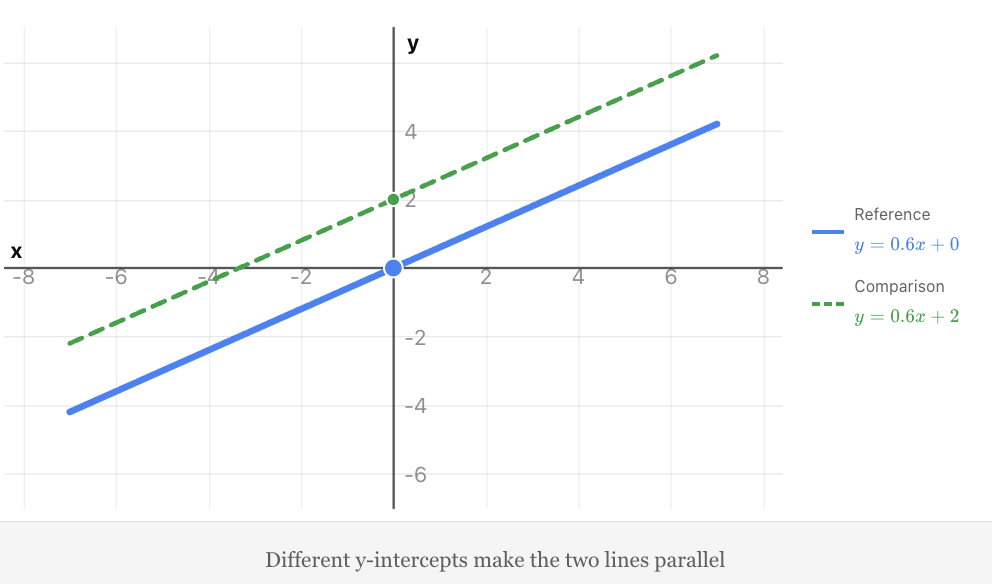
The visualization illustrates how changing the y-intercept moves a line upward or downward without changing its slope.
As long as the lines have the same slope and different y-intercepts, they remain parallel.
Mathematical condition
For two nonvertical lines:
Line 1: y = m₁x + b₁
Line 2: y = m₂x + b₂
The lines are distinct and parallel when:
m₁ = m₂ and b₁ ≠ b₂
Equal slopes mean the lines have the same direction.
Different y-intercepts mean they occupy different positions.
Identifying Parallel Lines from Equations
The easiest way to identify parallel nonvertical lines is to compare their slopes.
Worked Example: Equations in slope-intercept form
Determine whether the following lines are parallel.
Line A: y = 3x + 5
Line B: y = 3x − 2
Step 1: Identify the slopes
For Line A:
m₁ = 3
For Line B:
m₂ = 3
Step 2: Compare the y-intercepts
For Line A:
b₁ = 5
For Line B:
b₂ = −2
Step 3: State the conclusion
The slopes are equal, but the y-intercepts are different.
Therefore:
The lines are parallel.
They never intersect.
Identifying Parallel Lines in Standard Form
Linear equations are not always written in slope-intercept form.
They may be written as:
Ax + By = C
To compare slopes, we can rearrange the equations into y = mx + b.
Worked Example
Determine whether these lines are parallel:
Line A: 2x + y = 7
Line B: 4x + 2y = 6
Step 1: Rearrange Line A
2x + y = 7
Subtract 2x:
y = −2x + 7
Slope:
m₁ = −2
Step 2: Rearrange Line B
4x + 2y = 6
Subtract 4x:
2y = −4x + 6
Divide by 2:
y = −2x + 3
Slope:
m₂ = −2
Step 3: Compare
Both slopes equal −2.
The y-intercepts are 7 and 3.
Therefore:
The lines are parallel.
Shortcut using standard form
For a nonvertical line written as:
Ax + By = C
where B ≠ 0:
y = −(A/B)x + C/B
Therefore, the slope is:
m = −A/B
This allows us to compare slopes without fully rearranging each equation.
However, we must still check whether the equations represent different lines or the same line.
What Are Coincident Lines?
Coincident lines are two equations that represent exactly the same straight line.
They overlap completely.
Every point on one line is also a point on the other.
For example:
Line A: y = 2x + 3
Line B: 2y = 4x + 6
Rearrange Line B:
2y = 4x + 6
Divide by 2:
y = 2x + 3
This is identical to Line A.
Therefore, the lines are coincident.
Important distinction
Parallel lines and coincident lines both have equal slopes, but they are not the same situation.
-
Distinct parallel lines never meet.
-
Coincident lines overlap at every point.
For nonvertical lines, coincident lines have both equal slopes and equal y-intercepts.
Mathematical condition
Two nonvertical lines are coincident when:
m₁ = m₂ and b₁ = b₂
This means they have exactly the same equation when written in slope-intercept form.
Identifying Coincident Lines from Equations
Worked Example
Determine whether the following equations represent coincident lines.
Equation A:
3x + 2y = 12
Equation B:
6x + 4y = 24
Step 1: Compare the equations
Multiply Equation A by 2:
2(3x + 2y) = 2(12)
This gives:
6x + 4y = 24
This is exactly Equation B.
Step 2: State the conclusion
Both equations represent the same line.
Therefore:
The lines are coincident.
Another method: Rearranging into slope-intercept form
Equation A:
3x + 2y = 12
2y = −3x + 12
y = −1.5x + 6
Equation B:
6x + 4y = 24
4y = −6x + 24
y = −1.5x + 6
Both equations have:
-
Slope = −1.5
-
y-intercept = 6
Therefore, the lines are coincident.
Comparing Parallel and Coincident Lines
|
Feature |
Parallel lines |
Coincident lines |
|---|---|---|
|
Slopes |
Equal |
Equal |
|
y-intercepts (nonvertical) |
Different |
Equal |
|
Graphs |
Separate lines |
Same line |
|
Intersection points |
None |
Infinitely many |
|
Solutions to the system |
No solution |
Infinitely many solutions |
The key difference is whether the equations represent different positions or exactly the same line.
Systems of Linear Equations
A system of linear equations consists of two or more linear equations considered together.
For example:
y = 2x + 1
y = −x + 7
A solution must satisfy both equations simultaneously.
Graphically, the solution is a point where the two lines intersect.
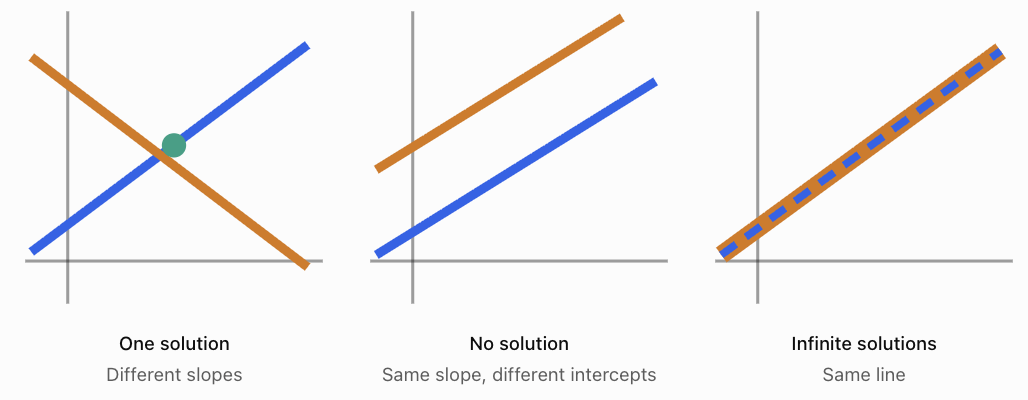
For two linear equations in x and y, there are three possibilities:
-
Exactly one solution.
-
No solution.
-
Infinitely many solutions.
Intersecting Lines: One Solution
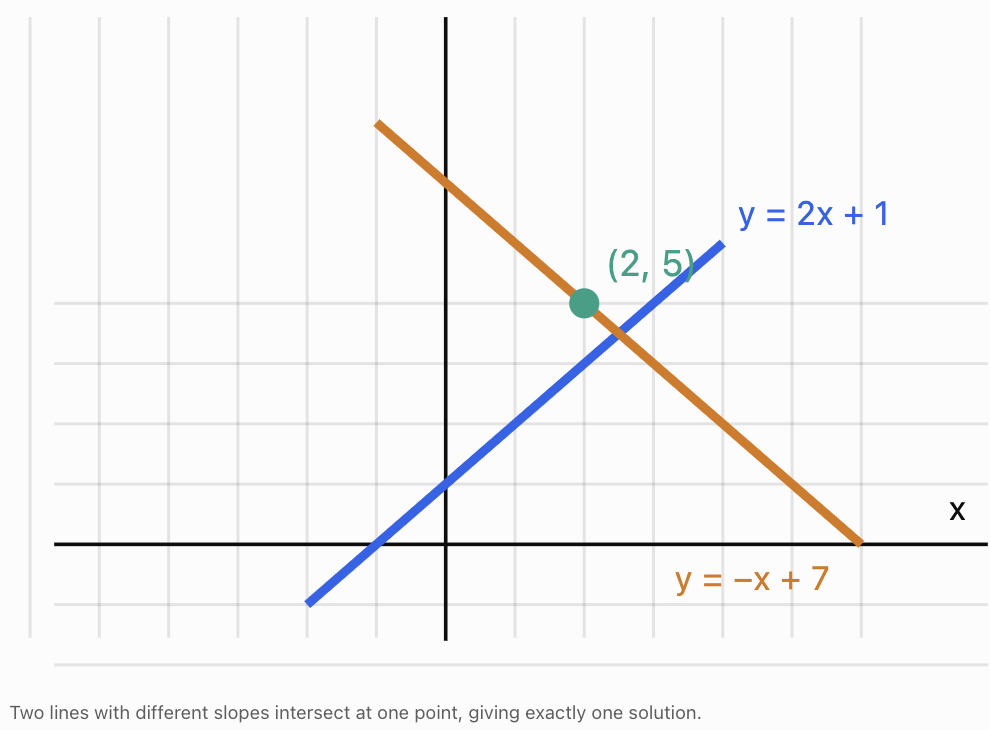
Two nonvertical lines with different slopes intersect at exactly one point.
Consider:
Line A: y = 2x + 1
Line B: y = −x + 7
The slopes are:
m₁ = 2
m₂ = −1
Because the slopes are different, the lines intersect exactly once.
Worked Example: Finding the intersection
Set the equations equal:
2x + 1 = −x + 7
Add x to both sides:
3x + 1 = 7
Subtract 1:
3x = 6
Divide by 3:
x = 2
Substitute into either equation:
y = 2(2) + 1
y = 5
Therefore:
Solution: (2, 5)
Check using the second equation:
y = −2 + 7 = 5
The point (2, 5) satisfies both equations.
Parallel Lines: No Solution
Consider the system:
y = 2x + 1
y = 2x + 5
Both lines have slope 2, but different y-intercepts.
Therefore, they are parallel.
Since parallel lines never intersect, there is no point that satisfies both equations.
The system has no solution.
Algebraic explanation
Set the equations equal:
2x + 1 = 2x + 5
Subtract 2x from both sides:
1 = 5
This statement is false.
No value of x can make it true.
Therefore:
No solution exists.
Why a contradiction means no solution
When solving a system, the variables may disappear and leave an impossible statement.
Examples include:
-
0 = 4
-
3 = −2
-
5 = 10
These contradictions show that the equations cannot both be satisfied.
For a system of two linear equations in two variables representing distinct parallel lines, the solution set is empty.
Coincident Lines: Infinitely Many Solutions
Consider:
y = 3x − 2
2y = 6x − 4
Rearrange the second equation:
y = 3x − 2
Both equations are identical.
Therefore, every point on the line satisfies both equations.
Examples include:
|
x |
y = 3x − 2 |
Point |
|---|---|---|
|
0 |
−2 |
(0, −2) |
|
1 |
1 |
(1, 1) |
|
2 |
4 |
(2, 4) |
|
−1 |
−5 |
(−1, −5) |
All these points satisfy both equations.
There are infinitely many possible x-values, so there are infinitely many solutions.
Algebraic explanation
Set the equations equal:
3x − 2 = 3x − 2
Subtract 3x:
−2 = −2
This is always true.
The equation is an identity.
It confirms that the two equations describe the same line.
Important distinction
An identity such as 0 = 0 indicates infinitely many solutions in this situation because the original equations describe the same line.
It does not mean that every ordered pair (x, y) is a solution.
Only points lying on the shared line satisfy the system.
For example, for y = 3x − 2:
(0, −2) is a solution.
But (0, 5) is not.
Comparing the Three Possible Systems
|
Relationship |
Slope comparison |
Number of solutions |
|---|---|---|
|
Intersecting |
Different slopes |
One |
|
Parallel |
Equal slopes, different intercepts |
Zero |
|
Coincident |
Equal slopes, equal intercepts |
Infinitely many |
This comparison applies directly to nonvertical lines.
Vertical lines require a slightly different approach because their slopes are undefined.
Special Case: Vertical Lines
Vertical lines have equations of the form:
x = a
For example:
x = 2
This represents every point whose x-coordinate is 2.
Examples include:
(2, 0), (2, 3), and (2, −5).
Vertical lines do not have a defined slope.
Therefore, we cannot use the ordinary slope comparison formula to classify them.
Parallel vertical lines
Consider:
x = 2
x = 5
These are distinct vertical lines.
They never intersect.
Therefore:
The system has no solution.
Coincident vertical lines
Consider:
x = 3
2x = 6
The second equation simplifies to:
x = 3
Both equations represent the same vertical line.
Therefore:
The system has infinitely many solutions.
Intersecting vertical and nonvertical lines
Consider:
x = 2
y = 3x + 1
Substitute x = 2:
y = 3(2) + 1
y = 7
Therefore:
Solution: (2, 7)
A vertical line and a nonvertical line intersect exactly once.
Classifying Systems in Standard Form
A system may be written as:
A₁x + B₁y = C₁
A₂x + B₂y = C₂
We can classify the system without graphing.
Different line directions
Calculate:
D = A₁B₂ − A₂B₁
If D ≠ 0, the lines intersect at exactly one point.
This expression is called the determinant of the coefficient matrix.
When D = 0
If D = 0, the coefficient pairs are proportional.
The lines are either parallel or coincident.
We then check whether the constants follow the same proportional relationship.
For example:
2x + 3y = 8
4x + 6y = 16
Every coefficient and the constant in the second equation is twice the corresponding value in the first.
Therefore, the lines are coincident.
But:
2x + 3y = 8
4x + 6y = 10
The variable coefficients are proportional, but the constants are not.
Therefore, the lines are distinct and parallel.
Summary
-
D ≠ 0: one solution.
-
D = 0 and the complete equations are proportional: infinitely many solutions.
-
D = 0 and the complete equations are not proportional: no solution.
This method works for vertical as well as nonvertical lines, provided each equation genuinely represents a line.
Solving Systems Using Substitution
Substitution is an algebraic method for solving systems of equations.
It can also reveal whether a system has no solution or infinitely many solutions.
Worked Example: No solution
Solve:
y = 4x + 2
2y = 8x − 6
Substitute y = 4x + 2 into the second equation:
2(4x + 2) = 8x − 6
Expand:
8x + 4 = 8x − 6
Subtract 8x:
4 = −6
This is a contradiction.
Therefore:
The system has no solution.
The lines are parallel.
Worked Example: Infinitely many solutions
Solve:
y = −2x + 5
3y = −6x + 15
Substitute:
3(−2x + 5) = −6x + 15
Expand:
−6x + 15 = −6x + 15
Subtract the matching terms:
0 = 0
This is an identity.
Therefore:
The system has infinitely many solutions.
The lines are coincident.
Solving Systems Using Elimination
Elimination is another method for solving systems.
It involves adding or subtracting equations to remove one variable.
Worked Example: Parallel lines
Solve:
2x + 3y = 12
4x + 6y = 30
Multiply the first equation by 2:
4x + 6y = 24
Compare with the second equation:
4x + 6y = 30
Subtract:
0 = 6
This is impossible.
Therefore:
No solution.
The lines are parallel.
Worked Example: Coincident lines
Solve:
3x − 2y = 8
6x − 4y = 16
Multiply the first equation by 2:
6x − 4y = 16
This is exactly the second equation.
Subtracting gives:
0 = 0
Therefore:
Infinitely many solutions.
The lines are coincident.
A Systematic Method for Classifying Two Lines
When given two linear equations, follow these steps.
Step 1: Check whether either line is vertical.
If both are vertical, compare their x-values.
If only one is vertical, the lines intersect once.
Step 2: Rearrange nonvertical equations into slope-intercept form.
Write both as:
y = mx + b
Step 3: Compare the slopes.
If the slopes are different, the lines intersect once.
Step 4: If the slopes are equal, compare the y-intercepts.
Different y-intercepts mean distinct parallel lines.
Equal y-intercepts mean coincident lines.
Step 5: State the number of solutions.
-
Intersecting: one.
-
Parallel: zero.
-
Coincident: infinitely many.
Step 6: Explain the graphical meaning.
Describe whether the lines cross once, never cross, or overlap completely.
Worked Example: Classifying Several Systems
Determine the number of solutions for each system.
System A
y = 5x + 1
y = −2x + 4
Slopes:
5 and −2
The slopes are different.
Therefore:
One solution.
System B
y = −3x + 7
y = −3x − 2
Slopes:
−3 and −3
The y-intercepts differ.
Therefore:
No solution.
System C
2x + y = 9
4x + 2y = 18
Multiply the first equation by 2:
4x + 2y = 18
The equations are identical.
Therefore:
Infinitely many solutions.
System D
x = 4
x = −1
These are distinct vertical lines.
Therefore:
No solution.
System E
x = 2
y = 3x − 5
Substitute x = 2:
y = 6 − 5 = 1
Therefore:
One solution: (2, 1).
Real-World Application: Comparing Two Pricing Plans
Suppose two companies offer equipment rental.
Company A charges a fixed fee of $20 plus $5 per hour.
Company B charges a fixed fee of $35 plus $5 per hour.
Their cost equations are:
A = 5h + 20
B = 5h + 35
Both have slope 5.
However, their y-intercepts are different.
Therefore, their graphs are parallel.
Interpretation
Both companies charge the same additional amount per hour.
However, Company B always charges $15 more than Company A.
There is no rental duration for which the two costs are equal.
This is a real-world example of parallel lines representing a system with no solution.
Real-World Application: Equivalent Pricing Plans
Suppose another company offers:
Plan A:
C = 4h + 12
Plan B:
2C = 8h + 24
Simplify Plan B:
C = 4h + 12
Both plans have the same equation.
Their graphs are coincident.
Interpretation
The two plans have identical costs for every rental duration.
There are infinitely many combinations of rental time and cost satisfying both equations.
The equations look different, but they describe exactly the same pricing relationship.
Real-World Application: Motion at Constant Velocity
Suppose two objects move along the same straight track.
Their positions are modeled by:
Object A:
d₁(t) = 3t + 5
Object B:
d₂(t) = 3t + 12
where:
-
d is position in metres.
-
t is time in seconds.
Both objects move at a constant velocity of 3 m/s.
Their initial positions differ by 7 m.
Therefore, their position-time graphs are parallel.
Interpretation
The objects move at the same velocity and maintain a constant separation of 7 m.
They never occupy the same position at the same time under the model.
Now suppose Object B instead follows:
d₂(t) = 3t + 5
The equations would be identical.
The position-time graphs would be coincident.
The two objects would have the same modeled position at every time.
Common Mistakes
Assuming equal slopes always mean distinct parallel lines
Equal slopes may also indicate coincident lines.
Always compare intercepts or check whether the equations are equivalent.
Comparing slopes before rearranging equations correctly
For example:
2x + y = 5
has slope −2, not 2.
Assuming different y-intercepts always mean parallel lines
Lines with different slopes can have different y-intercepts and still intersect.
Confusing no solution with infinitely many solutions
No solution means the lines never meet.
Infinitely many solutions means the lines overlap completely.
Treating 0 = 0 as a unique solution
An identity does not identify one ordered pair. For two coincident lines, it means every point on the shared line is a solution.
Treating 0 = 5 as a valid solution
A contradiction means the system is inconsistent.
Ignoring vertical lines
Vertical lines have undefined slopes and must be handled separately.
Assuming two equations that look different represent different lines
Multiplying every term of an equation by the same nonzero number does not change its graph.
Confusing the number of intersection points with the number of equations
Two equations do not necessarily have two solutions.
Key Terms
-
Linear equation: An equation whose graph is a straight line.
-
System of linear equations: Two or more linear equations considered simultaneously.
-
Solution of a system: An ordered pair satisfying every equation in the system.
-
Parallel lines: Distinct coplanar lines that never intersect.
-
Coincident lines: Lines that overlap completely.
-
Intersecting lines: Lines that meet at a point.
-
Slope: The rate of change of a line.
-
Gradient: Another term for slope.
-
y-intercept: The point where a line crosses the y-axis.
-
Slope-intercept form: A linear equation written as y = mx + b.
-
Standard form: A linear equation written as Ax + By = C.
-
Consistent system: A system with at least one solution.
-
Inconsistent system: A system with no solution.
-
Independent system: A system of two linear equations with exactly one solution.
-
Dependent system: A system whose equations represent the same line and have infinitely many solutions.
-
Contradiction: A false mathematical statement obtained during solving.
-
Identity: A statement that is true for all relevant values of its variables.
-
Substitution: A method of solving equations by replacing one expression with an equivalent expression.
-
Elimination: A method of solving systems by removing a variable through addition or subtraction.
-
Vertical line: A line with equation x = a and undefined slope.
-
Determinant: A numerical expression used to analyse whether a linear system has a unique solution.
Key Takeaways
-
Two distinct nonvertical lines are parallel when they have equal slopes and different y-intercepts.
-
Coincident lines have equal slopes and equal y-intercepts.
-
Parallel lines never intersect and produce no solution.
-
Coincident lines overlap completely and produce infinitely many solutions.
-
Nonvertical lines with different slopes intersect exactly once.
-
Vertical lines have undefined slopes and must be classified using their equations.
-
A contradiction such as 0 = 5 indicates no solution.
-
An identity such as 0 = 0 can indicate coincident lines in a two-line system.
-
Equations that are nonzero multiples of one another represent the same line.
-
Slope comparisons allow us to classify many systems without graphing.
-
Graphs provide a visual explanation of why systems have one, zero, or infinitely many solutions.
Check Your Understanding
Recall and Understanding
1. What is the relationship between the slopes of two distinct parallel nonvertical lines?
2. Explain the difference between parallel lines and coincident lines.
3. How many solutions does a system of two intersecting lines have?
4. Why does a system of two distinct parallel lines have no solution?
5. What does it mean when solving a system produces an identity such as 0 = 0?
Application
6. Determine whether the lines y = 4x + 2 and y = 4x − 7 are parallel, coincident, or intersecting.
7. Determine whether the equations 2x + y = 8 and 4x + 2y = 16 represent parallel or coincident lines.
8. Determine the number of solutions for:
y = −3x + 5
y = 2x − 1
9. Determine the number of solutions for:
3x + 2y = 12
6x + 4y = 30
10. Determine whether the lines x = 3 and x = −2 are parallel, coincident, or intersecting.
Analysis and Challenge
11. A student claims that two lines with the same slope must have no solution. Explain why the claim is incorrect.
12. Find the value of k that makes these lines parallel but not coincident:
y = 5x + 3
y = kx − 4
13. Find the value of k that makes the following equations coincident:
2x + 3y = 9
4x + 6y = k
14. Two companies charge according to:
A = 6h + 15
B = 6h + 25
Explain whether the costs can ever be equal and justify your answer graphically.
15. Classify the following systems and state the number of solutions:
A.
2x + y = 5
4x + 2y = 10
B.
3x − y = 7
6x − 2y = 10
C.
y = 2x + 1
y = −x + 7
Answers to Check Your Understanding
1. Two distinct parallel nonvertical lines have equal slopes.
2. Parallel lines are separate and never intersect. Coincident lines overlap completely and represent the same line.
3. Exactly one solution.
4. A solution must lie on both lines. Distinct parallel lines never intersect, so no point satisfies both equations.
5. An identity indicates that the equations are compatible for all values satisfying the remaining relationship. In a system of two coincident lines, this means infinitely many solutions along the shared line.
6.
y = 4x + 2
y = 4x − 7
Both slopes equal 4.
The y-intercepts differ.
Answer: Parallel lines; no solution.
7.
2x + y = 8
4x + 2y = 16
Multiply the first equation by 2:
4x + 2y = 16
This is identical to the second equation.
Answer: Coincident lines; infinitely many solutions.
8.
y = −3x + 5
y = 2x − 1
The slopes are −3 and 2.
Since they differ, the lines intersect once.
Answer: One solution.
To find it:
−3x + 5 = 2x − 1
6 = 5x
x = 6/5
Substitute:
y = 2(6/5) − 1 = 7/5
Intersection: (6/5, 7/5)
9.
3x + 2y = 12
6x + 4y = 30
Multiply the first equation by 2:
6x + 4y = 24
The second equation states:
6x + 4y = 30
This produces a contradiction.
Answer: Parallel lines; no solution.
10.
x = 3 and x = −2 are distinct vertical lines.
They never intersect.
Answer: Parallel lines; no solution.
11. Equal slopes do not automatically mean no solution. If the lines also have the same y-intercept, they are coincident and have infinitely many solutions. Equal slopes with different y-intercepts produce distinct parallel lines and no solution.
12.
y = 5x + 3
y = kx − 4
For the lines to be parallel:
k = 5
The y-intercepts are already different, so the lines are not coincident.
Answer: k = 5
13.
2x + 3y = 9
4x + 6y = k
Multiply the first equation by 2:
4x + 6y = 18
Therefore:
k = 18
14.
A = 6h + 15
B = 6h + 25
Both lines have slope 6.
Their y-intercepts differ.
Therefore, the graphs are parallel and never intersect.
Algebraically:
6h + 15 = 6h + 25
Subtract 6h:
15 = 25
This is impossible.
The costs are never equal. Company B always charges $10 more than Company A.
15A.
2x + y = 5
4x + 2y = 10
The second equation is twice the first.
Coincident lines; infinitely many solutions.
15B.
3x − y = 7
6x − 2y = 10
Doubling the first equation gives:
6x − 2y = 14
This contradicts the second equation.
Parallel lines; no solution.
15C.
y = 2x + 1
y = −x + 7
The slopes are different, so the lines intersect.
Set equal:
2x + 1 = −x + 7
3x = 6
x = 2
Substitute:
y = 2(2) + 1 = 5
Intersecting lines; one solution at (2, 5).
Final Summary
Parallel and coincident lines reveal an important connection between the equations of straight lines and the number of solutions in a linear system.
By comparing slopes and intercepts, we can determine whether two lines intersect once, never intersect, or overlap completely.
These relationships can be verified algebraically through substitution or elimination and explained graphically using the positions of the lines.
The central principle is that the number of solutions to a system of two linear equations is determined by the number of points shared by their graphs.
2. Systems from Word Problems
Learning outcomes
- I can identify variables in word problems.
- I can write systems of equations from real situations.
- I can solve contextual problems.
- I can interpret solutions appropriately.
- I can verify that solutions make sense.
Introduction
Many real-world problems involve two or more unknown quantities that are connected by several conditions.
For example:
-
How many adult and student tickets were sold at an event?
-
How many notebooks and pens can be purchased with a certain amount of money?
-
When will two vehicles travelling at different speeds meet?
-
How many products must a business sell to cover its costs?
-
How can two ingredients be combined to produce a mixture with a particular concentration?
These problems can often be solved using systems of equations.
A system of equations consists of two or more equations that must be satisfied at the same time.
Instead of solving for one unknown quantity, we use several relationships to determine values that satisfy all the conditions.
The most important skill is not simply solving the equations. It is learning how to translate a written description into mathematical language.
A successful solution involves identifying variables, constructing appropriate equations, selecting a solving method, interpreting the results, and checking that the answers make sense in the original situation.
Understanding Word Problems
A mathematical word problem describes a situation using ordinary language.
Our task is to identify the mathematical relationships hidden within that description.
Consider:
"A school sells adult tickets for $12 and student tickets for $7. A total of 100 tickets are sold, generating $950 in revenue. How many of each ticket were sold?"
This problem provides two important relationships:
-
The total number of tickets is 100.
-
The total revenue is $950.
There are also two unknown quantities:
-
Number of adult tickets.
-
Number of student tickets.
Since there are two unknowns and two independent equations, we can construct a system and solve it.
Identifying Variables
The first step in solving a word problem is deciding what the variables represent.
Variables are symbols used to represent unknown quantities.
Common choices include x and y, but descriptive letters may also be used.
For the ticket problem, define:
x = number of adult tickets
y = number of student tickets
This is better than writing only "Let x and y be the unknowns."
Clear variable definitions make the equations easier to understand and the final answer easier to interpret.
Choosing suitable variables
A good variable definition should:
-
Identify the quantity clearly.
-
Include units when appropriate.
-
Distinguish between different unknowns.
-
Match the situation described.
-
Avoid using the same variable for different quantities.
Example: Travel problem
Suppose two cyclists travel at different speeds.
We might define:
x = speed of Cyclist A in km/h
y = speed of Cyclist B in km/h
Example: Shopping problem
Suppose a customer purchases notebooks and pens.
We might define:
n = price of one notebook in dollars
p = price of one pen in dollars
The variables represent unit prices, not the number of items purchased.
This distinction is essential when writing the equations.
Translating Words into Mathematical Expressions
Word problems often contain phrases that indicate mathematical operations.
|
Phrase |
Mathematical meaning |
Example |
|---|---|---|
|
Sum or total |
Addition |
x + y |
|
Difference |
Subtraction |
x − y |
|
Twice a number |
Multiplication by 2 |
2x |
|
Three more than |
Add 3 |
x + 3 |
|
Five less than |
Subtract 5 |
x − 5 |
|
Half of |
Divide by 2 |
x/2 |
|
Equal to |
Equals sign |
= |
|
Total cost |
Price × quantity, then add |
5x + 3y |
|
Total distance |
Speed × time |
d = vt |
|
Combined amount |
Add quantities |
x + y |
Example: Translating statements
"The sum of two numbers is 25."
Equation:
x + y = 25
"One number is 7 greater than the other."
Equation:
x = y + 7
"The total cost of three notebooks and two pens is $14."
If n and p represent their unit prices:
3n + 2p = 14
"The total number of adults and children is 80."
If a and c represent the numbers of adults and children:
a + c = 80
Important language distinction
Compare:
"Five less than a number."
x − 5
"A number is five less than another number."
x = y − 5
The first is an expression.
The second describes a relationship between two variables and can be written as an equation.
Constructing Systems of Equations
A system of two linear equations often takes the form:
ax + by = c
dx + ey = f
The coefficients and constants come from the information in the word problem.
Worked Example: Two unknown numbers
The sum of two numbers is 40.
Their difference is 12.
Find the numbers.
Step 1: Define the variables
x = larger number
y = smaller number
Step 2: Write the equations
The sum is 40:
x + y = 40
The difference is 12:
x − y = 12
Step 3: Solve using elimination
Add the equations:
(x + y) + (x − y) = 40 + 12
2x = 52
x = 26
Substitute into the first equation:
26 + y = 40
y = 14
Step 4: Interpret
The two numbers are 26 and 14.
Step 5: Verify
Sum:
26 + 14 = 40
Difference:
26 − 14 = 12
Both conditions are satisfied.
Answer: The numbers are 26 and 14.
A General Strategy for Word Problems
Use the following process whenever you encounter a system of equations in a real-world situation.
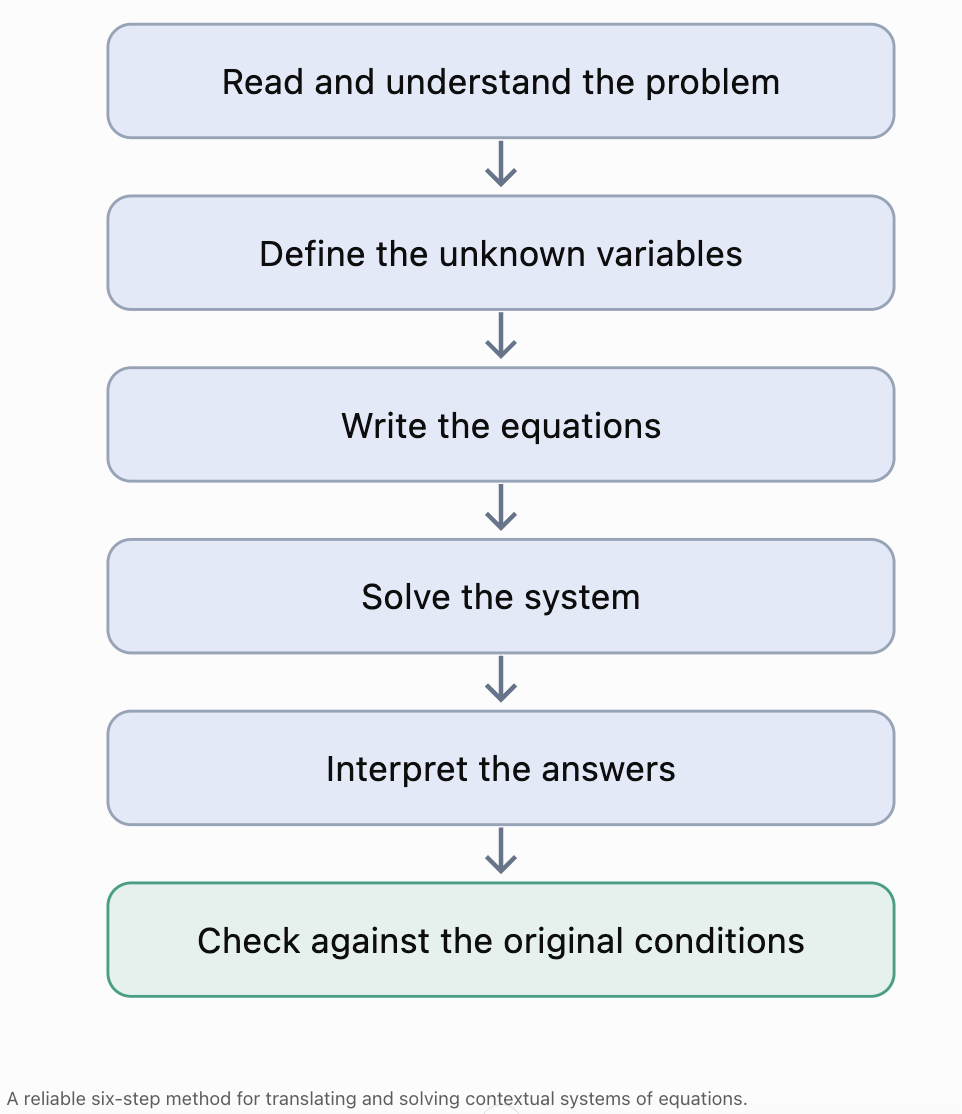
Each stage matters.
A correctly solved system may still produce an incorrect answer to the word problem if the variables were defined incorrectly or the equations did not represent the situation.
Worked Example: Ticket Sales
A school concert sells adult tickets for $15 and student tickets for $8.
A total of 120 tickets are sold.
The total revenue is $1,320.
How many adult and student tickets were sold?
Step 1: Define the variables
Let:
a = number of adult tickets
s = number of student tickets
Step 2: Construct the equations
The total number of tickets is 120:
a + s = 120
Each adult ticket costs $15 and each student ticket costs $8.
The total revenue is $1,320:
15a + 8s = 1320
Our system is:
a + s = 120
15a + 8s = 1320
Step 3: Solve using substitution
Rearrange the first equation:
s = 120 − a
Substitute into the second equation:
15a + 8(120 − a) = 1320
Expand:
15a + 960 − 8a = 1320
Combine like terms:
7a + 960 = 1320
Subtract 960:
7a = 360
Divide by 7:
a = 360/7 ≈ 51.43
Then:
s = 120 − 360/7
s = 480/7 ≈ 68.57
Step 4: Interpret the result
The algebra produces fractional numbers of tickets.
However, tickets are counted in whole numbers.
It is impossible to sell approximately 51.43 adult tickets and 68.57 student tickets as individual tickets.
Therefore, the problem has no valid whole-number solution.
This is an important lesson: a system can have a perfectly valid algebraic solution that does not make sense in the original context.
Step 5: Investigate the problem
Suppose the revenue had instead been $1,324.
Then:
15a + 8s = 1324
Using s = 120 − a:
15a + 8(120 − a) = 1324
7a + 960 = 1324
7a = 364
a = 52
Then:
s = 120 − 52
s = 68
Verification
Total tickets:
52 + 68 = 120
Total revenue:
52(15) + 68(8)
= 780 + 544
= 1324
Both conditions are satisfied.
For the revised revenue of $1,324, the solution is 52 adult tickets and 68 student tickets.
This example demonstrates why verifying answers in context is essential.
Worked Example: Shopping and Prices
A customer purchases 3 notebooks and 2 pens for $13.
Another customer purchases 2 notebooks and 5 pens for $16.
Find the price of one notebook and one pen.
Step 1: Define variables
n = price of one notebook in dollars
p = price of one pen in dollars
Step 2: Construct equations
First purchase:
3n + 2p = 13
Second purchase:
2n + 5p = 16
Step 3: Solve using elimination
Multiply the first equation by 5:
15n + 10p = 65
Multiply the second equation by 2:
4n + 10p = 32
Subtract:
11n = 33
n = 3
Substitute into:
3n + 2p = 13
3(3) + 2p = 13
9 + 2p = 13
2p = 4
p = 2
Step 4: Interpret
One notebook costs $3.
One pen costs $2.
Step 5: Verify
First purchase:
3(3) + 2(2) = 9 + 4 = 13
Second purchase:
2(3) + 5(2) = 6 + 10 = 16
Both totals are correct.
Answer: Notebook = $3; pen = $2.
Worked Example: Ages
A mother is three times as old as her daughter.
In 10 years, the mother will be twice as old as her daughter.
Find their present ages.
Step 1: Define variables
m = mother's present age in years
d = daughter's present age in years
Step 2: Write equations
The mother is three times the daughter's age:
m = 3d
In 10 years:
Mother's age = m + 10
Daughter's age = d + 10
The mother will be twice as old:
m + 10 = 2(d + 10)
Step 3: Solve
Substitute m = 3d:
3d + 10 = 2(d + 10)
Expand:
3d + 10 = 2d + 20
Subtract 2d:
d + 10 = 20
d = 10
Then:
m = 3(10)
m = 30
Step 4: Interpret
The daughter is currently 10 years old.
The mother is currently 30 years old.
Step 5: Verify
Present ages:
30 = 3 × 10
In 10 years:
Mother = 40
Daughter = 20
40 = 2 × 20
Both conditions are satisfied.
Answer: Mother = 30 years; daughter = 10 years.
Common age-problem mistake
Students sometimes multiply the daughter's current age by 2 and then add 10:
m + 10 = 2d + 10
This is incorrect because the daughter's age in 10 years is d + 10.
The correct relationship is:
m + 10 = 2(d + 10)
Parentheses are important.
Worked Example: Distance, Speed, and Time
Two cyclists start from the same point and travel in opposite directions.
Cyclist A travels at 18 km/h.
Cyclist B travels at 22 km/h.
After how many hours will they be 100 km apart?
This can be solved using a simple equation, but it also illustrates how two distance relationships can form a system.
Step 1: Define variables
x = distance travelled by Cyclist A in kilometres
y = distance travelled by Cyclist B in kilometres
t = time in hours
Step 2: Write equations
Using:
Distance = Speed × Time
Cyclist A:
x = 18t
Cyclist B:
y = 22t
Since they travel in opposite directions:
x + y = 100
Step 3: Solve
Substitute the distance equations:
18t + 22t = 100
40t = 100
t = 2.5
Step 4: Find distances
Cyclist A:
x = 18(2.5) = 45 km
Cyclist B:
y = 22(2.5) = 55 km
Step 5: Verify
45 + 55 = 100 km
Answer: The cyclists will be 100 km apart after 2.5 hours.
Worked Example: Two Vehicles Meeting
Two vehicles travel along the same straight road.
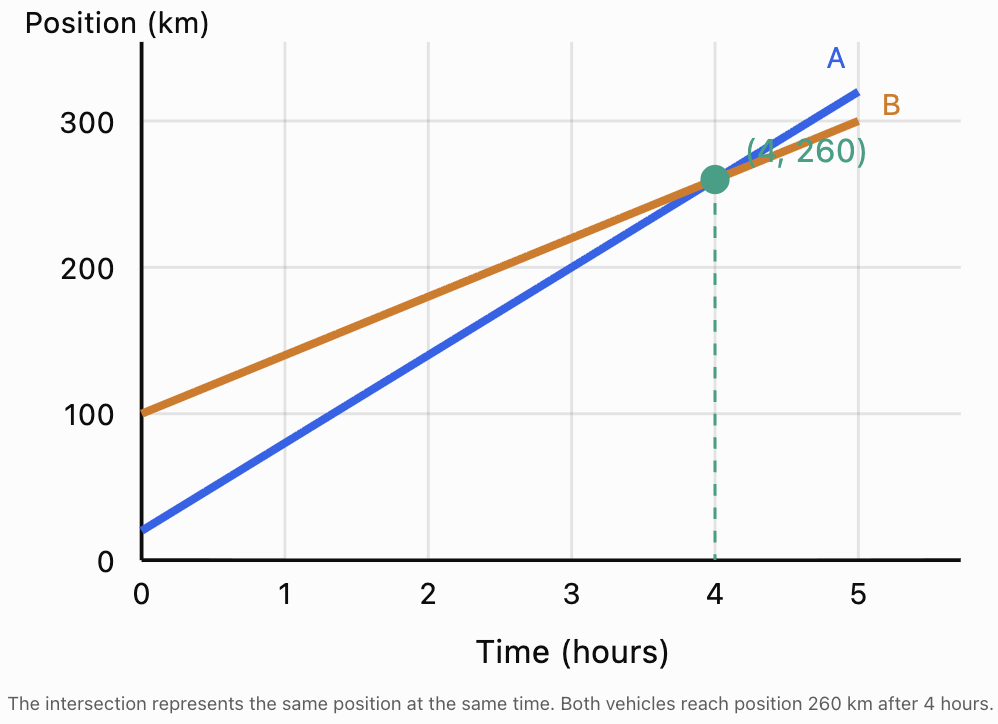
Vehicle A starts at position 20 km and travels at 60 km/h.
Vehicle B starts at position 100 km and travels in the same direction at 40 km/h.
When and where will Vehicle A catch Vehicle B?
Step 1: Define variables
t = time in hours
d = position along the road in kilometres
Step 2: Write position equations
Vehicle A:
d = 60t + 20
Vehicle B:
d = 40t + 100
These equations form a system.
Step 3: Solve
At the meeting point, both vehicles have the same position.
60t + 20 = 40t + 100
Subtract 40t:
20t + 20 = 100
Subtract 20:
20t = 80
t = 4
Step 4: Find the meeting position
Substitute into Vehicle A's equation:
d = 60(4) + 20
d = 260 km
Check Vehicle B:
d = 40(4) + 100
d = 260 km
Interpretation
Vehicle A catches Vehicle B after 4 hours, at position 260 km along the road.
Graphical explanation
On a position-time graph, each vehicle is represented by a straight line.
The intersection of the two lines represents the moment when the vehicles occupy the same position at the same time.
Worked Example: Business Break-Even
A small business sells handmade products.
The fixed operating cost is $500.
Each product costs $8 to manufacture.
Each product sells for $18.
How many products must the business sell to break even?
Step 1: Define variables
x = number of products sold
y = amount of money in dollars
Step 2: Construct the cost equation
Fixed cost = $500
Variable cost = $8 per product
Therefore:
C(x) = 8x + 500
Step 3: Construct the revenue equation
Revenue is:
Selling price × Quantity
Therefore:
R(x) = 18x
Step 4: Find the break-even point
At break-even:
Cost = Revenue
8x + 500 = 18x
500 = 10x
x = 50
Step 5: Calculate the amount
Revenue:
R(50) = 18(50) = 900
Cost:
C(50) = 8(50) + 500 = 900
Interpretation
The business breaks even after selling 50 products.
At this point:
-
Total cost = $900.
-
Total revenue = $900.
-
Profit = $0.
Selling fewer than 50 products produces a loss under the model.
Selling more than 50 products produces a profit.
The break-even point is the intersection of the cost and revenue graphs.
Worked Example: Mixture Problems
Mixture problems involve combining substances with different concentrations, prices, or compositions.
These problems are common in chemistry, food production, agriculture, and manufacturing.
Suppose a laboratory needs to prepare 10 litres of a 30% salt solution.
Two solutions are available:
-
Solution A contains 20% salt.
-
Solution B contains 50% salt.
How many litres of each solution should be mixed?
Step 1: Define variables
x = volume of 20% solution in litres
y = volume of 50% solution in litres
Step 2: Write the total volume equation
The combined volume is 10 litres:
x + y = 10
Step 3: Write the salt-content equation
Solution A contains 20% salt:
Salt amount = 0.20x
Solution B contains 50% salt:
Salt amount = 0.50y
The final solution contains 30% salt in 10 litres:
0.30 × 10 = 3
Therefore:
0.20x + 0.50y = 3
Step 4: Solve
From the first equation:
x = 10 − y
Substitute:
0.20(10 − y) + 0.50y = 3
Expand:
2 − 0.20y + 0.50y = 3
Combine:
2 + 0.30y = 3
0.30y = 1
y = 10/3 ≈ 3.33
Then:
x = 10 − 10/3
x = 20/3 ≈ 6.67
Step 5: Interpret
Use:
-
6.67 L of the 20% solution.
-
3.33 L of the 50% solution.
Step 6: Verify using exact values
Total volume:
20/3 + 10/3 = 10 L
Total salt:
0.20(20/3) + 0.50(10/3)
= 4/3 + 5/3
= 3 L
Salt concentration:
3/10 × 100% = 30%
Answer: Mix 6⅔ L of the 20% solution with 3⅓ L of the 50% solution.
This model assumes the volumes are additive and the concentrations are expressed on a consistent basis.
Worked Example: Geometry and Perimeter
A rectangular garden has a perimeter of 54 metres.
Its length is 5 metres greater than its width.
Find the dimensions.
Step 1: Define variables
L = length in metres
W = width in metres
Step 2: Write the equations
The perimeter of a rectangle is:
P = 2L + 2W
Therefore:
2L + 2W = 54
The length is 5 metres greater than the width:
L = W + 5
Step 3: Solve
Substitute:
2(W + 5) + 2W = 54
Expand:
2W + 10 + 2W = 54
4W + 10 = 54
4W = 44
W = 11
Then:
L = 11 + 5
L = 16
Step 4: Verify
Perimeter:
2(16) + 2(11) = 32 + 22 = 54 m
Difference:
16 − 11 = 5 m
Answer: Length = 16 m; width = 11 m.
The area is:
A = 16 × 11 = 176 m²
Although the question asks only for dimensions, the model can also be used to calculate other properties of the garden.
Worked Example: A System with No Real-World Solution
A school has 30 students in a club.
Each student is either in Group A or Group B.
Group A has 5 more students than Group B.
Find the number of students in each group.
Step 1: Define variables
a = number of students in Group A
b = number of students in Group B
Step 2: Write equations
a + b = 30
a − b = 5
Step 3: Solve
Add the equations:
2a = 35
a = 17.5
Then:
b = 12.5
Step 4: Interpret
The algebraic solution is:
a = 17.5
b = 12.5
However, groups cannot contain half a student.
Therefore, the original conditions cannot be satisfied using whole numbers.
The word problem has no valid solution in nonnegative integers.
This is not the same as saying the linear system has no mathematical solution.
The linear system has exactly one real-number solution, but it is not meaningful for the context.
Why this distinction matters
Mathematical solutions must satisfy both:
-
The equations.
-
The restrictions of the real-world situation.
These restrictions are sometimes called contextual constraints.
Choosing a Solving Method
There are three common approaches to solving systems of linear equations.
|
Method |
Most useful when |
Main advantage |
|---|---|---|
|
Substitution |
One variable is already isolated |
Straightforward replacement |
|
Elimination |
Coefficients can be matched easily |
Efficient algebraic solving |
|
Graphing |
Visual interpretation is important |
Shows intersections and trends |
Substitution
Example:
y = 2x + 3
x + y = 12
Substitute:
x + 2x + 3 = 12
3x = 9
x = 3
y = 9
Solution:
(3, 9)
Elimination
Example:
2x + 3y = 17
2x − y = 5
Subtract the second equation from the first:
4y = 12
y = 3
Substitute:
2x − 3 = 5
2x = 8
x = 4
Solution:
(4, 3)
Graphing
For:
y = 2x + 3
y = −x + 12
The intersection satisfies:
2x + 3 = −x + 12
3x = 9
x = 3
y = 9
The lines intersect at (3, 9).
Graphing is especially useful for understanding the meaning of a solution, although exact algebraic methods are often more accurate than reading coordinates from a graph.
Interpreting Solutions in Context
Solving the equations is not the final step.
The solution must be interpreted using the original variables.
Suppose a system produces:
x = 12
y = 8
These numbers have little meaning without context.
If x represents adult tickets and y represents student tickets, the interpretation is:
"12 adult tickets and 8 student tickets were sold."
If x represents time and y represents distance, the interpretation could be:
"After 12 hours, the distance is 8 kilometres."
The variables and their units determine what the solution means.
Interpreting an intersection point
For two linear models, an intersection often represents a situation where two quantities are equal.
Examples include:
-
Two vehicles occupying the same position at the same time.
-
Two pricing plans having the same total cost.
-
Revenue equalling total cost.
-
Two water tanks containing the same volume.
The x-coordinate and y-coordinate should both be interpreted.
For example, if two cost graphs intersect at (5, 40):
-
x = 5 may represent five hours.
-
y = 40 may represent a cost of $40.
The interpretation is:
Both plans cost $40 for five hours of use.
Checking Whether Solutions Are Reasonable
A mathematical answer should be checked for both algebraic correctness and practical meaning.
Algebraic verification
Substitute the solution into every original equation.
Contextual verification
Ask whether the answer makes sense in the situation.
For example:
-
Can the number of people be negative?
-
Can the number of tickets be fractional?
-
Is the time positive?
-
Are the prices realistic?
-
Does the total match the stated amount?
-
Are the units consistent?
-
Does the solution fall within the allowed domain?
Example: Negative time
Suppose two position equations intersect at:
t = −3 hours
The algebraic solution may be correct.
However, if t represents time after an experiment begins, negative time lies outside the practical domain.
Therefore, the model predicts no meeting after the experiment begins, even though the extended lines intersect at a negative time.
This is another example of the difference between an algebraic solution and a contextual solution.
Special Cases in Word Problems
Some real-world systems produce parallel or coincident lines.
Parallel lines: No common solution
Two rental companies charge:
Company A:
C = 5h + 20
Company B:
C = 5h + 35
Both have the same hourly rate, but different fixed fees.
The graphs are parallel.
There is no rental duration for which the costs are equal.
Coincident lines: Infinitely many common solutions
Two companies charge:
Company A:
C = 4h + 10
Company B:
2C = 8h + 20
Simplify Company B:
C = 4h + 10
Both equations represent the same line.
Every rental duration produces the same cost under both plans.
Therefore, the system has infinitely many solutions over an unrestricted mathematical domain, and infinitely many nonnegative-time solutions in this continuous rental model.
Common Mistakes
Failing to define variables
Always state what each variable represents before constructing equations.
Using the wrong quantity for a variable
Distinguish between unit price and number of items, or between speed and distance.
Reversing relationships
"Five less than x" means x − 5, not 5 − x.
Forgetting to multiply price by quantity
Total revenue is calculated by adding price × quantity for each item type.
Incorrectly translating age problems
Future ages must be written by adding the number of years to each person's present age.
Ignoring units
Distances, speeds, times, costs, and concentrations must use consistent units.
Assuming every algebraic solution is realistic
Fractional numbers of people or negative quantities may be invalid.
Not checking both equations
A proposed solution must satisfy every equation in the system.
Confusing an intersection with an intercept
An intersection of two graphs is where they meet each other. An intercept is where a graph meets a coordinate axis.
Forgetting to interpret the answer
A complete solution includes a sentence explaining what the values mean.
Key Terms
-
System of equations: Two or more equations solved simultaneously.
-
Variable: A symbol representing an unknown or changing quantity.
-
Independent variable: The input variable.
-
Dependent variable: The output variable.
-
Linear equation: An equation representing a straight-line relationship.
-
Coefficient: A number multiplying a variable.
-
Constant: A value that does not change.
-
Substitution: Solving by replacing a variable with an equivalent expression.
-
Elimination: Solving by adding or subtracting equations to remove a variable.
-
Intersection point: A point shared by two graphs.
-
Ordered pair: Two coordinates written as (x, y).
-
Contextual interpretation: Explaining a mathematical answer using the real-world situation.
-
Verification: Checking that a solution satisfies the original conditions.
-
Constraint: A restriction on the values allowed in a problem.
-
Domain: The set of permitted input values.
-
Revenue: Total money earned from sales before deducting costs.
-
Cost: Money required to produce or provide goods or services.
-
Profit: Revenue minus cost.
-
Break-even point: The point where revenue equals total cost.
-
Concentration: The amount or proportion of a substance in a mixture or solution.
-
Consistent system: A system with at least one mathematical solution.
-
Inconsistent system: A system with no mathematical solution.
Key Takeaways
-
Systems of equations can represent many real-world situations involving multiple unknown quantities.
-
The first step is to identify and define the variables clearly.
-
Word problems contain mathematical relationships that can be translated into equations.
-
Two independent relationships are generally needed to determine two unknown quantities uniquely.
-
Substitution, elimination, and graphing are common solving methods.
-
An intersection point represents values that satisfy both equations.
-
Solutions must be interpreted using the original context and units.
-
Every solution should be checked in the original equations.
-
Contextual constraints may exclude mathematically valid solutions.
-
A complete answer includes calculations, verification, and a clear concluding statement.
Check Your Understanding
Recall and Understanding
1. Why is it important to define variables before writing equations?
2. What is the difference between solving a system algebraically and interpreting its solution in context?
3. Describe two situations in which substitution may be preferable to elimination.
4. Why might a mathematically correct solution be unsuitable for a real-world problem?
5. What does the intersection of two cost graphs represent?
Application
6. The sum of two numbers is 56. Their difference is 14. Find the numbers.
7. A cinema sells adult tickets for $14 and child tickets for $8. A total of 90 tickets are sold, generating $1,080. How many of each ticket were sold?
8. Three notebooks and two pens cost $17. Two notebooks and four pens cost $18. Find the price of each item.
9. A father is four times as old as his son. In 12 years, the father will be twice as old as his son. Find their present ages.
10. A rectangular field has a perimeter of 70 metres. Its length is 9 metres greater than its width. Find the dimensions.
Analysis and Challenge
11. A company has fixed costs of $800 and variable costs of $12 per product. Each product sells for $28. Determine the break-even quantity and revenue.
12. Two vehicles travel along the same road. Vehicle A starts at position 10 km and travels at 70 km/h. Vehicle B starts at position 130 km and travels in the same direction at 50 km/h. When and where does Vehicle A catch Vehicle B?
13. A laboratory needs 20 litres of a 40% solution. It has 25% and 55% solutions available. Determine how much of each should be mixed.
14. A club has 45 members. There are 8 more adults than children. Determine whether the conditions allow a whole-number solution, and explain.
15. Two companies charge according to:
A(t) = 6t + 25
B(t) = 9t + 10
Find when the costs are equal, calculate the cost, and interpret the result.
Answers to Check Your Understanding
1. Defining variables identifies the unknown quantities and prevents confusion when constructing equations or interpreting the solution.
2. Algebraic solving finds values that satisfy the equations. Contextual interpretation explains what those values mean and whether they are realistic.
3. Substitution is useful when one equation already isolates a variable, or when a variable can easily be expressed in terms of another.
4. The solution may violate contextual constraints. For example, a negative number of tickets or a fractional number of people may not be possible.
5. The intersection represents an input value at which both companies or plans have the same total cost.
6.
Let x and y be the two numbers.
x + y = 56
x − y = 14
Add:
2x = 70
x = 35
Then:
y = 21
Answer: 35 and 21.
Verification:
35 + 21 = 56
35 − 21 = 14
7.
Let a = adult tickets and c = child tickets.
a + c = 90
14a + 8c = 1080
Substitute c = 90 − a:
14a + 8(90 − a) = 1080
14a + 720 − 8a = 1080
6a = 360
a = 60
c = 30
Verification:
60 + 30 = 90
14(60) + 8(30) = 840 + 240 = 1080
Answer: 60 adult tickets and 30 child tickets.
8.
Let n = notebook price and p = pen price.
3n + 2p = 17
2n + 4p = 18
Multiply the first equation by 2:
6n + 4p = 34
Subtract the second equation:
4n = 16
n = 4
Substitute:
3(4) + 2p = 17
12 + 2p = 17
2p = 5
p = 2.50
Answer: Notebook = $4; pen = $2.50.
Verification:
2(4) + 4(2.50) = 18
9.
Let f = father's age and s = son's age.
f = 4s
f + 12 = 2(s + 12)
Substitute:
4s + 12 = 2s + 24
2s = 12
s = 6
f = 24
Answer: Father = 24 years; son = 6 years.
In 12 years, they will be 36 and 18 years old.
10.
Let L = length and W = width.
2L + 2W = 70
L = W + 9
Substitute:
2(W + 9) + 2W = 70
4W + 18 = 70
4W = 52
W = 13
L = 22
Answer: Length = 22 m; width = 13 m.
Verification:
2(22) + 2(13) = 70 m
11.
Cost:
C(x) = 12x + 800
Revenue:
R(x) = 28x
At break-even:
12x + 800 = 28x
800 = 16x
x = 50
Revenue:
R(50) = 28(50) = 1400
Answer: Break-even occurs at 50 products, with revenue and cost both equal to $1,400.
12.
Vehicle A:
d = 70t + 10
Vehicle B:
d = 50t + 130
Set equal:
70t + 10 = 50t + 130
20t = 120
t = 6
Position:
d = 70(6) + 10 = 430
Check:
50(6) + 130 = 430
Answer: Vehicle A catches Vehicle B after 6 hours at position 430 km.
13.
Let x = litres of 25% solution and y = litres of 55% solution.
Total volume:
x + y = 20
Total concentration:
0.25x + 0.55y = 0.40(20)
0.25x + 0.55y = 8
Substitute x = 20 − y:
0.25(20 − y) + 0.55y = 8
5 − 0.25y + 0.55y = 8
0.30y = 3
y = 10
Then:
x = 10
Answer: Mix 10 L of the 25% solution with 10 L of the 55% solution.
Verification:
0.25(10) + 0.55(10) = 2.5 + 5.5 = 8
8/20 = 0.40 = 40%
14.
Let a = adults and c = children.
a + c = 45
a − c = 8
Add:
2a = 53
a = 26.5
Then:
c = 18.5
These are not whole numbers.
Answer: There is no valid whole-number solution.
The system has a real-number solution, but it cannot represent numbers of club members.
15.
Company A:
A(t) = 6t + 25
Company B:
B(t) = 9t + 10
Set equal:
6t + 25 = 9t + 10
15 = 3t
t = 5
Calculate cost:
A(5) = 6(5) + 25 = 55
B(5) = 9(5) + 10 = 55
Answer: Both companies charge $55 when t = 5.
If t represents hours, the interpretation is that both companies charge $55 for five hours of service.
For fewer than five hours, Company B is cheaper.
For more than five hours, Company A is cheaper.
Final Summary
Systems of equations provide a practical method for solving real-world problems involving multiple unknown quantities.
The most important steps are identifying variables, translating information into equations, solving the system, and checking that the solution satisfies both the mathematics and the original situation.
Systems can be applied to ticket sales, shopping, ages, motion, business costs, mixtures, and geometry.
A complete word-problem solution does more than find numbers: it explains what those numbers represent, verifies the original conditions, and determines whether the result makes sense in the real world.
3. Mixture Problems
Learning outcomes
- I can represent mixture situations using equations.
- I can construct systems from mixture problems.
- I can solve mixture problems using algebra.
- I can interpret solutions in context.
- I can verify my answers.
Introduction
Many real-world situations involve combining two or more substances, products, or quantities to create a mixture with specific properties.
For example:
-
A laboratory combines two salt solutions to produce a solution with a desired concentration.
-
A juice company mixes drinks containing different percentages of fruit juice.
-
A coffee shop blends two types of coffee beans with different prices.
-
A metal manufacturer combines alloys containing different percentages of copper.
-
A farmer mixes two fertilizers to obtain a particular nutrient concentration.
-
A business combines products of different values to create a mixture with a target average price.
These situations can often be solved using systems of linear equations.
Mixture problems require us to consider two important relationships:
-
The total amount of the mixture.
-
The amount of a particular substance or the total value contributed by each component.
By translating these relationships into equations, we can determine how much of each ingredient is required.
Mixture problems are an important application of algebra because they connect mathematical equations to chemistry, manufacturing, agriculture, food production, and business.
What Is a Mixture Problem?
A mixture problem is a mathematical problem involving two or more quantities that are combined to produce a desired total amount, concentration, or average value.
Suppose we combine:
-
4 litres of a 20% salt solution.
-
6 litres of a 40% salt solution.
The resulting mixture has a total volume of:
4 + 6 = 10 litres
However, the final concentration is not found by simply adding the percentages.
20% + 40% = 60% is incorrect.
Instead, we must calculate how much salt each solution contributes.
Salt in the first solution:
0.20 × 4 = 0.8 litres of salt-equivalent volume
Salt in the second solution:
0.40 × 6 = 2.4 litres
Total salt:
0.8 + 2.4 = 3.2 litres
Final concentration:
3.2/10 × 100% = 32%
The resulting mixture is 32% salt.
This calculation assumes the percentages are volume-based and the volumes are additive. In real chemistry, volume changes during mixing may need to be considered.
The central principle is that the total amount of a component in the final mixture equals the sum of the amounts contributed by the ingredients, provided none is added, removed, or transformed during mixing.
Understanding Concentration
Concentration describes how much of a particular substance is present in a mixture or solution.
It can be expressed in different ways.
Examples include:
-
Percentage by mass.
-
Percentage by volume.
-
Mass per unit volume.
-
Molar concentration.
-
Parts per million.
In introductory algebra mixture problems, concentration is often expressed as a percentage.
Percentage concentration
A percentage tells us how much of a substance is present in every 100 units of the mixture.
For example:
A 25% salt solution contains 25 units of salt per 100 units of solution, using the specified concentration basis.
If we are working with mass percentages:
25% by mass means 25 g of salt in 100 g of solution.
If we are working with volume percentages:
25% by volume means 25 mL of a component per 100 mL of final solution.
Converting percentages into decimals
Before constructing equations, convert percentages into decimals.
|
Percentage |
Decimal |
|---|---|
|
5% |
0.05 |
|
10% |
0.10 |
|
15% |
0.15 |
|
20% |
0.20 |
|
25% |
0.25 |
|
40% |
0.40 |
|
60% |
0.60 |
|
75% |
0.75 |
|
100% |
1.00 |
For example:
20% of 50 litres = 0.20 × 50 = 10 litres
The decimal form is generally easier to use in equations.
The Fundamental Mixture Relationship
The most important relationship is:
Amount of substance = Concentration × Total amount
For example, if a solution contains 30% salt and has a volume of 8 litres:
Salt amount = 0.30 × 8
Salt amount = 2.4 litres, when concentration is expressed by volume and volumes are additive.
For mass-based concentration, the same structure applies using mass units.
General mixture equation
Suppose two solutions are combined.
Let:
-
x = amount of Solution A.
-
y = amount of Solution B.
-
c₁ = concentration of Solution A.
-
c₂ = concentration of Solution B.
-
c₃ = desired final concentration.
Then:
x + y = T
where T is the total amount of the final mixture.
The substance-balance equation is:
c₁x + c₂y = c₃T
Together, these form a system:
x + y = T
c₁x + c₂y = c₃T
These equations are the foundation of many mixture problems.
Visualising a Mixture Problem
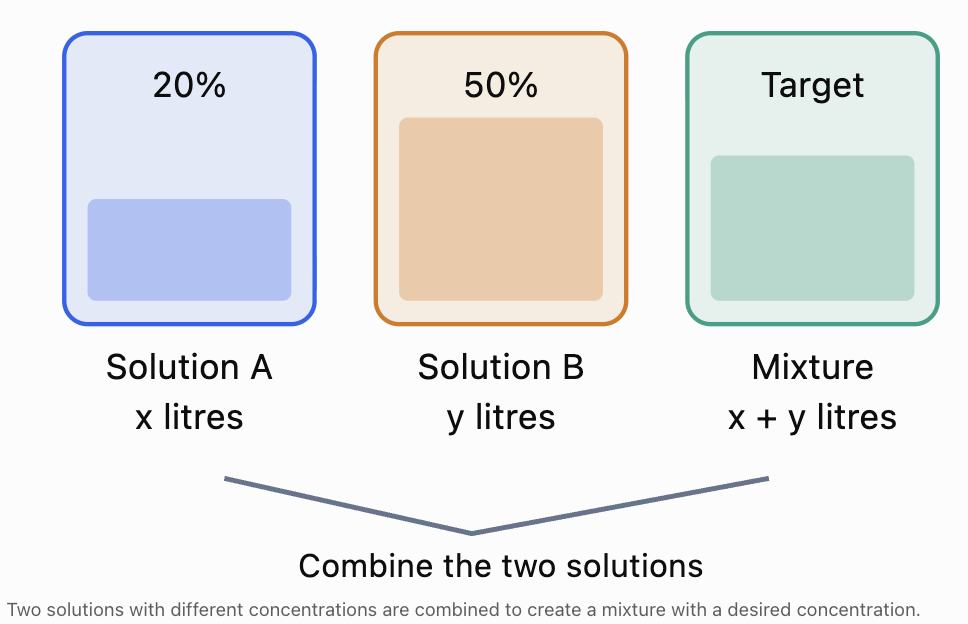
The total volume equation describes how much mixture is produced.
The concentration equation describes how much of the relevant substance is present.
Both equations must be satisfied simultaneously.
Identifying Variables in Mixture Problems
The first step is defining the unknown quantities.
Consider:
"A laboratory needs 12 litres of a 35% solution. It has 20% and 50% solutions available."
We need to determine how much of each solution to use.
Define:
x = litres of 20% solution
y = litres of 50% solution
The total volume equation is:
x + y = 12
The concentration equation is:
0.20x + 0.50y = 0.35(12)
Simplify:
0.20x + 0.50y = 4.2
Our system is:
x + y = 12
0.20x + 0.50y = 4.2
The next step is solving the system.
Worked Example: Mixing Salt Solutions
A laboratory needs to prepare 12 litres of a 35% salt solution.
It has:
-
A 20% salt solution.
-
A 50% salt solution.
How many litres of each should be mixed?
Step 1: Define variables
x = volume of 20% solution in litres
y = volume of 50% solution in litres
Step 2: Write the total volume equation
x + y = 12
Step 3: Write the salt-content equation
Salt contributed by the 20% solution:
0.20x
Salt contributed by the 50% solution:
0.50y
Salt required in the final mixture:
0.35 × 12 = 4.2
Therefore:
0.20x + 0.50y = 4.2
Step 4: Solve using substitution
From the first equation:
x = 12 − y
Substitute into the second:
0.20(12 − y) + 0.50y = 4.2
Expand:
2.4 − 0.20y + 0.50y = 4.2
Combine:
2.4 + 0.30y = 4.2
Subtract 2.4:
0.30y = 1.8
Divide:
y = 6
Then:
x = 12 − 6
x = 6
Step 5: Interpret
Use:
-
6 litres of the 20% solution.
-
6 litres of the 50% solution.
Step 6: Verify
Total volume:
6 + 6 = 12 litres
Salt amount:
0.20(6) + 0.50(6)
= 1.2 + 3.0
= 4.2 litres
Final concentration:
4.2/12 × 100% = 35%
Both conditions are satisfied.
Answer: Mix 6 L of the 20% solution with 6 L of the 50% solution.
Worked Example: Mixing Fruit Juice
A juice company wants to produce 20 litres of a drink containing 45% fruit juice.
It has two mixtures available:
-
Drink A contains 30% fruit juice.
-
Drink B contains 70% fruit juice.
How much of each drink should be combined?
Step 1: Define variables
x = volume of 30% drink in litres
y = volume of 70% drink in litres
Step 2: Write the total volume equation
x + y = 20
Step 3: Write the fruit juice equation
Fruit juice contributed by Drink A:
0.30x
Fruit juice contributed by Drink B:
0.70y
The final mixture must contain:
0.45 × 20 = 9 litres of fruit juice
Therefore:
0.30x + 0.70y = 9
Step 4: Solve
From the first equation:
x = 20 − y
Substitute:
0.30(20 − y) + 0.70y = 9
6 − 0.30y + 0.70y = 9
6 + 0.40y = 9
0.40y = 3
y = 7.5
Then:
x = 20 − 7.5
x = 12.5
Step 5: Interpret
The company should mix:
-
12.5 L of the 30% drink.
-
7.5 L of the 70% drink.
Step 6: Verify
Total volume:
12.5 + 7.5 = 20 L
Fruit juice:
0.30(12.5) + 0.70(7.5)
= 3.75 + 5.25
= 9 L
Concentration:
9/20 × 100% = 45%
Answer: 12.5 L of the 30% drink and 7.5 L of the 70% drink.
Worked Example: Mixing Coffee Beans
Not every mixture problem involves percentages.
Some involve prices or average values.
A coffee shop wants to produce 15 kg of a coffee blend costing $18 per kilogram.
Two varieties are available:
-
Coffee A costs $12 per kilogram.
-
Coffee B costs $22 per kilogram.
How many kilograms of each variety should be used?
Step 1: Define variables
x = mass of $12/kg coffee in kilograms
y = mass of $22/kg coffee in kilograms
Step 2: Write the mass equation
x + y = 15
Step 3: Write the value equation
The total value of the desired blend is:
18 × 15 = $270
The individual contributions are:
12x and 22y
Therefore:
12x + 22y = 270
Step 4: Solve using elimination
Multiply the first equation by 12:
12x + 12y = 180
Subtract this equation from the value equation:
(12x + 22y) − (12x + 12y) = 270 − 180
10y = 90
y = 9
Substitute:
x + 9 = 15
x = 6
Step 5: Interpret
The shop should combine:
-
6 kg of $12/kg coffee.
-
9 kg of $22/kg coffee.
Step 6: Verify
Total mass:
6 + 9 = 15 kg
Total value:
12(6) + 22(9)
= 72 + 198
= $270
Average price:
270/15 = $18/kg
Answer: 6 kg of Coffee A and 9 kg of Coffee B.
This example assumes that the blend's unit value is the weighted average of the ingredient prices, with no additional costs.
Weighted Averages in Mixture Problems
The coffee example illustrates a general mathematical principle called a weighted average.
A weighted average accounts for the different amounts of each component.
For two ingredients:
Average value = (v₁x + v₂y)/(x + y)
where:
-
v₁ = value per unit of the first ingredient.
-
v₂ = value per unit of the second ingredient.
-
x = amount of the first ingredient.
-
y = amount of the second ingredient.
For the coffee blend:
Average price = [12(6) + 22(9)]/(6 + 9)
= 270/15
= $18/kg
Why an ordinary average may be incorrect
The ordinary average of $12 and $22 is:
(12 + 22)/2 = $17
However, the blend contains more of the expensive coffee than the cheaper coffee.
Therefore, its average price is $18/kg, not $17/kg.
An ordinary average is appropriate only when the two ingredients contribute equal amounts.
Worked Example: Mixing Metal Alloys
A manufacturer wants to produce 40 kg of an alloy containing 65% copper by mass.
Two alloys are available:
-
Alloy A contains 50% copper.
-
Alloy B contains 80% copper.
How much of each alloy should be used?
Step 1: Define variables
x = mass of 50% copper alloy in kilograms
y = mass of 80% copper alloy in kilograms
Step 2: Write the total mass equation
x + y = 40
Step 3: Write the copper mass equation
The final alloy must contain:
0.65 × 40 = 26 kg of copper
Therefore:
0.50x + 0.80y = 26
Step 4: Solve
Substitute x = 40 − y:
0.50(40 − y) + 0.80y = 26
20 − 0.50y + 0.80y = 26
0.30y = 6
y = 20
Then:
x = 40 − 20
x = 20
Step 5: Verify
Total mass:
20 + 20 = 40 kg
Copper mass:
0.50(20) + 0.80(20)
= 10 + 16
= 26 kg
Copper percentage:
26/40 × 100% = 65%
Answer: 20 kg of each alloy.
Worked Example: Adding Pure Water
Some mixture problems involve adding a substance with a concentration of zero.
Suppose we have 8 litres of a 50% sugar solution.
How much pure water must be added to reduce the concentration to 20%?
Step 1: Identify the important quantities
Initial solution:
8 L at 50%
Pure water:
0% sugar
Final concentration:
20%
Step 2: Define variables
x = litres of water added
y = final volume in litres
Step 3: Write the total volume equation
8 + x = y
Step 4: Write the sugar-content equation
The original sugar amount is:
0.50 × 8 = 4 L
Pure water contributes no sugar.
Therefore:
4 = 0.20y
Step 5: Solve
4 = 0.20y
y = 20
Now:
8 + x = 20
x = 12
Step 6: Interpret
The original 8 L solution must be diluted with 12 L of water.
Step 7: Verify
Final volume:
8 + 12 = 20 L
Sugar amount:
4 L
Final concentration:
4/20 × 100% = 20%
Answer: Add 12 litres of pure water.
Important concept: Dilution
When pure water is added, the amount of dissolved sugar remains constant, assuming none is lost or reacts.
Only the total volume changes.
This explains why the concentration decreases.
Worked Example: Evaporation
Evaporation problems are slightly different because some of the solvent is removed.
Suppose a container holds 20 kg of a salt solution containing 15% salt by mass.
Water evaporates until the salt concentration reaches 25% by mass.
How much water evaporates?
Step 1: Find the original salt mass
Salt mass:
0.15 × 20 = 3 kg
Assume only water evaporates, so the salt mass remains 3 kg.
Step 2: Define variables
x = kilograms of water evaporated
y = final mass of the solution in kilograms
Step 3: Construct equations
Total mass:
20 − x = y
Final salt concentration:
0.25y = 3
Step 4: Solve
0.25y = 3
y = 12
Then:
20 − x = 12
x = 8
Step 5: Verify
Final solution mass:
20 − 8 = 12 kg
Salt mass remains:
3 kg
Final concentration:
3/12 × 100% = 25%
Answer: 8 kg of water must evaporate.
Notice that the amount of salt stays constant while the total mass decreases.
This is why evaporation increases the concentration.
Worked Example: A Three-Ingredient Mixture
Some mixture problems involve three unknown quantities.
These require additional information.
A manufacturer wants to produce 100 kg of a mixture using three ingredients.
The ingredients cost:
-
Ingredient A: $4/kg.
-
Ingredient B: $6/kg.
-
Ingredient C: $10/kg.
The desired average cost is $6.80/kg.
The manufacturer also requires twice as much Ingredient A as Ingredient C.
Find the amount of each ingredient.
Step 1: Define variables
x = mass of Ingredient A in kg
y = mass of Ingredient B in kg
z = mass of Ingredient C in kg
Step 2: Write the total mass equation
x + y + z = 100
Step 3: Write the total cost equation
The desired total value is:
6.80 × 100 = $680
Therefore:
4x + 6y + 10z = 680
Step 4: Write the additional condition
Twice as much Ingredient A as Ingredient C:
x = 2z
We now have three equations for three unknowns.
Step 5: Solve
Substitute x = 2z into the total mass equation:
2z + y + z = 100
y = 100 − 3z
Substitute both expressions into the cost equation:
4(2z) + 6(100 − 3z) + 10z = 680
8z + 600 − 18z + 10z = 680
600 = 680
This is a contradiction.
Step 6: Interpret
The three conditions cannot all be satisfied.
Why?
If x = 2z, then the combined average price of Ingredients A and C is:
[4(2z) + 10z]/(3z) = 18z/(3z) = $6/kg
Ingredient B also costs $6/kg.
Therefore, every mixture satisfying x = 2z has an average price of $6/kg, not $6.80/kg.
The original problem has no solution.
This demonstrates an important principle: not every mixture specification is mathematically possible.
Revised example
If the desired average price were $6/kg instead, the cost equation would be satisfied automatically whenever x = 2z and the total mass is 100 kg.
There would then be infinitely many nonnegative mixtures satisfying the conditions.
An additional independent condition would be needed to determine a unique mixture.
Using a Table to Organise Mixture Problems
A table is often helpful when translating a mixture problem into equations.
Consider the earlier example of producing 20 litres of a 45% fruit juice mixture from 30% and 70% drinks.
|
Component |
Amount (L) |
Concentration |
Fruit juice amount (L) |
|---|---|---|---|
|
Drink A |
x |
30% |
0.30x |
|
Drink B |
y |
70% |
0.70y |
|
Final mixture |
20 |
45% |
9 |
From the amount column:
x + y = 20
From the fruit juice column:
0.30x + 0.70y = 9
The table separates the total amount from the amount of the component being tracked.
This reduces the risk of confusing concentrations with actual quantities.
A General Formula for Two-Ingredient Mixtures
Suppose we mix two ingredients with concentrations:
c₁ and c₂
The desired concentration is:
cₜ
The final total amount is:
T
Let x be the amount of the first ingredient and y the amount of the second.
Our equations are:
x + y = T
c₁x + c₂y = cₜT
Substitute:
y = T − x
Then:
c₁x + c₂(T − x) = cₜT
Expand:
c₁x + c₂T − c₂x = cₜT
Group the x terms:
(c₁ − c₂)x = (cₜ − c₂)T
Therefore:
x = T(cₜ − c₂)/(c₁ − c₂)
Equivalently:
x = T(c₂ − cₜ)/(c₂ − c₁)
Similarly:
y = T(cₜ − c₁)/(c₂ − c₁)
These formulas apply when c₁ and c₂ are different and the usual additive-mixture assumptions hold.
Worked Example
Prepare 30 litres of a 40% solution from 25% and 55% solutions.
Let:
c₁ = 0.25
c₂ = 0.55
cₜ = 0.40
T = 30
Amount of 25% solution:
x = 30(0.55 − 0.40)/(0.55 − 0.25)
x = 30(0.15)/(0.30)
x = 15
Amount of 55% solution:
y = 30 − 15
y = 15
Answer: 15 litres of each solution.
This formula provides a useful shortcut, but constructing the original system remains important because it explains why the calculation works.
Why the Target Concentration Must Be Between the Starting Concentrations
Suppose we mix a 20% solution and a 60% solution.
Can we obtain a final concentration of 80%?
No, not by mixing only these two solutions without adding or removing any component.
The final concentration is a weighted average of the starting concentrations.
Therefore, it must lie between 20% and 60%.
For nonnegative quantities x and y:
cₜ = (c₁x + c₂y)/(x + y)
If both ingredients are used in positive amounts and c₁ < c₂, then:
c₁ < cₜ < c₂
If one ingredient is allowed to have zero quantity, the target may equal one of the starting concentrations.
Example
A student tries to produce 10 litres of an 80% solution from 20% and 60% solutions.
The equations are:
x + y = 10
0.20x + 0.60y = 8
Substitute x = 10 − y:
0.20(10 − y) + 0.60y = 8
2 + 0.40y = 8
0.40y = 6
y = 15
Then:
x = −5
The algebraic solution requires −5 litres of the 20% solution.
This is physically impossible.
Therefore, the mixture problem has no valid solution using nonnegative ingredient amounts.
The negative result is evidence that the requested concentration cannot be produced under the stated conditions.
Interpreting Solutions in Context
After solving a mixture problem, we must explain what the values mean.
Suppose the solution is:
x = 7
y = 13
These values are not meaningful without the variable definitions.
If:
x = litres of 20% solution
y = litres of 50% solution
then the interpretation is:
"Mix 7 litres of the 20% solution with 13 litres of the 50% solution."
A complete interpretation should include:
-
The quantity of each ingredient.
-
The correct units.
-
The relevant concentration or price.
-
The final result.
Contextual restrictions
Mixture quantities usually cannot be negative.
The units must also be appropriate.
For example:
-
Liquids may be measured in litres or millilitres.
-
Solids may be measured in grams or kilograms.
-
Prices may be expressed per kilogram.
-
Concentrations must be expressed using a consistent basis.
Some quantities can be fractional, while others must be whole numbers.
For example, 2.5 litres of juice is reasonable.
However, 2.5 sealed cans may not be possible if cans cannot be opened or divided.
Verifying Mixture Solutions
A reliable solution should satisfy both equations.
Total amount check
Does the sum of the ingredients equal the required total?
x + y = T
Component or value check
Does the combined amount of the relevant substance equal the required amount?
c₁x + c₂y = cₜT
Concentration check
Calculate the final concentration independently:
Final concentration = Total component amount / Total mixture amount
Multiply by 100% when reporting a percentage.
Reasonableness check
Ask:
-
Are both amounts nonnegative?
-
Is the total correct?
-
Is the target concentration possible?
-
Are the units consistent?
-
Does the answer make sense in the real-world situation?
A mathematical solution should not be accepted until these checks have been completed.
Choosing a Solving Method
Most introductory mixture problems can be solved using substitution or elimination.
Substitution
Substitution is particularly useful when the total amount equation is:
x + y = T
We can easily rearrange:
x = T − y
or:
y = T − x
This expression can then be substituted into the concentration equation.
Elimination
Elimination is useful when the coefficients can be matched conveniently.
For example:
x + y = 20
0.30x + 0.70y = 9
Multiply the first equation by 0.30:
0.30x + 0.30y = 6
Subtract:
0.40y = 3
y = 7.5
Then:
x = 12.5
Both methods produce the same result.
Graphing
The equations can also be graphed.
For example:
x + y = 20
0.30x + 0.70y = 9
Rearrange:
y = 20 − x
and:
y = (9 − 0.30x)/0.70
The intersection represents the amounts that satisfy both conditions.
In this case, the intersection is:
(12.5, 7.5)
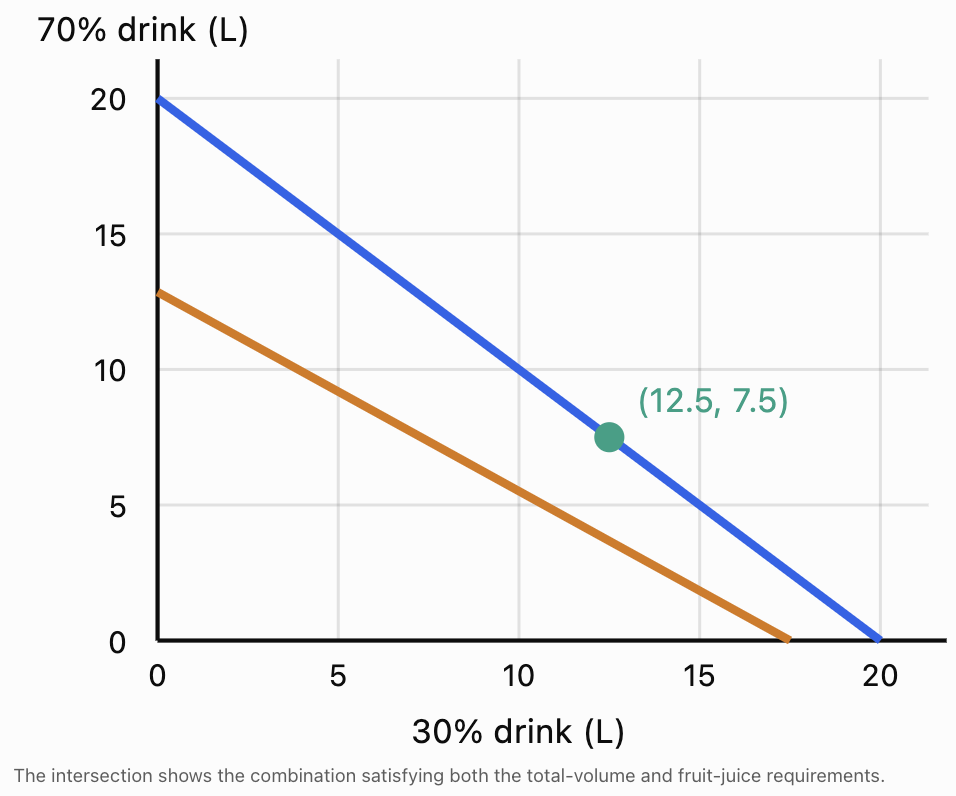
Real-World Applications of Mixture Problems
Chemistry
Chemists use mixture calculations when preparing solutions of particular concentrations.
Examples include preparing salt solutions, buffer components, and diluted laboratory reagents.
Actual laboratory calculations may require molarity, density, or mass-based concentration rather than the simplified volume-percentage models used in introductory algebra.
Food and Beverage Production
Manufacturers combine ingredients to achieve desired sweetness, flavour, concentration, or average cost.
Examples include fruit juices, coffee blends, tea blends, and food ingredients.
Agriculture
Farmers and agricultural specialists may combine fertilizers with different nutrient contents to meet target requirements.
These problems can involve several nutrients and may require systems containing more than two equations.
Manufacturing
Mixture calculations are used when combining metals, plastics, chemicals, and raw materials.
A manufacturer may need to meet both composition and cost requirements.
Business
Businesses can combine products with different prices to produce blends with a target average cost.
These calculations help with pricing, budgeting, and purchasing decisions.
A Systematic Method for Solving Mixture Problems
When solving any mixture problem, follow this process.
-
Read the problem carefully. Identify what is being mixed, the concentrations or unit prices, and the desired total.
-
Define the variables. Let x and y represent the amounts of the two ingredients.
-
Write the total amount equation. Usually x + y = T.
-
Write the component equation. Multiply each ingredient amount by its concentration or unit value.
-
Solve the system. Use substitution or elimination.
-
Interpret the answer. Explain how much of each ingredient is needed.
-
Verify the result. Check the total amount, final concentration or value, and practical restrictions.
Common Mistakes
Adding percentages directly
Mixing 20% and 40% solutions does not produce a 60% solution. The final concentration depends on the quantities used.
Using percentages instead of decimals incorrectly
For 25%, use 0.25, not 25, when multiplying by an amount.
Forgetting the total amount equation
A concentration equation alone is generally insufficient to determine two unknown amounts.
Confusing the amount of solution with the amount of dissolved substance
A 10 L solution containing 30% salt does not contain 10 L of salt. It contains 3 L of salt-equivalent volume if the concentration is volume-based.
Using inconsistent units
Do not combine litres and millilitres, or grams and kilograms, without converting first.
Ignoring concentration definitions
Mass percentages and volume percentages are not interchangeable without additional information.
Assuming the final concentration is the ordinary average
The ordinary average applies only when equal amounts are mixed on a compatible basis.
Accepting negative ingredient quantities
A negative amount generally indicates that the requested mixture cannot be produced under the stated conditions.
Failing to verify
A complete solution must satisfy both the total amount and component-balance equations.
Key Terms
-
Mixture: A combination of two or more substances or ingredients.
-
Solution: A homogeneous mixture containing a dissolved substance.
-
Solute: The substance dissolved in a solution.
-
Solvent: The substance that dissolves the solute.
-
Concentration: The amount or proportion of a component in a mixture.
-
Percentage concentration: Concentration expressed as a percentage on a specified basis.
-
Mass percentage: The mass of a component divided by the total mass, multiplied by 100%.
-
Volume percentage: The volume of a component divided by the final solution volume, multiplied by 100%.
-
Dilution: Reducing concentration by adding solvent.
-
Evaporation: The conversion of liquid into vapour, potentially increasing the concentration of a nonvolatile solute.
-
Weighted average: An average accounting for the different amounts contributing to it.
-
System of equations: Two or more equations considered simultaneously.
-
Substitution: Replacing one variable with an equivalent expression.
-
Elimination: Combining equations to remove a variable.
-
Constraint: A restriction on possible values.
-
Verification: Checking that the solution satisfies the original conditions.
-
Component balance: An equation accounting for the total amount of a particular substance or component.
-
Total amount equation: An equation describing the sum of the ingredient amounts.
Key Takeaways
-
Mixture problems involve combining ingredients to achieve a target amount, concentration, or average value.
-
Most two-ingredient mixture problems use two equations.
-
The first equation describes the total amount.
-
The second describes the amount of a particular component or the total value.
-
Percentage concentrations should be converted into decimals before calculation.
-
The final concentration is a weighted average of the starting concentrations under suitable mixing assumptions.
-
Substitution and elimination are effective solving methods.
-
Dilution decreases concentration by adding solvent.
-
Removing solvent can increase concentration without changing the amount of nonvolatile solute.
-
Solutions must be interpreted using the correct units and context.
-
Every answer should be checked using the original conditions.
Check Your Understanding
Recall and Understanding
1. What is a mixture problem?
2. Explain why the final concentration of two mixed solutions is not usually the ordinary average of their concentrations.
3. Write the two general equations used to solve a two-ingredient mixture problem.
4. Why must percentages usually be converted into decimals before constructing equations?
5. Explain why mixing a 20% solution and a 60% solution cannot produce an 80% solution under ordinary additive-mixture conditions.
Application
6. A laboratory needs 10 L of a 30% solution. It has 20% and 50% solutions available. Find the volume of each solution required.
7. A juice company wants to produce 25 L of a 40% fruit juice drink using 20% and 60% drinks. Determine the required volumes.
8. A coffee shop wants 20 kg of a blend costing $15/kg. It has coffee costing $10/kg and $18/kg. Find the mass of each variety.
9. A 12 L solution contains 40% sugar. How much pure water must be added to reduce the concentration to 30%?
10. A 30 kg salt solution contains 20% salt by mass. Water evaporates until the concentration reaches 30%. How much water evaporates?
Analysis and Challenge
11. A manufacturer needs 50 kg of an alloy containing 70% copper. It has 60% and 85% copper alloys. Determine how much of each alloy is needed.
12. A company wants to produce 40 kg of a product with an average cost of $12/kg. Ingredient A costs $8/kg and Ingredient B costs $18/kg. Find the amount of each ingredient.
13. A student attempts to create 15 L of a 75% solution using 30% and 60% solutions. Explain whether this is possible.
14. A laboratory combines x litres of a 25% solution and y litres of a 65% solution to produce 24 litres of a 40% solution. Construct and solve the system.
15. A company combines three ingredients costing $5/kg, $8/kg, and $12/kg to produce 60 kg of a blend costing $9/kg. The amount of the $5/kg ingredient equals the amount of the $12/kg ingredient. Determine whether the conditions are possible.
Answers to Check Your Understanding
1. A mixture problem involves combining two or more ingredients to obtain a desired total amount, concentration, or average value.
2. The final concentration depends on how much of each solution is used. Different quantities contribute different amounts of the component, so a weighted average is required.
3.
Total amount:
x + y = T
Component balance:
c₁x + c₂y = cₜT
4. Decimal concentrations allow us to multiply the proportion directly by the ingredient amount. For example, 25% of 8 L is 0.25 × 8 = 2 L.
5. The final concentration must lie between the starting concentrations when only nonnegative amounts of the two solutions are combined and no component is added or removed. Therefore, 80% cannot be obtained from 20% and 60% solutions alone.
6.
Let x = 20% solution and y = 50% solution.
x + y = 10
0.20x + 0.50y = 3
Substitute x = 10 − y:
0.20(10 − y) + 0.50y = 3
2 + 0.30y = 3
y = 10/3
x = 20/3
Answer: 6⅔ L of 20% solution and 3⅓ L of 50% solution.
Verification:
0.20(20/3) + 0.50(10/3) = 3 L
3/10 = 30%
7.
x + y = 25
0.20x + 0.60y = 0.40(25) = 10
Substitute x = 25 − y:
5 − 0.20y + 0.60y = 10
0.40y = 5
y = 12.5
x = 12.5
Answer: 12.5 L of each drink.
8.
Let x = mass of $10/kg coffee and y = mass of $18/kg coffee.
x + y = 20
10x + 18y = 300
Substitute x = 20 − y:
10(20 − y) + 18y = 300
200 + 8y = 300
y = 12.5
x = 7.5
Answer: 7.5 kg of $10/kg coffee and 12.5 kg of $18/kg coffee.
Verification:
10(7.5) + 18(12.5) = 75 + 225 = $300
300/20 = $15/kg
9.
Initial sugar amount:
0.40 × 12 = 4.8 L
Let x = water added.
Final volume:
12 + x
Final concentration:
4.8/(12 + x) = 0.30
4.8 = 0.30(12 + x)
4.8 = 3.6 + 0.30x
1.2 = 0.30x
x = 4
Answer: Add 4 L of water.
Verification:
4.8/16 = 0.30 = 30%
10.
Initial salt mass:
0.20 × 30 = 6 kg
Let y = final solution mass.
0.30y = 6
y = 20 kg
Water evaporated:
30 − 20 = 10 kg
Answer: 10 kg of water evaporates.
Verification:
6/20 × 100% = 30%
11.
Let x = 60% alloy and y = 85% alloy.
x + y = 50
0.60x + 0.85y = 0.70(50)
0.60x + 0.85y = 35
Substitute x = 50 − y:
0.60(50 − y) + 0.85y = 35
30 + 0.25y = 35
y = 20
x = 30
Answer: 30 kg of 60% alloy and 20 kg of 85% alloy.
Verification:
0.60(30) + 0.85(20) = 18 + 17 = 35 kg copper
35/50 = 70%
12.
Let x = $8/kg ingredient and y = $18/kg ingredient.
x + y = 40
8x + 18y = 480
Substitute x = 40 − y:
8(40 − y) + 18y = 480
320 + 10y = 480
y = 16
x = 24
Answer: 24 kg of Ingredient A and 16 kg of Ingredient B.
Verification:
8(24) + 18(16) = 192 + 288 = $480
480/40 = $12/kg
13.
The requested concentration of 75% is greater than both available concentrations.
Therefore, it is impossible to produce the mixture using only the 30% and 60% solutions under the stated conditions.
Answer: No valid nonnegative mixture exists.
14.
Total volume:
x + y = 24
Component balance:
0.25x + 0.65y = 0.40(24)
0.25x + 0.65y = 9.6
Substitute x = 24 − y:
0.25(24 − y) + 0.65y = 9.6
6 + 0.40y = 9.6
0.40y = 3.6
y = 9
x = 15
Answer: 15 L of the 25% solution and 9 L of the 65% solution.
Verification:
0.25(15) + 0.65(9)
= 3.75 + 5.85
= 9.6
9.6/24 = 40%
15.
Let:
x = mass of $5/kg ingredient
y = mass of $8/kg ingredient
z = mass of $12/kg ingredient
Total mass:
x + y + z = 60
Total value:
5x + 8y + 12z = 9(60) = 540
Additional condition:
x = z
Substitute z = x.
Mass equation:
2x + y = 60
Therefore:
y = 60 − 2x
Value equation:
5x + 8y + 12x = 540
17x + 8y = 540
Substitute:
17x + 8(60 − 2x) = 540
17x + 480 − 16x = 540
x = 60
Therefore:
z = 60
y = 60 − 120 = −60
This requires a negative quantity of Ingredient B.
Answer: The conditions are impossible using nonnegative ingredient amounts.
In fact, equal masses of the $5/kg and $12/kg ingredients have an average price of $8.50/kg. Adding the $8/kg ingredient can only lower that average, not increase it to $9/kg.
Final Summary
Mixture problems demonstrate how systems of equations can be used to solve practical problems involving concentrations, quantities, and costs.
The essential mathematical relationships are the total amount equation and the component-balance equation.
By defining variables, constructing the system, solving algebraically, interpreting the results, and verifying the original conditions, we can determine the correct quantities needed for a desired mixture.
The central idea is that the total amount of each conserved component in a mixture must equal the sum of the amounts contributed by its ingredients.
4. Money and Cost Problems
Learning outcomes
- I can model financial situations with systems.
- I can solve problems involving costs and prices.
- I can determine unknown values using systems.
- I can interpret financial solutions.
- I can explain my reasoning.
Introduction
Money and cost problems are among the most practical applications of systems of linear equations. Every day, people and businesses make decisions involving prices, quantities, expenses, revenue, and profit.
For example:
-
A student buys notebooks and pens but does not know the individual prices.
-
A cinema sells adult and child tickets at different prices.
-
Two companies offer different payment plans.
-
A business wants to know how many products it must sell to cover its costs.
-
A school sells two types of merchandise and needs to determine how many of each were sold.
-
A customer compares two mobile phone plans to decide which offers better value.
Many of these situations involve two unknown quantities and two relationships. By representing the information using equations, we can construct a system of linear equations and solve it.
The goal is not simply to calculate numbers. We must also understand what the numbers represent, check whether they are realistic, and explain how the mathematical solution answers the original financial question.
Understanding Financial Relationships
Before solving money and cost problems, it is important to understand several common financial quantities.
Cost
Cost is the amount of money required to purchase, produce, or provide something.
Examples include the cost of buying supplies, manufacturing products, renting equipment, or operating a business.
A business may have two main types of costs:
-
Fixed costs: Expenses that do not change with the number of products made within the model, such as monthly rent.
-
Variable costs: Expenses that change with the number of products made, such as materials and packaging.
A common linear cost model is:
C(x) = mx + b
where:
-
C(x) = total cost.
-
x = number of products or units.
-
m = variable cost per unit.
-
b = fixed cost.
Revenue
Revenue is the total money received from selling goods or services before deducting costs.
For a product sold at a constant price:
Revenue = Selling price × Quantity sold
For example, selling 40 products at $15 each gives:
R = 15 × 40 = $600
Profit
Profit is the money remaining after costs are deducted from revenue.
Profit = Revenue − Cost
If a business earns $600 in revenue and has $450 in costs:
Profit = 600 − 450
Profit = $150
If costs exceed revenue, the business makes a loss.
Break-even point
The break-even point occurs when total revenue equals total cost.
Revenue = Cost
At this point:
Profit = $0
Finding the break-even point is one of the most important applications of systems of equations in business.
Identifying Variables in Financial Problems
A financial word problem often contains two unknown quantities.
The first step is defining them clearly.
For example:
"A customer purchases three notebooks and two pens for $17. Another customer purchases two notebooks and four pens for $18."
We need to determine the individual prices.
Define:
x = price of one notebook in dollars
y = price of one pen in dollars
These definitions allow us to write equations using the quantities purchased and the total amounts paid.
Translating financial statements
|
Statement |
Equation or expression |
|---|---|
|
Three notebooks cost $12 |
3x = 12 |
|
Two pens and one notebook cost $9 |
2y + x = 9 |
|
A total of 50 tickets were sold |
x + y = 50 |
|
Adult tickets cost $15 each |
Adult revenue = 15x |
|
A fixed fee of $20 plus $5 per hour |
C = 5h + 20 |
|
Revenue equals cost |
R = C |
|
A business earns $200 profit |
R − C = 200 |
The most important skill is recognizing how the written information becomes mathematical relationships.
Constructing Systems from Purchase Problems
Suppose a shop sells notebooks and pens.
Three notebooks and two pens cost $17.
Two notebooks and four pens cost $18.
Step 1: Define variables
x = price of one notebook
y = price of one pen
Step 2: Write equations
First purchase:
3x + 2y = 17
Second purchase:
2x + 4y = 18
We now have a system of two equations with two unknowns.
Step 3: Solve using elimination
Multiply the first equation by 2:
6x + 4y = 34
Subtract the second equation:
(6x + 4y) − (2x + 4y) = 34 − 18
4x = 16
x = 4
Substitute into the first equation:
3(4) + 2y = 17
12 + 2y = 17
2y = 5
y = 2.50
Step 4: Interpret
One notebook costs $4.
One pen costs $2.50.
Step 5: Verify
First purchase:
3(4) + 2(2.50) = 12 + 5 = $17
Second purchase:
2(4) + 4(2.50) = 8 + 10 = $18
Both equations are satisfied.
Answer: Notebook = $4; pen = $2.50.
A General Method for Financial Systems
A reliable approach to financial word problems is:
-
Read the problem and identify the unknown quantities.
-
Define variables with appropriate units.
-
Translate the financial relationships into equations.
-
Solve the system using substitution, elimination, or graphing.
-
Interpret the values in the original context.
-
Verify that the solution satisfies every condition.
-
Check whether the result is financially and practically reasonable.
For example, if x represents the number of tickets sold, x should normally be a nonnegative whole number.
If x represents a price, a fractional value may be acceptable, but it should be expressed correctly in dollars and cents.
Worked Example: Ticket Sales
A school concert sells two types of tickets:
-
Adult tickets cost $15 each.
-
Student tickets cost $9 each.
A total of 140 tickets are sold.
The total revenue is $1,740.
How many adult and student tickets were sold?
Step 1: Define variables
a = number of adult tickets
s = number of student tickets
Step 2: Write the total ticket equation
a + s = 140
Step 3: Write the revenue equation
Adult ticket revenue:
15a
Student ticket revenue:
9s
Therefore:
15a + 9s = 1740
Step 4: Solve
From the first equation:
s = 140 − a
Substitute:
15a + 9(140 − a) = 1740
Expand:
15a + 1260 − 9a = 1740
Combine:
6a + 1260 = 1740
6a = 480
a = 80
Then:
s = 140 − 80
s = 60
Step 5: Interpret
The school sold:
-
80 adult tickets.
-
60 student tickets.
Step 6: Verify
Total tickets:
80 + 60 = 140
Total revenue:
15(80) + 9(60)
= 1200 + 540
= $1740
Answer: 80 adult tickets and 60 student tickets.
Worked Example: Comparing Two Payment Plans
A customer wants to compare two mobile phone plans.
Plan A charges a fixed monthly fee of $20 plus $5 per unit of additional usage.
Plan B charges a fixed monthly fee of $35 plus $2 per unit of additional usage.
At what usage level will the two plans cost the same?
Step 1: Define variables
x = number of additional usage units
y = total monthly cost in dollars
Step 2: Write the cost equations
Plan A:
y = 5x + 20
Plan B:
y = 2x + 35
Step 3: Solve the system
Set the equations equal:
5x + 20 = 2x + 35
Subtract 2x:
3x + 20 = 35
Subtract 20:
3x = 15
x = 5
Step 4: Find the cost
Substitute x = 5:
Plan A:
y = 5(5) + 20 = 45
Plan B:
y = 2(5) + 35 = 45
Step 5: Interpret
Both plans cost $45 when the customer uses five additional units.
For fewer than five units, Plan A is cheaper.
For more than five units, Plan B is cheaper.
Step 6: Verify
Both equations produce $45 at x = 5.
Answer: The plans have equal costs at five additional usage units, when each costs $45.
Graphical Interpretation of Payment Plans
A system of cost equations can be represented by two straight lines.
The point where the lines intersect shows the usage level at which the costs are equal.
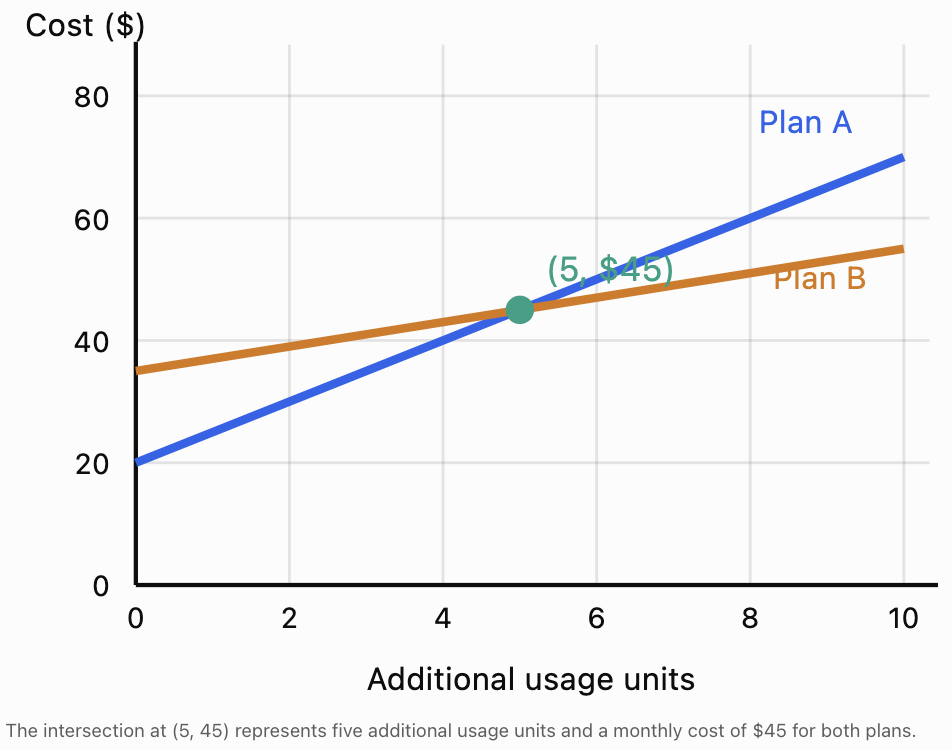
This graph also illustrates the meaning of the slope and y-intercept.
-
The slope represents the cost per additional usage unit.
-
The y-intercept represents the fixed monthly fee.
-
The intersection represents the break-even usage level between the two plans.
Worked Example: Taxi Fares
Two taxi companies charge different rates.
Company A charges a starting fee of $6 and $2 per kilometre.
Company B charges a starting fee of $3 and $2.50 per kilometre.
At what distance will the fares be equal?
Step 1: Define variables
d = distance travelled in kilometres
C = total fare in dollars
Step 2: Construct equations
Company A:
C = 2d + 6
Company B:
C = 2.50d + 3
Step 3: Solve
2d + 6 = 2.50d + 3
Subtract 2d:
6 = 0.50d + 3
Subtract 3:
3 = 0.50d
d = 6
Step 4: Calculate the fare
Company A:
C = 2(6) + 6 = 18
Company B:
C = 2.50(6) + 3 = 18
Step 5: Interpret
The taxi companies charge the same fare for a 6 km journey.
Both fares are $18.
For journeys shorter than 6 km, Company B is cheaper.
For journeys longer than 6 km, Company A is cheaper.
Answer: 6 km, at a fare of $18.
Worked Example: Business Break-Even Analysis
A small business manufactures reusable water bottles.
Its monthly fixed costs are $1,200.
Each bottle costs $8 to produce.
The selling price is $20 per bottle.
How many bottles must the business sell to break even?
Step 1: Define variables
x = number of bottles produced and sold
y = total amount in dollars
Step 2: Write the cost equation
Fixed costs:
$1,200
Variable cost per bottle:
$8
Therefore:
C(x) = 8x + 1200
Step 3: Write the revenue equation
Each bottle sells for $20.
Therefore:
R(x) = 20x
Step 4: Find the break-even point
At break-even:
C(x) = R(x)
8x + 1200 = 20x
1200 = 12x
x = 100
Step 5: Calculate cost and revenue
Cost:
C(100) = 8(100) + 1200
C(100) = 2000
Revenue:
R(100) = 20(100)
R(100) = 2000
Step 6: Interpret
The business must sell 100 bottles to break even.
At this quantity:
-
Total cost = $2,000.
-
Total revenue = $2,000.
-
Profit = $0.
Selling fewer than 100 bottles produces a loss.
Selling more than 100 bottles produces a profit under this model.
Answer: The break-even point is 100 bottles, corresponding to $2,000 in cost and revenue.
Understanding Profit Functions
Profit can be represented mathematically.
P(x) = R(x) − C(x)
For the water bottle business:
R(x) = 20x
C(x) = 8x + 1200
Therefore:
P(x) = 20x − (8x + 1200)
Simplify:
P(x) = 12x − 1200
This equation can be used to predict profit at different sales quantities.
Example: Selling 150 bottles
P(150) = 12(150) − 1200
= 1800 − 1200
= $600
Example: Selling 60 bottles
P(60) = 12(60) − 1200
= 720 − 1200
= −$480
A negative profit represents a loss.
Example: Target profit
How many bottles must the business sell to earn $1,200 profit?
Set:
12x − 1200 = 1200
12x = 2400
x = 200
The business must sell 200 bottles to earn $1,200 profit.
These calculations assume every bottle produced is sold and that unit costs and selling prices remain constant.
Worked Example: Finding Unknown Prices
A school canteen sells sandwiches and drinks.
Three sandwiches and two drinks cost $21.
Two sandwiches and five drinks cost $24.
Find the price of one sandwich and one drink.
Step 1: Define variables
s = price of one sandwich in dollars
d = price of one drink in dollars
Step 2: Construct equations
First purchase:
3s + 2d = 21
Second purchase:
2s + 5d = 24
Step 3: Solve using elimination
Multiply the first equation by 5:
15s + 10d = 105
Multiply the second equation by 2:
4s + 10d = 48
Subtract:
11s = 57
s = 57/11 ≈ 5.18
Substitute into the first equation:
3(57/11) + 2d = 21
171/11 + 2d = 231/11
2d = 60/11
d = 30/11 ≈ 2.73
Step 4: Interpret
The exact algebraic prices are:
-
Sandwich = $57/11 ≈ $5.18.
-
Drink = $30/11 ≈ $2.73.
However, these exact values are not whole numbers of cents.
If the canteen charges only whole cents, the original totals do not produce a valid exact pricing solution under that restriction.
This illustrates why financial solutions must be checked for practical reasonableness.
A revised example
Suppose the second purchase instead costs $25.
Then:
3s + 2d = 21
2s + 5d = 25
Multiply the first equation by 5:
15s + 10d = 105
Multiply the second equation by 2:
4s + 10d = 50
Subtract:
11s = 55
s = 5
Substitute:
3(5) + 2d = 21
15 + 2d = 21
d = 3
Verification
First purchase:
3(5) + 2(3) = 21
Second purchase:
2(5) + 5(3) = 25
For the revised totals, a sandwich costs $5 and a drink costs $3.
Worked Example: Finding Numbers of Coins
A student has 30 coins consisting only of 20-cent and 50-cent coins.
The total value is $9.00.
How many of each coin does the student have?
Step 1: Define variables
x = number of 20-cent coins
y = number of 50-cent coins
Step 2: Construct equations
Total coins:
x + y = 30
Total value:
0.20x + 0.50y = 9
Step 3: Solve
From the first equation:
x = 30 − y
Substitute:
0.20(30 − y) + 0.50y = 9
6 − 0.20y + 0.50y = 9
6 + 0.30y = 9
0.30y = 3
y = 10
Then:
x = 30 − 10
x = 20
Step 4: Interpret
The student has:
-
20 twenty-cent coins.
-
10 fifty-cent coins.
Step 5: Verify
Total number:
20 + 10 = 30 coins
Total value:
0.20(20) + 0.50(10)
= 4 + 5
= $9
Answer: 20 twenty-cent coins and 10 fifty-cent coins.
Worked Example: Finding Two Unknown Quantities from Revenue
A school sells T-shirts and caps at a fundraising event.
T-shirts cost $18 each.
Caps cost $12 each.
A total of 85 items are sold, generating $1,320.
How many T-shirts and caps were sold?
Step 1: Define variables
t = number of T-shirts sold
c = number of caps sold
Step 2: Construct equations
Total items:
t + c = 85
Total revenue:
18t + 12c = 1320
Step 3: Solve
Substitute c = 85 − t:
18t + 12(85 − t) = 1320
18t + 1020 − 12t = 1320
6t = 300
t = 50
Then:
c = 85 − 50
c = 35
Step 4: Verify
Total items:
50 + 35 = 85
Total revenue:
18(50) + 12(35)
= 900 + 420
= $1320
Answer: 50 T-shirts and 35 caps were sold.
Worked Example: Comparing Production Costs
Two companies manufacture the same product using different production methods.
Company A has fixed costs of $800 and variable costs of $12 per unit.
Company B has fixed costs of $1,400 and variable costs of $8 per unit.
At what production quantity will their costs be equal?
Step 1: Define variables
x = number of products manufactured
C = total production cost
Step 2: Construct equations
Company A:
C = 12x + 800
Company B:
C = 8x + 1400
Step 3: Solve
12x + 800 = 8x + 1400
4x = 600
x = 150
Step 4: Calculate the equal cost
Company A:
C = 12(150) + 800
C = 2600
Company B:
C = 8(150) + 1400
C = 2600
Step 5: Interpret
At 150 products, both methods cost $2,600.
For fewer than 150 products, Company A has lower costs.
For more than 150 products, Company B has lower costs.
Answer: 150 products, at a total cost of $2,600.
This example shows why a business might choose a production method with higher fixed costs but lower variable costs when production quantities are large.
Solving Financial Systems Using Graphs
Graphs provide a useful way to compare financial relationships.
Consider:
Company A:
C = 12x + 800
Company B:
C = 8x + 1400
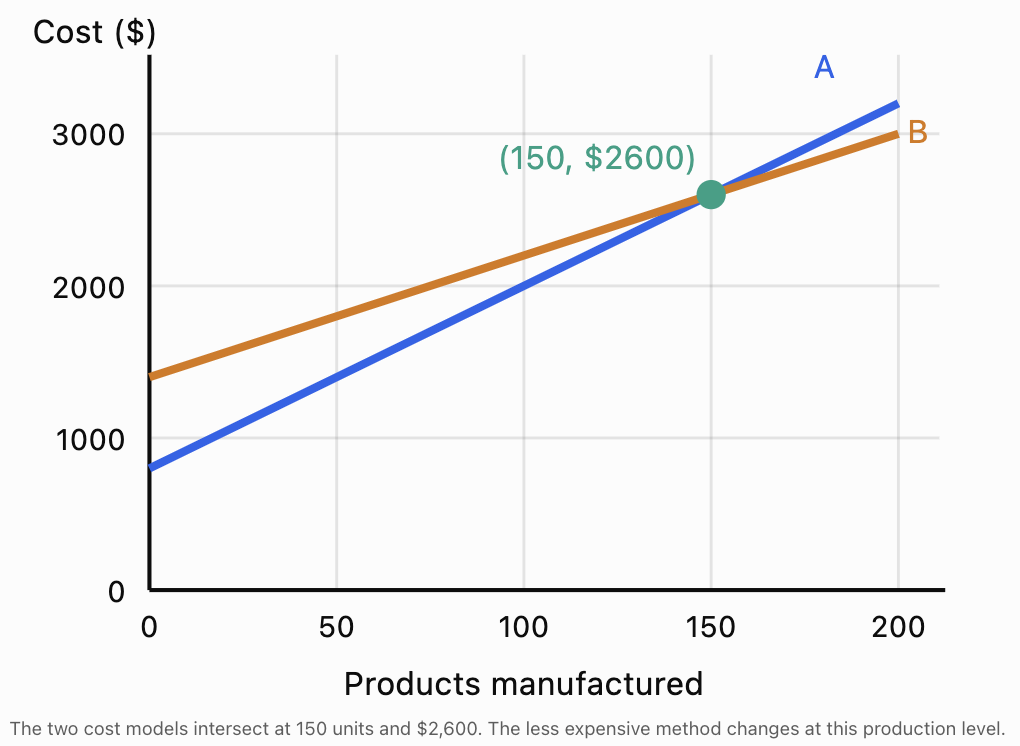
Graphing allows us to identify:
-
Fixed costs from the y-intercepts.
-
Variable costs from the slopes.
-
Equal-cost quantities from intersection points.
-
Which company is cheaper over different production ranges.
Parallel and Coincident Financial Models
Not every financial system has exactly one solution.
Parallel cost models
Consider:
Plan A:
C = 4x + 20
Plan B:
C = 4x + 35
Both plans have the same variable cost of $4 per unit.
However, Plan B has a higher fixed fee.
The lines are parallel.
There is no value of x for which their costs are equal.
Plan A is always $15 cheaper.
Coincident cost models
Consider:
Plan A:
C = 6x + 25
Plan B:
2C = 12x + 50
Simplify Plan B:
C = 6x + 25
The equations represent the same line.
The plans have equal costs for every usage level in their shared domain.
Therefore, the system has infinitely many solutions if the domain contains infinitely many possible usage values.
Financial Constraints and Reasonableness
Financial systems often have restrictions that must be considered.
Nonnegative quantities
Prices, sales quantities, and costs are usually nonnegative.
A solution requiring −5 tickets is not meaningful.
Whole-number quantities
Numbers of tickets, coins, or indivisible products must be whole numbers.
A result of 12.5 tickets is not a valid contextual answer.
Money precision
Prices are often expressed in dollars and cents.
If a solution produces a price that cannot be represented exactly in cents, additional interpretation may be required.
Realistic domains
A financial model may only apply within a certain range.
For example, a business might produce between 0 and 500 products.
An intersection at 2,000 products would lie outside the practical domain.
Simplifying assumptions
Linear financial models often assume:
-
Constant selling prices.
-
Constant variable costs.
-
Fixed costs that do not change.
-
No discounts or taxes unless specified.
-
All produced goods are sold, when revenue and production quantity use the same variable.
Real businesses may not follow these assumptions exactly.
Recognizing the limitations of a model is part of mathematical reasoning.
Explaining Mathematical Reasoning
A complete financial solution should explain not only what was calculated, but why the equations were chosen.
For example, consider a ticket problem:
"Adult tickets cost $12, student tickets cost $7, and 100 tickets generate $950."
A clear explanation would be:
Let a represent the number of adult tickets and s represent the number of student tickets.
Since 100 tickets were sold:
a + s = 100
Since adult tickets generate $12 each and student tickets generate $7 each:
12a + 7s = 950
The first equation represents the total number of tickets, while the second represents the total revenue.
We can then solve the system.
Substitute s = 100 − a:
12a + 7(100 − a) = 950
12a + 700 − 7a = 950
5a = 250
a = 50
Then:
s = 50
Verification:
50 + 50 = 100
12(50) + 7(50) = 600 + 350 = 950
Therefore, 50 adult tickets and 50 student tickets were sold.
This explanation clearly connects the equations to the original financial situation.
A General Strategy for Money and Cost Problems
Use the following process.
Identify the unknowns
Determine whether the variables represent prices, quantities, costs, time, or revenue.
Construct the equations
Use relationships such as:
Total quantity = Quantity A + Quantity B
Total cost = Unit price × Quantity
Revenue = Selling price × Quantity
Profit = Revenue − Cost
Solve the system
Use substitution, elimination, or graphing.
Interpret the solution
Explain what each value represents.
Verify
Substitute the values into the original equations.
Evaluate reasonableness
Check units, restrictions, and whether the values make financial sense.
Common Mistakes
Confusing cost and revenue
Revenue is money received from sales. Cost is money spent.
Profit is the difference between them.
Forgetting fixed costs
A cost model such as C = 8x + 500 includes both variable and fixed costs.
Using total price instead of unit price
If a notebook costs $4, then three notebooks cost 3 × $4 = $12.
Defining variables incorrectly
Be clear whether x represents the number of items or the price of one item.
Mixing dollars and cents
Convert all monetary values into consistent units before solving.
Ignoring whole-number restrictions
A solution of 12.5 coins is not valid if individual coins must be counted.
Assuming every financial model has one solution
Parallel models may have no intersection, while coincident models have infinitely many.
Confusing break-even with profit
At break-even, profit equals zero.
Failing to interpret an intersection
The x-coordinate usually represents a quantity or usage level, while the y-coordinate represents a financial amount.
Not verifying the result
A proposed solution must satisfy every original financial condition.
Key Terms
-
Cost: Money spent on goods, services, or production.
-
Fixed cost: A cost that remains constant within the model.
-
Variable cost: A cost that changes with production or usage.
-
Total cost: The sum of fixed and variable costs.
-
Unit cost: The cost of one item or unit.
-
Selling price: The amount charged for a product or service.
-
Revenue: Total money received from sales.
-
Profit: Revenue minus total cost.
-
Loss: A negative profit.
-
Break-even point: The point where revenue equals cost.
-
Financial model: A mathematical representation of a financial situation.
-
System of equations: Two or more equations solved simultaneously.
-
Variable: A symbol representing an unknown quantity.
-
Coefficient: A number multiplying a variable.
-
Slope: The rate of change of a linear relationship.
-
y-intercept: The value of a linear function when x = 0.
-
Substitution: Solving by replacing a variable with an equivalent expression.
-
Elimination: Solving by combining equations to remove a variable.
-
Intersection: A point shared by two graphs.
-
Constraint: A restriction on possible solutions.
-
Verification: Checking a solution against the original conditions.
Key Takeaways
-
Systems of linear equations can model many financial situations.
-
Variables must be clearly defined before constructing equations.
-
Total costs and revenues can often be expressed using linear functions.
-
Unknown prices and quantities can be determined using simultaneous equations.
-
Substitution and elimination are effective algebraic methods.
-
Graphs help compare costs and identify equal-cost points.
-
The break-even point occurs when revenue equals total cost.
-
Financial solutions must be interpreted using appropriate units.
-
Contextual restrictions may exclude mathematically valid solutions.
-
A complete financial solution includes equations, calculations, interpretation, and verification.
Check Your Understanding
Recall and Understanding
1. Explain the difference between fixed costs and variable costs.
2. What is the difference between revenue and profit?
3. What does the intersection of two cost graphs represent?
4. Why is it important to define variables clearly in financial word problems?
5. Explain what happens at the break-even point.
Application
6. Two notebooks and three pens cost $16. Four notebooks and one pen cost $22. Find the price of one notebook and one pen.
7. A school sells adult tickets for $16 and student tickets for $10. A total of 120 tickets are sold, generating $1,560. How many of each ticket were sold?
8. Two rental companies charge:
Company A: C = 7h + 25
Company B: C = 5h + 45
Find the rental duration when the costs are equal.
9. A business has fixed costs of $900 and variable costs of $15 per product. Each product sells for $30. Determine the break-even quantity.
10. A student has 40 coins consisting only of 20-cent and 50-cent coins. The total value is $14. Find the number of each coin.
Analysis and Challenge
11. Two companies have cost equations:
A(x) = 10x + 600
B(x) = 6x + 1200
Determine when their costs are equal and which company is cheaper at higher production quantities.
12. A school sells T-shirts for $20 and caps for $12. A total of 90 items are sold, generating $1,480. Determine how many of each item were sold.
13. A business has cost and revenue functions:
C(x) = 12x + 1500
R(x) = 27x
Determine how many products must be sold to earn a profit of $750.
14. Two companies offer identical variable costs but different fixed fees:
A(x) = 8x + 30
B(x) = 8x + 50
Explain why the system has no solution and interpret this financially.
15. A student solves a ticket problem and obtains 35.5 adult tickets and 44.5 student tickets. Explain why this answer may be mathematically correct but contextually invalid.
Answers to Check Your Understanding
1. Fixed costs remain constant within the model, while variable costs change with production or usage.
2. Revenue is the total money received from sales. Profit is the amount remaining after subtracting costs.
3. The intersection represents the quantity or usage level at which the two costs are equal.
4. Clear variable definitions prevent confusion and allow the final answer to be interpreted correctly.
5. At break-even, revenue equals cost and profit is zero.
6.
Let n = notebook price and p = pen price.
2n + 3p = 16
4n + p = 22
From the second equation:
p = 22 − 4n
Substitute:
2n + 3(22 − 4n) = 16
2n + 66 − 12n = 16
−10n = −50
n = 5
Then:
p = 22 − 4(5) = 2
Answer: Notebook = $5; pen = $2.
Verification:
2(5) + 3(2) = 16
4(5) + 2 = 22
7.
Let a = adult tickets and s = student tickets.
a + s = 120
16a + 10s = 1560
Substitute s = 120 − a:
16a + 10(120 − a) = 1560
6a + 1200 = 1560
6a = 360
a = 60
s = 60
Answer: 60 adult tickets and 60 student tickets.
Verification:
16(60) + 10(60) = 960 + 600 = $1560
8.
7h + 25 = 5h + 45
2h = 20
h = 10
Cost:
7(10) + 25 = 95
Answer: Both companies charge $95 for 10 hours of rental.
9.
Cost:
C(x) = 15x + 900
Revenue:
R(x) = 30x
Break-even:
15x + 900 = 30x
900 = 15x
x = 60
Answer: 60 products.
Verification:
Cost = 15(60) + 900 = $1800
Revenue = 30(60) = $1800
10.
Let x = number of 20-cent coins and y = number of 50-cent coins.
x + y = 40
0.20x + 0.50y = 14
Substitute x = 40 − y:
0.20(40 − y) + 0.50y = 14
8 + 0.30y = 14
0.30y = 6
y = 20
x = 20
Answer: 20 twenty-cent coins and 20 fifty-cent coins.
Verification:
20(0.20) + 20(0.50) = 4 + 10 = $14
11.
10x + 600 = 6x + 1200
4x = 600
x = 150
Cost:
A(150) = 10(150) + 600 = 2100
B(150) = 6(150) + 1200 = 2100
Answer: The costs are equal at 150 products, when each costs $2,100.
Company B has the lower variable cost, so it becomes cheaper for production quantities greater than 150.
12.
Let t = T-shirts and c = caps.
t + c = 90
20t + 12c = 1480
Substitute c = 90 − t:
20t + 12(90 − t) = 1480
20t + 1080 − 12t = 1480
8t = 400
t = 50
c = 40
Answer: 50 T-shirts and 40 caps.
Verification:
20(50) + 12(40) = 1000 + 480 = $1480
13.
Profit:
P(x) = R(x) − C(x)
P(x) = 27x − (12x + 1500)
P(x) = 15x − 1500
Set profit to $750:
15x − 1500 = 750
15x = 2250
x = 150
Answer: 150 products.
Verification:
Revenue = 27(150) = $4050
Cost = 12(150) + 1500 = $3300
Profit = 4050 − 3300 = $750
14.
A(x) = 8x + 30
B(x) = 8x + 50
Both lines have slope 8 but different y-intercepts.
They are parallel.
Setting them equal:
8x + 30 = 8x + 50
30 = 50
This is impossible.
Answer: There is no quantity for which the costs are equal. Company A is always $20 cheaper.
15.
The algebraic solution may satisfy both equations, but tickets are normally sold as whole items.
Therefore, 35.5 adult tickets and 44.5 student tickets are not valid contextual quantities.
The student should check the original information and determine whether the problem has a whole-number solution.
Final Summary
Money and cost problems show how systems of linear equations can help us make financial decisions.
By representing prices, quantities, costs, revenue, and profit mathematically, we can solve problems involving purchases, ticket sales, payment plans, production costs, and break-even analysis.
The most important skills are defining variables, constructing accurate equations, selecting an appropriate solving method, and interpreting the results in context.
A successful financial model does not simply produce numbers. It explains the relationships between financial quantities and helps us understand the decisions those numbers represent.
5. Distance, Speed, and Motion Problems
Learning outcomes
- I can represent motion problems with systems.
- I can identify relevant variables.
- I can solve travel problems using systems.
- I can interpret solutions with units.
- I can verify whether answers are reasonable.
Introduction
Motion is an important part of everyday life. People travel by walking, cycling, driving, flying, and using public transport. Scientists and engineers also study the motion of objects such as vehicles, satellites, and machines.
Many motion problems involve two moving objects or two unknown quantities. These situations can be represented using systems of equations.
For example:
-
Two cyclists travel towards each other. When will they meet?
-
A faster car starts behind a slower car. When will it catch up?
-
Two trains leave different stations at different times. Where will they meet?
-
A boat travels downstream and upstream. What is its speed in still water?
-
A traveller covers a journey using two different speeds. How far was travelled at each speed?
-
Two objects move along a straight line. When will they occupy the same position?
Systems of equations allow us to model these situations mathematically, solve for unknown values, and interpret the results.
The most important skills are identifying variables, constructing equations from motion information, solving the system, and checking whether the answer makes sense.
Understanding Distance, Speed, and Time
The fundamental relationship used in travel problems is:
Distance = Speed × Time
Using symbols:
d = vt
where:
-
d = distance travelled.
-
v = speed.
-
t = time taken.
This equation assumes the speed is constant over the time interval, or that v represents the average speed for the interval.
We can rearrange the equation to find speed or time.
Calculating speed
v = d/t
Example:
A car travels 180 km in 3 hours.
v = 180/3
v = 60 km/h
Calculating time
t = d/v
Example:
A cyclist travels 45 km at 15 km/h.
t = 45/15
t = 3 hours
Calculating distance
d = vt
Example:
A train travels at 80 km/h for 2.5 hours.
d = 80 × 2.5
d = 200 km
These relationships form the foundation of most introductory motion problems.
Distance and Displacement
Before constructing motion equations, we must distinguish between distance and displacement.
Distance is the total length of the path travelled.
It is a scalar quantity and has magnitude but no direction.
Displacement is the change in position from the starting point to the ending point.
It is a vector quantity and includes direction.
For example, suppose a student walks 100 m east and then 40 m west.
Total distance:
100 + 40 = 140 m
Displacement:
100 − 40 = 60 m east
The student travels 140 m but ends 60 m east of the starting point.
This distinction becomes important when objects move in opposite directions.
Speed and Velocity
Speed describes how quickly distance is travelled.
Velocity describes the rate of change of displacement and includes direction.
For motion along a straight line, we often choose one direction as positive.
For example:
-
East may be positive.
-
West may be negative.
An object moving east at 20 km/h has velocity +20 km/h.
An object moving west at 20 km/h has velocity −20 km/h.
The speeds are equal, but the velocities are different.
Why signs matter
When modelling position, direction determines whether velocity is positive or negative.
A position equation for constant velocity is:
x = x₀ + vt
where:
-
x = position at time t.
-
x₀ = initial position.
-
v = signed velocity.
-
t = elapsed time.
For an object moving in the positive direction:
x = 10 + 5t
For an object moving in the negative direction:
x = 50 − 5t
These equations can be solved simultaneously to determine when the objects occupy the same position.
Choosing Appropriate Units
Motion calculations require consistent units.
Common units include:
|
Quantity |
Common units |
|---|---|
|
Distance |
metres (m), kilometres (km) |
|
Displacement |
metres (m), kilometres (km), with direction |
|
Speed |
m/s, km/h |
|
Velocity |
m/s, km/h, with direction |
|
Time |
seconds (s), minutes (min), hours |
If speed is measured in km/h, time should be expressed in hours to obtain distance in kilometres.
If speed is measured in m/s, time should be expressed in seconds to obtain distance in metres.
Converting time
30 minutes = 0.5 hours
45 minutes = 0.75 hours
90 minutes = 1.5 hours
15 minutes = 0.25 hours
Converting speed
1 m/s = 3.6 km/h
To convert m/s into km/h:
Multiply by 3.6.
To convert km/h into m/s:
Divide by 3.6.
Example
A vehicle travels at 72 km/h.
Convert to m/s:
72/3.6 = 20 m/s
Therefore:
72 km/h = 20 m/s
Identifying Variables in Motion Problems
The first step is deciding what the unknown quantities represent.
Consider:
"Two vehicles travel towards each other from towns 240 km apart. One travels at 50 km/h and the other at 70 km/h."
We may define:
t = time until the vehicles meet, in hours
d₁ = distance travelled by the first vehicle, in kilometres
d₂ = distance travelled by the second vehicle, in kilometres
Their distances satisfy:
d₁ = 50t
d₂ = 70t
Since the vehicles travel towards each other:
d₁ + d₂ = 240
These equations describe the motion.
Choosing variables carefully
Good variable definitions should:
-
Clearly identify the unknown quantity.
-
Include the correct units.
-
Distinguish between the different objects.
-
Specify whether the variable represents distance, displacement, speed, time, or position.
-
Identify the starting time when necessary.
For example, "t = time in hours after the first train leaves" is clearer than simply writing "t = time."
Constructing Systems from Motion Situations
There are several common types of travel problems.
Objects travelling towards each other
When two objects move towards each other along a straight line, the distances they travel before meeting add to the original separation.
d₁ + d₂ = D
where D is their initial separation.
Objects travelling in the same direction
When a faster object catches a slower object, both occupy the same position at the meeting time.
x₁ = x₂
If the faster object starts behind, it must close the initial separation.
Objects travelling in opposite directions away from each other
If two objects start together and move in opposite directions:
Separation = d₁ + d₂
Round trips
When an object travels out and returns, the total time is the sum of the outward and return travel times.
t₁ + t₂ = T
If the outward and return distances are equal:
v₁t₁ = v₂t₂
These relationships can be used to construct systems of equations.
A General Strategy for Solving Motion Problems
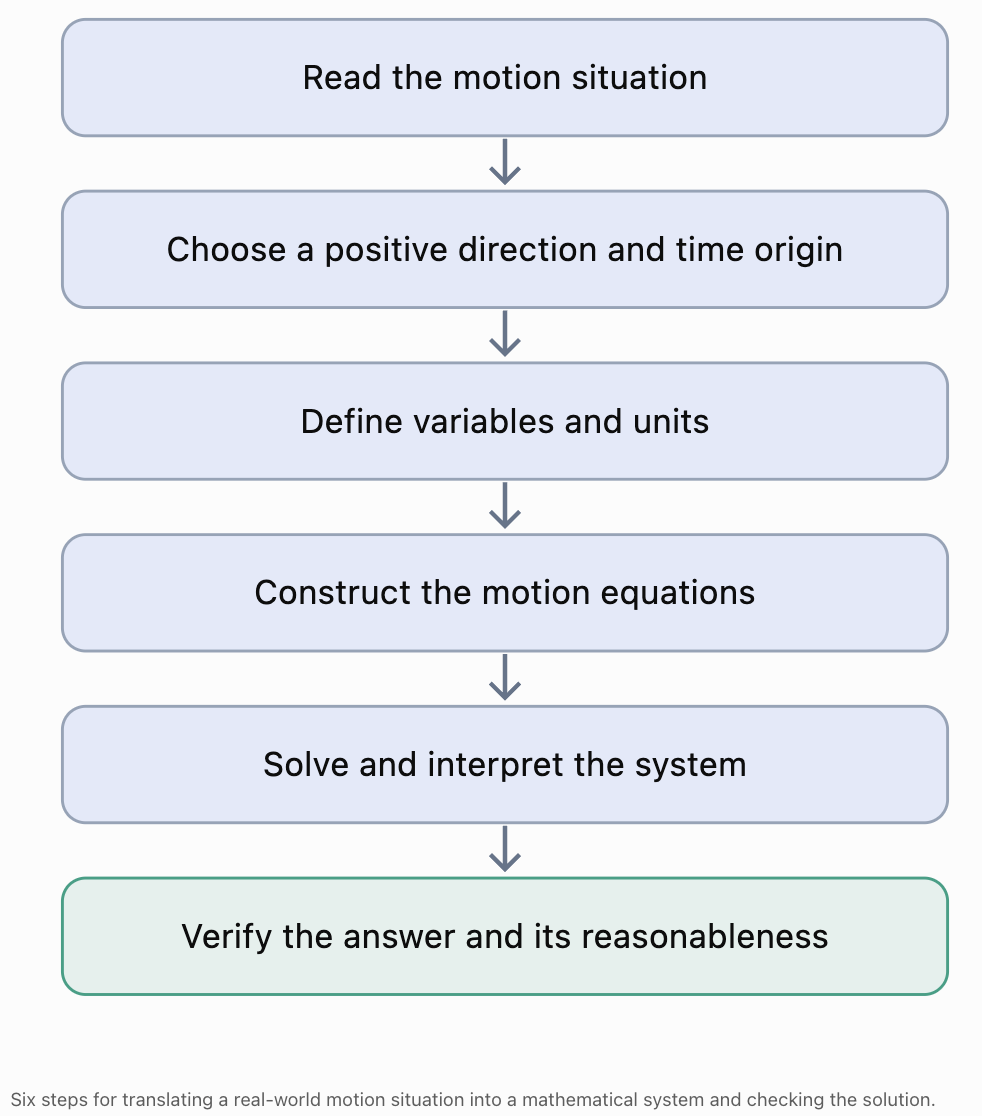
The equations should always reflect the physical situation.
A system may be solved correctly algebraically but still produce an unreasonable answer if the original motion relationships were constructed incorrectly.
Worked Example: Two Cyclists Travelling Towards Each Other
Two cyclists start at the same time from towns 180 km apart.
Cyclist A travels at 40 km/h.
Cyclist B travels at 50 km/h.
They travel towards each other.
How long will it take them to meet, and how far does each cyclist travel?
Step 1: Define variables
t = time until meeting, in hours
d₁ = distance travelled by Cyclist A, in kilometres
d₂ = distance travelled by Cyclist B, in kilometres
Step 2: Write the distance equations
Cyclist A:
d₁ = 40t
Cyclist B:
d₂ = 50t
Since the cyclists travel towards each other:
d₁ + d₂ = 180
Step 3: Solve
Substitute:
40t + 50t = 180
90t = 180
t = 2
Step 4: Calculate distances
Cyclist A:
d₁ = 40(2) = 80 km
Cyclist B:
d₂ = 50(2) = 100 km
Step 5: Interpret
The cyclists meet after 2 hours.
Cyclist A travels 80 km.
Cyclist B travels 100 km.
Step 6: Verify
80 + 100 = 180 km
Both cyclists travel for 2 hours.
Their distances match their speeds.
Answer: They meet after 2 hours, 80 km from Cyclist A's starting point.
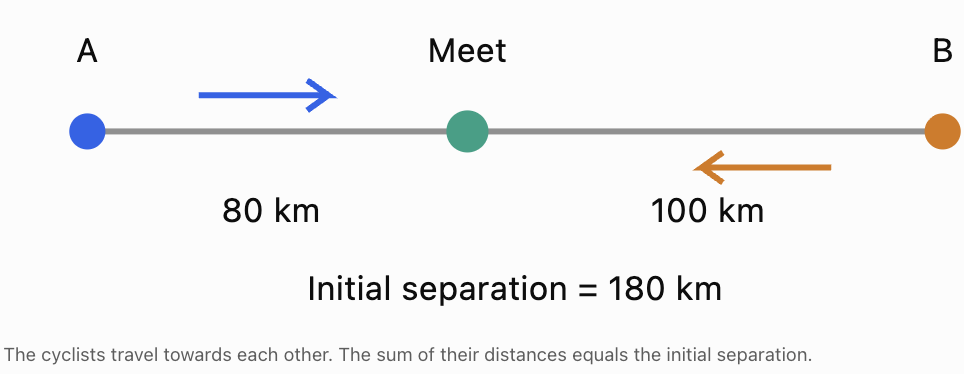
Worked Example: A Faster Car Catching a Slower Car
Car A starts from a town and travels at 60 km/h.
One hour later, Car B leaves the same town travelling in the same direction at 90 km/h.
How long after Car B starts will it catch Car A?
Step 1: Identify the important information
Car A has a one-hour head start.
During that hour, Car A travels:
60 × 1 = 60 km
Therefore, when Car B starts, Car A is already 60 km ahead.
Step 2: Define variables
t = time after Car B starts, in hours
d = distance from the town, in kilometres
Step 3: Write position equations
Car A:
d = 60t + 60
Car B:
d = 90t
At the catch-up point, both cars have the same position.
Step 4: Solve the system
60t + 60 = 90t
60 = 30t
t = 2
Step 5: Find the meeting position
Car B:
d = 90(2)
d = 180 km
Car A:
d = 60(2) + 60
d = 180 km
Step 6: Interpret
Car B catches Car A 2 hours after Car B starts.
This is 3 hours after Car A starts.
They meet 180 km from the town.
Step 7: Verify
Car A:
60 km/h × 3 h = 180 km
Car B:
90 km/h × 2 h = 180 km
Both reach the same position.
Answer: Car B catches Car A after 2 hours, 180 km from the starting town.
Understanding Relative Speed
Relative speed describes how quickly the separation between two objects changes.
Moving towards each other
If two objects move towards each other, their closing speed is the sum of their speeds.
Relative speed = v₁ + v₂
For the cyclists:
40 + 50 = 90 km/h
Time to meet:
180/90 = 2 hours
Moving in the same direction
If a faster object follows a slower object, the closing speed is the difference between their speeds.
Relative speed = Faster speed − Slower speed
For the cars:
90 − 60 = 30 km/h
Initial separation:
60 km
Catch-up time:
60/30 = 2 hours
Relative speed provides a shortcut, but it comes from the same equations used in the system.
Worked Example: Two Trains Travelling Towards Each Other
Two trains depart simultaneously from stations 420 km apart.
Train A travels at 80 km/h.
Train B travels at 60 km/h.
They travel towards each other.
Find the meeting time and location.
Step 1: Define variables
t = time after departure, in hours
x = position measured from Station A, in kilometres
Take the direction from Station A towards Station B as positive.
Step 2: Write position equations
Train A begins at x = 0 and travels in the positive direction:
x = 80t
Train B begins at x = 420 and travels in the negative direction:
x = 420 − 60t
Step 3: Solve
At the meeting point:
80t = 420 − 60t
140t = 420
t = 3
Step 4: Calculate position
x = 80(3)
x = 240 km
Step 5: Verify
Train A travels:
80 × 3 = 240 km
Train B travels:
60 × 3 = 180 km
Total:
240 + 180 = 420 km
Answer: The trains meet after 3 hours, 240 km from Station A and 180 km from Station B.
Worked Example: Two Objects with Different Starting Positions
Two objects move along the same straight track.
Object A starts at position 10 m and moves at 4 m/s.
Object B starts at position 70 m and moves towards Object A at 6 m/s.
When and where do they meet?
Step 1: Define variables
t = time in seconds
x = position in metres
Choose the direction from Object A towards Object B as positive.
Step 2: Write position equations
Object A:
x = 10 + 4t
Object B:
x = 70 − 6t
Step 3: Solve
10 + 4t = 70 − 6t
10t = 60
t = 6
Step 4: Calculate position
x = 10 + 4(6)
x = 34 m
Check Object B:
x = 70 − 6(6)
x = 34 m
Interpretation
The objects meet after 6 seconds at position 34 m.
Answer: t = 6 s; x = 34 m.
Graphing Motion Systems
Position-time graphs are especially useful for visualising systems of motion equations.
Consider the previous example:
Object A:
x = 10 + 4t
Object B:
x = 70 − 6t
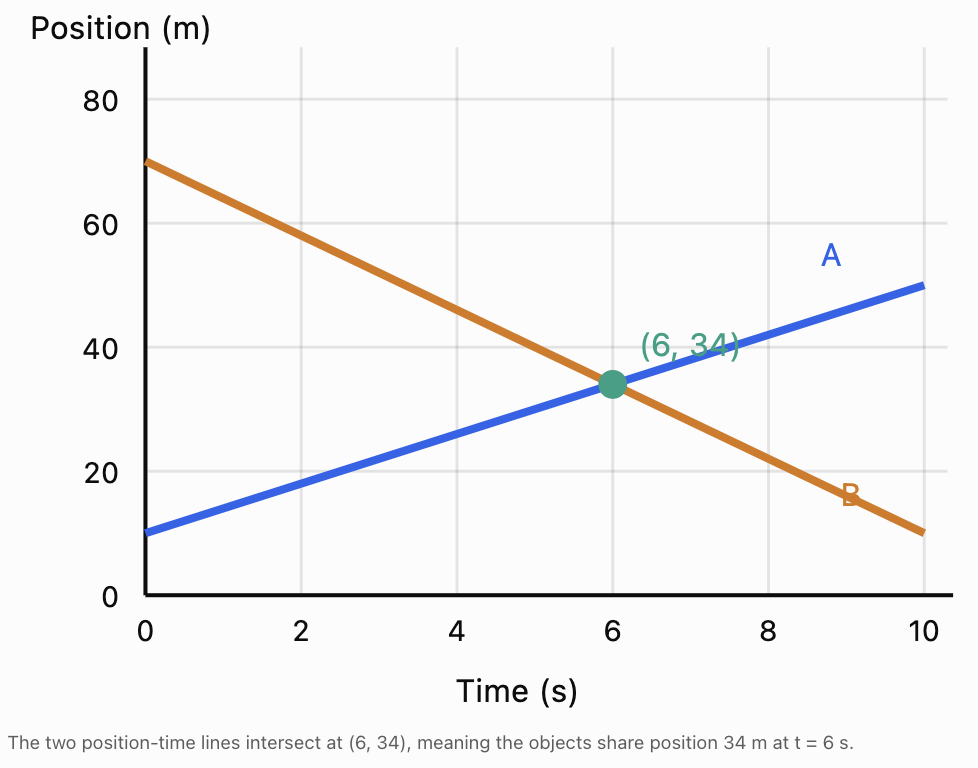
Interpreting the graph
-
The slope of each line represents velocity.
-
A positive slope represents motion in the chosen positive direction.
-
A negative slope represents motion in the opposite direction.
-
The vertical intercept represents initial position.
-
The intersection represents the meeting time and position.
The intersection is a solution to both equations.
Worked Example: Finding Two Unknown Speeds
Two cyclists travel towards each other from towns 150 km apart.
They meet after 2 hours.
Cyclist A travels 15 km/h faster than Cyclist B.
Find their speeds.
Step 1: Define variables
x = speed of Cyclist A in km/h
y = speed of Cyclist B in km/h
Step 2: Write the speed relationship
Cyclist A travels 15 km/h faster:
x − y = 15
Step 3: Write the distance relationship
They travel for 2 hours and cover a combined distance of 150 km.
2x + 2y = 150
Divide by 2:
x + y = 75
Step 4: Solve using elimination
x − y = 15
x + y = 75
Add:
2x = 90
x = 45
Then:
y = 75 − 45
y = 30
Step 5: Interpret
Cyclist A travels at 45 km/h.
Cyclist B travels at 30 km/h.
Step 6: Verify
Difference in speed:
45 − 30 = 15 km/h
Distances:
Cyclist A: 45 × 2 = 90 km
Cyclist B: 30 × 2 = 60 km
Total:
90 + 60 = 150 km
Answer: Cyclist A = 45 km/h; Cyclist B = 30 km/h.
This example is particularly important because the unknown quantities are speeds rather than times or distances.
Worked Example: Journey at Two Different Speeds
A delivery driver travels a total of 180 km.
Part of the journey is completed at 60 km/h.
The remaining distance is completed at 90 km/h.
The total driving time is 2.5 hours.
Find the distance travelled at each speed.
Step 1: Define variables
x = distance travelled at 60 km/h, in kilometres
y = distance travelled at 90 km/h, in kilometres
Step 2: Write the distance equation
x + y = 180
Step 3: Write the time equation
Time = Distance / Speed
Time at 60 km/h:
x/60
Time at 90 km/h:
y/90
Total time:
x/60 + y/90 = 2.5
Step 4: Eliminate fractions
Multiply the second equation by 180:
3x + 2y = 450
The system is:
x + y = 180
3x + 2y = 450
Step 5: Solve
Multiply the first equation by 2:
2x + 2y = 360
Subtract:
x = 90
Then:
y = 180 − 90
y = 90
Step 6: Verify
Total distance:
90 + 90 = 180 km
Total time:
90/60 + 90/90
= 1.5 + 1
= 2.5 hours
Answer: 90 km at 60 km/h and 90 km at 90 km/h.
Important distinction
The driver spends different amounts of time travelling at the two speeds.
Time at 60 km/h = 1.5 hours
Time at 90 km/h = 1 hour
Although the distances are equal, the times are not.
Worked Example: A Boat Travelling Upstream and Downstream
A boat travels along a river.
Its speed in still water is unknown.
The river current also has an unknown speed.
The boat travels downstream at 18 km/h and upstream at 10 km/h.
Find the boat's speed in still water and the speed of the current.
Step 1: Define variables
b = boat speed in still water, in km/h
c = river current speed, in km/h
Step 2: Write equations
When travelling downstream, the current helps the boat:
b + c = 18
When travelling upstream, the current opposes the boat:
b − c = 10
Step 3: Solve using elimination
Add the equations:
(b + c) + (b − c) = 18 + 10
2b = 28
b = 14
Substitute:
14 + c = 18
c = 4
Step 4: Interpret
Boat speed in still water:
14 km/h
River current speed:
4 km/h
Step 5: Verify
Downstream speed:
14 + 4 = 18 km/h
Upstream speed:
14 − 4 = 10 km/h
Answer: Boat speed = 14 km/h; current speed = 4 km/h.
Worked Example: Round Trip with Different Speeds
A boat travels 24 km downstream and then returns 24 km upstream.
The downstream journey takes 1 hour.
The upstream journey takes 2 hours.
Find the boat's speed in still water and the river current speed.
Step 1: Calculate the travel speeds
Downstream:
v = 24/1 = 24 km/h
Upstream:
v = 24/2 = 12 km/h
Step 2: Define variables
b = boat speed in still water
c = current speed
Step 3: Construct the system
b + c = 24
b − c = 12
Step 4: Solve
Add:
2b = 36
b = 18
Then:
c = 24 − 18
c = 6
Step 5: Verify
Downstream:
18 + 6 = 24 km/h
Upstream:
18 − 6 = 12 km/h
Travel times:
24/24 = 1 hour
24/12 = 2 hours
Answer: Boat speed = 18 km/h; current speed = 6 km/h.
Worked Example: Aircraft and Wind Speed
An aircraft travels at 650 km/h relative to the air.
With a tailwind, its ground speed is 720 km/h.
What is the wind speed?
Let:
a = aircraft speed relative to the air
w = wind speed
For a tailwind:
a + w = 720
Given:
a = 650
Substitute:
650 + w = 720
w = 70
Answer: The tailwind speed is 70 km/h.
Now suppose the aircraft's speed relative to the air is unknown, but its ground speed is:
-
720 km/h with a tailwind.
-
580 km/h with an equal-strength headwind.
Then:
a + w = 720
a − w = 580
Add:
2a = 1300
a = 650
Then:
w = 70
Answer: Aircraft airspeed = 650 km/h; wind speed = 70 km/h.
This simplified model assumes the aircraft flies directly along or against a steady wind.
Worked Example: Two Runners on a Circular Track
Two runners start together at the same point on a 400 m circular track.
They run in the same direction.
Runner A runs at 6 m/s.
Runner B runs at 4 m/s.
When will Runner A first lap Runner B?
Step 1: Identify the important relationship
Runner A must travel one complete lap farther than Runner B.
Therefore:
Distance A − Distance B = 400 m
Step 2: Define variables
t = time in seconds
d₁ = distance travelled by Runner A
d₂ = distance travelled by Runner B
Step 3: Construct equations
d₁ = 6t
d₂ = 4t
d₁ − d₂ = 400
Step 4: Solve
6t − 4t = 400
2t = 400
t = 200
Step 5: Verify
Runner A travels:
6(200) = 1200 m
Runner B travels:
4(200) = 800 m
Difference:
1200 − 800 = 400 m
Answer: Runner A first laps Runner B after 200 seconds, or 3 minutes 20 seconds.
This example shows how relative speed can be used for circular motion when both runners maintain constant speeds.
Worked Example: Determining Whether Two Objects Will Meet
Two cars travel along the same straight road.
Car A starts at position 20 km and travels at 60 km/h.
Car B starts at position 100 km and travels at 80 km/h.
Both travel in the same direction.
Will Car A ever catch Car B after the start of the observation?
Step 1: Write position equations
Car A:
x = 20 + 60t
Car B:
x = 100 + 80t
Step 2: Solve the system
20 + 60t = 100 + 80t
−80 = 20t
t = −4
Step 3: Interpret
The algebraic intersection occurs at t = −4 hours.
However, t represents time after the observation begins.
Therefore, the practical domain is:
t ≥ 0
A negative meeting time lies outside the relevant domain.
Physical explanation
Car B starts ahead of Car A and travels faster.
The separation increases rather than decreases.
Answer: Car A will not catch Car B after the observation begins.
This is an important example of a mathematically valid intersection that does not represent a future meeting.
Solving Motion Problems Using Graphs
Graphs are useful because they show how motion changes over time.
For constant-velocity motion, the position-time graph is a straight line.
The general equation is:
x = x₀ + vt
This has the same mathematical structure as:
y = mx + b
The correspondence is:
|
Linear graph feature |
Motion interpretation |
|---|---|
|
x-axis |
Time |
|
y-axis |
Position |
|
Slope |
Velocity |
|
y-intercept |
Initial position |
|
Intersection |
Same position at the same time |
|
Parallel lines |
Equal velocities |
|
Coincident lines |
Same position at every time |
Parallel position-time graphs
Suppose:
Object A:
x = 5t + 10
Object B:
x = 5t + 30
Both objects move at 5 m/s.
Their initial positions differ by 20 m.
The graphs are parallel.
The objects never meet because they maintain a constant separation of 20 m.
Coincident position-time graphs
Suppose:
Object A:
x = 5t + 10
Object B:
2x = 10t + 20
Simplify Object B:
x = 5t + 10
The equations are identical.
Both objects have the same position at every time in the model.
Their position-time graphs are coincident.
Intersecting position-time graphs
Suppose:
Object A:
x = 4t + 10
Object B:
x = 2t + 30
Set equal:
4t + 10 = 2t + 30
2t = 20
t = 10
Position:
x = 4(10) + 10
x = 50 m
The objects meet after 10 seconds at position 50 m.
Choosing the Correct Equations
Different motion problems require different relationships.
|
Situation |
Useful relationship |
|---|---|
|
Constant speed |
d = vt |
|
Constant velocity |
x = x₀ + vt |
|
Moving towards each other |
d₁ + d₂ = initial separation |
|
Catching up |
x₁ = x₂ |
|
Same starting point, opposite directions |
Separation = d₁ + d₂ |
|
Two-stage journey |
d₁ + d₂ = total distance |
|
Two-stage travel time |
t₁ + t₂ = total time |
|
Boat downstream |
b + c = downstream speed |
|
Boat upstream |
b − c = upstream speed |
|
Aircraft with tailwind |
a + w = ground speed |
|
Aircraft with headwind |
a − w = ground speed |
These equations are useful starting points, but the exact system must always match the situation described.
Interpreting Motion Solutions
A solution should always include the correct units.
For example, if a system produces:
t = 4
x = 240
and t is measured in hours while x is measured in kilometres, the interpretation is:
"The objects meet after 4 hours at position 240 km."
Simply writing "(4, 240)" is incomplete because it does not explain the physical meaning.
Important questions
After solving, ask:
-
Does the time represent seconds, minutes, or hours?
-
Is the position measured from the correct starting point?
-
Is the direction correct?
-
Is the time positive?
-
Does the object travel a realistic distance?
-
Does the solution satisfy both motion equations?
-
Does the solution occur within the stated time interval?
These questions help distinguish a correct mathematical calculation from a meaningful physical answer.
Checking Whether Answers Are Reasonable
Checking travel time
If two objects start 100 km apart and approach each other at a combined speed of 50 km/h, they should meet after:
100/50 = 2 hours
An answer of 20 hours would be unreasonable.
Checking meeting position
If two objects meet between towns 200 km apart, the distances travelled towards each other should add to 200 km.
Checking speed
If a car travels 120 km in 2 hours, its average speed is:
120/2 = 60 km/h
A result of 600 km/h would suggest an error in the calculation or units.
Checking negative values
Negative position can be valid if the coordinate system allows it.
Negative velocity can also be valid because it indicates direction.
However, negative elapsed time is generally not valid when the question asks about events after the starting moment.
Checking assumptions
Most introductory motion systems assume constant speeds or velocities.
In real life, vehicles accelerate, decelerate, stop, and change direction.
The model is useful only when its assumptions are reasonable for the situation.
Real-World Applications
Transport planning
Travel equations can estimate meeting times, journey durations, and distances.
They can help compare routes and travel speeds.
Logistics and delivery
Businesses use motion models to estimate delivery times, vehicle positions, and travel schedules.
Sports
Relative speed can be used to study runners, cyclists, and racing vehicles.
Aviation
Aircraft ground speed depends on airspeed and wind velocity.
Marine transport
Boat speed relative to the ground depends on the boat's speed through water and the river current.
Physics and engineering
Position-time equations are used to model moving objects and understand their relative motion.
More advanced models include acceleration and nonlinear motion.
Common Mistakes
Confusing distance with displacement
Distance is the total path length, while displacement includes direction.
Confusing speed with velocity
Speed is scalar; velocity includes direction.
Using inconsistent units
For example, multiplying km/h by seconds without converting time will produce an incorrect result.
Forgetting a head start
If one object begins earlier, it may already be some distance ahead when the second starts.
Adding speeds when they should be subtracted
For objects moving towards each other, closing speed is usually the sum of speeds.
For objects moving in the same direction, closing speed is the difference.
Using the wrong sign for velocity
Motion in the negative direction should have negative velocity in the position equation.
Confusing meeting time with total travel time
An object that starts earlier has travelled longer by the time the objects meet.
Assuming every algebraic intersection represents a future meeting
A negative meeting time may fall outside the problem's domain.
Ignoring initial positions
The equation x = vt applies when the initial position is zero.
Otherwise, use x = x₀ + vt.
Failing to verify
Always substitute the answer into both original motion equations.
Key Terms
-
Motion: A change in position over time.
-
Distance: The total length of the path travelled.
-
Displacement: The change in position, including direction.
-
Speed: Distance travelled per unit time.
-
Velocity: Rate of change of displacement.
-
Average speed: Total distance divided by total time.
-
Constant speed: Motion in which speed does not change.
-
Constant velocity: Motion with unchanged speed and direction.
-
Position: Location relative to a chosen reference point.
-
Initial position: Position at the starting time.
-
Relative speed: The rate at which separation between objects changes.
-
Closing speed: The rate at which two objects approach each other.
-
Meeting point: The position where two objects occupy the same location at the same time.
-
Catch-up time: The time required for a faster object to reach a slower object.
-
Position-time graph: A graph showing position as a function of time.
-
Slope: The gradient of a line; velocity on a position-time graph.
-
System of equations: Two or more equations solved simultaneously.
-
Substitution: Solving by replacing one variable with an equivalent expression.
-
Elimination: Solving by combining equations to remove a variable.
-
Domain: The set of allowed input values.
-
Verification: Checking that the answer satisfies the original conditions.
Key Takeaways
-
Motion problems can be represented using systems of linear equations.
-
The fundamental relationship is d = vt.
-
Constant-velocity position equations take the form x = x₀ + vt.
-
Variables must be clearly defined with appropriate units.
-
Objects moving towards each other have a closing speed equal to the sum of their speeds.
-
Objects moving in the same direction may have a closing speed equal to the difference between their speeds.
-
A meeting point occurs when two objects have the same position at the same time.
-
Position-time graphs allow motion systems to be interpreted visually.
-
The slope of a position-time graph represents velocity.
-
Substitution and elimination can determine unknown speeds, times, and positions.
-
Solutions must be interpreted using the original context.
-
Every answer should be verified for mathematical correctness and physical reasonableness.
Check Your Understanding
Recall and Understanding
1. State the relationship between distance, speed, and time.
2. Explain the difference between distance and displacement.
3. Why must units be consistent when solving motion problems?
4. What does the intersection of two position-time graphs represent?
5. Explain the difference between relative speed for objects moving towards each other and objects moving in the same direction.
Application
6. Two cyclists start 120 km apart and travel towards each other at 25 km/h and 35 km/h. How long will it take them to meet, and how far will each cyclist travel?
7. A car travels at 70 km/h. Another car starts from the same location 2 hours later at 105 km/h. How long after the second car starts will it catch the first car?
8. Two trains start 360 km apart and travel towards each other at 80 km/h and 100 km/h. Determine their meeting time and the distance travelled by each train.
9. A boat travels downstream at 24 km/h and upstream at 16 km/h. Find the boat's speed in still water and the river current speed.
10. A driver travels 240 km. Part of the journey is completed at 60 km/h and the remainder at 80 km/h. The total driving time is 3.5 hours. Find the distance travelled at each speed.
Analysis and Challenge
11. Two runners start at the same point on a 400 m circular track and run in the same direction at 7 m/s and 5 m/s. When will the faster runner first lap the slower runner?
12. Two objects move according to:
x = 15 + 6t
x = 75 − 4t
Find the meeting time and position.
13. Two vehicles travel in the same direction:
Vehicle A: x = 20 + 50t
Vehicle B: x = 100 + 70t
Determine whether Vehicle A catches Vehicle B for t ≥ 0.
14. Two cyclists travel towards each other from towns 210 km apart. They meet after 3 hours. One cyclist travels 10 km/h faster than the other. Find their speeds.
15. An aircraft travels at 760 km/h with a tailwind and 640 km/h against a headwind of the same magnitude. Find its speed relative to the air and the wind speed.
Answers to Check Your Understanding
1.
Distance = Speed × Time
d = vt
2. Distance is the total path length travelled. Displacement is the change in position and includes direction.
3. Units must be consistent so that the calculated quantities have the correct dimensions. For example, km/h multiplied by hours gives kilometres.
4. The intersection represents the time and position at which two objects occupy the same location.
5. When objects move towards each other, the closing speed is the sum of their speeds. When they move in the same direction, the closing speed is the difference between their speeds, provided the faster object is behind.
6.
Combined speed:
25 + 35 = 60 km/h
Meeting time:
t = 120/60 = 2 hours
Distances:
Cyclist A:
25(2) = 50 km
Cyclist B:
35(2) = 70 km
Verification:
50 + 70 = 120 km
Answer: They meet after 2 hours. The cyclists travel 50 km and 70 km.
7.
The first car's head start is:
70 × 2 = 140 km
Let t = time after the second car starts.
First car position:
d = 70t + 140
Second car position:
d = 105t
Set equal:
70t + 140 = 105t
140 = 35t
t = 4
Answer: The second car catches the first after 4 hours, or 6 hours after the first car departed.
Verification:
First car: 70 × 6 = 420 km
Second car: 105 × 4 = 420 km
8.
Combined speed:
80 + 100 = 180 km/h
Meeting time:
t = 360/180 = 2 hours
Train A distance:
80 × 2 = 160 km
Train B distance:
100 × 2 = 200 km
Answer: They meet after 2 hours, having travelled 160 km and 200 km.
9.
Let b = boat speed in still water and c = current speed.
b + c = 24
b − c = 16
Add:
2b = 40
b = 20
Then:
c = 4
Answer: Boat speed = 20 km/h; current speed = 4 km/h.
10.
Let x = distance at 60 km/h and y = distance at 80 km/h.
x + y = 240
x/60 + y/80 = 3.5
Multiply the second equation by 240:
4x + 3y = 840
Multiply the first equation by 3:
3x + 3y = 720
Subtract:
x = 120
Then:
y = 120
Verification:
120/60 + 120/80
= 2 + 1.5
= 3.5 hours
Answer: 120 km at each speed.
11.
Relative speed:
7 − 5 = 2 m/s
The faster runner must gain one full lap:
400 m
Time:
t = 400/2
t = 200 seconds
Answer: 200 seconds, or 3 minutes 20 seconds.
12.
Set positions equal:
15 + 6t = 75 − 4t
10t = 60
t = 6 seconds
Position:
x = 15 + 6(6)
x = 51 m
Verification:
75 − 4(6) = 51 m
Answer: They meet after 6 seconds at position 51 m.
13.
Set positions equal:
20 + 50t = 100 + 70t
−80 = 20t
t = −4
The solution lies outside the domain t ≥ 0.
Vehicle B starts ahead and moves faster.
Answer: Vehicle A never catches Vehicle B after the observation begins.
14.
Let x = faster speed and y = slower speed.
Speed difference:
x − y = 10
Combined distance:
3x + 3y = 210
Divide by 3:
x + y = 70
Add equations:
2x = 80
x = 40
Then:
y = 30
Verification:
40 − 30 = 10 km/h
3(40) + 3(30) = 120 + 90 = 210 km
Answer: The cyclists travel at 40 km/h and 30 km/h.
15.
Let a = aircraft speed relative to the air and w = wind speed.
With tailwind:
a + w = 760
Against headwind:
a − w = 640
Add:
2a = 1400
a = 700
Substitute:
700 + w = 760
w = 60
Verification:
700 + 60 = 760 km/h
700 − 60 = 640 km/h
Answer: Aircraft airspeed = 700 km/h; wind speed = 60 km/h.
Final Summary
Distance, speed, and motion problems demonstrate how systems of equations can model moving objects and predict when and where they meet.
By combining the relationship d = vt with position equations and information about direction, starting positions, and travel times, we can solve a wide variety of practical problems.
These methods are useful in transport, logistics, sports, aviation, marine travel, and physics.
The central principle is that two objects meet when they occupy the same position at the same time. Systems of equations allow us to determine exactly when and where that happens, provided the model's assumptions are satisfied.