Special Systems and Applications
3. Mixture Problems
Learning outcomes
- I can represent mixture situations using equations.
- I can construct systems from mixture problems.
- I can solve mixture problems using algebra.
- I can interpret solutions in context.
- I can verify my answers.
Introduction
Many real-world situations involve combining two or more substances, products, or quantities to create a mixture with specific properties.
For example:
-
A laboratory combines two salt solutions to produce a solution with a desired concentration.
-
A juice company mixes drinks containing different percentages of fruit juice.
-
A coffee shop blends two types of coffee beans with different prices.
-
A metal manufacturer combines alloys containing different percentages of copper.
-
A farmer mixes two fertilizers to obtain a particular nutrient concentration.
-
A business combines products of different values to create a mixture with a target average price.
These situations can often be solved using systems of linear equations.
Mixture problems require us to consider two important relationships:
-
The total amount of the mixture.
-
The amount of a particular substance or the total value contributed by each component.
By translating these relationships into equations, we can determine how much of each ingredient is required.
Mixture problems are an important application of algebra because they connect mathematical equations to chemistry, manufacturing, agriculture, food production, and business.
What Is a Mixture Problem?
A mixture problem is a mathematical problem involving two or more quantities that are combined to produce a desired total amount, concentration, or average value.
Suppose we combine:
-
4 litres of a 20% salt solution.
-
6 litres of a 40% salt solution.
The resulting mixture has a total volume of:
4 + 6 = 10 litres
However, the final concentration is not found by simply adding the percentages.
20% + 40% = 60% is incorrect.
Instead, we must calculate how much salt each solution contributes.
Salt in the first solution:
0.20 × 4 = 0.8 litres of salt-equivalent volume
Salt in the second solution:
0.40 × 6 = 2.4 litres
Total salt:
0.8 + 2.4 = 3.2 litres
Final concentration:
3.2/10 × 100% = 32%
The resulting mixture is 32% salt.
This calculation assumes the percentages are volume-based and the volumes are additive. In real chemistry, volume changes during mixing may need to be considered.
The central principle is that the total amount of a component in the final mixture equals the sum of the amounts contributed by the ingredients, provided none is added, removed, or transformed during mixing.
Understanding Concentration
Concentration describes how much of a particular substance is present in a mixture or solution.
It can be expressed in different ways.
Examples include:
-
Percentage by mass.
-
Percentage by volume.
-
Mass per unit volume.
-
Molar concentration.
-
Parts per million.
In introductory algebra mixture problems, concentration is often expressed as a percentage.
Percentage concentration
A percentage tells us how much of a substance is present in every 100 units of the mixture.
For example:
A 25% salt solution contains 25 units of salt per 100 units of solution, using the specified concentration basis.
If we are working with mass percentages:
25% by mass means 25 g of salt in 100 g of solution.
If we are working with volume percentages:
25% by volume means 25 mL of a component per 100 mL of final solution.
Converting percentages into decimals
Before constructing equations, convert percentages into decimals.
|
Percentage |
Decimal |
|---|---|
|
5% |
0.05 |
|
10% |
0.10 |
|
15% |
0.15 |
|
20% |
0.20 |
|
25% |
0.25 |
|
40% |
0.40 |
|
60% |
0.60 |
|
75% |
0.75 |
|
100% |
1.00 |
For example:
20% of 50 litres = 0.20 × 50 = 10 litres
The decimal form is generally easier to use in equations.
The Fundamental Mixture Relationship
The most important relationship is:
Amount of substance = Concentration × Total amount
For example, if a solution contains 30% salt and has a volume of 8 litres:
Salt amount = 0.30 × 8
Salt amount = 2.4 litres, when concentration is expressed by volume and volumes are additive.
For mass-based concentration, the same structure applies using mass units.
General mixture equation
Suppose two solutions are combined.
Let:
-
x = amount of Solution A.
-
y = amount of Solution B.
-
c₁ = concentration of Solution A.
-
c₂ = concentration of Solution B.
-
c₃ = desired final concentration.
Then:
x + y = T
where T is the total amount of the final mixture.
The substance-balance equation is:
c₁x + c₂y = c₃T
Together, these form a system:
x + y = T
c₁x + c₂y = c₃T
These equations are the foundation of many mixture problems.
Visualising a Mixture Problem
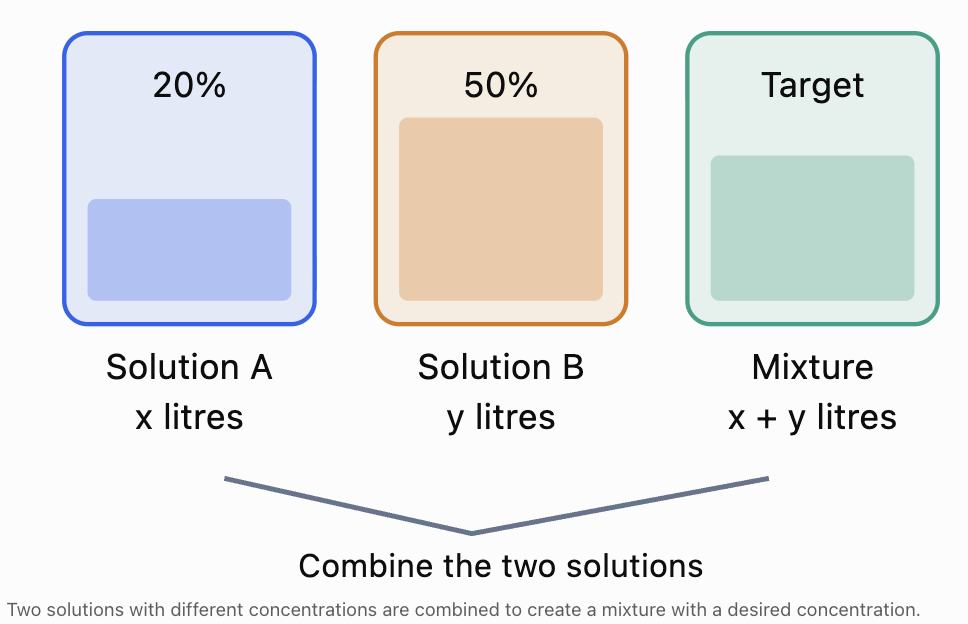
The total volume equation describes how much mixture is produced.
The concentration equation describes how much of the relevant substance is present.
Both equations must be satisfied simultaneously.
Identifying Variables in Mixture Problems
The first step is defining the unknown quantities.
Consider:
"A laboratory needs 12 litres of a 35% solution. It has 20% and 50% solutions available."
We need to determine how much of each solution to use.
Define:
x = litres of 20% solution
y = litres of 50% solution
The total volume equation is:
x + y = 12
The concentration equation is:
0.20x + 0.50y = 0.35(12)
Simplify:
0.20x + 0.50y = 4.2
Our system is:
x + y = 12
0.20x + 0.50y = 4.2
The next step is solving the system.
Worked Example: Mixing Salt Solutions
A laboratory needs to prepare 12 litres of a 35% salt solution.
It has:
-
A 20% salt solution.
-
A 50% salt solution.
How many litres of each should be mixed?
Step 1: Define variables
x = volume of 20% solution in litres
y = volume of 50% solution in litres
Step 2: Write the total volume equation
x + y = 12
Step 3: Write the salt-content equation
Salt contributed by the 20% solution:
0.20x
Salt contributed by the 50% solution:
0.50y
Salt required in the final mixture:
0.35 × 12 = 4.2
Therefore:
0.20x + 0.50y = 4.2
Step 4: Solve using substitution
From the first equation:
x = 12 − y
Substitute into the second:
0.20(12 − y) + 0.50y = 4.2
Expand:
2.4 − 0.20y + 0.50y = 4.2
Combine:
2.4 + 0.30y = 4.2
Subtract 2.4:
0.30y = 1.8
Divide:
y = 6
Then:
x = 12 − 6
x = 6
Step 5: Interpret
Use:
-
6 litres of the 20% solution.
-
6 litres of the 50% solution.
Step 6: Verify
Total volume:
6 + 6 = 12 litres
Salt amount:
0.20(6) + 0.50(6)
= 1.2 + 3.0
= 4.2 litres
Final concentration:
4.2/12 × 100% = 35%
Both conditions are satisfied.
Answer: Mix 6 L of the 20% solution with 6 L of the 50% solution.
Worked Example: Mixing Fruit Juice
A juice company wants to produce 20 litres of a drink containing 45% fruit juice.
It has two mixtures available:
-
Drink A contains 30% fruit juice.
-
Drink B contains 70% fruit juice.
How much of each drink should be combined?
Step 1: Define variables
x = volume of 30% drink in litres
y = volume of 70% drink in litres
Step 2: Write the total volume equation
x + y = 20
Step 3: Write the fruit juice equation
Fruit juice contributed by Drink A:
0.30x
Fruit juice contributed by Drink B:
0.70y
The final mixture must contain:
0.45 × 20 = 9 litres of fruit juice
Therefore:
0.30x + 0.70y = 9
Step 4: Solve
From the first equation:
x = 20 − y
Substitute:
0.30(20 − y) + 0.70y = 9
6 − 0.30y + 0.70y = 9
6 + 0.40y = 9
0.40y = 3
y = 7.5
Then:
x = 20 − 7.5
x = 12.5
Step 5: Interpret
The company should mix:
-
12.5 L of the 30% drink.
-
7.5 L of the 70% drink.
Step 6: Verify
Total volume:
12.5 + 7.5 = 20 L
Fruit juice:
0.30(12.5) + 0.70(7.5)
= 3.75 + 5.25
= 9 L
Concentration:
9/20 × 100% = 45%
Answer: 12.5 L of the 30% drink and 7.5 L of the 70% drink.
Worked Example: Mixing Coffee Beans
Not every mixture problem involves percentages.
Some involve prices or average values.
A coffee shop wants to produce 15 kg of a coffee blend costing $18 per kilogram.
Two varieties are available:
-
Coffee A costs $12 per kilogram.
-
Coffee B costs $22 per kilogram.
How many kilograms of each variety should be used?
Step 1: Define variables
x = mass of $12/kg coffee in kilograms
y = mass of $22/kg coffee in kilograms
Step 2: Write the mass equation
x + y = 15
Step 3: Write the value equation
The total value of the desired blend is:
18 × 15 = $270
The individual contributions are:
12x and 22y
Therefore:
12x + 22y = 270
Step 4: Solve using elimination
Multiply the first equation by 12:
12x + 12y = 180
Subtract this equation from the value equation:
(12x + 22y) − (12x + 12y) = 270 − 180
10y = 90
y = 9
Substitute:
x + 9 = 15
x = 6
Step 5: Interpret
The shop should combine:
-
6 kg of $12/kg coffee.
-
9 kg of $22/kg coffee.
Step 6: Verify
Total mass:
6 + 9 = 15 kg
Total value:
12(6) + 22(9)
= 72 + 198
= $270
Average price:
270/15 = $18/kg
Answer: 6 kg of Coffee A and 9 kg of Coffee B.
This example assumes that the blend's unit value is the weighted average of the ingredient prices, with no additional costs.
Weighted Averages in Mixture Problems
The coffee example illustrates a general mathematical principle called a weighted average.
A weighted average accounts for the different amounts of each component.
For two ingredients:
Average value = (v₁x + v₂y)/(x + y)
where:
-
v₁ = value per unit of the first ingredient.
-
v₂ = value per unit of the second ingredient.
-
x = amount of the first ingredient.
-
y = amount of the second ingredient.
For the coffee blend:
Average price = [12(6) + 22(9)]/(6 + 9)
= 270/15
= $18/kg
Why an ordinary average may be incorrect
The ordinary average of $12 and $22 is:
(12 + 22)/2 = $17
However, the blend contains more of the expensive coffee than the cheaper coffee.
Therefore, its average price is $18/kg, not $17/kg.
An ordinary average is appropriate only when the two ingredients contribute equal amounts.
Worked Example: Mixing Metal Alloys
A manufacturer wants to produce 40 kg of an alloy containing 65% copper by mass.
Two alloys are available:
-
Alloy A contains 50% copper.
-
Alloy B contains 80% copper.
How much of each alloy should be used?
Step 1: Define variables
x = mass of 50% copper alloy in kilograms
y = mass of 80% copper alloy in kilograms
Step 2: Write the total mass equation
x + y = 40
Step 3: Write the copper mass equation
The final alloy must contain:
0.65 × 40 = 26 kg of copper
Therefore:
0.50x + 0.80y = 26
Step 4: Solve
Substitute x = 40 − y:
0.50(40 − y) + 0.80y = 26
20 − 0.50y + 0.80y = 26
0.30y = 6
y = 20
Then:
x = 40 − 20
x = 20
Step 5: Verify
Total mass:
20 + 20 = 40 kg
Copper mass:
0.50(20) + 0.80(20)
= 10 + 16
= 26 kg
Copper percentage:
26/40 × 100% = 65%
Answer: 20 kg of each alloy.
Worked Example: Adding Pure Water
Some mixture problems involve adding a substance with a concentration of zero.
Suppose we have 8 litres of a 50% sugar solution.
How much pure water must be added to reduce the concentration to 20%?
Step 1: Identify the important quantities
Initial solution:
8 L at 50%
Pure water:
0% sugar
Final concentration:
20%
Step 2: Define variables
x = litres of water added
y = final volume in litres
Step 3: Write the total volume equation
8 + x = y
Step 4: Write the sugar-content equation
The original sugar amount is:
0.50 × 8 = 4 L
Pure water contributes no sugar.
Therefore:
4 = 0.20y
Step 5: Solve
4 = 0.20y
y = 20
Now:
8 + x = 20
x = 12
Step 6: Interpret
The original 8 L solution must be diluted with 12 L of water.
Step 7: Verify
Final volume:
8 + 12 = 20 L
Sugar amount:
4 L
Final concentration:
4/20 × 100% = 20%
Answer: Add 12 litres of pure water.
Important concept: Dilution
When pure water is added, the amount of dissolved sugar remains constant, assuming none is lost or reacts.
Only the total volume changes.
This explains why the concentration decreases.
Worked Example: Evaporation
Evaporation problems are slightly different because some of the solvent is removed.
Suppose a container holds 20 kg of a salt solution containing 15% salt by mass.
Water evaporates until the salt concentration reaches 25% by mass.
How much water evaporates?
Step 1: Find the original salt mass
Salt mass:
0.15 × 20 = 3 kg
Assume only water evaporates, so the salt mass remains 3 kg.
Step 2: Define variables
x = kilograms of water evaporated
y = final mass of the solution in kilograms
Step 3: Construct equations
Total mass:
20 − x = y
Final salt concentration:
0.25y = 3
Step 4: Solve
0.25y = 3
y = 12
Then:
20 − x = 12
x = 8
Step 5: Verify
Final solution mass:
20 − 8 = 12 kg
Salt mass remains:
3 kg
Final concentration:
3/12 × 100% = 25%
Answer: 8 kg of water must evaporate.
Notice that the amount of salt stays constant while the total mass decreases.
This is why evaporation increases the concentration.
Worked Example: A Three-Ingredient Mixture
Some mixture problems involve three unknown quantities.
These require additional information.
A manufacturer wants to produce 100 kg of a mixture using three ingredients.
The ingredients cost:
-
Ingredient A: $4/kg.
-
Ingredient B: $6/kg.
-
Ingredient C: $10/kg.
The desired average cost is $6.80/kg.
The manufacturer also requires twice as much Ingredient A as Ingredient C.
Find the amount of each ingredient.
Step 1: Define variables
x = mass of Ingredient A in kg
y = mass of Ingredient B in kg
z = mass of Ingredient C in kg
Step 2: Write the total mass equation
x + y + z = 100
Step 3: Write the total cost equation
The desired total value is:
6.80 × 100 = $680
Therefore:
4x + 6y + 10z = 680
Step 4: Write the additional condition
Twice as much Ingredient A as Ingredient C:
x = 2z
We now have three equations for three unknowns.
Step 5: Solve
Substitute x = 2z into the total mass equation:
2z + y + z = 100
y = 100 − 3z
Substitute both expressions into the cost equation:
4(2z) + 6(100 − 3z) + 10z = 680
8z + 600 − 18z + 10z = 680
600 = 680
This is a contradiction.
Step 6: Interpret
The three conditions cannot all be satisfied.
Why?
If x = 2z, then the combined average price of Ingredients A and C is:
[4(2z) + 10z]/(3z) = 18z/(3z) = $6/kg
Ingredient B also costs $6/kg.
Therefore, every mixture satisfying x = 2z has an average price of $6/kg, not $6.80/kg.
The original problem has no solution.
This demonstrates an important principle: not every mixture specification is mathematically possible.
Revised example
If the desired average price were $6/kg instead, the cost equation would be satisfied automatically whenever x = 2z and the total mass is 100 kg.
There would then be infinitely many nonnegative mixtures satisfying the conditions.
An additional independent condition would be needed to determine a unique mixture.
Using a Table to Organise Mixture Problems
A table is often helpful when translating a mixture problem into equations.
Consider the earlier example of producing 20 litres of a 45% fruit juice mixture from 30% and 70% drinks.
|
Component |
Amount (L) |
Concentration |
Fruit juice amount (L) |
|---|---|---|---|
|
Drink A |
x |
30% |
0.30x |
|
Drink B |
y |
70% |
0.70y |
|
Final mixture |
20 |
45% |
9 |
From the amount column:
x + y = 20
From the fruit juice column:
0.30x + 0.70y = 9
The table separates the total amount from the amount of the component being tracked.
This reduces the risk of confusing concentrations with actual quantities.
A General Formula for Two-Ingredient Mixtures
Suppose we mix two ingredients with concentrations:
c₁ and c₂
The desired concentration is:
cₜ
The final total amount is:
T
Let x be the amount of the first ingredient and y the amount of the second.
Our equations are:
x + y = T
c₁x + c₂y = cₜT
Substitute:
y = T − x
Then:
c₁x + c₂(T − x) = cₜT
Expand:
c₁x + c₂T − c₂x = cₜT
Group the x terms:
(c₁ − c₂)x = (cₜ − c₂)T
Therefore:
x = T(cₜ − c₂)/(c₁ − c₂)
Equivalently:
x = T(c₂ − cₜ)/(c₂ − c₁)
Similarly:
y = T(cₜ − c₁)/(c₂ − c₁)
These formulas apply when c₁ and c₂ are different and the usual additive-mixture assumptions hold.
Worked Example
Prepare 30 litres of a 40% solution from 25% and 55% solutions.
Let:
c₁ = 0.25
c₂ = 0.55
cₜ = 0.40
T = 30
Amount of 25% solution:
x = 30(0.55 − 0.40)/(0.55 − 0.25)
x = 30(0.15)/(0.30)
x = 15
Amount of 55% solution:
y = 30 − 15
y = 15
Answer: 15 litres of each solution.
This formula provides a useful shortcut, but constructing the original system remains important because it explains why the calculation works.
Why the Target Concentration Must Be Between the Starting Concentrations
Suppose we mix a 20% solution and a 60% solution.
Can we obtain a final concentration of 80%?
No, not by mixing only these two solutions without adding or removing any component.
The final concentration is a weighted average of the starting concentrations.
Therefore, it must lie between 20% and 60%.
For nonnegative quantities x and y:
cₜ = (c₁x + c₂y)/(x + y)
If both ingredients are used in positive amounts and c₁ < c₂, then:
c₁ < cₜ < c₂
If one ingredient is allowed to have zero quantity, the target may equal one of the starting concentrations.
Example
A student tries to produce 10 litres of an 80% solution from 20% and 60% solutions.
The equations are:
x + y = 10
0.20x + 0.60y = 8
Substitute x = 10 − y:
0.20(10 − y) + 0.60y = 8
2 + 0.40y = 8
0.40y = 6
y = 15
Then:
x = −5
The algebraic solution requires −5 litres of the 20% solution.
This is physically impossible.
Therefore, the mixture problem has no valid solution using nonnegative ingredient amounts.
The negative result is evidence that the requested concentration cannot be produced under the stated conditions.
Interpreting Solutions in Context
After solving a mixture problem, we must explain what the values mean.
Suppose the solution is:
x = 7
y = 13
These values are not meaningful without the variable definitions.
If:
x = litres of 20% solution
y = litres of 50% solution
then the interpretation is:
"Mix 7 litres of the 20% solution with 13 litres of the 50% solution."
A complete interpretation should include:
-
The quantity of each ingredient.
-
The correct units.
-
The relevant concentration or price.
-
The final result.
Contextual restrictions
Mixture quantities usually cannot be negative.
The units must also be appropriate.
For example:
-
Liquids may be measured in litres or millilitres.
-
Solids may be measured in grams or kilograms.
-
Prices may be expressed per kilogram.
-
Concentrations must be expressed using a consistent basis.
Some quantities can be fractional, while others must be whole numbers.
For example, 2.5 litres of juice is reasonable.
However, 2.5 sealed cans may not be possible if cans cannot be opened or divided.
Verifying Mixture Solutions
A reliable solution should satisfy both equations.
Total amount check
Does the sum of the ingredients equal the required total?
x + y = T
Component or value check
Does the combined amount of the relevant substance equal the required amount?
c₁x + c₂y = cₜT
Concentration check
Calculate the final concentration independently:
Final concentration = Total component amount / Total mixture amount
Multiply by 100% when reporting a percentage.
Reasonableness check
Ask:
-
Are both amounts nonnegative?
-
Is the total correct?
-
Is the target concentration possible?
-
Are the units consistent?
-
Does the answer make sense in the real-world situation?
A mathematical solution should not be accepted until these checks have been completed.
Choosing a Solving Method
Most introductory mixture problems can be solved using substitution or elimination.
Substitution
Substitution is particularly useful when the total amount equation is:
x + y = T
We can easily rearrange:
x = T − y
or:
y = T − x
This expression can then be substituted into the concentration equation.
Elimination
Elimination is useful when the coefficients can be matched conveniently.
For example:
x + y = 20
0.30x + 0.70y = 9
Multiply the first equation by 0.30:
0.30x + 0.30y = 6
Subtract:
0.40y = 3
y = 7.5
Then:
x = 12.5
Both methods produce the same result.
Graphing
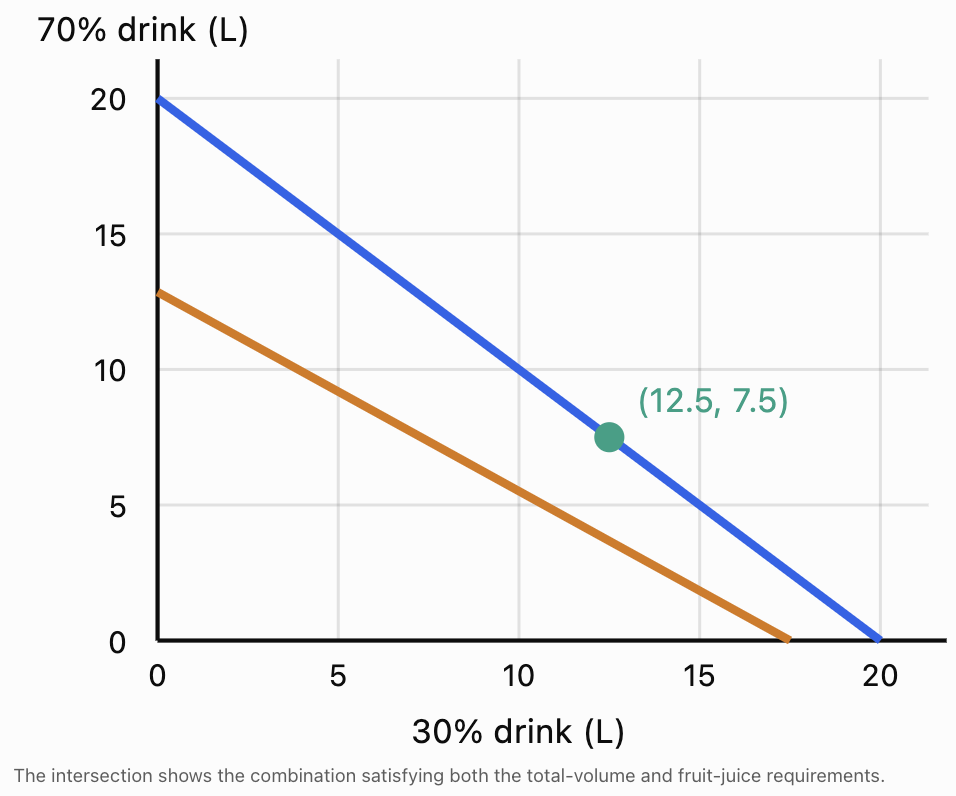
The equations can also be graphed.
For example:
x + y = 20
0.30x + 0.70y = 9
Rearrange:
y = 20 − x
and:
y = (9 − 0.30x)/0.70
The intersection represents the amounts that satisfy both conditions.
In this case, the intersection is:
(12.5, 7.5)
Real-World Applications of Mixture Problems
Chemistry
Chemists use mixture calculations when preparing solutions of particular concentrations.
Examples include preparing salt solutions, buffer components, and diluted laboratory reagents.
Actual laboratory calculations may require molarity, density, or mass-based concentration rather than the simplified volume-percentage models used in introductory algebra.
Food and Beverage Production
Manufacturers combine ingredients to achieve desired sweetness, flavour, concentration, or average cost.
Examples include fruit juices, coffee blends, tea blends, and food ingredients.
Agriculture
Farmers and agricultural specialists may combine fertilizers with different nutrient contents to meet target requirements.
These problems can involve several nutrients and may require systems containing more than two equations.
Manufacturing
Mixture calculations are used when combining metals, plastics, chemicals, and raw materials.
A manufacturer may need to meet both composition and cost requirements.
Business
Businesses can combine products with different prices to produce blends with a target average cost.
These calculations help with pricing, budgeting, and purchasing decisions.
A Systematic Method for Solving Mixture Problems
When solving any mixture problem, follow this process.
-
Read the problem carefully. Identify what is being mixed, the concentrations or unit prices, and the desired total.
-
Define the variables. Let x and y represent the amounts of the two ingredients.
-
Write the total amount equation. Usually x + y = T.
-
Write the component equation. Multiply each ingredient amount by its concentration or unit value.
-
Solve the system. Use substitution or elimination.
-
Interpret the answer. Explain how much of each ingredient is needed.
-
Verify the result. Check the total amount, final concentration or value, and practical restrictions.
Common Mistakes
Adding percentages directly
Mixing 20% and 40% solutions does not produce a 60% solution. The final concentration depends on the quantities used.
Using percentages instead of decimals incorrectly
For 25%, use 0.25, not 25, when multiplying by an amount.
Forgetting the total amount equation
A concentration equation alone is generally insufficient to determine two unknown amounts.
Confusing the amount of solution with the amount of dissolved substance
A 10 L solution containing 30% salt does not contain 10 L of salt. It contains 3 L of salt-equivalent volume if the concentration is volume-based.
Using inconsistent units
Do not combine litres and millilitres, or grams and kilograms, without converting first.
Ignoring concentration definitions
Mass percentages and volume percentages are not interchangeable without additional information.
Assuming the final concentration is the ordinary average
The ordinary average applies only when equal amounts are mixed on a compatible basis.
Accepting negative ingredient quantities
A negative amount generally indicates that the requested mixture cannot be produced under the stated conditions.
Failing to verify
A complete solution must satisfy both the total amount and component-balance equations.
Key Terms
-
Mixture: A combination of two or more substances or ingredients.
-
Solution: A homogeneous mixture containing a dissolved substance.
-
Solute: The substance dissolved in a solution.
-
Solvent: The substance that dissolves the solute.
-
Concentration: The amount or proportion of a component in a mixture.
-
Percentage concentration: Concentration expressed as a percentage on a specified basis.
-
Mass percentage: The mass of a component divided by the total mass, multiplied by 100%.
-
Volume percentage: The volume of a component divided by the final solution volume, multiplied by 100%.
-
Dilution: Reducing concentration by adding solvent.
-
Evaporation: The conversion of liquid into vapour, potentially increasing the concentration of a nonvolatile solute.
-
Weighted average: An average accounting for the different amounts contributing to it.
-
System of equations: Two or more equations considered simultaneously.
-
Substitution: Replacing one variable with an equivalent expression.
-
Elimination: Combining equations to remove a variable.
-
Constraint: A restriction on possible values.
-
Verification: Checking that the solution satisfies the original conditions.
-
Component balance: An equation accounting for the total amount of a particular substance or component.
-
Total amount equation: An equation describing the sum of the ingredient amounts.
Key Takeaways
-
Mixture problems involve combining ingredients to achieve a target amount, concentration, or average value.
-
Most two-ingredient mixture problems use two equations.
-
The first equation describes the total amount.
-
The second describes the amount of a particular component or the total value.
-
Percentage concentrations should be converted into decimals before calculation.
-
The final concentration is a weighted average of the starting concentrations under suitable mixing assumptions.
-
Substitution and elimination are effective solving methods.
-
Dilution decreases concentration by adding solvent.
-
Removing solvent can increase concentration without changing the amount of nonvolatile solute.
-
Solutions must be interpreted using the correct units and context.
-
Every answer should be checked using the original conditions.
Check Your Understanding
Recall and Understanding
1. What is a mixture problem?
2. Explain why the final concentration of two mixed solutions is not usually the ordinary average of their concentrations.
3. Write the two general equations used to solve a two-ingredient mixture problem.
4. Why must percentages usually be converted into decimals before constructing equations?
5. Explain why mixing a 20% solution and a 60% solution cannot produce an 80% solution under ordinary additive-mixture conditions.
Application
6. A laboratory needs 10 L of a 30% solution. It has 20% and 50% solutions available. Find the volume of each solution required.
7. A juice company wants to produce 25 L of a 40% fruit juice drink using 20% and 60% drinks. Determine the required volumes.
8. A coffee shop wants 20 kg of a blend costing $15/kg. It has coffee costing $10/kg and $18/kg. Find the mass of each variety.
9. A 12 L solution contains 40% sugar. How much pure water must be added to reduce the concentration to 30%?
10. A 30 kg salt solution contains 20% salt by mass. Water evaporates until the concentration reaches 30%. How much water evaporates?
Analysis and Challenge
11. A manufacturer needs 50 kg of an alloy containing 70% copper. It has 60% and 85% copper alloys. Determine how much of each alloy is needed.
12. A company wants to produce 40 kg of a product with an average cost of $12/kg. Ingredient A costs $8/kg and Ingredient B costs $18/kg. Find the amount of each ingredient.
13. A student attempts to create 15 L of a 75% solution using 30% and 60% solutions. Explain whether this is possible.
14. A laboratory combines x litres of a 25% solution and y litres of a 65% solution to produce 24 litres of a 40% solution. Construct and solve the system.
15. A company combines three ingredients costing $5/kg, $8/kg, and $12/kg to produce 60 kg of a blend costing $9/kg. The amount of the $5/kg ingredient equals the amount of the $12/kg ingredient. Determine whether the conditions are possible.
Answers to Check Your Understanding
1. A mixture problem involves combining two or more ingredients to obtain a desired total amount, concentration, or average value.
2. The final concentration depends on how much of each solution is used. Different quantities contribute different amounts of the component, so a weighted average is required.
3.
Total amount:
x + y = T
Component balance:
c₁x + c₂y = cₜT
4. Decimal concentrations allow us to multiply the proportion directly by the ingredient amount. For example, 25% of 8 L is 0.25 × 8 = 2 L.
5. The final concentration must lie between the starting concentrations when only nonnegative amounts of the two solutions are combined and no component is added or removed. Therefore, 80% cannot be obtained from 20% and 60% solutions alone.
6.
Let x = 20% solution and y = 50% solution.
x + y = 10
0.20x + 0.50y = 3
Substitute x = 10 − y:
0.20(10 − y) + 0.50y = 3
2 + 0.30y = 3
y = 10/3
x = 20/3
Answer: 6⅔ L of 20% solution and 3⅓ L of 50% solution.
Verification:
0.20(20/3) + 0.50(10/3) = 3 L
3/10 = 30%
7.
x + y = 25
0.20x + 0.60y = 0.40(25) = 10
Substitute x = 25 − y:
5 − 0.20y + 0.60y = 10
0.40y = 5
y = 12.5
x = 12.5
Answer: 12.5 L of each drink.
8.
Let x = mass of $10/kg coffee and y = mass of $18/kg coffee.
x + y = 20
10x + 18y = 300
Substitute x = 20 − y:
10(20 − y) + 18y = 300
200 + 8y = 300
y = 12.5
x = 7.5
Answer: 7.5 kg of $10/kg coffee and 12.5 kg of $18/kg coffee.
Verification:
10(7.5) + 18(12.5) = 75 + 225 = $300
300/20 = $15/kg
9.
Initial sugar amount:
0.40 × 12 = 4.8 L
Let x = water added.
Final volume:
12 + x
Final concentration:
4.8/(12 + x) = 0.30
4.8 = 0.30(12 + x)
4.8 = 3.6 + 0.30x
1.2 = 0.30x
x = 4
Answer: Add 4 L of water.
Verification:
4.8/16 = 0.30 = 30%
10.
Initial salt mass:
0.20 × 30 = 6 kg
Let y = final solution mass.
0.30y = 6
y = 20 kg
Water evaporated:
30 − 20 = 10 kg
Answer: 10 kg of water evaporates.
Verification:
6/20 × 100% = 30%
11.
Let x = 60% alloy and y = 85% alloy.
x + y = 50
0.60x + 0.85y = 0.70(50)
0.60x + 0.85y = 35
Substitute x = 50 − y:
0.60(50 − y) + 0.85y = 35
30 + 0.25y = 35
y = 20
x = 30
Answer: 30 kg of 60% alloy and 20 kg of 85% alloy.
Verification:
0.60(30) + 0.85(20) = 18 + 17 = 35 kg copper
35/50 = 70%
12.
Let x = $8/kg ingredient and y = $18/kg ingredient.
x + y = 40
8x + 18y = 480
Substitute x = 40 − y:
8(40 − y) + 18y = 480
320 + 10y = 480
y = 16
x = 24
Answer: 24 kg of Ingredient A and 16 kg of Ingredient B.
Verification:
8(24) + 18(16) = 192 + 288 = $480
480/40 = $12/kg
13.
The requested concentration of 75% is greater than both available concentrations.
Therefore, it is impossible to produce the mixture using only the 30% and 60% solutions under the stated conditions.
Answer: No valid nonnegative mixture exists.
14.
Total volume:
x + y = 24
Component balance:
0.25x + 0.65y = 0.40(24)
0.25x + 0.65y = 9.6
Substitute x = 24 − y:
0.25(24 − y) + 0.65y = 9.6
6 + 0.40y = 9.6
0.40y = 3.6
y = 9
x = 15
Answer: 15 L of the 25% solution and 9 L of the 65% solution.
Verification:
0.25(15) + 0.65(9)
= 3.75 + 5.85
= 9.6
9.6/24 = 40%
15.
Let:
x = mass of $5/kg ingredient
y = mass of $8/kg ingredient
z = mass of $12/kg ingredient
Total mass:
x + y + z = 60
Total value:
5x + 8y + 12z = 9(60) = 540
Additional condition:
x = z
Substitute z = x.
Mass equation:
2x + y = 60
Therefore:
y = 60 − 2x
Value equation:
5x + 8y + 12x = 540
17x + 8y = 540
Substitute:
17x + 8(60 − 2x) = 540
17x + 480 − 16x = 540
x = 60
Therefore:
z = 60
y = 60 − 120 = −60
This requires a negative quantity of Ingredient B.
Answer: The conditions are impossible using nonnegative ingredient amounts.
In fact, equal masses of the $5/kg and $12/kg ingredients have an average price of $8.50/kg. Adding the $8/kg ingredient can only lower that average, not increase it to $9/kg.
Final Summary
Mixture problems demonstrate how systems of equations can be used to solve practical problems involving concentrations, quantities, and costs.
The essential mathematical relationships are the total amount equation and the component-balance equation.
By defining variables, constructing the system, solving algebraically, interpreting the results, and verifying the original conditions, we can determine the correct quantities needed for a desired mixture.
The central idea is that the total amount of each conserved component in a mixture must equal the sum of the amounts contributed by its ingredients.