Special Systems and Applications
2. Systems from Word Problems
Learning outcomes
- I can identify variables in word problems.
- I can write systems of equations from real situations.
- I can solve contextual problems.
- I can interpret solutions appropriately.
- I can verify that solutions make sense.
Introduction
Many real-world problems involve two or more unknown quantities that are connected by several conditions.
For example:
-
How many adult and student tickets were sold at an event?
-
How many notebooks and pens can be purchased with a certain amount of money?
-
When will two vehicles travelling at different speeds meet?
-
How many products must a business sell to cover its costs?
-
How can two ingredients be combined to produce a mixture with a particular concentration?
These problems can often be solved using systems of equations.
A system of equations consists of two or more equations that must be satisfied at the same time.
Instead of solving for one unknown quantity, we use several relationships to determine values that satisfy all the conditions.
The most important skill is not simply solving the equations. It is learning how to translate a written description into mathematical language.
A successful solution involves identifying variables, constructing appropriate equations, selecting a solving method, interpreting the results, and checking that the answers make sense in the original situation.
Understanding Word Problems
A mathematical word problem describes a situation using ordinary language.
Our task is to identify the mathematical relationships hidden within that description.
Consider:
"A school sells adult tickets for $12 and student tickets for $7. A total of 100 tickets are sold, generating $950 in revenue. How many of each ticket were sold?"
This problem provides two important relationships:
-
The total number of tickets is 100.
-
The total revenue is $950.
There are also two unknown quantities:
-
Number of adult tickets.
-
Number of student tickets.
Since there are two unknowns and two independent equations, we can construct a system and solve it.
Identifying Variables
The first step in solving a word problem is deciding what the variables represent.
Variables are symbols used to represent unknown quantities.
Common choices include x and y, but descriptive letters may also be used.
For the ticket problem, define:
x = number of adult tickets
y = number of student tickets
This is better than writing only "Let x and y be the unknowns."
Clear variable definitions make the equations easier to understand and the final answer easier to interpret.
Choosing suitable variables
A good variable definition should:
-
Identify the quantity clearly.
-
Include units when appropriate.
-
Distinguish between different unknowns.
-
Match the situation described.
-
Avoid using the same variable for different quantities.
Example: Travel problem
Suppose two cyclists travel at different speeds.
We might define:
x = speed of Cyclist A in km/h
y = speed of Cyclist B in km/h
Example: Shopping problem
Suppose a customer purchases notebooks and pens.
We might define:
n = price of one notebook in dollars
p = price of one pen in dollars
The variables represent unit prices, not the number of items purchased.
This distinction is essential when writing the equations.
Translating Words into Mathematical Expressions
Word problems often contain phrases that indicate mathematical operations.
|
Phrase |
Mathematical meaning |
Example |
|---|---|---|
|
Sum or total |
Addition |
x + y |
|
Difference |
Subtraction |
x − y |
|
Twice a number |
Multiplication by 2 |
2x |
|
Three more than |
Add 3 |
x + 3 |
|
Five less than |
Subtract 5 |
x − 5 |
|
Half of |
Divide by 2 |
x/2 |
|
Equal to |
Equals sign |
= |
|
Total cost |
Price × quantity, then add |
5x + 3y |
|
Total distance |
Speed × time |
d = vt |
|
Combined amount |
Add quantities |
x + y |
Example: Translating statements
"The sum of two numbers is 25."
Equation:
x + y = 25
"One number is 7 greater than the other."
Equation:
x = y + 7
"The total cost of three notebooks and two pens is $14."
If n and p represent their unit prices:
3n + 2p = 14
"The total number of adults and children is 80."
If a and c represent the numbers of adults and children:
a + c = 80
Important language distinction
Compare:
"Five less than a number."
x − 5
"A number is five less than another number."
x = y − 5
The first is an expression.
The second describes a relationship between two variables and can be written as an equation.
Constructing Systems of Equations
A system of two linear equations often takes the form:
ax + by = c
dx + ey = f
The coefficients and constants come from the information in the word problem.
Worked Example: Two unknown numbers
The sum of two numbers is 40.
Their difference is 12.
Find the numbers.
Step 1: Define the variables
x = larger number
y = smaller number
Step 2: Write the equations
The sum is 40:
x + y = 40
The difference is 12:
x − y = 12
Step 3: Solve using elimination
Add the equations:
(x + y) + (x − y) = 40 + 12
2x = 52
x = 26
Substitute into the first equation:
26 + y = 40
y = 14
Step 4: Interpret
The two numbers are 26 and 14.
Step 5: Verify
Sum:
26 + 14 = 40
Difference:
26 − 14 = 12
Both conditions are satisfied.
Answer: The numbers are 26 and 14.
A General Strategy for Word Problems
Use the following process whenever you encounter a system of equations in a real-world situation.
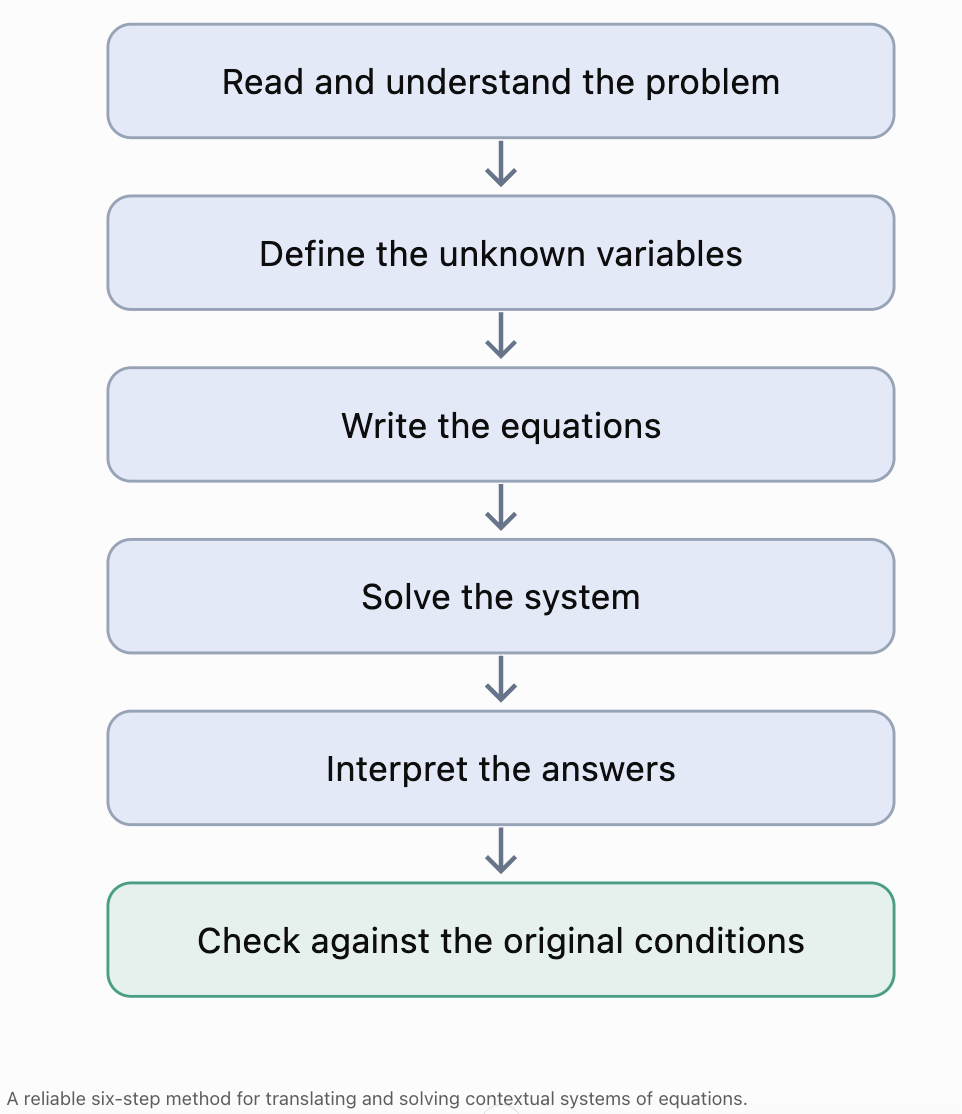
Each stage matters.
A correctly solved system may still produce an incorrect answer to the word problem if the variables were defined incorrectly or the equations did not represent the situation.
Worked Example: Ticket Sales
A school concert sells adult tickets for $15 and student tickets for $8.
A total of 120 tickets are sold.
The total revenue is $1,320.
How many adult and student tickets were sold?
Step 1: Define the variables
Let:
a = number of adult tickets
s = number of student tickets
Step 2: Construct the equations
The total number of tickets is 120:
a + s = 120
Each adult ticket costs $15 and each student ticket costs $8.
The total revenue is $1,320:
15a + 8s = 1320
Our system is:
a + s = 120
15a + 8s = 1320
Step 3: Solve using substitution
Rearrange the first equation:
s = 120 − a
Substitute into the second equation:
15a + 8(120 − a) = 1320
Expand:
15a + 960 − 8a = 1320
Combine like terms:
7a + 960 = 1320
Subtract 960:
7a = 360
Divide by 7:
a = 360/7 ≈ 51.43
Then:
s = 120 − 360/7
s = 480/7 ≈ 68.57
Step 4: Interpret the result
The algebra produces fractional numbers of tickets.
However, tickets are counted in whole numbers.
It is impossible to sell approximately 51.43 adult tickets and 68.57 student tickets as individual tickets.
Therefore, the problem has no valid whole-number solution.
This is an important lesson: a system can have a perfectly valid algebraic solution that does not make sense in the original context.
Step 5: Investigate the problem
Suppose the revenue had instead been $1,324.
Then:
15a + 8s = 1324
Using s = 120 − a:
15a + 8(120 − a) = 1324
7a + 960 = 1324
7a = 364
a = 52
Then:
s = 120 − 52
s = 68
Verification
Total tickets:
52 + 68 = 120
Total revenue:
52(15) + 68(8)
= 780 + 544
= 1324
Both conditions are satisfied.
For the revised revenue of $1,324, the solution is 52 adult tickets and 68 student tickets.
This example demonstrates why verifying answers in context is essential.
Worked Example: Shopping and Prices
A customer purchases 3 notebooks and 2 pens for $13.
Another customer purchases 2 notebooks and 5 pens for $16.
Find the price of one notebook and one pen.
Step 1: Define variables
n = price of one notebook in dollars
p = price of one pen in dollars
Step 2: Construct equations
First purchase:
3n + 2p = 13
Second purchase:
2n + 5p = 16
Step 3: Solve using elimination
Multiply the first equation by 5:
15n + 10p = 65
Multiply the second equation by 2:
4n + 10p = 32
Subtract:
11n = 33
n = 3
Substitute into:
3n + 2p = 13
3(3) + 2p = 13
9 + 2p = 13
2p = 4
p = 2
Step 4: Interpret
One notebook costs $3.
One pen costs $2.
Step 5: Verify
First purchase:
3(3) + 2(2) = 9 + 4 = 13
Second purchase:
2(3) + 5(2) = 6 + 10 = 16
Both totals are correct.
Answer: Notebook = $3; pen = $2.
Worked Example: Ages
A mother is three times as old as her daughter.
In 10 years, the mother will be twice as old as her daughter.
Find their present ages.
Step 1: Define variables
m = mother's present age in years
d = daughter's present age in years
Step 2: Write equations
The mother is three times the daughter's age:
m = 3d
In 10 years:
Mother's age = m + 10
Daughter's age = d + 10
The mother will be twice as old:
m + 10 = 2(d + 10)
Step 3: Solve
Substitute m = 3d:
3d + 10 = 2(d + 10)
Expand:
3d + 10 = 2d + 20
Subtract 2d:
d + 10 = 20
d = 10
Then:
m = 3(10)
m = 30
Step 4: Interpret
The daughter is currently 10 years old.
The mother is currently 30 years old.
Step 5: Verify
Present ages:
30 = 3 × 10
In 10 years:
Mother = 40
Daughter = 20
40 = 2 × 20
Both conditions are satisfied.
Answer: Mother = 30 years; daughter = 10 years.
Common age-problem mistake
Students sometimes multiply the daughter's current age by 2 and then add 10:
m + 10 = 2d + 10
This is incorrect because the daughter's age in 10 years is d + 10.
The correct relationship is:
m + 10 = 2(d + 10)
Parentheses are important.
Worked Example: Distance, Speed, and Time
Two cyclists start from the same point and travel in opposite directions.
Cyclist A travels at 18 km/h.
Cyclist B travels at 22 km/h.
After how many hours will they be 100 km apart?
This can be solved using a simple equation, but it also illustrates how two distance relationships can form a system.
Step 1: Define variables
x = distance travelled by Cyclist A in kilometres
y = distance travelled by Cyclist B in kilometres
t = time in hours
Step 2: Write equations
Using:
Distance = Speed × Time
Cyclist A:
x = 18t
Cyclist B:
y = 22t
Since they travel in opposite directions:
x + y = 100
Step 3: Solve
Substitute the distance equations:
18t + 22t = 100
40t = 100
t = 2.5
Step 4: Find distances
Cyclist A:
x = 18(2.5) = 45 km
Cyclist B:
y = 22(2.5) = 55 km
Step 5: Verify
45 + 55 = 100 km
Answer: The cyclists will be 100 km apart after 2.5 hours.
Worked Example: Two Vehicles Meeting
Two vehicles travel along the same straight road.
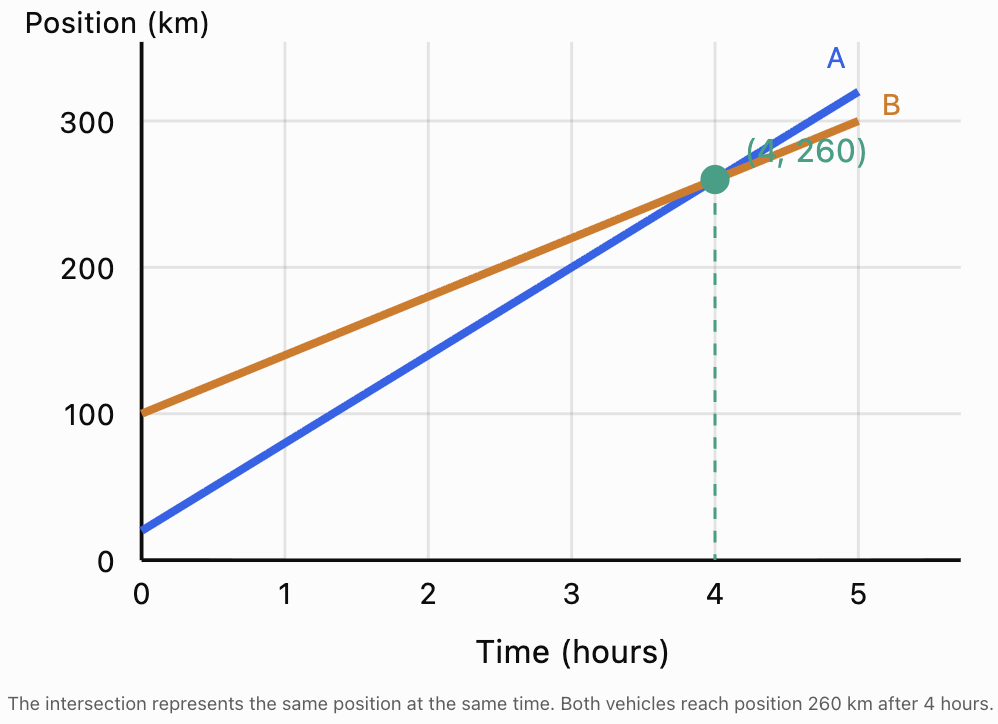
Vehicle A starts at position 20 km and travels at 60 km/h.
Vehicle B starts at position 100 km and travels in the same direction at 40 km/h.
When and where will Vehicle A catch Vehicle B?
Step 1: Define variables
t = time in hours
d = position along the road in kilometres
Step 2: Write position equations
Vehicle A:
d = 60t + 20
Vehicle B:
d = 40t + 100
These equations form a system.
Step 3: Solve
At the meeting point, both vehicles have the same position.
60t + 20 = 40t + 100
Subtract 40t:
20t + 20 = 100
Subtract 20:
20t = 80
t = 4
Step 4: Find the meeting position
Substitute into Vehicle A's equation:
d = 60(4) + 20
d = 260 km
Check Vehicle B:
d = 40(4) + 100
d = 260 km
Interpretation
Vehicle A catches Vehicle B after 4 hours, at position 260 km along the road.
Graphical explanation
On a position-time graph, each vehicle is represented by a straight line.
The intersection of the two lines represents the moment when the vehicles occupy the same position at the same time.
Worked Example: Business Break-Even
A small business sells handmade products.
The fixed operating cost is $500.
Each product costs $8 to manufacture.
Each product sells for $18.
How many products must the business sell to break even?
Step 1: Define variables
x = number of products sold
y = amount of money in dollars
Step 2: Construct the cost equation
Fixed cost = $500
Variable cost = $8 per product
Therefore:
C(x) = 8x + 500
Step 3: Construct the revenue equation
Revenue is:
Selling price × Quantity
Therefore:
R(x) = 18x
Step 4: Find the break-even point
At break-even:
Cost = Revenue
8x + 500 = 18x
500 = 10x
x = 50
Step 5: Calculate the amount
Revenue:
R(50) = 18(50) = 900
Cost:
C(50) = 8(50) + 500 = 900
Interpretation
The business breaks even after selling 50 products.
At this point:
-
Total cost = $900.
-
Total revenue = $900.
-
Profit = $0.
Selling fewer than 50 products produces a loss under the model.
Selling more than 50 products produces a profit.
The break-even point is the intersection of the cost and revenue graphs.
Worked Example: Mixture Problems
Mixture problems involve combining substances with different concentrations, prices, or compositions.
These problems are common in chemistry, food production, agriculture, and manufacturing.
Suppose a laboratory needs to prepare 10 litres of a 30% salt solution.
Two solutions are available:
-
Solution A contains 20% salt.
-
Solution B contains 50% salt.
How many litres of each solution should be mixed?
Step 1: Define variables
x = volume of 20% solution in litres
y = volume of 50% solution in litres
Step 2: Write the total volume equation
The combined volume is 10 litres:
x + y = 10
Step 3: Write the salt-content equation
Solution A contains 20% salt:
Salt amount = 0.20x
Solution B contains 50% salt:
Salt amount = 0.50y
The final solution contains 30% salt in 10 litres:
0.30 × 10 = 3
Therefore:
0.20x + 0.50y = 3
Step 4: Solve
From the first equation:
x = 10 − y
Substitute:
0.20(10 − y) + 0.50y = 3
Expand:
2 − 0.20y + 0.50y = 3
Combine:
2 + 0.30y = 3
0.30y = 1
y = 10/3 ≈ 3.33
Then:
x = 10 − 10/3
x = 20/3 ≈ 6.67
Step 5: Interpret
Use:
-
6.67 L of the 20% solution.
-
3.33 L of the 50% solution.
Step 6: Verify using exact values
Total volume:
20/3 + 10/3 = 10 L
Total salt:
0.20(20/3) + 0.50(10/3)
= 4/3 + 5/3
= 3 L
Salt concentration:
3/10 × 100% = 30%
Answer: Mix 6⅔ L of the 20% solution with 3⅓ L of the 50% solution.
This model assumes the volumes are additive and the concentrations are expressed on a consistent basis.
Worked Example: Geometry and Perimeter
A rectangular garden has a perimeter of 54 metres.
Its length is 5 metres greater than its width.
Find the dimensions.
Step 1: Define variables
L = length in metres
W = width in metres
Step 2: Write the equations
The perimeter of a rectangle is:
P = 2L + 2W
Therefore:
2L + 2W = 54
The length is 5 metres greater than the width:
L = W + 5
Step 3: Solve
Substitute:
2(W + 5) + 2W = 54
Expand:
2W + 10 + 2W = 54
4W + 10 = 54
4W = 44
W = 11
Then:
L = 11 + 5
L = 16
Step 4: Verify
Perimeter:
2(16) + 2(11) = 32 + 22 = 54 m
Difference:
16 − 11 = 5 m
Answer: Length = 16 m; width = 11 m.
The area is:
A = 16 × 11 = 176 m²
Although the question asks only for dimensions, the model can also be used to calculate other properties of the garden.
Worked Example: A System with No Real-World Solution
A school has 30 students in a club.
Each student is either in Group A or Group B.
Group A has 5 more students than Group B.
Find the number of students in each group.
Step 1: Define variables
a = number of students in Group A
b = number of students in Group B
Step 2: Write equations
a + b = 30
a − b = 5
Step 3: Solve
Add the equations:
2a = 35
a = 17.5
Then:
b = 12.5
Step 4: Interpret
The algebraic solution is:
a = 17.5
b = 12.5
However, groups cannot contain half a student.
Therefore, the original conditions cannot be satisfied using whole numbers.
The word problem has no valid solution in nonnegative integers.
This is not the same as saying the linear system has no mathematical solution.
The linear system has exactly one real-number solution, but it is not meaningful for the context.
Why this distinction matters
Mathematical solutions must satisfy both:
-
The equations.
-
The restrictions of the real-world situation.
These restrictions are sometimes called contextual constraints.
Choosing a Solving Method
There are three common approaches to solving systems of linear equations.
|
Method |
Most useful when |
Main advantage |
|---|---|---|
|
Substitution |
One variable is already isolated |
Straightforward replacement |
|
Elimination |
Coefficients can be matched easily |
Efficient algebraic solving |
|
Graphing |
Visual interpretation is important |
Shows intersections and trends |
Substitution
Example:
y = 2x + 3
x + y = 12
Substitute:
x + 2x + 3 = 12
3x = 9
x = 3
y = 9
Solution:
(3, 9)
Elimination
Example:
2x + 3y = 17
2x − y = 5
Subtract the second equation from the first:
4y = 12
y = 3
Substitute:
2x − 3 = 5
2x = 8
x = 4
Solution:
(4, 3)
Graphing
For:
y = 2x + 3
y = −x + 12
The intersection satisfies:
2x + 3 = −x + 12
3x = 9
x = 3
y = 9
The lines intersect at (3, 9).
Graphing is especially useful for understanding the meaning of a solution, although exact algebraic methods are often more accurate than reading coordinates from a graph.
Interpreting Solutions in Context
Solving the equations is not the final step.
The solution must be interpreted using the original variables.
Suppose a system produces:
x = 12
y = 8
These numbers have little meaning without context.
If x represents adult tickets and y represents student tickets, the interpretation is:
"12 adult tickets and 8 student tickets were sold."
If x represents time and y represents distance, the interpretation could be:
"After 12 hours, the distance is 8 kilometres."
The variables and their units determine what the solution means.
Interpreting an intersection point
For two linear models, an intersection often represents a situation where two quantities are equal.
Examples include:
-
Two vehicles occupying the same position at the same time.
-
Two pricing plans having the same total cost.
-
Revenue equalling total cost.
-
Two water tanks containing the same volume.
The x-coordinate and y-coordinate should both be interpreted.
For example, if two cost graphs intersect at (5, 40):
-
x = 5 may represent five hours.
-
y = 40 may represent a cost of $40.
The interpretation is:
Both plans cost $40 for five hours of use.
Checking Whether Solutions Are Reasonable
A mathematical answer should be checked for both algebraic correctness and practical meaning.
Algebraic verification
Substitute the solution into every original equation.
Contextual verification
Ask whether the answer makes sense in the situation.
For example:
-
Can the number of people be negative?
-
Can the number of tickets be fractional?
-
Is the time positive?
-
Are the prices realistic?
-
Does the total match the stated amount?
-
Are the units consistent?
-
Does the solution fall within the allowed domain?
Example: Negative time
Suppose two position equations intersect at:
t = −3 hours
The algebraic solution may be correct.
However, if t represents time after an experiment begins, negative time lies outside the practical domain.
Therefore, the model predicts no meeting after the experiment begins, even though the extended lines intersect at a negative time.
This is another example of the difference between an algebraic solution and a contextual solution.
Special Cases in Word Problems
Some real-world systems produce parallel or coincident lines.
Parallel lines: No common solution
Two rental companies charge:
Company A:
C = 5h + 20
Company B:
C = 5h + 35
Both have the same hourly rate, but different fixed fees.
The graphs are parallel.
There is no rental duration for which the costs are equal.
Coincident lines: Infinitely many common solutions
Two companies charge:
Company A:
C = 4h + 10
Company B:
2C = 8h + 20
Simplify Company B:
C = 4h + 10
Both equations represent the same line.
Every rental duration produces the same cost under both plans.
Therefore, the system has infinitely many solutions over an unrestricted mathematical domain, and infinitely many nonnegative-time solutions in this continuous rental model.
Common Mistakes
Failing to define variables
Always state what each variable represents before constructing equations.
Using the wrong quantity for a variable
Distinguish between unit price and number of items, or between speed and distance.
Reversing relationships
"Five less than x" means x − 5, not 5 − x.
Forgetting to multiply price by quantity
Total revenue is calculated by adding price × quantity for each item type.
Incorrectly translating age problems
Future ages must be written by adding the number of years to each person's present age.
Ignoring units
Distances, speeds, times, costs, and concentrations must use consistent units.
Assuming every algebraic solution is realistic
Fractional numbers of people or negative quantities may be invalid.
Not checking both equations
A proposed solution must satisfy every equation in the system.
Confusing an intersection with an intercept
An intersection of two graphs is where they meet each other. An intercept is where a graph meets a coordinate axis.
Forgetting to interpret the answer
A complete solution includes a sentence explaining what the values mean.
Key Terms
-
System of equations: Two or more equations solved simultaneously.
-
Variable: A symbol representing an unknown or changing quantity.
-
Independent variable: The input variable.
-
Dependent variable: The output variable.
-
Linear equation: An equation representing a straight-line relationship.
-
Coefficient: A number multiplying a variable.
-
Constant: A value that does not change.
-
Substitution: Solving by replacing a variable with an equivalent expression.
-
Elimination: Solving by adding or subtracting equations to remove a variable.
-
Intersection point: A point shared by two graphs.
-
Ordered pair: Two coordinates written as (x, y).
-
Contextual interpretation: Explaining a mathematical answer using the real-world situation.
-
Verification: Checking that a solution satisfies the original conditions.
-
Constraint: A restriction on the values allowed in a problem.
-
Domain: The set of permitted input values.
-
Revenue: Total money earned from sales before deducting costs.
-
Cost: Money required to produce or provide goods or services.
-
Profit: Revenue minus cost.
-
Break-even point: The point where revenue equals total cost.
-
Concentration: The amount or proportion of a substance in a mixture or solution.
-
Consistent system: A system with at least one mathematical solution.
-
Inconsistent system: A system with no mathematical solution.
Key Takeaways
-
Systems of equations can represent many real-world situations involving multiple unknown quantities.
-
The first step is to identify and define the variables clearly.
-
Word problems contain mathematical relationships that can be translated into equations.
-
Two independent relationships are generally needed to determine two unknown quantities uniquely.
-
Substitution, elimination, and graphing are common solving methods.
-
An intersection point represents values that satisfy both equations.
-
Solutions must be interpreted using the original context and units.
-
Every solution should be checked in the original equations.
-
Contextual constraints may exclude mathematically valid solutions.
-
A complete answer includes calculations, verification, and a clear concluding statement.
Check Your Understanding
Recall and Understanding
1. Why is it important to define variables before writing equations?
2. What is the difference between solving a system algebraically and interpreting its solution in context?
3. Describe two situations in which substitution may be preferable to elimination.
4. Why might a mathematically correct solution be unsuitable for a real-world problem?
5. What does the intersection of two cost graphs represent?
Application
6. The sum of two numbers is 56. Their difference is 14. Find the numbers.
7. A cinema sells adult tickets for $14 and child tickets for $8. A total of 90 tickets are sold, generating $1,080. How many of each ticket were sold?
8. Three notebooks and two pens cost $17. Two notebooks and four pens cost $18. Find the price of each item.
9. A father is four times as old as his son. In 12 years, the father will be twice as old as his son. Find their present ages.
10. A rectangular field has a perimeter of 70 metres. Its length is 9 metres greater than its width. Find the dimensions.
Analysis and Challenge
11. A company has fixed costs of $800 and variable costs of $12 per product. Each product sells for $28. Determine the break-even quantity and revenue.
12. Two vehicles travel along the same road. Vehicle A starts at position 10 km and travels at 70 km/h. Vehicle B starts at position 130 km and travels in the same direction at 50 km/h. When and where does Vehicle A catch Vehicle B?
13. A laboratory needs 20 litres of a 40% solution. It has 25% and 55% solutions available. Determine how much of each should be mixed.
14. A club has 45 members. There are 8 more adults than children. Determine whether the conditions allow a whole-number solution, and explain.
15. Two companies charge according to:
A(t) = 6t + 25
B(t) = 9t + 10
Find when the costs are equal, calculate the cost, and interpret the result.
Answers to Check Your Understanding
1. Defining variables identifies the unknown quantities and prevents confusion when constructing equations or interpreting the solution.
2. Algebraic solving finds values that satisfy the equations. Contextual interpretation explains what those values mean and whether they are realistic.
3. Substitution is useful when one equation already isolates a variable, or when a variable can easily be expressed in terms of another.
4. The solution may violate contextual constraints. For example, a negative number of tickets or a fractional number of people may not be possible.
5. The intersection represents an input value at which both companies or plans have the same total cost.
6.
Let x and y be the two numbers.
x + y = 56
x − y = 14
Add:
2x = 70
x = 35
Then:
y = 21
Answer: 35 and 21.
Verification:
35 + 21 = 56
35 − 21 = 14
7.
Let a = adult tickets and c = child tickets.
a + c = 90
14a + 8c = 1080
Substitute c = 90 − a:
14a + 8(90 − a) = 1080
14a + 720 − 8a = 1080
6a = 360
a = 60
c = 30
Verification:
60 + 30 = 90
14(60) + 8(30) = 840 + 240 = 1080
Answer: 60 adult tickets and 30 child tickets.
8.
Let n = notebook price and p = pen price.
3n + 2p = 17
2n + 4p = 18
Multiply the first equation by 2:
6n + 4p = 34
Subtract the second equation:
4n = 16
n = 4
Substitute:
3(4) + 2p = 17
12 + 2p = 17
2p = 5
p = 2.50
Answer: Notebook = $4; pen = $2.50.
Verification:
2(4) + 4(2.50) = 18
9.
Let f = father's age and s = son's age.
f = 4s
f + 12 = 2(s + 12)
Substitute:
4s + 12 = 2s + 24
2s = 12
s = 6
f = 24
Answer: Father = 24 years; son = 6 years.
In 12 years, they will be 36 and 18 years old.
10.
Let L = length and W = width.
2L + 2W = 70
L = W + 9
Substitute:
2(W + 9) + 2W = 70
4W + 18 = 70
4W = 52
W = 13
L = 22
Answer: Length = 22 m; width = 13 m.
Verification:
2(22) + 2(13) = 70 m
11.
Cost:
C(x) = 12x + 800
Revenue:
R(x) = 28x
At break-even:
12x + 800 = 28x
800 = 16x
x = 50
Revenue:
R(50) = 28(50) = 1400
Answer: Break-even occurs at 50 products, with revenue and cost both equal to $1,400.
12.
Vehicle A:
d = 70t + 10
Vehicle B:
d = 50t + 130
Set equal:
70t + 10 = 50t + 130
20t = 120
t = 6
Position:
d = 70(6) + 10 = 430
Check:
50(6) + 130 = 430
Answer: Vehicle A catches Vehicle B after 6 hours at position 430 km.
13.
Let x = litres of 25% solution and y = litres of 55% solution.
Total volume:
x + y = 20
Total concentration:
0.25x + 0.55y = 0.40(20)
0.25x + 0.55y = 8
Substitute x = 20 − y:
0.25(20 − y) + 0.55y = 8
5 − 0.25y + 0.55y = 8
0.30y = 3
y = 10
Then:
x = 10
Answer: Mix 10 L of the 25% solution with 10 L of the 55% solution.
Verification:
0.25(10) + 0.55(10) = 2.5 + 5.5 = 8
8/20 = 0.40 = 40%
14.
Let a = adults and c = children.
a + c = 45
a − c = 8
Add:
2a = 53
a = 26.5
Then:
c = 18.5
These are not whole numbers.
Answer: There is no valid whole-number solution.
The system has a real-number solution, but it cannot represent numbers of club members.
15.
Company A:
A(t) = 6t + 25
Company B:
B(t) = 9t + 10
Set equal:
6t + 25 = 9t + 10
15 = 3t
t = 5
Calculate cost:
A(5) = 6(5) + 25 = 55
B(5) = 9(5) + 10 = 55
Answer: Both companies charge $55 when t = 5.
If t represents hours, the interpretation is that both companies charge $55 for five hours of service.
For fewer than five hours, Company B is cheaper.
For more than five hours, Company A is cheaper.
Final Summary
Systems of equations provide a practical method for solving real-world problems involving multiple unknown quantities.
The most important steps are identifying variables, translating information into equations, solving the system, and checking that the solution satisfies both the mathematics and the original situation.
Systems can be applied to ticket sales, shopping, ages, motion, business costs, mixtures, and geometry.
A complete word-problem solution does more than find numbers: it explains what those numbers represent, verifies the original conditions, and determines whether the result makes sense in the real world.