Introduction to Functions
2. Domain and Range
Learning outcomes
- I can define the domain and range of a function.
- I can determine the domain from tables, graphs, and equations.
- I can determine the range from tables, graphs, and equations.
- I can identify restrictions on the domain of a function.
- I can explain the meaning of domain and range in context.


What Are Domain and Range?
A function describes a relationship between:
inputs and outputs.
We usually represent the input using:
x
and the output using:
y or f(x).
For example:
y = 2x + 1
We can choose an input value for x and use the function to calculate an output.
If:
x = 3
then:
y = 2(3) + 1
y = 7
So:
Input = 3
Output = 7
Domain and range describe the possible:
inputs and outputs of a function.
Domain
The domain of a function is:
the set of all possible input values.
In most functions, the input is represented by:
x.
A useful way to remember this is:
Domain → Inputs → x-values
If a function can accept x-values of:
1, 2, 3, and 4
then its domain is:
Domain = {1, 2, 3, 4}
Range
The range of a function is:
the set of all possible output values.
Outputs are usually represented by:
y or f(x).
Remember:
Range → Outputs → y-values
If the outputs of a function are:
3, 5, 7, and 9
then:
Range = {3, 5, 7, 9}
Input → Function → Output
We can think of a function as a:
function machine.
An input enters the machine.
The function performs an operation.
An output is produced.
For:
f(x) = 3x + 2
we could have:
Input: 4
↓
Multiply by 3
↓
Add 2
↓
Output: 14
The input belongs to the:
domain.
The output belongs to the:
range.


Domain and Range from a Table
Consider:
| x | y |
|---|---|
| -2 | 1 |
| -1 | 3 |
| 0 | 5 |
| 1 | 7 |
| 2 | 9 |
The domain consists of the:
x-values.
Therefore:
Domain = {-2, -1, 0, 1, 2}
The range consists of the:
y-values.
Therefore:
Range = {1, 3, 5, 7, 9}
A Simple Rule
When reading a table:
Domain → look at the x-column
Range → look at the y-column
This works because x represents the:
input
and y represents the:
output.
Repeated Values in the Range
Consider:
| x | y |
|---|---|
| -2 | 4 |
| -1 | 1 |
| 0 | 0 |
| 1 | 1 |
| 2 | 4 |
The domain is:
Domain = {-2, -1, 0, 1, 2}
The outputs are:
4, 1, 0, 1, 4
But when writing the range as a set, we do not need to repeat values.
Therefore:
Range = {0, 1, 4}
Notice:
Different inputs can produce the same output.
Domain and Range from Ordered Pairs
A relation might be written as:
(-3, 2), (-1, 4), (0, 5), (2, 4), (5, 8)
The first number in each ordered pair is:
x.
Therefore:
Domain = {-3, -1, 0, 2, 5}
The second number is:
y.
Therefore:
Range = {2, 4, 5, 8}
The value 4 appears twice as an output, but we only list it:
once.
Domain and Range from a Mapping Diagram
A mapping diagram can show inputs and outputs visually.
For example:
Domain
1
2
3
4
↓
Range
3
5
7
9
The values on the input side form the:
domain.
The values that actually receive arrows on the output side form the:
range.


Domain and Range from a Graph
A graph gives us a visual way to determine:
domain and range.
To determine the domain, ask:
How far does the graph extend horizontally?
To determine the range, ask:
How far does the graph extend vertically?
A useful memory aid is:
Domain → left to right
Range → bottom to top
Reading Domain Horizontally
Imagine shining a light on the graph from:
above.
The shadow the graph creates on the x-axis represents its:
domain.
Every x-value touched by that horizontal spread belongs to the:
domain.
Reading Range Vertically
Now imagine shining a light from the:
side.
The shadow the graph creates on the y-axis represents its:
range.
Every y-value covered by the vertical spread belongs to the:
range.


Example: A Finite Set of Points
Suppose a graph contains the points:
(-3, 2), (-1, 5), (2, 1), (4, 5)
Read the x-coordinates:
-3, -1, 2, 4
Therefore:
Domain = {-3, -1, 2, 4}
Read the y-coordinates:
2, 5, 1, 5
Therefore:
Range = {1, 2, 5}
Example: A Line Segment
Suppose a line segment begins at:
(-2, 1)
and ends at:
(4, 7).
If both endpoints are included, then the x-values extend from:
-2 to 4.
Therefore:
Domain: -2 ≤ x ≤ 4
The y-values extend from:
1 to 7.
Therefore:
Range: 1 ≤ y ≤ 7
Closed Points
A closed point means that the endpoint is:
included.
For example:
x ≥ 2
includes:
x = 2.
We use:
≥
rather than:
>.
Similarly:
x ≤ 5
includes:
x = 5.
Open Points
An open point means the endpoint is:
not included.
For example:
x > 2
does not include:
x = 2.
Similarly:
x < 5
does not include:
x = 5.


Inequality Notation
Domain and range are often expressed using:
inequalities.
Examples:
x ≥ 0
means x can be:
0 or any larger value.
x < 5
means x can be:
any value less than 5, but not 5 itself.
-3 ≤ x ≤ 7
means x can be any value from:
-3 through 7, including both endpoints.
Interval Notation
Another way to express domain and range is:
interval notation.
For example:
-3 ≤ x ≤ 7
can be written:
[-3, 7]
Square brackets mean:
endpoint included.
For:
-3 < x < 7
we write:
(-3, 7)
Parentheses mean:
endpoint not included.
Mixed Endpoints
Suppose:
-3 ≤ x < 7
Then:
-3 is included
but:
7 is not included.
Interval notation:
[-3, 7)
The bracket matches the:
included endpoint.
The parenthesis matches the:
excluded endpoint.
Infinity
Suppose the domain is:
x ≥ 2
This means the graph begins at x = 2 and continues indefinitely to the:
right.
We can write:
Domain: x ≥ 2
or:
Domain: [2, ∞)
Infinity is not an actual endpoint.
Therefore, we always use a:
parenthesis with infinity.
Domain of an Equation
Sometimes the domain can be determined directly from the:
equation.
Consider:
f(x) = 2x + 5
Can we substitute:
x = 1?
Yes.
Can we substitute:
x = -100?
Yes.
Can we substitute:
x = 0?
Yes.
There is no obvious restriction on x.
Therefore:
Domain = all real numbers
or:
Domain: -∞ < x < ∞
Linear Functions
Most ordinary linear functions have:
all real numbers
as their domain.
For example:
f(x) = 4x - 7
Any real value of x can be substituted into the:
equation.
The graph also extends forever to the:
left and right.
For this function:
Domain = all real numbers
and:
Range = all real numbers.
Quadratic Functions
Consider:
f(x) = x²
Any real value can be used for:
x.
Therefore:
Domain = all real numbers
However, squaring a real number cannot produce a:
negative result.
So:
Range: y ≥ 0
The graph extends forever:
left and right,
but its lowest y-value is:
0.
Another Quadratic Example
Consider:
f(x) = x² + 3
The parabola has been shifted:
3 units upward.
The domain is still:
all real numbers.
But the smallest possible output is:
3.
Therefore:
Range: y ≥ 3
Square Root Functions
Consider:
f(x) = √x
Can we substitute:
x = 4?
Yes.
√4 = 2
Can we substitute:
x = 0?
Yes.
√0 = 0
Can we substitute:
x = -4?
Not if we are working with real numbers.
Therefore:
Domain: x ≥ 0
The outputs are also non-negative.
Therefore:
Range: y ≥ 0
Why Square Roots Can Restrict the Domain
For real-valued functions:
the quantity inside an even square root cannot be negative.
Consider:
f(x) = √(x - 3)
We need:
x - 3 ≥ 0
Therefore:
x ≥ 3
So:
Domain: x ≥ 3
Worked Example: Square Root Restriction
Find the domain of:
f(x) = √(x + 5)
The expression inside the square root must be:
greater than or equal to zero.
Therefore:
x + 5 ≥ 0
Subtract 5:
x ≥ -5
Therefore:
Domain: x ≥ -5
Fractions Can Restrict the Domain
Consider:
f(x) = 1 ÷ x
What happens when:
x = 0?
We would have:
1 ÷ 0
Division by zero is:
undefined.
Therefore:
x cannot equal 0.
So:
Domain: x ≠ 0
Notice that the graph never touches:
x = 0.
Denominators Cannot Equal Zero
This gives us an important rule:
The denominator of a fraction cannot equal zero.
Consider:
f(x) = 5 ÷ (x - 2)
We cannot allow:
x - 2 = 0
Therefore:
x ≠ 2
So:
Domain = all real numbers except 2
Worked Example: Rational Function
Find the domain of:
f(x) = 3 ÷ (x + 4)
The denominator cannot equal zero.
Set:
x + 4 = 0
Therefore:
x = -4
So:
Domain: x ≠ -4
Every other real value of x is allowed.
Two Common Domain Restrictions
When finding domain from an equation, two especially important restrictions are:
Division
You cannot divide by:
zero.
Even Square Roots
You cannot take the square root of a negative number when working with:
real numbers.
These restrictions allow us to determine the domain of many functions.
Domain Does Not Always Mean All Mathematically Possible Values
Real-world situations can create additional:
restrictions.
Suppose:
C = 5n + 20
represents the cost of renting bicycles, where n is the number of bicycles rented.
Mathematically, we could substitute:
n = -10.
But what would:
-10 bicycles
mean?
It makes no sense in this context.
Therefore, the real-world domain is more restricted than the equation alone might suggest.
Domain in Context
Suppose:
C = 5n + 20
where n represents the number of bicycles.
Reasonable values might be:
n = 0, 1, 2, 3, 4, ...
The domain consists of:
non-negative whole numbers.
Why not 2.7?
Because we cannot normally rent:
2.7 bicycles.
Context determines which mathematical values are:
meaningful.
Range in Context
Using:
C = 5n + 20
if:
n = 0
then:
C = 20
If:
n = 1
then:
C = 25
If:
n = 2
then:
C = 30
So possible outputs include:
20, 25, 30, 35, ...
These values form the:
range.
Discrete and Continuous Domains
A domain can be:
discrete
or:
continuous.
A discrete domain contains separate values.
Example:
number of students
Possible values:
0, 1, 2, 3, ...
You cannot normally have:
14.6 students.
Continuous Domains
A continuous domain can contain any value within an:
interval.
Examples include:
- time
- temperature
- distance
- mass
- height
If time can vary from 0 to 10 seconds, then values such as:
2 s
2.5 s
2.537 s
may all be possible.
This creates a:
continuous domain.


Worked Example: A Thrown Ball
Suppose the height of a ball is modeled by:
h = -5t² + 20t + 1
where:
t = time in seconds
and:
h = height in metres.
Mathematically, the quadratic equation accepts negative values of t.
But:
negative time before the ball was thrown
may not belong to the situation being modeled.
If the model begins when the ball is thrown, then:
t ≥ 0
until the ball reaches the ground.
The physical situation determines the meaningful:
domain.
Domain and Range Have Meaning
Domain and range are not simply mathematical rules.
They answer two useful questions:
Domain
What inputs make sense or are allowed?
Range
What outputs are possible?
This becomes especially important when functions represent:
real situations.
Example: Movie Tickets
Suppose:
C = 12n
where:
n = number of tickets
and:
C = total cost in dollars.
If a cinema allows one person to purchase at most 8 tickets, then:
Domain = {0, 1, 2, 3, 4, 5, 6, 7, 8}
The corresponding range is:
Range = {0, 12, 24, 36, 48, 60, 72, 84, 96}
The context creates both:
restrictions and meaning.
Example: Filling a Tank
Suppose a tank begins empty and fills at:
5 litres per minute
for 20 minutes.
Let:
V = 5t
where:
t = time in minutes
and:
V = volume of water in litres.
The meaningful domain is:
0 ≤ t ≤ 20
The corresponding range is:
0 ≤ V ≤ 100
Because time and volume can vary continuously, these intervals contain:
all values between the endpoints.
Domain from a Graph
When examining a graph, start at its:
leftmost point.
Then move toward the:
rightmost point.
Ask:
Which x-values does the graph contain?
Those values form the:
domain.
If arrows show that the graph continues forever, the domain may extend toward:
infinity.
Range from a Graph
Now examine the graph from:
bottom to top.
Ask:
Which y-values does the graph contain?
Those values form the:
range.
Look carefully for:
- highest points
- lowest points
- open endpoints
- closed endpoints
- arrows
- gaps
These features determine whether particular values are:
included.
Worked Example: Reading Endpoints
Suppose a graph begins with a closed point at:
(-4, -2)
and ends with an open point at:
(6, 5).
Assume the graph covers all x-values and y-values between these endpoints.
For the domain:
-4 is included
6 is not included
Therefore:
Domain: -4 ≤ x < 6
For the range:
-2 is included
5 is not included
Therefore:
Range: -2 ≤ y < 5
Domain and Range of Absolute Value
Consider:
f(x) = |x|
Any real number can be substituted for:
x.
Therefore:
Domain = all real numbers
Absolute value cannot produce a negative output.
Therefore:
Range: y ≥ 0
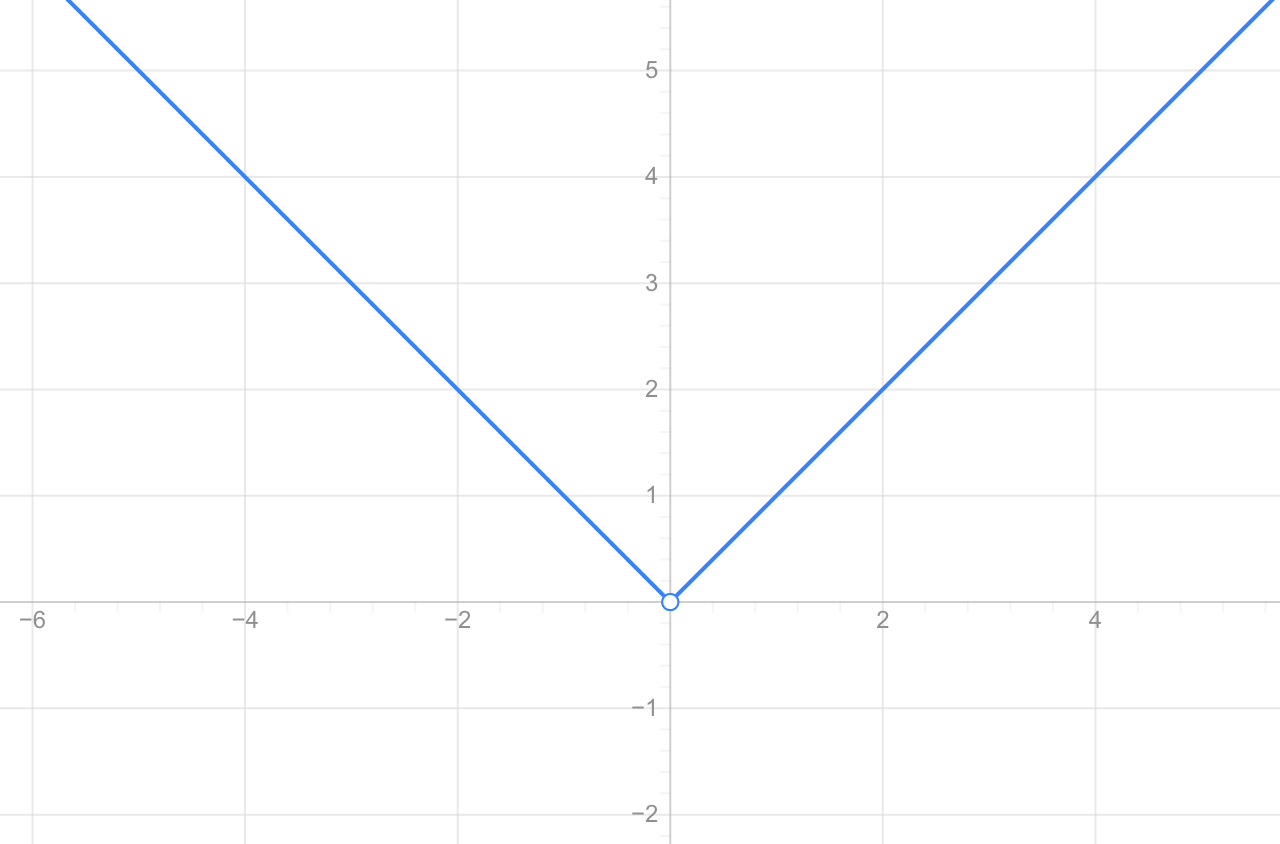
The graph extends left and right forever but has a minimum value at:
y = 0.
Comparing Common Functions
| Function | Domain | Range |
|---|---|---|
| y = x | All real numbers | All real numbers |
| y = x² | All real numbers | y ≥ 0 |
| y = x² + 3 | All real numbers | y ≥ 3 |
| y = √x | x ≥ 0 | y ≥ 0 |
| y = |x| | All real numbers | y ≥ 0 |
| y = 1 ÷ x | x ≠ 0 | y ≠ 0 |
Recognizing these common patterns makes domain and range much easier to:
determine.
A Useful Domain Checklist
When given an equation, ask:
Is there a denominator?
If yes:
What values make the denominator zero?
Exclude those values.
Is there an even square root?
If yes:
What values make the expression inside the root negative?
Exclude those values.
Is there a real-world context?
If yes:
Which values actually make sense?
Apply those restrictions.
Are there no restrictions?
Then the domain may be:
all real numbers.
A Useful Range Checklist
Finding range from an equation can sometimes be more difficult.
Ask:
Does the function have a minimum?
Example:
y = x²
Minimum:
y = 0
So:
y ≥ 0
Does the function have a maximum?
A downward-opening parabola may have a:
maximum output.
Are some y-values impossible?
Example:
y = 1 ÷ x
The output can never equal:
0.
Does the context restrict outputs?
Example:
A height cannot reasonably be:
negative.
Domain and Range from Real Data
Suppose a table records the temperature of water during an experiment.
| Time (min) | Temperature (°C) |
|---|---|
| 0 | 20 |
| 2 | 29 |
| 4 | 38 |
| 6 | 47 |
| 8 | 56 |
| 10 | 65 |
The recorded domain is:
{0, 2, 4, 6, 8, 10}
The recorded range is:
{20, 29, 38, 47, 56, 65}
But if the function models temperature continuously throughout the experiment, the meaningful domain may instead be:
0 ≤ t ≤ 10
This illustrates an important distinction between:
recorded data points and the underlying situation.
Common Mistake: Switching Domain and Range
A common mistake is to reverse:
domain and range.
Remember:
Domain = x = input
Range = y = output
On a graph:
Domain → horizontal
Range → vertical
Common Mistake: Listing Repeated Values
Suppose the outputs are:
3, 5, 5, 7, 7, 7
When writing the range as a set:
Range = {3, 5, 7}
Each possible output only needs to be listed:
once.
Common Mistake: Ignoring Restrictions
Consider:
f(x) = 4 ÷ (x - 6)
It would be incorrect to say:
Domain = all real numbers
because:
x = 6
would make the denominator:
zero.
The correct domain is:
x ≠ 6.
Common Mistake: Ignoring Context
Suppose:
P = 8n
represents the price of n notebooks.
A purely algebraic interpretation might allow:
n = -4
or:
n = 2.7.
But neither represents a sensible number of notebooks.
The mathematical model must be interpreted within:
its context.
Why Domain and Range Matter
Domain and range help us understand the:
limits of a mathematical model.
They tell us:
- which inputs are possible
- which outputs are possible
- where a graph exists
- where an equation is defined
- which values make sense in context
Without domain and range, we may apply a function to values for which it was never:
intended.
Domain and Range in Science
Suppose a scientist models the growth of a plant during a:
30-day experiment.
The time domain might be:
0 ≤ t ≤ 30
Even if the mathematical equation could accept:
t = 1,000,
the model may not be valid that far into the:
future.
Mathematical models have:
limits.
Domain and Range in Business
Suppose a company can manufacture at most:
5,000 products per month.
If x represents the number of products manufactured, then the meaningful domain might be:
0 ≤ x ≤ 5000
If only whole products can be manufactured, x would also need to be:
a whole number.
Domain restrictions can therefore represent:
real limitations.
Domain and Range in Geometry
Suppose the perimeter of a square is:
P = 4s
where:
s = side length.
Mathematically, the equation works for negative s-values.
But a physical side length cannot be:
negative.
Therefore:
s > 0
for an actual square.
The corresponding perimeter must also satisfy:
P > 0.
The DR Method
A simple strategy is the:
DR Method.
D — Domain
Ask:
What x-values or inputs are possible?
Look:
left to right.
R — Range
Ask:
What y-values or outputs are possible?
Look:
bottom to top.
Then check:
Are there mathematical or real-world restrictions?
Check Your Understanding
1. Define domain.
2. Define range.
3. Which variable usually represents the domain?
4. Which variable usually represents the range?
5. Find the domain of the table:
| x | y |
|---|---|
| -3 | 2 |
| 0 | 5 |
| 4 | 8 |
| 7 | 11 |
6. Find the range of the same table.
7. Find the domain of:
(-2, 5), (1, 7), (4, 5), (8, 10)
8. Find the range of the ordered pairs above.
9. Why do repeated output values only need to be listed once in the range?
10. What is the domain of:
f(x) = 5x - 3
11. What is the range of:
f(x) = x²
12. Find the domain of:
f(x) = √x
13. Find the domain of:
f(x) = √(x - 7)
14. Find the domain of:
f(x) = 1 ÷ x
15. Find the domain of:
f(x) = 4 ÷ (x + 3)
16. Explain why division by zero creates a domain restriction.
17. Explain why an even square root can create a domain restriction.
18. A line segment extends from x = -5 to x = 8 with both endpoints included. State its domain.
19. A graph extends from y = 2 upward forever. State its range.
20. Explain the difference between a discrete and continuous domain.
21. A concert venue sells at most 500 tickets. If n represents tickets sold, describe a sensible domain for n.
22. A tank fills for 15 minutes. If t represents time since filling began, describe the domain.
23. Explain why the domain of a mathematical equation may differ from the meaningful domain of a real-world model.
24. What does an open point on a graph tell you about domain or range?
25. Explain how you can determine domain and range visually from a graph.
Key Terms
- Function: Relationship in which each allowed input has exactly one output.
- Domain: Set of all possible input values of a function.
- Range: Set of all possible output values of a function.
- Input: Value entered into a function.
- Output: Value produced by a function.
- Independent variable: Variable whose value is used as the input.
- Dependent variable: Variable whose value depends on the input.
- Ordered pair: Pair of coordinates written as (x, y).
- Mapping diagram: Diagram showing connections between inputs and outputs.
- Restriction: Condition preventing certain values from belonging to a domain or range.
- Real numbers: Numbers represented on the ordinary number line.
- Discrete: Consisting of separate individual values.
- Continuous: Containing all possible values throughout an interval.
- Endpoint: Value marking the beginning or end of an interval.
- Closed point: Endpoint that is included.
- Open point: Endpoint that is excluded.
- Inequality notation: Method of describing a set of values using symbols such as <, >, ≤, and ≥.
- Interval notation: Method of describing continuous sets of numbers using brackets and parentheses.
- Undefined: Mathematical expression that has no permitted value under the given number system or operation.
- Mathematical model: Function or equation used to represent a real-world situation.
Key Takeaways
- The domain is the set of possible inputs of a function.
- The range is the set of possible outputs.
- Domain usually corresponds to x-values.
- Range usually corresponds to y-values.
- From a table, domain comes from the x-column and range comes from the y-column.
- From ordered pairs, domain comes from the first coordinates and range from the second coordinates.
- Repeated values only need to appear once when writing a set.
- On a graph, read domain from left to right.
- On a graph, read range from bottom to top.
- Closed endpoints are included.
- Open endpoints are excluded.
- Linear functions such as y = 2x + 3 usually have all real numbers as both their domain and range.
- The function y = x² has all real numbers as its domain but y ≥ 0 as its range.
- The function y = √x has x ≥ 0 as its real-number domain.
- A denominator can never equal zero.
- Therefore, rational functions may have excluded domain values.
- Even square roots cannot contain negative values when working with real numbers.
- Real-world contexts can create additional domain restrictions.
- Counts such as numbers of people or objects usually have discrete domains.
- Measurements such as time, distance, and temperature can have continuous domains.
- The mathematical domain of an equation and the meaningful domain of a model are not always the same.
- Domain asks: What inputs are allowed?
- Range asks: What outputs are possible?
- Understanding domain and range helps us determine both the mathematical and practical limits of a function.