Algebraic Problem Solving
2. Algebraic Modeling
Learning outcomes
- I can translate words into algebra.
- I can define variables clearly.
- I can write algebraic expressions.
- I can develop mathematical models.
- I can interpret results.
Introduction
Algebra is much more than solving equations. One of its most powerful applications is using mathematical symbols to describe situations in the real world.
Algebraic modeling is the process of representing real-world situations using variables, expressions, equations, inequalities, and functions.
For example, imagine a taxi company charges a fixed booking fee of $5 plus $2 for every kilometre travelled.
We can describe the cost in words:
Total cost = booking fee + cost per kilometre × distance
We can then translate this relationship into algebra:
C = 5 + 2d
where:
-
C = total cost in dollars
-
d = distance travelled in kilometres
This equation is an algebraic model. It allows us to calculate the cost of any journey, compare different journeys, and make predictions.
If the taxi travels 12 km:
C = 5 + 2(12)
C = 5 + 24
C = $29
The model predicts that the journey will cost $29.
In this topic, we will explore how to translate written descriptions into algebra, define variables, construct expressions and equations, develop mathematical models, and interpret solutions in meaningful ways.
What Is a Mathematical Model?
A mathematical model is a representation of a real-world situation using mathematical relationships.
Models help us:
-
Describe relationships between quantities.
-
Explain how one quantity affects another.
-
Make predictions.
-
Compare different situations.
-
Solve practical problems.
-
Support decisions.
Mathematical models are used in science, engineering, economics, medicine, business, environmental studies, and everyday life.
For example:
|
Situation |
Mathematical model |
|---|---|
|
Total cost of n items costing $8 each |
C = 8n |
|
Distance travelled at constant speed |
d = vt |
|
Perimeter of a square |
P = 4s |
|
Earnings at $15 per hour |
E = 15h |
|
Temperature conversion |
F = (9/5)C + 32 |
|
Population increasing by 5% each year |
P = P₀(1.05)ᵗ |
Each model represents a relationship between quantities.
However, models are usually based on assumptions. For example, d = vt assumes constant speed, while the earnings model assumes a constant hourly rate without deductions or overtime.
Translating Words into Algebra
The first step in algebraic modeling is converting ordinary language into mathematical expressions.
Many everyday words suggest specific mathematical operations.
Addition
Words that often indicate addition include:
-
Sum
-
Total
-
Increased by
-
More than
-
Added to
-
Combined
Examples:
Five more than a number:
x + 5
The sum of two numbers:
a + b
A number increased by 12:
x + 12
Subtraction
Words that often indicate subtraction include:
-
Difference
-
Decreased by
-
Less than
-
Reduced by
-
Subtracted from
Examples:
Seven less than a number:
x − 7
The difference between a and b:
a − b
A number decreased by 15:
x − 15
Be careful with the order of subtraction.
"Five less than a number" means:
x − 5
It does not mean 5 − x.
Multiplication
Words that often indicate multiplication include:
-
Product
-
Times
-
Twice
-
Triple
-
Of
-
Multiplied by
Examples:
Twice a number:
2x
Three times a number:
3x
The product of a and b:
ab
Half of a number:
x/2
Division
Words that often indicate division include:
-
Quotient
-
Divided by
-
Shared equally
-
Ratio
-
Per
Examples:
A number divided by 4:
x/4
The quotient of a and b:
a/b
A total cost shared equally among n people:
C/n
Here, n must not equal zero.
Powers and Roots
Some phrases indicate powers or roots.
Examples:
The square of a number:
x²
The cube of a number:
x³
The square root of a number:
√x
Five more than the square of a number:
x² + 5
The square of five more than a number:
(x + 5)²
These last two expressions are different. Brackets are essential for representing the correct meaning.
Understanding the Importance of Word Order
Algebraic modeling requires careful attention to how a statement is written.
Consider the following expressions:
|
Written statement |
Algebraic expression |
|---|---|
|
Twice a number increased by 3 |
2x + 3 |
|
Twice the sum of a number and 3 |
2(x + 3) |
|
Five less than three times a number |
3x − 5 |
|
Three times a number less 5 |
3x − 5 |
|
The square of a number increased by 4 |
x² + 4 |
|
The square of the sum of a number and 4 |
(x + 4)² |
Brackets help distinguish between operations performed on individual terms and operations performed on entire expressions.
Worked Example: Comparing expressions
Translate the following statements.
A. Three times a number, increased by 7.
3x + 7
B. Three times the sum of a number and 7.
3(x + 7)
C. Seven less than three times a number.
3x − 7
If x = 4:
A = 3(4) + 7 = 19
B = 3(4 + 7) = 33
C = 3(4) − 7 = 5
The different wordings produce different mathematical results.
Defining Variables Clearly
A variable is a symbol representing a quantity that may change or be unknown.
Common variables include x, y, a, b, t, d, and C.
However, a variable should always be defined in context.
For example:
Let x = number of notebooks purchased.
This is clearer than simply writing:
Let x = notebooks.
A good variable definition should identify:
-
What the variable represents.
-
Its unit, where appropriate.
-
Any restrictions on its possible values.
Example: Defining variables in a shopping problem
A shop sells notebooks for $4 each and pens for $2 each.
Let:
n = number of notebooks purchased
p = number of pens purchased
The total cost is:
C = 4n + 2p
Because notebooks and pens are counted as whole items:
n and p must be non-negative integers.
We cannot purchase −3 notebooks or 2.5 individual pens under the assumptions of this model.
Independent and dependent variables
In many models, one quantity depends on another.
For example:
C = 4n + 2
where:
-
n = number of items purchased
-
C = total cost
Here, n is the independent variable and C is the dependent variable.
The cost depends on how many items are purchased.
This relationship can be represented by a function:
C = 4n + 2
The notation C means that cost is a function of n.
Writing Algebraic Expressions
An algebraic expression represents a quantity using numbers, variables, and operations.
Unlike an equation, an expression does not contain an equals sign.
Worked Example: School supplies
A student purchases x notebooks at $3 each and y folders at $5 each.
Cost of notebooks:
3x
Cost of folders:
5y
Total cost:
3x + 5y
If the student buys 4 notebooks and 2 folders:
Total cost = 3(4) + 5(2)
= 12 + 10
= $22
Worked Example: Ages
A father is four times as old as his daughter.
Let x = daughter's age in years.
Father's age:
4x
Their combined age:
x + 4x = 5x
If the daughter is 9 years old:
Father's age = 4(9) = 36 years
Combined age = 45 years
Worked Example: Consecutive integers
Three consecutive integers can be represented as:
n, n + 1, n + 2
Their sum is:
n + (n + 1) + (n + 2)
Simplify:
3n + 3
If n = 7, the integers are 7, 8, and 9.
Their sum is:
7 + 8 + 9 = 24
Using the expression:
3(7) + 3 = 24
Both methods agree.
Worked Example: Geometry
A rectangle has width x cm and length 5 cm greater than its width.
Width = x
Length = x + 5
Perimeter:
P = 2l + 2w
Substitute:
P = 2(x + 5) + 2x
Expand:
P = 2x + 10 + 2x
P = 4x + 10
Area:
A = lw
A = x(x + 5) = x² + 5x
The same situation can produce different expressions depending on the quantity being investigated.
From Expressions to Equations
An expression represents a quantity. An equation states that two expressions are equal.
For example:
3x + 5
is an expression.
3x + 5 = 20
is an equation.
Equations allow us to determine unknown quantities.
Worked Example: Finding an unknown number
Five more than three times a number is 32.
Let x = the unknown number.
Translate:
3x + 5 = 32
Subtract 5:
3x = 27
Divide by 3:
x = 9
Verification:
3(9) + 5 = 32
The number is 9.
Worked Example: A ticket problem
Adult tickets cost $12 and student tickets cost $7.
A group purchases 15 tickets for a total of $135.
How many adult tickets were purchased?
Let a = number of adult tickets.
Number of student tickets = 15 − a
Total cost:
12a + 7(15 − a) = 135
Expand:
12a + 105 − 7a = 135
Simplify:
5a + 105 = 135
Subtract 105:
5a = 30
Divide by 5:
a = 6
Number of student tickets:
15 − 6 = 9
Answer: 6 adult tickets and 9 student tickets.
Verification:
6(12) + 9(7) = 72 + 63 = $135
The solution satisfies both the ticket count and the total cost.
Developing Mathematical Models
Constructing a mathematical model involves more than translating individual words.
A useful modeling process includes six stages.
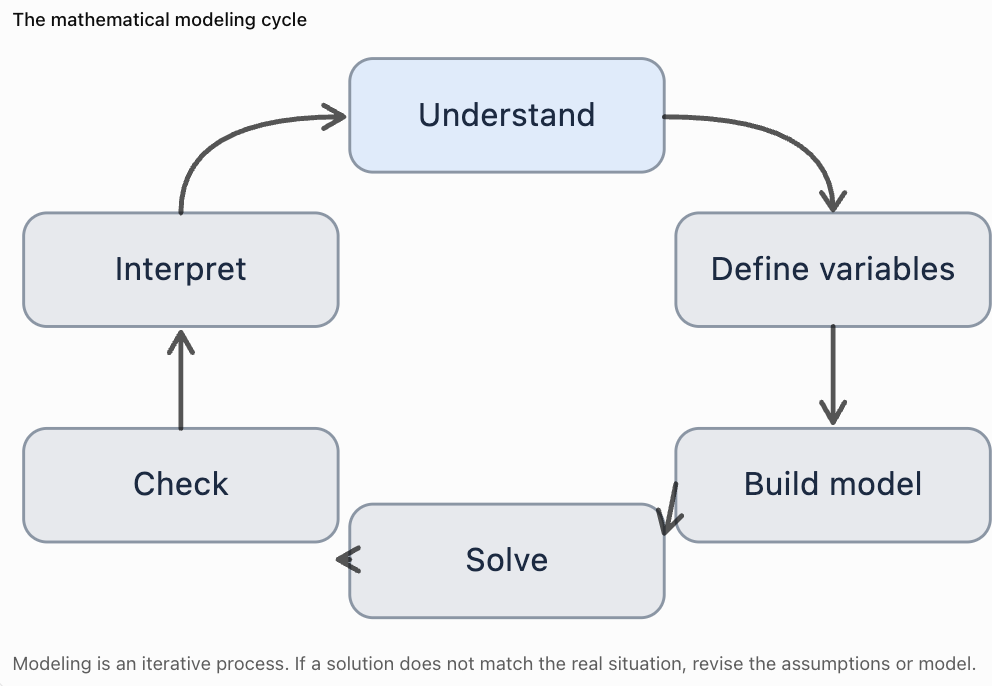
Understanding the situation
Read the problem carefully and identify what is known and what must be found.
Defining variables
Assign symbols to important quantities and specify their units.
Constructing the model
Translate the relationships into expressions, equations, inequalities, or functions.
Solving the model
Use appropriate algebraic techniques.
Checking the result
Substitute values, verify units, and assess whether the answer is reasonable.
Interpreting and refining
Explain the result in context. If the model is unrealistic, reconsider its assumptions.
Linear Mathematical Models
A linear model describes a relationship with a constant rate of change.
The general form is:
y = mx + b
where:
-
m = rate of change or gradient
-
b = initial value or y-intercept
-
x = independent variable
-
y = dependent variable
Worked Example: Mobile phone plans
A mobile phone company charges $18 per month plus $0.05 for each minute of calls beyond the included allowance.
Let:
m = number of additional minutes
C = total monthly cost in dollars
The model is:
C = 18 + 0.05m
If a customer uses 120 additional minutes:
C = 18 + 0.05(120)
C = 18 + 6
C = $24
The model predicts a monthly bill of $24.
The fixed charge of $18 is the y-intercept.
The rate of change is $0.05 per additional minute.
Graphical Interpretation
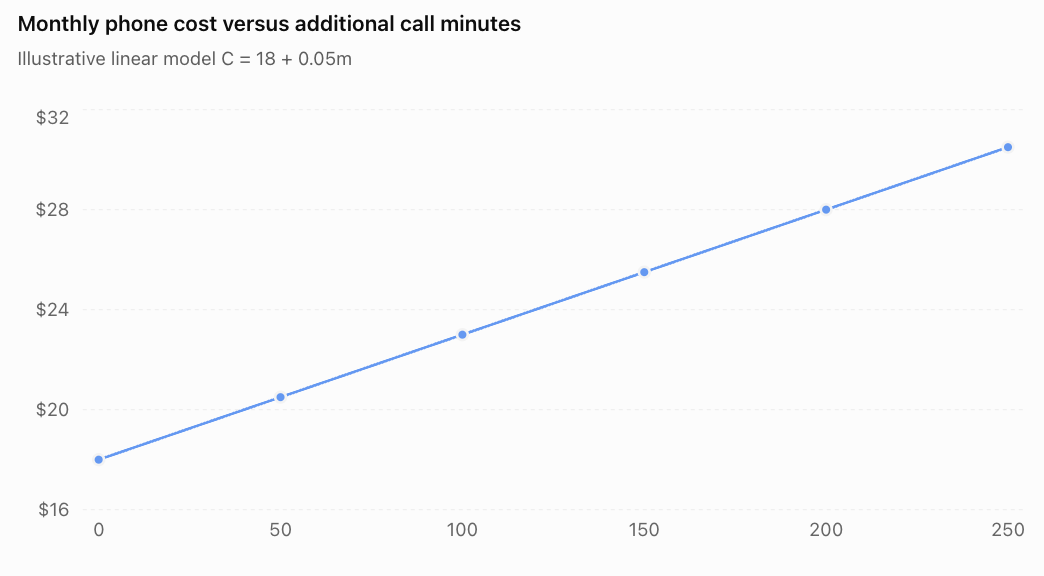
The graph is a straight line because the cost increases by the same amount for every additional minute.
The model is valid only while the pricing assumptions remain unchanged.
Comparing Two Mathematical Models
Mathematical modeling is particularly useful when comparing different options.
Worked Example: Two transport services
Company A charges a $6 booking fee plus $1.50 per kilometre.
Company B charges a $2 booking fee plus $2.00 per kilometre.
Let d = distance in kilometres.
Company A:
A = 6 + 1.5d
Company B:
B = 2 + 2d
Find the distance at which both companies charge the same amount.
Set the models equal:
6 + 1.5d = 2 + 2d
Subtract 2:
4 + 1.5d = 2d
Subtract 1.5d:
4 = 0.5d
d = 8
At 8 km:
A = 6 + 1.5(8) = $18
B = 2 + 2(8) = $18
Both companies charge $18 for an 8 km journey.
For journeys shorter than 8 km, Company B is cheaper.
For journeys longer than 8 km, Company A is cheaper.
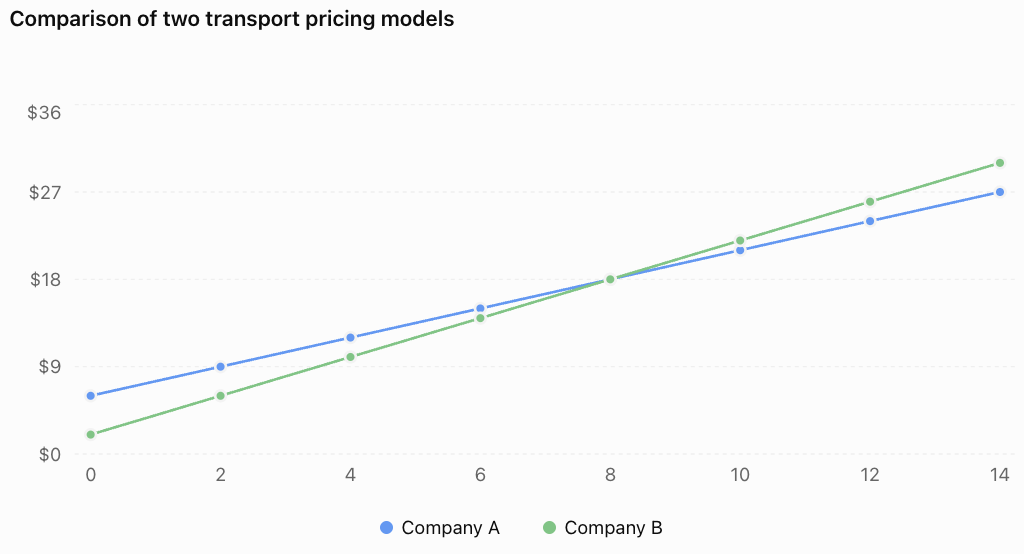
The intersection represents the distance at which the costs are equal.
Modeling with Quadratic Equations
Not all relationships are linear.
A quadratic model involves a squared variable and often describes area, projectile motion, or other nonlinear relationships.
Worked Example: Designing a garden
A rectangular garden has a perimeter of 40 m.
Find an expression for its area in terms of its width.
Let:
w = width (m)
l = length (m)
Perimeter:
2l + 2w = 40
Divide by 2:
l + w = 20
Therefore:
l = 20 − w
Area:
A = lw
Substitute:
A = w(20 − w)
Expand:
A = 20w − w²
This is a quadratic model.
Because both dimensions must be positive:
0 < w < 20
Finding the maximum area
Complete the square:
A = −(w² − 20w)
A = −(w² − 20w + 100) + 100
A = 100 − (w − 10)²
Since (w − 10)² ≥ 0, the maximum area occurs when:
w = 10 m
Then:
l = 20 − 10 = 10 m
Maximum area:
A = 10 × 10
A = 100 m²
The garden with the greatest area is a square measuring 10 m by 10 m.
Modeling with Exponential Relationships
Some real-world quantities change by a constant percentage rather than a constant amount.
Examples include population growth, compound interest, and radioactive decay.
An exponential growth model can be written as:
P = P₀(1 + r)ᵗ
where:
-
P = quantity after t periods
-
P₀ = initial quantity
-
r = growth rate per period, expressed as a decimal
-
t = number of periods
Worked Example: Population growth
A town has a population of 20,000 people and grows by 3% each year.
The model is:
P = 20,000(1.03)ᵗ
After five years:
P = 20,000(1.03)⁵
P ≈ 23,185
The model predicts approximately 23,185 people after five years.
This assumes the population continues growing by exactly 3% each year.
Unlike a linear model, the amount of population growth increases over time because the percentage is applied to a growing population.
Modeling with Inequalities
Sometimes a situation involves a limit or restriction rather than an exact equality.
For example:
A school has a budget of $500 for purchasing calculators costing $24 each.
Let n = number of calculators.
The total cost must not exceed $500:
24n ≤ 500
Divide by 24:
n ≤ 20.833...
Since n must be a whole number:
n ≤ 20
The school can purchase at most 20 calculators.
Common inequality phrases
|
Written statement |
Symbol |
|---|---|
|
Greater than |
> |
|
Less than |
< |
|
At least |
≥ |
|
At most |
≤ |
|
No more than |
≤ |
|
No less than |
≥ |
The choice between an equation and an inequality depends on whether the problem describes an exact relationship or a restriction.
Real-World Applications of Algebraic Modeling
Physics: Modeling Motion
For an object travelling at constant velocity:
d = vt
where:
-
d = displacement
-
v = velocity
-
t = time
Suppose a cyclist travels at a constant speed of 6 m/s along a straight path.
The distance model is:
d = 6t
After 30 seconds:
d = 6(30)
d = 180 m
The cyclist travels 180 m.
Chemistry: Modeling Concentration
Mass concentration can be represented by:
c = m/V
where:
-
c = mass concentration (g/L)
-
m = mass of solute (g)
-
V = volume of solution (L)
Suppose a chemist prepares solutions using 5 g of solute.
The model becomes:
c = 5/V
As the final solution volume increases, concentration decreases.
For V = 0.5 L:
c = 5/0.5 = 10 g/L
For V = 1.0 L:
c = 5/1.0 = 5 g/L
This is an inverse relationship, not a linear relationship.
Business: Modeling Profit
Profit is calculated using:
Profit = Revenue − Cost
Suppose a business sells products for $25 each.
Its fixed operating costs are $600, and each product costs $10 to manufacture.
Let n = number of products produced and sold.
Revenue:
R = 25n
Cost:
C = 600 + 10n
Profit:
P = R − C
P = 25n − (600 + 10n)
P = 15n − 600
Finding the break-even point
At break-even:
P = 0
15n − 600 = 0
15n = 600
n = 40
The business must sell 40 products to break even.
If it sells 60 products:
P = 15(60) − 600
P = $300
The model predicts a profit of $300.
Interpreting Mathematical Results
Obtaining an algebraic answer is not the final stage of modeling.
We must decide what the result means in the original situation.
For example, suppose an equation gives:
n = 12.6
If n represents time in hours, 12.6 hours may be perfectly reasonable.
If n represents the number of buses required to transport students, we cannot use 12.6 buses.
We may need to round up to 13 buses.
However, rounding depends on the context.
-
If calculating the number of buses needed, round up.
-
If calculating the maximum number of whole items affordable, round down.
-
If calculating a measurement, round to an appropriate precision.
-
If calculating a theoretical value, an exact expression may be preferable.
Checking whether a model is reasonable
A good model should satisfy several conditions.
Mathematical consistency: The equations must be algebraically correct.
Realistic assumptions: The model should reflect the important features of the situation.
Appropriate units: Quantities must use compatible units.
Meaningful solutions: Results must make sense in context.
Reasonable predictions: The model should not be extended beyond its valid range without justification.
For example, a linear population model might predict negative population values if extended far enough into the past. Such predictions would not be meaningful.
Limitations of Mathematical Models
Every mathematical model is a simplified representation of reality.
For example, the model:
d = vt
assumes constant velocity.
In real life, vehicles accelerate, brake, turn, and encounter traffic.
Similarly, a simple cost model may ignore taxes, discounts, inflation, or changing prices.
When evaluating a model, consider:
-
What assumptions have been made?
-
Which factors have been ignored?
-
What range of values is reasonable?
-
How accurate are the input measurements?
-
How might the model be improved?
Understanding limitations is an important part of mathematical reasoning.
Communicating Algebraic Models Clearly
A well-presented modeling solution should include the following elements.
Define the variables.
State what each variable represents, including units where appropriate.
Explain the relationship.
Describe how the quantities are connected.
Construct the model.
Write the expression, equation, inequality, or function.
Solve or evaluate.
Show the algebraic steps clearly.
Interpret the result.
Explain what the answer means in the original situation.
Verify and evaluate.
Check the result and comment on any relevant assumptions.
Complete Worked Example: Planning a School Trip
A school is organising a trip for students.
The bus company charges a fixed fee of $180 plus $12 per student.
The school has a maximum budget of $900.
How many students can attend?
Step 1: Define the variable
Let n = number of students.
Step 2: Construct the model
Total cost:
C = 180 + 12n
Step 3: Apply the budget restriction
180 + 12n ≤ 900
Step 4: Solve
12n ≤ 720
n ≤ 60
Step 5: Interpret
A maximum of 60 students can attend within the stated budget.
Step 6: Verify
C = 180 + 12(60)
C = 180 + 720
C = $900
The total cost exactly matches the budget.
The model assumes the company can transport 60 students under this pricing arrangement and that no additional costs apply.
Common Mistakes
Failing to define variables
Writing an equation without explaining the variables makes the model difficult to interpret.
Translating word order incorrectly
"Five less than a number" means x − 5, not 5 − x.
Forgetting brackets
"Three times the sum of a number and four" is 3(x + 4), not 3x + 4.
Confusing expressions and equations
An expression represents a quantity. An equation establishes equality between expressions.
Ignoring units
A model using kilometres and metres must account for the difference in units.
Using an unsuitable model
Not every relationship is linear. Some situations require quadratic, exponential, inverse, or other models.
Ignoring restrictions
Numbers of people, vehicles, and products are generally non-negative integers.
Assuming a model is always accurate
A model is only as useful as its assumptions and the information used to construct it.
Failing to interpret the solution
A numerical answer should be connected to the original situation.
Key Terms
-
Algebraic modeling: Representing real-world situations using algebraic relationships.
-
Mathematical model: A mathematical representation of a real system or situation.
-
Variable: A symbol representing an unknown or changing quantity.
-
Independent variable: A variable used to determine or predict another quantity.
-
Dependent variable: A quantity whose value depends on another variable.
-
Algebraic expression: A combination of numbers, variables, and mathematical operations.
-
Equation: A statement that two expressions are equal.
-
Inequality: A mathematical statement comparing quantities using symbols such as <, >, ≤, or ≥.
-
Coefficient: A numerical factor multiplying a variable.
-
Constant: A value that does not change within the model.
-
Function: A relationship assigning exactly one output to each allowed input.
-
Linear model: A model with a constant rate of change.
-
Quadratic model: A model involving a squared variable.
-
Exponential model: A model involving repeated multiplication by a constant factor.
-
Rate of change: The amount by which one quantity changes relative to another.
-
Domain: The set of allowed input values.
-
Constraint: A restriction on the values that variables can take.
-
Assumption: A condition accepted when constructing a model.
-
Verification: Checking whether a result satisfies the original conditions.
-
Interpretation: Explaining what a mathematical result means in context.
-
Break-even point: The point where total revenue equals total cost.
-
Prediction: An estimate of a future or unknown quantity based on a model.
Key Takeaways
-
Algebraic modeling translates real-world situations into mathematical relationships.
-
Words such as "sum," "difference," "product," and "quotient" suggest mathematical operations.
-
Word order and brackets are important when translating statements.
-
Variables should be defined clearly, with units and restrictions where appropriate.
-
Expressions represent quantities, while equations describe equal relationships.
-
Mathematical models may be linear, quadratic, exponential, inverse, or other forms.
-
Equations can be used to find unknown values, while inequalities represent limits or constraints.
-
Real-world modeling requires both mathematical accuracy and an understanding of context.
-
Solutions should be checked and interpreted rather than reported as numbers alone.
-
Models have assumptions and limitations that affect their accuracy and usefulness.
Check Your Understanding
Recall and Understanding
1. What is algebraic modeling, and why is it useful?
2. Explain the difference between an algebraic expression and an equation.
3. Translate "seven less than three times a number" into algebra.
4. Explain why defining variables is important when constructing a mathematical model.
Application
5. Write an expression for the total cost of x books costing $9 each and y pens costing $3 each.
6. A taxi charges $4 plus $2.50 per kilometre. Write a model for the total cost C of a journey of d kilometres. Calculate the cost of a 14 km journey.
7. A rectangle has width x cm and length 6 cm greater than its width. Write expressions for its perimeter and area.
8. The sum of three consecutive integers is 72. Construct an equation and determine the integers.
9. A student earns $18 per hour and receives a fixed bonus of $50. Write an equation for total earnings E after h hours. Calculate the hours required to earn $230.
10. A company sells products for $30 each. Its fixed costs are $400, and each product costs $12 to manufacture. Write a profit model and calculate the break-even quantity.
Analysis and Challenge
11. Two gyms offer different membership plans.
Gym A charges $40 per month plus a $60 joining fee.
Gym B charges $55 per month with no joining fee.
Construct models and determine when the total costs are equal.
12. A rectangular garden has a perimeter of 60 m. Develop a quadratic model for its area in terms of width, and determine the dimensions that produce the maximum area.
13. A population of 5,000 increases by 4% each year. Construct an exponential model and predict the population after six years, rounded to the nearest whole person.
14. A school has $750 to purchase science kits costing $28 each, with a fixed delivery charge of $50. Construct an inequality and determine the maximum number of kits it can purchase.
15. A student models the cost of purchasing n notebooks at $5 each, with a one-time delivery fee of $8, using C = 5(n + 8). Explain the mistake and write the correct model.
Answers to Check Your Understanding
1. Algebraic modeling represents real-world situations using variables, expressions, equations, inequalities, or functions. It helps us describe relationships, solve problems, and make predictions.
2. An expression represents a quantity without an equals sign, such as 3x + 5. An equation states that two expressions are equal, such as 3x + 5 = 20.
3. 3x − 7.
4. Clear variable definitions identify the quantities represented, their units, and any restrictions. This makes the model easier to understand, solve, and interpret.
5. C = 9x + 3y dollars, where x and y are non-negative integers.
6. C = 4 + 2.5d. For d = 14: C = 4 + 2.5(14) = $39.
7. Length = x + 6. Perimeter P = 2x + 2(x + 6) = 4x + 12 cm. Area A = x(x + 6) = x² + 6x cm².
8. Let the integers be n, n + 1, n + 2. Then 3n + 3 = 72, so n = 23. The integers are 23, 24, and 25.
9. E = 18h + 50. Set 230 = 18h + 50 → 180 = 18h → h = 10 hours.
10. Revenue R = 30n. Cost C = 400 + 12n. Profit P = 18n − 400. Break-even occurs at n = 400/18 ≈ 22.22. Therefore, 23 whole products must be sold to make a positive profit; exact break-even is not possible at a whole-number quantity.
11. Gym A: A = 40m + 60. Gym B: B = 55m. Set equal: 40m + 60 = 55m → 60 = 15m → m = 4. Both cost $220 after four months.
12. Let width = w and length = 30 − w. Area A = w(30 − w) = 30w − w² = 225 − (w − 15)². Maximum area is 225 m² when width and length are both 15 m.
13. P = 5000(1.04)ᵗ. After six years: P = 5000(1.04)⁶ ≈ 6,327 people.
14. 28n + 50 ≤ 750 → 28n ≤ 700 → n ≤ 25. The school can purchase at most 25 kits.
15. The student's equation incorrectly multiplies the delivery fee by the price per notebook. The delivery fee is added only once. Correct model: C = 5n + 8.
Final Summary
Algebraic modeling connects mathematical ideas with the world around us. By translating words into expressions, defining variables clearly, and constructing equations or functions, we can represent situations that would otherwise be difficult to analyse.
A successful model must be mathematically correct, logically constructed, and appropriate for the situation it describes.
The most important skill is not simply writing an equation. It is understanding the relationship between quantities and using mathematics to explain, predict, and solve real-world problems.