Algebraic Problem Solving
| Website: | Young Education |
| Kurs: | Algebraic Manipulation |
| Buch: | Algebraic Problem Solving |
| Gedruckt von: | Guest user |
| Datum: | Montag, 9. November 2026, 16:36 |
1. Multi-Step Algebraic Problems
Learning outcomes
- I can identify appropriate solution strategies.
- I can simplify complex expressions.
- I can organize multi-step solutions.
- I can verify final answers.
- I can communicate my reasoning.
Introduction
Many algebraic problems cannot be solved using just one operation. Instead, they require several connected steps, such as simplifying expressions, expanding brackets, collecting like terms, rearranging equations, factoring, and checking solutions.
These are called multi-step algebraic problems.
For example, consider:
3(2x − 4) + 5 = 29
We cannot immediately determine x. First, we must expand the brackets, simplify the equation, and isolate the variable.
3(2x − 4) + 5 = 29
6x − 12 + 5 = 29
6x − 7 = 29
6x = 36
x = 6
We can verify the solution by substituting x = 6 into the original equation:
3(2 × 6 − 4) + 5 = 29
3(8) + 5 = 29
24 + 5 = 29
29 = 29 ✓
This example demonstrates an important principle: complex algebraic problems become manageable when they are divided into smaller, logical steps.
In this topic, we will explore how to choose efficient solution strategies, simplify complicated expressions, organise calculations, solve equations involving several operations, and communicate mathematical reasoning clearly.
Understanding Multi-Step Algebraic Problems
A multi-step algebraic problem requires two or more mathematical operations to reach a solution.
These problems may involve:
-
Brackets and the distributive property.
-
Like terms.
-
Fractions and rational expressions.
-
Variables on both sides of an equation.
-
Powers and roots.
-
Quadratic expressions.
-
Systems of equations.
-
Word problems and mathematical modelling.
The challenge is not simply knowing how to perform each operation. It is knowing which operation to use, when to use it, and why it is appropriate.
Expressions and equations
An algebraic expression contains numbers, variables, and operations.
Example:
4x² − 3x + 7
An equation states that two expressions are equal.
Example:
4x² − 3x + 7 = 0
We can simplify an expression, but we solve an equation.
This distinction helps us select the correct mathematical strategy.
Choosing an Appropriate Solution Strategy
Before beginning a complicated problem, examine its structure.
Ask yourself:
-
Are there brackets that need expanding?
-
Can any like terms be combined?
-
Are there fractions that can be eliminated?
-
Does the variable appear on both sides?
-
Is the variable squared or raised to a higher power?
-
Would factoring or substitution simplify the problem?
-
Are there restrictions on the possible solutions?
Different problem structures suggest different strategies.
|
Problem structure |
Recommended strategy |
|---|---|
|
Brackets |
Expand using the distributive property |
|
Repeated variable terms |
Collect like terms |
|
Fractions |
Multiply by a common denominator |
|
Variable on both sides |
Collect variable terms on one side |
|
Quadratic expression |
Factor, complete the square, or use the quadratic formula |
|
Two equations with two unknowns |
Substitution or elimination |
|
Root expressions |
Isolate the radical, then apply an appropriate power |
|
Word problem |
Define variables, construct equations, solve, and interpret |
A useful general approach is:
Understand → Plan → Simplify → Solve → Verify → Communicate
Simplifying Complex Algebraic Expressions
Simplification is often the first step in solving a complicated algebraic problem.
An expression is simplified by applying algebraic rules to produce an equivalent expression that is easier to work with.
Collecting Like Terms
Like terms have identical variable parts, including the same exponents.
For example:
3x + 5x = 8x
4x² − x² = 3x²
However:
3x + 4x²
cannot be combined because x and x² are different variable parts.
Worked Example: Multiple terms
Simplify:
7x − 3 + 4x + 8 − 2x
Group like terms:
7x + 4x − 2x − 3 + 8
Combine:
9x + 5
Final answer: 9x + 5
Worked Example: Several variables
Simplify:
5a + 3b − 2a + 7b − 4
Group like terms:
5a − 2a + 3b + 7b − 4
Combine:
3a + 10b − 4
Notice that a and b terms cannot be combined with each other.
Expanding and Simplifying Brackets
The distributive property states:
a(b + c) = ab + ac
This means that every term inside a bracket must be multiplied by the factor outside it.
Worked Example: Single bracket
Simplify:
4(3x − 2) + 5x
Expand:
12x − 8 + 5x
Collect like terms:
17x − 8
Worked Example: Multiple brackets
Simplify:
3(2x + 5) − 2(x − 4) + 7
Expand carefully:
6x + 15 − 2x + 8 + 7
Collect variable terms:
6x − 2x = 4x
Collect constants:
15 + 8 + 7 = 30
Final answer: 4x + 30
The negative sign before the second bracket is especially important.
−2(x − 4) = −2x + 8
A common error is to write −2x − 8.
Worked Example: Products of binomials
Simplify:
(2x + 3)(x − 5)
Multiply each term in the first bracket by each term in the second:
2x(x) + 2x(−5) + 3(x) + 3(−5)
= 2x² − 10x + 3x − 15
Combine like terms:
2x² − 7x − 15
This method is sometimes called double distribution or the FOIL method when multiplying two binomials.
Solving Multi-Step Linear Equations
A linear equation contains a variable to the first power.
The goal is to isolate the variable while preserving equality.
Worked Example: Brackets and constants
Solve:
5(2x − 3) + 4 = 39
Expand:
10x − 15 + 4 = 39
Simplify:
10x − 11 = 39
Add 11:
10x = 50
Divide by 10:
x = 5
Verification:
5(2 × 5 − 3) + 4
= 5(7) + 4
= 39 ✓
Worked Example: Variables on both sides
Solve:
4(2x − 1) = 3x + 21
Expand:
8x − 4 = 3x + 21
Subtract 3x:
5x − 4 = 21
Add 4:
5x = 25
Divide by 5:
x = 5
Worked Example: Multiple brackets on both sides
Solve:
3(2x + 4) − 5 = 2(x + 9) + 1
Expand:
6x + 12 − 5 = 2x + 18 + 1
Simplify:
6x + 7 = 2x + 19
Subtract 2x:
4x + 7 = 19
Subtract 7:
4x = 12
x = 3
Verification:
Left side:
3(2 × 3 + 4) − 5 = 25
Right side:
2(3 + 9) + 1 = 25
Both sides are equal.
Solving Equations Containing Fractions
Fractions can make algebraic equations appear more complicated.
A useful strategy is to multiply every term by the lowest common denominator (LCD).
Worked Example: Two fractions
Solve:
x/3 + x/4 = 7
The LCD of 3 and 4 is 12.
Multiply every term by 12:
12(x/3) + 12(x/4) = 12(7)
Simplify:
4x + 3x = 84
7x = 84
x = 12
Verification:
12/3 + 12/4 = 4 + 3 = 7 ✓
Worked Example: Fractions and brackets
Solve:
(x − 2)/3 + (x + 1)/2 = 6
The LCD is 6.
Multiply every term by 6:
2(x − 2) + 3(x + 1) = 36
Expand:
2x − 4 + 3x + 3 = 36
Simplify:
5x − 1 = 36
Add 1:
5x = 37
x = 37/5 = 7.4
Verification:
(7.4 − 2)/3 + (7.4 + 1)/2
= 5.4/3 + 8.4/2
= 1.8 + 4.2
= 6 ✓
Important: Variables in denominators
Consider:
1/(x − 2) = 3
The denominator cannot equal zero.
Therefore:
x ≠ 2
Multiply both sides by x − 2:
1 = 3(x − 2)
1 = 3x − 6
7 = 3x
x = 7/3
The solution is valid because it does not make the denominator zero.
When multiplying by expressions containing variables, always consider restrictions and check the final solution.
Solving Problems Involving Powers and Roots
Some multi-step equations involve squared variables, square roots, or higher powers.
These problems require us to combine ordinary algebraic operations with inverse powers and roots.
Worked Example: Squared expression
Solve:
2(x − 3)² + 5 = 55
Subtract 5:
2(x − 3)² = 50
Divide by 2:
(x − 3)² = 25
Take square roots:
x − 3 = ±5
Solve both cases:
x − 3 = 5 → x = 8
x − 3 = −5 → x = −2
Final answer: x = 8 or x = −2
Verification:
For x = 8:
2(8 − 3)² + 5 = 2(25) + 5 = 55
For x = −2:
2(−2 − 3)² + 5 = 2(25) + 5 = 55
Both are correct.
Worked Example: Square root equation
Solve:
√(2x + 9) = x
Square both sides:
2x + 9 = x²
Rearrange:
x² − 2x − 9 = 0
Use the quadratic formula:
x = (2 ± √(4 + 36))/2
x = (2 ± √40)/2
x = 1 ± √10
Because the original equation requires x ≥ 0, the candidate x = 1 − √10 is invalid.
The remaining solution is:
x = 1 + √10 ≈ 4.162
Verification:
For x = 1 + √10:
2x + 9 = 11 + 2√10
Also:
(1 + √10)² = 11 + 2√10
Therefore √(2x + 9) = 1 + √10, as required.
This example demonstrates why solutions obtained after squaring must be checked.
Solving Quadratic Equations
A quadratic equation contains a squared variable and can be written in the form:
ax² + bx + c = 0
where a ≠ 0.
There are several possible strategies:
-
Factoring.
-
Completing the square.
-
Using the quadratic formula.
-
Taking square roots when the squared expression is isolated.
Worked Example: Factoring
Solve:
x² + 7x + 12 = 0
Find two numbers that multiply to 12 and add to 7.
The numbers are 3 and 4.
Factor:
(x + 3)(x + 4) = 0
Using the zero-product property:
x + 3 = 0 or x + 4 = 0
x = −3 or x = −4
Worked Example: Quadratic formula
Solve:
2x² + 3x − 4 = 0
The quadratic formula is:
x = (−b ± √(b² − 4ac))/(2a)
Here:
a = 2, b = 3, c = −4
Substitute:
x = (−3 ± √(3² − 4 × 2 × (−4)))/(2 × 2)
x = (−3 ± √41)/4
Therefore:
x ≈ 0.851 or x ≈ −2.351
The quadratic formula is particularly useful when a quadratic does not factor conveniently into rational factors.
Organising Long Algebraic Solutions
One of the most important skills in advanced algebra is presenting calculations in a clear, logical order.
Consider:
2(3x − 4) + (x + 5)/2 = 17
A disorganised solution may contain several operations on the same line, making errors difficult to identify.
A more effective method is to simplify systematically.
Step 1: Eliminate the fraction
Multiply every term by 2:
4(3x − 4) + (x + 5) = 34
Step 2: Expand brackets
12x − 16 + x + 5 = 34
Step 3: Collect like terms
13x − 11 = 34
Step 4: Isolate the variable
13x = 45
Step 5: Solve
x = 45/13
Step 6: Verify
Substituting x = 45/13 into the original equation gives 17 on the left-hand side.
The solution is correct.
Why clear organisation matters
Organised algebra helps us:
-
Recognise mistakes before they become larger problems.
-
Explain why each operation is valid.
-
Keep track of negative signs and fractions.
-
Check intermediate calculations.
-
Communicate solutions to other people.
In examinations, clearly written working can also demonstrate mathematical understanding even if a final arithmetic error occurs.
Solving Systems of Equations
Some multi-step problems involve two or more unknown variables.
A system of equations contains multiple equations that must be satisfied simultaneously.
Worked Example: Substitution method
Solve:
2x + y = 11
x − y = 1
First rearrange the second equation:
y = x − 1
Substitute into the first equation:
2x + (x − 1) = 11
3x − 1 = 11
3x = 12
x = 4
Now calculate y:
y = 4 − 1
y = 3
Final answer: x = 4, y = 3
Verification:
2(4) + 3 = 11
4 − 3 = 1
Both equations are satisfied.
Worked Example: Elimination method
Solve:
3x + 2y = 16
2x − 2y = 4
Add the equations:
5x = 20
x = 4
Substitute into the second equation:
2(4) − 2y = 4
8 − 2y = 4
−2y = −4
y = 2
Final answer: x = 4, y = 2
Elimination is especially efficient when the coefficients of one variable are equal or opposites.
Translating Word Problems into Algebra
Real-world problems are often presented using words rather than equations.
The first challenge is translating the information into mathematical relationships.
A useful approach is:
-
Identify the unknown quantity.
-
Assign a variable.
-
Express other quantities using that variable.
-
Construct an equation.
-
Solve systematically.
-
Interpret the result in context.
Worked Example: Ticket sales
A school sells adult tickets for $12 and student tickets for $7.
A total of 80 tickets are sold, producing $760 in revenue.
How many of each type were sold?
Let:
a = number of adult tickets
s = number of student tickets
Total tickets:
a + s = 80
Total revenue:
12a + 7s = 760
Rearrange the first equation:
s = 80 − a
Substitute:
12a + 7(80 − a) = 760
Expand:
12a + 560 − 7a = 760
Simplify:
5a + 560 = 760
5a = 200
a = 40
Then:
s = 80 − 40
s = 40
Answer: 40 adult tickets and 40 student tickets.
Verification:
40 + 40 = 80 tickets
12(40) + 7(40) = 480 + 280 = $760
Both conditions are satisfied.
Real-World Applications
Engineering: Calculating Material Dimensions
A rectangular metal plate has an area of 240 cm². Its length is 4 cm greater than its width.
Find the dimensions.
Let the width be x cm.
Length = x + 4
Area = length × width
240 = x(x + 4)
Expand:
240 = x² + 4x
Rearrange:
x² + 4x − 240 = 0
Factor:
(x + 20)(x − 12) = 0
x = −20 or x = 12
A negative width is not physically meaningful.
Therefore:
Width = 12 cm
Length = 16 cm
Verification:
12 × 16 = 192 cm²
This does not match the given area, so the proposed factorisation must be incorrect.
The correct factorisation is not (x + 20)(x − 12), because that expands to x² + 8x − 240.
Instead, solve:
x² + 4x − 240 = 0
Using the quadratic formula:
x = (−4 ± √(16 + 960))/2
x = (−4 ± √976)/2
x = −2 ± 2√61
The positive solution is:
x = −2 + 2√61 ≈ 13.62 cm
Length = x + 4 ≈ 17.62 cm
Final dimensions: approximately 13.62 cm by 17.62 cm.
The exact dimensions are:
Width = 2√61 − 2 cm
Length = 2√61 + 2 cm
Verification using exact values:
(2√61 − 2)(2√61 + 2)
= (2√61)² − 2²
= 244 − 4
= 240 cm² ✓
This example illustrates why verification is important: it can reveal an error in an earlier algebraic step.
Physics: Force and Motion
A 10 kg object experiences a forward force of 80 N and a resistive force of 25 N.
Calculate its acceleration.
Resultant force:
Fₙₑₜ = 80 − 25
Fₙₑₜ = 55 N
Newton's Second Law:
Fₙₑₜ = ma
Rearrange:
a = Fₙₑₜ/m
a = 55/10
a = 5.5 m/s²
The object accelerates forward at 5.5 m/s².
Finance: Comparing Two Pricing Plans
A service offers two subscription plans.
Plan A charges $15 per month plus a one-time $40 setup fee.
Plan B charges $23 per month with no setup fee.
After how many months will the total costs be equal?
Let m = number of months.
Plan A:
C = 15m + 40
Plan B:
C = 23m
Set the costs equal:
15m + 40 = 23m
Subtract 15m:
40 = 8m
m = 5
Answer: The plans cost the same after 5 months.
Verification:
Plan A: 15(5) + 40 = $115
Plan B: 23(5) = $115
For fewer than five months, Plan B is cheaper. For more than five months, Plan A is cheaper, assuming the stated charges remain unchanged.
Recognising and Correcting Algebraic Errors
Even when we understand algebraic techniques, mistakes can occur during long calculations.
The ability to recognise and correct errors is an important mathematical skill.
Error Example: Incorrect distribution
A student writes:
3(2x − 5) = 6x − 5
This is incorrect because the 3 must multiply both terms inside the brackets.
Correct:
3(2x − 5) = 6x − 15
Error Example: Incorrect handling of negative signs
A student writes:
−2(x − 4) = −2x − 8
Correct:
−2(x − 4) = −2x + 8
The product of two negative numbers is positive.
Error Example: Dividing by a variable
Consider:
x² = 5x
A student divides both sides by x:
x = 5
However, dividing by x assumes x ≠ 0 and loses a possible solution.
Instead, rearrange:
x² − 5x = 0
Factor:
x(x − 5) = 0
Therefore:
x = 0 or x = 5
Both values satisfy the original equation.
Error Example: Squaring a binomial
Incorrect:
(x + 4)² = x² + 16
Correct:
(x + 4)² = x² + 8x + 16
The middle term must be included.
Verifying Solutions
Verification means checking whether the proposed answer satisfies the original equation.
There are several useful methods.
Substitution: Replace the variable with the proposed solution and evaluate both sides.
Reverse operations: Work backwards from the solution to check the original relationship.
Graphical verification: When appropriate, graph both sides of an equation and identify their intersections.
Estimation: Decide whether the result is reasonable before accepting it.
Checking restrictions: Confirm that solutions do not cause division by zero, invalid real square roots, or other domain violations.
Worked Example: Verification by substitution
Solve:
4(x − 2) + 3x = 27
Expand:
4x − 8 + 3x = 27
7x − 8 = 27
7x = 35
x = 5
Check:
4(5 − 2) + 3(5)
= 12 + 15
= 27 ✓
The solution is valid.
Communicating Mathematical Reasoning
A complete algebraic solution should show not only the final answer but also the reasoning used to obtain it.
A useful format is:
-
Define: Identify the unknown quantities.
-
Formulate: Write the equation or equations.
-
Simplify: Expand, collect like terms, or eliminate fractions.
-
Solve: Isolate the variable using valid operations.
-
Verify: Check the answer against the original conditions.
-
Interpret: Explain the result in the context of the problem.
Worked Example: A Complete Mathematical Explanation
A rectangle has a perimeter of 54 cm. Its length is 3 cm more than twice its width. Find its dimensions.
Let w = width in centimetres.
Then:
Length = 2w + 3
The perimeter formula is:
P = 2l + 2w
Substitute the known information:
54 = 2(2w + 3) + 2w
Expand:
54 = 4w + 6 + 2w
Combine like terms:
54 = 6w + 6
Subtract 6:
48 = 6w
Divide by 6:
w = 8
Calculate the length:
l = 2(8) + 3
l = 19
Verification:
P = 2(19) + 2(8)
P = 38 + 16
P = 54 cm ✓
Final answer: The rectangle is 19 cm long and 8 cm wide.
The answer includes the equation, algebraic steps, verification, units, and interpretation.
Common Mistakes
Expanding brackets incorrectly
Remember to multiply every term inside a bracket by the outside factor.
Combining unlike terms
Terms such as 3x and 5x² cannot be combined through addition because their variable parts are different.
Ignoring the order of operations
Brackets, exponents, multiplication, division, addition, and subtraction must be handled correctly.
Performing an operation on only one side of an equation
An equation must remain balanced. Any operation used to isolate a variable must preserve equality.
Cancelling terms incorrectly
For example:
(x + 3)/x ≠ 3, in general.
Cancellation applies to common factors, not arbitrary terms in a sum.
Dividing by an expression that could equal zero
Dividing by x can eliminate the solution x = 0. Check restrictions before dividing.
Forgetting negative solutions
When solving equations involving even powers, consider both positive and negative possibilities where appropriate.
Failing to verify answers
An algebraic manipulation can introduce invalid solutions or hide earlier errors. Substitute final answers into the original equation.
Giving answers without context
In word problems, include the meaning of the variable, appropriate units, and a clear concluding statement.
Key Terms
-
Algebraic expression: A mathematical combination of numbers, variables, and operations.
-
Equation: A mathematical statement that two expressions are equal.
-
Variable: A symbol representing an unknown or changing quantity.
-
Coefficient: A number multiplying a variable.
-
Constant: A term without a variable.
-
Like terms: Terms with identical variable parts and exponents.
-
Distributive property: A rule allowing multiplication across terms inside brackets.
-
Simplification: Rewriting an expression in an equivalent, more manageable form.
-
Equivalent expressions: Expressions that have the same value for all allowed values of their variables.
-
Inverse operations: Operations that reverse one another.
-
Linear equation: An equation involving variables to the first power.
-
Quadratic equation: An equation that can be written as ax² + bx + c = 0, where a ≠ 0.
-
Factorisation: Expressing an expression as a product of factors.
-
Substitution: Replacing a variable with a value or equivalent expression.
-
Elimination: Removing a variable by combining equations.
-
Lowest common denominator: The smallest positive denominator that is a multiple of all denominators being considered.
-
Extraneous solution: A proposed solution that does not satisfy the original equation.
-
Verification: Checking whether a result satisfies the original conditions.
-
Mathematical modelling: Representing real-world situations using mathematical relationships.
-
Solution strategy: A planned sequence of mathematical operations used to solve a problem.
Key Takeaways
-
Multi-step algebraic problems require a planned sequence of operations.
-
Understanding the structure of a problem helps identify the most efficient strategy.
-
Simplification often involves expanding brackets and collecting like terms.
-
Fractions can frequently be eliminated using a common denominator.
-
Variables appearing on both sides of an equation should be collected systematically.
-
Quadratic equations may require factoring, completing the square, or the quadratic formula.
-
Systems of equations can be solved using substitution or elimination.
-
Word problems must be translated into mathematical relationships before solving.
-
Clear organisation makes errors easier to identify and correct.
-
Every final solution should be verified using the original equation or conditions.
-
Mathematical communication should include reasoning, calculations, appropriate units, and interpretation.
Check Your Understanding
Recall and Understanding
1. Explain the difference between simplifying an expression and solving an equation.
2. Why is it important to expand brackets carefully before collecting like terms?
3. Describe two methods for solving simultaneous linear equations.
4. Why should a solution be substituted into the original equation?
Application
5. Simplify:
4(3x − 2) − 2(x + 5) + 7
6. Solve:
5(2x − 3) + 4 = 3x + 24
7. Solve:
(x + 2)/3 + (x − 1)/4 = 5
8. Solve:
3(x − 2)² − 12 = 63
9. Solve the simultaneous equations:
2x + 3y = 19
x + y = 7
10. Solve the quadratic equation:
x² − 5x − 24 = 0
Analysis and Challenge
11. A rectangle has a perimeter of 70 cm. Its length is 5 cm greater than twice its width. Calculate its dimensions.
12. A company charges a fixed delivery fee of $25 plus $8 per kilogram of goods. Another company charges $13 per kilogram with no fixed fee. At what mass will the two delivery costs be equal?
13. Solve:
√(x + 10) = x − 2
Identify and reject any extraneous solutions.
14. A student solves the equation:
2(x + 4) − 3(x − 2) = 12
and obtains x = 2.
Determine whether the answer is correct. If it is incorrect, identify the mistake and find the correct solution.
15. A school purchases 45 notebooks and pens altogether. Each notebook costs $4 and each pen costs $2. The total cost is $130. Determine how many notebooks and pens were purchased.
Answers to Check Your Understanding
1. Simplifying means rewriting an expression in an equivalent form. Solving means finding the values of variables that satisfy an equation.
2. Every term inside a bracket must be multiplied correctly. Errors during expansion affect all later calculations.
3. Substitution involves expressing one variable in terms of another and replacing it in a second equation. Elimination involves combining equations to remove one variable.
4. Substitution confirms that the proposed solution satisfies the original equation and helps identify arithmetic errors or extraneous solutions.
5. 12x − 8 − 2x − 10 + 7 = 10x − 11.
6. 10x − 15 + 4 = 3x + 24 → 10x − 11 = 3x + 24 → 7x = 35 → x = 5.
7. Multiply by 12: 4(x + 2) + 3(x − 1) = 60 → 4x + 8 + 3x − 3 = 60 → 7x = 55 → x = 55/7.
8. 3(x − 2)² = 75 → (x − 2)² = 25 → x − 2 = ±5 → x = 7 or x = −3.
9. From x + y = 7, x = 7 − y. Substitute: 2(7 − y) + 3y = 19 → y = 5, so x = 2.
10. (x − 8)(x + 3) = 0 → x = 8 or x = −3.
11. Let width = w and length = 2w + 5. Then 2w + 2(2w + 5) = 70 → 6w = 60 → w = 10 cm and length = 25 cm.
12. 25 + 8m = 13m → 25 = 5m → m = 5 kg. Both companies charge $65.
13. Square: x + 10 = (x − 2)² → x² − 5x − 6 = 0 → (x − 6)(x + 1) = 0. Candidates: 6 and −1. Check: x = 6 gives √16 = 4, matching 6 − 2 = 4. x = −1 gives √9 = 3 but −1 − 2 = −3. Thus x = 6 only.
14. Expand: 2x + 8 − 3x + 6 = 12 → −x + 14 = 12 → x = 2. The student's answer is correct. Verification: 2(6) − 3(0) = 12.
15. Let n = notebooks and p = pens. n + p = 45 and 4n + 2p = 130. Substitute p = 45 − n: 4n + 2(45 − n) = 130 → 2n = 40 → n = 20, p = 25. Check: 20 + 25 = 45 and 4(20) + 2(25) = $130.
Final Summary
Multi-step algebraic problems develop more than calculation skills. They require logical thinking, strategic planning, accuracy, and the ability to explain mathematical ideas.
The most effective approach is to understand the problem, select a suitable strategy, simplify systematically, solve carefully, and verify the final answer.
With practice, complicated equations become a sequence of manageable operations rather than a single difficult task.
Successful algebra is not just about finding an answer. It is about understanding why the answer is correct and being able to explain the reasoning clearly.
2. Algebraic Modeling
Learning outcomes
- I can translate words into algebra.
- I can define variables clearly.
- I can write algebraic expressions.
- I can develop mathematical models.
- I can interpret results.
Introduction
Algebra is much more than solving equations. One of its most powerful applications is using mathematical symbols to describe situations in the real world.
Algebraic modeling is the process of representing real-world situations using variables, expressions, equations, inequalities, and functions.
For example, imagine a taxi company charges a fixed booking fee of $5 plus $2 for every kilometre travelled.
We can describe the cost in words:
Total cost = booking fee + cost per kilometre × distance
We can then translate this relationship into algebra:
C = 5 + 2d
where:
-
C = total cost in dollars
-
d = distance travelled in kilometres
This equation is an algebraic model. It allows us to calculate the cost of any journey, compare different journeys, and make predictions.
If the taxi travels 12 km:
C = 5 + 2(12)
C = 5 + 24
C = $29
The model predicts that the journey will cost $29.
In this topic, we will explore how to translate written descriptions into algebra, define variables, construct expressions and equations, develop mathematical models, and interpret solutions in meaningful ways.
What Is a Mathematical Model?
A mathematical model is a representation of a real-world situation using mathematical relationships.
Models help us:
-
Describe relationships between quantities.
-
Explain how one quantity affects another.
-
Make predictions.
-
Compare different situations.
-
Solve practical problems.
-
Support decisions.
Mathematical models are used in science, engineering, economics, medicine, business, environmental studies, and everyday life.
For example:
|
Situation |
Mathematical model |
|---|---|
|
Total cost of n items costing $8 each |
C = 8n |
|
Distance travelled at constant speed |
d = vt |
|
Perimeter of a square |
P = 4s |
|
Earnings at $15 per hour |
E = 15h |
|
Temperature conversion |
F = (9/5)C + 32 |
|
Population increasing by 5% each year |
P = P₀(1.05)ᵗ |
Each model represents a relationship between quantities.
However, models are usually based on assumptions. For example, d = vt assumes constant speed, while the earnings model assumes a constant hourly rate without deductions or overtime.
Translating Words into Algebra
The first step in algebraic modeling is converting ordinary language into mathematical expressions.
Many everyday words suggest specific mathematical operations.
Addition
Words that often indicate addition include:
-
Sum
-
Total
-
Increased by
-
More than
-
Added to
-
Combined
Examples:
Five more than a number:
x + 5
The sum of two numbers:
a + b
A number increased by 12:
x + 12
Subtraction
Words that often indicate subtraction include:
-
Difference
-
Decreased by
-
Less than
-
Reduced by
-
Subtracted from
Examples:
Seven less than a number:
x − 7
The difference between a and b:
a − b
A number decreased by 15:
x − 15
Be careful with the order of subtraction.
"Five less than a number" means:
x − 5
It does not mean 5 − x.
Multiplication
Words that often indicate multiplication include:
-
Product
-
Times
-
Twice
-
Triple
-
Of
-
Multiplied by
Examples:
Twice a number:
2x
Three times a number:
3x
The product of a and b:
ab
Half of a number:
x/2
Division
Words that often indicate division include:
-
Quotient
-
Divided by
-
Shared equally
-
Ratio
-
Per
Examples:
A number divided by 4:
x/4
The quotient of a and b:
a/b
A total cost shared equally among n people:
C/n
Here, n must not equal zero.
Powers and Roots
Some phrases indicate powers or roots.
Examples:
The square of a number:
x²
The cube of a number:
x³
The square root of a number:
√x
Five more than the square of a number:
x² + 5
The square of five more than a number:
(x + 5)²
These last two expressions are different. Brackets are essential for representing the correct meaning.
Understanding the Importance of Word Order
Algebraic modeling requires careful attention to how a statement is written.
Consider the following expressions:
|
Written statement |
Algebraic expression |
|---|---|
|
Twice a number increased by 3 |
2x + 3 |
|
Twice the sum of a number and 3 |
2(x + 3) |
|
Five less than three times a number |
3x − 5 |
|
Three times a number less 5 |
3x − 5 |
|
The square of a number increased by 4 |
x² + 4 |
|
The square of the sum of a number and 4 |
(x + 4)² |
Brackets help distinguish between operations performed on individual terms and operations performed on entire expressions.
Worked Example: Comparing expressions
Translate the following statements.
A. Three times a number, increased by 7.
3x + 7
B. Three times the sum of a number and 7.
3(x + 7)
C. Seven less than three times a number.
3x − 7
If x = 4:
A = 3(4) + 7 = 19
B = 3(4 + 7) = 33
C = 3(4) − 7 = 5
The different wordings produce different mathematical results.
Defining Variables Clearly
A variable is a symbol representing a quantity that may change or be unknown.
Common variables include x, y, a, b, t, d, and C.
However, a variable should always be defined in context.
For example:
Let x = number of notebooks purchased.
This is clearer than simply writing:
Let x = notebooks.
A good variable definition should identify:
-
What the variable represents.
-
Its unit, where appropriate.
-
Any restrictions on its possible values.
Example: Defining variables in a shopping problem
A shop sells notebooks for $4 each and pens for $2 each.
Let:
n = number of notebooks purchased
p = number of pens purchased
The total cost is:
C = 4n + 2p
Because notebooks and pens are counted as whole items:
n and p must be non-negative integers.
We cannot purchase −3 notebooks or 2.5 individual pens under the assumptions of this model.
Independent and dependent variables
In many models, one quantity depends on another.
For example:
C = 4n + 2
where:
-
n = number of items purchased
-
C = total cost
Here, n is the independent variable and C is the dependent variable.
The cost depends on how many items are purchased.
This relationship can be represented by a function:
C = 4n + 2
The notation C means that cost is a function of n.
Writing Algebraic Expressions
An algebraic expression represents a quantity using numbers, variables, and operations.
Unlike an equation, an expression does not contain an equals sign.
Worked Example: School supplies
A student purchases x notebooks at $3 each and y folders at $5 each.
Cost of notebooks:
3x
Cost of folders:
5y
Total cost:
3x + 5y
If the student buys 4 notebooks and 2 folders:
Total cost = 3(4) + 5(2)
= 12 + 10
= $22
Worked Example: Ages
A father is four times as old as his daughter.
Let x = daughter's age in years.
Father's age:
4x
Their combined age:
x + 4x = 5x
If the daughter is 9 years old:
Father's age = 4(9) = 36 years
Combined age = 45 years
Worked Example: Consecutive integers
Three consecutive integers can be represented as:
n, n + 1, n + 2
Their sum is:
n + (n + 1) + (n + 2)
Simplify:
3n + 3
If n = 7, the integers are 7, 8, and 9.
Their sum is:
7 + 8 + 9 = 24
Using the expression:
3(7) + 3 = 24
Both methods agree.
Worked Example: Geometry
A rectangle has width x cm and length 5 cm greater than its width.
Width = x
Length = x + 5
Perimeter:
P = 2l + 2w
Substitute:
P = 2(x + 5) + 2x
Expand:
P = 2x + 10 + 2x
P = 4x + 10
Area:
A = lw
A = x(x + 5) = x² + 5x
The same situation can produce different expressions depending on the quantity being investigated.
From Expressions to Equations
An expression represents a quantity. An equation states that two expressions are equal.
For example:
3x + 5
is an expression.
3x + 5 = 20
is an equation.
Equations allow us to determine unknown quantities.
Worked Example: Finding an unknown number
Five more than three times a number is 32.
Let x = the unknown number.
Translate:
3x + 5 = 32
Subtract 5:
3x = 27
Divide by 3:
x = 9
Verification:
3(9) + 5 = 32
The number is 9.
Worked Example: A ticket problem
Adult tickets cost $12 and student tickets cost $7.
A group purchases 15 tickets for a total of $135.
How many adult tickets were purchased?
Let a = number of adult tickets.
Number of student tickets = 15 − a
Total cost:
12a + 7(15 − a) = 135
Expand:
12a + 105 − 7a = 135
Simplify:
5a + 105 = 135
Subtract 105:
5a = 30
Divide by 5:
a = 6
Number of student tickets:
15 − 6 = 9
Answer: 6 adult tickets and 9 student tickets.
Verification:
6(12) + 9(7) = 72 + 63 = $135
The solution satisfies both the ticket count and the total cost.
Developing Mathematical Models
Constructing a mathematical model involves more than translating individual words.
A useful modeling process includes six stages.
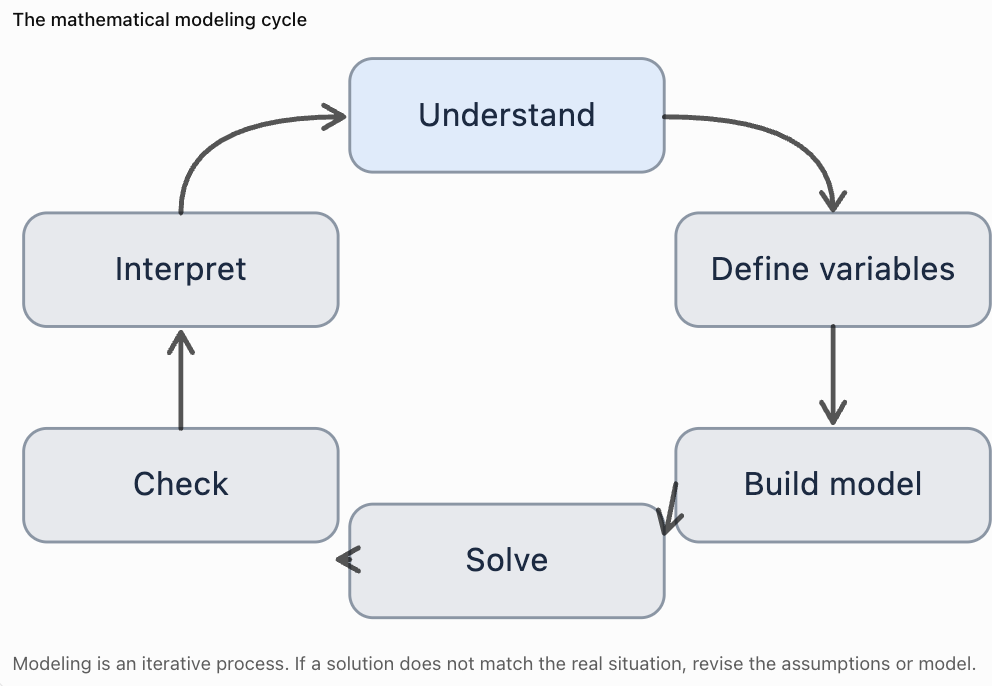
Understanding the situation
Read the problem carefully and identify what is known and what must be found.
Defining variables
Assign symbols to important quantities and specify their units.
Constructing the model
Translate the relationships into expressions, equations, inequalities, or functions.
Solving the model
Use appropriate algebraic techniques.
Checking the result
Substitute values, verify units, and assess whether the answer is reasonable.
Interpreting and refining
Explain the result in context. If the model is unrealistic, reconsider its assumptions.
Linear Mathematical Models
A linear model describes a relationship with a constant rate of change.
The general form is:
y = mx + b
where:
-
m = rate of change or gradient
-
b = initial value or y-intercept
-
x = independent variable
-
y = dependent variable
Worked Example: Mobile phone plans
A mobile phone company charges $18 per month plus $0.05 for each minute of calls beyond the included allowance.
Let:
m = number of additional minutes
C = total monthly cost in dollars
The model is:
C = 18 + 0.05m
If a customer uses 120 additional minutes:
C = 18 + 0.05(120)
C = 18 + 6
C = $24
The model predicts a monthly bill of $24.
The fixed charge of $18 is the y-intercept.
The rate of change is $0.05 per additional minute.
Graphical Interpretation
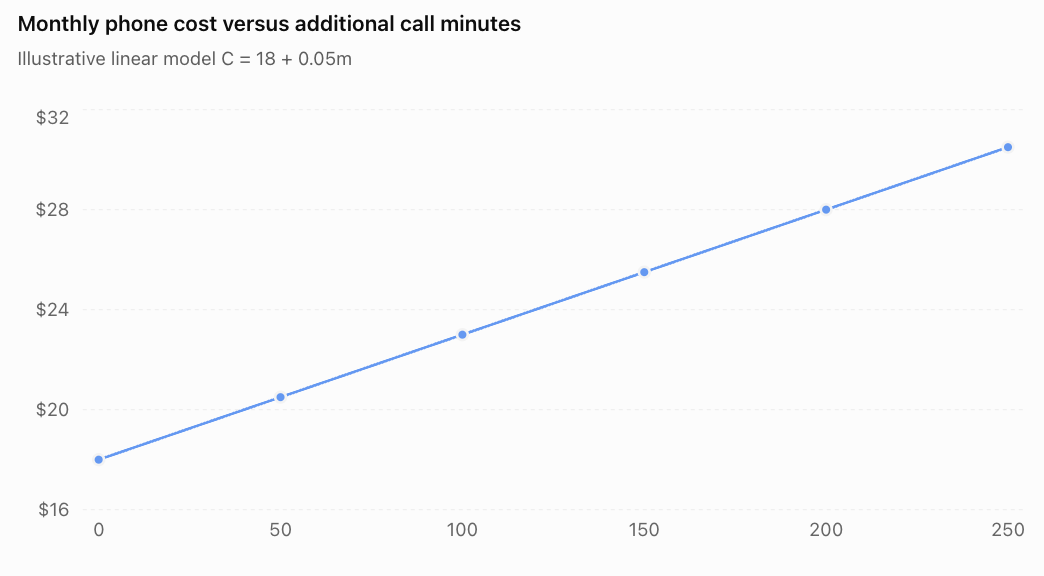
The graph is a straight line because the cost increases by the same amount for every additional minute.
The model is valid only while the pricing assumptions remain unchanged.
Comparing Two Mathematical Models
Mathematical modeling is particularly useful when comparing different options.
Worked Example: Two transport services
Company A charges a $6 booking fee plus $1.50 per kilometre.
Company B charges a $2 booking fee plus $2.00 per kilometre.
Let d = distance in kilometres.
Company A:
A = 6 + 1.5d
Company B:
B = 2 + 2d
Find the distance at which both companies charge the same amount.
Set the models equal:
6 + 1.5d = 2 + 2d
Subtract 2:
4 + 1.5d = 2d
Subtract 1.5d:
4 = 0.5d
d = 8
At 8 km:
A = 6 + 1.5(8) = $18
B = 2 + 2(8) = $18
Both companies charge $18 for an 8 km journey.
For journeys shorter than 8 km, Company B is cheaper.
For journeys longer than 8 km, Company A is cheaper.
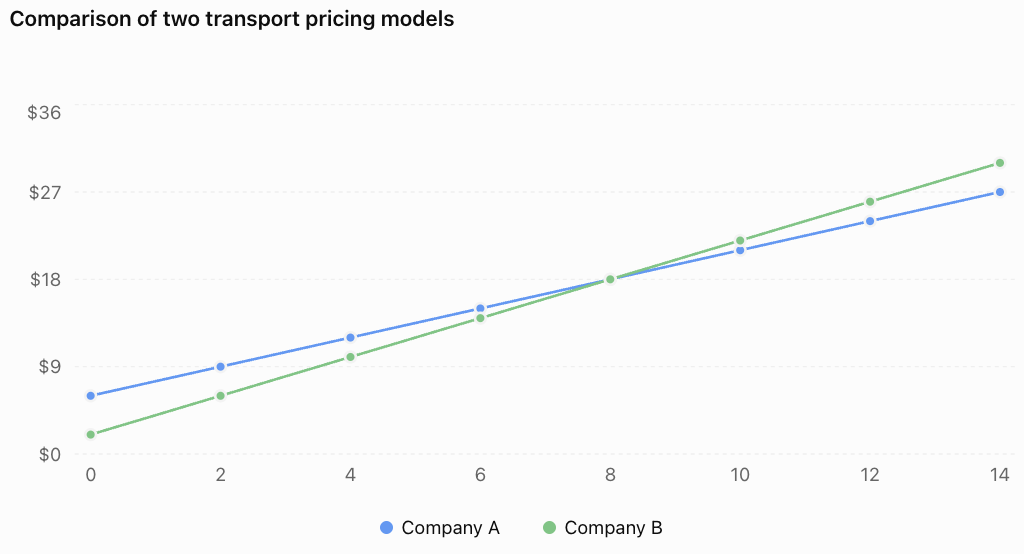
The intersection represents the distance at which the costs are equal.
Modeling with Quadratic Equations
Not all relationships are linear.
A quadratic model involves a squared variable and often describes area, projectile motion, or other nonlinear relationships.
Worked Example: Designing a garden
A rectangular garden has a perimeter of 40 m.
Find an expression for its area in terms of its width.
Let:
w = width (m)
l = length (m)
Perimeter:
2l + 2w = 40
Divide by 2:
l + w = 20
Therefore:
l = 20 − w
Area:
A = lw
Substitute:
A = w(20 − w)
Expand:
A = 20w − w²
This is a quadratic model.
Because both dimensions must be positive:
0 < w < 20
Finding the maximum area
Complete the square:
A = −(w² − 20w)
A = −(w² − 20w + 100) + 100
A = 100 − (w − 10)²
Since (w − 10)² ≥ 0, the maximum area occurs when:
w = 10 m
Then:
l = 20 − 10 = 10 m
Maximum area:
A = 10 × 10
A = 100 m²
The garden with the greatest area is a square measuring 10 m by 10 m.
Modeling with Exponential Relationships
Some real-world quantities change by a constant percentage rather than a constant amount.
Examples include population growth, compound interest, and radioactive decay.
An exponential growth model can be written as:
P = P₀(1 + r)ᵗ
where:
-
P = quantity after t periods
-
P₀ = initial quantity
-
r = growth rate per period, expressed as a decimal
-
t = number of periods
Worked Example: Population growth
A town has a population of 20,000 people and grows by 3% each year.
The model is:
P = 20,000(1.03)ᵗ
After five years:
P = 20,000(1.03)⁵
P ≈ 23,185
The model predicts approximately 23,185 people after five years.
This assumes the population continues growing by exactly 3% each year.
Unlike a linear model, the amount of population growth increases over time because the percentage is applied to a growing population.
Modeling with Inequalities
Sometimes a situation involves a limit or restriction rather than an exact equality.
For example:
A school has a budget of $500 for purchasing calculators costing $24 each.
Let n = number of calculators.
The total cost must not exceed $500:
24n ≤ 500
Divide by 24:
n ≤ 20.833...
Since n must be a whole number:
n ≤ 20
The school can purchase at most 20 calculators.
Common inequality phrases
|
Written statement |
Symbol |
|---|---|
|
Greater than |
> |
|
Less than |
< |
|
At least |
≥ |
|
At most |
≤ |
|
No more than |
≤ |
|
No less than |
≥ |
The choice between an equation and an inequality depends on whether the problem describes an exact relationship or a restriction.
Real-World Applications of Algebraic Modeling
Physics: Modeling Motion
For an object travelling at constant velocity:
d = vt
where:
-
d = displacement
-
v = velocity
-
t = time
Suppose a cyclist travels at a constant speed of 6 m/s along a straight path.
The distance model is:
d = 6t
After 30 seconds:
d = 6(30)
d = 180 m
The cyclist travels 180 m.
Chemistry: Modeling Concentration
Mass concentration can be represented by:
c = m/V
where:
-
c = mass concentration (g/L)
-
m = mass of solute (g)
-
V = volume of solution (L)
Suppose a chemist prepares solutions using 5 g of solute.
The model becomes:
c = 5/V
As the final solution volume increases, concentration decreases.
For V = 0.5 L:
c = 5/0.5 = 10 g/L
For V = 1.0 L:
c = 5/1.0 = 5 g/L
This is an inverse relationship, not a linear relationship.
Business: Modeling Profit
Profit is calculated using:
Profit = Revenue − Cost
Suppose a business sells products for $25 each.
Its fixed operating costs are $600, and each product costs $10 to manufacture.
Let n = number of products produced and sold.
Revenue:
R = 25n
Cost:
C = 600 + 10n
Profit:
P = R − C
P = 25n − (600 + 10n)
P = 15n − 600
Finding the break-even point
At break-even:
P = 0
15n − 600 = 0
15n = 600
n = 40
The business must sell 40 products to break even.
If it sells 60 products:
P = 15(60) − 600
P = $300
The model predicts a profit of $300.
Interpreting Mathematical Results
Obtaining an algebraic answer is not the final stage of modeling.
We must decide what the result means in the original situation.
For example, suppose an equation gives:
n = 12.6
If n represents time in hours, 12.6 hours may be perfectly reasonable.
If n represents the number of buses required to transport students, we cannot use 12.6 buses.
We may need to round up to 13 buses.
However, rounding depends on the context.
-
If calculating the number of buses needed, round up.
-
If calculating the maximum number of whole items affordable, round down.
-
If calculating a measurement, round to an appropriate precision.
-
If calculating a theoretical value, an exact expression may be preferable.
Checking whether a model is reasonable
A good model should satisfy several conditions.
Mathematical consistency: The equations must be algebraically correct.
Realistic assumptions: The model should reflect the important features of the situation.
Appropriate units: Quantities must use compatible units.
Meaningful solutions: Results must make sense in context.
Reasonable predictions: The model should not be extended beyond its valid range without justification.
For example, a linear population model might predict negative population values if extended far enough into the past. Such predictions would not be meaningful.
Limitations of Mathematical Models
Every mathematical model is a simplified representation of reality.
For example, the model:
d = vt
assumes constant velocity.
In real life, vehicles accelerate, brake, turn, and encounter traffic.
Similarly, a simple cost model may ignore taxes, discounts, inflation, or changing prices.
When evaluating a model, consider:
-
What assumptions have been made?
-
Which factors have been ignored?
-
What range of values is reasonable?
-
How accurate are the input measurements?
-
How might the model be improved?
Understanding limitations is an important part of mathematical reasoning.
Communicating Algebraic Models Clearly
A well-presented modeling solution should include the following elements.
Define the variables.
State what each variable represents, including units where appropriate.
Explain the relationship.
Describe how the quantities are connected.
Construct the model.
Write the expression, equation, inequality, or function.
Solve or evaluate.
Show the algebraic steps clearly.
Interpret the result.
Explain what the answer means in the original situation.
Verify and evaluate.
Check the result and comment on any relevant assumptions.
Complete Worked Example: Planning a School Trip
A school is organising a trip for students.
The bus company charges a fixed fee of $180 plus $12 per student.
The school has a maximum budget of $900.
How many students can attend?
Step 1: Define the variable
Let n = number of students.
Step 2: Construct the model
Total cost:
C = 180 + 12n
Step 3: Apply the budget restriction
180 + 12n ≤ 900
Step 4: Solve
12n ≤ 720
n ≤ 60
Step 5: Interpret
A maximum of 60 students can attend within the stated budget.
Step 6: Verify
C = 180 + 12(60)
C = 180 + 720
C = $900
The total cost exactly matches the budget.
The model assumes the company can transport 60 students under this pricing arrangement and that no additional costs apply.
Common Mistakes
Failing to define variables
Writing an equation without explaining the variables makes the model difficult to interpret.
Translating word order incorrectly
"Five less than a number" means x − 5, not 5 − x.
Forgetting brackets
"Three times the sum of a number and four" is 3(x + 4), not 3x + 4.
Confusing expressions and equations
An expression represents a quantity. An equation establishes equality between expressions.
Ignoring units
A model using kilometres and metres must account for the difference in units.
Using an unsuitable model
Not every relationship is linear. Some situations require quadratic, exponential, inverse, or other models.
Ignoring restrictions
Numbers of people, vehicles, and products are generally non-negative integers.
Assuming a model is always accurate
A model is only as useful as its assumptions and the information used to construct it.
Failing to interpret the solution
A numerical answer should be connected to the original situation.
Key Terms
-
Algebraic modeling: Representing real-world situations using algebraic relationships.
-
Mathematical model: A mathematical representation of a real system or situation.
-
Variable: A symbol representing an unknown or changing quantity.
-
Independent variable: A variable used to determine or predict another quantity.
-
Dependent variable: A quantity whose value depends on another variable.
-
Algebraic expression: A combination of numbers, variables, and mathematical operations.
-
Equation: A statement that two expressions are equal.
-
Inequality: A mathematical statement comparing quantities using symbols such as <, >, ≤, or ≥.
-
Coefficient: A numerical factor multiplying a variable.
-
Constant: A value that does not change within the model.
-
Function: A relationship assigning exactly one output to each allowed input.
-
Linear model: A model with a constant rate of change.
-
Quadratic model: A model involving a squared variable.
-
Exponential model: A model involving repeated multiplication by a constant factor.
-
Rate of change: The amount by which one quantity changes relative to another.
-
Domain: The set of allowed input values.
-
Constraint: A restriction on the values that variables can take.
-
Assumption: A condition accepted when constructing a model.
-
Verification: Checking whether a result satisfies the original conditions.
-
Interpretation: Explaining what a mathematical result means in context.
-
Break-even point: The point where total revenue equals total cost.
-
Prediction: An estimate of a future or unknown quantity based on a model.
Key Takeaways
-
Algebraic modeling translates real-world situations into mathematical relationships.
-
Words such as "sum," "difference," "product," and "quotient" suggest mathematical operations.
-
Word order and brackets are important when translating statements.
-
Variables should be defined clearly, with units and restrictions where appropriate.
-
Expressions represent quantities, while equations describe equal relationships.
-
Mathematical models may be linear, quadratic, exponential, inverse, or other forms.
-
Equations can be used to find unknown values, while inequalities represent limits or constraints.
-
Real-world modeling requires both mathematical accuracy and an understanding of context.
-
Solutions should be checked and interpreted rather than reported as numbers alone.
-
Models have assumptions and limitations that affect their accuracy and usefulness.
Check Your Understanding
Recall and Understanding
1. What is algebraic modeling, and why is it useful?
2. Explain the difference between an algebraic expression and an equation.
3. Translate "seven less than three times a number" into algebra.
4. Explain why defining variables is important when constructing a mathematical model.
Application
5. Write an expression for the total cost of x books costing $9 each and y pens costing $3 each.
6. A taxi charges $4 plus $2.50 per kilometre. Write a model for the total cost C of a journey of d kilometres. Calculate the cost of a 14 km journey.
7. A rectangle has width x cm and length 6 cm greater than its width. Write expressions for its perimeter and area.
8. The sum of three consecutive integers is 72. Construct an equation and determine the integers.
9. A student earns $18 per hour and receives a fixed bonus of $50. Write an equation for total earnings E after h hours. Calculate the hours required to earn $230.
10. A company sells products for $30 each. Its fixed costs are $400, and each product costs $12 to manufacture. Write a profit model and calculate the break-even quantity.
Analysis and Challenge
11. Two gyms offer different membership plans.
Gym A charges $40 per month plus a $60 joining fee.
Gym B charges $55 per month with no joining fee.
Construct models and determine when the total costs are equal.
12. A rectangular garden has a perimeter of 60 m. Develop a quadratic model for its area in terms of width, and determine the dimensions that produce the maximum area.
13. A population of 5,000 increases by 4% each year. Construct an exponential model and predict the population after six years, rounded to the nearest whole person.
14. A school has $750 to purchase science kits costing $28 each, with a fixed delivery charge of $50. Construct an inequality and determine the maximum number of kits it can purchase.
15. A student models the cost of purchasing n notebooks at $5 each, with a one-time delivery fee of $8, using C = 5(n + 8). Explain the mistake and write the correct model.
Answers to Check Your Understanding
1. Algebraic modeling represents real-world situations using variables, expressions, equations, inequalities, or functions. It helps us describe relationships, solve problems, and make predictions.
2. An expression represents a quantity without an equals sign, such as 3x + 5. An equation states that two expressions are equal, such as 3x + 5 = 20.
3. 3x − 7.
4. Clear variable definitions identify the quantities represented, their units, and any restrictions. This makes the model easier to understand, solve, and interpret.
5. C = 9x + 3y dollars, where x and y are non-negative integers.
6. C = 4 + 2.5d. For d = 14: C = 4 + 2.5(14) = $39.
7. Length = x + 6. Perimeter P = 2x + 2(x + 6) = 4x + 12 cm. Area A = x(x + 6) = x² + 6x cm².
8. Let the integers be n, n + 1, n + 2. Then 3n + 3 = 72, so n = 23. The integers are 23, 24, and 25.
9. E = 18h + 50. Set 230 = 18h + 50 → 180 = 18h → h = 10 hours.
10. Revenue R = 30n. Cost C = 400 + 12n. Profit P = 18n − 400. Break-even occurs at n = 400/18 ≈ 22.22. Therefore, 23 whole products must be sold to make a positive profit; exact break-even is not possible at a whole-number quantity.
11. Gym A: A = 40m + 60. Gym B: B = 55m. Set equal: 40m + 60 = 55m → 60 = 15m → m = 4. Both cost $220 after four months.
12. Let width = w and length = 30 − w. Area A = w(30 − w) = 30w − w² = 225 − (w − 15)². Maximum area is 225 m² when width and length are both 15 m.
13. P = 5000(1.04)ᵗ. After six years: P = 5000(1.04)⁶ ≈ 6,327 people.
14. 28n + 50 ≤ 750 → 28n ≤ 700 → n ≤ 25. The school can purchase at most 25 kits.
15. The student's equation incorrectly multiplies the delivery fee by the price per notebook. The delivery fee is added only once. Correct model: C = 5n + 8.
Final Summary
Algebraic modeling connects mathematical ideas with the world around us. By translating words into expressions, defining variables clearly, and constructing equations or functions, we can represent situations that would otherwise be difficult to analyse.
A successful model must be mathematically correct, logically constructed, and appropriate for the situation it describes.
The most important skill is not simply writing an equation. It is understanding the relationship between quantities and using mathematics to explain, predict, and solve real-world problems.
3. Solving Applied Equations
Learning outcomes
- I can create equations from situations.
- I can solve real-world algebra problems.
- I can evaluate whether solutions are reasonable.
- I can interpret answers in context.
- I can explain my solution process.
Introduction
Algebra becomes especially useful when we apply it to problems outside the mathematics classroom. Many everyday situations involve unknown quantities, relationships between values, and conditions that can be represented using equations.
For example, suppose a school is organising a field trip. The bus company charges a fixed fee of $150 plus $12 for each student. The total transportation cost is $510.
How many students are attending?
We can represent the situation using an equation.
Let n = number of students.
Total cost = fixed fee + cost per student
510 = 150 + 12n
Subtract 150 from both sides:
360 = 12n
Divide by 12:
n = 30
Therefore, 30 students are attending the trip.
We can verify the answer:
150 + 12(30) = 510
150 + 360 = 510 ✓
This example demonstrates how a real-world situation can be translated into mathematics, solved using algebra, and interpreted in context.
In this topic, we will explore how to construct equations from written descriptions, solve practical algebra problems, evaluate the reasonableness of solutions, and communicate mathematical reasoning clearly.
What Are Applied Equations?
An applied equation is an equation used to represent and solve a problem involving a real-world situation.
Applied equations are common in:
-
Personal finance and budgeting.
-
Shopping and pricing.
-
Travel, speed, distance, and time.
-
Science and engineering.
-
Geometry and measurement.
-
Business and profit calculations.
-
Mixtures and concentration.
-
Population growth.
-
Planning and resource allocation.
The algebraic techniques are often familiar, but the challenge is determining which equation represents the situation correctly.
A useful problem-solving process is:
Understand → Define → Model → Solve → Check → Interpret
Understanding the Problem Before Solving
Before writing an equation, identify three important elements.
Known information
What values or relationships are provided?
For example:
A concert ticket costs $18, and there is a fixed booking fee of $6.
Known information:
-
Ticket price = $18.
-
Booking fee = $6.
Unknown information
What are we trying to calculate?
For example:
How many tickets can be purchased for $150?
Unknown:
Number of tickets.
Relationships
How are the quantities connected?
Total cost = ticket cost + booking fee
If n is the number of tickets:
C = 18n + 6
If the total cost is exactly $150:
150 = 18n + 6
Solve:
144 = 18n
n = 8
Therefore, eight tickets can be purchased for exactly $150.
If the question instead asks for the maximum number of tickets affordable with a budget of $150, the mathematical model is an inequality:
18n + 6 ≤ 150
This also gives a maximum of eight tickets, but the distinction between an exact total and a maximum budget is important.
Defining Variables Clearly
A variable represents an unknown or changing quantity.
Before constructing an equation, clearly state what each variable represents.
For example:
Let x = number of adult tickets sold.
This is better than simply writing "Let x = tickets" because it identifies the quantity precisely.
Variables may represent:
-
Whole numbers, such as the number of students.
-
Measurements, such as length or mass.
-
Monetary values.
-
Time intervals.
-
Rates, such as speed or hourly wages.
-
Quantities that may be positive or negative.
Restrictions on variables
Some variables have natural restrictions.
For example:
-
The number of students must be a non-negative integer.
-
A physical length cannot be negative.
-
A time interval cannot be negative.
-
A percentage discount is usually between 0% and 100%.
-
A denominator cannot equal zero.
Recognising these restrictions helps us determine whether a mathematical solution is reasonable.
Translating Words into Equations
Many written statements can be translated directly into algebra.
|
Written statement |
Algebraic equation |
|---|---|
|
Five more than a number is 17 |
x + 5 = 17 |
|
Three times a number is 42 |
3x = 42 |
|
Seven less than twice a number is 19 |
2x − 7 = 19 |
|
A number divided by four is 9 |
x/4 = 9 |
|
The sum of two consecutive integers is 35 |
n + (n + 1) = 35 |
|
A rectangle has a perimeter of 50 cm |
2l + 2w = 50 |
|
A product costs $8 each, plus a $5 fee, for a total of $69 |
8n + 5 = 69 |
Worked Example: Translating a statement
Three times a number, increased by eight, equals 50.
Let x = the unknown number.
Translate:
3x + 8 = 50
Subtract 8:
3x = 42
Divide by 3:
x = 14
Verification:
3(14) + 8 = 50
The number is 14.
Worked Example: Consecutive integers
The sum of three consecutive integers is 84.
Let n = the smallest integer.
The integers are:
n, n + 1, n + 2
Construct the equation:
n + (n + 1) + (n + 2) = 84
Simplify:
3n + 3 = 84
Subtract 3:
3n = 81
Divide by 3:
n = 27
The integers are:
27, 28, and 29
Verification:
27 + 28 + 29 = 84 ✓
Solving Problems Involving Money
Financial situations are particularly suitable for algebraic equations because they often involve fixed costs, rates, and totals.
Worked Example: Shopping
A student purchases several notebooks costing $4 each and a calculator costing $28.
The total cost is $60.
How many notebooks were purchased?
Let n = number of notebooks.
Total cost:
4n + 28 = 60
Subtract 28:
4n = 32
Divide by 4:
n = 8
Answer: Eight notebooks were purchased.
Verification:
8(4) + 28 = 32 + 28 = $60
Worked Example: Saving money
A student already has $85 saved and adds $15 each week.
How many weeks will it take to have $250?
Let w = number of weeks.
Total savings:
S = 85 + 15w
Set the total to $250:
250 = 85 + 15w
Subtract 85:
165 = 15w
Divide by 15:
w = 11
Answer: The student will reach $250 after 11 weeks.
Solving Problems Involving Distance, Speed, and Time
One of the most common scientific relationships is:
d = vt
where:
-
d = distance travelled.
-
v = constant speed.
-
t = time taken.
The formula can be rearranged:
v = d/t
t = d/v
The correct rearrangement depends on the unknown quantity.
Worked Example: Finding travel time
A train travels at a constant speed of 90 km/h.
How long does it take to travel 225 km?
Given:
d = 225 km
v = 90 km/h
Use:
t = d/v
Substitute:
t = 225/90
t = 2.5 hours
Answer: The journey takes 2 hours and 30 minutes.
Worked Example: Two vehicles travelling toward each other
Two towns are 300 km apart.
A car leaves one town travelling at 80 km/h. At the same time, another car leaves the other town travelling toward the first at 70 km/h.
How long will it take for the cars to meet?
Let t = time in hours.
Distance travelled by the first car:
d₁ = 80t
Distance travelled by the second car:
d₂ = 70t
Together, they travel 300 km:
80t + 70t = 300
150t = 300
t = 2
Answer: The cars meet after 2 hours.
Verification:
First car: 80 × 2 = 160 km
Second car: 70 × 2 = 140 km
Total = 300 km ✓
Solving Problems Involving Geometry
Geometric problems often require us to combine algebraic expressions with formulas for perimeter, area, and volume.
Worked Example: Rectangle dimensions
A rectangle has a perimeter of 64 cm.
Its length is 8 cm greater than its width.
Find its dimensions.
Let w = width in centimetres.
Length:
l = w + 8
Perimeter:
P = 2l + 2w
Substitute:
64 = 2(w + 8) + 2w
Expand:
64 = 2w + 16 + 2w
Simplify:
64 = 4w + 16
Subtract 16:
48 = 4w
w = 12
Length:
l = 12 + 8 = 20
Answer: Width = 12 cm, length = 20 cm.
Verification:
P = 2(20) + 2(12)
P = 40 + 24
P = 64 cm ✓
Worked Example: Area of a rectangle
A rectangular garden has an area of 96 m². Its length is 4 m greater than its width.
Find its dimensions.
Let w = width in metres.
Length = w + 4
Area:
A = lw
Substitute:
96 = w(w + 4)
Expand:
96 = w² + 4w
Rearrange:
w² + 4w − 96 = 0
Factor:
(w + 12)(w − 8) = 0
Possible solutions:
w = −12 or w = 8
A negative width is not physically meaningful.
Therefore:
w = 8 m
Length = 8 + 4 = 12 m
Answer: The garden measures 8 m by 12 m.
Verification:
8 × 12 = 96 m² ✓
Solving Problems Involving Ages
Age problems often involve relationships between people's ages at different times.
The important principle is that everyone ages at the same rate: after five years, each person's age increases by five years.
Worked Example: Present ages
A father is three times as old as his son.
Their combined age is 56 years.
Find their present ages.
Let x = son's age.
Father's age = 3x
Combined age:
x + 3x = 56
4x = 56
x = 14
Father's age:
3(14) = 42
Answer: The son is 14 years old, and the father is 42 years old.
Verification:
14 + 42 = 56
42 = 3 × 14
Both conditions are satisfied.
Worked Example: Ages in the future
A mother is currently 36 years old, and her daughter is 12.
In how many years will the mother be twice as old as her daughter?
Let t = number of years from now.
Mother's future age:
36 + t
Daughter's future age:
12 + t
Construct the equation:
36 + t = 2(12 + t)
Expand:
36 + t = 24 + 2t
Subtract 24:
12 + t = 2t
Subtract t:
t = 12
Answer: In 12 years, the mother will be twice as old as her daughter.
Verification:
Mother: 36 + 12 = 48
Daughter: 12 + 12 = 24
48 = 2 × 24 ✓
Solving Problems Involving Mixtures
Mixture problems often involve combining substances with different concentrations or prices.
The central idea is that the total amount of a substance is conserved when the mixtures are combined, assuming no substance is lost or produced.
Worked Example: Mixing solutions
A chemist needs 500 mL of a 20% salt solution.
Two solutions are available:
-
A 10% salt solution.
-
A 30% salt solution.
How much of each should be mixed?
Let x = volume of 10% solution in mL.
Volume of 30% solution:
500 − x
The amount of salt in the final mixture must equal the sum of the amounts of salt in the original solutions.
Construct the equation:
0.10x + 0.30(500 − x) = 0.20(500)
Expand:
0.10x + 150 − 0.30x = 100
Simplify:
−0.20x + 150 = 100
Subtract 150:
−0.20x = −50
Divide:
x = 250
Therefore:
10% solution = 250 mL
30% solution = 500 − 250 = 250 mL
Answer: Mix 250 mL of each solution.
Verification:
Salt from first solution:
0.10 × 250 = 25 mL equivalent
Salt from second solution:
0.30 × 250 = 75 mL equivalent
Total = 100 mL equivalent
100/500 = 0.20 = 20%
The model assumes the percentages are volume-based and that the volumes are additive.
Solving Problems Involving Percentages
Percentages appear in discounts, taxes, interest, population changes, and many other applications.
Worked Example: Finding an original price
A jacket is discounted by 25% and now costs $90.
What was the original price?
Let P = original price.
After a 25% discount, the customer pays 75% of the original price.
0.75P = 90
Divide by 0.75:
P = 90/0.75
P = 120
Answer: The original price was $120.
Verification:
25% of $120 = $30
$120 − $30 = $90 ✓
Worked Example: Percentage increase
A town's population increases by 8% and becomes 27,000.
What was the original population?
Let P = original population.
After an 8% increase:
1.08P = 27,000
Divide:
P = 27,000/1.08
P = 25,000
Answer: The original population was 25,000.
Verification:
8% of 25,000 = 2,000
25,000 + 2,000 = 27,000 ✓
Solving Problems with Systems of Equations
Sometimes a real-world situation involves two unknown quantities.
In such cases, we may need two equations.
Worked Example: Ticket sales
A school sells adult tickets for $15 and student tickets for $8.
A total of 100 tickets are sold, producing $1,080.
How many of each ticket were sold?
Let:
a = number of adult tickets
s = number of student tickets
Total tickets:
a + s = 100
Total revenue:
15a + 8s = 1080
Rearrange the first equation:
s = 100 − a
Substitute into the second:
15a + 8(100 − a) = 1080
Expand:
15a + 800 − 8a = 1080
Simplify:
7a + 800 = 1080
Subtract 800:
7a = 280
a = 40
Calculate student tickets:
s = 100 − 40
s = 60
Answer: 40 adult tickets and 60 student tickets.
Verification:
40 + 60 = 100 tickets
15(40) + 8(60) = 600 + 480 = $1,080
Both conditions are satisfied.
Solving Applied Quadratic Equations
Some real-world problems produce quadratic equations.
These often arise when calculating areas, dimensions, and motion under constant acceleration.
Worked Example: Projectile motion
A ball is thrown upward from a platform. Its height above the ground is modeled by:
h = −5t² + 20t + 15
where:
-
h = height above ground in metres.
-
t = time in seconds.
The model approximates gravitational acceleration as 10 m/s² and neglects air resistance.
When does the ball reach the ground?
At ground level:
h = 0
Therefore:
−5t² + 20t + 15 = 0
Divide by −5:
t² − 4t − 3 = 0
Use the quadratic formula:
t = (4 ± √(16 + 12))/2
t = (4 ± √28)/2
t = 2 ± √7
Approximate solutions:
t ≈ 4.646 or t ≈ −0.646
The negative time is outside the physical domain of this situation.
Answer: The ball reaches the ground approximately 4.65 seconds after being thrown.
Evaluating Whether Solutions Are Reasonable
Solving an equation is only part of the process.
We must also determine whether the result makes sense.
Checking units
If a question asks for distance, the answer should use a distance unit such as metres or kilometres.
Checking signs
Negative values may be valid for quantities such as displacement, temperature in Celsius, or financial losses.
However, negative values are generally invalid for physical lengths, elapsed time, and numbers of people.
Checking whole-number restrictions
If a calculation gives:
n = 12.7 buses
we cannot use 12.7 actual buses.
If the problem asks for the minimum number needed, we would normally round up to 13 buses.
Checking magnitude
Suppose a student calculates that a cyclist travels 5,000 km in 10 minutes.
Although the algebra may appear correct, the result is not reasonable for an ordinary cyclist.
This suggests a possible error in units, substitution, or calculation.
Checking original conditions
A solution must satisfy every condition in the problem, not just one equation.
For example, a ticket problem may require both the correct total number of tickets and the correct total revenue.
Using Estimation to Check Answers
Estimation can help identify unreasonable results before performing exact calculations.
Worked Example: Estimating a journey time
A car travels 310 km at approximately 100 km/h.
Estimated time:
t ≈ 310/100
t ≈ 3.1 hours
If a detailed calculation gives 31 hours, something has gone wrong.
Estimation provides a useful independent check.
Worked Example: Checking a shopping calculation
A student buys 19 items costing approximately $5 each.
Estimated total:
19 × 5 ≈ $95
A calculated total of $950 is unlikely to be correct.
Estimation does not replace exact calculations, but it can help detect mistakes.
Communicating Solutions Clearly
A well-presented applied algebra solution should include:
-
Define the variable: Explain what the unknown represents.
-
Construct the equation: Translate the situation into mathematics.
-
Solve: Show each algebraic operation logically.
-
Verify: Substitute the result into the original relationship.
-
Interpret: State the answer using appropriate units and context.
Complete Worked Example: Planning a School Event
A school is organising a science fair.
The venue costs $350 to rent, and materials cost $8 per student.
The total available budget is $950.
How many students can participate?
Step 1: Define the variable
Let n = number of students.
Step 2: Construct the model
Total cost:
C = 350 + 8n
The cost must not exceed $950:
350 + 8n ≤ 950
Step 3: Solve
Subtract 350:
8n ≤ 600
Divide by 8:
n ≤ 75
Step 4: Interpret
A maximum of 75 students can participate within the budget.
Step 5: Verify
C = 350 + 8(75)
C = 350 + 600
C = $950
The total exactly matches the budget.
Step 6: Evaluate
The model assumes the cost per student remains constant and that no additional expenses are incurred.
This solution combines algebra, inequality reasoning, practical interpretation, and verification.
Common Mistakes
Failing to identify the unknown
Before solving, clearly define the quantity represented by the variable.
Constructing the wrong equation
Read the problem carefully and identify how the quantities are related. A correct algebraic solution to an incorrect equation will not solve the original problem.
Ignoring fixed costs
Many practical problems involve both a fixed fee and a variable cost.
For example:
C = 50 + 12n
The fixed fee of $50 must be included.
Confusing total and remaining quantities
If 100 tickets are sold and x are adult tickets, the number of student tickets is 100 − x, not x.
Using inconsistent units
Convert measurements into compatible units before substituting them into equations.
Accepting impossible solutions
Negative lengths, fractional people, or times outside the situation's domain may need to be rejected.
Rounding incorrectly
When calculating the minimum number of vehicles required, round up. When calculating the maximum number of whole items affordable, round down.
Failing to verify
Always check that the solution satisfies the original conditions.
Not interpreting the result
An answer such as x = 15 is incomplete if the question asks how many students, hours, or kilometres are involved.
Key Terms
-
Applied equation: An equation used to represent and solve a real-world problem.
-
Variable: A symbol representing an unknown or changing quantity.
-
Constant: A value that remains unchanged within a model.
-
Coefficient: A numerical factor multiplying a variable.
-
Mathematical model: A mathematical representation of a real situation.
-
Linear equation: An equation involving variables to the first power.
-
Quadratic equation: An equation involving a squared variable.
-
System of equations: Two or more equations that must be satisfied simultaneously.
-
Substitution: Replacing a variable with a known value or equivalent expression.
-
Elimination: Removing a variable by combining equations.
-
Constraint: A condition restricting possible values.
-
Inequality: A statement comparing quantities using symbols such as <, >, ≤, or ≥.
-
Reasonableness: Whether a mathematical result makes sense in context.
-
Estimation: Finding an approximate value to guide or check calculations.
-
Verification: Checking a solution against the original equation or conditions.
-
Interpretation: Explaining the meaning of a result in its real-world context.
-
Fixed cost: A cost that does not change with the number of items or activities.
-
Variable cost: A cost that changes with the quantity produced, purchased, or used.
-
Rate: A comparison of two quantities with different units.
-
Domain: The set of allowed values for a variable.
-
Extraneous solution: A value obtained during solving that does not satisfy the original equation.
Key Takeaways
-
Applied equations connect algebra to practical situations.
-
Understanding the problem is essential before constructing an equation.
-
Variables should be clearly defined and given appropriate units.
-
Written relationships can be translated into equations or inequalities.
-
Real-world problems may involve linear, quadratic, or simultaneous equations.
-
Fixed costs, variable costs, rates, and totals must be identified correctly.
-
Mathematical solutions must be checked against the original conditions.
-
Not every algebraic solution is physically or practically meaningful.
-
Estimation helps identify unreasonable results.
-
Clear mathematical communication includes equations, working, units, verification, and interpretation.
Check Your Understanding
Recall and Understanding
1. What is an applied equation?
2. Why is it important to define variables before constructing an equation?
3. Explain the difference between an equation and an inequality in a budgeting problem.
4. Give two reasons why a mathematically correct answer might not be reasonable in a real-world situation.
Application
5. A student purchases notebooks costing $6 each and pays a fixed delivery fee of $9. The total cost is $57. How many notebooks were purchased?
6. A cyclist travels 84 km at a constant speed of 21 km/h. How long does the journey take?
7. A rectangle has a perimeter of 50 cm. Its length is 5 cm greater than its width. Find its dimensions.
8. A jacket is sold for $108 after a 20% discount. What was the original price?
9. A father is four times as old as his daughter. Their combined age is 65 years. Find their ages.
10. A school purchases 50 tickets for a performance. Adult tickets cost $14, and student tickets cost $8. The total cost is $520. How many adult and student tickets were purchased?
Analysis and Challenge
11. Two taxi companies charge different rates.
Company A charges $5 plus $2 per kilometre.
Company B charges $11 plus $1.50 per kilometre.
At what distance will both companies charge the same amount?
12. A rectangular garden has an area of 120 m². Its length is 2 m greater than its width. Calculate its dimensions.
13. A ball's height is modeled by:
h = −5t² + 15t + 20
where h is measured in metres and t in seconds.
Calculate when the ball reaches the ground.
14. A school has a budget of $800 for purchasing science equipment. Each kit costs $35, and delivery costs $65. Determine the maximum number of kits the school can purchase.
15. A student solves a word problem and obtains x = −6, where x represents the number of students attending an event. Explain why the result is not reasonable and describe what the student should do next.
Answers to Check Your Understanding
1. An applied equation is a mathematical equation constructed to represent and solve a real-world problem.
2. Defining variables makes clear what each symbol represents and helps ensure the equation matches the situation.
3. An equation describes an exact equality, such as C = 500. An inequality describes a restriction, such as C ≤ 500 for a maximum budget.
4. Examples include a negative number of people, a negative physical length, incompatible units, or a result that violates the assumptions of the situation.
5. 6n + 9 = 57 → 6n = 48 → n = 8 notebooks.
6. t = d/v = 84/21 = 4 hours.
7. Let width = w and length = w + 5. Then 2w + 2(w + 5) = 50 → 4w = 40 → w = 10 cm, length = 15 cm.
8. 0.80P = 108 → P = 108/0.80 = $135.
9. Let daughter’s age = x and father’s age = 4x. Then 5x = 65 → x = 13. Daughter = 13 years, father = 52 years.
10. Let a = adult tickets and s = student tickets. a + s = 50, 14a + 8s = 520. Substitute s = 50 − a: 14a + 8(50 − a) = 520 → 6a = 120 → a = 20, s = 30.
11. 5 + 2d = 11 + 1.5d → 0.5d = 6 → d = 12 km. Both companies charge $29.
12. Let width = w and length = w + 2. Then w(w + 2) = 120 → w² + 2w − 120 = 0 → (w + 12)(w − 10) = 0. Reject −12. Width = 10 m, length = 12 m.
13. Set h = 0: −5t² + 15t + 20 = 0. Divide by −5: t² − 3t − 4 = 0. Factor: (t − 4)(t + 1) = 0. Reject t = −1 because it is outside the modeled time interval. The ball reaches the ground after 4 seconds.
14. 35n + 65 ≤ 800 → 35n ≤ 735 → n ≤ 21. Maximum = 21 kits. Verification: 35(21) + 65 = $800.
15. A negative number of students is impossible. The student should check the variable definition, equation construction, algebraic steps, and original conditions. The problem may have been modeled incorrectly or may have no feasible solution under the stated assumptions.
Final Summary
Solving applied equations involves more than manipulating algebraic symbols. It requires understanding real situations, identifying relationships, constructing appropriate equations, and interpreting results.
A successful solution follows a logical process: understand the situation, define the variables, construct the equation, solve carefully, verify the answer, and explain its meaning.
The true value of applied algebra is its ability to turn real-world questions into mathematical problems that can be solved, checked, and used to make informed decisions.
4. Choosing Efficient Algebraic Strategies
Learning outcomes
- I can compare different solution methods.
- I can identify efficient manipulations.
- I can recognize useful algebraic identities.
- I can simplify calculations strategically.
- I can justify my chosen approach.
Introduction
In algebra, there is often more than one correct way to solve a problem. Some methods involve many calculations, while others use the structure of an expression to reach the answer much more quickly.
An important part of becoming a confident mathematician is learning not only how to solve a problem, but also how to choose an efficient method.
Consider the equation:
5(x − 3) = 40
One approach is to expand the brackets:
5x − 15 = 40
5x = 55
x = 11
However, we could divide both sides by 5 first:
x − 3 = 8
x = 11
Both approaches are correct, but the second requires fewer steps.
Efficient algebra involves recognising patterns, choosing useful operations, avoiding unnecessary calculations, and explaining why a particular method works.
In this topic, we will compare different algebraic strategies, explore useful identities, simplify expressions strategically, and learn how to justify our mathematical decisions.
What Makes an Algebraic Strategy Efficient?
An efficient algebraic strategy reaches a correct result using a clear, logical sequence of operations while minimising unnecessary work.
Efficiency does not always mean using the fewest written steps. A slightly longer method may be preferable if it is easier to understand, verify, or apply consistently.
A good strategy should be:
-
Correct: Every operation must preserve the mathematical relationship.
-
Clear: The reasoning should be understandable.
-
Efficient: Unnecessary calculations should be avoided.
-
Appropriate: The method should suit the structure of the problem.
-
Reliable: The method should minimise opportunities for errors.
-
Justifiable: We should be able to explain why it works.
For example, expanding every bracket is not always necessary. Sometimes factoring, cancelling common factors, or applying an algebraic identity provides a shorter solution.
Recognising the Structure of a Problem
Before beginning a calculation, examine the expression or equation carefully.
Ask:
-
Are there common factors?
-
Can the expression be simplified before expanding?
-
Are there familiar algebraic patterns?
-
Would factoring be easier than expanding?
-
Can fractions be eliminated?
-
Is substitution useful?
-
Can a special identity simplify the calculation?
-
Would a graphical or numerical method help check the result?
Recognising structure is often more important than performing calculations quickly.
Example: Two approaches to the same equation
Solve:
4(3x + 2) = 56
Method A: Expand first
12x + 8 = 56
12x = 48
x = 4
Method B: Divide first
3x + 2 = 14
3x = 12
x = 4
Both methods are correct.
Method B is more efficient because dividing by 4 removes the outside coefficient immediately.
Comparing Solution Methods
Consider:
2(x + 5) + 3(x + 5) = 40
Method A: Expand everything
2x + 10 + 3x + 15 = 40
5x + 25 = 40
5x = 15
x = 3
Method B: Factor the common expression
Notice that both terms contain (x + 5).
2(x + 5) + 3(x + 5) = 40
Factor:
(2 + 3)(x + 5) = 40
5(x + 5) = 40
x + 5 = 8
x = 3
Which method is more efficient?
Method B recognises the repeated expression and combines the coefficients without expanding both brackets.
This reduces the number of operations and the chance of sign errors.
General principle
If an expression contains repeated factors, consider factoring before expanding.
For example:
7(a − 2) − 4(a − 2)
= (7 − 4)(a − 2)
= 3(a − 2)
= 3a − 6
Recognising common factors is a powerful algebraic strategy.
Using Algebraic Identities
An algebraic identity is an equation that is true for every value of its variables for which both sides are defined.
Identities allow us to simplify calculations without performing every multiplication separately.
Some important identities include:
Square of a sum
(a + b)² = a² + 2ab + b²
Square of a difference
(a − b)² = a² − 2ab + b²
Difference of two squares
(a + b)(a − b) = a² − b²
Distributive property
a(b + c) = ab + ac
Difference of cubes
a³ − b³ = (a − b)(a² + ab + b²)
Sum of cubes
a³ + b³ = (a + b)(a² − ab + b²)
These identities can transform complicated expressions into simpler forms.
Using the Difference of Two Squares
The identity:
(a + b)(a − b) = a² − b²
is particularly useful when multiplying numbers or expressions that differ only by a sign.
Worked Example: Simplifying an expression
Simplify:
(x + 7)(x − 7)
Recognise the pattern:
a = x
b = 7
Apply the identity:
x² − 7²
x² − 49
This is faster than multiplying all four terms separately.
Worked Example: Mental arithmetic
Calculate:
103 × 97
Notice:
103 = 100 + 3
97 = 100 − 3
Therefore:
103 × 97 = (100 + 3)(100 − 3)
= 100² − 3²
= 10,000 − 9
= 9,991
This approach is more efficient than long multiplication.
Worked Example: Solving an equation
Solve:
x² − 81 = 0
Recognise a difference of squares:
(x − 9)(x + 9) = 0
Therefore:
x = 9 or x = −9
This avoids using the quadratic formula.
Using Perfect Square Identities
Perfect square identities are useful for expanding, factoring, solving equations, and simplifying numerical calculations.
Worked Example: Squaring a number
Calculate:
49²
Rewrite:
49 = 50 − 1
Apply:
(a − b)² = a² − 2ab + b²
49² = (50 − 1)²
= 50² − 2(50)(1) + 1²
= 2500 − 100 + 1
= 2401
Worked Example: Expanding a binomial
Expand:
(3x + 4)²
Use:
(a + b)² = a² + 2ab + b²
Here:
a = 3x
b = 4
Therefore:
(3x + 4)² = (3x)² + 2(3x)(4) + 4²
= 9x² + 24x + 16
Worked Example: Recognising a perfect square trinomial
Factor:
x² + 12x + 36
Notice:
36 = 6²
12x = 2(x)(6)
Therefore:
x² + 12x + 36 = (x + 6)²
Recognising this pattern is faster than searching for two factors through trial and error.
Factoring Before Solving
Factoring can turn a complicated equation into simpler equations.
Worked Example: Quadratic equation
Solve:
x² − 7x + 12 = 0
We need two numbers that:
-
Multiply to 12.
-
Add to −7.
The numbers are −3 and −4.
Factor:
(x − 3)(x − 4) = 0
Using the zero-product property:
x − 3 = 0 or x − 4 = 0
x = 3 or x = 4
Alternative: Quadratic formula
We could also use:
x = (−b ± √(b² − 4ac))/(2a)
With a = 1, b = −7, c = 12:
x = (7 ± √(49 − 48))/2
x = (7 ± 1)/2
x = 4 or x = 3
Both methods work.
However, factoring is more efficient in this example because the quadratic factors easily.
When should we use the quadratic formula?
The quadratic formula is often preferable when:
-
The quadratic does not factor conveniently.
-
The coefficients are awkward.
-
The solutions are irrational.
-
We need a reliable general method.
For example:
2x² + 3x − 5 = 0
This quadratic factors as:
(2x + 5)(x − 1) = 0
So factoring is efficient.
But for:
x² + 3x − 1 = 0
the quadratic formula is more convenient:
x = (−3 ± √13)/2
The best method depends on the structure of the equation.
Simplifying Fractions Strategically
Algebraic fractions often become easier when we factor the numerator and denominator before performing other operations.
Worked Example: Cancelling common factors
Simplify:
(x² − 9)/(x² + 3x)
Factor the numerator:
x² − 9 = (x − 3)(x + 3)
Factor the denominator:
x² + 3x = x(x + 3)
Therefore:
(x² − 9)/(x² + 3x) = (x − 3)(x + 3)/[x(x + 3)]
Cancel the common factor (x + 3):
(x − 3)/x
However, the original denominator cannot equal zero.
Therefore:
x ≠ 0 and x ≠ −3
These restrictions remain even after simplification.
Why factoring first is efficient
Factoring reveals common factors that may not be obvious in the original expression.
It is important to remember that we can cancel factors, not individual terms in a sum.
For example:
(x + 5)/x ≠ 5
The numerator is a sum, and x is not a factor of the entire numerator.
Eliminating Fractions Efficiently
When an equation contains several fractions, multiplying by the lowest common denominator can simplify the problem immediately.
Worked Example: Choosing the lowest common denominator
Solve:
(x − 1)/3 + (x + 2)/6 = 5
The lowest common denominator is 6.
Multiply every term by 6:
2(x − 1) + (x + 2) = 30
Expand:
2x − 2 + x + 2 = 30
Simplify:
3x = 30
x = 10
Verification:
(10 − 1)/3 + (10 + 2)/6
= 9/3 + 12/6
= 3 + 2
= 5 ✓
Multiplying by 6 first avoids working with several fractions throughout the solution.
Using Substitution to Simplify Complex Expressions
Substitution is useful when a complicated expression appears repeatedly.
Worked Example: Repeated expressions
Solve:
(x² + 2x)² − 5(x² + 2x) + 4 = 0
Instead of immediately expanding everything, notice that the expression x² + 2x appears twice.
Let:
u = x² + 2x
The equation becomes:
u² − 5u + 4 = 0
Factor:
(u − 1)(u − 4) = 0
Therefore:
u = 1 or u = 4
Now substitute back.
Case 1: u = 1
x² + 2x = 1
x² + 2x − 1 = 0
Using the quadratic formula:
x = −1 ± √2
Case 2: u = 4
x² + 2x = 4
x² + 2x − 4 = 0
Using the quadratic formula:
x = −1 ± √5
The four real solutions are:
x = −1 + √2, −1 − √2, −1 + √5, or −1 − √5
Substitution reduces a complicated fourth-degree equation to two simpler quadratic equations.
Choosing Between Substitution and Elimination
When solving simultaneous equations, both substitution and elimination can be effective.
The most efficient method depends on the coefficients and structure.
Worked Example: Substitution is convenient
Solve:
y = 2x + 3
3x + y = 18
Because y is already isolated, substitution is natural.
Substitute:
3x + (2x + 3) = 18
5x + 3 = 18
5x = 15
x = 3
Then:
y = 2(3) + 3
y = 9
Answer: x = 3, y = 9
Worked Example: Elimination is convenient
Solve:
4x + 3y = 23
4x − 2y = 8
The coefficients of x are identical.
Subtract the second equation from the first:
5y = 15
y = 3
Substitute into the first equation:
4x + 3(3) = 23
4x = 14
x = 3.5
Answer: x = 3.5, y = 3
Choosing a method
Substitution is often preferable when one variable is already isolated or has a coefficient of 1.
Elimination is often preferable when the coefficients of one variable are equal, opposite, or easy to make equal.
Neither method is always superior. The goal is to recognise which produces simpler calculations.
Strategic Simplification in Numerical Calculations
Algebraic thinking can also make arithmetic more efficient.
Worked Example: Using common factors
Calculate:
48 × 25
One approach is long multiplication.
A more efficient approach is to recognise:
25 = 100/4
Therefore:
48 × 25 = 48 × 100/4
= 12 × 100
= 1200
Worked Example: Using the distributive property
Calculate:
98 × 17
Rewrite 98 as 100 − 2:
98 × 17 = (100 − 2) × 17
= 100(17) − 2(17)
= 1700 − 34
= 1666
Worked Example: Simplifying before multiplying
Calculate:
(24 × 35)/6
Divide 24 by 6 first:
= 4 × 35
= 140
Simplifying before multiplying reduces the size of the numbers involved.
These strategies are useful in mental arithmetic, estimation, scientific calculations, and checking answers.
Using Symmetry and Patterns
Some algebraic expressions contain symmetry that can simplify the calculation.
Consider:
(x + 4)² − (x − 4)²
We could expand both squares.
However, the difference-of-squares identity is faster.
Let:
a = x + 4
b = x − 4
Then:
a² − b² = (a − b)(a + b)
Therefore:
(x + 4)² − (x − 4)²
= [(x + 4) − (x − 4)][(x + 4) + (x − 4)]
= (8)(2x)
= 16x
This is much simpler than expanding both squares separately.
Recognising patterns is particularly valuable in advanced algebra, calculus, and mathematical problem-solving.
Applications in Science and Engineering
Efficient algebraic manipulation is useful when working with scientific formulas.
Physics: Rearranging kinetic energy
Kinetic energy is:
KE = ½mv²
Suppose we want to find speed.
Multiply by 2:
2KE = mv²
Divide by m:
2KE/m = v²
Take the positive square root because speed is non-negative:
v = √(2KE/m)
A 5 kg object has 360 J of kinetic energy.
v = √(2 × 360/5)
v = √144
v = 12 m/s
An efficient strategy is to isolate v² before taking square roots rather than introducing roots earlier.
Engineering: Rearranging a resistance formula
The resistance of a uniform conductor is:
R = ρL/A
where:
-
R = electrical resistance (Ω)
-
ρ = resistivity (Ω·m)
-
L = conductor length (m)
-
A = cross-sectional area (m²)
To make A the subject, multiply by A:
RA = ρL
Divide by R:
A = ρL/R
This direct rearrangement is more efficient than introducing unnecessary intermediate fractions.
Geometry: Recognising an identity
Suppose the length of a rectangle is x + 5 and its width is x − 5.
Area:
A = (x + 5)(x − 5)
Use the difference-of-squares identity:
A = x² − 25
This is efficient because the middle terms cancel automatically.
The model requires x > 5 for both dimensions to be positive.
Comparing Methods Using an Efficiency Checklist
When several methods are possible, compare them using the following questions.
|
Question |
Why it matters |
|---|---|
|
Does the method preserve equivalence? |
Ensures mathematical correctness |
|
Does it use a recognisable identity? |
May avoid unnecessary expansion |
|
Can common factors be removed? |
Reduces complexity |
|
Does it introduce fractions? |
Fractions may make calculations harder |
|
Does it require many operations? |
More operations create more opportunities for error |
|
Is the result easy to verify? |
Supports confidence in the answer |
|
Can I explain the method clearly? |
Demonstrates mathematical understanding |
A method that is slightly longer but easier to verify may be preferable to a shorter, less reliable method.
Justifying a Chosen Strategy
Mathematical justification explains why a method is appropriate.
For example:
Problem: Solve x² − 16 = 0.
A useful justification is:
"I chose factoring because the expression is a difference of two squares. This allows me to rewrite the equation as a product and use the zero-product property."
Solution:
(x − 4)(x + 4) = 0
x = 4 or x = −4
Another example:
Problem: Solve 3(x + 5) = 36.
Justification:
"I divided both sides by 3 before expanding because the entire bracket is multiplied by 3. This removes the coefficient and reduces the number of calculations."
Solution:
x + 5 = 12
x = 7
Clear justifications connect algebraic decisions to the structure of the problem.
Common Mistakes
Expanding everything immediately
Expansion is useful, but it can create unnecessary terms. Look for common factors and identities first.
Using a complicated method for a simple equation
The quadratic formula works for x² − 25 = 0, but taking square roots or factoring is faster.
Cancelling terms instead of factors
Incorrect:
(x + 4)/x = 4
Correct:
(x + 4)/x = 1 + 4/x, for x ≠ 0.
Forgetting domain restrictions
Simplifying an algebraic fraction does not remove restrictions from its original denominator.
Dividing by a variable without checking whether it can equal zero
From x² = 3x, dividing by x loses the solution x = 0.
Instead:
x(x − 3) = 0
x = 0 or x = 3
Misusing algebraic identities
Incorrect:
(a + b)² = a² + b²
Correct:
(a + b)² = a² + 2ab + b²
Choosing a method solely because it has fewer steps
An efficient method must also be correct, understandable, and reliable.
Failing to justify the strategy
A complete mathematical explanation should identify the useful feature of the problem and explain why the chosen method is appropriate.
Key Terms
-
Algebraic strategy: A planned approach to simplifying or solving an algebraic problem.
-
Efficiency: Achieving a correct result while minimising unnecessary calculations and complexity.
-
Algebraic identity: An equality that holds for all values in its domain.
-
Distributive property: The rule a(b + c) = ab + ac.
-
Common factor: A factor shared by two or more terms.
-
Factorisation: Rewriting an expression as a product of factors.
-
Difference of squares: The identity a² − b² = (a − b)(a + b).
-
Perfect square trinomial: A trinomial that can be expressed as the square of a binomial.
-
Substitution: Replacing an expression or variable with an equivalent quantity.
-
Elimination: Solving simultaneous equations by combining equations to remove a variable.
-
Zero-product property: If ab = 0, then a = 0 or b = 0.
-
Equivalent expressions: Expressions with the same value for every input in their shared domain.
-
Simplification: Rewriting an expression in a more manageable equivalent form.
-
Quadratic formula: A general formula for solving quadratic equations.
-
Domain restriction: A condition limiting allowed variable values.
-
Verification: Checking a result against the original problem.
-
Justification: Explaining why a mathematical method or operation is valid and appropriate.
Key Takeaways
-
Many algebraic problems can be solved using several different methods.
-
The most efficient strategy depends on the structure of the problem.
-
Factoring before expanding can save time and reduce errors.
-
Algebraic identities simplify both symbolic expressions and numerical calculations.
-
The difference-of-squares and perfect-square identities are especially useful.
-
Multiplying by a common denominator can simplify equations involving fractions.
-
Substitution is effective when complicated expressions repeat.
-
Elimination is useful when simultaneous equations contain matching or easily matched coefficients.
-
Simplifying numerical factors before multiplying can reduce calculation effort.
-
Efficient methods must preserve mathematical correctness and domain restrictions.
-
A good mathematical solution explains why the chosen strategy is appropriate.
-
Verification remains important even when a solution is obtained efficiently.
Check Your Understanding
Recall and Understanding
1. What makes an algebraic strategy efficient?
2. Explain why factoring may be preferable to expanding.
3. State the difference-of-squares identity.
4. When might elimination be more efficient than substitution?
Application
5. Solve efficiently:
6(x − 4) = 54
6. Simplify using an algebraic identity:
(x + 9)(x − 9)
7. Calculate mentally using an identity:
102 × 98
8. Factor:
x² + 14x + 49
9. Solve using factoring:
x² − 11x + 30 = 0
10. Simplify, stating restrictions:
(x² − 16)/(x² + 4x)
Analysis and Challenge
11. Solve the system using an efficient method:
3x + 2y = 19
3x − 2y = 5
Explain your choice.
12. Solve:
(x² − 3x)² − 5(x² − 3x) + 4 = 0
Use substitution to simplify the problem.
13. Simplify without fully expanding both squares:
(x + 6)² − (x − 6)²
14. Compare two methods for solving:
4(x + 3) = 32
Explain which method you would choose and why.
15. A student solves x² = 7x by dividing both sides by x and obtaining x = 7. Explain why this approach is incomplete and find all solutions.
Answers to Check Your Understanding
1. An efficient strategy produces a correct result through clear, reliable operations while avoiding unnecessary complexity.
2. Factoring can reveal common factors, zero-product relationships, or familiar patterns without generating extra terms.
3. a² − b² = (a − b)(a + b).
4. Elimination is often more efficient when one variable has equal or opposite coefficients, allowing it to be removed immediately.
5. Divide by 6 first: x − 4 = 9, so x = 13.
6. (x + 9)(x − 9) = x² − 81.
7. (100 + 2)(100 − 2) = 100² − 2² = 9996.
8. x² + 14x + 49 = (x + 7)².
9. (x − 5)(x − 6) = 0, so x = 5 or x = 6.
10. (x² − 16)/(x² + 4x) = (x − 4)(x + 4)/[x(x + 4)] = (x − 4)/x. Restrictions: x ≠ 0 and x ≠ −4.
11. Add the equations to eliminate y: 6x = 24, so x = 4. Substitute: 12 + 2y = 19, giving y = 7/2. Elimination is efficient because the y coefficients are opposites.
12. Let u = x² − 3x. Then u² − 5u + 4 = 0, so (u − 1)(u − 4) = 0. For u = 1: x² − 3x − 1 = 0, giving x = (3 ± √13)/2. For u = 4: x² − 3x − 4 = 0, giving x = 4 or x = −1. All four values are solutions.
13. Using the difference-of-squares identity: [(x + 6) − (x − 6)][(x + 6) + (x − 6)] = 12(2x) = 24x.
14. Method A expands: 4x + 12 = 32 → 4x = 20 → x = 5. Method B divides first: x + 3 = 8 → x = 5. Method B is more efficient because it avoids unnecessary expansion.
15. Dividing by x assumes x ≠ 0 and loses a possible solution. Rearrange: x² − 7x = 0 → x(x − 7) = 0. Therefore x = 0 or x = 7.
Final Summary
Choosing efficient algebraic strategies is an important step toward advanced mathematical problem-solving. It requires recognising patterns, comparing methods, and selecting operations that simplify rather than complicate a problem.
Factoring, substitution, algebraic identities, and strategic rearrangement can often reduce lengthy calculations to a few clear steps.
The best algebraic method is not necessarily the shortest one. It is the method that is correct, efficient, reliable, and easy to justify.
5. Integrated Algebra Challenge
Learning outcomes
- I can solve extended algebra problems.
- I can combine multiple algebraic techniques.
- I can communicate complete mathematical solutions.
- I can evaluate and refine my work.
- I can demonstrate fluency with algebraic manipulation.
Introduction
Algebra is most powerful when we can combine different mathematical techniques to solve unfamiliar and complex problems.
In earlier topics, we explored simplifying expressions, expanding and factoring, solving equations, rearranging formulas, working with fractions, applying algebra to real-world situations, and choosing efficient solution strategies.
An integrated algebra challenge brings these skills together.
Instead of being told which technique to use, we must analyse the problem, select an appropriate strategy, carry out several mathematical operations, and verify that the solution is correct.
For example, consider:
3(x − 2) + (x + 4)/2 = 17
This equation involves brackets, fractions, like terms, and inverse operations.
We can solve it systematically.
Multiply every term by 2:
6(x − 2) + (x + 4) = 34
Expand:
6x − 12 + x + 4 = 34
Collect like terms:
7x − 8 = 34
Add 8:
7x = 42
Divide by 7:
x = 6
Verification:
3(6 − 2) + (6 + 4)/2
= 12 + 5
= 17 ✓
This problem demonstrates how several familiar algebraic techniques can be combined into one logical solution.
The goal of this topic is to develop algebraic fluency: the ability to recognise mathematical structures, select efficient methods, communicate reasoning clearly, and evaluate the accuracy of solutions.
What Is an Integrated Algebra Problem?
An integrated algebra problem requires several algebraic ideas or techniques to be used together.
These problems may involve:
-
Simplifying complicated expressions.
-
Expanding and factoring.
-
Solving linear and quadratic equations.
-
Manipulating fractions and rational expressions.
-
Rearranging formulas.
-
Solving systems of equations.
-
Working with powers and roots.
-
Constructing equations from written descriptions.
-
Applying algebra to scientific and practical situations.
-
Checking solutions and identifying invalid answers.
The difficulty often comes from deciding which technique to use first.
Example: Recognising different structures
Consider the following equations.
Equation A
5(x + 2) = 35
A useful strategy is to divide by 5 before expanding.
Equation B
x² − 25 = 0
A useful strategy is factoring or taking square roots.
Equation C
(x + 2)/3 + (x − 1)/4 = 5
A useful strategy is eliminating fractions using a common denominator.
Equation D
(x² + 3x)² − 5(x² + 3x) + 6 = 0
A useful strategy is substitution because the expression x² + 3x appears repeatedly.
Each problem suggests a different approach.
The Integrated Problem-Solving Process
A reliable process for extended algebraic problems is:
Understand
Identify the unknowns, given information, and restrictions.
Plan
Choose appropriate algebraic techniques and their order.
Solve
Carry out each step systematically, preserving equivalence.
Verify
Substitute answers into the original problem and check restrictions.
Communicate and refine
Explain the result and consider whether a better method exists.
The process is not always strictly linear. If verification reveals an error, we may need to revisit an earlier step.
Challenge: Combining Brackets, Fractions, and Variables
Solve:
2(3x − 4) − (x + 2)/3 = 10
Step 1: Identify the techniques
The equation contains:
-
Brackets.
-
A fraction.
-
Several terms involving x.
-
Constants.
We can eliminate the fraction first by multiplying every term by 3.
Step 2: Eliminate fractions
3[2(3x − 4)] − (x + 2) = 30
Simplify:
6(3x − 4) − (x + 2) = 30
Step 3: Expand
18x − 24 − x − 2 = 30
Step 4: Collect like terms
17x − 26 = 30
Step 5: Solve
17x = 56
x = 56/17
Step 6: Verify
Substitute x = 56/17 into the original equation.
First term:
2(3x − 4) = 2(168/17 − 68/17) = 200/17
Second term:
(x + 2)/3 = (56/17 + 34/17)/3 = 30/17
Difference:
200/17 − 30/17 = 170/17 = 10 ✓
The solution is correct.
Reflection
Eliminating the fraction first makes the equation easier to manage.
An alternative is to expand first, but this introduces additional fractional calculations.
Both methods are valid.
Challenge: Factoring and Rational Expressions
Solve:
(x² − 9)/(x + 3) = 2x − 8
Step 1: Identify restrictions
The denominator cannot equal zero.
x + 3 ≠ 0
Therefore:
x ≠ −3
Step 2: Factor the numerator
x² − 9 = (x − 3)(x + 3)
Therefore:
(x − 3)(x + 3)/(x + 3) = 2x − 8
For x ≠ −3, cancel the common factor:
x − 3 = 2x − 8
Step 3: Solve
Add 8:
x + 5 = 2x
Subtract x:
x = 5
Step 4: Verify
Original equation:
(5² − 9)/(5 + 3) = 2(5) − 8
16/8 = 2
2 = 2 ✓
The solution is valid.
Important observation
Cancelling x + 3 does not remove the restriction x ≠ −3.
A simplified expression may look valid at values that were excluded from the original expression.
Challenge: Recognising Algebraic Identities
Simplify:
(x + 5)² − (x − 5)²
We could expand both squares, but the difference-of-squares identity is more efficient.
a² − b² = (a − b)(a + b)
Let:
a = x + 5
b = x − 5
Then:
[(x + 5) − (x − 5)][(x + 5) + (x − 5)]
Simplify:
(10)(2x)
= 20x
Alternative method
Expand both squares:
(x² + 10x + 25) − (x² − 10x + 25)
= x² + 10x + 25 − x² + 10x − 25
= 20x
Both approaches produce the same result.
However, recognising the identity avoids unnecessary expansion.
Challenge: Substitution and Quadratic Equations
Solve:
(x² − 2x)² − 7(x² − 2x) + 12 = 0
This expression appears complicated because it contains powers of quadratic expressions.
However, notice that x² − 2x appears repeatedly.
Step 1: Substitute
Let:
u = x² − 2x
The equation becomes:
u² − 7u + 12 = 0
Step 2: Factor
(u − 3)(u − 4) = 0
Therefore:
u = 3 or u = 4
Step 3: Substitute back
Case A: u = 3
x² − 2x = 3
x² − 2x − 3 = 0
Factor:
(x − 3)(x + 1) = 0
x = 3 or x = −1
Case B: u = 4
x² − 2x = 4
x² − 2x − 4 = 0
Use the quadratic formula:
x = (2 ± √(4 + 16))/2
x = (2 ± √20)/2
x = 1 ± √5
Final answer
x = 3, −1, 1 + √5, or 1 − √5
Why substitution is efficient
Without substitution, expanding the original equation would produce a fourth-degree polynomial.
Substitution allows us to solve simpler equations while preserving the original structure.
Challenge: Solving Equations with Powers and Roots
Equations involving roots require particular care because operations such as squaring can introduce extraneous solutions.
Worked Example
Solve:
√(x + 5) = x − 1
Step 1: Identify restrictions
A square root is non-negative.
Therefore:
x − 1 ≥ 0
x ≥ 1
Step 2: Square both sides
x + 5 = (x − 1)²
Expand:
x + 5 = x² − 2x + 1
Rearrange:
x² − 3x − 4 = 0
Step 3: Factor
(x − 4)(x + 1) = 0
Possible solutions:
x = 4 or x = −1
Step 4: Verify
For x = 4:
√(4 + 5) = 4 − 1
3 = 3 ✓
For x = −1:
√(−1 + 5) = −1 − 1
2 ≠ −2
Therefore, x = −1 is an extraneous solution.
Final answer: x = 4
Reflection
The most important lesson is that solving the transformed equation is not always enough. Every proposed solution must satisfy the original equation.
Challenge: Combining Simultaneous Equations and Geometry
A rectangular garden has a perimeter of 54 m and an area of 180 m².
Find its dimensions.
Step 1: Define variables
Let:
l = length in metres
w = width in metres
Step 2: Construct equations
Perimeter:
2l + 2w = 54
Divide by 2:
l + w = 27
Area:
lw = 180
Step 3: Use substitution
From the perimeter equation:
l = 27 − w
Substitute into the area equation:
w(27 − w) = 180
Expand:
27w − w² = 180
Rearrange:
w² − 27w + 180 = 0
Step 4: Factor
(w − 12)(w − 15) = 0
Therefore:
w = 12 or w = 15
The corresponding other dimension is 15 or 12.
Step 5: Interpret
The garden measures:
12 m by 15 m
Step 6: Verify
Perimeter:
2(12) + 2(15) = 54 m
Area:
12 × 15 = 180 m²
Both conditions are satisfied.
This problem combines geometry, simultaneous relationships, substitution, quadratic equations, and verification.
Challenge: Rearranging a Scientific Formula
A physics experiment uses the kinetic energy formula:
KE = ½mv²
An object has 450 J of kinetic energy and a mass of 9 kg.
Find its speed.
Step 1: Identify the unknown
We need v.
Step 2: Rearrange
KE = ½mv²
Multiply both sides by 2:
2KE = mv²
Divide by m:
v² = 2KE/m
Take the positive square root because speed is non-negative:
v = √(2KE/m)
Step 3: Substitute
v = √(2 × 450/9)
v = √100
v = 10 m/s
Step 4: Verify
KE = ½(9)(10²)
KE = 4.5 × 100
KE = 450 J ✓
Extension: Combining two physics formulas
Suppose the same object is brought to rest by a constant resultant braking force over a distance of 20 m.
Use:
W = Fs
and the work-energy relationship:
|W| = ΔKE magnitude = 450 J
For a braking force opposite to the motion, its magnitude is:
F = 450/20
F = 22.5 N
The braking force has a magnitude of 22.5 N, acting opposite to the direction of motion.
This problem combines kinetic energy, formula rearrangement, work, and force.
Challenge: Algebraic Modeling and Profit
A company produces educational kits.
Its fixed production cost is $600, and each kit costs $12 to manufacture. The kits sell for $32 each.
Determine how many kits must be sold to earn a profit of at least $1,000.
Step 1: Define the variable
Let n = number of kits produced and sold.
Step 2: Model revenue
R = 32n
Step 3: Model costs
C = 600 + 12n
Step 4: Construct a profit model
Profit = Revenue − Cost
P = 32n − (600 + 12n)
Simplify:
P = 20n − 600
Step 5: Construct an inequality
The required profit is at least $1,000.
20n − 600 ≥ 1000
Add 600:
20n ≥ 1600
Divide by 20:
n ≥ 80
Step 6: Interpret
The company must sell at least 80 kits to earn a profit of $1,000 or more.
Verification:
Revenue = 80 × 32 = $2,560
Costs = 600 + 80 × 12 = $1,560
Profit = 2560 − 1560 = $1,000 ✓
Evaluation
This model assumes every kit produced is sold, the selling price stays constant, and no additional costs apply.
Real businesses may need to consider discounts, taxes, returns, and changes in production costs.
Challenge: Comparing Different Solution Strategies
Consider the equation:
(x + 4)² = 49
There are several ways to solve it.
Method A: Expand first
x² + 8x + 16 = 49
x² + 8x − 33 = 0
Factor:
(x + 11)(x − 3) = 0
x = −11 or x = 3
Method B: Take square roots first
(x + 4)² = 49
x + 4 = ±7
Therefore:
x = 3 or x = −11
Which method is better?
Method B is more efficient because the squared expression is already isolated.
It avoids expansion and factorisation.
However, both methods are mathematically valid.
The key skill is recognising the structure of the equation before deciding which operations to perform.
Evaluating and Refining Algebraic Work
Extended algebra problems create more opportunities for mistakes. Effective mathematicians therefore review their working rather than relying only on the final answer.
Checking for algebraic errors
Review each step for:
-
Incorrect distribution of negative signs.
-
Missing brackets.
-
Incorrect collection of like terms.
-
Invalid cancellation.
-
Division by zero.
-
Lost positive or negative solutions.
-
Incorrect application of algebraic identities.
Checking mathematical equivalence
Every rearrangement should preserve the original relationship, except when an operation may introduce or eliminate candidate solutions.
For example, multiplying both sides by a variable expression requires attention to its possible zero values.
Squaring both sides can introduce extraneous solutions.
Checking the original problem
Always substitute the final answer into the original equation rather than only into a simplified version.
This is particularly important when working with rational expressions and roots.
Refining the solution
After finding a correct answer, ask:
-
Could I have factored before expanding?
-
Was there a simpler common denominator?
-
Would substitution have reduced the complexity?
-
Did I perform unnecessary calculations?
-
Could I communicate the reasoning more clearly?
The ability to improve a solution is part of mathematical fluency.
Communicating Complete Mathematical Solutions
A strong extended solution should be understandable to someone who has not seen the problem before.
Consider this example.
Problem: The sum of two numbers is 18, and their product is 65. Find the numbers.
Define variables
Let x and y represent the two numbers.
Construct equations
x + y = 18
xy = 65
Choose a strategy
Substitution is useful because we can easily isolate one variable in the first equation.
y = 18 − x
Substitute
x(18 − x) = 65
18x − x² = 65
x² − 18x + 65 = 0
Factor
(x − 5)(x − 13) = 0
x = 5 or x = 13
Interpret
If x = 5, then y = 13.
If x = 13, then y = 5.
The two numbers are 5 and 13.
Verify
5 + 13 = 18
5 × 13 = 65
Both conditions are satisfied.
Justify the method
Substitution was appropriate because one equation was linear and allowed a variable to be isolated easily. This reduced the system to a single quadratic equation.
Common Mistakes
Starting calculations without a strategy
Identify the structure of the problem before choosing operations. Unnecessary expansion can make an equation more complicated.
Failing to preserve equality
When solving equations, operations must be applied consistently to both sides.
Cancelling terms incorrectly
Common factors may be cancelled, but individual terms in a sum generally cannot.
For example:
(x + 3)/x ≠ 3
Losing solutions through division
From x² = 4x, dividing by x gives x = 4 but loses x = 0.
Instead:
x(x − 4) = 0
Therefore x = 0 or x = 4.
Accepting extraneous solutions
Squaring both sides of an equation may introduce solutions that do not satisfy the original equation.
Ignoring restrictions
Denominators cannot equal zero, and physical quantities may have additional restrictions.
Rounding too early
Keep exact values or sufficient decimal places during intermediate calculations.
Failing to verify all conditions
In applied problems, the answer must satisfy every relevant equation and restriction.
Presenting disconnected calculations
Write the solution in a logical order and explain important decisions.
Assuming the first correct method is always the best
After solving, consider whether a shorter, clearer, or more reliable strategy was available.
Key Terms
-
Integrated algebra: The combined use of multiple algebraic techniques to solve a problem.
-
Algebraic fluency: The ability to manipulate algebraic expressions accurately, flexibly, and efficiently.
-
Solution strategy: A planned sequence of mathematical operations.
-
Equivalent equation: An equation with the same solution set as another equation.
-
Algebraic identity: An equality that holds for all values in its domain.
-
Factorisation: Rewriting an expression as a product of factors.
-
Substitution: Replacing a variable or expression with an equivalent quantity.
-
Elimination: Combining equations to remove a variable.
-
Rational expression: A ratio of polynomial expressions.
-
Quadratic equation: An equation that can be written as ax² + bx + c = 0, where a ≠ 0.
-
Zero-product property: If ab = 0, then a = 0 or b = 0.
-
Extraneous solution: A candidate solution that does not satisfy the original equation.
-
Domain restriction: A condition limiting the allowed values of a variable.
-
Mathematical modeling: Representing a real-world situation using mathematical relationships.
-
Verification: Checking whether a proposed answer satisfies the original conditions.
-
Evaluation: Assessing the correctness, efficiency, and appropriateness of a solution.
-
Justification: Explaining why a mathematical method or conclusion is valid.
Key Takeaways
-
Integrated algebra problems require several techniques to be combined.
-
The first step is to analyse the structure of the problem.
-
Efficient strategies often involve factoring, substitution, or eliminating fractions.
-
Algebraic identities can reduce complicated expressions to simpler forms.
-
Quadratic equations may be solved by factoring, square roots, completing the square, or the quadratic formula.
-
Restrictions must be considered when working with rational expressions and roots.
-
Applied algebra requires defining variables and interpreting results in context.
-
Verification is essential, especially after operations that may change the solution set.
-
Clear mathematical communication includes logical steps and explanations.
-
Reviewing and refining a solution helps develop algebraic fluency.
Check Your Understanding
Recall and Understanding
1. Explain what is meant by algebraic fluency.
2. Why is it useful to examine the structure of an equation before solving it?
3. Describe a situation in which substitution is more efficient than expanding.
4. Explain why solutions obtained after squaring both sides of an equation must be checked.
Application
5. Solve:
3(x + 4) − (x − 2)/2 = 25
6. Simplify, stating any restrictions:
(x² − 25)/(x² + 5x)
7. Simplify using an algebraic identity:
(x + 8)² − (x − 8)²
8. Solve:
(x − 3)² = 64
9. Solve:
x² − 9x + 20 = 0
10. Solve the simultaneous equations:
2x + y = 17
x − y = 4
Analysis and Challenge
11. Solve using substitution:
(x² − x)² − 5(x² − x) + 4 = 0
12. Solve and check for extraneous solutions:
√(x + 6) = x
13. A rectangle has a perimeter of 46 cm and an area of 120 cm². Find its dimensions.
14. A business sells products for $25 each. Fixed costs are $400, and variable costs are $9 per product. How many products must be sold to earn a profit of at least $560?
15. A student solves x² = 6x by dividing both sides by x and obtains x = 6. Explain why this solution is incomplete and find all solutions.
Answers to Check Your Understanding
Recall and Understanding
1. Algebraic fluency is the ability to use algebraic techniques accurately, efficiently, and flexibly, selecting suitable methods for different problems.
2. Examining the structure helps identify useful factors, identities, substitutions, and simpler operations. This reduces unnecessary calculations and errors.
3. Substitution is useful when a complicated expression appears repeatedly, such as x² + 3x in several terms of an equation.
4. Squaring can introduce candidate solutions that do not satisfy the original equation. Each candidate must be checked by substitution.
Application
5.
3(x + 4) − (x − 2)/2 = 25
Multiply by 2:
6(x + 4) − (x − 2) = 50
Expand:
6x + 24 − x + 2 = 50
5x + 26 = 50
5x = 24
x = 24/5 = 4.8
6.
(x² − 25)/(x² + 5x)
= (x − 5)(x + 5)/[x(x + 5)]
= (x − 5)/x
Restrictions:
x ≠ 0 and x ≠ −5
7.
(x + 8)² − (x − 8)²
= [(x + 8) − (x − 8)][(x + 8) + (x − 8)]
= 16(2x)
= 32x
8.
(x − 3)² = 64
x − 3 = ±8
x = 3 ± 8
x = 11 or x = −5
9.
x² − 9x + 20 = 0
(x − 4)(x − 5) = 0
x = 4 or x = 5
10.
2x + y = 17
x − y = 4
Add the equations:
3x = 21
x = 7
Substitute:
7 − y = 4
y = 3
x = 7, y = 3
Analysis and Challenge
11.
(x² − x)² − 5(x² − x) + 4 = 0
Let u = x² − x.
u² − 5u + 4 = 0
(u − 1)(u − 4) = 0
u = 1 or u = 4
For u = 1:
x² − x = 1
x² − x − 1 = 0
x = (1 ± √5)/2
For u = 4:
x² − x = 4
x² − x − 4 = 0
x = (1 ± √17)/2
Final answer:
x = (1 + √5)/2, (1 − √5)/2, (1 + √17)/2, or (1 − √17)/2
12.
√(x + 6) = x
Because the square root is non-negative, x ≥ 0.
Square both sides:
x + 6 = x²
x² − x − 6 = 0
(x − 3)(x + 2) = 0
Candidates:
x = 3 or x = −2
Check:
x = 3: √9 = 3 ✓
x = −2: √4 = 2, but the right side is −2. Invalid.
Final answer: x = 3
13.
Let length = l and width = w.
Perimeter:
2l + 2w = 46
l + w = 23
Therefore:
l = 23 − w
Area:
lw = 120
w(23 − w) = 120
23w − w² = 120
w² − 23w + 120 = 0
(w − 8)(w − 15) = 0
w = 8 or w = 15
Dimensions: 8 cm by 15 cm
Verification:
Perimeter = 2(8) + 2(15) = 46 cm
Area = 8 × 15 = 120 cm²
14.
Let n = number of products sold.
Revenue:
R = 25n
Costs:
C = 400 + 9n
Profit:
P = R − C
P = 25n − (400 + 9n)
P = 16n − 400
Required profit:
16n − 400 ≥ 560
16n ≥ 960
n ≥ 60
The business must sell at least 60 products.
Verification:
Revenue = 25(60) = $1,500
Costs = 400 + 9(60) = $940
Profit = $560
15.
The student divided by x without considering whether x = 0.
This operation can remove a valid solution.
Instead:
x² = 6x
x² − 6x = 0
x(x − 6) = 0
Therefore:
x = 0 or x = 6
Both values satisfy the original equation.
Final Summary
Integrated algebra challenges bring together the full range of algebraic skills developed throughout a course. They require more than remembering individual techniques: students must recognise structures, select suitable methods, combine operations, and evaluate the results.
Successful problem-solving involves planning carefully, working logically, verifying solutions, and communicating reasoning clearly.
Algebraic fluency is demonstrated when we can solve unfamiliar problems confidently, explain why our methods work, and recognise opportunities to improve our solutions.