Acids, Bases, and Equilibrium Systems
3. Buffer Solutions
Learning outcomes
- I can define a buffer solution.
- I can explain how buffers resist changes in pH.
- I can describe the importance of buffers in living systems.
- I can identify common buffer systems.
- I can explain buffer action using equilibrium concepts.
Buffer Solutions
A buffer solution is a solution that resists large changes in pH when small amounts of acid or base are added.
Buffers do not keep pH perfectly constant. Instead, they make the change in pH much smaller than it would be in an unbuffered solution.
Buffers are extremely important in:
- living organisms
- blood
- cells
- medicines
- foods
- chemical laboratories
- industrial processes
The central idea is:
added acid or base is consumed by components of the buffer
↓
the H₃O⁺ concentration changes only slightly
↓
pH changes only slightly
Why Buffers Are Needed
The pH of an ordinary solution can change significantly when even a relatively small amount of strong acid or strong base is added.
For example:
acid added → [H₃O⁺] increases → pH decreases
base added → [OH⁻] increases → pH increases
A buffer contains substances capable of reacting with these added ions before they cause a large change in pH.
This gives the solution a degree of pH stability.
What Is in a Buffer?
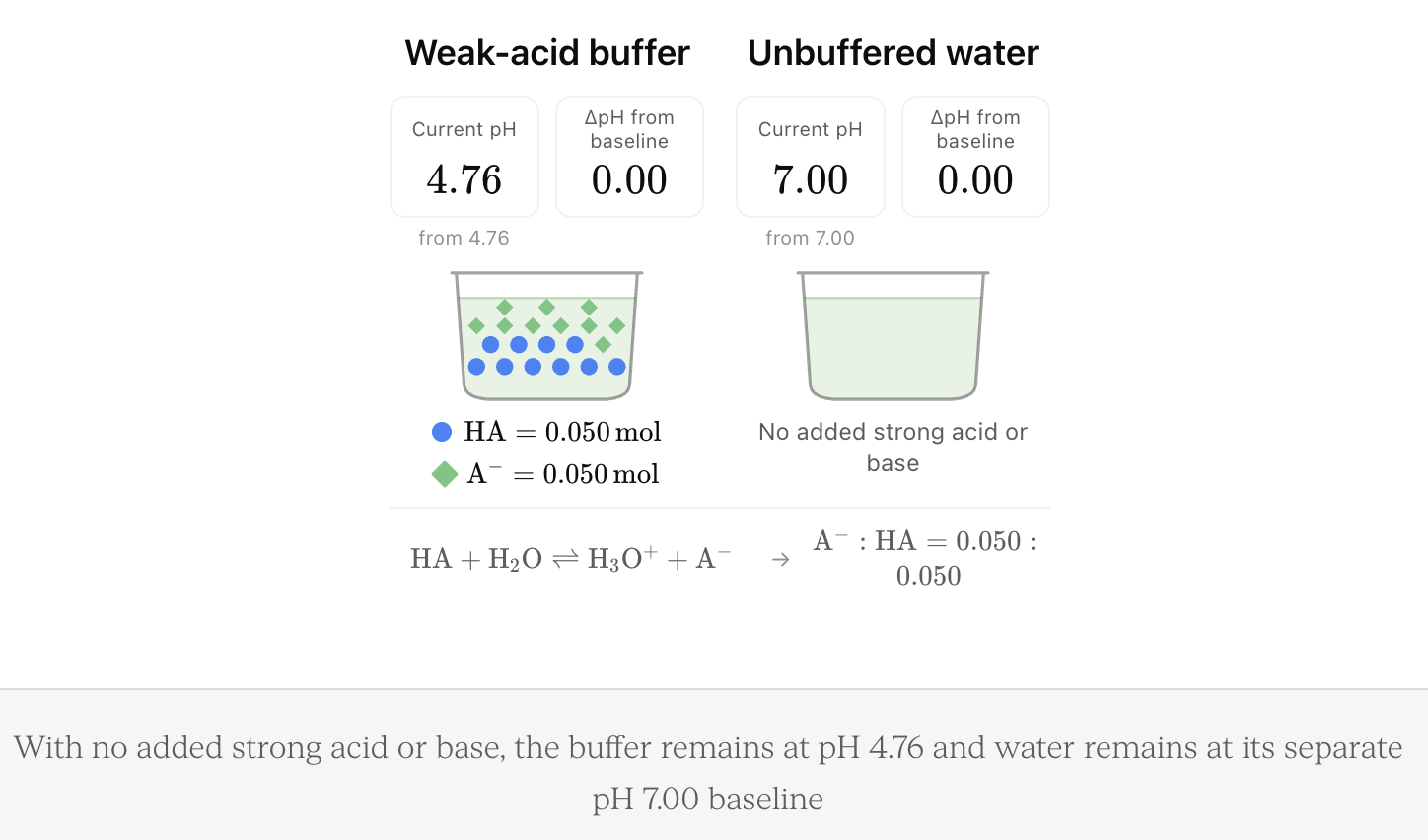
A common acidic buffer contains:
- a weak acid
- its conjugate base
For a general weak acid HA:
HA + H₂O ⇌ H₃O⁺ + A⁻
The buffer therefore contains significant amounts of:
HA
and:
A⁻
These two substances work together.
HA can react with added base.
A⁻ can react with added acid.
Example: Ethanoic Acid Buffer
A common example consists of:
- ethanoic acid, CH₃COOH
- ethanoate ions, CH₃COO⁻
The equilibrium is:
CH₃COOH + H₂O ⇌ H₃O⁺ + CH₃COO⁻
Ethanoic acid is weak, so it only partially ionizes.
Therefore, significant quantities of both:
CH₃COOH
and:
CH₃COO⁻
can be present.
This allows the solution to resist both added acid and added base.
What Happens When Acid Is Added?
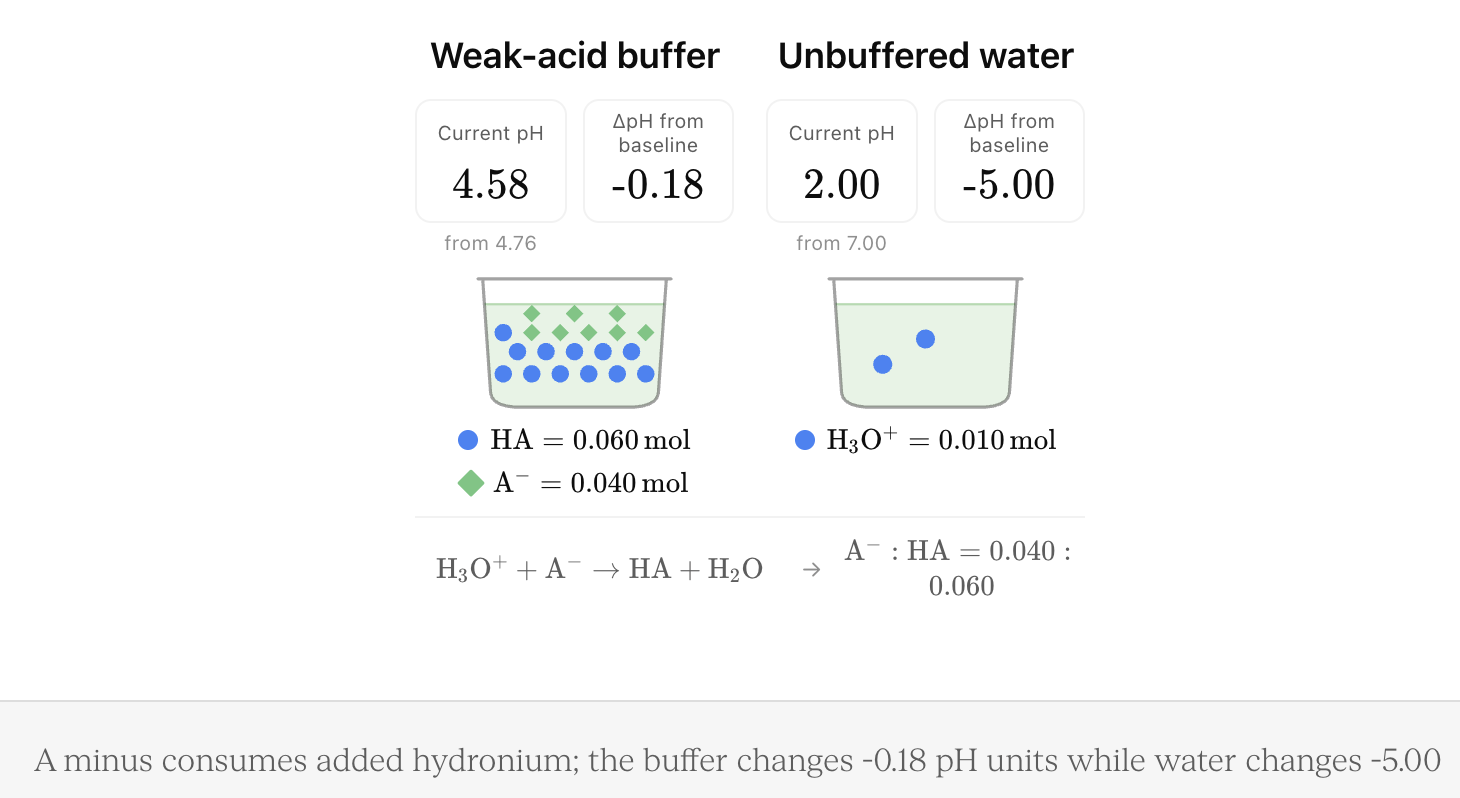
Suppose a small amount of strong acid is added to a buffer.
The added acid increases the amount of:
H₃O⁺
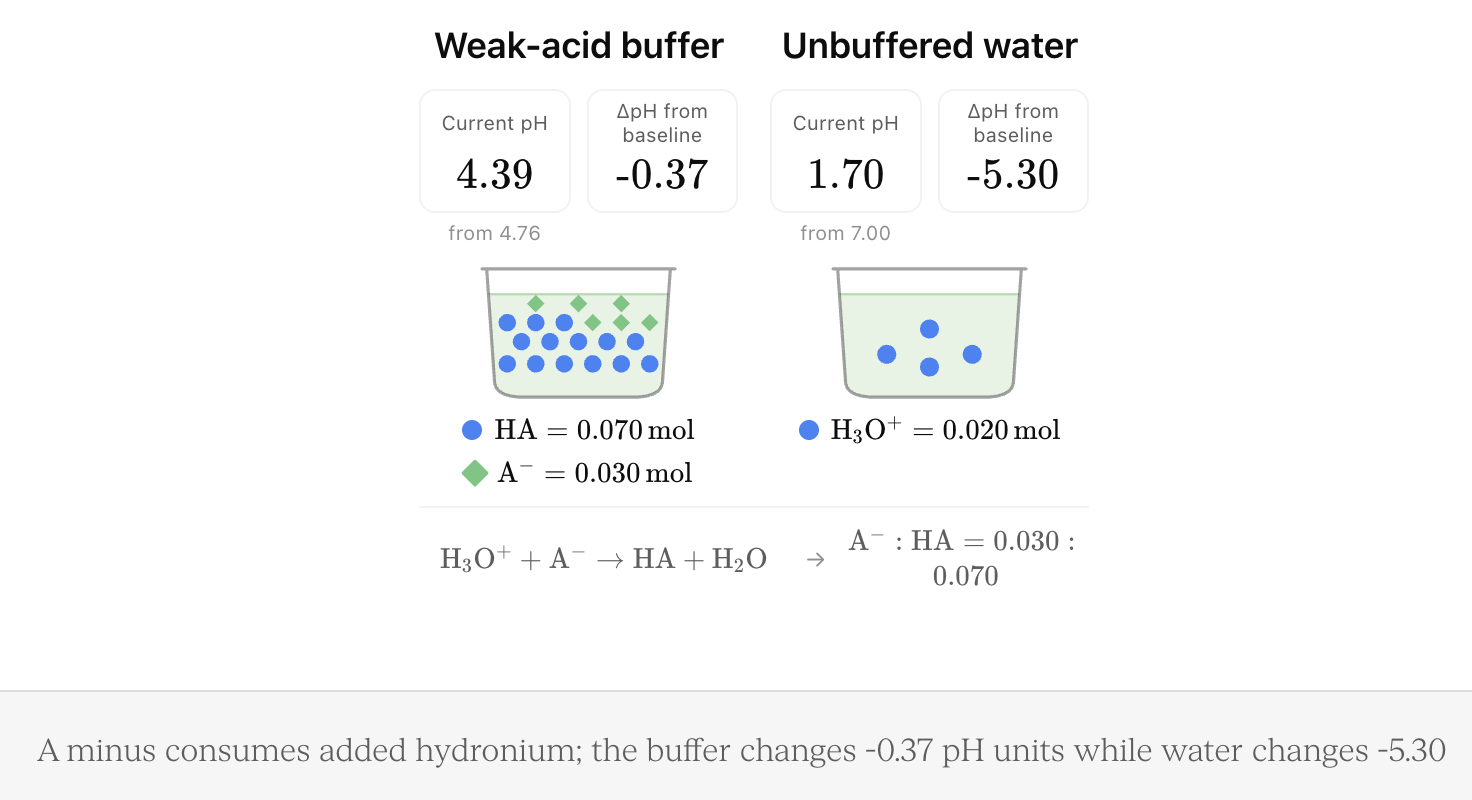
The conjugate base component of the buffer reacts with this added H₃O⁺:
A⁻ + H₃O⁺ → HA + H₂O
The added H₃O⁺ is therefore largely consumed.
Instead of remaining in solution and causing a major decrease in pH, much of it is converted into the weak acid HA.
Therefore:
acid added → A⁻ consumes much of the added H₃O⁺ → small pH decrease
What Happens When Base Is Added?
Suppose a small amount of strong base is added.
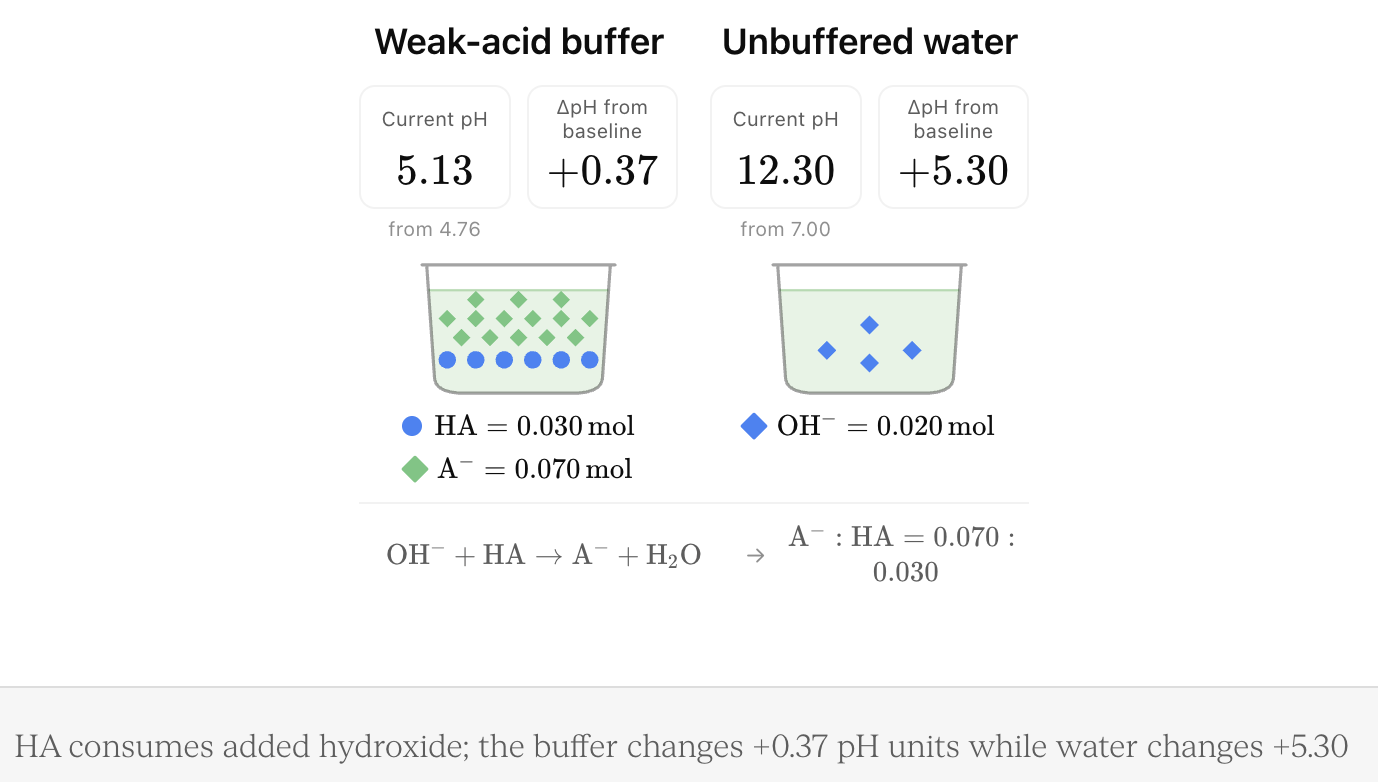
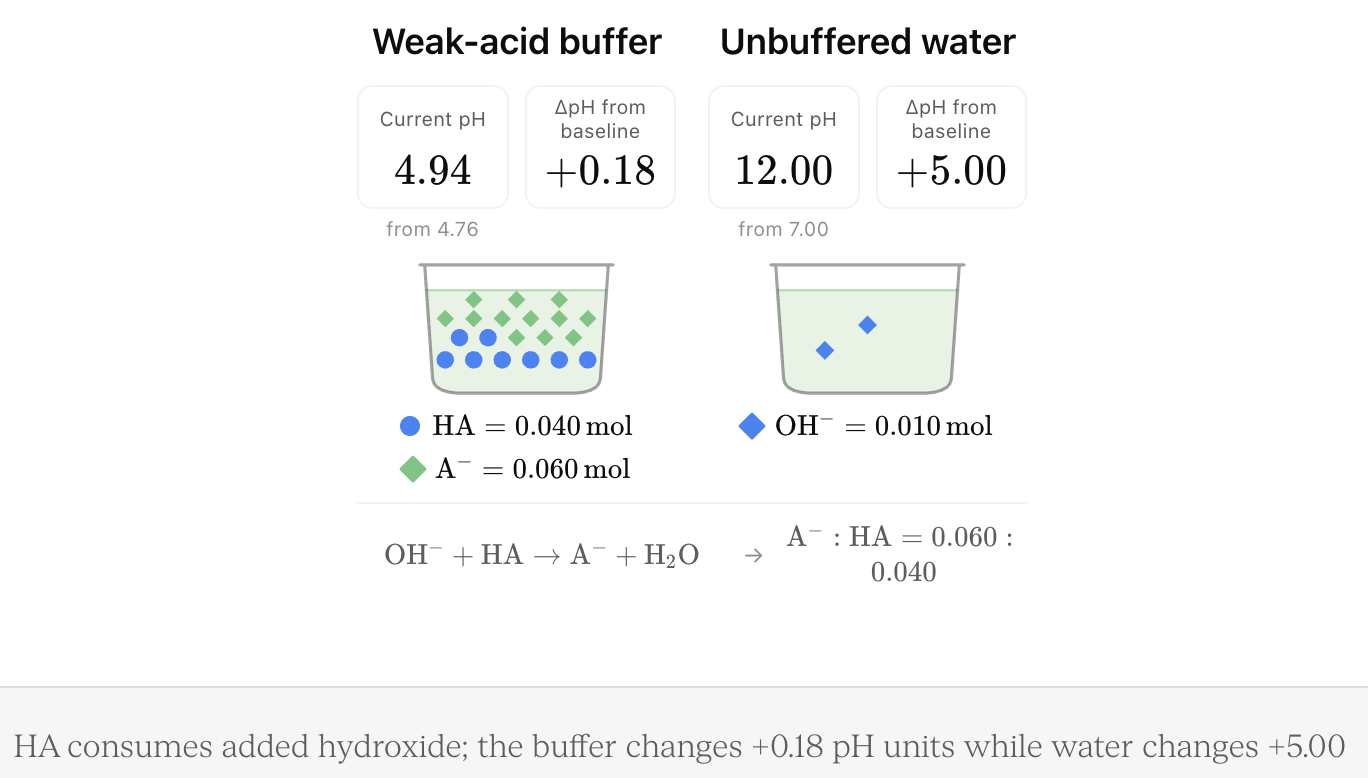
The added OH⁻ reacts with the weak acid component:
HA + OH⁻ → A⁻ + H₂O
The OH⁻ is largely consumed.
Therefore:
base added → HA consumes much of the added OH⁻ → small pH increase
The buffer can therefore resist changes in either direction.
Buffer Action at the Particle Level
Imagine a buffer containing many particles of:
HA and A⁻
Acid is added
Extra H₃O⁺ enters the solution.
A⁻ particles react with it:
A⁻ + H₃O⁺ → HA + H₂O
The number of A⁻ particles decreases slightly.
The number of HA particles increases slightly.
But the increase in free H₃O⁺ is limited.
Base is added
Extra OH⁻ enters the solution.
HA reacts with it:
HA + OH⁻ → A⁻ + H₂O
The number of HA particles decreases slightly.
The number of A⁻ particles increases slightly.
Again, the pH changes only slightly.
Comparing Buffered and Unbuffered Solutions
The difference becomes clear if the same small amount of strong acid or base is added to buffered and unbuffered solutions.