Solutions and Solubility
5. Factors Affecting Solubility
Learning outcomes
- I can describe how temperature affects solubility.
- I can explain the effect of pressure on gases dissolved in liquids.
- I can compare solubility trends for solids and gases.
- I can analyze graphs showing solubility changes.
- I can predict how changing conditions affects solubility.
Factors Affecting Solubility
Solubility is the maximum amount of a solute that can dissolve in a given amount of solvent under specific conditions.
Solubility is not always constant. Changing environmental conditions can change how much of a substance can remain dissolved.
Two particularly important factors are:
- temperature
- pressure
Temperature is especially important for both solids and gases, while pressure has its greatest effect on gases dissolved in liquids.


Solubility of Solids and Temperature
For many solid solutes, solubility increases as temperature increases.
This means that a larger amount of solid can often dissolve in hot solvent than in cold solvent.
For example, many salts and sugars become more soluble as water temperature increases.
A general trend for many solids is:
temperature increases → solubility increases
However, this is a general trend rather than a universal rule. Some solids show little change, and a few become less soluble as temperature increases.
Example: Dissolving a Solid
Suppose 35 g of a particular solid can dissolve in 100 g of water at 20°C.
At 60°C, perhaps 70 g can dissolve in the same amount of water.
Heating has therefore increased the solubility.
At 20°C:
Maximum dissolved = 35 g
At 60°C:
Maximum dissolved = 70 g
The warmer solution can hold more dissolved solute.
Why Temperature Can Affect Solid Solubility
Dissolving involves interactions between:
- solute particles
- solvent particles
Changing temperature changes the energy of these particles and can change the balance of interactions involved in dissolving.
For many common solids dissolved in water, higher temperatures favor greater solubility.
Because different substances have different particle interactions, however, they do not all respond to temperature in exactly the same way.
Heating a Saturated Solution
Suppose a solution is saturated at 20°C.
If it is heated and the solute becomes more soluble:
- the solubility limit increases
- additional solute can dissolve
- undissolved solid may begin to dissolve
Therefore, a solution that was saturated at a lower temperature may become unsaturated after heating.
More solute can then dissolve until the new saturation point is reached.


Cooling a Saturated Solution
The opposite can happen when a hot saturated solution cools.
If solubility decreases as temperature falls:
- the solvent can no longer hold as much dissolved solute
- excess dissolved solute leaves the solution
- crystals may form
This process is called crystallization.
Therefore:
cooling → lower solubility → excess solute crystallizes
This principle can be used to produce crystals in the laboratory.
Growing Crystals
A common crystal-growing method involves:
- Heating a solvent.
- Dissolving a large amount of solid solute.
- Producing a concentrated or saturated hot solution.
- Allowing the solution to cool slowly.
- Allowing excess dissolved solute to form crystals.
Slow cooling can allow well-formed crystals to develop.


Solubility Curves
A solubility curve is a graph showing how the solubility of a substance changes with temperature.
Usually:
- temperature is shown on the horizontal axis
- solubility is shown on the vertical axis
Solubility may be expressed as:
grams of solute per 100 g of water
Each line represents a different substance.


Reading a Solubility Curve
Suppose a graph shows that the solubility of substance X is:
30 g per 100 g water at 20°C
and:
70 g per 100 g water at 60°C
This means:
At 20°C, a maximum of 30 g can dissolve in 100 g water.
At 60°C, a maximum of 70 g can dissolve in 100 g water.
Therefore:
70 − 30 = 40 g
An additional 40 g can dissolve at 60°C.
Interpreting the Shape of a Solubility Curve
The direction and steepness of a solubility curve provide useful information.
A line that rises steeply means:
solubility increases greatly with temperature
A line that rises gradually means:
temperature has a smaller effect
A nearly horizontal line means:
temperature has little effect on solubility
A downward-sloping line means:
solubility decreases as temperature increases
Points on a Solubility Graph
For a typical solubility curve:
On the curve
The solution is saturated.
It contains the maximum stable amount of dissolved solute at that temperature.
Below the curve
The solution is unsaturated.
More solute could dissolve.
Above the curve
The amount shown is greater than the normal solubility at that temperature.
Depending on the circumstances, this could represent excess undissolved solute or a temporarily supersaturated solution.
Worked Example: Reading a Solubility Graph
Suppose the solubility of substance A is:
40 g per 100 g water at 30°C.
A solution contains 25 g of A in 100 g water.
Because:
25 g < 40 g
the solution is unsaturated.
An additional:
40 − 25 = 15 g
could dissolve before the solution becomes saturated.
Worked Example: Cooling a Solution
Suppose a substance has a solubility of:
80 g per 100 g water at 70°C
and:
30 g per 100 g water at 20°C.
A saturated solution containing 80 g dissolved solute is cooled from 70°C to 20°C.
At 20°C, only 30 g can remain dissolved.
Therefore:
80 − 30 = 50 g
50 g of solute crystallizes out.
Comparing Different Solutes
Solubility curves can also be used to compare substances.
Suppose at 40°C:
Substance A = 60 g per 100 g water
Substance B = 35 g per 100 g water
Substance C = 15 g per 100 g water
At 40°C:
A is the most soluble
and:
C is the least soluble
It is important to compare substances at the same temperature.
Solubility of Gases
Gases often show the opposite temperature trend to many solids.
For many gases dissolved in liquids:
temperature increases → gas solubility decreases
Therefore, gases are generally more soluble in colder liquids.
This is why cold water can usually hold more dissolved oxygen than warmer water.


Why Gases Escape from Warm Liquids
Gas particles dissolved in a liquid can escape from the liquid surface.
When temperature increases:
- particles have greater kinetic energy
- dissolved gas particles can escape more readily
- less gas remains dissolved
Therefore:
warming a liquid often decreases gas solubility
Example: Warm Soft Drinks
Carbon dioxide is dissolved in carbonated drinks.
A cold carbonated drink generally keeps carbon dioxide dissolved more effectively than a warm one.
As the drink warms:
- carbon dioxide becomes less soluble
- more CO₂ escapes
- the drink loses carbonation more quickly
This is one reason carbonated drinks are usually best kept cold.
Temperature and Aquatic Life
Water contains dissolved oxygen that aquatic organisms use for respiration.
Cold water can generally contain more dissolved oxygen than warm water.
If water temperature rises significantly:
- oxygen solubility decreases
- dissolved oxygen levels may fall
- aquatic organisms may experience greater stress
Temperature therefore affects not only chemistry but also aquatic ecosystems.
Pressure and Gas Solubility
Pressure has a particularly important effect on gases dissolved in liquids.
For gases:
pressure increases → gas solubility increases
Increasing the pressure of a gas above a liquid causes more gas particles to remain dissolved.
Decreasing the pressure allows more dissolved gas to escape.
This relationship is described quantitatively by Henry's law under appropriate conditions.


Particle Explanation of Pressure
Imagine a gas above a liquid.
Gas particles constantly collide with the liquid surface.
At higher pressure:
- more gas particles are present per unit volume above the liquid
- collisions with the liquid surface occur more frequently
- more gas can be maintained in the dissolved state
Therefore, higher gas pressure generally increases gas solubility.
Carbonated Drinks and Pressure
Carbonated drinks provide a familiar example.
During manufacturing, carbon dioxide is placed above and dissolved into the drink under high pressure.
Inside a sealed bottle:
high CO₂ pressure → more CO₂ remains dissolved
When the bottle is opened:
pressure decreases
The carbon dioxide becomes less soluble.
Gas escapes from the liquid as bubbles.
This produces the familiar fizz.
Why a Warm Carbonated Drink Fizzes More
Opening a warm carbonated drink can produce especially rapid bubbling.
Two changes favor the escape of CO₂:
Higher temperature
reduces the solubility of the gas.
Lower pressure after opening
also reduces gas solubility.
Therefore:
warming + pressure decrease → more CO₂ escapes
Solids and Pressure
Pressure usually has very little effect on the solubility of solids and liquids because their particles are already relatively close together and their volumes change very little under ordinary pressure changes.
Therefore, in introductory chemistry:
pressure is mainly considered when discussing gases
Comparing Solids and Gases
| Condition | Many Solids in Liquids | Gases in Liquids |
|---|---|---|
| Temperature increases. | Solubility usually increases | Solubility usually decreases |
| Temperature decreases | Solubility usually decreases. | Solubility usually increases |
| Pressure increases | Little effect | Solubility increases |
| Pressure decreases | Little effect | Solubility decreases |
These are useful general trends, although individual substances can behave differently.
A Visual Comparison of Typical Trends
For many solids, a typical trend might look like this:
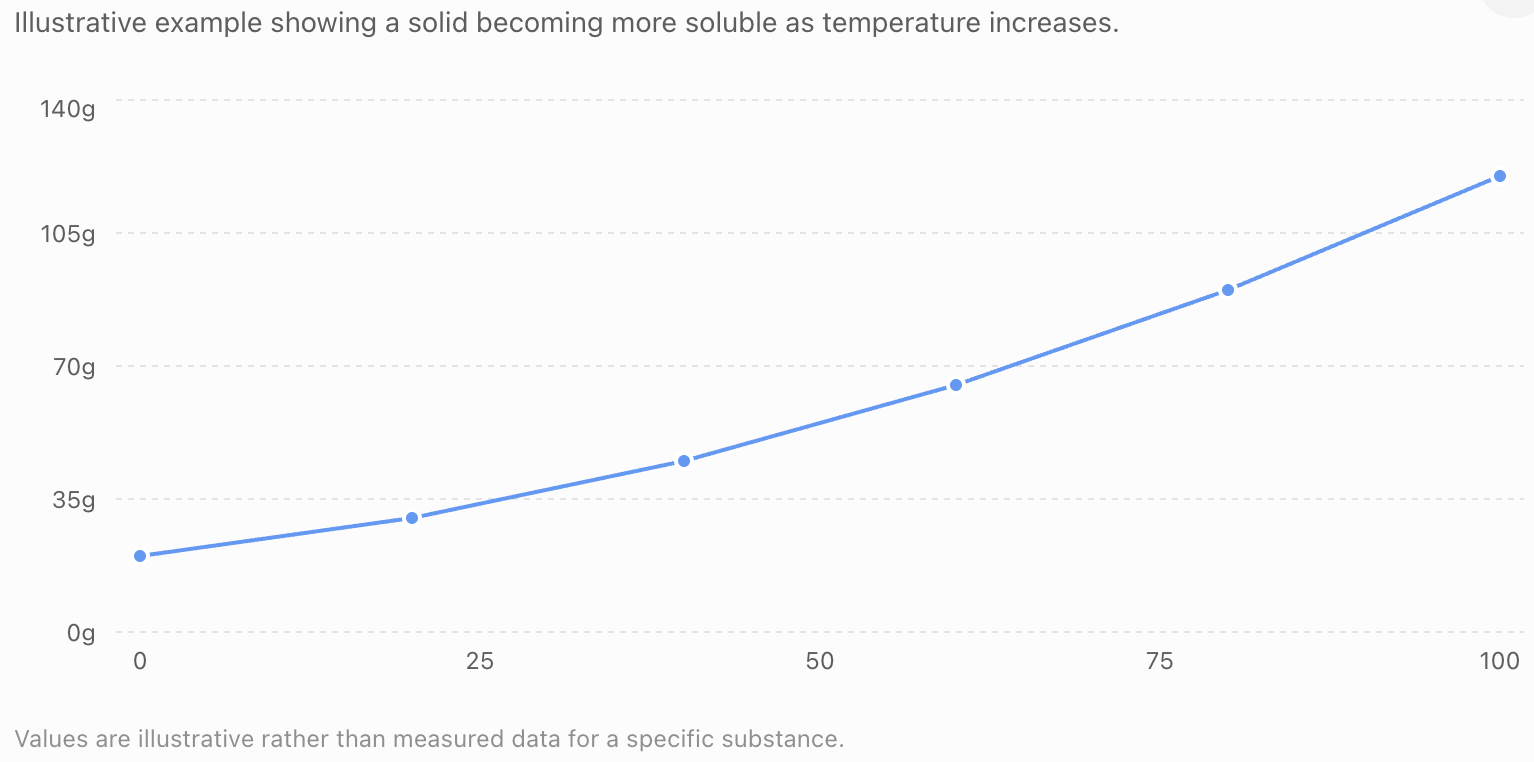
The important feature is the upward trend, not the particular values.
For gases, the typical temperature trend is reversed:
Typical gas solubility trend
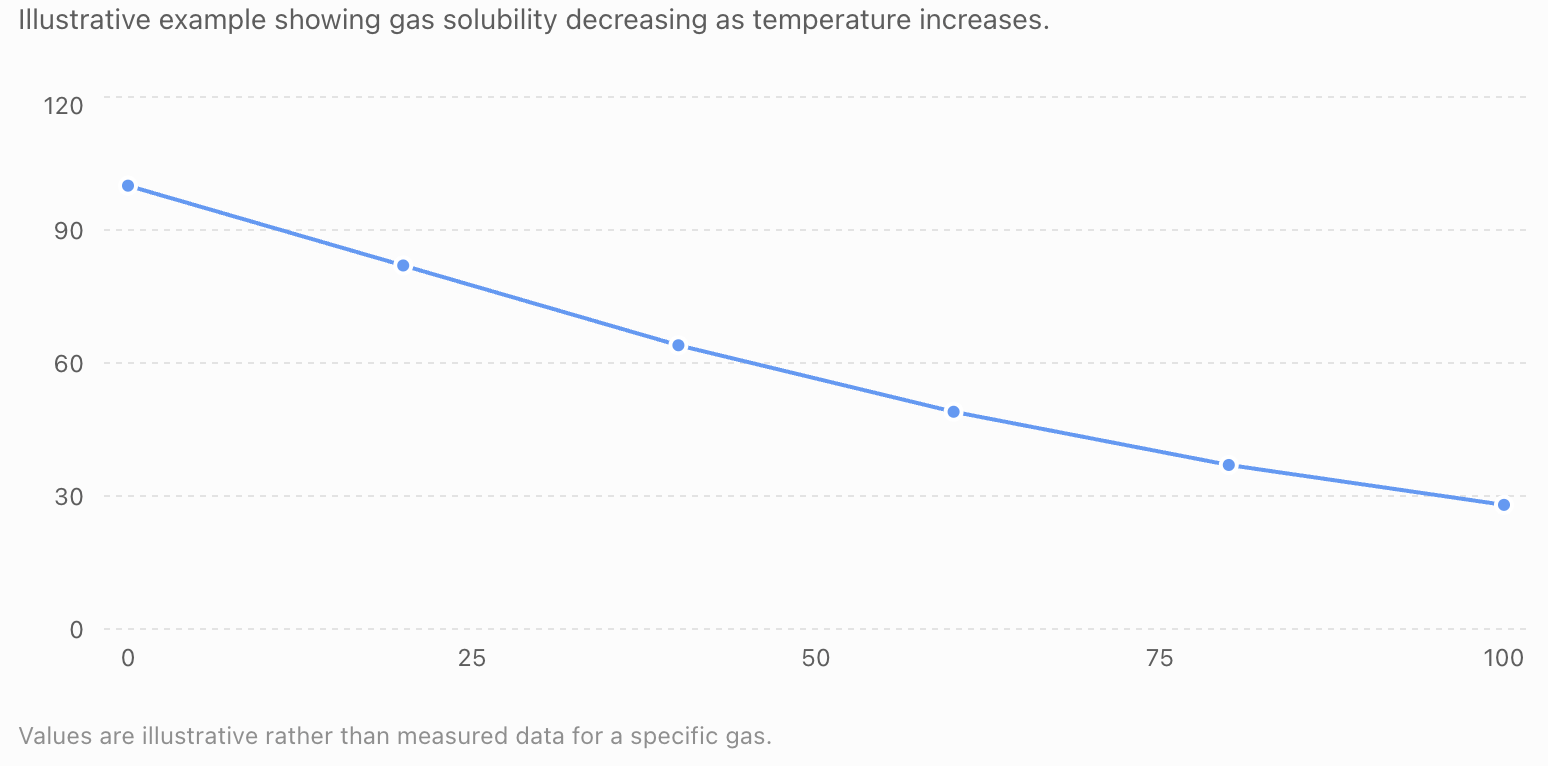
Here the important feature is the downward trend.
Predicting Changes in Solubility
When asked to predict what happens, first identify whether the solute is a solid or gas.
Then identify which condition changes.
For many solids:
increase temperature → increase solubility
For gases:
increase temperature → decrease solubility
For gases:
increase pressure → increase solubility
This provides a useful starting point for predictions.
Worked Example: Heating Salt Water
A saturated solution contains a solid whose solubility increases with temperature.
The solution is heated.
Prediction:
The solubility increases.
Therefore, more solid can dissolve.
If undissolved solid is present, some may dissolve.
Worked Example: Cooling a Hot Solution
A hot saturated solution contains 90 g of dissolved solute.
After cooling, the solubility is only 55 g under the new conditions.
Amount that crystallizes:
90 − 55 = 35 g
Therefore:
35 g crystallizes from the solution.
Worked Example: Heating a Gas Solution
Water contains dissolved oxygen.
The water temperature increases.
For gases:
temperature increases → solubility decreases
Therefore, less oxygen can remain dissolved.
Some dissolved oxygen may escape.
Worked Example: Increasing Pressure
Carbon dioxide gas is in contact with water.
The pressure of CO₂ above the water increases.
Prediction:
CO₂ solubility increases.
More carbon dioxide can dissolve in the water.
Worked Example: Opening a Bottle
A sealed carbonated drink is opened.
Pressure above the liquid suddenly decreases.
Prediction:
The solubility of carbon dioxide decreases.
CO₂ leaves the solution and forms bubbles.
Worked Example: Interpreting a Curve
Suppose a solubility graph shows:
At 20°C: 25 g/100 g water
At 40°C: 40 g/100 g water
At 60°C: 70 g/100 g water
What happens to solubility as temperature increases?
The solubility increases.
Between 20°C and 60°C:
70 − 25 = 45 g
The solubility increases by:
45 g per 100 g water
Worked Example: Crystallization from a Graph
A saturated solution contains 75 g of solute in 100 g water at 80°C.
The solution is cooled to 30°C.
The solubility at 30°C is 35 g per 100 g water.
Amount remaining dissolved:
35 g
Amount crystallized:
75 − 35 = 40 g
Therefore:
40 g of crystals form.
Solubility vs Rate of Dissolving
A very important distinction is the difference between:
solubility
and:
rate of dissolving
Solubility tells us:
how much can dissolve
Rate of dissolving tells us:
how quickly it dissolves
Stirring
Stirring usually increases the rate of dissolving.
It brings fresh solvent particles into contact with the solute.
However, stirring does not normally change the maximum amount that can dissolve at equilibrium.
Therefore:
stirring → faster dissolving
but not necessarily:
stirring → greater solubility
Particle Size
Crushing a solid into smaller pieces increases its surface area.
This allows more contact between solute and solvent.
Therefore:
smaller particles → faster dissolving
Again, this affects the rate rather than necessarily changing the final solubility.
Temperature Can Affect Both
Temperature can be slightly confusing because it may affect:
- the rate of dissolving
- the solubility itself
A solid may dissolve faster in hot water because particles move more rapidly.
At the same time, for many solids, a larger total amount may also be able to dissolve.
These are related but different observations.
A Useful Analysis Strategy
When analyzing a solubility question, ask:
1. What type of solute is involved?
Solid or gas?
2. What condition changes?
Temperature or pressure?
3. Which direction does the condition change?
Increase or decrease?
4. What happens to solubility?
Increase or decrease?
5. What happens to the solution?
More dissolves, gas escapes, or crystals form?
For example:
Gas + temperature increases → solubility decreases → gas escapes
or:
Many solids + cooling → solubility decreases → crystals may form
Common Misconceptions
All solids become more soluble when heated.
Incorrect. Many do, but the exact relationship depends on the substance.
Heating always increases solubility.
Incorrect. Heating generally decreases the solubility of gases in liquids.
Pressure greatly changes the solubility of solids.
Under ordinary conditions, pressure has little effect on solid solubility.
Stirring increases solubility.
Stirring usually increases the rate of dissolving, not the final equilibrium solubility.
Crushing a solute increases its solubility.
Crushing increases surface area and usually makes dissolving faster, but it does not normally change the equilibrium solubility.
A point below a solubility curve represents a saturated solution.
Incorrect. A point below the curve normally represents an unsaturated solution.
A point on the curve represents an unsaturated solution.
Incorrect. A point on the curve represents saturation.
Cooling a saturated solution always causes all of the solute to crystallize.
Incorrect. Only the amount that exceeds the new solubility limit crystallizes.
Did You Know?
Fish can be affected by changes in water temperature partly because warmer water generally holds less dissolved oxygen.
At the same time, many aquatic animals have higher metabolic demands at warmer temperatures.
This can create a difficult combination:
less oxygen available + greater oxygen demand
Solubility therefore has important consequences not only in chemistry laboratories but also in natural ecosystems.
Key Terms
Solubility – The maximum amount of solute that can dissolve in a given amount of solvent under specified conditions.
Solute – The substance being dissolved.
Solvent – The substance that dissolves the solute.
Saturated solution – A solution containing the maximum stable amount of dissolved solute under the current conditions.
Unsaturated solution – A solution that can still dissolve additional solute.
Solubility curve – A graph showing how solubility changes with temperature.
Crystallization – Formation of solid crystals from dissolved solute.
Supersaturated solution – A solution temporarily containing more dissolved solute than would normally be stable at that temperature.
Pressure – Force acting per unit area.
Henry's law – The relationship describing how the solubility of a gas in a liquid depends on the gas pressure above the liquid under appropriate conditions.
Rate of dissolving – How quickly a solute dissolves.
Key Takeaways
- Solubility is the maximum amount of solute that can dissolve under specified conditions.
- Temperature can change solubility.
- For many solids, increasing temperature increases solubility.
- Cooling a saturated solution may cause crystals to form.
- Gases generally become less soluble as temperature increases.
- Cold liquids can generally hold more dissolved gas than warm liquids.
- Increasing gas pressure generally increases the solubility of a gas in a liquid.
- Decreasing pressure causes dissolved gases to escape more easily.
- Pressure has relatively little effect on the solubility of solids under ordinary conditions.
- Solubility curves show how solubility changes with temperature.
- A point on a solubility curve represents a saturated solution.
- A point below the curve represents an unsaturated solution.
- The steepness of a curve shows how strongly solubility changes with temperature.
- Solubility and rate of dissolving are different concepts.
- Stirring and crushing usually affect how fast a solid dissolves rather than how much can ultimately dissolve.
- A useful general comparison is: many solids become more soluble when heated, while gases become less soluble when heated.