Solutions and Solubility
| Сайт: | Young Education |
| Курс: | Solutions and Chemical Equilibrium |
| Книга: | Solutions and Solubility |
| Надруковано: | ゲストユーザ |
| Дата: | понеділок 5 жовтня 2026 03:04 AM |
1. Solutes and Solvents
Learning outcomes
- I can define solute, solvent, and solution.
- I can identify the solute and solvent in a solution.
- I can distinguish between homogeneous and heterogeneous mixtures.
- I can explain how solutions differ from pure substances.
- I can identify examples of solutions in everyday life.


2. The Process of Dissolving
Learning outcomes
- I can describe how particles interact during dissolving.
- I can explain dissolution using the particle model.
- I can distinguish between dissolving and chemical reactions.
- I can explain why some substances dissolve more readily than others.
- I can describe factors that affect the dissolving process.
Introduction
When sugar disappears in a cup of tea or salt seems to vanish in water, it may look as though the substance has disappeared completely. In reality, the particles of the substance have simply spread throughout the liquid to form a solution. This process is called dissolving or dissolution.
The particle model of matter helps explain exactly what happens during dissolving. It shows how particles of the solute separate, interact with particles of the solvent, and become evenly distributed throughout the solution. Understanding this process also helps explain why some substances dissolve easily while others do not.
What Is Dissolving?
Dissolving is the process in which the particles of a solute become evenly distributed throughout a solvent to form a solution.
During dissolving:
- The solute breaks into tiny particles.
- Solvent particles surround the solute particles.
- The particles spread evenly throughout the solvent.
The solute has not disappeared—its particles are simply too small to see.


Figure 1. Solute particles separate and become evenly distributed among solvent particles.
Dissolving and the Particle Model
According to the particle model:
- All matter is made of tiny particles.
- Particles are constantly moving.
- There are spaces between particles.
- Particles attract one another.
When a solute is added to a solvent:
- Solvent particles collide with the surface of the solute.
- They pull individual solute particles away.
- The solvent surrounds these particles.
- The solute particles spread throughout the solvent.
Eventually, the solution becomes uniform.
Particle Interactions During Dissolving
During dissolution:
- Attractive forces between solute particles are weakened.
- New attractions form between solute particles and solvent particles.
If the attraction between the solute and solvent is strong enough, the substance dissolves.
If these attractions are too weak, the substance remains undissolved.


Figure 2. Solvent particles surround and separate solute particles during dissolving.
Dissolving Is Not a Chemical Reaction
Dissolving is a physical change, not a chemical reaction.
During dissolving:
- No new substance is formed.
- The chemical identity of the solute remains unchanged.
- The process can often be reversed.
For example:
Salt dissolved in water can be recovered by evaporating the water.
Comparing Dissolving and Chemical Reactions
| Dissolving | Chemical Reaction |
|---|---|
| Physical change | Chemical change |
| No new substance formed | New substances formed |
| Usually reversible | Often difficult to reverse |
| Particles remain chemically unchanged. | Chemical bonds are broken and formed |
Understanding this difference helps identify physical and chemical changes.
Why Do Some Substances Dissolve?
Not every substance dissolves in every solvent.
A substance dissolves when:
- Solute particles are strongly attracted to solvent particles.
A useful rule is:
"Like dissolves like."
This means:
- Polar substances usually dissolve in polar solvents.
- Non-polar substances usually dissolve in non-polar solvents.
For example:
- Salt dissolves well in water.
- Sugar dissolves well in water.
- Oil does not dissolve in water.


Figure 3. Some substances dissolve easily, while others do not because of differences in particle interactions.
Factors That Affect the Rate of Dissolving
Several factors affect how quickly a substance dissolves.
Temperature
Increasing the temperature usually causes solids to dissolve faster because:
- Solvent particles move more quickly.
- More frequent collisions occur.
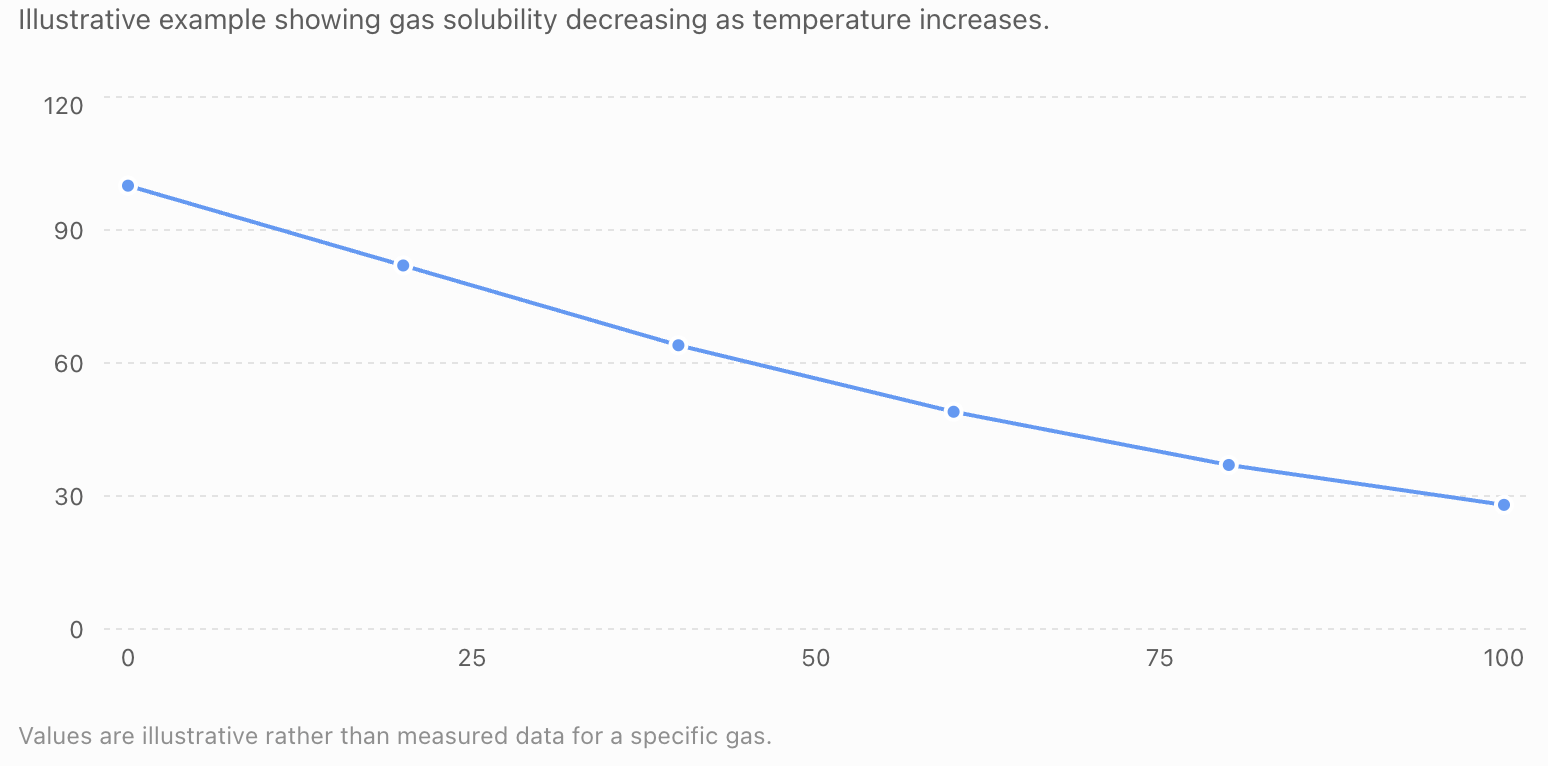
For gases, increasing temperature usually makes them less soluble.
Stirring
Stirring mixes the solvent.
Fresh solvent particles are continually brought into contact with the solute, increasing the rate of dissolving.
Particle Size
Crushing a solid into smaller pieces increases its surface area.
Greater surface area allows:
- More solvent particles to collide with the solute.
- Faster dissolving.
Powdered sugar dissolves faster than a sugar cube.
Nature of the Solute and Solvent
Some substances naturally dissolve more readily than others because of differences in their particle attractions.
For example:
- Sugar dissolves easily in water.
- Sand does not dissolve in water.


Figure 4. Temperature, stirring, and particle size all affect the rate at which a substance dissolves.
Dissolving vs Melting
Students sometimes confuse dissolving with melting.
| Dissolving | Melting |
|---|---|
| Requires a solvent | Does not require a solvent |
| Forms a solution | Forms a liquid |
| Solute mixes with solvent. | Solid changes to liquid |
| Physical change | Physical change |
For example:
- Ice melting forms liquid water.
- Sugar dissolving forms a sugar solution.
These are different processes.
Everyday Examples of Dissolving
Examples include:
- Sugar dissolving in tea.
- Salt dissolving in cooking water.
- Instant coffee dissolving in hot water.
- Medicines dissolving in the stomach.
- Oxygen dissolving in rivers and lakes for aquatic life.
Dissolving is an essential process in both nature and everyday life.


Figure 5. Dissolving occurs in many everyday situations and natural processes.
Worked Example
Question
A student wants sugar to dissolve more quickly in a cup of tea.
Suggest three ways to increase the rate of dissolving.
Solution
The student could:
- Stir the tea.
- Use hotter tea.
- Crush the sugar into smaller pieces.
Each of these methods increases the rate at which sugar dissolves.
Real-World Connection
Many medicines are designed to dissolve at different rates inside the body. Some tablets dissolve quickly to provide rapid pain relief, while others have special coatings that dissolve slowly over several hours, releasing the medicine gradually. Scientists carefully control particle size and tablet design to achieve the desired rate of dissolution.
Did You Know?
Tiny fish and other aquatic animals depend on oxygen dissolved in water for survival. Although oxygen is a gas, some of its particles dissolve naturally in rivers, lakes, and oceans. Cold water can hold more dissolved oxygen than warm water, which is one reason why many fish thrive in cooler environments.
Key Terms
Dissolving (dissolution) – The process in which a solute becomes evenly distributed throughout a solvent to form a solution.
Particle model – A model describing matter as tiny particles that are constantly moving.
Physical change – A change that does not produce a new substance.
Solution – A homogeneous mixture formed when a solute dissolves in a solvent.
Solubility – The ability of a substance to dissolve in a particular solvent.
Solute – The substance being dissolved.
Solvent – The substance that dissolves the solute.
Surface area – The amount of exposed surface of a material; increasing surface area generally increases the rate of dissolving.
Key Takeaways
- Dissolving is the process in which a solute becomes evenly distributed throughout a solvent to form a solution.
- The particle model explains dissolving as solvent particles separating and surrounding solute particles.
- Dissolving is a physical change, not a chemical reaction, because no new substance is formed.
- A substance dissolves when the attraction between the solute and solvent particles is strong enough.
- The rate of dissolving is affected by temperature, stirring, particle size (surface area), and the nature of the solute and solvent.
- Dissolving is important in everyday life, from preparing food and medicines to supporting life in aquatic ecosystems.
3. Solubility
Learning outcomes
- I can define solubility.
- I can describe what it means for a substance to be soluble or insoluble.
- I can interpret solubility data and tables.
- I can compare the solubility of different substances.
- I can predict whether a substance will dissolve under given conditions.


4. Saturated and Unsaturated Solutions
Learning outcomes
- I can distinguish between saturated and unsaturated solutions.
- I can explain how saturation occurs.
- I can describe how additional solute behaves in a saturated solution.
- I can interpret particle diagrams of saturated solutions.
- I can predict how solutions change as more solute is added.
Saturated and Unsaturated Solutions
A solution forms when a solute dissolves in a solvent.
For example, when sugar dissolves in water:
- sugar is the solute
- water is the solvent
- sugar solution is the solution
However, a solvent cannot dissolve an unlimited amount of solute. At a particular temperature, there is a maximum amount that can dissolve.
This leads to two important types of solution:
- unsaturated solutions
- saturated solutions

Unsaturated Solutions
An unsaturated solution contains less than the maximum amount of dissolved solute that the solvent can hold at a particular temperature.
This means:
more solute can still dissolve
For example, suppose a spoonful of sugar is added to water and completely disappears.
If another spoonful can also dissolve, the solution is still unsaturated.
An unsaturated solution has not yet reached its solubility limit.
Saturated Solutions
A saturated solution contains the maximum amount of dissolved solute that can remain dissolved in a particular amount of solvent at a particular temperature.
Once the solution reaches this point:
additional solute will not dissolve overall
Instead, extra solid solute may remain at the bottom of the container.
Comparing Saturated and Unsaturated Solutions
| Unsaturated Solution | Saturated Solution |
|---|---|
| Less than maximum dissolved solute | Maximum dissolved solute |
| More solute can dissolve | No additional solute dissolves overall |
| Below the solubility limit | At the solubility limit |
| Added soluble solute disappears. | Excess solute may remain undissolved |
The important difference is not simply how much solute is present.
The key question is:
Can more solute dissolve under the current conditions?
How Saturation Occurs
Imagine adding sugar to a beaker of water one spoonful at a time.
At first:
- sugar particles separate
- solvent particles surround them
- the sugar dissolves
As more sugar is added:
- the concentration of dissolved sugar increases
- fewer additional sugar particles can remain dissolved
Eventually, the solution reaches its maximum dissolved concentration.
The solution is now saturated.
A Step-by-Step Example
Suppose we slowly add salt to water.
First addition:
All the salt dissolves.
The solution is unsaturated.
Second addition:
The salt still dissolves.
The solution is still unsaturated.
More salt is added:
The concentration increases.
Eventually:
Some newly added salt remains at the bottom.
The solution has reached saturation.
This sequence can be represented as:
solvent → unsaturated solution → saturated solution → saturated solution + excess solid
What Happens When More Solute Is Added?
If more solute is added to an unsaturated solution, the added solute can dissolve.
Therefore:
more solute added → concentration increases
This continues until the saturation point is reached.
If more solute is added to a saturated solution, the solution cannot hold more dissolved solute under those conditions.
Therefore:
extra solute remains undissolved
The amount of dissolved solute stays approximately constant.
Saturated Does Not Mean "Full of Solid"
A saturated solution may appear completely clear.
It does not have to contain a visible pile of solid.
A solution is saturated when it contains the maximum amount of dissolved solute possible under those conditions.
Visible undissolved solute is strong evidence that a solution is saturated, provided enough time has been allowed for dissolving.
Particle View of an Unsaturated Solution
At the particle level, an unsaturated solution contains:
- solvent particles
- dissolved solute particles spread throughout the solvent
- room for additional solute particles to dissolve
The dissolved particles are distributed throughout the liquid.
There may be no solid solute remaining at the bottom.
Particle View of a Saturated Solution
In a saturated solution:
- many solute particles are already dissolved
- the maximum stable amount is dissolved
- additional solute cannot increase the dissolved concentration
If extra solute is present, some particles remain together as solid material at the bottom.
At the particle level, particles may continuously:
- leave the solid and dissolve
- return from the solution to the solid
In a saturated solution at equilibrium, these processes occur at equal average rates.
Dynamic Equilibrium
A saturated solution containing undissolved solute is not completely inactive.
Particles continue moving.
Some solute particles leave the solid and enter the solution.
At the same time, some dissolved particles return to the solid.
Eventually:
rate of dissolving = rate of crystallizing
This is called dynamic equilibrium.
The dissolved concentration remains constant even though individual particles continue to move between the solid and dissolved states.
Interpreting Particle Diagrams
Particle diagrams can be used to distinguish saturated and unsaturated solutions.
When examining a diagram, look for:
- how many solute particles are dispersed in the solvent
- whether undissolved solute remains at the bottom
- whether additional solute appears able to dissolve
An unsaturated particle diagram normally shows dissolved solute particles dispersed throughout the liquid with no evidence that the maximum has been reached.
A saturated diagram may show dissolved particles throughout the liquid plus undissolved solid particles.
Example: Interpreting a Particle Diagram
Suppose Diagram A shows:
- water particles
- several dissolved solute particles
- no solid at the bottom
Another amount of solute is added and dissolves.
Conclusion:
Diagram A represents an unsaturated solution.
Now suppose Diagram B shows:
- many dissolved solute particles
- a pile of undissolved solute at the bottom
Additional solute remains at the bottom.
Conclusion:
Diagram B represents a saturated solution.
Predicting What Happens as Solute Is Added
Suppose solute is added gradually to a fixed amount of solvent.
At first:
solute added → solute dissolves → concentration increases
As more is added:
more dissolves → concentration continues increasing
At saturation:
maximum dissolved concentration is reached
After saturation:
additional solute remains undissolved
Therefore, the concentration of dissolved solute stops increasing once saturation is reached, as long as temperature and solvent quantity remain unchanged.
Solubility
Solubility is the maximum amount of a solute that can dissolve in a given amount of solvent under particular conditions.
A saturated solution has reached this maximum.
An unsaturated solution is below this maximum.
Therefore:
unsaturated = below the solubility limit
saturated = at the solubility limit
Temperature Matters
Saturation depends on temperature.
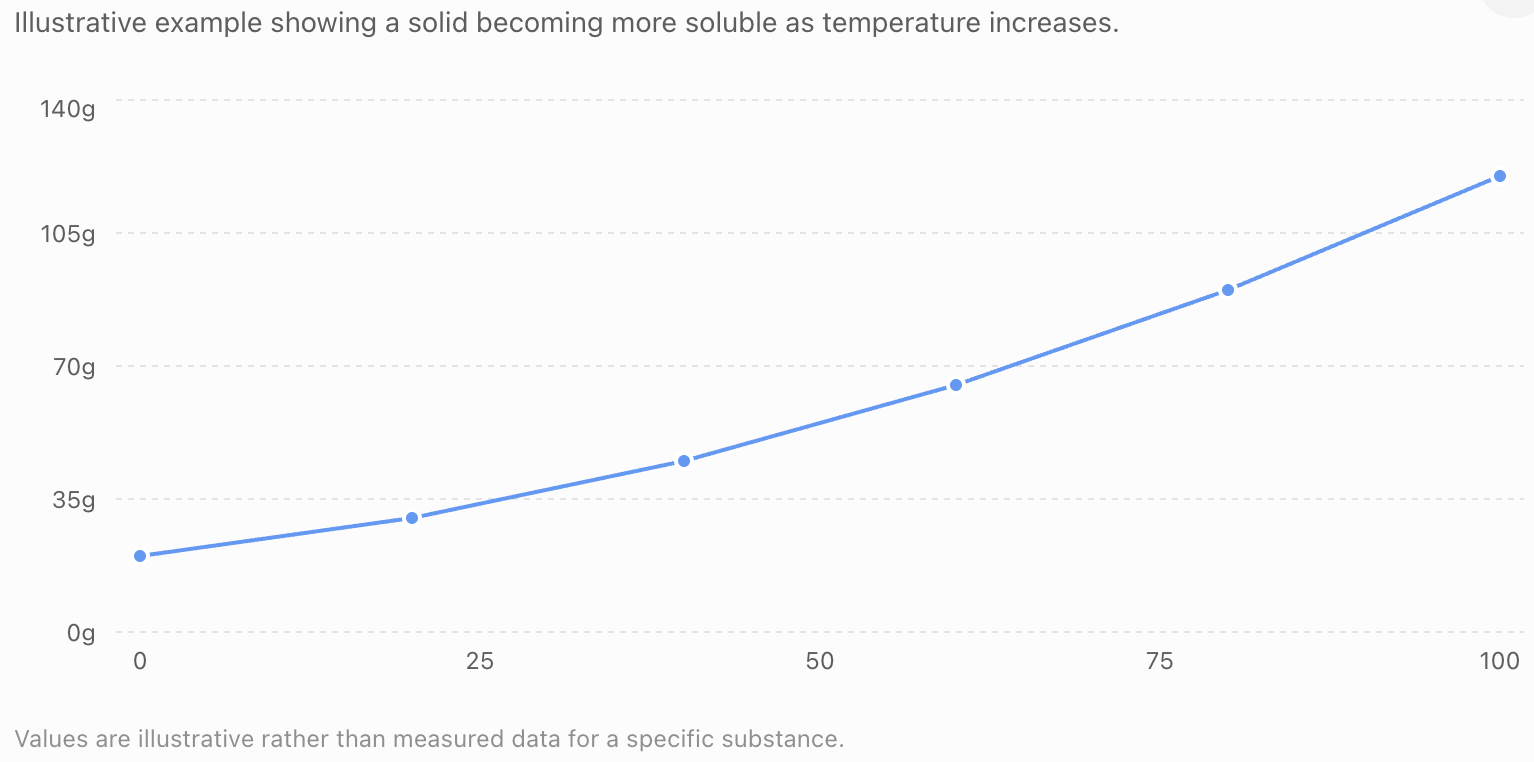
For many solid solutes, more can dissolve in a solvent at higher temperatures.
For example, sugar generally dissolves in greater amounts in hot water than in cold water.
Therefore, a solution that is saturated at one temperature may become unsaturated if the temperature increases.
If more solute can now dissolve:
saturated solution + heating → potentially unsaturated solution
However, the exact effect of temperature depends on the particular solute and solvent.
Example: Heating a Saturated Solution
Suppose a saturated sugar solution contains undissolved sugar at 20°C.
The solution is heated.
If sugar becomes more soluble at the higher temperature:
- some of the remaining solid dissolves
- the amount of dissolved sugar increases
- the solution may temporarily become unsaturated until more sugar dissolves
Eventually, a new saturation point may be reached at the higher temperature.
Cooling a Saturated Solution
Suppose a hot saturated solution is cooled.
If the solubility decreases as temperature falls:
- the solution may temporarily contain more dissolved solute than is stable
- some solute may crystallize out
Crystals form because the cooler solvent can no longer keep as much solute dissolved.
Adding More Solvent
Another way to change saturation is to add more solvent.
Suppose a saturated salt solution contains undissolved salt.
If more water is added:
- the amount of solvent increases
- more salt may dissolve
- the solution may become unsaturated
The new solvent provides additional capacity for dissolving solute.
Saturated vs Concentrated
These terms do not mean exactly the same thing.
A concentrated solution contains a relatively large amount of dissolved solute.
A saturated solution contains the maximum amount that can dissolve under the current conditions.
A solution can be:
- concentrated but still unsaturated
- dilute but saturated if the solute has very low solubility
Saturation describes whether the solubility limit has been reached.
Concentration describes how much solute is actually present.
Dissolving Rate vs Solubility
It is also important to distinguish between:
how fast something dissolves
and
how much can dissolve
Stirring may make a solute dissolve faster.
Crushing a solid may make it dissolve faster.
These changes affect the rate of dissolving.
They do not necessarily increase the final amount that can dissolve.
That maximum amount is the solubility.
Worked Example: Adding Sugar
A student adds 10 g of sugar to water.
All of it dissolves.
Another 5 g is added.
This also dissolves.
What can we conclude?
The solution was unsaturated before the second addition because more sugar was able to dissolve.
Worked Example: Undissolved Salt
A student adds salt to water until some salt remains at the bottom after stirring for several minutes.
What does this indicate?
The solution has reached its solubility limit.
Therefore, the liquid portion is saturated with salt under those conditions.
Worked Example: Adding More Solute
A saturated solution contains 25 g of dissolved solute.
Another 5 g of the same solute is added at the same temperature.
What is most likely to happen?
The extra solute will remain undissolved.
The amount of dissolved solute remains approximately 25 g.
Worked Example: Adding More Water
A saturated solution has undissolved crystals at the bottom.
More water is added.
What happens?
Some of the crystals may dissolve because there is now more solvent available.
The solution can become unsaturated until enough solute dissolves to reach the new saturation limit.
Worked Example: Heating
A saturated solution of a solid is heated, and the solid becomes more soluble at higher temperatures.
Predict what happens.
The solution can dissolve additional solute.
Any undissolved solid may begin to dissolve.
Analyzing a Sequence
Imagine four beakers containing the same amount of water.
Beaker A:
5 g solute added; all dissolves.
Beaker B:
10 g solute added; all dissolves.
Beaker C:
15 g solute added; all dissolves.
Beaker D:
20 g solute added; 3 g remains at the bottom.
What can we conclude?
Beakers A, B, and C are below the saturation limit.
Beaker D contains a saturated solution plus excess undissolved solute.
At least 17 g of the solute dissolved in Beaker D.
A Useful Decision Test
To determine whether a solution is saturated, ask:
Can more of this solute dissolve at the same temperature?
If yes:
unsaturated
If no:
saturated
If added solute remains undissolved after sufficient mixing and time:
the solution is saturated
Common Misconceptions
A saturated solution contains no solvent.
Incorrect. It is still a solution containing both solvent and dissolved solute.
Saturated means the container is completely full.
Incorrect. Saturation refers to how much solute has dissolved, not how full the container is.
Any solution with undissolved solid is automatically saturated.
Not always. The solid may simply need more time to dissolve, or it may be insoluble. The system must be considered under appropriate conditions.
Adding more solute always increases concentration.
Incorrect. Once saturation is reached, additional solute remains undissolved.
Stirring increases solubility.
Stirring usually increases the rate of dissolving, but it does not normally change the maximum amount that can dissolve at a fixed temperature.
A concentrated solution must be saturated.
Incorrect. It may contain a lot of solute while still being able to dissolve more.
Saturated solutions contain particles that have stopped moving.
Incorrect. Particles continue moving, and a saturated solution can exist in dynamic equilibrium.
Did You Know?
A saturated solution can appear unchanged even though particles are constantly moving between dissolved and solid states.
At equilibrium:
dissolving continues
and
crystallization continues
but because the two processes occur at equal average rates, there is no overall change in the amount of dissolved solute.
Key Terms
Solution – A homogeneous mixture formed when a solute dissolves in a solvent.
Solute – The substance being dissolved.
Solvent – The substance that dissolves the solute.
Unsaturated solution – A solution that can still dissolve more solute under the current conditions.
Saturated solution – A solution containing the maximum stable amount of dissolved solute under the current conditions.
Solubility – The maximum amount of solute that can dissolve in a given amount of solvent under specified conditions.
Undissolved solute – Solute that remains as solid because it has not entered the solution.
Dynamic equilibrium – A condition in which opposing processes occur at equal average rates.
Concentration – The amount of solute present in a given amount of solution.
Crystallization – The formation of solid crystals from dissolved particles.
Key Takeaways
- An unsaturated solution can dissolve more solute.
- A saturated solution contains the maximum amount of dissolved solute possible under the current conditions.
- Saturation occurs when the solution reaches its solubility limit.
- Adding solute to an unsaturated solution increases the amount dissolved.
- Once saturation is reached, additional solute remains undissolved.
- Particle diagrams can show dissolved solute particles and excess solid solute.
- Saturated solutions can exist in dynamic equilibrium.
- Saturation depends on factors such as temperature and the amount of solvent.
- Adding more solvent can allow additional solute to dissolve.
- Heating often increases the solubility of solid solutes, although this depends on the substance.
- Concentrated and saturated do not mean the same thing.
- Stirring affects dissolving rate more than the final solubility.
- A useful test is: Can more solute dissolve under the current conditions?
5. Factors Affecting Solubility
Learning outcomes
- I can describe how temperature affects solubility.
- I can explain the effect of pressure on gases dissolved in liquids.
- I can compare solubility trends for solids and gases.
- I can analyze graphs showing solubility changes.
- I can predict how changing conditions affects solubility.