Structure Determines Properties
1. Comparing Bond Types
Learning outcomes
- I can compare ionic, covalent, and metallic bonding.
- I can identify bonding types from chemical formulas and structures.
- I can explain the similarities and differences among bond types.
- I can relate bond type to material properties.
- I can classify substances according to bonding.
Why Bonding Matters
The properties of a substance depend strongly on:
- The particles it contains.
- How those particles are arranged.
- The forces or bonds holding them together.
Three major types of chemical bonding are:
metallic bonding
Understanding the bonding allows us to predict many properties of a substance, including:
- Melting and boiling point.
- Electrical conductivity.
- Hardness.
- Brittleness.
- Malleability and ductility.
- Solubility.


The Role of Valence Electrons
All three bonding types involve valence electrons.
Valence electrons are the electrons in the outer energy level of an atom.
Atoms can achieve more stable electron arrangements by:
- Transferring electrons.
- Sharing electrons.
- Allowing electrons to become delocalized.
The way electrons behave helps determine the type of bonding.
Ionic Bonding
Ionic bonding usually occurs between:
metal + nonmetal
Electrons are transferred from the metal atoms to the nonmetal atoms.
This produces charged particles called ions.
The metal forms a:
positive ion (cation)
The nonmetal forms a:
negative ion (anion)
The oppositely charged ions attract one another.
This electrostatic attraction is called an ionic bond.
Example: Sodium Chloride
Sodium has one valence electron.
Chlorine has seven valence electrons.
Sodium transfers one electron to chlorine.
This produces:
Na⁺
and:
Cl⁻
The oppositely charged ions attract.
The formula is:
NaCl


Ionic Structures
Ionic substances do not normally exist as separate molecules.
Instead, large numbers of positive and negative ions form a repeating three-dimensional structure called a:
giant ionic lattice
Each ion is surrounded by ions of opposite charge.
Strong electrostatic attractions act throughout the lattice.
Properties of Ionic Substances
Ionic substances commonly have:
- High melting points.
- High boiling points.
- Hard crystalline structures.
- Brittle behavior.
- Electrical conductivity when molten.
- Electrical conductivity when dissolved in water, if soluble.
- No electrical conductivity when solid.
These properties can be explained using their structure.
Why Ionic Compounds Have High Melting Points
The ions in an ionic lattice are held together by strong electrostatic attractions.
A large amount of energy is required to overcome these attractions.
Therefore, many ionic substances have relatively high melting and boiling points.
Why Solid Ionic Compounds Do Not Conduct
Ions are charged particles.
However, in a solid ionic lattice, the ions are held in fixed positions.
They cannot move through the material.
Therefore:
solid ionic compound → no mobile charge carriers → does not conduct
When melted, the ions become mobile.
Therefore:
molten ionic compound → mobile ions → conducts electricity
Why Ionic Substances Are Brittle
When a force causes layers of ions to shift, ions with the same charge can become aligned.
For example:
positive beside positive
or:
negative beside negative
Like charges repel.
This repulsion can split the lattice.
Therefore, many ionic solids are:
hard but brittle
Covalent Bonding
Covalent bonding usually occurs between:
nonmetal + nonmetal
Instead of transferring electrons, atoms:
share pairs of electrons
The shared electrons are attracted to both nuclei.
This attraction holds the atoms together.
A shared pair of electrons forms a:
covalent bond


Example: Hydrogen
Each hydrogen atom has one electron.
Two hydrogen atoms can share their electrons.
This creates a shared pair.
The resulting molecule is:
H₂
The two atoms are joined by a single covalent bond.
Example: Water
A water molecule contains:
two hydrogen atoms + one oxygen atom
Formula:
H₂O
The oxygen atom forms covalent bonds with the two hydrogen atoms.
The electrons are shared rather than completely transferred.
Molecular Covalent Substances
Many covalent substances consist of individual molecules.
Examples include:
- H₂O.
- CO₂.
- CH₄.
- O₂.
- N₂.
Strong covalent bonds hold the atoms together within each molecule.
However, the attractions between separate molecules are usually much weaker than the covalent bonds inside them.
This distinction is extremely important.
Properties of Simple Molecular Substances
Many simple molecular substances have:
- Relatively low melting points.
- Relatively low boiling points.
- Poor electrical conductivity.
Why?
When a molecular substance melts or boils, it is mainly the intermolecular attractions that are overcome.
The covalent bonds inside the molecules usually remain intact.
Covalent Does Not Always Mean Low Melting Point
Some covalent substances form giant covalent structures rather than separate molecules.
Examples include:
- Diamond.
- Graphite.
- Silicon dioxide.
In these substances, enormous networks of atoms are connected by covalent bonds.


These substances can have very different properties from simple molecular substances.
Diamond
Diamond consists of carbon atoms joined in a three-dimensional network.
Each carbon atom forms four covalent bonds.
The structure contains many strong covalent bonds.
Therefore, diamond is:
- Extremely hard.
- High melting/sublimation temperature.
- A poor electrical conductor under ordinary conditions.
Its electrons are localized within covalent bonds and are not free to move throughout the structure.
Graphite
Graphite is also made entirely of carbon.
However, its structure is different.
Each carbon atom bonds to three others, forming layers.
Graphite contains delocalized electrons that can move along the layers.
Therefore, graphite can conduct electricity.
This is an important exception to the general statement that covalent substances do not conduct.
Metallic Bonding
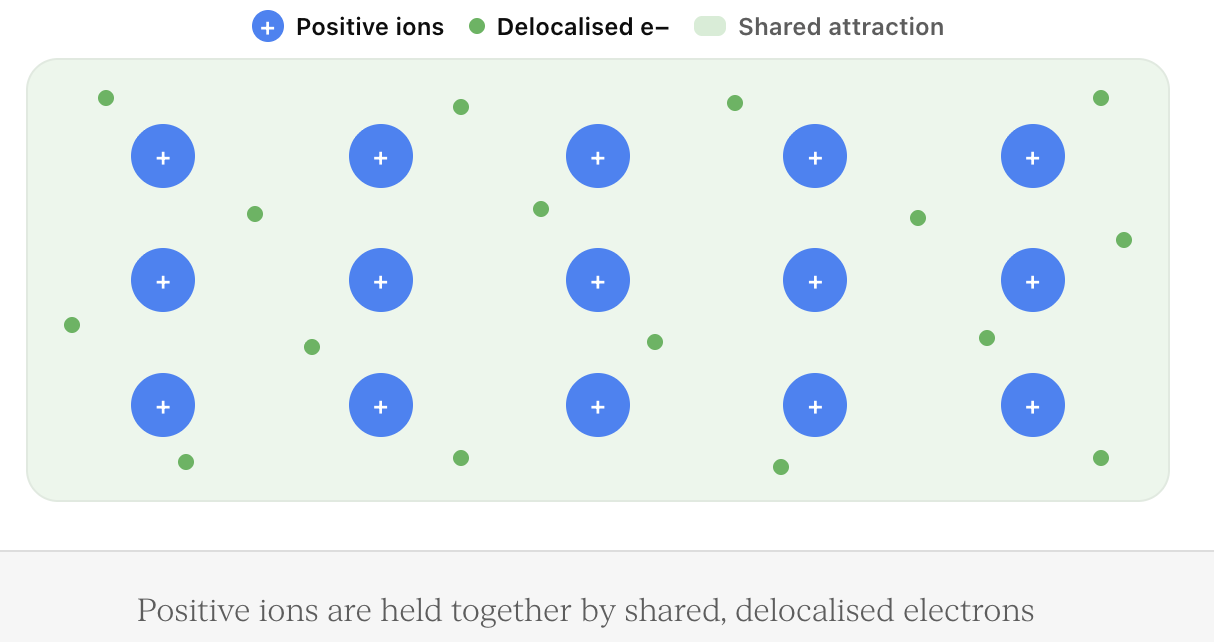
Metallic bonding occurs in metals and alloys.
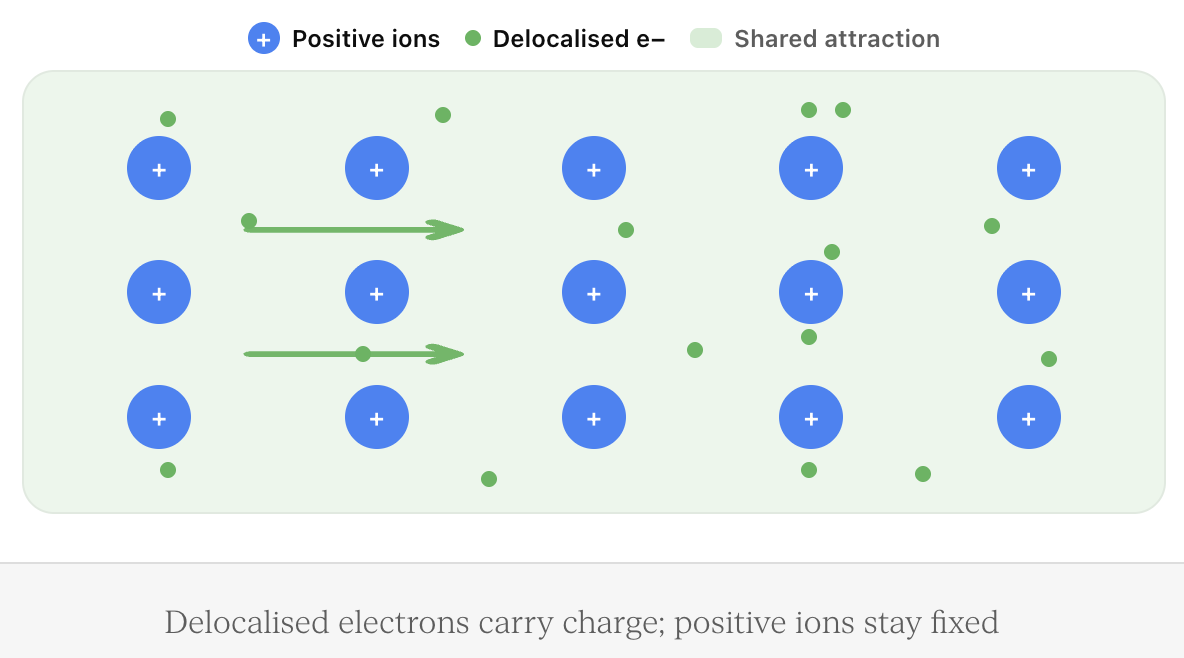
Metal atoms contribute valence electrons to a shared system of:
delocalized electrons
The metal can be modeled as:
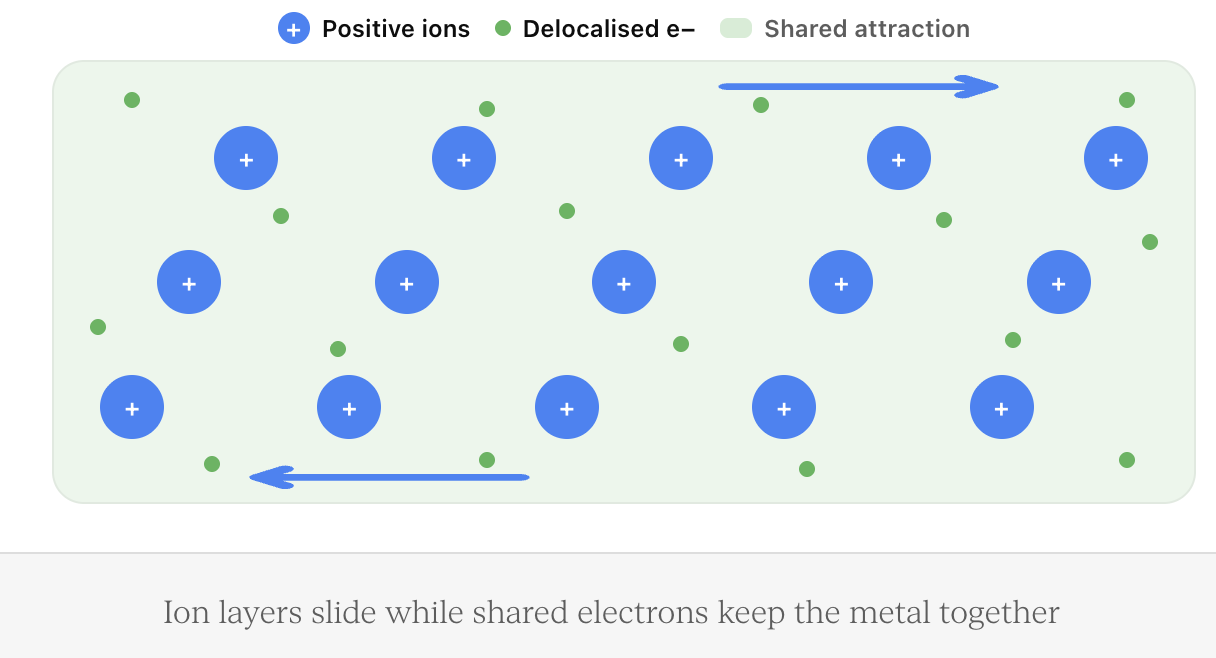
positive metal ions surrounded by mobile delocalized electrons
The attraction between the positive ions and negative electrons holds the structure together.