Structure Determines Properties
| Website: | Young Education |
| Kurs: | Chemical Bonding and Structure |
| Buch: | Structure Determines Properties |
| Gedruckt von: | ゲストユーザ |
| Datum: | Montag, 5. Oktober 2026, 03:04 |
1. Comparing Bond Types
Learning outcomes
- I can compare ionic, covalent, and metallic bonding.
- I can identify bonding types from chemical formulas and structures.
- I can explain the similarities and differences among bond types.
- I can relate bond type to material properties.
- I can classify substances according to bonding.
Why Bonding Matters
The properties of a substance depend strongly on:
- The particles it contains.
- How those particles are arranged.
- The forces or bonds holding them together.
Three major types of chemical bonding are:
metallic bonding
Understanding the bonding allows us to predict many properties of a substance, including:
- Melting and boiling point.
- Electrical conductivity.
- Hardness.
- Brittleness.
- Malleability and ductility.
- Solubility.


The Role of Valence Electrons
All three bonding types involve valence electrons.
Valence electrons are the electrons in the outer energy level of an atom.
Atoms can achieve more stable electron arrangements by:
- Transferring electrons.
- Sharing electrons.
- Allowing electrons to become delocalized.
The way electrons behave helps determine the type of bonding.
Ionic Bonding
Ionic bonding usually occurs between:
metal + nonmetal
Electrons are transferred from the metal atoms to the nonmetal atoms.
This produces charged particles called ions.
The metal forms a:
positive ion (cation)
The nonmetal forms a:
negative ion (anion)
The oppositely charged ions attract one another.
This electrostatic attraction is called an ionic bond.
Example: Sodium Chloride
Sodium has one valence electron.
Chlorine has seven valence electrons.
Sodium transfers one electron to chlorine.
This produces:
Na⁺
and:
Cl⁻
The oppositely charged ions attract.
The formula is:
NaCl


Ionic Structures
Ionic substances do not normally exist as separate molecules.
Instead, large numbers of positive and negative ions form a repeating three-dimensional structure called a:
giant ionic lattice
Each ion is surrounded by ions of opposite charge.
Strong electrostatic attractions act throughout the lattice.
Properties of Ionic Substances
Ionic substances commonly have:
- High melting points.
- High boiling points.
- Hard crystalline structures.
- Brittle behavior.
- Electrical conductivity when molten.
- Electrical conductivity when dissolved in water, if soluble.
- No electrical conductivity when solid.
These properties can be explained using their structure.
Why Ionic Compounds Have High Melting Points
The ions in an ionic lattice are held together by strong electrostatic attractions.
A large amount of energy is required to overcome these attractions.
Therefore, many ionic substances have relatively high melting and boiling points.
Why Solid Ionic Compounds Do Not Conduct
Ions are charged particles.
However, in a solid ionic lattice, the ions are held in fixed positions.
They cannot move through the material.
Therefore:
solid ionic compound → no mobile charge carriers → does not conduct
When melted, the ions become mobile.
Therefore:
molten ionic compound → mobile ions → conducts electricity
Why Ionic Substances Are Brittle
When a force causes layers of ions to shift, ions with the same charge can become aligned.
For example:
positive beside positive
or:
negative beside negative
Like charges repel.
This repulsion can split the lattice.
Therefore, many ionic solids are:
hard but brittle
Covalent Bonding
Covalent bonding usually occurs between:
nonmetal + nonmetal
Instead of transferring electrons, atoms:
share pairs of electrons
The shared electrons are attracted to both nuclei.
This attraction holds the atoms together.
A shared pair of electrons forms a:
covalent bond


Example: Hydrogen
Each hydrogen atom has one electron.
Two hydrogen atoms can share their electrons.
This creates a shared pair.
The resulting molecule is:
H₂
The two atoms are joined by a single covalent bond.
Example: Water
A water molecule contains:
two hydrogen atoms + one oxygen atom
Formula:
H₂O
The oxygen atom forms covalent bonds with the two hydrogen atoms.
The electrons are shared rather than completely transferred.
Molecular Covalent Substances
Many covalent substances consist of individual molecules.
Examples include:
- H₂O.
- CO₂.
- CH₄.
- O₂.
- N₂.
Strong covalent bonds hold the atoms together within each molecule.
However, the attractions between separate molecules are usually much weaker than the covalent bonds inside them.
This distinction is extremely important.
Properties of Simple Molecular Substances
Many simple molecular substances have:
- Relatively low melting points.
- Relatively low boiling points.
- Poor electrical conductivity.
Why?
When a molecular substance melts or boils, it is mainly the intermolecular attractions that are overcome.
The covalent bonds inside the molecules usually remain intact.
Covalent Does Not Always Mean Low Melting Point
Some covalent substances form giant covalent structures rather than separate molecules.
Examples include:
- Diamond.
- Graphite.
- Silicon dioxide.
In these substances, enormous networks of atoms are connected by covalent bonds.


These substances can have very different properties from simple molecular substances.
Diamond
Diamond consists of carbon atoms joined in a three-dimensional network.
Each carbon atom forms four covalent bonds.
The structure contains many strong covalent bonds.
Therefore, diamond is:
- Extremely hard.
- High melting/sublimation temperature.
- A poor electrical conductor under ordinary conditions.
Its electrons are localized within covalent bonds and are not free to move throughout the structure.
Graphite
Graphite is also made entirely of carbon.
However, its structure is different.
Each carbon atom bonds to three others, forming layers.
Graphite contains delocalized electrons that can move along the layers.
Therefore, graphite can conduct electricity.
This is an important exception to the general statement that covalent substances do not conduct.
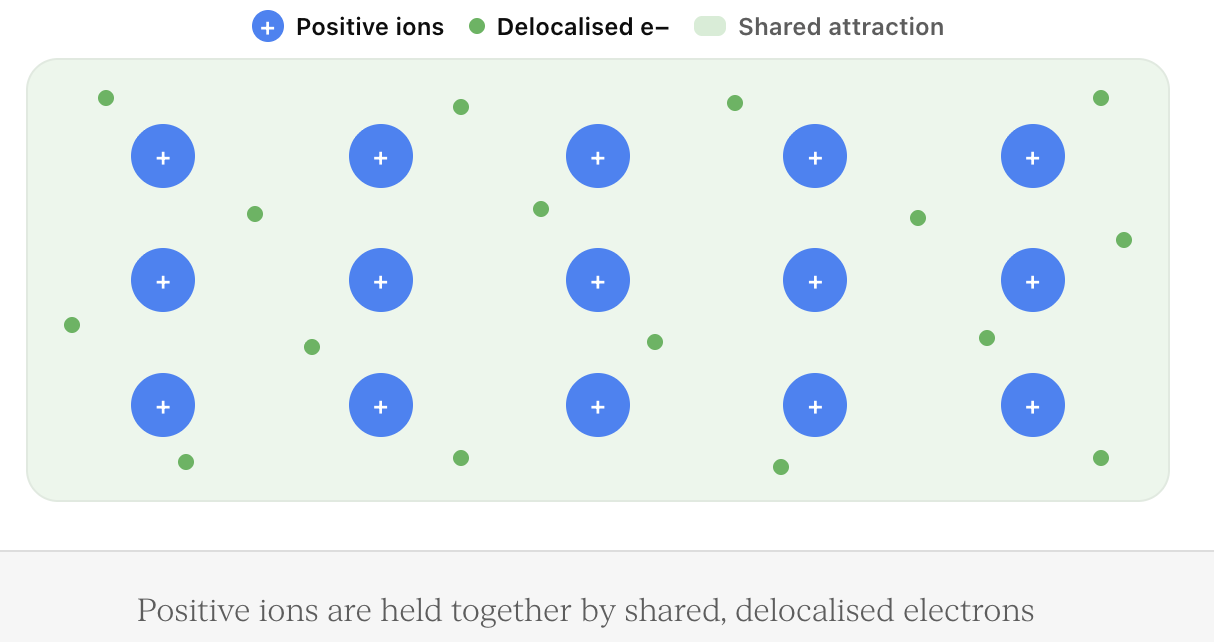
Metallic Bonding
Metallic bonding occurs in metals and alloys.
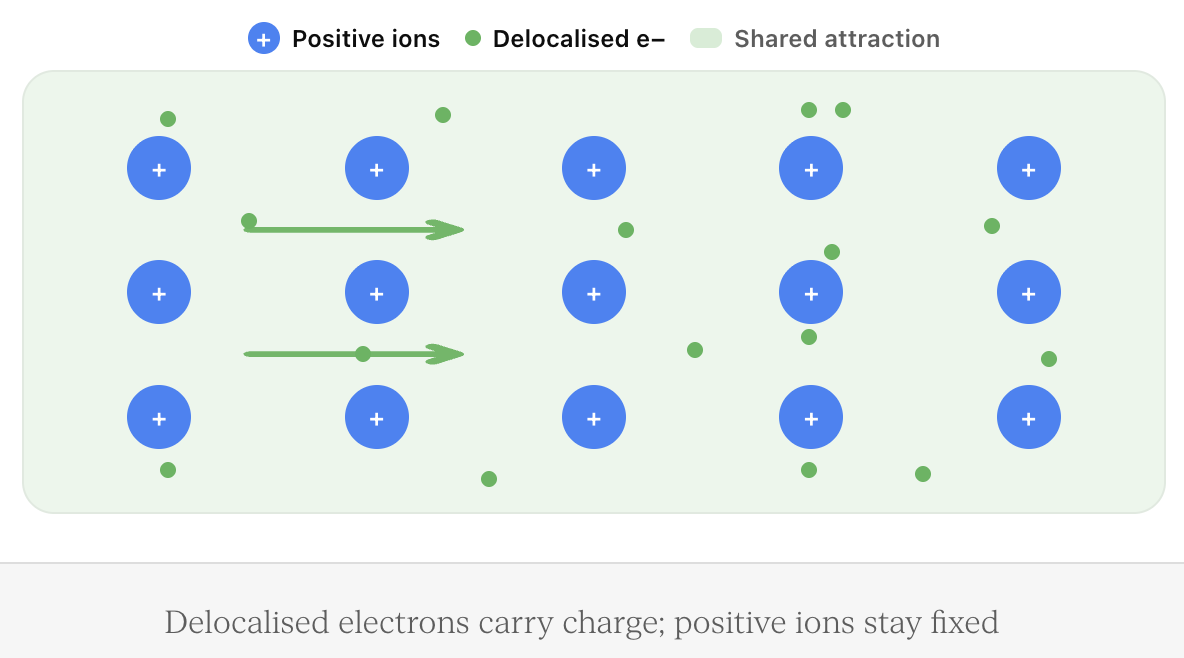
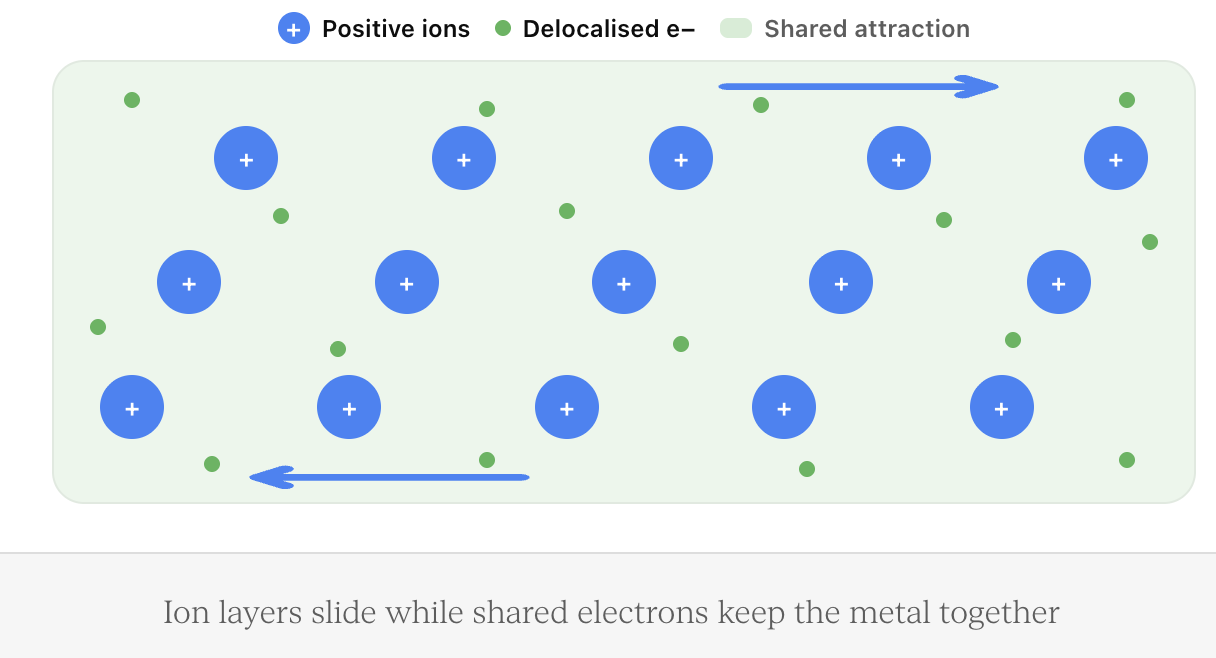
Metal atoms contribute valence electrons to a shared system of:
delocalized electrons
The metal can be modeled as:
positive metal ions surrounded by mobile delocalized electrons
The attraction between the positive ions and negative electrons holds the structure together.
2. Bonding and Physical Properties
Learning outcomes
- I can explain how bonding affects melting point and boiling point.
- I can compare conductivity among different substances.
- I can predict physical properties from bonding type.
- I can explain why substances with different structures behave differently.
- I can use bonding to explain observed material properties.
Why Bonding Affects Physical Properties
The physical properties of a substance depend strongly on:
- The particles it contains.
- How those particles are arranged.
- The forces or bonds between the particles.
- Whether charged particles are able to move.
This means that properties such as melting point, boiling point, electrical conductivity, hardness, brittleness, malleability, and physical state can often be predicted by examining bonding and structure.
A useful reasoning pattern is:
bonding → structure → forces between particles → physical properties


Melting and Boiling
Melting and boiling require particles to move farther apart or move more freely.
Melting
solid → liquid
Boiling
liquid → gas
Energy must be supplied to overcome some of the attractive forces holding particles together.
Therefore, a useful general principle is:
stronger attractions that must be overcome → more energy required → higher melting or boiling temperature
However, we must identify which attractions are actually being overcome.
That depends on the structure of the substance.
Ionic Substances
Ionic substances consist of:
positive ions + negative ions
arranged in a giant ionic lattice.
Strong electrostatic attractions act between oppositely charged ions throughout the structure.
Examples include:
- NaCl
- MgO
- CaCl₂
- KBr


Melting Ionic Substances
When an ionic solid melts, ions must become able to move relative to one another.
This requires enough energy to overcome a significant amount of the strong electrostatic attraction within the lattice.
Therefore, ionic compounds generally have:
relatively high melting points
and:
relatively high boiling points
Comparing Ionic Bond Strength
Not all ionic compounds have the same melting point.
The strength of electrostatic attraction depends partly on:
- The charges of the ions.
- The sizes of the ions.
- The distances between them.
Greater ionic charges generally produce stronger attractions.
For example, ions carrying charges of 2+ and 2− can experience stronger electrostatic attractions than similarly sized ions carrying 1+ and 1− charges.
Therefore, ionic structure allows us to explain general trends, although actual melting points also depend on the details of the crystal structure.
Electrical Conductivity of Ionic Substances
Ionic substances contain charged particles.
However, having charged particles is not enough to conduct electricity.
The charged particles must also be:
mobile
Solid ionic compound
The ions are held in fixed lattice positions.
Therefore:
no mobile charge carriers → does not conduct
Molten ionic compound
The ions are free to move.
Therefore:
mobile ions → conducts
Ionic compound dissolved in water
If the compound dissolves and produces mobile ions:
mobile dissolved ions → conducts
This gives an important principle:
electrical conductivity requires mobile charged particles.
Simple Molecular Covalent Substances
Many covalent substances consist of individual molecules.
Examples include:
- H₂O
- CO₂
- CH₄
- NH₃
- O₂
Atoms within each molecule are joined by strong covalent bonds.
However, separate molecules are held near one another by weaker:
intermolecular forces


Melting Molecular Substances
When a molecular solid melts, the molecules do not normally break apart.
Instead, enough intermolecular attraction is overcome to allow the molecules to move more freely.
For example:
H₂O(s) → H₂O(l)
The H₂O molecules remain H₂O molecules.
The O–H covalent bonds remain intact.
It is mainly the interactions between molecules that change.
Boiling Molecular Substances
The same principle applies when a molecular liquid boils.
For example:
H₂O(l) → H₂O(g)
Water molecules move farther apart.
The covalent bonds within the molecules remain intact.
Therefore, the boiling point depends strongly on the:
intermolecular forces between molecules
Why Many Molecular Substances Have Low Melting and Boiling Points
Intermolecular forces are generally much weaker than ionic or covalent bonds.
Therefore, many simple molecular substances require relatively little energy to separate their molecules.
This often results in:
- Low melting points.
- Low boiling points.
- Gases or liquids at room temperature.
However, intermolecular forces vary greatly in strength.
Intermolecular Forces Matter
Different molecular substances can have very different boiling points because their intermolecular attractions differ.
Important intermolecular forces include:
- London dispersion forces.
- Dipole-dipole attractions.
- Hydrogen bonding.
For comparable molecules:
stronger intermolecular attraction → higher boiling point
Example: Water and Methane
Water, H₂O, and methane, CH₄, are both small molecular substances.
However:
Methane
- Nonpolar.
- Mainly London dispersion forces.
Water
- Polar.
- Forms hydrogen bonds.
Water therefore has much stronger intermolecular attractions.
This contributes to water having a much higher boiling point than methane.
Molecular Size Matters Too
London dispersion forces generally become stronger as molecular size and polarizability increase.
Consider:
F₂ → Cl₂ → Br₂ → I₂
All are nonpolar molecules.
However, their electron clouds become larger and more polarizable down the group.
London dispersion forces become stronger.
Their physical states near room temperature change:
- F₂ – gas
- Cl₂ – gas
- Br₂ – liquid
- I₂ – solid


This shows that molecular substances do not all have identical physical properties.
Conductivity of Molecular Substances
Most simple molecular substances are poor electrical conductors.
Their electrons are generally localized in covalent bonds, and they do not contain freely moving ions or electrons.
Therefore:
no mobile charged particles → poor electrical conductivity
There are exceptions when substances react or ionize in solution, so the actual conductivity of a solution depends on the particles present.
Giant Covalent Structures
Not every covalent substance consists of separate molecules.
Some form enormous networks of covalently bonded atoms.
These are called:
giant covalent structures
Examples include:
- Diamond.
- Graphite.
- Silicon dioxide.
Their properties differ greatly from those of simple molecular substances.
Diamond
Diamond consists of carbon atoms joined in a giant three-dimensional covalent network.
Each carbon atom is covalently bonded to four other carbon atoms.


Strong covalent bonds extend throughout the structure.
A very large amount of energy is required to disrupt this network.
Therefore, diamond has:
- Extremely high hardness.
- Very high thermal stability.
- Very high sublimation/melting conditions.
- Poor electrical conductivity under ordinary conditions.
Why Diamond Does Not Conduct Electricity
The valence electrons in diamond are involved in covalent bonds.
There are no freely moving charged particles available to carry an electrical current.
Therefore:
diamond does not normally conduct electricity
despite being made entirely of carbon.
Graphite
Graphite is also made entirely of carbon.
However, its structure is different.
Each carbon atom forms covalent bonds with three other carbon atoms.
This produces layers.
Some electrons are delocalized and can move along these layers.


Therefore, graphite:
conducts electricity
This demonstrates an important principle:
bond type alone is not always enough — structure also matters.
Comparing Diamond and Graphite
| Property | Diamond | Graphite |
|---|---|---|
| Element | Carbon | Carbon |
| Main bonding | Covalent | Covalent |
| Structure | 3D network | Layers |
| Delocalized electrons | No mobile electron system like graphite | Yes |
| Electrical conductivity | Poor | Conducts along layers |
| Mechanical behavior | Extremely hard | Layers slide relatively easily |
Both contain carbon.
Both contain strong covalent bonds.
Their different structures produce very different physical properties.
Metallic Substances
Metals have a giant metallic structure consisting of:
positive metal ions + delocalized electrons
The electrostatic attraction between these particles produces metallic bonding.


3. Structure and Function
Learning outcomes
- I can explain how structure influences function in materials.
- I can relate atomic structure to practical applications.
- I can compare materials designed for different purposes.
- I can explain why different structures suit different functions.
- I can evaluate materials based on their properties.


 rYBjzJHzbRnNcCZADEPGB2MsDSQZT8yzSAf8ReOFvMxLn8Mi0sQO-l00-ma6CKGLwVqlINJjt-UnPU?purpose=inline" alt="


4. Nanomaterials and Advanced Materials
Learning outcomes
- I can describe what nanomaterials are.
- I can explain how nanoscale structures affect properties.
- I can identify examples of advanced materials.
- I can describe applications of nanotechnology.
- I can evaluate benefits and challenges of nanomaterials.
What Are Nanomaterials?
Nanomaterials are materials that have important structural features on the nanoscale, commonly around 1–100 nanometres (nm) in at least one dimension.
A nanometre is extremely small:
1 nm = 0.000000001 m = 10⁻⁹ m
For comparison:
- A human hair is typically tens of thousands of nanometres wide.
- Many bacteria are thousands of nanometres long.
- Many proteins are only a few nanometres in size.
At this scale, materials can behave differently from the same substance in larger pieces.


Why Size Matters
A piece of material does not necessarily have exactly the same properties when it is made extremely small.
At the nanoscale, properties can change because of:
- Very large surface area compared with volume.
- Changes in interactions between atoms and electrons.
- Quantum effects that become important at very small scales.
- Changes in how light interacts with the material.
This can change properties such as:
- Color.
- Electrical conductivity.
- Chemical reactivity.
- Strength.
- Magnetism.
- Melting behavior.
- Optical properties.
Therefore:
smaller structure → different behavior → new applications
Surface Area-to-Volume Ratio
One of the most important features of nanomaterials is their very high:
surface area-to-volume ratio
When a large object is divided into many smaller particles, its total volume can remain the same while its total surface area increases greatly.
Imagine cutting a cube into many tiny cubes.
The amount of material has not changed, but much more of it is now exposed at the surface.


Why Surface Area Matters
Chemical reactions often occur at surfaces.
Therefore, a material with a larger surface area can provide more sites where reactions can occur.
This can make nanoparticles:
- More reactive.
- More effective as catalysts.
- More useful in some sensors.
- More effective in certain coatings.
A substance that is relatively unreactive in a large piece may behave differently when divided into extremely small particles.
Worked Example: Particle Size
Imagine the same mass of a solid in two forms.
Sample A
One large piece.
Sample B
Millions of nanoparticles.
Both contain the same total amount of material.
However, Sample B has a much greater total surface area.
Therefore, if a reaction occurs at the surface:
Sample B may react much more rapidly.
The difference comes from structure and particle size, not simply chemical composition.
Nanoscale Effects on Optical Properties
Some nanoparticles interact with light differently from larger samples of the same material.
This can cause changes in:
- Color.
- Transparency.
- Light absorption.
- Light emission.
For example, nanoparticles of gold can appear red, purple, or other colors depending on their size, shape, and surroundings rather than having the familiar appearance of bulk gold.


This is an excellent example of:
same element + different scale → different observable properties
Quantum Effects
At extremely small scales, the behavior of electrons can become strongly influenced by quantum effects.
These effects can change:
- Electrical properties.
- Optical properties.
- Magnetic properties.
- Energy levels.
Quantum effects are particularly important in structures such as:
quantum dots
Their optical behavior can depend strongly on particle size.
Quantum Dots
Quantum dots are extremely small semiconductor particles.
Their size influences the energies available to electrons.
As a result, different-sized quantum dots can absorb and emit different wavelengths of light.


Quantum dots have applications in areas such as:
- Displays.
- Imaging.
- Sensors.
- Photonics.
- Research.
Their function depends directly on their nanoscale structure.
Carbon Nanotubes
A carbon nanotube is a nanoscale structure made from carbon atoms arranged in a tube-like form.
They can be imagined approximately as sheets of carbon atoms rolled into cylinders.


Depending on their exact structure, carbon nanotubes can have remarkable:
- Mechanical strength.
- Low mass.
- Electrical properties.
- Thermal properties.
Why Carbon Nanotubes Are Interesting
Carbon atoms within the nanotube are connected by strong covalent bonds.
This contributes to high mechanical strength.
At the same time, nanotubes are extremely small and lightweight.
Potential applications include:
- Composite materials.
- Electronics.
- Sensors.
- Conductive materials.
- Research into energy technologies.
However, manufacturing and safely handling nanotubes can present challenges.
Graphene
Graphene consists of a single layer of carbon atoms arranged in a two-dimensional hexagonal network.
It is essentially one atomic layer thick.


Graphene has attracted considerable research interest because it can combine unusual properties such as:
- Very high strength for its thickness.
- Excellent electrical conductivity.
- Excellent thermal conductivity.
- Flexibility.
- Extremely small thickness.
Graphene and Graphite
Graphene and graphite are closely related.
Graphene → one carbon layer
Graphite → many carbon layers stacked together
This provides another example of structure affecting properties.
Changing the arrangement of the same element can produce materials with different behavior.
Nanoparticles
A nanoparticle is an extremely small particle with dimensions in the nanoscale range.
Nanoparticles can be made from many substances, including:
- Metals.
- Metal oxides.
- Carbon-based materials.
- Semiconductors.
- Polymers.
Different nanoparticles are designed for different functions.
Silver Nanoparticles
Silver has antimicrobial properties, and nanoscale silver provides a large surface area.
Silver nanoparticles have therefore been investigated and used in some:
- Coatings.
- Textiles.
- Medical-related materials.
- Consumer products.


However, their release into the environment can also raise questions about effects on microorganisms and ecosystems.
This illustrates why benefits and risks must both be considered.
Titanium Dioxide Nanoparticles
Titanium dioxide nanoparticles have useful interactions with ultraviolet radiation.
They can be found in applications including some:
- Sunscreens.
- Coatings.
- Pigments.
- Photocatalytic surfaces.
At nanoscale dimensions, titanium dioxide can provide useful UV protection while being less visibly opaque than larger particles in some formulations.
Nanotechnology
Nanotechnology involves understanding, designing, producing, or using structures and devices at very small scales, typically involving nanoscale features.
It combines knowledge from areas including:
- Chemistry.
- Physics.
- Biology.
- Materials science.
- Engineering.
- Medicine.
Nanotechnology is therefore not one single technology.
It is a broad field based on controlling matter at extremely small scales.
Nanotechnology in Medicine
Nanoscale materials are being investigated and used for several medical purposes.
Examples include:
- Drug-delivery systems.
- Diagnostic imaging.
- Biosensors.
- Medical coatings.
- Targeted therapies.
- Research tools.


One goal of some nanoparticle drug-delivery systems is to control where or how a medicine is released.
This could potentially increase effectiveness or reduce exposure elsewhere in the body, depending on the treatment.
Nanotechnology in Electronics
Electronic devices have become possible partly because engineers can manufacture extremely small structures.
Nanotechnology contributes to areas such as:
- Semiconductor devices.
- Sensors.
- Displays.
- Data storage.
- Conductive materials.
Smaller structures can allow large numbers of components to fit into very small devices.
Nanotechnology in Sensors
Nanomaterials can be particularly useful in sensors because their surfaces can interact strongly with surrounding substances.
A sensor may detect:
- Gases.
- Chemicals.
- Biological molecules.
- Changes in temperature.
- Changes in light.
A very high surface area can increase interaction between the sensing material and its environment.
Nanotechnology in Energy
Nanomaterials are being investigated and used in technologies involving:
- Batteries.
- Solar cells.
- Fuel cells.
- Catalysts.
- Hydrogen technologies.
- Energy storage.
Their usefulness can come from:
- High surface area.
- Electrical properties.
- Optical properties.
- Ability to control structures at very small scales.
Nanotechnology in Coatings
Nanomaterials can be incorporated into coatings to modify surface properties.
Depending on the material, coatings may be designed to improve:
- Scratch resistance.
- Water repellency.
- UV protection.
- Corrosion resistance.
- Antimicrobial activity.
- Optical properties.


Advanced Materials
Advanced materials are materials developed or engineered to provide specialized or improved performance.
Not every advanced material is a nanomaterial.
Examples include:
- Graphene.
- Carbon nanotubes.
- Smart materials.
- Shape-memory alloys.
- Advanced ceramics.
- High-performance composites.
- Semiconductor materials.
The important idea is that their composition and structure are deliberately controlled to produce useful properties.
Shape-Memory Alloys
A shape-memory alloy can return toward a previously defined shape after being deformed under suitable conditions, often when heated through a transformation temperature.
One well-known example is:
nickel-titanium alloy (Nitinol)


Applications can include:
- Medical devices.
- Actuators.
- Specialized mechanical components.
- Flexible frames.
Their unusual behavior results from reversible changes in crystal structure.
Smart Materials
A smart material changes one or more properties in response to its environment.
The stimulus might include:
- Temperature.
- Light.
- Pressure.
- Electrical voltage.
- Magnetic field.
- Moisture.
The material's response can then be used to perform a function.
Piezoelectric Materials
Some materials show the piezoelectric effect.
Mechanical stress can produce an electrical response, and in suitable materials an applied electric field can also produce mechanical deformation.
These materials are used in devices such as:
- Sensors.
- Ultrasound equipment.
- Actuators.
- Buzzers.
- Precision positioning systems.
Their function results from the arrangement of electric charges within their structure.
Advanced Ceramics
Traditional ceramics are often:
- Hard.
- Heat resistant.
- Chemically stable.
- Brittle.
Modern engineering ceramics can be designed for demanding applications.
Examples include materials used in:
- Cutting tools.
- Electronics.
- High-temperature equipment.
- Wear-resistant components.
- Some medical applications.
Their strong bonding and controlled structures can provide excellent performance under conditions where many metals would struggle.
Composite Materials
A composite combines different materials so that the resulting material has a useful combination of properties.
Examples include:
- Carbon-fiber reinforced polymers.
- Fiberglass.
- Reinforced concrete.


In carbon-fiber composites:
carbon fibers → provide high strength and stiffness
while:
polymer matrix → holds fibers together and transfers forces
The combination can produce a material with an excellent strength-to-weight ratio.
Advanced Materials in Aircraft
Aircraft provide an excellent example of why advanced materials are valuable.
Aircraft materials may need:
- High strength.
- Low density.
- Fatigue resistance.
- Corrosion resistance.
- Temperature resistance.
Modern aircraft can use combinations of:
- Aluminum alloys.
- Titanium alloys.
- Carbon-fiber composites.
- High-performance polymers.
- Specialized coatings.
No single material is ideal for every component.
Benefits of Nanomaterials
Nanomaterials can provide important advantages.
High Surface Area
Can improve:
- Catalysis.
- Sensing.
- Chemical interaction.
Unique Optical Properties
Useful for:
- Displays.
- Imaging.
- Sensors.
Electrical Properties
Useful for:
- Electronics.
- Conductive materials.
- Sensors.
High Strength at Low Mass
Some nanostructured materials may improve the performance of composites.
Medical Applications
Nanoscale systems may provide new approaches to:
- Drug delivery.
- Diagnostics.
- Imaging.
Challenges of Nanomaterials
The same features that make nanomaterials useful can also create challenges.
These include:
- Manufacturing difficulty.
- Cost.
- Controlling particle size.
- Preventing unwanted aggregation.
- Recycling.
- Environmental release.
- Worker exposure.
- Uncertain behavior of some materials in biological systems.
Nanomaterials therefore require careful evaluation.
Health and Safety
A material that is safe as a large solid piece is not automatically equally safe as nanoparticles.
Nanoparticles can have:
- Different surface reactivity.
- Different movement through environments.
- Different interactions with cells and tissues.
The effects depend strongly on:
- Chemical composition.
- Size.
- Shape.
- Surface chemistry.
- Dose.
- Route of exposure.
Therefore, it is incorrect to say either:
“all nanoparticles are dangerous”
or:
“all nanoparticles are safe.”
Each material and use must be evaluated using evidence.
Environmental Challenges
Nanoparticles released into the environment may interact with:
- Water.
- Soil.
- Microorganisms.
- Plants.
- Animals.
Scientists may investigate:
- How long nanoparticles persist.
- Whether they accumulate.
- How they move through ecosystems.
- Whether they affect organisms.
- How they can be recovered or recycled.
This research helps determine how nanotechnology can be used responsibly.
Manufacturing Challenges
Producing nanomaterials often requires precise control.
Engineers may need to control:
- Particle size.
- Particle shape.
- Purity.
- Surface chemistry.
- Distribution.
- Crystal structure.
Small differences can produce major changes in performance.
This means manufacturing quality is extremely important.
Worked Example: Catalyst
Suppose the same mass of a catalyst is available as:
one large piece
or:
many nanoparticles
The nanoparticles have much greater total surface area.
More catalyst surface can contact the reactants.
Therefore:
smaller particles → larger surface area → more available reaction sites → potentially faster catalytic reaction
This is why nanoscale catalysts can be extremely useful.
Worked Example: Sunscreen
A sunscreen needs to reduce exposure to harmful ultraviolet radiation.
Some formulations use nanoscale titanium dioxide or zinc oxide.
Their small particle size can provide effective interaction with UV radiation while reducing some of the visible whitening associated with larger particles.
The useful property depends partly on:
particle size and interaction with light
Worked Example: Aircraft Panel
An engineer needs a material that is:
- Strong.
- Stiff.
- Lightweight.
A carbon-fiber composite may be considered.
The carbon fibers provide high strength and stiffness.
The polymer matrix holds the fibers together and transfers forces.
Therefore:
designed structure → useful combination of properties → aerospace application
Worked Example: Shape-Memory Device
Suppose a component needs to change shape when its temperature changes and then return to a designed form.
An ordinary metal may not provide this function.
A suitable shape-memory alloy can undergo a reversible structural transformation.
Therefore:
change in temperature → change in crystal structure → change in shape
The microscopic structure produces the macroscopic function.
Evaluating a New Nanomaterial
Imagine a new nanoparticle has been developed for removing pollutants from water.
Scientists should investigate:
Effectiveness
Does it actually remove the pollutant?
Efficiency
How much material is required?
Safety
Does the nanoparticle itself create health or environmental risks?
Recovery
Can it be removed from the treated water?
Reuse
Can it be used again?
Cost
Can it be produced economically?
Life Cycle
What happens during production, use, and disposal?
A technology should be evaluated using both:
benefits + potential costs and risks
Comparing Conventional and Advanced Materials
| Material | Important Structure | Useful Property | Example Application |
|---|---|---|---|
| Steel | Iron-based alloy structure | Strength and toughness | Buildings |
| Aluminum alloy | Lightweight metallic alloy | Good strength-to-weight ratio | Aircraft |
| Graphene | Single carbon layer | Conductivity and high strength for its thickness | Advanced electronics/research |
| Carbon nanotube | Nanoscale carbon cylinder | High strength and unusual electrical properties | Composites and sensors |
| Carbon-fiber composite | Strong fibers in polymer matrix | High strength-to-weight ratio | Aircraft |
| Shape-memory alloy | Transformable crystal structure | Shape recovery | Actuators and medical devices |
| Quantum dot | Nanoscale semiconductor | Size-dependent optical behavior | Displays and imaging |
Nanotechnology and Structure–Property Relationships
Nanotechnology extends an idea we have already seen throughout materials science:
composition + structure → properties → applications
At the nanoscale, we can extend this further:
composition + size + shape + structure → properties → applications
The same chemical substance can behave differently when its size or nanoscale structure changes.
Common Mistakes
Thinking "Nano" Means Microscopic
Nanometres are much smaller than the dimensions of most cells.
Thinking Every Small Particle Is a Nanoparticle
Nanomaterials generally involve dimensions around the nanoscale, commonly about 1–100 nm.
Assuming Nanomaterials Are Different Elements
A nanomaterial can contain exactly the same element as a bulk material but behave differently because of its size and structure.
Saying Nanoparticles Have More Volume
Breaking material into smaller particles does not necessarily increase its total volume.
It increases the surface area-to-volume ratio.
Assuming All Nanoparticles Have the Same Properties
Properties depend on composition, size, shape, structure, and surface chemistry.
Assuming All Nanotechnology Is Dangerous
Risks vary greatly between materials and applications.
Assuming Nanotechnology Is Automatically Safe
Nanoscale materials can behave differently and must be evaluated carefully.
Confusing Nanomaterials with All Advanced Materials
Some advanced materials are nanoscale.
Others are not.
Check Your Understanding
1. What is a nanomaterial?
2. Approximately what size range is commonly associated with nanomaterials?
3. How many metres are in one nanometre?
4. What happens to surface area-to-volume ratio as particles become smaller?
5. Why can nanoparticles be more reactive than larger particles?
6. Why can nanoscale materials have different colors from bulk materials?
7. What is a quantum dot?
8. How can quantum-dot size affect its properties?
9. Describe the structure of a carbon nanotube.
10. What is graphene?
11. How are graphene and graphite related?
12. Give two possible applications of carbon nanotubes.
13. Why can nanoparticles be useful in catalysts?
14. Give two medical applications of nanotechnology.
15. Give two possible applications of nanotechnology in electronics or energy.
16. What is a smart material?
17. What is a shape-memory alloy?
18. How does a carbon-fiber composite combine the properties of different materials?
19. Give three possible benefits of nanomaterials.
20. Give three challenges associated with nanomaterials.
21. Why should the safety of nanoparticles be evaluated separately from larger pieces of the same material?
22. Why is environmental release of nanoparticles an area of research?
23. Explain why manufacturing control is particularly important for nanomaterials.
24. Explain the relationship:
size and structure → properties → applications
25. A new nanomaterial removes pollutants from water very efficiently. What additional questions should scientists ask before recommending widespread use?
Key Terms
- Nanomaterial – material with important structural features on the nanoscale, commonly around 1–100 nm.
- Nanometre (nm) – one billionth of a metre.
- Nanoparticle – particle with dimensions in the nanoscale range.
- Nanotechnology – science and engineering involving the control and use of nanoscale structures.
- Surface area-to-volume ratio – amount of surface area compared with the volume of an object.
- Quantum effect – behavior arising from quantum mechanics that can become particularly important at very small scales.
- Quantum dot – nanoscale semiconductor particle with size-dependent electronic and optical properties.
- Carbon nanotube – tube-like nanoscale structure made from carbon atoms.
- Graphene – single layer of carbon atoms arranged in a hexagonal network.
- Advanced material – engineered material designed to provide specialized or improved performance.
- Smart material – material that changes properties in response to an external stimulus.
- Shape-memory alloy – alloy capable of returning toward a previously defined shape under suitable conditions.
- Piezoelectric material – material that links mechanical deformation with electrical effects.
- Composite – material made by combining different materials to obtain useful properties.
- Nanocomposite – composite containing nanoscale components or structures.
Key Takeaways
- Nanomaterials have important structures on scales commonly around 1–100 nm.
- 1 nm = 10⁻⁹ m.
- Materials can behave differently at the nanoscale.
- Nanoparticles have very high surface area-to-volume ratios.
- High surface area can increase chemical interaction and catalytic activity.
- Nanoscale structures can have unusual optical, electrical, magnetic, and mechanical properties.
- Quantum effects can become important at very small scales.
- Quantum dots can have size-dependent optical properties.
- Carbon nanotubes combine nanoscale dimensions with strong carbon bonding.
- Graphene is a single layer of carbon atoms with unusual mechanical, electrical, and thermal properties.
- Nanotechnology has applications in medicine, electronics, sensors, coatings, energy, and materials engineering.
- Advanced materials include nanomaterials, composites, smart materials, shape-memory alloys, and advanced ceramics.
- Carbon-fiber composites provide excellent strength-to-weight ratios.
- Shape-memory alloys change behavior because of transformations in their internal structure.
- Nanomaterials can offer significant benefits but may also create manufacturing, health, environmental, and economic challenges.
- Nanoparticle safety depends on composition, size, shape, surface chemistry, dose, and exposure.
- New technologies should be evaluated using both their benefits and potential risks.
- At the nanoscale, a particularly useful relationship is:
composition + size + shape + structure → properties → function and applications
5. Bonding in the Real World
Learning outcomes
- I can apply bonding concepts to everyday materials.
- I can explain the properties of common substances using bonding.
- I can analyze real-world material choices.
- I can evaluate how chemistry influences technology and design.
- I can connect bonding concepts to modern scientific applications.


