Chapter 1 Text work review
4. page 54 #s 9 - 15
9. Fan out system:
t1 = 1, r = 4
a) 1 + 4 + 16 + 64 + ... (if person in charge is included)
4 + 16 + 64 + ... (if person in charge is not included)
b) Let's go with the person in charge not being included, and find out S10.
In this case, t1 = 4, r = 4:
S10 = 4(410 - 1)/(4 - 1) = 1,398,100 people contacted.
10.
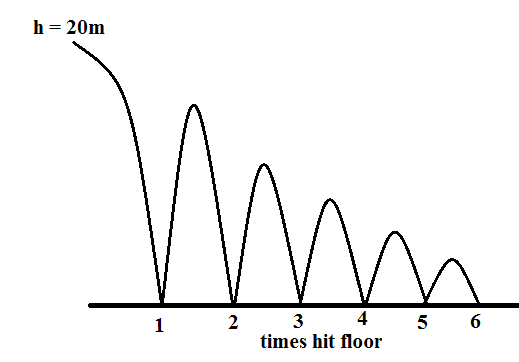
The ball will drop 6 times, that is, n = 6, where t1 = 20, and r = 0.4.
The ball will rise 5 times (n = 5), with t1 = 0.4(20) = 8, and r = 0.4.
To find the total vertical distance travelled, there are a few different ways we could look at this.
First, we could find the sum of the two series: down and up:
Sdown6 + Sup5 = 20(0.46 - 1)/(0.4 - 1) + 8(0.45 - 1)/(0.4 - 1) = 33.2 + 13.2 = 46.4m
Or... since after the first drop, the distance up is the same as the distance down, we could look at ...
20 + 2S5 where t1 = 8, r = 0.4 --> distance = 20 + 2\( \cdot \)8(0.45 - 1)/(0.4 - 1) = 20 + 2\( \cdot \)13.2 = 46.4m
11. Marathon training: t1 = 25km, r = 1.1, n = 15, S15 = ?
S15 = 25(1.115 - 1)/(1.1 - 1) = 794.3km
12. Koch snowflakes:
| Stage | Length of line segment | # of line segments | perimeter of snowflake |
|---|---|---|---|
| 1 | 1 | 3 | 3 |
| 2 | \( \frac{1}{3} \) | 12 | 4 |
| 3 | \( \frac{1}{9} \) | 48 | \( \frac{16}{3} \) |
| 4 | \( \frac{1}{27} \) | 192 | \( \frac{64}{9} \) |
| 5 | \( \frac{1}{81} \) | 768 | \( \frac{256}{27} \) |
c)
length: tn = (\( \frac{1}{3} \))n - 1
# segments: tn = 3(4)n - 1
perimeter: tn = 3(\( \frac{4}{3} \))n - 1
d) perimeter at stage 6 (n = 6)
t6 = 3(\( \frac{4}{3} \))6 - 1 = \( \frac{1024}{81} \) = 12.64
13. Advertising company: t1 = 1000, r = 1.4, want S11.
n is a counter and when n = 2, it represents the next 10 days. We want 100 days, so n = 11:
S11 = 1000(1.411 - 1)/(1.4 - 1) = 98739 people.
14. 10 beads: t = 24mm, r = 0.75, n = 10, S10 = ?
S10 = 24(0.7510 - 1)/(0.75 - 1) = 91mm
15. 200mg ampicillan ear drugs: t1 = 200, r = 0.12
a) S3 = 200(0.123 - 1)(/(0.12 - 1) = 226.9mg
b) S6 = 200(0.126 - 1)/(0.12 - 1) = 227.3mg