Chapter 1 Text work review
| サイト: | Young Education |
| コース: | Sequences and Series |
| ブック: | Chapter 1 Text work review |
| 印刷者: | Guest user |
| 日付: | 2026年 09月 25日(金曜日) 01:02 |
1. page 16 #s 1 - 6, 8 - 10, 13, 19, 25
6.
a) t1 = 6, t4 = 33, d = ? t2 = ? t3 = ?
t4 = t1 + 3d --> 33 = 6 + 3d --> 3d = 27 --> d = 9
t2 = t1 + d = 15 t3 = t2 + d = 24
b) t1 = 8, t4 = 41, d = ?, t2 = ? t3 = ?
t4 = t1 + 3d --> 41 = 8 + 3d --> 3d = 33 --> d = 11
t2 = t1 + d = 19 t3 = t2 + d = 30
c) t1 = 42, t4 = 27, d = ?, t2 = ? t3 = ?
t4 = t1 + 3d -->
2. page 28 #s 10 - 12, 16
10. Determine S25.
t2 = 40, t5 = 121 d = ? t1 = ? t25 = ?
t5 = t2 + 3d --> 121 = 40 + 3d --> 3d = 81 ---> d = 27
t2 = t1 + d ---> t1 = 13
t25 = 13 + 27(24) = 13 + 648 --> t25 = 661
S25 = \( \frac{25}{2} \)(13 + 661) = \( \frac{25}{2} \)(674) = 8425
11. Find the first four terms:
S5 = 85 S6 = 123 t6 = ? d = ?
t6 = S6 - S5 = 123 - 85 = 38
S6 = \( \frac{6}{2} \)(t1 + 38) = 123 ---> t1 + 38 = 41 ---> t1 = 3
t6 = 3 + 5d = 38 --> 5d = 35 --> d = 7
so, the first four terms are 3, 10, 17, 24
12. Derive d = 5n2.
| time (s) |
1 | 2 | 3 | 4 |
|---|---|---|---|---|
| distance fallen in this second (m): | 5 | 15 | 25 | 35 |
| Total distance fallen: | 5 | 20 | 45 | 80 |
This was a bit of a tricky question, because we had to recognize that the distances given were the distance traveled in a particular second. The formula, d
We know that t1 = 5, and t2 = S2 - S1 = 20 - 5 = 15 = t2
This gives us d = t2 - t1= 15 - 5 = 10 = d
and then, tn = t1 + d(n - 1) = 5 + 10(n - 1) = 5 + 10n - 10 = 10n - 5 = tn
Using Sn = \( \frac{n}{2} \)(t1 + tn) we get
Sn = \( \frac{n}{2} \)(5 + 10n - 5) = \( \frac{n}{2} \)(10n) or
Sn = 5n2 = d
16. Distance from top to bottom...
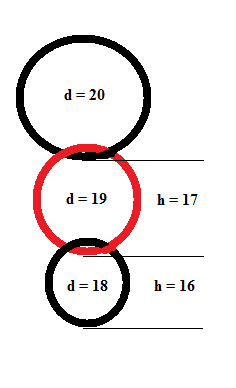
First, let's be sure how many rings there are, according to diameter:
20, 19, 18, ..., 3
here, t1 = 20, d = -1, and tn = 3
3 = 20 - (n - 1) ---> n = 18, so there are 18 rings.
From the diagram, one can see that after the first ring, the distance from the bottom of one ring to the bottom of the next follows the pattern: 17, 16, 15, ..., 1, where there are 17 terms, with t1 = 17, and tn = 1, n = 17.
We want 20 + S17 = 20 + \( \frac{17}{2} \)(17 + 1) = 20 + 153 = 173cm = distance from top to bottom.
3. page 39 #s 1, 3, 5
1. If it is a geometric sequence, state the common ratio r, and the general term tn.
a) 1, 2, 4, 8, ...
r = 2, tn = 2n - 1
b) 2, 4, 6, 8, ... not a geometric sequence
c) 3, -9, 27, -87, ...
r = -3, tn = 3(-3)n - 1
d) 1, 1, 2, 4, 8, ... not a geometric sequence
e) 10, 15, 22.5, 33.75, ...
r = 1.5, tn = 10\( \cdot \)1.5n - 1
f) -1, -5, -25, -125, ...
r = 5, tn = -5n-1
3. Determine the first four terms:
a) t1 = 2, r = 3
2, 6, 18, 54
b) t1 = -3, r = -4
-3, 12, -48, 192
c) t1 = 4, r = -3
4, -12, 36, -108
d) t1 = 2, r = 0.5
2, 1, 0.5, 0.25
5. Determine the formula for the general term:
a) r = 2, t1 = 3
tn = 3\( \cdot \)2n - 1
b) 192, -48, 12, -3, ...
r = -\( \frac{1}{4} \), t1 = 192, tn = 192(\( \frac{1}{4} \)n - 1
c) t3 = 5, t6 = 135
t6 = t3r3, r3 = \( \frac{135}{5} \) = 27 = 33 ---> r = 3
t3 = t1\( \cdot \)32 ---> t1 = \( \frac{5}{9} \)
tn = \( \frac{5}{9} \)\( \cdot \)3n - 1
d) t1 = 4, t13 = 16,384
t13 = 4r12 = 16,384 ---> r12 = 4096 = 212 ---> r = 2
tn = 4\( \cdot \)2n - 1 = 22\( \cdot \)2n - 1 = 2n + 1 = tn
4. page 54 #s 9 - 15
9. Fan out system:
t1 = 1, r = 4
a) 1 + 4 + 16 + 64 + ... (if person in charge is included)
4 + 16 + 64 + ... (if person in charge is not included)
b) Let's go with the person in charge not being included, and find out S10.
In this case, t1 = 4, r = 4:
S10 = 4(410 - 1)/(4 - 1) = 1,398,100 people contacted.
10.
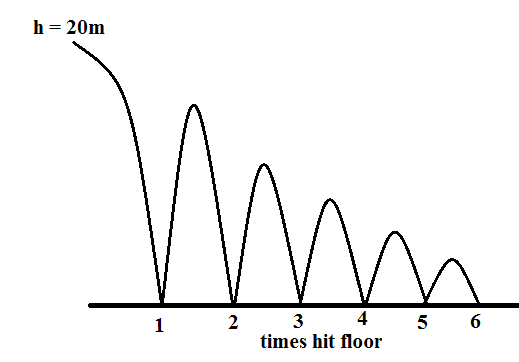
The ball will drop 6 times, that is, n = 6, where t1 = 20, and r = 0.4.
The ball will rise 5 times (n = 5), with t1 = 0.4(20) = 8, and r = 0.4.
To find the total vertical distance travelled, there are a few different ways we could look at this.
First, we could find the sum of the two series: down and up:
Sdown6 + Sup5 = 20(0.46 - 1)/(0.4 - 1) + 8(0.45 - 1)/(0.4 - 1) = 33.2 + 13.2 = 46.4m
Or... since after the first drop, the distance up is the same as the distance down, we could look at ...
20 + 2S5 where t1 = 8, r = 0.4 --> distance = 20 + 2\( \cdot \)8(0.45 - 1)/(0.4 - 1) = 20 + 2\( \cdot \)13.2 = 46.4m
11. Marathon training: t1 = 25km, r = 1.1, n = 15, S15 = ?
S15 = 25(1.115 - 1)/(1.1 - 1) = 794.3km
12. Koch snowflakes:
| Stage | Length of line segment | # of line segments | perimeter of snowflake |
|---|---|---|---|
| 1 | 1 | 3 | 3 |
| 2 | \( \frac{1}{3} \) | 12 | 4 |
| 3 | \( \frac{1}{9} \) | 48 | \( \frac{16}{3} \) |
| 4 | \( \frac{1}{27} \) | 192 | \( \frac{64}{9} \) |
| 5 | \( \frac{1}{81} \) | 768 | \( \frac{256}{27} \) |
c)
length: tn = (\( \frac{1}{3} \))n - 1
# segments: tn = 3(4)n - 1
perimeter: tn = 3(\( \frac{4}{3} \))n - 1
d) perimeter at stage 6 (n = 6)
t6 = 3(\( \frac{4}{3} \))6 - 1 = \( \frac{1024}{81} \) = 12.64
13. Advertising company: t1 = 1000, r = 1.4, want S11.
n is a counter and when n = 2, it represents the next 10 days. We want 100 days, so n = 11:
S11 = 1000(1.411 - 1)/(1.4 - 1) = 98739 people.
14. 10 beads: t = 24mm, r = 0.75, n = 10, S10 = ?
S10 = 24(0.7510 - 1)/(0.75 - 1) = 91mm
15. 200mg ampicillan ear drugs: t1 = 200, r = 0.12
a) S3 = 200(0.123 - 1)(/(0.12 - 1) = 226.9mg
b) S6 = 200(0.126 - 1)/(0.12 - 1) = 227.3mg
5. page 56 #s 16 - 22
16. t1 = 3, r = 3, Sn = 9840, n = ?
9840 = 3(3n - 1)/(3 - 1)
9840(\( \frac{2}{3} \)) = 3n - 1 = 6560
3n = 6561 = 38
n = 8
17. t3 = 24, t4 = 36, S10 = ?
t4 = rt3
r = \( \frac{36}{24} \) = \( \frac{3}{2} \)
t3 = r2t1
t1 = 24(\( \frac{2}{3} \))2 = 24\( \frac{4}{9} \) = \( \frac{32}{3} \)
S10 = \( \frac{32}{3} \)(\( \frac{( \frac{3}{2})^9 \frac{3}{2} - 1 }{ \frac{3}{2} - 1 } \)) = \( ( \frac{32}{3} )( \frac{ \frac{59049}{1024} - 1 }{ \frac{1}{2} }) = (\frac{64}{3} )( \frac{59049}{1024} - \frac{1024}{1024}) \) = \( ( \frac{64}{3})( \frac{58025}{1024}) \) = \( \frac{58025}{48} \)
18. a + b + c = 35, abc = 1000, what are a, b, c?
b = ar, c = br = ar2
abc = 1000
a(ar)(ar) = 103
a3r3 = 103
ar = 10
r = \( \frac{10}{a} \)
b = ar = a\( \frac{10}{a} \) = 10
a + b + c = 35
a + 10 + ar2 = 35
a + a(\( \frac{100}{a^2} \) = 25
a2 - 25a + 100 = 0
(a - 20)(a - 5) = 0
a = 20 or a = 5
a + c = 25, c = 25 - a
c = 5 or c = 20
a = 20, b = 10, c =5 OR a = 5, b = 10, c = 20
19. S7 = 89, S8 = 104, t8 = ?
t8 = S8 - S7 = 15
20.
6. page 63 #s 1 - 9
1.
4. Does 0.9999... = 1?
0.9999.... = 0.9 + 0.09 + 0.009 + ...
t1 = \( \frac{9}{10} \) , r = \( \frac{1}{10} \)
S\( _\infty \) = \( \frac{ \frac{9}{10} }{1 - \frac{1}{10} } = \frac{ \frac{9}{10} }{ \frac{9}{10} } = 1 \)
7. page 64 #s 10 - 18
10. S\( _\infty \) = 2t1. r = ?
S\( _\infty \) = 2t1 = \( \frac{t_1}{1 - r} \)
2(1 - r) = 1
2 - 2r = 1
2r = 1
r = 0.5
11. For what values of x will each series be convergent?
a) 5 + 5x + 5x2 + 5x3 + ...
r = x, t1 = 5
-1 < x < 1
b) 1 + \( \frac{x}{3} \) + \( \frac{x^2}{9} \) + \( \frac{x^3}{27} \) + ...
r = \( \frac{x}{3} \)
-1 < \( \frac{x}{3} \) < 1
-3 < x < 3
c) 2 + 4x + 8x2 + 16x3 + ...
r = 2x
-1 < 2x < 1
-\( \frac{1}{2} \) < x < \( \frac{1}{2} \)
12.