Chapter 1 Text work review
2. page 28 #s 10 - 12, 16
10. Determine S25.
t2 = 40, t5 = 121 d = ? t1 = ? t25 = ?
t5 = t2 + 3d --> 121 = 40 + 3d --> 3d = 81 ---> d = 27
t2 = t1 + d ---> t1 = 13
t25 = 13 + 27(24) = 13 + 648 --> t25 = 661
S25 = \( \frac{25}{2} \)(13 + 661) = \( \frac{25}{2} \)(674) = 8425
11. Find the first four terms:
S5 = 85 S6 = 123 t6 = ? d = ?
t6 = S6 - S5 = 123 - 85 = 38
S6 = \( \frac{6}{2} \)(t1 + 38) = 123 ---> t1 + 38 = 41 ---> t1 = 3
t6 = 3 + 5d = 38 --> 5d = 35 --> d = 7
so, the first four terms are 3, 10, 17, 24
12. Derive d = 5n2.
| time (s) |
1 | 2 | 3 | 4 |
|---|---|---|---|---|
| distance fallen in this second (m): | 5 | 15 | 25 | 35 |
| Total distance fallen: | 5 | 20 | 45 | 80 |
This was a bit of a tricky question, because we had to recognize that the distances given were the distance traveled in a particular second. The formula, d
We know that t1 = 5, and t2 = S2 - S1 = 20 - 5 = 15 = t2
This gives us d = t2 - t1= 15 - 5 = 10 = d
and then, tn = t1 + d(n - 1) = 5 + 10(n - 1) = 5 + 10n - 10 = 10n - 5 = tn
Using Sn = \( \frac{n}{2} \)(t1 + tn) we get
Sn = \( \frac{n}{2} \)(5 + 10n - 5) = \( \frac{n}{2} \)(10n) or
Sn = 5n2 = d
16. Distance from top to bottom...
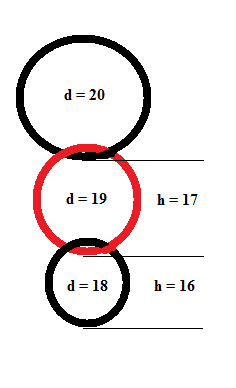
First, let's be sure how many rings there are, according to diameter:
20, 19, 18, ..., 3
here, t1 = 20, d = -1, and tn = 3
3 = 20 - (n - 1) ---> n = 18, so there are 18 rings.
From the diagram, one can see that after the first ring, the distance from the bottom of one ring to the bottom of the next follows the pattern: 17, 16, 15, ..., 1, where there are 17 terms, with t1 = 17, and tn = 1, n = 17.
We want 20 + S17 = 20 + \( \frac{17}{2} \)(17 + 1) = 20 + 153 = 173cm = distance from top to bottom.