Chapter 1: Sequences and Series
1. 1.1 Arithmetic Sequences
1.1. 1.1 Extra Practice
1. Identify which of the following sequences are arithmetic.
For each arithmetic sequence, state the values of t1 and d,
and the next three terms.
a) 4, 7, 10, 13, …
b) 12, 7, 2, –3, …
c) 5, 15, 45, 135, …
d) x, x2, x3, x4, …
e) x, x + 2, x + 4, x + 6, …
2. Write the first four terms of each arithmetic sequence for the given values of t1 and d.
a) t1 = –5, d = –2
b) t1 = 10, d = –0.5
c) t1 = 3, d = x
d) t1 = \( \frac{7}{3} \), d = \( \frac{1}{3} \)
3. Given the general term, state the first four terms of each sequence. Then, graph tn versus n.
a) tn = 13 – 3n
b) tn = \( \frac{1}{2} \)n + 4
4. Determine the general term and the 50th term for each arithmetic sequence.
a) 6, 10, 14, …
b) 3, 2\( \frac{1}{2} \), 2, …
5. Determine the number of terms in each finite arithmetic sequence.
a) –6, –3, 0, …, 222
b) 3\( \frac{1}{4} \), 3\( \frac{3}{4} \), 4\( \frac{1}{4} \), … , 15\( \frac{3}{4} \)
6. Determine the unknown terms in each arithmetic sequence.
a) 4, __, __, 16
b) __, 8, __, __, 2
c) 20, __, __, __, __, –10
7. The 20th term of an arithmetic sequence is 107, and the common difference is 5. Determine the first term, the general term, and the 40th term of this sequence.
8. Use the two given terms to find t1, d, and tn for each arithmetic sequence.
a) t11 = 25, t30 = 101
b) t2 = 90, t51 = –57
9. The terms 5 + x, 8, and 1 + 2x are consecutive terms in an arithmetic sequence. Determine the
value of x and state the
three terms.
10. The triangular shapes are made from asterisks.
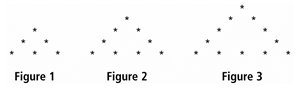
a) How many asterisks will be in the fourth triangle? the fifth triangle?
b) Write the general term for the sequence involving the number of asterisks in the triangles.
c) How many asterisks will be in the 20th diagram?
d) Which diagram will contain 126 asterisks?