Chapter 1: Sequences and Series
| Website: | Young Education |
| Kurs: | Sequences and Series |
| Buch: | Chapter 1: Sequences and Series |
| Gedruckt von: | ゲストユーザ |
| Datum: | Freitag, 25. September 2026, 02:37 |
1. 1.1 Arithmetic Sequences
Objectives:
- Identify the assumption(s) made when defining an arithmetic sequence or series.
- Provide and justify an example of an arithmetic sequence.
- Derive a rule for determining the general term of an arithmetic sequence.
- Describe the relationship between arithmetic sequences and linear functions.
- Determine the first term, the common difference, the number of terms, or the value of a specific term in a problem involving an arithmetic sequence.
An Arithmetic Sequence is an ordered list of terms in which the difference between consecutive terms is constant.
Examples
- 2, 5, 8, 11, 14
- 7, 3, -1, -5, -9, -13, ...
- 5a, 12a, 19a, 26a, 33a, ...
The constant by which each subsequent term increases or decreases is the common difference, or d.
In the Examples above,
- d = 3
- d = -4
- d = 7a
Sequences can be described as finite or infinite, as well as increasing or decreasing.
In the Examples above, the sequences can be described as:
- increasing and finite
- decreasing and infinite
- either increasing or decreasing depending on a, and infinite.
The first term can be represented by t1. The general term can be represented by tn.
The general term can be found from the equation tn = t1 + (n - 1)d
For the Examples above, the general terms are:
- tn = 2 + 3(n - 1)
- tn = 7 - 4(n - 1)
- tn = 5a +7a(n - 1)
1.1. 1.1 Extra Practice
1. Identify which of the following sequences are arithmetic.
For each arithmetic sequence, state the values of t1 and d,
and the next three terms.
a) 4, 7, 10, 13, …
b) 12, 7, 2, –3, …
c) 5, 15, 45, 135, …
d) x, x2, x3, x4, …
e) x, x + 2, x + 4, x + 6, …
2. Write the first four terms of each arithmetic sequence for the given values of t1 and d.
a) t1 = –5, d = –2
b) t1 = 10, d = –0.5
c) t1 = 3, d = x
d) t1 = \( \frac{7}{3} \), d = \( \frac{1}{3} \)
3. Given the general term, state the first four terms of each sequence. Then, graph tn versus n.
a) tn = 13 – 3n
b) tn = \( \frac{1}{2} \)n + 4
4. Determine the general term and the 50th term for each arithmetic sequence.
a) 6, 10, 14, …
b) 3, 2\( \frac{1}{2} \), 2, …
5. Determine the number of terms in each finite arithmetic sequence.
a) –6, –3, 0, …, 222
b) 3\( \frac{1}{4} \), 3\( \frac{3}{4} \), 4\( \frac{1}{4} \), … , 15\( \frac{3}{4} \)
6. Determine the unknown terms in each arithmetic sequence.
a) 4, __, __, 16
b) __, 8, __, __, 2
c) 20, __, __, __, __, –10
7. The 20th term of an arithmetic sequence is 107, and the common difference is 5. Determine the first term, the general term, and the 40th term of this sequence.
8. Use the two given terms to find t1, d, and tn for each arithmetic sequence.
a) t11 = 25, t30 = 101
b) t2 = 90, t51 = –57
9. The terms 5 + x, 8, and 1 + 2x are consecutive terms in an arithmetic sequence. Determine the
value of x and state the
three terms.
10. The triangular shapes are made from asterisks.
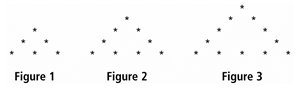
a) How many asterisks will be in the fourth triangle? the fifth triangle?
b) Write the general term for the sequence involving the number of asterisks in the triangles.
c) How many asterisks will be in the 20th diagram?
d) Which diagram will contain 126 asterisks?
1.2. 1.1 solutions
1. Identify which of the following sequences are arithmetic. For each arithmetic sequence, state the values of t1 and d, and the next three terms.
a) 4, 7, 10, 13, … t1 = 4, d = 3, next 3 terms: 16, 19, 22
b) 12, 7, 2, –3, … t1 = 12, d = -5, next 3 terms: -8, -13, -18
c) 5, 15, 45, 135, … Not an arithmetic sequence
d) x, x2, x3, x4, … Not an arithmetic sequence
e) x, x + 2, x + 4, x + 6, … t1 = x, d = 2, next 3 terms: x + 8, x + 10, x + 12
2. Write the first four terms of each arithmetic sequence for the given values of t1 and d.
a) t1 = –5, d = –2
-5, -7, -9, -11
b) t1 = 10, d = –0.5
10, 9.5, 9, 8.5
c) t1 = 3, d = x
3, 3 + x, 3 + 2x, 3 + 3x
d) t1 = \( \frac{7}{3} \) , d = \( \frac{1}{3} \)
\( \frac{7}{3}, \frac{8}{3}, 3, \frac{10}{3} \)
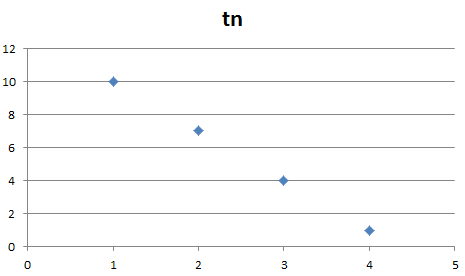
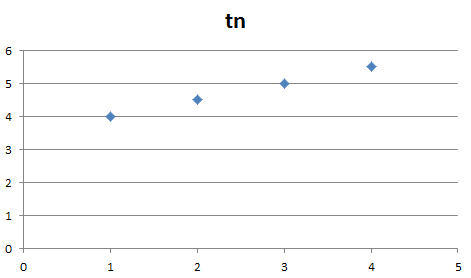
3. Given the general term, state the first four terms of each sequence. Then, graph tn versus n.
a) tn = 13 – 3n
10, 7, 4, 1
b) tn = \( \frac{1}{2}n \) + 4
4, 4.5, 5, 5.5
4. Determine the general term and the 50th term for each arithmetic sequence.
a) 6, 10, 14, …
d = 4, t1 = 6, tn = t1 + (n - 1)d, t50 = 6 + (49)4 = 202
b) 3, \( 2 \frac{1}{2}, 2, ... \)
d = \( - \frac{1}{2} \), t1 = 3, tn = t1 + (n - 1)d, t50 = 3 + 49(\( - \frac{1}{2} \)) = -21.5
5. Determine the number of terms in each finite arithmetic sequence.
a) –6, –3, 0, …, 222
d = 3, t1 = -6, tn = t1 + (n - 1)d,
tn = -6 + ( n - 1)3 = 222
3n - 3 = 228
n = 77
b) \( 3 \frac{1}{4}, 3 \frac{3}{4}, 4 \frac{1}{4}, ... , 15 \frac{3}{4} \)
d = \( \frac{1}{2} \), t1 = \( 3 \frac{1}{4} \)t = \( 3 \frac{1}{4} \) + (n - 1)(\( 3 \frac{1}{4} \)) = \( 15 \frac{3}{4} \)
6. Determine the unknown terms in each arithmetic sequence.
a) 4, __, __, 16
b) __, 8, __, __, 2
c) 20, __, __, __, __, –10
7. The 20th term of an arithmetic sequence is 107, and the common difference is 5. Determine the first term, the general term, and the 40th term of this sequence.
8. Use the two given terms to find t1, d, and tn for each arithmetic sequence.
a) t11 = 25, t30 = 101
b) t2 = 90, t51 = –57
9. The terms 5 + x, 8, and 1 + 2x are consecutive terms in an arithmetic sequence. Determine the value of x and state the
three terms.
10. The triangular shapes are made from asterisks.

a) How many asterisks will be in the fourth triangle? the fifth triangle?
b) Write the general term for the sequence involving the number of asterisks in the triangles.
c) How many asterisks will be in the 20th diagram?
d) Which diagram will contain 126 asterisks?
2. 1.2 Arithmetic Series
Objectives:
- Derive a rule for determining the sum of n terms of an arithmetic series.
- Determine the first term, the common difference, the number of terms, or the value of the sum of specific numbers of terms in a problem involving an arithmetic series.
- Solve a problem that involves an arithmetic sequence or series.
You can think of an Arithmetic Series as the sum of an Arithmetic Sequence.
For example, for the arithmetic sequence 3, 8, 13, 18, 23
the arithmetic series would be 3 + 8 + 13 + 18 + 23
The common difference and general term is the same in the series as it is for the sequence, however, we need a formula for determining the sum of the arithmetic series. Two formulas can be shown to be:
- Sn = \( \frac{n}{2} \)[2t1 + (n - 1)d]
- Sn = \( \frac{n}{2} \)(t1 + tn)
2.1. 1.2 Extra Practice
1. Determine the sum of each arithmetic series.
a) 14 + 10 + 6 + ... + (–86)
b) 5 + 6.5 + 8 + ... + 26
c) \( \frac{3}{4} + 2 + \frac{13}{4} + ... + \frac{49}{2} \)
2. For each arithmetic series, determine the
indicated sum.
a) 4 + 9 + 14 + …; first 12 terms
b) (–16) + (–14) + (–12) + …; first 17 terms
c) x + 3x + 5x + …; first 20 terms
3. For each arithmetic series, determine the number of terms.
a) t1 = 3, tn = 59, Sn = 465
b) t1 = –2, tn = –74, Sn = –950
c) t1 = 20, tn = –40, Sn = –210
4. For each arithmetic series, determine the 12th term and the 12th partial sum.
a) 3 – 1 – 5 – …
b) \( \frac{3}{5} + \frac{7}{5} + \frac{11}{5} \)+ …
5. Determine the sum of each arithmetic series, given the first and nth terms.
a) t1 = –3, t14 = 62
b) t1 = \( \sqrt[]{3} \), t10 = 18\( \sqrt[]{3} \)
6. Determine the sum of all multiples of 7 between 1 and 1000.
7. In an arithmetic series, the third term is 24 and the sixth term is 51. What is the sum of the first 25 terms of the series?
8. The sum of the first eight terms of an arithmetic series is 176. The sum of the first nine terms is 216. Determine the first and ninth terms of the series.
9. The sum of the first n terms of an arithmetic series is Sn = 3n2 + 4n.
a) Determine the first five partial sums.
b) Determine the first five terms of the series.
c) Use the formula to verify that the sum of the first five terms is equal to S5.
10. A student is offered the opportunity to earn $6.00 for the first day, $11.00 for the second day, $16.00 for the third day, and so on, for 20 working days. Or, the student can accept $1000 for the whole job. Which offer pays more?
2.2. 1.2 solutions
1. Determine the sum of each arithmetic series.
a) 14 + 10 + 6 + ... + (–86)
b) 5 + 6.5 + 8 + ... + 26
c) \( \frac{3}{4} + 2 + \frac{13}{4} + ... + \frac{49}{2} \)
2. For each arithmetic series, determine the indicated sum.
a) 4 + 9 + 14 + …; first 12 terms
b) (–16) + (–14) + (–12) + …; first 17 terms
c) x + 3x + 5x + …; first 20 terms
3. For each arithmetic series, determine the number of terms.
a) t1 = 3, tn = 59, Sn = 465
b) t1 = –2, tn = –74, Sn = –950
c) t1 = 20, tn = –40, Sn = –210
4. For each arithmetic series, determine the 12th term and the 12th partial sum.
a) 3 – 1 – 5 – …
b) \( \frac{3}{5} + \frac{7}{5} + \frac{11}{5} \)+ …
5. Determine the sum of each arithmetic series, given the first and nth terms.
a) t1 = –3, t14 = 62
b) t1 = \( \sqrt[]{3} \), t10 = 18\( \sqrt[]{3} \)
6. Determine the sum of all multiples of 7 between 1 and 1000.
7. In an arithmetic series, the third term is 24 and the sixth term is 51. What is the sum of the first 25 terms of the series?
8. The sum of the first eight terms of an arithmetic series is 176. The sum of the first nine terms is 216. Determine the first and ninth terms of the series.
9. The sum of the first n terms of an arithmetic series is Sn = 3n2 + 4n.
a) Determine the first five partial sums.
b) Determine the first five terms of the series.
c) Use the formula to verify that the sum of the first five terms is equal to S5.
10. A student is offered the opportunity to earn $6.00 for the first day, $11.00 for the second day, $16.00 for the third day, and so on, for 20 working days. Or, the student can accept $1000 for the whole job. Which offer pays more?
3. 1.3 Geometric Sequences
Objectives:
- Identify assumptions made when identifying a geometric sequence or series.
- Provide and justify an example of a geometric sequence.
- Derive a rule for determining the general term of a geometric sequence.
- Determine the first term, the common ratio, the number of terms, or the value of a specific term in a problem involving a geometric sequence.
In a Geometric Sequence, the ratio of consecutive terms is a constant.
Examples:
- 3, 6, 12, 24, 48
- 200, 100, 50, 25, ...
- 4, -8, 16, -32, 64, ...
and the general term is given by tn = t1rn - 1.
For the Examples above, the general terms are:
- tn = 32n - 1
- tn = 200()n - 1
- tn = 4(-2)n - 1
3.1. 1.3 Extra Practice
1. Is each sequence geometric? If it is, state the common ratio and a formula to determine the general term in the form tn = t1rn – 1.
a) 11, 33, 99, 297, …
b) 6, 12, 18, 24, …
c) \( \frac{1}{3}, \frac{2}{3}, \frac{4}{3}, \frac{8}{3}, ... \)
d) 0.5, 0.2, 0.08, 0.032, …
2. Write the first four terms of each geometric sequence.
a) t1 = 7, r = –3
b) t1 = –8, r = \( \frac{1}{2} \)
c) tn = 3(0.6)n – 1
d) tn = (–4)n
3. Determine the number of terms in each geometric sequence.
a) 4, 12, 36, ..., 78 732
b) 5\( \sqrt[]{2} \), 10, 10\( \sqrt[]{2} \), ..., 640
c) t1 = 5, r = \( - \frac{1}{2} \), tn = \( \frac{5}{64} \)
d) t1 = \( \frac{1}{4} \), r = 3, tn = 44 286.75
4. Determine the nth term of each geometric sequence.
a) t1 = 2, r = 7
b) 6, –18, 54, –164, …
c) t1 = 7, t5 = 1792
d) r = \( \frac{1}{4} \), t8 = \( \frac{1}{4} \)
5. Determine the unknown terms in each geometric sequence.
a) 18, ___, ___, 6174
b) ___, 4, ___, ___, 108
c) 5, ___, ___, ___, 80
6. The first term of a geometric sequence is 0.1; the tenth term is 26 214.4. Determine the value of the common ratio.
7. Determine the first term, the common ratio, and an expression for the general term of each geometric sequence.
a) t5 = 900, t7 = 0.09
b) t3 = –1728, t6 = 373 248
c) t5 = 28, t11 = 1792
d) t2 = 3, t4 = 0.75
8. The following sequences are geometric. What is the value of each variable?
a) 8x – 12, 16, 64, 256, …
b) 25, 5, 1, 2y – 1, …
9. For a geometric sequence t4 = 4x + 8 and t7 = x – 4. If the common ratio is \( \frac{1}{2} \), what is the first term?
10. An excavating company has a digger that was purchased for $240 000. It is depreciating at 12% per year.
a) Determine the next three terms of this geometric sequence.
b) Determine the general term. Define your variables.
c) How much will the digger be worth in 7 years?
d) How long will it take before the equipment is worth less than $120 000?
4. 1.4 Geometric Series
Objectives:
- Derive a rule for determining the sum of n terms of a geometric series.
- Determine the first term, the common ratio, the number of terms, or the value of the sum of a specific number of terms in a problem involving a geometric series.
A Geometric Series is the expression for the sum of terms of a Geometric Sequence.
Again, the common ratio and general term will be the same for the corresponding sequence.
The sum of a Geometric Sequence can be shown to be
Sn =\( \frac{t_1(r^n - 1)}{r - 1} \), \( r \neq 1 \) and Sn = \( \frac{t_1r^n - t_1}{r - 1} \), \( r \neq 1 \)
Example:
For the Geometric Series 4 + 8 + 16 + 32 + 64 + ...
S8 = \( \frac{4(2^8 - 1)}{1} \)
4.1. 1.4 Extra Practice
1. Determine whether each series is geometric. Justify your answers.
a) 5 + 6 + 7.2 + 8.64 + …
b) 3125 – 625 + 125 – 25 + …
c) \( \frac{3}{4} + \frac{1}{2} + \frac{1}{3} + \frac{2}{9} + ... \)
d) 2 + 3 + 5 + 8 + …
2. For each geometric series, state the values of t1 and r. Then, determine each partial sum.
a) 0.43 + 0.0043 + 0.000 043 + …, (S6)
b) 5 – 5 + 5 – …, (S10)
c) –100 + 50 – 25 + …, (S7)
3. Determine the partial sum, Sn, for each geometric series described.
a) t1 = 50, r = 1.1, n = 4
b) t1 = –4, r = 2, n = 10
c) tn = (–5)(0.5)n – 1 , n = 5
d) tn = (3)(2)n – 1 , n = 12
4. Determine the partial sum, Sn, for each geometric series.
a) 2 + 6 + 18 + ... + 354 294
b) t1 = –3, r = –2, tn = 6144
c) Sn = (–32)(0.75n – 1), n = 6
5. Determine the first term for each geometric series.
a) Sn = 3932.4, tn = 4915.2, r = –4
b) Sn = 292 968, n = 8, r = 5
6. Determine the number of terms in each geometric series.
a) 4 + 20 + 100 + ... + tn = 15 624
b) 1792 – 896 + 448 – ... – tn = 1197
7. The fourth term of a geometric series is 30; the ninth term is 960. Determine the sum of the first nine terms.
8. The first term of a geometric series is 3. The sum of the first two terms of the series is 15 and the sum of the first three terms of the series is 63. Determine the common ratio.
9. Determine the first four terms of each geometric series.
a) Sn = 5(3n – 1)
b) Sn = –24(0.5n – 1)
10. A ball is dropped from the top of a 25-m ladder. In each bounce, the ball reaches a vertical height that is \( \frac{3}{5} \) the previous vertical height. Determine the total vertical distance traveled by the ball when it contacts the ground for the sixth time. Express your answer to the nearest tenth of a meter.
5. 1.5 Infinite Geometric Series
Objectives:
- Generalize, using inductive reasoning, a rule for determining the sum of an infinite geometric series.
- Explain why an infinite geometric series is convergent or divergent.
- Solve a problem that involves a geometric sequence or series.
An Infinite Geometric Series can either be divergent or convergent.
For a divergent series, the infinite sum does not approach a fixed value. (r \( \geq \) 1 or r \( \leq \) -1)
For a convergent series, the infinite sum does approach a finite value. ( -1 < r < 1)
The sum of an infinite series that converges can be shown to be:
S = \( \frac{t_1}{1 - r} \), -1 < r < 1
5.1. 1.5 Extra Practice
1. State whether each geometric series is convergent or divergent.
a) 80 + 20 + 5 + \( \frac{5}{4} \) + …
b) –30 + 20 – \( \frac{40}{3} \) + \( \frac{80}{9} \) – …
c) t1 = –5, r = \( \frac{1}{2} \)
d) t1 = \( \frac{1}{3} \), r = –2
2. Determine the sum of each geometric series, if it exists.
a) t1 = –4, r = \( \frac{4}{5} \)
b) t1 = 10, r = \( \frac{-2}{3} \)
c) 10 + 10\( \sqrt[]{3} \) + 30 + 30\( \sqrt[]{3} \)+ …
d) \( \frac{5}{3} - \frac{5}{9} + \frac{5}{27} - \frac{5}{81} + ... \)
e) 8 + 8\( ( \frac{2}{3}) \)+ 8\( ( \frac{2}{3}) \)2+ 8\( ( \frac{2}{3}) \)3 + …
f) – 2 – 2\( ( \frac{-3}{4}) \) – 2\( ( \frac{-3}{4}) \)2 – 2\( ( \frac{-3}{4}) \)3 – …
3. Express each of the following as an infinite geometric series. Determine the sum of the series.
a) 0.\( \vec{65} \)
b) 7.4\( \vec{5} \)
c) 0.123\( \vec{456} \)
4. The general term of an infinite geometric series is tn = 7\( ( \frac{1}{3}) \)n - 1. Determine the sum of the series, if it exists.
5. The sum of an infinite geometric series is \( \frac{10}{3} \) and the first term is 5. Determine the common ratio.
6. The sum of an infinite geometric series is \( \frac{3 \pi }{2} \) and the common ratio is \( \frac{1}{2} \). Determine the first term.
7. A ball is dropped from a height of 2.0 m onto a floor. On each bounce the ball rises to 75% of the height from which it fell. Calculate the total distance the ball travels before coming to rest.
8. Determine the values of x such that the series 1 + x + x2 + x3 + … has a sum.
9. The sum of an infinite geometric series is three times the first term. Determine the common ratio.
10. A new oil well produces 12 000 m3/month of oil. Its production is known to be dropping by 2.5% each month.
a) What is the total production in the first year?
b) Determine the total production of the well.