Arithmetic Sequences and Series
5. Sum Formulas for Arithmetic Series
Learning outcomes
- I can explain why a formula can be used to find the sum of an arithmetic series.
- I can identify the values needed to use an arithmetic series formula.
- I can calculate the sum of an arithmetic series using a formula.
- I can compare formula-based solutions with direct addition.
- I can apply arithmetic series formulas to real-world situations.
Sum Formulas for Arithmetic Series
Introduction
An arithmetic series is the sum of the terms in an arithmetic sequence.
For example, consider the sequence:
4, 7, 10, 13, 16, 19
Its corresponding arithmetic series is:
4 + 7 + 10 + 13 + 16 + 19 = 69
When a series contains only a few terms, we can calculate its sum through direct addition.
However, what if we need to add 50, 100, or even 1,000 terms?
Adding every term individually would take considerable time and increase the possibility of errors.
Fortunately, arithmetic series follow a predictable pattern. Because consecutive terms have a constant difference, we can use formulas to calculate their sums efficiently.
These formulas are useful in mathematics and real-world situations involving savings, seating arrangements, production, construction, and other quantities that increase or decrease regularly.


Reviewing Arithmetic Sequences and Series
An arithmetic sequence is an ordered list of numbers with a constant difference between consecutive terms.
Example:
5, 9, 13, 17, 21, ...
The common difference is:
d = 9 − 5 = 4
An arithmetic series is formed by adding terms from an arithmetic sequence.
Example:
5 + 9 + 13 + 17 + 21 = 65
Comparing Sequences and Series
|
Arithmetic sequence |
Arithmetic series |
|---|---|
|
3, 6, 9, 12, 15 |
3 + 6 + 9 + 12 + 15 |
|
Describes individual terms |
Describes their combined total |
|
Uses aₙ for a term |
Uses Sₙ for a sum |
|
Has a constant difference |
Can be calculated using a sum formula |
The nth term formula for an arithmetic sequence is:
aₙ = a₁ + (n − 1)d
where:
-
a₁ = first term
-
aₙ = nth term
-
n = term position
-
d = common difference
This formula will help us develop and use arithmetic series formulas.
Why Can We Use a Formula to Find a Sum?
Arithmetic sequences have a special property: their terms are evenly spaced.
Consider:
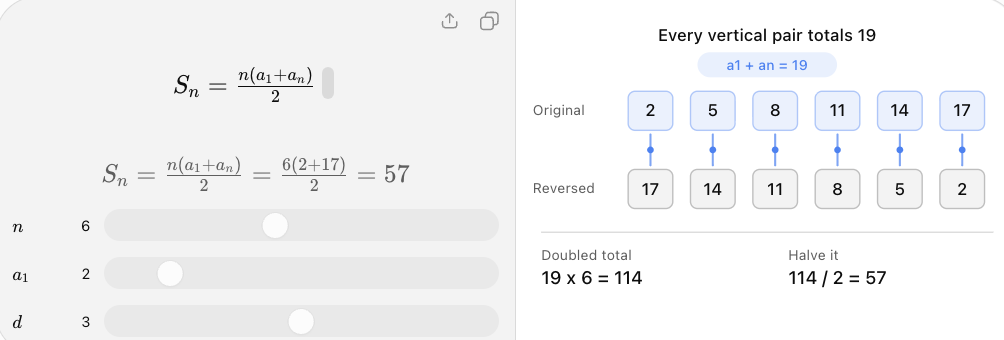
2 + 5 + 8 + 11 + 14 + 17
The common difference is 3.
Now pair terms from opposite ends:
2 + 17 = 19
5 + 14 = 19
8 + 11 = 19
Every pair has the same sum.
There are three pairs, so:
S₆ = 3 × 19
S₆ = 57
We did not need to add all six terms individually.
Why Does Pairing Work?
In an arithmetic sequence:
-
Moving one term forward increases its value by d.
-
Moving one term backward decreases its value by d.
These changes cancel when the terms are paired from opposite ends.
For example:
2 + 17 = 19
(2 + 3) + (17 − 3) = 19
The pair sum remains constant.
This pattern is the foundation of the arithmetic series sum formula.
Deriving the Arithmetic Series Formula
Suppose an arithmetic series contains n terms.
Write the series in its original order:
Sₙ = a₁ + a₂ + a₃ + ... + aₙ
Now write it in reverse:
Sₙ = aₙ + aₙ₋₁ + aₙ₋₂ + ... + a₁
Add the two expressions vertically.
Each pair has the same sum:
a₁ + aₙ
There are n such pairs.
Therefore:
2Sₙ = n(a₁ + aₙ)
Dividing by 2 gives the sum formula.
Understanding the Formula
The sum is calculated by multiplying:
Number of terms × Average term value
For an arithmetic sequence, the average of all its terms equals the average of the first and last terms.
Therefore:
Average term value = (a₁ + aₙ)/2
This is why the sum formula works.
Important Observation
The formula works for:
-
Increasing arithmetic sequences.
-
Decreasing arithmetic sequences.
-
Constant arithmetic sequences.
-
Sequences containing negative numbers.
-
Sequences containing fractions or decimals.
The essential requirement is that the sequence has a constant common difference.
Identifying the Values Needed
Before using the arithmetic series formula, identify the required information.
|
Symbol |
Meaning |
Example |
|---|---|---|
|
Sₙ |
Sum of the first n terms |
S₁₀ |
|
n |
Number of terms |
10 |
|
a₁ |
First term |
4 |
|
aₙ |
Last term |
31 |
|
d |
Common difference |
3 |
For the first-and-last-term formula, we need:
n, a₁, and aₙ
Worked Example
Consider:
4 + 7 + 10 + 13 + 16 + 19
Identify:
a₁ = 4
aₙ = 19
n = 6
The common difference is:
d = 3
Although the common difference helps describe the series, we do not need it directly when the first term, last term, and number of terms are already known.
A Common Mistake
The last term is not the same as the number of terms.
For example:
5 + 10 + 15 + 20
The last term is 20.
The number of terms is 4.
Therefore:
aₙ = 20
n = 4
Confusing these values produces an incorrect sum.
Using the First-and-Last-Term Formula
Worked Example
Find the sum:
6 + 10 + 14 + 18 + 22
Step 1: Identify the Values
a₁ = 6
aₙ = 22
n = 5
Step 2: Substitute into the Formula
S₅ = 5(6 + 22)/2
Step 3: Simplify
S₅ = 5(28)/2
S₅ = 140/2
S₅ = 70
Step 4: Verify by Direct Addition
6 + 10 + 14 + 18 + 22
= 16 + 14 + 18 + 22
= 30 + 18 + 22
= 48 + 22
= 70
Both methods give the same result.
The Alternative Arithmetic Series Formula
Sometimes we know the first term, common difference, and number of terms, but not the last term.
We can use a second formula.
Recall:
aₙ = a₁ + (n − 1)d
Substitute this expression for aₙ into the sum formula:
Sₙ = n[a₁ + a₁ + (n − 1)d]/2
Combine the first two terms:
Sₙ = n[2a₁ + (n − 1)d]/2
This is the alternative arithmetic series formula.
When Should We Use Each Formula?
|
Information given |
Formula to use |
|---|---|
|
First term, last term, number of terms |
Sₙ = n(a₁ + aₙ)/2 |
|
First term, common difference, number of terms |
Sₙ = n[2a₁ + (n − 1)d]/2 |
Both formulas produce the same answer.
Choose the one that requires the fewest additional calculations.
Using the First Term and Common Difference
Worked Example
Find the sum of the first 15 terms of:
3, 8, 13, 18, ...
Step 1: Identify the Values
a₁ = 3
d = 5
n = 15
Step 2: Substitute
S₁₅ = 15[2(3) + (15 − 1)(5)]/2
Step 3: Simplify
S₁₅ = 15[6 + 14(5)]/2
S₁₅ = 15[6 + 70]/2
S₁₅ = 15(76)/2
S₁₅ = 570
Verification Using the Other Formula
First calculate the 15th term:
a₁₅ = 3 + 14(5)
a₁₅ = 73
Now:
S₁₅ = 15(3 + 73)/2
S₁₅ = 15(76)/2
S₁₅ = 570
The two formulas agree.
Finding the Number of Terms
Sometimes a series gives the first and last terms but does not state how many terms are included.
We must determine n before calculating the sum.
Worked Example
Find:
5 + 9 + 13 + ... + 81
Step 1: Identify the Values
a₁ = 5
d = 4
aₙ = 81
Step 2: Use the nth Term Formula
aₙ = a₁ + (n − 1)d
81 = 5 + (n − 1)(4)
76 = 4(n − 1)
19 = n − 1
n = 20
Step 3: Calculate the Sum
S₂₀ = 20(5 + 81)/2
S₂₀ = 10(86)
S₂₀ = 860
Important Reminder
Always determine the correct number of terms before substituting into a sum formula.
Comparing Formula-Based Solutions with Direct Addition
Consider the series:
4 + 8 + 12 + 16 + 20 + 24
Method A: Direct Addition
4 + 8 = 12
12 + 12 = 24
24 + 16 = 40
40 + 20 = 60
60 + 24 = 84
Total = 84
Method B: Sum Formula
a₁ = 4
aₙ = 24
n = 6
S₆ = 6(4 + 24)/2
S₆ = 3(28)
Total = 84
Comparing the Methods
|
Direct addition |
Sum formula |
|---|---|
|
Adds terms individually |
Uses the structure of the series |
|
Simple for short series |
Efficient for long series |
|
Requires all terms to be known or generated |
Requires only a few key values |
|
Useful for checking answers |
Useful for distant or large totals |
Which Method Is Better?
For a series with five terms, direct addition may be just as convenient.
For a series with 500 terms, the formula is usually much more efficient.
Both methods are mathematically valid.
Calculating the Sum of the First 100 Positive Integers
Consider:
1 + 2 + 3 + ... + 100
This is an arithmetic series with:
a₁ = 1
aₙ = 100
n = 100
Use the sum formula:
S₁₀₀ = 100(1 + 100)/2
S₁₀₀ = 50(101)
S₁₀₀ = 5,050
This is a famous example often associated with the mathematician Carl Friedrich Gauss.
The Pairing Method
Pair the first and last terms:
1 + 100 = 101
2 + 99 = 101
3 + 98 = 101
There are 50 pairs.
Therefore:
50 × 101 = 5,050
The sum formula generalises this pairing method.

Arithmetic Series with Negative Common Differences
The sum formulas also work for decreasing arithmetic sequences.
Worked Example
Find the sum of the first 12 terms of:
50, 46, 42, 38, ...
Step 1: Identify the Values
a₁ = 50
d = −4
n = 12
Step 2: Use the Formula
S₁₂ = 12[2(50) + 11(−4)]/2
S₁₂ = 6[100 − 44]
S₁₂ = 6(56)
S₁₂ = 336
Verification
Find the last term:
a₁₂ = 50 + 11(−4)
a₁₂ = 6
Now:
S₁₂ = 12(50 + 6)/2
S₁₂ = 6(56)
S₁₂ = 336
Interpretation
Although the terms decrease, they are all positive in this example.
Therefore, the total is positive.
A decreasing sequence does not necessarily produce a negative sum.
Arithmetic Series Containing Negative Terms
Worked Example
Calculate:
12 + 8 + 4 + 0 − 4 − 8 − 12
There are seven terms.
a₁ = 12
aₙ = −12
n = 7
S₇ = 7(12 + (−12))/2
S₇ = 7(0)/2
S₇ = 0
The positive and negative terms cancel.
Another Example
Find the sum of the first 10 terms of:
5, 2, −1, −4, ...
First term:
a₁ = 5
Common difference:
d = −3
Number of terms:
n = 10
Use:
S₁₀ = 10[2(5) + 9(−3)]/2
S₁₀ = 5[10 − 27]
S₁₀ = 5(−17)
S₁₀ = −85
The sum is negative because the later negative terms outweigh the earlier positive terms.
Arithmetic Series with Fractions and Decimals
The formulas are not restricted to whole numbers.
Worked Example: Fractions
Find:
1/2 + 1 + 3/2 + 2 + 5/2
The first term is:
a₁ = 1/2
The last term is:
aₙ = 5/2
There are five terms.
S₅ = 5(1/2 + 5/2)/2
S₅ = 5(6/2)/2
S₅ = 5(3)/2
S₅ = 15/2 = 7.5
Worked Example: Decimals
Find the sum of the first eight terms of:
1.2, 1.7, 2.2, 2.7, ...
a₁ = 1.2
d = 0.5
n = 8
S₈ = 8[2(1.2) + 7(0.5)]/2
S₈ = 4[2.4 + 3.5]
S₈ = 4(5.9)
S₈ = 23.6
Finding an Unknown First Term
Sometimes we know the total sum, number of terms, and common difference.
We can rearrange the sum formula to determine the first term.
Worked Example
An arithmetic series contains 10 terms.
Its common difference is 3.
The total sum is 185.
Find the first term.
Use:
Sₙ = n[2a₁ + (n − 1)d]/2
Substitute:
185 = 10[2a₁ + 9(3)]/2
185 = 5(2a₁ + 27)
Divide by 5:
37 = 2a₁ + 27
10 = 2a₁
a₁ = 5
Verification
The first term is 5.
The tenth term is:
a₁₀ = 5 + 9(3) = 32
S₁₀ = 10(5 + 32)/2
S₁₀ = 185
The answer is correct.
Finding an Unknown Number of Terms
Sometimes the total sum is known, but the number of terms is unknown.
This may produce a quadratic equation.
Worked Example
The arithmetic sequence is:
3, 7, 11, 15, ...
How many terms must be added to obtain a total of 210?
Step 1: Identify the Values
a₁ = 3
d = 4
Sₙ = 210
Step 2: Substitute
210 = n[2(3) + (n − 1)(4)]/2
210 = n[6 + 4n − 4]/2
210 = n(4n + 2)/2
210 = n(2n + 1)
Step 3: Rearrange
2n² + n − 210 = 0
Step 4: Factor
(2n + 21)(n − 10) = 0
Therefore:
n = 10 or n = −10.5
A number of terms must be a positive integer.
Therefore:
n = 10
Verification
The tenth term is:
a₁₀ = 3 + 9(4) = 39
S₁₀ = 10(3 + 39)/2
S₁₀ = 210
Exactly 10 terms are required.
Real-World Application: Stadium Seating
A stadium has 24 seats in its first row.
Each successive row contains 4 more seats.
There are 30 rows.

Find the Number of Seats in the Last Row
a₃₀ = 24 + 29(4)
a₃₀ = 24 + 116
a₃₀ = 140
Calculate the Total Seating Capacity
S₃₀ = 30(24 + 140)/2
S₃₀ = 15(164)
S₃₀ = 2,460 seats
Interpretation
The stadium contains 2,460 seats.
The arithmetic sequence describes the seats in individual rows.
The arithmetic series describes the total number of seats.
Why Is the Formula Useful?
A stadium with 30 rows would require considerable time to calculate through direct addition.
The formula provides the total using only the first row, last row, and number of rows.
Real-World Application: Weekly Savings
A student saves $15 during the first week.
Each week, the student increases the amount saved by $5.
How much money will the student save over 20 weeks?

Step 1: Identify the Values
a₁ = 15
d = 5
n = 20
Step 2: Find the Last Term
a₂₀ = 15 + 19(5)
a₂₀ = 110
Step 3: Find the Total
S₂₀ = 20(15 + 110)/2
S₂₀ = 10(125)
S₂₀ = $1,250
Interpretation
The student saves $110 during week 20.
The total saved over all 20 weeks is $1,250.
These are different quantities.
Real-World Application: Factory Production
A factory produces 200 items during its first day.
Production increases by 15 items each day.
How many items are produced over 14 days?
Step 1: Identify the Values
a₁ = 200
d = 15
n = 14
Step 2: Find the Last Term
a₁₄ = 200 + 13(15)
a₁₄ = 395
Step 3: Calculate the Total
S₁₄ = 14(200 + 395)/2
S₁₄ = 7(595)
S₁₄ = 4,165 items
Interpretation
The factory produces 4,165 items during the 14-day period.
This model assumes that daily production increases by exactly 15 items throughout the period.
Real-World Application: Building a Staircase
A decorative staircase uses 4 blocks in its first row.
Each new row requires 4 additional blocks.
The pattern continues for 25 rows.

Identify the Sequence
4, 8, 12, 16, 20, ...
Find the Last Term
a₂₅ = 4 + 24(4)
a₂₅ = 100
Calculate the Total Blocks
S₂₅ = 25(4 + 100)/2
S₂₅ = 25(104)/2
S₂₅ = 1,300 blocks
The formula allows the total number of blocks to be determined without counting each row individually.
A Complete Strategy for Arithmetic Series Problems
When solving an arithmetic series problem, use the following approach.
-
Identify the arithmetic pattern. Check that consecutive terms have a constant difference.
-
Determine what is being asked. Is the question asking for one term or the total sum?
-
Identify the known values. Record a₁, aₙ, d, and n where available.
-
Find any missing information. Use the nth term formula if necessary.
-
Choose the appropriate sum formula. Select the formula that matches the information given.
-
Substitute carefully. Include brackets and negative signs correctly.
-
Calculate the sum. Show the main algebraic steps.
-
Verify when possible. Use direct addition for short series or the alternative formula.
-
Interpret the answer. Include units and explain what the total represents.
-
Check reasonableness. Consider whether the answer makes sense in the context.
Common Mistakes
Confusing the nth term with the sum
aₙ gives the value of one term.
Sₙ gives the total of the first n terms.
Using the wrong number of terms
Always count the terms carefully or calculate n from the nth term formula.
Confusing the last term with n
The last term is a value. The number of terms is a count.
Forgetting to divide by 2
Both arithmetic series formulas include division by 2.
Using the wrong common difference
For decreasing sequences, the common difference is negative.
Ignoring brackets
In Sₙ = n[2a₁ + (n − 1)d]/2, calculate the expression inside the brackets correctly.
Using a sum formula for a non-arithmetic sequence
The formulas apply only when consecutive terms have a constant difference.
Forgetting to find the last term
If using the first-and-last-term formula, calculate aₙ when it is not provided.
Accepting an invalid number of terms
The number of terms must be a positive integer.
Failing to interpret the answer
A total should be expressed with appropriate units, such as dollars, seats, tiles, or items.
Key Terms
-
Arithmetic Sequence: Ordered list of numbers with a constant difference between consecutive terms.
-
Arithmetic Series: Sum of the terms of an arithmetic sequence.
-
Common Difference: Fixed change between consecutive terms.
-
First Term: The value of the sequence at position 1.
-
Last Term: Final term included in a finite series.
-
Number of Terms: Count of terms being added.
-
nth Term: Term at position n.
-
Partial Sum: Sum of the first n terms.
-
Sₙ: Symbol representing the sum of the first n terms.
-
Sum Formula: Formula used to calculate the total of an arithmetic series.
-
Pairing Method: Method of adding terms from opposite ends of a series.
-
Average Term Value: Mean of the terms in a finite arithmetic sequence.
-
Direct Addition: Calculating a series by adding each term individually.
-
Formula-Based Solution: Calculating a sum using an algebraic formula.
-
Sigma Notation: Compact notation using Σ to represent summation.
-
Finite Series: Series containing a specified number of terms.
-
Verification: Checking that a solution is correct.
-
Mathematical Model: Mathematical representation of a real-world situation.
-
Cumulative Total: Total obtained by successively adding quantities.
Key Takeaways
-
Arithmetic series formulas work because arithmetic sequences have a constant common difference.
-
Terms paired from opposite ends have equal sums.
-
The average term value equals the average of the first and last terms.
-
The sum of a finite arithmetic series equals the number of terms multiplied by the average term value.
-
The first-and-last-term formula is Sₙ = n(a₁ + aₙ)/2.
-
The first-term-and-difference formula is Sₙ = n[2a₁ + (n − 1)d]/2.
-
Both formulas produce the same answer.
-
The best formula depends on which values are known.
-
Direct addition is useful for short series and verification.
-
Formula-based solutions are more efficient for long series.
-
Negative terms and negative common differences must be handled carefully.
-
The number of terms can be found using the nth term formula.
-
Arithmetic series formulas are useful for savings, seating, production, construction, and other regularly changing quantities.
Check Your Understanding
Identifying Values
-
Identify a₁, aₙ, and n for 4 + 8 + 12 + 16 + 20.
-
Identify a₁, d, and n for the first 12 terms of 5, 9, 13, 17, ...
-
Explain why the arithmetic series formula includes division by 2.
-
Explain why pairing terms from opposite ends works.
Calculating Sums
-
Find the sum of 3 + 6 + 9 + 12 + 15.
-
Find the sum of 7 + 11 + 15 + 19 + 23.
-
Find the sum of the first 10 terms of 2, 5, 8, 11, ...
-
Find the sum of the first 20 terms of 4, 10, 16, 22, ...
Finding Missing Values
-
Find the number of terms in 5 + 10 + 15 + ... + 100.
-
Find the sum of 6 + 12 + 18 + ... + 120.
-
An arithmetic series contains 8 terms, has common difference 3, and has sum 132. Find the first term.
-
How many terms of 3 + 7 + 11 + ... are needed to obtain a sum of 210?
Comparing Methods
-
Calculate 2 + 4 + 6 + 8 + 10 using direct addition.
-
Calculate the same series using the sum formula.
-
Explain why the sum formula is more efficient for a series containing 100 terms.
-
Explain how direct addition can help verify a formula-based solution.
Real-World Applications
-
A theatre has 20 seats in its first row and 4 additional seats in each successive row. Find the total number of seats in 15 rows.
-
A student saves $10 in week 1 and increases weekly savings by $5. Find the total saved over 12 weeks.
-
A factory produces 100 items on day 1 and increases production by 10 items each day. Find the total production over 10 days.
-
A staircase has 20 rows. The first row uses 3 blocks and each successive row uses 3 more. Find the total blocks required.
Answer Key
|
Question |
Answer |
|---|---|
|
1 |
a₁ = 4, aₙ = 20, n = 5 |
|
2 |
a₁ = 5, d = 4, n = 12 |
|
3 |
The formula uses the average of the first and last terms |
|
4 |
Each pair has the same sum |
|
5 |
45 |
|
6 |
75 |
|
7 |
155 |
|
8 |
1,220 |
|
9 |
20 terms |
|
10 |
1,260 |
|
11 |
a₁ = 6 |
|
12 |
10 terms |
|
13 |
30 |
|
14 |
30 |
|
15 |
It avoids adding 100 terms individually |
|
16 |
It provides an independent check of the result |
|
17 |
720 seats |
|
18 |
$450 |
|
19 |
1,450 items |
|
20 |
630 blocks |
Extended Challenge
Understanding the Formulas
-
Derive the first-and-last-term sum formula using the pairing method.
-
Explain why the average of the first and last terms equals the average of all terms in a finite arithmetic sequence.
-
Derive the alternative sum formula from the nth term formula.
-
Explain why both sum formulas must give the same result.
-
Show that the sum of the first n positive integers is n(n + 1)/2.
Calculating Larger Sums
-
Find the sum of the first 100 even positive integers.
-
Find the sum of the first 75 odd positive integers.
-
Calculate 12 + 18 + 24 + ... + 300.
-
Calculate 200 + 195 + 190 + ... + 5.
-
Find the sum of the first 50 terms of 7, 12, 17, 22, ...
Finding Unknown Values
-
An arithmetic series has 15 terms, a first term of 8, and a sum of 645. Find the last term.
-
An arithmetic series has 12 terms, a common difference of 5, and a sum of 510. Find the first term.
-
Find the number of terms needed for 4 + 8 + 12 + ... to have a sum of 840.
-
Determine how many terms of 5 + 10 + 15 + ... must be added to obtain a sum of 1,050.
-
An arithmetic series has 20 terms and a sum of 1,000. Its first term is 12. Find the common difference.
Real-World Applications
-
A stadium has 30 seats in its first row and 5 additional seats per row. Find the total seats in 40 rows.
-
A student saves $20 in week 1 and increases weekly savings by $4. Find the total saved over 30 weeks.
-
A factory produces 500 items on day 1 and increases daily production by 25 items. Find total production over 20 days.
-
A construction project requires 10 bricks in the first layer and 6 additional bricks in each successive layer. Find the total bricks in 25 layers.
-
A theatre has 18 seats in its first row and 3 additional seats per row. Determine how many rows are needed to provide at least 1,000 seats.
Final Challenge: Designing a Stadium
A new stadium is being designed with the following seating arrangement:
-
The first row contains 28 seats.
-
Each successive row contains 6 more seats than the previous row.
-
The stadium contains 35 rows.
Complete the investigation.
-
Write the first six terms of the seating sequence.
-
Identify the first term.
-
Identify the common difference.
-
Explain why the sequence is arithmetic.
-
Write the nth term formula.
-
Calculate the number of seats in row 10.
-
Calculate the number of seats in row 20.
-
Calculate the number of seats in row 35.
-
Identify the values needed for the first-and-last-term sum formula.
-
Calculate the total seating capacity.
-
Verify the total using the alternative sum formula.
-
Calculate the average number of seats per row.
-
Explain how the average relates to the first and last rows.
-
Calculate the total seats in the first five rows using direct addition.
-
Calculate the same total using a formula.
-
Compare the efficiency of the two methods.
-
Determine the total seats in the first 20 rows.
-
Determine the number of seats in rows 21 through 35.
-
Explain why the total seating capacity grows faster than the number of seats in a single row.
-
Describe how arithmetic series formulas could help architects estimate seating capacity during stadium design.
Further Investigation: Create Your Own Arithmetic Series Problem
Develop a realistic situation involving an arithmetic series.
Your situation might involve savings, manufacturing, seating, construction, or another quantity that changes regularly.
Then:
-
Describe the situation.
-
Identify the first term.
-
Identify the common difference.
-
Specify the number of terms.
-
Write the arithmetic sequence.
-
Write the corresponding arithmetic series.
-
Determine the nth term formula.
-
Calculate the last term.
-
Calculate the total using the first-and-last-term formula.
-
Verify using the alternative formula.
-
Calculate a smaller partial sum using direct addition.
-
Explain why the formulas are useful.
-
Interpret the final total in context.
-
Identify any limitations of your model.
-
Explain how changing the common difference would affect the total.