Arithmetic Sequences and Series
| Sitio: | Young Education |
| Curso: | Sequences and Series |
| Libro: | Arithmetic Sequences and Series |
| Impreso por: | Guest user |
| Fecha: | lunes, 9 de noviembre de 2026, 16:37 |
1. Arithmetic Sequences
Learning outcomes
- I can define an arithmetic sequence as a sequence with a constant difference between consecutive terms.
- I can identify the common difference in an arithmetic sequence.
- I can determine whether a sequence is arithmetic.
- I can generate terms in an arithmetic sequence.
- I can describe arithmetic patterns using mathematical language.
Arithmetic Sequences
Introduction to Arithmetic Sequences
Patterns are found throughout mathematics and everyday life. Some patterns involve shapes, colours, or arrangements, while others involve numbers that follow a predictable rule.
A sequence is an ordered list of numbers or other mathematical objects that follow a particular arrangement or rule.
An arithmetic sequence is a sequence of numbers in which the difference between consecutive terms is constant.
This means that the same number is added to each term to produce the next term.
For example:
3, 7, 11, 15, 19, 23, ...
Each term increases by 4.
Another example is:
30, 25, 20, 15, 10, 5, ...
Each term decreases by 5.
Arithmetic sequences are useful for describing regular changes in quantities such as savings, distances, temperatures, seating arrangements, and repeated payments.
Understanding arithmetic sequences allows us to recognise patterns, determine missing values, generate terms, and describe mathematical relationships.
Understanding Sequences
A sequence consists of terms arranged in a particular order.
Each number in a sequence is called a term.
Consider:
2, 5, 8, 11, 14, ...
The terms are:
-
First term: 2
-
Second term: 5
-
Third term: 8
-
Fourth term: 11
-
Fifth term: 14
The position of each term is important.
We commonly use the notation:
-
a₁ = first term
-
a₂ = second term
-
a₃ = third term
-
a₄ = fourth term
-
aₙ = term in position n
For this sequence:
a₁ = 2
a₂ = 5
a₃ = 8
a₄ = 11
a₅ = 14
The symbol aₙ represents the value of a term at a particular position.
Finite and Infinite Sequences
A finite sequence has a specified number of terms.
Example:
4, 8, 12, 16, 20
An infinite sequence continues without a final term.
Example:
4, 8, 12, 16, 20, ...
The three dots, called an ellipsis, indicate that the pattern continues.
An arithmetic sequence can be either finite or infinite.
What Makes a Sequence Arithmetic?
The defining feature of an arithmetic sequence is a constant difference between consecutive terms.
Consider:
5, 9, 13, 17, 21, ...
Calculate the difference between each pair of consecutive terms:
9 − 5 = 4
13 − 9 = 4
17 − 13 = 4
21 − 17 = 4
Since every difference is 4, the sequence is arithmetic.
The constant difference is called the common difference.
It is represented by the letter:
d
For this sequence:
d = 4
Important Principle
An arithmetic sequence is created by repeatedly adding the same number.
This number may be:
-
Positive.
-
Negative.
-
Zero.
-
A fraction.
-
A decimal.
The common difference does not have to be a positive whole number.
Visualising an Arithmetic Sequence
Consider the sequence:
2, 5, 8, 11, 14, ...
Each term is 3 greater than the previous term.
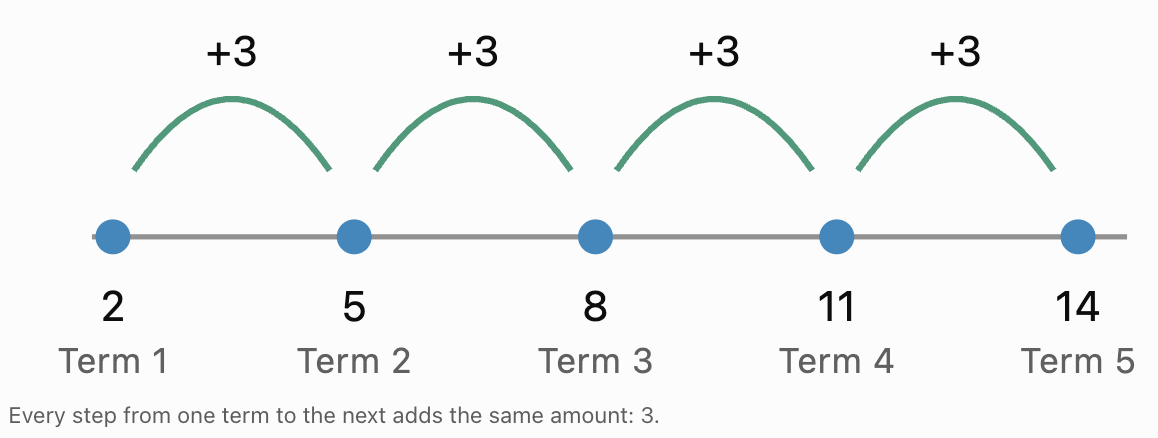
The terms are equally spaced in value.
This equal spacing is an important characteristic of arithmetic sequences.
Finding the Common Difference
The common difference is calculated by subtracting one term from the next.
d = next term − previous term
Using mathematical notation:
d = a₂ − a₁
For an arithmetic sequence, this same difference applies between every pair of consecutive terms.
Worked Example: Positive Common Difference
Find the common difference of:
7, 12, 17, 22, 27, ...
Step 1: Subtract Consecutive Terms
12 − 7 = 5
17 − 12 = 5
22 − 17 = 5
Step 2: Identify the Common Difference
Every difference is 5.
d = 5
Interpretation
The sequence increases by 5 with each new term.
Worked Example: Negative Common Difference
Find the common difference of:
50, 43, 36, 29, 22, ...
Step 1: Subtract Consecutive Terms
43 − 50 = −7
36 − 43 = −7
29 − 36 = −7
Step 2: Identify the Common Difference
d = −7
Interpretation
The sequence decreases by 7 with each new term.
Important Observation
A negative common difference means the sequence is decreasing.
The rule can be described as either:
"Add −7 each time."
or:
"Subtract 7 each time."
Both descriptions are mathematically equivalent.
Arithmetic Sequences with Decimals
Arithmetic sequences may contain decimal values.
Worked Example
Consider:
1.5, 2.0, 2.5, 3.0, 3.5, ...
Calculate the difference:
2.0 − 1.5 = 0.5
2.5 − 2.0 = 0.5
3.0 − 2.5 = 0.5
Therefore:
d = 0.5
The sequence increases by 0.5 each time.
Arithmetic Sequences with Fractions
Fractions can also form arithmetic sequences.
Worked Example
Consider:
1/4, 1/2, 3/4, 1, 5/4, ...
Calculate:
1/2 − 1/4 = 1/4
3/4 − 1/2 = 1/4
1 − 3/4 = 1/4
Therefore:
d = 1/4
Each term increases by one quarter.
Increasing, Decreasing, and Constant Sequences
The sign of the common difference determines the behaviour of an arithmetic sequence.
|
Common difference |
Behaviour |
Example |
|---|---|---|
|
d > 0 |
Increasing |
2, 6, 10, 14, ... |
|
d < 0 |
Decreasing |
20, 17, 14, 11, ... |
|
d = 0 |
Constant |
5, 5, 5, 5, ... |
Increasing Sequences
An arithmetic sequence increases when the common difference is positive.
Example:
4, 10, 16, 22, ...
d = 6
Decreasing Sequences
An arithmetic sequence decreases when the common difference is negative.
Example:
18, 13, 8, 3, ...
d = −5
Constant Sequences
A constant sequence contains the same value in every position.
Example:
7, 7, 7, 7, ...
d = 0
This is still an arithmetic sequence because the difference between consecutive terms is always zero.
Determining Whether a Sequence Is Arithmetic
Not every number sequence is arithmetic.
To determine whether a sequence is arithmetic, calculate the differences between consecutive terms.
If all differences are equal, the sequence is arithmetic.
If the differences are not equal, the sequence is not arithmetic.
Worked Example: Arithmetic Sequence
Determine whether the following sequence is arithmetic:
6, 11, 16, 21, 26
Step 1: Calculate Differences
11 − 6 = 5
16 − 11 = 5
21 − 16 = 5
26 − 21 = 5
Step 2: Compare
All differences are equal.
Conclusion
The sequence is arithmetic, with d = 5.
Worked Example: Non-Arithmetic Sequence
Determine whether the following sequence is arithmetic:
2, 4, 8, 16, 32
Step 1: Calculate Differences
4 − 2 = 2
8 − 4 = 4
16 − 8 = 8
32 − 16 = 16
Step 2: Compare
The differences are:
2, 4, 8, 16
They are not constant.
Conclusion
The sequence is not arithmetic.
Important Observation
Although the sequence follows a clear pattern, it is not arithmetic.
Each term is multiplied by 2 rather than increased by a constant amount.
This is an example of a geometric sequence.
Worked Example: An Irregular Sequence
Consider:
3, 8, 13, 19, 23
The differences are:
5, 5, 6, 4
Since the differences are not equal:
The sequence is not arithmetic.
A sequence must have a constant difference throughout the given terms to be arithmetic.
Arithmetic Versus Geometric Sequences
Arithmetic and geometric sequences both follow predictable patterns, but they use different rules.
|
Property |
Arithmetic sequence |
Geometric sequence |
|---|---|---|
|
Pattern |
Add a constant |
Multiply by a constant |
|
Main relationship |
Constant difference |
Constant ratio |
|
Example |
3, 6, 9, 12, ... |
3, 6, 12, 24, ... |
|
Change between terms |
+3 |
×2 |
|
Typical behaviour |
Linear |
Exponential |
Example
Sequence A:
5, 10, 15, 20, ...
The differences are:
5, 5, 5
Therefore, Sequence A is arithmetic.
Sequence B:
5, 10, 20, 40, ...
The differences are:
5, 10, 20
The differences are not constant.
However, each term is multiplied by 2.
Therefore, Sequence B is geometric rather than arithmetic.
Why This Matters
Recognising the correct type of sequence allows us to select the appropriate mathematical rule.
Generating Terms in an Arithmetic Sequence
Once the first term and common difference are known, additional terms can be generated.
The recursive relationship is:
Next term = previous term + common difference
In symbols:
aₙ = aₙ₋₁ + d, for n ≥ 2.
Worked Example: Generating an Increasing Sequence
Given:
First term = 4
Common difference = 6
Generate the first six terms.
Step 1: Write the First Term
a₁ = 4
Step 2: Add the Common Difference
a₂ = 4 + 6 = 10
a₃ = 10 + 6 = 16
a₄ = 16 + 6 = 22
a₅ = 22 + 6 = 28
a₆ = 28 + 6 = 34
Final Answer
4, 10, 16, 22, 28, 34
Worked Example: Generating a Decreasing Sequence
Given:
First term = 25
Common difference = −4
Generate the first seven terms.
Step 1: Start with 25
a₁ = 25
Step 2: Add −4 Repeatedly
a₂ = 25 − 4 = 21
a₃ = 21 − 4 = 17
a₄ = 17 − 4 = 13
a₅ = 13 − 4 = 9
a₆ = 9 − 4 = 5
a₇ = 5 − 4 = 1
Final Answer
25, 21, 17, 13, 9, 5, 1
Important Observation
The same common difference is applied at every step.
It does not matter whether the sequence is increasing or decreasing.
Finding Missing Terms
Sometimes an arithmetic sequence contains missing values.
These can be found using the common difference.
Worked Example: One Missing Term
Find the missing number:
4, 9, __, 19, 24
Step 1: Determine the Common Difference
9 − 4 = 5
Step 2: Add the Common Difference
9 + 5 = 14
Final Answer
4, 9, 14, 19, 24
Worked Example: Multiple Missing Terms
Find the missing values:
30, __, __, 12, 6
Step 1: Identify the Known Difference
12 − 6 = 6
Since the sequence is decreasing from left to right:
d = −6
Step 2: Work Backwards
The term before 12 is:
12 + 6 = 18
The term before 18 is:
18 + 6 = 24
Final Answer
30, 24, 18, 12, 6
Worked Example: Finding a Common Difference from Non-Consecutive Terms
An arithmetic sequence has:
First term = 5
Fourth term = 20
Find the common difference.
Step 1: Count the Intervals
From the first term to the fourth term, there are three equal steps.
Step 2: Calculate the Total Change
20 − 5 = 15
Step 3: Divide by the Number of Steps
d = 15/3
d = 5
Step 4: Generate the Sequence
5, 10, 15, 20, ...
Verification
Each term increases by 5.
Describing Arithmetic Patterns Mathematically
Arithmetic sequences can be described using words, tables, recursive rules, and formulas.
Consider:
7, 11, 15, 19, 23, ...
Verbal Description
"Start at 7 and add 4 each time."
Mathematical Description
First term:
a₁ = 7
Common difference:
d = 4
Recursive Rule
a₁ = 7
aₙ = aₙ₋₁ + 4, for n ≥ 2
Table of Values
|
Term number |
Term value (aₙ) |
|---|---|
|
1 |
7 |
|
2 |
11 |
|
3 |
15 |
|
4 |
19 |
|
5 |
23 |
|
6 |
27 |
Each representation communicates the same arithmetic pattern.
Writing an Explicit Rule
Repeated addition is useful for finding nearby terms.
However, finding a distant term by repeatedly adding can be inefficient.
An explicit rule allows us to calculate any term directly.
For an arithmetic sequence:
aₙ = a₁ + (n − 1)d
where:
-
aₙ = the term in position n.
-
a₁ = the first term.
-
n = the term number.
-
d = the common difference.
Why We Use n − 1
The first term requires zero additions of the common difference.
The second term requires one addition.
The third term requires two additions.
The fourth term requires three additions.
Therefore, the term in position n requires:
n − 1 additions
This explains the structure of the formula.
Worked Example: Finding the Tenth Term
Consider:
3, 7, 11, 15, ...
Find the tenth term.
Step 1: Identify the Values
a₁ = 3
d = 4
n = 10
Step 2: Substitute
a₁₀ = 3 + (10 − 1)(4)
Step 3: Simplify
a₁₀ = 3 + 9(4)
a₁₀ = 3 + 36
Final Answer
a₁₀ = 39
Verification
The sequence increases by 4.
There are nine intervals from the first term to the tenth term.
9 × 4 = 36
3 + 36 = 39
The result is correct.
Worked Example: Finding a Term in a Decreasing Sequence
Consider:
40, 35, 30, 25, ...
Find the eighth term.
Step 1: Identify the Values
a₁ = 40
d = −5
n = 8
Step 2: Substitute
a₈ = 40 + (8 − 1)(−5)
Step 3: Simplify
a₈ = 40 + 7(−5)
a₈ = 40 − 35
Final Answer
a₈ = 5
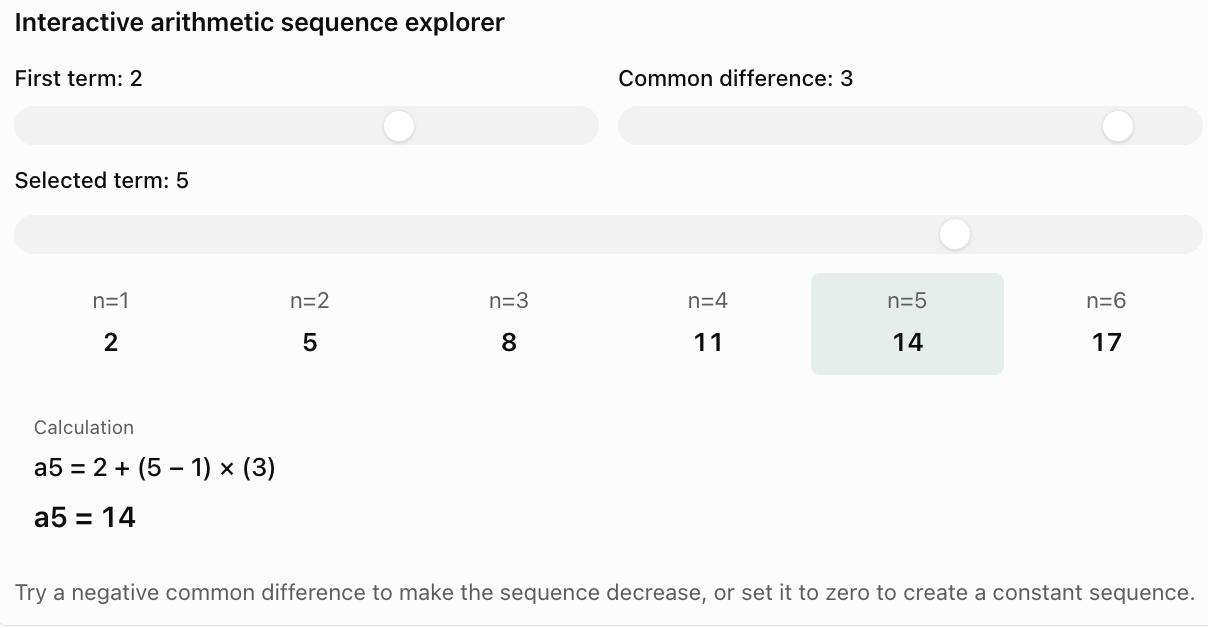
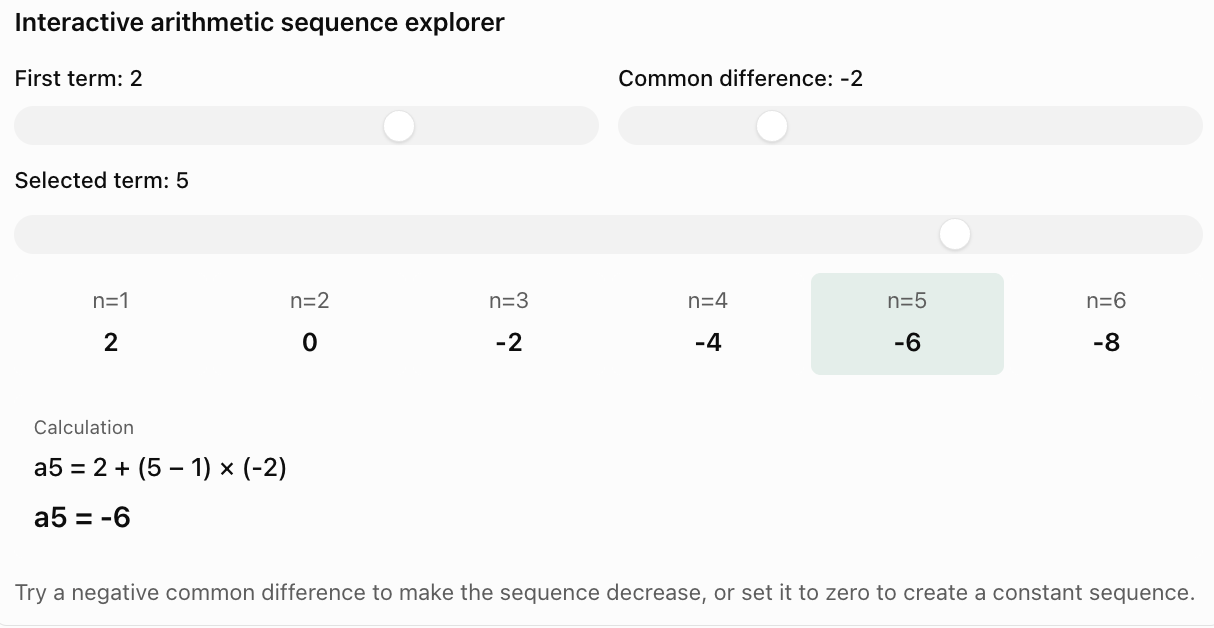
Exploring Arithmetic Sequences
Changing the first term moves the entire sequence up or down. Changing the common difference changes how quickly the terms increase or decrease.
Arithmetic Sequences and Linear Relationships
Arithmetic sequences are closely related to linear functions.
Consider:
4, 7, 10, 13, 16, ...
The term number increases by 1 each time.
The term value increases by 3 each time.
This creates a constant rate of change.
Table of Values
|
Term number |
Term value |
|---|---|
|
1 |
4 |
|
2 |
7 |
|
3 |
10 |
|
4 |
13 |
|
5 |
16 |
The explicit rule is:
aₙ = 4 + (n − 1)(3)
Simplifying:
aₙ = 4 + 3n − 3
aₙ = 3n + 1
This resembles the equation of a straight line:
y = mx + b
The common difference corresponds to the slope.
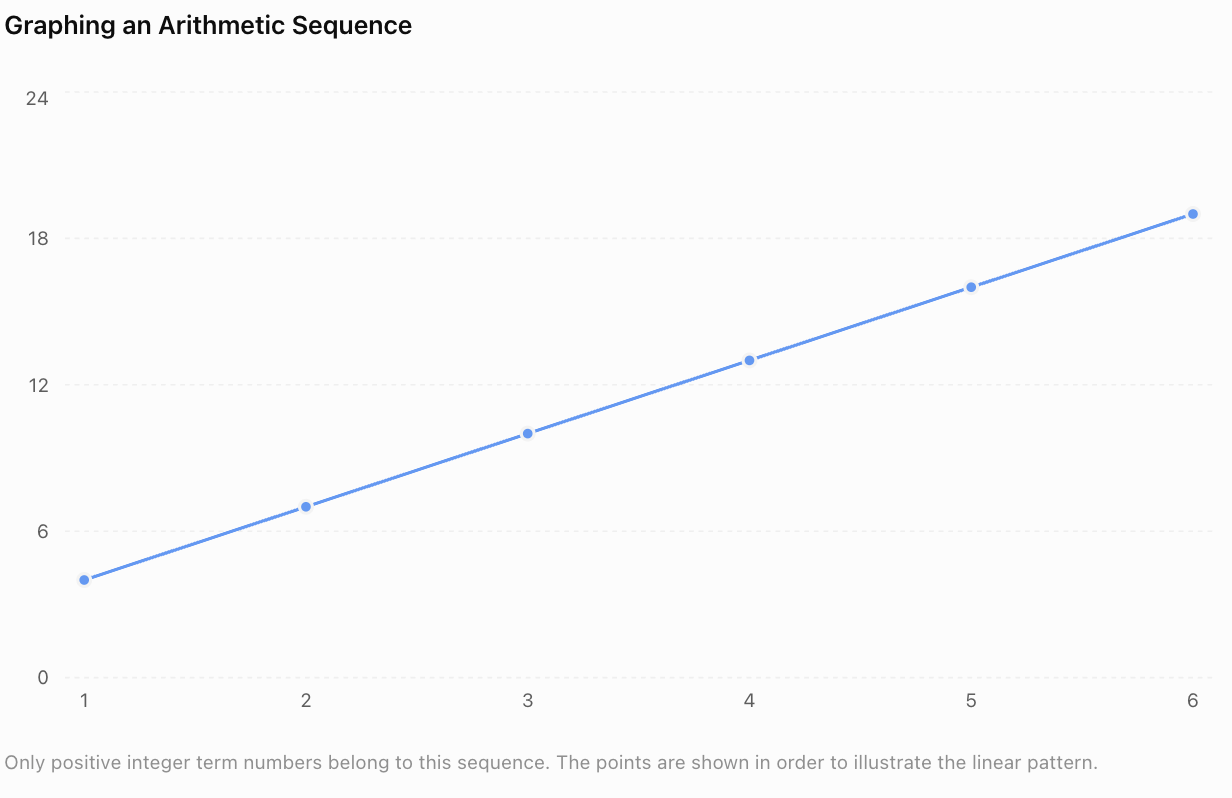
The term values follow a linear pattern.
When graphing an arithmetic sequence, only whole-number term positions are included.
Therefore, the graph consists of discrete points rather than a continuous line.
Important Connection
Arithmetic sequences are discrete linear relationships.
This means their values change at a constant rate, but the input positions are whole numbers.
Real-World Application: Saving Money
Arithmetic sequences can describe savings that increase by the same amount each week.
Worked Example
A student has $20 saved at the end of Week 1.
The student saves an additional $15 each week.
The amount saved at the end of each week forms the sequence:
20, 35, 50, 65, 80, ...
Step 1: Identify the First Term
a₁ = 20
Step 2: Identify the Common Difference
d = 15
Step 3: Generate the Next Terms
Week 1: $20
Week 2: $35
Week 3: $50
Week 4: $65
Week 5: $80
Step 4: Write the Rule
aₙ = 20 + (n − 1)(15)
Interpretation
The student's savings balance increases by $15 each week, assuming no withdrawals or interest.

Real-World Application: Theatre Seating
Rows of seats in theatres may increase by a fixed number from one row to the next.
Worked Example
A theatre has:
12 seats in the first row.
15 seats in the second row.
18 seats in the third row.
21 seats in the fourth row.
Step 1: Identify the Pattern
12, 15, 18, 21, ...
Step 2: Calculate the Common Difference
15 − 12 = 3
18 − 15 = 3
21 − 18 = 3
Therefore:
d = 3
Step 3: Find the Number of Seats in Row 8
a₈ = 12 + (8 − 1)(3)
a₈ = 12 + 21
a₈ = 33
Interpretation
The eighth row contains 33 seats.
Real-World Application: Temperature Changes
A temperature that changes by the same amount each hour can be modelled using an arithmetic sequence.
Worked Example
The temperature is 18°C at the first recorded hour.
It decreases by 2°C each hour.
The sequence is:
18, 16, 14, 12, 10, ...
Step 1: Identify the First Term
a₁ = 18
Step 2: Identify the Common Difference
d = −2
Step 3: Find the Sixth Recorded Temperature
a₆ = 18 + (6 − 1)(−2)
a₆ = 18 − 10
a₆ = 8°C
Interpretation
At the sixth recorded hour, the temperature would be 8°C if the same rate of change continued.
Important Observation
Real temperatures do not usually change by exactly the same amount every hour.
Arithmetic sequences can model regular changes, but real-world patterns may only be approximately arithmetic.
Real-World Application: Exercise and Training
An exercise plan may increase the number of repetitions by a fixed amount each session.
Worked Example
A student completes:
10 repetitions in Session 1.
13 repetitions in Session 2.
16 repetitions in Session 3.
19 repetitions in Session 4.
Step 1: Identify the Common Difference
d = 3
Step 2: Generate the Next Terms
Session 5: 22 repetitions.
Session 6: 25 repetitions.
Session 7: 28 repetitions.
Step 3: Describe the Pattern
The student increases the number of repetitions by 3 each session.
Important Observation
This mathematical model describes the pattern, but it does not establish that continuing the increases indefinitely would be appropriate or safe.
Real-World Application: Building Staircases
Staircases can illustrate arithmetic sequences when each step rises by the same vertical height.
Worked Example
Each stair has a vertical rise of 18 cm.
The heights above the floor after each step are:
18, 36, 54, 72, 90, ...
Step 1: Identify the First Term
a₁ = 18 cm
Step 2: Identify the Common Difference
d = 18 cm
Step 3: Find the Height After 12 Steps
a₁₂ = 18 + (12 − 1)(18)
a₁₂ = 18 + 198
a₁₂ = 216 cm
Interpretation
The top of the twelfth step is 216 cm above the starting floor level.


Comparing Arithmetic Patterns
Arithmetic sequences can have different starting values and common differences.
Consider three sequences.
Sequence A:
2, 5, 8, 11, 14, ...
d = 3
Sequence B:
10, 13, 16, 19, 22, ...
d = 3
Sequence C:
2, 7, 12, 17, 22, ...
d = 5
Comparing A and B
Sequences A and B have the same common difference.
They increase at the same rate.
However, Sequence B begins 8 units higher.
Comparing A and C
Sequences A and C have the same first term.
However, Sequence C has a larger common difference.
Therefore, Sequence C increases more quickly.
Mathematical Interpretation
The first term determines where the sequence begins.
The common difference determines how rapidly the terms change.
These are the two main characteristics of an arithmetic sequence.
Solving Multi-Step Arithmetic Sequence Problems
Some problems require finding the common difference before calculating a particular term.
Worked Example
An arithmetic sequence has:
Third term = 14
Seventh term = 30
Find the common difference and first term.
Step 1: Determine the Number of Intervals
From the third term to the seventh term:
7 − 3 = 4 intervals
Step 2: Calculate the Total Change
30 − 14 = 16
Step 3: Find the Common Difference
d = 16/4
d = 4
Step 4: Work Backwards to the First Term
Third term = 14
Second term = 14 − 4 = 10
First term = 10 − 4 = 6
Therefore:
a₁ = 6
Step 5: Verify
Sequence:
6, 10, 14, 18, 22, 26, 30
The third term is 14.
The seventh term is 30.
Both conditions are satisfied.
Worked Example: Finding the Term Position
Consider:
5, 9, 13, 17, ...
Which term is equal to 45?
Step 1: Identify the Values
a₁ = 5
d = 4
aₙ = 45
Step 2: Substitute into the Formula
45 = 5 + (n − 1)(4)
Step 3: Rearrange
40 = 4(n − 1)
10 = n − 1
Step 4: Solve
n = 11
Interpretation
45 is the eleventh term.
Verification
a₁₁ = 5 + (11 − 1)(4)
a₁₁ = 5 + 40
a₁₁ = 45
The answer is correct.
A Systematic Method for Arithmetic Sequences
When solving arithmetic sequence problems, follow these steps.
Identify the Terms
Write the given terms in order.
Calculate the Differences
Subtract each term from the following term.
Check for a Constant Difference
Determine whether all consecutive differences are equal.
Identify the First Term
Record the starting value, a₁.
Identify the Common Difference
Record d, including its sign.
Choose a Method
Use repeated addition for nearby terms.
Use the explicit formula for distant terms.
Calculate
Substitute carefully and perform the required operations.
Verify
Check that the calculated terms follow the same pattern.
Interpret
Explain what the answer represents in the original problem.
Common Mistakes
Confusing the common difference with the first term
The first term is the starting value, while the common difference describes the change between terms.
Subtracting in the wrong order
Calculate the next term minus the previous term.
Assuming all arithmetic sequences increase
Arithmetic sequences may increase, decrease, or remain constant.
Confusing addition with multiplication
Arithmetic sequences involve repeated addition, not repeated multiplication.
Assuming a pattern is arithmetic without checking
A sequence can follow a pattern without having a constant difference.
Ignoring negative common differences
A decreasing sequence usually has a negative common difference.
Confusing the term number with the term value
The position n is not necessarily equal to the value aₙ.
Using n instead of n − 1
The first term requires zero additions of the common difference.
Making errors with negative numbers
Adding a negative common difference decreases the sequence.
Assuming the first term must be positive
Arithmetic sequences may begin with negative numbers or zero.
Assuming the common difference must be a whole number
Fractions and decimals can also be common differences.
Failing to verify missing terms
All consecutive differences should remain equal.
Assuming real-world patterns remain arithmetic forever
Mathematical models may only be valid over a limited range.
Key Terms
-
Sequence: An ordered list of numbers or mathematical objects.
-
Term: An individual value in a sequence.
-
Term Number: The position of a term in a sequence.
-
Arithmetic Sequence: A sequence with a constant difference between consecutive terms.
-
Common Difference: The constant amount added to each term to obtain the next term.
-
First Term: The initial value of a sequence, represented by a₁.
-
Nth Term: The value of the sequence at position n, represented by aₙ.
-
Consecutive Terms: Terms that appear next to one another in a sequence.
-
Constant Difference: An equal numerical change between every pair of consecutive terms.
-
Increasing Sequence: A sequence whose terms become larger.
-
Decreasing Sequence: A sequence whose terms become smaller.
-
Constant Sequence: A sequence in which every term has the same value.
-
Finite Sequence: A sequence containing a specified number of terms.
-
Infinite Sequence: A sequence that continues indefinitely.
-
Ellipsis: Three dots indicating that a pattern continues.
-
Recursive Rule: A rule that defines each term using a previous term.
-
Explicit Rule: A formula that calculates a term directly from its position.
-
Linear Relationship: A relationship with a constant rate of change.
-
Discrete Relationship: A relationship defined at separate values rather than every value in an interval.
-
Rate of Change: The amount by which one quantity changes relative to another.
-
Slope: A measure of the rate of change in a linear relationship.
-
Pattern Recognition: Identifying a consistent rule or relationship.
-
Arithmetic Pattern: A numerical pattern involving repeated addition of a constant.
-
Geometric Sequence: A sequence in which consecutive terms have a constant multiplicative ratio.
-
Mathematical Model: A mathematical representation of a real-world situation.
-
Proportional Reasoning: Using numerical relationships to solve problems.
-
Verification: Checking that a result satisfies the original conditions.
Key Takeaways
-
An arithmetic sequence is a sequence with a constant difference between consecutive terms.
-
The individual values in a sequence are called terms.
-
The position of a term is represented by n.
-
The value of the term at position n is represented by aₙ.
-
The first term is represented by a₁.
-
The common difference is represented by d.
-
The common difference is found by subtracting a term from the following term.
-
A positive common difference produces an increasing sequence.
-
A negative common difference produces a decreasing sequence.
-
A common difference of zero produces a constant sequence.
-
Arithmetic sequences can contain integers, fractions, decimals, and negative numbers.
-
A sequence is arithmetic only when all consecutive differences are equal.
-
Arithmetic sequences are generated by repeatedly adding the common difference.
-
A recursive rule uses a previous term to calculate the next term.
-
An explicit rule calculates a term directly from its position.
-
The nth-term formula is aₙ = a₁ + (n − 1)d.
-
The expression n − 1 represents the number of intervals from the first term to the nth term.
-
Arithmetic sequences are closely related to linear functions.
-
The common difference corresponds to the slope of the associated linear relationship.
-
Arithmetic sequences are represented by discrete points when graphed.
-
Real-world arithmetic patterns may describe savings, seating arrangements, temperatures, and repeated measurements.
-
The central skill is identifying the constant difference, using it to generate terms, and describing the pattern clearly using mathematical language.
Check Your Understanding
Recall and Understanding
-
Define an arithmetic sequence.
-
Explain what is meant by the common difference.
-
Describe the difference between an increasing and decreasing arithmetic sequence.
-
Explain why the sequence 7, 7, 7, 7, ... is arithmetic.
-
Explain how an arithmetic sequence differs from a geometric sequence.
Application
-
Find the common difference of the sequence: 4, 11, 18, 25, 32, ...
-
Determine whether the sequence 3, 6, 12, 24, 48 is arithmetic. Justify your answer.
-
Generate the first six terms of an arithmetic sequence with a₁ = 8 and d = 5.
-
Find the missing values: 6, __, 18, __, 30.
-
Determine the tenth term of the arithmetic sequence 2, 7, 12, 17, ...
Analysis and Challenge
-
An arithmetic sequence has a₁ = 40 and d = −3. Find the fifteenth term.
-
The third term of an arithmetic sequence is 17, and the seventh term is 37. Determine the common difference and first term.
-
A theatre has 14 seats in its first row. Each following row contains 3 more seats than the previous row. How many seats are in the twelfth row?
-
A student begins with $50 and adds $12 to their savings each week. If $50 is the balance at the end of Week 1, how much will the student have at the end of Week 15?
-
The sequence 9, 15, 21, 27, ... contains the value 105. Determine which term equals 105 and show your reasoning.
Final Summary
Arithmetic sequences describe numerical patterns in which consecutive terms differ by a constant amount.
The common difference determines whether a sequence increases, decreases, or remains constant.
By identifying the first term and common difference, we can generate additional terms, complete missing values, and describe patterns mathematically.
Arithmetic sequences can be represented using verbal rules, tables, recursive relationships, explicit formulas, and graphs.
Their constant rate of change connects them directly to linear relationships.
They also provide useful models for everyday situations involving regular increases or decreases in quantities.
The central principle is that every arithmetic sequence follows a constant additive pattern, allowing its terms to be predicted, calculated, and explained using mathematical reasoning.
2. The nth Term Formula
Learning outcomes
- I can explain the purpose of an nth term formula.
- I can determine the nth term formula for an arithmetic sequence.
- I can use the nth term formula to find specific terms.
- I can predict distant terms without listing the entire sequence.
- I can verify whether a formula correctly describes a sequence.
The nth Term Formula
Introduction
A sequence is an ordered list of numbers that follows a particular pattern or rule.
For example:
3, 7, 11, 15, 19, ...
Each term is 4 greater than the previous term.
We can continue the sequence by repeatedly adding 4, but what if we want to find the 50th term, the 100th term, or the 1,000th term?
Writing out every term would be inefficient.
Instead, we can use an nth term formula, which allows us to calculate any term directly from its position in the sequence.
For the sequence above, the nth term formula is:
aₙ = 4n − 1
To find the 100th term:
a₁₀₀ = 4(100) − 1
a₁₀₀ = 399
Therefore, the 100th term is 399.
The nth term formula is an important tool in algebra because it connects number patterns, arithmetic sequences, linear relationships, and mathematical modelling.


What Is a Sequence?
A sequence is an ordered list of numbers called terms.
Each term occupies a particular position.
Consider:
5, 9, 13, 17, 21, ...
|
Term number |
Term value |
|---|---|
|
1 |
5 |
|
2 |
9 |
|
3 |
13 |
|
4 |
17 |
|
5 |
21 |
The position of a term is represented by n.
The value of the term is represented by aₙ.
For example:
-
a₁ = 5 means the first term is 5.
-
a₂ = 9 means the second term is 9.
-
a₃ = 13 means the third term is 13.
-
a₅ = 21 means the fifth term is 21.
The subscript identifies the position of the term. It does not mean multiplication.
For example, a₅ means the fifth term, not a × 5.
Finite and Infinite Sequences
A finite sequence has a limited number of terms.
Example:
2, 4, 6, 8, 10
An infinite sequence continues indefinitely.
Example:
2, 4, 6, 8, 10, ...
The three dots indicate that the pattern continues.
What Is an Arithmetic Sequence?
An arithmetic sequence is a sequence in which the difference between consecutive terms is constant.
This fixed difference is called the common difference.
Example
Consider:
4, 10, 16, 22, 28, ...
Find the differences:
10 − 4 = 6
16 − 10 = 6
22 − 16 = 6
28 − 22 = 6
Every difference is 6.
Therefore, this is an arithmetic sequence with:
-
First term: a₁ = 4.
-
Common difference: d = 6.
Another Example
Consider:
20, 16, 12, 8, 4, ...
The common difference is:
d = 16 − 20 = −4
This is also an arithmetic sequence.
The negative common difference means that the terms decrease.
Important Observation
An arithmetic sequence may:
-
Increase when d > 0.
-
Decrease when d < 0.
-
Remain constant when d = 0.
The common difference can be positive, negative, or zero.
Understanding the Purpose of an nth Term Formula
The nth term formula provides a direct rule for calculating a term from its position.
Instead of finding all previous terms, we substitute the required term number into the formula.
Example
Consider:
7, 12, 17, 22, 27, ...
The first term is 7.
The common difference is 5.
The nth term formula is:
aₙ = 5n + 2
To find the 30th term:
a₃₀ = 5(30) + 2
= 150 + 2
= 152
To find the 200th term:
a₂₀₀ = 5(200) + 2
= 1,000 + 2
= 1,002
We do not need to list the first 199 terms.
Why Is This Useful?
An nth term formula helps us:
-
Find specific terms quickly.
-
Predict distant terms.
-
Describe number patterns algebraically.
-
Compare different sequences.
-
Determine whether a number belongs to a sequence.
-
Solve real-world problems involving regular increases or decreases.
-
Connect sequences to linear functions.
The nth Term Formula for an Arithmetic Sequence
For an arithmetic sequence, the nth term is calculated from the first term, common difference, and term position.
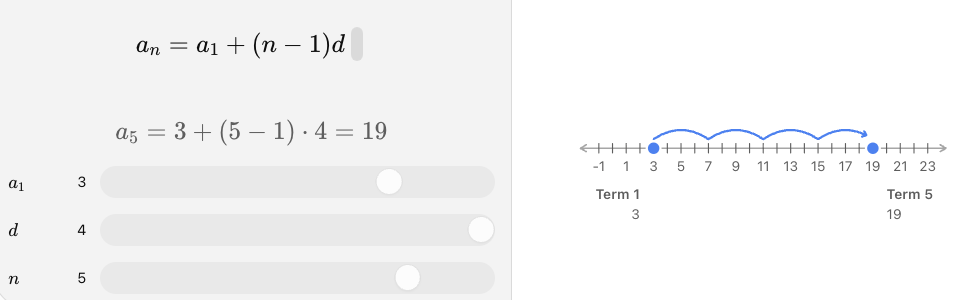
Here:
-
aₙ represents the nth term.
-
a₁ represents the first term.
-
n represents the term number.
-
d represents the common difference.
Why Do We Use n − 1?
Consider the sequence:
3, 7, 11, 15, 19, ...
The first term is 3.
To reach the second term, we add 4 once.
To reach the third term, we add 4 twice.
To reach the fourth term, we add 4 three times.
|
Position |
Calculation |
Term |
|---|---|---|
|
1 |
3 + 0(4) |
3 |
|
2 |
3 + 1(4) |
7 |
|
3 |
3 + 2(4) |
11 |
|
4 |
3 + 3(4) |
15 |
|
5 |
3 + 4(4) |
19 |
To reach term n from term 1, we make n − 1 additions.
That is why the formula uses n − 1, rather than n.
Deriving the nth Term Formula
We can derive the formula by examining the structure of an arithmetic sequence.
Suppose the first term is a₁ and the common difference is d.
The first few terms are:
a₁ = a₁
a₂ = a₁ + d
a₃ = a₁ + 2d
a₄ = a₁ + 3d
a₅ = a₁ + 4d
Notice the pattern:
The number of common differences added is always one less than the term number.
Therefore:
aₙ = a₁ + (n − 1)d
This is called an explicit formula because it calculates a term directly from n.
Recursive Formula Compared with Explicit Formula
A recursive rule describes how to get the next term from the previous term.
For example:
a₁ = 3
aₙ = aₙ₋₁ + 4, for n ≥ 2
This tells us to add 4 each time.
The explicit formula is:
aₙ = 4n − 1
This allows us to calculate any term directly.
Both rules describe the same sequence, but the explicit formula is more efficient for finding distant terms.
Finding the nth Term Formula from a Sequence
Worked Example
Find the nth term formula for:
5, 9, 13, 17, 21, ...
Step 1: Identify the First Term
a₁ = 5
Step 2: Find the Common Difference
d = 9 − 5
d = 4
Step 3: Substitute into the Formula
aₙ = a₁ + (n − 1)d
aₙ = 5 + (n − 1)(4)
Step 4: Expand
aₙ = 5 + 4n − 4
Step 5: Simplify
aₙ = 4n + 1
Step 6: Verify
For n = 1:
a₁ = 4(1) + 1 = 5
For n = 2:
a₂ = 4(2) + 1 = 9
For n = 3:
a₃ = 4(3) + 1 = 13
The formula produces the correct terms.
A Shortcut for Finding the nth Term
Arithmetic sequences can also be written in the form:
aₙ = dn + c
where:
-
d is the common difference.
-
c is a constant.
To find c, use the first term:
a₁ = d + c
Therefore:
c = a₁ − d
Example
Find the nth term formula for:
8, 13, 18, 23, ...
The common difference is 5.
Begin with:
aₙ = 5n + c
Substitute n = 1 and a₁ = 8:
8 = 5(1) + c
8 = 5 + c
c = 3
Therefore:
aₙ = 5n + 3
Verification
n = 1 → 8
n = 2 → 13
n = 3 → 18
n = 4 → 23
The formula is correct.
Important Distinction
The common difference is the coefficient of n in the simplified nth term formula.
However, the constant term is not usually the first term.
For example:
aₙ = 5n + 3
has first term 8, not 3.
Finding the nth Term of a Decreasing Sequence
An arithmetic sequence may decrease instead of increase.
Worked Example
Find the nth term formula for:
30, 25, 20, 15, 10, ...
Step 1: Identify the First Term
a₁ = 30
Step 2: Find the Common Difference
d = 25 − 30
d = −5
Step 3: Substitute
aₙ = 30 + (n − 1)(−5)
Step 4: Simplify
aₙ = 30 − 5n + 5
aₙ = 35 − 5n
Verification
a₁ = 35 − 5 = 30
a₂ = 35 − 10 = 25
a₃ = 35 − 15 = 20
The formula correctly describes the decreasing sequence.
Important Reminder
When a sequence decreases, the common difference is negative.
Using a positive difference would produce an incorrect formula.
Finding Specific Terms Using the nth Term Formula
Once an nth term formula is known, we can calculate any term by substituting its position.
Worked Example
The nth term formula for a sequence is:
aₙ = 6n − 4
Find the 15th term.
Substitute n = 15:
a₁₅ = 6(15) − 4
= 90 − 4
a₁₅ = 86
Another Example
A sequence has the formula:
aₙ = 50 − 3n
Find the 12th term.
a₁₂ = 50 − 3(12)
= 50 − 36
a₁₂ = 14
Finding Several Terms
For:
aₙ = 4n + 7
we can calculate:
|
Term |
Calculation |
Value |
|---|---|---|
|
a₁ |
4(1) + 7 |
11 |
|
a₅ |
4(5) + 7 |
27 |
|
a₁₀ |
4(10) + 7 |
47 |
|
a₂₅ |
4(25) + 7 |
107 |
|
a₁₀₀ |
4(100) + 7 |
407 |
The formula makes finding distant terms straightforward.
Predicting Distant Terms
One of the greatest advantages of an nth term formula is that we can predict terms far beyond those initially listed.
Worked Example
Consider:
12, 19, 26, 33, 40, ...
Find the 500th term.
Step 1: Identify the Pattern
First term:
a₁ = 12
Common difference:
d = 7
Step 2: Develop the Formula
aₙ = 12 + (n − 1)(7)
aₙ = 12 + 7n − 7
aₙ = 7n + 5
Step 3: Find the 500th Term
a₅₀₀ = 7(500) + 5
= 3,500 + 5
a₅₀₀ = 3,505
We have found the 500th term without calculating the previous 499 terms.
Another Example
A sequence begins:
1,000, 992, 984, 976, ...
Find the 100th term.
First term:
a₁ = 1,000
Common difference:
d = −8
Therefore:
aₙ = 1,000 + (n − 1)(−8)
aₙ = 1,008 − 8n
For n = 100:
a₁₀₀ = 1,008 − 800
a₁₀₀ = 208
This illustrates how the formula can predict distant terms in decreasing sequences.
Finding the Term Number from a Given Value
Sometimes we know the value of a term and want to determine its position.
Instead of substituting n, we solve an equation for n.
Worked Example
The nth term formula is:
aₙ = 5n + 3
Which term has a value of 78?
Step 1: Substitute the Given Value
78 = 5n + 3
Step 2: Subtract 3
75 = 5n
Step 3: Divide by 5
n = 15
Final Answer
78 is the 15th term.
Another Example
Consider:
aₙ = 40 − 3n
Which term has a value of 7?
7 = 40 − 3n
−33 = −3n
n = 11
Therefore:
7 is the 11th term.
Important Observation
A valid term number must be a positive integer when the sequence begins at n = 1.
A calculation producing n = 4.5 does not identify a term position.
Determining Whether a Number Belongs to a Sequence
We can use an nth term formula to check whether a particular number occurs in a sequence.
Worked Example
Does 103 belong to the sequence:
4, 10, 16, 22, ...?
Step 1: Find the nth Term Formula
a₁ = 4
d = 6
aₙ = 4 + (n − 1)(6)
aₙ = 6n − 2
Step 2: Set the Formula Equal to 103
103 = 6n − 2
105 = 6n
n = 17.5
Step 3: Interpret
Term positions must be positive integers.
Because 17.5 is not an integer:
103 is not a term in the sequence.
Check Another Number
Does 106 belong to the sequence?
106 = 6n − 2
108 = 6n
n = 18
Therefore:
106 is the 18th term.
Key Principle
To determine whether a number belongs to an arithmetic sequence:
-
Set the nth term formula equal to that number.
-
Solve for n.
-
Check whether n is a positive integer.
Finding a Formula When Two Terms Are Known
Sometimes the first few terms are not given.
Instead, we may know the values of two terms at different positions.
We can still determine the arithmetic sequence.
Worked Example
The 4th term is 17 and the 10th term is 41.
Find the nth term formula.
Step 1: Find the Common Difference
From the 4th term to the 10th term, there are:
10 − 4 = 6 intervals
The term value increases by:
41 − 17 = 24
Therefore:
d = 24/6
d = 4
Step 2: Find the First Term
Use:
a₄ = a₁ + 3d
17 = a₁ + 3(4)
17 = a₁ + 12
a₁ = 5
Step 3: Write the Formula
aₙ = 5 + (n − 1)(4)
aₙ = 4n + 1
Step 4: Verify
Fourth term:
a₄ = 4(4) + 1 = 17
Tenth term:
a₁₀ = 4(10) + 1 = 41
Both given terms are correct.
General Method
If two terms aₚ and aₛ are known, their common difference is:
d = (aₛ − aₚ)/(s − p)
Once d is known, substitute into the nth term formula to determine the first term.
Using the nth Term Formula with Negative and Fractional Values
Arithmetic sequences do not need to contain only positive integers.
They may contain negative numbers, fractions, or decimals.
Worked Example: Negative Terms
Find the nth term formula for:
−8, −3, 2, 7, 12, ...
First term:
a₁ = −8
Common difference:
d = 5
Therefore:
aₙ = −8 + (n − 1)(5)
aₙ = −8 + 5n − 5
aₙ = 5n − 13
Worked Example: Fractions
Find the nth term formula for:
1/2, 1, 3/2, 2, 5/2, ...
First term:
a₁ = 1/2
Common difference:
d = 1/2
Therefore:
aₙ = 1/2 + (n − 1)(1/2)
Simplify:
aₙ = n/2
Worked Example: Decimals
Find the nth term formula for:
1.2, 1.7, 2.2, 2.7, ...
First term:
a₁ = 1.2
Common difference:
d = 0.5
Therefore:
aₙ = 1.2 + (n − 1)(0.5)
aₙ = 1.2 + 0.5n − 0.5
aₙ = 0.5n + 0.7
Connecting the nth Term Formula to Linear Functions
Arithmetic sequences have a close connection to linear functions.
Consider:
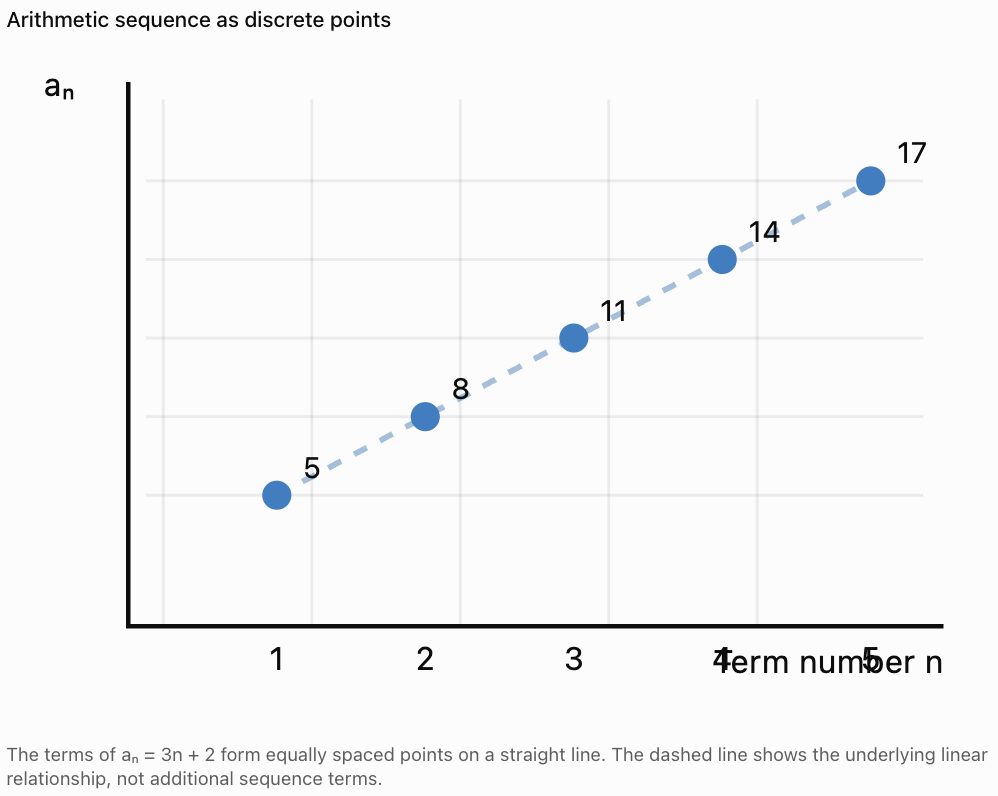
aₙ = 3n + 2
This resembles the linear equation:
y = 3x + 2
Both have a constant rate of change of 3.
The important difference is that a sequence uses positive integer term positions:
n = 1, 2, 3, 4, ...
A linear function may allow any real input.
Example
For:
aₙ = 3n + 2
|
n |
aₙ |
|---|---|
|
1 |
5 |
|
2 |
8 |
|
3 |
11 |
|
4 |
14 |
|
5 |
17 |
When plotted, the points lie on a straight line.
However, the sequence consists of discrete points, rather than every point along the line.
Connection to Slope
For an arithmetic sequence:
aₙ = dn + c
the common difference d corresponds to the slope of the underlying linear relationship.
The constant c corresponds to the value at n = 0 if the rule is extended to that position.
The first term is:
a₁ = d + c
This explains why the constant term in the simplified formula is not necessarily the first term.
Recognising Sequences That Are Not Arithmetic
Not every sequence has a constant difference.
Example
Consider:
2, 4, 8, 16, 32, ...
Find the differences:
4 − 2 = 2
8 − 4 = 4
16 − 8 = 8
32 − 16 = 16
The differences are not constant.
Therefore, this is not an arithmetic sequence.
It is a geometric sequence, in which each term is multiplied by 2.
Another Example
Consider:
1, 4, 9, 16, 25, ...
The differences are:
3, 5, 7, 9
They are not constant.
This sequence follows the formula:
aₙ = n²
It is a quadratic sequence, not an arithmetic sequence.
Important Reminder
The arithmetic nth term formula applies only when the common difference is constant.
Other types of sequences require different formulas.
Real-World Application: Stadium Seating
A small stadium has 18 seats in the first row.
Each following row contains 4 more seats than the previous row.

Step 1: Identify the Sequence
The number of seats in successive rows is:
18, 22, 26, 30, 34, ...
First term:
a₁ = 18
Common difference:
d = 4
Step 2: Find the nth Term Formula
aₙ = 18 + (n − 1)(4)
aₙ = 18 + 4n − 4
aₙ = 4n + 14
Step 3: Find the Number of Seats in Row 25
a₂₅ = 4(25) + 14
= 100 + 14
a₂₅ = 114
Therefore, row 25 contains 114 seats.
Step 4: Determine Which Row Has 154 Seats
154 = 4n + 14
140 = 4n
n = 35
Row 35 contains 154 seats.
Important Distinction
The nth term formula gives the number of seats in a particular row.
It does not give the total number of seats in all rows combined. That requires a formula for the sum of an arithmetic sequence.
Real-World Application: Weekly Savings
A student saves $15 during the first week.
Each following week, the student saves $5 more than the previous week.
The weekly savings form the sequence:
15, 20, 25, 30, 35, ...
Find the Formula
a₁ = 15
d = 5
aₙ = 15 + (n − 1)(5)
aₙ = 5n + 10
Find the Amount Saved During Week 20
a₂₀ = 5(20) + 10
a₂₀ = $110
Interpretation
The student saves $110 during week 20.
This is not the total amount saved over the first 20 weeks.
The nth term describes the amount saved in one particular week.
Real-World Application: Building a Tile Pattern
A designer creates a growing pattern using square tiles.
The first design contains 6 tiles.
Each new design adds 3 tiles.

The number of tiles forms the sequence:
6, 9, 12, 15, 18, ...
Find the nth Term
a₁ = 6
d = 3
aₙ = 6 + (n − 1)(3)
aₙ = 3n + 3
Predict the 50th Design
a₅₀ = 3(50) + 3
a₅₀ = 153
Therefore, the 50th design contains 153 tiles.
Determine the Design Number
Which design contains 303 tiles?
303 = 3n + 3
300 = 3n
n = 100
The 100th design contains 303 tiles.
This is a useful example of how a visual growing pattern can be represented by an algebraic formula.
Real-World Application: Decreasing Temperature
Suppose a controlled cooling process begins at 80°C.
The temperature decreases by 3°C every minute.
The recorded temperatures at the end of each minute are:
77, 74, 71, 68, ...
Find the nth Term Formula
The first recorded temperature is:
a₁ = 77
The common difference is:
d = −3
Therefore:
aₙ = 77 + (n − 1)(−3)
aₙ = 80 − 3n
Predict the Temperature After 15 Minutes
a₁₅ = 80 − 3(15)
= 80 − 45
a₁₅ = 35°C
Model Limitations
This formula assumes the temperature decreases by exactly 3°C every minute.
Real cooling processes often slow down as an object approaches the surrounding temperature.
Therefore, this arithmetic model is useful only while the constant-rate assumption is reasonable.
Verifying an nth Term Formula
An nth term formula should reproduce the given sequence.
Worked Example
A student claims that the sequence:
7, 11, 15, 19, ...
has the formula:
aₙ = 4n + 3
Test the formula.
For n = 1:
a₁ = 4(1) + 3 = 7
For n = 2:
a₂ = 4(2) + 3 = 11
For n = 3:
a₃ = 4(3) + 3 = 15
For n = 4:
a₄ = 4(4) + 3 = 19
The formula reproduces the listed terms.
It also has common difference 4.
Therefore, it correctly describes the arithmetic sequence.
Testing an Incorrect Formula
Suppose another student suggests:
aₙ = 4n + 7
For n = 1:
a₁ = 11
But the first term should be 7.
Therefore, the formula is incorrect.
A Reliable Verification Method
For an arithmetic sequence, check:
-
Does the formula produce the correct first term?
-
Does it produce the correct common difference?
-
Does it agree with other known terms?
For a formula of the form aₙ = dn + c, the difference between consecutive terms is d.
Therefore, verifying the first term and the common difference is sufficient to establish that the formula describes the entire arithmetic sequence.
Common Mistakes
Using n instead of n − 1
The first term requires zero additions of the common difference.
Confusing the first term with the constant term
For aₙ = 5n + 2, the first term is 7, not 2.
Using the wrong common difference
Always subtract consecutive terms in the correct order:
d = a₂ − a₁
Forgetting negative differences
A decreasing arithmetic sequence has a negative common difference.
Confusing the term number with the term value
In a₁₀ = 47, the position is 10 and the value is 47.
Assuming every sequence is arithmetic
Check that consecutive differences are constant before applying the formula.
Using a non-integer term position
For sequences indexed from n = 1, valid positions are positive integers.
Confusing a specific term with a sum
The 20th term is not the same as the sum of the first 20 terms.
Failing to verify the formula
Substitute known term positions and check that the values match.
Assuming a real-world pattern continues forever
Mathematical predictions are only as reliable as the assumptions used to construct the model.
Key Terms
-
Sequence: An ordered list of numbers following a rule or pattern.
-
Term: An individual number in a sequence.
-
Term Number: The position of a term in a sequence.
-
nth Term: The term at position n.
-
nth Term Formula: Algebraic rule used to calculate a term directly from its position.
-
Arithmetic Sequence: Sequence with a constant difference between consecutive terms.
-
Common Difference: Fixed amount added to each term to obtain the next term.
-
First Term: The term at position n = 1.
-
Explicit Formula: Formula that calculates a term directly from its position.
-
Recursive Formula: Rule that calculates a term using one or more previous terms.
-
Constant Sequence: Arithmetic sequence with common difference zero.
-
Increasing Sequence: Sequence whose terms become larger.
-
Decreasing Sequence: Sequence whose terms become smaller.
-
Term Position: Positive integer identifying a term's location.
-
Linear Relationship: Relationship with a constant rate of change.
-
Slope: Rate of change of a linear relationship.
-
Discrete Data: Values occurring at separate, specified inputs.
-
Verification: Checking that a formula produces the expected terms.
-
Prediction: Using a mathematical rule to determine an unknown term.
-
Geometric Sequence: Sequence with a constant ratio between consecutive terms.
-
Quadratic Sequence: Sequence commonly described by a second-degree formula and having constant second differences.
-
Mathematical Model: Formula or relationship representing a real-world situation.
Key Takeaways
-
An nth term formula allows any term of a sequence to be calculated directly.
-
An arithmetic sequence has a constant common difference.
-
The first term is represented by a₁.
-
The common difference is represented by d.
-
The term position is represented by n.
-
The arithmetic nth term formula is aₙ = a₁ + (n − 1)d.
-
The expression n − 1 represents the number of steps from the first term.
-
An arithmetic sequence can also be written as aₙ = dn + c.
-
In the simplified formula, the coefficient of n is the common difference.
-
A negative common difference produces a decreasing sequence.
-
The nth term formula makes distant-term predictions efficient.
-
The formula can be rearranged to find a term's position.
-
A number belongs to a sequence only if it corresponds to a valid term position.
-
Two known terms at different positions can be used to determine an arithmetic sequence.
-
Arithmetic sequences are related to linear functions, but their inputs are discrete term positions.
-
A formula can be verified by checking its first term and common difference.
-
Arithmetic nth term formulas do not apply to sequences without constant differences.
Check Your Understanding
Identifying Arithmetic Sequences
-
Find the common difference of 4, 9, 14, 19, ...
-
Find the common difference of 30, 24, 18, 12, ...
-
Is 3, 6, 12, 24, ... an arithmetic sequence?
-
Identify the first term and common difference of −5, −1, 3, 7, ...
Finding nth Term Formulas
-
Find the nth term formula for 2, 5, 8, 11, ...
-
Find the nth term formula for 7, 12, 17, 22, ...
-
Find the nth term formula for 20, 16, 12, 8, ...
-
Find the nth term formula for −3, 2, 7, 12, ...
Finding Specific Terms
-
Find the 10th term of aₙ = 4n + 3.
-
Find the 25th term of aₙ = 6n − 2.
-
Find the 50th term of aₙ = 100 − 2n.
-
Find the 100th term of 5, 12, 19, 26, ...
Finding Term Positions
-
Which term of aₙ = 3n + 4 has value 49?
-
Which term of aₙ = 5n − 2 has value 98?
-
Does 75 belong to the sequence 4, 10, 16, 22, ...?
-
Does 82 belong to the sequence 4, 10, 16, 22, ...?
Verification and Reasoning
-
Verify that aₙ = 5n + 1 describes 6, 11, 16, 21, ...
-
Explain why the arithmetic nth term formula uses n − 1.
-
The 3rd term is 14 and the 8th term is 34. Find the nth term formula.
-
Explain the difference between the 20th term and the sum of the first 20 terms.
Answer Key
|
Question |
Answer |
|---|---|
|
1 |
5 |
|
2 |
−6 |
|
3 |
No; the differences are not constant |
|
4 |
a₁ = −5, d = 4 |
|
5 |
aₙ = 3n − 1 |
|
6 |
aₙ = 5n + 2 |
|
7 |
aₙ = 24 − 4n |
|
8 |
aₙ = 5n − 8 |
|
9 |
43 |
|
10 |
148 |
|
11 |
0 |
|
12 |
698 |
|
13 |
15th term |
|
14 |
20th term |
|
15 |
No; n = 77/6 is not an integer |
|
16 |
Yes; it is the 14th term |
|
17 |
Substitution gives 6, 11, 16, 21 and common difference 5 |
|
18 |
There are n − 1 steps from the first term to the nth term |
|
19 |
aₙ = 4n + 2 |
|
20 |
The 20th term is one value; the sum combines the first 20 values |
Extended Challenge
Developing Formulas
-
Find the nth term formula for 11, 18, 25, 32, ...
-
Find the nth term formula for 50, 43, 36, 29, ...
-
Find the nth term formula for −12, −5, 2, 9, ...
-
Find the nth term formula for 1.5, 2.25, 3, 3.75, ...
-
Find the nth term formula for 3/4, 5/4, 7/4, 9/4, ...
Distant Terms
-
Find the 250th term of 6, 14, 22, 30, ...
-
Find the 1,000th term of 12, 17, 22, 27, ...
-
Find the 150th term of 500, 496, 492, 488, ...
-
Find the 75th term of aₙ = 12n − 7.
-
Find the 500th term of aₙ = 1,000 − 3n.
Term Positions
-
Which term of aₙ = 7n + 5 has value 355?
-
Does 500 belong to the sequence 8, 15, 22, 29, ...?
-
Which term of aₙ = 200 − 4n has value 60?
-
Determine whether −50 occurs in the sequence 30, 24, 18, 12, ...
-
Find the first term greater than 1,000 in the sequence 9, 17, 25, 33, ...
Finding Formulas from Given Terms
-
The 5th term is 23 and the 12th term is 58. Find the nth term formula.
-
The 3rd term is 40 and the 9th term is 16. Find the nth term formula.
-
The 10th term is 72 and the 20th term is 142. Find the nth term formula.
-
A sequence has a₇ = −2 and a₁₅ = 30. Determine a₁ and d.
-
Two arithmetic sequences have formulas aₙ = 3n + 10 and bₙ = 5n − 6. Find the term position at which they have equal values.
Real-World Applications
-
A theatre has 24 seats in its first row and 3 additional seats in each successive row. How many seats are in row 40?
-
A student saves $12 in week 1 and increases weekly savings by $4. How much is saved during week 30?
-
A staircase pattern contains 7 blocks in the first design and adds 5 blocks for each new design. Which design contains 157 blocks?
-
A machine produces 500 units on its first day and 10 fewer units on each successive day. Find the production on day 25.
-
Explain why a constant-difference model may not remain appropriate indefinitely for a real-world situation.
Final Challenge: Investigating an Arithmetic Sequence
A growing pattern begins:
13, 20, 27, 34, 41, ...
Complete the investigation.
-
Identify the first term.
-
Determine the common difference.
-
Explain why the sequence is arithmetic.
-
Write the recursive rule.
-
Write the explicit nth term formula.
-
Simplify the formula.
-
Verify the formula using the first three terms.
-
Calculate the 15th term.
-
Calculate the 50th term.
-
Calculate the 100th term.
-
Determine which term has value 153.
-
Determine whether 200 belongs to the sequence.
-
Determine whether 300 belongs to the sequence.
-
Find the first term greater than 500.
-
Write the corresponding linear equation using x and y.
-
Explain the meaning of its slope.
-
Explain why the sequence is represented by discrete points.
-
Determine the term at position n + 1.
-
Show algebraically that consecutive terms differ by 7.
-
Explain why the nth term formula is more efficient than repeatedly adding 7 when finding distant terms.
Further Investigation: Create Your Own Sequence
Create an arithmetic sequence that satisfies the following conditions:
-
The first term is negative.
-
The common difference is positive.
-
The 10th term is greater than 20.
-
The 50th term is greater than 100.
Then:
-
Write the first six terms.
-
Identify the first term and common difference.
-
Develop the nth term formula.
-
Simplify the formula.
-
Verify the first six terms.
-
Find the 25th term.
-
Find the 100th term.
-
Determine when the sequence first becomes positive.
-
Determine whether 250 belongs to your sequence.
-
Explain how the formula describes the relationship between term position and term value.
3. Graphing Arithmetic Sequences
Learning outcomes
- I can create a table of values for an arithmetic sequence.
- I can graph arithmetic sequence terms on a coordinate plane.
- I can recognize that arithmetic sequences produce linear patterns.
- I can interpret the meaning of the common difference on a graph.
- I can connect arithmetic sequences to linear relationships.
Graphing Arithmetic Sequences
Introduction
Arithmetic sequences are number patterns in which the difference between consecutive terms remains constant.
For example:
3, 7, 11, 15, 19, ...
Each term is 4 greater than the previous term.
We can represent this sequence in several ways:
-
As a list of numbers.
-
As a table of values.
-
As an nth term formula.
-
As points on a coordinate plane.
When we graph an arithmetic sequence, we discover an important mathematical relationship: the points lie on a straight line.
This happens because arithmetic sequences have a constant rate of change, just like linear functions.
However, there is an important difference. Arithmetic sequences are normally represented by separate points rather than a continuous line because term numbers are whole-number positions.
Understanding how to graph arithmetic sequences helps connect number patterns to coordinate geometry, linear equations, slope, and real-world mathematical models.


Reviewing Arithmetic Sequences
An arithmetic sequence is a sequence in which the difference between consecutive terms is constant.
Consider:
5, 8, 11, 14, 17, ...
Find the differences:
8 − 5 = 3
11 − 8 = 3
14 − 11 = 3
17 − 14 = 3
The common difference is:
d = 3
The sequence increases by 3 each time.
Important Vocabulary
-
Term: A number in a sequence.
-
Term number: The position of a term.
-
First term: The value at position n = 1.
-
Common difference: The fixed amount added to obtain the next term.
-
nth term formula: A rule for calculating the value at any term position.
The nth term formula for an arithmetic sequence is:
aₙ = a₁ + (n − 1)d
where a₁ is the first term and d is the common difference.
Creating a Table of Values
A table of values organises the positions and values of a sequence.
Consider:
4, 9, 14, 19, 24, ...
We can create the following table:
|
Term number |
Term value (aₙ) |
|---|---|
|
1 |
4 |
|
2 |
9 |
|
3 |
14 |
|
4 |
19 |
|
5 |
24 |
The first column shows the term position.
The second column shows the value at that position.
Why Are Tables Useful?
A table allows us to:
-
Organise sequence information.
-
Identify patterns.
-
Calculate coordinates for graphing.
-
Compare changes between terms.
-
Check an nth term formula.
-
Predict additional terms.
Extending the Table
Because the common difference is 5, we can continue:
|
Term number |
Term value (aₙ) |
|---|---|
|
6 |
29 |
|
7 |
34 |
|
8 |
39 |
|
9 |
44 |
|
10 |
49 |
We can now use these values to graph the sequence.
Turning a Table into Coordinates
Every row in a table of values can be written as an ordered pair.
An ordered pair has the form:
(x, y)
For arithmetic sequences:
-
x represents the term number n.
-
y represents the term value aₙ.
For the sequence:
4, 9, 14, 19, 24, ...
the coordinates are:
(1, 4)
(2, 9)
(3, 14)
(4, 19)
(5, 24)
Important Observation
The first coordinate is the term number, not the first term.
For example:
(3, 14)
means:
The third term has a value of 14.
It does not mean that the sequence begins with 3.
Graphing an Arithmetic Sequence
To graph an arithmetic sequence, plot the ordered pairs on a coordinate plane.
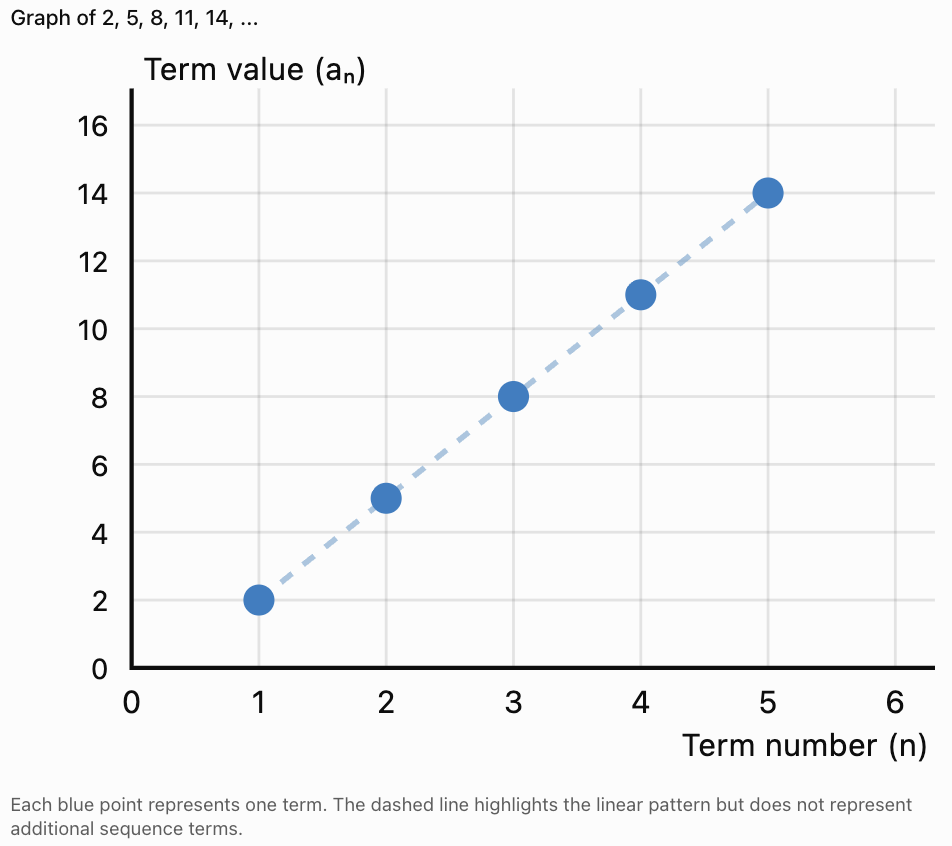
Worked Example
Graph:
2, 5, 8, 11, 14, ...
Step 1: Create a Table
|
n |
aₙ |
|---|---|
|
1 |
2 |
|
2 |
5 |
|
3 |
8 |
|
4 |
11 |
|
5 |
14 |
Step 2: Write the Coordinates
(1, 2)
(2, 5)
(3, 8)
(4, 11)
(5, 14)
Step 3: Label the Axes
-
Horizontal axis: term number n.
-
Vertical axis: term value aₙ.
Step 4: Plot the Points
Step 5: Interpret the Graph
Notice that:
-
The points rise from left to right.
-
The points lie on a straight line.
-
Each time n increases by 1, the term value increases by 3.
-
The common difference is positive.
This is the graphical pattern of an increasing arithmetic sequence.
Why Arithmetic Sequences Form Linear Patterns
Arithmetic sequences have a constant common difference.
For example:
6, 10, 14, 18, 22, ...
The common difference is 4.
Each time the term number increases by 1, the term value increases by 4.
On the graph, this means:
Horizontal change = 1
Vertical change = 4
The ratio is:
Vertical change / Horizontal change = 4/1 = 4
This is the slope of the straight line containing the sequence points.
Connection to Linear Equations
The nth term formula is:
aₙ = a₁ + (n − 1)d
Expand:
aₙ = a₁ + dn − d
Rearrange:
aₙ = dn + (a₁ − d)
Compare this with the slope-intercept form of a linear equation:
y = mx + b
We can identify:
-
Slope m = d.
-
Vertical intercept b = a₁ − d.
Therefore, an arithmetic sequence is a linear relationship restricted to positive integer inputs.
Understanding the Common Difference as Slope
The slope describes how much a graph rises or falls as we move horizontally.
For two points:
(x₁, y₁) and (x₂, y₂)
the slope is:
m = (y₂ − y₁)/(x₂ − x₁)
Worked Example
Consider the sequence:
7, 12, 17, 22, ...
Two points are:
(1, 7) and (2, 12)
Calculate the slope:
m = (12 − 7)/(2 − 1)
m = 5/1
m = 5
This is exactly the common difference.
Another Example
Use the points:
(2, 12) and (4, 22)
m = (22 − 12)/(4 − 2)
m = 10/2
m = 5
Even when the points are not consecutive, the slope remains the same.
Key Relationship
For an arithmetic sequence, the common difference equals the slope of its underlying linear relationship.
This is one of the most important connections between sequences and graphing.
Positive Common Differences
A positive common difference produces an increasing sequence.
Example
3, 8, 13, 18, 23, ...
The common difference is:
d = 5
The nth term formula is:
aₙ = 3 + (n − 1)(5)
aₙ = 5n − 2
The points are:
(1, 3), (2, 8), (3, 13), (4, 18), (5, 23)
Graph Behaviour
-
The graph rises from left to right.
-
The slope is positive.
-
The sequence values become larger.
-
A greater positive common difference produces a steeper upward line when both axes use the same scales.

Negative Common Differences
A negative common difference produces a decreasing sequence.
Worked Example
Consider:
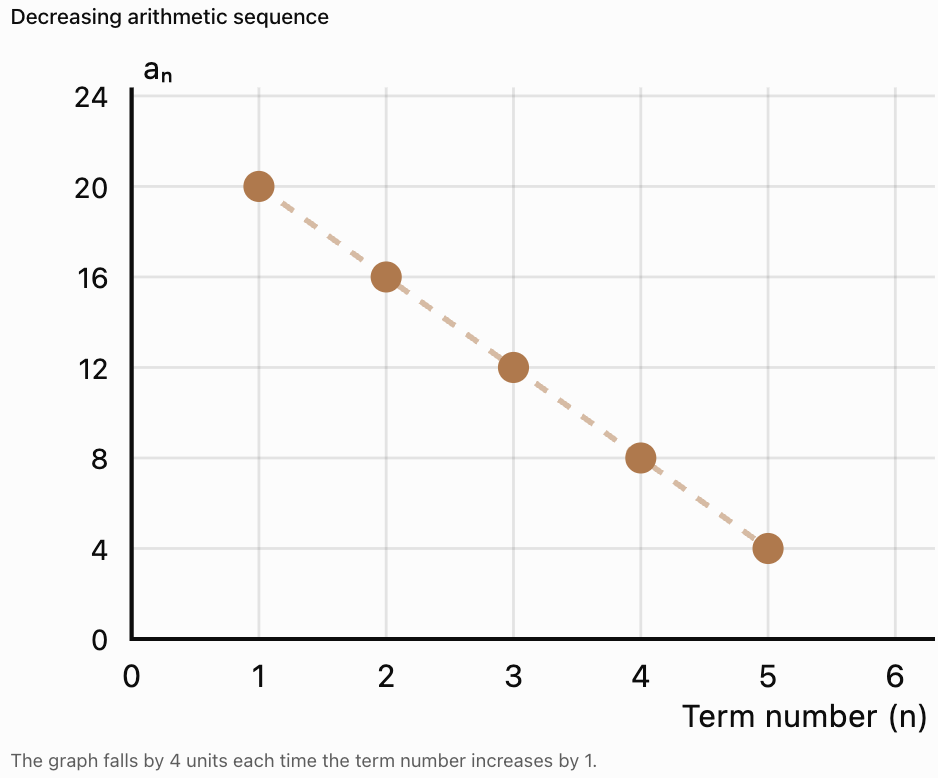
20, 16, 12, 8, 4, ...
The common difference is:
d = −4
Step 1: Create a Table
|
n |
aₙ |
|---|---|
|
1 |
20 |
|
2 |
16 |
|
3 |
12 |
|
4 |
8 |
|
5 |
4 |
Step 2: Find the nth Term Formula
aₙ = 20 + (n − 1)(−4)
aₙ = 20 − 4n + 4
aₙ = 24 − 4n
Step 3: Graph the Points
Interpretation
-
The graph falls from left to right.
-
The slope is −4.
-
Each term is 4 less than the previous term.
-
The common difference is negative.
Zero Common Difference
A sequence may have a common difference of zero.
Example
6, 6, 6, 6, 6, ...
The common difference is:
d = 0
The nth term formula is:
aₙ = 6
The points are:
(1, 6), (2, 6), (3, 6), (4, 6), (5, 6)
All points lie at the same height.
Graph Behaviour
-
The points form a horizontal pattern.
-
The slope is zero.
-
The sequence remains constant.
This is called a constant sequence.
Comparing Different Common Differences
The common difference controls the direction and steepness of the underlying linear relationship.
Consider three sequences:
|
Sequence |
nth Term Formula |
Common Difference |
|---|---|---|
|
A: 2, 4, 6, 8, ... |
aₙ = 2n |
2 |
|
B: 2, 7, 12, 17, ... |
bₙ = 5n − 3 |
5 |
|
C: 2, 0, −2, −4, ... |
cₙ = 4 − 2n |
−2 |
All three begin at 2.
However:
-
Sequence A rises by 2 each term.
-
Sequence B rises by 5 each term.
-
Sequence C falls by 2 each term.
Sequence B rises more steeply than Sequence A.
Sequence C has a negative slope.
Important Observation
Two arithmetic sequences with the same common difference have parallel underlying lines.
Two sequences with different common differences have different slopes.
Graphing from an nth Term Formula
Sometimes we are given a formula instead of a list of terms.
We can use the formula to construct a table and graph.
Worked Example
Graph the arithmetic sequence:
aₙ = 4n − 3
Step 1: Choose Term Numbers
Use:
n = 1, 2, 3, 4, 5
Step 2: Calculate Each Term
a₁ = 4(1) − 3 = 1
a₂ = 4(2) − 3 = 5
a₃ = 4(3) − 3 = 9
a₄ = 4(4) − 3 = 13
a₅ = 4(5) − 3 = 17
Step 3: Create a Table
|
n |
aₙ |
|---|---|
|
1 |
1 |
|
2 |
5 |
|
3 |
9 |
|
4 |
13 |
|
5 |
17 |
Step 4: Plot the Coordinates
(1, 1), (2, 5), (3, 9), (4, 13), (5, 17)
Step 5: Interpret
The points lie on the line:
y = 4x − 3
The slope is 4.
The common difference is also 4.
The sequence begins at n = 1, so (0, −3) is not normally included as a sequence point.
Understanding Discrete and Continuous Graphs
One of the most important differences between an arithmetic sequence and a linear function is the set of permitted inputs.
Discrete Graph
An arithmetic sequence is normally defined at positive integer positions:
n = 1, 2, 3, 4, ...
The graph contains separate points.
For example:
aₙ = 2n + 1
produces:
(1, 3), (2, 5), (3, 7), (4, 9), ...
There is no term at position n = 2.5.
Continuous Graph
A linear function such as:
y = 2x + 1
may be defined for every real x-value.
It includes points such as:
(2.5, 6)
The graph is a continuous straight line.
Discrete sequence
Only whole-number positions are included.Continuous linear function
All real inputs are included, unless restricted.Why Shouldn't We Connect Sequence Points?
Connecting the points with a solid line may suggest that positions such as 1.5 or 3.7 are valid term numbers.
For a standard arithmetic sequence, they are not.
A dashed line may be used to illustrate the underlying linear relationship, but the sequence itself consists of discrete points.
The y-Intercept and the First Term
An arithmetic sequence with formula:
aₙ = dn + c
has an underlying linear equation:
y = dx + c
The y-intercept of this line is:
(0, c)
However, the first sequence term occurs at n = 1.
Therefore:
a₁ = d + c
Worked Example
Consider:
aₙ = 3n + 4
The first term is:
a₁ = 3(1) + 4
a₁ = 7
The underlying line has y-intercept:
(0, 4)
These are not the same point.
Why Is This Important?
The y-intercept describes the value of the extended linear relationship at n = 0.
The first term describes the sequence value at n = 1.
For a sequence beginning at n = 1, the point (0, 4) is not normally part of the sequence.
Special Case
If d = 0, the first term and the line's y-intercept have the same numerical value.
Otherwise, they are different.
Finding the nth Term Formula from a Graph
We can reverse the graphing process.
Instead of using a formula to construct a graph, we can use points on a graph to determine the formula.
Worked Example
An arithmetic sequence graph contains the points:
(1, 6), (2, 10), (3, 14), (4, 18)
Find its nth term formula.
Step 1: Find the First Term
The point (1, 6) tells us:
a₁ = 6
Step 2: Find the Common Difference
From the graph, the term values increase by 4.
Therefore:
d = 4
Step 3: Substitute into the Formula
aₙ = 6 + (n − 1)(4)
Step 4: Simplify
aₙ = 6 + 4n − 4
aₙ = 4n + 2
Step 5: Verify
a₁ = 4(1) + 2 = 6
a₂ = 4(2) + 2 = 10
a₃ = 4(3) + 2 = 14
The formula matches the plotted points.
Finding the Formula Using Two Nonconsecutive Points
We do not need to know consecutive terms to determine an arithmetic sequence.
Worked Example
A sequence graph contains:
(3, 11) and (8, 31)
Find the nth term formula.
Step 1: Calculate the Slope
m = (31 − 11)/(8 − 3)
m = 20/5
m = 4
Therefore, the common difference is 4.
Step 2: Use the Linear Form
aₙ = 4n + c
Step 3: Substitute a Known Point
Use (3, 11):
11 = 4(3) + c
11 = 12 + c
c = −1
Final Formula
aₙ = 4n − 1
Verification
At n = 8:
a₈ = 4(8) − 1
= 32 − 1
= 31
The formula is correct.
General Rule
For two points (p, aₚ) and (q, aᵩ):
d = (aᵩ − aₚ)/(q − p)
The common difference is the change in term value divided by the change in term position.
Recognising Arithmetic Sequences from Graphs
A graph represents an arithmetic sequence when:
-
The term numbers are equally spaced along the horizontal axis.
-
The plotted points lie on a straight line.
-
The change in the term value is constant for each increase of 1 in term number.
Example
Suppose a graph contains:
(1, 4), (2, 7), (3, 10), (4, 13)
The differences are:
7 − 4 = 3
10 − 7 = 3
13 − 10 = 3
The points form a linear pattern.
Therefore, the sequence is arithmetic.
Non-Arithmetic Example
Now consider:
(1, 1), (2, 4), (3, 9), (4, 16)
The term values are:
1, 4, 9, 16
The differences are:
3, 5, 7
They are not constant.
The points follow a curved quadratic pattern rather than a straight-line pattern.

Important Qualification
A straight-line pattern must be interpreted using the term numbers as the horizontal coordinates.
If points are plotted using an unrelated horizontal scale, visual alignment alone may be misleading.
Comparing Two Arithmetic Sequences on a Graph
Graphing two sequences on the same coordinate plane can help us compare their values.
Consider:
Sequence A: aₙ = 2n + 5
Sequence B: bₙ = 4n − 1
Create a table:
|
n |
Sequence A |
Sequence B |
|---|---|---|
|
1 |
7 |
3 |
|
2 |
9 |
7 |
|
3 |
11 |
11 |
|
4 |
13 |
15 |
|
5 |
15 |
19 |
What Does the Table Show?
At n = 1:
Sequence A has the larger value.
At n = 3:
Both sequences have the same value.
After n = 3:
Sequence B has the larger value.
Finding the Intersection Algebraically
Set the formulas equal:
2n + 5 = 4n − 1
6 = 2n
n = 3
Substitute:
a₃ = 2(3) + 5 = 11
Therefore, the graphs share the sequence point:
(3, 11)
Interpretation
The two sequences have equal values at their third terms.
Sequence B increases faster because its common difference is 4, compared with 2 for Sequence A.
Parallel Arithmetic Sequence Graphs
Consider:
aₙ = 3n + 2
bₙ = 3n + 8
Both sequences have the same common difference:
d = 3
Therefore, their underlying lines have the same slope.
The lines are parallel.
Comparing Values
For any term position n:
bₙ − aₙ = (3n + 8) − (3n + 2)
bₙ − aₙ = 6
Sequence B is always 6 greater than Sequence A.
Important Conclusion
Arithmetic sequences with the same common difference have parallel underlying lines.
If their first terms are also equal, the sequences are identical and their graphs overlap.
Using a Graph to Predict Distant Terms
Graphs help us recognise a pattern, while the nth term formula allows us to make accurate predictions.
Worked Example
A graph contains:
(1, 8), (2, 13), (3, 18), (4, 23)
Predict the 100th term.
Step 1: Find the Common Difference
d = 13 − 8
d = 5
Step 2: Find the Formula
aₙ = 8 + (n − 1)(5)
aₙ = 5n + 3
Step 3: Calculate the 100th Term
a₁₀₀ = 5(100) + 3
a₁₀₀ = 503
Why Not Read the Value Directly from the Graph?
The graph may only display the first few terms.
Extending the graph to n = 100 could be impractical or inaccurate.
The formula provides the exact value.
Real-World Application: Stadium Seating
A stadium has 20 seats in its first row. Each new row has 4 more seats than the previous row.

The number of seats in each row forms the sequence:
20, 24, 28, 32, 36, ...
Creating a Table
|
Row number |
Seats in row |
|---|---|
|
1 |
20 |
|
2 |
24 |
|
3 |
28 |
|
4 |
32 |
|
5 |
36 |
Finding the Formula
a₁ = 20
d = 4
aₙ = 20 + (n − 1)(4)
aₙ = 4n + 16
Interpreting the Graph
-
Horizontal axis: row number.
-
Vertical axis: number of seats.
-
Each plotted point represents one row.
-
The slope is 4 seats per row.
-
The first plotted point is (1, 20).
Predicting the 30th Row
a₃₀ = 4(30) + 16
a₃₀ = 136
Therefore, the 30th row contains 136 seats.
Why Is the Graph Discrete?
A stadium has row 1, row 2, row 3, and so on.
There is no row 2.5 in this model.
Therefore, separate points are more appropriate than a continuous line.
Real-World Application: Weekly Savings
A student saves $10 during the first week and increases the amount saved each week by $5.
The weekly savings are:
10, 15, 20, 25, 30, ...
nth Term Formula
a₁ = 10
d = 5
aₙ = 10 + (n − 1)(5)
aₙ = 5n + 5
Interpreting the Graph
-
Horizontal axis: week number.
-
Vertical axis: amount saved during that week.
-
Slope: $5 per week.
-
First plotted point: (1, 10).
Finding Week 20
a₂₀ = 5(20) + 5
a₂₀ = $105
The student saves $105 during week 20.
This does not represent the total savings over 20 weeks.
Real-World Application: Decreasing Inventory
A warehouse begins with 500 boxes and ships 25 boxes at the end of each day.
The remaining inventory after each day forms the sequence:
475, 450, 425, 400, ...
nth Term Formula
a₁ = 475
d = −25
aₙ = 475 + (n − 1)(−25)
aₙ = 500 − 25n
Interpreting the Graph
-
The graph decreases from left to right.
-
The common difference is −25.
-
The slope represents a decrease of 25 boxes per day.
-
The first point is (1, 475).
When Will the Inventory Reach Zero?
Set:
500 − 25n = 0
25n = 500
n = 20
The inventory reaches zero at the end of day 20.
Model Limitation
The formula should not be used to predict negative inventory after day 20.
In this situation, the meaningful domain is restricted to the days for which the model is valid.
Common Mistakes
Switching the axes
The term number belongs on the horizontal axis. The term value belongs on the vertical axis.
Connecting the points with a solid line
Arithmetic sequences are normally discrete. A continuous line may incorrectly suggest fractional term positions.
Confusing slope and first term
The slope equals the common difference, not the first term.
Confusing the y-intercept with the first term
For aₙ = 4n + 3, the first term is 7, while the underlying line's y-intercept is 3.
Using the wrong sign for the common difference
A decreasing sequence has a negative common difference.
Assuming all increasing sequences are arithmetic
The increase must be constant.
Calculating slope without considering horizontal change
When using nonconsecutive points, divide the change in term value by the change in term position.
Assuming all points on the underlying line are sequence terms
Only points with valid integer term numbers belong to the standard sequence.
Extending real-world graphs beyond meaningful values
A mathematical formula may predict values that are not physically possible.
Key Terms
-
Arithmetic Sequence: Sequence with a constant difference between consecutive terms.
-
Term: Individual value in a sequence.
-
Term Number: Position of a term.
-
Common Difference: Fixed amount added to obtain the next term.
-
nth Term Formula: Algebraic expression used to calculate a term from its position.
-
Table of Values: Organised set of input and output values.
-
Coordinate Plane: Plane formed by horizontal and vertical axes.
-
Ordered Pair: Two coordinates written as (x, y).
-
Horizontal Axis: Axis normally representing the term number.
-
Vertical Axis: Axis normally representing the term value.
-
Linear Pattern: Relationship with a constant rate of change.
-
Slope: Ratio of vertical change to horizontal change.
-
Positive Slope: Slope indicating an increasing relationship.
-
Negative Slope: Slope indicating a decreasing relationship.
-
Zero Slope: Slope of a horizontal line.
-
Discrete Graph: Graph containing separate points at specified input values.
-
Continuous Graph: Graph defined across an interval of real inputs.
-
y-Intercept: Point where the underlying line crosses the vertical axis.
-
Parallel Lines: Lines with equal slopes that do not intersect.
-
Rate of Change: Change in output per unit change in input.
-
Linear Equation: Equation representing a constant rate of change.
-
Prediction: Calculation of an unknown value using a mathematical rule.
-
Mathematical Model: Mathematical representation of a real-world situation.
Key Takeaways
-
Arithmetic sequences can be represented using tables, graphs, and formulas.
-
A table of values pairs term positions with term values.
-
The term number is plotted on the horizontal axis.
-
The term value is plotted on the vertical axis.
-
Arithmetic sequence points lie on a straight line.
-
The common difference equals the slope of the underlying linear relationship.
-
A positive common difference produces an increasing graph.
-
A negative common difference produces a decreasing graph.
-
A zero common difference produces a horizontal pattern.
-
Arithmetic sequence graphs are normally discrete.
-
The first sequence point occurs at n = 1.
-
The y-intercept of the underlying line is not necessarily the first term.
-
The nth term formula can be found from graph coordinates.
-
Two nonconsecutive points can be used to calculate the common difference.
-
Arithmetic sequences with equal common differences have parallel underlying lines.
-
Graphs help identify trends, while formulas allow accurate distant-term predictions.
-
Real-world sequence models must be interpreted within meaningful domains.
Check Your Understanding
Tables of Values
-
Create a table for the first five terms of 3, 8, 13, 18, ...
-
Create a table for the first five terms of aₙ = 4n + 2.
-
Create a table for the first five terms of aₙ = 20 − 3n.
-
Write the ordered pairs for the sequence 6, 10, 14, 18, ...
Graphing Sequences
-
Which variable should be placed on the horizontal axis?
-
Which variable should be placed on the vertical axis?
-
Why are arithmetic sequence graphs normally discrete?
-
Describe the graph of 5, 5, 5, 5, ...
Common Difference and Slope
-
Find the common difference of 7, 12, 17, 22, ...
-
Find the slope through the points (2, 9) and (5, 21).
-
A sequence graph rises by 6 units for each increase of 1 in term number. What is its common difference?
-
A sequence has common difference −3. Describe its graph.
Connecting Sequences to Linear Equations
-
Find the nth term formula for the points (1, 4), (2, 7), (3, 10).
-
Find the nth term formula for the points (1, 15), (2, 11), (3, 7).
-
Determine the first term of aₙ = 5n + 2.
-
Determine the y-intercept of the underlying line for aₙ = 5n + 2.
Interpretation
-
Two sequences have common differences 3 and 7. Which underlying line has the greater positive slope?
-
Explain why sequences with the same common difference have parallel underlying lines.
-
A sequence graph contains (4, 18) and (9, 43). Find the nth term formula.
-
A stadium has 12 seats in its first row and adds 5 seats per row. Write the nth term formula and find the number of seats in row 20.
Answer Key
|
Question |
Answer |
|---|---|
|
1 |
(1, 3), (2, 8), (3, 13), (4, 18), (5, 23) |
|
2 |
(1, 6), (2, 10), (3, 14), (4, 18), (5, 22) |
|
3 |
(1, 17), (2, 14), (3, 11), (4, 8), (5, 5) |
|
4 |
(1, 6), (2, 10), (3, 14), (4, 18) |
|
5 |
Term number n |
|
6 |
Term value aₙ |
|
7 |
Term positions are positive integers |
|
8 |
Horizontal points at y = 5 |
|
9 |
5 |
|
10 |
4 |
|
11 |
6 |
|
12 |
Decreasing linear pattern with slope −3 |
|
13 |
aₙ = 3n + 1 |
|
14 |
aₙ = 19 − 4n |
|
15 |
7 |
|
16 |
(0, 2), on the underlying line |
|
17 |
Common difference 7 |
|
18 |
Their slopes are equal |
|
19 |
aₙ = 5n − 2 |
|
20 |
aₙ = 5n + 7; row 20 has 107 seats |
Extended Challenge
Creating Tables and Graphs
-
Create a table and graph for the first six terms of aₙ = 3n + 4.
-
Create a table and graph for the first six terms of aₙ = 25 − 4n.
-
Graph the first five terms of 8, 8, 8, 8, ...
-
Graph the first six terms of −5, −2, 1, 4, ...
-
Compare the graphs of aₙ = 2n + 1 and bₙ = 5n + 1.
Finding Formulas from Graph Data
-
Find the nth term formula for points (1, 9), (2, 15), (3, 21).
-
Find the nth term formula for points (2, 18) and (6, 34).
-
Find the nth term formula for points (3, 40) and (8, 15).
-
A sequence graph has slope 7 and first term 12. Find its formula.
-
A sequence graph has slope −5 and first term 30. Find its formula.
Comparing Sequences
-
Determine where aₙ = 3n + 8 and bₙ = 5n intersect for valid term positions.
-
Determine whether aₙ = 4n + 2 and bₙ = 4n − 5 ever have equal values.
-
Explain how changing the first term affects a sequence graph.
-
Explain how changing the common difference affects a sequence graph.
-
Determine whether the points (1, 3), (2, 6), (3, 12), (4, 24) form an arithmetic sequence.
Real-World Problems
-
A theatre has 18 seats in row 1 and adds 6 seats per row. Graph the first five rows and find the number of seats in row 25.
-
A student saves $20 in week 1 and increases weekly savings by $8. Graph the first five weeks and predict week 30.
-
A warehouse begins with 800 boxes and ships 40 each day. Graph the inventory remaining at the end of the first five days and determine when it reaches zero.
-
A tile design begins with 9 tiles and adds 4 tiles for each new design. Determine the design number containing 101 tiles.
-
Explain why a discrete sequence graph may be more appropriate than a continuous line for modelling the number of students in a classroom.
Final Challenge: Investigating Two Arithmetic Sequences
Two arithmetic sequences are defined by:
Sequence A: aₙ = 3n + 8
Sequence B: bₙ = 6n − 4
Complete the investigation.
-
Find the first term of Sequence A.
-
Find the first term of Sequence B.
-
Determine the common difference of each sequence.
-
Create a table for the first eight terms of both sequences.
-
Write the coordinates for the first five terms of each sequence.
-
Plot both sequences on the same coordinate plane.
-
Describe the slope of each underlying line.
-
Determine which sequence initially has the larger values.
-
Find the term position at which the sequences have equal values.
-
Determine the common term value at that position.
-
Identify the intersection point on the graph.
-
Determine which sequence increases faster.
-
Find the 20th term of each sequence.
-
Find the 100th term of each sequence.
-
Explain why the graphs are discrete.
-
Write the corresponding linear equations using x and y.
-
Determine the y-intercept of each underlying line.
-
Explain how the first term differs from the y-intercept.
-
Predict which sequence will have the larger values for all n > 4.
-
Explain how the table, graph, and formulas support the same conclusion.
Further Investigation: Design Your Own Sequence Graph
Create two arithmetic sequences that satisfy these conditions:
-
Both begin with positive first terms.
-
Sequence A has a positive common difference.
-
Sequence B has a negative common difference.
-
The sequences have equal values at some positive integer term position.
-
Their graphs have different slopes.
Then:
-
Write the first six terms of each sequence.
-
Create a table of values.
-
Determine each common difference.
-
Write each nth term formula.
-
Plot both sequences.
-
Identify their slopes.
-
Find the intersection algebraically.
-
Verify the intersection using the table or graph.
-
Predict the 50th term of each sequence.
-
Explain how graphing makes it easier to compare the two patterns.
4. Arithmetic Series
Learning outcomes
- I can define an arithmetic series as the sum of the terms in an arithmetic sequence.
- I can distinguish between a sequence and a series.
- I can calculate the sum of a finite arithmetic series by adding terms directly.
- I can represent arithmetic series using mathematical notation.
- I can solve simple problems involving arithmetic series.
Arithmetic Series
Introduction
An arithmetic series is the sum of the terms in an arithmetic sequence.
For example, consider the arithmetic sequence:
3, 7, 11, 15, 19
Each term increases by 4.
When we add the terms together, we create an arithmetic series:
3 + 7 + 11 + 15 + 19 = 55
The sequence describes the individual numbers and their order. The series describes their sum.
Arithmetic series are useful whenever quantities increase or decrease by a constant amount and we need to determine their combined total.
Examples include calculating total savings over several weeks, finding the total number of seats in a stadium, counting tiles in growing patterns, and determining total production over a period of time.


What Is an Arithmetic Sequence?
An arithmetic sequence is an ordered list of numbers in which the difference between consecutive terms is constant.
Consider:
5, 8, 11, 14, 17, ...
The difference between consecutive terms is:
8 − 5 = 3
11 − 8 = 3
14 − 11 = 3
17 − 14 = 3
The common difference is:
d = 3
The terms follow a regular pattern.
An arithmetic sequence may increase, decrease, or remain constant.
Increasing Sequence
2, 5, 8, 11, 14, ...
Common difference: d = 3
Decreasing Sequence
20, 16, 12, 8, 4, ...
Common difference: d = −4
Constant Sequence
6, 6, 6, 6, 6, ...
Common difference: d = 0
All three are arithmetic sequences.
What Is an Arithmetic Series?
An arithmetic series is formed by adding the terms of an arithmetic sequence.
Consider:
4, 9, 14, 19, 24
The corresponding series is:
4 + 9 + 14 + 19 + 24
Calculate the sum:
4 + 9 = 13
13 + 14 = 27
27 + 19 = 46
46 + 24 = 70
Therefore:
4 + 9 + 14 + 19 + 24 = 70
The sum of the first five terms is 70.
Sequence Versus Series
|
Arithmetic sequence |
Arithmetic series |
|---|---|
|
2, 5, 8, 11, 14 |
2 + 5 + 8 + 11 + 14 |
|
Lists the terms |
Adds the terms |
|
Has individual term values |
Has a total sum |
|
Uses an nth term formula |
Uses addition or a sum formula |
Important Distinction
A sequence is a list of terms.
A series is the addition of those terms.
The terms themselves do not change. Only the way we use them changes.
Finite and Infinite Arithmetic Series
A finite arithmetic series contains a specified number of terms.
Example:
2 + 5 + 8 + 11 + 14
There are five terms.
The sum is:
2 + 5 + 8 + 11 + 14 = 40
An infinite arithmetic series continues without a final term.
Example:
2 + 5 + 8 + 11 + 14 + ...
For an infinite series, we must consider whether its partial sums approach a finite value.
A nonzero arithmetic sequence does not produce a convergent infinite series. Its terms do not approach zero, which is necessary for an infinite series to converge.
Even a constant nonzero sequence produces a series whose partial sums grow without bound in magnitude.
In this topic, we will focus on finite arithmetic series, where a specific number of terms is added.
Understanding Partial Sums
A partial sum is the sum of the first n terms of a sequence.
The symbol Sₙ represents the sum of the first n terms.
Consider:
3, 6, 9, 12, 15, ...
We can calculate different partial sums.
|
Number of terms |
Addition |
Partial sum |
|---|---|---|
|
1 |
3 |
S₁ = 3 |
|
2 |
3 + 6 |
S₂ = 9 |
|
3 |
3 + 6 + 9 |
S₃ = 18 |
|
4 |
3 + 6 + 9 + 12 |
S₄ = 30 |
|
5 |
3 + 6 + 9 + 12 + 15 |
S₅ = 45 |
Notice that each new partial sum includes the previous total plus the next term.
For example:
S₄ = S₃ + a₄
S₄ = 18 + 12
S₄ = 30
In general:
Sₙ = Sₙ₋₁ + aₙ, for n ≥ 2.
This relationship is useful when building a series one term at a time.
Calculating Arithmetic Series by Direct Addition
The simplest method for finding the sum of a short arithmetic series is to add its terms directly.
Worked Example
Find the sum of:
6 + 10 + 14 + 18 + 22
Add the first two terms:
6 + 10 = 16
Add the third term:
16 + 14 = 30
Add the fourth term:
30 + 18 = 48
Add the fifth term:
48 + 22 = 70
Therefore:
S₅ = 70
Another Example
Find the sum of:
25 + 20 + 15 + 10 + 5
25 + 20 = 45
45 + 15 = 60
60 + 10 = 70
70 + 5 = 75
Therefore:
S₅ = 75
When Is Direct Addition Useful?
Direct addition works well when:
-
The series contains only a few terms.
-
The values are easy to calculate.
-
We want to verify a result.
-
We are first learning what a series represents.
For longer series, a formula is usually more efficient.
Using a Table to Calculate a Series
Tables help organise both the individual terms and their cumulative sums.
Worked Example
A sequence begins at 4 and increases by 3.
The first six terms are:
4, 7, 10, 13, 16, 19
Create a table.
|
Term number |
Term value |
Running total |
|---|---|---|
|
1 |
4 |
4 |
|
2 |
7 |
11 |
|
3 |
10 |
21 |
|
4 |
13 |
34 |
|
5 |
16 |
50 |
|
6 |
19 |
69 |
The running total is also called the cumulative sum.
The sum of the first six terms is:
S₆ = 69
What Does the Table Show?
The term value increases by 3 each time.
However, the running total increases by the value of each new term.
For example:
S₅ = 50
S₆ = 50 + 19 = 69
This shows why a sequence and its series behave differently.
Representing Arithmetic Series with Mathematical Notation
We use several symbols to describe arithmetic series.
Term Notation
The terms of a sequence are represented by:
a₁, a₂, a₃, ..., aₙ
where:
-
a₁ is the first term.
-
a₂ is the second term.
-
aₙ is the nth term.
Sum Notation
The sum of the first n terms is represented by:
Sₙ = a₁ + a₂ + a₃ + ... + aₙ
For example:
S₄ = 5 + 9 + 13 + 17
S₄ = 44
Sigma Notation
The Greek capital letter sigma, Σ, represents summation.
For example:
This means:
(3 × 1 + 1) + (3 × 2 + 1) + (3 × 3 + 1) + (3 × 4 + 1) + (3 × 5 + 1)
= 4 + 7 + 10 + 13 + 16
= 50
Understanding the Symbols
In the expression Σ from k = 1 to 5 of (3k + 1):
-
Σ means add the terms.
-
k is the index or counting variable.
-
k = 1 is the starting value.
-
5 is the final value.
-
3k + 1 tells us how to calculate each term.
Sigma notation is especially useful for representing long series without writing every term individually.
Writing a Series Using Sigma Notation
Worked Example
Write the series:
2 + 5 + 8 + 11 + 14
using sigma notation.
Step 1: Find the nth Term Formula
The first term is:
a₁ = 2
The common difference is:
d = 3
Therefore:
aₙ = 2 + (n − 1)(3)
aₙ = 3n − 1
Step 2: Identify the Number of Terms
There are five terms.
Step 3: Write the Summation
This represents the same series.
Another Example
Write:
10 + 8 + 6 + 4 + 2
in sigma notation.
First term:
a₁ = 10
Common difference:
d = −2
nth term:
aₙ = 10 + (n − 1)(−2)
aₙ = 12 − 2n
Therefore:
Both the expanded series and sigma notation represent the same total.
Discovering a Faster Way to Add an Arithmetic Series
Direct addition is useful for short series, but it becomes inefficient when there are many terms.
Consider:
1 + 2 + 3 + 4 + 5 + 6 + 7 + 8 + 9 + 10
Instead of adding every term individually, pair terms from opposite ends:
1 + 10 = 11
2 + 9 = 11
3 + 8 = 11
4 + 7 = 11
5 + 6 = 11
There are five pairs, each with a sum of 11.
Therefore:
S₁₀ = 5 × 11 = 55
This pairing method works because the terms of an arithmetic sequence are equally spaced.
Another Example
Find:
4 + 7 + 10 + 13 + 16 + 19
Pair the terms:
4 + 19 = 23
7 + 16 = 23
10 + 13 = 23
There are three pairs.
Therefore:
S₆ = 3 × 23
S₆ = 69
This agrees with the result obtained through direct addition.
What If There Is an Odd Number of Terms?
Consider:
2 + 5 + 8 + 11 + 14
Pair the outer terms:
2 + 14 = 16
5 + 11 = 16
The middle term is 8.
Therefore:
S₅ = 16 + 16 + 8
S₅ = 40
We can also think of this as five terms with an average value of 8:
S₅ = 5 × 8 = 40
This observation leads to the arithmetic series formula.
The Arithmetic Series Sum Formula
For a finite arithmetic series, the sum equals the number of terms multiplied by the average of the first and last terms.
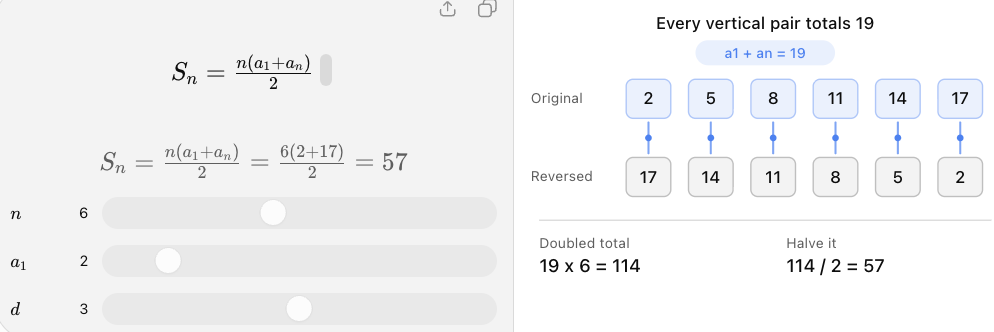
The formula is:
Sₙ = n(a₁ + aₙ)/2
where:
-
Sₙ is the sum of the first n terms.
-
n is the number of terms.
-
a₁ is the first term.
-
aₙ is the last term being added.
Why Does This Formula Work?
Consider the series:
3 + 7 + 11 + 15 + 19
Write the same terms in reverse:
19 + 15 + 11 + 7 + 3
Add the corresponding terms:
3 + 19 = 22
7 + 15 = 22
11 + 11 = 22
15 + 7 = 22
19 + 3 = 22
There are five pairs, each with a sum of 22.
Adding the original series and its reverse gives:
2S₅ = 5 × 22
2S₅ = 110
S₅ = 55
The method works because each pair has the same sum: the first term plus the last term.
Alternative Formula
If we know the first term and common difference, we can use:
Sₙ = n[2a₁ + (n − 1)d]/2
This comes from substituting the nth term formula:
aₙ = a₁ + (n − 1)d
into the sum formula.
Both versions calculate the same total.
Using the Sum Formula
Worked Example: Sum of the First Ten Terms
Find the sum of:
5 + 8 + 11 + ... + 32
Step 1: Identify the Information
First term:
a₁ = 5
Last term:
aₙ = 32
Common difference:
d = 3
Step 2: Determine the Number of Terms
Use:
aₙ = a₁ + (n − 1)d
32 = 5 + (n − 1)(3)
27 = 3(n − 1)
9 = n − 1
n = 10
Step 3: Calculate the Sum
Sₙ = n(a₁ + aₙ)/2
S₁₀ = 10(5 + 32)/2
S₁₀ = 10(37)/2
S₁₀ = 185
Verification
The complete series is:
5 + 8 + 11 + 14 + 17 + 20 + 23 + 26 + 29 + 32
Adding these terms gives 185.
Finding the Sum from the First Term and Common Difference
Worked Example
Find the sum of the first 20 terms of:
4, 10, 16, 22, ...
First term:
a₁ = 4
Common difference:
d = 6
Number of terms:
n = 20
Use:
Sₙ = n[2a₁ + (n − 1)d]/2
Substitute:
S₂₀ = 20[2(4) + 19(6)]/2
S₂₀ = 10[8 + 114]
S₂₀ = 10(122)
S₂₀ = 1,220
Check Using the Last Term
a₂₀ = 4 + 19(6)
a₂₀ = 118
Then:
S₂₀ = 20(4 + 118)/2
S₂₀ = 10(122)
S₂₀ = 1,220
Both methods agree.
Arithmetic Series with Negative Terms
Arithmetic series may contain negative numbers.
Worked Example
Find the sum:
15 + 10 + 5 + 0 − 5 − 10
There are six terms.
Direct addition:
15 + 10 = 25
25 + 5 = 30
30 + 0 = 30
30 − 5 = 25
25 − 10 = 15
Therefore:
S₆ = 15
Using the formula:
S₆ = 6(15 + (−10))/2
S₆ = 6(5)/2
S₆ = 15
Another Example
Find:
−12 − 8 − 4 + 0 + 4 + 8 + 12
The terms are symmetric around zero.
The negative and positive terms cancel:
−12 + 12 = 0
−8 + 8 = 0
−4 + 4 = 0
The middle term is zero.
Therefore:
S₇ = 0
Important Observation
A series containing both positive and negative terms may have a positive, negative, or zero sum.
We must consider all terms rather than assuming the total follows the direction of the sequence.
Visualising Arithmetic Series with Growing Patterns
Consider a staircase pattern made from square tiles.
The first row has 1 tile, the second row has 2 tiles, the third row has 3 tiles, and so on.
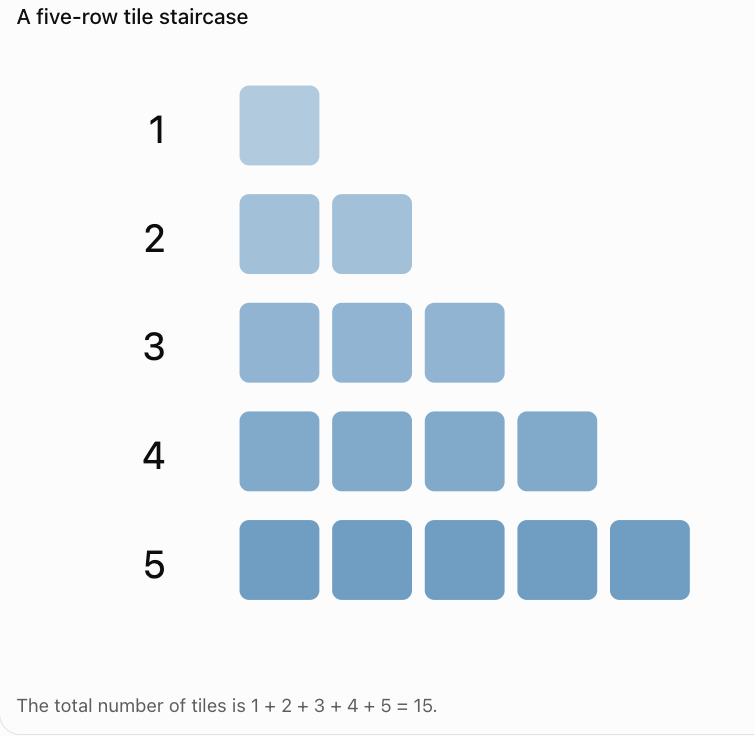
The number of tiles in each row forms the arithmetic sequence:
1, 2, 3, 4, 5
The total number of tiles forms the arithmetic series:
1 + 2 + 3 + 4 + 5 = 15
Extending the Pattern
What if the staircase contains 20 rows?
The number of tiles is:
1 + 2 + 3 + ... + 20
Use the sum formula:
S₂₀ = 20(1 + 20)/2
S₂₀ = 10(21)
S₂₀ = 210 tiles
The formula saves us from counting every tile individually.
Connecting an Arithmetic Series to Its Sequence
The nth term and the sum of the first n terms describe different quantities.
Consider:
2, 5, 8, 11, 14, ...
The nth term formula is:
aₙ = 3n − 1
The sum formula is:
Sₙ = n(3n + 1)/2
We can compare the results:
|
n |
nth term aₙ |
Sum Sₙ |
|---|---|---|
|
1 |
2 |
2 |
|
2 |
5 |
7 |
|
3 |
8 |
15 |
|
4 |
11 |
26 |
|
5 |
14 |
40 |
|
6 |
17 |
57 |
Notice:
-
The nth term increases by a constant amount.
-
The sum increases by the value of each new term.
-
The sum grows faster because it accumulates all earlier terms.
The relationship is:
Sₙ − Sₙ₋₁ = aₙ
For example:
S₅ − S₄ = 40 − 26 = 14
This is exactly the fifth term.
Real-World Application: Stadium Seating
A stadium has 18 seats in its first row. Each new row has 4 more seats than the previous row.
The number of seats per row is:
18, 22, 26, 30, ...
Suppose the stadium has 15 rows.
Finding the Number of Seats in the Last Row
a₁₅ = 18 + (15 − 1)(4)
a₁₅ = 18 + 56
a₁₅ = 74
The 15th row contains 74 seats.
Finding the Total Number of Seats
S₁₅ = 15(18 + 74)/2
S₁₅ = 15(92)/2
S₁₅ = 690
The stadium contains 690 seats in total.
Interpreting the Results
-
The arithmetic sequence describes the seats in individual rows.
-
The arithmetic series describes the total seats across all rows.
This distinction is essential when interpreting word problems.
Real-World Application: Weekly Savings
A student saves $10 in the first week and increases the amount saved by $5 each week.
The weekly savings are:
$10, $15, $20, $25, ...
How much money does the student save in total over 12 weeks?
Find the 12th Term
a₁₂ = 10 + 11(5)
a₁₂ = 65
The student saves $65 during week 12.
Calculate the Total
S₁₂ = 12(10 + 65)/2
S₁₂ = 6(75)
S₁₂ = $450
The student saves $450 over the 12 weeks.
Important Distinction
The 12th term is $65.
The sum of the first 12 terms is $450.
These represent different quantities.
Real-World Application: Production Planning
A factory produces 120 items on its first day.
Production increases by 10 items each day.
The daily production follows:
120, 130, 140, 150, ...
Find the total production over 10 days.
Find Day 10 Production
a₁₀ = 120 + 9(10)
a₁₀ = 210
Find Total Production
S₁₀ = 10(120 + 210)/2
S₁₀ = 5(330)
S₁₀ = 1,650 items
The factory produces 1,650 items over the first 10 days.
The arithmetic series allows the total to be calculated without adding each day's production separately.
Common Mistakes
Confusing a sequence with a series
A sequence lists numbers. A series adds numbers.
Confusing aₙ with Sₙ
aₙ represents one term. Sₙ represents the sum of the first n terms.
Using the wrong number of terms
For example, 5 + 10 + 15 + 20 contains four terms, not five.
Forgetting the first term
When calculating a series, include every term from the specified starting position.
Using n instead of n − 1 in the nth term formula
The number of common differences between the first and nth terms is n − 1.
Adding the common difference instead of the terms
The common difference determines how the terms change, but the series adds the actual term values.
Ignoring negative signs
Negative terms must be subtracted correctly.
Forgetting to divide by 2
The sum formula uses the average of the first and last terms.
Confusing the last term with the number of terms
In 3 + 6 + 9 + 12, the last term is 12, but there are only four terms.
Assuming all series are arithmetic
The underlying sequence must have a constant common difference.
Key Terms
-
Arithmetic Sequence: An ordered list of numbers with a constant difference between consecutive terms.
-
Arithmetic Series: The sum of terms from an arithmetic sequence.
-
Term: An individual value in a sequence.
-
First Term: The term at position n = 1.
-
Last Term: The final term included in a finite series.
-
Common Difference: The constant change between consecutive terms.
-
Finite Series: A sum containing a specified number of terms.
-
Infinite Series: A sum extending through infinitely many terms.
-
Partial Sum: Sum of the first n terms of a sequence.
-
Sₙ: Symbol representing the sum of the first n terms.
-
aₙ: Symbol representing the nth term of a sequence.
-
Summation: The process of adding terms together.
-
Sigma Notation: Compact notation using Σ to represent a sum.
-
Index: Variable indicating which term is being included in a summation.
-
Cumulative Sum: Running total obtained by adding successive terms.
-
Pairing Method: Method of combining terms from opposite ends of an arithmetic series.
-
Average of End Terms: Half the sum of the first and last terms.
-
nth Term Formula: Formula used to calculate an individual term.
-
Sum Formula: Formula used to calculate the total of a finite series.
-
Mathematical Model: Mathematical representation of a real-world situation.
Key Takeaways
-
An arithmetic series is the sum of the terms of an arithmetic sequence.
-
A sequence lists terms, while a series adds them.
-
Arithmetic sequences have a constant common difference.
-
The symbol Sₙ represents the sum of the first n terms.
-
Short arithmetic series can be calculated through direct addition.
-
Tables can be used to organise terms and cumulative sums.
-
Sigma notation provides a compact way to represent a series.
-
Pairing the first and last terms reveals a useful pattern.
-
The sum of a finite arithmetic series equals the number of terms multiplied by the average of the first and last terms.
-
The arithmetic series formula is Sₙ = n(a₁ + aₙ)/2.
-
An alternative formula is Sₙ = n[2a₁ + (n − 1)d]/2.
-
The nth term and the sum of the first n terms are different quantities.
-
Arithmetic series are useful for calculating totals in savings, seating, production, and growing patterns.
Check Your Understanding
Sequence or Series?
-
Explain the difference between an arithmetic sequence and an arithmetic series.
-
Write the arithmetic series corresponding to the sequence 4, 7, 10, 13, 16.
-
Identify the common difference in the series 5 + 9 + 13 + 17.
-
How many terms are included in 3 + 6 + 9 + 12 + 15 + 18?
Direct Addition
-
Calculate 2 + 4 + 6 + 8 + 10.
-
Calculate 7 + 11 + 15 + 19.
-
Calculate 20 + 15 + 10 + 5 + 0.
-
Calculate −6 − 3 + 0 + 3 + 6.
Mathematical Notation
-
What does S₅ represent?
-
Write 3 + 7 + 11 + 15 using Sₙ notation.
-
Expand the summation Σ from k = 1 to 4 of (2k + 1).
-
Write 5 + 10 + 15 + 20 + 25 using sigma notation.
Using the Sum Formula
-
Find the sum of the first 10 positive integers.
-
Find the sum of 4 + 8 + 12 + ... + 40.
-
Find the sum of the first 12 terms of 3, 8, 13, 18, ...
-
Find the sum of the first 8 terms of 30, 27, 24, 21, ...
Applications
-
A theatre has 10 seats in its first row and adds 2 seats per row. How many seats are there in the first 8 rows?
-
A student saves $5 in week 1 and increases savings by $5 each week. What is the total saved over 6 weeks?
-
A factory produces 50 items on day 1 and 10 additional items each day. How many items are produced in total over 5 days?
-
Explain why finding the 20th term is different from finding the sum of the first 20 terms.
Answer Key
|
Question |
Answer |
|---|---|
|
1 |
A sequence lists terms; a series adds terms |
|
2 |
4 + 7 + 10 + 13 + 16 |
|
3 |
4 |
|
4 |
6 terms |
|
5 |
30 |
|
6 |
52 |
|
7 |
50 |
|
8 |
0 |
|
9 |
The sum of the first five terms |
|
10 |
S₄ = 3 + 7 + 11 + 15 = 36 |
|
11 |
3 + 5 + 7 + 9 = 24 |
|
12 |
Σ from k = 1 to 5 of 5k |
|
13 |
55 |
|
14 |
220 |
|
15 |
366 |
|
16 |
156 |
|
17 |
136 seats |
|
18 |
$105 |
|
19 |
350 items |
|
20 |
The 20th term is one value; the sum combines the first 20 values |
Extended Challenge
Understanding Arithmetic Series
-
Explain why 2 + 4 + 8 + 16 is not an arithmetic series.
-
Write the first six terms of an arithmetic sequence with a₁ = 7 and d = 5, then calculate their sum.
-
Create a decreasing arithmetic sequence with five terms and calculate its sum.
-
Construct an arithmetic series containing both positive and negative terms with a total of zero.
-
Explain why pairing terms from opposite ends is useful.
Calculating Sums
-
Find the sum of the first 50 positive integers.
-
Find the sum of the first 25 even positive integers.
-
Calculate 7 + 14 + 21 + ... + 140.
-
Calculate 100 + 95 + 90 + ... + 5.
-
Find the sum of the first 30 terms of the sequence 4, 10, 16, 22, ...
Using Mathematical Notation
-
Write 6 + 10 + 14 + 18 + 22 using sigma notation.
-
Expand and evaluate Σ from k = 1 to 6 of (3k − 2).
-
Explain what the lower and upper limits of a summation mean.
-
Write an expression for the sum of the first n terms of 5, 8, 11, 14, ...
-
Show that Sₙ − Sₙ₋₁ = aₙ.
Real-World Applications
-
A stadium has 25 seats in its first row and 5 additional seats in each successive row. Find the total seats in 20 rows.
-
A student saves $10 in the first week and increases weekly savings by $3. Find the total saved over 15 weeks.
-
A factory produces 200 units on day 1 and 20 additional units each day. Find total production over 12 days.
-
A staircase has 30 steps. The first step uses 2 blocks, and each successive step uses 2 additional blocks. Find the total blocks required.
-
A theatre has 15 rows containing 18, 21, 24, ... seats. Find the total seating capacity.
Final Challenge: Planning a School Auditorium
A school auditorium has 16 seats in its first row.
Each successive row contains 3 more seats than the previous row.
There are 20 rows altogether.
Complete the investigation.
-
Write the first six terms of the seating sequence.
-
Identify the first term.
-
Identify the common difference.
-
Explain why the seating pattern is arithmetic.
-
Write the nth term formula.
-
Calculate the number of seats in row 10.
-
Calculate the number of seats in row 20.
-
Write the addition expression for the first five rows.
-
Calculate the total number of seats in the first five rows.
-
Explain the difference between the number of seats in row 20 and the total seats in the auditorium.
-
Identify the values of n, a₁, and aₙ for the complete auditorium.
-
Use the arithmetic series formula to find the total seating capacity.
-
Verify the result using the alternative sum formula.
-
Determine the average number of seats per row.
-
Explain how the average relates to the first and last rows.
-
Write the seating series using sigma notation.
-
Explain how the pairing method could be used to calculate the total.
-
Predict how the total seating capacity would change if another five rows were added.
-
Explain why the total number of seats grows faster than the number of seats in a single row.
-
Describe how arithmetic series could help an architect or school administrator plan seating capacity.
Further Investigation: Create Your Own Arithmetic Series
Design a real-world situation involving an arithmetic series.
Your situation might involve savings, seating, production, tiles, or another quantity that changes by a constant amount.
Then:
-
Describe the situation.
-
Identify the first term.
-
Identify the common difference.
-
Specify the number of terms.
-
Write the arithmetic sequence.
-
Write the corresponding arithmetic series.
-
Calculate the sum through direct addition for a small number of terms.
-
Determine the nth term formula.
-
Calculate the last term.
-
Use the sum formula to calculate the complete total.
-
Explain the meaning of the total in context.
-
Identify any limitations of your mathematical model.
5. Sum Formulas for Arithmetic Series
Learning outcomes
- I can explain why a formula can be used to find the sum of an arithmetic series.
- I can identify the values needed to use an arithmetic series formula.
- I can calculate the sum of an arithmetic series using a formula.
- I can compare formula-based solutions with direct addition.
- I can apply arithmetic series formulas to real-world situations.
Sum Formulas for Arithmetic Series
Introduction
An arithmetic series is the sum of the terms in an arithmetic sequence.
For example, consider the sequence:
4, 7, 10, 13, 16, 19
Its corresponding arithmetic series is:
4 + 7 + 10 + 13 + 16 + 19 = 69
When a series contains only a few terms, we can calculate its sum through direct addition.
However, what if we need to add 50, 100, or even 1,000 terms?
Adding every term individually would take considerable time and increase the possibility of errors.
Fortunately, arithmetic series follow a predictable pattern. Because consecutive terms have a constant difference, we can use formulas to calculate their sums efficiently.
These formulas are useful in mathematics and real-world situations involving savings, seating arrangements, production, construction, and other quantities that increase or decrease regularly.

Reviewing Arithmetic Sequences and Series
An arithmetic sequence is an ordered list of numbers with a constant difference between consecutive terms.
Example:
5, 9, 13, 17, 21, ...
The common difference is:
d = 9 − 5 = 4
An arithmetic series is formed by adding terms from an arithmetic sequence.
Example:
5 + 9 + 13 + 17 + 21 = 65
Comparing Sequences and Series
|
Arithmetic sequence |
Arithmetic series |
|---|---|
|
3, 6, 9, 12, 15 |
3 + 6 + 9 + 12 + 15 |
|
Describes individual terms |
Describes their combined total |
|
Uses aₙ for a term |
Uses Sₙ for a sum |
|
Has a constant difference |
Can be calculated using a sum formula |
The nth term formula for an arithmetic sequence is:
aₙ = a₁ + (n − 1)d
where:
-
a₁ = first term
-
aₙ = nth term
-
n = term position
-
d = common difference
This formula will help us develop and use arithmetic series formulas.
Why Can We Use a Formula to Find a Sum?
Arithmetic sequences have a special property: their terms are evenly spaced.
Consider:
2 + 5 + 8 + 11 + 14 + 17
The common difference is 3.
Now pair terms from opposite ends:
2 + 17 = 19
5 + 14 = 19
8 + 11 = 19
Every pair has the same sum.
There are three pairs, so:
S₆ = 3 × 19
S₆ = 57
We did not need to add all six terms individually.
Why Does Pairing Work?
In an arithmetic sequence:
-
Moving one term forward increases its value by d.
-
Moving one term backward decreases its value by d.
These changes cancel when the terms are paired from opposite ends.
For example:
2 + 17 = 19
(2 + 3) + (17 − 3) = 19
The pair sum remains constant.
This pattern is the foundation of the arithmetic series sum formula.
Deriving the Arithmetic Series Formula
Suppose an arithmetic series contains n terms.
Write the series in its original order:
Sₙ = a₁ + a₂ + a₃ + ... + aₙ
Now write it in reverse:
Sₙ = aₙ + aₙ₋₁ + aₙ₋₂ + ... + a₁
Add the two expressions vertically.
Each pair has the same sum:
a₁ + aₙ
There are n such pairs.
Therefore:
2Sₙ = n(a₁ + aₙ)
Dividing by 2 gives the sum formula.
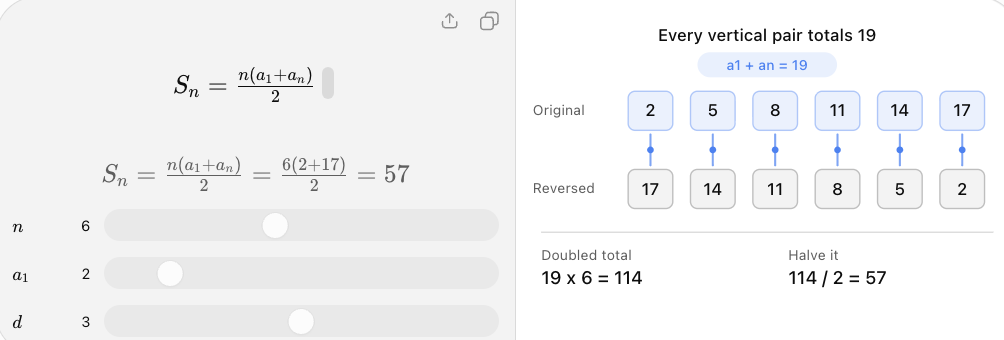
Understanding the Formula
The sum is calculated by multiplying:
Number of terms × Average term value
For an arithmetic sequence, the average of all its terms equals the average of the first and last terms.
Therefore:
Average term value = (a₁ + aₙ)/2
This is why the sum formula works.
Important Observation
The formula works for:
-
Increasing arithmetic sequences.
-
Decreasing arithmetic sequences.
-
Constant arithmetic sequences.
-
Sequences containing negative numbers.
-
Sequences containing fractions or decimals.
The essential requirement is that the sequence has a constant common difference.
Identifying the Values Needed
Before using the arithmetic series formula, identify the required information.
|
Symbol |
Meaning |
Example |
|---|---|---|
|
Sₙ |
Sum of the first n terms |
S₁₀ |
|
n |
Number of terms |
10 |
|
a₁ |
First term |
4 |
|
aₙ |
Last term |
31 |
|
d |
Common difference |
3 |
For the first-and-last-term formula, we need:
n, a₁, and aₙ
Worked Example
Consider:
4 + 7 + 10 + 13 + 16 + 19
Identify:
a₁ = 4
aₙ = 19
n = 6
The common difference is:
d = 3
Although the common difference helps describe the series, we do not need it directly when the first term, last term, and number of terms are already known.
A Common Mistake
The last term is not the same as the number of terms.
For example:
5 + 10 + 15 + 20
The last term is 20.
The number of terms is 4.
Therefore:
aₙ = 20
n = 4
Confusing these values produces an incorrect sum.
Using the First-and-Last-Term Formula
Worked Example
Find the sum:
6 + 10 + 14 + 18 + 22
Step 1: Identify the Values
a₁ = 6
aₙ = 22
n = 5
Step 2: Substitute into the Formula
S₅ = 5(6 + 22)/2
Step 3: Simplify
S₅ = 5(28)/2
S₅ = 140/2
S₅ = 70
Step 4: Verify by Direct Addition
6 + 10 + 14 + 18 + 22
= 16 + 14 + 18 + 22
= 30 + 18 + 22
= 48 + 22
= 70
Both methods give the same result.
The Alternative Arithmetic Series Formula
Sometimes we know the first term, common difference, and number of terms, but not the last term.
We can use a second formula.
Recall:
aₙ = a₁ + (n − 1)d
Substitute this expression for aₙ into the sum formula:
Sₙ = n[a₁ + a₁ + (n − 1)d]/2
Combine the first two terms:
Sₙ = n[2a₁ + (n − 1)d]/2
This is the alternative arithmetic series formula.
When Should We Use Each Formula?
|
Information given |
Formula to use |
|---|---|
|
First term, last term, number of terms |
Sₙ = n(a₁ + aₙ)/2 |
|
First term, common difference, number of terms |
Sₙ = n[2a₁ + (n − 1)d]/2 |
Both formulas produce the same answer.
Choose the one that requires the fewest additional calculations.
Using the First Term and Common Difference
Worked Example
Find the sum of the first 15 terms of:
3, 8, 13, 18, ...
Step 1: Identify the Values
a₁ = 3
d = 5
n = 15
Step 2: Substitute
S₁₅ = 15[2(3) + (15 − 1)(5)]/2
Step 3: Simplify
S₁₅ = 15[6 + 14(5)]/2
S₁₅ = 15[6 + 70]/2
S₁₅ = 15(76)/2
S₁₅ = 570
Verification Using the Other Formula
First calculate the 15th term:
a₁₅ = 3 + 14(5)
a₁₅ = 73
Now:
S₁₅ = 15(3 + 73)/2
S₁₅ = 15(76)/2
S₁₅ = 570
The two formulas agree.
Finding the Number of Terms
Sometimes a series gives the first and last terms but does not state how many terms are included.
We must determine n before calculating the sum.
Worked Example
Find:
5 + 9 + 13 + ... + 81
Step 1: Identify the Values
a₁ = 5
d = 4
aₙ = 81
Step 2: Use the nth Term Formula
aₙ = a₁ + (n − 1)d
81 = 5 + (n − 1)(4)
76 = 4(n − 1)
19 = n − 1
n = 20
Step 3: Calculate the Sum
S₂₀ = 20(5 + 81)/2
S₂₀ = 10(86)
S₂₀ = 860
Important Reminder
Always determine the correct number of terms before substituting into a sum formula.
Comparing Formula-Based Solutions with Direct Addition
Consider the series:
4 + 8 + 12 + 16 + 20 + 24
Method A: Direct Addition
4 + 8 = 12
12 + 12 = 24
24 + 16 = 40
40 + 20 = 60
60 + 24 = 84
Total = 84
Method B: Sum Formula
a₁ = 4
aₙ = 24
n = 6
S₆ = 6(4 + 24)/2
S₆ = 3(28)
Total = 84
Comparing the Methods
|
Direct addition |
Sum formula |
|---|---|
|
Adds terms individually |
Uses the structure of the series |
|
Simple for short series |
Efficient for long series |
|
Requires all terms to be known or generated |
Requires only a few key values |
|
Useful for checking answers |
Useful for distant or large totals |
Which Method Is Better?
For a series with five terms, direct addition may be just as convenient.
For a series with 500 terms, the formula is usually much more efficient.
Both methods are mathematically valid.
Calculating the Sum of the First 100 Positive Integers
Consider:
1 + 2 + 3 + ... + 100
This is an arithmetic series with:
a₁ = 1
aₙ = 100
n = 100
Use the sum formula:
S₁₀₀ = 100(1 + 100)/2
S₁₀₀ = 50(101)
S₁₀₀ = 5,050
This is a famous example often associated with the mathematician Carl Friedrich Gauss.
The Pairing Method
Pair the first and last terms:
1 + 100 = 101
2 + 99 = 101
3 + 98 = 101
There are 50 pairs.
Therefore:
50 × 101 = 5,050
The sum formula generalises this pairing method.

Arithmetic Series with Negative Common Differences
The sum formulas also work for decreasing arithmetic sequences.
Worked Example
Find the sum of the first 12 terms of:
50, 46, 42, 38, ...
Step 1: Identify the Values
a₁ = 50
d = −4
n = 12
Step 2: Use the Formula
S₁₂ = 12[2(50) + 11(−4)]/2
S₁₂ = 6[100 − 44]
S₁₂ = 6(56)
S₁₂ = 336
Verification
Find the last term:
a₁₂ = 50 + 11(−4)
a₁₂ = 6
Now:
S₁₂ = 12(50 + 6)/2
S₁₂ = 6(56)
S₁₂ = 336
Interpretation
Although the terms decrease, they are all positive in this example.
Therefore, the total is positive.
A decreasing sequence does not necessarily produce a negative sum.
Arithmetic Series Containing Negative Terms
Worked Example
Calculate:
12 + 8 + 4 + 0 − 4 − 8 − 12
There are seven terms.
a₁ = 12
aₙ = −12
n = 7
S₇ = 7(12 + (−12))/2
S₇ = 7(0)/2
S₇ = 0
The positive and negative terms cancel.
Another Example
Find the sum of the first 10 terms of:
5, 2, −1, −4, ...
First term:
a₁ = 5
Common difference:
d = −3
Number of terms:
n = 10
Use:
S₁₀ = 10[2(5) + 9(−3)]/2
S₁₀ = 5[10 − 27]
S₁₀ = 5(−17)
S₁₀ = −85
The sum is negative because the later negative terms outweigh the earlier positive terms.
Arithmetic Series with Fractions and Decimals
The formulas are not restricted to whole numbers.
Worked Example: Fractions
Find:
1/2 + 1 + 3/2 + 2 + 5/2
The first term is:
a₁ = 1/2
The last term is:
aₙ = 5/2
There are five terms.
S₅ = 5(1/2 + 5/2)/2
S₅ = 5(6/2)/2
S₅ = 5(3)/2
S₅ = 15/2 = 7.5
Worked Example: Decimals
Find the sum of the first eight terms of:
1.2, 1.7, 2.2, 2.7, ...
a₁ = 1.2
d = 0.5
n = 8
S₈ = 8[2(1.2) + 7(0.5)]/2
S₈ = 4[2.4 + 3.5]
S₈ = 4(5.9)
S₈ = 23.6
Finding an Unknown First Term
Sometimes we know the total sum, number of terms, and common difference.
We can rearrange the sum formula to determine the first term.
Worked Example
An arithmetic series contains 10 terms.
Its common difference is 3.
The total sum is 185.
Find the first term.
Use:
Sₙ = n[2a₁ + (n − 1)d]/2
Substitute:
185 = 10[2a₁ + 9(3)]/2
185 = 5(2a₁ + 27)
Divide by 5:
37 = 2a₁ + 27
10 = 2a₁
a₁ = 5
Verification
The first term is 5.
The tenth term is:
a₁₀ = 5 + 9(3) = 32
S₁₀ = 10(5 + 32)/2
S₁₀ = 185
The answer is correct.
Finding an Unknown Number of Terms
Sometimes the total sum is known, but the number of terms is unknown.
This may produce a quadratic equation.
Worked Example
The arithmetic sequence is:
3, 7, 11, 15, ...
How many terms must be added to obtain a total of 210?
Step 1: Identify the Values
a₁ = 3
d = 4
Sₙ = 210
Step 2: Substitute
210 = n[2(3) + (n − 1)(4)]/2
210 = n[6 + 4n − 4]/2
210 = n(4n + 2)/2
210 = n(2n + 1)
Step 3: Rearrange
2n² + n − 210 = 0
Step 4: Factor
(2n + 21)(n − 10) = 0
Therefore:
n = 10 or n = −10.5
A number of terms must be a positive integer.
Therefore:
n = 10
Verification
The tenth term is:
a₁₀ = 3 + 9(4) = 39
S₁₀ = 10(3 + 39)/2
S₁₀ = 210
Exactly 10 terms are required.
Real-World Application: Stadium Seating
A stadium has 24 seats in its first row.
Each successive row contains 4 more seats.
There are 30 rows.

Find the Number of Seats in the Last Row
a₃₀ = 24 + 29(4)
a₃₀ = 24 + 116
a₃₀ = 140
Calculate the Total Seating Capacity
S₃₀ = 30(24 + 140)/2
S₃₀ = 15(164)
S₃₀ = 2,460 seats
Interpretation
The stadium contains 2,460 seats.
The arithmetic sequence describes the seats in individual rows.
The arithmetic series describes the total number of seats.
Why Is the Formula Useful?
A stadium with 30 rows would require considerable time to calculate through direct addition.
The formula provides the total using only the first row, last row, and number of rows.
Real-World Application: Weekly Savings
A student saves $15 during the first week.
Each week, the student increases the amount saved by $5.
How much money will the student save over 20 weeks?

Step 1: Identify the Values
a₁ = 15
d = 5
n = 20
Step 2: Find the Last Term
a₂₀ = 15 + 19(5)
a₂₀ = 110
Step 3: Find the Total
S₂₀ = 20(15 + 110)/2
S₂₀ = 10(125)
S₂₀ = $1,250
Interpretation
The student saves $110 during week 20.
The total saved over all 20 weeks is $1,250.
These are different quantities.
Real-World Application: Factory Production
A factory produces 200 items during its first day.
Production increases by 15 items each day.
How many items are produced over 14 days?
Step 1: Identify the Values
a₁ = 200
d = 15
n = 14
Step 2: Find the Last Term
a₁₄ = 200 + 13(15)
a₁₄ = 395
Step 3: Calculate the Total
S₁₄ = 14(200 + 395)/2
S₁₄ = 7(595)
S₁₄ = 4,165 items
Interpretation
The factory produces 4,165 items during the 14-day period.
This model assumes that daily production increases by exactly 15 items throughout the period.
Real-World Application: Building a Staircase
A decorative staircase uses 4 blocks in its first row.
Each new row requires 4 additional blocks.
The pattern continues for 25 rows.

Identify the Sequence
4, 8, 12, 16, 20, ...
Find the Last Term
a₂₅ = 4 + 24(4)
a₂₅ = 100
Calculate the Total Blocks
S₂₅ = 25(4 + 100)/2
S₂₅ = 25(104)/2
S₂₅ = 1,300 blocks
The formula allows the total number of blocks to be determined without counting each row individually.
A Complete Strategy for Arithmetic Series Problems
When solving an arithmetic series problem, use the following approach.
-
Identify the arithmetic pattern. Check that consecutive terms have a constant difference.
-
Determine what is being asked. Is the question asking for one term or the total sum?
-
Identify the known values. Record a₁, aₙ, d, and n where available.
-
Find any missing information. Use the nth term formula if necessary.
-
Choose the appropriate sum formula. Select the formula that matches the information given.
-
Substitute carefully. Include brackets and negative signs correctly.
-
Calculate the sum. Show the main algebraic steps.
-
Verify when possible. Use direct addition for short series or the alternative formula.
-
Interpret the answer. Include units and explain what the total represents.
-
Check reasonableness. Consider whether the answer makes sense in the context.
Common Mistakes
Confusing the nth term with the sum
aₙ gives the value of one term.
Sₙ gives the total of the first n terms.
Using the wrong number of terms
Always count the terms carefully or calculate n from the nth term formula.
Confusing the last term with n
The last term is a value. The number of terms is a count.
Forgetting to divide by 2
Both arithmetic series formulas include division by 2.
Using the wrong common difference
For decreasing sequences, the common difference is negative.
Ignoring brackets
In Sₙ = n[2a₁ + (n − 1)d]/2, calculate the expression inside the brackets correctly.
Using a sum formula for a non-arithmetic sequence
The formulas apply only when consecutive terms have a constant difference.
Forgetting to find the last term
If using the first-and-last-term formula, calculate aₙ when it is not provided.
Accepting an invalid number of terms
The number of terms must be a positive integer.
Failing to interpret the answer
A total should be expressed with appropriate units, such as dollars, seats, tiles, or items.
Key Terms
-
Arithmetic Sequence: Ordered list of numbers with a constant difference between consecutive terms.
-
Arithmetic Series: Sum of the terms of an arithmetic sequence.
-
Common Difference: Fixed change between consecutive terms.
-
First Term: The value of the sequence at position 1.
-
Last Term: Final term included in a finite series.
-
Number of Terms: Count of terms being added.
-
nth Term: Term at position n.
-
Partial Sum: Sum of the first n terms.
-
Sₙ: Symbol representing the sum of the first n terms.
-
Sum Formula: Formula used to calculate the total of an arithmetic series.
-
Pairing Method: Method of adding terms from opposite ends of a series.
-
Average Term Value: Mean of the terms in a finite arithmetic sequence.
-
Direct Addition: Calculating a series by adding each term individually.
-
Formula-Based Solution: Calculating a sum using an algebraic formula.
-
Sigma Notation: Compact notation using Σ to represent summation.
-
Finite Series: Series containing a specified number of terms.
-
Verification: Checking that a solution is correct.
-
Mathematical Model: Mathematical representation of a real-world situation.
-
Cumulative Total: Total obtained by successively adding quantities.
Key Takeaways
-
Arithmetic series formulas work because arithmetic sequences have a constant common difference.
-
Terms paired from opposite ends have equal sums.
-
The average term value equals the average of the first and last terms.
-
The sum of a finite arithmetic series equals the number of terms multiplied by the average term value.
-
The first-and-last-term formula is Sₙ = n(a₁ + aₙ)/2.
-
The first-term-and-difference formula is Sₙ = n[2a₁ + (n − 1)d]/2.
-
Both formulas produce the same answer.
-
The best formula depends on which values are known.
-
Direct addition is useful for short series and verification.
-
Formula-based solutions are more efficient for long series.
-
Negative terms and negative common differences must be handled carefully.
-
The number of terms can be found using the nth term formula.
-
Arithmetic series formulas are useful for savings, seating, production, construction, and other regularly changing quantities.
Check Your Understanding
Identifying Values
-
Identify a₁, aₙ, and n for 4 + 8 + 12 + 16 + 20.
-
Identify a₁, d, and n for the first 12 terms of 5, 9, 13, 17, ...
-
Explain why the arithmetic series formula includes division by 2.
-
Explain why pairing terms from opposite ends works.
Calculating Sums
-
Find the sum of 3 + 6 + 9 + 12 + 15.
-
Find the sum of 7 + 11 + 15 + 19 + 23.
-
Find the sum of the first 10 terms of 2, 5, 8, 11, ...
-
Find the sum of the first 20 terms of 4, 10, 16, 22, ...
Finding Missing Values
-
Find the number of terms in 5 + 10 + 15 + ... + 100.
-
Find the sum of 6 + 12 + 18 + ... + 120.
-
An arithmetic series contains 8 terms, has common difference 3, and has sum 132. Find the first term.
-
How many terms of 3 + 7 + 11 + ... are needed to obtain a sum of 210?
Comparing Methods
-
Calculate 2 + 4 + 6 + 8 + 10 using direct addition.
-
Calculate the same series using the sum formula.
-
Explain why the sum formula is more efficient for a series containing 100 terms.
-
Explain how direct addition can help verify a formula-based solution.
Real-World Applications
-
A theatre has 20 seats in its first row and 4 additional seats in each successive row. Find the total number of seats in 15 rows.
-
A student saves $10 in week 1 and increases weekly savings by $5. Find the total saved over 12 weeks.
-
A factory produces 100 items on day 1 and increases production by 10 items each day. Find the total production over 10 days.
-
A staircase has 20 rows. The first row uses 3 blocks and each successive row uses 3 more. Find the total blocks required.
Answer Key
|
Question |
Answer |
|---|---|
|
1 |
a₁ = 4, aₙ = 20, n = 5 |
|
2 |
a₁ = 5, d = 4, n = 12 |
|
3 |
The formula uses the average of the first and last terms |
|
4 |
Each pair has the same sum |
|
5 |
45 |
|
6 |
75 |
|
7 |
155 |
|
8 |
1,220 |
|
9 |
20 terms |
|
10 |
1,260 |
|
11 |
a₁ = 6 |
|
12 |
10 terms |
|
13 |
30 |
|
14 |
30 |
|
15 |
It avoids adding 100 terms individually |
|
16 |
It provides an independent check of the result |
|
17 |
720 seats |
|
18 |
$450 |
|
19 |
1,450 items |
|
20 |
630 blocks |
Extended Challenge
Understanding the Formulas
-
Derive the first-and-last-term sum formula using the pairing method.
-
Explain why the average of the first and last terms equals the average of all terms in a finite arithmetic sequence.
-
Derive the alternative sum formula from the nth term formula.
-
Explain why both sum formulas must give the same result.
-
Show that the sum of the first n positive integers is n(n + 1)/2.
Calculating Larger Sums
-
Find the sum of the first 100 even positive integers.
-
Find the sum of the first 75 odd positive integers.
-
Calculate 12 + 18 + 24 + ... + 300.
-
Calculate 200 + 195 + 190 + ... + 5.
-
Find the sum of the first 50 terms of 7, 12, 17, 22, ...
Finding Unknown Values
-
An arithmetic series has 15 terms, a first term of 8, and a sum of 645. Find the last term.
-
An arithmetic series has 12 terms, a common difference of 5, and a sum of 510. Find the first term.
-
Find the number of terms needed for 4 + 8 + 12 + ... to have a sum of 840.
-
Determine how many terms of 5 + 10 + 15 + ... must be added to obtain a sum of 1,050.
-
An arithmetic series has 20 terms and a sum of 1,000. Its first term is 12. Find the common difference.
Real-World Applications
-
A stadium has 30 seats in its first row and 5 additional seats per row. Find the total seats in 40 rows.
-
A student saves $20 in week 1 and increases weekly savings by $4. Find the total saved over 30 weeks.
-
A factory produces 500 items on day 1 and increases daily production by 25 items. Find total production over 20 days.
-
A construction project requires 10 bricks in the first layer and 6 additional bricks in each successive layer. Find the total bricks in 25 layers.
-
A theatre has 18 seats in its first row and 3 additional seats per row. Determine how many rows are needed to provide at least 1,000 seats.
Final Challenge: Designing a Stadium
A new stadium is being designed with the following seating arrangement:
-
The first row contains 28 seats.
-
Each successive row contains 6 more seats than the previous row.
-
The stadium contains 35 rows.
Complete the investigation.
-
Write the first six terms of the seating sequence.
-
Identify the first term.
-
Identify the common difference.
-
Explain why the sequence is arithmetic.
-
Write the nth term formula.
-
Calculate the number of seats in row 10.
-
Calculate the number of seats in row 20.
-
Calculate the number of seats in row 35.
-
Identify the values needed for the first-and-last-term sum formula.
-
Calculate the total seating capacity.
-
Verify the total using the alternative sum formula.
-
Calculate the average number of seats per row.
-
Explain how the average relates to the first and last rows.
-
Calculate the total seats in the first five rows using direct addition.
-
Calculate the same total using a formula.
-
Compare the efficiency of the two methods.
-
Determine the total seats in the first 20 rows.
-
Determine the number of seats in rows 21 through 35.
-
Explain why the total seating capacity grows faster than the number of seats in a single row.
-
Describe how arithmetic series formulas could help architects estimate seating capacity during stadium design.
Further Investigation: Create Your Own Arithmetic Series Problem
Develop a realistic situation involving an arithmetic series.
Your situation might involve savings, manufacturing, seating, construction, or another quantity that changes regularly.
Then:
-
Describe the situation.
-
Identify the first term.
-
Identify the common difference.
-
Specify the number of terms.
-
Write the arithmetic sequence.
-
Write the corresponding arithmetic series.
-
Determine the nth term formula.
-
Calculate the last term.
-
Calculate the total using the first-and-last-term formula.
-
Verify using the alternative formula.
-
Calculate a smaller partial sum using direct addition.
-
Explain why the formulas are useful.
-
Interpret the final total in context.
-
Identify any limitations of your model.
-
Explain how changing the common difference would affect the total.