Arithmetic Sequences and Series
1. Arithmetic Sequences
Learning outcomes
- I can define an arithmetic sequence as a sequence with a constant difference between consecutive terms.
- I can identify the common difference in an arithmetic sequence.
- I can determine whether a sequence is arithmetic.
- I can generate terms in an arithmetic sequence.
- I can describe arithmetic patterns using mathematical language.
Arithmetic Sequences
Introduction to Arithmetic Sequences
Patterns are found throughout mathematics and everyday life. Some patterns involve shapes, colours, or arrangements, while others involve numbers that follow a predictable rule.
A sequence is an ordered list of numbers or other mathematical objects that follow a particular arrangement or rule.
An arithmetic sequence is a sequence of numbers in which the difference between consecutive terms is constant.
This means that the same number is added to each term to produce the next term.
For example:
3, 7, 11, 15, 19, 23, ...
Each term increases by 4.
Another example is:
30, 25, 20, 15, 10, 5, ...
Each term decreases by 5.
Arithmetic sequences are useful for describing regular changes in quantities such as savings, distances, temperatures, seating arrangements, and repeated payments.
Understanding arithmetic sequences allows us to recognise patterns, determine missing values, generate terms, and describe mathematical relationships.
Understanding Sequences
A sequence consists of terms arranged in a particular order.
Each number in a sequence is called a term.
Consider:
2, 5, 8, 11, 14, ...
The terms are:
-
First term: 2
-
Second term: 5
-
Third term: 8
-
Fourth term: 11
-
Fifth term: 14
The position of each term is important.
We commonly use the notation:
-
a₁ = first term
-
a₂ = second term
-
a₃ = third term
-
a₄ = fourth term
-
aₙ = term in position n
For this sequence:
a₁ = 2
a₂ = 5
a₃ = 8
a₄ = 11
a₅ = 14
The symbol aₙ represents the value of a term at a particular position.
Finite and Infinite Sequences
A finite sequence has a specified number of terms.
Example:
4, 8, 12, 16, 20
An infinite sequence continues without a final term.
Example:
4, 8, 12, 16, 20, ...
The three dots, called an ellipsis, indicate that the pattern continues.
An arithmetic sequence can be either finite or infinite.
What Makes a Sequence Arithmetic?
The defining feature of an arithmetic sequence is a constant difference between consecutive terms.
Consider:
5, 9, 13, 17, 21, ...
Calculate the difference between each pair of consecutive terms:
9 − 5 = 4
13 − 9 = 4
17 − 13 = 4
21 − 17 = 4
Since every difference is 4, the sequence is arithmetic.
The constant difference is called the common difference.
It is represented by the letter:
d
For this sequence:
d = 4
Important Principle
An arithmetic sequence is created by repeatedly adding the same number.
This number may be:
-
Positive.
-
Negative.
-
Zero.
-
A fraction.
-
A decimal.
The common difference does not have to be a positive whole number.
Visualising an Arithmetic Sequence
Consider the sequence:
2, 5, 8, 11, 14, ...
Each term is 3 greater than the previous term.
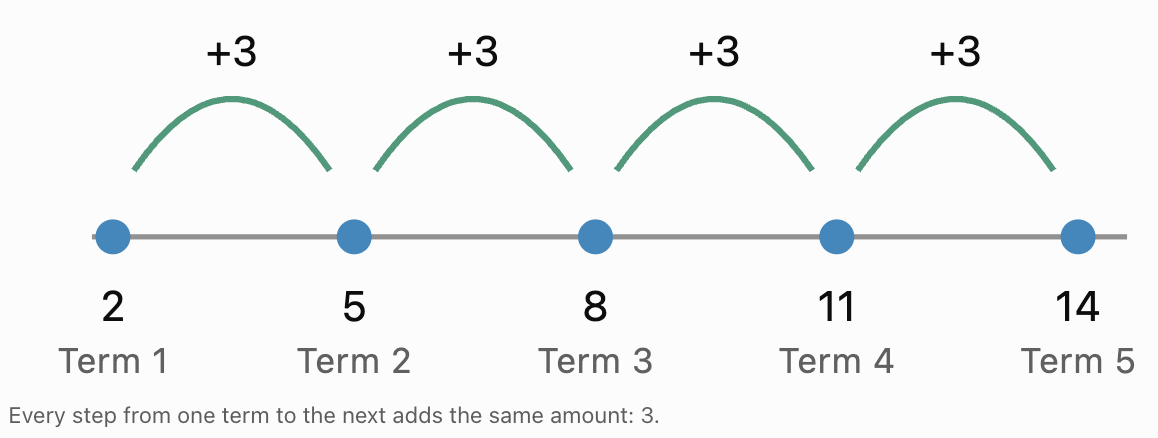
The terms are equally spaced in value.
This equal spacing is an important characteristic of arithmetic sequences.
Finding the Common Difference
The common difference is calculated by subtracting one term from the next.
d = next term − previous term
Using mathematical notation:
d = a₂ − a₁
For an arithmetic sequence, this same difference applies between every pair of consecutive terms.
Worked Example: Positive Common Difference
Find the common difference of:
7, 12, 17, 22, 27, ...
Step 1: Subtract Consecutive Terms
12 − 7 = 5
17 − 12 = 5
22 − 17 = 5
Step 2: Identify the Common Difference
Every difference is 5.
d = 5
Interpretation
The sequence increases by 5 with each new term.
Worked Example: Negative Common Difference
Find the common difference of:
50, 43, 36, 29, 22, ...
Step 1: Subtract Consecutive Terms
43 − 50 = −7
36 − 43 = −7
29 − 36 = −7
Step 2: Identify the Common Difference
d = −7
Interpretation
The sequence decreases by 7 with each new term.
Important Observation
A negative common difference means the sequence is decreasing.
The rule can be described as either:
"Add −7 each time."
or:
"Subtract 7 each time."
Both descriptions are mathematically equivalent.
Arithmetic Sequences with Decimals
Arithmetic sequences may contain decimal values.
Worked Example
Consider:
1.5, 2.0, 2.5, 3.0, 3.5, ...
Calculate the difference:
2.0 − 1.5 = 0.5
2.5 − 2.0 = 0.5
3.0 − 2.5 = 0.5
Therefore:
d = 0.5
The sequence increases by 0.5 each time.
Arithmetic Sequences with Fractions
Fractions can also form arithmetic sequences.
Worked Example
Consider:
1/4, 1/2, 3/4, 1, 5/4, ...
Calculate:
1/2 − 1/4 = 1/4
3/4 − 1/2 = 1/4
1 − 3/4 = 1/4
Therefore:
d = 1/4
Each term increases by one quarter.
Increasing, Decreasing, and Constant Sequences
The sign of the common difference determines the behaviour of an arithmetic sequence.
|
Common difference |
Behaviour |
Example |
|---|---|---|
|
d > 0 |
Increasing |
2, 6, 10, 14, ... |
|
d < 0 |
Decreasing |
20, 17, 14, 11, ... |
|
d = 0 |
Constant |
5, 5, 5, 5, ... |
Increasing Sequences
An arithmetic sequence increases when the common difference is positive.
Example:
4, 10, 16, 22, ...
d = 6
Decreasing Sequences
An arithmetic sequence decreases when the common difference is negative.
Example:
18, 13, 8, 3, ...
d = −5
Constant Sequences
A constant sequence contains the same value in every position.
Example:
7, 7, 7, 7, ...
d = 0
This is still an arithmetic sequence because the difference between consecutive terms is always zero.
Determining Whether a Sequence Is Arithmetic
Not every number sequence is arithmetic.
To determine whether a sequence is arithmetic, calculate the differences between consecutive terms.
If all differences are equal, the sequence is arithmetic.
If the differences are not equal, the sequence is not arithmetic.
Worked Example: Arithmetic Sequence
Determine whether the following sequence is arithmetic:
6, 11, 16, 21, 26
Step 1: Calculate Differences
11 − 6 = 5
16 − 11 = 5
21 − 16 = 5
26 − 21 = 5
Step 2: Compare
All differences are equal.
Conclusion
The sequence is arithmetic, with d = 5.
Worked Example: Non-Arithmetic Sequence
Determine whether the following sequence is arithmetic:
2, 4, 8, 16, 32
Step 1: Calculate Differences
4 − 2 = 2
8 − 4 = 4
16 − 8 = 8
32 − 16 = 16
Step 2: Compare
The differences are:
2, 4, 8, 16
They are not constant.
Conclusion
The sequence is not arithmetic.
Important Observation
Although the sequence follows a clear pattern, it is not arithmetic.
Each term is multiplied by 2 rather than increased by a constant amount.
This is an example of a geometric sequence.
Worked Example: An Irregular Sequence
Consider:
3, 8, 13, 19, 23
The differences are:
5, 5, 6, 4
Since the differences are not equal:
The sequence is not arithmetic.
A sequence must have a constant difference throughout the given terms to be arithmetic.
Arithmetic Versus Geometric Sequences
Arithmetic and geometric sequences both follow predictable patterns, but they use different rules.
|
Property |
Arithmetic sequence |
Geometric sequence |
|---|---|---|
|
Pattern |
Add a constant |
Multiply by a constant |
|
Main relationship |
Constant difference |
Constant ratio |
|
Example |
3, 6, 9, 12, ... |
3, 6, 12, 24, ... |
|
Change between terms |
+3 |
×2 |
|
Typical behaviour |
Linear |
Exponential |
Example
Sequence A:
5, 10, 15, 20, ...
The differences are:
5, 5, 5
Therefore, Sequence A is arithmetic.
Sequence B:
5, 10, 20, 40, ...
The differences are:
5, 10, 20
The differences are not constant.
However, each term is multiplied by 2.
Therefore, Sequence B is geometric rather than arithmetic.
Why This Matters
Recognising the correct type of sequence allows us to select the appropriate mathematical rule.
Generating Terms in an Arithmetic Sequence
Once the first term and common difference are known, additional terms can be generated.
The recursive relationship is:
Next term = previous term + common difference
In symbols:
aₙ = aₙ₋₁ + d, for n ≥ 2.
Worked Example: Generating an Increasing Sequence
Given:
First term = 4
Common difference = 6
Generate the first six terms.
Step 1: Write the First Term
a₁ = 4
Step 2: Add the Common Difference
a₂ = 4 + 6 = 10
a₃ = 10 + 6 = 16
a₄ = 16 + 6 = 22
a₅ = 22 + 6 = 28
a₆ = 28 + 6 = 34
Final Answer
4, 10, 16, 22, 28, 34
Worked Example: Generating a Decreasing Sequence
Given:
First term = 25
Common difference = −4
Generate the first seven terms.
Step 1: Start with 25
a₁ = 25
Step 2: Add −4 Repeatedly
a₂ = 25 − 4 = 21
a₃ = 21 − 4 = 17
a₄ = 17 − 4 = 13
a₅ = 13 − 4 = 9
a₆ = 9 − 4 = 5
a₇ = 5 − 4 = 1
Final Answer
25, 21, 17, 13, 9, 5, 1
Important Observation
The same common difference is applied at every step.
It does not matter whether the sequence is increasing or decreasing.
Finding Missing Terms
Sometimes an arithmetic sequence contains missing values.
These can be found using the common difference.
Worked Example: One Missing Term
Find the missing number:
4, 9, __, 19, 24
Step 1: Determine the Common Difference
9 − 4 = 5
Step 2: Add the Common Difference
9 + 5 = 14
Final Answer
4, 9, 14, 19, 24
Worked Example: Multiple Missing Terms
Find the missing values:
30, __, __, 12, 6
Step 1: Identify the Known Difference
12 − 6 = 6
Since the sequence is decreasing from left to right:
d = −6
Step 2: Work Backwards
The term before 12 is:
12 + 6 = 18
The term before 18 is:
18 + 6 = 24
Final Answer
30, 24, 18, 12, 6
Worked Example: Finding a Common Difference from Non-Consecutive Terms
An arithmetic sequence has:
First term = 5
Fourth term = 20
Find the common difference.
Step 1: Count the Intervals
From the first term to the fourth term, there are three equal steps.
Step 2: Calculate the Total Change
20 − 5 = 15
Step 3: Divide by the Number of Steps
d = 15/3
d = 5
Step 4: Generate the Sequence
5, 10, 15, 20, ...
Verification
Each term increases by 5.
Describing Arithmetic Patterns Mathematically
Arithmetic sequences can be described using words, tables, recursive rules, and formulas.
Consider:
7, 11, 15, 19, 23, ...
Verbal Description
"Start at 7 and add 4 each time."
Mathematical Description
First term:
a₁ = 7
Common difference:
d = 4
Recursive Rule
a₁ = 7
aₙ = aₙ₋₁ + 4, for n ≥ 2
Table of Values
|
Term number |
Term value (aₙ) |
|---|---|
|
1 |
7 |
|
2 |
11 |
|
3 |
15 |
|
4 |
19 |
|
5 |
23 |
|
6 |
27 |
Each representation communicates the same arithmetic pattern.
Writing an Explicit Rule
Repeated addition is useful for finding nearby terms.
However, finding a distant term by repeatedly adding can be inefficient.
An explicit rule allows us to calculate any term directly.
For an arithmetic sequence:
aₙ = a₁ + (n − 1)d
where:
-
aₙ = the term in position n.
-
a₁ = the first term.
-
n = the term number.
-
d = the common difference.
Why We Use n − 1
The first term requires zero additions of the common difference.
The second term requires one addition.
The third term requires two additions.
The fourth term requires three additions.
Therefore, the term in position n requires:
n − 1 additions
This explains the structure of the formula.
Worked Example: Finding the Tenth Term
Consider:
3, 7, 11, 15, ...
Find the tenth term.
Step 1: Identify the Values
a₁ = 3
d = 4
n = 10
Step 2: Substitute
a₁₀ = 3 + (10 − 1)(4)
Step 3: Simplify
a₁₀ = 3 + 9(4)
a₁₀ = 3 + 36
Final Answer
a₁₀ = 39
Verification
The sequence increases by 4.
There are nine intervals from the first term to the tenth term.
9 × 4 = 36
3 + 36 = 39
The result is correct.
Worked Example: Finding a Term in a Decreasing Sequence
Consider:
40, 35, 30, 25, ...
Find the eighth term.
Step 1: Identify the Values
a₁ = 40
d = −5
n = 8
Step 2: Substitute
a₈ = 40 + (8 − 1)(−5)
Step 3: Simplify
a₈ = 40 + 7(−5)
a₈ = 40 − 35
Final Answer
a₈ = 5
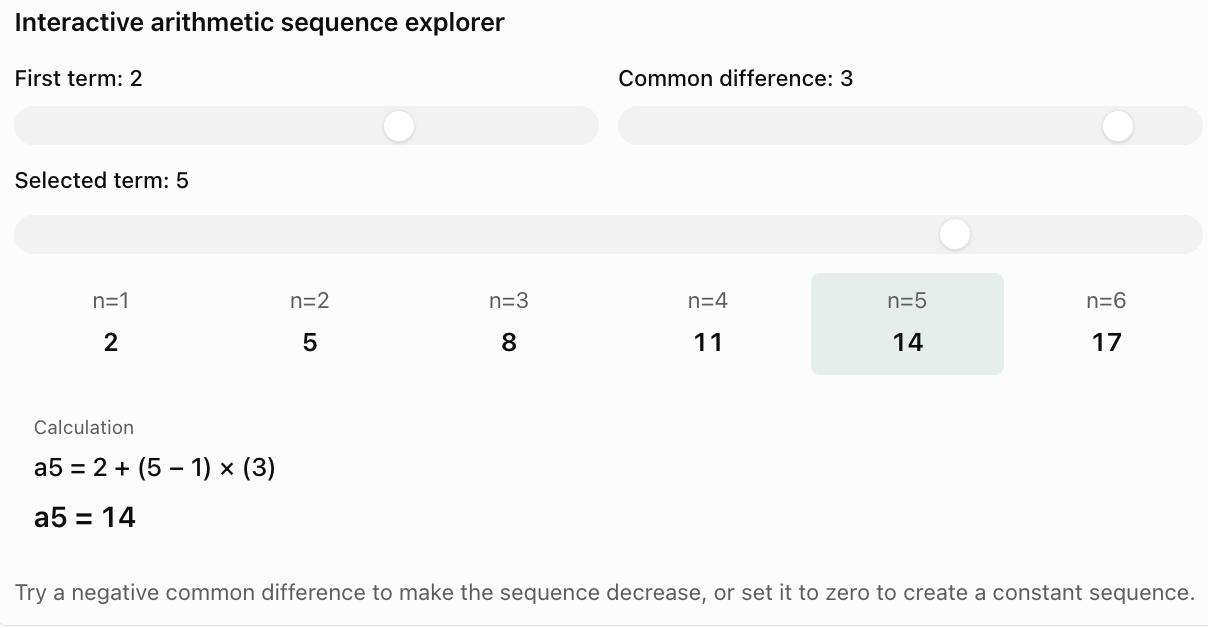
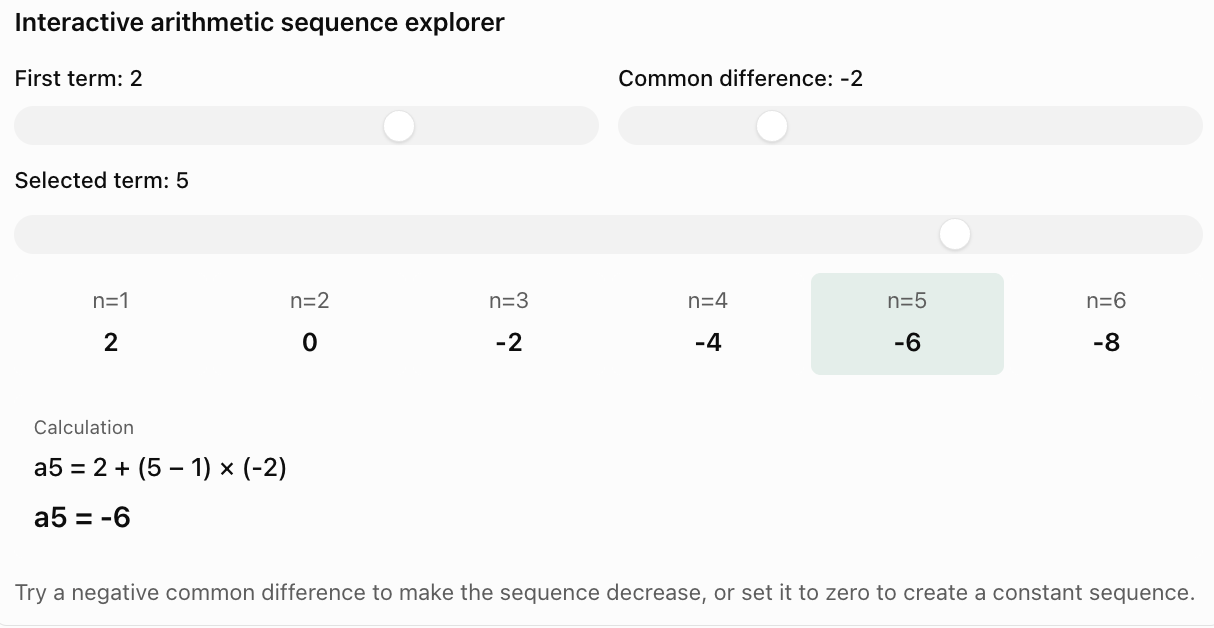
Exploring Arithmetic Sequences
Changing the first term moves the entire sequence up or down. Changing the common difference changes how quickly the terms increase or decrease.
Arithmetic Sequences and Linear Relationships
Arithmetic sequences are closely related to linear functions.
Consider:
4, 7, 10, 13, 16, ...
The term number increases by 1 each time.
The term value increases by 3 each time.
This creates a constant rate of change.
Table of Values
|
Term number |
Term value |
|---|---|
|
1 |
4 |
|
2 |
7 |
|
3 |
10 |
|
4 |
13 |
|
5 |
16 |
The explicit rule is:
aₙ = 4 + (n − 1)(3)
Simplifying:
aₙ = 4 + 3n − 3
aₙ = 3n + 1
This resembles the equation of a straight line:
y = mx + b
The common difference corresponds to the slope.
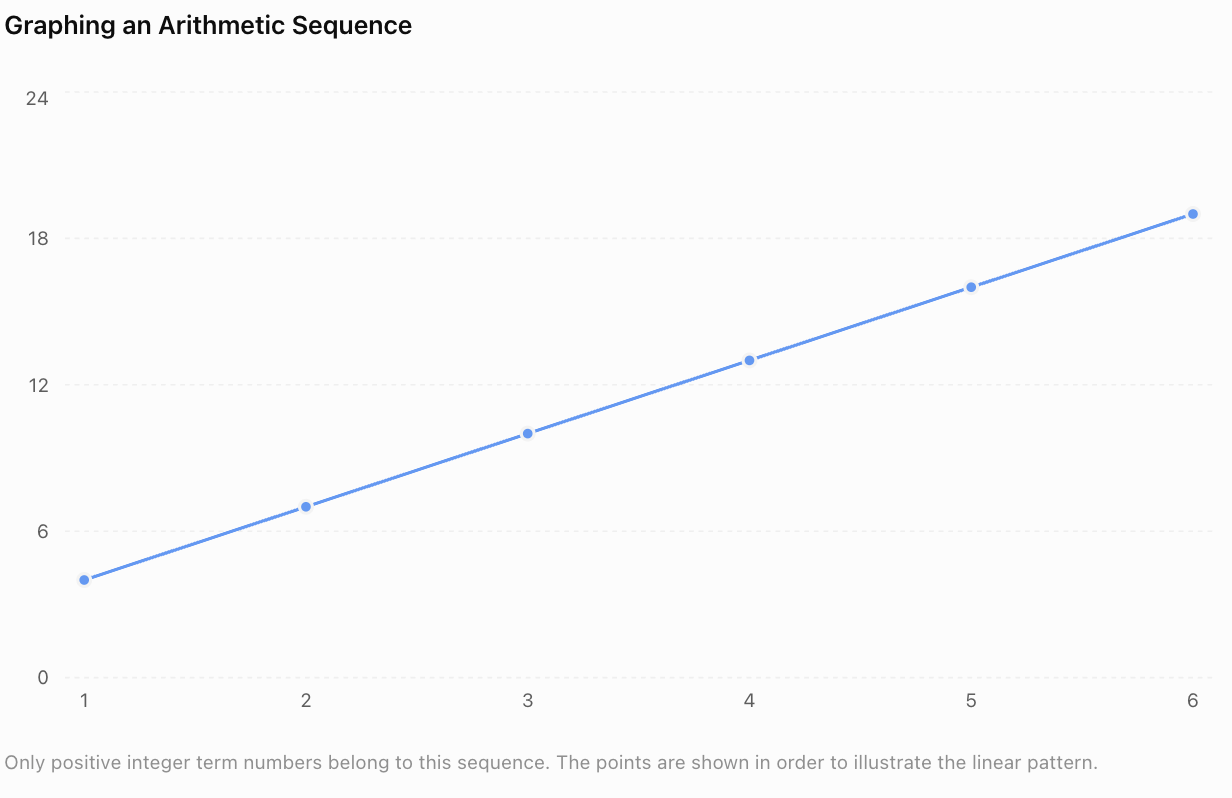
The term values follow a linear pattern.
When graphing an arithmetic sequence, only whole-number term positions are included.
Therefore, the graph consists of discrete points rather than a continuous line.
Important Connection
Arithmetic sequences are discrete linear relationships.
This means their values change at a constant rate, but the input positions are whole numbers.
Real-World Application: Saving Money
Arithmetic sequences can describe savings that increase by the same amount each week.
Worked Example
A student has $20 saved at the end of Week 1.
The student saves an additional $15 each week.
The amount saved at the end of each week forms the sequence:
20, 35, 50, 65, 80, ...
Step 1: Identify the First Term
a₁ = 20
Step 2: Identify the Common Difference
d = 15
Step 3: Generate the Next Terms
Week 1: $20
Week 2: $35
Week 3: $50
Week 4: $65
Week 5: $80
Step 4: Write the Rule
aₙ = 20 + (n − 1)(15)
Interpretation
The student's savings balance increases by $15 each week, assuming no withdrawals or interest.

Real-World Application: Theatre Seating
Rows of seats in theatres may increase by a fixed number from one row to the next.
Worked Example
A theatre has:
12 seats in the first row.
15 seats in the second row.
18 seats in the third row.
21 seats in the fourth row.
Step 1: Identify the Pattern
12, 15, 18, 21, ...
Step 2: Calculate the Common Difference
15 − 12 = 3
18 − 15 = 3
21 − 18 = 3
Therefore:
d = 3
Step 3: Find the Number of Seats in Row 8
a₈ = 12 + (8 − 1)(3)
a₈ = 12 + 21
a₈ = 33
Interpretation
The eighth row contains 33 seats.
Real-World Application: Temperature Changes
A temperature that changes by the same amount each hour can be modelled using an arithmetic sequence.
Worked Example
The temperature is 18°C at the first recorded hour.
It decreases by 2°C each hour.
The sequence is:
18, 16, 14, 12, 10, ...
Step 1: Identify the First Term
a₁ = 18
Step 2: Identify the Common Difference
d = −2
Step 3: Find the Sixth Recorded Temperature
a₆ = 18 + (6 − 1)(−2)
a₆ = 18 − 10
a₆ = 8°C
Interpretation
At the sixth recorded hour, the temperature would be 8°C if the same rate of change continued.
Important Observation
Real temperatures do not usually change by exactly the same amount every hour.
Arithmetic sequences can model regular changes, but real-world patterns may only be approximately arithmetic.
Real-World Application: Exercise and Training
An exercise plan may increase the number of repetitions by a fixed amount each session.
Worked Example
A student completes:
10 repetitions in Session 1.
13 repetitions in Session 2.
16 repetitions in Session 3.
19 repetitions in Session 4.
Step 1: Identify the Common Difference
d = 3
Step 2: Generate the Next Terms
Session 5: 22 repetitions.
Session 6: 25 repetitions.
Session 7: 28 repetitions.
Step 3: Describe the Pattern
The student increases the number of repetitions by 3 each session.
Important Observation
This mathematical model describes the pattern, but it does not establish that continuing the increases indefinitely would be appropriate or safe.
Real-World Application: Building Staircases
Staircases can illustrate arithmetic sequences when each step rises by the same vertical height.
Worked Example
Each stair has a vertical rise of 18 cm.
The heights above the floor after each step are:
18, 36, 54, 72, 90, ...
Step 1: Identify the First Term
a₁ = 18 cm
Step 2: Identify the Common Difference
d = 18 cm
Step 3: Find the Height After 12 Steps
a₁₂ = 18 + (12 − 1)(18)
a₁₂ = 18 + 198
a₁₂ = 216 cm
Interpretation
The top of the twelfth step is 216 cm above the starting floor level.


Comparing Arithmetic Patterns
Arithmetic sequences can have different starting values and common differences.
Consider three sequences.
Sequence A:
2, 5, 8, 11, 14, ...
d = 3
Sequence B:
10, 13, 16, 19, 22, ...
d = 3
Sequence C:
2, 7, 12, 17, 22, ...
d = 5
Comparing A and B
Sequences A and B have the same common difference.
They increase at the same rate.
However, Sequence B begins 8 units higher.
Comparing A and C
Sequences A and C have the same first term.
However, Sequence C has a larger common difference.
Therefore, Sequence C increases more quickly.
Mathematical Interpretation
The first term determines where the sequence begins.
The common difference determines how rapidly the terms change.
These are the two main characteristics of an arithmetic sequence.
Solving Multi-Step Arithmetic Sequence Problems
Some problems require finding the common difference before calculating a particular term.
Worked Example
An arithmetic sequence has:
Third term = 14
Seventh term = 30
Find the common difference and first term.
Step 1: Determine the Number of Intervals
From the third term to the seventh term:
7 − 3 = 4 intervals
Step 2: Calculate the Total Change
30 − 14 = 16
Step 3: Find the Common Difference
d = 16/4
d = 4
Step 4: Work Backwards to the First Term
Third term = 14
Second term = 14 − 4 = 10
First term = 10 − 4 = 6
Therefore:
a₁ = 6
Step 5: Verify
Sequence:
6, 10, 14, 18, 22, 26, 30
The third term is 14.
The seventh term is 30.
Both conditions are satisfied.
Worked Example: Finding the Term Position
Consider:
5, 9, 13, 17, ...
Which term is equal to 45?
Step 1: Identify the Values
a₁ = 5
d = 4
aₙ = 45
Step 2: Substitute into the Formula
45 = 5 + (n − 1)(4)
Step 3: Rearrange
40 = 4(n − 1)
10 = n − 1
Step 4: Solve
n = 11
Interpretation
45 is the eleventh term.
Verification
a₁₁ = 5 + (11 − 1)(4)
a₁₁ = 5 + 40
a₁₁ = 45
The answer is correct.
A Systematic Method for Arithmetic Sequences
When solving arithmetic sequence problems, follow these steps.
Identify the Terms
Write the given terms in order.
Calculate the Differences
Subtract each term from the following term.
Check for a Constant Difference
Determine whether all consecutive differences are equal.
Identify the First Term
Record the starting value, a₁.
Identify the Common Difference
Record d, including its sign.
Choose a Method
Use repeated addition for nearby terms.
Use the explicit formula for distant terms.
Calculate
Substitute carefully and perform the required operations.
Verify
Check that the calculated terms follow the same pattern.
Interpret
Explain what the answer represents in the original problem.
Common Mistakes
Confusing the common difference with the first term
The first term is the starting value, while the common difference describes the change between terms.
Subtracting in the wrong order
Calculate the next term minus the previous term.
Assuming all arithmetic sequences increase
Arithmetic sequences may increase, decrease, or remain constant.
Confusing addition with multiplication
Arithmetic sequences involve repeated addition, not repeated multiplication.
Assuming a pattern is arithmetic without checking
A sequence can follow a pattern without having a constant difference.
Ignoring negative common differences
A decreasing sequence usually has a negative common difference.
Confusing the term number with the term value
The position n is not necessarily equal to the value aₙ.
Using n instead of n − 1
The first term requires zero additions of the common difference.
Making errors with negative numbers
Adding a negative common difference decreases the sequence.
Assuming the first term must be positive
Arithmetic sequences may begin with negative numbers or zero.
Assuming the common difference must be a whole number
Fractions and decimals can also be common differences.
Failing to verify missing terms
All consecutive differences should remain equal.
Assuming real-world patterns remain arithmetic forever
Mathematical models may only be valid over a limited range.
Key Terms
-
Sequence: An ordered list of numbers or mathematical objects.
-
Term: An individual value in a sequence.
-
Term Number: The position of a term in a sequence.
-
Arithmetic Sequence: A sequence with a constant difference between consecutive terms.
-
Common Difference: The constant amount added to each term to obtain the next term.
-
First Term: The initial value of a sequence, represented by a₁.
-
Nth Term: The value of the sequence at position n, represented by aₙ.
-
Consecutive Terms: Terms that appear next to one another in a sequence.
-
Constant Difference: An equal numerical change between every pair of consecutive terms.
-
Increasing Sequence: A sequence whose terms become larger.
-
Decreasing Sequence: A sequence whose terms become smaller.
-
Constant Sequence: A sequence in which every term has the same value.
-
Finite Sequence: A sequence containing a specified number of terms.
-
Infinite Sequence: A sequence that continues indefinitely.
-
Ellipsis: Three dots indicating that a pattern continues.
-
Recursive Rule: A rule that defines each term using a previous term.
-
Explicit Rule: A formula that calculates a term directly from its position.
-
Linear Relationship: A relationship with a constant rate of change.
-
Discrete Relationship: A relationship defined at separate values rather than every value in an interval.
-
Rate of Change: The amount by which one quantity changes relative to another.
-
Slope: A measure of the rate of change in a linear relationship.
-
Pattern Recognition: Identifying a consistent rule or relationship.
-
Arithmetic Pattern: A numerical pattern involving repeated addition of a constant.
-
Geometric Sequence: A sequence in which consecutive terms have a constant multiplicative ratio.
-
Mathematical Model: A mathematical representation of a real-world situation.
-
Proportional Reasoning: Using numerical relationships to solve problems.
-
Verification: Checking that a result satisfies the original conditions.
Key Takeaways
-
An arithmetic sequence is a sequence with a constant difference between consecutive terms.
-
The individual values in a sequence are called terms.
-
The position of a term is represented by n.
-
The value of the term at position n is represented by aₙ.
-
The first term is represented by a₁.
-
The common difference is represented by d.
-
The common difference is found by subtracting a term from the following term.
-
A positive common difference produces an increasing sequence.
-
A negative common difference produces a decreasing sequence.
-
A common difference of zero produces a constant sequence.
-
Arithmetic sequences can contain integers, fractions, decimals, and negative numbers.
-
A sequence is arithmetic only when all consecutive differences are equal.
-
Arithmetic sequences are generated by repeatedly adding the common difference.
-
A recursive rule uses a previous term to calculate the next term.
-
An explicit rule calculates a term directly from its position.
-
The nth-term formula is aₙ = a₁ + (n − 1)d.
-
The expression n − 1 represents the number of intervals from the first term to the nth term.
-
Arithmetic sequences are closely related to linear functions.
-
The common difference corresponds to the slope of the associated linear relationship.
-
Arithmetic sequences are represented by discrete points when graphed.
-
Real-world arithmetic patterns may describe savings, seating arrangements, temperatures, and repeated measurements.
-
The central skill is identifying the constant difference, using it to generate terms, and describing the pattern clearly using mathematical language.
Check Your Understanding
Recall and Understanding
-
Define an arithmetic sequence.
-
Explain what is meant by the common difference.
-
Describe the difference between an increasing and decreasing arithmetic sequence.
-
Explain why the sequence 7, 7, 7, 7, ... is arithmetic.
-
Explain how an arithmetic sequence differs from a geometric sequence.
Application
-
Find the common difference of the sequence: 4, 11, 18, 25, 32, ...
-
Determine whether the sequence 3, 6, 12, 24, 48 is arithmetic. Justify your answer.
-
Generate the first six terms of an arithmetic sequence with a₁ = 8 and d = 5.
-
Find the missing values: 6, __, 18, __, 30.
-
Determine the tenth term of the arithmetic sequence 2, 7, 12, 17, ...
Analysis and Challenge
-
An arithmetic sequence has a₁ = 40 and d = −3. Find the fifteenth term.
-
The third term of an arithmetic sequence is 17, and the seventh term is 37. Determine the common difference and first term.
-
A theatre has 14 seats in its first row. Each following row contains 3 more seats than the previous row. How many seats are in the twelfth row?
-
A student begins with $50 and adds $12 to their savings each week. If $50 is the balance at the end of Week 1, how much will the student have at the end of Week 15?
-
The sequence 9, 15, 21, 27, ... contains the value 105. Determine which term equals 105 and show your reasoning.
Final Summary
Arithmetic sequences describe numerical patterns in which consecutive terms differ by a constant amount.
The common difference determines whether a sequence increases, decreases, or remains constant.
By identifying the first term and common difference, we can generate additional terms, complete missing values, and describe patterns mathematically.
Arithmetic sequences can be represented using verbal rules, tables, recursive relationships, explicit formulas, and graphs.
Their constant rate of change connects them directly to linear relationships.
They also provide useful models for everyday situations involving regular increases or decreases in quantities.
The central principle is that every arithmetic sequence follows a constant additive pattern, allowing its terms to be predicted, calculated, and explained using mathematical reasoning.