Solving Linear Equations
5. Real-World Equation Modeling
Learning outcomes
- I can translate verbal descriptions into algebraic equations.
- I can identify variables and unknown quantities in real situations.
- I can solve equations that model real-world problems.
- I can interpret solutions within the context of a problem.
- I can evaluate whether a solution is reasonable.
What Is Equation Modeling?
A mathematical model is a representation of a real situation using mathematics.
A real-world problem might describe:
- the cost of a taxi ride
- the number of tickets sold
- the distance travelled
- the dimensions of a shape
- a phone bill
- a savings goal
- an age relationship
- a measurement
- a salary plus commission
The words tell us how quantities are related.
Our job is to translate those relationships into an equation.
Once the equation is written, we can use algebra to solve it.
A useful overall process is:
real situation → identify unknown → write equation → solve → interpret → check
A reliable word-problem strategy begins by identifying what is unknown, assigning a variable, translating the relationships into an equation, solving, and then checking the result in context.
Why Is Modeling Important?
Algebra is useful because it allows us to represent situations that contain an unknown quantity.
For example:
A streaming service charges a monthly fee of $8 plus $2 per movie.
Your total bill is $22.
How many movies did you rent?
We could guess and check.
But algebra gives us a systematic approach.
Let:
m = number of movies
The cost of the movies is:
2m
The fixed monthly fee is:
8
Total bill:
22
So the equation is:
2m + 8 = 22
Subtract 8:
2m = 14
Divide by 2:
m = 7
Interpretation:
7 movies were rented.
This is equation modeling.
Start by Identifying the Unknown
Before writing an equation, determine:
What am I trying to find?
This unknown quantity should be represented by a variable.
For example:
A concert ticket costs $18. You spent $126. How many tickets did you buy?
The unknown is:
number of tickets
We could write:
Let t = number of tickets
Then:
18t = 126
Solve:
t = 7
The variable has a specific meaning in the problem.
It is not simply an abstract letter.
Define Your Variable Clearly
Good modeling begins with a clear variable statement.
Instead of writing only:
x = ?
write:
Let x = number of notebooks purchased
or:
Let d = distance travelled in kilometres
or:
Let w = width of the garden in metres
This helps prevent confusion later.
A variable should represent a quantity, not a unit or vague idea.
Known Quantities vs Unknown Quantities
Every problem contains information that is already known and something that must be found.
Consider:
A gym charges a joining fee of $25 and $15 each month. Your total cost was $130.
Known quantities:
- joining fee = $25
- monthly fee = $15
- total cost = $130
Unknown:
- number of months
Let:
m = number of months
Then:
25 + 15m = 130
Recognising these quantities is often more important than immediately looking for arithmetic keywords.
Translating Words into Mathematics
Certain words often suggest mathematical operations.
| Words or Phrase | Possible Operation |
|---|---|
| sum, total, added to, increased by | Addition |
| difference, decreased by, less than | Subtraction |
| product, times, twice, triple | Multiplication |
| quotient, divided by, per | Division |
| is, equals, results in | Equals |
These words are helpful clues, but they should not replace understanding the situation.

Addition Phrases
Examples:
A number plus 7
becomes:
x + 7
Eight more than a number
becomes:
x + 8
A number increased by 12
becomes:
x + 12
The total of a number and 5
becomes:
x + 5
Subtraction Phrases
Examples:
A number minus 4
becomes:
x − 4
A number decreased by 9
becomes:
x − 9
But be careful with:
5 less than a number
This means:
x − 5
not:
5 − x
Order matters in subtraction.
"Less Than" Can Reverse the Order
Consider:
3 less than 10
We calculate:
10 − 3
Therefore:
3 less than x
means:
x − 3
Similarly:
7 less than twice a number
means:
2x − 7
This is a common source of errors in equation modeling.
Multiplication Phrases
Examples:
three times a number
3x
twice a number
2x
half a number
x/2
the product of 5 and a number
5x
Remember:
twice x = 2x
not:
x²
Division Phrases
Examples:
a number divided by 5
x/5
the quotient of a number and 4
x/4
half of a number
x/2
a cost of $24 shared equally among x people
24/x
The order of division matters.
From an Expression to an Equation
An expression does not contain an equals sign.
Example:
3x + 5
An equation states that two expressions are equal.
Example:
3x + 5 = 20
Real-world modeling often requires us to determine what quantity represents each side of the equation.
Example: Translating a Verbal Statement
"The sum of twice a number and 9 is 31."
Let:
x = the number
Twice the number:
2x
Add 9:
2x + 9
"is 31" means:
= 31
Equation:
2x + 9 = 31
Solve:
2x = 22
x = 11
Not Every Problem Should Be Translated Word by Word
Keywords are helpful, but modeling is really about relationships.
For example:
"A taxi charges $4 to begin a ride and $2.50 for every kilometre travelled. The total fare is $19."
We should think:
total cost = starting fee + distance charge
Let:
d = distance in kilometres
Then:
19 = 4 + 2.50d
or equivalently:
4 + 2.50d = 19
Understanding the structure is more reliable than hunting for individual keywords.
A Useful Modeling Framework
For many linear situations, the model has the form:
Total = fixed amount + rate × quantity
or:
y = mx + b
Here:
- b represents a fixed starting amount
- m represents a rate per unit
- x represents the number of units
- y represents the total
This pattern appears in many real-life problems.
Examples include:
- taxi fares
- phone plans
- hourly wages
- delivery fees
- equipment rentals
- memberships
Example: Taxi Fare
A taxi charges:
$5 starting fee
plus:
$3 per kilometre
The total fare is:
$29
Let:
k = kilometres travelled
Model:
5 + 3k = 29
Subtract 5:
3k = 24
Divide by 3:
k = 8
Interpretation:
The taxi travelled 8 km.
Does the Answer Make Sense?
We should check:
Starting fee:
$5
Distance charge:
8 × $3 = $24
Total:
$5 + $24 = $29
Yes.
The solution satisfies both the equation and the real-world situation.
Example: Phone Plan
A phone plan costs:
$20 per month
plus:
$0.10 per text message above the included limit
One month the bill was:
$32.50
Let:
t = number of extra text messages
Equation:
20 + 0.10t = 32.50
Subtract 20:
0.10t = 12.50
Divide:
t = 125
Interpretation:
125 extra messages were sent.
Check:
$20 + $0.10(125)
= $20 + $12.50
= $32.50
Reasonable.
Example: Hourly Pay
A worker receives a base payment of $45 plus $18 per hour.
The total pay for a job was:
$153
Let:
h = number of hours worked
Equation:
45 + 18h = 153
Subtract 45:
18h = 108
Divide by 18:
h = 6
Interpretation:
The worker worked for 6 hours.
Example: Savings
You already have:
$120
You save:
$25 each week
You want:
$320
Let:
w = number of weeks
Model:
120 + 25w = 320
Subtract 120:
25w = 200
Divide:
w = 8
It will take:
8 weeks
to reach the goal.
The Meaning of the Variable Matters
Suppose the algebra gave:
w = 8
That answer alone is incomplete.
What does 8 mean?
It might mean:
- $8
- 8 km
- 8 people
- 8 weeks
- 8 tickets
In the savings example:
w = 8 weeks
Always interpret the solution in the context of the problem.
Distance, Rate and Time Problems
A common real-world relationship is:
distance = rate × time
or:
d = rt
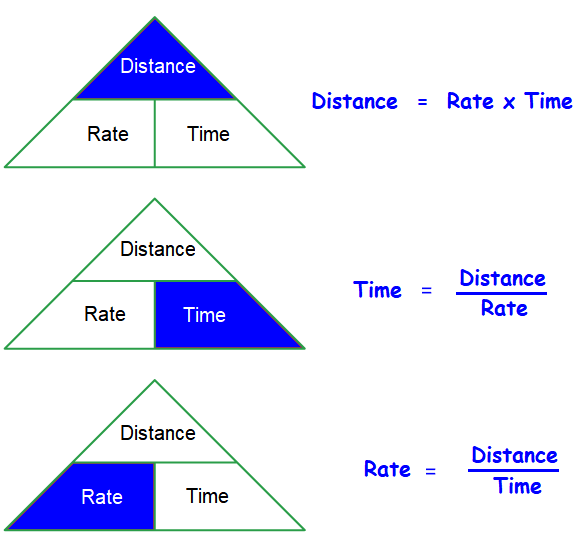
This formula can be used to create and solve linear equations.
Example: Distance Travelled
A cyclist travels at:
18 km/h
for:
t hours
and covers:
72 km
Equation:
18t = 72
Divide by 18:
t = 4
Interpretation:
The cyclist travelled for 4 hours.
Check:
18 km/h × 4 h = 72 km
Example: Journey with a Fixed Distance
A driver has already travelled:
45 km
and continues at:
70 km/h
The total journey is:
255 km
How much longer must the driver travel?
Let:
t = remaining travel time in hours
Distance still being modelled:
70t
Equation:
45 + 70t = 255
Subtract 45:
70t = 210
Divide:
t = 3
The driver must travel:
3 more hours.
Geometry as a Real-World Model
Equations can also model physical dimensions.
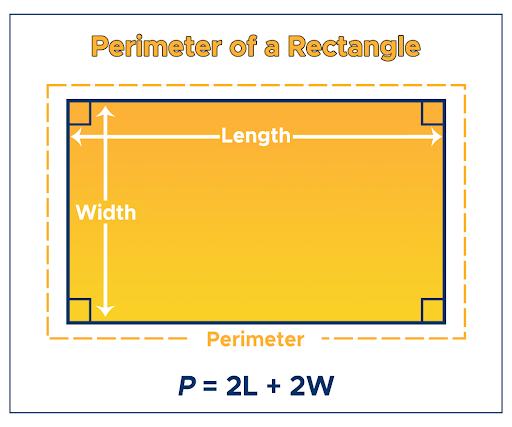
Suppose a rectangular garden has:
width = x metres
length = x + 4 metres
perimeter = 32 metres
The perimeter formula is:
P = 2L + 2W
Substitute:
32 = 2(x + 4) + 2x
Expand:
32 = 2x + 8 + 2x
Combine:
32 = 4x + 8
Subtract 8:
24 = 4x
Therefore:
x = 6
Width:
6 m
Length:
10 m
Check the Geometry Answer
Perimeter:
2(10) + 2(6)
= 20 + 12
= 32
So the solution is correct.
Also, both dimensions are positive, which is necessary for a real rectangle.
Modeling Consecutive Numbers
Real-world modeling can also involve numbers that have a special relationship.
Consecutive integers differ by 1.
If the first integer is:
x
then the next is:
x + 1
and the next:
x + 2
Suppose two consecutive integers have a sum of 41.
Equation:
x + (x + 1) = 41
Simplify:
2x + 1 = 41
2x = 40
x = 20
Therefore the numbers are:
20 and 21
Modeling Ages
Suppose Maya is 6 years older than Ben.
Together their ages total 34.
Let:
b = Ben's age
Then Maya's age is:
b + 6
Equation:
b + (b + 6) = 34
Simplify:
2b + 6 = 34
2b = 28
b = 14
Maya:
14 + 6 = 20
Answer:
Ben is 14 and Maya is 20.
Why Parentheses Are Useful
In the previous example:
b + (b + 6) = 34
The parentheses show that:
b + 6
represents Maya's entire age.
Parentheses become especially important when a quantity is multiplied.
Example:
A family buys 3 tickets, each costing:
x + 4 dollars
Total:
3(x + 4)
This is different from:
3x + 4
Example: Ticket Sales
Adult tickets cost:
$12
Student tickets cost:
$7
Suppose a group buys:
3 adult tickets
and some student tickets.
The total cost is:
$71
Let:
s = number of student tickets
Adult cost:
3(12) = 36
Student cost:
7s
Equation:
36 + 7s = 71
Subtract 36:
7s = 35
Therefore:
s = 5
The group bought:
5 student tickets.
Integer Restrictions Matter
Suppose you solve a ticket problem and obtain:
s = 5.4
Mathematically, the equation may have been solved correctly.
But in the real-world context:
5.4 tickets does not make sense
because tickets are normally counted as whole objects.
This tells us to reconsider:
- whether the equation was written correctly
- whether the data were copied correctly
- whether rounding is appropriate
- whether the problem expects an integer solution
Context matters.
Example: Buying Boxes
A school needs at least 100 markers.
Markers are sold in boxes of 12.
If a calculation says:
8.33 boxes
you cannot normally purchase 0.33 of a sealed box.
So the practical answer would be:
9 boxes
This shows that interpreting a model may require more than simply reporting a calculator result.
Continuous Quantities Are Different
Some quantities can reasonably contain decimals.
Examples include:
- distance
- mass
- time
- volume
- money
- temperature
For example:
t = 2.5 hours
is perfectly reasonable.
Likewise:
d = 7.25 km
can make sense.
So whether a decimal answer is acceptable depends on the quantity being modeled.
Example: Restaurant Bill
Three friends split a bill equally.
The bill includes a fixed service charge of:
$9
The total bill is:
$72
Suppose each person's food cost before the service charge is the same.
Let:
x = food cost per person
Equation:
3x + 9 = 72
Subtract 9:
3x = 63
Divide by 3:
x = 21
Each person's food cost was:
$21
Example: Temperature Relationship
Suppose a laboratory sample begins at:
18°C
and warms at:
4°C per minute
After some time, its temperature reaches:
46°C
Let:
t = time in minutes
Model:
18 + 4t = 46
Subtract 18:
4t = 28
t = 7
The sample heated for:
7 minutes.
Model the Relationship, Not Just the Numbers
A common mistake is to see numbers and immediately perform arithmetic.
Consider:
A parking garage charges $6 to enter and $2 for every hour parked. Your bill is $18.
Numbers:
6, 2, 18
Blind arithmetic might lead to:
18 ÷ 6
or:
18 ÷ 2
Neither fully represents the situation.
The correct relationship is:
starting fee + hourly charge = total
So:
6 + 2h = 18
This gives:
h = 6
Understanding the story comes first.
Fixed Costs and Variable Costs
Many real-world linear equations contain two kinds of costs.
Fixed cost
A cost that does not depend on how many units are used.
Examples:
- entrance fee
- subscription fee
- equipment rental fee
- delivery charge
Variable cost
A cost that changes with the number of units.
Examples:
- cost per kilometre
- cost per hour
- cost per item
- cost per gigabyte
This often creates:
Total cost = fixed cost + variable rate × quantity
Example: Bicycle Rental
A bicycle rental shop charges:
$12 fixed fee
plus:
$6 per hour
Your bill is:
$42
Let:
h = hours rented
Equation:
12 + 6h = 42
Subtract 12:
6h = 30
Divide:
h = 5
The bicycle was rented for:
5 hours.
Reverse Modeling
Sometimes you are given a situation and must decide whether an equation correctly represents it.
Suppose:
"A music service charges $10 per month plus $0.50 per downloaded song."
Let:
s = number of downloaded songs
Which equation gives total cost C?
Correct:
C = 10 + 0.50s
Why?
- $10 is fixed
- $0.50 depends on the number of songs
Incorrect:
C = 10s + 0.50
because that would charge $10 per song.
Units Can Help You Build an Equation
Units are powerful clues.
Suppose:
$4 per notebook × n notebooks
The notebooks cancel conceptually, leaving:
dollars
So:
4n
represents a cost.
Likewise:
60 km/h × t hours
gives:
60t km
which represents distance.
If the units of your expression do not match the quantity being modeled, something may be wrong.
Example: Unit Reasoning
A car travels:
80 km/h
for:
t hours
Distance:
80 km/h × t h
The hours cancel:
80t km
Therefore:
d = 80t
Unit analysis supports the equation.
Interpreting Negative Solutions
Suppose a problem asks:
"How many tickets were sold?"
and your solution is:
x = −12
That is not physically reasonable.
You cannot sell negative tickets in the ordinary interpretation.
A negative result may indicate:
- the model was written incorrectly
- the given numbers are inconsistent
- a sign was reversed
- the variable was defined differently than expected
Not every algebraic solution is meaningful in every context.
Interpreting Zero
Zero can sometimes be completely reasonable.
For example:
"How many additional kilometres must you travel?"
A solution:
d = 0
could mean:
you have already arrived.
Context determines whether zero makes sense.
Evaluating Reasonableness with Estimation
You do not always need an exact calculation to spot an unreasonable result.
Suppose:
A notebook costs about $4.
You spent about $40.
You should expect roughly:
10 notebooks
If your algebra gives:
x = 100
something is probably wrong.
Estimation provides a useful reality check.
Example: Estimating First
A concert charges:
$24 per ticket
plus a one-time booking fee of:
$5
The total is:
$101
Before solving:
Four tickets cost about:
4 × $24 = $96
plus $5:
$101
So we already expect:
4 tickets
Now solve:
24t + 5 = 101
24t = 96
t = 4
The exact solution agrees with our estimate.
Checking by Substitution
Once an equation is solved, substitute the solution back into the model.
Suppose:
3x + 8 = 35
Solution:
x = 9
Check:
3(9) + 8
= 27 + 8
= 35
Mathematically correct.
Then check the context.
If x represented:
number of books
then:
9 books
is reasonable.
This gives two kinds of checking:
algebraic check
and:
context check
Algebraically Correct Does Not Always Mean Contextually Correct
Suppose:
A boat can carry 6 people per row.
An equation gives:
r = 4.5 rows
The algebra may be correct numerically.
But a real boat cannot normally have half of a seating row added for one trip.
The final interpretation may require:
5 rows
depending on the problem.
Mathematical models represent reality, but interpretation still requires judgment.
Multi-Step Modeling Example
A museum charges:
$14 admission
plus:
$3 for each special exhibit
A visitor spends:
$26
How many special exhibits did the visitor see?
Let:
e = number of special exhibits
Equation:
14 + 3e = 26
Subtract 14:
3e = 12
Divide by 3:
e = 4
Interpretation:
The visitor saw 4 special exhibits.
Check:
14 + 3(4) = 26
Reasonable because 4 exhibits is a whole, non-negative number.
More Challenging Example: Perimeter
A rectangular field is 7 m longer than it is wide.
Its perimeter is 54 m.
Let:
w = width
Then:
length = w + 7
Using:
P = 2L + 2W
we get:
54 = 2(w + 7) + 2w
Expand:
54 = 2w + 14 + 2w
Combine:
54 = 4w + 14
Subtract 14:
40 = 4w
w = 10
Length:
17
Therefore:
width = 10 m
length = 17 m
Check:
2(17) + 2(10) = 54
More Challenging Example: Two Related Quantities
There are 38 students in two classes.
Class A has 6 more students than Class B.
Let:
x = number of students in Class B
Then Class A has:
x + 6
Equation:
x + (x + 6) = 38
Simplify:
2x + 6 = 38
2x = 32
x = 16
So:
Class B = 16
Class A = 22
Check:
16 + 22 = 38
and:
22 − 16 = 6
Both conditions are satisfied.
Modeling Requires All Conditions to Be Satisfied
The previous example gives an important idea.
A solution must satisfy every condition in the problem.
It is not enough that:
16 + 22 = 38
We also need:
22 is 6 more than 16
A good contextual check tests all important relationships.
A Structured Problem-Solving Method
A strong approach to real-world equations is:
1. Read
Understand the situation.
2. Identify
Determine what is known and unknown.
3. Define
Choose a variable and state what it represents.
4. Model
Translate the relationships into an equation.
5. Solve
Use algebra to isolate the variable.
6. Interpret
State what the numerical solution means.
7. Evaluate
Check the equation and decide whether the answer is reasonable.
This closely matches standard algebraic problem-solving methods.
Visualizing the Modeling Process
A verbal statement contains mathematical structure.
For example:
"Five less than twice a number is 17."
Break it apart:
twice a number:
2x
five less than this:
2x − 5
is 17:
2x − 5 = 17
Now solve:
2x = 22
x = 11
Common Mistake: Choosing the Wrong Variable
Suppose:
"A jacket is $15 cheaper than a pair of shoes. Together they cost $105."
If:
x = cost of the shoes
then jacket cost:
x − 15
Equation:
x + (x − 15) = 105
But if:
x = cost of the jacket
then shoes cost:
x + 15
Equation:
x + (x + 15) = 105
Both approaches can work.
The important thing is to define the variable clearly and remain consistent.
Common Mistake: Ignoring a Fixed Amount
Problem:
A delivery service charges $8 plus $3 per package.
For 5 packages:
Incorrect:
3(5) = 15
Correct:
8 + 3(5) = 23
The fixed charge must be included.
Common Mistake: Multiplying the Wrong Quantity
"A gym charges $20 membership plus $10 per class."
Incorrect:
20x + 10
Correct:
20 + 10x
Only the class charge depends on the number of classes.
Common Mistake: Giving Only a Number
Suppose:
x = 12
If x represents months, the final answer should say:
It will take 12 months.
If x represents kilograms:
The mass is 12 kg.
Context is part of the answer.
Common Mistake: Trusting the Calculator Automatically
A calculator may correctly solve the arithmetic while the original model is wrong.
If you write the wrong equation, the calculator will faithfully solve:
the wrong equation.
That is why the modeling step is often the most important part.
Real-World Models Have Assumptions
Mathematical models simplify reality.
For example:
C = 5 + 2d
for a taxi fare assumes:
- the starting fee is exactly $5
- the rate remains $2 per kilometre
- there are no traffic charges
- there are no tolls
- there are no special surcharges
A model can be useful without including every possible detail.
Understanding its assumptions helps us know when the model is appropriate.
When a Linear Model Works
Linear equations work well when a quantity changes at a constant rate.
Examples:
- $4 per item
- 60 km each hour
- 3 cm growth each week
- $15 saved each month
These situations follow a pattern such as:
y = mx + b
where the rate of change remains constant.
When a Linear Model May Not Work
Not every real-world situation is linear.
Examples might include:
- compound interest
- population growth
- falling objects over long periods
- curved trajectories
- areas involving squared dimensions
For example:
The area of a circle is:
A = πr²
Because r is squared, the relationship is not linear.
Choosing the correct type of model is part of mathematical thinking.
Did You Know?
When engineers, economists, scientists, and businesses create mathematical models, they rarely begin by solving equations.
They first decide:
- which quantities matter
- which quantities can change
- which relationships are important
- which assumptions are reasonable
The equation comes after the situation has been understood.
That is why real-world equation modeling is more than an algebra skill. It is also a reasoning skill.
Model-Building Example
Suppose a company rents equipment.
The cost is:
- $50 setup fee
- $18 per day
We can create a general model.
Let:
d = number of days
Let:
C = total cost
Then:
C = 50 + 18d
This model can now answer many questions.
For 3 days:
C = 50 + 18(3)
C = 104
If total cost is $176:
176 = 50 + 18d
126 = 18d
d = 7
One equation can model an entire family of situations.
From a Table to an Equation
Suppose a delivery company has this pricing pattern:
| Packages | Cost |
|---|---|
| 1 | $11 |
| 2 | $14 |
| 3 | $17 |
| 4 | $20 |
The cost increases by:
$3 per package
So the rate is:
3
If one package costs $11, then the fixed starting cost must be:
$8
because:
8 + 3(1) = 11
Model:
C = 8 + 3p
This shows that real-world equations can be developed from data as well as written descriptions.
A Graph Can Represent the Same Model
For:
C = 8 + 3p
the equation, table, graph, and verbal description all represent the same relationship.
The 8 represents the starting cost.
The 3 represents the cost added per package.
This is an important connection between linear equations and linear functions.
Evaluating Whether a Model Makes Sense
After solving, ask:
- Is the value positive when it should be?
- Should the answer be a whole number?
- Are the units correct?
- Is the size of the answer reasonable?
- Does substitution reproduce the original information?
- Does the answer satisfy all conditions?
- Did I include every fixed amount and rate?
These questions turn calculation into mathematical reasoning.
Worked Example: Complete Modeling Process
A kayak rental costs $18 plus $7 per hour. A customer pays $53.
Step 1: Identify the unknown
Number of hours.
Step 2: Define the variable
Let h = number of hours rented.
Step 3: Identify the relationship
Total cost:
fixed fee + hourly cost
Step 4: Write the equation
18 + 7h = 53
Step 5: Solve
Subtract 18:
7h = 35
Divide by 7:
h = 5
Step 6: Interpret
The kayak was rented for 5 hours.
Step 7: Check
18 + 7(5)
= 18 + 35
= 53
The result is positive, realistic, and satisfies the original problem.
Challenge Example
A rectangular garden has a length that is 3 m more than twice its width.
Its perimeter is:
42 m
Let:
w = width
Then:
length = 2w + 3
Perimeter formula:
P = 2L + 2W
Substitute:
42 = 2(2w + 3) + 2w
Expand:
42 = 4w + 6 + 2w
Combine:
42 = 6w + 6
Subtract 6:
36 = 6w
Therefore:
w = 6
Length:
2(6) + 3 = 15
Check:
2(15) + 2(6)
= 30 + 12
= 42
Answer:
The garden is 6 m wide and 15 m long.
Key Terms
Model – A mathematical representation of a real situation.
Variable – A symbol representing a quantity that can change or is unknown.
Unknown – A quantity whose value must be determined.
Equation – A statement showing that two mathematical expressions are equal.
Expression – A mathematical combination of numbers, variables, and operations without an equals sign.
Fixed amount – A quantity that remains constant regardless of the number of units.
Rate – A quantity measured per unit, such as dollars per hour or kilometres per hour.
Interpret – Explain what a mathematical result means in its original context.
Reasonable solution – A solution that is mathematically correct and sensible in the real situation.
Constraint – A condition that limits possible values, such as requiring a number of people to be a whole number.
Assumption – A condition treated as true when building a model.
Key Takeaways
- Real-world equation modeling translates everyday situations into mathematics.
- Begin by identifying what quantity is unknown.
- Clearly define a variable and state what it represents.
- Separate known quantities from unknown quantities.
- Look for relationships between quantities rather than relying only on keywords.
- Addition phrases include total, increased by, sum, and more than.
- Subtraction phrases include difference, decreased by, and less than.
- Multiplication phrases include times, product, twice, and triple.
- Division phrases include quotient, divided by, and per.
- Be careful with order in expressions such as 5 less than x = x − 5.
- Many linear real-world models have the structure:
total = fixed amount + rate × quantity
- Use algebra to solve the model.
- Always interpret the numerical solution using the appropriate units and context.
- Whole-number quantities such as people, tickets, or boxes may require special interpretation.
- Decimal answers are often appropriate for time, distance, mass, and other continuous quantities.
- Substitute your answer back into the equation to check the mathematics.
- Also check whether the result makes sense in reality.
- Estimation can help identify unreasonable solutions.
- Units can help verify that an equation has been modeled correctly.
- A mathematically correct solution may still be meaningless if it violates the real-world conditions.
- Good modeling follows:
understand → define → translate → solve → interpret → evaluate.