Solving Linear Equations
4. Literal Equations and Formula Rearrangement
Learning outcomes
- I can identify variables and constants within formulas.
- I can rearrange formulas to isolate a specified variable.
- I can apply inverse operations when manipulating formulas.
- I can solve scientific and geometric formulas for different variables.
- I can verify the correctness of a rearranged formula.
What Is a Literal Equation?
A literal equation is an equation containing two or more variables.
Many formulas used in mathematics, science, engineering, and finance are literal equations.
Examples include:
d = vt
F = ma
A = πr²
V = IR
I = Prt
Instead of solving for a numerical answer, we often rearrange the formula so that a particular variable is isolated.
For example:
d = vt
can be rearranged to:
v = d/t
or:
t = d/v
The relationship has not changed. We have simply written the formula in a different form.
Variables and Constants
A variable is a quantity that can change.
For example, in:
d = vt
the letters:
d, v, and t
represent variables.
They might represent:
- d = distance
- v = velocity
- t = time
Each quantity can take different values in different situations.
A constant is a value that remains fixed.
For example, in:
C = 2πr
the number:
2
is a constant.
The value:
π
is also a mathematical constant, approximately:
3.14159
The variables are:
C and r
Coefficients in Formulas
A coefficient is a number or expression multiplying a variable.
For example:
y = 3x
The coefficient of x is:
3
In:
A = 1/2 bh
the coefficient of bh is:
1/2
In:
C = 2πr
the coefficient multiplying r is:
2π
Understanding what is multiplying or dividing the target variable is essential when rearranging formulas.
What Does It Mean to Rearrange a Formula?
To rearrange a formula means to rewrite it so that a chosen variable is alone on one side.
This is also called:
making a variable the subject of the formula.
For example:
F = ma
already has F as the subject.
If we want m as the subject:
m = F/a
If we want a as the subject:
a = F/m
The formula still represents the same physical relationship.
The Balance Principle Still Applies
Formula rearrangement uses exactly the same algebra rules as ordinary equation solving.
Whatever operation is performed on one side must also be performed on the other side.
For example:
A = bh
Suppose we want to isolate h.
h is multiplied by b.
Use the inverse operation:
divide by b
So:
A/b = bh/b
Therefore:
h = A/b
The other letters are treated just like known numbers while we isolate the target variable.
Inverse Operations
Formula rearrangement depends heavily on inverse operations.
| Operation | Inverse Operation |
|---|---|
| Addition | Subtraction |
| Subtraction | Addition |
| Multiplication | Division |
| Division | Multiplication |
| Squaring | Square root |
| Square root | Squaring |
The goal is to undo the operations surrounding the variable.
Example 1: Addition
Rearrange:
y = x + 7
Solve for x.
Subtract 7 from both sides:
y − 7 = x
Therefore:
x = y − 7
Example 2: Subtraction
Rearrange:
A = B − C
Solve for C.
Add C to both sides:
A + C = B
Subtract A:
C = B − A
Example 3: Multiplication
Rearrange:
P = IV
Solve for I.
I is multiplied by V.
Divide both sides by V:
P/V = I
Therefore:
I = P/V
Example 4: Division
Rearrange:
v = d/t
Solve for d.
Multiply both sides by t:
vt = d
Therefore:
d = vt
This is one reason formula triangles can be useful for simple multiplication-and-division relationships.
Rearranging Distance, Speed and Time
The basic motion formula is:
d = vt
where:
- d = distance
- v = velocity or speed
- t = time
To solve for velocity:
d = vt
Divide by t:
v = d/t
To solve for time:
d = vt
Divide by v:
t = d/v
So the three equivalent forms are:
d = vt
v = d/t
t = d/v
Formula Triangles
Formula triangles can help with simple relationships involving multiplication and division.
For example:
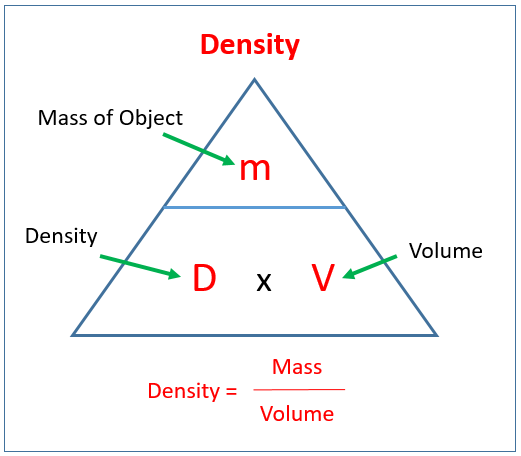
The density formula is:
ρ = m/V
where:
- ρ = density
- m = mass
- V = volume
From the same relationship:
m = ρV
and:
V = m/ρ
Formula triangles are useful shortcuts, but algebraic rearrangement is more powerful because it works with much more complicated formulas.
Rearranging the Density Formula
Start with:
ρ = m/V
Solve for m.
Multiply both sides by V:
ρV = m
Therefore:
m = ρV
Now solve for V.
Start again:
ρ = m/V
Multiply by V:
ρV = m
Divide by ρ:
V = m/ρ
One formula can therefore answer three different questions.
Ohm's Law
A common electrical formula is:
V = IR
where:
- V = voltage
- I = current
- R = resistance
To solve for current:
V = IR
Divide by R:
I = V/R
To solve for resistance:
V = IR
Divide by I:
R = V/I
Rearranging Formulas with More Than One Operation
Some formulas require several inverse operations.
Consider:
y = 3x + 5
Solve for x.
First subtract 5:
y − 5 = 3x
Then divide by 3:
x = (y − 5)/3
Notice the order.
We undo the addition first, then the multiplication.
This is often the reverse of the order in which the operations act on x.
Work from the Outside In
Consider:
P = 4x + 12
To isolate x:
First remove the addition:
P − 12 = 4x
Then remove multiplication by 4:
x = (P − 12)/4
A useful strategy is:
identify what is being done to the target variable and undo those operations in reverse order.
Example with Brackets
Rearrange:
y = 5(x + 2)
Solve for x.
First divide both sides by 5:
y/5 = x + 2
Then subtract 2:
x = y/5 − 2
Equivalent form:
x = (y − 10)/5
Both are correct.
Example with the Variable in a Denominator
Rearrange:
v = d/t
Solve for t.
Because t is in the denominator, first multiply both sides by t:
vt = d
Then divide by v:
t = d/v
When the target variable appears in a denominator, it is often helpful to remove the fraction first.
Geometry Example: Area of a Triangle
The area of a triangle is:
A = 1/2 bh
where:
- A = area
- b = base
- h = perpendicular height
Suppose we want h as the subject.
Start:
A = 1/2 bh
Multiply both sides by 2:
2A = bh
Divide by b:
h = 2A/b
So:
h = 2A/b
Rearranging the Triangle Formula for Base
Start with:
A = 1/2 bh
Multiply by 2:
2A = bh
Divide by h:
b = 2A/h
So the formula can be written as:
A = 1/2 bh
b = 2A/h
h = 2A/b
Geometry Example: Area of a Circle
The area of a circle is:
A = πr²

Suppose we want to solve for r.
Start:
A = πr²
Divide both sides by π:
A/π = r²
Now take the square root:
r = √(A/π)
This example introduces another inverse pair:
square ↔ square root
Why Do We Need a Square Root?
In:
A = πr²
the variable r is squared.
To isolate r, we must undo the square.
The inverse operation of:
r²
is:
√
Therefore:
r = √(A/π)
For a geometric radius, we use the positive root because radius represents a non-negative length.
Pythagorean Theorem
The Pythagorean theorem is:
a² + b² = c²
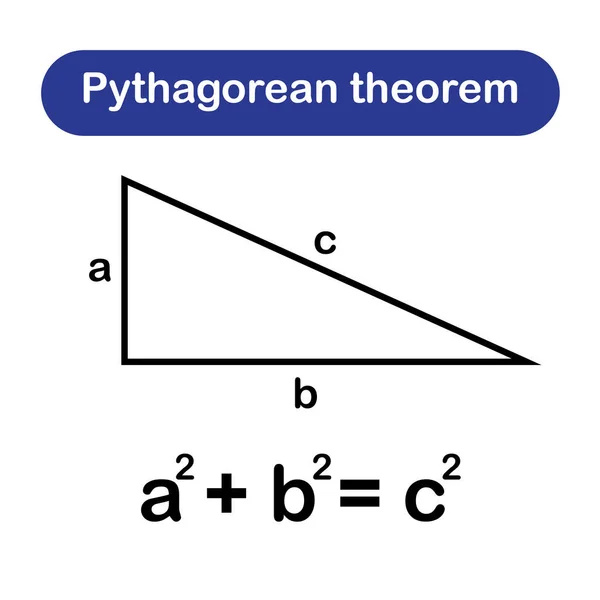
Usually c represents the hypotenuse.
If we want c:
a² + b² = c²
Take the square root:
c = √(a² + b²)
Rearranging the Pythagorean Theorem for a
Start with:
a² + b² = c²
Subtract b²:
a² = c² − b²
Take the square root:
a = √(c² − b²)
Similarly:
b = √(c² − a²)
Scientific Example: Newton's Second Law
Newton's second law is:
F = ma
where:
- F = resultant force
- m = mass
- a = acceleration
Solve for mass:
m = F/a
Solve for acceleration:
a = F/m
This is a good example of how algebra allows one scientific formula to calculate several different quantities.
Scientific Example: Kinetic Energy
Kinetic energy is given by:
Eₖ = 1/2 mv²
Suppose we want mass.
Start:
Eₖ = 1/2 mv²
Multiply by 2:
2Eₖ = mv²
Divide by v²:
m = 2Eₖ/v²
Rearranging Kinetic Energy for Velocity
Start:
Eₖ = 1/2 mv²
Multiply by 2:
2Eₖ = mv²
Divide by m:
2Eₖ/m = v²
Take the square root:
v = √(2Eₖ/m)
This requires three stages:
- remove 1/2
- remove m
- undo the square
Temperature Conversion Formula
A common relationship between Celsius and Fahrenheit temperatures is:
F = 9/5 C + 32
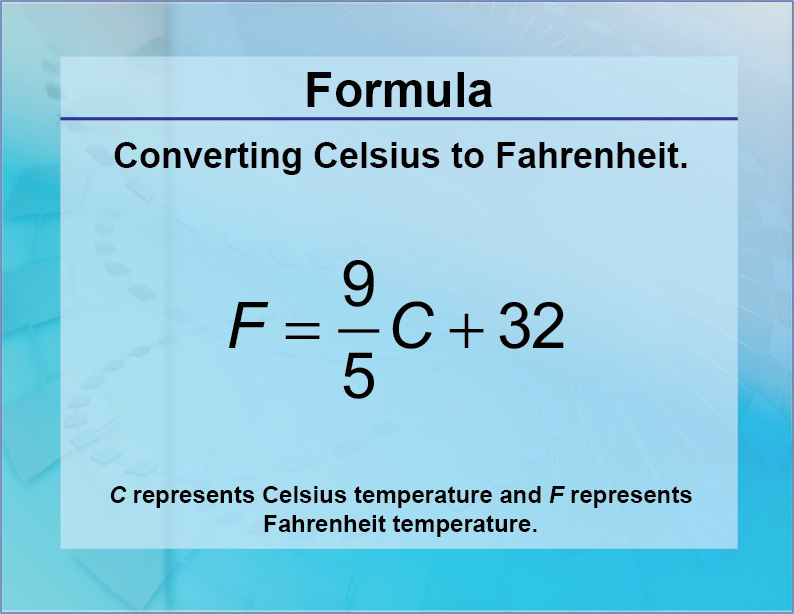
Suppose we want C as the subject.
Start:
F = 9/5 C + 32
Subtract 32:
F − 32 = 9/5 C
Multiply by 5/9:
C = 5/9(F − 32)
This gives the familiar Celsius conversion formula.
Why the Brackets Matter
Notice:
C = 5/9(F − 32)
The entire quantity:
F − 32
must be multiplied by 5/9.
It would be incorrect to write:
C = 5/9F − 32
because that represents a different relationship.
Brackets help preserve the correct order of operations.
Finance Example: Simple Interest
The simple interest formula is:
I = Prt
where:
- I = interest
- P = principal
- r = interest rate
- t = time
The formula is commonly used to calculate simple interest.
Rearranging Simple Interest for Rate
Start:
I = Prt
We want r.
Divide both sides by Pt:
I/(Pt) = r
Therefore:
r = I/(Pt)
Rearranging Simple Interest for Time
Start:
I = Prt
Divide both sides by Pr:
t = I/(Pr)
For principal:
P = I/(rt)
One formula can therefore be rearranged depending on which quantity is unknown.
When the Target Variable Appears More Than Once
Some formulas are more challenging because the target variable appears in several terms.
Consider:
ax + bx = c
We want x.
We cannot simply divide by a or b because x appears twice.
First factor x:
x(a + b) = c
Now divide by:
a + b
Therefore:
x = c/(a + b)
Factoring is an important strategy in literal equations.
Another Factoring Example
Rearrange:
P = xy + xz
Solve for x.
Factor x:
P = x(y + z)
Divide by:
y + z
Therefore:
x = P/(y + z)
Variable on Both Sides
Consider:
y = ax + bx
This is straightforward because x can be factored:
y = x(a + b)
Therefore:
x = y/(a + b)
But sometimes the variable appears on both sides.
Example:
ax + b = cx + d
Solve for x.
Move the x terms together:
ax − cx = d − b
Factor:
x(a − c) = d − b
Divide:
x = (d − b)/(a − c)
provided:
a − c ≠ 0
Formula Rearrangement and Restrictions
Whenever we divide by an expression, that expression must not equal zero.
For example:
x = c/(a + b)
requires:
a + b ≠ 0
because division by zero is undefined.
At an introductory level, these restrictions may not always be emphasized, but they become increasingly important in advanced algebra.
Fractional Formulas
Consider:
A = (x + y)/z
Solve for x.
Multiply both sides by z:
Az = x + y
Subtract y:
x = Az − y
If solving for z:
Start:
A = (x + y)/z
Multiply by z:
Az = x + y
Divide by A:
z = (x + y)/A
Example with Several Terms
Rearrange:
v = u + at
Solve for a.
Subtract u:
v − u = at
Divide by t:
a = (v − u)/t
This formula appears frequently in motion problems.
Rearranging for Time
Start:
v = u + at
Subtract u:
v − u = at
Divide by a:
t = (v − u)/a
The same formula can therefore be used to calculate:
- final velocity
- initial velocity
- acceleration
- time
depending on which variable is unknown.
Rearranging for Initial Velocity
Start:
v = u + at
Subtract at:
v − at = u
Therefore:
u = v − at
This requires only one inverse operation.
A Systematic Rearrangement Method
A reliable approach is:
- Identify the variable you need to isolate.
- Identify all operations acting on that variable.
- Simplify or factor if necessary.
- Apply inverse operations.
- Perform the same operation on both sides.
- Continue until the target variable is alone.
- Rewrite with the target variable on the left if desired.
- Verify the rearranged formula.
Example Using the Method
Rearrange:
A = 3x + 2y
Solve for x.
Step 1: Target variable
x
Step 2: Operations involving x
x is:
- multiplied by 3
- then 2y is added
Step 3: Undo addition
A − 2y = 3x
Step 4: Undo multiplication
x = (A − 2y)/3
Verifying a Rearranged Formula
How can we know that a rearranged formula is correct?
One method is to rearrange it back to the original form.
Suppose:
Original:
F = ma
Rearranged:
a = F/m
Multiply both sides by m:
ma = F
Rewrite:
F = ma
We have recovered the original formula.
Therefore the rearrangement is consistent.
Verification by Substitution
Another method is to choose numerical values.
Suppose:
F = ma
Let:
m = 4
and:
a = 3
Then:
F = 4 × 3 = 12
Now use the rearranged formula:
a = F/m
Substitute:
a = 12/4
a = 3
The same result is obtained.
This provides a useful check.
Verify the Triangle Formula
Original:
A = 1/2 bh
Let:
b = 10
h = 6
Then:
A = 1/2(10)(6)
A = 30
Our rearranged formula was:
h = 2A/b
Substitute:
h = 2(30)/10
h = 6
The original value is recovered.
Therefore the rearrangement works.
Dimensional and Unit Checks
Scientific formulas can sometimes be checked using units.
Consider:
v = d/t
Units are:
m/s = m/s
Now rearrange:
d = vt
Units:
m = (m/s)(s)
The seconds cancel:
m = m
This supports the rearrangement.
Unit Check for F = ma
Original:
F = ma
Units:
N = kg × m/s²
Now rearrange:
m = F/a
Units:
kg = N ÷ (m/s²)
Since:
1 N = 1 kg·m/s²
the units simplify to:
kg
A unit check can sometimes reveal algebraic errors.
Common Mistake: Moving Terms Without Explaining the Operation
Students often say:
"Move the 5 to the other side."
For:
y = 3x + 5
it is better to think:
subtract 5 from both sides
giving:
y − 5 = 3x
Terms do not magically change sides.
Their signs change because an inverse operation was performed.
Common Mistake: Dividing Only One Term
Suppose:
A − B = 3x
Then:
x = (A − B)/3
Both A and B are divided by 3.
It would be incorrect to write:
x = A − B/3
unless brackets are handled appropriately.
Common Mistake: Forgetting Brackets
Correct:
x = (y − 5)/3
Incorrect:
x = y − 5/3
The two expressions are not equivalent.
Brackets show that the entire numerator is divided by 3.
Common Mistake: Forgetting the Square Root
From:
r² = A/π
it is incorrect to conclude:
r = A/π
You must undo the square:
r = √(A/π)
Common Mistake: Square Rooting Only One Term
From:
c² = a² + b²
correct:
c = √(a² + b²)
not:
c = a + b
In general:
√(a² + b²) ≠ a + b
Common Mistake: Changing the Formula Instead of Rearranging It
A rearranged formula must describe exactly the same relationship as the original.
For example:
Original:
F = ma
Correct:
m = F/a
Incorrect:
m = Fa
The second formula represents a different mathematical relationship.
Why Formula Rearrangement Matters
Formula rearrangement allows us to use one relationship in many different ways.
For example:
V = IR
can calculate voltage if current and resistance are known.
But in a different experiment, voltage and resistance may be known and current may be unknown.
Rather than memorizing three separate formulas, we can rearrange one:
V = IR
I = V/R
R = V/I
This is much more flexible.
Application in Science
Science is full of formulas that need rearranging.
Examples include:
v = d/t
F = ma
ρ = m/V
V = IR
Eₖ = 1/2 mv²
p = F/A
Q = mcΔT
Being able to manipulate formulas reduces the number of separate equations that need to be memorized.
Application in Geometry
Geometry also depends heavily on formula rearrangement.
Examples include:
A = bh
A = 1/2 bh
A = πr²
C = 2πr
V = lwh
V = 1/3 πr²h
The variable you need depends on the information given in the problem.
Example: Circumference of a Circle
Start with:
C = 2πr
Solve for r.
Divide by 2π:
r = C/(2π)
If:
C = 31.4 cm
then:
r = 31.4/(2π)
approximately:
r = 5.0 cm
Example: Volume of a Rectangular Prism
The volume formula is:
V = lwh
Solve for h.
Divide both sides by lw:
h = V/(lw)
Similarly:
l = V/(wh)
and:
w = V/(lh)
Challenge Example: Cone Volume
The volume of a cone is:
V = 1/3 πr²h
Solve for h.
Multiply both sides by 3:
3V = πr²h
Divide by πr²:
h = 3V/(πr²)
Now solve for r.
Start:
3V = πr²h
Divide by πh:
3V/(πh) = r²
Take the square root:
r = √(3V/(πh))
Challenge Example: Rearranging with the Variable on Both Sides
Solve for x:
ax + b = cx + d
Subtract cx:
ax − cx + b = d
Subtract b:
ax − cx = d − b
Factor x:
x(a − c) = d − b
Divide:
x = (d − b)/(a − c)
This combines several algebra skills:
- collecting variable terms
- factoring
- dividing
- using brackets correctly
Did You Know?
Scientists and engineers often rearrange formulas before entering values into a calculator.
For example, if:
Eₖ = 1/2 mv²
and velocity is required, it is usually clearer to rearrange first:
v = √(2Eₖ/m)
and only then substitute the numbers.
This reduces repeated calculations and makes the mathematical structure easier to check.
A Useful Rearrangement Checklist
Before finishing, ask:
Is the requested variable completely alone?
Did I perform the same operation on both sides?
Did I use inverse operations correctly?
Do I need brackets?
Did I factor if the target variable appeared more than once?
Did I undo powers using roots?
Could any denominator become zero?
Can I rearrange the result back to the original formula?
If the answer to these questions is yes, the rearrangement is likely correct.
Key Terms
Literal equation – An equation containing two or more variables.
Formula – An equation describing a relationship between quantities.
Variable – A quantity whose value can change.
Constant – A fixed value.
Coefficient – A number or expression multiplying a variable.
Subject of a formula – The variable isolated on one side of a formula.
Rearrange – Rewrite a formula so that a different variable becomes the subject.
Inverse operation – An operation that reverses another operation.
Isolate – Get a variable alone on one side of an equation.
Factor – Rewrite an expression as a product of factors.
Verify – Check that a rearranged formula is equivalent to the original.
Key Takeaways
- A literal equation contains several variables.
- Variables represent quantities that may change.
- Constants have fixed values.
- Rearranging a formula means making a chosen variable the subject.
- Formula rearrangement follows the same balance rules as ordinary equations.
- Use inverse operations to isolate the target variable.
- Addition is undone by subtraction.
- Multiplication is undone by division.
- Squaring is undone using a square root.
- If the target variable appears more than once, you may need to factor it.
- Brackets are important when an entire expression is divided or multiplied.
- Scientific formulas such as F = ma, V = IR, and ρ = m/V can be rearranged for different quantities.
- Geometric formulas such as A = πr² and A = 1/2 bh can also be rearranged.
- The same formula can often answer several different types of questions.
- You can verify a rearrangement by transforming it back into the original equation.
- Numerical substitution and unit checks can also help verify the result.
- A reliable strategy is:
identify the target → simplify if needed → undo operations → isolate the variable → verify.