Coordinates, Transformations, and Symmetry
2. Translations
Learning outcomes
- I can define a translation as a slide of a figure.
- I can describe translations using direction and distance.
- I can perform translations on a coordinate grid.
- I can determine the coordinates of translated figures.
- I can recognize that translations preserve size and shape.
What Is a Translation?
In geometry, a translation is a transformation that slides a figure from one position to another.
During a translation:
- Every point moves the same distance.
- Every point moves in the same direction.
- The figure does not turn.
- The figure does not flip.
- The size and shape of the figure stay the same.
A translation changes the position of a figure, but not its size, shape, or orientation.


Transformations
A transformation changes the position, orientation, or size of a geometric figure.
Common transformations include:
- Translation – slides a figure.
- Reflection – flips a figure.
- Rotation – turns a figure.
- Dilation – changes the size of a figure.
A translation is sometimes simply called a:
slide
The Original Figure and Its Image
The figure before a transformation is sometimes called the:
preimage
After the transformation, the new figure is called the:
image
Points on the original figure are often labelled:
A, B, C
The corresponding translated points may be labelled:
A′, B′, C′
The symbol ′ is read as "prime."
Therefore:
A′ = A prime
Describing a Translation
A translation can be described using:
- Direction
- Distance
For example:
Translate 4 units right and 3 units up.
This tells us exactly how every point must move.
Other examples include:
2 units left and 5 units down
6 units right and 1 unit down
3 units left and 4 units up
Horizontal Translations
A horizontal translation moves a figure:
left or right
The x-coordinates change.
The y-coordinates stay the same.
For example, consider:
A(2, 3)
Translate A:
4 units right
The x-coordinate increases by 4:
2 + 4 = 6
The y-coordinate stays 3.
Therefore:
A(2, 3) → A′(6, 3)
Moving Left
Suppose:
B(5, 4)
is translated:
3 units left
Subtract 3 from the x-coordinate:
5 − 3 = 2
The y-coordinate does not change.
Therefore:
B(5, 4) → B′(2, 4)
Vertical Translations
A vertical translation moves a figure:
up or down
The y-coordinates change.
The x-coordinates stay the same.
Suppose:
C(3, 2)
is translated:
5 units up
Add 5 to the y-coordinate:
2 + 5 = 7
Therefore:
C(3, 2) → C′(3, 7)
Moving Down
Suppose:
D(−2, 6)
is translated:
4 units down
Subtract 4 from the y-coordinate:
6 − 4 = 2
Therefore:
D(−2, 6) → D′(−2, 2)
Horizontal and Vertical Movement Together
Most translations involve both horizontal and vertical movement.
Suppose:
P(2, 3)
is translated:
4 units right and 2 units up
First change x:
2 + 4 = 6
Then change y:
3 + 2 = 5
Therefore:
P(2, 3) → P′(6, 5)
Translating into Another Quadrant
Translations can move points across the coordinate axes.
Suppose:
A(−3, 2)
is translated:
5 units right and 4 units down
Calculate the new x-coordinate:
−3 + 5 = 2
Calculate the new y-coordinate:
2 − 4 = −2
Therefore:
A′(2, −2)
The point moved from Quadrant II to Quadrant IV.
Translation Rules
Translations can be represented using coordinate rules.
For example:
3 units right and 2 units up
can be written:
(x, y) → (x + 3, y + 2)
This means:
- Add 3 to every x-coordinate.
- Add 2 to every y-coordinate.
Direction and Coordinate Changes
The following relationships are useful:
| Movement | Coordinate Change |
|---|---|
| Right | Add to x |
| Left | Subtract from x |
| Up | Add to y |
| Down | Subtract from y |
This gives us an easy way to translate any point.
Example: Translation Rule
Translate:
A(4, 1)
using:
(x, y) → (x + 5, y − 3)
For x:
4 + 5 = 9
For y:
1 − 3 = −2
Therefore:
A′(9, −2)
The point moved:
5 units right and 3 units down
Translating a Figure
When translating a shape, every vertex must move according to the same rule.
Suppose triangle ABC has vertices:
A(1, 1)
B(4, 1)
C(2, 4)
Translate the triangle:
3 units right and 2 units up
Use:
(x, y) → (x + 3, y + 2)
Translating Vertex A
Original:
A(1, 1)
Apply the rule:
A′ = (1 + 3, 1 + 2)
Therefore:
A′(4, 3)
Translating Vertex B
Original:
B(4, 1)
Apply the rule:
B′ = (4 + 3, 1 + 2)
Therefore:
B′(7, 3)
Translating Vertex C
Original:
C(2, 4)
Apply the rule:
C′ = (2 + 3, 4 + 2)
Therefore:
C′(5, 6)
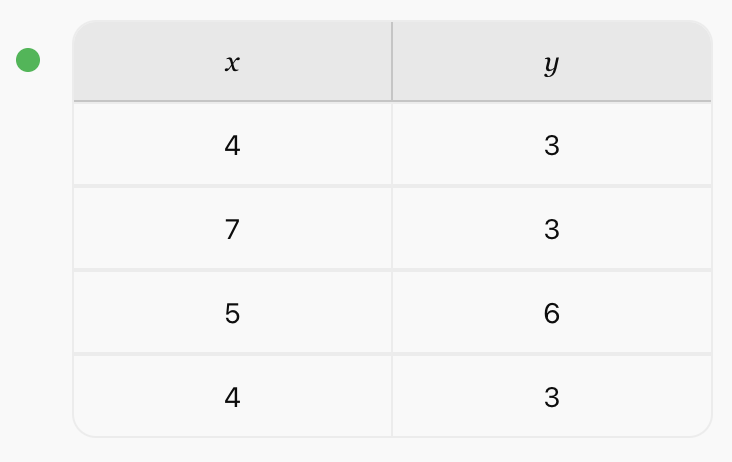
The translated triangle has vertices:
A′(4, 3)
B′(7, 3)
C′(5, 6)
Visualizing a Translation
Here is the original triangle and its translated image. Each vertex moves 3 units right and 2 units up.
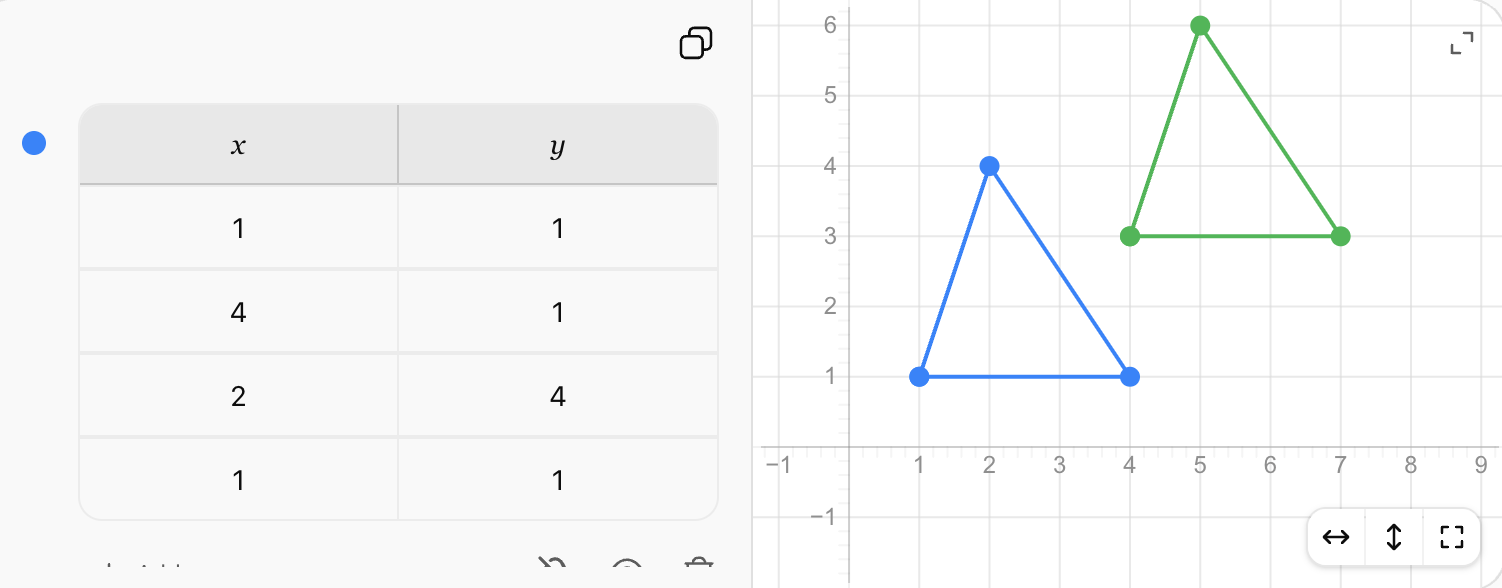
Notice that the translated triangle has exactly the same:
- Side lengths.
- Angles.
- Shape.
- Size.
- Orientation.
Only its position has changed.
Translations Preserve Size
A translation does not make a figure larger or smaller.
Suppose a line segment is:
5 cm
before a translation.
After the translation, the corresponding segment is still:
5 cm
Distances between corresponding points remain unchanged.
Translations Preserve Shape
A triangle remains the same type of triangle after translation.
For example:
- A right triangle remains a right triangle.
- A square remains a square.
- A rectangle remains a rectangle.
- A regular pentagon remains a regular pentagon.
The translation only changes where the figure is located.
Translations Preserve Angles
All angle measurements remain unchanged during a translation.
If an angle originally measures:
90°
then its corresponding angle after translation also measures:
90°
This is why the translated figure keeps the same shape.
Translations Preserve Orientation
A translation does not flip or rotate a figure.
If the original figure points upward, the translated figure still points upward.
If vertices originally occur in the order:
A → B → C
the corresponding vertices maintain the same orientation:
A′ → B′ → C′
Congruent Figures
Two figures are congruent if they have the same size and shape.
Because translations preserve both size and shape:
a figure and its translated image are congruent
The figures may be in different locations, but their dimensions are identical.
Finding a Translation from Two Points
Sometimes we know the original point and its translated position.
For example:
A(2, 3) → A′(7, 5)
Compare the x-coordinates:
7 − 2 = 5
So the point moved:
5 units right
Compare the y-coordinates:
5 − 3 = 2
So it moved:
2 units up
Therefore, the translation is:
5 units right and 2 units up
Another Example
Suppose:
B(4, 7) → B′(1, 2)
Horizontal change:
1 − 4 = −3
This means:
3 units left
Vertical change:
2 − 7 = −5
This means:
5 units down
Therefore, the translation is:
3 units left and 5 units down
Finding the Translation Rule
Suppose:
A(−2, 4) → A′(3, 1)
Horizontal change:
3 − (−2) = 5
Vertical change:
1 − 4 = −3
Therefore, the rule is:
(x, y) → (x + 5, y − 3)
Checking a Translation
Suppose we are told that the following points belong to the same translated figure:
A(1, 2) → A′(5, 5)
B(3, 4) → B′(7, 7)
Check A:
x change = +4
y change = +3
Check B:
x change = +4
y change = +3
Both points moved by the same amount.
Therefore, this is consistent with a translation.
When It Is Not a Translation
Suppose:
A(1, 2) → A′(5, 5)
but:
B(3, 4) → B′(8, 7)
For A:
change = (+4, +3)
For B:
change = (+5, +3)
The points did not move the same horizontal distance.
Therefore, these movements do not describe one translation of the entire figure.
Every point must move exactly the same distance and direction.
Translations with Negative Coordinates
Negative coordinates do not change the translation process.
Suppose:
P(−5, −2)
is translated:
7 units right and 4 units up
Calculate:
x = −5 + 7 = 2
y = −2 + 4 = 2
Therefore:
P′(2, 2)
Translating Left Across the y-Axis
Suppose:
Q(3, 4)
moves:
6 units left
Calculate:
3 − 6 = −3
Therefore:
Q′(−3, 4)
The point crosses the y-axis during the translation.
Translating Down Across the x-Axis
Suppose:
R(2, 3)
moves:
5 units down
Calculate:
3 − 5 = −2
Therefore:
R′(2, −2)
The point crosses the x-axis.
Translating Across Both Axes
Suppose:
S(−2, 3)
is translated:
5 units right and 7 units down
Calculate:
x = −2 + 5 = 3
y = 3 − 7 = −4
Therefore:
S′(3, −4)
The point has moved across both coordinate axes.
Translation Vectors
A translation can also be described using a vector.
For example:
(+4, +3)
means:
4 units right and 3 units up
Similarly:
(−5, +2)
means:
5 units left and 2 units up
and:
(+3, −6)
means:
3 units right and 6 units down
The first value describes horizontal movement.
The second describes vertical movement.
Translating with a Vector
Suppose the translation vector is:
(+3, −4)
and the original point is:
A(2, 6)
Add the horizontal change:
2 + 3 = 5
Add the vertical change:
6 + (−4) = 2
Therefore:
A′(5, 2)
Finding the Original Point
Sometimes the translated point is known, but the original point is missing.
Suppose a point is translated:
4 units right and 3 units up
and finishes at:
A′(7, 8)
Work backward.
For x:
7 − 4 = 3
For y:
8 − 3 = 5
Therefore, the original point was:
A(3, 5)
Reverse Translations
Every translation can be reversed.
If a figure moves:
5 units right and 2 units up
the reverse translation is:
5 units left and 2 units down
In coordinate form:
Original:
(x, y) → (x + 5, y + 2)
Reverse:
(x, y) → (x − 5, y − 2)
Translation Versus Reflection
A translation:
slides
a figure.
A reflection:
flips
a figure.


Both preserve size and shape, but a reflection reverses the orientation of a figure while a translation does not.
Translation Versus Rotation
A translation:
slides
A rotation:
turns
For example, rotating a triangle 90° changes its orientation.
Translating the triangle does not.
Translation Versus Dilation
A translation preserves size.
A dilation changes size.
For example, a dilation might make every side twice as long.
A translation never does this.
Comparing Transformations
| Transformation | Main Action | Size Preserved? | Shape Preserved? | Orientation Preserved? |
|---|---|---|---|---|
| Translation | Slide | Yes | Yes | Yes |
| Reflection | Flip | Yes | Yes | No |
| Rotation | Turn | Yes | Yes | Yes |
| Dilation | Resize | No* | Yes | Yes |
*Except when the scale factor is 1.
Translations in Patterns
Translations occur frequently in repeating patterns.
A design can be created by repeatedly sliding the same shape:
- Horizontally.
- Vertically.
- Diagonally.


This is called translational symmetry.
Examples can appear in:
- Wallpaper.
- Floor tiles.
- Brick walls.
- Fabric patterns.
- Decorative borders.
Translations in the Real World
The mathematical idea of translation can describe many types of movement.
Examples include:
- Sliding a book across a table.
- Moving a chess piece without turning it.
- Moving an object across a computer screen.
- Repeating tiles across a floor.
- Moving objects in computer graphics.
- Moving components in engineering designs.
The mathematical model assumes that every point on the object moves the same distance in the same direction.
A Reliable Translation Strategy
When translating a figure on a coordinate plane:
Step 1: Identify the direction and distance.
Step 2: Convert the movement into coordinate changes.
Right:
add to x
Left:
subtract from x
Up:
add to y
Down:
subtract from y
Step 3: Apply the same changes to every vertex.
Step 4: Plot the new points.
Step 5: Connect the points in the same order.
Step 6: Check that the new figure has the same size, shape, and orientation.
Worked Example
Rectangle ABCD has vertices:
A(1, 1)
B(5, 1)
C(5, 3)
D(1, 3)
Translate the rectangle:
2 units left and 4 units up
The rule is:
(x, y) → (x − 2, y + 4)
For A:
A′(−1, 5)
For B:
B′(3, 5)
For C:
C′(3, 7)
For D:
D′(−1, 7)
The new rectangle has exactly the same dimensions as the original.
Worked Example: Finding the Translation
Triangle ABC is translated to triangle A′B′C′.
Suppose:
A(−3, 2) → A′(2, 6)
Calculate the changes.
Horizontal:
2 − (−3) = 5
Vertical:
6 − 2 = 4
Therefore, the translation is:
5 units right and 4 units up
The rule is:
(x, y) → (x + 5, y + 4)
Every other vertex must follow this same rule.
Common Mistakes
Moving Only One Point
A translation applies to the entire figure.
Every vertex must move.
Moving Different Points Different Distances
Every point must move:
the same distance in the same direction
Otherwise, the transformation is not a translation.
Changing the Wrong Coordinate
Horizontal movement changes:
x
Vertical movement changes:
y
Remember:
left/right → x
up/down → y
Adding When Moving Left
Moving left means the x-coordinate becomes smaller.
Therefore:
subtract from x
Subtracting When Moving Up
Moving up means the y-coordinate becomes larger.
Therefore:
add to y
Ignoring Negative Numbers
Suppose:
x = −3
and the point moves 5 units right.
Calculate:
−3 + 5 = 2
Do not ignore the negative sign.
Changing the Shape
A translation cannot stretch, shrink, rotate, or distort a figure.
The image must be congruent to the original.
Confusing Translation and Reflection
A translation is a:
slide
A reflection is a:
flip
Confusing Translation and Rotation
A translation moves a figure without turning it.
A rotation:
turns the figure around a point
Check Your Understanding
1. Define a translation.
2. Why is a translation sometimes called a slide?
3. What must be true about the movement of every point during a translation?
4. What happens to the size of a figure during a translation?
5. What happens to its shape?
6. What happens to its orientation?
7. Translate (2, 3) four units right.
8. Translate (5, 2) three units left.
9. Translate (4, 1) five units up.
10. Translate (3, 7) four units down.
11. Translate (2, 3) four units right and five units up.
12. Translate (−3, 4) six units right and two units down.
13. Translate (5, −2) seven units left and four units up.
14. Describe the translation rule:
(x, y) → (x + 4, y + 3)
15. Describe the translation rule:
(x, y) → (x − 2, y − 5)
16. Write a coordinate rule for a translation of 6 units right and 3 units down.
17. Write a coordinate rule for a translation of 4 units left and 7 units up.
18. Point A moves from (2, 4) to (7, 6). Describe the translation.
19. Point B moves from (5, 7) to (2, 1). Describe the translation.
20. Point C moves from (−4, −2) to (3, 3). Describe the translation.
21. Triangle ABC has vertices A(1, 1), B(4, 1), and C(2, 4). Translate it 2 units right and 3 units up. Find A′, B′, and C′.
22. Rectangle ABCD has vertices A(−2, 1), B(3, 1), C(3, 4), and D(−2, 4). Translate it 4 units left and 2 units down. Find the new coordinates.
23. Explain why a translated figure is congruent to its original figure.
24. Explain the difference between a translation and reflection.
25. Explain the difference between a translation and rotation.
26. A translation moves every point 3 units right except one vertex, which moves 4 units right. Is this a valid translation? Explain.
27. A point is translated 5 units right and 4 units up and finishes at (8, 7). Find its original coordinates.
28. What is the reverse of a translation 6 units left and 2 units down?
29. Give two examples of translations that could occur in everyday life.
30. Explain how coordinates can be used to check whether two figures are related by a translation.
Key Terms
- Transformation – change in the position, orientation, or size of a geometric figure.
- Translation – transformation that slides every point the same distance in the same direction.
- Preimage – original figure before a transformation.
- Image – resulting figure after a transformation.
- Direction – way in which a figure moves.
- Distance – amount a figure moves.
- Translation rule – coordinate rule describing a translation.
- Translation vector – numerical description of horizontal and vertical movement.
- Congruent – having the same size and shape.
- Translational symmetry – repeating pattern produced by translations.
- Reflection – transformation that flips a figure.
- Rotation – transformation that turns a figure.
- Dilation – transformation that changes a figure's size.
Key Takeaways
- A translation is a slide.
- Every point moves the same distance in the same direction.
- Translations preserve size and shape.
- Translations also preserve angles, lengths, and orientation.
- The original and translated figures are congruent.
- Horizontal movement changes the x-coordinate.
- Vertical movement changes the y-coordinate.
- Moving right means add to x.
- Moving left means subtract from x.
- Moving up means add to y.
- Moving down means subtract from y.
- A translation of 3 units right and 2 units up can be written:
(x, y) → (x + 3, y + 2)
- The same coordinate rule must be applied to every vertex of a figure.
- A translation can move a figure across one or both coordinate axes.
- Translation rules can be determined by comparing original and translated coordinates.
- Translations are used in geometry, patterns, design, computer graphics, engineering, and many everyday situations.
A useful rule to remember is:
Translation = same direction + same distance for every point.