Coordinates, Transformations, and Symmetry

Safle: Young Education
Cwrs: Measurement and Geometry Basics
Llyfrau: Coordinates, Transformations, and Symmetry
Argraffwyd gan: Guest user
Dyddiad: Dydd Llun, 9 Tachwedd 2026, 4:36 PM

1. The Coordinate Plane

Learning outcomes
  • I can identify the x-axis, y-axis, and origin on a coordinate plane.
  • I can read and write ordered pairs correctly.
  • I can plot points on a coordinate grid.
  • I can determine the coordinates of points on a graph.
  • I can use coordinates to describe locations and positions.

What Is a Coordinate Plane?

A coordinate plane is a two-dimensional grid used to describe the exact location of points.

It is formed by two number lines that meet at right angles:

  • The horizontal x-axis
  • The vertical y-axis

These axes divide the coordinate plane into four regions called quadrants.

Coordinate planes allow us to represent positions using numbers rather than descriptions such as "a little to the right" or "near the top."

https://images.openai.com/static-rsc-4/GAss17jpiYULMOiat-LRBz6deRnV5eMl3DAyouEFWtSozKcXZNEjvEYp5bfwVTO-VARhhFzHTu6bsKDFerkFaIXCnTMgZWQtGGRX9CR3xJdIQ7qq2-g26Z1OnLj64meYtm0Xxpsyed4hpKA_PXprFBzLgUxpKNQQkpHbk0C6MY3mU0iBR9VzF_B7coBO7Usi?purpose=fullsize
 
https://images.openai.com/static-rsc-4/3feD0zDanmqmGCoIXL7M_7G7fbquU2KkpAJrJBbF9KBzeUS9Kj_0Uh_KEOw1a1ygAJwZ6HWXYg1DvnvFBFH-pS37jX-B7wLzoZEefkVnXaloVzA578VaS15aTrWVzw1Lq3XK8DNRBGMS11qFdzu2f61JDK0arF33eITAUlJCuPyd_w8uYv1d2gve5ewStuNb?purpose=fullsize
 
https://images.openai.com/static-rsc-4/FCskUvQnfQXKwQF1Vmu91BbEGHUx6YcxXl5ToB0EsiqtRZ7W8Q3ZeJNfNAbaXEjlaiCbTuANYe5KR5wHTzs235q8xK-B0X9f2Igoe_IISOtmJR9IUKSYdI6i2y66Prn8lx-nZKjoeq2MOy3t5SMWlUOJK2F5Kaq0jVhbCbC30nYMnqvcXvQDxKBHGOobCm1e?purpose=fullsize
 
5

The x-Axis

The x-axis is the horizontal number line.

Values increase as you move:

right

and decrease as you move:

left

Therefore:

  • Positive x-values are to the right of the origin.
  • Negative x-values are to the left of the origin.

The x-axis itself can be described by:

y = 0

because every point on the x-axis has a y-coordinate of zero.


The y-Axis

The y-axis is the vertical number line.

Values increase as you move:

up

and decrease as you move:

down

Therefore:

  • Positive y-values are above the origin.
  • Negative y-values are below the origin.

The y-axis can be described by:

x = 0

because every point on the y-axis has an x-coordinate of zero.


The Origin

The origin is the point where the x-axis and y-axis intersect.

Its coordinates are:

(0, 0)

The origin is the reference point from which positions on the coordinate plane are measured.


Ordered Pairs

A point on a coordinate plane is described using an ordered pair.

An ordered pair is written:

(x, y)

The first number gives the:

x-coordinate

The second number gives the:

y-coordinate

The order matters.

For example:

(4, 2)

means:

  • Move 4 units along the x-axis.
  • Move 2 units along the y-axis.

x Comes Before y

A useful rule is:

(x, y)

Always read the x-coordinate first.

One memory aid is:

Across first, then up or down.

For:

(3, 5)

move:

3 right

then:

5 up

For:

(−3, 5)

move:

3 left

then:

5 up


Plotting Points

To plot a point means to place it at the correct location on a coordinate plane.

Suppose we want to plot:

A(3, 2)

Start at the origin.

Move:

3 units right

because x = 3.

Then move:

2 units up

because y = 2.

Mark the location and label it:

A


An Interactive Coordinate Example

The points below show how positive and negative coordinates determine position.
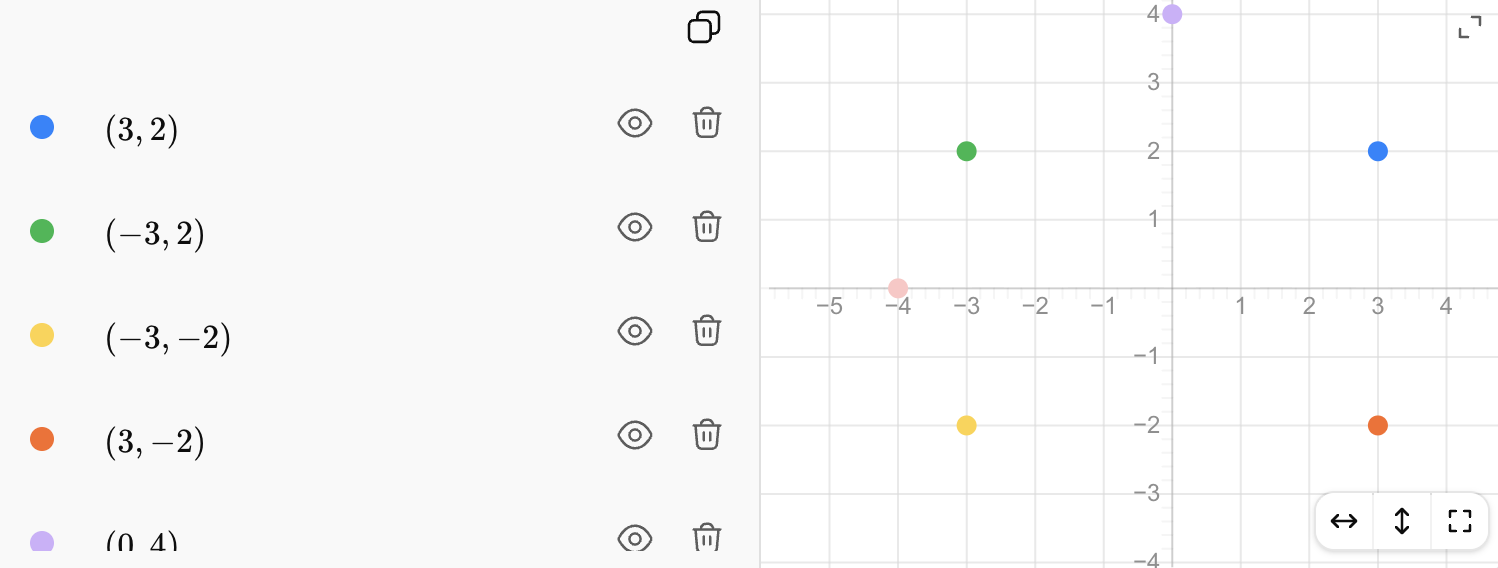
These positions illustrate several important patterns:

  • (3, 2) is right and up.
  • (−3, 2) is left and up.
  • (−3, −2) is left and down.
  • (3, −2) is right and down.
  • (0, 4) lies on the y-axis.
  • (−4, 0) lies on the x-axis.

Positive Coordinates

Consider:

P(5, 3)

Both coordinates are positive.

Start at:

(0, 0)

Move:

5 units right

and:

3 units up

The point is located in the upper-right part of the coordinate plane.


Negative x-Coordinates

Consider:

Q(−4, 2)

The x-coordinate is negative.

Move:

4 units left

Then the positive y-coordinate tells us to move:

2 units up


Negative y-Coordinates

Consider:

R(3, −5)

Move:

3 units right

Then:

5 units down

because the y-coordinate is negative.


Two Negative Coordinates

Consider:

S(−2, −4)

Move:

2 units left

and:

4 units down

Both coordinates are negative.


The Four Quadrants

The x-axis and y-axis divide the coordinate plane into four sections called quadrants.

https://images.openai.com/static-rsc-4/89MibETMGAy8ZN4CauxfqLxkCEXjAOYJcOgyrt-HYYC5MeVCHQ-Du7xQy6TKJMXLQz2-O6GG3EO7tPzbAts7o2DI-_xvJsvuuU7vYv8FHBMVk-y-zLepiBOqsOpUcJM9UMznY4LPRAzLWcT6MqapnO719NoaOnp04mjdMtoTxjp1CLL9ljY7UwWytmf-VTHJ?purpose=fullsize
 
https://images.openai.com/static-rsc-4/GAss17jpiYULMOiat-LRBz6deRnV5eMl3DAyouEFWtSozKcXZNEjvEYp5bfwVTO-VARhhFzHTu6bsKDFerkFaIXCnTMgZWQtGGRX9CR3xJdIQ7qq2-g26Z1OnLj64meYtm0Xxpsyed4hpKA_PXprFBzLgUxpKNQQkpHbk0C6MY3mU0iBR9VzF_B7coBO7Usi?purpose=fullsize
 
https://images.openai.com/static-rsc-4/U9FIuEQnVmG4Hhzfa3hZFwV3P0sQi49wSWNfdv6k5sXZR8HL6HLR8vGBmjK_37HA8Vcvnqs_NsUZGkiyxYlI8slgdM1YakgrYtoqcG3PqTsmBVhnnmHc5gX4baZ5AG11SExrYQ1Nws91qV6vtrcYP8gwwEhtT8NZvI_jmVHmPO4yWo8v2PQUykthVLFj2E_A?purpose=fullsize
 
4

The quadrants are numbered using Roman numerals:

Quadrant I

Quadrant II

Quadrant III

Quadrant IV

They are numbered counterclockwise beginning in the upper-right region.


Quadrant I

In Quadrant I:

x is positive

y is positive

Sign pattern:

(+, +)

Example:

(4, 6)


Quadrant II

In Quadrant II:

x is negative

y is positive

Sign pattern:

(−, +)

Example:

(−3, 7)


Quadrant III

In Quadrant III:

x is negative

y is negative

Sign pattern:

(−, −)

Example:

(−5, −2)


Quadrant IV

In Quadrant IV:

x is positive

y is negative

Sign pattern:

(+, −)

Example:

(6, −4)


Remembering the Quadrants

The quadrants begin in the upper-right and move counterclockwise.

Quadrant x y Example
I + + (3, 4)
II − + (−3, 4)
III − − (−3, −4)
IV + − (3, −4)

Points on the x-Axis

A point on the x-axis has:

y = 0

Examples:

(5, 0)

(−3, 0)

(10, 0)

These points are not located inside any quadrant.

For example:

(−6, 0)

means move 6 units left from the origin but do not move up or down.


Points on the y-Axis

A point on the y-axis has:

x = 0

Examples:

(0, 5)

(0, −7)

(0, 12)

These points are also not inside any quadrant.


The Origin Is Special

The origin:

(0, 0)

lies on both:

  • The x-axis.
  • The y-axis.

It does not belong to any quadrant.


Reading Coordinates from a Graph

Sometimes a point is already plotted and you must determine its coordinates.

To read a point:

Step 1: Determine its horizontal position.

This gives the:

x-coordinate

Step 2: Determine its vertical position.

This gives the:

y-coordinate

Step 3: Write the coordinates as:

(x, y)


Example: Reading a Point

Suppose point A is located:

  • 4 units to the right of the origin.
  • 3 units above the origin.

Then:

x = 4

y = 3

Therefore:

A(4, 3)


Example with Negative Coordinates

Suppose point B is located:

  • 5 units left.
  • 2 units down.

Then:

x = −5

y = −2

Therefore:

B(−5, −2)

Point B lies in:

Quadrant III


Coordinates Are Ordered

The points:

(2, 5)

and:

(5, 2)

are not the same point.

For:

(2, 5)

move:

2 right, 5 up

For:

(5, 2)

move:

5 right, 2 up

Changing the order changes the location.


Comparing Coordinates

Coordinates can help us compare the positions of points.

Suppose:

A(2, 5)

B(2, −3)

Both points have:

x = 2

Therefore, they are vertically aligned.

Point A is above point B because:

5 > −3


Same y-Coordinate

Suppose:

C(−4, 3)

D(6, 3)

Both have:

y = 3

Therefore, the points are horizontally aligned.

Point C is to the left of D because:

−4 < 6


Vertical and Horizontal Lines

If several points have the same x-coordinate, they form a:

vertical line

For example:

(3, 5)

(3, 2)

(3, −4)

all have:

x = 3


If several points have the same y-coordinate, they form a:

horizontal line

For example:

(−4, 2)

(0, 2)

(6, 2)

all have:

y = 2


Distance Along a Horizontal Line

Coordinates can be used to determine distances.

Suppose:

A(2, 4)

and:

B(8, 4)

The y-coordinates are equal, so the points lie on a horizontal line.

The distance is:

8 − 2 = 6 units


Distance Along a Vertical Line

Suppose:

C(−3, 2)

and:

D(−3, 9)

The x-coordinates are equal.

Distance:

9 − 2 = 7 units


Distance Across Zero

Be careful when coordinates are on opposite sides of zero.

Suppose:

A(−4, 2)

and:

B(3, 2)

The horizontal distance is:

3 − (−4)

= 7 units

You can also think:

4 units to reach zero + 3 more units

= 7 units


Plotting Shapes

Coordinate planes can be used to create geometric shapes.

Consider the points:

A(1, 1)

B(5, 1)

C(5, 4)

D(1, 4)

Connecting the points in order creates a:

rectangle

The coordinates tell us exactly where each vertex is located.


Finding Missing Coordinates

Suppose three vertices of a rectangle are:

A(2, 1)

B(7, 1)

C(7, 5)

The fourth vertex must align:

  • Horizontally with C.
  • Vertically with A.

Therefore:

D(2, 5)

Coordinates can therefore be used to reason about geometric shapes.


Reflections Across the x-Axis

A reflection creates a mirror image.

When a point is reflected across the x-axis:

the x-coordinate stays the same

and:

the sign of the y-coordinate changes

For example:

(4, 3) → (4, −3)

Another example:

(−2, −5) → (−2, 5)


Reflections Across the y-Axis

When a point is reflected across the y-axis:

the y-coordinate stays the same

and:

the sign of the x-coordinate changes

For example:

(4, 3) → (−4, 3)

Another example:

(−6, 2) → (6, 2)


Reflection Through the Origin

When a point is reflected through the origin, both signs change.

For example:

(3, 5) → (−3, −5)

and:

(−4, 2) → (4, −2)


Coordinate Changes and Movement

Coordinates can also describe movement.

Suppose a point moves from:

(2, 3)

to:

(7, 3)

The x-coordinate increases by:

5

The y-coordinate does not change.

Therefore, the point moved:

5 units right


Another Movement Example

A point moves from:

(4, 6)

to:

(4, 1)

The x-coordinate remains the same.

The y-coordinate decreases by:

5

Therefore, the point moved:

5 units down


Using Coordinates to Describe Locations

Coordinate systems allow us to describe positions precisely.

For example, imagine a grid map where:

School = (2, 4)

Park = (−3, 5)

Library = (4, −2)

Sports field = (−2, −3)

Instead of giving long descriptions, each location can be identified using an ordered pair.


Coordinates in Maps

Maps often use grid systems similar to coordinate planes.

Coordinates can help identify:

  • Locations.
  • Distances.
  • Directions.
  • Routes.

Modern geographic systems are more complicated than a basic classroom coordinate grid, but the underlying idea is similar:

numbers are used to describe precise locations.

https://images.openai.com/static-rsc-4/YgRFZ80Z9nkQSxx1lmBCdTq0CaMMOiBDyiiLRokrLviAdsGiSmYZX-PPwGVGq7vfP66xrTenayaOf876s-QwXitv18UCY2LauFmM1A1LyMuqKJ3GSw6wrVDt19Bk5x7eQMNLOWJqptPO-K6IVvJI2Q1ytzbM7uZnLB6bWY10QM2kpXNHbDrH1eReqT70YZ1-?purpose=fullsize
 
https://images.openai.com/static-rsc-4/hDamGZ0_drT0YQPVvxHaB5mBuMZVfmfr3NCvaDXDpIelDiuNhxrlzDWmClkwbYBOuTdwtlKiqz1iS7fXogNv6lPTx78J4TGV-8Djt2kcTep4wlGk3CVtzQnT0yHvclLrUUpIIiiYj_NikAmoMwCyg8DnIyU1Ye8m9tm-mxqMsgPx8XyEUl8EPN5dS_EpfpNa?purpose=fullsize
 
https://images.openai.com/static-rsc-4/LBxQyNtJ7gijEO1ZdtSW0g4XUzYRffZ3N5PwozR0pIjaVNR4EwW7PSQJwrAlRgErzeY7FbT5kOILhfK4XFj34t8VQwJc2pWbCDXhEzPxx85b9o9vXzVRIamCFLagAm7yRCvtc7dXoMTfltpSgvZplo9cppwOpf7iQQJhKV7b_oLgL14tKS_pN8DGobEEcrZf?purpose=fullsize
 
5

Coordinates in Computer Graphics

Computer screens also use coordinate systems.

Images, shapes, buttons, and other objects can be positioned using coordinates.

Coordinates are important in:

  • Computer graphics.
  • Animation.
  • Video games.
  • Digital design.
  • Robotics.

A computer needs precise numerical information about where objects should appear.


Coordinates in Science

Coordinate systems are extremely important in science.

In physics, graphs may represent quantities such as:

  • Distance and time.
  • Velocity and time.
  • Force and displacement.
  • Temperature and time.

The horizontal axis usually represents one variable, while the vertical axis represents another.

Understanding coordinate planes therefore prepares learners for graphing scientific data.


Coordinates in Mathematics

Coordinate planes connect geometry and algebra.

Geometry describes:

  • Shapes.
  • Locations.
  • Distances.

Algebra describes relationships using:

  • Numbers.
  • Variables.
  • Equations.

Coordinates allow shapes to be described using numbers and equations.

This branch of mathematics is called:

coordinate geometry

or:

analytic geometry


Scale on a Coordinate Plane

Not every coordinate grid counts by ones.

A graph might increase by:

1

2

5

10

or another amount.

For example, if each grid interval represents:

5 units

then the first mark after zero represents:

5

the second represents:

10

and the third represents:

15

Always check the scale before reading coordinates.


Example with a Different Scale

Suppose each grid square represents:

10 units

A point located:

  • 3 squares right.
  • 2 squares up.

has coordinates:

(30, 20)

not:

(3, 2)


A Reliable Method for Plotting Points

When plotting an ordered pair:

(x, y)

use this method:

Step 1: Start at the origin.

Step 2: Read the x-coordinate.

Move:

  • Right if positive.
  • Left if negative.

Step 3: Read the y-coordinate.

Move:

  • Up if positive.
  • Down if negative.

Step 4: Mark the point.

Step 5: Label it if required.

A useful memory aid is:

x first, y second

or:

across, then up or down


A Reliable Method for Reading Points

When determining the coordinates of an existing point:

Step 1: Trace vertically to the x-axis.

Read the:

x-coordinate

Step 2: Trace horizontally to the y-axis.

Read the:

y-coordinate

Step 3: Write:

(x, y)

Step 4: Check whether the signs match the point's quadrant.


Common Mistakes

Reversing x and y

For:

(3, 7)

3 is the x-coordinate.

7 is the y-coordinate.

Do not write:

(7, 3)


Moving Vertically First

The first coordinate describes horizontal movement.

Always think:

x first → horizontal

y second → vertical


Forgetting Negative Signs

A point to the left of the y-axis has a:

negative x-coordinate

A point below the x-axis has a:

negative y-coordinate


Numbering Quadrants Clockwise

Quadrants are numbered:

counterclockwise

starting in the upper-right.


Saying Points on Axes Are in Quadrants

A point such as:

(5, 0)

is on the x-axis.

It is not in Quadrant I or IV.

Similarly:

(0, −4)

is on the y-axis.

It is not in Quadrant III or IV.


Forgetting the Scale

Do not assume every grid square represents one unit.

Check the numbers printed on the axes.


Confusing the Origin with an Axis

The origin is one specific point:

(0, 0)

The axes are entire number lines.


Check Your Understanding

1. What is a coordinate plane?

2. Which axis is horizontal?

3. Which axis is vertical?

4. What is the origin?

5. Write the coordinates of the origin.

6. In the ordered pair (4, 7), which number is the x-coordinate?

7. In the ordered pair (4, 7), which number is the y-coordinate?

8. Describe how you would plot (5, 3).

9. Describe how you would plot (−4, 6).

10. Describe how you would plot (3, −5).

11. Describe how you would plot (−2, −7).

12. In which quadrant is (6, 4)?

13. In which quadrant is (−3, 8)?

14. In which quadrant is (−5, −2)?

15. In which quadrant is (7, −4)?

16. Does the point (5, 0) lie in a quadrant? Explain.

17. Where is the point (0, −6) located?

18. What must be true about the y-coordinate of every point on the x-axis?

19. What must be true about the x-coordinate of every point on the y-axis?

20. Explain why (2, 5) and (5, 2) represent different locations.

21. Points A(3, 7) and B(3, 1) have the same x-coordinate. How are they aligned?

22. Points C(−4, 5) and D(6, 5) have the same y-coordinate. How are they aligned?

23. Find the horizontal distance between (2, 4) and (9, 4).

24. Find the vertical distance between (−3, −2) and (−3, 6).

25. Find the horizontal distance between (−5, 3) and (4, 3).

26. Reflect (4, 6) across the x-axis.

27. Reflect (−3, 5) across the y-axis.

28. A point moves from (2, 4) to (8, 4). Describe its movement.

29. A point moves from (−3, 6) to (−3, 1). Describe its movement.

30. Give two real-world situations in which coordinates can be used to describe locations or positions.


Key Terms

  • Coordinate plane – two-dimensional grid formed by perpendicular number lines.
  • x-axis – horizontal axis of a coordinate plane.
  • y-axis – vertical axis of a coordinate plane.
  • Origin – point where the axes intersect; (0, 0).
  • Ordered pair – pair of numbers written (x, y) describing a point's location.
  • x-coordinate – first number in an ordered pair; describes horizontal position.
  • y-coordinate – second number in an ordered pair; describes vertical position.
  • Quadrant – one of the four regions formed by the coordinate axes.
  • Plot – place a point at its correct location on a coordinate plane.
  • Coordinate – number used to describe a point's position.
  • Scale – amount represented by each interval on an axis.
  • Reflection – transformation that creates a mirror image.
  • Coordinate geometry – study of geometric figures using coordinates and algebra.

Key Takeaways

  • A coordinate plane contains a horizontal x-axis and vertical y-axis.
  • The axes intersect at the origin.
  • The origin is:

(0, 0)

  • Locations are written as ordered pairs:

(x, y)

  • The x-coordinate always comes first.
  • Positive x means move right.
  • Negative x means move left.
  • Positive y means move up.
  • Negative y means move down.
  • Quadrant I has signs (+, +).
  • Quadrant II has signs (−, +).
  • Quadrant III has signs (−, −).
  • Quadrant IV has signs (+, −).
  • Points on the x-axis have y = 0.
  • Points on the y-axis have x = 0.
  • Points on either axis are not in a quadrant.
  • Coordinates can describe locations, movements, shapes, and distances.
  • Coordinate systems are widely used in mathematics, science, maps, engineering, computing, and navigation.

A useful rule for plotting any point is:

Start at the origin → x first → y second.


2. Translations

Learning outcomes
  • I can define a translation as a slide of a figure.
  • I can describe translations using direction and distance.
  • I can perform translations on a coordinate grid.
  • I can determine the coordinates of translated figures.
  • I can recognize that translations preserve size and shape.

What Is a Translation?

In geometry, a translation is a transformation that slides a figure from one position to another.

During a translation:

  • Every point moves the same distance.
  • Every point moves in the same direction.
  • The figure does not turn.
  • The figure does not flip.
  • The size and shape of the figure stay the same.

A translation changes the position of a figure, but not its size, shape, or orientation.

https://images.openai.com/static-rsc-4/kBafwaxc_Nb9j1fShpuf6tfdCvRHZonu8ZK76yoPm2wCgIewFoTL9XM5xoztLgjwFmFDCsrHKHk4r85_fQgKRZVBg58KEUXq2S3DuMX-riBHkEFEs3ML1k6kBSWWr9vh8xpq57HpILLV-RTTjhwROxcgHMIm9odXL-6y54weF_cjhkdQi8YS_dZjySHJxeBn?purpose=fullsize
 
https://images.openai.com/static-rsc-4/z5v7GfumnITBzfO6e2EbC3ze1Aga3nHHrkDrILFy5PdUvyZXSyhzPeiMV_BzdLrjgcEwJD7Sb9-QCmZvDwGkaN8RFLcwlIwL75mfwJ14JO87wrtojxmSgSAGcKd8-fIrg499wBscx_KAZqqz52xE3EB4XSIfceFnH6rKsrsYlFdIHO7mc1puvYWHsGUxf4iS?purpose=fullsize
 
https://images.openai.com/static-rsc-4/jklRw6TRxvLngUbuyY1SFvG4g_2x6-ud4kTmTQ3XKXfaqrDnN0MKQpG1Qz-NF6vjcuqwKAdoT2EjiCiTPv0kOE1wkQdzl-ozcFArzUS-ff7YVaZOgghR2otzQhvVm5D57i3u444_jhjNOcQt-nxuCNiHKdZbOaTLIz60wKW1p3lql-J1MUvAt-diBSBvil70?purpose=fullsize
 
6

Transformations

A transformation changes the position, orientation, or size of a geometric figure.

Common transformations include:

  • Translation – slides a figure.
  • Reflection – flips a figure.
  • Rotation – turns a figure.
  • Dilation – changes the size of a figure.

A translation is sometimes simply called a:

slide


The Original Figure and Its Image

The figure before a transformation is sometimes called the:

preimage

After the transformation, the new figure is called the:

image

Points on the original figure are often labelled:

A, B, C

The corresponding translated points may be labelled:

A′, B′, C′

The symbol ′ is read as "prime."

Therefore:

A′ = A prime


Describing a Translation

A translation can be described using:

  • Direction
  • Distance

For example:

Translate 4 units right and 3 units up.

This tells us exactly how every point must move.

Other examples include:

2 units left and 5 units down

6 units right and 1 unit down

3 units left and 4 units up


Horizontal Translations

A horizontal translation moves a figure:

left or right

The x-coordinates change.

The y-coordinates stay the same.

For example, consider:

A(2, 3)

Translate A:

4 units right

The x-coordinate increases by 4:

2 + 4 = 6

The y-coordinate stays 3.

Therefore:

A(2, 3) → A′(6, 3)


Moving Left

Suppose:

B(5, 4)

is translated:

3 units left

Subtract 3 from the x-coordinate:

5 − 3 = 2

The y-coordinate does not change.

Therefore:

B(5, 4) → B′(2, 4)


Vertical Translations

A vertical translation moves a figure:

up or down

The y-coordinates change.

The x-coordinates stay the same.

Suppose:

C(3, 2)

is translated:

5 units up

Add 5 to the y-coordinate:

2 + 5 = 7

Therefore:

C(3, 2) → C′(3, 7)


Moving Down

Suppose:

D(−2, 6)

is translated:

4 units down

Subtract 4 from the y-coordinate:

6 − 4 = 2

Therefore:

D(−2, 6) → D′(−2, 2)


Horizontal and Vertical Movement Together

Most translations involve both horizontal and vertical movement.

Suppose:

P(2, 3)

is translated:

4 units right and 2 units up

First change x:

2 + 4 = 6

Then change y:

3 + 2 = 5

Therefore:

P(2, 3) → P′(6, 5)


Translating into Another Quadrant

Translations can move points across the coordinate axes.

Suppose:

A(−3, 2)

is translated:

5 units right and 4 units down

Calculate the new x-coordinate:

−3 + 5 = 2

Calculate the new y-coordinate:

2 − 4 = −2

Therefore:

A′(2, −2)

The point moved from Quadrant II to Quadrant IV.


Translation Rules

Translations can be represented using coordinate rules.

For example:

3 units right and 2 units up

can be written:

(x, y) → (x + 3, y + 2)

This means:

  • Add 3 to every x-coordinate.
  • Add 2 to every y-coordinate.

Direction and Coordinate Changes

The following relationships are useful:

Movement Coordinate Change
Right Add to x
Left Subtract from x
Up Add to y
Down Subtract from y

This gives us an easy way to translate any point.


Example: Translation Rule

Translate:

A(4, 1)

using:

(x, y) → (x + 5, y − 3)

For x:

4 + 5 = 9

For y:

1 − 3 = −2

Therefore:

A′(9, −2)

The point moved:

5 units right and 3 units down


Translating a Figure

When translating a shape, every vertex must move according to the same rule.

Suppose triangle ABC has vertices:

A(1, 1)

B(4, 1)

C(2, 4)

Translate the triangle:

3 units right and 2 units up

Use:

(x, y) → (x + 3, y + 2)


Translating Vertex A

Original:

A(1, 1)

Apply the rule:

A′ = (1 + 3, 1 + 2)

Therefore:

A′(4, 3)


Translating Vertex B

Original:

B(4, 1)

Apply the rule:

B′ = (4 + 3, 1 + 2)

Therefore:

B′(7, 3)


Translating Vertex C

Original:

C(2, 4)

Apply the rule:

C′ = (2 + 3, 4 + 2)

Therefore:

C′(5, 6)

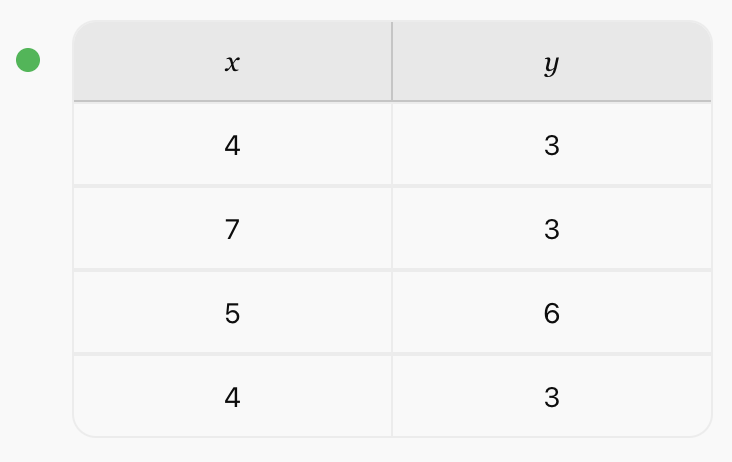
The translated triangle has vertices:

A′(4, 3)

B′(7, 3)

C′(5, 6)


Visualizing a Translation

Here is the original triangle and its translated image. Each vertex moves 3 units right and 2 units up.
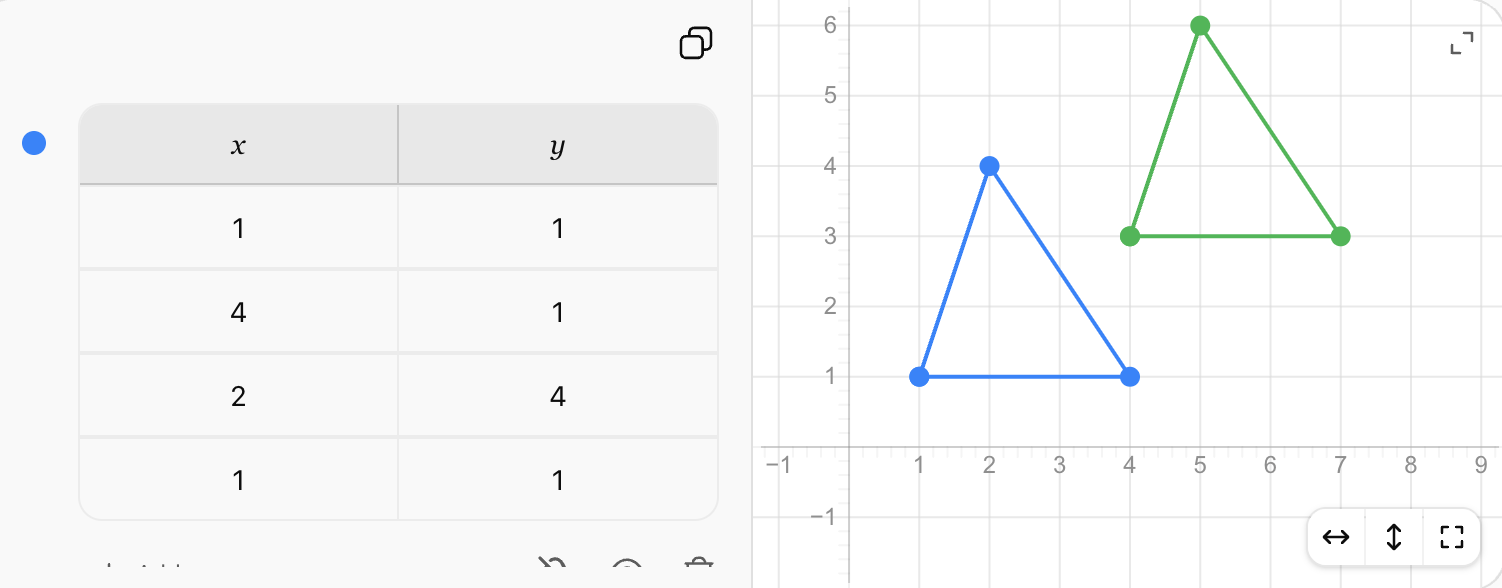
Notice that the translated triangle has exactly the same:

  • Side lengths.
  • Angles.
  • Shape.
  • Size.
  • Orientation.

Only its position has changed.


Translations Preserve Size

A translation does not make a figure larger or smaller.

Suppose a line segment is:

5 cm

before a translation.

After the translation, the corresponding segment is still:

5 cm

Distances between corresponding points remain unchanged.


Translations Preserve Shape

A triangle remains the same type of triangle after translation.

For example:

  • A right triangle remains a right triangle.
  • A square remains a square.
  • A rectangle remains a rectangle.
  • A regular pentagon remains a regular pentagon.

The translation only changes where the figure is located.


Translations Preserve Angles

All angle measurements remain unchanged during a translation.

If an angle originally measures:

90°

then its corresponding angle after translation also measures:

90°

This is why the translated figure keeps the same shape.


Translations Preserve Orientation

A translation does not flip or rotate a figure.

If the original figure points upward, the translated figure still points upward.

If vertices originally occur in the order:

A → B → C

the corresponding vertices maintain the same orientation:

A′ → B′ → C′


Congruent Figures

Two figures are congruent if they have the same size and shape.

Because translations preserve both size and shape:

a figure and its translated image are congruent

The figures may be in different locations, but their dimensions are identical.


Finding a Translation from Two Points

Sometimes we know the original point and its translated position.

For example:

A(2, 3) → A′(7, 5)

Compare the x-coordinates:

7 − 2 = 5

So the point moved:

5 units right

Compare the y-coordinates:

5 − 3 = 2

So it moved:

2 units up

Therefore, the translation is:

5 units right and 2 units up


Another Example

Suppose:

B(4, 7) → B′(1, 2)

Horizontal change:

1 − 4 = −3

This means:

3 units left

Vertical change:

2 − 7 = −5

This means:

5 units down

Therefore, the translation is:

3 units left and 5 units down


Finding the Translation Rule

Suppose:

A(−2, 4) → A′(3, 1)

Horizontal change:

3 − (−2) = 5

Vertical change:

1 − 4 = −3

Therefore, the rule is:

(x, y) → (x + 5, y − 3)


Checking a Translation

Suppose we are told that the following points belong to the same translated figure:

A(1, 2) → A′(5, 5)

B(3, 4) → B′(7, 7)

Check A:

x change = +4

y change = +3

Check B:

x change = +4

y change = +3

Both points moved by the same amount.

Therefore, this is consistent with a translation.


When It Is Not a Translation

Suppose:

A(1, 2) → A′(5, 5)

but:

B(3, 4) → B′(8, 7)

For A:

change = (+4, +3)

For B:

change = (+5, +3)

The points did not move the same horizontal distance.

Therefore, these movements do not describe one translation of the entire figure.

Every point must move exactly the same distance and direction.


Translations with Negative Coordinates

Negative coordinates do not change the translation process.

Suppose:

P(−5, −2)

is translated:

7 units right and 4 units up

Calculate:

x = −5 + 7 = 2

y = −2 + 4 = 2

Therefore:

P′(2, 2)


Translating Left Across the y-Axis

Suppose:

Q(3, 4)

moves:

6 units left

Calculate:

3 − 6 = −3

Therefore:

Q′(−3, 4)

The point crosses the y-axis during the translation.


Translating Down Across the x-Axis

Suppose:

R(2, 3)

moves:

5 units down

Calculate:

3 − 5 = −2

Therefore:

R′(2, −2)

The point crosses the x-axis.


Translating Across Both Axes

Suppose:

S(−2, 3)

is translated:

5 units right and 7 units down

Calculate:

x = −2 + 5 = 3

y = 3 − 7 = −4

Therefore:

S′(3, −4)

The point has moved across both coordinate axes.


Translation Vectors

A translation can also be described using a vector.

For example:

(+4, +3)

means:

4 units right and 3 units up

Similarly:

(−5, +2)

means:

5 units left and 2 units up

and:

(+3, −6)

means:

3 units right and 6 units down

The first value describes horizontal movement.

The second describes vertical movement.


Translating with a Vector

Suppose the translation vector is:

(+3, −4)

and the original point is:

A(2, 6)

Add the horizontal change:

2 + 3 = 5

Add the vertical change:

6 + (−4) = 2

Therefore:

A′(5, 2)


Finding the Original Point

Sometimes the translated point is known, but the original point is missing.

Suppose a point is translated:

4 units right and 3 units up

and finishes at:

A′(7, 8)

Work backward.

For x:

7 − 4 = 3

For y:

8 − 3 = 5

Therefore, the original point was:

A(3, 5)


Reverse Translations

Every translation can be reversed.

If a figure moves:

5 units right and 2 units up

the reverse translation is:

5 units left and 2 units down

In coordinate form:

Original:

(x, y) → (x + 5, y + 2)

Reverse:

(x, y) → (x − 5, y − 2)


Translation Versus Reflection

A translation:

slides

a figure.

A reflection:

flips

a figure.

https://images.openai.com/static-rsc-4/Pe18wsBRsblW-zVJP3F5-dfr3Xc18eWTU3MYaWsPP3HadQ1x-V2-eUsoNYPOJAB5A-ydG8NtrW9gqJPn51PqJVw0i8Kgdt0ZYFlTNZvD-e6KTA1rWju_tnmvlWGJDS9be8GRJoApz17Ovr7E4FS4qEuDNDNu1crbgdUsvAXruEz-g0ftRmXJFHV6AYbwKyyQ?purpose=fullsize
 
https://images.openai.com/static-rsc-4/8GH2bcMkBneTXIar6On7IgGFcgML5pMEHl-rdWAXspH3blDAmYiOH9FbByP_ophFoML2QqcO6an-eAFcmdwVOqixhNeVIBCkGhpTeCmPfI7jkFY1aLDTI82pUlKwuMlpfvOpKhxGrvZDx7mNEkMV7yk4-oxqSAV18zUx7Ygv2_E4q5DAjjIG0dH6rTwiKD_A?purpose=fullsize
 
https://images.openai.com/static-rsc-4/fIktbULpQWavoEWZBZuZnY16W8GC5q2OvQZ0bd78Lmjc9PpG8dOUknzfFEyx2rw8h2TWVKSfczOvUr6lu8tV9WcE8daesc5pHQ6-TdtZuTBaQBWl27o-SnyjYmULhKgHfUqcjEYhmLx2O0nFjVYIWXvBMfcMdznMRBb9JmKw7TurrI7uKPx51jYy0vbnX52u?purpose=fullsize
 
5

Both preserve size and shape, but a reflection reverses the orientation of a figure while a translation does not.


Translation Versus Rotation

A translation:

slides

A rotation:

turns

For example, rotating a triangle 90° changes its orientation.

Translating the triangle does not.


Translation Versus Dilation

A translation preserves size.

A dilation changes size.

For example, a dilation might make every side twice as long.

A translation never does this.


Comparing Transformations

Transformation Main Action Size Preserved? Shape Preserved? Orientation Preserved?
Translation Slide Yes Yes Yes
Reflection Flip Yes Yes No
Rotation Turn Yes Yes Yes
Dilation Resize No* Yes Yes

*Except when the scale factor is 1.


Translations in Patterns

Translations occur frequently in repeating patterns.

A design can be created by repeatedly sliding the same shape:

  • Horizontally.
  • Vertically.
  • Diagonally.
https://images.openai.com/static-rsc-4/tfoyxoPYoJQojl9gu6SYVRYHlt3ZeJod4YXXLZXEpuF3m6bovMcdQJkkKBrygo-uz_jqP04OEdIUb9MfCJhHQGbyY26crsYogO7zfdiopF7_s_Bt8DybamVCGa6m2984z7DzvCkBShTWrPNyQnTHdZEwq2bpg5gssRXbMZmVLVY8hAW7udvTMOCoD2XFXG07?purpose=fullsize
 
https://images.openai.com/static-rsc-4/nDfiFErGpbRP7voyVISZU2wHLw6RmAXEjW61ZPOrLz_HwVfJTgtWAjW0r9B7OkykiYZ51FjbIjC0iDuJC5ZK2FKHFfHQ6zzAB244pzJTw_fgsRcgAXF0k6MOPPKB5wtjOekfs2SO78PxgJ-2X-ZUjTsPeQeadmPVLBOYAJIxfEC0HdiAIAJDjf5Cvc9EWMdL?purpose=fullsize
 
https://images.openai.com/static-rsc-4/IvMf14UAmQZIyiDQ2JTgicBPhcn9OzTIqbyP6ScfEcTVAfVKQ74YXCQtKaRoczR7HcfwZUqYP30VthLWJmVSCEm9ANbhCB6eBZTHGIA2_l2b7xGFnNKnYRuaCUcgpcxOqmejM_BskFW3tuAPlHUgnpi6wxkQ1vcV-TidPo9Goq69lxv3Bp6dng19LO6aNWq-?purpose=fullsize
 
5

This is called translational symmetry.

Examples can appear in:

  • Wallpaper.
  • Floor tiles.
  • Brick walls.
  • Fabric patterns.
  • Decorative borders.

Translations in the Real World

The mathematical idea of translation can describe many types of movement.

Examples include:

  • Sliding a book across a table.
  • Moving a chess piece without turning it.
  • Moving an object across a computer screen.
  • Repeating tiles across a floor.
  • Moving objects in computer graphics.
  • Moving components in engineering designs.

The mathematical model assumes that every point on the object moves the same distance in the same direction.


A Reliable Translation Strategy

When translating a figure on a coordinate plane:

Step 1: Identify the direction and distance.

Step 2: Convert the movement into coordinate changes.

Right:

add to x

Left:

subtract from x

Up:

add to y

Down:

subtract from y

Step 3: Apply the same changes to every vertex.

Step 4: Plot the new points.

Step 5: Connect the points in the same order.

Step 6: Check that the new figure has the same size, shape, and orientation.


Worked Example

Rectangle ABCD has vertices:

A(1, 1)

B(5, 1)

C(5, 3)

D(1, 3)

Translate the rectangle:

2 units left and 4 units up

The rule is:

(x, y) → (x − 2, y + 4)

For A:

A′(−1, 5)

For B:

B′(3, 5)

For C:

C′(3, 7)

For D:

D′(−1, 7)

The new rectangle has exactly the same dimensions as the original.


Worked Example: Finding the Translation

Triangle ABC is translated to triangle A′B′C′.

Suppose:

A(−3, 2) → A′(2, 6)

Calculate the changes.

Horizontal:

2 − (−3) = 5

Vertical:

6 − 2 = 4

Therefore, the translation is:

5 units right and 4 units up

The rule is:

(x, y) → (x + 5, y + 4)

Every other vertex must follow this same rule.


Common Mistakes

Moving Only One Point

A translation applies to the entire figure.

Every vertex must move.


Moving Different Points Different Distances

Every point must move:

the same distance in the same direction

Otherwise, the transformation is not a translation.


Changing the Wrong Coordinate

Horizontal movement changes:

x

Vertical movement changes:

y

Remember:

left/right → x

up/down → y


Adding When Moving Left

Moving left means the x-coordinate becomes smaller.

Therefore:

subtract from x


Subtracting When Moving Up

Moving up means the y-coordinate becomes larger.

Therefore:

add to y


Ignoring Negative Numbers

Suppose:

x = −3

and the point moves 5 units right.

Calculate:

−3 + 5 = 2

Do not ignore the negative sign.


Changing the Shape

A translation cannot stretch, shrink, rotate, or distort a figure.

The image must be congruent to the original.


Confusing Translation and Reflection

A translation is a:

slide

A reflection is a:

flip


Confusing Translation and Rotation

A translation moves a figure without turning it.

A rotation:

turns the figure around a point


Check Your Understanding

1. Define a translation.

2. Why is a translation sometimes called a slide?

3. What must be true about the movement of every point during a translation?

4. What happens to the size of a figure during a translation?

5. What happens to its shape?

6. What happens to its orientation?

7. Translate (2, 3) four units right.

8. Translate (5, 2) three units left.

9. Translate (4, 1) five units up.

10. Translate (3, 7) four units down.

11. Translate (2, 3) four units right and five units up.

12. Translate (−3, 4) six units right and two units down.

13. Translate (5, −2) seven units left and four units up.

14. Describe the translation rule:

(x, y) → (x + 4, y + 3)

15. Describe the translation rule:

(x, y) → (x − 2, y − 5)

16. Write a coordinate rule for a translation of 6 units right and 3 units down.

17. Write a coordinate rule for a translation of 4 units left and 7 units up.

18. Point A moves from (2, 4) to (7, 6). Describe the translation.

19. Point B moves from (5, 7) to (2, 1). Describe the translation.

20. Point C moves from (−4, −2) to (3, 3). Describe the translation.

21. Triangle ABC has vertices A(1, 1), B(4, 1), and C(2, 4). Translate it 2 units right and 3 units up. Find A′, B′, and C′.

22. Rectangle ABCD has vertices A(−2, 1), B(3, 1), C(3, 4), and D(−2, 4). Translate it 4 units left and 2 units down. Find the new coordinates.

23. Explain why a translated figure is congruent to its original figure.

24. Explain the difference between a translation and reflection.

25. Explain the difference between a translation and rotation.

26. A translation moves every point 3 units right except one vertex, which moves 4 units right. Is this a valid translation? Explain.

27. A point is translated 5 units right and 4 units up and finishes at (8, 7). Find its original coordinates.

28. What is the reverse of a translation 6 units left and 2 units down?

29. Give two examples of translations that could occur in everyday life.

30. Explain how coordinates can be used to check whether two figures are related by a translation.


Key Terms

  • Transformation – change in the position, orientation, or size of a geometric figure.
  • Translation – transformation that slides every point the same distance in the same direction.
  • Preimage – original figure before a transformation.
  • Image – resulting figure after a transformation.
  • Direction – way in which a figure moves.
  • Distance – amount a figure moves.
  • Translation rule – coordinate rule describing a translation.
  • Translation vector – numerical description of horizontal and vertical movement.
  • Congruent – having the same size and shape.
  • Translational symmetry – repeating pattern produced by translations.
  • Reflection – transformation that flips a figure.
  • Rotation – transformation that turns a figure.
  • Dilation – transformation that changes a figure's size.

Key Takeaways

  • A translation is a slide.
  • Every point moves the same distance in the same direction.
  • Translations preserve size and shape.
  • Translations also preserve angles, lengths, and orientation.
  • The original and translated figures are congruent.
  • Horizontal movement changes the x-coordinate.
  • Vertical movement changes the y-coordinate.
  • Moving right means add to x.
  • Moving left means subtract from x.
  • Moving up means add to y.
  • Moving down means subtract from y.
  • A translation of 3 units right and 2 units up can be written:

(x, y) → (x + 3, y + 2)

  • The same coordinate rule must be applied to every vertex of a figure.
  • A translation can move a figure across one or both coordinate axes.
  • Translation rules can be determined by comparing original and translated coordinates.
  • Translations are used in geometry, patterns, design, computer graphics, engineering, and many everyday situations.

A useful rule to remember is:

Translation = same direction + same distance for every point.

3. Reflections and Rotations

Learning outcomes
  • I can define reflections and rotations as geometric transformations.
  • I can identify lines of reflection in geometric figures.
  • I can perform reflections on a coordinate grid.
  • I can describe and perform rotations about a point.
  • I can compare reflections and rotations and their effects on shapes.

Geometric Transformations

A geometric transformation changes the position, orientation, or size of a figure.

Two important transformations are:

  • Reflection – flips a figure across a line.
  • Rotation – turns a figure around a fixed point.

Like translations, reflections and rotations are rigid transformations. This means they preserve:

  • Side lengths.
  • Angle measures.
  • Size.
  • Shape.

The original figure and its transformed image are therefore congruent.

https://images.openai.com/static-rsc-4/8GH2bcMkBneTXIar6On7IgGFcgML5pMEHl-rdWAXspH3blDAmYiOH9FbByP_ophFoML2QqcO6an-eAFcmdwVOqixhNeVIBCkGhpTeCmPfI7jkFY1aLDTI82pUlKwuMlpfvOpKhxGrvZDx7mNEkMV7yk4-oxqSAV18zUx7Ygv2_E4q5DAjjIG0dH6rTwiKD_A?purpose=fullsize
 
https://images.openai.com/static-rsc-4/5UabqAJPqoOXPbN-DNrIpJYXjje6bNYBborRNd18oU-kVXfnR6ZuleNirdksqZf7ebRVXMFV9vYQnarFpJGnlavqMA3-Uw77Usb75XBC4ct7m_wBC16Io-TJ1kGYGkAWvFFeSm-OJoxLkWaNHl3vZXRU09UYfilnSZxUo4usNsAwn1ka7raPysSM2_a10hJI?purpose=fullsize
 
https://images.openai.com/static-rsc-4/zH8v6VUkjpoEEw1STbUNHR20BPSRR4Pr5-eAof0a3HVXD7TwU0CznPri5FjeRhtSggf0dkADM5eOnbgkCwSqxMyksfuPXYyqdx_iZRH65Sz3D-jGo510KJr8KzHSC5tMt0bmz5a5B4qChSilx61vBYKEIlQyO5kcwUtjXlib1voA5o2WTj4YhsXu_3EOBv5N?purpose=fullsize
 
5

Reflections

A reflection is a transformation that flips a figure across a line.

The result looks like a mirror image of the original figure.

The line across which the figure is flipped is called the:

line of reflection

Imagine placing a mirror along this line. The reflected figure would appear on the opposite side.


The Line of Reflection

Every point and its reflected image are the same perpendicular distance from the line of reflection.

For example, if point A is:

3 units to the right

of a vertical line of reflection, then A′ will be:

3 units to the left

of that line.

https://images.openai.com/static-rsc-4/nqroAVO37QZWlEB3VLY8T812Ro3V3XxP2nVbsDUv4pR8zgk73mtn1urMSU3RGf3kJB5k_V42BuFSKQCYhVPFhgo4xxsxgYPe2TkrCLmBqxVxmtV425k_U-lDeKDRYgVZ610OjPPxt5yK6lpQ7DCkJ2kKH4S_HMaq5T0doi--ly3KfPTw1sgrBjnTxGldaajH?purpose=fullsize
 
https://images.openai.com/static-rsc-4/gbDCgKC6icaGh1ZtUyJM4IYH0qwrf9529npwiKGUX8z-VJBm34MD3kHoB5tH2KFayHy2u-KhkEFt0kigGhjdrafCA4qVZ8BZLAWgJUpdvS3uiwY67SyegkeUwjnTYOi9MF4bN2dkmqsGLdYTqJcx3RQ8mqFXj2eJYNOaTGrstVZ7Lpr37aMh-m3uAQ_Uee07?purpose=fullsize
 
https://images.openai.com/static-rsc-4/FJEuTVPPhnOHhbki-OZq5Hs5puzxD1B_vij9Hp3l-Jpw29Cth2VpCIzqa3yct0jhAZuG_scP94gqi4hvu6AmB8l00X8Dhq3p0nL1qTgLyYJj9NXtu1mZ6u5jUwgV_Bm8ABac0NmqzWi4rKmTBORJCqg1Ude-qIlGel812wvfqPrkDZXMI08a12xWcioKy5tI?purpose=fullsize
 

The line of reflection lies exactly halfway between corresponding points.


Reflection Across the x-Axis

One of the most common coordinate transformations is reflection across the x-axis.

Suppose:

A(3, 4)

is reflected across the x-axis.

The x-coordinate stays the same.

The y-coordinate changes sign.

Therefore:

A(3, 4) → A′(3, −4)

The rule is:

(x, y) → (x, −y)


Why the y-Coordinate Changes

The x-axis is horizontal.

A reflection across it changes the point's vertical position.

For example:

(2, 5) → (2, −5)

The original point is 5 units above the x-axis.

The reflected point must be 5 units below the x-axis.


Another x-Axis Example

Reflect:

B(−4, −3)

across the x-axis.

Keep x:

−4

Change the sign of y:

−3 → 3

Therefore:

B′(−4, 3)


Reflection Across the y-Axis

When reflecting across the y-axis, the y-coordinate stays the same.

The x-coordinate changes sign.

For example:

C(4, 2) → C′(−4, 2)

The rule is:

(x, y) → (−x, y)


Why the x-Coordinate Changes

The y-axis is vertical.

A reflection across it changes the point's horizontal position.

For example:

(6, 3)

is 6 units to the right of the y-axis.

Its reflection must be 6 units to the left.

Therefore:

(6, 3) → (−6, 3)


Reflection Across the Line y = x

Another important line of reflection is:

y = x

When reflecting across this line, the x- and y-coordinates exchange positions.

The rule is:

(x, y) → (y, x)

For example:

(2, 5) → (5, 2)

and:

(−3, 4) → (4, −3)

https://images.openai.com/static-rsc-4/2iHdweMrhd4Y056OD6tCrCNgtX13yJxdajNXiKX-jvUce9O8qax7aLj_HYQS07ibjA1FtfUOczslk1EZEaxcKbW2pCjPMZWE3zhYoDwMDRGa185qlu9TnNLSmyhyhkpegY-O5rYo1p2qP-i7TEZ0ee-RfHygoCtyJdNB3XCNgGbei2FGyFpAkGJ9KhZb2IEa?purpose=fullsize
 
https://images.openai.com/static-rsc-4/zvmwii3oCAgIGXVUCjD2LSsLdwaGD3EeWTBiY7KqTdRllWD8gLxPTYjy05XcuYbyuirmQ9LXJhrDyWtkbTWPxPRc6Nn7zeK1gz536X2fb21m9pWzZPhmLm1fltE7Iq8G78HUpqtPLvokHxizCHx39f-FGNuChdC5hQ2xyZavKzfiVV0sEhimcVyXNYqMpLd6?purpose=fullsize
 
https://images.openai.com/static-rsc-4/po2lvXzJmWKDmsTmo383D9YT7EUU8M-SV--EUsP9nW631R4Fh4JDLdCcoHbw5MDHGaqmbqN-IQZee6aYpk-ObFiSMJIy4MPvyA2qP_B2dpz_VKH9dSRYS4IQZKreD1NZwTErHuFXVispabiFjl684p0aVy3wW_53w8iEr9MZuiQSxRqACfRSDUOmPDxok8Bb?purpose=fullsize
 
5

Reflecting an Entire Figure

Suppose triangle ABC has vertices:

A(1, 2)

B(4, 2)

C(2, 5)

Reflect the triangle across the y-axis.

Use:

(x, y) → (−x, y)

Therefore:

A(1, 2) → A′(−1, 2)

B(4, 2) → B′(−4, 2)

C(2, 5) → C′(−2, 5)

Every vertex follows the same reflection rule.


What Reflections Preserve

A reflection preserves:

  • Side lengths.
  • Angle measures.
  • Parallel lines.
  • Perpendicular lines.
  • Area.
  • Perimeter.
  • Overall size and shape.

However, a reflection reverses orientation.

This is an important difference between reflections and translations.


Orientation After Reflection

Imagine a triangle whose vertices go around the figure in this order:

A → B → C

After reflection, its mirror image has the opposite orientation.

This is similar to looking at writing in a mirror.

The shape has not changed size, but it has been:

flipped


Lines of Reflection in Shapes

A line of reflection can also refer to a line of symmetry within a figure.

If a shape can be folded along a line so that the two halves match exactly, that line is a:

line of symmetry

or:

line of reflection

https://images.openai.com/static-rsc-4/zm7bz2kDyYI9Bff5Bus7ORGwa6bUPU0fVQ2cs1fkGRyjwmpXY6SUo0DHSa3ZzqWiaYG5-qh1cbbHgRd_6liX7ZZimgzooS0nb26NsItf1ytMwtKzPD3l9yoM29vlfjKqWqQhE9KhTt7IkjvMICv9_y0jqbkjoCeHA-3rv2_AaOAQJdQvISB68NQzizfigg41?purpose=fullsize
 
https://images.openai.com/static-rsc-4/U_ZLCheFsLrzTqUmY1_jrzgkvIg6JDdzA5g-3c5FLF84XwfhvjSZkiQllC8RIi2PsjqccpVKSPAHqPZODesK3wc8f3ze9y8XdUCB8H9YhmU5-4F7pIEtE10iw98gw-eNQhaFpzUSMT55-rlUJZfQmJ8UmBe7KJDvSQq7Nl23SgdDbyHYDSMrcVA18nrp7nXH?purpose=fullsize
 
https://images.openai.com/static-rsc-4/6QyZvuHU82pPPjcJY1_b0XWOSqWRvMg2MUZ6LRX8UHW29BfPdMxfnWICeBsRjMCXWTpwc9ve_oP79I1t7RSK_ou97VbojKDdfJa6iJZV1rh8VOebbqg-2T2Z3G5JrBEW5WK2F_08UyVSbN5zsjttNNC71PtLHJID4Bif5ZY86O2O1gFH37HlnwhCyw-hPMSG?purpose=fullsize
 
4

Lines of Reflection in a Square

A square has:

4 lines of reflection

These are:

  • One vertical line through the center.
  • One horizontal line through the center.
  • Two diagonals.

Each line divides the square into two matching halves.


Lines of Reflection in a Rectangle

A non-square rectangle has:

2 lines of reflection

They pass:

  • Vertically through the center.
  • Horizontally through the center.

Its diagonals are not lines of reflection unless the rectangle is a square.


Lines of Reflection in Triangles

An equilateral triangle has:

3 lines of reflection

An isosceles triangle has:

1 line of reflection

A scalene triangle has:

0 lines of reflection

This provides another way to compare triangle types.


Lines of Reflection in Circles

A circle has:

infinitely many lines of reflection

Any line passing through its center divides the circle into two matching halves.


Rotations

A rotation is a transformation that turns a figure around a fixed point.

The fixed point is called the:

center of rotation

A rotation must specify:

  • Center of rotation.
  • Angle of rotation.
  • Direction of rotation.
https://images.openai.com/static-rsc-4/aX3DN49VeTlHYSYJrK2_tQtnOFXDIKW7pcN3HyI10sBtDYNw1rNU8wEYlAdQjljo9w3YpYAy160-kkxLDu_vfOZ5md9dZqVZzQhWbF0zvE0bI-F0bmL1-3wfvMnR6h0uknNALXVHBapL_wVc-M6IsVLJWEiY_jWYelQ0UrkLsnO4pOnZiJ8kUIFw2J-N0DOo?purpose=fullsize
 
https://images.openai.com/static-rsc-4/QUTdxU7h_Wl7nHFYYZOzNA2bIsnNXq9bnZ-Ici10JBFSOZHE9PLV0sThKP-4XdQLCXhNdkzS7oLGWPR7YBoE8mujfd5SO3jBBYwvnKzydma5WzHo3AQeUKXS2ty6iCFL8B0DlzuFEMdiErJ7i1xtKWcDWW9LlPUW6M7FA__9lsfyALdzsTwDwD9zFstKei1W?purpose=fullsize
 
https://images.openai.com/static-rsc-4/4uBAS9MHa0wUVTtQ5ENPZ6KhWW6rzvUU1o1dWbNsjzLD2NL2ijzwiAadlFGqAC2jI56tJ23ywzJY05PJV6wYvC7g1AbbWoqSKbp7YoGhjrq2-FRSqaBqLpEKwQ3rSW24VbGNY5yZHAJV8fo8bA5RO2JCrxXxkQotCmNe2LEyxgCuQLPYyH7dsHIKkOJ5JYeo?purpose=fullsize
 
5

Clockwise and Counterclockwise

A rotation can occur in two directions.

Clockwise means turning in the same direction as the hands of a clock.

Counterclockwise means turning in the opposite direction.

For example:

90° clockwise

and:

90° counterclockwise

produce different positions.


Common Rotation Angles

Common rotation angles include:

90°

180°

270°

360°

A 360° rotation is one complete turn.

After a full 360° rotation, a figure returns to its original position.


Quarter, Half, and Full Turns

It can be helpful to connect angles with turns.

90° = ¼ turn

180° = ½ turn

270° = ¾ turn

360° = 1 complete turn


Rotations About the Origin

On a coordinate plane, rotations are often performed around:

the origin (0, 0)

There are useful coordinate rules for these rotations.

For a 90° counterclockwise rotation:

(x, y) → (−y, x)

For a 180° rotation:

(x, y) → (−x, −y)

For a 270° counterclockwise rotation:

(x, y) → (y, −x)


90° Counterclockwise Rotation

Consider:

A(3, 2)

Rotate it 90° counterclockwise around the origin.

Use:

(x, y) → (−y, x)

Therefore:

(3, 2) → (−2, 3)


Another 90° Counterclockwise Example

Consider:

B(−4, 2)

Apply:

(x, y) → (−y, x)

Therefore:

B(−4, 2) → B′(−2, −4)

The point moves from Quadrant II to Quadrant III.


90° Clockwise Rotation

For a 90° clockwise rotation around the origin:

(x, y) → (y, −x)

For example:

(3, 2) → (2, −3)

Notice that this is the same coordinate rule as a:

270° counterclockwise rotation


180° Rotation

For a 180° rotation around the origin:

(x, y) → (−x, −y)

Both coordinates change signs.

For example:

(4, 3) → (−4, −3)

Another example:

(−5, 2) → (5, −2)

The direction does not matter for a 180° rotation.

A 180° clockwise rotation and a 180° counterclockwise rotation produce the same result.


270° Counterclockwise Rotation

For a 270° counterclockwise rotation:

(x, y) → (y, −x)

For example:

(2, 5) → (5, −2)

A 270° counterclockwise rotation is equivalent to:

90° clockwise


Rotation Rules About the Origin

Rotation Coordinate Rule
90° counterclockwise (x, y) → (−y, x)
180° (x, y) → (−x, −y)
270° counterclockwise (x, y) → (y, −x)
90° clockwise (x, y) → (y, −x)
270° clockwise (x, y) → (−y, x)

These rules apply when the center of rotation is the origin.


Understanding Rather Than Memorizing

Rotation rules can be memorized, but understanding the movement is more useful.

Consider:

A(4, 1)

The point lies mostly to the right and slightly above the origin.

After a 90° counterclockwise turn, it should lie:

  • Mostly above the origin.
  • Slightly to the left.

The result:

A′(−1, 4)

makes sense.

A quick sketch can help check whether a coordinate rule has been used correctly.


Rotating an Entire Figure

Suppose triangle ABC has:

A(1, 1)

B(4, 1)

C(2, 3)

Rotate it 90° counterclockwise around the origin.

Use:

(x, y) → (−y, x)

For A:

A(1, 1) → A′(−1, 1)

For B:

B(4, 1) → B′(−1, 4)

For C:

C(2, 3) → C′(−3, 2)

The entire triangle has turned around the origin.


Rotating About a Point Other Than the Origin

A figure can rotate around any point.

Suppose point A is rotated around point P.

Point P remains fixed while A travels along part of a circular path around it.

The distance between A and P remains constant.

https://images.openai.com/static-rsc-4/lNQj6v5Y0tKL1QwI3-B_1BWOZBcKVzfiBNRWG0sZAJCI3Hjbw6umCRl6QLEnKnn1zpWi8gE7V-mPWPzR8EQ7OOCoCjYhr4B17VdParPfokpxkpl9e3khrra2WD66kKzhEe7J7XZ46d7OdQf-s0_f6yOyqq4SRSUYhFNCd-bYrgJfIINHBdcBnuixJIdfDHcZ?purpose=fullsize
 
https://images.openai.com/static-rsc-4/tIbdDbBgFeNm_rMmaSDh_nUbqHoUwB6VaSc4OgfKBAjtQDtll-PZJimaavxqqnniDS3wAZeJNZuAEIAAH7gh3kqR-W47hdTn_HP2gyNCAZj3z6POd1I3A8DeWkfCnUwDwQBla9a65OzkZlzMyq_B2L5o15i8oEJwNiHiMZv2KAsYcXZ5rmaNhdsf-RIeCE6a?purpose=fullsize
 
https://images.openai.com/static-rsc-4/d8G7kZ0t9Z60uClYTO-sP1cN7dWh_51FILY2EQAmzFa0oLOUXgHAoF4PgvVYTtfzQkR3-6GYBzqtI8JrGFv475U09oK6XuU94-pqKpjZgH0_dc5cTWJz-CXYGkyg3rBVn9C-B9OUqWHJ767FaUg4igGkPKIasy93EWAevkTFFjXKkBODvjjNvcVpfli46qdl?purpose=fullsize
 
4

This gives us an important rotation property:

Every point remains the same distance from the center of rotation.


Finding the Center of Rotation

When examining a diagram, the center of rotation is the fixed point around which the figure turns.

To identify it, consider corresponding points such as:

A and A′

The center must be equally distant from both.

The same must be true for:

B and B′

and other corresponding points.

For basic problems, the center is often given directly.


Rotations Preserve Size and Shape

Rotations are rigid transformations.

They preserve:

  • Side lengths.
  • Angles.
  • Area.
  • Perimeter.
  • Parallel relationships.
  • Perpendicular relationships.

Therefore, the original figure and rotated image are:

congruent


Rotations Preserve Orientation

Unlike a reflection, a rotation does not create a mirror image.

A rotation turns the figure but preserves the order of its vertices.

This means its orientation is preserved.


Comparing Reflections and Rotations

Reflections and rotations are both rigid transformations.

They both preserve:

  • Size.
  • Shape.
  • Side lengths.
  • Angle measures.
  • Area.
  • Perimeter.

However, they move figures differently.

Property Reflection Rotation
Main action Flip Turn
Size preserved Yes Yes
Shape preserved Yes Yes
Angles preserved Yes Yes
Orientation preserved No Yes
Requires a line Yes No
Requires a center No Yes
Requires an angle No Yes

Reflection Versus Rotation Example

Suppose an arrow points:

right

After reflection across a vertical line, it may point:

left

It has been flipped.

After a 90° counterclockwise rotation, it would point:

up

It has been turned.

The two transformations therefore produce different results even though both preserve the arrow's size and shape.


Comparing Translation, Reflection, and Rotation

The three rigid transformations can be remembered as:

Translation → slide

Reflection → flip

Rotation → turn

https://images.openai.com/static-rsc-4/WZQLD6BpJENxZ33h-XKxSkp7qk-I2OMqQS0cIespiQg7y9BJh1ShX2disVH3wfcvKO5Ti3OH7kcnBTzyDG4X7skpqpxWWSg-tRRTRowCGa-AOUbFJxvUfTWEs9kMNYYdeMDTDXIEh0kF7kAsGcKJkocXdKqxejLY8Z8S66xM40lwURVyEih5ucGIflm9z_kv?purpose=fullsize
 
https://images.openai.com/static-rsc-4/XT_ycsEo2JJ6PfvlZZaUejQu-FqnFTTI4p2b8K8Mk9vI59vNmbkO7daYbAE0PYn8jeF2ODK2lY85rLsT1IVF4PqarAvSDwuhfOZNwM4OFZH0VMtaMOnqKvVqPeY4Yx0TxKoRfSQaNPUH2GIQVkJHG_7NGKOdvsmpXuiMNLSyBKd9q239meEl1j8B7AMG-BeW?purpose=fullsize
 
https://images.openai.com/static-rsc-4/KJxi_Z6PPIhKltSFPcZp-jJDGyan6asW5zOxcUGhMwjYNqH6JUXmJRelItQWFFmEdGULQGeSlJQZ0DpKTS6FqJCHVD5nfCmM1cXN0Q6H67oC-8mX0LyQPd6jIn00Z4bGI6DvHNHpodKHDbkJskIvRuL-kMfGktOZ6aMA5WSxwFSC4Bu2sleM4jEcvo4XIToq?purpose=fullsize
 
6

All three preserve:

  • Size.
  • Shape.
  • Lengths.
  • Angles.

But they change position and sometimes orientation.


Reflection Rules

Some useful coordinate rules are:

Across the x-axis

(x, y) → (x, −y)

Across the y-axis

(x, y) → (−x, y)

Across y = x

(x, y) → (y, x)


Rotation Rules

For rotations around the origin:

90° counterclockwise

(x, y) → (−y, x)

180°

(x, y) → (−x, −y)

270° counterclockwise

(x, y) → (y, −x)


Worked Reflection Example

Rectangle ABCD has vertices:

A(1, 2)

B(5, 2)

C(5, 4)

D(1, 4)

Reflect the rectangle across the y-axis.

Use:

(x, y) → (−x, y)

Therefore:

A′(−1, 2)

B′(−5, 2)

C′(−5, 4)

D′(−1, 4)

The new rectangle has the same dimensions as the original but has been flipped across the y-axis.


Worked Rotation Example

Triangle ABC has vertices:

A(2, 1)

B(5, 1)

C(3, 4)

Rotate the triangle:

180° about the origin

Use:

(x, y) → (−x, −y)

Therefore:

A′(−2, −1)

B′(−5, −1)

C′(−3, −4)


Checking a Reflection

Suppose:

A(4, 3) → A′(−4, 3)

The y-coordinate remained unchanged.

The x-coordinate changed sign.

Therefore, this is consistent with a reflection across the:

y-axis


Checking a Rotation

Suppose:

B(3, 5) → B′(−3, −5)

Both coordinates changed signs.

Therefore, this is consistent with:

a 180° rotation around the origin


Symmetry and Reflection

A figure has reflectional symmetry if it can be reflected across a line and match itself exactly.

Examples include:

  • Squares.
  • Rectangles.
  • Equilateral triangles.
  • Isosceles triangles.
  • Circles.

The number of lines of reflection depends on the shape.


Rotational Symmetry

A figure has rotational symmetry if it can be rotated less than 360° around a point and still match its original position.

https://images.openai.com/static-rsc-4/594B9G9cOla2gFw7Fx3twj4EdarZPOy7lWUuKmyS9WLJd01zr7gG5O0y434hyB5L218nVLopUm1JJa-vlVYJoVx-GTDghSI1hemlP7r41Rmx_h-7g5T2EnVBbbCX9TC5sF-Zk2KPvw0Z7XIsULzmcWNZQxBCsXAjUgwz5LiRiCLFFTacChxLi_iccw0DzwUx?purpose=fullsize
 
https://images.openai.com/static-rsc-4/37udWFpO0hVECSiZhKGQs_xEZDLUbt-WXg08ugST6OMw3qN-HYkZl31TnLxuWmrxV_mszDVqNw6jn3g3p23iH_E7Zoaf3OTZHJciStzpY7EMuO6Ovfu3i2Bo1imXi7yW8MRovYI040uyrQnjYtRD8sZo-ZTBw-3yXTbVSDvmXqjPQ4HcPs0EvAcKJ3TuZtkg?purpose=fullsize
 
https://images.openai.com/static-rsc-4/I_2RBGBzUrgrQhxdPBoSmWmcCZWSXvk-529RKvDO57VsTDi5Lnnv5gLvwuti0J-Ds2QwlcPChEP3WjrTnIiV6_3SVdk43vCjyo8zJ_fXzFr7ylujrSHhfwm4NMWuctZXyGg-8L6yybU4uonQP0lEvjA1MH0RXh07S1A0J01OeKxoKfZGCDgSPQi4FvUwPBQE?purpose=fullsize
 
4

For example, a square matches itself after rotations of:

90°, 180°, 270°, and 360°

A non-square rectangle matches itself after:

180° and 360°


Order of Rotational Symmetry

The order of rotational symmetry tells us how many times a figure matches itself during one complete 360° turn.

A square has rotational symmetry of order:

4

A non-square rectangle has order:

2

An equilateral triangle has order:

3

A general scalene triangle has order:

1


Reflections and Rotations in the Real World

These transformations appear frequently in nature, design, art, and engineering.

https://images.openai.com/static-rsc-4/UeNRT0vdm76nSW1e9qhXJUR_kWU3qr_HGqQyIlnQlLHCbHUdlRgZNL_raLI3eiUAv9GNZwqm-ew9u-RZ9VSuG7XFMCOinrkuAr3foJRXKqtF2RgtLap3Hp_oH-dVb4zfVRDx8Lw0832NtnXC9Czv21LkcItpy9mM4ue8lZ2OlsGpD9EqDaq91oZWzAaREQle?purpose=fullsize
 
https://images.openai.com/static-rsc-4/bpUSAiyXEPSOWzn2dXBUCD-N28ICfLzveCEvaKaFoknG3hSS0e31A3w_ObaObMtXE4tioJTZcR0JcRJS6tkV4EBWFhQWiTaK1XqkG6xKr5HZd903hnfQyZJ--eVT7LNDu8Vqatq2msQxM7kaPPKj6XQTLLU5HR9W1jEFk5laaRq9w4XPwW4lSkXzY_joSgQY?purpose=fullsize
 
https://images.openai.com/static-rsc-4/oq8cbC3bM-CEVZNmD7oCZEfthzX8mpttE7OtDiLB4IYHoSy-MDuuhiClWMZF-gHmFx67Fn_bETxrGJHBB9B9QmR0gLXgG1X6MaehK3hi9BT_XEA4PqiXT6iwgfrgu4mmuYW6vvjExAycwn5ZFqMajm6Am3sUsMLYFeIxIAUGjx4KnYnLuN0rSMmQRMm6gchX?purpose=fullsize
 
5

Examples include:

  • Reflections in mirrors.
  • Butterfly wing patterns.
  • Building designs.
  • Decorative tiles.
  • Wheels and gears.
  • Fans and propellers.
  • Logos.
  • Flowers.
  • Snowflake patterns.

A Reliable Reflection Strategy

When reflecting a figure:

Step 1: Identify the line of reflection.

Step 2: Determine each vertex's perpendicular distance from the line.

Step 3: Place the reflected point the same distance on the opposite side.

Step 4: Repeat for every vertex.

Step 5: Connect the new points in the corresponding order.

Step 6: Check that size and shape have been preserved.


A Reliable Rotation Strategy

When rotating a figure:

Step 1: Identify the center of rotation.

Step 2: Identify the angle.

Step 3: Identify whether the rotation is clockwise or counterclockwise.

Step 4: Rotate each vertex by the same angle.

Step 5: Plot the new coordinates.

Step 6: Connect the corresponding vertices.

Step 7: Check that every point remains the same distance from the center of rotation.


Common Mistakes

Confusing Reflection and Rotation

Remember:

Reflection = flip

Rotation = turn


Changing the Size of the Figure

Neither reflection nor rotation changes size.

The image must remain:

congruent

to the original.


Using the Wrong Reflection Rule

Across the x-axis:

change the sign of y

Across the y-axis:

change the sign of x


Changing Both Signs for Every Reflection

Changing both signs:

(x, y) → (−x, −y)

is not generally a reflection across the x- or y-axis.

It represents a:

180° rotation about the origin


Forgetting the Direction of Rotation

A 90° clockwise rotation is different from a 90° counterclockwise rotation.

Always check the direction.


Rotating Around the Wrong Point

A rotation must occur around a specific:

center of rotation

Rotating around the origin when another center is specified will produce the wrong result.


Forgetting That 180° Is Special

A 180° clockwise rotation produces the same result as a 180° counterclockwise rotation.


Assuming a Diagonal Is Always a Line of Symmetry

The diagonals of a square are lines of symmetry.

The diagonals of a non-square rectangle are not.


Confusing Reflectional and Rotational Symmetry

Reflectional symmetry involves a:

flip across a line

Rotational symmetry involves a:

turn around a point

A shape may have one, both, or neither.


Check Your Understanding

1. Define a reflection.

2. Define a rotation.

3. What is a line of reflection?

4. What is the center of rotation?

5. What three pieces of information describe a rotation?

6. Reflect (4, 3) across the x-axis.

7. Reflect (−5, 2) across the x-axis.

8. Reflect (6, −3) across the y-axis.

9. Reflect (−2, −7) across the y-axis.

10. Reflect (3, 5) across y = x.

11. Write the coordinate rule for reflection across the x-axis.

12. Write the coordinate rule for reflection across the y-axis.

13. Rotate (3, 2) 90° counterclockwise around the origin.

14. Rotate (4, 1) 90° clockwise around the origin.

15. Rotate (5, 3) 180° around the origin.

16. Rotate (−2, 4) 270° counterclockwise around the origin.

17. Write the rule for a 90° counterclockwise rotation around the origin.

18. Write the rule for a 180° rotation around the origin.

19. Explain why a reflection preserves size and shape.

20. Explain why a rotation preserves size and shape.

21. What happens to orientation during a reflection?

22. What happens to orientation during a rotation?

23. How many lines of reflection does a square have?

24. How many lines of reflection does a non-square rectangle have?

25. How many lines of reflection does an equilateral triangle have?

26. How many lines of reflection does a scalene triangle have?

27. What is the order of rotational symmetry of a square?

28. A point changes from (4, 6) to (−4, 6). Identify the likely transformation.

29. A point changes from (3, −5) to (−3, 5). Identify the rotation about the origin.

30. Explain one similarity and one difference between a reflection and a rotation.


Key Terms

  • Transformation – change in the position, orientation, or size of a geometric figure.
  • Reflection – transformation that flips a figure across a line.
  • Line of reflection – line across which a figure is reflected.
  • Rotation – transformation that turns a figure around a fixed point.
  • Center of rotation – fixed point around which a rotation occurs.
  • Clockwise – direction in which the hands of a clock turn.
  • Counterclockwise – direction opposite to clock hands.
  • Preimage – original figure before a transformation.
  • Image – resulting figure after a transformation.
  • Congruent – having the same size and shape.
  • Orientation – arrangement or direction of a figure and its vertices.
  • Reflectional symmetry – symmetry created when a figure matches itself after reflection.
  • Rotational symmetry – symmetry created when a figure matches itself after rotation.
  • Order of rotational symmetry – number of times a figure matches itself during a complete 360° rotation.

Key Takeaways

  • A reflection flips a figure across a line.
  • A rotation turns a figure around a fixed point.
  • Reflections and rotations preserve size and shape.
  • They also preserve side lengths and angle measures.
  • A reflection reverses orientation.
  • A rotation preserves orientation.
  • Reflection across the x-axis:

(x, y) → (x, −y)

  • Reflection across the y-axis:

(x, y) → (−x, y)

  • Reflection across y = x:

(x, y) → (y, x)

  • 90° counterclockwise rotation about the origin:

(x, y) → (−y, x)

  • 180° rotation about the origin:

(x, y) → (−x, −y)

  • 270° counterclockwise rotation about the origin:

(x, y) → (y, −x)

  • Every point and its reflected image are equally distant from the line of reflection.
  • Every point maintains its distance from the center during a rotation.
  • Reflectional symmetry involves a line.
  • Rotational symmetry involves a center and an angle.
  • Reflections and rotations are examples of rigid transformations.

A useful way to distinguish the transformations is:

Translation = slide

Reflection = flip

Rotation = turn


4. Scale Drawings and Similar Figures

Learning outcomes
  • I can explain what a scale drawing represents.
  • I can use scale factors to enlarge and reduce figures.
  • I can determine missing lengths using scale drawings.
  • I can identify similar figures and describe their properties.
  • I can apply scale drawings to maps, blueprints, and models.

What Is a Scale Drawing?

A scale drawing is a drawing that represents a real object at a different size while keeping all measurements in the same proportion.

A scale drawing may be:

  • Smaller than the real object.
  • Larger than the real object.
  • Occasionally the same size.

Scale drawings are useful when the actual object is too large or too small to draw conveniently.

Examples include:

  • Maps.
  • Building plans.
  • Blueprints.
  • Model vehicles.
  • Floor plans.
  • Engineering diagrams.
https://images.openai.com/static-rsc-4/c_o_9aaaIpJ8ocitkceNufKRkUCtFXlRDRd2sAAprWJGmxkaCXEvUfFsdv8-YBlwT85UgAdKxL_LqX1O1tIkXFwuUp2oaM1q4RSx8joGPf32qjylgbyDq5mSRS9qr42rkMcS8ItbB85oPuRYprI-Nw28K1X6FOJo9YO7WMQNhE7SaAFQgwfHoTOGdeRcLhdT?purpose=fullsize
 
https://images.openai.com/static-rsc-4/ag2UximutP2IA-46lBehsNcs_iPnJuumbZxNpQapexhxfZUOcmlv2uMX4se0C79PxgGj5eyVn33ieSIqFL0fjTihATc_43gQ7Sz42Pk2hUXiwr929OuDisJmhPE4pTiAlraLZQyCQgL-3U5h0vnGhxrD-k_4kWkPi85UrMVAtSg40qhTghgkYEy-cCBkbxCQ?purpose=fullsize
 
https://images.openai.com/static-rsc-4/v196Nnc4yU5QXiyOqcroJpa_-XZEQ7nGSCJLy-sO0IRXGGbl0N2yRq_M3zBKBzVjqpA5JcQW7kOaj3lstTKwDhfl2DvJ8atAaVn9zXjLs_rHLfWQjNqfegzQ3h8gSmPrjAc10v_Cr4vyKuP2z3dkKVj1TYql_ScAEDy8gFvSQNsoXd4Czh0ScOd76HRxzYxN?purpose=fullsize
 
8

Scale

The scale tells us how measurements on a drawing relate to measurements in real life.

For example:

1 cm represents 5 m

means that every:

1 cm

on the drawing represents:

5 m

in the real object.

If a wall measures 4 cm on the drawing, its actual length is:

4 × 5 = 20 m


Why Scale Drawings Are Useful

Imagine trying to draw a school building at its actual size.

That would obviously be impractical.

Instead, we reduce all of its measurements by the same proportion.

Likewise, a very small object can be enlarged so its details are easier to see.

The important idea is that the object's proportions remain unchanged.


Scale Factors

A scale factor tells us how much a figure has been enlarged or reduced.

The scale factor can be calculated using:

scale factor = new length ÷ original length

For example, suppose a line that was originally:

4 cm

becomes:

12 cm

The scale factor is:

12 ÷ 4 = 3

Therefore:

scale factor = 3

Every length has been multiplied by 3.


Enlargements

An enlargement makes a figure larger while keeping the same proportions.

If the scale factor is:

greater than 1

the figure is enlarged.

For example:

scale factor = 2

means every length is doubled.

A rectangle measuring:

4 cm × 3 cm

becomes:

8 cm × 6 cm

because:

4 × 2 = 8

and:

3 × 2 = 6

https://images.openai.com/static-rsc-4/CP5KhSdxmE5z87GbCFKKERZLpGyZGJerLjb_RH-3AMw24EHi7aaRNtvlpOaesSnMgPdwohCkvywymLT7yKAG5j6UHGm65_dB3yopnWae_G8RDLDd5gFMMbb0mmG9hTRvRIyfcp5lBkXU6jIJl8aSe3aABserA-sSQJ2mAE0Q6SrlTHZ-eNc4AxVg6Fbp3F8U?purpose=fullsize
 
https://images.openai.com/static-rsc-4/vmZK3IYNed-_xUHK4B17y017xrUoaH6YDDJF8PxW6PWuMefFIIm3X4O747I6FI3R_Yb4Vk2Ix6C1EJE0pRVweMbItsGo-TUzpvpIkdBEknpmZODLQbSHj9-drPfJuVEY9cwqbRpVac9GA7j7nTOj94LG6DyayeMOsuDuCiQco42LIMuneAMKvRQ8DUsn-9QW?purpose=fullsize
 
https://images.openai.com/static-rsc-4/DbqhShuu3ORrxIgJgPwbQWsEMouN4nFUtNXl8kD3v5rEdNWukb--jx3jvXeiyAAbL1B9dPSNLsLBdHAKxTtj9xX7Rhr1Z9-1ESPPjXi9WcSjAR_50ZPkU7I1zpJNRZ7U5CsP7A9LLh7I7AG__BryDKcaYxf1lGiwQaCPrHIYTbR9H5sJv43A5YqjkXTX05jl?purpose=fullsize
 
4

Reductions

A reduction makes a figure smaller while keeping the same proportions.

If the scale factor is:

between 0 and 1

the figure is reduced.

For example:

scale factor = 0.5

means every length becomes half as long.

A rectangle measuring:

10 cm × 6 cm

becomes:

5 cm × 3 cm

because:

10 × 0.5 = 5

and:

6 × 0.5 = 3


Scale Factor of 1

If:

scale factor = 1

the figure remains the same size.

For example:

8 cm × 1 = 8 cm

The figure has not been enlarged or reduced.


Using Scale Factors

To calculate a new length:

new length = original length × scale factor

Example

A triangle has a side measuring:

7 cm

It is enlarged using a scale factor of:

3

Therefore:

new length = 7 × 3

new length = 21 cm


Finding the Original Length

Sometimes the new measurement and scale factor are known.

Use:

original length = new length ÷ scale factor

Example

A figure has been enlarged by a scale factor of:

4

A side of the enlarged figure measures:

28 cm

Original length:

28 ÷ 4 = 7 cm


Similar Figures

Two figures are similar when they have:

  • The same shape.
  • Equal corresponding angles.
  • Corresponding side lengths in the same proportion.

Similar figures do not have to be the same size.

https://images.openai.com/static-rsc-4/wepSZ1aNq2RLOBpT3enE5d1pf3dr_hcSencMeRvpwom_tvD0r3_aOQ_wOB35vna9c6asNDxmO_KrXf1hVyE36JiLtJ3gL7180VmmoHipCficlNTWD1Tuf4dAsbBhwja6igkgfyPYvQ0pb7YaOJWW3_cYe77PwFUfOEEH65nnr7m9iydqRixV9jnNzvH3lMmA?purpose=fullsize
 
https://images.openai.com/static-rsc-4/FXK-bTegHRqEh7cDXJSJq6OT_PLu_0hfWmIYa-quuGAGflB32HeKbab4DaGBT5mrSbZhk0laZVE_uiUFKB2yoHKoUBMhHYSN8M4BcqIZUAfP4xzvvpAYQd4zYbGsJfnz-Bj9IqjpXjrj8OleH3JLfwpm8wFGikUjOMk868k6StLh0uh7c5_HEiHwbpcGOmT0?purpose=fullsize
 
https://images.openai.com/static-rsc-4/rWBw9FPl8Ak4XGyU7PZlHi4eXaxpgYIsxp_SL-DBnQB3UsKeKFKq6VLFDlftRND2LQUMMcbSj8FpZ55-3Bn4e9ajJhGrEk4pFVfM1NQ7uB_KVhC7iBzNVAmbLiiQG17l91vS6WLLOfluAgM3HD7cSLFBDUX_hc8vdAhEc2GITtH-hEXSdoCFnVPqs6L48v96?purpose=fullsize
 
5

For example, two rectangles measuring:

4 cm × 6 cm

and:

8 cm × 12 cm

are similar.

Each side of the second rectangle is:

2 times

the corresponding side of the first.


Similar Is Not the Same as Congruent

Congruent figures have:

  • The same shape.
  • The same size.

Similar figures have:

  • The same shape.
  • Not necessarily the same size.

All congruent figures are similar.

However, similar figures are not necessarily congruent.


Corresponding Sides

Corresponding sides are sides that occupy matching positions in similar figures.

Suppose triangle ABC is similar to triangle DEF.

The corresponding vertices might be:

A ↔ D

B ↔ E

C ↔ F

Therefore, the corresponding sides are:

AB ↔ DE

BC ↔ EF

AC ↔ DF

It is important to match the correct sides before calculating a scale factor.


Corresponding Angles

Corresponding angles in similar figures are equal.

For example, if:

∠A = 60°

then its corresponding angle:

∠D = 60°

Scaling changes lengths, but it does not change the angle measurements.


Finding a Scale Factor

Suppose two similar triangles have corresponding sides:

small triangle = 5 cm

large triangle = 15 cm

Calculate:

scale factor = new ÷ original

scale factor = 15 ÷ 5

scale factor = 3

The larger triangle is therefore three times the size of the smaller triangle in each linear dimension.


Finding Missing Lengths

Similarity allows us to determine unknown measurements.

Suppose two similar rectangles have:

Small rectangle:

width = 4 cm

length = 6 cm

Large rectangle:

width = 10 cm

length = x

First find the scale factor:

10 ÷ 4 = 2.5

Now apply the same scale factor to the length:

x = 6 × 2.5

x = 15 cm


Using Proportions

Missing lengths can also be found using proportions.

Suppose two similar triangles have corresponding sides:

4 cm ↔ 10 cm

6 cm ↔ x

Write:

4/10 = 6/x

Cross multiply:

4x = 60

Therefore:

x = 15 cm

This works because corresponding sides of similar figures have equal ratios.


Checking Whether Figures Are Similar

Consider two rectangles:

Rectangle A:

4 cm × 6 cm

Rectangle B:

8 cm × 12 cm

Compare corresponding sides:

8 ÷ 4 = 2

12 ÷ 6 = 2

The scale factor is the same.

Therefore, the rectangles are:

similar


Example of Figures That Are Not Similar

Consider:

Rectangle A:

4 cm × 6 cm

Rectangle B:

8 cm × 10 cm

Compare corresponding sides:

8 ÷ 4 = 2

but:

10 ÷ 6 ≈ 1.67

The scale factors are different.

Therefore, the rectangles are:

not similar

Simply being the same type of shape does not always make two figures similar.


Squares and Similarity

All squares are similar.

Why?

Every square has:

  • Four 90° angles.
  • Four equal sides.

A larger square is simply a scaled version of a smaller square.

For example:

A 3 cm × 3 cm square and a 12 cm × 12 cm square have scale factor:

12 ÷ 3 = 4


Circles and Similarity

All circles are also similar.

A circle can be enlarged or reduced without changing its basic shape.

If the radius doubles, then:

  • Radius doubles.
  • Diameter doubles.
  • Circumference doubles.

The circle remains similar to the original.


Similar Triangles

Two triangles can have different sizes but still be similar.

For similar triangles:

  • Corresponding angles are equal.
  • Corresponding sides are proportional.
https://images.openai.com/static-rsc-4/YS1DritvjLy2VGxwvHlbnQdK375pebwatHihBqgE3rar8U5YhJF5ZfTga5yoU31n_-hkASABGxAzrH5EYlCu4DbyZdpcxsWDfHYE83ueQGECrKKgnqroj-SzpPKDkRxFby6JBQEGXEIvtJPl46OKDQsK4wp0qFlSQu_gMlag_kgUWVUOxJt0b-BdekAGNVRl?purpose=fullsize
 
https://images.openai.com/static-rsc-4/4UuVr-U3L41iApIVncm8ahrLw5kJsaRCeOJhe2JEetY5IIEkgVnt6eJIv1v4Ys-rRCYyEX2TCRymsQQ74FK5lQuRUtbXrSWY_kMNuohTGGVreYa8i3CI9IMrTNCLItIpfEh3-9plDH6XesgAWwFSWLjQXJpWyyLwleqcAy8YkgG88uEX6aXs3o53uv1pYZLl?purpose=fullsize
 
https://images.openai.com/static-rsc-4/QGlZrstXxEutstIkWUGrYJxeqCj35T7u2nL9AAErl0-E2B5YIozTZ49_CL0gdtMd1CdlbJmZO4MlSG5D2G6EE-VxE_wP4WgHjttP1H1ITz9-2iWRgvrn0qyDHAxYuL4NLrKC_nFAWB6H1km8GS696VZLbg0HQk76R4yUxmvUvdcj_EUvSyqaeG8l79fS-bZv?purpose=fullsize
 
5

For example:

Triangle A has sides:

3 cm, 4 cm, 5 cm

Triangle B has sides:

6 cm, 8 cm, 10 cm

Each side has been multiplied by:

2

Therefore, the triangles are similar.


Scale Drawings and Units

One important challenge with scale drawings is making sure the units match.

Suppose a map scale is:

1 cm : 5 km

A road measures:

7 cm

on the map.

Actual distance:

7 × 5 = 35 km

The answer should be written in:

kilometres

because that is the real-world unit given by the scale.


Ratio Scales

Scale can also be written as a ratio.

For example:

1 : 100

This means:

1 unit on the drawing represents 100 of the same units in reality.

Therefore:

1 cm on drawing = 100 cm in reality

Since:

100 cm = 1 m

a 5 cm line on the drawing represents:

500 cm = 5 m

in reality.


Understanding 1 : 50

A scale of:

1 : 50

means the real object is 50 times larger than the drawing.

If a wall measures:

8 cm

on the drawing:

actual length = 8 × 50

= 400 cm

Convert:

400 cm = 4 m

Therefore, the actual wall is:

4 m long


Understanding 1 : 100

A scale of:

1 : 100

is particularly convenient.

It means:

1 cm on drawing = 100 cm in reality

Since:

100 cm = 1 m

we can also say:

1 cm on drawing = 1 m in reality

Therefore, a 7.5 cm wall on a 1:100 floor plan represents:

7.5 m


Finding a Drawing Length

Suppose a building is:

30 m long

and the scale is:

1 cm : 5 m

Drawing length:

30 ÷ 5 = 6 cm

Therefore, the building should be drawn:

6 cm long


Finding an Actual Length

Suppose a road measures:

9 cm

on a map with scale:

1 cm : 4 km

Actual length:

9 × 4 = 36 km


Finding the Scale

Sometimes the drawing and actual measurements are known.

Suppose:

2 cm on a drawing represents 10 m

Divide both values by 2:

1 cm represents 5 m

Therefore, the scale can be written:

1 cm : 5 m


Scale Drawings of Rooms

Architects and designers often use scale drawings of rooms and buildings.

https://images.openai.com/static-rsc-4/tcEEFV_Rfg1wqFs3ZXLR_OcPJdQ9vgH6sBEkdLCwAk6hCzvQr30_ErpJYkVPfZvdJkLhDFl-6nL7KLCgqZV5VVQTnCsrdYExc8RM9JEx3-c09r9CBMKUVmfKuHSYsUfrDAjFUJPsGM1gYHqIfavWadTRqDl7BKt-DHZGutv2H6lEjkdHXr6NsN8sbw49FdnK?purpose=fullsize
 
https://images.openai.com/static-rsc-4/2JEUNhMImWdIwtAGh-2IpScA2XVdDFHgqjaod5izAd3s_EjuZyGdPQ4xJseRm58Us4vL7Z4ycmwCLGJnvg6eFuBL4CJ_ijxM8YGjImOjQR4kIUzncM5mM3StEtDXyFlYwpLmcbZ0D6YIIIq4rqvJUeP1wQng4-brOaacnFKOip6-WagMhBbE2tBtiV2JpM1C?purpose=fullsize
 
https://images.openai.com/static-rsc-4/6vQnBYM5h6NQcXaNxehbhlpNIcd-F1PVY5uACwL06IMcF-z0ozoEuHCIseikLEjQgKhP7-cJur5aohkHrkS5Oc-0HF3ahYoJ_UByHC3UkfKDu4HwTyMAvb1hiQDFNFukh4nb2aUgpylIUdwR2in5_X2Jykbou32dpKCZRj2VV4ks8fVhjdmYOCLPFtHSlpCZ?purpose=fullsize
 
6

Suppose a classroom measures:

8 m × 6 m

A drawing uses the scale:

1 cm : 1 m

The drawing dimensions will be:

8 cm × 6 cm

Furniture and other objects can then be placed proportionally on the plan.


Maps

Maps are scale drawings of real geographic areas.

A map might use:

1 cm : 20 km

Suppose two cities are:

6.5 cm apart

on the map.

Actual distance:

6.5 × 20

= 130 km

Therefore, the map represents a distance of approximately:

130 km

https://images.openai.com/static-rsc-4/WiEmKu6NgFhitKPTZDgSUe0N70Uzjbg8BVRY9cWU_T-UBcp-BIgJCeIzp53zDAPz4XxUKnoX5FwPrPydSpW2d2Rh9HnJ-Fi5VBMX75AivS_1UO0EXtuSFwkHoCmuxZY59tD0Wqx0tgnZ55xkDzgPBrwQMJKXTXMAhUFvOBXEd0njeMsREGwVnOU_uBIMTrE_?purpose=fullsize
 
https://images.openai.com/static-rsc-4/KKX8uWMZqvQqXWLgDc7aSyo-vJ7dXS91QIX8IS8xue2EewsUbLryRruX14JYSDC65qkvVgy0UsB1zCOcv08QBNj4iSXtMhn4Y_nfGbPJB2Erpn4DcxbTvNI4Gf3hp_lGfStd9ciMh5t9nRVsZCxMl9QQCBFIFCeVrOh-OKWty7Ui6DfRucmnEWV9K3SUQwwA?purpose=fullsize
 
https://images.openai.com/static-rsc-4/_OjxzDgjcPt1RDUTfPIq3FavLE04qrMaoGIl4A_-jhxFGcTXq-VsS5Q5ru7d1zOgrBNKQF_jgZppjtY6TGye574FopcIZl2OHncuZWZbpvWi7quFbTaoXw7ByLYw_ejDSHg-RymwuQk3ONSvWl59qFwTf07RT7w7fKpMab3LANwNuUqiqK_Drl_XBJDE7Epe?purpose=fullsize
 
6

Blueprints

A blueprint or technical plan represents an object or structure using accurate scaled measurements.

Blueprints are used for:

  • Buildings.
  • Machines.
  • Bridges.
  • Furniture.
  • Electrical systems.
  • Engineering projects.

Engineers and builders can determine actual measurements from the drawing's scale.


Models

Models also use scale.

For example, a model car might have a scale of:

1 : 20

This means the real car is:

20 times larger

in each linear dimension.

If the model car is:

22 cm long

then the real car is:

22 × 20 = 440 cm

or:

4.4 m

long.


Scale Model Aircraft

Suppose a model airplane uses a scale of:

1 : 50

The real airplane has a wingspan of:

30 m

Convert to centimetres:

30 m = 3000 cm

Then divide by 50:

3000 ÷ 50 = 60 cm

The model should have a wingspan of:

60 cm


Enlarging Small Objects

Scale drawings can also make very small objects easier to examine.

For example, diagrams of:

  • Cells.
  • Insects.
  • Electronic components.
  • Machine parts.

may be much larger than the actual objects.

If a drawing uses a scale factor of:

10

then every length shown is 10 times the corresponding actual length.


Scale Factor and Perimeter

When all lengths are multiplied by a scale factor, the perimeter changes by the same factor.

Suppose a rectangle has perimeter:

20 cm

and is enlarged by scale factor:

3

New perimeter:

20 × 3 = 60 cm

This happens because every side length has been multiplied by 3.


Scale Factor and Area

Area behaves differently.

Suppose a square has sides:

2 cm

Its area is:

2 × 2 = 4 cm²

Enlarge it using scale factor:

3

New side:

2 × 3 = 6 cm

New area:

6 × 6 = 36 cm²

Compare:

36 ÷ 4 = 9

The length scale factor was:

3

but the area scale factor was:

3² = 9

Therefore:

area scale factor = (length scale factor)²


Why Area Changes Faster

Imagine a square enlarged by scale factor 2.

Original:

3 cm × 3 cm

Area:

9 cm²

Enlarged:

6 cm × 6 cm

Area:

36 cm²

The side lengths doubled, but:

36 ÷ 9 = 4

The area became four times larger.

This is because:

2² = 4

https://images.openai.com/static-rsc-4/-KUhprxhaoaXh_igQnyoRjVg3eUIwLxLyv5ITRmVQh77Nlj5C8XdhsW3clflbxrrExj5fMpmbQClBsewcFWLo0p0BrX9K9I6UpeZfqeh-RuBdEanCVoZJYQoIvH_BSpr4aW5qCweoqj7AqFgojww8vLUOCTorUPJ0JtbgptlLeJ9CtgGLA8vDcuvt-wacPSM?purpose=fullsize
 
https://images.openai.com/static-rsc-4/DPaMvN8nVe8unoiI_AbRt8G7tO7XGQUJyC9Du205TOMcv_fbXMrdGkXCE7fta3tmU9Cf6p1wrqIue1nXddz1cz0UQM3qMcBSWv0uzFN1AgY08O5tjhEXZCjCq9_gQf_UmGsVIkL3MaaTb3SamdEMR8sgNV21QKuE_1Br8AAldtPpmLaa0TjA0YA9U5KK9dEC?purpose=fullsize
 
https://images.openai.com/static-rsc-4/qnYAU1jlKhmIL6Ga2tPrZN4ccEMLqDcbEAIU8FrsHbP4mlioNn0gF4ZiAQI-CvvAmk2a5s6wS-kodL4Bw_PB08AMQQlgHkJ4GjKLAxNH-uqu-WlzN7bdTPQWqQz-AU3vItCDUIAWOenXel1asIo6mo2_uLHDoR-ZodMD6McXKAQn-jotjbIG1AvPBN7YRTam?purpose=fullsize
 
6

Scale Factor and Volume

For three-dimensional similar objects, volume changes even faster.

If the length scale factor is:

k

then:

volume scale factor = k³

For example, if every dimension doubles:

volume scale factor = 2³ = 8

The new object has eight times the volume.


Comparing Linear, Area, and Volume Scale Factors

If the linear scale factor is:

k

then:

Measurement Scale Factor
Length k
Perimeter k
Area k²
Volume k³

For example, if:

k = 3

then:

  • Lengths become 3 times larger.
  • Perimeter becomes 3 times larger.
  • Area becomes 9 times larger.
  • Volume becomes 27 times larger.

A Reliable Scale Drawing Strategy

When solving a scale drawing problem:

Step 1: Identify the scale.

Step 2: Identify whether you are finding the drawing measurement or actual measurement.

Step 3: Make sure the units are compatible.

Step 4: Multiply or divide using the scale.

Step 5: Include the correct units.

Step 6: Check whether the answer is reasonable.


A Reliable Similar-Figures Strategy

When working with similar figures:

Step 1: Identify corresponding sides.

Step 2: Find the scale factor using a pair of known corresponding sides.

Step 3: Apply the same scale factor to the unknown side.

Step 4: Check that all corresponding lengths remain proportional.


Worked Example: Map

A map uses:

1 cm : 8 km

Two towns are:

5.5 cm apart

on the map.

Actual distance:

5.5 × 8

= 44 km

Therefore:

The towns are 44 km apart.


Worked Example: Blueprint

A blueprint uses a scale of:

1 : 50

A door measures:

4 cm

on the blueprint.

Actual measurement:

4 × 50 = 200 cm

Convert:

200 cm = 2 m

Therefore, the actual door is:

2 m

high or wide, depending on the measurement shown.


Worked Example: Similar Triangles

Two triangles are similar.

The smaller triangle has corresponding sides:

4 cm and 7 cm

The larger triangle has:

12 cm and x

Find the scale factor:

12 ÷ 4 = 3

Therefore:

x = 7 × 3

x = 21 cm


Worked Example: Reduction

A photograph measures:

24 cm × 18 cm

It is reduced using scale factor:

0.5

New length:

24 × 0.5 = 12 cm

New width:

18 × 0.5 = 9 cm

Therefore, the reduced photograph measures:

12 cm × 9 cm

The proportions have not changed.


Common Mistakes

Using Different Scale Factors for Different Sides

For similar figures, the same scale factor must apply to every corresponding length.

If one side doubles while another triples, the figures are not similar.


Matching the Wrong Sides

Always identify corresponding sides before calculating.

A long side should correspond to the matching long side, not automatically to whichever measurement appears first.


Multiplying When You Should Divide

If you know the drawing measurement and need the larger real measurement, you will often multiply.

If you know the real measurement and need the smaller drawing measurement, you will often divide.

Think about whether your answer should become larger or smaller.


Ignoring Units

Consider:

1 cm : 5 m

This does not mean:

1 : 5

because the units are different.

If writing a unitless ratio, convert to the same units first.

Since:

5 m = 500 cm

the ratio is:

1 : 500


Assuming Similar Means Congruent

Similar figures have the same:

shape

but may have different:

sizes

Congruent figures have both the same size and shape.


Changing Angles During Scaling

Enlargements and reductions change lengths.

They do not change corresponding angle measurements.


Applying the Length Scale Factor Directly to Area

If lengths are multiplied by 3, area is not multiplied by 3.

It is multiplied by:

3² = 9


Forgetting to Check Reasonableness

If a map uses:

1 cm : 10 km

and a 4 cm distance is calculated as 0.4 km, something has gone wrong.

We expect the real distance to be much larger than the map measurement.


Check Your Understanding

1. Define a scale drawing.

2. What information does a scale provide?

3. Define scale factor.

4. What happens when the scale factor is greater than 1?

5. What happens when the scale factor is between 0 and 1?

6. What happens when the scale factor is exactly 1?

7. A 5 cm side is enlarged using scale factor 3. Find the new length.

8. A 12 cm side is reduced using scale factor 0.5. Find the new length.

9. A side changes from 4 cm to 20 cm. Find the scale factor.

10. A side becomes 24 cm after an enlargement with scale factor 3. Find its original length.

11. Define similar figures.

12. What happens to corresponding angles in similar figures?

13. What happens to corresponding side lengths in similar figures?

14. Explain the difference between similar and congruent figures.

15. Are all squares similar? Explain.

16. Are all rectangles similar? Explain.

17. Two similar figures have corresponding sides of 3 cm and 12 cm. Find the scale factor from the smaller figure to the larger figure.

18. A second side measures 5 cm on the smaller figure. Find its corresponding length on the larger figure from Question 17.

19. A map uses the scale 1 cm : 6 km. Two locations are 8 cm apart. Find their represented distance.

20. On the same map, two locations are 42 km apart. How far apart should they be drawn?

21. A blueprint uses a scale of 1:100. A wall measures 7 cm on the plan. Find its actual length in metres.

22. A model car uses a scale of 1:25. The model is 18 cm long. Find the length of the real car.

23. A real building is 40 m long. A plan uses 1 cm : 5 m. How long should the building appear on the plan?

24. Two rectangles measure 4 cm × 6 cm and 10 cm × 15 cm. Are they similar? Explain.

25. Two rectangles measure 4 cm × 6 cm and 8 cm × 10 cm. Are they similar? Explain.

26. A figure is enlarged using scale factor 4. By what factor does its perimeter increase?

27. A figure is enlarged using scale factor 4. By what factor does its area increase?

28. A three-dimensional model is enlarged using scale factor 2. By what factor does its volume increase?

29. Explain why scale drawings are useful for architects and engineers.

30. Give three real-world situations in which scale drawings or similar figures are useful.


Key Terms

  • Scale drawing – representation of an object in which all measurements are changed proportionally.
  • Scale – relationship between a measurement on a drawing and the corresponding actual measurement.
  • Scale factor – number by which corresponding lengths are multiplied.
  • Enlargement – proportional increase in the size of a figure.
  • Reduction – proportional decrease in the size of a figure.
  • Similar figures – figures with the same shape, equal corresponding angles, and proportional corresponding sides.
  • Congruent figures – figures with the same size and shape.
  • Corresponding sides – sides that occupy matching positions in similar figures.
  • Corresponding angles – angles that occupy matching positions in similar figures.
  • Proportion – equality between two ratios.
  • Blueprint – technical scale drawing used in design or construction.
  • Model – representation of an object, often produced using a particular scale.

Key Takeaways

  • A scale drawing represents a real object at a proportional size.
  • The scale connects measurements on the drawing with actual measurements.
  • A scale factor describes how much lengths have been multiplied.
  • A scale factor greater than 1 produces an enlargement.
  • A scale factor between 0 and 1 produces a reduction.
  • Similar figures have the same shape but may have different sizes.
  • Corresponding angles of similar figures are equal.
  • Corresponding sides of similar figures are proportional.
  • The same scale factor applies to all corresponding lengths.
  • Scale drawings can be used to calculate unknown real-world measurements.
  • Units must be considered carefully when using scales.
  • Maps, blueprints, floor plans, diagrams, and models all use scale.
  • When the length scale factor is k, the perimeter scale factor is also k.
  • The area scale factor is k².
  • For similar three-dimensional objects, the volume scale factor is k³.

The central relationship to remember is:

new length = original length × scale factor

and for similar figures:

corresponding lengths must all change by the same scale factor.


5. Symmetry in Nature and Design

Learning outcomes
  • I can identify lines of symmetry in geometric figures.
  • I can recognize rotational symmetry in shapes.
  • I can distinguish between line symmetry and rotational symmetry.
  • I can identify examples of symmetry in nature, art, and architecture.
  • I can create designs that demonstrate symmetry.

What Is Symmetry?

Symmetry occurs when a shape, object, or design has parts that match in an organized way.

A symmetrical object often appears balanced because one part corresponds to another.

Two important types of symmetry are:

  • Line symmetry – a figure can be divided into matching mirror-image halves.
  • Rotational symmetry – a figure matches itself after being turned around a point.

Symmetry appears throughout mathematics, nature, art, architecture, engineering, and design.

https://images.openai.com/static-rsc-4/UMbwsdB0AjUU90oOCO1L-l7yCp812hL6RCGZEPT1UjrM8_lsSktF3oE40nAIy1ijAr0wYwujPm3nAg_7HvR5CXN921JT73KrSv4OZ94h7O_8nk5_iCJ0E1Z2DvXsWxQSFQiDF1mV4edvVPjxNn2i-Dy0wwq-05ZI5AUkhAEoAGMZSX1wJ8W-3nuLx9f9J8to?purpose=fullsize
 
https://images.openai.com/static-rsc-4/xl0hJOEvEUa2rqS_tgGVZa1iNwMTZa519qdAvF2xF6e_rtULSVQ5qYXw5LjXXjcmHdRiyeHDUBe3PDkS2golKr7tUf5uq1m4GW4ODQDGH664djLLmk_rPpB3K62YZRKZdS3apz9TFVWUIgC2VgA9RWzvRVxqEdgrqrvRQXzrJMERlfFQZ8eYAXbnauyxos5-?purpose=fullsize
 
https://images.openai.com/static-rsc-4/GZ3C5_84vUSn5ZuQP0Em54dsW_ZuF-eJuU8uzYPJIC9m0REx0oNiTBsZg8DPFqp0qHShJMvvUL4YF3R3Hgflxd8qVQI5TSdcdEFVoFqNs9Cbm_RJ-0-WxdPvDrZR9y0RPnge-TK7HJd4Sq1NQcgHuN8vQ3Wchwd0dDjt_wNyB6nJTTu8AMgbHQyyd8dMUbqr?purpose=fullsize
 
6

Line Symmetry

A figure has line symmetry if it can be divided by a line so that the two sides are mirror images.

The dividing line is called a:

line of symmetry

It may also be called an:

axis of symmetry

If you folded the figure along its line of symmetry, the two halves would match exactly.


Identifying a Line of Symmetry

To decide whether a line is a line of symmetry, imagine folding the shape along that line.

Ask:

Would the two halves match exactly?

If yes, the line is a line of symmetry.

If no, it is not.

https://images.openai.com/static-rsc-4/RbmDn1CzL9WIbsvOOLVgBIFZCxAKtJH17S_yG_TSRj-LC7yAJvt8FkCvo51O3PjrH03kMzJYbzbXcAHFTX1ze488wfScjKyGvfjBwH3lFg20Z5hJChm7Q5zBY_cGYAX83M-y6Ef8ZDMaMpkxHzAlLJHaNVaOseq3CPBV8BrpUJJn0mpXFJJGpVmHTPexHHIk?purpose=fullsize
 
https://images.openai.com/static-rsc-4/YfSV7TIGij1yKwaAsVQ5vUgIkLAlRhQ5PLCN4NUaGdYhOszdwTNgwhAiFKKYiIBolPAr_e5gsi50U1xGs-z2Xd4jdwbdZMaJo6rcsDZX8pmkql2zubcuk9895gRbPR1P2hLhu5B6UNbOixMYKe05EuVAVIIPeFvG3z_llFLCWK0gvGNbs9tYtCSEjFYXVou7?purpose=fullsize
 
https://images.openai.com/static-rsc-4/d2MRsrLzpyRhRm7uGqxBCMdEy89BnW1Ok1a2Fo9iMTywPtltFR4-kEECj0jpaZQCaPXzRfZOC0GlMCh6_cLsf8VVHjYwjx5ZeggGdN3zN-TYo6ogbCZvYYuGTbRKjwi1wGcsoNpl7G61YRTh_orJX_fL8JOfpchLXlaNzGP0EeEA2QaEsI9ssb8ide4904Ao?purpose=fullsize
 
5

Vertical Line Symmetry

Some figures have a vertical line of symmetry.

Imagine a line running:

top to bottom

through the center of the figure.

If the left side is a mirror image of the right side, the figure has vertical line symmetry.

A common example is an isosceles triangle.

Its line of symmetry passes through:

  • The top vertex.
  • The midpoint of the base.

Horizontal Line Symmetry

Some figures have a horizontal line of symmetry.

Imagine a line running:

left to right

through the center.

If the upper half matches the lower half when reflected, the line is a line of symmetry.

A non-square rectangle has both:

  • One vertical line of symmetry.
  • One horizontal line of symmetry.

Diagonal Lines of Symmetry

Some shapes also have diagonal lines of symmetry.

A square, for example, has:

  • One vertical line of symmetry.
  • One horizontal line of symmetry.
  • Two diagonal lines of symmetry.

Therefore, a square has:

4 lines of symmetry


Symmetry of Common Shapes

Different geometric figures have different numbers of lines of symmetry.

Shape Number of Lines of Symmetry
Scalene triangle 0
Isosceles triangle 1
Equilateral triangle 3
Non-square rectangle 2
Square 4
Regular pentagon 5
Regular hexagon 6
Circle Infinitely many

These results depend on the shapes being exactly regular where stated.


Triangle Symmetry

Triangles provide a useful way to compare symmetry.

Scalene Triangle

A scalene triangle has no equal sides.

It has:

0 lines of symmetry

Isosceles Triangle

An isosceles triangle has two equal sides.

It has:

1 line of symmetry

Equilateral Triangle

An equilateral triangle has three equal sides.

It has:

3 lines of symmetry

https://images.openai.com/static-rsc-4/VntIdBV55PGtr_OYpkfBcLI2GwzwQ0c7i-AUaDMm_7T19rkNZ3d6MQufcpd9Km4EDttwRhbSJq63Ntk9FqMtSV3aKShxZSKPe5sDyM_ucj4pplYtvQu4RPuwOHSU9EvckoJR6tF7QK6lLD18O3KAkfqnhwMkGgpCqzrU7C7DcFIcdSJWeAvyKCLvpHtAcNyC?purpose=fullsize
 
https://images.openai.com/static-rsc-4/NT-bJeIvYl_C4bPrW-4epuYtWE_L21CKI-AZHqCYrMlU4EOvhHPKABZ-PBqsEe-6NuPF5GnF4hBnL4VzeVhGF0xdDqCGT0_UuNNIzA1GUJAQqggUoTJthSxp7Tk-6btSUhciJNO9cbsWXgD-cqJUmLyfHJ6-a5R09LQXSfd31dKzEcSXWNPIajnOOUJdMhg1?purpose=fullsize
 
https://images.openai.com/static-rsc-4/I9GwRrhra7lqi0qq_534wcGxhlPNSGts_YGnz3oZb-vHVDKp0Kcnpx8kV8B74UWY4kI3-L-9pmbK9UHFwNghZi6bbxN2sz9Ff2qN5RhZkh6uBoSjGR_pX9OKIkaX_KbWr1PMKuPdTpbbXNCVPn_fvqD7zK0uFOFAnlUJgIJ82FtID3ed6Jr7kMRLsbPkaYye?purpose=fullsize
 
5

Quadrilateral Symmetry

Different quadrilaterals have different symmetry properties.

A square has:

4 lines of symmetry

A non-square rectangle has:

2 lines of symmetry

A rhombus has:

2 lines of symmetry

A general parallelogram has:

0 lines of symmetry

This shows why it is important to examine the actual properties of the shape rather than simply counting its sides.


Symmetry of a Circle

A circle has:

infinitely many lines of symmetry

Any straight line passing through the center divides the circle into two matching halves.

This is possible because every point on a circle is the same distance from its center.


Regular Polygons

A regular polygon has:

  • Equal side lengths.
  • Equal interior angles.

For a regular polygon, the number of lines of symmetry is equal to the number of sides.

For example:

Regular triangle → 3

Square → 4

Regular pentagon → 5

Regular hexagon → 6


Rotational Symmetry

A figure has rotational symmetry if it can be rotated around a fixed point by less than 360° and still look exactly the same.

The point around which it turns is called the:

center of rotation

https://images.openai.com/static-rsc-4/594B9G9cOla2gFw7Fx3twj4EdarZPOy7lWUuKmyS9WLJd01zr7gG5O0y434hyB5L218nVLopUm1JJa-vlVYJoVx-GTDghSI1hemlP7r41Rmx_h-7g5T2EnVBbbCX9TC5sF-Zk2KPvw0Z7XIsULzmcWNZQxBCsXAjUgwz5LiRiCLFFTacChxLi_iccw0DzwUx?purpose=fullsize
 
https://images.openai.com/static-rsc-4/NnpjIOz8HYLVmRJyB8cHyP3WbFn09AVA7EFvxnHuMqLddtYFcM_reuR56b-cErVG3r7oSKMPmMkkmDBuhPRZFfSafYt8JnHdYXEDdXpS92iLPhD4tKNOM8TLeTARukysQxhBW4kyrBAUDhkFND80jaF4pdP-V1d7XErLCyjvO32wmG9txYymytuYaYT4bNSK?purpose=fullsize
 
https://images.openai.com/static-rsc-4/2mtsSR3gsH8zvV7HTGH9N8_-K1vnMfXcUezOIcSir77CdWFPimrvNBAlZUzBO2Mq1kr_wS5WEZ_QDKXzXmUKrKchaN2kjH8yPdJe2CHcgQGXTeCrCZMFqT9R6JWEYC2054cnGqLJ1CplXaHfMch2blrV5xshxHrIODZ-EKrJb2DiPkD-AvgGcsJEwq3JNjxR?purpose=fullsize
 
5

Rotation and Symmetry

Imagine rotating a square around its center.

After a:

90° turn

the square matches its original position.

It also matches after:

180°

and:

270°

Finally, after:

360°

it returns to its starting position.

Therefore, a square has rotational symmetry.


Order of Rotational Symmetry

The order of rotational symmetry is the number of times a figure matches itself during one complete 360° turn.

A square matches itself:

4 times

Therefore:

order = 4


Angle of Rotational Symmetry

For a regular shape, the smallest angle that maps the figure onto itself can often be calculated using:

angle of rotation = 360° ÷ order

For a square:

360° ÷ 4 = 90°

Therefore, the smallest angle of rotational symmetry is:

90°


Rotational Symmetry of a Rectangle

A non-square rectangle matches itself after:

180°

and:

360°

Therefore:

order = 2

The smallest angle of rotational symmetry is:

360° ÷ 2 = 180°


Rotational Symmetry of an Equilateral Triangle

An equilateral triangle matches itself three times during a complete rotation.

Therefore:

order = 3

Smallest angle:

360° ÷ 3 = 120°

The triangle matches itself after:

120°

240°

and:

360°


Rotational Symmetry of Regular Polygons

Regular polygons have predictable rotational symmetry.

Shape Rotational Order Smallest Rotation
Equilateral triangle 3 120°
Square 4 90°
Regular pentagon 5 72°
Regular hexagon 6 60°
Regular octagon 8 45°

For a regular polygon:

rotational order = number of sides


Order 1

Every figure returns to its starting position after:

360°

However, when we describe a figure as having rotational symmetry, we usually mean that it matches itself before completing the full 360° turn.

A figure with only order 1 therefore has no non-trivial rotational symmetry.

For example, most scalene triangles have:

order 1


Line Symmetry Versus Rotational Symmetry

Line symmetry and rotational symmetry are different ideas.

Line symmetry involves:

reflection

Rotational symmetry involves:

turning

A shape may have:

  • Both types.
  • Only line symmetry.
  • Only rotational symmetry.
  • Neither type.

Comparing the Two Types

Feature Line Symmetry Rotational Symmetry
Main idea Mirror image Turning
Uses a line? Yes No
Uses a center? Not necessarily Yes
Main transformation Reflection Rotation
Test Fold or reflect Turn the figure
Measurement Number of symmetry lines Order and angle

A Shape Can Have Both

A square has both types.

It has:

4 lines of symmetry

and rotational symmetry of:

order 4

This means it can be reflected in several ways and rotated in several ways while still matching itself.


A Shape Can Have Rotational Symmetry Without Line Symmetry

A general parallelogram provides an important example.

It usually has:

0 lines of symmetry

but it has rotational symmetry of:

order 2

Rotate it 180° around its center and it matches itself.

This shows that rotational symmetry does not require line symmetry.


A Shape Can Have Line Symmetry but No Non-Trivial Rotational Symmetry

A typical isosceles triangle has:

1 line of symmetry

but no rotational symmetry before a complete 360° turn.

Its rotational order is:

1


Symmetry in Nature

Symmetry appears frequently in living organisms and natural structures.

https://images.openai.com/static-rsc-4/bi8r_AWee-sHWyntqRJou33J0BRGxqqa-Z3CgXS1Dcy8nBLNWWzz6n_vVKHNMwBst8C2gnwJJqQKxlFT2xlzfNctmhYc99AJpQ7eV773Q4RBwrbYhJpDqaxWsf5pulli9cM6tkNzSMD6vcYuqzEI4GcPkrMQG8BM9in6NfCAJMFrbG9fMQDEUuDJZVvdhITe?purpose=fullsize
 
https://images.openai.com/static-rsc-4/Ohacdqvg7H9fZnUG5f-CTmCX28o0e_tO3ATbuExJGxWo3bC7G-NQhV4BJldf_CLIANlNsSOZHl4RCJF4_zwTLJkhD71qEFQ9OWKiIB4Rp4oBH6NLM9j24KYHofj6E7gWyoFCW6I9zUnxS9l8YDaPA6PeifQ7pSls-Yapv-RpkuqnA15GrSPwdQVePLzVWi9Y?purpose=fullsize
 
https://images.openai.com/static-rsc-4/N-xqZKxwrR51de2bhTrg4rxB2vEAI_PSdNO7TuJsaH-ZW7sAv-8-SvRWmMRiDP9rhZZOx4YPLTG1lFY4j1cRrr1BoyIG8ImHI6GO-jb9kw1BNOroAPs-FevDF0FuMFm6Dx3Hs25XfWS1Zl3UfEiSvARH2694Wa_wdLphymYORBYNIxKgiYc5CROxjLcMBWt3?purpose=fullsize
 
5

Examples include:

  • Butterflies.
  • Leaves.
  • Flowers.
  • Starfish.
  • Snowflakes.
  • Shells.
  • Many animals.

However, natural objects are often approximately symmetrical rather than mathematically perfect.


Bilateral Symmetry

Bilateral symmetry occurs when an organism can be divided into approximately matching left and right sides.

Many animals show bilateral symmetry.

Examples include:

  • Humans.
  • Butterflies.
  • Fish.
  • Birds.
  • Cats.

A vertical plane through the body can divide it into approximate left and right mirror halves.


Radial Symmetry

Radial symmetry occurs when parts are arranged around a central point or axis.

Examples include:

  • Many flowers.
  • Starfish.
  • Sea anemones.
  • Jellyfish.

Radial symmetry is closely related to rotational patterns.

https://images.openai.com/static-rsc-4/rgOxCGfwogA8Odk7uWAY9ThC0H28nw1x1UhMCMCW0VoL_fGhAF-_Ki_OuVwZsomqXtZC6pBuJBf6e1pHgQoHLn5db8zcrMRkkr39Lsbwb8cKIrQuxVTHlD9Rfn9W4QosOk86t4_7jAAA4yxoNN9xALJGYujDNlJqthSX7Wod4c9lSgrdf2P9zgqQ4MBRYuGe?purpose=fullsize
 
https://images.openai.com/static-rsc-4/Loap2GdD1HNODPyInFyRSonFuM3K9YZ3BYm3cHKjYUkPcnmjW_AMTgTlSI3bUBl3AI05M-kFe3qiYLEzgr2AnzoBMuRa_y1gmPO8GVNsaClD7mG54H_aHJIj3e7kb-eg_9Vz7WrZt6cF_cWzWe5JzczNvaxU4PaClFExk7TsQYJDdPENxu5tO4UqdfCM_Ky3?purpose=fullsize
 
https://images.openai.com/static-rsc-4/0JOm-ImwsRlQxmDuL8_DOFAH4ezlM-hOXL1uT0RU16U-UOQsAo_pNZMh6GkAyYzJk1cmgvSaVFSvgMu4MiISaRs16A87LicHBWHOAwRjc8MFoceijphpjItPNQghRS6Yq8uZCuKU46hh0oZ1Wi5N8qcip-ApNU7uT-j4RlUXCnzdbOcXfn6J9QURvq6lYLjb?purpose=fullsize
 
5

Symmetry in Flowers

Many flowers display strong symmetry.

A flower with five evenly spaced petals may have:

5-fold rotational symmetry

If each petal is identical and evenly arranged, rotating the flower by:

360° ÷ 5 = 72°

can make the pattern appear unchanged.

Some flowers also have several lines of symmetry.


Symmetry in Snowflakes

Snowflakes commonly display six-fold patterns.

Their structures form because water molecules arrange themselves according to the structure of ice crystals.

A highly regular snowflake may show:

  • Six repeating arms.
  • Rotational symmetry.
  • Several lines of symmetry.

Real snowflakes, however, often contain small irregularities.


Symmetry in Animals

Many animals show approximate bilateral symmetry.

For example, a butterfly has:

  • A left wing.
  • A right wing.

The wings often have similar shapes and patterns on opposite sides of the body.

https://images.openai.com/static-rsc-4/6iPlibFl7ySTYItLLv8NQHySPccFeb-mhnQpMNMpOT1GpfIb8epZC7xJHSav74XqXeVKchmhTDDbwwFdnCyzRCiTmNeTYsIUZWFR9fY4hudVd3pzfbLD0VvExhPdGtD_SDd3i_41jGz6Wls8ItUwxqzN-hfZXC0q28Uarfn_3qmqqCEl4m4X0mU28Y9Ni9tt?purpose=fullsize
 
https://images.openai.com/static-rsc-4/LDVIpDoIJ6YKgoXE0zNSRxS2-OzWtMdmvsv8qDeda1bCHTGnfqdAdpEZVWy5XM4UCdSX9LJKO6_8uSdSkrwCNcRsdHuuXxIRmrY2C12vaEuEeK2fiDI6uQF4YWF9iqZ7iTFciUwVFnz06uOlqmOoShM55HvatF53NnnpAfsvFnYMmbp7CDmF3viJh3NWHlPg?purpose=fullsize
 
https://images.openai.com/static-rsc-4/pOVWcUxhge_0HsyVDHjlVmwBFdzEbtH0tQXzaYx1NI4tQW1yTa3hCH6DioZSvxXaw2yLAF9b62QSDlnX1mCJz818vAmZY_fQr-M5hoSok2VdRGFhSykzQ-5Wm8sp2Elmysxr3sfsrZ0vdu9jfSnitzFvPdh2jq2oDgrJATH_Zn5mofMeJJ89SIw9MQyRSyRy?purpose=fullsize
 
5

The butterfly's body acts approximately as a line of symmetry.


Symmetry in Art

Artists have used symmetry for thousands of years.

Symmetry can create a sense of:

  • Balance.
  • Repetition.
  • Order.
  • Harmony.
  • Pattern.

It appears in:

  • Paintings.
  • Mosaics.
  • Textiles.
  • Pottery.
  • Decorative borders.
  • Graphic design.

Symmetry in Patterns

Repeated geometric designs often combine several transformations.

A pattern might use:

  • Reflection.
  • Rotation.
  • Translation.

For example, a tile design might repeat one shape by translating it across a floor while also rotating parts of the design around particular points.

https://images.openai.com/static-rsc-4/kCy1uRjJBStuz0w-Salffn3WzDzbAPtrhHdYix340SN-YZO-S9sOGgsy9JCwy0LQLB9Lht-l2Vvz2do2XKwTHwZp_VO45XgvKiHzq3o0cq5Qbw3o6UVKstKJhyMSI-Mls6ZBLh7coHZpu5MOHmYOM0JU6y4_NWGTMAM7aPdmDB64S_SaBU4eQ1uHVwX2OVN_?purpose=fullsize
 
https://images.openai.com/static-rsc-4/YJGT4toL0zeDESbhZ-OUMBUTPzJR72uf8Buwxt6KyoTXHBncfnqHVDRJu-Rfb-jZbUAh-VuVJJqx8b64mw9zHD_i0FDQYBV-MQm-KKBTX86BYdbLxPDfkYB5ktEYE5b42JzMdC_6ZOA8aKboiEku1RxC3hdeAoCDNJwxInta4g05iZl5BJ0K_uqLNI4c24aV?purpose=fullsize
 
https://images.openai.com/static-rsc-4/N1xt-_HFhv3HJpUwyZ7YFtjfZp5lQ956Tzn2vFZ9Sm1FoLnmUjHwm9UZqBmLOA9TkmfDBXNnC_nxtju9MHTvxjJRolQ-CdCu0iXd8KxQEuqJ4anFF52FMhqYw3jvEmPqwiJJ34qebQXFp72XmG7VTTlGGlUIayBZLL279hP7f8P_1BUxt161U92DJwgwNwX7?purpose=fullsize
 
5

Symmetry in Architecture

Architects frequently use symmetry to organize buildings and spaces.

https://images.openai.com/static-rsc-4/Nju2NO90tmpmntIRvzWZhTf72i7ujKVaQTH0YSvkFyew0K-wVD7PWsQd0hdzvcUDGZjBjRk95ZNlUPh98FV22DZ1EY8drO0pcCW2CFfakgwsUtz0ojAYNVcpu-okqu9ZPuKgoyUiOrMBz-NjSGMniByqYXaaW4RYzzVXVniWOIwIUJrooJj5rbzTv1HF3alF?purpose=fullsize
 
https://images.openai.com/static-rsc-4/hUXDct1VxTSwHKy8wfkep39QJ1uA3lr38wPRSt-2aedbdp2zpPGvScNSJUJ7iSiUJh9S3BtFp3zTBZlwI2Ht8Cvy3Oh9dWR3WRPLTDjWDRf6EDwz3OkD1DhsAtivhRSdFllwdaYl_5XtGTvDRvaTYWKNWlbB4RpbV4Nw3OskFSp1G-L8jT9T0OUD4ujHATrQ?purpose=fullsize
 
https://images.openai.com/static-rsc-4/Gfkkv9ppIV95t0Zsy6ewbLwh6JIIZ0vwjI9Rk1Zin0ch1mmksa0jRJsbliSGRmSwyllvWNhmna_yh5L7sua8rRUAoz6I26X1FeJZ7THNnWCiFeOGeo61SxB3TRoDM-zbiKvDaKyzt8BA4NHPOSK6x5RNszzo_3FGeNSedJEL9-VdQqvWOA0uPVwPsd6i_ZCP?purpose=fullsize
 
6

A building may have a central entrance with:

  • Matching windows.
  • Matching columns.
  • Matching wings.
  • Repeated decorative features.

A vertical line through the center may act as a line of symmetry.


Why Designers Use Symmetry

Symmetry can make designs appear:

  • Organized.
  • Balanced.
  • Predictable.
  • Unified.

However, designers do not always use perfect symmetry.

Asymmetry can also be deliberately used to create visual interest.

Therefore, symmetry is a design tool rather than a rule that every design must follow.


Symmetry in Logos

Many logos use symmetry because simple symmetrical patterns can be easy to recognize.

A logo may use:

  • Reflectional symmetry.
  • Rotational symmetry.
  • Repeating shapes.
  • Combinations of transformations.

Designers can deliberately choose the type of symmetry that best suits the design.


Creating a Line-Symmetrical Design

Suppose you are given a vertical line.

Draw a triangle on the left side.

To create its reflection:

Step 1: Identify each vertex.

Step 2: Measure its perpendicular distance from the symmetry line.

Step 3: Place the corresponding vertex the same distance on the opposite side.

Step 4: Connect the reflected vertices.

The finished design will have:

line symmetry


Creating Symmetry on a Coordinate Grid

Suppose point:

A(3, 4)

is reflected across the y-axis.

The rule is:

(x, y) → (−x, y)

Therefore:

A(3, 4) → A′(−3, 4)

The two points are equally distant from the y-axis.


Creating a Rotational Design

Suppose you draw one shape around a central point.

You could rotate copies of it by:

90°

180°

and:

270°

around the center.

The resulting design would have rotational symmetry of:

order 4

This method is commonly used in geometric art and pattern design.


Designing a Six-Fold Pattern

Suppose you want a design with rotational order:

6

Calculate the angle between repeated sections:

360° ÷ 6 = 60°

Create one section.

Then repeat it after rotations of:

60°

around the center.

After six copies, the complete design will have six-fold rotational symmetry.


Finding Rotational Order

Suppose a shape matches itself every:

45°

To find the order:

360° ÷ 45° = 8

Therefore:

order = 8


Finding the Smallest Rotation

Suppose a design has rotational order:

5

Calculate:

360° ÷ 5 = 72°

Therefore, its smallest angle of rotational symmetry is:

72°


Symmetry and Coordinate Geometry

Coordinate grids make symmetry easier to analyze.

Reflection across the x-axis:

(x, y) → (x, −y)

Reflection across the y-axis:

(x, y) → (−x, y)

A 180° rotation around the origin:

(x, y) → (−x, −y)

These rules allow symmetrical designs to be created precisely.


Symmetry and Transformations

The symmetry studied here connects directly with geometric transformations.

Line symmetry → reflection

Rotational symmetry → rotation

Repeating designs may also involve:

translation

Together, these transformations explain many patterns found in mathematics, art, nature, and design.


Worked Example: Line Symmetry

A shape has vertices:

A(1, 1)

B(4, 1)

C(2, 5)

Reflect the shape across the y-axis.

Use:

(x, y) → (−x, y)

Therefore:

A′(−1, 1)

B′(−4, 1)

C′(−2, 5)

The original and reflected figures together create a design with symmetry across the y-axis.


Worked Example: Rotational Symmetry

A regular hexagon has:

6-fold rotational symmetry

Its smallest rotation is:

360° ÷ 6

= 60°

Therefore, the hexagon matches itself after rotations of:

60°, 120°, 180°, 240°, 300°, and 360°


Worked Example: Identifying Symmetry

Consider a non-square rectangle.

It has:

2 lines of symmetry

One is horizontal.

One is vertical.

It also has rotational symmetry of:

order 2

because a 180° rotation maps the rectangle onto itself.

This figure therefore has both:

line symmetry and rotational symmetry


Testing a Design for Line Symmetry

A useful procedure is:

Step 1: Choose a possible symmetry line.

Step 2: Identify corresponding points on opposite sides.

Step 3: Check their perpendicular distances from the line.

Step 4: Check that corresponding shapes and angles match.

If all parts correspond correctly, the line is a:

line of symmetry


Testing a Design for Rotational Symmetry

Use this procedure:

Step 1: Identify the likely center of rotation.

Step 2: Imagine rotating the design around that point.

Step 3: Check whether it matches itself before 360°.

Step 4: Record each matching position.

Step 5: Count the matches during one complete turn.

This gives the:

order of rotational symmetry


Common Mistakes

Assuming Every Shape Has Symmetry

Some shapes have no lines of symmetry.

For example, a typical:

scalene triangle

has none.


Assuming All Quadrilaterals Have the Same Symmetry

A square, rectangle, rhombus, and parallelogram have different symmetry properties.

The shape's exact properties matter.


Confusing Line and Rotational Symmetry

Remember:

Line symmetry → flip

Rotational symmetry → turn


Counting 360° Incorrectly

The order of rotational symmetry includes the position reached at:

360°

For example, a square has order 4, not 3.


Assuming Rotational Symmetry Requires Line Symmetry

It does not.

A general parallelogram has rotational symmetry of order 2 but usually has no lines of symmetry.


Treating Natural Symmetry as Perfect

Real organisms often have small differences between their two sides.

Biological symmetry is frequently:

approximate

rather than mathematically exact.


Guessing the Rotational Angle

Use:

smallest angle = 360° ÷ order

For order 8:

360° ÷ 8 = 45°


Check Your Understanding

1. Define symmetry.

2. What is line symmetry?

3. What is a line of symmetry?

4. How could folding help you test whether a figure has line symmetry?

5. How many lines of symmetry does a square have?

6. How many lines of symmetry does a non-square rectangle have?

7. How many lines of symmetry does an equilateral triangle have?

8. How many lines of symmetry does an isosceles triangle have?

9. How many lines of symmetry does a scalene triangle have?

10. Why does a circle have infinitely many lines of symmetry?

11. Define rotational symmetry.

12. What is the center of rotation?

13. What does the order of rotational symmetry describe?

14. What is the rotational order of a square?

15. What is the smallest angle of rotation for a square?

16. What is the rotational order of an equilateral triangle?

17. Calculate its smallest angle of rotation.

18. What is the rotational order of a regular hexagon?

19. Calculate the smallest rotational angle of a regular hexagon.

20. A design matches itself every 45°. What is its rotational order?

21. A design has rotational order 5. Find its smallest angle of rotation.

22. Explain the difference between line symmetry and rotational symmetry.

23. Give an example of a shape with both line and rotational symmetry.

24. Give an example of a shape with rotational symmetry but no line symmetry.

25. Describe the symmetry of a non-square rectangle.

26. Give two examples of symmetry found in nature.

27. Give two examples of symmetry used in art or design.

28. Explain why natural symmetry may not be mathematically perfect.

29. Describe how you could create a design with four-fold rotational symmetry.

30. Explain how reflection and rotation are connected to the two main types of symmetry.


Key Terms

  • Symmetry – balanced arrangement in which parts of a figure correspond in a regular way.
  • Line symmetry – symmetry in which a figure can be divided into matching mirror-image halves.
  • Line of symmetry – line dividing a figure into matching reflected halves.
  • Axis of symmetry – another name for a line of symmetry.
  • Rotational symmetry – symmetry in which a figure matches itself after being rotated by less than 360°.
  • Center of rotation – fixed point around which a figure rotates.
  • Order of rotational symmetry – number of times a figure matches itself during a complete turn.
  • Bilateral symmetry – approximate symmetry between left and right sides.
  • Radial symmetry – arrangement of parts around a central point or axis.
  • Regular polygon – polygon with equal sides and equal angles.
  • Reflection – transformation that produces a mirror image.
  • Rotation – transformation that turns a figure around a fixed point.
  • Asymmetry – absence of symmetry.

Key Takeaways

  • Symmetry describes matching or repeating parts of a figure or design.
  • Line symmetry involves reflection across a line.
  • A line of symmetry divides a figure into matching mirror-image halves.
  • Rotational symmetry occurs when a figure matches itself after being turned.
  • The number of matching positions in one complete turn is the order of rotational symmetry.
  • The smallest rotational angle can be calculated using:

smallest angle = 360° ÷ order

  • A square has 4 lines of symmetry and rotational order 4.
  • A non-square rectangle has 2 lines of symmetry and rotational order 2.
  • An equilateral triangle has 3 lines of symmetry and rotational order 3.
  • A general parallelogram has rotational symmetry but no line symmetry.
  • Regular polygons have predictable line and rotational symmetry.
  • Symmetry appears throughout nature, including flowers, animals, and snowflakes.
  • Symmetry is widely used in art, architecture, patterns, logos, and engineering.
  • Natural symmetry is often approximate rather than mathematically perfect.
  • Symmetrical designs can be created using reflections, rotations, and repeated geometric patterns.

A useful way to remember the two main types is:

Line symmetry = mirror or flip

Rotational symmetry = turn around a point