1. The Coordinate Plane

Learning outcomes
  • I can identify the x-axis, y-axis, and origin on a coordinate plane.
  • I can read and write ordered pairs correctly.
  • I can plot points on a coordinate grid.
  • I can determine the coordinates of points on a graph.
  • I can use coordinates to describe locations and positions.

What Is a Coordinate Plane?

A coordinate plane is a two-dimensional grid used to describe the exact location of points.

It is formed by two number lines that meet at right angles:

  • The horizontal x-axis
  • The vertical y-axis

These axes divide the coordinate plane into four regions called quadrants.

Coordinate planes allow us to represent positions using numbers rather than descriptions such as "a little to the right" or "near the top."

https://images.openai.com/static-rsc-4/GAss17jpiYULMOiat-LRBz6deRnV5eMl3DAyouEFWtSozKcXZNEjvEYp5bfwVTO-VARhhFzHTu6bsKDFerkFaIXCnTMgZWQtGGRX9CR3xJdIQ7qq2-g26Z1OnLj64meYtm0Xxpsyed4hpKA_PXprFBzLgUxpKNQQkpHbk0C6MY3mU0iBR9VzF_B7coBO7Usi?purpose=fullsize
 
https://images.openai.com/static-rsc-4/3feD0zDanmqmGCoIXL7M_7G7fbquU2KkpAJrJBbF9KBzeUS9Kj_0Uh_KEOw1a1ygAJwZ6HWXYg1DvnvFBFH-pS37jX-B7wLzoZEefkVnXaloVzA578VaS15aTrWVzw1Lq3XK8DNRBGMS11qFdzu2f61JDK0arF33eITAUlJCuPyd_w8uYv1d2gve5ewStuNb?purpose=fullsize
 
https://images.openai.com/static-rsc-4/FCskUvQnfQXKwQF1Vmu91BbEGHUx6YcxXl5ToB0EsiqtRZ7W8Q3ZeJNfNAbaXEjlaiCbTuANYe5KR5wHTzs235q8xK-B0X9f2Igoe_IISOtmJR9IUKSYdI6i2y66Prn8lx-nZKjoeq2MOy3t5SMWlUOJK2F5Kaq0jVhbCbC30nYMnqvcXvQDxKBHGOobCm1e?purpose=fullsize
 
5

The x-Axis

The x-axis is the horizontal number line.

Values increase as you move:

right

and decrease as you move:

left

Therefore:

  • Positive x-values are to the right of the origin.
  • Negative x-values are to the left of the origin.

The x-axis itself can be described by:

y = 0

because every point on the x-axis has a y-coordinate of zero.


The y-Axis

The y-axis is the vertical number line.

Values increase as you move:

up

and decrease as you move:

down

Therefore:

  • Positive y-values are above the origin.
  • Negative y-values are below the origin.

The y-axis can be described by:

x = 0

because every point on the y-axis has an x-coordinate of zero.


The Origin

The origin is the point where the x-axis and y-axis intersect.

Its coordinates are:

(0, 0)

The origin is the reference point from which positions on the coordinate plane are measured.


Ordered Pairs

A point on a coordinate plane is described using an ordered pair.

An ordered pair is written:

(x, y)

The first number gives the:

x-coordinate

The second number gives the:

y-coordinate

The order matters.

For example:

(4, 2)

means:

  • Move 4 units along the x-axis.
  • Move 2 units along the y-axis.

x Comes Before y

A useful rule is:

(x, y)

Always read the x-coordinate first.

One memory aid is:

Across first, then up or down.

For:

(3, 5)

move:

3 right

then:

5 up

For:

(−3, 5)

move:

3 left

then:

5 up


Plotting Points

To plot a point means to place it at the correct location on a coordinate plane.

Suppose we want to plot:

A(3, 2)

Start at the origin.

Move:

3 units right

because x = 3.

Then move:

2 units up

because y = 2.

Mark the location and label it:

A


An Interactive Coordinate Example

The points below show how positive and negative coordinates determine position.
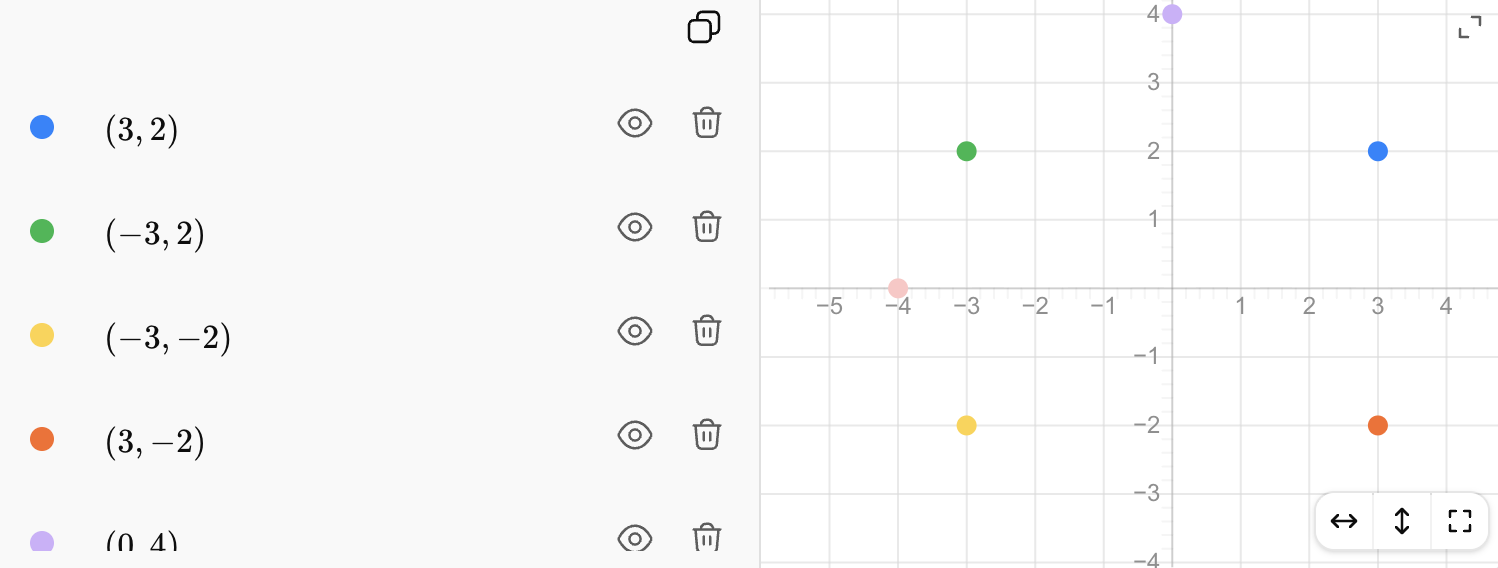
These positions illustrate several important patterns:

  • (3, 2) is right and up.
  • (−3, 2) is left and up.
  • (−3, −2) is left and down.
  • (3, −2) is right and down.
  • (0, 4) lies on the y-axis.
  • (−4, 0) lies on the x-axis.

Positive Coordinates

Consider:

P(5, 3)

Both coordinates are positive.

Start at:

(0, 0)

Move:

5 units right

and:

3 units up

The point is located in the upper-right part of the coordinate plane.


Negative x-Coordinates

Consider:

Q(−4, 2)

The x-coordinate is negative.

Move:

4 units left

Then the positive y-coordinate tells us to move:

2 units up


Negative y-Coordinates

Consider:

R(3, −5)

Move:

3 units right

Then:

5 units down

because the y-coordinate is negative.


Two Negative Coordinates

Consider:

S(−2, −4)

Move:

2 units left

and:

4 units down

Both coordinates are negative.


The Four Quadrants

The x-axis and y-axis divide the coordinate plane into four sections called quadrants.

https://images.openai.com/static-rsc-4/89MibETMGAy8ZN4CauxfqLxkCEXjAOYJcOgyrt-HYYC5MeVCHQ-Du7xQy6TKJMXLQz2-O6GG3EO7tPzbAts7o2DI-_xvJsvuuU7vYv8FHBMVk-y-zLepiBOqsOpUcJM9UMznY4LPRAzLWcT6MqapnO719NoaOnp04mjdMtoTxjp1CLL9ljY7UwWytmf-VTHJ?purpose=fullsize
 
https://images.openai.com/static-rsc-4/GAss17jpiYULMOiat-LRBz6deRnV5eMl3DAyouEFWtSozKcXZNEjvEYp5bfwVTO-VARhhFzHTu6bsKDFerkFaIXCnTMgZWQtGGRX9CR3xJdIQ7qq2-g26Z1OnLj64meYtm0Xxpsyed4hpKA_PXprFBzLgUxpKNQQkpHbk0C6MY3mU0iBR9VzF_B7coBO7Usi?purpose=fullsize
 
https://images.openai.com/static-rsc-4/U9FIuEQnVmG4Hhzfa3hZFwV3P0sQi49wSWNfdv6k5sXZR8HL6HLR8vGBmjK_37HA8Vcvnqs_NsUZGkiyxYlI8slgdM1YakgrYtoqcG3PqTsmBVhnnmHc5gX4baZ5AG11SExrYQ1Nws91qV6vtrcYP8gwwEhtT8NZvI_jmVHmPO4yWo8v2PQUykthVLFj2E_A?purpose=fullsize
 
4

The quadrants are numbered using Roman numerals:

Quadrant I

Quadrant II

Quadrant III

Quadrant IV

They are numbered counterclockwise beginning in the upper-right region.


Quadrant I

In Quadrant I:

x is positive

y is positive

Sign pattern:

(+, +)

Example:

(4, 6)


Quadrant II

In Quadrant II:

x is negative

y is positive

Sign pattern:

(−, +)

Example:

(−3, 7)


Quadrant III

In Quadrant III:

x is negative

y is negative

Sign pattern:

(−, −)

Example:

(−5, −2)


Quadrant IV

In Quadrant IV:

x is positive

y is negative

Sign pattern:

(+, −)

Example:

(6, −4)


Remembering the Quadrants

The quadrants begin in the upper-right and move counterclockwise.

Quadrant x y Example
I + + (3, 4)
II − + (−3, 4)
III − − (−3, −4)
IV + − (3, −4)

Points on the x-Axis

A point on the x-axis has:

y = 0

Examples:

(5, 0)

(−3, 0)

(10, 0)

These points are not located inside any quadrant.

For example:

(−6, 0)

means move 6 units left from the origin but do not move up or down.


Points on the y-Axis

A point on the y-axis has:

x = 0

Examples:

(0, 5)

(0, −7)

(0, 12)

These points are also not inside any quadrant.


The Origin Is Special

The origin:

(0, 0)

lies on both:

  • The x-axis.
  • The y-axis.

It does not belong to any quadrant.


Reading Coordinates from a Graph

Sometimes a point is already plotted and you must determine its coordinates.

To read a point:

Step 1: Determine its horizontal position.

This gives the:

x-coordinate

Step 2: Determine its vertical position.

This gives the:

y-coordinate

Step 3: Write the coordinates as:

(x, y)


Example: Reading a Point

Suppose point A is located:

  • 4 units to the right of the origin.
  • 3 units above the origin.

Then:

x = 4

y = 3

Therefore:

A(4, 3)


Example with Negative Coordinates

Suppose point B is located:

  • 5 units left.
  • 2 units down.

Then:

x = −5

y = −2

Therefore:

B(−5, −2)

Point B lies in:

Quadrant III


Coordinates Are Ordered

The points:

(2, 5)

and:

(5, 2)

are not the same point.

For:

(2, 5)

move:

2 right, 5 up

For:

(5, 2)

move:

5 right, 2 up

Changing the order changes the location.


Comparing Coordinates

Coordinates can help us compare the positions of points.

Suppose:

A(2, 5)

B(2, −3)

Both points have:

x = 2

Therefore, they are vertically aligned.

Point A is above point B because:

5 > −3


Same y-Coordinate

Suppose:

C(−4, 3)

D(6, 3)

Both have:

y = 3

Therefore, the points are horizontally aligned.

Point C is to the left of D because:

−4 < 6


Vertical and Horizontal Lines

If several points have the same x-coordinate, they form a:

vertical line

For example:

(3, 5)

(3, 2)

(3, −4)

all have:

x = 3


If several points have the same y-coordinate, they form a:

horizontal line

For example:

(−4, 2)

(0, 2)

(6, 2)

all have:

y = 2


Distance Along a Horizontal Line

Coordinates can be used to determine distances.

Suppose:

A(2, 4)

and:

B(8, 4)

The y-coordinates are equal, so the points lie on a horizontal line.

The distance is:

8 − 2 = 6 units


Distance Along a Vertical Line

Suppose:

C(−3, 2)

and:

D(−3, 9)

The x-coordinates are equal.

Distance:

9 − 2 = 7 units


Distance Across Zero

Be careful when coordinates are on opposite sides of zero.

Suppose:

A(−4, 2)

and:

B(3, 2)

The horizontal distance is:

3 − (−4)

= 7 units

You can also think:

4 units to reach zero + 3 more units

= 7 units


Plotting Shapes

Coordinate planes can be used to create geometric shapes.

Consider the points:

A(1, 1)

B(5, 1)

C(5, 4)

D(1, 4)

Connecting the points in order creates a:

rectangle

The coordinates tell us exactly where each vertex is located.


Finding Missing Coordinates

Suppose three vertices of a rectangle are:

A(2, 1)

B(7, 1)

C(7, 5)

The fourth vertex must align:

  • Horizontally with C.
  • Vertically with A.

Therefore:

D(2, 5)

Coordinates can therefore be used to reason about geometric shapes.


Reflections Across the x-Axis

A reflection creates a mirror image.

When a point is reflected across the x-axis:

the x-coordinate stays the same

and:

the sign of the y-coordinate changes

For example:

(4, 3) → (4, −3)

Another example:

(−2, −5) → (−2, 5)


Reflections Across the y-Axis

When a point is reflected across the y-axis:

the y-coordinate stays the same

and:

the sign of the x-coordinate changes

For example:

(4, 3) → (−4, 3)

Another example:

(−6, 2) → (6, 2)


Reflection Through the Origin

When a point is reflected through the origin, both signs change.

For example:

(3, 5) → (−3, −5)

and:

(−4, 2) → (4, −2)


Coordinate Changes and Movement

Coordinates can also describe movement.

Suppose a point moves from:

(2, 3)

to:

(7, 3)

The x-coordinate increases by:

5

The y-coordinate does not change.

Therefore, the point moved:

5 units right


Another Movement Example

A point moves from:

(4, 6)

to:

(4, 1)

The x-coordinate remains the same.

The y-coordinate decreases by:

5

Therefore, the point moved:

5 units down


Using Coordinates to Describe Locations

Coordinate systems allow us to describe positions precisely.

For example, imagine a grid map where:

School = (2, 4)

Park = (−3, 5)

Library = (4, −2)

Sports field = (−2, −3)

Instead of giving long descriptions, each location can be identified using an ordered pair.


Coordinates in Maps

Maps often use grid systems similar to coordinate planes.

Coordinates can help identify:

  • Locations.
  • Distances.
  • Directions.
  • Routes.

Modern geographic systems are more complicated than a basic classroom coordinate grid, but the underlying idea is similar:

numbers are used to describe precise locations.

https://images.openai.com/static-rsc-4/YgRFZ80Z9nkQSxx1lmBCdTq0CaMMOiBDyiiLRokrLviAdsGiSmYZX-PPwGVGq7vfP66xrTenayaOf876s-QwXitv18UCY2LauFmM1A1LyMuqKJ3GSw6wrVDt19Bk5x7eQMNLOWJqptPO-K6IVvJI2Q1ytzbM7uZnLB6bWY10QM2kpXNHbDrH1eReqT70YZ1-?purpose=fullsize
 
https://images.openai.com/static-rsc-4/hDamGZ0_drT0YQPVvxHaB5mBuMZVfmfr3NCvaDXDpIelDiuNhxrlzDWmClkwbYBOuTdwtlKiqz1iS7fXogNv6lPTx78J4TGV-8Djt2kcTep4wlGk3CVtzQnT0yHvclLrUUpIIiiYj_NikAmoMwCyg8DnIyU1Ye8m9tm-mxqMsgPx8XyEUl8EPN5dS_EpfpNa?purpose=fullsize
 
https://images.openai.com/static-rsc-4/LBxQyNtJ7gijEO1ZdtSW0g4XUzYRffZ3N5PwozR0pIjaVNR4EwW7PSQJwrAlRgErzeY7FbT5kOILhfK4XFj34t8VQwJc2pWbCDXhEzPxx85b9o9vXzVRIamCFLagAm7yRCvtc7dXoMTfltpSgvZplo9cppwOpf7iQQJhKV7b_oLgL14tKS_pN8DGobEEcrZf?purpose=fullsize
 
5

Coordinates in Computer Graphics

Computer screens also use coordinate systems.

Images, shapes, buttons, and other objects can be positioned using coordinates.

Coordinates are important in:

  • Computer graphics.
  • Animation.
  • Video games.
  • Digital design.
  • Robotics.

A computer needs precise numerical information about where objects should appear.


Coordinates in Science

Coordinate systems are extremely important in science.

In physics, graphs may represent quantities such as:

  • Distance and time.
  • Velocity and time.
  • Force and displacement.
  • Temperature and time.

The horizontal axis usually represents one variable, while the vertical axis represents another.

Understanding coordinate planes therefore prepares learners for graphing scientific data.


Coordinates in Mathematics

Coordinate planes connect geometry and algebra.

Geometry describes:

  • Shapes.
  • Locations.
  • Distances.

Algebra describes relationships using:

  • Numbers.
  • Variables.
  • Equations.

Coordinates allow shapes to be described using numbers and equations.

This branch of mathematics is called:

coordinate geometry

or:

analytic geometry


Scale on a Coordinate Plane

Not every coordinate grid counts by ones.

A graph might increase by:

1

2

5

10

or another amount.

For example, if each grid interval represents:

5 units

then the first mark after zero represents:

5

the second represents:

10

and the third represents:

15

Always check the scale before reading coordinates.


Example with a Different Scale

Suppose each grid square represents:

10 units

A point located:

  • 3 squares right.
  • 2 squares up.

has coordinates:

(30, 20)

not:

(3, 2)


A Reliable Method for Plotting Points

When plotting an ordered pair:

(x, y)

use this method:

Step 1: Start at the origin.

Step 2: Read the x-coordinate.

Move:

  • Right if positive.
  • Left if negative.

Step 3: Read the y-coordinate.

Move:

  • Up if positive.
  • Down if negative.

Step 4: Mark the point.

Step 5: Label it if required.

A useful memory aid is:

x first, y second

or:

across, then up or down


A Reliable Method for Reading Points

When determining the coordinates of an existing point:

Step 1: Trace vertically to the x-axis.

Read the:

x-coordinate

Step 2: Trace horizontally to the y-axis.

Read the:

y-coordinate

Step 3: Write:

(x, y)

Step 4: Check whether the signs match the point's quadrant.


Common Mistakes

Reversing x and y

For:

(3, 7)

3 is the x-coordinate.

7 is the y-coordinate.

Do not write:

(7, 3)


Moving Vertically First

The first coordinate describes horizontal movement.

Always think:

x first → horizontal

y second → vertical


Forgetting Negative Signs

A point to the left of the y-axis has a:

negative x-coordinate

A point below the x-axis has a:

negative y-coordinate


Numbering Quadrants Clockwise

Quadrants are numbered:

counterclockwise

starting in the upper-right.


Saying Points on Axes Are in Quadrants

A point such as:

(5, 0)

is on the x-axis.

It is not in Quadrant I or IV.

Similarly:

(0, −4)

is on the y-axis.

It is not in Quadrant III or IV.


Forgetting the Scale

Do not assume every grid square represents one unit.

Check the numbers printed on the axes.


Confusing the Origin with an Axis

The origin is one specific point:

(0, 0)

The axes are entire number lines.


Check Your Understanding

1. What is a coordinate plane?

2. Which axis is horizontal?

3. Which axis is vertical?

4. What is the origin?

5. Write the coordinates of the origin.

6. In the ordered pair (4, 7), which number is the x-coordinate?

7. In the ordered pair (4, 7), which number is the y-coordinate?

8. Describe how you would plot (5, 3).

9. Describe how you would plot (−4, 6).

10. Describe how you would plot (3, −5).

11. Describe how you would plot (−2, −7).

12. In which quadrant is (6, 4)?

13. In which quadrant is (−3, 8)?

14. In which quadrant is (−5, −2)?

15. In which quadrant is (7, −4)?

16. Does the point (5, 0) lie in a quadrant? Explain.

17. Where is the point (0, −6) located?

18. What must be true about the y-coordinate of every point on the x-axis?

19. What must be true about the x-coordinate of every point on the y-axis?

20. Explain why (2, 5) and (5, 2) represent different locations.

21. Points A(3, 7) and B(3, 1) have the same x-coordinate. How are they aligned?

22. Points C(−4, 5) and D(6, 5) have the same y-coordinate. How are they aligned?

23. Find the horizontal distance between (2, 4) and (9, 4).

24. Find the vertical distance between (−3, −2) and (−3, 6).

25. Find the horizontal distance between (−5, 3) and (4, 3).

26. Reflect (4, 6) across the x-axis.

27. Reflect (−3, 5) across the y-axis.

28. A point moves from (2, 4) to (8, 4). Describe its movement.

29. A point moves from (−3, 6) to (−3, 1). Describe its movement.

30. Give two real-world situations in which coordinates can be used to describe locations or positions.


Key Terms

  • Coordinate plane – two-dimensional grid formed by perpendicular number lines.
  • x-axis – horizontal axis of a coordinate plane.
  • y-axis – vertical axis of a coordinate plane.
  • Origin – point where the axes intersect; (0, 0).
  • Ordered pair – pair of numbers written (x, y) describing a point's location.
  • x-coordinate – first number in an ordered pair; describes horizontal position.
  • y-coordinate – second number in an ordered pair; describes vertical position.
  • Quadrant – one of the four regions formed by the coordinate axes.
  • Plot – place a point at its correct location on a coordinate plane.
  • Coordinate – number used to describe a point's position.
  • Scale – amount represented by each interval on an axis.
  • Reflection – transformation that creates a mirror image.
  • Coordinate geometry – study of geometric figures using coordinates and algebra.

Key Takeaways

  • A coordinate plane contains a horizontal x-axis and vertical y-axis.
  • The axes intersect at the origin.
  • The origin is:

(0, 0)

  • Locations are written as ordered pairs:

(x, y)

  • The x-coordinate always comes first.
  • Positive x means move right.
  • Negative x means move left.
  • Positive y means move up.
  • Negative y means move down.
  • Quadrant I has signs (+, +).
  • Quadrant II has signs (−, +).
  • Quadrant III has signs (−, −).
  • Quadrant IV has signs (+, −).
  • Points on the x-axis have y = 0.
  • Points on the y-axis have x = 0.
  • Points on either axis are not in a quadrant.
  • Coordinates can describe locations, movements, shapes, and distances.
  • Coordinate systems are widely used in mathematics, science, maps, engineering, computing, and navigation.

A useful rule for plotting any point is:

Start at the origin → x first → y second.