Density and the Properties of Fluids
4. Floating and Sinking
Learning outcomes
- I can explain why some objects float while others sink.
- I can compare the density of an object to the density of a fluid.
- I can predict whether an object will float, sink, or remain suspended.
- I can describe how changing an object's volume can affect its buoyancy.
- I can apply density concepts to real-world examples of floating and sinking.


Why Do Some Objects Float?
Drop a stone into water and it usually sinks.
Drop a piece of wood into the same water and it usually floats.
Why?
The answer involves two important ideas:
density
and:
buoyancy.
An object's behaviour in a fluid depends on the relationship between the object's average density and the density of the surrounding:
fluid.
Density and Floating
Density describes how much mass is contained in a particular:
volume.
To predict what happens when an object is placed in a fluid, compare:
density of the object
with:
density of the fluid.
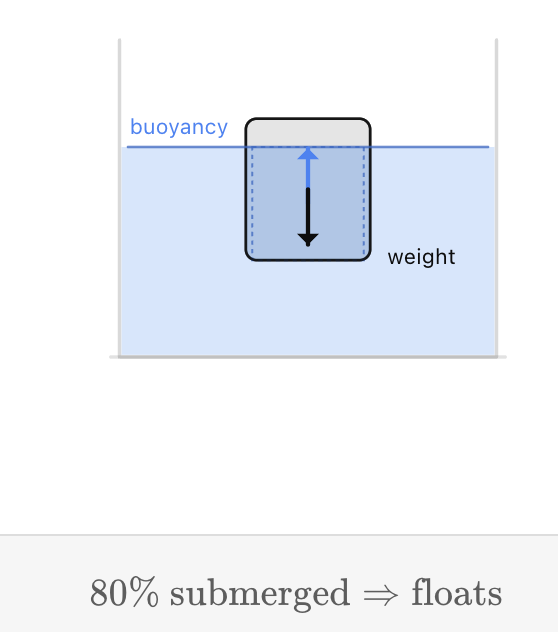
For simple situations:
Object less dense than fluid → floats
Object denser than fluid → sinks
Object with the same density as fluid → can remain suspended
This relationship is one of the most useful ways to predict:
floating and sinking.
Example: Wood and Water
Suppose a piece of wood has a density of:
0.70 g/cm³
Water has a density of approximately:
1.00 g/cm³.
Since:
0.70 < 1.00
the wood is less dense than water.
Therefore it:
floats.
Example: Rock and Water
Suppose a rock has a density of:
2.6 g/cm³.
Water has a density of:
1.0 g/cm³.
Since:
2.6 > 1.0
the rock is denser than water.
Therefore it:
sinks.
What Does "Suspended" Mean?
An object can sometimes remain within a fluid without rising or sinking.
This is called:
neutral buoyancy.
For this to occur under simple conditions, the object's average density must be approximately equal to the density of the:
fluid.


If:
ρobject = ρfluid
the object can remain:
suspended.
This is important for:
- submarines
- scuba divers
- fish
- underwater robots
It Is Not Just About Weight
A common misconception is:
heavy objects sink and light objects float.
This is not correct.
A huge ship can float while a tiny metal ball can:
sink.
The important comparison is not simply weight.
It is the relationship between:
density and buoyant force.
What Is Buoyancy?
When an object is placed in a fluid, the fluid pushes on the object.
Fluid pressure acts in:
all directions.
Because fluid pressure generally increases with depth, the upward force acting on the bottom of a submerged object is greater than the downward force acting on its top.
The result is a net upward force called:
buoyant force.


Two Important Forces
For a simple floating or sinking object, two forces are especially important:
Weight acts downward.
Buoyant force acts upward.
We can compare these forces.
If:
buoyant force > weight
the object accelerates upward.
If:
weight > buoyant force
the object accelerates downward.
If:
buoyant force = weight
the object has no vertical acceleration.
Why Does Buoyant Force Exist?
Consider a cube completely underwater.
Water pushes:
- downward on the top
- upward on the bottom
- sideways on the sides
The bottom of the cube is deeper than the top.
Pressure is therefore greater at the:
bottom.
The upward force exceeds the downward force.
This creates the net:
buoyant force.
Archimedes' Principle
The relationship between displacement and buoyancy is described by:
Archimedes' principle.
It states:
The buoyant force acting on an object equals the weight of the fluid displaced by the object.
This means that the more fluid an object displaces, the greater the potential:
buoyant force.


What Does "Displace" Mean?
To displace fluid means to push it out of the space that the object now:
occupies.
Place an object into a completely full container of water.
Some water may overflow.
That water has been:
displaced.
The object's interaction with this displaced fluid determines the:
buoyant force.
Why Does a Floating Object Stop Rising?
Imagine a block rising toward the surface.
Eventually part of it emerges from the water.
As less of the block remains underwater, it displaces:
less water.
The buoyant force therefore decreases.
The block reaches equilibrium when:
buoyant force = weight.
At that point it floats at the:
surface.
How Much of an Object Is Submerged?
The density of a floating object affects how much of it must be:
submerged.
A very low-density object needs to displace relatively little water to support its weight.
A denser floating object must displace:
more water.
Therefore it sits deeper.


Example: Two Floating Blocks
Block A:
density = 0.30 g/cm³
Block B:
density = 0.80 g/cm³
Both are placed in water:
density = 1.00 g/cm³.
Both float.
However, Block B must displace more water to support its weight.
Therefore Block B floats:
deeper in the water.
Fraction Submerged
For a simple uniform floating object:
fraction submerged ≈ object density ÷ fluid density
For example, an object with density:
0.75 g/cm³
floating in water:
0.75 ÷ 1.00 = 0.75
Approximately:
75%
of its volume will be submerged.
Worked Example 1
A block has:
density = 0.60 g/cm³
It floats in water.
Approximately what percentage of the block is underwater?
0.60 ÷ 1.00 = 0.60
Therefore approximately:
60%
of the block is submerged.
Floating in Different Fluids
The same object can behave differently in different:
fluids.
Suppose an object has a density of:
0.95 g/cm³.
In Fluid A:
density = 0.80 g/cm³
The object is denser than the fluid.
It:
sinks.
In Fluid B:
density = 1.10 g/cm³
The object is less dense than the fluid.
It:
floats.
Salt Water vs Fresh Water
Salt water is denser than:
fresh water.
Therefore an object floating in salt water does not need to displace as much volume to support the same weight.
As a result, objects generally float:
higher in salt water.


The Floating Egg
An egg may sink in ordinary water.
When salt is added, the density of the water:
increases.
Eventually the salt water may become denser than the egg.
The egg then:
floats.
The egg did not become lighter.
Instead, the density of the surrounding fluid:
increased.
Why Does Ice Float?
The density of ice is approximately:
0.92 g/cm³.
The density of liquid water is approximately:
1.00 g/cm³.
Because:
0.92 < 1.00
ice floats.
Most of an iceberg therefore remains underwater, while a smaller portion extends above the:
surface.


Changing Volume Can Change Floating Behaviour
Suppose an object has a fixed mass.
Its average density is:
mass ÷ volume.
If we increase its volume without significantly increasing its mass:
average density decreases.
A lower average density can make an object more likely to:
float.
This idea explains many important examples.
A Ball of Clay
Imagine a solid ball of modeling clay.
Its density is greater than water.
Place it in water and it:
sinks.
Now take exactly the same clay and reshape it into a hollow:
boat shape.
It may float.
Why?


Why the Clay Boat Floats
The amount of clay has not changed significantly.
Therefore its mass is approximately:
the same.
But the boat shape encloses air and occupies a much larger total:
volume.
Its average density becomes lower.
The shape also allows it to displace a greater volume of water before becoming fully submerged.
Eventually the displaced water weighs enough to support the:
boat.
Average Density
For hollow objects, we often need to consider:
average density.
Average density includes the entire volume of the object, including:
empty or air-filled spaces.
This is why a hollow steel ship can have an average density lower than water even though steel itself is much:
denser than water.
Why Do Steel Ships Float?
Steel has a density of roughly:
7.8 g/cm³.
That is much greater than the density of water.
A solid block of steel therefore:
sinks.
But a ship is mostly:
hollow space.


The large hull contains air and gives the entire ship a huge:
volume.
This lowers the ship's average density.
The hull also displaces a large amount of water.
When:
weight of displaced water = weight of ship
the ship floats.
Loading a Ship
What happens when cargo is loaded onto a ship?
The ship's mass:
increases.
Its weight therefore increases.
To produce a larger buoyant force, the ship must displace:
more water.
The ship therefore sinks slightly deeper into the water until a new equilibrium is reached.
The Load Line
Ships have markings that indicate safe loading depths.
These are often associated with a:
load line.
Loading too much cargo causes the ship to sit too low in the water.
This reduces its safety margin and can increase the risk of water entering the:
vessel.
Submarines
Submarines provide an excellent example of controlled:
buoyancy.
They contain tanks called:
ballast tanks.
By changing the amount of water and air in these tanks, a submarine can change its overall:
average density.


Making a Submarine Sink
To dive, ballast tanks can take in:
water.
This increases the submarine's mass while its external volume changes relatively little.
Its average density:
increases.
The submarine can then descend.
Making a Submarine Rise
To rise, compressed air can force water out of the ballast tanks.
The submarine's mass:
decreases.
Its average density decreases.
The submarine becomes more positively buoyant and:
rises.
Neutral Buoyancy in a Submarine
A submarine can adjust its mass so that its average density is approximately equal to that of the surrounding:
water.
Then:
buoyant force ≈ weight.
The submarine can remain at approximately the same:
depth.
Fish and Swim Bladders
Many bony fish have a gas-filled organ called a:
swim bladder.
Changing the amount or volume of gas in the swim bladder helps control the fish's:
buoyancy.


Increasing the effective volume occupied by gas can reduce average density and increase buoyancy.
This helps the fish maintain or change its position in:
water.
Scuba Divers
Scuba divers also need to control buoyancy.
A diver can use a:
buoyancy control device (BCD).
Adding air to the BCD increases its volume and therefore increases the amount of water it can:
displace.
This can increase buoyancy.
Releasing air reduces buoyancy.
Hot-Air Balloons
Buoyancy does not occur only in liquids.
Remember:
gases are fluids too.
A hot-air balloon floats in:
air.


Heating the air inside the balloon makes it less dense than the surrounding cooler air.
The balloon experiences an upward buoyant force from the:
surrounding atmosphere.
If the upward force is sufficient compared with the total weight, the balloon rises.
Helium Balloons
Helium is much less dense than ordinary:
air.
A helium-filled balloon displaces surrounding air.
If the weight of the displaced air is greater than the total weight of the balloon and helium, the balloon:
rises.
Again, the same principles of buoyancy apply in:
gases.
Floating Liquid Layers
Liquids themselves can float on other:
liquids.
For example, many oils are less dense than water.
Therefore oil forms a layer:
above water.


If several liquids do not mix significantly, they can form a density column.
Generally:
most dense → bottom
least dense → top.
Objects Between Liquid Layers
Suppose a density column contains:
oil = 0.80 g/mL
water = 1.00 g/mL
An object has density:
0.90 g/cm³.
The object is denser than the oil, so it:
sinks through the oil.
But it is less dense than water, so it:
floats on the water.
It therefore settles near the boundary between the two liquids.
Worked Example 2 — Float or Sink?
Object density:
1.4 g/cm³
Fluid density:
1.0 g/cm³
Since:
1.4 > 1.0
the object:
sinks.
Worked Example 3 — Suspended Object
Object density:
1.05 g/cm³
Fluid density:
1.05 g/cm³
The densities are equal.
The object can be:
neutrally buoyant.
It can remain suspended rather than rising or sinking.
Worked Example 4 — Different Fluid
A plastic object has density:
0.95 g/cm³.
In water:
0.95 < 1.00
so it floats.
In a liquid with density:
0.80 g/cm³:
0.95 > 0.80
so it sinks.
Therefore:
floating is determined by both the object and the fluid.
Worked Example 5 — Calculate and Predict
An object has:
mass = 160 g
volume = 200 cm³
Density:
ρ = 160 ÷ 200
ρ = 0.80 g/cm³
Water density:
1.00 g/cm³
Since:
0.80 < 1.00
the object should:
float.
Worked Example 6 — A Metal Boat
A piece of aluminum foil sinks when compressed into a very compact shape but floats when carefully formed into a wide boat.
Why?
The mass of aluminum remains approximately the:
same.
The boat shape increases the total volume and allows more water to be:
displaced.
Its average density becomes lower, and sufficient buoyant force can support it.
Worked Example 7 — Loading a Boat
A boat is floating.
Several heavy boxes are added.
What happens?
Mass and weight:
increase.
The boat must displace more water to produce a larger:
buoyant force.
Therefore the boat settles:
deeper into the water.
Worked Example 8 — Floating in Salt Water
A swimmer moves from fresh water into denser salt water.
What changes?
The denser salt water can provide the required buoyant force while a smaller volume of the swimmer is:
submerged.
The swimmer therefore tends to float slightly:
higher.
Worked Example 9 — Changing Volume
An object's mass remains 500 g, but its volume changes from 400 cm³ to 600 cm³.
Original average density:
500 ÷ 400 = 1.25 g/cm³
New average density:
500 ÷ 600 ≈ 0.83 g/cm³
In water, the first configuration tends to:
sink.
The second configuration can:
float.
Changing volume has changed the object's:
average density.
Worked Example 10 — Density Layers
Three liquids have densities:
A = 1.20 g/mL
B = 0.75 g/mL
C = 1.00 g/mL
If they do not mix, from top to bottom they should arrange as:
B
C
A
The least dense liquid floats highest.
Floating Does Not Mean There Is No Gravity
Gravity still acts on a floating object.
Its weight acts:
downward.
The object remains at rest because the fluid provides an equal upward:
buoyant force.
Therefore:
buoyant force = weight
for an object floating at rest.
Suspended Does Not Mean There Are No Forces
A neutrally buoyant object also experiences forces.
Weight acts:
downward.
Buoyant force acts:
upward.
The forces balance, so the resultant vertical force is approximately:
zero.
Common Mistake: Heavy Objects Always Sink
False.
A ship can weigh thousands of tonnes and still:
float.
Floating depends on density, displaced fluid, and buoyant force—not simply total mass.
Common Mistake: Light Objects Always Float
Also false.
A tiny steel ball can be light compared with a ship but still sink because its density is greater than:
water.
Common Mistake: Hollow Objects Have No Density
A hollow object still has an:
average density.
We consider its total mass divided by its total external volume.
The enclosed air can greatly reduce its average density.
Common Mistake: Buoyant Force Only Acts on Floating Objects
Buoyant force acts on:
submerged objects too.
A rock sinking through water experiences an upward buoyant force.
It sinks because its weight is greater than the buoyant force available when fully submerged.
Common Mistake: Sinking Means There Is No Upward Force
A sinking object can still experience:
buoyant force.
The forces are simply unbalanced:
weight > buoyant force
so the resultant force is downward.
Common Mistake: An Object That Floats in Water Floats in Every Liquid
No.
The object's density must be compared with the density of the:
specific fluid.
An object can float in water but sink in a less-dense liquid.
Practical Activity — Foil Boat Challenge
This topic works especially well as a design investigation.
Give each group the same-sized sheet of:
aluminum foil.
Challenge students to construct a boat capable of supporting the greatest number of identical masses or coins before sinking.


Students should investigate:
- boat shape
- boat volume
- mass carried
- displacement
- stability
- maximum load
The key question is:
How can we change the shape and volume without changing the amount of aluminum?
Students can then explain why some designs support more mass using:
density, displacement, and buoyancy.
Real-World Applications
Floating and sinking principles are important in:
- ships
- submarines
- life jackets
- scuba diving
- fishing
- hot-air balloons
- weather balloons
- floating docks
- offshore platforms
- underwater robots
- hydrometers
Understanding buoyancy is therefore important in both:
science and engineering.
Check Your Understanding
- What determines whether an object floats or sinks?
- What happens when an object is less dense than the surrounding fluid?
- What happens when it is denser?
- What happens when its density equals the fluid density?
- Define neutral buoyancy.
- Why is "heavy objects sink" an incorrect rule?
- What is buoyant force?
- In which direction does buoyant force act?
- In which direction does weight act?
- Why does a fluid produce an upward buoyant force?
- State Archimedes' principle.
- What does it mean to displace water?
- How does displaced fluid affect buoyant force?
- Why does a floating object stop rising?
- Why do denser floating objects sit deeper in water?
- An object has density 0.60 g/cm³. Will it float in water?
- An object has density 1.40 g/cm³. Will it float in water?
- An object has density 1.00 g/cm³. What might it do in water?
- Approximately what fraction of an object with density 0.70 g/cm³ will be submerged in water?
- Why can an object float in one fluid but sink in another?
- Why do objects generally float higher in salt water?
- Explain the floating egg experiment.
- Why does ice float on liquid water?
- What is average density?
- How can increasing an object's volume reduce its average density?
- Why can a clay ball sink while a clay boat floats?
- Why does changing shape affect the amount of water displaced?
- Why can a steel ship float?
- Why does a solid steel block sink?
- What happens when cargo is added to a ship?
- Why does the ship move deeper into the water?
- How does a submarine use ballast tanks?
- How can a submarine make itself sink?
- How can it make itself rise?
- How can a submarine achieve neutral buoyancy?
- How can a fish use a swim bladder to control buoyancy?
- How does a scuba diver use a BCD?
- Why can a hot-air balloon rise?
- Why can a helium balloon rise?
- Can buoyancy occur in gases? Explain.
- Why does oil often float on water?
- How do liquids arrange themselves in a density column?
- An object has density 0.90 g/cm³. Oil has density 0.80 g/mL and water has density 1.00 g/mL. Where will the object settle?
- Calculate the density of a 240 g object with volume 300 cm³ and predict its behaviour in water.
- Explain why buoyant force still acts on a sinking object.
- What forces act on a floating object?
- What is the resultant vertical force on an object floating at rest?
- Explain how changing volume can change whether an object floats or sinks.
- Design an experiment to investigate how boat shape affects the maximum load it can carry.
- Explain how density, displacement, buoyant force, and weight work together to determine whether an object floats, sinks, or remains suspended.
Key Terms
Buoyancy: Tendency of an object to float or rise in a fluid due to an upward force.
Buoyant force: Upward force exerted by a fluid on an object immersed in it.
Density: Mass per unit volume.
Displacement: Movement of fluid caused by an object occupying space within it.
Archimedes' principle: The buoyant force on an object equals the weight of the fluid it displaces.
Neutral buoyancy: Condition in which buoyant force balances weight while an object is completely immersed.
Average density: Total mass divided by total external volume, including hollow spaces.
Ballast: Material or water used to change the mass and stability of a vessel.
Swim bladder: Gas-filled organ used by many fish to help regulate buoyancy.
Fluid: Substance that can flow; liquids and gases are fluids.
Key Takeaways
- Whether an object floats or sinks depends strongly on its average density compared with the density of the fluid.
- If object density < fluid density, the object tends to float.
- If object density > fluid density, the object tends to sink.
- If the densities are equal, the object can be neutrally buoyant.
- Fluids exert an upward buoyant force on immersed objects.
- According to Archimedes' principle, buoyant force equals the weight of the displaced fluid.
- A floating object settles until buoyant force equals its weight.
- Denser floating objects generally sit deeper in a fluid.
- Increasing an object's volume without significantly increasing its mass lowers its average density.
- This explains why hollow boats can float even when made from materials denser than water.
- A steel ship floats because its overall structure contains a large volume of air and displaces enough water.
- Adding cargo makes a ship sit deeper because it must displace more water.
- Submarines control buoyancy by changing their mass using ballast tanks.
- Fish, scuba divers, ships, submarines, balloons, and underwater vehicles all make use of buoyancy.
- Buoyancy occurs in both liquids and gases.
- Floating and sinking are excellent examples of how density, forces, and fluid behaviour work together.