Density and the Properties of Fluids
2. Density
Learning outcomes
- I can define density as mass per unit volume.
- I can use the density equation to calculate density, mass, or volume.
- I can explain how density affects the behaviour of materials.
- I can compare the densities of different substances.
- I can predict whether one substance will float on another based on density.


What Is Density?
Why does a small piece of metal often feel much heavier than a similar-sized piece of wood?
Why does oil float on water?
Why can an enormous steel ship float while a small steel bolt sinks?
All of these questions involve:
density.
Density describes how much mass is contained in a particular volume of a substance.
A material with a large amount of mass packed into a small volume has a:
high density.
A material with relatively little mass in the same volume has a:
low density.
Mass, Volume, and Density
To understand density, we need to distinguish three quantities.
Mass tells us how much matter an object contains.
Volume tells us how much space the object occupies.
Density compares the object's mass with its volume.
For example, two blocks could have exactly the same volume but very different:
masses.
The heavier block has the greater density.


The Density Equation
Density is calculated from mass and volume.
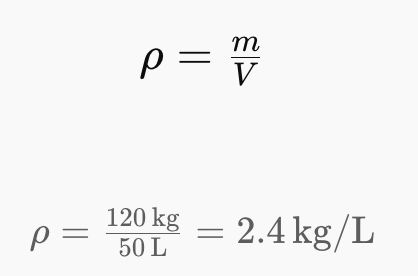
where:
ρ = density
m = mass
V = volume
The Greek letter ρ, pronounced rho, is commonly used to represent:
density.
Units of Density
Common units for density include:
g/cm³
g/mL
kg/m³
For solids, density is often expressed in:
g/cm³.
For liquids, it is often convenient to use:
g/mL.
In SI calculations, density is commonly expressed in:
kg/m³.
Cubic Centimetres and Millilitres
An important relationship is:
1 cm³ = 1 mL
Therefore:
1 g/cm³ = 1 g/mL
This makes it easy to compare densities measured using cubic centimetres and:
millilitres.
Density of Water
The density of pure water is approximately:
1.0 g/cm³
or:
1.0 g/mL
near ordinary laboratory temperatures.
In SI units this is approximately:
1000 kg/m³.
Water provides a useful reference when predicting whether many materials will:
float or sink.
Understanding High and Low Density
Imagine two cubes with exactly the same dimensions.
Cube A has a mass of:
20 g
Cube B has a mass of:
80 g
Because they have the same volume, Cube B has:
four times as much mass packed into the same space.
Therefore Cube B has the greater:
density.
Density and the Particle Model
Density can also be considered using the particle model.
A substance may have greater density because:
- its particles have greater mass
- its particles are packed more closely
- or both
A substance with less mass within the same volume has a lower:
density.


Density Is a Property of a Substance
Density is an important characteristic property of a:
material.
Suppose you cut a uniform aluminum block in half.
Its mass decreases.
Its volume also decreases.
But the ratio of mass to volume remains approximately the:
same.
Therefore the density remains approximately unchanged.
A Large Sample Does Not Necessarily Have Greater Density
A common mistake is to think:
bigger object = greater density.
This is not necessarily true.
A huge block of foam can have more total mass than a tiny steel ball.
But the steel can still have a much greater:
density.
Density depends on the ratio between mass and volume, not simply the object's size.
Calculating Density
Suppose a block has:
mass = 120 g
volume = 50 cm³
Density:
ρ = 120 ÷ 50
ρ = 2.4 g/cm³
Therefore the density of the block is:
2.4 g/cm³.
Worked Example 1
A rock has a mass of 180 g and a volume of 60 cm³.
Calculate its density.
ρ = m ÷ V
ρ = 180 ÷ 60
ρ = 3.0 g/cm³
Answer: 3.0 g/cm³
Worked Example 2
A piece of wood has a mass of 150 g and a volume of 250 cm³.
ρ = 150 ÷ 250
ρ = 0.60 g/cm³
The density of the wood is:
0.60 g/cm³.
Because this is less than the density of water, the wood would generally be expected to:
float on water.
Rearranging the Density Equation
Sometimes density is known, but mass or volume is missing.
From the density relationship we can rearrange to calculate:
mass = density × volume
and:
volume = mass ÷ density
It is important to choose the equation that matches the quantity you are trying to:
find.
Finding Mass
Suppose a metal has:
density = 8.0 g/cm³
and:
volume = 15 cm³
Mass:
m = ρV
m = 8.0 × 15
m = 120 g
Worked Example 3
A liquid has a density of 0.80 g/mL and a volume of 250 mL.
Calculate its mass.
m = ρV
m = 0.80 × 250
m = 200 g
Answer: 200 g
Finding Volume
Suppose an object has:
mass = 270 g
and:
density = 2.7 g/cm³
Volume:
V = m ÷ ρ
V = 270 ÷ 2.7
V = 100 cm³
Worked Example 4
A metal sample has a mass of 624 g and a density of 7.8 g/cm³.
Calculate its volume.
V = m ÷ ρ
V = 624 ÷ 7.8
V = 80 cm³
Answer: 80 cm³
Measuring the Density of a Regular Solid
To determine the density of a regular solid such as a rectangular block:
Step 1 — Measure the mass
Use a:
balance.
Step 2 — Calculate the volume
For a rectangular block:
V = length × width × height
Step 3 — Calculate density
Use the measured mass and calculated volume.


Worked Example 5 — Regular Solid
A block measures:
5 cm × 4 cm × 3 cm
Its mass is:
162 g
First calculate volume:
V = 5 × 4 × 3
V = 60 cm³
Now calculate density:
ρ = 162 ÷ 60
ρ = 2.7 g/cm³
Measuring an Irregular Solid
What if the object is a rock or another irregular shape?
Its volume cannot easily be calculated using length × width × height.
Instead, we can use:
water displacement.


Water Displacement
Suppose the initial water level is:
50 mL
After a rock is submerged, the water level becomes:
72 mL.
Volume of rock:
72 − 50 = 22 mL
Because:
1 mL = 1 cm³
the rock's volume is:
22 cm³.
If its mass is known, its density can then be calculated.
Worked Example 6 — Irregular Solid
A stone has a mass of:
66 g.
Water rises from:
40 mL to 64 mL.
Volume of stone:
64 − 40 = 24 cm³
Density:
ρ = 66 ÷ 24
ρ = 2.75 g/cm³
Answer: 2.75 g/cm³
Measuring the Density of a Liquid
The density of a liquid can also be measured experimentally.
Step 1
Measure the mass of an empty container.
Step 2
Add a known volume of liquid.
Step 3
Measure the mass of the container plus liquid.
Step 4
Subtract the mass of the empty container.
This gives the mass of the:
liquid alone.
Step 5
Calculate its density.


Worked Example 7 — Liquid
An empty measuring cylinder has a mass of:
45 g.
With 50 mL of liquid, its mass is:
85 g.
Mass of liquid:
85 − 45 = 40 g
Volume:
50 mL
Density:
ρ = 40 ÷ 50
ρ = 0.80 g/mL
Comparing Densities
Different substances have different characteristic densities.
Approximate values include:
| Substance | Density |
|---|---|
| Air | 0.0012 g/cm³ |
| Cork | 0.24 g/cm³ |
| Ice | 0.92 g/cm³ |
| Vegetable oil | ~0.9 g/cm³ |
| Water | 1.0 g/cm³ |
| Aluminum | 2.7 g/cm³ |
| Iron | 7.9 g/cm³ |
| Copper | 9.0 g/cm³ |
| Lead | 11.3 g/cm³ |
Exact density can depend on factors such as:
temperature and composition.
Density and Floating
Density helps us predict whether one substance will float on:
another.
For an object placed in a fluid:
average object density < fluid density → tends to float
average object density > fluid density → tends to sink
average object density = fluid density → can remain suspended under suitable conditions


Example — Wood in Water
Suppose wood has a density of:
0.70 g/cm³.
Water has a density of approximately:
1.0 g/cm³.
Since:
0.70 < 1.0
the wood is less dense than water.
Therefore it tends to:
float.
Example — Iron in Water
Iron has a density of approximately:
7.9 g/cm³.
Water has a density of:
1.0 g/cm³.
Since:
7.9 > 1.0
a solid piece of iron will normally:
sink.
Why Does Ice Float?
Ice is unusual because solid water is less dense than liquid water.
Ice has a density of approximately:
0.92 g/cm³.
Liquid water is approximately:
1.0 g/cm³.
Therefore:
ice floats on water.


Why Is Ice Less Dense Than Water?
When water freezes, its molecules arrange into a more open:
crystal structure.
The molecules occupy more volume than they did in liquid water.
The mass does not increase, but the volume does.
Since density depends on mass divided by volume, the density:
decreases.
Why Does Oil Float on Water?
Many common oils have densities around:
0.8–0.9 g/mL.
Water has a density of approximately:
1.0 g/mL.
Therefore many oils are less dense than water and form a layer:
above the water.
Oil and water also do not mix readily, making the layers easy to observe.


Density Columns
Several liquids with different densities can form layers.
If the liquids do not mix significantly, the:
most dense liquid settles toward the bottom
and the:
least dense liquid remains toward the top.
A possible density column might contain:
honey → water → oil
from bottom to top.
This provides a useful visual demonstration of:
relative density.
Predicting Floating Between Two Liquids
Suppose:
Liquid A density = 0.80 g/mL
Object density = 0.90 g/cm³
Liquid B density = 1.00 g/mL
The object is denser than Liquid A, so it sinks through:
Liquid A.
But it is less dense than Liquid B, so it floats on:
Liquid B.
The object may therefore settle at the:
boundary between the liquids.
Worked Example 8 — Float or Sink?
An object has:
mass = 75 g
volume = 100 cm³
Density:
ρ = 75 ÷ 100
ρ = 0.75 g/cm³
Since:
0.75 < 1.0
the object should generally:
float in water.
Worked Example 9 — Float or Sink?
A rock has:
mass = 540 g
volume = 200 cm³
Density:
ρ = 540 ÷ 200
ρ = 2.7 g/cm³
Since:
2.7 > 1.0
the rock should:
sink in water.
But Ships Are Made of Steel!
Steel is much denser than water.
So why can a steel ship float?
The important quantity is the:
average density of the entire ship.
A ship contains a large volume of:
air.
The hollow structure greatly increases its total volume without adding an equally large amount of mass.
Therefore the ship's overall average density can be low enough for it to:
float.


Density and Buoyancy
Floating also involves an upward force called:
buoyant force.
When an object is placed in a fluid, it displaces some of that fluid.
The fluid exerts an upward force on the object.
Whether the object floats or sinks depends on the relationship between:
its weight and the buoyant force.
Density provides a convenient way of predicting the result for many simple situations.
Floating Objects Are Partly Submerged
A floating object does not necessarily sit completely above the liquid.
It sinks into the liquid until it displaces enough fluid for the buoyant force to balance its:
weight.
A denser floating object generally needs to displace more fluid and therefore sits:
deeper in the liquid.
Salt Water and Fresh Water
Salt water is denser than:
fresh water.
Dissolved salts add mass to the water without increasing its volume proportionally.
Therefore people, boats, and other objects generally float slightly higher in:
salt water.


The Floating Egg Experiment
An egg may sink in ordinary fresh water.
If enough salt is dissolved in the water, the water's density:
increases.
Eventually the salt solution can become denser than the egg.
The egg then:
floats.
The egg itself has not necessarily changed.
The density of the surrounding:
fluid has changed.
Density and Temperature
Density can change when temperature changes.
Heating usually causes substances to:
expand.
If mass remains constant while volume increases:
density decreases.
Cooling often causes substances to contract, increasing their:
density.
Water behaves unusually near its freezing point, so its behaviour is more complicated than this general pattern.
Warm and Cold Fluids
Warm fluids are often less dense than cooler fluids of the same substance.
This density difference can cause:
convection.
Warmer fluid rises while cooler, denser fluid sinks.
This contributes to:
- ocean currents
- atmospheric circulation
- boiling water
- heating systems


Density in the Atmosphere
Warm air expands and usually becomes less dense than surrounding cooler air.
The less-dense warm air can:
rise.
Cooler, denser air can move downward.
Density differences therefore play an important role in:
weather and atmospheric circulation.
Density in Oceans
Ocean water density depends strongly on:
- temperature
- salinity
Colder water is generally denser than warmer water, while saltier water is generally denser than fresher water.
Density differences contribute to large-scale:
ocean circulation.
Density and Material Identification
Because pure substances have characteristic densities under specified conditions, density can help identify an:
unknown material.
Suppose an unknown metal has a measured density of:
2.7 g/cm³.
This is consistent with the approximate density of:
aluminum.
However, density alone may not always provide certain identification because different materials can have similar densities.
Worked Example 10 — Identifying a Material
An unknown metal has:
mass = 178 g
volume = 20 cm³
Density:
ρ = 178 ÷ 20
ρ = 8.9 g/cm³
This is close to the density of:
copper.
The density measurement therefore provides evidence that the sample may be copper.
Unit Conversion
Sometimes density values are given in different units.
A useful relationship is:
1 g/cm³ = 1000 kg/m³
Therefore:
2.7 g/cm³ = 2700 kg/m³
and:
0.80 g/cm³ = 800 kg/m³.
Always check that the units in a density calculation are:
compatible.
Worked Example 11 — Unit Conversion
Convert:
7.9 g/cm³
to:
kg/m³.
Multiply by 1000:
7.9 × 1000 = 7900 kg/m³
Answer: 7900 kg/m³
Density vs Weight
Density and weight are not the same thing.
Weight is a force caused by gravity.
Density is mass per unit volume.
A large piece of low-density material can weigh more than a tiny piece of high-density material.
Therefore:
heavy does not automatically mean dense.
Density vs Mass
Mass tells us the total amount of matter in an object.
Density tells us how concentrated that mass is within a given:
volume.
Two objects can have equal mass but different densities if they have different:
volumes.
Worked Example 12 — Same Mass, Different Volume
Object A:
mass = 100 g
volume = 50 cm³
Density:
2.0 g/cm³
Object B:
mass = 100 g
volume = 200 cm³
Density:
0.50 g/cm³
Both have the same mass, but Object A is:
four times as dense.
Common Mistake: Bigger Means Denser
An object's size does not determine its density.
Density depends on:
mass relative to volume.
A huge piece of foam may be less dense than a tiny piece of metal.
Common Mistake: Heavier Means Denser
An object can have greater mass simply because there is:
more of it.
To compare density fairly, both mass and volume must be considered.
Common Mistake: Anything Heavy Sinks
Floating depends on the object's average density compared with the density of the:
fluid.
Large ships can have enormous masses and still float because their overall volume is also enormous.
Common Mistake: All Liquids Have the Same Density
Different liquids can have very different densities.
For example:
oil < water
for many common oils.
Density differences allow some liquids to form:
layers.
Common Mistake: An Object Always Floats or Always Sinks
Whether an object floats depends on the:
fluid as well as the object.
An object that sinks in one fluid may float in a denser fluid.
Common Mistake: Density Changes When You Cut an Object
If a uniform substance is cut into smaller pieces, both its mass and volume decrease proportionally.
Its density remains approximately:
unchanged.
Check Your Understanding
- Define density.
- What two quantities are needed to calculate density?
- What symbol is commonly used for density?
- State the density equation.
- Give three common units of density.
- What is the relationship between 1 mL and 1 cm³?
- What is the approximate density of water in g/cm³?
- What is the approximate density of water in kg/m³?
- What does a high density mean?
- Can two objects with the same volume have different densities? Explain.
- Can two objects with the same mass have different densities? Explain.
- Why is density considered a characteristic property of a material?
- Calculate the density of a 200 g object with a volume of 50 cm³.
- Calculate the density of a 90 g object with a volume of 120 cm³.
- Calculate the mass of 30 cm³ of material with a density of 4.0 g/cm³.
- Calculate the mass of 500 mL of liquid with a density of 0.80 g/mL.
- Calculate the volume of a 270 g object with a density of 2.7 g/cm³.
- Calculate the volume of a 500 g substance with a density of 5.0 g/cm³.
- How would you determine the density of a rectangular block?
- How would you determine the density of an irregular rock?
- Explain water displacement.
- Water rises from 35 mL to 58 mL when a stone is submerged. What is the stone's volume?
- How would you measure the density of a liquid?
- Why must the mass of the empty container be subtracted?
- What determines whether an object tends to float or sink?
- What happens if an object's average density is less than the fluid density?
- What happens if its average density is greater?
- Predict whether an object with density 0.65 g/cm³ will float in water.
- Predict whether an object with density 3.2 g/cm³ will float in water.
- Why does ice float on water?
- Why does oil commonly float on water?
- Explain how a density column works.
- An object has density 0.90 g/cm³. It is placed between liquids with densities 0.80 and 1.10 g/mL. Predict where it will settle.
- Why can a steel ship float?
- What is meant by average density?
- What is buoyant force?
- Why does a floating object sit partly below the water surface?
- Why do objects generally float higher in salt water than fresh water?
- Explain the floating egg experiment.
- How does heating usually affect density?
- Why does warm air tend to rise?
- Explain how density differences can cause convection.
- Name two factors affecting seawater density.
- How can density help identify an unknown substance?
- Why might density alone not prove the identity of a material?
- Convert 3.5 g/cm³ into kg/m³.
- Convert 0.85 g/cm³ into kg/m³.
- Explain the difference between mass and density.
- Explain the difference between weight and density.
- A material has a mass of 360 g and volume of 400 cm³. Calculate its density and predict whether it would tend to float in water.
Key Terms
Density: Mass contained per unit volume.
Mass: Amount of matter in an object.
Volume: Amount of space occupied by an object or substance.
ρ (rho): Symbol commonly used for density.
Water displacement: Method for determining the volume of an irregular object by measuring how much liquid it displaces.
Buoyant force: Upward force exerted by a fluid on an immersed object.
Average density: Total mass of an object divided by its total volume, including hollow spaces.
Float: Remain supported at or near the surface of a fluid because buoyant force balances weight.
Sink: Move downward through a fluid when weight exceeds the available buoyant force.
Convection: Movement in a fluid driven partly by density differences.
Key Takeaways
- Density is mass per unit volume.
- Density depends on both mass and volume, not simply how heavy or large an object is.
- Common density units include g/cm³, g/mL, and kg/m³.
- 1 mL = 1 cm³.
- Water has a density of approximately 1.0 g/cm³.
- The density relationship can be rearranged to calculate density, mass, or volume.
- The volume of a regular solid can be calculated from its dimensions.
- The volume of an irregular solid can be measured using water displacement.
- Density is a characteristic property that can help identify substances.
- An object less dense than a fluid tends to float.
- An object denser than a fluid tends to sink.
- Ice floats because it is less dense than liquid water.
- Many oils float because they are less dense than water.
- Steel ships can float because their hollow structures give them a sufficiently low average density.
- Salt water is denser than fresh water, so objects generally float higher in it.
- Temperature can affect density by changing the volume of a substance.
- Density differences in fluids can produce convection currents.
- Understanding density provides an important foundation for studying buoyancy, pressure, fluids, weather, oceans, and engineering.