3. Muscles and Movement

Learning outcomes
  • I can explain how muscles produce movement.
  • I can describe the interaction between muscles and bones.
  • I can distinguish between different types of muscle tissue.
  • I can explain the role of energy in muscle contraction.
  • I can analyze how movement supports survival and behavior.

How Do Animals Produce Movement?

Movement is one of the most obvious characteristics of animals. Animals move their entire bodies to find food, escape predators, locate mates, and explore their environments. They also produce smaller movements involved in breathing, digestion, circulation, and communication.

In vertebrates, most visible body movement results from cooperation between three major systems:

  • The nervous system sends signals that control muscles.
  • The muscular system produces force by contracting.
  • The skeletal system provides support and structures that muscles can pull against.

Together, the muscles and skeleton form the musculoskeletal system.

https://images.openai.com/static-rsc-4/lScRqRGDVVPcm6R2A4dE4RXKH2h4b_W0MHp9m2fF6h9DGTM8Go6Y5tZ7scT5mEWtMrXFh8AwvrA2qdvO-BwMYbe1GU1W88VadcC1B8xcLh7uKHCw08wLFhnVApYZ0e-dgyZu8HEi9ujfuZ1HKrvanaJiga4c7TI92pwbMHSslSjLaMtrjx7zyzhiWtjgkW4G?purpose=fullsize
 
https://images.openai.com/static-rsc-4/xd-Ms_akGXl-8MfizrGtyFWOu1U1QrThtd07W74XjK6b-3hDf10xOa5cQlAEdbegDDuy3-PssIb3j0dNd8SUqV0gDUpxqP6G6R4hIEiQqK1L8iQ4dQpSVEKypZYgaZO0R9UEO8Cw78WrWm9t6yfnCs4qXtyqaSzhdeCCXjLmAe1ChXkB1cSJGQEzF0BQ9vwz?purpose=fullsize
 
https://images.openai.com/static-rsc-4/KHs6qSLrFo-FJITW13x8aj8ZoFOgwNkHqQQoojYO31vFvPovOiez9B_IjCgHTHsc-TLn0x-y8LeQZyppUBHAO2Fakcp5Oz8c3ItqBQmVMWTQy6prkgWv2a1UUkQ-FJ2eHIVqQrP1iuD524sYZ3R3pKuqtolZOYGiioPRvmWqzCRJtWUifmFgKSSC9fst0Ss5?purpose=fullsize
 
5

A useful sequence is:

Nervous signal → muscle contraction → force on bone → movement at joint


Muscles Produce Force by Contracting

Muscles produce movement through contraction.

When a muscle contracts, it develops tension and can shorten, pulling on structures attached to it.

An important principle is:

Muscles pull; they do not actively push.

This means that moving a joint in opposite directions usually requires different muscles.

For example, bending and straightening the elbow involve different muscles working together.


Muscles and Bones

Most skeletal muscles are attached to bones by strong connective tissues called tendons.

When a skeletal muscle contracts:

  • The muscle produces tension.
  • The tendon transmits the force.
  • The force pulls on a bone.
  • The bone moves around a joint.
https://images.openai.com/static-rsc-4/leXIfigHAWjFXhhReHRCDhUER8uSCAivlSenvLqKCvbILCyePgHffkkrkaDYNpyvhfg9XkegwCdINR0L8ci_kX2xE272BTmv1yI9TQmEUk30y0BWBhmC8D5FnVnnW8xjIi7zDRTZABs83HWLYotIfYvDK6ZMnhTZXElN8dubKUvCdyNX0c2JTWhFFC8XJkAH?purpose=fullsize
 
https://images.openai.com/static-rsc-4/1cEDN2pdHDfaPBQhwhVEbRr4xrLX3W0zxbIBPZxNObAb_YX7GMmbpLaX_ybnZwk-I2oCpnNlDGU-5VBkAlFqnTfiPm21NdktGpAN0jFM6poWOSa0gnGoCUMS3f9AP9IGpC71uQK3woCXGOyOdvyBmaBHAJAHSlcPh3SC_gi1idFJENcw2v0Pm09_geQhd9kH?purpose=fullsize
 
https://images.openai.com/static-rsc-4/5BKszVrnlsuxZ-7qeCws2z6u6AT_WUupSOEz6rhYU8wUjktnn1RGeJs4YM-8quq2t6hDu_ljE9jIYiei6kQhUg83E-0JJntJtlC5CBtW3ei59OHs1QZ0tYrA-Iq_Cq7yfhlA8gfY9ekxJGrM0lMhwVk5mbwrR_64nWeUWwEZATyKFpAe4R-3SX0tsbAOFVlp?purpose=fullsize
 
5

The skeleton therefore does more than support the body. It provides a mechanical framework against which muscles can produce movement.


Tendons and Ligaments

Tendons and ligaments are often confused.

A tendon connects:

Muscle → bone

A ligament connects:

Bone → bone

Ligaments help stabilise joints, while tendons transfer muscular force to the skeleton.


Joints

A joint is a location where two or more bones meet.

Some joints permit little or no movement, while others allow considerable movement.

Examples of movable joints include:

  • Shoulder.
  • Elbow.
  • Wrist.
  • Hip.
  • Knee.
  • Ankle.
https://images.openai.com/static-rsc-4/bAjm7MgIgLg89X1HD8eIZK-eLTCwXbwBKtR2N2eIZg2Bf9YUHzAcF-Fyfw_UPLoAxlzgUw0e26g_FqAqhAgyWIl_Wrf6u6nLFAWjFPBetSKxsxfzu807q0UVpjOw_Mol1Urhn5h6WC9Y2EjX-UJa9EYE8R4whKLZLSoWgmn1pUj4IMQq5bVS48WnHCTVHs_z?purpose=fullsize
 
https://images.openai.com/static-rsc-4/90W1WUQj3wg7cSjSjcb1l0AUJGmGzA8-UyF2rtMr_oUve3vuXXbNj9ae9aahfM7yjdo7345z5FWIMOWBcoaRmMq1ICc566Dy_FL3bfnpkaDpQXmTa02sh8Na0ktouqQJv01iBrEjok7zxye5YJBo198uePTG2E2QOWCBC15adEmO971lx4M5SnO1InFmubnI?purpose=fullsize
 
https://images.openai.com/static-rsc-4/dqeHqTGXwG8r2KEZWQ69uuwCYckAa-30u-3Aa7_jHJlhzwo72MgO6bfKTYoLOss7rYvJ7H14xhYHURf9aA0-uNYX5zLbIAQexUqzegnAhXdyx9uisqRYjtnDpx5_toRh3VFJX__NQyo9VkHJIgBr9AfBBlTyzLm9m-nZ3B1vY-frk_ELSG-XL_3s3ijwp29N?purpose=fullsize
 
4

Many freely movable joints are called synovial joints.

They contain structures that reduce friction and allow controlled movement.


Bones Act as Levers

Bones can act as levers.

A lever is a rigid structure that rotates around a pivot.

In the body:

  • Bone acts as the lever.
  • Joint acts as the pivot.
  • Muscle provides the force.
  • Body part or external object provides resistance.

For example, when the biceps contracts to lift the forearm, the forearm bones rotate around the elbow joint.

This arrangement converts muscle contraction into useful movement.


Antagonistic Muscle Pairs

Because muscles pull rather than push, many skeletal muscles work in antagonistic pairs.

An antagonistic pair consists of muscles that produce opposite movements.

The biceps and triceps are a familiar example.

https://images.openai.com/static-rsc-4/cXr1bmde62JKhwq3abKp8nADYOuOvJKT944U8_NdVm2xr0Xp3ocXsKLNyph5s5sBSkr7AioQc5DQl0eMeCGwEs72Wni8mvBE8uaxT4KX_gxatVAsQlStImSWf0h5Ct8k52WWIQYeYGtCq-dEQQZwqBFPJRfvwHJGQND62h6snIUJm534FwhOFIXlC0x99k3T?purpose=fullsize
 
https://images.openai.com/static-rsc-4/Se4ckmnkkuExjlEsvMbUfzzvm2Di27V1P65w-Ov-zgz_iL0tkXhYAZMK0PyLMZFCYLeZ0OFAmEmZuprYj1foOZNtYNjQjToynRMRmwtFg5MKW3CPG32lRnDmMP_oiOvSn32rH5GZh_IW_sSlgRR0vLW1KkOH7J_guIHruiDiTVYK2kQ-l0UEk6CR-tjdgLwD?purpose=fullsize
 
https://images.openai.com/static-rsc-4/2rmB-kY45SVM4KH0sYRnTQFtkC4xkDpbuYSOttPmsT9o5Zl9bh-3mRVDp6IxfUKn-rEYEQE5b8n0h4lhr60hU4mK2yns6jIgKrKyF1-AWIyrm_DPkKd7P-lAR1MdO3pdpKXy__D9fcCQ1YJy11TD0N_ysEU_UhGOoy9nYI6mxg0k-ssYXDZ0pVcmJEnnP7gy?purpose=fullsize
 
5

Bending the Arm

When the elbow bends:

  • Biceps contracts.
  • Biceps shortens and produces tension.
  • Triceps relaxes sufficiently to allow movement.
  • Forearm moves upward.

This movement is called flexion.

The biceps acts as a flexor at the elbow.


Straightening the Arm

When the elbow straightens:

  • Triceps contracts.
  • Triceps produces force on the forearm.
  • Biceps relaxes sufficiently to allow movement.
  • Forearm moves downward or away from the upper arm.

This movement is called extension.

The triceps acts as an extensor at the elbow.

Therefore:

Flexion → biceps contracts

Extension → triceps contracts

In real movements, muscle control can be more complex, and opposing muscles may sometimes contract simultaneously to stabilise a joint.


Muscle Tissue

Animals contain different types of muscle tissue specialised for different functions.

Humans have three major types:

  • Skeletal muscle.
  • Smooth muscle.
  • Cardiac muscle.
https://images.openai.com/static-rsc-4/lXOZaaqzksLaaxtowppYB9tE_4YEAnUtM6sRNGYXsqMaKTrPa6xdb09CFj5GCGq7Z0A0G4JG5UV4xTF_nraJZf92LYPbOrz3VdZmXJtXGi9TB_pt_Sov5GK1prGOEEa3EiP-9_99tpioedeI6Lx_8XawGF0LwWtUln6ZX_CUBF5jtxCtvXQnGlTS21rikmd5?purpose=fullsize
 
https://images.openai.com/static-rsc-4/iJXwO5XU0dCLCaUkelJztlBKgtaEYFstrnm4m1O0EiUgNktTlnKKSv3HvbmZ_gkAWF_pVkBd0Al-AFx1Yzmjb4mSXt6uEHSO9HRtFoBgekV6Aio-rHbVixXs59Bqaf43HZMb7Wo100IkhiNI6Ia7kh4MACaVct4rkiCqPnPkbFc_7BuGtdFgnzr1-OlEDCbT?purpose=fullsize
 
https://images.openai.com/static-rsc-4/2_NP0HTAkaxyBDlZWUWHO1HObKUzoeUTBPsjkGYYeHK3WMWdc3ULwH22VG_lkTEWi_hao3uvWxwaWOzLKAunHmTKeDQDBZUW1YN-xAt8CrqxYfSfUd9AfoFvvLvZL1CePb6tTRYEgDPsxood55asChFiDIqjTgP8JZtHxj0ljTB7xr2F6u2AWzsFcgJqV5HB?purpose=fullsize
 
6

Although all three types can contract, their structures, locations, and functions differ.


Skeletal Muscle

Skeletal muscle is usually attached to bones.

It produces movements such as:

  • Walking.
  • Running.
  • Jumping.
  • Writing.
  • Chewing.
  • Moving the eyes.
  • Maintaining posture.

Skeletal muscle is usually described as voluntary muscle because many of its movements can be consciously controlled.

However, skeletal muscles are also involved in automatic responses such as reflexes.

Under a microscope, skeletal muscle has a striped or striated appearance.


Smooth Muscle

Smooth muscle is found in the walls of many internal organs.

Examples include:

  • Digestive tract.
  • Blood vessels.
  • Bladder.
  • Airways.
  • Uterus.

Smooth muscle usually operates without conscious control and is therefore described as involuntary.

https://images.openai.com/static-rsc-4/DJKf66xzrc3CTDHv2zz29Ydy05PRmdsXOhXfsGMFCOgQinTJKgFhFfY5bH4hJX9TcO8vihq5NLLht1YaWRKcbL9WQO8TOhtqaeh5oZTodL5vvD_6xdEFNWLKV0GxnLBxfbTkM6GUc9wNl71v_uFyrohbgjFRNmyJ1SkOuAymND-NkDoNvCPxNp53cZ8J0TOu?purpose=fullsize
 
https://images.openai.com/static-rsc-4/BSRCwMH004bTMP9VIxf0OIYekncB75IzvLVvIU3zk9EguxytOE8r0-pazCadxsbtn8Kwit-xGVreKZG4czZPv5V6T6fU5kf_o_6EuoOFCwWipYCWHxqFhoLm_ToNf2kHjr8lRB7WhUsURXteaw44INj8TBC4ydiXQpHjcMWX31-6U116MzDOFRJ9MHOFlJ2Q?purpose=fullsize
 
https://images.openai.com/static-rsc-4/yQeh7iFpCmbhlnt8CBSH80dSFUrwGTTkONBZU5a2NG39VpZVJIy-Jf7JxhmbGgLn0YUkn4hBdVNRZX7G202v5BbZ6-PUO4O12SE0rHgacedDQ2FlRC4D0OP2PhZjbeBi4Ugb8WCPWCAadjGWWLIjSPYnDvNszu34Wrhrm-UGj4SVXXvLOB9-qo_a-cxBNoru?purpose=fullsize
 
4

For example, smooth muscle in the digestive tract produces waves of contraction called peristalsis, which help move food through the digestive system.


Cardiac Muscle

Cardiac muscle is found only in the heart.

It contracts rhythmically throughout life to pump blood around the body.

Cardiac muscle is:

  • Involuntary.
  • Striated.
  • Highly resistant to fatigue under normal conditions.
  • Specialised for repeated rhythmic contraction.
https://images.openai.com/static-rsc-4/mWy3cFlAzs_RCmonOLVpCFOKs2Yj9XZMPCComOAXSGPbtykWRzdzu5fMbHG33d6q_FufTcw0fpMmqjeO7fepiAAuvFlOEXwJY4IjNA1rG-hVohvcLcY4xj3697_rDsNrYDEgnhlQ_89rPLGAamGei62Q2AMkyLI9UgXqHNVVVnPHOm1ImhGCMhyZt55aJfJy?purpose=fullsize
 
https://images.openai.com/static-rsc-4/Ah5_v8QLZ_BjK9TZu77VyBhPy_XCWUtxXLxOZ4nDH7dUK_9nsddG7yIjtuDiITJ-olSBeUpOWuTR_0x2FY3-bjl05Jm69Qk9isVDOEiQxfy1a0_6mTIysAJt4B3PMWa2c3uNL21gfpkEZiT36qdZo58wm4HjHHBb94SwUwa9XvMteq0DD0Fm2IPr96bG4OS1?purpose=fullsize
 
https://images.openai.com/static-rsc-4/FxWsxS0F-UXXd5HhSK94dzdSSX79XbWrkRg92Y66RbJiIic49MKpq2FwXco2gO0jNxJ9UmErreXa7ffCuCdWeB99lpeXoH602W4rBYQ_-p3tfnnz_mMvvqWBwpfgDB2MSkw09N1lsDM9PXNRr4rWY8_sMn4g8dcfSAJMr0rCwgGfA0KOLExoVWqyqOZcE-GE?purpose=fullsize
 
4

Cardiac muscle cells are connected in ways that allow coordinated contraction of heart tissue.


Comparing Muscle Types

Feature Skeletal Muscle Smooth Muscle Cardiac Muscle
Main location Attached to skeleton Internal organs Heart
Control Mostly voluntary Involuntary Involuntary
Appearance Striated Non-striated Striated
Typical role Body movement Movement within organs Pumping blood
Contraction Can be rapid and powerful Usually slower Rhythmic

Each muscle type is adapted to its particular function.


Structure of Skeletal Muscle

A skeletal muscle is organised into increasingly smaller structures.

A simplified organisation is:

Whole muscle → muscle bundles → muscle fibres → myofibrils → contractile proteins

A muscle fibre is actually a specialised muscle cell.

https://images.openai.com/static-rsc-4/V3C9uedd72ORaGsOm6HQK-nXKf-kOIwRNiL4Olu9kGNWnIbbkrPdVPG-USRe_HWnS9Hv3M1wTqsX5u1u5VvOrC4LAGgAV0HrWuUP3Qs0EDCrm7B04ztPIL5sg9R9icsIV54A6S_8ZhrNHzLnsevo3fK7iGq_4hoINdSu6q1xqq61R3G3TPdoCjRUQEWquCOA?purpose=fullsize
 
https://images.openai.com/static-rsc-4/RwpLTVJvsM4fFHTzOi4e3yC5eq3vKfKIueFXPrXY0TMwsIlXJ-lM7439JOGvWvMcUcWujVHCcQEYB0bq3tbB-wZvPO-UFUDmYYSIOoh15ONr6EUncgO9vxZ-Zq0QN0yyBISj_pFqK9HQ2dySOe7B-uu76eKFkPkYOUiiNqPjbpBTESd1DM4YLwgmBTxYREm-?purpose=fullsize
 
https://images.openai.com/static-rsc-4/ZuxN9D_LjJh5FX1-n-Ro4i9IVXuJ1DrQnoRMpzc-9KytD_B2YjjK3WCbbJRF8zpjIwXvXhEy9s1bIl6Mu0E73pTzqMNIms74bTouTs2JCIQXEGbmIGwbv7kckPfO_PdH91IZDNmZx5zFkMPTE4DgOJ0UttCXvxdgcAXnpAay4F0aPfbfEJ_Zz327_vbao9JP?purpose=fullsize
 
6

Inside the fibres are many myofibrils, which contain the protein structures responsible for contraction.


Actin and Myosin

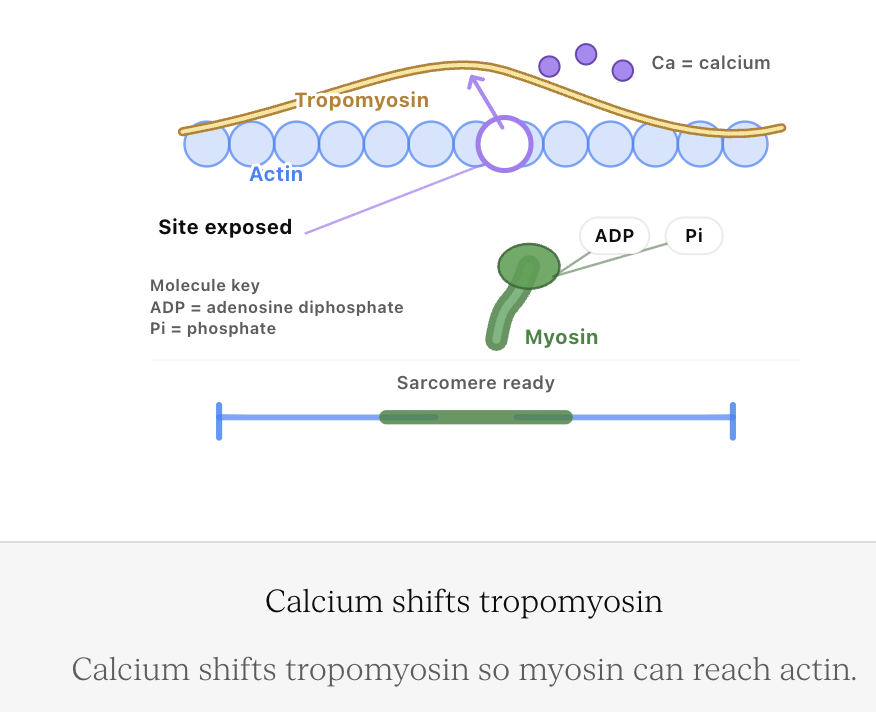
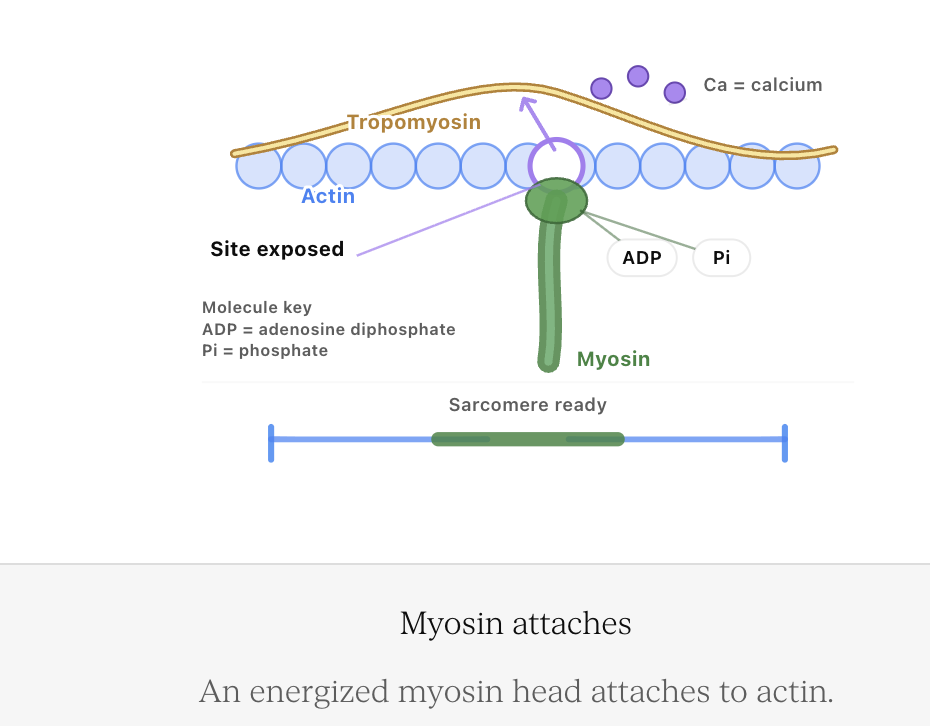
Two important proteins involved in muscle contraction are:

  • Actin
  • Myosin

These proteins are arranged in repeating units called sarcomeres.

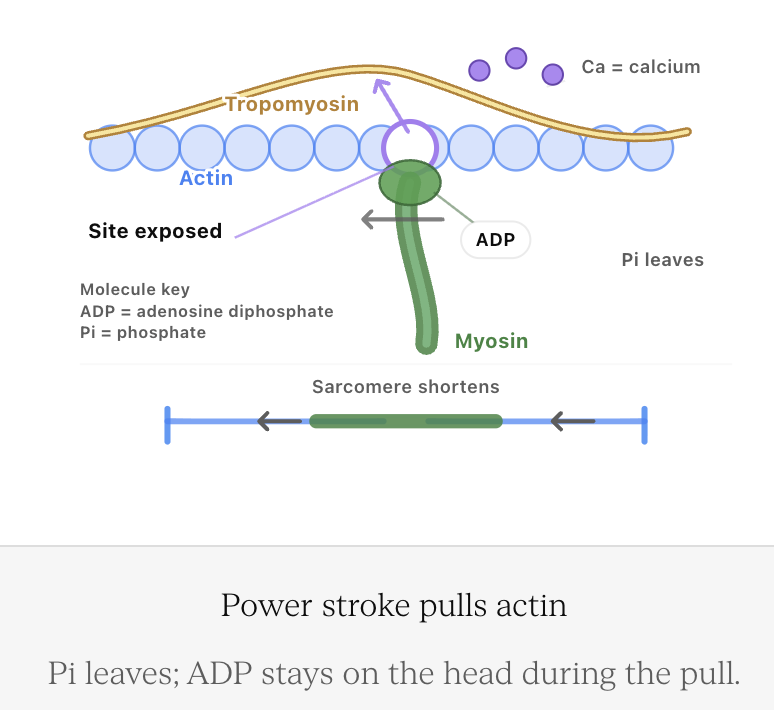
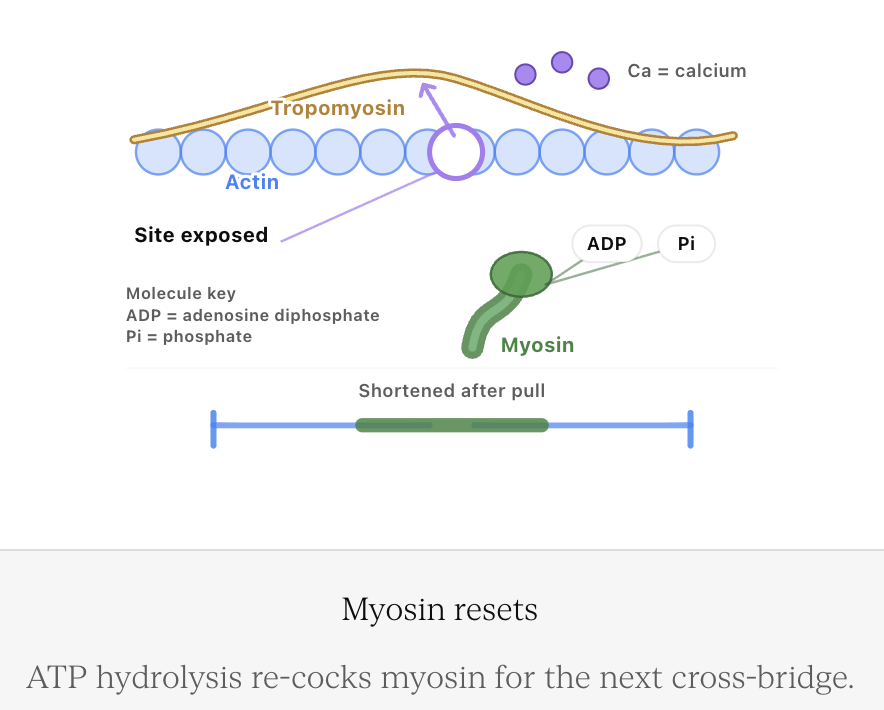
During contraction, actin and myosin interact so that the protein filaments slide past one another.

This is known as the sliding filament mechanism.

https://images.openai.com/static-rsc-4/h7uQDUkaN6al6KqvhcN4tm37PdVBENIYd4phgUUhQj0-W6W7AxNXOeCch3Cq1FHITNVI5ZqRneimp91x6wf_tPfgCGUOzPa5o7CUy5-Ie1fI7HVyiYKLSpErVkD_gGsooaBRjjkoSR34nM_FlOW8y1lTDIXCXj0NsZrxMsa5Zyo7yJGMJxuIl58YAfVzbI1M?purpose=fullsize
 
https://images.openai.com/static-rsc-4/dPDrokMGcacFSt2sSIik9tE2KPQ05z3LKaxR4Wa4q-3qDEfP8J7EyRbQL52GUIOV9bQ_T8LEEsXBByRP2imlFUBWKIkwDgdvqUTz8EWznq_mw4Lf0MSpibK0mzP6O_pfzaeGZ2oTShfJej4gd-yFVs3woifATDZkJsUcBHmYA0M588VQiZrA2c-NW-JLBSDs?purpose=fullsize
 
https://images.openai.com/static-rsc-4/X5PQqhoHeKOqi0FawWnZIFm1t_AQZ355Tan1JNYr_5-3f7QLoVCq_hRl6a7TGpuWikojwzkn4e1ZgwsKxIQDlA_TjSEgZ7844b6d8Fr7qhKk_qW2-4GFnisDDhh3hCt97i0gdvJI_NzhF6Y0sy9hKBD6bAbjM-WzJvczeUBc8HldMtjUNm1N6CSp3AUqPX-U?purpose=fullsize
 
4

The filaments themselves do not simply become shorter.

Instead, their arrangement changes as they slide relative to one another, shortening the sarcomere.

Many sarcomeres shortening together causes the muscle fibre to shorten.


How Muscle Contraction Occurs

A skeletal muscle does not contract spontaneously during normal movement. It receives instructions from the nervous system.

A simplified sequence is:

Motor neuron stimulated

↓

Signal reaches muscle fibre

↓

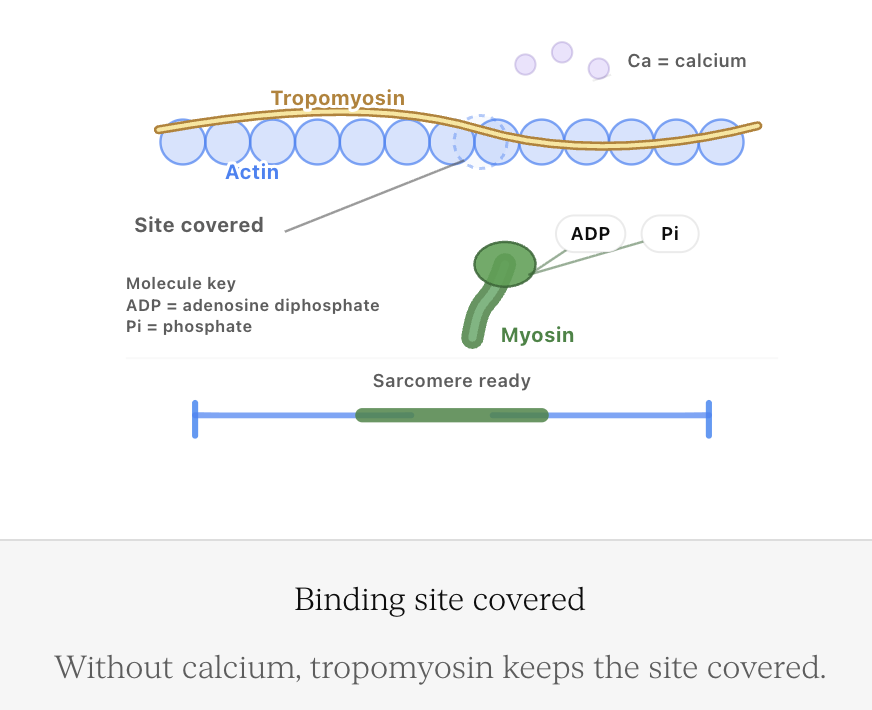
Calcium ions become available inside the muscle fibre

↓

Actin and myosin interact

↓

Myosin pulls actin

↓

Sarcomeres shorten

↓

Muscle develops tension and may shorten
This connects the nervous system directly with movement.


The Neuromuscular Junction

The connection between a motor neuron and a skeletal muscle fibre is called a neuromuscular junction.

It is a specialised type of synapse.

https://images.openai.com/static-rsc-4/Htne3kUxbA9g26QkWHtD90d8eTy0Qg-yGkUeOkbF9On7KhhasDdRseWeXpjQiJMRQBazeFHriJdLf9d4BnQt-S-Erd63v_BXusosJ7gq6aUWrwaoqh0e7YY0EHkASitXP_xH9AXA6MdvmnmZVgMZ31WsCD5ZxQwPCgAX10hT11-se6ZY-bzeW4CmgF58oWDn?purpose=fullsize
 
https://images.openai.com/static-rsc-4/mKO_03sjqyHZolAmQYCoQ5qbGN1zy0xT1XMzBjEvEjxIBIiYeGUFXxFS78HT8i0P9VZdNzlr81Tbxns9Yh8Y_nrdIjHGJkW-5sAJg1Iyw6OyLR1t9jWtx9ItP-QWE4jIUsw9BLlramA9Wt1IB3fma1-TkLZl1iKVjQB-_QU9AYbp-Xgo31QCO279LGPQH2-D?purpose=fullsize
 
https://images.openai.com/static-rsc-4/dG_nQ66EsqOszneg334Syg_LHNY9t2Yo5xMFsuf5JDAqA3e_TEHMvJGE954V_E8QsnMUW1t11CfTBALeCZyA1FXjVPIxOQrtgcVMFb59vw1_BCsx0e_khikXXX26pLG1cl9uMjxI4sle7M5qL6UyEQwrJ3BySfcPihTDmfoTXWky1uPWLfo0YkygaFmlVCOo?purpose=fullsize
 
5

When a nerve impulse reaches the end of the motor neuron:

  • A neurotransmitter is released.
  • The neurotransmitter crosses the small synaptic gap.
  • It binds to receptors on the muscle cell.
  • Electrical activity spreads across the muscle membrane.
  • Processes inside the fibre trigger contraction.

The neurotransmitter used at vertebrate skeletal neuromuscular junctions is acetylcholine.


Muscles Need Energy

Muscle contraction requires energy.

The immediate usable energy is supplied by ATP.

ATP is needed for several processes involved in contraction, including the repeated interactions between actin and myosin.

Muscles therefore require a continuous supply of ATP during activity.


Where Does the ATP Come From?

Muscle cells regenerate ATP using energy released from nutrients.

During aerobic respiration:

glucose + oxygen → carbon dioxide + water + energy transferred

Some of this transferred energy is used to produce ATP.

Muscles therefore depend on several organ systems.

The respiratory system supplies oxygen.

The digestive system supplies nutrients.

The circulatory system transports oxygen and nutrients to muscle cells.

Muscle cells use these materials to release energy through cellular respiration.

https://images.openai.com/static-rsc-4/Obkp4cfa9YRHzv9PrTKt-CJnInV1mnYt85i3ave3SbSRRVVnddnApYP-SZZvR_JPMYhJcbGWMgVFZAI2ECM7ZIe40PWrU5e_R3DSm2DnVzgOyxHL8EOqDRvByw2NYpKTVfUy4Dw2GG0ChNjJaWF1YpG9H6o8x-jao--vM0Bw1tJF2pULv-_iATGc7I1GjNwZ?purpose=fullsize
 
https://images.openai.com/static-rsc-4/5QGXv3Bscp3KHvJpGA7lPYu3YwDFCVF-1ThjJl3CZuYOKKZYrtLSkNFTJKtzcn-Xir6ELt5yE4jLV9Zx7PbAG9dxHUn36j2nbHVU1UJs1EGHeemiU1PVstXnRKjR6rD-m6BU1_evULBbauI4obmJzofOufjqJTbHsp47GmX-30_zGxtEMjQsgICYMqN633XZ?purpose=fullsize
 
https://images.openai.com/static-rsc-4/wrlPiReRcN7RaZI6-R5eLvI9W_4dDvHonnDn0Q0CCsd_xBNNTtPQew66sFThB9wW4wJRau-nbpLjlvlG9mwI3Ox9wlkIJ5MludHC_b3jlCOCdEofDfkQJL_ugLkIDJ6LeOAH7F9SFgvdsRVUvsswyE5WkzZVrcvu1o-ShF0SHbzJ_EJDsMNe1AvtX3484jGi?purpose=fullsize
 
5

ATP and the Sliding Filament Mechanism

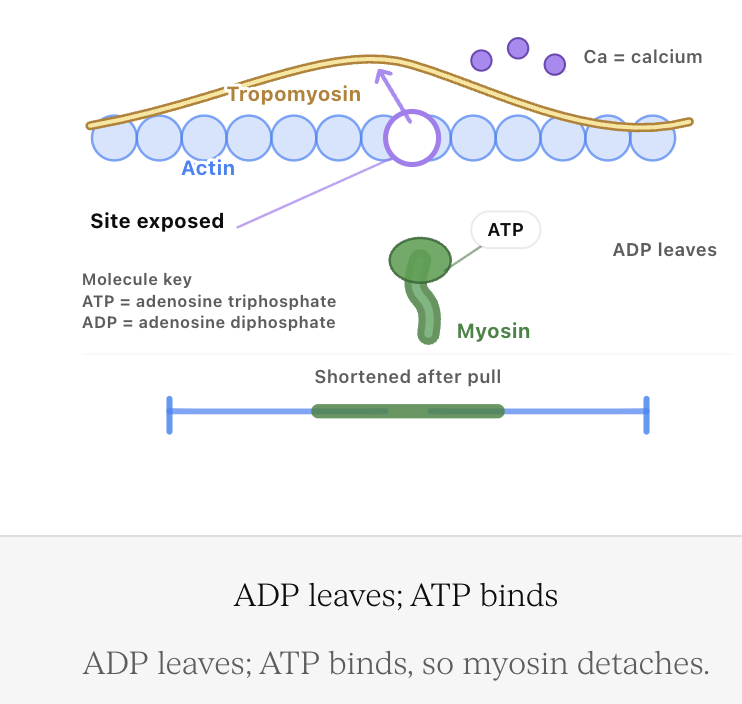
ATP plays a direct role in interactions between actin and myosin.

Myosin structures repeatedly:

  • Attach to actin.
  • Produce a pulling movement.
  • Detach.
  • Reset their position.

ATP is required for this cycle to continue.

Without sufficient ATP, normal muscle contraction and relaxation cannot continue.

Muscular movement therefore represents a conversion of:

Chemical energy → mechanical work + thermal energy


Muscles and Oxygen

During sustained activity, muscles require large amounts of ATP.

This increases the rate of cellular respiration.

As a result:

  • Breathing rate can increase.
  • Breathing depth can increase.
  • Heart rate can increase.
  • Blood flow to active muscles can increase.
https://images.openai.com/static-rsc-4/oe1jYeuycfGMyOGP18U5Vuvl86L_QesBEbbJzbvLC-XniCaMpGUoPGkP_3vIdiL3hLyXKqvOzu3mpQiv4SC1BjB0058FO7txjQktT00hgY4CDnwwgwEjQrCel9In3A8ghMRXCLckeRGvp_6wZQVYQCRlTYwTLulSb063oiRiLGM2qtM2hc3Ir3CYbKLXL1fd?purpose=fullsize
 
https://images.openai.com/static-rsc-4/VCCiJhel8PW1RlmzZjuMFPYugXct45OTimsDOKXTxuYXSMx7BBa_QMzo4udNB8QI_hBhAeQMfBIwR6pkG8avTTg_aKNfEUIeoZ0ForH-tC-9O35kUj4C4cregSNw5-fGpfoBvGG4Fk0Kg0ZTDQpkL_-WoLnkIecY18_84QUgk-V5vE7wc2UIuPI9CicM18uT?purpose=fullsize
 
https://images.openai.com/static-rsc-4/EHAlzeUqOaN6kyu8xaph-PUSLb5lBF4ameAN4shTrRGVfLfBBUceL6OAjy4nbVUGxtqOLJINLtdFvvoEY1H2cvBm2xcJSzeefGGXaMRuQQ7mXKni2gBx3EGy3be_rJy7jlWV-ttCgzuI8X2Ty8RqeCFwDZL1N3HmG7IC1n_ahwmxrbW5xOjsMLiWsQYXYXlr?purpose=fullsize
 
5

These responses help deliver additional oxygen and nutrients while removing carbon dioxide and other metabolic products.


Anaerobic Energy Supply

Sometimes the demand for ATP becomes greater than can be supported immediately by aerobic pathways alone.

Muscle cells can also regenerate ATP through processes that do not depend directly on oxygen.

During intense exercise, anaerobic glycolysis can contribute significantly.

In humans, this can result in increased production of lactate.

Anaerobic pathways can provide ATP relatively quickly but cannot support high-intensity activity indefinitely.


Muscle Fatigue

During prolonged or intense activity, the ability of muscles to maintain the same force may decrease.

This is called muscle fatigue.

Fatigue is complex and can involve factors such as:

  • Changes in energy supply.
  • Changes in ion concentrations.
  • Accumulation of metabolic products.
  • Changes in nervous-system activation.

It is therefore an oversimplification to say that muscle fatigue is caused only by "lactic acid."


Movement and Survival

Movement has enormous survival value.

Animals use movement to:

  • Escape predators.
  • Capture prey.
  • Find food.
  • Locate water.
  • Find shelter.
  • Find mates.
  • Defend territory.
  • Care for offspring.
  • Migrate.
  • Communicate.
https://images.openai.com/static-rsc-4/-ZEh_d2LhCv-9UU1t-lcrYxtSYyzckWRuCuvxjBikhDCCd3vubxulQaVh6A9c0Ns1UTWad5iOnZeeuOtG6C3hZlX3aaNTOxNsc-eneSDU8ARoAqcFBBo19oMY-3GsDlU21QatAuuz8n0eluXOURr5f08UBhotckDojF95NaANMOKNgTqGAq6ISLhXoWT_LQ0?purpose=fullsize
 
https://images.openai.com/static-rsc-4/_jF2LnJgQSd2reNuMytR62sqvxirKsdsNKz8J5-9snnq2bJjVbUIvaaD1BIDgpW_agicqyfvqIWNI6ofMOjELYRN2Dr58Tnwxmc45ex24AfE8qSzdwBKMf96Hy_1HAIdMZr0vWly71TjNORoYEZ02DnedifF5QudH_9ABXdTRkYZthDC-No84g7oh6CHBKrj?purpose=fullsize
 
https://images.openai.com/static-rsc-4/phrwc3m0QtMslYHKiDpuSFk-gc3nZcLBlwUBCvosOh7BW4a411R0FGORvI5P8ueO0OFIsAefurgEQnUjazEAhnyIWYkpfuTGOCni-zhJJHcc77g7WlVAAnpBLSmVC55z4MkwQguIadPqEXt6OJdAPVisW8yM3H9PHuFF2XCVm1BL0C41aCSKdjGTkLXT6YKf?purpose=fullsize
 
6

The muscular system therefore affects how an animal interacts with virtually every part of its environment.


Movement and Feeding

Animals often need coordinated muscular movement to obtain food.

A predator may need to:

  • Detect prey.
  • Approach it.
  • Accelerate rapidly.
  • Change direction.
  • Capture it.
  • Manipulate and consume it.

Each stage requires cooperation between:

sensory systems + nervous system + muscles + skeleton

Movement is therefore closely connected with both feeding strategies and nervous coordination.


Movement and Predator Avoidance

For prey animals, rapid movement can be essential for survival.

Different species use strategies such as:

  • Rapid acceleration.
  • High maximum speed.
  • Sudden changes of direction.
  • Jumping.
  • Climbing.
  • Swimming.
  • Flying.

The most useful movement depends on the animal's body structure, habitat, and predators.


Movement and Migration

Some animals travel enormous distances during seasonal migrations.

Examples include:

  • Birds.
  • Whales.
  • Salmon.
  • Caribou.
  • Insects.
https://images.openai.com/static-rsc-4/u9BuGxf0-36UeBAvvg9IXSeHhNz6grU_NGxhZpW3Cxe9YESAX5omVn7V6RW4m1RA-01KGhQIdyXB6_RM0z26zB2Vkn2hHnNR9nSHARxJLeRUOizUjxFNjTpqNbuzEIkJZDqaqa7z2qS_W7jxEtkS70uUIT2Jlb4k7C-RwdKqghk72hJAsIf6Ry_kO8wA0M9C?purpose=fullsize
 
https://images.openai.com/static-rsc-4/YaTk_Ej6DzG_FgW1mB-deUmVkxJ0VLxT7an6a6bmyS5x8Am9XudhyPuaV76LkOeVJ6kUznVS6cAbHQzjZ-0ImeIqQMdporW0dc9TumsnDjVLonUiBhoZ4Cx84BAlq6x1zzHFkYN1fopJ2SYYiwMRS-X1TdW2cbCW6KaA6mnxyQkZ-S7zB1l9_G-LNwtVWUBQ?purpose=fullsize
 
https://images.openai.com/static-rsc-4/v0QXsVXW5ahV3btOAUjFU9qTbtAEsiP4M28bE8mysg-Yeq1FhEKUrx3l4bPSpi8PBOhUmmDt-5_PT_9T0Gla0QMLFAkNvasbWp-FAfgv_zz1QyaNYWXtGT-ImCSB-ubOqn48zpQYn8Ki4qaMgusx8Q77EzoF9BgXbV8oui_JYewgaUCgAXolsHgFWgQW0t7F?purpose=fullsize
 
5

Migration may allow animals to:

  • Reach breeding areas.
  • Find food.
  • Avoid harsh weather.
  • Reach suitable temperatures.
  • Access seasonal resources.

Muscles must therefore sometimes support prolonged activity rather than short bursts of speed.


Different Muscles for Different Lifestyles

Muscular systems reflect an animal's lifestyle.

For example:

Cheetah

Powerful limb muscles help produce rapid acceleration and high running speed.

Migratory Bird

Flight muscles can support prolonged muscular activity.

Fish

Muscles along the body produce waves of contraction that move the animal through water.

Snake

Coordinated muscle contractions interact with the skeleton and ground to produce locomotion without limbs.

https://images.openai.com/static-rsc-4/QbxBSSLaLhOef0kXMiVz8vFWPbZKk_OjOwVBwWPY5Qy-EXONFVf22yVFYqlVLemzaU4V-1lbtBhFzCjbw9DqLQr7XwmFgl-Xsl41eWwugevm7SeK1KDqVvK0zMff7JfGvmJViGIatIjdCm-D3P1Nz6tuyZ352cc3VQiatwrfVvgMQGgKaq2eembT4cpJf9Sw?purpose=fullsize
 
https://images.openai.com/static-rsc-4/tyYgliNu0xHC5_qkYsZK7bp638mkM2KrNegNJUkm92IvnH6jkq_VVTnvPfitEXTXjLHDzZhHy_FLyvodUPG58jY3T4oyXOpYdO-Q2Tz4dq6vNRlav4aKo0BCAyxV3xvb_17HEN6oF8z8wAX1gAF4tdcbKwBRhsm9nAIsXEDpLj4ueOl21kbBvhAFamBwRQcg?purpose=fullsize
 
https://images.openai.com/static-rsc-4/l0au21EthhF4H-fSc9rvJtfFCJQmi6ioMncuZxDmO47o2O0hMF9FDfDiHu9e85511jMAl0mJPXI7ug4nlGAqIk0MXO2BI4-PkhpFsoi2PeKdiTnCN6IzmQcNUiu2uj7cmMBq00KkeUI4k0_7bThKF4m3hXBOnCdrLwVhKZQcb9SvIl-_yk0XQrSuBcJu6qaO?purpose=fullsize
 
4

There is no single "best" muscular system. Different arrangements are suited to different environments and behaviours.


Muscles Do More Than Produce Locomotion

Muscles are involved in many processes besides moving from one location to another.

Examples include:

  • Breathing.
  • Pumping blood.
  • Moving food through the digestive tract.
  • Maintaining posture.
  • Producing facial expressions.
  • Speaking.
  • Shivering.
  • Controlling body openings.

Movement occurs at many levels within an animal's body.


Muscles and Breathing

Breathing depends on skeletal muscles.

The diaphragm and intercostal muscles change the volume of the thoracic cavity.

During inhalation, contraction of these muscles increases thoracic volume, helping air enter the lungs.

https://images.openai.com/static-rsc-4/6Q8NKMBjntIcZWAA-zx8zRkVm5QivsF62GeU9UIbDb2ykbeCWTjtkpGMSM7PB_Khs7g2VqfBKy0JrWTTNRehZMdfpnOprEUOPepiTdPzvjNfuW_VhfsgY2ayaR6ip86XGJ_NitTSBBZpLe0-99PQFDdseGZe9FdXednjRDbs6qSg9FGmKkDgA9-XA_Gul_h3?purpose=fullsize
 
https://images.openai.com/static-rsc-4/vo2ULmYTbWwzRn4v_0w6EhGwIdpJiu41oWE3JN3qD8Bmdijz996ngdu7aZ1d6jNYXMB7E9ia7TBQKa-ax1k_galLtHydQ4ltv59E6DAolso2KIxvyUi3WwvA2tmEzElqNhGQZbe5MFOW10TmBPskW8hH9RcoQWqsyxo0KCRLZCArNXyP2HGF_YktNP1nbFWJ?purpose=fullsize
 
https://images.openai.com/static-rsc-4/jse9bv7MxVVoFj7pw783b9q9vyglDMamiI-9ch4OgMlyvM1GCEpeVuaYS7wvDYzotssBSUCNZg9wKttMao6w5zoF6BDUpHDDImLrSAbQdeUhgwie9oWw_upFncjIvBulhh8GA4MxbXcqafpRNZ-Pmuc3sx-_3CHCg79yKph4-YFDQu-FQfwFFap7D_WhstUF?purpose=fullsize
 
5

Muscular activity is therefore essential for maintaining gas exchange.


Muscles and Digestion

Smooth muscle in the digestive system produces coordinated contractions.

One important process is peristalsis.

During peristalsis, waves of smooth muscle contraction move material through structures such as:

  • Oesophagus.
  • Stomach.
  • Intestines.

This demonstrates that movement inside the body is just as important as external locomotion.


Muscles and Thermoregulation

Muscle activity can also help regulate body temperature.

When humans become cold, skeletal muscles may contract rapidly and repeatedly.

This is shivering.

Shivering increases metabolic activity and transfers more energy as heat.

Muscles therefore contribute to homeostasis as well as movement.


Movement Requires Coordination

Effective movement requires more than strong muscles.

The nervous system must control:

  • Which muscles contract.
  • When they contract.
  • How strongly they contract.
  • How long they contract.
  • Which opposing muscles relax or stabilise a joint.

Sensory receptors provide continuous information about:

  • Body position.
  • Muscle stretch.
  • Balance.
  • External conditions.

The brain and spinal cord use this information to adjust movement.


Proprioception and Movement

Proprioceptors provide information about the position and movement of body parts.

Imagine walking upstairs without looking directly at your feet.

Your nervous system continually receives information about:

  • Joint angles.
  • Muscle length.
  • Muscle tension.
  • Body position.

This allows muscular contractions to be adjusted from moment to moment.

Movement is therefore a continuous feedback process rather than a simple sequence of fixed commands.


Worked Example: Lifting a Backpack

Suppose you lift a backpack from the floor.

Several processes occur.

Nervous Control

Motor neurons send signals to skeletal muscles.

Muscle Contraction

Actin and myosin interact, producing tension.

Force Transfer

Tendons transfer muscular force to bones.

Joint Movement

Bones rotate around joints.

Energy Supply

ATP provides energy for muscle contraction.

Feedback

Sensory receptors provide information about the backpack's weight and the positions of your limbs.

The nervous system adjusts muscle activity accordingly.

A seemingly simple action therefore involves several interacting body systems.


Worked Example: Running from a Predator

Consider an animal detecting a predator.

Sensory receptors detect the threat.

The nervous system processes the information.

Motor neurons activate appropriate skeletal muscles.

Muscles contract using ATP.

Bones move around joints.

The animal accelerates away.

At the same time:

  • Heart rate increases.
  • Breathing increases.
  • More oxygen and nutrients are delivered to muscles.

This demonstrates how several organ systems cooperate to produce survival behaviour.


Worked Example: Holding an Object Still

Muscles do not only produce visible movement.

Suppose you hold a heavy book still with your elbow bent.

The position of the book may not change, but your muscles are still producing force.

Muscle contraction in which tension is produced without a major change in muscle length is called an isometric contraction.

This is important for:

  • Maintaining posture.
  • Holding objects.
  • Stabilising joints.

Therefore, muscular contraction does not always result in obvious movement.


Exercise and Muscular Adaptation

Regular physical activity can produce adaptations in muscle and supporting systems.

Depending on the type of training, adaptations may include:

  • Increased muscle size.
  • Increased strength.
  • Improved endurance.
  • Increased blood supply to active tissues.
  • Changes in energy-producing capacity.
  • Improved coordination of movement.

The body can therefore adapt to repeated physical demands.


Common Mistakes

Saying Muscles Push Bones

Muscles generate pulling forces through contraction. Opposite movements generally require other muscles.

Confusing Tendons and Ligaments

Tendons connect muscle to bone.

Ligaments connect bone to bone.

Saying the Biceps and Triceps Always Work Independently

They form an antagonistic pair and their activities are coordinated. They may also contract together when joint stability is required.

Saying All Muscle Is Voluntary

Smooth and cardiac muscle are involuntary. Skeletal muscle is mostly under voluntary control but can also participate in automatic responses.

Saying Muscles "Make Energy"

Muscles do not create energy. They transform energy supplied through biochemical processes into mechanical work and thermal energy.

Saying Actin and Myosin Become Shorter

The sliding filament mechanism mainly involves actin and myosin filaments sliding past one another, shortening the sarcomere.

Saying Muscles Only Need Energy During Exercise

Muscles require ATP whenever they are active, including for posture, breathing, heart function, and internal movement.

Saying Lactate Alone Causes Muscle Fatigue

Muscle fatigue has several causes and cannot be explained by lactate alone.


Check Your Understanding

1. Explain how skeletal muscles produce movement of bones.

2. Why are many muscles arranged in antagonistic pairs?

3. Describe what happens to the biceps and triceps when the elbow bends.

4. Explain the difference between a tendon and a ligament.

5. Compare skeletal, smooth, and cardiac muscle.

6. Where is smooth muscle found? Give two examples.

7. Explain the roles of actin and myosin in muscle contraction.

8. Why is ATP necessary for muscle contraction?

9. Explain how the nervous system controls skeletal muscle.

10. What happens at a neuromuscular junction?

11. Explain why breathing and circulation increase during vigorous exercise.

12. Give three examples of movement that increase an animal's chances of survival.

13. Explain how sensory receptors contribute to coordinated movement.

14. Why can holding a heavy object still require considerable muscular effort even though the object is not moving?

15. A desert predator can sprint rapidly but cannot maintain its maximum speed for very long. Explain how muscle function and energy supply could account for this pattern.


Key Terms

  • Muscle – tissue specialised to produce force through contraction.
  • Contraction – development of tension by muscle tissue, sometimes accompanied by shortening.
  • Skeletal muscle – mostly voluntary, striated muscle commonly attached to bones.
  • Smooth muscle – involuntary muscle found in many internal organs.
  • Cardiac muscle – specialised involuntary muscle forming the heart.
  • Tendon – connective tissue attaching muscle to bone.
  • Ligament – connective tissue connecting bone to bone.
  • Joint – location where two or more bones meet.
  • Antagonistic pair – muscles that produce opposing movements.
  • Flexion – movement that decreases the angle at a joint.
  • Extension – movement that increases the angle at a joint.
  • Muscle fibre – specialised muscle cell.
  • Myofibril – contractile structure within a muscle fibre.
  • Sarcomere – repeating contractile unit of skeletal and cardiac muscle.
  • Actin – protein forming thin filaments involved in muscle contraction.
  • Myosin – motor protein forming thick filaments and interacting with actin during contraction.
  • Sliding filament mechanism – process in which actin and myosin filaments slide relative to one another during contraction.
  • Neuromuscular junction – specialised synapse between a motor neuron and skeletal muscle fibre.
  • ATP – molecule providing immediately usable energy for cellular processes, including muscle contraction.
  • Peristalsis – wave-like smooth muscle contractions that move material through the digestive tract.
  • Proprioception – sensory awareness of body position and movement.
  • Isometric contraction – muscle contraction producing tension without substantial shortening of the muscle.

Key Takeaways

  • Muscles produce force through contraction.
  • Skeletal muscles usually move bones by pulling on them through tendons.
  • Bones act as levers and joints act as pivots during many movements.
  • Because muscles pull rather than push, many skeletal muscles work in antagonistic pairs.
  • The biceps and triceps produce opposing movements at the elbow.
  • Tendons connect muscle to bone, while ligaments connect bone to bone.
  • Animals have skeletal, smooth, and cardiac muscle.
  • Skeletal muscle produces most movement of the skeleton.
  • Smooth muscle moves materials through many internal organs.
  • Cardiac muscle produces the contractions that pump blood.
  • Skeletal muscle contains actin and myosin arranged in repeating sarcomeres.
  • Muscle contraction occurs through the sliding filament mechanism.
  • Motor neurons control skeletal muscle through neuromuscular junctions.
  • ATP is required for muscle contraction and must continually be regenerated.
  • Muscles depend on the respiratory, circulatory, and digestive systems for the materials needed to sustain activity.
  • Movement helps animals obtain food, escape predators, reproduce, migrate, communicate, and interact with their environments.
  • Muscles are also essential for breathing, digestion, circulation, posture, and thermoregulation.
  • Effective movement requires continuous coordination between the nervous system, sensory receptors, muscles, and skeleton.