DNA Technology and Genetic Engineering
1. DNA and Genes
Learning outcomes
- I can describe the structure and function of DNA.
- I can explain the relationship between genes and proteins.
- I can identify how genetic information is inherited.
- I can describe how DNA carries biological instructions.
- I can explain why DNA is central to biotechnology.
What Is DNA?
DNA, or deoxyribonucleic acid, is the molecule that stores the genetic information needed for an organism to grow, function, reproduce, and respond to its environment.
In eukaryotic organisms, most DNA is found inside the nucleus. Smaller amounts are also present in mitochondria and, in plant cells, chloroplasts.
In prokaryotic cells such as bacteria, DNA is found in the cytoplasm because these cells do not have a nucleus.


DNA contains instructions for:
- Building proteins
- Controlling chemical reactions
- Producing cell structures
- Coordinating growth and development
- Repairing and replacing cells
- Reproducing and passing information to offspring
DNA does not usually perform these jobs directly. Instead, its instructions allow cells to make proteins, which carry out many of the jobs.
The Structure of DNA
A DNA molecule consists of two long strands twisted around each other to form a double helix. Its shape is often compared to a twisted ladder.
Each DNA strand is constructed from repeating units called nucleotides.
Every nucleotide contains:
- A deoxyribose sugar
- A phosphate group
- One nitrogen-containing base
There are four possible DNA bases:
- Adenine, represented by A
- Thymine, represented by T
- Cytosine, represented by C
- Guanine, represented by G
The DNA Backbone
The alternating sugar and phosphate groups form the outer sides, or backbone, of the DNA molecule.
Strong covalent bonds connect the sugar and phosphate groups within each strand.
Complementary Base Pairing
The bases point toward the centre of the double helix and pair in a specific way:
These are called complementary base pairs.
Hydrogen bonds form between the paired bases and help hold the two DNA strands together.
If one DNA strand has the sequence:
the complementary strand must have the sequence:
Complementary pairing is important because it allows DNA to be copied accurately before a cell divides.
How DNA Stores Information
DNA carries biological information in the order of its bases.
Consider these two short DNA sequences:
They contain the same types of bases, but the bases occur in different orders. Just as changing the order of letters changes the meaning of a word, changing the order of DNA bases can change the biological instruction.
A cell reads groups of bases and uses the information to determine the order of amino acids in a protein.
Therefore:
The sequence of bases in DNA determines the instructions carried by the molecule.
Chromosomes, DNA and Genes
DNA is an extremely long molecule. To fit inside a cell, it wraps around proteins and coils into structures called chromosomes.
The relationship can be summarized as follows:
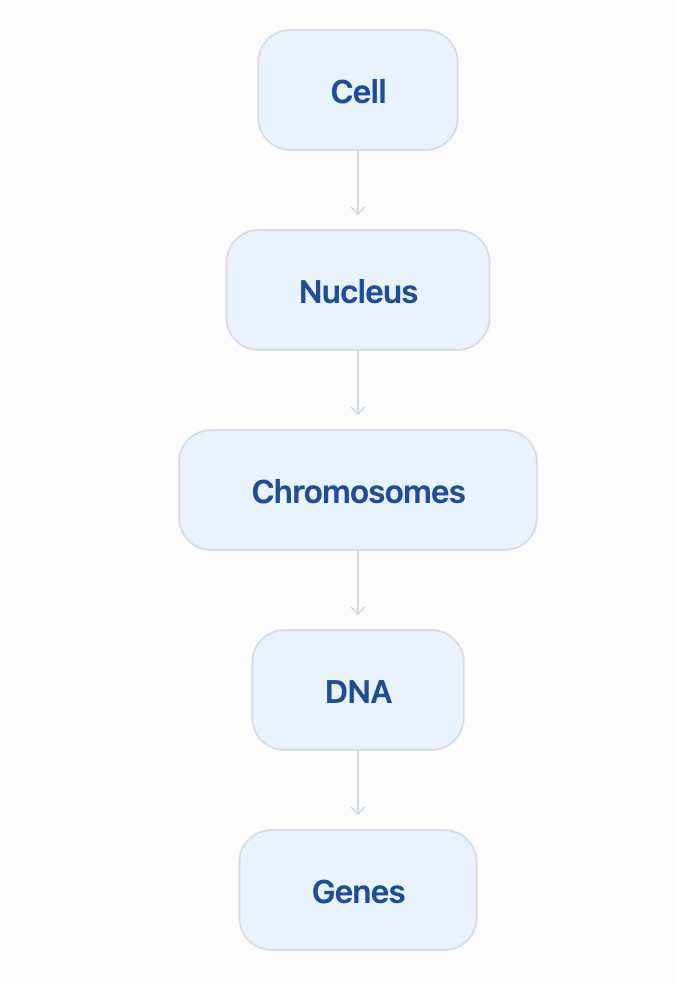
A gene is a section of DNA containing instructions for producing a functional product, usually a protein or functional RNA molecule.
Each chromosome contains many genes. Different genes have different base sequences and therefore carry different instructions.
For example, humans have genes involved in:
- Producing insulin
- Making haemoglobin
- Controlling eye pigment
- Building enzymes
- Regulating cell division
- Supporting immune responses
Not every section of DNA codes directly for a protein. Some DNA sequences help control when, where, and how strongly genes are activated.
From Genes to Proteins
Proteins are large biological molecules built from smaller units called amino acids.
A gene’s base sequence provides instructions that help determine the amino acid sequence of a protein. The amino acid sequence then causes the protein to fold into a particular three-dimensional shape.
That shape is essential to the protein’s function.
The pathway from DNA to protein can be summarized as:

Transcription
During transcription:
- A particular gene is activated.
- The DNA strands separate in the gene’s region.
- One DNA strand acts as a template.
- The cell produces a messenger RNA copy called mRNA.
- The mRNA leaves the nucleus and travels to a ribosome.
Translation
During translation:
- A ribosome reads the base sequence in the mRNA.
- The sequence is read in groups of three bases called codons.
- Each codon corresponds to a particular amino acid or instruction.
- Amino acids are joined in the correct order.
- The amino-acid chain folds into a working protein.
This is sometimes summarized as:
How Proteins Influence Characteristics
Proteins can influence characteristics by forming structures or controlling processes inside cells.
Examples include:
- Keratin contributes to hair and nail structure.
- Collagen provides strength and support to tissues.
- Haemoglobin transports oxygen in red blood cells.
- Insulin helps regulate blood glucose.
- Melanin-producing enzymes affect pigmentation.
- Digestive enzymes break large food molecules into smaller molecules.
- Antibodies help defend the body against pathogens.
The relationship between genes and characteristics can be written as:
However, most characteristics are not controlled by one gene alone. Many result from the interaction of:
- Several genes
- Environmental conditions
- Nutrition
- Lifestyle
- Development
- Chance biological events
For example, a person’s height is influenced by many genes, but it is also affected by nutrition and health.
Alleles and Genetic Variation
Different versions of the same gene are called alleles.
Alleles have slightly different DNA base sequences. These differences may produce:
- Different forms of a protein
- Different amounts of a protein
- A protein that does not function
- No noticeable difference
For example, different alleles of genes involved in pigmentation can contribute to differences in eye, hair, or skin colour.
Not all genetic differences affect appearance. Genetic variation can also influence:
- Blood type
- Enzyme activity
- Disease resistance
- Metabolism
- Responses to medications
How Genetic Information Is Inherited
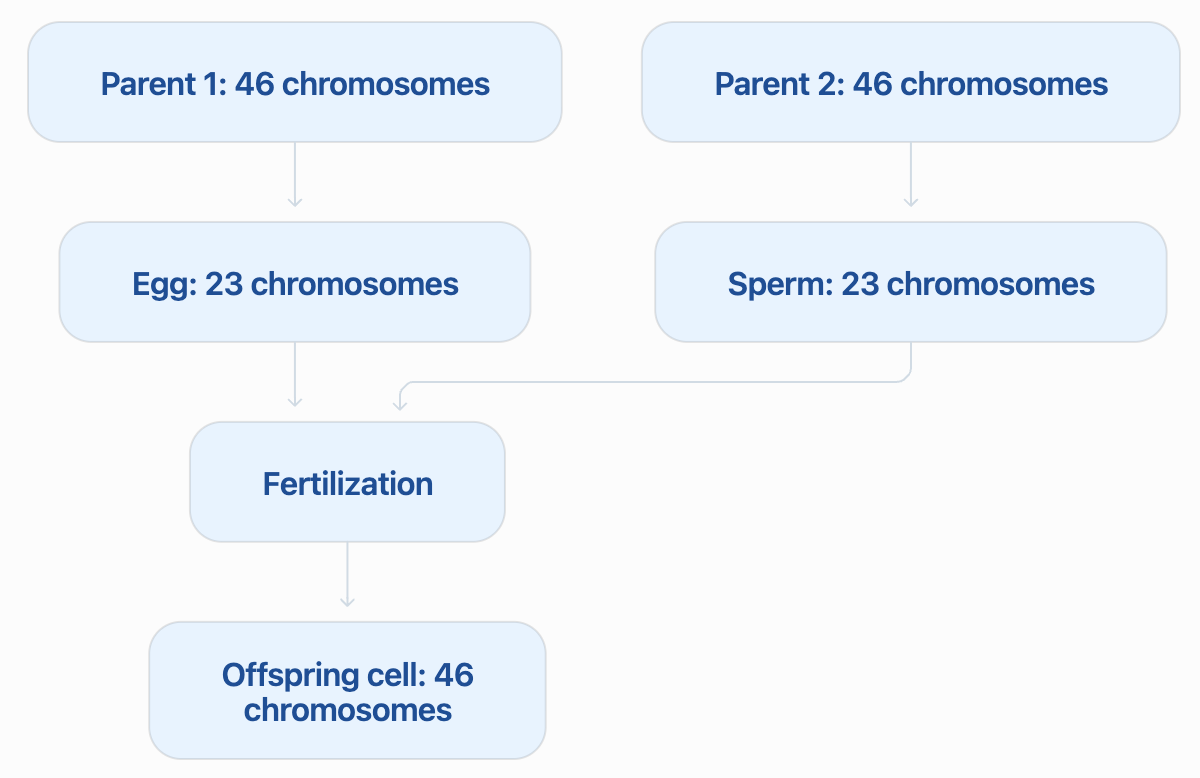
Genetic information passes from parents to offspring through reproductive cells called gametes.
In humans:
- The male gamete is the sperm cell.
- The female gamete is the egg cell.
- Each gamete contains one set of 23 chromosomes.
- Fertilization combines the two gametes.
- The resulting cell usually contains 46 chromosomes.
An offspring normally receives:
- One version of each gene from its biological mother
- One version of each gene from its biological father
Before gametes form, DNA is copied and chromosomes are separated through meiosis. Meiosis also rearranges genetic information, helping make each gamete genetically different.
This mixing of alleles is one reason siblings from the same parents are usually genetically different.
DNA Replication
Before most cells divide, their DNA must be copied. This process is called DNA replication.
During replication:
- The two DNA strands separate.
- Each original strand acts as a template.
- Complementary nucleotides are added.
- A pairs with T, and C pairs with G.
- Two DNA molecules are produced.
Each new DNA molecule contains:
- One strand from the original molecule
- One newly constructed strand
Accurate replication allows new cells to receive essentially the same genetic instructions as the original cell.
Mutations
A mutation is a change in a DNA sequence.
Mutations can occur because of:
- Errors during DNA replication
- Ultraviolet radiation
- Ionizing radiation
- Certain chemicals
- Some viruses
A mutation may:
- Have no observable effect
- Change a protein slightly
- Prevent a protein from working
- Alter gene regulation
- Occasionally produce a beneficial characteristic
If a mutation occurs in a body cell, it may affect only the individual. If it occurs in a cell that produces gametes, it may be passed to offspring.
Mutations create new alleles and are an important source of genetic variation.
Why DNA Is Central to Biotechnology
Biotechnology uses organisms, cells, enzymes, or biological molecules to develop useful products and processes.
DNA is central to modern biotechnology because it:
- Stores biological instructions.
- Can be extracted from cells.
- Can be copied.
- Can be sequenced.
- Can be compared between organisms.
- Can sometimes be transferred or edited.
- Can direct cells to produce useful proteins.


DNA Profiling
DNA profiling examines highly variable regions of DNA.
It can be used to:
- Help identify individuals
- Investigate biological relationships
- Analyze evidence in forensic investigations
- Identify human remains
- Support wildlife conservation
Except for identical twins, individuals normally have different DNA profiles.
Polymerase Chain Reaction
Polymerase chain reaction, or PCR, is a laboratory technique used to make millions of copies of a selected DNA region.
PCR is useful when only a small DNA sample is available. Applications include:
- Medical testing
- Pathogen detection
- Forensic science
- Genetic research
- Environmental DNA analysis
DNA Sequencing
DNA sequencing determines the order of bases in a DNA molecule.
Scientists can use sequencing to:
- Identify genetic variants
- Study inherited conditions
- Compare species
- Track disease-causing organisms
- Investigate evolutionary relationships
- Support personalized medicine
Recombinant DNA
Recombinant DNA is formed by combining DNA from different sources.
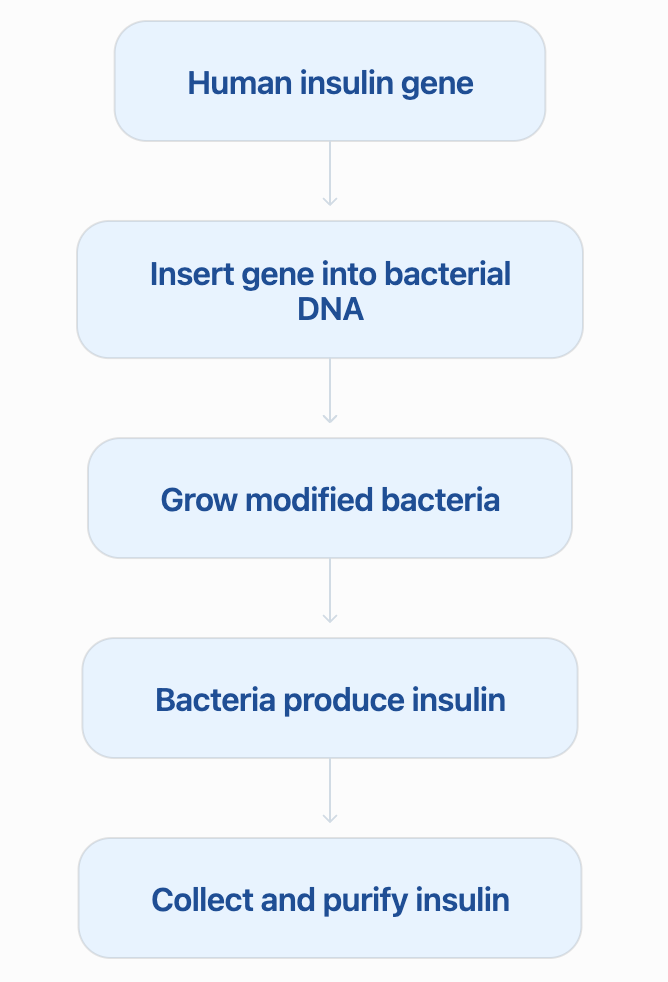
For example, scientists can insert the human insulin gene into bacteria. The genetically modified bacteria read the gene and produce human insulin protein.
The process can be summarized as: