Evolution of Disease and Global Health
1. Antibiotic Resistance
Learning outcomes
- I can explain how antibiotic resistance develops.
- I can describe the role of natural selection in resistance.
- I can identify factors that contribute to antibiotic resistance.
- I can explain why resistance is a global health concern.
- I can evaluate strategies for reducing antibiotic resistance.


What Is Antibiotic Resistance?
Antibiotic resistance occurs when bacteria are able to survive and reproduce despite exposure to an antibiotic that would normally kill them or stop their growth.
The bacteria become resistant — not the person taking the antibiotic.
This distinction is important:
Incorrect: The patient's body became resistant to the antibiotic.
Correct: The bacteria became resistant to the antibiotic.
When resistance develops, an antibiotic may become less effective or may stop working against that bacterial population.
What Are Antibiotics?
Antibiotics are medicines used to treat certain:
bacterial infections.
Different antibiotics affect bacteria in different ways.
Depending on the antibiotic, they may interfere with:
- bacterial cell-wall production
- protein synthesis
- DNA replication
- essential metabolic reactions
Antibiotics either kill bacteria or prevent them from reproducing effectively.
Antibiotics Do Not Treat Viral Infections
Antibiotics act against:
bacteria.
They do not treat viral infections such as:
- influenza
- most common colds
- many viral sore throats
Viruses have very different structures and reproductive processes from bacteria.
Using antibiotics when they are not needed can contribute to unnecessary antibiotic exposure and therefore increase:
selection pressure for resistance among bacteria.
Where Does Resistance Come From?
A bacterial population contains many individual cells.
These cells are not necessarily genetically identical.
Occasionally, genetic variation gives a bacterium the ability to survive exposure to a particular:
antibiotic.
Resistance can arise through:
- random mutations
- acquisition of resistance genes from other bacteria
The antibiotic does not deliberately cause bacteria to develop the resistance they need.
Instead, resistance may already exist or arise through genetic change.
Mutation and Resistance
A mutation is a change in DNA.
Mutations occur naturally and randomly.
Most mutations do not provide antibiotic resistance.
However, occasionally a mutation changes a bacterial structure or process in a way that makes an antibiotic:
less effective.
If antibiotics are then used, this resistant bacterium may have a major survival advantage.
Natural Selection
The development of antibiotic resistance is an important example of:
natural selection.
Natural selection occurs when organisms with characteristics that provide an advantage in a particular environment survive and reproduce more successfully than others.
In this case, the environmental pressure is:
exposure to an antibiotic.
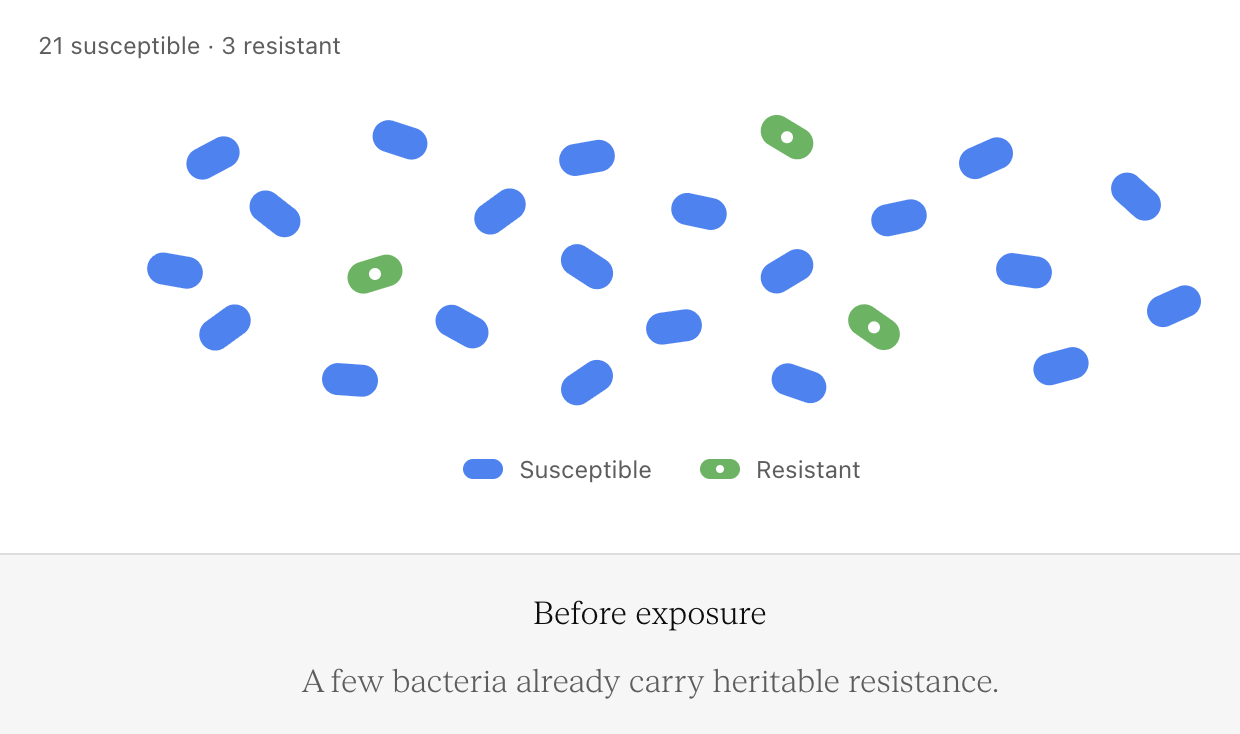
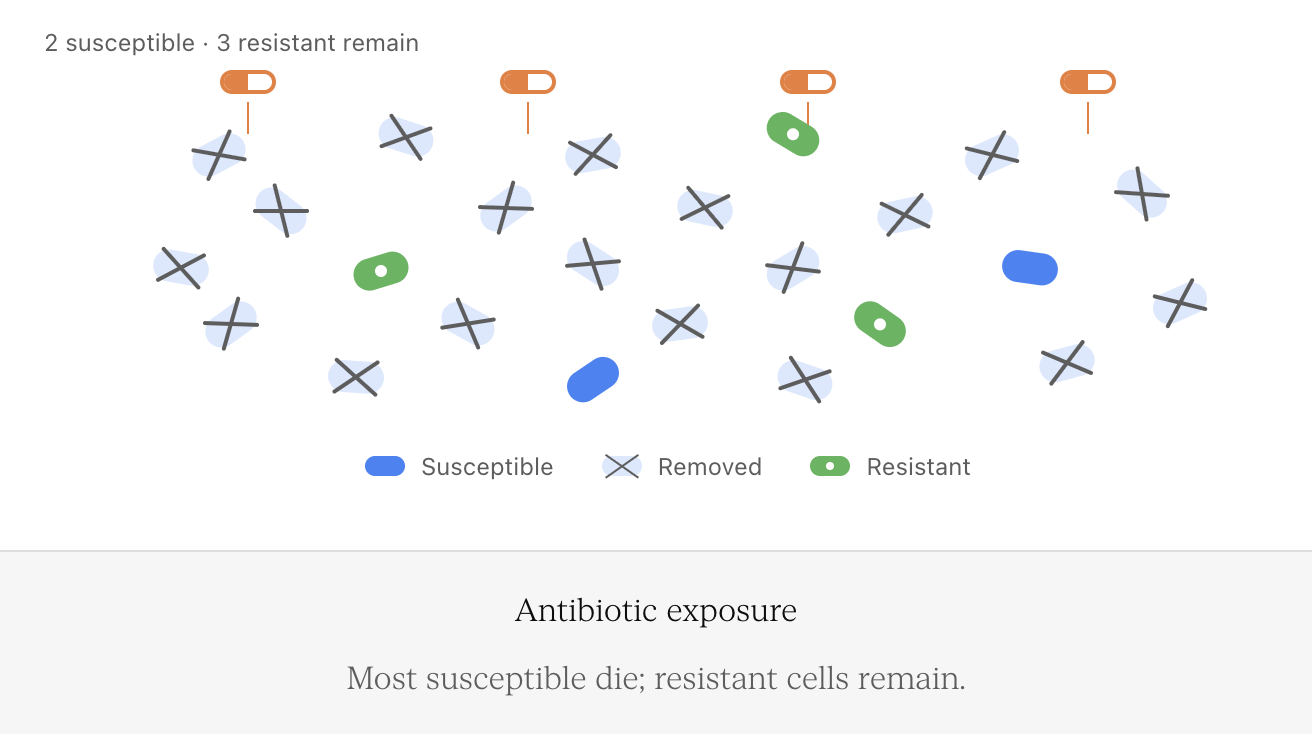
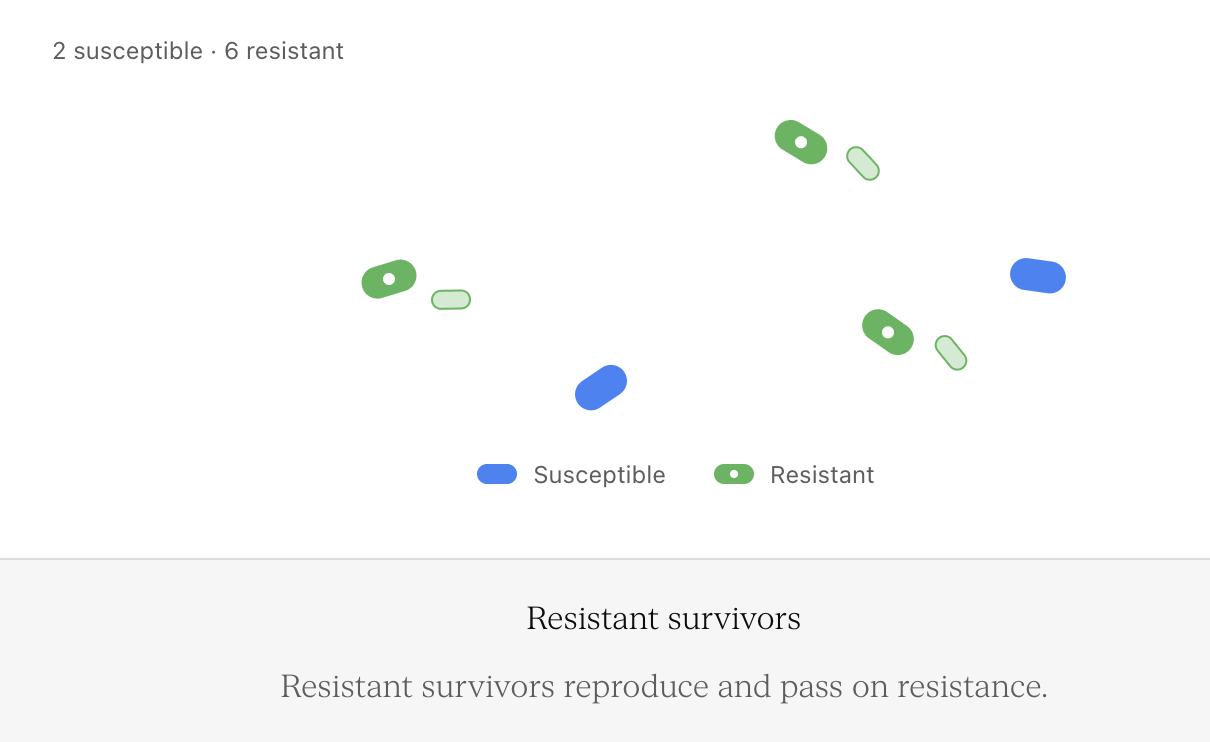
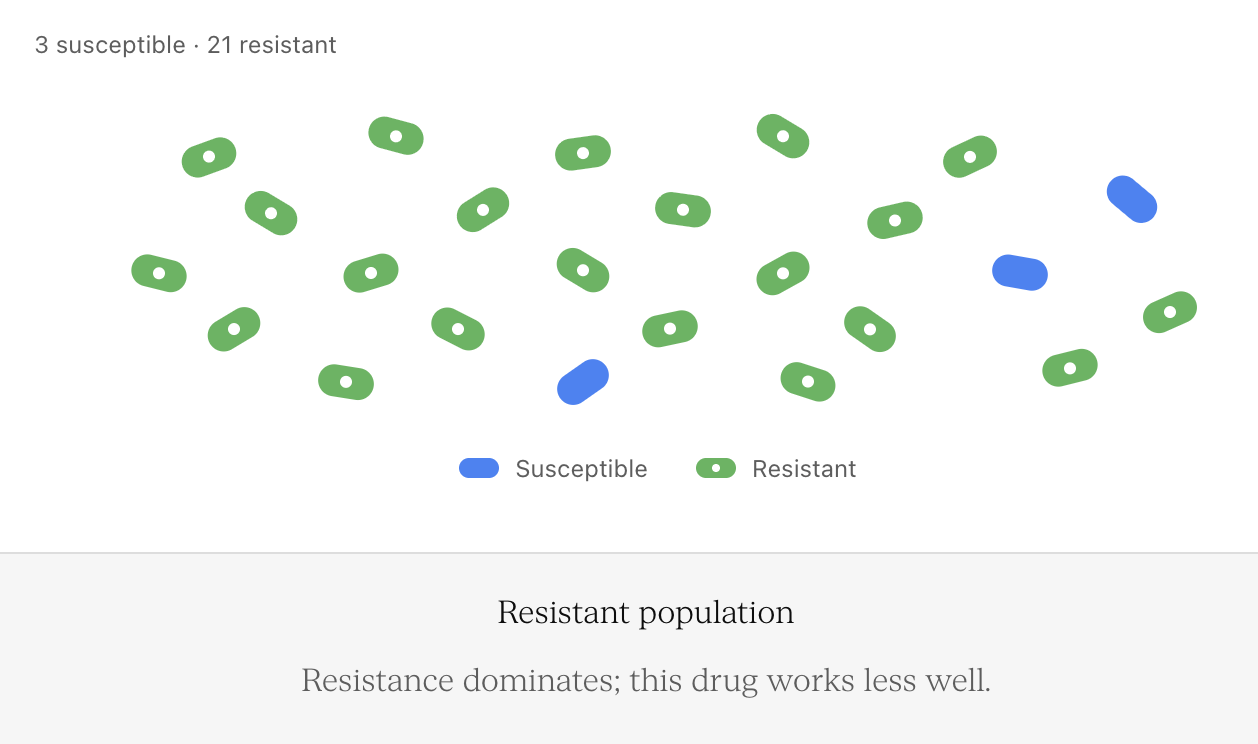
How Natural Selection Produces Resistance
Consider a population containing millions of bacteria.
Most are susceptible to an antibiotic.
A few happen to carry resistance.
Before antibiotic treatment
The population contains:
many susceptible bacteria + a few resistant bacteria
Antibiotic is introduced
The antibiotic kills or inhibits many susceptible bacteria.
Resistant bacteria survive
The resistant bacteria are more likely to remain alive.
Survivors reproduce
Bacteria can reproduce rapidly by:
binary fission.
The resistant bacteria pass resistance genes to their descendants.
Population changes
After many generations:
resistant bacteria become a larger proportion of the population.
This is natural selection.
A Simple Model
Imagine a bacterial population:
1,000 susceptible bacteria + 5 resistant bacteria
An antibiotic is applied.
Most susceptible bacteria die.
Suppose the five resistant bacteria survive.
Those bacteria reproduce:
5 → 10 → 20 → 40 → 80 → 160 → ...
Eventually, the population may contain a high proportion of:
resistant bacteria.
The antibiotic did not teach the bacteria how to resist it.
It:
selected bacteria that already possessed resistance.
Selection Pressure
A selection pressure is an environmental factor that affects which organisms survive and reproduce.
Antibiotics create strong selection pressure.
In an environment containing an antibiotic:
susceptible bacteria have a disadvantage
while:
resistant bacteria have an advantage.
This changes the genetic composition of the bacterial population over generations.
Resistance Is Evolution
Antibiotic resistance is an observable example of:
evolution.
Evolution involves changes in inherited characteristics within populations across generations.
As resistant bacteria survive and reproduce:
resistance genes become more common in the population.
The bacterial population has therefore changed genetically.

Bacteria Reproduce Quickly
Bacteria can reproduce extremely rapidly under favorable conditions.
Some bacterial populations can increase dramatically within:
hours.
Rapid reproduction means:
- many generations occur quickly
- mutations can appear in large populations
- beneficial resistance traits can spread rapidly
- evolution can sometimes be observed over relatively short timescales
This helps explain why antibiotic resistance can develop quickly.
Resistance Can Be Inherited
When a resistant bacterium reproduces by binary fission, its descendants usually inherit copies of its:
DNA.
If the resistance is genetically determined, the descendants can inherit the resistance characteristic.
This is called:
vertical gene transfer.
Resistance therefore passes from one bacterial generation to the next.
Horizontal Gene Transfer
Bacteria can also acquire genetic material from other bacteria.
This is called:
horizontal gene transfer.
Unlike ordinary inheritance, the DNA does not have to pass from parent to offspring.
Resistance genes can sometimes move between bacterial cells.
This can accelerate the spread of antibiotic resistance.
Plasmids and Resistance
Many bacteria contain small circular pieces of DNA called:
plasmids.
Some plasmids carry:
antibiotic resistance genes.
A bacterium carrying a resistance plasmid may therefore survive an antibiotic that kills susceptible bacteria.


Conjugation
One mechanism of horizontal gene transfer is:
conjugation.
During conjugation, genetic material can be transferred between bacterial cells through direct contact.
If a plasmid contains an antibiotic resistance gene:
resistant bacterium → plasmid transfer → another bacterium gains resistance
This allows resistance to spread without waiting for a new mutation to occur.
Multiple Resistance Genes
Some plasmids can carry resistance genes for:
more than one antibiotic.
This means bacteria can potentially acquire resistance to several drugs.
Bacteria resistant to multiple antibiotics are often described as:
multidrug-resistant bacteria.
These infections can be particularly difficult to treat.
How Can Bacteria Resist Antibiotics?
Bacteria have evolved several mechanisms of antibiotic resistance.
They may:
- destroy or modify the antibiotic
- change the antibiotic's target
- prevent the antibiotic from entering
- pump the antibiotic out of the cell
- bypass the process blocked by the antibiotic
Different resistance mechanisms work against different antibiotics.
Destroying the Antibiotic
Some resistant bacteria produce:
enzymes
that destroy or chemically modify an antibiotic.
For example, some bacteria produce enzymes called:
beta-lactamases.
These enzymes can break down certain beta-lactam antibiotics.
The drug may then become ineffective against those bacteria.
Changing the Target
Antibiotics often work by binding to a particular bacterial:
target.
A mutation or acquired gene can change that target.
If the antibiotic can no longer bind effectively:
its action may be reduced.
Preventing Entry
Some bacteria can alter their cell structures so that an antibiotic enters less easily.
If insufficient antibiotic reaches its target:
the bacterium may survive.
Efflux Pumps
Some bacteria contain proteins called:
efflux pumps.
These pumps transport substances out of bacterial cells.
Certain resistance mechanisms increase the removal of antibiotics:
antibiotic enters → pump removes antibiotic → intracellular concentration remains lower
This can reduce the drug's effectiveness.
Factors Contributing to Antibiotic Resistance
Antibiotic resistance is a natural evolutionary phenomenon, but human activities can increase the selection and spread of resistant bacteria.
Important factors include:
- unnecessary antibiotic use
- inappropriate antibiotic selection
- incorrect dosing or duration
- poor infection prevention
- transmission of resistant organisms
- antibiotic use in animals
- inadequate sanitation
- environmental contamination
- limited diagnostic capacity
These factors can operate together.
Unnecessary Antibiotic Use
Every time bacteria are exposed to an antibiotic, susceptible bacteria may be removed while resistant bacteria have a greater chance of surviving.
Therefore, antibiotics should be used when they are:
medically appropriate.
Using antibiotics unnecessarily increases selection pressure without providing a useful treatment benefit.
Correct Use of Prescribed Antibiotics
Patients should use antibiotics according to current instructions from their:
qualified healthcare professional.
This includes following the prescribed:
- dose
- timing
- duration
The appropriate duration depends on the infection, antibiotic, and clinical situation.
It is therefore better to follow the specific prescription than rely on a blanket rule such as:
"always take antibiotics for as long as possible."
Do Not Share Antibiotics
Antibiotics prescribed for one person should not simply be given to another person.
Different infections may require:
- different drugs
- different doses
- different treatment durations
The illness may also not be bacterial at all.
Appropriate diagnosis helps reduce unnecessary antibiotic use.
Antibiotics in Agriculture
Antibiotics are also used in:
animal health and agriculture.
When antibiotics are used, resistant bacteria can be selected in animal populations.
These bacteria or their resistance genes may potentially spread through:
- direct contact
- food systems
- waste
- water
- the environment
Antibiotic resistance therefore involves both:
human and animal health.
One Health
The One Health approach recognizes that:
human health + animal health + environmental health
are interconnected.
Antibiotic resistance demonstrates this clearly.
Resistant bacteria and resistance genes can move between humans, animals, food systems, and environments.
Controlling resistance therefore requires cooperation across many sectors.


Hospitals and Antibiotic Resistance
Hospitals and healthcare facilities face particular challenges because:
- antibiotics are frequently used
- vulnerable patients are present
- invasive procedures may create infection risks
- bacteria can spread between people and surfaces
Strong infection-prevention procedures are therefore especially important.
MRSA
One well-known resistant bacterium is:
MRSA.
MRSA stands for:
methicillin-resistant Staphylococcus aureus.
Some strains of Staphylococcus aureus have acquired resistance to methicillin-related beta-lactam antibiotics.
MRSA can cause infections that are more difficult to treat than susceptible strains.
Drug-Resistant Tuberculosis
Tuberculosis is caused by the bacterium:
Mycobacterium tuberculosis.
Some strains have developed resistance to important tuberculosis medicines.
Drug-resistant tuberculosis can require:
- more complex treatment
- different combinations of medicines
- careful medical monitoring
It illustrates the serious consequences of antimicrobial resistance.
Why Is Antibiotic Resistance a Global Concern?
Resistant bacteria do not remain confined to one person, hospital, or country.
People and microorganisms move through:
- communities
- healthcare systems
- food systems
- international travel
- trade
- environmental pathways
Resistance is therefore a:
global health issue.
When Antibiotics Stop Working
Antibiotics have made many bacterial infections much easier to treat.
Increasing resistance can make infections:
- harder to treat
- slower to resolve
- more expensive to manage
- more likely to require alternative medicines
- associated with longer healthcare stays
Some resistant infections have very limited treatment options.
Modern Medicine Depends on Antibiotics
Antibiotics are important not only for treating ordinary infections.
They also help make many medical procedures safer.
These can include:
- major surgery
- organ transplantation
- cancer treatment
- intensive care
- some neonatal care
If bacterial infections become increasingly difficult to treat, the risks associated with other medical treatments can also increase.
Reducing Antibiotic Resistance
There is no single solution.
Effective strategies include:
- appropriate antibiotic use
- accurate diagnosis
- infection prevention
- vaccination
- sanitation
- surveillance
- responsible agricultural practices
- research
- development of new treatments and diagnostics
- public education
A combination of approaches is needed.
Antibiotic Stewardship
Antibiotic stewardship means using antibiotics carefully and appropriately to improve patient outcomes while reducing unnecessary use and resistance pressure.
This can include:
- prescribing antibiotics only when appropriate
- selecting an appropriate antibiotic
- using an appropriate dose
- using an appropriate treatment duration
- reviewing treatment when diagnostic information becomes available
The goal is not to stop using antibiotics.
The goal is to use them:
effectively and responsibly.
Narrow-Spectrum and Broad-Spectrum Antibiotics
A broad-spectrum antibiotic affects many types of bacteria.
A narrow-spectrum antibiotic targets a smaller range.
When appropriate and supported by diagnosis, more targeted treatment can reduce unnecessary effects on other bacterial populations.
The correct choice depends on:
the infection and clinical evidence.
Laboratory Testing
Doctors can sometimes collect a sample and grow bacteria in a laboratory.
The bacteria can then be tested against different antibiotics.
This is called:
antimicrobial susceptibility testing.
The results can help identify which antibiotics are likely to be effective.


Zones of Inhibition
In a disk-diffusion test, antibiotic-containing disks are placed on agar containing bacteria.
If an antibiotic inhibits bacterial growth, a clear region may form around the disk.
This is called a:
zone of inhibition.
The size of the zone is interpreted using standardized criteria rather than simply assuming:
bigger zone = best medicine.
Preventing Infection
One of the most effective ways to reduce antibiotic use is to prevent bacterial infections in the first place.
Strategies include:
- hand hygiene
- clean water
- sanitation
- safe food handling
- appropriate sterilization
- infection-control procedures
- vaccination where applicable
Fewer infections mean:
fewer opportunities for antibiotics to be required.
Vaccination and Resistance
Vaccines can indirectly help reduce antibiotic resistance.
If vaccination prevents infections:
fewer people become ill → fewer antibiotics may be needed → less selection pressure
Vaccines can also reduce transmission of some bacterial pathogens.
Surveillance
Surveillance involves collecting information about resistant bacteria.
Scientists and health organizations can monitor:
- which bacteria are resistant
- which antibiotics are affected
- where resistance is occurring
- how resistance changes over time
This information helps guide treatment and public-health strategies.
Developing New Antibiotics
Another strategy is developing:
new antibiotics.
However, discovering and developing new medicines can be:
- difficult
- expensive
- time-consuming
Furthermore, bacteria can eventually evolve resistance to new antibiotics as well.
New drug development must therefore be combined with:
responsible use.
Alternative Approaches
Scientists are investigating additional ways to control bacterial infections.
Examples include:
- bacteriophage therapy
- new antimicrobial compounds
- anti-virulence approaches
- improved vaccines
- rapid diagnostic technologies
These approaches may complement antibiotics rather than simply replacing them.
Bacteriophages
Bacteriophages, or phages, are viruses that infect bacteria.
Researchers are investigating whether particular phages can be used to target disease-causing bacteria.
Potential advantages include high specificity.
Challenges include:
- identifying appropriate phages
- bacterial resistance to phages
- manufacturing and regulation
- ensuring effectiveness and safety
Phage therapy remains an important area of research and specialized clinical use.
Evaluating Strategies
A strong response should consider both the advantages and limitations of different strategies.
For example:
Reducing unnecessary antibiotic use
Advantage: Reduces unnecessary selection pressure.
Limitation: Antibiotics must still remain available when genuinely needed.
Infection prevention
Advantage: Prevents infections before treatment is necessary.
Limitation: Cannot prevent every bacterial infection.
New antibiotics
Advantage: Can provide new treatment options.
Limitation: Resistance can eventually develop.
Surveillance
Advantage: Helps detect and track resistance.
Limitation: Requires laboratories, data systems, funding, and international cooperation.
The strongest approach combines:
prevention + responsible use + surveillance + research.
Worked Example 1
A bacterial population contains mostly susceptible bacteria and a few resistant bacteria.
An antibiotic is introduced.
Which bacteria are most likely to survive?
The resistant bacteria.
They then have less competition and can reproduce.
Worked Example 2
Did the antibiotic cause bacteria to mutate because they needed resistance?
No.
Mutations are not produced because bacteria recognize what they need.
The antibiotic creates a:
selection pressure
that favors bacteria already possessing useful resistance.
Worked Example 3
A resistant bacterium divides into two daughter cells.
Both inherit the resistance gene.
What process is involved?
Vertical gene transfer.
Resistance passes from parent to descendants.
Worked Example 4
A bacterium transfers a resistance plasmid to another bacterium.
What process has occurred?
Horizontal gene transfer.
If direct cell-to-cell plasmid transfer is involved, this can occur through:
conjugation.
Worked Example 5
A person has a viral cold and asks for antibiotics.
Why would antibiotics usually not help?
Antibiotics target structures or processes found in:
bacteria.
Viruses do not have these same structures and processes.
Worked Example 6
A hospital improves handwashing procedures.
How could this reduce antibiotic resistance?
Better hygiene can reduce:
transmission of bacteria.
Fewer infections can mean fewer antibiotic treatments and less spread of resistant organisms.
Worked Example 7
A bacterial infection is tested against several antibiotics.
Why is this useful?
Susceptibility testing can help determine:
which antibiotics are likely to work.
This can support more targeted treatment.
Worked Example 8
A new antibiotic is developed.
Has the resistance problem been permanently solved?
No.
Bacterial populations can potentially evolve resistance to new antibiotics.
The new drug must therefore be used responsibly.
Worked Example 9
Why can international travel contribute to the global spread of resistance?
People can carry resistant bacteria without necessarily showing symptoms.
Movement between regions can therefore move resistant bacteria into:
new populations.
Worked Example 10
Why is antibiotic resistance an example of evolution?
The frequency of inherited resistance characteristics changes in a bacterial population over:
successive generations.
That is evolutionary change.
Common Mistake: People Become Resistant to Antibiotics
People do not become antibiotic resistant.
Bacteria become resistant.
A person may become infected with bacteria that are resistant to one or more antibiotics.
Common Mistake: Antibiotics Cause Helpful Mutations
Antibiotics do not tell bacteria which mutations to develop.
Genetic variation arises independently.
Antibiotics then:
select among the existing variants.
Common Mistake: Every Bacterium Becomes Resistant During Treatment
Some bacteria may already be resistant.
Susceptible bacteria are preferentially killed or inhibited.
Resistant bacteria survive and reproduce, making resistance more common in the:
population.
Common Mistake: Antibiotics Kill Viruses
Antibiotics are designed to target:
bacteria.
They do not treat viral infections such as influenza or the common cold.
Common Mistake: Resistance Only Matters in Hospitals
Resistant bacteria can occur in:
- hospitals
- communities
- farms
- animals
- wastewater
- natural environments
Antibiotic resistance is therefore a:
One Health problem.
Common Mistake: New Antibiotics Alone Will Solve the Problem
New antibiotics are important, but bacteria can evolve resistance to new drugs.
Long-term control requires:
responsible antibiotic use + infection prevention + surveillance + research.
Check Your Understanding
1. Define antibiotic resistance.
2. What becomes resistant: the patient or the bacteria?
3. What are antibiotics used to treat?
4. Why don't antibiotics treat viral infections?
5. Give two ways bacteria can acquire antibiotic resistance.
6. What is a mutation?
7. Explain how a mutation could provide antibiotic resistance.
8. What is natural selection?
9. What selection pressure occurs during antibiotic treatment?
10. Explain why resistant bacteria survive antibiotic treatment more successfully.
11. How does reproduction increase the number of resistant bacteria?
12. Why is antibiotic resistance an example of evolution?
13. What is vertical gene transfer?
14. What is horizontal gene transfer?
15. What is a plasmid?
16. Explain how plasmids can spread antibiotic resistance.
17. What is bacterial conjugation?
18. Give three mechanisms bacteria can use to resist antibiotics.
19. What is an efflux pump?
20. How can bacterial enzymes produce resistance?
21. Identify four human activities or conditions that can contribute to antibiotic resistance.
22. Why can unnecessary antibiotic use increase resistance?
23. Why should antibiotics be used according to professional medical instructions?
24. How can antibiotic use in animals contribute to the wider resistance problem?
25. What is the One Health approach?
26. What does MRSA stand for?
27. Why are multidrug-resistant bacteria particularly concerning?
28. Why is antibiotic resistance a global rather than purely local issue?
29. How could increasing resistance affect modern medicine?
30. Define antibiotic stewardship.
31. Why can targeted antibiotic treatment be useful?
32. What is antimicrobial susceptibility testing?
33. What is a zone of inhibition?
34. How can improved hygiene reduce antibiotic resistance?
35. Explain how vaccination can indirectly reduce antibiotic resistance.
36. Why is surveillance important?
37. Why can't developing new antibiotics alone solve resistance?
38. What are bacteriophages?
39. Compare two strategies for reducing antibiotic resistance.
40. Evaluate how natural selection, antibiotic use, infection control, surveillance, and research are connected in efforts to reduce antibiotic resistance.
Key Terms
- Antibiotic: Medicine used to treat certain bacterial infections.
- Antibiotic resistance: Ability of bacteria to survive or grow despite exposure to an antibiotic that would normally inhibit them.
- Mutation: Change in DNA.
- Natural selection: Process in which organisms with advantageous inherited characteristics survive and reproduce more successfully under particular conditions.
- Selection pressure: Environmental factor affecting survival and reproduction.
- Evolution: Change in inherited characteristics of a population across generations.
- Vertical gene transfer: Transfer of genetic information from parent cells to descendants.
- Horizontal gene transfer: Movement of genetic material between organisms other than parent-to-offspring inheritance.
- Plasmid: Small DNA molecule separate from the main bacterial chromosome.
- Conjugation: Direct transfer of genetic material between bacterial cells.
- Multidrug resistance: Resistance to multiple antimicrobial drugs.
- Efflux pump: Protein system capable of transporting substances, including some antibiotics, out of bacterial cells.
- Beta-lactamase: Bacterial enzyme capable of breaking down certain beta-lactam antibiotics.
- Antibiotic stewardship: Careful, evidence-based use of antibiotics.
- Antimicrobial susceptibility testing: Laboratory testing used to determine how a microorganism responds to antimicrobial drugs.
- Zone of inhibition: Area around an antimicrobial source where bacterial growth has been inhibited.
- MRSA: Methicillin-resistant Staphylococcus aureus.
- One Health: Approach recognizing connections between human, animal, and environmental health.
- Surveillance: Systematic collection and analysis of information about resistance.
- Bacteriophage: Virus that infects bacteria.
Key Takeaways
- Antibiotic resistance occurs in bacteria, not in people.
- Antibiotics are used against bacterial infections and do not treat viruses.
- Resistance can arise through random mutations or acquisition of resistance genes.
- Antibiotic exposure creates a selection pressure.
- Susceptible bacteria are more likely to be killed or inhibited, while resistant bacteria are more likely to survive.
- Resistant survivors reproduce and pass resistance genes to their descendants.
- This process is an example of natural selection and evolution.
- Bacteria can also exchange resistance genes through horizontal gene transfer.
- Plasmids can carry resistance genes between bacterial cells.
- Resistance mechanisms include destroying antibiotics, changing their targets, preventing entry, and pumping antibiotics out of cells.
- Unnecessary or inappropriate antibiotic use can increase selection pressure.
- Infection prevention reduces both disease transmission and the need for antibiotics.
- Antibiotic resistance occurs across humans, animals, and the environment, making it a One Health issue.
- Resistant infections can be more difficult and expensive to treat.
- Modern medical procedures depend partly on effective antibiotics.
- Antibiotic stewardship aims to preserve antibiotic effectiveness while ensuring patients who need antibiotics receive appropriate treatment.
- Laboratory susceptibility testing can help guide treatment.
- Vaccination, sanitation, hygiene, and infection control can reduce the need for antibiotics.
- Surveillance helps scientists and health authorities track emerging resistance.
- New antibiotics are valuable, but new drugs alone cannot permanently solve resistance.
- Reducing antibiotic resistance requires a combination of responsible use, prevention, surveillance, research, and cooperation.