Evolution of Disease and Global Health
| Site: | Young Education |
| Course: | Microbiology and Disease |
| Book: | Evolution of Disease and Global Health |
| Printed by: | Người dùng khách |
| Date: | Monday, 5 October 2026, 4:04 AM |
1. Antibiotic Resistance
Learning outcomes
- I can explain how antibiotic resistance develops.
- I can describe the role of natural selection in resistance.
- I can identify factors that contribute to antibiotic resistance.
- I can explain why resistance is a global health concern.
- I can evaluate strategies for reducing antibiotic resistance.


What Is Antibiotic Resistance?
Antibiotic resistance occurs when bacteria are able to survive and reproduce despite exposure to an antibiotic that would normally kill them or stop their growth.
The bacteria become resistant — not the person taking the antibiotic.
This distinction is important:
Incorrect: The patient's body became resistant to the antibiotic.
Correct: The bacteria became resistant to the antibiotic.
When resistance develops, an antibiotic may become less effective or may stop working against that bacterial population.
What Are Antibiotics?
Antibiotics are medicines used to treat certain:
bacterial infections.
Different antibiotics affect bacteria in different ways.
Depending on the antibiotic, they may interfere with:
- bacterial cell-wall production
- protein synthesis
- DNA replication
- essential metabolic reactions
Antibiotics either kill bacteria or prevent them from reproducing effectively.
Antibiotics Do Not Treat Viral Infections
Antibiotics act against:
bacteria.
They do not treat viral infections such as:
- influenza
- most common colds
- many viral sore throats
Viruses have very different structures and reproductive processes from bacteria.
Using antibiotics when they are not needed can contribute to unnecessary antibiotic exposure and therefore increase:
selection pressure for resistance among bacteria.
Where Does Resistance Come From?
A bacterial population contains many individual cells.
These cells are not necessarily genetically identical.
Occasionally, genetic variation gives a bacterium the ability to survive exposure to a particular:
antibiotic.
Resistance can arise through:
- random mutations
- acquisition of resistance genes from other bacteria
The antibiotic does not deliberately cause bacteria to develop the resistance they need.
Instead, resistance may already exist or arise through genetic change.
Mutation and Resistance
A mutation is a change in DNA.
Mutations occur naturally and randomly.
Most mutations do not provide antibiotic resistance.
However, occasionally a mutation changes a bacterial structure or process in a way that makes an antibiotic:
less effective.
If antibiotics are then used, this resistant bacterium may have a major survival advantage.
Natural Selection
The development of antibiotic resistance is an important example of:
natural selection.
Natural selection occurs when organisms with characteristics that provide an advantage in a particular environment survive and reproduce more successfully than others.
In this case, the environmental pressure is:
exposure to an antibiotic.
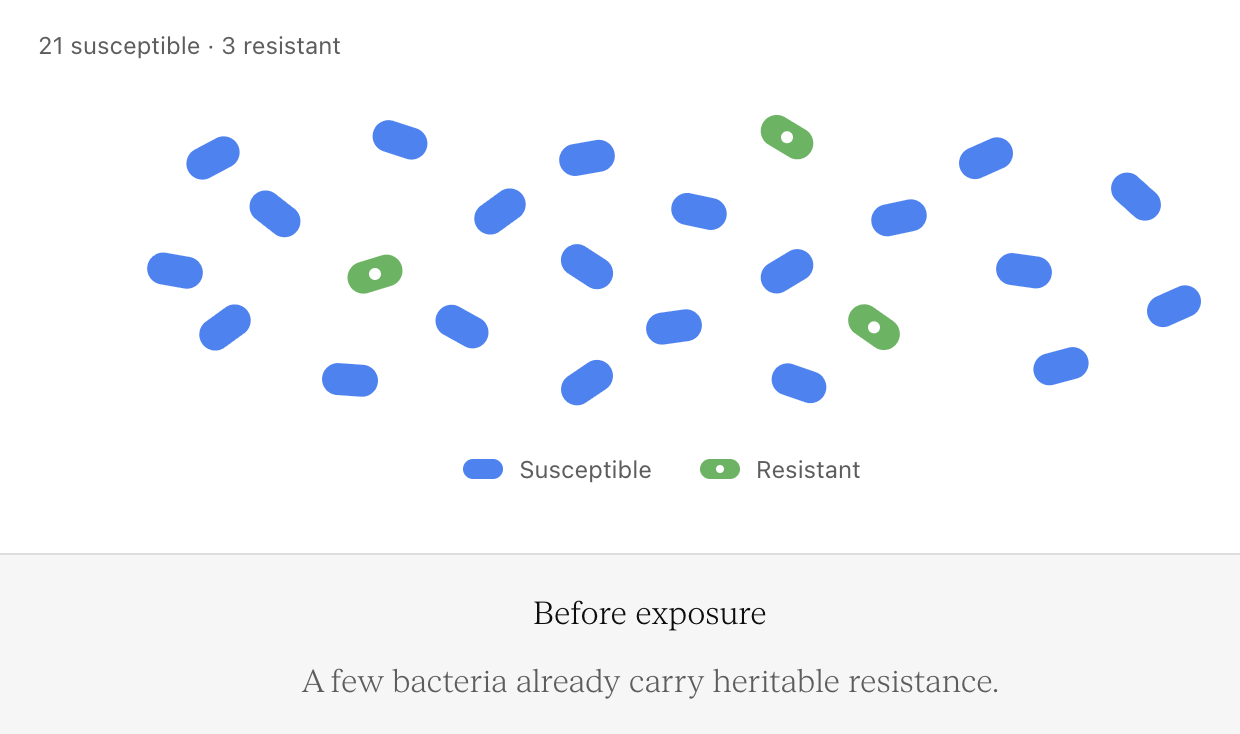
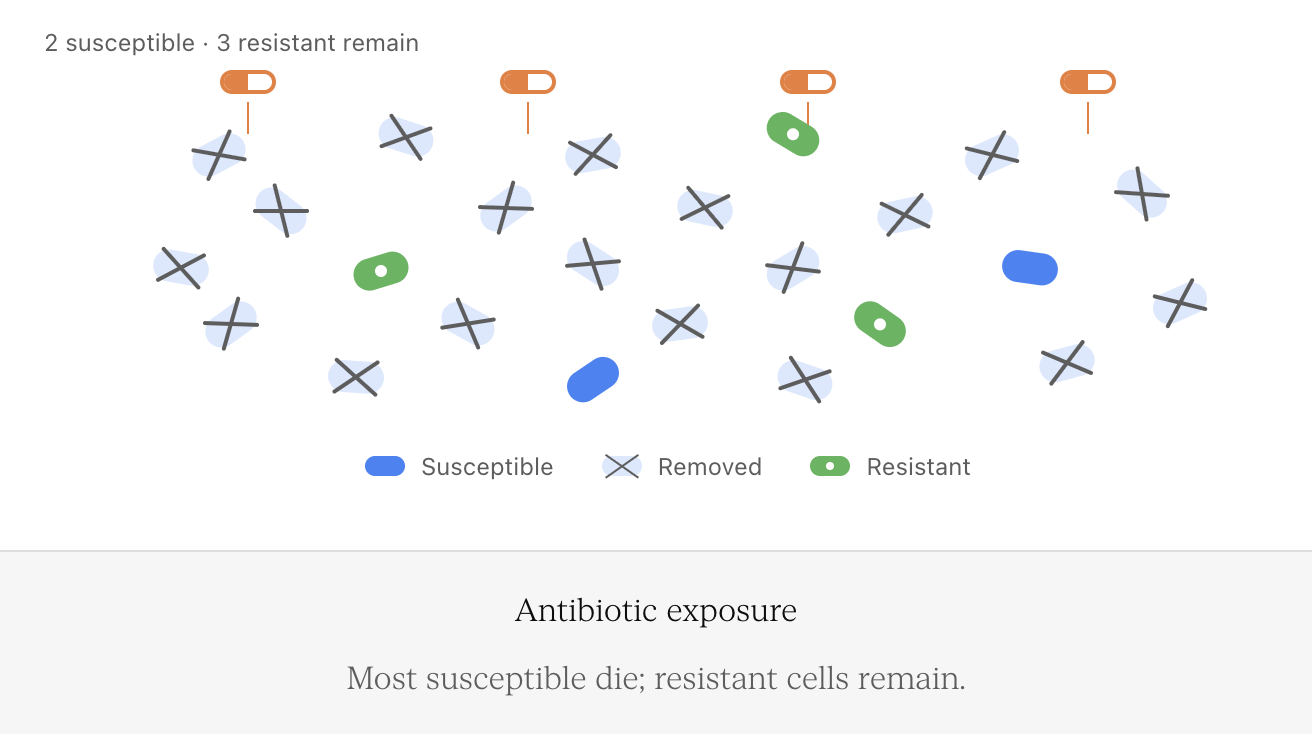
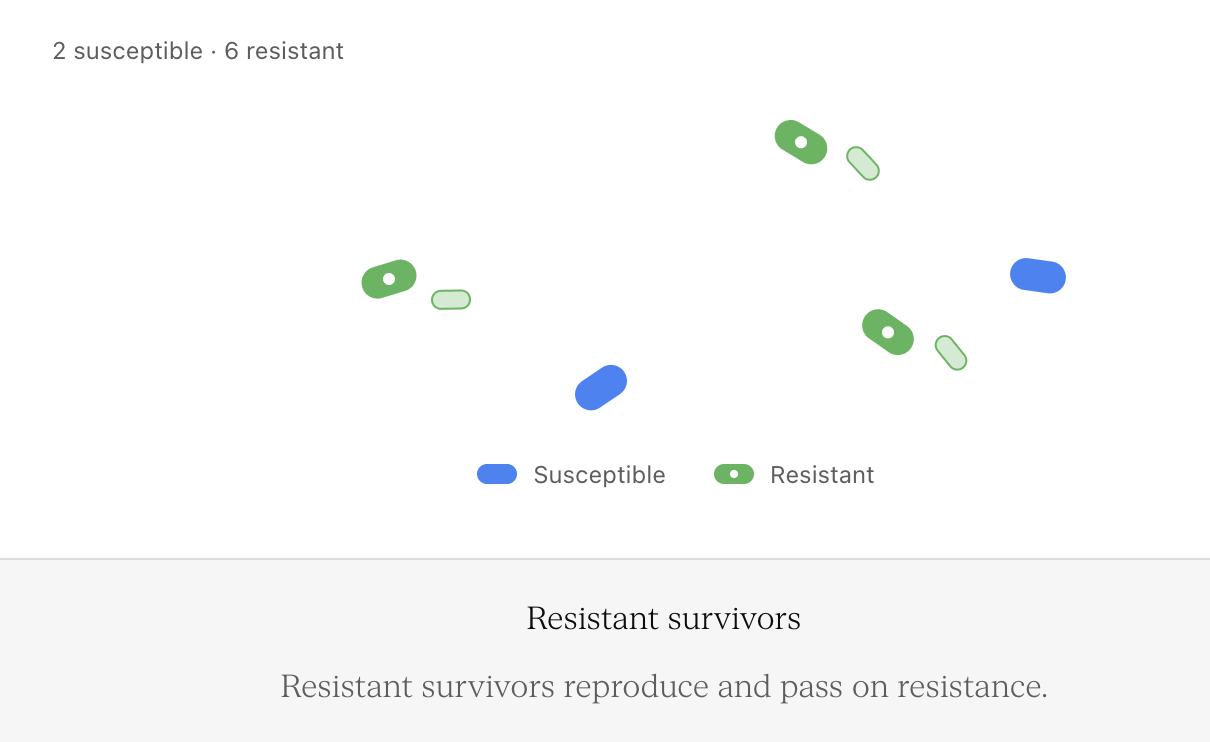
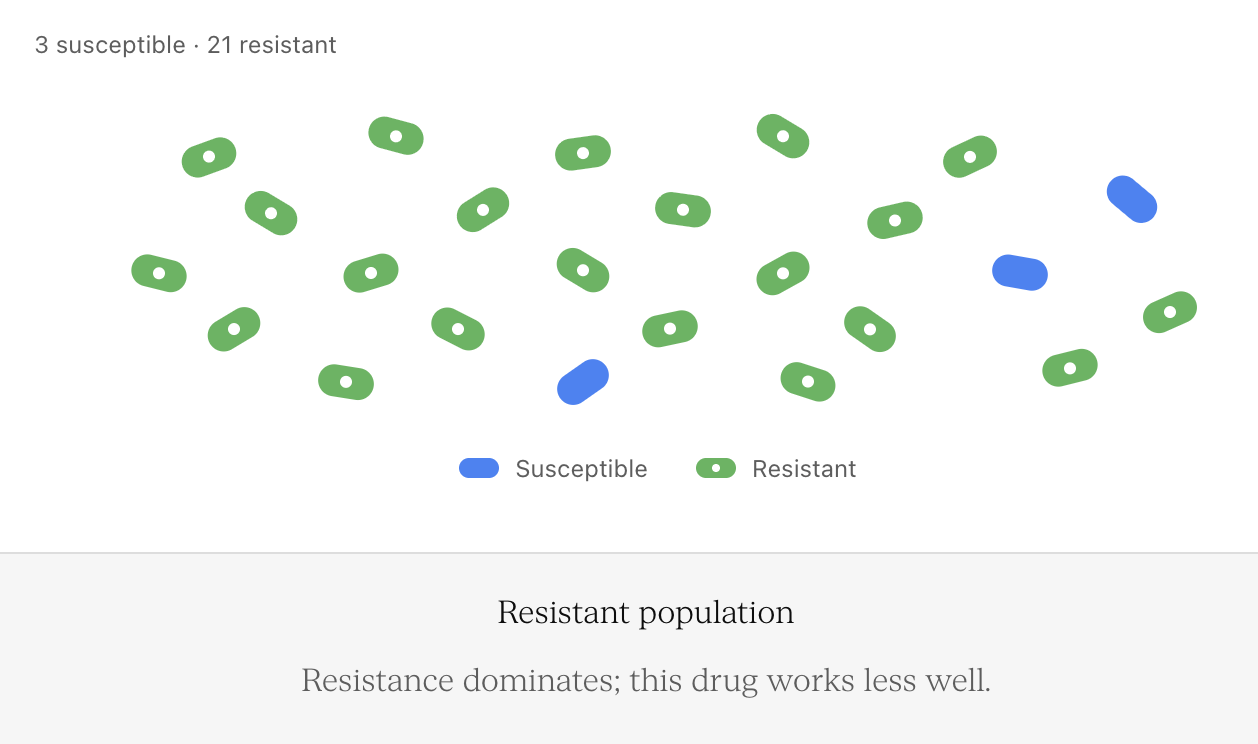
How Natural Selection Produces Resistance
Consider a population containing millions of bacteria.
Most are susceptible to an antibiotic.
A few happen to carry resistance.
Before antibiotic treatment
The population contains:
many susceptible bacteria + a few resistant bacteria
Antibiotic is introduced
The antibiotic kills or inhibits many susceptible bacteria.
Resistant bacteria survive
The resistant bacteria are more likely to remain alive.
Survivors reproduce
Bacteria can reproduce rapidly by:
binary fission.
The resistant bacteria pass resistance genes to their descendants.
Population changes
After many generations:
resistant bacteria become a larger proportion of the population.
This is natural selection.
A Simple Model
Imagine a bacterial population:
1,000 susceptible bacteria + 5 resistant bacteria
An antibiotic is applied.
Most susceptible bacteria die.
Suppose the five resistant bacteria survive.
Those bacteria reproduce:
5 → 10 → 20 → 40 → 80 → 160 → ...
Eventually, the population may contain a high proportion of:
resistant bacteria.
The antibiotic did not teach the bacteria how to resist it.
It:
selected bacteria that already possessed resistance.
Selection Pressure
A selection pressure is an environmental factor that affects which organisms survive and reproduce.
Antibiotics create strong selection pressure.
In an environment containing an antibiotic:
susceptible bacteria have a disadvantage
while:
resistant bacteria have an advantage.
This changes the genetic composition of the bacterial population over generations.
Resistance Is Evolution
Antibiotic resistance is an observable example of:
evolution.
Evolution involves changes in inherited characteristics within populations across generations.
As resistant bacteria survive and reproduce:
resistance genes become more common in the population.
The bacterial population has therefore changed genetically.

Bacteria Reproduce Quickly
Bacteria can reproduce extremely rapidly under favorable conditions.
Some bacterial populations can increase dramatically within:
hours.
Rapid reproduction means:
- many generations occur quickly
- mutations can appear in large populations
- beneficial resistance traits can spread rapidly
- evolution can sometimes be observed over relatively short timescales
This helps explain why antibiotic resistance can develop quickly.
Resistance Can Be Inherited
When a resistant bacterium reproduces by binary fission, its descendants usually inherit copies of its:
DNA.
If the resistance is genetically determined, the descendants can inherit the resistance characteristic.
This is called:
vertical gene transfer.
Resistance therefore passes from one bacterial generation to the next.
Horizontal Gene Transfer
Bacteria can also acquire genetic material from other bacteria.
This is called:
horizontal gene transfer.
Unlike ordinary inheritance, the DNA does not have to pass from parent to offspring.
Resistance genes can sometimes move between bacterial cells.
This can accelerate the spread of antibiotic resistance.
Plasmids and Resistance
Many bacteria contain small circular pieces of DNA called:
plasmids.
Some plasmids carry:
antibiotic resistance genes.
A bacterium carrying a resistance plasmid may therefore survive an antibiotic that kills susceptible bacteria.


Conjugation
One mechanism of horizontal gene transfer is:
conjugation.
During conjugation, genetic material can be transferred between bacterial cells through direct contact.
If a plasmid contains an antibiotic resistance gene:
resistant bacterium → plasmid transfer → another bacterium gains resistance
This allows resistance to spread without waiting for a new mutation to occur.
Multiple Resistance Genes
Some plasmids can carry resistance genes for:
more than one antibiotic.
This means bacteria can potentially acquire resistance to several drugs.
Bacteria resistant to multiple antibiotics are often described as:
multidrug-resistant bacteria.
These infections can be particularly difficult to treat.
How Can Bacteria Resist Antibiotics?
Bacteria have evolved several mechanisms of antibiotic resistance.
They may:
- destroy or modify the antibiotic
- change the antibiotic's target
- prevent the antibiotic from entering
- pump the antibiotic out of the cell
- bypass the process blocked by the antibiotic
Different resistance mechanisms work against different antibiotics.
Destroying the Antibiotic
Some resistant bacteria produce:
enzymes
that destroy or chemically modify an antibiotic.
For example, some bacteria produce enzymes called:
beta-lactamases.
These enzymes can break down certain beta-lactam antibiotics.
The drug may then become ineffective against those bacteria.
Changing the Target
Antibiotics often work by binding to a particular bacterial:
target.
A mutation or acquired gene can change that target.
If the antibiotic can no longer bind effectively:
its action may be reduced.
Preventing Entry
Some bacteria can alter their cell structures so that an antibiotic enters less easily.
If insufficient antibiotic reaches its target:
the bacterium may survive.
Efflux Pumps
Some bacteria contain proteins called:
efflux pumps.
These pumps transport substances out of bacterial cells.
Certain resistance mechanisms increase the removal of antibiotics:
antibiotic enters → pump removes antibiotic → intracellular concentration remains lower
This can reduce the drug's effectiveness.
Factors Contributing to Antibiotic Resistance
Antibiotic resistance is a natural evolutionary phenomenon, but human activities can increase the selection and spread of resistant bacteria.
Important factors include:
- unnecessary antibiotic use
- inappropriate antibiotic selection
- incorrect dosing or duration
- poor infection prevention
- transmission of resistant organisms
- antibiotic use in animals
- inadequate sanitation
- environmental contamination
- limited diagnostic capacity
These factors can operate together.
Unnecessary Antibiotic Use
Every time bacteria are exposed to an antibiotic, susceptible bacteria may be removed while resistant bacteria have a greater chance of surviving.
Therefore, antibiotics should be used when they are:
medically appropriate.
Using antibiotics unnecessarily increases selection pressure without providing a useful treatment benefit.
Correct Use of Prescribed Antibiotics
Patients should use antibiotics according to current instructions from their:
qualified healthcare professional.
This includes following the prescribed:
- dose
- timing
- duration
The appropriate duration depends on the infection, antibiotic, and clinical situation.
It is therefore better to follow the specific prescription than rely on a blanket rule such as:
"always take antibiotics for as long as possible."
Do Not Share Antibiotics
Antibiotics prescribed for one person should not simply be given to another person.
Different infections may require:
- different drugs
- different doses
- different treatment durations
The illness may also not be bacterial at all.
Appropriate diagnosis helps reduce unnecessary antibiotic use.
Antibiotics in Agriculture
Antibiotics are also used in:
animal health and agriculture.
When antibiotics are used, resistant bacteria can be selected in animal populations.
These bacteria or their resistance genes may potentially spread through:
- direct contact
- food systems
- waste
- water
- the environment
Antibiotic resistance therefore involves both:
human and animal health.
One Health
The One Health approach recognizes that:
human health + animal health + environmental health
are interconnected.
Antibiotic resistance demonstrates this clearly.
Resistant bacteria and resistance genes can move between humans, animals, food systems, and environments.
Controlling resistance therefore requires cooperation across many sectors.


Hospitals and Antibiotic Resistance
Hospitals and healthcare facilities face particular challenges because:
- antibiotics are frequently used
- vulnerable patients are present
- invasive procedures may create infection risks
- bacteria can spread between people and surfaces
Strong infection-prevention procedures are therefore especially important.
MRSA
One well-known resistant bacterium is:
MRSA.
MRSA stands for:
methicillin-resistant Staphylococcus aureus.
Some strains of Staphylococcus aureus have acquired resistance to methicillin-related beta-lactam antibiotics.
MRSA can cause infections that are more difficult to treat than susceptible strains.
Drug-Resistant Tuberculosis
Tuberculosis is caused by the bacterium:
Mycobacterium tuberculosis.
Some strains have developed resistance to important tuberculosis medicines.
Drug-resistant tuberculosis can require:
- more complex treatment
- different combinations of medicines
- careful medical monitoring
It illustrates the serious consequences of antimicrobial resistance.
Why Is Antibiotic Resistance a Global Concern?
Resistant bacteria do not remain confined to one person, hospital, or country.
People and microorganisms move through:
- communities
- healthcare systems
- food systems
- international travel
- trade
- environmental pathways
Resistance is therefore a:
global health issue.
When Antibiotics Stop Working
Antibiotics have made many bacterial infections much easier to treat.
Increasing resistance can make infections:
- harder to treat
- slower to resolve
- more expensive to manage
- more likely to require alternative medicines
- associated with longer healthcare stays
Some resistant infections have very limited treatment options.
Modern Medicine Depends on Antibiotics
Antibiotics are important not only for treating ordinary infections.
They also help make many medical procedures safer.
These can include:
- major surgery
- organ transplantation
- cancer treatment
- intensive care
- some neonatal care
If bacterial infections become increasingly difficult to treat, the risks associated with other medical treatments can also increase.
Reducing Antibiotic Resistance
There is no single solution.
Effective strategies include:
- appropriate antibiotic use
- accurate diagnosis
- infection prevention
- vaccination
- sanitation
- surveillance
- responsible agricultural practices
- research
- development of new treatments and diagnostics
- public education
A combination of approaches is needed.
Antibiotic Stewardship
Antibiotic stewardship means using antibiotics carefully and appropriately to improve patient outcomes while reducing unnecessary use and resistance pressure.
This can include:
- prescribing antibiotics only when appropriate
- selecting an appropriate antibiotic
- using an appropriate dose
- using an appropriate treatment duration
- reviewing treatment when diagnostic information becomes available
The goal is not to stop using antibiotics.
The goal is to use them:
effectively and responsibly.
Narrow-Spectrum and Broad-Spectrum Antibiotics
A broad-spectrum antibiotic affects many types of bacteria.
A narrow-spectrum antibiotic targets a smaller range.
When appropriate and supported by diagnosis, more targeted treatment can reduce unnecessary effects on other bacterial populations.
The correct choice depends on:
the infection and clinical evidence.
Laboratory Testing
Doctors can sometimes collect a sample and grow bacteria in a laboratory.
The bacteria can then be tested against different antibiotics.
This is called:
antimicrobial susceptibility testing.
The results can help identify which antibiotics are likely to be effective.


Zones of Inhibition
In a disk-diffusion test, antibiotic-containing disks are placed on agar containing bacteria.
If an antibiotic inhibits bacterial growth, a clear region may form around the disk.
This is called a:
zone of inhibition.
The size of the zone is interpreted using standardized criteria rather than simply assuming:
bigger zone = best medicine.
Preventing Infection
One of the most effective ways to reduce antibiotic use is to prevent bacterial infections in the first place.
Strategies include:
- hand hygiene
- clean water
- sanitation
- safe food handling
- appropriate sterilization
- infection-control procedures
- vaccination where applicable
Fewer infections mean:
fewer opportunities for antibiotics to be required.
Vaccination and Resistance
Vaccines can indirectly help reduce antibiotic resistance.
If vaccination prevents infections:
fewer people become ill → fewer antibiotics may be needed → less selection pressure
Vaccines can also reduce transmission of some bacterial pathogens.
Surveillance
Surveillance involves collecting information about resistant bacteria.
Scientists and health organizations can monitor:
- which bacteria are resistant
- which antibiotics are affected
- where resistance is occurring
- how resistance changes over time
This information helps guide treatment and public-health strategies.
Developing New Antibiotics
Another strategy is developing:
new antibiotics.
However, discovering and developing new medicines can be:
- difficult
- expensive
- time-consuming
Furthermore, bacteria can eventually evolve resistance to new antibiotics as well.
New drug development must therefore be combined with:
responsible use.
Alternative Approaches
Scientists are investigating additional ways to control bacterial infections.
Examples include:
- bacteriophage therapy
- new antimicrobial compounds
- anti-virulence approaches
- improved vaccines
- rapid diagnostic technologies
These approaches may complement antibiotics rather than simply replacing them.
Bacteriophages
Bacteriophages, or phages, are viruses that infect bacteria.
Researchers are investigating whether particular phages can be used to target disease-causing bacteria.
Potential advantages include high specificity.
Challenges include:
- identifying appropriate phages
- bacterial resistance to phages
- manufacturing and regulation
- ensuring effectiveness and safety
Phage therapy remains an important area of research and specialized clinical use.
Evaluating Strategies
A strong response should consider both the advantages and limitations of different strategies.
For example:
Reducing unnecessary antibiotic use
Advantage: Reduces unnecessary selection pressure.
Limitation: Antibiotics must still remain available when genuinely needed.
Infection prevention
Advantage: Prevents infections before treatment is necessary.
Limitation: Cannot prevent every bacterial infection.
New antibiotics
Advantage: Can provide new treatment options.
Limitation: Resistance can eventually develop.
Surveillance
Advantage: Helps detect and track resistance.
Limitation: Requires laboratories, data systems, funding, and international cooperation.
The strongest approach combines:
prevention + responsible use + surveillance + research.
Worked Example 1
A bacterial population contains mostly susceptible bacteria and a few resistant bacteria.
An antibiotic is introduced.
Which bacteria are most likely to survive?
The resistant bacteria.
They then have less competition and can reproduce.
Worked Example 2
Did the antibiotic cause bacteria to mutate because they needed resistance?
No.
Mutations are not produced because bacteria recognize what they need.
The antibiotic creates a:
selection pressure
that favors bacteria already possessing useful resistance.
Worked Example 3
A resistant bacterium divides into two daughter cells.
Both inherit the resistance gene.
What process is involved?
Vertical gene transfer.
Resistance passes from parent to descendants.
Worked Example 4
A bacterium transfers a resistance plasmid to another bacterium.
What process has occurred?
Horizontal gene transfer.
If direct cell-to-cell plasmid transfer is involved, this can occur through:
conjugation.
Worked Example 5
A person has a viral cold and asks for antibiotics.
Why would antibiotics usually not help?
Antibiotics target structures or processes found in:
bacteria.
Viruses do not have these same structures and processes.
Worked Example 6
A hospital improves handwashing procedures.
How could this reduce antibiotic resistance?
Better hygiene can reduce:
transmission of bacteria.
Fewer infections can mean fewer antibiotic treatments and less spread of resistant organisms.
Worked Example 7
A bacterial infection is tested against several antibiotics.
Why is this useful?
Susceptibility testing can help determine:
which antibiotics are likely to work.
This can support more targeted treatment.
Worked Example 8
A new antibiotic is developed.
Has the resistance problem been permanently solved?
No.
Bacterial populations can potentially evolve resistance to new antibiotics.
The new drug must therefore be used responsibly.
Worked Example 9
Why can international travel contribute to the global spread of resistance?
People can carry resistant bacteria without necessarily showing symptoms.
Movement between regions can therefore move resistant bacteria into:
new populations.
Worked Example 10
Why is antibiotic resistance an example of evolution?
The frequency of inherited resistance characteristics changes in a bacterial population over:
successive generations.
That is evolutionary change.
Common Mistake: People Become Resistant to Antibiotics
People do not become antibiotic resistant.
Bacteria become resistant.
A person may become infected with bacteria that are resistant to one or more antibiotics.
Common Mistake: Antibiotics Cause Helpful Mutations
Antibiotics do not tell bacteria which mutations to develop.
Genetic variation arises independently.
Antibiotics then:
select among the existing variants.
Common Mistake: Every Bacterium Becomes Resistant During Treatment
Some bacteria may already be resistant.
Susceptible bacteria are preferentially killed or inhibited.
Resistant bacteria survive and reproduce, making resistance more common in the:
population.
Common Mistake: Antibiotics Kill Viruses
Antibiotics are designed to target:
bacteria.
They do not treat viral infections such as influenza or the common cold.
Common Mistake: Resistance Only Matters in Hospitals
Resistant bacteria can occur in:
- hospitals
- communities
- farms
- animals
- wastewater
- natural environments
Antibiotic resistance is therefore a:
One Health problem.
Common Mistake: New Antibiotics Alone Will Solve the Problem
New antibiotics are important, but bacteria can evolve resistance to new drugs.
Long-term control requires:
responsible antibiotic use + infection prevention + surveillance + research.
Check Your Understanding
1. Define antibiotic resistance.
2. What becomes resistant: the patient or the bacteria?
3. What are antibiotics used to treat?
4. Why don't antibiotics treat viral infections?
5. Give two ways bacteria can acquire antibiotic resistance.
6. What is a mutation?
7. Explain how a mutation could provide antibiotic resistance.
8. What is natural selection?
9. What selection pressure occurs during antibiotic treatment?
10. Explain why resistant bacteria survive antibiotic treatment more successfully.
11. How does reproduction increase the number of resistant bacteria?
12. Why is antibiotic resistance an example of evolution?
13. What is vertical gene transfer?
14. What is horizontal gene transfer?
15. What is a plasmid?
16. Explain how plasmids can spread antibiotic resistance.
17. What is bacterial conjugation?
18. Give three mechanisms bacteria can use to resist antibiotics.
19. What is an efflux pump?
20. How can bacterial enzymes produce resistance?
21. Identify four human activities or conditions that can contribute to antibiotic resistance.
22. Why can unnecessary antibiotic use increase resistance?
23. Why should antibiotics be used according to professional medical instructions?
24. How can antibiotic use in animals contribute to the wider resistance problem?
25. What is the One Health approach?
26. What does MRSA stand for?
27. Why are multidrug-resistant bacteria particularly concerning?
28. Why is antibiotic resistance a global rather than purely local issue?
29. How could increasing resistance affect modern medicine?
30. Define antibiotic stewardship.
31. Why can targeted antibiotic treatment be useful?
32. What is antimicrobial susceptibility testing?
33. What is a zone of inhibition?
34. How can improved hygiene reduce antibiotic resistance?
35. Explain how vaccination can indirectly reduce antibiotic resistance.
36. Why is surveillance important?
37. Why can't developing new antibiotics alone solve resistance?
38. What are bacteriophages?
39. Compare two strategies for reducing antibiotic resistance.
40. Evaluate how natural selection, antibiotic use, infection control, surveillance, and research are connected in efforts to reduce antibiotic resistance.
Key Terms
- Antibiotic: Medicine used to treat certain bacterial infections.
- Antibiotic resistance: Ability of bacteria to survive or grow despite exposure to an antibiotic that would normally inhibit them.
- Mutation: Change in DNA.
- Natural selection: Process in which organisms with advantageous inherited characteristics survive and reproduce more successfully under particular conditions.
- Selection pressure: Environmental factor affecting survival and reproduction.
- Evolution: Change in inherited characteristics of a population across generations.
- Vertical gene transfer: Transfer of genetic information from parent cells to descendants.
- Horizontal gene transfer: Movement of genetic material between organisms other than parent-to-offspring inheritance.
- Plasmid: Small DNA molecule separate from the main bacterial chromosome.
- Conjugation: Direct transfer of genetic material between bacterial cells.
- Multidrug resistance: Resistance to multiple antimicrobial drugs.
- Efflux pump: Protein system capable of transporting substances, including some antibiotics, out of bacterial cells.
- Beta-lactamase: Bacterial enzyme capable of breaking down certain beta-lactam antibiotics.
- Antibiotic stewardship: Careful, evidence-based use of antibiotics.
- Antimicrobial susceptibility testing: Laboratory testing used to determine how a microorganism responds to antimicrobial drugs.
- Zone of inhibition: Area around an antimicrobial source where bacterial growth has been inhibited.
- MRSA: Methicillin-resistant Staphylococcus aureus.
- One Health: Approach recognizing connections between human, animal, and environmental health.
- Surveillance: Systematic collection and analysis of information about resistance.
- Bacteriophage: Virus that infects bacteria.
Key Takeaways
- Antibiotic resistance occurs in bacteria, not in people.
- Antibiotics are used against bacterial infections and do not treat viruses.
- Resistance can arise through random mutations or acquisition of resistance genes.
- Antibiotic exposure creates a selection pressure.
- Susceptible bacteria are more likely to be killed or inhibited, while resistant bacteria are more likely to survive.
- Resistant survivors reproduce and pass resistance genes to their descendants.
- This process is an example of natural selection and evolution.
- Bacteria can also exchange resistance genes through horizontal gene transfer.
- Plasmids can carry resistance genes between bacterial cells.
- Resistance mechanisms include destroying antibiotics, changing their targets, preventing entry, and pumping antibiotics out of cells.
- Unnecessary or inappropriate antibiotic use can increase selection pressure.
- Infection prevention reduces both disease transmission and the need for antibiotics.
- Antibiotic resistance occurs across humans, animals, and the environment, making it a One Health issue.
- Resistant infections can be more difficult and expensive to treat.
- Modern medical procedures depend partly on effective antibiotics.
- Antibiotic stewardship aims to preserve antibiotic effectiveness while ensuring patients who need antibiotics receive appropriate treatment.
- Laboratory susceptibility testing can help guide treatment.
- Vaccination, sanitation, hygiene, and infection control can reduce the need for antibiotics.
- Surveillance helps scientists and health authorities track emerging resistance.
- New antibiotics are valuable, but new drugs alone cannot permanently solve resistance.
- Reducing antibiotic resistance requires a combination of responsible use, prevention, surveillance, research, and cooperation.
2. Evolution of Pathogens
Learning outcomes
- I can explain how pathogens evolve over time.
- I can describe how mutations affect pathogen populations.
- I can explain why some pathogens become more difficult to control.
- I can investigate examples of pathogen evolution.
- I can connect evolution to disease prevention strategies.


What Is Pathogen Evolution?
A pathogen is an infectious agent capable of causing disease.
Pathogens include:
- bacteria
- viruses
- fungi
- protozoan parasites
- other infectious agents
Like other biological populations, pathogen populations can change over time.
These changes are examples of:
evolution.
Evolution occurs when inherited characteristics within a population change across generations.
For pathogens, evolution can affect characteristics such as:
- resistance to medicines
- ability to infect particular hosts
- ability to evade immune responses
- transmission
- survival under different environmental conditions
Why Can Pathogens Evolve Quickly?
Many pathogens reproduce rapidly.
A bacterium may produce new generations in:
minutes or hours.
Some viruses can produce enormous numbers of new viral particles during an infection.
Large populations and rapid reproduction provide many opportunities for:
genetic variation.
Evolution can therefore sometimes occur relatively quickly in pathogen populations.
Genetic Variation
Evolution requires variation.
Members of a pathogen population are not necessarily genetically identical.
Variation can arise through:
- mutation
- recombination
- horizontal gene transfer in bacteria
- exchange or reassortment of genetic material in some viruses
These processes can produce new:
genetic variants.


What Is a Mutation?
A mutation is a change in genetic material.
For cellular organisms such as bacteria, this means a change in:
DNA.
Viruses may have DNA or RNA genomes, so mutations can occur in either type of genetic material depending on the virus.
Mutations occur naturally during processes such as genome replication.
Mutations Are Random with Respect to Need
A common misconception is that pathogens deliberately mutate because they:
need to survive.
This is incorrect.
Mutations do not occur because an organism knows what change would be useful.
Instead:
genetic changes arise → environmental conditions determine which variants are more successful
This distinction is fundamental to understanding evolution.
Most Mutations Do Not Create an Advantage
A mutation can be:
- harmful
- neutral
- beneficial in a particular environment
Many mutations have little effect.
Some reduce the pathogen's ability to survive or reproduce.
Occasionally, however, a mutation provides an advantage under particular:
environmental conditions.
Natural Selection
Natural selection occurs when organisms with advantageous inherited characteristics survive or reproduce more successfully than others in a particular environment.
For natural selection to occur:
- variation must exist
- some variation must be heritable
- variants must differ in reproductive success
- advantageous characteristics become more common over generations
Pathogens experience these same evolutionary processes.
Selection Pressure
A selection pressure is an environmental factor that influences survival and reproduction.
For pathogens, selection pressures can include:
- antibiotics
- antiviral medicines
- host immune responses
- environmental conditions
- competition
- availability of susceptible hosts
Variants better suited to those conditions may reproduce more successfully.
Evolution in a Pathogen Population
Imagine a population containing:
10,000 pathogens.
Most are susceptible to a particular environmental challenge.
A few contain genetic variations that provide greater survival.
The environment changes.
Many susceptible organisms fail to reproduce.
The better-adapted variants survive and reproduce.
After several generations:
the advantageous variant becomes more common.
The population has evolved.
Populations Evolve, Not Individual Pathogens
An individual bacterium does not gradually evolve during its lifetime because it is trying to adapt.
Instead:
populations change across generations.
Individuals possess particular genetic characteristics.
Natural selection changes how common those characteristics become in the:
population.
Mutation and Natural Selection Work Together
Mutation and natural selection have different roles.
Mutation
creates new genetic variation.
Natural selection
changes the frequency of variants according to how successfully they survive and reproduce.
A useful summary is:
mutation creates variation → selection acts on variation → population changes over generations
Evolution of Antibiotic Resistance
Antibiotic resistance is a clear example of pathogen evolution.
Suppose a bacterial population contains:
mostly susceptible bacteria + a few resistant bacteria.
An antibiotic is introduced.
Many susceptible bacteria are killed or prevented from reproducing.
Resistant bacteria survive.
They reproduce and pass resistance genes to their descendants.
Over time:
resistance becomes more common.


The Antibiotic Does Not Create the Needed Mutation
It is important to distinguish:
mutation from selection.
The antibiotic does not instruct bacteria to mutate into resistant forms.
Instead, resistance may arise before treatment through mutation or acquisition of resistance genes.
The antibiotic then:
selects for resistant bacteria.
Horizontal Gene Transfer
Bacteria do not obtain genetic variation only through mutation.
They can sometimes exchange genes through:
horizontal gene transfer.
Resistance genes may move between bacterial cells on pieces of DNA such as:
plasmids.
This can allow useful adaptations to spread rapidly through bacterial populations.
Viruses Also Evolve
Viruses can also evolve rapidly.
When a virus replicates, its genetic material must be copied.
Copying can introduce:
mutations.
Some mutations have little effect.
Others can change characteristics of the virus.
Viral Variants
A genetically different form of a virus may be called a:
variant.
Variants arise naturally as viruses replicate.
A variant may differ in characteristics such as:
- transmission
- recognition by antibodies
- ability to enter host cells
- susceptibility to antiviral drugs
However, a mutation does not automatically make a virus:
more dangerous.
Many mutations have little or no important effect.


RNA Viruses
Many important viruses have:
RNA genomes.
Examples include influenza viruses and coronaviruses.
Mutation rates differ greatly among viruses.
Some RNA viruses generate substantial genetic variation during replication, although different viruses have different proofreading and repair mechanisms.
This variation provides material upon which:
natural selection can act.
Influenza and Evolution
Influenza viruses provide an important example of pathogen evolution.
Influenza populations continually accumulate genetic changes.
Some changes alter proteins recognized by the:
immune system.
As viral populations change, immunity from previous exposure may become less effective against some later strains.
Antigenic Drift
Antigenic drift refers to the gradual accumulation of mutations that change viral antigens.
Antigens are structures recognized by the immune system.
Over time:
mutations accumulate → viral antigens change → immune recognition may change
Antigenic drift is especially important in influenza viruses.
Why Is the Influenza Vaccine Updated?
Influenza viruses evolve.
Scientists monitor which influenza viruses are circulating and how they are changing.
Vaccine composition can then be updated to better match viruses expected to circulate.
This demonstrates an important connection between:
evolutionary biology and disease prevention.
Antigenic Shift
Some influenza A viruses can undergo a more substantial genetic change called:
antigenic shift.
This can occur when genetic material from different influenza viruses is reassorted.
The result can be a virus with a substantially different combination of:
surface antigens.
Antigenic shift differs from the gradual process of antigenic drift.
Drift vs Shift
Antigenic drift
- gradual
- caused by accumulating mutations
- produces smaller genetic and antigenic changes
Antigenic shift
- more abrupt
- involves reassortment of genome segments
- can produce major antigenic changes
- occurs in influenza A viruses
Both processes demonstrate how viral evolution can influence disease patterns.
SARS-CoV-2 as an Example
SARS-CoV-2, the virus responsible for COVID-19, has also accumulated mutations as it has replicated through large human populations.
Different variants have emerged over time.
Some acquired combinations of mutations affecting characteristics such as:
- transmission
- immune recognition
- viral biology
The emergence of variants demonstrates that viral populations continue evolving while they circulate.
HIV and Evolution
HIV provides another important example of rapid viral evolution.
HIV populations can develop substantial genetic diversity.
This creates challenges for:
- immune control
- vaccine development
- antiviral treatment
Combination drug therapy helps reduce the likelihood that a virus resistant to all components of treatment will successfully dominate the population.
Drug Resistance in HIV
Suppose an antiviral drug eliminates most viruses but a resistant variant survives.
That variant can reproduce.
Over time:
drug-sensitive viruses decrease → resistant viruses increase
This is natural selection.
Using combinations of effective drugs makes successful resistance more difficult because a virus may need multiple relevant resistance changes.
Malaria and Drug Resistance
Malaria is caused by parasites belonging to the genus:
Plasmodium.
These parasites can also evolve resistance to medicines.
When antimalarial drugs create selection pressure, resistant parasites may survive and reproduce more successfully.
Drug resistance therefore affects pathogens beyond:
bacteria and viruses.
Why Do Some Pathogens Become More Difficult to Control?
Pathogen evolution can make disease control more difficult when variants acquire characteristics that increase their success.
Examples can include:
- antibiotic resistance
- antiviral resistance
- antimalarial resistance
- altered antigen recognition
- increased transmission in a particular environment
- adaptation to new hosts
These changes can reduce the effectiveness of existing control strategies.
Immune Evasion
The immune system recognizes pathogens partly through their:
antigens.
If genetic changes alter important antigens, antibodies produced against an earlier form of a pathogen may recognize the changed form less effectively.
This is known broadly as:
immune evasion or immune escape.
However, immune protection is complex and usually involves more than a single antibody or antigen.
Evolution Does Not Always Mean Greater Severity
A common misconception is:
pathogens always evolve to become more dangerous.
This is incorrect.
Natural selection favors characteristics that improve reproductive success in the current environment.
That does not necessarily mean greater:
disease severity.
A pathogen could evolve toward greater, lower, or unchanged severity depending on the biological circumstances.
Evolution Does Not Have a Goal
Evolution does not plan for the future.
Pathogens do not decide to:
- become resistant
- evade vaccines
- spread faster
- infect new hosts
Genetic variation occurs.
Environmental conditions then influence which variants:
reproduce successfully.
Transmission and Evolution
For an infectious pathogen to persist, it must successfully reach:
new susceptible hosts.
Characteristics affecting transmission can therefore influence evolutionary success.
These may include:
- survival outside the host
- route of transmission
- amount of pathogen produced
- timing of infectiousness
- ability to enter host cells
Different pathogens face different selection pressures.
Host-Pathogen Evolution
Hosts and pathogens can influence each other's evolution.
Hosts evolve defenses.
Pathogens evolve mechanisms that can overcome some defenses.
This continuing interaction is sometimes described as:
coevolution.
Neither side remains biologically unchanged over long evolutionary timescales.


Pathogens Can Cross into New Hosts
Sometimes pathogens move from one host species into another.
A disease transmitted naturally between animals and humans is called a:
zoonosis.
Cross-species transmission requires a pathogen to overcome biological barriers.
Genetic variation can sometimes contribute to adaptation to a new host.
Zoonotic Spillover
Spillover occurs when a pathogen moves from its usual animal host into another species, including humans.
Whether sustained transmission follows depends on many factors, including:
- pathogen biology
- host susceptibility
- opportunities for contact
- environmental conditions
- ability to transmit between new hosts
Evolution can influence some of these factors.
Disease Prevention Creates Selection Pressures
Disease-control strategies change the environment experienced by pathogens.
Examples include:
- antimicrobial drugs
- vaccination
- infection-control measures
This does not mean these strategies should be avoided.
Instead, understanding evolution helps scientists design strategies that remain effective for:
as long as possible.
Responsible Antibiotic Use
Unnecessary antibiotic exposure increases selection pressure favoring resistant bacteria.
Responsible antibiotic use can help slow this process.
Strategies include:
- prescribing antibiotics when appropriate
- choosing suitable antibiotics
- using appropriate doses
- following evidence-based treatment durations
- using diagnostic testing when appropriate
This is called:
antibiotic stewardship.
Combination Therapy
Sometimes multiple medicines are used together.
This can make resistance more difficult because a pathogen may need resistance mechanisms against:
multiple treatments simultaneously.
Combination therapy is important in diseases such as:
- HIV
- tuberculosis
- some malaria infections
The specific treatment strategy depends on the disease and clinical evidence.
Vaccination
Vaccination can reduce pathogen evolution opportunities indirectly by reducing:
- infections
- pathogen replication
- transmission
Fewer infections can mean fewer opportunities for new variants to arise and spread.
Vaccines can therefore influence both:
individual health and pathogen population dynamics.
Updating Vaccines
For rapidly evolving pathogens, vaccines may sometimes need to be:
updated.
Influenza is a major example.
Scientists monitor circulating viral strains and use this information when selecting strains for future vaccines.
Evolutionary surveillance therefore supports:
vaccine design.
Surveillance
Pathogen surveillance involves monitoring infectious organisms and their characteristics.
Scientists can examine:
- infection numbers
- geographic distribution
- drug resistance
- genetic sequences
- emerging variants
Surveillance can reveal how pathogen populations are:
changing over time.
Genomic Surveillance
Modern scientists can sequence pathogen:
genomes.
Genetic sequences from different samples can be compared.
This can help scientists investigate:
- relationships among variants
- transmission patterns
- emergence of resistance
- introduction of new lineages
- changes in important genes
Genomic surveillance connects genetics directly with:
public health.


Phylogenetic Trees
A phylogenetic tree is a diagram representing evolutionary relationships.
Scientists can compare pathogen genetic sequences and construct trees showing how closely related samples are.
Closely related pathogens generally share a more recent:
common ancestor.
These diagrams can help researchers investigate outbreaks and pathogen evolution.
Prevention Reduces Opportunities for Evolution
Consider two situations.
Situation A
A pathogen infects:
1,000,000 people.
It undergoes enormous numbers of replication cycles.
Situation B
Prevention reduces infections to:
10,000 people.
There are far fewer total replication events.
Reducing transmission can therefore reduce opportunities for new mutations to arise and spread.
Hygiene and Sanitation
Measures such as:
- handwashing
- clean water
- sanitation
- food safety
- sterilization
- ventilation where appropriate
can reduce pathogen transmission.
Reduced transmission means fewer infections and therefore fewer opportunities for pathogen:
replication and evolution.
Isolation and Infection Control
In healthcare settings, infection-control measures can reduce the spread of resistant or emerging pathogens.
Examples include:
- hand hygiene
- appropriate protective equipment
- cleaning
- sterilization
- isolation procedures when necessary
Preventing transmission reduces the evolutionary success of variants that might otherwise spread.
Evolutionary Trade-Offs
An adaptation can provide an advantage while also creating a:
cost.
For example, a resistance mutation might allow a bacterium to survive an antibiotic but reduce its growth rate when the antibiotic is absent.
This is called a:
fitness cost.
Evolution therefore involves trade-offs rather than simply making organisms universally "better."
Fitness
In evolutionary biology, fitness refers to an organism's reproductive success in a particular environment.
A pathogen with greater evolutionary fitness produces more successful descendants.
Fitness does not necessarily mean:
- stronger
- larger
- more dangerous
- more complex
It means:
more reproductively successful under the relevant conditions.
Example: Antibiotic-Resistant Bacteria
Variation: Some bacteria possess resistance.
Selection pressure: Antibiotic treatment.
Survival: Resistant bacteria survive more successfully.
Reproduction: Resistant bacteria multiply.
Inheritance: Resistance genes pass to descendants.
Result: Resistance becomes more common.
This is evolution through:
natural selection.
Example: Influenza
Variation: Mutations occur as viruses replicate.
Change: Some mutations alter viral antigens.
Selection: Variants interact differently with existing immunity.
Result: Viral populations change over time.
Prevention response: Scientists monitor circulating viruses and update vaccines when appropriate.
Example: HIV
Variation: Viral replication produces genetic diversity.
Selection pressure: Antiviral medicines and immune responses.
Possible result: Resistant variants can be selected.
Prevention strategy: Effective combination therapy suppresses replication and reduces opportunities for resistance to dominate.
Example: Malaria
Variation: Genetic differences exist among parasites.
Selection pressure: Antimalarial medicines.
Result: Resistant parasites may survive and spread.
Response: Surveillance and carefully designed treatment strategies help manage resistance.
Investigating Pathogen Evolution
Scientists investigate pathogen evolution using:
- genetic sequencing
- laboratory experiments
- epidemiological data
- drug-resistance testing
- phylogenetic analysis
- mathematical models
- clinical observations
Combining these approaches provides a more complete picture of:
how pathogens change.
Worked Example 1
A bacterial population contains one resistant bacterium among thousands of susceptible bacteria.
An antibiotic is applied.
Which bacterium has the greatest survival advantage?
The resistant bacterium.
If it reproduces, resistance may become more common.
Worked Example 2
A virus acquires a mutation.
Does this automatically make the virus more dangerous?
No.
The mutation could be:
- harmful
- neutral
- advantageous
Its effect must be investigated.
Worked Example 3
A viral variant reproduces more successfully than competing variants.
What is likely to happen?
The variant may become:
more common in the population.
This is natural selection.
Worked Example 4
Why can rapid pathogen reproduction accelerate evolution?
Rapid reproduction produces many:
generations and replication events.
This creates more opportunities for genetic variation to arise and selection to change variant frequencies.
Worked Example 5
A bacterial population develops resistance after repeated exposure to an antibiotic.
Did individual bacteria deliberately adapt?
No.
Genetic variation existed or arose.
The antibiotic selected bacteria with advantageous resistance characteristics.
Worked Example 6
Why are influenza viruses monitored every year?
Influenza populations:
evolve continually.
Monitoring helps identify circulating strains and supports decisions about vaccine composition.
Worked Example 7
A pathogen has fewer opportunities to spread because vaccination greatly reduces infections.
How could this affect evolution?
Fewer infections mean fewer:
replication events.
This can reduce opportunities for new variants to arise and spread.
Worked Example 8
A resistant mutation helps bacteria survive an antibiotic but causes them to reproduce more slowly when no antibiotic is present.
What does this demonstrate?
An evolutionary:
trade-off or fitness cost.
Worked Example 9
Scientists compare viral genomes collected in several countries.
What can this reveal?
It can help identify:
- related variants
- patterns of spread
- evolutionary relationships
- emerging mutations
This is an example of:
genomic surveillance.
Worked Example 10
Why is evolution important when designing disease-control strategies?
Pathogen populations can change in response to:
selection pressures.
Understanding evolution helps scientists anticipate resistance, monitor variants, and design more durable prevention and treatment strategies.
Common Mistake: Pathogens Mutate Because They Need To
Mutations do not occur because a pathogen decides what change would be useful.
Mutations create variation.
Natural selection determines which variants become more common.
Common Mistake: Every Mutation Is Dangerous
Most mutations do not automatically make a pathogen more harmful.
Many are:
neutral or harmful to the pathogen itself.
The effects of mutations must be studied rather than assumed.
Common Mistake: Evolution Always Makes Pathogens More Deadly
Natural selection favors reproductive success.
It does not automatically favor:
greater disease severity.
Virulence can increase, decrease, or remain relatively unchanged depending on the circumstances.
Common Mistake: Individual Pathogens Evolve During Their Lifetime
Evolution describes changes in:
populations across generations.
Individuals can acquire mutations, but evolutionary change refers to changes in the frequencies of inherited variants within populations.
Common Mistake: Vaccination Causes Pathogens to Become Dangerous
Vaccination is an important disease-prevention strategy.
Like other environmental factors, immunity can contribute to selection pressures, but pathogen evolution is influenced by many factors.
Vaccination also reduces infections and pathogen replication, thereby reducing opportunities for transmission and evolutionary change.
Common Mistake: Evolution Means Progress
Evolution does not have a goal.
It does not necessarily make organisms:
- stronger
- more complicated
- more dangerous
- more advanced
Evolution favors characteristics that increase reproductive success under:
particular environmental conditions.
Check Your Understanding
1. Define pathogen evolution.
2. Why can many pathogen populations evolve rapidly?
3. What is a mutation?
4. Are mutations produced because pathogens need them? Explain.
5. Give three possible effects of a mutation.
6. Explain how mutations create genetic variation.
7. Define natural selection.
8. What is a selection pressure?
9. Give three selection pressures experienced by pathogens.
10. Explain why populations, rather than individual organisms, are said to evolve.
11. Describe the relationship between mutation and natural selection.
12. Explain how antibiotic resistance evolves.
13. Why doesn't an antibiotic deliberately create resistance?
14. How can horizontal gene transfer contribute to bacterial evolution?
15. What is a viral variant?
16. Why can viral populations change rapidly?
17. What is antigenic drift?
18. Explain how antigenic drift can affect immune recognition.
19. What is antigenic shift?
20. Compare antigenic drift and antigenic shift.
21. Why are influenza vaccines periodically updated?
22. How does HIV demonstrate pathogen evolution?
23. How can malaria parasites develop drug resistance?
24. Why can pathogen evolution make diseases more difficult to control?
25. What is immune evasion?
26. Explain why evolution does not necessarily make pathogens more severe.
27. What is zoonotic spillover?
28. How can pathogen evolution contribute to adaptation to new hosts?
29. How can responsible antibiotic use reduce selection for resistance?
30. Why can combination therapy slow the evolution of drug resistance?
31. How can vaccination influence pathogen evolution?
32. What is pathogen surveillance?
33. What is genomic surveillance?
34. How can genetic sequencing help investigate pathogen evolution?
35. What is a phylogenetic tree?
36. How can reducing transmission reduce opportunities for pathogen evolution?
37. What is an evolutionary trade-off?
38. What does fitness mean in evolutionary biology?
39. Compare the evolution of antibiotic-resistant bacteria with the evolution of influenza viruses.
40. Explain how understanding pathogen evolution can improve disease prevention and treatment strategies.
Key Terms
- Pathogen: Infectious agent capable of causing disease.
- Evolution: Change in inherited characteristics of a population across generations.
- Mutation: Change in genetic material.
- Genetic variation: Differences in genetic information among members of a population.
- Natural selection: Process in which inherited characteristics affecting reproductive success change in frequency within a population.
- Selection pressure: Environmental factor affecting survival or reproductive success.
- Variant: Genetically different form within a pathogen population.
- Antibiotic resistance: Ability of bacteria to survive or grow despite exposure to an antibiotic that would normally inhibit them.
- Horizontal gene transfer: Movement of genetic material between organisms other than parent-to-offspring inheritance.
- Plasmid: Small DNA molecule that can carry genes between some bacterial cells.
- Antigen: Substance or molecular structure recognized by the immune system.
- Antigenic drift: Gradual accumulation of mutations that alter viral antigens.
- Antigenic shift: Major change in influenza A viruses caused by reassortment of genome segments.
- Immune evasion: Ability of a pathogen to avoid or reduce recognition or elimination by host immune defenses.
- Zoonosis: Infectious disease capable of transmission between animals and humans.
- Spillover: Transmission of a pathogen from its usual host population into another species.
- Coevolution: Evolutionary change in interacting species in response to one another.
- Fitness: Reproductive success in a particular environment.
- Genomic surveillance: Monitoring pathogens by analyzing and comparing their genetic sequences.
- Phylogenetic tree: Diagram representing evolutionary relationships.
- Fitness cost: Disadvantage associated with a characteristic that is beneficial under other conditions.
Key Takeaways
- Pathogen populations can evolve over time.
- Rapid reproduction and large population sizes can allow evolutionary changes to occur relatively quickly.
- Mutations create new genetic variation.
- Mutations occur without regard to whether they will be useful.
- Mutations can be beneficial, neutral, or harmful.
- Natural selection changes how common genetic variants become in pathogen populations.
- Drugs, immune responses, and environmental conditions can act as selection pressures.
- Populations evolve; individual pathogens do not deliberately change because they need to adapt.
- Antibiotic resistance is an important example of pathogen evolution through natural selection.
- Bacteria can also acquire resistance genes through horizontal gene transfer.
- Viruses evolve as genetic changes accumulate during replication.
- A new mutation does not automatically make a pathogen more dangerous.
- Influenza viruses demonstrate both antigenic drift and, for influenza A, antigenic shift.
- HIV demonstrates how rapid viral evolution can contribute to drug resistance.
- Malaria parasites can also evolve resistance to medicines.
- Evolution does not necessarily cause pathogens to become more severe.
- Pathogen evolution can alter transmission, drug resistance, immune recognition, and host range.
- Disease prevention can reduce opportunities for pathogen replication and transmission.
- Responsible antimicrobial use helps reduce selection for drug-resistant pathogens.
- Vaccination, combination therapies, infection control, and surveillance can all be informed by evolutionary principles.
- Genomic surveillance allows scientists to track how pathogen populations change.
- Understanding pathogen evolution helps scientists develop more effective and durable strategies for prevention, treatment, and disease control.
3. Pandemics and Public Health
Learning outcomes
- I can define a pandemic.
- I can distinguish between epidemics and pandemics.
- I can explain how public health systems respond to disease outbreaks.
- I can evaluate historical and modern examples of pandemics.
- I can assess the role of international cooperation in public health.


What Is a Pandemic?
A pandemic is an epidemic that spreads across countries or continents and affects populations over a large geographic area.
Pandemics occur when an infectious disease spreads widely through:
human populations.
The word pandemic describes the:
geographic spread of disease.
It does not automatically tell us how severe or deadly the disease is.
A disease can spread internationally while producing different levels of illness in different populations.
Outbreak, Epidemic, and Pandemic
These terms are related but describe different scales of disease occurrence.
Outbreak
An outbreak is an increase in cases of a disease above what is normally expected in a particular place or group.
An outbreak may occur in:
- a school
- a hospital
- a workplace
- a community
- a particular region
Epidemic
An epidemic occurs when disease cases increase above expected levels within a population or geographic area.
Pandemic
A pandemic involves an epidemic spreading across multiple countries or continents with sustained transmission across large populations.
A simplified progression might be:
local outbreak → wider epidemic → international spread → pandemic
Not every outbreak follows this progression.
Geographic Scale
The major difference among these terms involves:
scale and spread.
For example:
Outbreak: unusually high number of infections in one school.
Epidemic: disease spreading widely through a country or region.
Pandemic: sustained disease spread across many countries or continents.


What Does Endemic Mean?
Another useful term is:
endemic.
A disease is endemic when it is consistently present within a particular population or geographic area.
The number of cases may rise and fall, but the disease continues to circulate.
Therefore:
endemic does not mean harmless.
An endemic disease can still cause substantial illness and death.
Comparing Important Terms
Outbreak
Usually localized and limited in scale.
Epidemic
Cases exceed expected levels within a population or region.
Pandemic
An epidemic involving widespread international or intercontinental transmission.
Endemic
Disease remains regularly present within a population or region.
These categories describe patterns of disease occurrence rather than simply:
how dangerous the disease is.
How Does a Pandemic Begin?
Pandemics can begin when a pathogen capable of spreading efficiently enters a population with sufficient:
susceptibility.
The pathogen must then successfully move between hosts.
Factors affecting this process can include:
- pathogen characteristics
- immunity in the population
- population density
- travel
- human behavior
- living conditions
- environmental conditions
- effectiveness of disease-control measures
Emerging Pathogens
An emerging infectious disease is a disease that:
- has newly appeared in a population
- is increasing rapidly
- is expanding geographically
Some emerging diseases originate when pathogens move from animals into:
humans.
This is called:
zoonotic spillover.
Zoonotic Diseases
A zoonotic disease is an infectious disease that can be transmitted naturally between animals and humans.
Examples of pathogens with important animal origins or reservoirs include those responsible for:
- some influenza infections
- Ebola virus disease
- SARS
- MERS
- COVID-19
Not every zoonotic disease develops into a pandemic.
For widespread human transmission, a pathogen generally needs to spread effectively between:
people.
Why Does Global Travel Matter?
Modern transportation allows people to move between cities and countries rapidly.
A person carrying a pathogen may travel before realizing they are:
infected.
This can allow pathogens to reach new populations within:
hours or days.
International travel does not create pathogens, but it can greatly accelerate their geographic spread.


Disease Transmission
Pandemic potential depends partly on how efficiently a pathogen spreads.
Transmission can occur through routes such as:
- respiratory particles
- direct contact
- contaminated food
- contaminated water
- blood or body fluids
- vectors such as mosquitoes
Different pathogens require different:
control strategies.
The Chain of Infection
Disease transmission can be represented using a:
chain of infection.
A simplified chain includes:
pathogen → reservoir → exit from host → transmission → entry into new host → susceptible host
Disease-control measures attempt to:
break this chain.
For example, clean water can interrupt waterborne transmission, while ventilation can reduce transmission of some airborne or respiratory pathogens.
Epidemiology
Epidemiology is the study of patterns, causes, and distribution of health conditions within populations.
Epidemiologists investigate questions such as:
- Who is becoming infected?
- Where are cases occurring?
- When are cases occurring?
- How is the disease spreading?
- Which groups are at greater risk?
- Which interventions appear effective?
Epidemiology is central to:
public health.
What Is Public Health?
Public health focuses on protecting and improving the health of:
populations.
While a doctor may treat an individual patient, public health systems consider entire communities.
Public health activities include:
- disease surveillance
- vaccination
- sanitation
- health education
- outbreak investigation
- laboratory testing
- infection prevention
- emergency planning
Detecting an Outbreak
One of the first steps in controlling an outbreak is:
detecting it.
Health authorities monitor disease patterns through surveillance systems.
An unusual increase in:
- symptoms
- diagnoses
- laboratory results
- hospital admissions
- deaths
may indicate an emerging outbreak.
Disease Surveillance
Disease surveillance is the systematic collection, analysis, interpretation, and sharing of health information.
Surveillance helps public health officials:
- identify outbreaks
- monitor disease spread
- identify high-risk groups
- detect new variants
- monitor treatment resistance
- evaluate interventions
Early detection can allow a faster:
response.


Outbreak Investigation
When an outbreak is detected, investigators may:
- confirm diagnoses
- define what counts as a case
- identify infected people
- determine when symptoms began
- map where cases occurred
- investigate possible exposures
- identify transmission routes
- collect laboratory samples
The goal is to understand:
what is happening and how to interrupt transmission.
Case Definitions
A case definition establishes criteria for deciding whether someone should be counted as part of an outbreak investigation.
Criteria might include:
- symptoms
- laboratory results
- location
- exposure
- time period
Using consistent definitions helps scientists compare:
data accurately.
Contact Tracing
Contact tracing involves identifying people who may have been exposed to an infected person.
Depending on the disease, public health workers may:
- notify contacts
- provide testing
- monitor symptoms
- recommend appropriate precautions
- provide preventive treatment where available
Contact tracing can help interrupt:
chains of transmission.
Diagnostic Testing
Testing can help identify:
infected individuals.
Different tests may detect:
- the pathogen itself
- pathogen genetic material
- pathogen proteins
- antibodies produced by the immune system
Different tests answer different questions and have different levels of:
accuracy and usefulness.
Isolation and Quarantine
These terms have different meanings.
Isolation
separates people who are infected from others when necessary to reduce transmission.
Quarantine
restricts the movement or activities of people who have been exposed and may become infectious.
The appropriate use of either measure depends on:
the disease and circumstances.
Vaccination
Vaccines can be among the most powerful tools for controlling infectious diseases.
Vaccination can:
- reduce the risk of infection for some diseases
- reduce severe illness
- reduce transmission in some circumstances
- protect vulnerable populations
- reduce pressure on healthcare systems
The effects depend on the:
particular vaccine and pathogen.


Population Immunity
When many people in a population have immunity, a pathogen may have fewer opportunities to spread.
This can indirectly protect some people who are:
susceptible.
The degree of population immunity required to substantially reduce transmission varies according to:
- pathogen transmissibility
- vaccine effectiveness
- previous infection
- duration of immunity
- population behavior
Population immunity is therefore not a single fixed percentage for every disease.
Hygiene and Sanitation
Simple public-health measures can have enormous effects.
These include:
- handwashing
- safe food preparation
- clean drinking water
- sewage treatment
- cleaning appropriate surfaces
- respiratory hygiene
The most effective measures depend on:
how the pathogen is transmitted.
Ventilation
For pathogens that spread substantially through respiratory particles, improving:
indoor ventilation
can reduce the concentration of infectious particles in the air.
Strategies can include:
- increasing outdoor air
- improving ventilation systems
- appropriate air filtration
Public-health measures should match the pathogen's:
transmission route.
Healthcare Capacity
During a large epidemic or pandemic, many people may require medical care at the same time.
Healthcare systems need:
- trained staff
- hospital beds
- medicines
- oxygen
- diagnostic equipment
- protective equipment
- intensive-care capacity
A rapid increase in patients can place healthcare systems under substantial:
pressure.
Flattening an Epidemic Curve
An epidemic curve shows the number of cases over time.
If infections increase extremely rapidly, a large number of people may become ill simultaneously.
Reducing the rate of transmission can spread cases over a longer period and reduce the peak demand on:
healthcare services.


Public Communication
Communication is an important part of outbreak response.
Public-health agencies need to communicate:
- what is known
- what remains uncertain
- symptoms to watch for
- how transmission occurs
- what people can do
- where to obtain medical care
Clear communication can help people make:
informed decisions.
Misinformation
Disease outbreaks can also produce:
misinformation.
Incorrect claims can spread rapidly through social media and other communication networks.
Misinformation can affect:
- treatment decisions
- vaccination
- protective behaviors
- trust in public-health systems
Reliable communication should be based on:
current scientific evidence.
Historical Pandemic: The Black Death
One of history's most devastating pandemics was the:
Black Death.
It spread through parts of Europe, Asia, and North Africa during the fourteenth century.
The disease was primarily caused by the bacterium:
Yersinia pestis.
It caused extraordinarily high mortality in affected populations.


How Did Plague Spread?
Yersinia pestis can circulate among rodents and their fleas.
Flea bites can transmit the bacterium to humans.
Plague can occur in several forms, including:
- bubonic plague
- septicemic plague
- pneumonic plague
Pneumonic plague can spread between people through respiratory droplets during close contact.
Why Was the Black Death So Destructive?
Several factors contributed to its enormous impact.
These included:
- limited medical knowledge
- poor sanitation
- crowded living conditions
- trade routes
- movement of people and goods
- lack of effective antibiotics
Modern understanding of microorganisms and transmission did not yet exist.
Historical Pandemic: The 1918 Influenza Pandemic
The influenza pandemic beginning in 1918 spread worldwide.
It was caused by an:
influenza A virus.
The pandemic infected a substantial proportion of the world's population and caused tens of millions of deaths worldwide, although exact estimates vary.


Public Health in 1918
Public-health measures varied among communities.
Measures included:
- isolation
- limits on gatherings
- school closures
- public communication
- masks in some locations
At the time, scientists did not yet have modern influenza vaccines or antiviral medicines.
The 1918 pandemic demonstrates how difficult disease control can be when medical technologies are:
limited.
HIV/AIDS Pandemic
HIV emerged as a major global health challenge during the twentieth century.
HIV attacks important cells of the:
immune system.
Without effective treatment, HIV infection can progress to AIDS.
The HIV/AIDS pandemic has affected populations around the world.
Responding to HIV
Public-health responses have included:
- testing
- education
- safer-sex strategies
- blood screening
- harm-reduction measures
- antiretroviral therapy
- prevention of parent-to-child transmission
Modern antiretroviral therapy can suppress HIV replication very effectively.
This demonstrates how scientific advances can transform the management of a:
pandemic disease.
COVID-19
COVID-19 is caused by the coronavirus:
SARS-CoV-2.
The disease was first recognized in 2019 and spread internationally.
The World Health Organization characterized COVID-19 as a pandemic in:
March 2020.


Public-Health Responses to COVID-19
Responses differed across countries and changed over time.
Measures included combinations of:
- surveillance
- diagnostic testing
- contact tracing
- isolation
- vaccination
- ventilation
- masks
- travel-related measures
- limits on some gatherings
- treatment development
- genomic surveillance
Different measures had different:
benefits, costs, and limitations.
Scientific Advances During COVID-19
The pandemic demonstrated the role of modern science in outbreak response.
Scientists rapidly:
- sequenced the viral genome
- developed diagnostic tests
- investigated transmission
- developed and evaluated vaccines
- tested treatments
- tracked viral variants
Genomic sequencing allowed researchers to monitor how SARS-CoV-2:
evolved over time.
Comparing Historical and Modern Pandemics
Modern societies have scientific tools that were unavailable during earlier pandemics.
These include:
- germ theory
- antibiotics for susceptible bacterial infections
- vaccines for some diseases
- antiviral medicines
- molecular diagnostics
- genomic sequencing
- intensive-care medicine
- global disease surveillance
However, modern societies also have:
rapid international travel and highly connected populations.
These can accelerate disease spread.
Evaluating a Pandemic
When evaluating a pandemic, we should consider more than the number of infections.
Useful questions include:
- How widely did the disease spread?
- How was it transmitted?
- Which populations were most affected?
- How severe was the disease?
- What treatments were available?
- Were vaccines available?
- How did healthcare systems respond?
- What were the social and economic effects?
- Which interventions were effective?
- What scientific knowledge was available at the time?
This allows a more balanced comparison between:
different pandemics.
International Cooperation
Pathogens do not respect:
national borders.
A disease emerging in one location can quickly become a concern for many countries.
International cooperation can therefore be essential for:
- surveillance
- information sharing
- scientific research
- laboratory testing
- vaccine development
- treatment development
- outbreak coordination
- sharing expertise
The World Health Organization
The World Health Organization (WHO) is an international public-health organization within the United Nations system.
During infectious-disease emergencies, WHO can help:
- coordinate international responses
- collect and share information
- provide technical guidance
- support surveillance
- assist countries
- coordinate research priorities
International organizations cannot replace national health systems, but they can help coordinate:
cross-border responses.
Sharing Disease Data
Countries can share information about:
- case numbers
- unusual disease clusters
- pathogen sequences
- drug resistance
- emerging variants
- treatment outcomes
Rapid sharing can help other countries:
prepare earlier.
Sharing Genetic Sequences
Genomic data can be particularly valuable.
Scientists can compare pathogen sequences from different locations to investigate:
- evolution
- transmission
- new variants
- drug resistance
- outbreak relationships
International sequence sharing can therefore strengthen:
global surveillance.
International Research Collaboration
Pandemic research often involves scientists from many countries.
Researchers may cooperate to:
- sequence pathogens
- develop diagnostics
- test treatments
- develop vaccines
- conduct clinical trials
- study transmission
- monitor variants
International collaboration can accelerate:
scientific discovery.


Challenges of International Cooperation
International cooperation is not always easy.
Challenges can include:
- differences in resources
- political disagreements
- unequal healthcare capacity
- delays in reporting
- misinformation
- competition for supplies
- differences in national priorities
- unequal access to medicines and vaccines
Effective cooperation therefore requires both scientific systems and:
trust.
Health Inequality
Pandemics do not affect all people equally.
Risk can be influenced by:
- age
- occupation
- housing
- access to healthcare
- income
- underlying health conditions
- access to clean water and sanitation
- geographic location
Public-health planning therefore needs to consider:
vulnerable populations.
Vaccine Equity
During a pandemic, vaccine supply may initially be limited.
An important international challenge is determining how vaccines are distributed between:
populations and countries.
Unequal access can leave some populations poorly protected.
Global disease control is stronger when effective health technologies can reach:
populations that need them.
Preparing for Future Pandemics
Pandemic preparedness should occur:
before an outbreak begins.
Preparedness can include:
- surveillance systems
- laboratory capacity
- trained healthcare workers
- emergency plans
- vaccine research platforms
- medical supply systems
- international reporting systems
- communication strategies
Preparation can greatly improve the speed of the response.
One Health and Pandemic Prevention
Many emerging infectious diseases have connections with:
animals and the environment.
The One Health approach recognizes connections among:
human health + animal health + environmental health.
Monitoring diseases in animals may sometimes provide early warning of pathogens with potential to affect humans.
Prevention at the Source
Reducing pandemic risk can involve:
- monitoring emerging diseases
- improving animal health surveillance
- strengthening infection control
- improving sanitation
- protecting healthcare workers
- developing vaccines and treatments
- improving laboratory networks
- investigating unusual disease clusters
Prevention can be more effective and less costly than responding after widespread transmission has occurred.
Evaluating Public-Health Measures
No intervention should be evaluated only by asking:
"Did it reduce infections?"
A complete evaluation may also consider:
- strength of evidence
- reduction in severe illness
- feasibility
- economic effects
- social effects
- effects on education
- equity
- individual rights
- duration
- unintended consequences
Public-health decisions often involve balancing:
multiple outcomes.
Evidence Can Change
During a new outbreak, scientists may initially have limited information.
As evidence accumulates, recommendations may:
change.
This does not necessarily mean that earlier scientific work was useless.
Science involves updating explanations and recommendations as:
better evidence becomes available.
Correlation vs Causation
Suppose disease cases decrease after a public-health measure is introduced.
This does not automatically prove the measure:
caused the entire decrease.
Other factors may also have changed.
Scientists use:
- controlled studies where possible
- comparisons
- statistical analysis
- epidemiological models
- multiple sources of evidence
to investigate cause-and-effect relationships.
Worked Example 1
A school normally has one case of a disease each month.
Suddenly, 30 students develop the disease in one week.
This could be described as:
an outbreak.
Worked Example 2
A disease spreads rapidly across several regions of one country and case numbers greatly exceed normal levels.
This can be described as:
an epidemic.
Worked Example 3
The same disease develops sustained transmission across many countries and continents.
It may now be classified as:
a pandemic.
Worked Example 4
Does the word pandemic automatically mean that a disease has an extremely high death rate?
No.
Pandemic primarily describes:
widespread geographic transmission.
Severity must be evaluated separately.
Worked Example 5
A new respiratory disease is detected.
What should public-health investigators determine?
They may investigate:
- the pathogen
- transmission route
- incubation period
- affected populations
- disease severity
- geographic spread
These data help guide the response.
Worked Example 6
A country detects a new pathogen but delays sharing information internationally.
Why could this be a problem?
Other countries lose valuable time to:
- prepare laboratories
- strengthen surveillance
- develop tests
- prepare healthcare systems
Rapid information sharing can improve international preparedness.
Worked Example 7
A vaccine reduces the number of infections.
How might this affect disease spread?
Fewer infected people generally create:
fewer opportunities for transmission.
Depending on the pathogen and vaccine, this can help reduce spread through the population.
Worked Example 8
Why can clean water be an important pandemic or epidemic-control strategy?
For pathogens transmitted through contaminated water, clean water interrupts the:
transmission pathway.
The correct public-health response depends on how the disease spreads.
Worked Example 9
A new disease begins spreading internationally.
Scientists from several countries immediately share pathogen genome sequences.
Why is this useful?
Researchers can:
- compare cases
- develop diagnostic tools
- monitor mutations
- investigate transmission
- support vaccine and treatment research
International scientific cooperation can therefore accelerate the response.
Worked Example 10
A government introduces a disease-control measure.
How should its effectiveness be evaluated?
Scientists should examine:
- appropriate epidemiological data
- strength of evidence
- benefits
- limitations
- unintended effects
- alternative explanations
Evaluation should be based on:
evidence rather than assumption.
Comparing Three Major Pandemics
Black Death
Pathogen: Yersinia pestis
Type: Bacterium
Period: Fourteenth century
Major challenge: Limited understanding of microorganisms and no modern antibiotics.
1918 Influenza
Pathogen: Influenza A virus
Type: Virus
Period: Beginning in 1918
Major challenge: Rapid respiratory spread with no modern influenza vaccines or antiviral drugs.
COVID-19
Pathogen: SARS-CoV-2
Type: Virus
Period: Emerged in 2019; characterized as a pandemic in 2020
Major challenge: Rapid international spread through a highly connected world.
Modern advantages: Molecular diagnostics, genomic sequencing, modern intensive care, vaccine technology, and international scientific communication.
Comparing these pandemics shows how both:
pathogens and human societies influence disease outcomes.
Common Mistake: Pandemic Means Extremely Deadly
A pandemic is defined primarily by:
widespread geographic transmission.
Severity is a separate characteristic.
Common Mistake: Epidemic and Pandemic Mean the Same Thing
An epidemic occurs when disease occurrence exceeds expected levels in a particular population or region.
A pandemic involves much wider:
international or intercontinental spread.
Common Mistake: Public Health Is Only About Hospitals
Hospitals are important, but public health also includes:
- prevention
- surveillance
- sanitation
- vaccination
- education
- outbreak investigation
Public health focuses primarily on:
populations.
Common Mistake: One Strategy Works for Every Pandemic
Different pathogens have different:
- transmission routes
- incubation periods
- severity
- environmental stability
- available treatments
Control measures should therefore be matched to the:
specific disease.
Common Mistake: International Cooperation Is Optional During Global Outbreaks
Countries remain responsible for their own health systems, but pathogens can cross borders rapidly.
International:
surveillance, data sharing, research, and coordination
can significantly strengthen outbreak responses.
Common Mistake: Changing Scientific Advice Means Science Has Failed
Scientific recommendations can change as:
new evidence becomes available.
Updating conclusions when evidence improves is a normal part of scientific reasoning.
Check Your Understanding
1. Define a pandemic.
2. What is an outbreak?
3. Define an epidemic.
4. Explain the difference between an epidemic and a pandemic.
5. What does endemic mean?
6. Why does pandemic not automatically mean extremely deadly?
7. Identify four factors that can influence the spread of an emerging disease.
8. What is a zoonotic disease?
9. What is zoonotic spillover?
10. How can international travel accelerate disease spread?
11. What is epidemiology?
12. Define public health.
13. What is disease surveillance?
14. Why is early outbreak detection important?
15. What is a case definition?
16. What is contact tracing?
17. Explain the difference between isolation and quarantine.
18. How can vaccination contribute to pandemic control?
19. Why is population immunity different for different diseases?
20. How can ventilation help control some respiratory diseases?
21. Why can pandemics place healthcare systems under pressure?
22. What information can an epidemic curve show?
23. Why is clear public communication important during an outbreak?
24. What pathogen caused the Black Death?
25. Identify two factors that contributed to the impact of the Black Death.
26. What type of pathogen caused the 1918 influenza pandemic?
27. Identify two public-health measures used during the 1918 pandemic.
28. How has modern treatment changed the management of HIV?
29. What pathogen causes COVID-19?
30. Identify four scientific or public-health tools used during the COVID-19 pandemic.
31. Give two advantages modern public health has compared with the fourteenth century.
32. How can modern international travel create an additional pandemic challenge?
33. Why is international cooperation important during pandemics?
34. What role can international organizations play?
35. Why is sharing pathogen genome sequences useful?
36. What is vaccine equity?
37. Why should pandemic preparedness begin before an outbreak?
38. Explain how One Health relates to pandemic prevention.
39. Why should public-health interventions be evaluated for both benefits and costs?
40. Assess the importance of international cooperation in preventing, monitoring, and responding to pandemics.
Key Terms
- Outbreak: Increase in disease cases above what is normally expected in a limited place or population.
- Epidemic: Disease occurrence above expected levels within a population or geographic region.
- Pandemic: Epidemic involving widespread international or intercontinental transmission.
- Endemic: Disease consistently present within a particular population or geographic area.
- Epidemiology: Study of the distribution and determinants of health conditions in populations.
- Public health: Organized efforts to protect and improve the health of populations.
- Surveillance: Systematic collection, analysis, interpretation, and sharing of health information.
- Case definition: Standard criteria used to identify cases during an investigation.
- Contact tracing: Identification and follow-up of people who may have been exposed to an infectious person.
- Isolation: Separation of infected individuals when appropriate to prevent transmission.
- Quarantine: Restriction of movement or activities of exposed individuals who may become infectious.
- Zoonosis: Infectious disease capable of transmission between animals and humans.
- Spillover: Transmission of a pathogen from its usual host into another species.
- Population immunity: Protection that can occur when enough members of a population possess relevant immunity to reduce transmission.
- Epidemic curve: Graph showing disease cases over time.
- Genomic surveillance: Monitoring pathogen genetic sequences to track evolution and transmission.
- Vaccine equity: Fair access to vaccines among different populations.
- One Health: Approach recognizing connections among human, animal, and environmental health.
- Pandemic preparedness: Planning and capacity building undertaken before widespread disease emergencies occur.
Key Takeaways
- A pandemic is an epidemic involving widespread transmission across countries or continents.
- Pandemic describes geographic spread and does not automatically describe disease severity.
- An outbreak is generally localized, while an epidemic involves disease occurrence above expected levels in a population or region.
- An endemic disease remains consistently present within a population or area.
- Global travel can allow infectious diseases to spread rapidly between countries.
- Public health focuses on protecting populations, not only treating individual patients.
- Disease surveillance allows unusual patterns to be detected early.
- Outbreak investigations identify cases, transmission routes, exposures, and affected populations.
- Contact tracing can help interrupt chains of infection.
- Vaccination, sanitation, ventilation, hygiene, testing, and infection control can all contribute to disease control depending on the pathogen.
- Public-health responses should be matched to the disease's transmission route and characteristics.
- The Black Death, 1918 influenza, HIV/AIDS, and COVID-19 demonstrate how pandemics can differ greatly.
- Modern public health benefits from vaccines, diagnostics, genomic sequencing, medicines, intensive care, and global surveillance.
- Modern global connectivity can also allow diseases to spread more rapidly.
- Public communication is an important part of outbreak response.
- Scientific recommendations may change as new evidence becomes available.
- International cooperation allows countries to share surveillance data, pathogen sequences, research, expertise, and resources.
- Genomic surveillance can help scientists track pathogen evolution and transmission.
- Pandemic preparedness is most effective when systems are strengthened before emergencies occur.
- One Health recognizes the links among human, animal, and environmental health.
- Public-health measures should be evaluated using evidence while considering effectiveness, feasibility, equity, social impacts, and unintended consequences.
- Effective pandemic response depends on science, healthcare capacity, public health, communication, preparedness, and international cooperation.
4. Disease Monitoring and Control
Learning outcomes
- I can explain how diseases are monitored and tracked.
- I can describe methods used to control outbreaks.
- I can interpret basic epidemiological data.
- I can evaluate the effectiveness of disease-control strategies.
- I can explain the importance of surveillance in global health.


Why Do We Monitor Diseases?
Infectious diseases can spread through communities, countries, and sometimes around the world.
Public-health organizations monitor diseases so they can detect changes such as:
- an unusual increase in cases
- a new infectious disease
- spread into a new geographic area
- emergence of a new pathogen variant
- increasing drug resistance
- changes in disease severity
- unusual patterns of transmission
Early detection gives health authorities more time to:
investigate and respond.
What Is Disease Surveillance?
Disease surveillance is the systematic collection, analysis, interpretation, and sharing of health information.
A surveillance system might collect information about:
- number of cases
- location of cases
- patient age groups
- symptoms
- laboratory results
- hospitalizations
- deaths
- vaccination status
- pathogen characteristics
The purpose is not simply to collect data.
The information should help guide:
public-health decisions.
The Surveillance Cycle
Disease surveillance can be represented as a cycle:
Collect data → Analyze data → Interpret results → Communicate findings → Take action → Continue monitoring
Surveillance therefore connects:
scientific evidence with public-health action.

Where Does Disease Information Come From?
Public-health authorities can collect information from many sources.
These include:
- hospitals
- doctors
- clinics
- laboratories
- pharmacies
- schools
- nursing homes
- veterinary services
- death records
- environmental monitoring
- wastewater surveillance
Combining multiple sources can provide a more complete picture of:
disease activity.
Clinical Surveillance
Clinical surveillance uses information collected from patients receiving healthcare.
Doctors and hospitals may report:
- symptoms
- diagnoses
- hospital admissions
- complications
- deaths
An unusual increase in patients with similar symptoms can provide an early indication of:
an outbreak.
Laboratory Surveillance
Laboratories can identify pathogens from patient samples.
Depending on the disease, laboratory testing may involve:
- microscopy
- bacterial culture
- antigen tests
- antibody tests
- PCR
- genetic sequencing
Laboratory confirmation can help determine:
which pathogen is causing an outbreak.
Syndromic Surveillance
Sometimes health authorities monitor groups of symptoms rather than waiting for confirmed diagnoses.
This is called:
syndromic surveillance.
For example, authorities might monitor increases in:
- fever
- coughing
- vomiting
- diarrhea
- respiratory illness
An unusual pattern may provide an:
early warning.
Wastewater Surveillance
People infected with some pathogens release biological material into:
wastewater.
Scientists can collect sewage samples and test them for evidence of particular pathogens.
Wastewater surveillance can provide information about infection trends within a:
community.


Why Is Wastewater Surveillance Useful?
Wastewater monitoring does not depend on every infected person:
- recognizing symptoms
- visiting a doctor
- receiving a diagnostic test
It can therefore provide another source of information about:
community-level disease activity.
However, wastewater data usually cannot tell scientists exactly which individual people are infected.
Genomic Surveillance
Scientists can sequence the genetic material of pathogens.
This is called:
genomic surveillance.
Researchers can compare pathogen genomes to investigate:
- emerging variants
- mutations
- transmission patterns
- evolutionary relationships
- antimicrobial resistance
- geographic spread
Genomic surveillance became particularly important during the:
COVID-19 pandemic.
Epidemiology
Epidemiology is the study of the distribution and determinants of health conditions within populations.
Epidemiologists investigate:
Who?
Who is becoming infected?
Where?
Where are infections occurring?
When?
When did infections occur?
How?
How is the disease spreading?
Why?
Which factors increase or decrease risk?
Descriptive Epidemiology
One of the first steps in investigating an outbreak is describing cases according to:
person, place, and time.
Person
Who is affected?
For example:
- age
- occupation
- health status
Place
Where are cases occurring?
For example:
- neighborhood
- city
- school
- workplace
Time
When did cases occur?
Looking at these patterns can provide clues about:
transmission.
Counting Cases
One of the simplest epidemiological measurements is the:
number of cases.
Suppose a school has:
50 cases of influenza this week.
This tells us how many cases occurred.
However, the number alone does not tell us how large the population is.
Fifty cases in a school of 100 students is very different from 50 cases in a city of:
one million people.
Rates and Proportions
Epidemiologists often compare disease occurrence relative to the:
population size.
A basic proportion can be calculated using:
Proportion = number with condition ÷ total population
To express this as a percentage:
Percentage = (number with condition ÷ total population) × 100
Worked Example: Percentage Infected
A school has 800 students.
During an outbreak, 120 students become infected.
Percentage infected:
(120 ÷ 800) × 100
= 15%
Therefore:
15% of the students were infected.
This is more informative than simply saying that 120 students were infected.
Incidence
Incidence describes the occurrence of:
new cases
within a population over a specified period.
For example:
A city records 500 new cases during one week.
Incidence helps scientists understand:
how quickly new disease is occurring.
Prevalence
Prevalence describes how many people in a population have a disease or condition:
at a particular time or during a particular period.
It includes existing cases rather than only newly occurring cases.
Incidence vs Prevalence
These terms are easily confused.
Incidence
→ focuses on new cases
Prevalence
→ focuses on all existing cases at a specified time or during a specified period
A useful way to remember this is:
Incidence = incoming new cases
Prevalence = present cases
Worked Example: Incidence and Prevalence
Suppose 100 people already have a disease at the beginning of June.
During June, another 30 people develop the disease.
The:
30 new cases
contribute to incidence.
At the end of June, assuming nobody recovered or died:
130 people
would have the disease and contribute to prevalence at that point.
Epidemic Curves
An epidemic curve, or epicurve, is a graph showing the number of disease cases over time.
Usually:
x-axis = time
y-axis = number of cases
The shape of the curve can provide clues about:
- when an outbreak began
- when cases peaked
- whether cases are increasing or decreasing
- possible patterns of transmission


Reading an Epidemic Curve
Imagine the following data:
Day 1: 3 cases
Day 2: 6 cases
Day 3: 14 cases
Day 4: 28 cases
Day 5: 42 cases
Day 6: 31 cases
Day 7: 18 cases
Day 8: 8 cases
The outbreak reaches its highest recorded number of daily cases on:
Day 5.
After Day 5, reported cases begin to:
decrease.
Maps and Disease Tracking
Maps can show where disease cases are occurring.
Scientists may use maps to identify:
- clusters
- geographic spread
- possible sources
- high-risk locations
Modern epidemiologists frequently use:
Geographic Information Systems (GIS).
GIS combines geographic information with disease data.
John Snow and Cholera
One famous historical example of disease mapping occurred during a cholera outbreak in London in:
1854.
Physician John Snow mapped cholera deaths and investigated their relationship with local water sources.
A concentration of cases was associated with the:
Broad Street water pump.
His investigation became an important example in the development of epidemiology.


Contact Tracing
Contact tracing involves identifying people who may have been exposed to an infected individual.
Public-health workers may:
- identify contacts
- notify them
- provide information
- recommend testing
- monitor symptoms
- recommend appropriate precautions
The aim is to interrupt:
chains of transmission.
Why Does Contact Tracing Work Best Early?
Imagine one infected person transmits a disease to:
3 other people.
If each of those infects three more:
1 → 3 → 9 → 27 → 81
The number of possible contacts can grow rapidly.
Identifying cases early makes tracing transmission chains:
more manageable.
Reproduction Number
Epidemiologists sometimes use a measure called the:
reproduction number.
It describes how many additional infections one infected person produces on average under particular conditions.
You may see terms such as:
R₀ and Rₜ.
Basic Reproduction Number
R₀, pronounced "R naught," describes transmission in a population where everyone is considered susceptible and no interventions or immunity are affecting transmission.
A simplified interpretation is:
R₀ > 1
infection has the potential to increase.
R₀ < 1
sustained spread is unlikely under those assumptions.
Real disease transmission is more complicated, so R₀ should not be interpreted as a fixed property that completely predicts an outbreak.
Effective Reproduction Number
The effective reproduction number, often written as Rₜ, describes transmission under current conditions.
It can be affected by:
- immunity
- vaccination
- behavior
- season
- public-health measures
- population structure
If:
Rₜ > 1
cases tend to increase.
If:
Rₜ < 1
cases tend to decrease.
Worked Example: Reproduction Number
Suppose each infected person infects an average of:
2 other people.
Starting with one person:
Generation 1: 1
Generation 2: 2
Generation 3: 4
Generation 4: 8
Generation 5: 16
This simplified model shows why diseases with sustained transmission can increase:
rapidly.
Case Fatality Ratio
Another epidemiological measure is the:
case fatality ratio (CFR).
A simplified calculation is:
CFR = (deaths among identified cases ÷ identified cases) × 100
For example:
500 identified cases
10 deaths
CFR:
(10 ÷ 500) × 100 = 2%
CFR must be interpreted carefully because it depends on factors such as which cases are identified and the time period studied.
Correlation Does Not Always Mean Causation
Suppose researchers notice that two events occur together.
This is a:
correlation.
However, correlation alone does not prove that one event caused the other.
Epidemiologists must investigate:
- alternative explanations
- confounding factors
- timing
- biological mechanisms
- additional evidence
Good epidemiology requires careful:
interpretation.
Controlling an Outbreak
Once an outbreak has been identified, the goal is to reduce:
transmission and disease impact.
The best strategy depends on:
- pathogen
- transmission route
- disease severity
- population affected
- available treatments
- available vaccines
There is no single control method appropriate for every disease.
Isolation
Isolation separates infected people from others when appropriate.
This can reduce opportunities for the pathogen to reach:
new hosts.
Isolation is particularly useful when infected individuals can be identified and the pathogen spreads directly between people.
Quarantine
Quarantine refers to separating or restricting the activities of people who have been exposed but are not known to be infected.
It may be considered for some diseases when there is a meaningful risk that exposed individuals could later become:
infectious.
Isolation and quarantine are therefore:
not the same thing.
Vaccination
Vaccination can reduce the impact of many infectious diseases.
Depending on the vaccine, vaccination may reduce:
- infection
- transmission
- severe disease
- hospitalization
- death
Vaccination can also contribute to:
population immunity.


Hygiene
Personal hygiene can reduce transmission of many pathogens.
Examples include:
- handwashing
- respiratory hygiene
- appropriate cleaning
- safe food handling
The importance of each measure depends on the pathogen's:
route of transmission.
Clean Water and Sanitation
Waterborne diseases can often be controlled through:
- clean drinking water
- sewage treatment
- safe waste disposal
- good sanitation
These measures interrupt the:
transmission pathway.
For diseases such as cholera, water and sanitation systems are particularly important.
Ventilation
Some infectious diseases spread substantially through respiratory particles.
Improving indoor:
ventilation
can reduce the concentration of infectious particles in the air.
This can include:
- bringing in outdoor air
- improving mechanical ventilation
- using appropriate air filtration
Vector Control
Some diseases are transmitted by organisms called:
vectors.
For example, mosquitoes can transmit pathogens responsible for:
- malaria
- dengue
- yellow fever
- Zika
Disease-control strategies can therefore target the:
vector.


Mosquito Control
Strategies may include:
- removing standing water
- using insecticide-treated bed nets
- improving housing barriers
- applying appropriate insecticides
- monitoring mosquito populations
Different strategies work best under different environmental and epidemiological conditions.
Antimicrobial Treatment
Medicines can reduce the effects or duration of some infections.
Examples include:
- antibiotics for susceptible bacterial infections
- antivirals for certain viral infections
- antifungal medicines
- antiparasitic medicines
Treatment can sometimes reduce transmission as well as helping the:
individual patient.
Antibiotic Resistance
Disease-control programs must also monitor:
antibiotic resistance.
If bacteria become resistant, standard treatments may stop working effectively.
Surveillance can identify:
- resistant bacterial strains
- geographic patterns
- changes over time
This information can help guide:
treatment decisions and antibiotic stewardship.
Border and Travel Measures
During some outbreaks, authorities may use measures such as:
- health information for travelers
- testing in particular circumstances
- screening
- vaccination requirements
- temporary travel-related restrictions
Their effectiveness depends heavily on:
- the pathogen
- timing
- implementation
- stage of the outbreak
These measures should therefore be evaluated using evidence rather than assuming they are always effective.
Evaluating Disease-Control Strategies
A disease-control strategy should be evaluated scientifically.
Questions include:
Did disease transmission decrease?
Did hospitalizations decrease?
Did deaths decrease?
Was the intervention practical?
What did it cost?
Were there unintended consequences?
Was it applied fairly?
Effective public health requires consideration of both:
benefits and limitations.
Before-and-After Comparisons
Suppose a community introduces a disease-control measure.
Before intervention:
200 new cases per week
After intervention:
80 new cases per week
The decrease is:
200 - 80 = 120 cases
Percentage decrease:
(120 ÷ 200) × 100 = 60%
Cases decreased by:
60%.
However, researchers should still investigate whether other factors could explain some of the change.
Control Groups
When possible, scientists can compare:
groups receiving an intervention
with:
groups not receiving the intervention.
This can provide stronger evidence about whether an intervention caused an observed effect.
In real public-health emergencies, controlled experiments are not always practical or ethical, so scientists may need to combine several types of:
evidence.
Confounding Variables
A confounding variable is another factor that can influence the relationship being investigated.
Suppose cases decrease after a public-health campaign.
At the same time:
- schools close for holidays
- weather changes
- vaccination increases
- population behavior changes
Any of these could influence disease transmission.
Scientists must therefore avoid assuming:
one change caused everything.
Effectiveness vs Efficiency
These terms describe different ideas.
Effectiveness
asks:
Does the strategy achieve its intended result?
Efficiency
asks:
Does it achieve the result while making good use of resources?
A strategy might be effective but:
very expensive or difficult to maintain.
Cost-Benefit Considerations
Public-health resources are limited.
Decision-makers may need to compare:
- effectiveness
- cost
- feasibility
- risks
- social effects
- healthcare capacity
- equity
The most appropriate strategy is not necessarily the one that produces the largest effect under ideal conditions.
It must also work in the:
real world.
Global Disease Surveillance
Infectious diseases can spread across:
national borders.
Global surveillance allows countries and organizations to share information about:
- emerging outbreaks
- new pathogens
- variants
- antimicrobial resistance
- unusual disease patterns
Early information can allow other countries to:
prepare and respond.


International Cooperation
Global disease surveillance requires cooperation among:
- governments
- hospitals
- laboratories
- universities
- research institutions
- international organizations
Information may need to move quickly from:
local clinic → regional authority → national health agency → international network
Fast communication can save valuable time.
The World Health Organization
The World Health Organization (WHO) helps coordinate international public-health activities.
Its work includes:
- monitoring health threats
- sharing information
- supporting countries
- providing technical guidance
- coordinating some international responses
Global surveillance is especially important because pathogens can travel faster than any single country can monitor them alone.
One Health Surveillance
Disease monitoring does not involve only:
humans.
Many pathogens circulate among:
- humans
- animals
- wildlife
- environmental reservoirs
The One Health approach combines information from:
human health + animal health + environmental health.
This can help identify potential threats before they become widespread.
Monitoring Animal Diseases
Monitoring animal populations can sometimes provide early warning of diseases that could affect humans.
Scientists may monitor:
- livestock
- poultry
- wild birds
- mosquitoes
- bats
- rodents
This is particularly important for:
zoonotic diseases.
Environmental Surveillance
Scientists may also monitor:
- water
- wastewater
- soil
- air in particular settings
- vectors
Environmental surveillance can reveal pathogens even when human clinical data are:
limited.
Digital Disease Surveillance
Modern disease monitoring can also use digital information.
Researchers may analyze:
- electronic health records
- laboratory databases
- pharmacy information
- anonymous aggregated mobility patterns
- online symptom-reporting systems
These methods can potentially provide:
rapid information.
However, they also raise questions about data quality and privacy.
Privacy and Disease Surveillance
Disease surveillance requires information.
However, individuals also have legitimate expectations of:
privacy.
Public-health systems should therefore:
- collect appropriate data
- protect personal information
- limit unnecessary access
- use secure systems
- communicate how information is used
Effective surveillance should balance:
public-health needs and individual privacy.
Data Quality
A surveillance system is only as useful as its:
data.
Problems can arise from:
- missed cases
- delayed reporting
- inaccurate diagnoses
- differences in testing
- incomplete records
- inconsistent definitions
Scientists must consider these limitations when interpreting:
epidemiological data.
Underreporting
Not every infected person is included in official case numbers.
Some people may:
- have no symptoms
- have mild symptoms
- avoid healthcare
- lack access to testing
- never receive a diagnosis
Therefore:
reported cases ≠ necessarily all infections.
Testing Bias
Suppose one region performs ten times as many diagnostic tests as another.
It may identify more cases simply because it is:
testing more people.
Comparing raw case numbers without considering testing practices can therefore be misleading.
Population Size Matters
Consider:
City A: 1,000 cases among 100,000 people
City B: 2,000 cases among 1,000,000 people
City B has more cases.
But relative to population:
City A:
1%
City B:
0.2%
Raw numbers and rates can tell:
different stories.
Trends Matter
A single day's data may not reveal much.
Scientists often examine:
trends over time.
For example:
Week 1: 100 cases
Week 2: 140 cases
Week 3: 210 cases
Week 4: 330 cases
This suggests cases are:
increasing.
Trend data can be more informative than an isolated number.
Moving Averages
Daily case numbers can fluctuate greatly.
A moving average can smooth short-term variation.
For example, a seven-day moving average combines information from several days to reveal the:
underlying trend.
This can make graphs easier to interpret.
Worked Example 1
A town usually records two cases of a disease each month.
This month it records 45.
What should health authorities do?
The unusual increase could indicate an:
outbreak.
Authorities should investigate the cases and determine whether they are connected.
Worked Example 2
A hospital reports an unusual cluster of patients with the same symptoms.
What type of surveillance might first detect this?
Clinical or syndromic surveillance.
Laboratory testing could then help identify the pathogen.
Worked Example 3
A city has 50,000 residents.
Five hundred develop an infection.
Percentage infected:
(500 ÷ 50,000) × 100
= 1%
Worked Example 4
A disease-control program reduces weekly cases from 400 to 100.
Decrease:
400 - 100 = 300
Percentage decrease:
(300 ÷ 400) × 100
= 75%
Cases decreased by:
75%.
Worked Example 5
An epidemic curve rises rapidly and then begins to decline.
What can we conclude?
We can say that:
reported cases increased, reached a peak, and then decreased.
We cannot determine the exact cause of the decrease from the graph alone.
Worked Example 6
A region reports twice as many cases as another region.
Can we conclude disease is more common there?
Not necessarily.
We should also consider:
- population size
- testing
- reporting systems
- time period
Rates may provide a more useful comparison.
Worked Example 7
Scientists detect increasing concentrations of viral genetic material in wastewater.
What might this suggest?
It may indicate:
increasing community circulation.
Clinical surveillance can then provide additional evidence.
Worked Example 8
A mosquito-borne disease is spreading.
Would improved indoor ventilation be the main control strategy?
Probably not.
The disease is transmitted primarily by:
mosquito vectors.
Vector-control measures would be more directly relevant.
Worked Example 9
A new bacterial strain becomes resistant to an important antibiotic.
Why is surveillance important?
Health authorities can track:
- where resistance occurs
- how rapidly it spreads
- which treatments remain effective
This information can guide:
treatment and prevention strategies.
Worked Example 10
Countries rapidly share the genetic sequence of a newly detected pathogen.
Why is this valuable?
Scientists in many locations can begin:
- developing tests
- comparing cases
- studying mutations
- tracking spread
- researching vaccines and treatments
Global surveillance allows knowledge to move faster than the:
pathogen itself.
Common Mistake: More Cases Always Means Greater Risk
Raw case numbers must be considered relative to:
population size.
Rates and percentages often provide better comparisons.
Common Mistake: Reported Cases Equal All Infections
Some infections are never:
detected or reported.
Surveillance data therefore have limitations.
Common Mistake: A Falling Graph Proves an Intervention Worked
A decrease after an intervention is important evidence, but it does not automatically prove:
causation.
Other factors may have changed at the same time.
Common Mistake: Surveillance Means Watching Individual People
Public-health surveillance usually focuses on:
patterns within populations.
Data protection and privacy remain important considerations.
Common Mistake: One Control Strategy Works for Every Disease
Disease-control methods should match the pathogen's:
transmission route and biology.
Mosquito control will not solve a waterborne outbreak, and water treatment will not directly stop a mosquito-borne disease.
Common Mistake: Global Surveillance Only Matters During Pandemics
Continuous surveillance helps detect:
problems before they become major emergencies.
Monitoring must occur even when disease levels are relatively low.
Check Your Understanding
1. Define disease surveillance.
2. Why is early detection of an outbreak important?
3. Give four sources of disease-surveillance data.
4. What is clinical surveillance?
5. What is laboratory surveillance?
6. Explain syndromic surveillance.
7. How can wastewater be used to monitor disease?
8. What is genomic surveillance?
9. Define epidemiology.
10. What do "person, place, and time" mean in epidemiology?
11. Why can raw case numbers be misleading?
12. Calculate the percentage infected if 75 people in a population of 500 become infected.
13. Define incidence.
14. Define prevalence.
15. Distinguish between incidence and prevalence.
16. What information is shown on an epidemic curve?
17. What does the peak of an epidemic curve represent?
18. How can maps help investigate an outbreak?
19. Why was John Snow's cholera investigation important?
20. What is contact tracing?
21. Why is contact tracing easier when outbreaks are detected early?
22. What does R₀ describe?
23. What does an effective reproduction number below 1 generally indicate?
24. Calculate the CFR if 20 people die among 1,000 identified cases.
25. Why does correlation not necessarily prove causation?
26. Explain the difference between isolation and quarantine.
27. Give four methods used to control disease outbreaks.
28. How can vaccination contribute to disease control?
29. How can clean water and sanitation prevent disease?
30. Why is vector control important for malaria?
31. How can surveillance help address antibiotic resistance?
32. What factors should be considered when evaluating a disease-control strategy?
33. Distinguish between effectiveness and efficiency.
34. What is a confounding variable?
35. Why is international disease surveillance important?
36. Explain how One Health can improve disease monitoring.
37. Why must scientists consider underreporting when interpreting disease data?
38. How can differences in testing affect comparisons between regions?
39. Why are trends often more useful than a single day's data?
40. Evaluate how surveillance, epidemiological data, outbreak-control measures, and international cooperation work together to protect global health.
Key Terms
- Disease surveillance: Systematic collection, analysis, interpretation, and sharing of health information.
- Epidemiology: Study of the distribution and determinants of health conditions in populations.
- Clinical surveillance: Monitoring disease through healthcare and patient information.
- Laboratory surveillance: Monitoring disease using laboratory-confirmed information.
- Syndromic surveillance: Monitoring patterns of symptoms that may provide early warning of disease.
- Wastewater surveillance: Monitoring pathogens or biological markers in sewage.
- Genomic surveillance: Monitoring pathogen genetic information and changes.
- Incidence: Occurrence of new cases in a population over a specified period.
- Prevalence: Number or proportion of people with a condition at a specified time or during a specified period.
- Epidemic curve: Graph showing the number of disease cases over time.
- Contact tracing: Identification and follow-up of people who may have been exposed to an infected individual.
- R₀: Basic reproduction number under specified susceptible-population assumptions.
- Rₜ: Effective reproduction number under current conditions.
- Case fatality ratio: Proportion of identified cases resulting in death.
- Isolation: Separation of infected individuals to reduce transmission.
- Quarantine: Restriction of exposed individuals who may become infectious.
- Vector: Organism that transmits a pathogen between hosts.
- Confounding variable: Factor that can influence an observed relationship between variables.
- Effectiveness: How well an intervention achieves its intended outcome.
- Efficiency: How effectively an intervention uses available resources.
- Underreporting: Failure to detect or record all cases that actually occur.
- One Health: Approach connecting human, animal, and environmental health.
Key Takeaways
- Disease surveillance allows health authorities to detect and monitor infectious diseases.
- Surveillance information can come from hospitals, laboratories, clinics, wastewater, environmental monitoring, and many other sources.
- Syndromic surveillance can provide early warning before every case has been laboratory confirmed.
- Genomic surveillance helps scientists monitor pathogen evolution, variants, and antimicrobial resistance.
- Epidemiologists examine patterns according to person, place, and time.
- Raw case numbers should be interpreted alongside population size.
- Incidence focuses on new cases, while prevalence describes existing cases.
- Epidemic curves show how disease cases change over time.
- Maps can reveal geographic patterns and clusters.
- Contact tracing can help interrupt chains of transmission.
- Reproduction numbers provide information about disease transmission under specified conditions.
- Epidemiological data must be interpreted carefully because testing, reporting, population size, and other factors can affect results.
- Disease-control strategies include vaccination, isolation, appropriate quarantine, hygiene, sanitation, ventilation, vector control, treatment, and contact tracing.
- The most appropriate strategy depends on the pathogen and its route of transmission.
- A decrease in cases after an intervention does not by itself prove causation.
- Scientists should consider confounding variables when evaluating interventions.
- Disease-control strategies should be evaluated for effectiveness, feasibility, cost, equity, and unintended consequences.
- Global surveillance allows countries to detect and share information about emerging health threats.
- One Health connects surveillance of humans, animals, and the environment.
- Surveillance is valuable even when no major outbreak is occurring because early detection can prevent a small problem from becoming a much larger one.
- Effective disease control depends on the continuous cycle of monitoring → analysis → response → evaluation → continued monitoring.
5. Future Challenges in Human Health
Learning outcomes
- I can identify emerging challenges in global health.
- I can explain how environmental and social factors influence disease.
- I can evaluate the impact of globalization on health.
- I can investigate future technologies for disease prevention and treatment.
- I can discuss possible solutions to future public health challenges.


The Future of Human Health
Human health has improved dramatically in many parts of the world because of developments such as:
- vaccination
- antibiotics
- sanitation
- clean drinking water
- improved nutrition
- safer childbirth
- diagnostic technologies
- modern surgery
- public-health programs
However, new challenges continue to emerge.
Some involve infectious diseases, while others involve environmental change, population growth, aging populations, lifestyle, inequality, and access to healthcare.
Future health will depend not only on medicine but also on:
environmental, social, economic, technological, and biological factors.
What Is Global Health?
Global health focuses on health issues that affect populations across countries and regions.
Global health includes issues such as:
- infectious diseases
- non-communicable diseases
- nutrition
- maternal and child health
- environmental health
- access to healthcare
- antimicrobial resistance
- pandemic preparedness
- health inequalities
Many health challenges cross national borders.
This means solutions often require:
international cooperation.
Emerging Health Challenges
An emerging health challenge is a health problem that is new, increasing, changing, or becoming more important.
Examples include:
- emerging infectious diseases
- antimicrobial resistance
- climate-related health risks
- aging populations
- increasing rates of some chronic diseases
- unequal healthcare access
- mental-health burdens
- pollution
- food and water insecurity
These challenges often interact with one another.
Infectious Diseases Remain a Challenge
Modern medicine has greatly improved our ability to prevent and treat infectious diseases.
However, infectious diseases have not disappeared.
New threats can emerge when:
- pathogens evolve
- pathogens move into new populations
- antimicrobial resistance develops
- environmental conditions change
- human populations move and interact
- healthcare systems become overwhelmed
Disease surveillance therefore remains essential.


Emerging Infectious Diseases
An emerging infectious disease may be:
- newly identified
- increasing rapidly
- appearing in a new geographic region
- changing in ways that affect human health
Examples from recent decades include diseases associated with pathogens such as:
- HIV
- SARS-CoV
- MERS-CoV
- SARS-CoV-2
- Ebola virus
- Zika virus
Future emerging diseases cannot always be predicted precisely.
This makes:
preparedness and surveillance
especially important.
Zoonotic Diseases
Many infectious diseases involve pathogens that circulate in:
animals.
A disease that can pass naturally between animals and humans is called a:
zoonosis.
When a pathogen moves from an animal population into humans, this may be described as:
zoonotic spillover.
Why Might Spillover Occur?
Spillover risk can be influenced by changes in:
- land use
- agriculture
- wildlife contact
- urban expansion
- animal trade
- habitat disturbance
- human movement
When humans, livestock, and wildlife interact more frequently, opportunities for pathogens to cross between species can sometimes increase.
One Health
The One Health approach recognizes that:
human health + animal health + environmental health
are interconnected.
For example, controlling a disease might require scientists to investigate:
- human infections
- animal reservoirs
- vectors
- environmental conditions
Protecting human health can therefore require understanding the entire:
ecosystem.


Antimicrobial Resistance
One of the major future health challenges is:
antimicrobial resistance (AMR).
Antimicrobial resistance occurs when microorganisms evolve so that medicines that previously controlled them become less effective.
Resistance can occur in:
- bacteria
- viruses
- fungi
- parasites
Antibiotic resistance is resistance specifically involving:
bacteria and antibiotics.
Why Is Antibiotic Resistance a Problem?
If bacteria become resistant to antibiotics:
- infections can become harder to treat
- treatment may take longer
- alternative drugs may be required
- healthcare costs may increase
- some medical procedures may become riskier
Modern medicine relies heavily on effective antibiotics.
For example, antibiotics can be important during:
- surgery
- cancer treatment
- organ transplantation
- treatment of serious bacterial infections
Reducing Antimicrobial Resistance
Strategies include:
- responsible antimicrobial use
- infection prevention
- vaccination
- improved sanitation
- rapid diagnostic testing
- surveillance
- development of new treatments
- preventing unnecessary antibiotic use in humans and animals
No single strategy can solve antimicrobial resistance.
It requires a:
coordinated approach.
Climate Change and Human Health
Environmental conditions strongly influence human health.
Climate change can affect health through:
- extreme heat
- changing rainfall
- flooding
- drought
- wildfire smoke
- food production
- water availability
- changing distributions of some disease vectors
The health effects vary greatly between:
locations and populations.


Extreme Heat
Periods of extreme heat can increase the risk of:
- dehydration
- heat exhaustion
- heatstroke
- cardiovascular stress
- worsening of some existing health conditions
Risk may be especially high for:
- older adults
- infants
- outdoor workers
- people with certain medical conditions
- people without access to cooling
Cities can reduce some risks through:
- heat-warning systems
- cooling centers
- shaded areas
- urban vegetation
- appropriate building design
Vector-Borne Diseases
A vector is an organism that transmits a pathogen between hosts.
Examples include:
mosquitoes and ticks.
Environmental conditions can influence:
- where vectors survive
- how quickly they reproduce
- how long they remain active
- whether pathogens can develop within them
Changing environmental conditions can therefore alter the geographic distribution of some:
vector-borne diseases.
Water and Disease
Human health depends on reliable access to:
safe water.
Flooding can contaminate water supplies.
Drought can reduce water availability.
Poor sanitation can increase the transmission of:
waterborne diseases.
Protecting water infrastructure will remain an important part of future public health.
Food Security
Food security means having reliable access to sufficient, safe, nutritious food.
Food security can be affected by:
- drought
- floods
- crop disease
- conflict
- economic disruption
- soil degradation
- supply-chain problems
Poor nutrition can increase vulnerability to:
disease and developmental problems.
Air Pollution
Air pollution is an important environmental health challenge.
Pollutants can come from:
- vehicles
- industry
- electricity generation
- fires
- household fuel use
- other combustion sources
Air pollution can contribute to respiratory and cardiovascular disease.
Reducing exposure can therefore provide major:
public-health benefits.
Urbanization
An increasing proportion of the world's population lives in:
cities.
Urbanization can provide health advantages, including easier access to:
- hospitals
- schools
- sanitation systems
- public transportation
However, rapid or poorly planned urbanization can also create challenges involving:
- overcrowding
- pollution
- housing
- sanitation
- infectious disease transmission
Urban design can therefore influence:
population health.
Social Factors Affect Health
Health is influenced by much more than biology.
Important social factors can include:
- income
- education
- housing
- employment
- nutrition
- sanitation
- healthcare access
- social support
- environmental conditions
These are sometimes called:
social determinants of health.
Health Inequality
Not everyone has equal access to:
- doctors
- hospitals
- vaccines
- medicines
- nutritious food
- safe housing
- clean water
- health information
Differences in these resources can produce:
health inequalities.
Two people with the same disease may experience very different outcomes because of differences in their circumstances.
Poverty and Health
Poverty can influence health in many interconnected ways.
It may limit access to:
- nutritious food
- safe housing
- clean water
- education
- healthcare
- preventive services
Poor health can also make it harder for people to:
work or attend school.
This can create a cycle connecting:
poverty and poor health.
Aging Populations
People are living longer in many countries.
This is an important achievement.
However, aging populations can increase demand for healthcare related to:
- cardiovascular disease
- cancer
- dementia
- diabetes
- mobility problems
- long-term care
Future health systems may need to shift more resources toward:
chronic disease management and healthy aging.


Non-Communicable Diseases
A non-communicable disease (NCD) is a disease that is not transmitted directly between people.
Major examples include:
- cardiovascular disease
- cancer
- diabetes
- chronic respiratory disease
Risk can be influenced by combinations of:
- genetics
- diet
- physical activity
- smoking
- alcohol use
- pollution
- age
- socioeconomic conditions
Future public health must address both:
infectious and non-communicable diseases.
Globalization
Globalization describes increasing connections among countries through:
- travel
- trade
- communication
- migration
- technology
- economic activity
Globalization can affect health in both:
positive and negative ways.
Globalization and Disease Spread
Modern transportation allows people to travel enormous distances in:
hours.
An infected person may travel internationally before developing symptoms.
This can allow pathogens to move between:
continents rapidly.
Modern disease surveillance must therefore operate internationally.
Globalization and Medical Knowledge
Globalization can also improve health.
Scientists can rapidly share:
- research
- pathogen sequences
- clinical information
- epidemiological data
- treatment results
International scientific cooperation can accelerate:
medical discovery.
Global Supply Chains
Modern healthcare depends on international supply chains.
Countries may import:
- medicines
- vaccines
- laboratory equipment
- protective equipment
- medical devices
- raw materials
This allows specialization and large-scale production.
However, disruption in one region can sometimes create shortages elsewhere.
Future health systems may therefore need more:
resilient supply chains.
International Cooperation
Many health problems cannot be solved by one country acting alone.
Examples include:
- pandemics
- antimicrobial resistance
- climate-related health risks
- emerging diseases
- international medicine shortages
Global health therefore depends partly on:
cooperation and information sharing.
Future Technologies
Technology may transform disease prevention, diagnosis, and treatment.
Promising areas include:
- genomic medicine
- gene editing
- mRNA technology
- artificial intelligence
- wearable health sensors
- rapid diagnostics
- telemedicine
- personalized medicine
- new vaccine platforms
- advanced drug discovery
These technologies also create important:
ethical and practical questions.


Genomic Medicine
Genomic medicine uses information from a person's DNA to help understand health and disease.
Genetic information may help scientists:
- identify disease risks
- diagnose genetic disorders
- select treatments
- understand drug responses
This could make some medical care increasingly:
personalized.
Personalized Medicine
Traditional treatment often uses a similar approach for many patients with the same disease.
Personalized medicine attempts to use information about an individual to select more suitable prevention or treatment strategies.
Information might include:
- genes
- proteins
- medical history
- environment
- lifestyle
The goal is sometimes summarized as:
the right treatment for the right patient at the right time.
Gene Editing
Gene-editing technologies allow scientists to make targeted changes to:
DNA.
One well-known technology is:
CRISPR-Cas systems.
Potential medical applications include treating diseases caused by particular genetic changes.
Some gene-editing treatments have already moved from laboratory research into clinical medicine.
Somatic vs Heritable Gene Editing
There is an important distinction between:
somatic gene editing
and:
heritable genome editing.
Somatic editing changes cells in an individual patient and is not intended to be inherited by future generations.
Heritable editing would alter genetic material that could be passed to:
future generations.
This raises much greater ethical and societal questions.
mRNA Technology
Messenger RNA, or mRNA, carries genetic instructions that cells can use to produce proteins.
mRNA technology can be used to deliver temporary instructions to cells.
It has been used successfully in some:
vaccines.
Scientists are also investigating applications involving:
- additional vaccines
- cancer treatment
- therapeutic proteins
- other medical treatments
Rapid Vaccine Development
Future vaccine technologies may allow scientists to respond more quickly to:
new pathogens.
Researchers can develop vaccine platforms that can be adapted when a new threat appears.
Rapid development still requires careful:
- laboratory testing
- clinical trials
- safety monitoring
- effectiveness evaluation
Speed does not eliminate the need for:
scientific evidence.
Artificial Intelligence in Medicine
Artificial intelligence can analyze large amounts of medical information.
Possible applications include:
- medical imaging
- pattern recognition
- drug discovery
- disease surveillance
- clinical decision support
- predicting disease risk
AI may help healthcare workers process information more efficiently.


Limitations of Medical AI
AI systems are not automatically correct.
Problems can arise from:
- poor-quality data
- biased training data
- inappropriate use
- lack of transparency
- privacy concerns
- errors
- unequal access
AI should therefore be carefully:
tested, monitored, and evaluated.
Wearable Health Technology
Wearable devices can measure information such as:
- heart rate
- physical activity
- sleep
- blood oxygen in some devices
- heart rhythm in some devices
Future devices may monitor even more biological information.
This could allow earlier detection of:
health changes.
Remote Healthcare
Telemedicine allows patients and healthcare professionals to communicate remotely.
Potential advantages include:
- reaching rural communities
- reducing travel
- improving specialist access
- monitoring patients at home
However, telemedicine also depends on:
- internet access
- suitable technology
- digital literacy
- privacy
- appropriate clinical use
Rapid Diagnostics
Rapid diagnostic technologies can identify some infections or health conditions quickly.
Fast diagnosis can help doctors determine:
which treatment is appropriate.
For bacterial infections, rapid identification and resistance testing could also help reduce unnecessary use of:
antibiotics.
Nanotechnology
Nanotechnology involves structures and devices operating at extremely small scales.
Potential medical applications include:
- targeted drug delivery
- diagnostic sensors
- medical imaging
- new biomaterials
Many applications remain areas of active:
research and development.
Regenerative Medicine
Regenerative medicine aims to repair or replace damaged:
cells, tissues, or organs.
Research areas include:
- stem cells
- tissue engineering
- biomaterials
- organoids
Future developments could potentially improve treatment for injuries and degenerative diseases.
3D Bioprinting
Researchers are investigating methods for using specialized printing technologies to arrange living cells and biological materials.
This is called:
3D bioprinting.
Possible future applications include producing:
- tissue models
- structures for research
- replacement tissues
Printing fully functional complex human organs for routine transplantation remains a major scientific challenge.
New Antimicrobial Technologies
Antibiotic resistance is encouraging scientists to investigate alternative approaches.
Examples include:
- new antibiotics
- bacteriophage therapy
- antimicrobial peptides
- improved vaccines
- targeted treatments
- rapid resistance testing
A bacteriophage is a virus that infects:
bacteria.


Digital Disease Surveillance
Future disease surveillance may increasingly combine information from:
- hospitals
- laboratories
- genomic sequencing
- wastewater
- wearable devices
- environmental sensors
- digital reporting systems
Combining these sources could allow health authorities to identify outbreaks:
earlier.
Wastewater Monitoring
Wastewater surveillance can detect biological signals from populations.
It has been used to monitor pathogens including:
- poliovirus
- SARS-CoV-2
It can provide information even when many infected people do not receive individual diagnostic tests.
Wastewater monitoring may therefore become an increasingly useful part of:
public-health surveillance.
Privacy and Health Technology
Future health technologies may collect enormous amounts of personal information.
This creates questions such as:
- Who owns health data?
- Who can access genetic information?
- How should data be protected?
- Can algorithms discriminate unfairly?
- Should employers or insurers access certain information?
Technological progress must therefore be accompanied by:
ethical safeguards and appropriate regulation.
Unequal Access to Technology
A medical technology can only improve global health if people can:
access it.
New treatments may initially be:
- expensive
- technically difficult
- available only in specialized hospitals
- concentrated in wealthier countries
Future health policy must therefore consider:
health equity.
Prevention vs Treatment
Medicine often focuses on treating disease after it occurs.
Public health also emphasizes:
prevention.
Preventive strategies can include:
- vaccination
- sanitation
- healthy environments
- nutrition
- physical activity
- screening
- disease surveillance
- health education
Preventing disease can sometimes be more effective and less costly than treating advanced illness.
Strengthening Healthcare Systems
New technology alone cannot solve global health problems.
Health systems also need:
- trained healthcare workers
- clinics and hospitals
- reliable electricity
- clean water
- laboratories
- medicines
- transportation
- information systems
A sophisticated treatment is of limited value if patients cannot:
reach or afford it.
Health Education
Education can improve health by helping people understand:
- disease prevention
- nutrition
- vaccination
- hygiene
- reproductive health
- appropriate medicine use
- risk factors
Health education is most effective when information is:
accurate, understandable, and accessible.
Preparing for Future Pandemics
Future pandemic preparedness can include:
- disease surveillance
- genomic monitoring
- rapid diagnostic systems
- vaccine platforms
- emergency medical supplies
- trained healthcare workers
- international communication
- research networks
Preparedness must occur:
before the emergency begins.
Climate Adaptation
Some future health effects can be reduced by adapting communities to environmental change.
Strategies might include:
- heat-warning systems
- improved buildings
- cooling centers
- flood protection
- resilient water systems
- disease-vector surveillance
- emergency planning
Adaptation aims to reduce the health effects of changes that:
cannot be completely avoided.
Climate Mitigation
Mitigation attempts to reduce the causes of climate change, particularly greenhouse-gas emissions.
Some mitigation strategies can also produce immediate health benefits.
For example, reducing fossil-fuel combustion can reduce some forms of:
air pollution.
This illustrates how environmental and health policies can sometimes support each other.
Urban Planning and Health
Cities can be designed to support healthier populations.
Features may include:
- safe walking routes
- cycling infrastructure
- public transportation
- green spaces
- clean water
- sanitation
- reduced air pollution
- access to healthcare
Public health therefore connects with:
engineering and urban planning.
Global Cooperation
Future health threats will often require cooperation across borders.
Countries can share:
- outbreak information
- pathogen sequences
- research
- medical expertise
- surveillance data
- technologies
Rapid information sharing can allow other countries to:
prepare sooner.
Evaluating Future Health Technologies
A new technology should not be judged simply because it is:
new or impressive.
Scientists and societies should ask:
- Does it work?
- Is it safe?
- Is the evidence strong?
- How much does it cost?
- Who can access it?
- What are the risks?
- Does it protect privacy?
- Are there ethical concerns?
- Is it better than existing approaches?
Good evaluation requires:
evidence and careful reasoning.
Technology Is Not the Only Solution
Future health challenges cannot be solved entirely through:
technology.
For example, an advanced vaccine has limited impact if:
- people cannot access it
- health systems cannot distribute it
- supply chains fail
- reliable information is unavailable
Successful public health combines:
science + technology + infrastructure + education + policy + cooperation.
Scenario 1: A New Respiratory Virus
Scientists detect a new respiratory virus spreading between humans.
Possible responses include:
- surveillance
- diagnostic testing
- genomic sequencing
- investigation of transmission
- healthcare preparation
- vaccine research
- international information sharing
No single measure is sufficient.
The response requires a:
coordinated system.
Scenario 2: Antibiotic-Resistant Bacteria
A bacterial infection becomes increasingly resistant to available antibiotics.
Possible solutions include:
- antibiotic stewardship
- infection control
- rapid diagnostics
- surveillance
- new antibiotic development
- vaccination where possible
- research into alternative treatments
The goal is both to:
slow resistance and develop new tools.
Scenario 3: Expanding Mosquito Range
A mosquito species capable of transmitting disease begins appearing in new regions.
Health authorities could:
- monitor mosquito populations
- track human cases
- reduce breeding sites
- educate communities
- investigate environmental changes
- use appropriate vector-control measures
This demonstrates the relationship between:
environment and infectious disease.
Scenario 4: AI Diagnostic System
A new AI system can analyze medical images.
Before widespread adoption, researchers should determine:
- accuracy
- reliability
- performance across different populations
- frequency of errors
- privacy risks
- comparison with existing methods
A promising technology still requires:
scientific validation.
Scenario 5: New Gene Therapy
A gene therapy is developed for a previously untreatable inherited disorder.
Potential benefits include:
- treating the underlying genetic cause
- reducing symptoms
- improving quality of life
Questions might include:
- long-term safety
- effectiveness
- cost
- accessibility
- informed consent
Scientific progress can create both:
opportunities and ethical challenges.
Scenario 6: Extreme Heat
A city experiences increasingly frequent periods of dangerous heat.
Possible responses include:
- heat-warning systems
- cooling centers
- shaded public spaces
- urban trees
- building improvements
- targeted support for vulnerable people
This demonstrates how public health can involve:
environmental and urban planning.
Worked Example 1
Why might climate change affect mosquito-borne diseases?
Temperature and rainfall can influence mosquito:
survival, reproduction, and geographic range.
Changing environmental conditions can therefore alter where some vector-borne diseases can occur.
Worked Example 2
Why is antimicrobial resistance a global problem?
Resistant microorganisms can:
spread between populations and countries.
Antimicrobial medicines are also essential to many parts of modern healthcare.
Worked Example 3
How can globalization increase infectious disease risk?
International travel can move infected individuals between:
countries rapidly.
However, globalization also allows rapid sharing of scientific knowledge and medical technology.
Worked Example 4
How could rapid diagnostic testing reduce antibiotic resistance?
Doctors could identify whether an infection is bacterial and which medicines are likely to work.
This could reduce:
unnecessary or inappropriate antibiotic use.
Worked Example 5
Why might genomic medicine improve treatment?
People can respond differently to diseases and medicines.
Genetic information may help doctors select treatments that are more appropriate for:
particular patients.
Worked Example 6
Why is health inequality a future global-health challenge?
Scientific advances do not benefit everyone equally if some populations lack access to:
healthcare, medicines, technology, clean water, or nutritious food.
Worked Example 7
How could wastewater surveillance help prevent outbreaks?
Changes in pathogen levels in wastewater may provide an early indication that infections are:
increasing within a community.
Health authorities can then investigate further.
Worked Example 8
Why is international cooperation important for emerging diseases?
Pathogens can cross national borders.
Sharing information allows countries to:
detect, prepare for, and respond to threats more quickly.
Common Mistake: Future Health Is Only About New Diseases
Emerging infectious diseases are important, but future health challenges also include:
- chronic disease
- aging
- pollution
- climate change
- antimicrobial resistance
- healthcare inequality
Global health involves many interacting problems.
Common Mistake: Climate Change Creates Every Disease Outbreak
Climate change can alter some environmental conditions that influence disease.
However, outbreaks are usually affected by:
multiple interacting factors.
These can include pathogen biology, population immunity, travel, sanitation, behavior, and healthcare systems.
Common Mistake: Globalization Is Entirely Harmful to Health
Globalization can increase the speed at which pathogens travel.
However, it can also improve:
- scientific collaboration
- communication
- medicine distribution
- research
- disease surveillance
Its effects can therefore be:
both beneficial and harmful.
Common Mistake: New Technology Automatically Improves Health
Technology must be:
- safe
- effective
- accessible
- affordable
- appropriately regulated
A technology that exists but cannot reach the people who need it has limited:
public-health impact.
Common Mistake: AI Will Replace Healthcare Professionals
AI can assist with:
- data analysis
- diagnosis
- research
- decision support
However, healthcare also requires:
- clinical judgment
- communication
- ethics
- patient preferences
- human oversight
AI is better understood as a potential:
tool within healthcare systems.
Common Mistake: More Medical Data Is Always Better
Large amounts of data can improve research and surveillance.
However, health information may be highly sensitive.
Systems must consider:
privacy, security, consent, and appropriate use.
Check Your Understanding
1. Define global health.
2. What is an emerging health challenge?
3. Identify five possible future global-health challenges.
4. Why do infectious diseases remain a threat despite advances in medicine?
5. What is zoonotic spillover?
6. Explain the One Health approach.
7. Define antimicrobial resistance.
8. Why is antibiotic resistance particularly important to modern medicine?
9. Give four strategies for reducing antimicrobial resistance.
10. Describe three ways environmental change can affect human health.
11. How can extreme heat affect health?
12. Explain how environmental conditions can influence vector-borne diseases.
13. What is food security?
14. How can air pollution affect health?
15. What are social determinants of health?
16. Explain how poverty and health can influence each other.
17. Why do aging populations create new healthcare challenges?
18. What is a non-communicable disease?
19. Explain one negative health effect of globalization.
20. Explain one positive health effect of globalization.
21. Why are resilient medical supply chains important?
22. What is genomic medicine?
23. Explain personalized medicine.
24. What is gene editing?
25. Distinguish between somatic and heritable gene editing.
26. How might mRNA technology contribute to future medicine?
27. Give three possible applications of AI in healthcare.
28. Why must medical AI be carefully evaluated?
29. Give two advantages and two limitations of telemedicine.
30. How could rapid diagnostics help address antimicrobial resistance?
31. What is regenerative medicine?
32. What is bacteriophage therapy?
33. How could digital technologies improve disease surveillance?
34. What privacy concerns might future health technologies create?
35. Why is equal access important when evaluating new medical technologies?
36. Why is disease prevention important even when effective treatments exist?
37. Identify four ways healthcare systems can prepare for future pandemics.
38. Distinguish between climate adaptation and climate mitigation.
39. Explain why technology alone cannot solve global-health problems.
40. Propose a coordinated response to one major future global-health challenge and explain why your proposed strategies could be effective.
Key Terms
- Global health: Study and improvement of health issues affecting populations internationally.
- Emerging health challenge: Health problem that is new, increasing, changing, or becoming increasingly important.
- Zoonosis: Disease capable of transmission between animals and humans.
- Zoonotic spillover: Movement of a pathogen from an animal population into humans.
- One Health: Approach recognizing connections among human, animal, and environmental health.
- Antimicrobial resistance (AMR): Ability of microorganisms to survive medicines that previously controlled them.
- Social determinants of health: Social and economic conditions influencing health.
- Health inequality: Differences in health or access to healthcare among populations.
- Food security: Reliable access to sufficient, safe, nutritious food.
- Vector: Organism that transmits a pathogen between hosts.
- Non-communicable disease: Disease that is not transmitted directly between people.
- Globalization: Increasing international connections through travel, trade, communication, migration, and technology.
- Genomic medicine: Use of genetic information in understanding, preventing, diagnosing, or treating disease.
- Personalized medicine: Healthcare tailored to characteristics of an individual patient.
- Gene editing: Targeted alteration of genetic material.
- CRISPR: Family of gene-editing technologies based on biological systems originally found in microorganisms.
- mRNA: Messenger RNA that carries instructions used by cells to produce proteins.
- Artificial intelligence: Computer systems designed to perform tasks involving pattern recognition, prediction, or other forms of information processing.
- Telemedicine: Delivery of healthcare services through remote communication technologies.
- Regenerative medicine: Field concerned with repairing or replacing damaged cells and tissues.
- Bacteriophage: Virus that infects bacteria.
- Climate adaptation: Changes designed to reduce the effects of climate-related hazards.
- Climate mitigation: Actions designed to reduce the causes of climate change.
- Health equity: Goal of reducing unfair and avoidable differences in health opportunities and outcomes.
Key Takeaways
- Future human health will be influenced by biological, environmental, social, technological, and economic factors.
- Emerging infectious diseases remain a threat because pathogens continue to evolve and move between populations.
- One Health recognizes that human, animal, and environmental health are interconnected.
- Antimicrobial resistance threatens the effectiveness of medicines used throughout modern healthcare.
- Environmental change can affect heat exposure, air quality, water, food production, and some infectious diseases.
- Social conditions such as income, education, housing, sanitation, and healthcare access strongly influence health.
- Aging populations will increase demand for chronic disease management and long-term care.
- Globalization can accelerate disease spread but can also accelerate scientific collaboration and medical innovation.
- Future technologies may include genomic medicine, gene editing, mRNA platforms, AI, rapid diagnostics, telemedicine, wearable sensors, and regenerative medicine.
- New technologies must be evaluated for safety, effectiveness, accessibility, cost, privacy, and ethics.
- Technology alone cannot solve public-health challenges.
- Prevention, surveillance, sanitation, education, and strong healthcare systems remain essential.
- Climate adaptation can reduce the health effects of environmental change.
- International surveillance and information sharing can improve preparedness for emerging diseases.
- Healthcare innovation must be accompanied by efforts to reduce health inequalities.
- Future public health will increasingly depend on cooperation between medicine, biology, environmental science, technology, engineering, and social sciences.
- The strongest responses combine prevention, scientific research, technology, resilient health systems, education, equity, and international cooperation.