Human Impacts and Sustainability
5. Future Environmental Challenges
Learning outcomes
- I can identify major environmental challenges facing society.
- I can explain how population growth affects ecosystems.
- I can analyze emerging environmental issues.
- I can evaluate possible solutions to environmental challenges.
- I can apply ecological principles to future sustainability decisions.
A Changing Planet
Human societies depend on healthy ecosystems for:
- Food.
- Fresh water.
- Clean air.
- Energy.
- Materials.
- Fertile soil.
- Climate regulation.
- Pollination.
- Waste decomposition.
At the same time, human activities are changing many ecosystems at increasingly large scales.
Some environmental problems have existed for centuries. Others are becoming more important because of new technologies, changing consumption patterns, population growth, and climate change.


Understanding ecology helps us predict the consequences of these changes and make better decisions about the future.
Major Environmental Challenges
Important environmental challenges include:
- Climate change.
- Biodiversity loss.
- Habitat destruction.
- Pollution.
- Freshwater scarcity.
- Soil degradation.
- Deforestation.
- Overfishing.
- Resource depletion.
- Invasive species.
- Waste production.
- Ocean degradation.
These problems are often connected rather than independent.
For example, climate change can increase drought, drought can increase wildfire risk, and severe fires can contribute to habitat loss and biodiversity decline.
Population Growth
The human population has grown greatly over the past several centuries.
More people can increase total demand for:
- Food.
- Water.
- Housing.
- Energy.
- Transportation.
- Land.
- Consumer products.
This can place greater pressure on natural ecosystems.
However, population size is only one part of environmental impact.
How much each person consumes also matters.
Population, Consumption, and Technology
Environmental impact depends on several interacting factors.
A larger population generally requires more resources, but two populations of the same size can have very different environmental impacts.
Differences can result from:
- Energy use.
- Transportation.
- Diet.
- Housing.
- Technology.
- Waste production.
- Industrial activity.
- Resource efficiency.
A useful way of thinking about environmental pressure is:
Environmental impact depends on population, consumption patterns, and the technologies used to meet those demands.
Population Growth and Carrying Capacity
In ecology, carrying capacity is the population size that an environment can support over time under particular conditions.
It depends on resources such as:
- Food.
- Water.
- Space.
- Nutrients.
- Shelter.
As a population approaches carrying capacity, limiting factors can slow population growth.
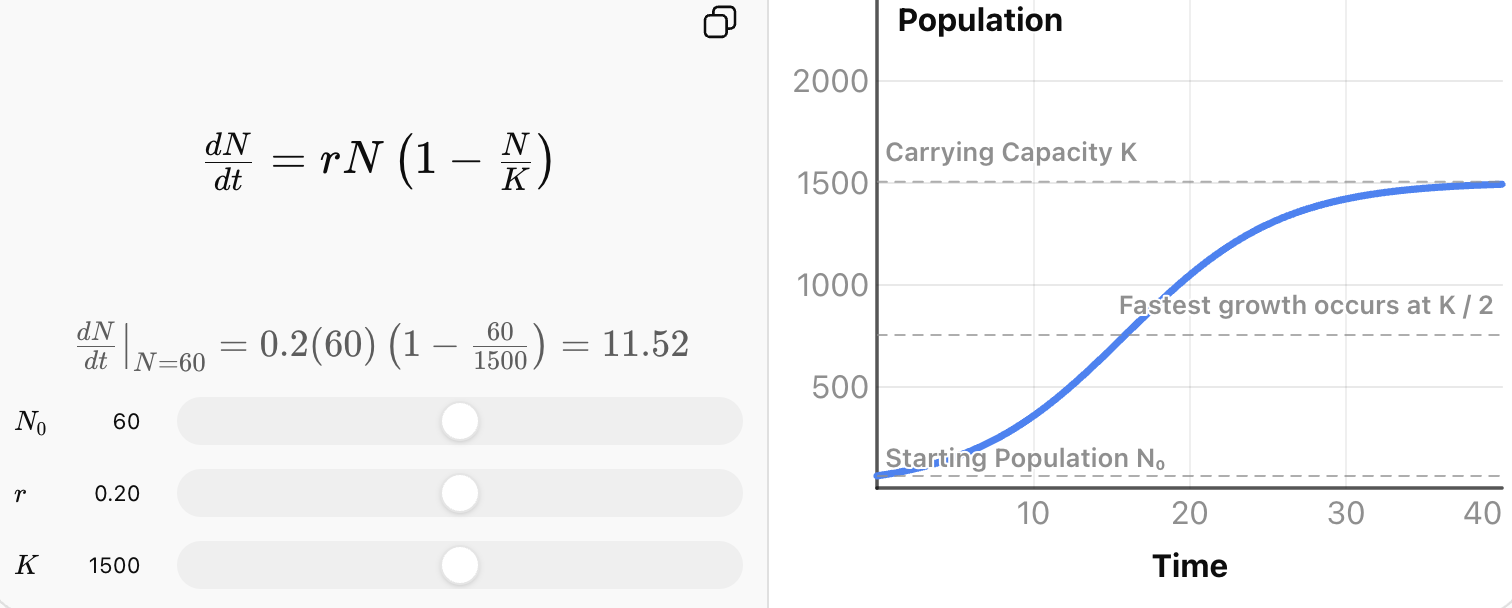
Human populations are more complicated because technology, agriculture, trade, medicine, and infrastructure can change resource availability.
Carrying capacity is therefore not a single permanent number.
Ecological Footprints
An ecological footprint estimates the environmental demand associated with a person or population.
Two communities with the same population could have very different footprints.
For example:
Community A
- High energy consumption.
- High material consumption.
- Large amounts of waste.
Community B
- Efficient public transportation.
- Lower energy consumption.
- Greater reuse of materials.
Population alone therefore does not determine environmental impact.
Growing Demand for Food
Population growth and changing diets can increase demand for food.
Expanding agriculture can cause:
- Deforestation.
- Habitat destruction.
- Water consumption.
- Soil erosion.
- Fertilizer runoff.
- Pesticide pollution.


The challenge is to produce sufficient food while protecting the ecosystems needed for long-term agricultural productivity.
Future Food Production
Possible approaches include:
- Improving crop yields.
- Reducing food waste.
- Improving irrigation.
- Protecting soil.
- Precision agriculture.
- Crop breeding.
- Integrated pest management.
- Improving food storage and distribution.
Different solutions will be appropriate in different regions.
Future food systems will need to consider both production and environmental impact.
Freshwater Scarcity
Fresh water is essential for:
- Drinking.
- Agriculture.
- Industry.
- Sanitation.
- Ecosystems.
Water scarcity can occur when demand exceeds available supplies.


Problems can become more severe because of:
- Population growth.
- Agricultural demand.
- Groundwater depletion.
- Pollution.
- Drought.
- Climate change.
Groundwater Depletion
Groundwater stored in aquifers can be an important water source.
If:
Water extraction > groundwater recharge
the amount of stored groundwater decreases.
Over time this can cause:
- Falling water tables.
- Dry wells.
- Reduced river flow.
- Land subsidence.
- Reduced water availability.
Sustainable management requires withdrawals to be considered alongside recharge rates.
Soil Degradation
Soil is essential for terrestrial ecosystems and agriculture.
However, soil can be damaged through:
- Erosion.
- Overgrazing.
- Deforestation.
- Excessive cultivation.
- Salinization.
- Pollution.
- Loss of organic matter.


Fertile topsoil can be lost much faster than it forms.
Soil should therefore be treated as an important long-term resource.
Desertification
Desertification is land degradation in dry regions that reduces biological productivity.
It can be influenced by:
- Overgrazing.
- Removal of vegetation.
- Poor farming practices.
- Drought.
- Climate change.
Desertification can reduce:
- Agricultural productivity.
- Biodiversity.
- Soil quality.
- Water retention.
Protecting vegetation and soil can reduce the risk.
Biodiversity Loss
Biodiversity is being affected by multiple pressures.
Major threats include:
- Habitat destruction.
- Overexploitation.
- Pollution.
- Invasive species.
- Climate change.


These threats can interact.
For example, a species already restricted to a small fragmented habitat may be less able to move when climate conditions change.
Why Biodiversity Loss Matters
Biodiversity contributes to ecosystem functions including:
- Pollination.
- Nutrient cycling.
- Decomposition.
- Soil formation.
- Food-web stability.
Humans also obtain:
- Food.
- Medicines.
- Materials.
- Cultural benefits.
Loss of biodiversity can therefore affect both ecosystems and human societies.
Climate Change
Climate change will remain an important environmental challenge because it affects many other environmental systems.
Potential effects include:
- Rising temperatures.
- Changing rainfall.
- Sea-level rise.
- Ocean warming.
- Changes in species distributions.
- Increased heat extremes.
- Changes in drought and heavy rainfall risks.


Climate change can therefore act as a threat multiplier, making some existing environmental problems more difficult to manage.
Ocean Change
Oceans face several environmental pressures simultaneously.
These include:
- Warming.
- Acidification.
- Overfishing.
- Plastic pollution.
- Nutrient pollution.
- Habitat destruction.
Marine ecosystems may therefore experience several stresses at once.
For example, a coral reef affected by warming may also experience pollution and overfishing.
Ocean Acidification
Oceans absorb some carbon dioxide from the atmosphere.
When CO₂ dissolves in seawater, it changes ocean chemistry and lowers pH.
This process is called ocean acidification.


Changes in seawater chemistry can make it more difficult for some organisms to build calcium carbonate structures.
This can affect:
- Corals.
- Shellfish.
- Some plankton.
Changes to these organisms can affect wider food webs.
Plastic and Microplastic Pollution
Plastic pollution is likely to remain an important environmental challenge because many plastics persist for long periods.
Large plastics can:
- Entangle animals.
- Be swallowed by wildlife.
- Damage habitats.
Over time, larger pieces can break into smaller particles.
Microplastics are plastic particles generally smaller than 5 mm.


Microplastics have been detected in marine, freshwater, and terrestrial environments.
Research continues into their long-term ecological effects.
Electronic Waste
Modern societies use increasing numbers of electronic devices.
Discarded electronics are called electronic waste, or e-waste.
Examples include:
- Phones.
- Computers.
- Batteries.
- Televisions.
- Appliances.
E-waste can contain valuable materials such as metals but can also contain hazardous substances.
Poor disposal can contaminate soil and water.
The E-Waste Challenge
Consider a smartphone.
Producing it requires:
- Mining.
- Metals.
- Energy.
- Manufacturing.
- Transportation.
If the phone is discarded after a short period, these resources may be lost.
A more sustainable system could emphasize:
Longer product life → repair → reuse → material recovery → recycling
Product design can therefore influence future environmental impacts.
Emerging Chemical Pollutants
Scientists are increasingly investigating pollutants that were previously poorly monitored or understood.
These can include some:
- Pharmaceuticals.
- Industrial chemicals.
- Pesticide residues.
- Flame retardants.
- Persistent chemicals.
Some substances can enter ecosystems through wastewater, industrial releases, or discarded products.
The environmental challenge is partly that new chemicals can enter widespread use before all of their long-term ecological effects are understood.
Antibiotic Resistance and the Environment
Antibiotic resistance is usually considered a health issue, but it also has an environmental dimension.
Antibiotics and resistant microorganisms can enter:
- Wastewater.
- Rivers.
- Agricultural environments.
- Soil.
Environmental exposure can contribute to conditions in which resistant microorganisms persist or spread.
This demonstrates how environmental and human-health systems can be interconnected.
Invasive Species in a Connected World
Global transportation and trade move organisms around the planet.
Species may be transported accidentally in:
- Ships.
- Cargo.
- Packaging.
- Plants.
- Soil.
- Ballast water.
Others are deliberately introduced.


When introduced organisms establish and spread, they may compete with, prey upon, or introduce diseases to native species.
Increasing global connectivity can therefore increase the challenge of preventing biological invasions.
Urbanization
An increasing proportion of people live in urban areas.
Cities require large quantities of:
- Food.
- Water.
- Energy.
- Building materials.
They also produce:
- Waste.
- Wastewater.
- Air pollution.
- Greenhouse gas emissions.
However, cities can also provide opportunities for efficient infrastructure.
Dense communities can sometimes support:
- Public transportation.
- Efficient buildings.
- Shared services.
- District energy systems.
Urbanization is therefore not automatically environmentally harmful or sustainable. How cities are designed matters.
Urban Heat Islands
Cities are often warmer than surrounding rural areas.
This is called the urban heat island effect.
Buildings and paved surfaces can absorb solar energy, while vegetation may be limited.
Possible solutions include:
- Urban trees.
- Parks.
- Green roofs.
- Reflective surfaces.
- Shading.
- Improved building design.


These solutions can also provide habitat and improve human well-being.
Resource Demand from New Technologies
Technologies designed to solve environmental problems also require resources.
For example:
- Solar panels require minerals and manufacturing.
- Wind turbines require metals and other materials.
- Batteries require mined materials.
- Electric vehicles require batteries and infrastructure.
This does not mean these technologies are necessarily worse than the systems they replace.
Instead, their complete life-cycle impacts should be considered.
Critical Minerals
Modern technologies require many different minerals.
Demand may increase for materials used in:
- Batteries.
- Electrical systems.
- Electronics.
- Renewable-energy infrastructure.
Mining can cause:
- Habitat destruction.
- Water use.
- Waste.
- Pollution.
Future sustainability therefore requires both cleaner technologies and improved management of the materials used to produce them.
Circular Economy
One approach to future resource challenges is a circular economy.
Instead of:
Extract → manufacture → use → discard
a more circular system aims for:
Design → use → repair → reuse → remanufacture → recycle


This can reduce demand for newly extracted resources.
However, complete recycling is rarely possible, so reducing unnecessary material use remains important.
Environmental Problems Can Interact
One of the most important principles for future environmental planning is that environmental problems are interconnected.
Consider this sequence:
Climate change
→ increased drought
→ vegetation stress
→ increased fire risk
→ habitat loss
→ population decline
→ biodiversity loss.
Or:
Population growth
→ greater food demand
→ agricultural expansion
→ deforestation
→ habitat loss
→ reduced biodiversity
→ increased carbon emissions.
Understanding these connections helps prevent solutions that address one problem while worsening another.
Ecological Tipping Points
Ecosystems can sometimes tolerate environmental change for a period and then change rapidly once important thresholds are crossed.
Such changes are sometimes described as ecological tipping points.
For example, a clear lake receiving increasing nutrients might initially show relatively little change.
Eventually:
Nutrient input increases
→ algal growth increases
→ water becomes cloudy
→ underwater plants decline
→ ecosystem structure changes.
Returning the ecosystem to its original condition may then be difficult.
This is one reason preventing environmental degradation can be easier than reversing it.
Ecosystem Resilience
Resilience is the ability of an ecosystem to resist disturbance or recover after disturbance.
Ecosystems with:
- High biodiversity.
- Large populations.
- Good habitat connectivity.
- Healthy soils.
- Intact food webs.
may sometimes be better able to recover from environmental change.
Protecting ecosystem resilience is therefore an important part of preparing for future environmental challenges.
Applying Carrying Capacity
Carrying capacity can help us think about sustainability.
If a population continuously consumes resources faster than they are replaced:
Consumption > resource regeneration
the system cannot continue indefinitely.
For humans, technology can increase resource availability or efficiency.
For example:
- Irrigation can increase food production.
- Fertilizers can increase crop yields.
- Desalination can increase freshwater supply.
But these technologies also require energy and resources.
Sustainability therefore requires considering the whole system.
Limiting Factors
In ecology, a limiting factor is something that restricts population growth.
Examples include:
- Food.
- Water.
- Space.
- Nutrients.
- Suitable habitat.
Human technology can modify some limiting factors, but cannot eliminate all environmental constraints.
For example, irrigation can reduce water limitations for crops, but excessive irrigation may deplete groundwater.
Solving one limiting factor can therefore create another problem.
Ecological Footprints and Future Decisions
A sustainable society must consider both:
How many resources are available
and
How quickly those resources are being consumed.
If consumption continually exceeds regeneration, resource stocks decline.
This principle applies to:
- Forests.
- Fisheries.
- Groundwater.
- Soil.
- Biological populations.
Long-term sustainability requires rates of use that ecosystems can support.
Evaluating Environmental Solutions
Future environmental problems will rarely have one perfect solution.
A useful evaluation considers:
- Environmental benefits.
- Environmental costs.
- Social impacts.
- Economic costs.
- Resource requirements.
- Scalability.
- Long-term effectiveness.
- Unintended consequences.
For example, replacing fossil-fuel vehicles with electric vehicles may reduce some emissions, but sustainable planning should also consider electricity generation, battery production, mining, public transportation, and vehicle demand.
Avoiding Problem Shifting
A solution should not simply move an environmental problem somewhere else.
Consider plastic packaging.
Replacing plastic with another material might reduce plastic waste.
However, the replacement could require:
- More energy.
- More water.
- More land.
- More transportation.
The correct question is therefore not simply:
"Is this material plastic?"
A stronger question is:
"What are the environmental impacts across the entire life cycle?"
The Precautionary Principle
Sometimes environmental damage could be serious or irreversible even though scientific uncertainty remains.
The precautionary principle suggests that uncertainty should not automatically be used as a reason to delay reasonable measures that could prevent serious harm.
This is particularly important when:
- Damage could be irreversible.
- Species could become extinct.
- Pollutants could persist for decades.
- Ecosystems could cross important thresholds.
Prevention Versus Restoration
Imagine two forests.
Forest A remains healthy.
Forest B has been heavily degraded.
Protecting Forest A may require relatively modest management.
Restoring Forest B may require:
- Replanting.
- Invasive species removal.
- Soil restoration.
- Wildlife reintroduction.
- Decades of monitoring.
Preventing environmental damage is often easier and less expensive than repairing severe damage afterward.
Nature-Based Solutions
Natural ecosystems can sometimes help address environmental challenges.
Examples include:
- Wetlands reducing floods.
- Mangroves protecting coastlines.
- Forests reducing erosion.
- Urban trees reducing heat.
- Vegetation filtering runoff.


These approaches can provide several benefits simultaneously, including habitat conservation.
Technology and Future Sustainability
Technology can help reduce environmental impacts.
Examples include:
- Renewable energy.
- Improved batteries.
- Precision agriculture.
- Water recycling.
- Environmental sensors.
- Cleaner industrial processes.
- Efficient buildings.
- Low-emission transportation.
But technology is not automatically sustainable.
It must be evaluated based on:
- Materials required.
- Energy required.
- Lifespan.
- Waste.
- Environmental impacts.
- Accessibility.
- Cost.
Environmental Monitoring
Future environmental management will increasingly depend on accurate data.
Scientists can use:
- Satellites.
- Remote sensors.
- Camera traps.
- GPS tracking.
- Environmental DNA.
- Automated water-quality sensors.
- Computer models.


Better monitoring can help detect environmental change before damage becomes severe.
Adaptive Management
Environmental management should change when new evidence becomes available.
This is called adaptive management.
The process is:
Identify problem → plan → act → monitor → evaluate → adjust
For example:
A marine reserve is established.
→ fish populations are monitored.
→ some species recover but others continue declining.
→ scientists investigate the causes.
→ management rules are adjusted.
Environmental management therefore becomes an ongoing scientific process.
Scenario: A Growing Coastal City
Imagine a coastal city whose population is expected to increase substantially.
The city already experiences:
- Traffic congestion.
- Water shortages.
- Habitat loss.
- Flooding.
- Waste problems.
A short-term approach might simply build more roads, pump more groundwater, and develop more land.
A sustainable approach would examine the whole system.
Possible strategies could include:
- Efficient public transportation.
- Water recycling.
- Efficient buildings.
- Wetland protection.
- Compact urban development.
- Renewable energy.
- Improved waste management.
- Coastal restoration.
This demonstrates how several environmental challenges can be addressed together.
Scenario: Future Food Production
Imagine a region must increase food production but is already experiencing soil erosion and water shortages.
Simply expanding farmland could destroy more habitat.
Alternative strategies might include:
- Improving yields on existing farmland.
- Reducing food waste.
- Using efficient irrigation.
- Protecting soil.
- Selecting suitable crops.
- Improving storage and transportation.
The best solution would depend on local environmental and social conditions.
Scenario: Protecting a Species Under Climate Change
Imagine a mountain species is losing suitable habitat because temperatures are increasing.
Traditional conservation might create a protected area around its current population.
However, if suitable climate conditions move uphill, the protected area may eventually become unsuitable.
Future conservation might therefore require:
- Protecting habitat at different elevations.
- Maintaining wildlife corridors.
- Monitoring population movement.
- Reducing other pressures such as hunting or pollution.
This illustrates why conservation planning must consider future environmental conditions, not only current conditions.
Thinking Like an Ecologist
Ecological principles provide useful tools for future decision-making.
Ask:
What resources are limiting?
What is the carrying capacity?
How quickly can the resource regenerate?
How are species connected through food webs?
Could removing one species affect others?
How resilient is the ecosystem?
Could the system cross a threshold?
What happens over several generations rather than several months?
These questions encourage systems thinking.
A Framework for Sustainability Decisions
When considering a future environmental decision, use:
Problem
What environmental challenge exists?
Cause
What processes are producing it?
Ecological impact
Which populations, communities, or ecosystem processes are affected?
Possible solutions
What options are available?
Trade-offs
What are the environmental, social, and economic costs?
Evidence
How do we know the proposed solution should work?
Monitoring
How will success be measured?
Adaptation
What will we change if the strategy does not work?
This framework can be applied to almost any environmental challenge.
Worked Example: Water Shortage
A city uses groundwater faster than its aquifer recharges.
Problem: Falling groundwater supply.
Cause: Extraction exceeds recharge.
Ecological impact: Reduced groundwater and potentially reduced water available to connected ecosystems.
Possible solutions:
- Reduce leaks.
- Improve water efficiency.
- Recycle wastewater.
- Harvest rainwater.
- Limit groundwater extraction.
Monitoring:
Measure groundwater levels each year.
If levels continue falling, management must change.
This is ecological thinking applied directly to sustainability.
Worked Example: Declining Fish Population
A fish population is declining because harvesting exceeds reproduction.
Ecological principle:
Population removed > population replacement
Possible management actions include:
- Lower catch limits.
- Seasonal closures.
- Minimum catch sizes.
- Protected breeding areas.
- Reduced bycatch.
Scientists then monitor population size and reproduction.
The goal is not simply to stop fishing, but to maintain harvesting at a level the population can support.
Uncertainty and Future Decisions
Environmental decisions often have to be made without perfect information.
Scientists may know that:
- A population is declining.
but not know exactly how quickly it will decline.
Or they may know:
- A pollutant affects organisms.
but still be investigating long-term ecosystem effects.
Uncertainty does not mean that nothing is known.
Good decisions identify:
- What is known.
- What remains uncertain.
- How serious the possible consequences are.
- Whether damage could be reversed.
Long-Term Environmental Planning
Many decisions made today will influence environmental conditions decades from now.
Examples include:
- City design.
- Energy infrastructure.
- Forest management.
- Water extraction.
- Transportation systems.
- Coastal development.
- Waste disposal.
Good planning asks:
What happens if we continue this practice for 10, 50, or 100 years?
A practice that works temporarily may not be sustainable over the long term.
The Goal: Resilient and Sustainable Systems
Future environmental management is not simply about preventing every environmental change.
The goal is to create human and ecological systems capable of functioning over long periods.
This requires:
- Protecting biodiversity.
- Maintaining ecosystem services.
- Using resources sustainably.
- Reducing pollution.
- Limiting climate change.
- Restoring damaged ecosystems.
- Improving resource efficiency.
- Monitoring environmental change.
- Adapting when new evidence becomes available.
The central ecological principle is simple:
Human societies are part of ecosystems, not separate from them.
Our long-term well-being depends on maintaining the biological and physical systems that support life.
Common Mistakes
Thinking Population Growth Is the Only Environmental Problem
Environmental impact also depends strongly on consumption, technology, and resource management.
Assuming Renewable Resources Cannot Be Depleted
Forests, fisheries, groundwater, and soils can all be damaged when use exceeds regeneration.
Treating Environmental Problems Separately
Climate change, biodiversity loss, pollution, resource depletion, and habitat destruction can interact.
Assuming New Technology Is Automatically Sustainable
The materials, energy, manufacturing, use, and disposal of technology must also be considered.
Thinking Recycling Eliminates Resource Problems
Recycling can reduce resource demand, but materials cannot always be recovered completely.
Assuming Ecosystems Always Change Gradually
Some ecosystems can undergo rapid changes after important thresholds are crossed.
Assuming Restoration Can Always Reverse Environmental Damage
Some changes are extremely difficult, expensive, or impossible to reverse.
Ignoring Future Conditions
A conservation strategy that works today may become ineffective as climate, populations, or resource demands change.
Waiting for Complete Certainty
Environmental decisions often need to be made using the best available evidence while acknowledging uncertainty.
Check Your Understanding
1. Identify five major environmental challenges likely to affect societies in the future.
2. Explain how population growth can increase pressure on ecosystems.
3. Why is population size alone not enough to predict environmental impact?
4. Explain how increasing food demand can contribute to habitat loss.
5. Describe two causes of freshwater scarcity.
6. Explain why groundwater extraction can become unsustainable.
7. Describe two causes of soil degradation.
8. Explain how climate change can increase other environmental pressures.
9. Identify three environmental pressures affecting oceans.
10. Explain why microplastic pollution is considered an emerging environmental issue.
11. Describe one environmental challenge associated with electronic waste.
12. Explain how global trade can contribute to the spread of invasive species.
13. Why should the environmental impacts of new technologies be evaluated across their entire life cycle?
14. Explain how two environmental problems can interact to produce a larger effect.
15. What is ecosystem resilience?
16. Explain why preventing environmental damage can be easier than restoring an ecosystem later.
17. Give two examples of nature-based solutions.
18. Explain how ecological carrying capacity relates to sustainability.
19. A city is growing rapidly while its groundwater supply is declining. Propose three possible solutions and explain how scientists could determine whether they are working.
20. A species is threatened by habitat fragmentation and climate change. Use ecological principles to propose a long-term conservation strategy.
Key Terms
- Environmental challenge – environmental problem that threatens ecosystems, resources, or human well-being.
- Population growth – increase in the number of individuals in a population.
- Carrying capacity – population size an environment can support under particular conditions.
- Limiting factor – environmental factor that restricts population growth.
- Ecological footprint – estimate of environmental demand associated with an individual or population.
- Water scarcity – situation in which available freshwater is insufficient to meet demand.
- Groundwater depletion – long-term reduction in groundwater caused by extraction exceeding recharge.
- Soil degradation – decline in the quality and productivity of soil.
- Desertification – degradation of land in dry regions.
- Ocean acidification – decrease in ocean pH caused largely by absorption of additional atmospheric carbon dioxide.
- Microplastic – small plastic particle generally less than 5 mm in size.
- Electronic waste – discarded electrical or electronic equipment.
- Emerging pollutant – contaminant whose environmental importance is newly recognized or still being investigated.
- Critical mineral – mineral resource considered important for technologies or economies and potentially vulnerable to supply constraints.
- Circular economy – system designed to reduce waste by keeping materials and products in use.
- Ecological tipping point – threshold beyond which an ecosystem may undergo substantial change.
- Resilience – ability of an ecosystem or system to withstand disturbance and recover.
- Precautionary principle – approach that considers preventive action when potentially serious harm is possible despite uncertainty.
- Nature-based solution – use or restoration of natural systems to help address environmental or social challenges.
- Adaptive management – adjustment of management strategies based on monitoring and new evidence.
Key Takeaways
- Future environmental challenges include climate change, biodiversity loss, pollution, resource depletion, freshwater scarcity, soil degradation, habitat destruction, invasive species, and waste.
- Population growth can increase demand for food, water, land, energy, and materials.
- Environmental impact depends on both population size and consumption patterns, as well as the technologies used.
- Ecological carrying capacity reminds us that populations depend on finite resources and environmental conditions.
- Renewable resources can still be depleted when use exceeds their rate of regeneration.
- Future food production must balance human needs with soil, water, habitat, and biodiversity conservation.
- Freshwater supplies can become unsustainable when extraction exceeds replenishment.
- Soil is a critical resource that can be lost much faster than it forms.
- Climate change interacts with many other environmental pressures.
- Oceans face multiple simultaneous stresses including warming, acidification, pollution, and overfishing.
- Emerging issues include microplastics, electronic waste, new chemical pollutants, and increasing demand for critical minerals.
- New technologies can solve environmental problems while also creating new resource demands and environmental impacts.
- Environmental problems should be analyzed as interconnected systems, rather than isolated issues.
- Biodiversity and habitat connectivity can contribute to ecosystem resilience.
- Preventing serious environmental damage is often easier than restoring ecosystems after degradation.
- Sustainable solutions should be evaluated for their environmental, social, economic, and long-term effects.
- Ecological principles such as carrying capacity, limiting factors, population dynamics, food-web interactions, resilience, and resource regeneration can guide sustainability decisions.
- Effective environmental management follows the process identify → understand → act → monitor → evaluate → adapt.
- Future sustainability depends on maintaining the ecosystems and resources on which human societies themselves depend.