Human Impacts and Sustainability

Сайт: Young Education
Курс: Ecology and Environmental Systems
Книга: Human Impacts and Sustainability
Надруковано: 访客用户
Дата: понеділок 5 жовтня 2026 04:59 AM

1. Pollution

Learning outcomes
  • I can identify major types of pollution.
  • I can explain how pollution affects ecosystems.
  • I can describe sources of air, water, and soil pollution.
  • I can evaluate the impacts of pollution on living organisms.
  • I can propose solutions to reduce pollution.

What Is Pollution?

Pollution is the introduction of harmful substances or forms of energy into the environment at levels that cause undesirable changes.

A substance that causes pollution is called a pollutant.

Pollutants can affect:

  • Air.
  • Water.
  • Soil.
  • Living organisms.
  • Entire ecosystems.

Pollution can come from natural processes, but many major pollution problems are associated with human activities such as industry, transportation, agriculture, energy production, mining, and waste disposal.

https://images.openai.com/static-rsc-4/MbKjk6fDaUiR2nHinxzCIERNfXJ_69Rt98d7UFZ_rHyUBgZsLa-V2YyQj7SXDDL-GOUXMH69G_ujyaL226I9OfXMaC78Esdv7XGiPZtYsiozoyRRlmi8v86peSj6xsaFwrYHQ-xdoG-CWadGAKz2bUsqkNFG-cPX1s3PPVBhETt_a-OcCnUZ4HRcIU9Uxrfo?purpose=fullsize
 
https://images.openai.com/static-rsc-4/bszCbtlFhywqMQncPnPYvL2Crb2hKfU3c1tQHOfR60EIEmxRnIr6mANanW9RMpd77GIe3dxBNFcPRTFPBPSWf8s7d6COrsqpUQY6Sa4f1lNMf3hK6cthugU7kzHcveQUEmiNacQ-pI4mU8PB19C3k_S2KHjTdeO0nhfDLNi21hrvaIzhb-KRFEF-wqUnuWGF?purpose=fullsize
 
https://images.openai.com/static-rsc-4/RCNF_owZVD_vmIIDuS1Pg4v4QQRsSrscnZbQYa2EhtJpKzJg4P4Y6EAS7XeV1fd-8m_BJLYTYVDWmEo53wG8PLujLMBKXWvZVv9zI-ugxlSPMqCl3eBmc-kPWir-4MFdfjXgiMZa-1xgD6Cgdc_KzH1WdMosHqBIMOfMkz8ZMNS_4QzIEDbV1NCfaeHTFhNJ?purpose=fullsize
 
5

Pollution does not always remain where it was produced. Pollutants can be transported through the atmosphere, rivers, groundwater, oceans, soil, and food webs.


Major Types of Pollution

Pollution can be classified in several ways.

Major types include:

  • Air pollution.
  • Water pollution.
  • Soil pollution.
  • Plastic pollution.
  • Nutrient pollution.
  • Chemical pollution.
  • Noise pollution.
  • Light pollution.
  • Thermal pollution.

These categories can overlap.

For example, chemicals released onto land can contaminate soil, enter groundwater, and eventually reach rivers.


Air Pollution

Air pollution occurs when harmful substances enter the atmosphere at concentrations that can damage organisms, ecosystems, or human health.

Important air pollutants include:

  • Particulate matter.
  • Nitrogen oxides.
  • Sulfur dioxide.
  • Carbon monoxide.
  • Ground-level ozone.
  • Volatile organic compounds.
https://images.openai.com/static-rsc-4/MpkeVM90UOGFmVJTRDDABGP4JAbk6Di34B0PLSUKPYbKAqkOavL9cBj_pAWOCe7SNfLDWxRQI7yNBlQD-5cSdST9L08jpLpw4T7A0daUJWfgo1zSZiNF4zBbT45B3DRooqpcAFW1uTipyQxx_OYZiEkSAEytX9JTm261r8kSXmhBH1CobOZNcvkV_QsFEP9h?purpose=fullsize
 
https://images.openai.com/static-rsc-4/TsVYLOys4oqIkXC9vi3ZjxOdS6c2Fn3gNuqfHUtLYz48bH-NEfDT8eVXoP5riJ1UQ9SvmsGJv7Y78MpaO__zP612w6UkQEM7i1fzhOi-p2kvG0nXKDsvzgxJpIP9z8_M-uSIvh0BTp39Ybz3V4kuTE8APB02tpxxVseuTx9CSHHX1cMBxodP_L-IyBUea4zI?purpose=fullsize
 
https://images.openai.com/static-rsc-4/3lIrbtVxRHWlaNtqv7LaiZyUzp4D0HbXmVbi-jG1erF2mFgliaFmDrYW6u5htyGqS7LiAzv8dZ57JVBCeIRl3-oq29teGwTdXUXbLhDhXagltRjyEIm2rwJXwZS7MHaeSz_MgG-IyBRWgdJ5OEEkRkeMDeY37k0V_f2KG_CmM7JD0OVHMrfVORGKokFx52uJ?purpose=fullsize
 
5

Air pollution is especially serious in densely populated areas where large numbers of people may be exposed.


Sources of Air Pollution

Major human sources include:

  • Vehicle exhaust.
  • Fossil-fuel power stations.
  • Factories.
  • Construction.
  • Burning waste.
  • Agricultural activities.
  • Household heating and cooking with polluting fuels.
  • Wildfires influenced by human activity.

Natural sources can include:

  • Volcanoes.
  • Dust storms.
  • Naturally occurring wildfires.

The type and severity of pollution depend on both the source and environmental conditions.


Particulate Matter

Particulate matter consists of tiny solid particles or liquid droplets suspended in air.

Sources include:

  • Vehicle exhaust.
  • Combustion.
  • Wildfires.
  • Construction.
  • Industrial processes.
  • Dust.

Very small particles can remain suspended for long periods and can be inhaled deeply into the respiratory system.

Particulates can also settle onto plants, soil, and water.


Smog

Smog is polluted air containing a mixture of pollutants.

Modern urban smog often develops when pollutants such as nitrogen oxides and volatile organic compounds react in sunlight.

This can produce ground-level ozone.

Ground-level ozone can:

  • Damage plant tissues.
  • Reduce photosynthesis.
  • Irritate respiratory systems.
  • Reduce crop productivity.

It is important to distinguish this harmful ground-level ozone from the ozone layer higher in the atmosphere, which helps absorb ultraviolet radiation.


Acid Deposition

Burning fossil fuels can release sulfur dioxide and nitrogen oxides.

These gases can undergo chemical reactions in the atmosphere and contribute to acidic substances that return to Earth's surface.

This is called acid deposition.

It may occur through:

  • Rain.
  • Snow.
  • Fog.
  • Dry particles.
https://images.openai.com/static-rsc-4/_uxtr3foNpzCq16LVxCdj8aFIpjaVp4ZEpA5EvfyKZ2e3G8vM7h63JQOP9RW_BwVfrEJitE4J4AOsBp6eELDWDgn9s4uP-Pftlv9zhVCM-q-djAdvYWbVuDDTzXiIwRIh9uUNuGwB9f0SjCxVwRNw_LtHiVM80aKCzJ0-kYDwCPROHvYhouGfsq8EfpnbMC6?purpose=fullsize
 
https://images.openai.com/static-rsc-4/ZSuP8lAemLeEFS9RiNvUYFb7-d4ffgVXuQeUkbeIwzTl8_wpnX12WFs3WljTjhtT4Iig0-7b0t9-cO4JyJyab2DGn6Fr6aECNPTnGELgmO0nYt5XZDJD8LD1aQdaHH92a1WeV1TFy1nIQf0uOS7CogtSQO0K6moeGg_0c8c3NlhXJpJmS7C2B28eLCDq7XRX?purpose=fullsize
 
https://images.openai.com/static-rsc-4/m38i7EUz3RHbyqW8tN1CGqwIfL7WfBnmNvS3tDPtOYUH1QUad87_RJ7VbXsNlsIIKJamdB7vQO0IjAlugpb47h2eTrVhoO_gK764qlVBR5HDP01Z0572NNJYlqxpBe2CiM98l3ZX1oZRxgMUQLf5v0C8qlbt8X1usYSVuDksDe9-yxtULTGqsvpKSlP1UqZd?purpose=fullsize
 
5

Acidification can affect lakes, soils, plants, and aquatic organisms.


How Air Pollution Affects Plants

Air pollutants can damage leaves and interfere with photosynthesis.

Possible effects include:

  • Reduced growth.
  • Leaf damage.
  • Reduced photosynthesis.
  • Greater vulnerability to disease.
  • Lower reproductive success.

Pollution can therefore affect entire food webs when primary producers are damaged.


Water Pollution

Water pollution occurs when harmful substances or conditions reduce water quality.

It can affect:

  • Rivers.
  • Lakes.
  • Wetlands.
  • Groundwater.
  • Estuaries.
  • Oceans.
https://images.openai.com/static-rsc-4/YwrPDfTu7u_6hrWu2dkQAXESHdX2-ew2w1Z7EL_EyKY2_T5k_-mv3_dQu4TphjBBfBI_gxY3ztfEC6xFJ1mmo29_qKCg4xHZH3mZxuVAAMVPfKhxD1RBdrWWsj4v7xTLvfb7hEvV1Lijk5TyjAookwl9y89IC1dXQYNirRkz8UfHl4nhsOGkA7egA0ZxdqbL?purpose=fullsize
 
https://images.openai.com/static-rsc-4/H2CdqYrb5cYetYz1MfRb_9zAtTxjwaSYiJcQGOZnrgDf52gy5-gmp9w6onh1hOB2gaajCb-qcvnvUZw0xkl4292x62NGmJBH0DuJyeAAyVte52SwIi7WnkSaSSQN5YLVA3bFU97zKAxscc1_4a09hDx8JJo8vIl2_hDQTqXtZoqa5rpWbnavJULsoswBA8cS?purpose=fullsize
 
https://images.openai.com/static-rsc-4/iMtM0ouSTm8TWwndBZs17ARRxs6iE67yR5tnqEbeTY05xl7w2IqH0T6a2kPwis2t0ECKVaEvk-OEzzExYDXYp54rdwcMw3QR7nJIg67Mm_G9TmV3wDcllJR5nEJscH7egQJANPHEeu-wNCFl0E4D9O1RT7RAecSdRM0mHMU4j6Y0AnMMR8UX4EBkBCMUJBm6?purpose=fullsize
 
6

Aquatic ecosystems are especially vulnerable because pollutants can spread through water and enter organisms directly.


Sources of Water Pollution

Common sources include:

  • Sewage.
  • Industrial discharge.
  • Agricultural runoff.
  • Fertilizers.
  • Pesticides.
  • Oil spills.
  • Mining waste.
  • Plastic waste.
  • Household chemicals.

Pollution may enter water from a clearly identifiable source or from many scattered sources across a large area.


Point-Source Pollution

Point-source pollution comes from a specific, identifiable location.

Examples include:

  • A discharge pipe.
  • A leaking storage tank.
  • A sewage outlet.
  • An industrial facility.

Because the source can be identified, it may be easier to monitor and regulate.


Non-Point-Source Pollution

Non-point-source pollution comes from many scattered sources.

Agricultural runoff is a common example.

Rainwater may carry:

  • Fertilizers.
  • Pesticides.
  • Soil.
  • Animal waste.

from large areas of farmland into waterways.

This type of pollution can be more difficult to control because there is no single source.


Sewage Pollution

Untreated or poorly treated sewage can introduce:

  • Organic matter.
  • Nutrients.
  • Disease-causing microorganisms.
  • Chemicals.

into aquatic ecosystems.

Microorganisms decompose organic material.

This process requires oxygen.

Large quantities of organic waste can therefore decrease the concentration of dissolved oxygen in water.

Fish and other organisms may die if oxygen becomes too low.


Nutrient Pollution

Plants require nutrients such as nitrogen and phosphorus.

However, excessive nutrients entering water can cause serious environmental problems.

Common sources include:

  • Fertilizers.
  • Sewage.
  • Animal waste.

Excessive nutrient enrichment can lead to eutrophication.


Eutrophication

Eutrophication can occur through a sequence of events:

Excess nutrients enter water

→ algae and aquatic plants grow rapidly

→ an algal bloom develops

→ algae and plants die

→ decomposers break down the dead material

→ decomposition consumes dissolved oxygen

→ oxygen levels decrease

→ aquatic animals may die.

https://images.openai.com/static-rsc-4/Hv9wCFEiqSAU3N8QGkC4m8t7eroUwk7lhHjKEz7_ADlBMeHpBUCKUHGRdlhv70nDG9647ynvhdeL7rJaRUmSD_Cv4S-PtHVDvxTrJGyVZVuh4m3THaazqaU6gQHH99Z5DjS-kkG9NUHB3K9kCRiI2_iTJSO-41jaAiu0ir9-_0VtGHXx-ePCynvkGfMb82ih?purpose=fullsize
 
https://images.openai.com/static-rsc-4/jBLUuH3drgwem6dzIZzsmusKLjVH2w09WM2HWi8qV-vdyREERUh0Hsddq09TdWK6QcDpg5tnHkbYm-eoNgVwNV9d-G3-tCXZ_kNj5IirsOoQznSIsyplyoegvDSAS0JRtCFHls0WmFQVHr5kAvpcvcPMjC04hXMKDlJEYsi8OYGW9Ru6fHaeikADevuROWn_?purpose=fullsize
 
https://images.openai.com/static-rsc-4/q6Xcd8mNxnQf90ZXM3voKN6PHLFlCM4fHyURDRdhSydRMh4LEN33G5CXy1DZNoDzbHf849jM-28UCpb7932SAxaESSfrNVB3D9cdtO3Ti97_symo8BotUFux7Txof7KYtnyx_jbop7r_GZu26sGB2AmXSPY-uMvv2nQa6OMei6-8Zl19GXe-YqQDoMdvnnWt?purpose=fullsize
 
6

Severe oxygen depletion can create areas where relatively few oxygen-dependent organisms survive.


Worked Example: Fertilizer Runoff

Imagine fertilizer is applied to farmland.

Heavy rain occurs.

Some fertilizer is washed from the soil into a nearby lake.

The sequence could be:

Fertilizer

→ increased nitrate and phosphate concentrations

→ increased algal growth

→ large algal bloom

→ algae die

→ bacterial decomposition increases

→ dissolved oxygen decreases

→ fish and aquatic invertebrates die.

This demonstrates how pollution can affect an ecosystem indirectly through a chain of biological processes.


Oil Pollution

Oil can enter marine and freshwater environments through:

  • Spills.
  • Shipping.
  • Industrial accidents.
  • Leaks.
  • Runoff.
https://images.openai.com/static-rsc-4/O-mFUKnhNl1e0L22OVpBPl41U6s5cDA0SUBPrYhGwiM3Q2zbPI8M-1Aw66IYMAa2nTtfdK7oLDumAUrTM7BfGE2-LRRZyU_EyBozzkYXIBFO7_H6JrxfQ2BIyjgAOKQhdchV22W9lDC-v1JGdF8gK6ycqybpk8qlS_sNw7yLwk8bxb8_jzSEs5hDB29GF1pu?purpose=fullsize
 
https://images.openai.com/static-rsc-4/ojmZSBTpwl-GGadoQpJLI9QyOaDltXAR5RLUpPcRW2O4sOcstwpkddDHXbIu0orGCpvGC4892RuJpQmlPuBAqaDoRvPkkwNNTJm2QVzRhEfbErn4OYiWNmFV6XQ6WnYrw-FcZxhtdW8WeSUd_P3Em8kH26p5FIJ7Kw3kkrwDrA5ioPxFAtzQgQ2Q3T5QzrJ0?purpose=fullsize
 
https://images.openai.com/static-rsc-4/QmWkjY4ky46DhKkFXiAoR0u_VJdpbra9QLk-yrpDmMuuGhvtLCLHoTQT915GI22Fq5tvTvjwFUWViP7_QVdzyDoa-Mr-nRJSYWtRv12D_05ozH9lUiSXIa2iGsXZTZGCMruLhTmFOadqAWLdL0bIsk7ZzM7IlOJjtXCTnngyLoq00fovICFnzCdUhOZh1wWO?purpose=fullsize
 
6

Oil can:

  • Coat feathers.
  • Coat fur.
  • Damage tissues.
  • Contaminate food.
  • Damage coastal habitats.

Animals that depend on feathers or fur for insulation can be particularly vulnerable.


Plastic Pollution

Plastic is useful because it is durable.

Unfortunately, this durability also means that many plastics persist in the environment for long periods.

Plastic waste can enter:

  • Rivers.
  • Lakes.
  • Oceans.
  • Beaches.
  • Soil.
https://images.openai.com/static-rsc-4/D6rlD4PYOX68nZu_qBfioNWrYp5ubuFXkILAWAGMdvuM-w2SuSVj8_15k2NPM9hiTsvggvyOXvYf_OHZgoLh1Rb2uRjG1YTFRwcFXbFK1ct5Ndc_rAbaBujLQ56MxU8X71Z6m5WDgEu3ZlxqlWa-lRPX7XE-wCcUjibkk_KAo0vWoY3C26OCnlt6BV9rvtzS?purpose=fullsize
 
https://images.openai.com/static-rsc-4/XI0DGhLsWyYEmOEMAHqIrITI0Qz3ChtzoX48ABWv6KykkGq3KnK0iKobd1knelHFc2mdlwvnvDgKMsnjE_0bLz_iTmaDjM34pGBvFdsFURapMPg992bb6DL_-X8UtKwfSzS5EWQXcIjsnv8hMzSHeAAumFzMeuZYgQi7bX3Quy2f4eOtsjYUvgizNnwAow2G?purpose=fullsize
 
https://images.openai.com/static-rsc-4/6lbKghHJK0SmBBhdnPiUkab-cUq2HhEszn2EN2JFnXAfZAjPsD2rH5myY4_JhpoRHByyPplqYU23AfI4vNdUrknHlAuWWnlbONyGM0tS5IQYavOVKEdu6hw8sM6uPjxZ-8_NpntxrjEcUxwmgBRvE8A_BSC9Ye3c0iXRpI-9pzVpJXONqp9COS-v1lmJDukp?purpose=fullsize
 
7

Animals may become entangled in plastic or mistake it for food.


Microplastics

Large plastic objects can gradually break into tiny pieces.

Microplastics are small plastic particles, generally smaller than 5 mm.

They can originate from:

  • Breakdown of larger plastics.
  • Synthetic textiles.
  • Industrial products.
  • Tire wear.
  • Other plastic materials.

Microplastics have been detected in aquatic and terrestrial environments and can be consumed by organisms.

Scientists continue to investigate their ecological and health effects.


Soil Pollution

Soil pollution occurs when harmful substances accumulate in soil.

Sources can include:

  • Pesticides.
  • Industrial chemicals.
  • Mining waste.
  • Oil.
  • Heavy metals.
  • Improper waste disposal.
  • Contaminated water.
https://images.openai.com/static-rsc-4/gnKFUilv-WOYcfxnz44yPKxbK0X80j-8_33wyMDVGIKaVOPQ6CtDNFxG3DR0mnRIEoFFyxYbj3274H45fk-7xLxQ8ncH0rdEGpj8_eeyW0cssouaQaIVVcx0z-dSYGh2KPnq2RcVmFwPRIWKxGIsxYPjek-AEMNRGshzdlY8y0q8NgzsKcglP-Wl428nZ3oW?purpose=fullsize
 
https://images.openai.com/static-rsc-4/g6xFH2OgQ8vwfteuuAj4eAMAoloNvVgXFsXdt1OsCj6Rvz1-K7ubbWILZKWjjWbuLbG8lJoyEAkoFVIzMa0kwBhTRFo0NzGYRgwvDzovLatjx-L-DzJSCV3CM-JMreJxnno6B8LlWJzSmx0_Z2eBypB1Vb-CpeTtY9hRcXZn4JHTmMfSyldD2lp4WCGyNpEs?purpose=fullsize
 
https://images.openai.com/static-rsc-4/3935gNlayZr85nGjZ7-S6VN4YHtFyLs4W-uzXnWv5PPBQz5RHW9l1UlH8FIAGmSTLAKr5UJs6fuWTgFMi4mFnijX61hbSUut8-_dbaqIQXVn-M4G_QCTlZ_tf6XYtqkT9r1SFD6dsrf5PNSEBD7qpzpy--jiKiT9sdPbKUHQj7gwXDQt3qdHOx8S13Os7GX-?purpose=fullsize
 
6

Soil pollution can affect plants, microorganisms, animals, and groundwater.


Pesticides

Pesticides are chemicals or biological agents used to control organisms considered pests.

They include:

  • Insecticides.
  • Herbicides.
  • Fungicides.

Pesticides can protect crops and reduce losses.

However, inappropriate or excessive use can affect non-target organisms.

For example, an insecticide intended to kill crop pests may also affect beneficial insects.

Effective environmental management therefore considers both the benefits and potential ecological costs of pesticide use.


Heavy Metals

Some metals become toxic at sufficiently high concentrations.

Examples of pollutants of concern include:

  • Mercury.
  • Lead.
  • Cadmium.

These substances can enter ecosystems through activities such as mining, industry, waste disposal, and combustion.

Some can persist in ecosystems and accumulate in organisms.


Bioaccumulation

Bioaccumulation occurs when a substance gradually builds up within an organism.

Imagine a fish repeatedly absorbs a pollutant faster than it can remove it.

Over time:

Pollutant entering body > pollutant leaving body

The concentration in the tissues increases.

This is bioaccumulation.


Biomagnification

Biomagnification occurs when the concentration of certain persistent pollutants increases at higher trophic levels in a food chain.

Consider:

Water → plankton → small fish → large fish → fish-eating bird

https://images.openai.com/static-rsc-4/6z8vLsdl4CGdJw07q-fbI67Q8u3rn3FqTN-wzff23ES9w8kAjfX46hJrxbhT3vpt2vVBTVk4omiEurlo_zZNfllPy6aefORS5rnq8SMwOyyRikWpwhElweSg0-OauNFb8whXfisMnarR1MpRuH2ZTIPqppBEwK-Jhf7mYCh7qgQSRagG1H82rGxYH8JsB8jN?purpose=fullsize
 
https://images.openai.com/static-rsc-4/Pa8sDz8StuYStjlO-B2ulf5vGTsjrCCakAnqTjM74J73Ip8hovemdAr6uTDkfju79XhBgN8phzwLAN2HAXCGeK2pEKWGCvuxetIHYEGu0nyVttIDxF-uDgR_E6sPxL19eR54OLmfltVRwx4RuXM8_-vc616VJqPzj4IGNbcsAFpTancOaAXjWnz-w3uh-sTd?purpose=fullsize
 
https://images.openai.com/static-rsc-4/mh9HT28Q25xwbvUiNomfrZxpTK-5vhVil5pUC9o6P-Wrqy7oll_l6EzLQIyMg6tbsiZS-89BG2hxdVtRgNHBMidvq3172l75LCaIpsrPTbTKS1vdaB7I6HaTKgOYaTTWQ3FlXtHZmidba26UOyE74tOpdh8uE5JOWzXYO5yyzAJL2LX5GxMZKL3kwhbzrZAe?purpose=fullsize
 
4

A large predator consumes many contaminated prey.

Pollutants can therefore reach particularly high concentrations in organisms near the top of the food chain.


Bioaccumulation vs Biomagnification

These terms are related but different.

Bioaccumulation

→ pollutant builds up within one organism over time.

Biomagnification

→ pollutant concentration increases across trophic levels.

An organism near the top of a food web may experience both processes.


Noise Pollution

Pollution does not have to be a chemical substance.

Noise pollution is excessive or disruptive human-generated sound.

Sources include:

  • Traffic.
  • Aircraft.
  • Ships.
  • Construction.
  • Industry.
https://images.openai.com/static-rsc-4/x2bTVJkZp1qHXeKqZK3FZNHu9NhXz0dfoJJXL5AbVJ3thQp0higjIS32yH4Wu-HO0UHQAdGH5dhiOTDItVN2U736E8M-gjcZHjWrhAgJlJH2Plonw-ufAz84lB0kzPo_1eLFqMctZQlXtaZvuZN3BxZ-JM-EcP4Xs0uCkyjPpau2G43JbVaxjfZApzv4VuV1?purpose=fullsize
 
https://images.openai.com/static-rsc-4/fv7sVlWxLK_nh2AjZfRgcWl03pf5I0W06XQLCO_O1hELE8W3XtMbGtVgvCkcJgLtN7cSjBqqxYdi1daPZZsvQsUQdpLbAISUStStPuGQFs-l7_TCV2s4aRla3O84hSVy6dEcP2NeEpo8OboRSXQY1BMTLNxD380i_JWTB8VXOw0di9FBcP1w1HYWIHhs8d5y?purpose=fullsize
 
https://images.openai.com/static-rsc-4/dvHACCvxzlBS-z26VKbgf9jdEhaXeUFEfYRD69uQzCX-iAahrhHecm3GgddTUJNPzUBFWUydsOOK2W199tunsdjrv-FR_t-V_v-JPOnx1UsY-Hr9w4Ckqzc_2r49T2rcvjy7z4hijp4MaFsNwPWP6ep_U-C3qPv0aZDVgM4qvsPwzznHxLSiYqqgGq6_BlRu?purpose=fullsize
 
6

Noise can interfere with animal communication.

Animals use sound to:

  • Find mates.
  • Warn of predators.
  • Defend territories.
  • Locate prey.
  • Maintain contact with group members.

Human-generated noise can therefore alter behavior and reproductive success.


Light Pollution

Light pollution is excessive or inappropriate artificial light at night.

It can affect:

  • Insects.
  • Birds.
  • Sea turtles.
  • Bats.
  • Other nocturnal animals.
https://images.openai.com/static-rsc-4/azQmLyYGx6ChcMlffLzskCLXa-FYfD8lJtHfnom313hadArLqoVfmW2O-HpD4FkAJs2oTnIEpncZSWLF8ouEhVk5r-azL5RMAagPbS1Kfd6jmbzz5Wxj1aFvVhbUkyVm23jt1aMNOPzmT1Pla6uyrNlneF6OcIovYG27RtLamPNhL2WLmZds5OEMTmXoH1VA?purpose=fullsize
 
https://images.openai.com/static-rsc-4/sRUbwpYAbR0UkXBmYSBzmfhR4MhAFHs2nsQbhLUnJt4E9Yesi0vTUMcBAN7RDDfsEDbmR4WYpxWMkM5SNveRT5ohjiwVU0Py0u4R-U0TrdCXkUfK1evewgU471ktg7jbmK4gE0mkUF70ROzvbxHKyytGwtRFeRRA5AxlC2B7Nj_jUSyJv1xX4Xgpuu9ojfku?purpose=fullsize
 
https://images.openai.com/static-rsc-4/p6VNZ1I-hmZYkGi5IUKhBbxW7J1AwxnrecOzVShJ_YYnyjyVLQ2ejQZx5wE2uFA2dfKLiPPZhoS1DD_1JvPpgnRmelvQWtKJKQBT3D4eDwsiiwmAn0nrtcUHi8yImEW9d5jl1ZExYv2jd7aWOFcald83dP1REH9NlLEWZj1oN8msQAxnAcnAoXm4wtQwVd3N?purpose=fullsize
 
7

Artificial light can interfere with:

  • Navigation.
  • Feeding.
  • Migration.
  • Reproduction.
  • Daily activity cycles.

For example, newly hatched sea turtles normally orient toward natural light over the ocean. Artificial coastal lighting can interfere with this behavior.


Thermal Pollution

Thermal pollution occurs when human activities significantly alter the temperature of natural water.

Some industrial facilities use water for cooling and then release warmer water into rivers or lakes.

Higher water temperatures can:

  • Reduce dissolved oxygen.
  • Change metabolic rates.
  • Affect reproduction.
  • Alter species distributions.

Species adapted to cool water can be particularly sensitive.


Pollution and Food Webs

Pollution can affect much more than individual organisms.

Suppose a pollutant reduces an insect population.

This may affect:

  • Birds that eat the insects.
  • Plants pollinated by the insects.
  • Predators that eat those birds.
  • Competitors using the same resources.

Pollution can therefore cause effects that spread through a food web.


Pollution and Biodiversity

Pollution can reduce biodiversity when sensitive species decline or disappear.

A polluted environment may become dominated by a smaller number of pollution-tolerant species.

This can change:

  • Species diversity.
  • Population sizes.
  • Food-web structure.
  • Competition.
  • Predator-prey relationships.
  • Ecosystem processes.

Pollution Can Affect Reproduction

Pollutants do not have to immediately kill an organism to damage a population.

They may instead affect:

  • Fertility.
  • Egg production.
  • Development.
  • Hormone systems.
  • Growth.
  • Behavior.

If fewer offspring survive and reproduce, the population can gradually decline.


Pollution Can Travel

Pollutants frequently move beyond the place where they were released.

Air pollutants can travel with wind.

Water pollutants can move downstream.

Chemicals can enter groundwater.

Plastic can travel through rivers into oceans.

Pollutants can also move through food webs.

https://images.openai.com/static-rsc-4/C_VPeZPAhAkQ4jasgkrpKy4ZE_WTfvHPg4FUYaminuDKGlEqOx8uOqBuiaJ192HNs-JKdau0nnAjWZhqB6s-vIURPk0-rRkJ-1p_Dovou-HnWV5M_89PNTPx3S1UuHIMTJIPS4mJhYHOB4gyx92hqxWzn_2z1KjGg2Sx2fcZwdVmnqjTHBjNmJQMP4wuJFJc?purpose=fullsize
 
https://images.openai.com/static-rsc-4/GyDUBzf7ph48OsSMlWtBWb4gHqUVv2DjEY3muRvWrQNSuPuK_9nHIDU5TfS9KuozIW3OtMx3eAtZ2aepwE2ib51Kdsi43nCpiXtUz3AMZTU28mkTmwVDmuNoHAyfqjVKo4vSJON8Pe09zE1Ddz-HLogNvBH_kyNwmrz5KLuVOw9Wz2ci4x9V_iP_GgNBcMX6?purpose=fullsize
 
https://images.openai.com/static-rsc-4/W5StWCUXuBXxHrTDm1XuMcVjoaOFKBPfG3q7tR7JlR-looXVsCUiDsMWGRGI3TrY5iloiRMuxvDQE3gAHfwLckfOL1q7X06sTbOhGrQ8x22V5zZPSZXdM0Piovzjstjp2IX-KSNIQX4faLx5jRSxL0nq2ckxwHCT1vbOplKRDWRNVozwOpddZXCtnWNnk1EI?purpose=fullsize
 
5

Pollution can therefore become a regional or international problem.


Reducing Pollution

Pollution can be addressed at several stages.

A useful hierarchy is:

Prevent pollution

→ reduce pollution

→ capture or treat pollutants

→ clean up existing contamination

Preventing pollution before it enters the environment is often more effective than attempting to remove it afterward.


Reducing Air Pollution

Possible approaches include:

  • Improving energy efficiency.
  • Using lower-emission energy sources.
  • Improving public transportation.
  • Reducing unnecessary vehicle use.
  • Installing industrial pollution-control equipment.
  • Improving fuel and vehicle standards.
  • Avoiding open burning of waste.

The most appropriate solutions depend on the major pollution sources in a particular location.


Reducing Water Pollution

Strategies can include:

  • Treating sewage.
  • Treating industrial wastewater.
  • Reducing fertilizer runoff.
  • Managing animal waste.
  • Protecting wetlands.
  • Preventing oil spills.
  • Reducing plastic waste.

Wetlands can sometimes help remove nutrients and sediments from water before they reach larger waterways.


Reducing Agricultural Pollution

Farmers can reduce pollution while continuing to produce food.

Possible strategies include:

  • Applying fertilizers more precisely.
  • Avoiding unnecessary pesticide use.
  • Planting vegetation beside waterways.
  • Preventing soil erosion.
  • Managing animal waste.
  • Using integrated pest management.

A buffer strip of vegetation beside a river can trap some sediment and nutrients before runoff reaches the water.

https://images.openai.com/static-rsc-4/7XGnbVAZOCJfyiVdSpCcbdpNjoQt2MrlwVyqwAFXpgytrR3Xm17In8cWoZKmTr-avEP_SGmcO3fn7l3vMva8NVZ2zz7uHoNWu5qTtGHtBYxTZWl8nW7ORuk3tN47lYLybaBt8ONAiVdW_IRk--LSEZFjHST9bVMdsy-u3dDg2NAO7YvKi8sIdKVCikj4Bs90?purpose=fullsize
 
https://images.openai.com/static-rsc-4/93PCtnrWAYhHv23w1jHhQTQj8GzL8Oi6CfQSbsQlPuyKDRpWuIA73GWKrnFLiP7Zf3DtS39nEPjyBLSScMPYA1pH34qQBKv8W-feW5oAVMOCsB59G9gkfQQy_xMfm5Iev7Mc_87eswtw4kDjE8y_Gmj410Wte-NB6LAm6DpH6w7HxF0Q-YbZJ3shvLcy_Q0S?purpose=fullsize
 
https://images.openai.com/static-rsc-4/MaE7p4PGBq5PhSbz0ShPsxw0lu3AyhyYDLDq-LA2ZYmQPwRpjcGhOZRpcLwMHcM3E-rG1yX3gwZx1EHfr38pwT3pWklB00mPY0o9V-mvsCt8ayVDV8LGrSHEM0BmmXscrqxKjqN-Qmh64C_RD_kN4IczPBSRNj_zEZ8xxoopstV9C0TviHsAr9nJ6p5YOC2E?purpose=fullsize
 
6

Reducing Plastic Pollution

Strategies can include:

  • Reducing unnecessary single-use plastics.
  • Reusing products.
  • Improving waste collection.
  • Improving recycling where appropriate.
  • Preventing litter.
  • Capturing waste before it reaches waterways.
  • Designing products that create less waste.

Cleanup is useful, but preventing plastic from entering ecosystems addresses the problem earlier.


Wastewater Treatment

Wastewater can be treated before it returns to the environment.

Treatment can remove:

  • Solid waste.
  • Organic matter.
  • Nutrients.
  • Disease-causing microorganisms.
  • Some chemical contaminants.

Effective wastewater treatment greatly reduces the amount of pollution entering aquatic ecosystems.


Laws and Regulations

Governments can establish limits on:

  • Industrial emissions.
  • Wastewater discharge.
  • Vehicle emissions.
  • Pesticide use.
  • Waste disposal.
  • Pollutant concentrations.

Regulations are most effective when pollution is:

  • Measured.
  • Reported accurately.
  • Monitored.
  • Enforced.

Scientific evidence is therefore important for environmental regulation.


Monitoring Pollution

Scientists can monitor pollution by measuring substances or biological responses.

Examples include:

  • Dissolved oxygen.
  • pH.
  • Nitrate concentration.
  • Phosphate concentration.
  • Particulate matter.
  • Heavy-metal concentrations.
  • Species diversity.

Living organisms can sometimes serve as bioindicators.

A bioindicator is an organism whose presence, absence, or condition provides information about environmental quality.


Worked Example: River Pollution

Imagine scientists investigate a river downstream from a wastewater discharge.

They measure:

Measurement Upstream Downstream
Dissolved oxygen 9 mg/L 4 mg/L
Nitrate 2 mg/L 12 mg/L
Number of aquatic invertebrate species 18 7

The downstream site has:

  • Lower oxygen.
  • Higher nitrate.
  • Lower species richness.

These observations suggest that environmental conditions differ downstream.

However, scientists would need further evidence to determine the precise cause and establish whether the wastewater discharge is responsible.


Worked Example: Choosing a Solution

Suppose a lake experiences repeated algal blooms.

Testing shows that large amounts of fertilizer are entering from surrounding farmland.

A solution focused only on removing algae treats the symptom.

A stronger long-term strategy would also reduce the cause:

Excess fertilizer runoff

Possible actions might include:

  • More precise fertilizer application.
  • Vegetated buffer strips.
  • Improved soil management.
  • Wetland restoration.

Good pollution management aims to address the source of the problem.


Evaluating Pollution Solutions

A proposed solution should be evaluated using evidence.

Ask:

  • Does it reduce pollution at the source?
  • How effective is it?
  • What does it cost?
  • Can it be maintained?
  • Does it create another environmental problem?
  • How will success be measured?
  • Who is responsible for implementing it?

For example, replacing one disposable material with another is not automatically environmentally beneficial. The complete environmental impact should be considered.


Individual and Collective Action

Individuals can help reduce pollution by:

  • Reducing unnecessary waste.
  • Disposing of chemicals correctly.
  • Avoiding littering.
  • Reducing unnecessary energy use.
  • Reusing materials.
  • Participating in local cleanups.

However, large pollution sources may require action from:

  • Governments.
  • Industries.
  • Farmers.
  • Cities.
  • International organizations.

Effective pollution reduction often involves both individual and system-level changes.


A Cause-and-Effect Approach

When analyzing pollution, use this sequence:

Source → pollutant → pathway → organism/ecosystem → effect

For example:

Farm

→ fertilizer

→ runoff into lake

→ algae

→ algal bloom

→ decomposition

→ oxygen depletion

→ fish mortality

Or:

Factory

→ air pollutant

→ atmosphere

→ plant leaves

→ reduced photosynthesis

→ reduced plant growth.

This approach makes it easier to explain how pollution produces ecological effects.


Common Mistakes

Thinking Pollution Is Only Litter

Pollution includes chemicals, gases, nutrients, plastics, noise, light, heat, and other harmful environmental changes.

Confusing Air Pollution with Climate Change

They are related in some ways, but they are not the same phenomenon. Some activities produce both greenhouse gases and conventional air pollutants.

Thinking All Algae Are Pollution

Algae are natural and important parts of aquatic ecosystems. Problems can occur when excessive nutrients cause unusually large blooms.

Confusing Bioaccumulation and Biomagnification

Bioaccumulation occurs within an organism.

Biomagnification occurs across trophic levels.

Thinking All Pesticide Use Is Automatically Harmful

Environmental effects depend on the chemical, concentration, application method, exposure, and affected organisms.

Assuming Pollution Only Affects Organisms That Die Immediately

Pollution can also reduce growth, reproduction, development, or behavior.

Assuming Cleanup Is Always the Best Solution

Preventing pollutants from entering the environment is often more effective than removing them later.


Check Your Understanding

1. Define pollution and pollutant.

2. Identify four major types of pollution.

3. Give three sources of air pollution.

4. Explain how air pollution can affect plants.

5. Give four possible sources of water pollution.

6. Distinguish between point-source and non-point-source pollution.

7. Explain the process of eutrophication.

8. Why can sewage reduce dissolved oxygen in water?

9. Describe two ways oil pollution can harm animals.

10. Explain two ways plastic pollution can affect organisms.

11. Distinguish between bioaccumulation and biomagnification.

12. Explain why predators near the top of a food chain can be particularly vulnerable to some persistent pollutants.

13. Describe one way noise pollution can affect animals.

14. Explain how light pollution can change animal behavior.

15. What is thermal pollution?

16. Explain how pollution affecting one species can influence an entire food web.

17. A lake beside farmland develops repeated algal blooms. Explain the likely chain of events and propose one method of reducing the problem.

18. Why is preventing pollution often preferable to cleaning it up afterward?


Key Terms

  • Pollution – introduction of harmful substances or forms of energy into the environment.
  • Pollutant – substance or form of energy that causes harmful environmental change.
  • Air pollution – contamination of the atmosphere by harmful substances.
  • Particulate matter – tiny solid particles or liquid droplets suspended in air.
  • Smog – polluted air containing a mixture of pollutants.
  • Acid deposition – acidic substances transferred from the atmosphere to Earth's surface.
  • Water pollution – contamination or harmful alteration of water.
  • Point-source pollution – pollution from a specific identifiable source.
  • Non-point-source pollution – pollution originating from many scattered sources.
  • Eutrophication – nutrient enrichment that can cause excessive biological growth and oxygen depletion.
  • Microplastic – small plastic particle, generally less than 5 mm in size.
  • Soil pollution – contamination of soil by harmful substances.
  • Bioaccumulation – buildup of a substance within an organism over time.
  • Biomagnification – increase in concentration of some pollutants at higher trophic levels.
  • Noise pollution – harmful or disruptive human-generated sound.
  • Light pollution – excessive or inappropriate artificial light.
  • Thermal pollution – human-caused alteration of environmental temperature, particularly in water.
  • Bioindicator – organism whose presence, absence, or condition provides information about environmental quality.

Key Takeaways

  • Pollution can affect air, water, soil, organisms, and entire ecosystems.
  • Major pollution sources include transportation, industry, agriculture, energy production, mining, sewage, and waste.
  • Pollutants can move far beyond their original source.
  • Air pollutants can damage respiratory systems, plants, and ecosystems.
  • Water pollution can come from sewage, industry, agriculture, oil, chemicals, and plastics.
  • Excess nutrients can cause eutrophication, leading to algal blooms and oxygen depletion.
  • Soil pollution can affect plants, microorganisms, animals, groundwater, and food webs.
  • Persistent pollutants can bioaccumulate within organisms and biomagnify through trophic levels.
  • Plastic pollution can cause ingestion, entanglement, and long-term contamination.
  • Noise and artificial light can disrupt animal communication, navigation, feeding, migration, and reproduction.
  • Pollution can reduce biodiversity without immediately killing organisms by affecting growth, behavior, development, and reproduction.
  • Effects on one species can spread through food webs.
  • Pollution solutions can involve prevention, regulation, treatment, improved technology, better land management, and cleanup.
  • Preventing pollution at its source is often more effective than trying to remove it after environmental contamination has occurred.
  • Pollution problems can be analyzed using the sequence source → pollutant → pathway → organism or ecosystem → effect.
  • Effective solutions should address the cause of pollution, not only its visible symptoms.

2. Climate Change

Learning outcomes
  • I can explain the greenhouse effect.
  • I can identify evidence for climate change.
  • I can describe human activities that contribute to climate change.
  • I can analyze the impacts of climate change on ecosystems.
  • I can evaluate strategies for reducing greenhouse gas emissions.

What Is Climate Change?

Climate describes the long-term patterns of temperature, rainfall, wind, and other atmospheric conditions in a region or across Earth.

Climate change refers to long-term changes in these patterns.

Earth's climate has changed naturally throughout its history. However, the rapid warming observed since the industrial era is primarily caused by increasing concentrations of greenhouse gases produced by human activities.

Climate change involves more than simply increasing temperature. It can affect:

  • Rainfall patterns.
  • Ocean temperatures.
  • Sea level.
  • Ice and snow cover.
  • Ocean chemistry.
  • Extreme weather.
  • Ecosystems and species distributions.
https://images.openai.com/static-rsc-4/3zoJXONuYuY_rTbQlU2SerGvHaED6RnMRjbdLei0gzHeMDHIwtkHm3pdyVByoXzI7vRcwbbkRyIyUrY2bwbZfkv7OowHKfurj_dU6RN403VXbDGDVmAjp5pvH5yUcJPsm4q-N2d5JyZ-IsnrmHfoaQFFijRg5Gg6ELaxzXSHVegf2p8_XGjv5Z2Twh648VEa?purpose=fullsize
 
https://images.openai.com/static-rsc-4/s0Ct4xIWbtDb12LS2lDPLtTvzQ4QsFhC5_ktgncpnjOqfjKvwed4Tl2FLYuVcT04YQMvuZVRRyB_87CCjrIJHS5XRZ5n0CViczTkneE2GVRNYI-SB8bzywE-Wm43taR_bTDqth4esaalkum1GSbBGt_2tfcu39Aaia2wubvWU8pziQSiyVlU1RkGfSd19hBJ?purpose=fullsize
 
https://images.openai.com/static-rsc-4/KwyGsO5YNA4yqB6RrNaz08CjXnZfBimvG4Ae2LQw18ZzckghprIGrxOcm1G7zjy8vciWjvnqvUsGe00xAgvd9LDdoA30XDzLOmfmkFrsFfGmKZwNRLZclD0RtHxrrDx1-yf4BEU6FqKCExjtAfb33QVtRi0d5ixFjyCc0sGiksXab_QvPBLZlV9UFvtO5R7B?purpose=fullsize
 
6

Weather and Climate

Weather describes short-term atmospheric conditions.

Examples include:

  • Today's temperature.
  • A thunderstorm tomorrow.
  • This week's rainfall.
  • A particularly cold morning.

Climate describes patterns measured over much longer periods, typically decades or longer.

A single unusually cold day does not disprove global warming, just as one unusually hot day does not by itself prove climate change.

Scientists investigate long-term patterns using large amounts of data collected across the planet.


Earth's Energy Balance

Almost all of the energy driving Earth's climate system originally comes from the Sun.

Solar radiation reaches Earth.

Some is:

  • Reflected by clouds.
  • Reflected by ice and other surfaces.
  • Absorbed by the atmosphere.
  • Absorbed by Earth's surface.

The warmed surface then releases energy mainly as infrared radiation.

Some of this infrared radiation escapes to space, while some interacts with greenhouse gases in the atmosphere.


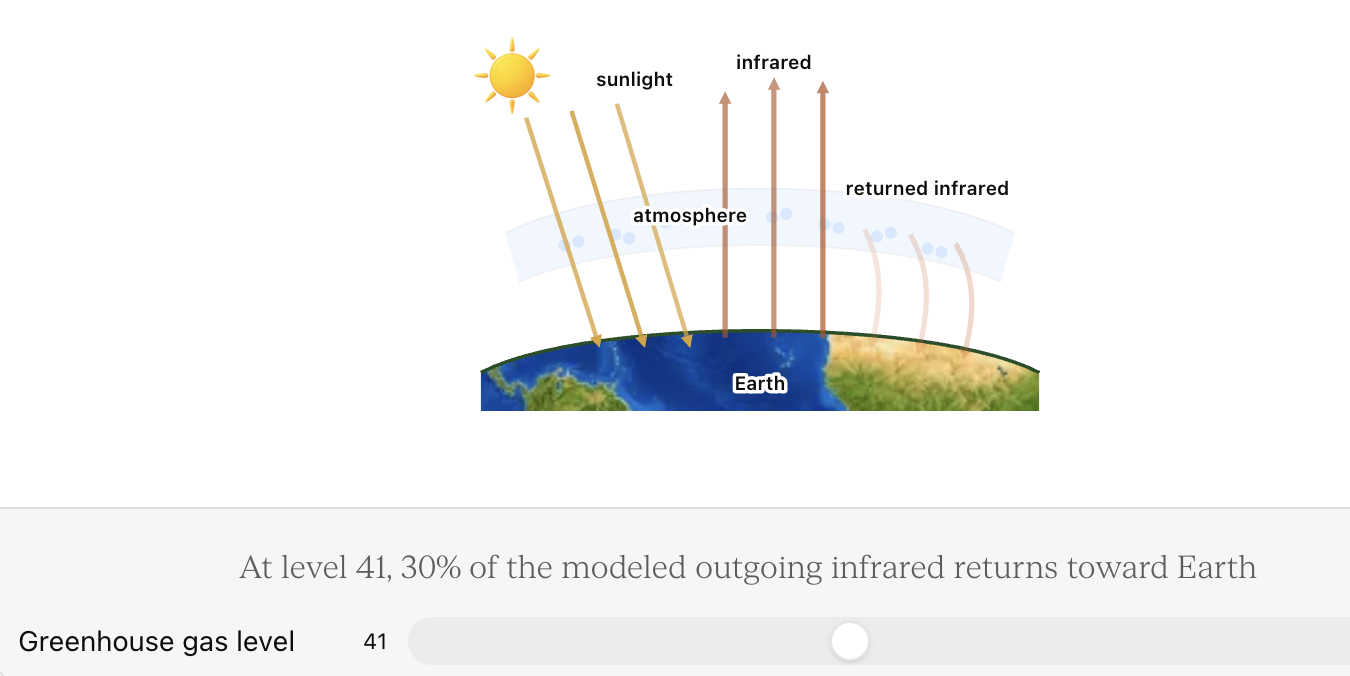
The Greenhouse Effect

The greenhouse effect is a natural process that helps keep Earth warm enough for life.

The basic process is:

Sunlight enters the atmosphere

→ Earth's surface absorbs energy

→ the surface warms

→ Earth emits infrared radiation

→ greenhouse gases absorb some outgoing infrared radiation

→ energy is emitted in different directions, including back toward the surface and lower atmosphere

→ Earth's surface and lower atmosphere remain warmer than they would be without these gases.
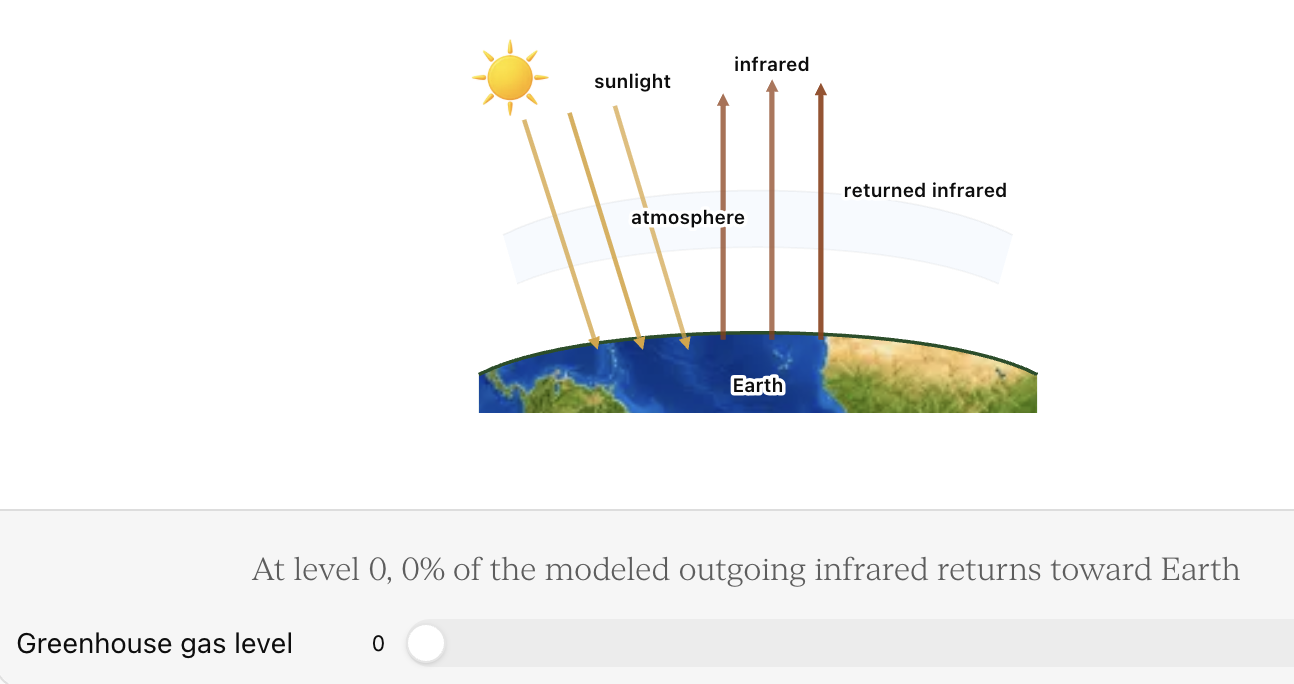
Without the natural greenhouse effect, Earth's average surface temperature would be much lower.

The greenhouse effect itself is therefore not pollution and is not inherently harmful.

The current concern is the enhanced greenhouse effect caused by increasing greenhouse gas concentrations.


Greenhouse Gases

Important greenhouse gases include:

  • Carbon dioxide.
  • Methane.
  • Nitrous oxide.
  • Water vapor.
  • Ozone.

These gases interact with infrared radiation emitted by Earth's surface and atmosphere.

Different greenhouse gases differ in:

  • Atmospheric concentration.
  • Ability to absorb infrared radiation.
  • Atmospheric lifetime.
  • Sources and sinks.

Carbon dioxide is especially important in current human-caused climate change because human activities release very large quantities and some of the resulting increase persists for a long time.


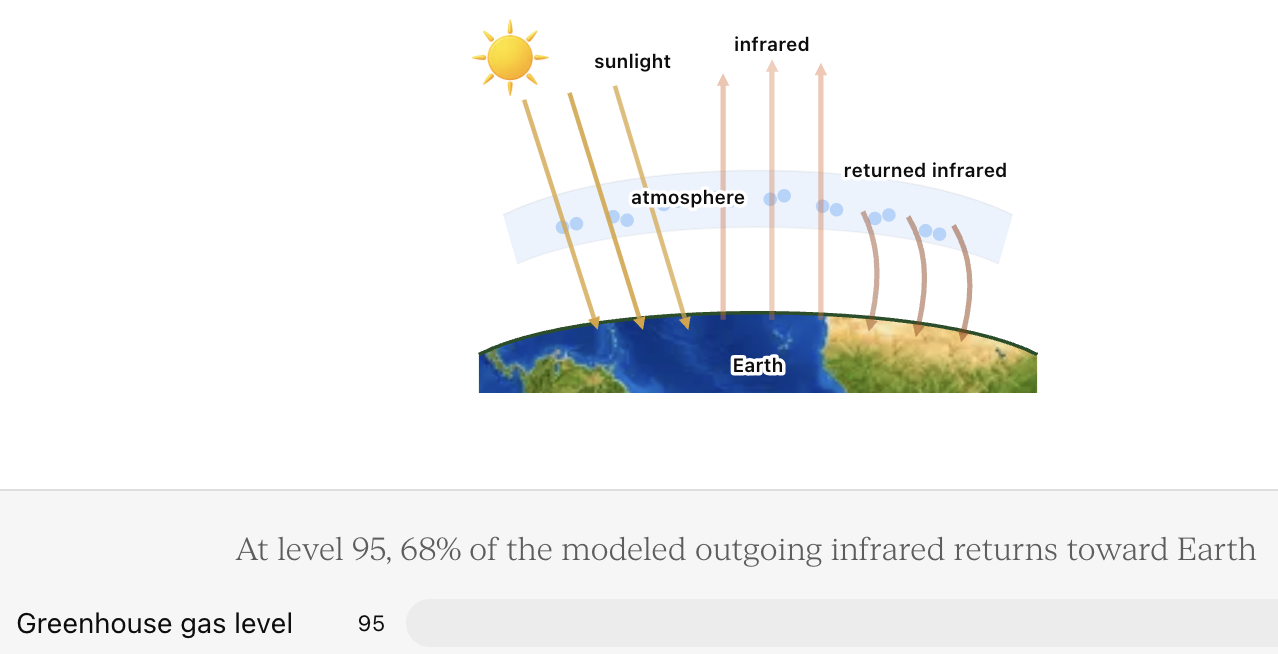
The Enhanced Greenhouse Effect

Human activities have increased concentrations of greenhouse gases in the atmosphere.

More greenhouse gases change Earth's energy balance.

In simplified terms:

More greenhouse gases

→ more interaction with outgoing infrared radiation

→ less energy escapes to space initially

→ Earth's climate system warms

→ the warmer Earth emits more energy

→ a new energy balance is eventually approached at a higher temperature.

This human-driven strengthening of the greenhouse effect is called the enhanced greenhouse effect.


Carbon Dioxide

Carbon dioxide, or CO₂, is released naturally through processes such as:

  • Respiration.
  • Decomposition.
  • Volcanic activity.

It is also absorbed naturally through processes including:

  • Photosynthesis.
  • Dissolution into oceans.

Human activities add additional CO₂ to this natural carbon cycle.

Major human sources include:

  • Burning coal.
  • Burning oil.
  • Burning natural gas.
  • Cement production.
  • Deforestation and other land-use changes.
https://images.openai.com/static-rsc-4/OrDiiB4x7L8zkFzam9042eEiWQSc2Xcy2H6ygrSSVU8N2Qht-6KYHiPERM9uFzXTKc56aTgvKGRN2fvw8T5noqfpLwlEboDOZpa0LS87t8T4YCcqeDRpnWFkgrxuWvudOidug5FWP_lyyb2J0OoABQZ9Fxou2dz2ulFUB3sJaoI1QVyuwq5Jcg78TUCEs5mw?purpose=fullsize
 
https://images.openai.com/static-rsc-4/rrsZKEplnr7DvGlD3BPJJ49YgPICrsIKq2LB9O_2Mg-5qDN81wUiXd9Nj2aOVfXd1VJpHOLKJkHM2H6lNhJoPoDbig8Ap52pr9lWqZFhVQbec_dsx5cjtFKDnGH6RjeAS671CxKHX7eQfRnvF2qCVLFlvhTRjNXHPiEkBJmYOpji5TvciBo-WTW2m5-Cg_xv?purpose=fullsize
 
https://images.openai.com/static-rsc-4/HEx0HSGCMFNpp1Ocoz3z499Qkc63eoXn4lWOF5rceLrLntuyfJ5sf8tTc0Ns8z5kMcI1HHr41mTmUhSpGtXj_c7r8Bp5neXfglnmO0TdrfF1ygCSGlbEXohLEt1fN2G8aMRQssAyUGFvN5S1866eU3jnPJNnzpa5Vpl3YLXGiRqMsK4rZvZ545GtR7a_wRXL?purpose=fullsize
 
5

Fossil Fuels and Climate Change

Coal, oil, and natural gas contain carbon that has been stored underground for millions of years.

When fossil fuels burn, carbon combines with oxygen and forms carbon dioxide.

For example:

Hydrocarbon fuel + oxygen → carbon dioxide + water + energy

The released carbon dioxide enters the atmosphere.

Large-scale fossil-fuel use for electricity, transportation, heating, and industry has therefore transferred large amounts of carbon from geological stores into the atmosphere.


Deforestation

Forests influence the carbon cycle.

Trees:

  • Absorb carbon dioxide through photosynthesis.
  • Store carbon in wood and other tissues.
  • Contribute carbon to soils.

When forests are removed, two effects can occur:

Less vegetation

→ less potential carbon uptake.

And when vegetation is burned or decomposes:

Stored carbon

→ released back into the atmosphere.

https://images.openai.com/static-rsc-4/HEx0HSGCMFNpp1Ocoz3z499Qkc63eoXn4lWOF5rceLrLntuyfJ5sf8tTc0Ns8z5kMcI1HHr41mTmUhSpGtXj_c7r8Bp5neXfglnmO0TdrfF1ygCSGlbEXohLEt1fN2G8aMRQssAyUGFvN5S1866eU3jnPJNnzpa5Vpl3YLXGiRqMsK4rZvZ545GtR7a_wRXL?purpose=fullsize
 
https://images.openai.com/static-rsc-4/ixQR8LgfTmeqYe09wSIsgYP74n-KwoB5tYQMnZFPAvlXT0V0IpZeeGs6xZe42mJp-b3tlfIZ1y600gh9BAOea9RfXlwS3XMoNwOILHFaDJbvw7Syhm5tO_1h-A7aGQfDw6U9wYx2iqGafzRJ0-eLu0lMuEXK8CK9sOZsXgRzQ2EJn4vlnnEsaxk962bfNr0K?purpose=fullsize
 
https://images.openai.com/static-rsc-4/Xn1GMF65m4ut9qbpVb40TvLeH24UXKNplj_qwylN6eT8vb5Ju3IdEUtp26FwR0KMRonH1I-RNuB-9njTFmxryT218gqmgFjRjTAAeuvBiJGRI_PS_7czwLcGNupTNxbnJTNdUDhhWW9ceHzBHNQv8mUzKAPdlIuixbmebdO_lk1Bo35hvY6t6NcdWmBVfgKe?purpose=fullsize
 
5

Protecting and restoring forests can therefore contribute to climate-change mitigation, although forests cannot substitute for reducing fossil-fuel emissions.


Methane

Methane, or CH₄, is another important greenhouse gas.

Human-related sources include:

  • Livestock.
  • Rice cultivation.
  • Landfills.
  • Fossil-fuel extraction and transport.
  • Waste management.

Methane remains in the atmosphere for less time than carbon dioxide on average, but molecule for molecule it has a stronger warming effect over commonly considered time periods.

Reducing methane emissions can therefore contribute to limiting warming.


Nitrous Oxide

Nitrous oxide, or N₂O, is a powerful greenhouse gas.

Human activities that increase emissions include:

  • Agricultural fertilizer use.
  • Manure management.
  • Some industrial processes.
  • Fuel combustion.

Agriculture is therefore connected with climate change through several different greenhouse gases.


Water Vapor

Water vapor is Earth's most abundant greenhouse gas.

However, in current climate change it acts mainly as a feedback rather than the initial human forcing.

The basic relationship is:

Greenhouse gas increase

→ warming

→ warmer air can contain more water vapor

→ additional greenhouse effect

→ further warming.

This is an example of a positive feedback.


Evidence for Climate Change

Scientists do not rely on a single measurement.

Evidence comes from many independent observations, including:

  • Surface temperature records.
  • Ocean temperatures.
  • Glacier retreat.
  • Ice-sheet changes.
  • Arctic sea ice.
  • Sea-level rise.
  • Changes in snow cover.
  • Changes in species distributions.
  • Changes in seasonal biological events.
https://images.openai.com/static-rsc-4/FiCasuf-sOEh786NCzQh9Vzx4h5LNr4Wc_dZJqyLpiXbAYiLl0qSQF0TVcSzoO4OZAtaVVyK5eREniUTFp5YzA1rN_63eMlCX2kafkR1iwZDob2Ig0cCYZoDvxMLS0fTCkJwXyzYKLZXFMXb2H9MigndZAv7bjn8HC2Bq7S59PcWxssZbuJRYvUSqyXuI1eD?purpose=fullsize
 
https://images.openai.com/static-rsc-4/3w7qDqz5tELsG_YU6VwTZO_9mbcQ-dtHNWVc5maJaBy7e6jd_obwOwuEf8I6bVlnOS26UzRx3H1XKYQO-5-3vYifht1fXukgrJkq4SQkxlUbfEahM1t1uHtDaGik-1bB6dyX2md_mvyS4utqnw6s9bM6pH4Pepa5I_wc5Bn1DxpeYbxTiMUOAYZ8xq1rHV63?purpose=fullsize
 
https://images.openai.com/static-rsc-4/AVuBORfPtjnc0hK2sItGmjlXrgVHdKQ6KsFOHMxAWeFH6fxLhriRnBxeRmx1mfeUaK07czuWpFZiTk3BiXZrH4uhQtBrGYSSR0wZ5epIoObgDL9j0tQCxekOKhK1YbFt0SIZzAWLXqpBLJSCM5sdX6QUbX6CuiDeRv0qs2y3ewHaoRA0bj2cFg0jELwSLiFL?purpose=fullsize
 
4

When independent measurements show consistent patterns, confidence in the overall conclusion becomes stronger.


Rising Global Temperature

Temperature measurements collected from thousands of locations show that Earth's average surface temperature has increased.

Scientists combine measurements from:

  • Land weather stations.
  • Ships.
  • Ocean buoys.
  • Satellites.
  • Other observing systems.

Individual locations vary considerably from year to year, but the global long-term trend shows warming.


Warming Oceans

Oceans absorb much of the additional heat accumulating in Earth's climate system.

Scientists measure ocean temperature at different depths using instruments including floats, ships, and satellites.

Ocean warming provides important evidence because oceans store enormous quantities of thermal energy.

Warmer oceans can also affect:

  • Marine ecosystems.
  • Sea level.
  • Ocean circulation.
  • Coral reefs.

Melting Glaciers

Many glaciers around the world have lost mass over recent decades.

https://images.openai.com/static-rsc-4/b_-pUVbU-K_3HzK8NeStb8YXasPqOLpKvuj5UPc14eejo3zdO--fzKTNPh30BRrkR5xWym9Ku1Xre4OilZXmWpGjq4hQRriUwrEVx9SmkyNu1e3BDM7oQR_XNfXMUEmRvONknb0FRRAdZYSj1xgGVHU0mKZUzTjOiOGuhm5bQotYvrZy_P3rNGKbw6-nh-9d?purpose=fullsize
 
https://images.openai.com/static-rsc-4/ZyQaGjnpdj_mmsY9x9bmWaCEVsRhQk8w4vcp-Z9GYM59Wu58PlRAL5r536vg5AhByNny9RfpYjRbD6yII7RrMyPkBuAyad_6wUMESeUTjpYXh75_RbOOp1oVS45ddkHfB9Mqa_zuZrwUnUwbCvGOvUH1xukwLG8dv5FDaJiXnYaegFuH74dtT6vB-ChOaYoR?purpose=fullsize
 
https://images.openai.com/static-rsc-4/AVuBORfPtjnc0hK2sItGmjlXrgVHdKQ6KsFOHMxAWeFH6fxLhriRnBxeRmx1mfeUaK07czuWpFZiTk3BiXZrH4uhQtBrGYSSR0wZ5epIoObgDL9j0tQCxekOKhK1YbFt0SIZzAWLXqpBLJSCM5sdX6QUbX6CuiDeRv0qs2y3ewHaoRA0bj2cFg0jELwSLiFL?purpose=fullsize
 
6

Scientists can monitor glaciers using:

  • Historical photographs.
  • Field measurements.
  • Aircraft.
  • Satellites.

Although individual glaciers can temporarily advance or retreat because of local conditions, the widespread long-term loss of glacier mass provides evidence of a warming climate.


Sea Ice and Ice Sheets

Climate change also affects frozen regions.

Observed changes include:

  • Declining Arctic sea-ice extent and thickness over the long term.
  • Loss of ice from Greenland.
  • Loss of ice from Antarctica.

It is important to distinguish between sea ice and land ice.

Melting floating sea ice has relatively little direct effect on sea level.

Melting land-based glaciers and ice sheets adds water to the oceans and raises sea level.


Sea-Level Rise

Global average sea level is rising mainly because of two processes.

Thermal Expansion

Water expands as it warms.

Warmer ocean water therefore occupies slightly more volume.

Melting Land Ice

Melting glaciers and ice sheets transfer water stored on land into the oceans.

https://images.openai.com/static-rsc-4/DrRdLVKr5B4qOZHDXPtMtOWLEuoJ47VfirqTNSobtdgyW_poYbLV9BFMK-YN-TWjFzERJ0BLJldGwBASDSTNfdn_ij15w2f6Lm8p-vrtQNhzcwaAFaL5xO-6OWi3yo4O4WBSxNqXiHbE7gdKK-VF4Euu3Z_QZ77Dy7EgXCahShphNqlfRt8LeorcWCgaqlED?purpose=fullsize
 
https://images.openai.com/static-rsc-4/zqYgl7rEbaA2OP51f1oZCBRtymOIMcUoWe__ULKUa0jKU1RsbmNJw6-hpvpmkzLX8sEgFvCOUv8UpCakF2su_qCSRqGvTwty2KpNyVZ48VLYNjNCDOF3vgNVbJDXM6sJIPfaEiMuk-nUarY_q_Ayk6LtjXjTls1KZKE0IhD87JBHzZGl058WfoNeQQRjQpOL?purpose=fullsize
 
https://images.openai.com/static-rsc-4/_XOJddTM975GvUUl7cDPIsL5pEJMEq7PUWfbzZQj580s9gY7C3Z_jRFnBgaDn4kUu_oqF_dbGDwvqXpCUDAAEAdX6TVGT6Z5wbt-0vPKRJC72Yzg_SeG-N7gfgLd0nOi5wq_sXQIqNrZppqygdWm9IutNq_6omQwONrJzXe1M4UilYEbpgKMYZ0QykMxWCwI?purpose=fullsize
 
5

Sea-level rise increases risks for low-lying coastal environments and communities.


Evidence from the Past

Scientists can investigate climates that existed before modern instruments.

Sources of evidence include:

  • Ice cores.
  • Tree rings.
  • Sediments.
  • Corals.
  • Fossils.

These are called climate proxies because they provide indirect information about past environmental conditions.


Ice Cores

Ice sheets contain layers of ice accumulated over thousands of years.

Tiny bubbles trapped within the ice preserve samples of ancient atmosphere.

Scientists can analyze these bubbles to estimate past concentrations of gases such as carbon dioxide and methane.

Ice chemistry can also provide information about past temperatures and environmental conditions.

https://images.openai.com/static-rsc-4/igs0X0dg6mszgXxy3lZXf9LJ02AyA0iaeU6WRQRYh_mZF-9TiILhLrktdAR3RAaeNqfY3w0qOL7ApCCak98dC3ZJAl-df1TekNtIXR0rpw0vwdi00WAu42YmONjuwp99ihkBoSEq68NAXGNEpWCZkvmQeVUPLRUglnZu4C5YRTAzXvW2IIlEs6PEtRPT4wt_?purpose=fullsize
 
https://images.openai.com/static-rsc-4/5-u7Dosk8Gf-J8OVPev357-9UBL-BjiP9QuZAw9zUTYPMMy3lM6WUPFLZy0sgzMv6H3QyNtvPk1cQYA5D3Cu4RRKvIfblwzJD1BBRGEwxfJ5X80GM0Kxj32FmmOSqGC0D784i915ifNqo6_91494_qEia_-LHlWdorLGa_Vyqimb6uaSh8A4hW0HKAGZpCqy?purpose=fullsize
 
https://images.openai.com/static-rsc-4/BDVpaxWStvfijbLdCCrxz0G4h8G3Q3WKVXuw6keorqZkpW0D3856kB5eq1QKsLTHDyx8v-1lYcnE498rNxtjFTG4Cxpi5sRV6B5Ec4RSOnpvxzYH4l4s1404ID242bRdFgnxCnh-L99Ev1zS26FJzM7tqGRcXgMpoD4sgP3SHz46LBe9mteGYZBNlG9oZiLB?purpose=fullsize
 
5

Ice cores allow scientists to compare greenhouse gas concentrations with climate conditions far into Earth's past.


Human Activities and Climate Change

Human activities contributing to greenhouse gas emissions include:

  • Electricity generation from fossil fuels.
  • Transportation.
  • Industry.
  • Building heating and cooling.
  • Agriculture.
  • Deforestation.
  • Cement production.
  • Waste management.

Different sectors contribute different gases and therefore require different solutions.


Climate Change and Ecosystems

Climate influences:

  • Temperature.
  • Rainfall.
  • Water availability.
  • Growing seasons.
  • Ocean conditions.
  • Seasonal cycles.

Changing climate can therefore alter the conditions to which organisms are adapted.

https://images.openai.com/static-rsc-4/3zoJXONuYuY_rTbQlU2SerGvHaED6RnMRjbdLei0gzHeMDHIwtkHm3pdyVByoXzI7vRcwbbkRyIyUrY2bwbZfkv7OowHKfurj_dU6RN403VXbDGDVmAjp5pvH5yUcJPsm4q-N2d5JyZ-IsnrmHfoaQFFijRg5Gg6ELaxzXSHVegf2p8_XGjv5Z2Twh648VEa?purpose=fullsize
 
https://images.openai.com/static-rsc-4/SbdvXzoiyAMla9C6G6dR1mo91zQAooVqvsljhe3ZBmHdiJtFk7uZNCyjhX6FgUXjd1CEiEee_UUWm_mdyGVpwAN7G1z_m5dq9g0YP47FE16hduWnObXOLneEpUC8w9lFM5LfQly0itw4VJR1tl1iqdJksev2Hg6X6l7V80QtJ0qyb1XPPmXgrjMzeqSVojzp?purpose=fullsize
 
https://images.openai.com/static-rsc-4/t7y96IdQnirogQxuwrgnpfT5v16Ugd11e-Jjfh5JLsY4IeJR960Fho_Uty5MELGj43KCEVew9dn85zdBcDP0j3C4QOc3r-Un0shtEskggOlkpUeughJdbBnpNpFRnkE1tVYSQUPw4ioxffgjqm-oUhQ1yw2oS9EhrIqk2FmUhu-f20GhvqrtDEtdD_vIwHmg?purpose=fullsize
 
6

Species may respond by:

  • Changing behavior.
  • Changing seasonal timing.
  • Moving to new locations.
  • Adapting over generations.
  • Declining if they cannot respond quickly enough.

Shifting Species Distributions

As temperatures change, suitable environmental conditions can move geographically.

Some species have shifted:

  • Toward higher latitudes.
  • To higher elevations.
  • Into deeper or cooler water.

However, movement may be prevented by:

  • Cities.
  • Roads.
  • Agricultural land.
  • Mountains.
  • Coastlines.
  • Habitat fragmentation.

A species may therefore lose suitable habitat faster than it can move.


Worked Example: Mountain Species

Imagine a species adapted to cool mountain temperatures.

As temperatures rise:

Suitable temperature zone moves uphill

→ population moves higher

→ available habitat becomes smaller

→ eventually the species approaches the summit

→ no higher habitat remains.

This can greatly increase extinction risk, particularly for species restricted to mountaintops.


Changes in Seasonal Timing

Many organisms use environmental cues to time biological events.

Examples include:

  • Flowering.
  • Migration.
  • Breeding.
  • Hibernation.
  • Egg laying.
  • Insect emergence.

Climate change can shift the timing of these events.

Different species may respond at different rates.

This can produce a phenological mismatch.


Worked Example: Birds and Insects

Suppose a bird normally times reproduction so its chicks hatch when insects are most abundant.

Warming causes the insects to emerge earlier.

If bird breeding does not shift by the same amount:

Insects peak earlier

→ chicks hatch later

→ less food available

→ chick survival may decrease.

Climate change can therefore disrupt ecological relationships even without directly killing organisms.


Coral Reefs

Coral reefs are particularly sensitive to changes in ocean temperature.

Corals live in association with microscopic algae that provide much of their energy.

When seawater becomes unusually warm, corals can lose these algae.

This causes coral bleaching.

https://images.openai.com/static-rsc-4/yc5EWdaq8kG9ESFV95L5MeIMEdew7CmNlgjfkaJZxFpbuWNygwq3GoUYYKe57iHG_O7BbQHaxX9SF86wlaiCh8CepOTNDoL5CI8a1A8lUSYp5lgjRAyimBarSttjHzcPO6b6Rms_EzLPIRQIyzlVGMhuJh94EAC3bp5hHeCFeqdpdT3MNI--7Ajx0rojFuJG?purpose=fullsize
 
https://images.openai.com/static-rsc-4/2cJmqnFCVhTQng0VaoN6n7Qyi1kER4iAsrAQMsJXfkmzmu-eNXe5rLTBHDk6G1G1YdN5b78_Gpl2o45KKjL89jEWZ1V5SmZS-AdHm1KrjP56SLAyzKn-EB_fAIX8XClgfvJUBUfnLed44MZxT7mVZQil6jI-4Q5OIbFauTzbpzirHZlfFVq5RpBCuHJ6lQ_1?purpose=fullsize
 
https://images.openai.com/static-rsc-4/jEnerRnMB1QNMpWW2qmdMFZYOnusKzipO7NSxXddT7KeGvaA59jHV4AqYPSmpFn-4PksX005JrMWviqwMVmAApCmzge4Y1pLUIqna_WEoj1BKm6RoAr_LkZM4Lll2SbXuhdfRzadP4yhYt2TECS_MFicXFPGn_famVuFVdM35NsnMUGHrfXGauTQVNHe-SE7?purpose=fullsize
 
5

Bleached coral is still alive initially, but prolonged or repeated stress can cause death.

Because coral reefs provide habitat for many species, widespread coral loss can reduce biodiversity.


Ocean Acidification

Climate change and ocean acidification are related consequences of increasing atmospheric carbon dioxide, although they occur through different mechanisms.

The ocean absorbs some atmospheric CO₂.

This changes seawater chemistry and decreases pH.

This process is called ocean acidification.

It can affect organisms that build calcium carbonate structures, including some:

  • Corals.
  • Mollusks.
  • Plankton.

Changes in these organisms can influence marine food webs.


Drought

Climate change can alter rainfall patterns and increase drought risk in some regions.

Drought can:

  • Reduce plant growth.
  • Reduce freshwater availability.
  • Increase wildfire risk.
  • Reduce food supplies.
  • Change habitats.
https://images.openai.com/static-rsc-4/DdXWnLXhLehF3cVDLDbiXqkqhRghyq2GJwHRrazpL82Qq0c0SOzZ65Jg2u0o69DvVNLqGMC_HDF-2DuelsU9zR-D0nMT7cUBD2h7HUaz9t__3lztzO7lw4IkfaLxD0BhPof-dFxwReBZCLdEuimY13YMGTXr4el33wHmAP5frjvFTOfjYM-bGMVslTa-niM2?purpose=fullsize
 
https://images.openai.com/static-rsc-4/HhPEt08HPcPq5mDsXMUeSBgzSIcpoaCLGNwl8QkcDdGts4EhiztGePxL9xKr8UJyTMqKGOTWufXGga1pWOZ2ddLBQvcwEpk_zh89fIzu1WKtCvirJnqpawBw6LB6AbaiscdJ8GTv7Qt-m6uKysWBDLQ0VOce2CDCZpGzxM9VqlXnUJALKM22kZKl8Znw5cGn?purpose=fullsize
 
https://images.openai.com/static-rsc-4/vxxVd-qo3Al-OIqXKqOjEPH-ht7cQern9_k7_s8C4F9r8CBMLDvcmq90D2ZPZQT0QgpVuxx0HZ7h0eAc33vhzHVqPnq0gvKYwP3o_a7uG7TJD4NeGRLq2oyZG12mred3llerFdrJTEjwU79tUoYv6uRSHQCA3n6zz1r8HtRbu8kDdRXp2kipEAKB3ARLvqBV?purpose=fullsize
 
5

Species adapted to consistently moist environments may be particularly vulnerable.


Wildfire

Fire is a natural and important part of some ecosystems.

However, hotter and drier conditions can increase fire risk or severity in some regions.

More severe or frequent fires can alter:

  • Vegetation.
  • Habitat structure.
  • Soil.
  • Food availability.
  • Animal populations.

Climate change is one factor affecting wildfire risk alongside land management, vegetation, ignition sources, and local weather.


Extreme Weather

A warmer climate can influence the probability or severity of some types of extreme events.

These can include:

  • Heatwaves.
  • Heavy rainfall.
  • Drought.
  • Some intense storms.

It is important to distinguish between individual weather events and long-term changes in their likelihood or intensity.

Scientists use observations and climate models to investigate how climate change affects particular types of events.


Positive Feedback

A positive feedback amplifies an initial change.

Consider Arctic ice.

Ice reflects a large proportion of incoming sunlight.

Dark ocean water absorbs more solar energy.

Therefore:

Warming

→ ice melts

→ darker surface exposed

→ more energy absorbed

→ additional warming

→ more ice melts.

 
https://images.openai.com/static-rsc-4/Yhq67E_puy8i_midBlUmL0oymYTQ1W_TwiD26b1dStK4F_dA_Rt22GCaueG8-Y_lGYnqBbrPQhTQku8DDGP6hGDdcoOVKNn9Dqg4DzM8BWobIO6rQeX6I7Nt4ML_oWQQYO5yW7Ewf5VHgcNmHgk7bSn7b-Eq63T2yeD7xc393iENCpWtV_uEkV3vuLuNZWJp?purpose=fullsize
 
https://images.openai.com/static-rsc-4/SWurVWZ7CDg4OgDdgFM2vAfD5j0D5ZphXu2p8-3soqDozilNJyPRKgjZOBE8RGE8EmScpKTLKga4MOYSlcM0hRKYtUyH0Jq1_v88tXDe77hZBELlEhRHNi4HAbfFNIrR8hjPtv3oEkckAiAiztTCDoihGMWvX7d-KiiLnre7Ac7nPmHG1cPKZrIwL5Xz3Kci?purpose=fullsize
 
5

This is called the ice-albedo feedback.


Carbon-Cycle Feedbacks

Warming can also influence natural carbon stores.

For example, thawing permafrost can expose previously frozen organic matter to decomposition.

Microorganisms can then release greenhouse gases.

This creates another potential feedback:

Warming

→ permafrost thaw

→ decomposition

→ greenhouse gas release

→ additional warming.

Feedbacks can therefore amplify climate changes.


Climate Change and Biodiversity

Climate change can affect biodiversity by:

  • Changing habitats.
  • Altering food availability.
  • Shifting species distributions.
  • Changing breeding seasons.
  • Increasing heat stress.
  • Changing rainfall.
  • Increasing some disturbance risks.
  • Altering ocean conditions.

Species already threatened by habitat loss, pollution, invasive species, or overexploitation may have less ability to respond to additional climatic changes.

Multiple threats can therefore interact.


Mitigation and Adaptation

Responses to climate change are often divided into two broad approaches.

Mitigation

Mitigation aims to reduce the causes of climate change.

Examples include:

  • Reducing greenhouse gas emissions.
  • Protecting carbon stores.
  • Increasing energy efficiency.

Adaptation

Adaptation aims to reduce harm from climate changes that occur.

Examples include:

  • Coastal flood defenses.
  • Drought-resistant crops.
  • Heat-management plans.
  • Wildlife corridors.

Both approaches can be important.


Reducing Fossil-Fuel Emissions

A major mitigation strategy is reducing carbon dioxide emissions from fossil-fuel combustion.

Possible approaches include:

  • Renewable electricity.
  • Nuclear energy.
  • Energy efficiency.
  • Electrification.
  • Public transportation.
  • Lower-emission industrial processes.
https://images.openai.com/static-rsc-4/Wda8PtkZmlZNO-FXZOZPWohf4FQndqf-cutDj-xVgILpbSXL-nPVpVhlIRj5lnbv1PSb2wA-6AAhVAC2dsMwS47OxowMfBOfpmxN58OVgIUf87xQ_2TpwVR9McsDjWbM92k3VMf7kte_6rDib7AOvel9-VIUDGMV2l-73SQX5UiMdjx6PbYV3HGQ98Tio1H9?purpose=fullsize
 
https://images.openai.com/static-rsc-4/YwmFMSn2fy1Ho7SqF-hSZyxwk7quk9x69znJu0lTb9hnxcewfjbRdrrJaiTumflcark2BjmIcPkPNDhMKRHsjAaeAYFJg5pgoAIBJdGVGGbPqinS3PJrli6NVCSLFsqUU_eMYdbOj0wUZ8FXhmTpAicFjWI0wP2D8BS4TS-3Rtk92_z-fHr75KK-t2518enM?purpose=fullsize
 
https://images.openai.com/static-rsc-4/rpTxwXfCnt7ADRCZtW-eXTMYz2osWU9USsSMUWn4jz7b9HA6oaet9n3nytc7dQzido8UWgkxJE2pUD4A4D7-EW5CnKwt2UNS5S0rAxOck-GSu89UoY7p6sQhPFWeICvkNsUFihv2TXnnSZ4R3ITUWhn_W2S0RJFmDU_qBxzgEy23rO4NMiRO1_X60xrBSt7O?purpose=fullsize
 
6

Different technologies have different costs, benefits, limitations, and environmental impacts.


Renewable Energy

Renewable energy sources include:

  • Solar.
  • Wind.
  • Hydroelectric.
  • Geothermal.

These generally produce much lower operational greenhouse gas emissions than fossil-fuel electricity generation.

However, renewable technologies still require:

  • Materials.
  • Land.
  • Manufacturing.
  • Infrastructure.

Their complete environmental impacts should therefore be evaluated using life-cycle analysis rather than assuming that any technology has zero impact.


Energy Efficiency

Another strategy is reducing the amount of energy required to provide the same service.

Examples include:

  • Better building insulation.
  • Efficient appliances.
  • Efficient industrial equipment.
  • Improved transportation systems.

If less energy is required, fewer emissions may be produced when that energy would otherwise come from fossil fuels.

Efficiency can therefore reduce emissions without necessarily reducing the useful service provided.


Transportation

Transportation emissions can be reduced through combinations of:

  • Public transportation.
  • Walking and cycling infrastructure.
  • Electric vehicles.
  • More efficient vehicles.
  • Reduced unnecessary travel.
  • Lower-carbon fuels in applications that are difficult to electrify.

The effectiveness of electric vehicles depends partly on how their electricity is generated.


Protecting Forests

Forests remove carbon dioxide from the atmosphere through photosynthesis and store carbon.

Strategies include:

  • Reducing deforestation.
  • Protecting existing forests.
  • Restoring degraded forests.
  • Reforestation.
https://images.openai.com/static-rsc-4/KATnjNLON-XSuIxtmEFcuAto7Tc7zLqyAqYwDz9QIMeLTj98d7DnWLeRjS9H09gwKQEjHhxfnPG8GJVQYmQMF4fAUvA7bQMKZD23QQuUi_uaAw7UHjAdJkUQp4Gko2fiyFqseTZ1AAXaiY8XkuC02kzJlp1gmDbVPSxU7ROF2CDc7xu57gMa3RZnmC0hsZrB?purpose=fullsize
 
https://images.openai.com/static-rsc-4/30Cv1S0KaGwN1o4iyW1G5hsOIgh5njy9N5Rs03mnrOJcAWj0Gb7JDDXRSIHy19aXCqQT-qTZHUEVEOonrxt_ad1fa7ZDpf5PkoIE2yduKHVf3vWHCocTKnce93rlyAizwZhOp31r7MpMd9wGz3vvNnOCMmN5eFEdgU9YSwrFBEp7M3zg8v9cwIjW-ebnTBog?purpose=fullsize
 
https://images.openai.com/static-rsc-4/WVjN5GIEk3zSB805brGUa2IowjNasagOLZXTZlGz9wnxTKpIU6Gagt1eokz5sKopmWfAxxD0wTBT6LGPAEy9HeJyrk76kCmIyfZpXhPPG_XP6ANq-8jESzSkHnEaI2OeJ5LHZYF-0UAgrw205_g7Uk2wgTqJ-cjFlK9QeMtRdW30MQVXW96GfRYeFUQ_I-4h?purpose=fullsize
 
6

Protecting existing mature ecosystems can also conserve biodiversity and ecosystem services.


Carbon Capture

Some technologies attempt to capture carbon dioxide before it enters the atmosphere or remove carbon dioxide directly from the air.

Captured carbon may then be stored underground or used in certain products.

Potential approaches include:

  • Carbon capture at industrial facilities.
  • Direct air capture.
  • Biological carbon storage.

These technologies may contribute to emission reduction strategies, but their cost, energy requirements, storage durability, and achievable scale must be considered.


Reducing Methane Emissions

Methane emissions can sometimes be reduced by:

  • Detecting leaks from oil and gas systems.
  • Improving waste management.
  • Capturing landfill gas.
  • Changing some agricultural practices.
  • Improving livestock and manure management.

Because methane has a relatively short atmospheric lifetime compared with carbon dioxide, reducing methane emissions can affect the rate of warming relatively quickly.


Evaluating Climate Strategies

No climate strategy should be evaluated using only one characteristic.

Useful questions include:

  • How much greenhouse gas does it reduce?
  • How quickly can it be implemented?
  • What does it cost?
  • Is the technology reliable?
  • What infrastructure is required?
  • What environmental impacts does it have?
  • Can it operate at a large enough scale?
  • Does it create other benefits or problems?

For example, an energy technology might reduce carbon emissions but require substantial land or mineral resources.

Scientific evaluation considers these trade-offs.


Worked Example: Comparing Electricity Sources

Imagine a community currently generates electricity from coal.

It considers replacing some electricity with solar power.

A useful evaluation would compare:

  • Greenhouse gas emissions.
  • Construction requirements.
  • Land use.
  • Cost.
  • Reliability.
  • Energy storage requirements.
  • Grid infrastructure.
  • Environmental impacts.

The question is therefore not simply:

"Does solar produce carbon dioxide?"

Instead, scientists consider the full life cycle and overall system.


Individual and System-Level Actions

Individuals can contribute to reducing emissions through choices involving:

  • Energy use.
  • Transportation.
  • Food.
  • Consumption.
  • Waste.

However, large-scale emission reductions also involve:

  • Electricity systems.
  • Transportation infrastructure.
  • Industry.
  • Agriculture.
  • Building design.
  • Technology.
  • Government policy.

Climate change is therefore both an individual and a system-level challenge.


Analyzing Climate Evidence

When examining evidence for climate change, ask:

  • Is this weather or climate?
  • How long is the record?
  • How large is the geographic area?
  • Is there a long-term trend?
  • Are several independent measurements consistent?
  • What mechanism could explain the observations?
  • Are alternative explanations supported by the evidence?

Climate science relies on patterns from multiple independent lines of evidence rather than one isolated observation.


Common Mistakes

Thinking Weather and Climate Are the Same

Weather describes short-term conditions. Climate describes long-term patterns.

Thinking the Greenhouse Effect Is Entirely Human-Caused

The natural greenhouse effect existed long before humans and makes Earth habitable. Human activities are enhancing it.

Thinking Greenhouse Gases Simply "Trap Heat"

A more accurate explanation is that greenhouse gases absorb and emit infrared radiation, altering Earth's energy balance.

Thinking the Ozone Hole Causes Global Warming

Ozone depletion and climate change are different environmental problems, although there are some interactions between atmospheric chemistry and climate.

Thinking Carbon Dioxide Is the Only Greenhouse Gas

Methane, nitrous oxide, water vapor, ozone, and other gases also contribute.

Thinking One Cold Winter Disproves Climate Change

Climate trends are measured over long periods and large geographic areas.

Thinking Melting Sea Ice Directly Causes Most Sea-Level Rise

Sea-level rise is mainly caused by thermal expansion of seawater and melting land-based ice.

Assuming Every Extreme Weather Event Is Caused Only by Climate Change

Individual events usually have multiple causes. Climate change can alter the probability or intensity of certain types of events.

Thinking Renewable Energy Has No Environmental Impact

All energy systems have environmental costs. Their impacts should be compared across their complete life cycles.


Check Your Understanding

1. Distinguish between weather and climate.

2. Explain the natural greenhouse effect.

3. Why is the greenhouse effect necessary for life on Earth?

4. What is meant by the enhanced greenhouse effect?

5. Identify four greenhouse gases.

6. Explain how burning fossil fuels increases atmospheric carbon dioxide.

7. Explain how deforestation can contribute to climate change.

8. Give four independent types of evidence that Earth's climate is warming.

9. Explain why warming oceans contribute to sea-level rise.

10. Why does melting land ice raise sea level more directly than melting floating sea ice?

11. Explain how climate change can cause species distributions to shift.

12. What is a phenological mismatch?

13. Explain how increasing ocean temperatures can affect coral reefs.

14. Explain the ice-albedo feedback.

15. Distinguish between climate-change mitigation and adaptation.

16. Describe three strategies that could reduce greenhouse gas emissions.

17. Explain why protecting forests can contribute to both climate mitigation and biodiversity conservation.

18. Why should the complete life cycle of an energy technology be considered when evaluating its environmental impact?

19. A student says, "It was unusually cold yesterday, so global warming cannot be happening." Explain the problem with this reasoning.

20. A country wants to reduce its greenhouse gas emissions. Identify three different sectors it could target and propose one strategy for each.


Key Terms

  • Climate – long-term pattern of atmospheric conditions.
  • Climate change – long-term change in climate patterns.
  • Greenhouse effect – warming caused by greenhouse gases absorbing and emitting infrared radiation.
  • Greenhouse gas – atmospheric gas that interacts with infrared radiation and contributes to the greenhouse effect.
  • Enhanced greenhouse effect – strengthening of the greenhouse effect caused by increased greenhouse gas concentrations.
  • Carbon dioxide (CO₂) – important greenhouse gas released by fossil-fuel combustion and other processes.
  • Methane (CH₄) – powerful greenhouse gas produced by natural and human processes.
  • Nitrous oxide (N₂O) – greenhouse gas associated with processes including agriculture and industry.
  • Infrared radiation – electromagnetic radiation emitted strongly by Earth's surface and atmosphere.
  • Climate proxy – indirect evidence used to reconstruct past climate.
  • Thermal expansion – increase in volume as a substance warms.
  • Coral bleaching – loss of symbiotic algae from stressed corals.
  • Ocean acidification – reduction in ocean pH associated with absorption of atmospheric carbon dioxide.
  • Phenological mismatch – disruption in the timing of ecological interactions.
  • Positive feedback – process that amplifies an initial change.
  • Albedo – proportion of incoming radiation reflected by a surface.
  • Mitigation – action that reduces the causes of climate change.
  • Adaptation – adjustment intended to reduce harm from climate change.
  • Carbon capture – collection of carbon dioxide for storage or use.
  • Life-cycle analysis – evaluation of environmental impacts throughout a product or technology's life.

Key Takeaways

  • Climate describes long-term patterns, while weather describes short-term atmospheric conditions.
  • The natural greenhouse effect keeps Earth warm enough to support life.
  • Greenhouse gases absorb and emit infrared radiation, influencing Earth's energy balance.
  • Human activities have increased greenhouse gas concentrations and strengthened the natural greenhouse effect.
  • Fossil-fuel combustion is a major source of human-produced carbon dioxide.
  • Deforestation can release stored carbon and reduce carbon uptake.
  • Methane and nitrous oxide also contribute significantly to climate change.
  • Evidence for climate change comes from multiple independent observations, including temperature records, ocean warming, glacier loss, ice-sheet changes, sea-level rise, and ecological changes.
  • Sea level rises because seawater expands as it warms and because melting land ice adds water to the oceans.
  • Climate change can alter habitats, species distributions, seasonal timing, food webs, and biodiversity.
  • Coral reefs are particularly vulnerable to ocean warming.
  • Positive feedbacks such as ice-albedo feedback can amplify warming.
  • Mitigation addresses the causes of climate change, while adaptation addresses its consequences.
  • Emissions can be reduced through cleaner energy systems, improved efficiency, lower-emission transportation, forest protection, methane reduction, and other approaches.
  • Every mitigation strategy has benefits, limitations, costs, and potential environmental impacts that should be evaluated using evidence.
  • Climate change is best understood using long-term trends, multiple independent measurements, and established physical mechanisms, rather than individual weather events.

3. Resource Use and Sustainability

Learning outcomes
  • I can distinguish between renewable and non-renewable resources.
  • I can explain the concept of sustainability.
  • I can analyze patterns of resource consumption.
  • I can evaluate the environmental impacts of resource use.
  • I can propose sustainable resource management practices.

What Is a Resource?

A resource is something that organisms or humans use to meet a need.

Natural resources come from the environment and include:

  • Water.
  • Soil.
  • Forests.
  • Wildlife.
  • Fish.
  • Minerals.
  • Metals.
  • Fossil fuels.
  • Sunlight.
  • Wind.

Humans depend on natural resources for food, energy, transportation, buildings, technology, clothing, medicines, and many other needs.

https://images.openai.com/static-rsc-4/raXz4oYiUPV9uJ035aanMMjsy1ny_CHtvj6PunUGfsII9H8fG3oK9pvasHQUqgtKw22UwvArbcy7GUYvAxA1l4huJWVZuW-A9szVyCriPZG2GkBa3IlSUA2PXCYmWx8qte32YwpJiVOYyk96Ijh_5iSY7UUxr6EhjIfIGnhkv12SNBN5JmVTzJJvb1JoAGka?purpose=fullsize
 
https://images.openai.com/static-rsc-4/CjH79FY-rWqP-BS7g6LH86hhNubarEb1t17O19eDxyxkcGb5myztRypgUqtRMCV16zJ4I6eOEHnfySR8UxOZ17C8lB11di649U1Oj6G7ePYfs9EMIZ1bjAPYhzGh6yOl4_OG_yONo-NJVBCNLl8pvxPIbOFCuLEFCynW6vZCwKC1oSJKTSLdZ68uAMQ6l4Sl?purpose=fullsize
 
https://images.openai.com/static-rsc-4/Cg2jFOnop9ZerecXKtXWNdUZ35w-buonUOrAL302LRlQBQua3hJLDPvXirw6dugkQQ6ZyeYHFoEjwdjSYHBDMP8h_PRTW05V3bMfNJerZid6wWjrOkPw9GA80QmGcsiCfQ8N79eZn-6ZG7j5Sa93mAczEH6IjMFmYMi4Y1B4_a-rcXsF9WShXKjQhwiKjnM-?purpose=fullsize
 
5

How these resources are obtained and used can have major effects on ecosystems and biodiversity.


Renewable and Non-Renewable Resources

Natural resources can be broadly classified as renewable or non-renewable.

A renewable resource can be naturally replenished on a timescale that allows continued use, provided it is not consumed faster than it can recover.

A non-renewable resource forms so slowly, or exists in such limited quantities, that it cannot be replaced on a human timescale once it is used.

The distinction depends partly on the rate of use compared with the rate of replacement.


Renewable Resources

Examples of renewable resources include:

  • Sunlight.
  • Wind.
  • Flowing water.
  • Forest products, when forests regenerate.
  • Fish populations, when harvesting remains within their capacity to reproduce.
  • Fresh water, when supplies are naturally replenished.
https://images.openai.com/static-rsc-4/EtTvN2r3vCFfFLA_QD-p2b1DWpkpt6DK1RQULjoCfXqEHTVJ8IWmsopvDaomw6_3HhYd9OhJKZ_57wHIiRYNE8UGBF-dw9qvP652jAU1W3elZbxFtGTxo5S5swCrr8Xs3AMsnoifsSCueWD9dRHKnC3wIJjQ_VIaBpf8PRGlFawIjoSh1Z7-_iQRLgl0SgDZ?purpose=fullsize
 
https://images.openai.com/static-rsc-4/v9w46jY5nk9kxwah8GvT9GBF1ZmG0Wp034DdsSuC3KMrcnXVq2UuKhNfycKTg7DFjICtBU2wa3mHjbqqSNRz3O_W7T5DzILPIAhrUP2rJ7Bhcdo_ZX-8hNYj4zLDwVhrxmqTo0oWLyrnObqN-xFqJo0MOcyX7aokwAMN6_vRKWyIMUXoUWbklgIx3s-gttCb?purpose=fullsize
 
https://images.openai.com/static-rsc-4/2fDV_tjKkhFOPVIRCFSZB3T4VUYMihW4o8YQapUWisPqsPHWqWJRXBia85GYAbGV02Ru8iikmsAeQQRuwjRLeirK2CdaLYmMBoe9kYFAeC14kjjtfxf1TKOVGGMwRpghglg70TZH-WnMz2TDVeS-xvUCeqrfuxmCTtWf8XE7AN5DZCPcFwM7rthquOaHPN3d?purpose=fullsize
 
5

However, renewable does not mean unlimited.

A renewable resource can still be depleted if it is used too quickly.


Renewable Does Not Mean Infinite

Imagine a forest grows enough new timber to replace approximately 2% of its usable wood each year.

If humans remove 1% each year, the forest may be able to replace what is harvested.

If humans remove 10% every year, harvesting may exceed regeneration.

The forest is renewable, but the rate of use is unsustainable.

The same principle applies to many biological resources.


Non-Renewable Resources

Examples of non-renewable resources include:

  • Coal.
  • Oil.
  • Natural gas.
  • Metal ores.
  • Many mineral deposits.
https://images.openai.com/static-rsc-4/TZm31HKemwOv3b7hHE9zD01Zj76N0LeLlQHNZpHftRH5ZzDrM0x-BSNoK35_rLWy56KVQsLnvMeYQS94uCkMBkzQC8HjGsGYdzGxENXz9yJhT8020CI1MTRvGGDCdSTImqTGFyYbk5i-IeQyJhqA5SksNGEZQBMQV7zcRP0gRgM5ml0CIxVzbmb55exuyFlQ?purpose=fullsize
 
https://images.openai.com/static-rsc-4/tINSHWYFlobvVQN3I2S_3RDKoR8m2L3fTaKKjKPlLuPWNiNoYSb0dCbuIkW39jQ0-tKH3mQtlSeHt14Jrgzi94mBD9xFKsFdoMEZrM1rEXL5PEbYIIP1KfnFM0oTYI6U4L1DX_ApH7sMpfPx3Jw3Ap4wdXGV7B5AWFXRzlEkFhKhHsTSRqh6tLXxkUS1uv_d?purpose=fullsize
 
https://images.openai.com/static-rsc-4/qNm3QQgT0V9QUIW6BAMaHcYHM5Z5QlkAfPaLgc4q4oqRyiUUnqoimzSHkvdeb1eDv3EOfdBvN5wp9A9Js71Flfi5zBy1v7xK3e_FRL2kID-myLSi1LYFQ2yeswy_kfGklU8BR5bdu_Y61ohbCe-yNzH4NgYBZqyrh88yoV_8_ofyGASwWaace1vJBGVHnqjd?purpose=fullsize
 
5

Fossil fuels formed through geological processes occurring over millions of years.

Humans consume them much faster than they are naturally produced.

For practical purposes, they are therefore non-renewable.


Resources Can Be Difficult to Classify

Not every resource fits perfectly into one category.

Fresh water, for example, is continuously recycled through the water cycle.

However, groundwater can sometimes be removed from an aquifer faster than it is replenished.

In this situation, the water supply behaves like a limited resource.

Similarly:

Trees are renewable — forests can still disappear.

Fish are renewable — fish populations can still collapse.

The important question is:

How quickly is the resource being used compared with how quickly it can recover?


What Is Sustainability?

Sustainability means meeting present needs while maintaining environmental systems and resources so that future generations can also meet their needs.

Sustainable resource use aims to balance:

  • Human needs.
  • Resource availability.
  • Ecosystem health.
  • Economic activity.
  • Long-term resource supply.

Sustainability does not necessarily mean never using a resource.

It means considering whether the way the resource is being used can continue over the long term.


Sustainable Yield

For renewable biological resources, an important concept is sustainable yield.

A sustainable yield is a level of harvesting that can continue without causing long-term population decline.

Imagine a fish population produces approximately 20,000 additional fish each year.

If harvesting removes:

10,000 fish per year → population may remain sustainable.

20,000 fish per year → potentially near the replacement rate.

40,000 fish per year → population may decline.

Real populations are more complicated because reproduction varies with age, population size, food supply, environmental conditions, and other factors.


Resource Consumption

Resource consumption describes the amount of resources used by individuals, communities, industries, or countries.

Consumption varies greatly depending on:

  • Population.
  • Income.
  • Technology.
  • Lifestyle.
  • Industrial development.
  • Climate.
  • Transportation systems.
  • Energy sources.

Two populations of the same size can therefore have very different environmental impacts.


Population and Consumption

Environmental impact is influenced by more than population size.

Consider two communities, each containing 100,000 people.

Community A may use:

  • Large amounts of energy.
  • Many private vehicles.
  • Large quantities of manufactured products.

Community B may consume fewer materials and less energy per person.

Their total environmental impacts may therefore be very different.

When analyzing resource use, both population and consumption per person matter.


Patterns of Consumption

Resource consumption is not evenly distributed.

Some societies use much more:

  • Energy.
  • Water.
  • Metals.
  • Manufactured goods.
  • Transportation fuel.

per person than others.

https://images.openai.com/static-rsc-4/EWvXeNWlZ04Xts7KXplZJ2mHT7WnFGCTpRuGxb8DIPvqfTMaPteWO5_NsWNv-ebpLxuLXtUHTkH86aTOjHL1R8UseSAnlMiJ72fYeFHP1hOPndxsXthSlcdVyhYAX1QtS-Oy8xvHienzFBrgkc6GBxOg934BZ5z5_Yo3T84js4W0eI9238bqGNCBAudnzHGc?purpose=fullsize
 
https://images.openai.com/static-rsc-4/uFafqN6Byvb9jtpgIeYmlNR8LSOI3DRYedCCx2YM3e-s1yQwx4tPNP1LK0CXZtkQsytuUWzm4bNmsDvsAuVihsUc0pNe9UhIHyTy16uu-kPkevoP3a8UtQOZ8AWT-4L2DqD2ySbVt1-zbj-uf-p-dyK2zoUu2bTxIcC3DGFJ0A0joo0xrDF3rJwEcRdVi_ie?purpose=fullsize
 
https://images.openai.com/static-rsc-4/ixHCkaudLkD0-S8j1-x_iNwS4klQn5XoQeT_4txE-ibMOz4UPzoZXR-9oXu4cvgB3_ZlX-8Bx6bDsd1_p_8RmfzJXOnJ4KWUWXcLx31prt9KXf9STngvKDXgDSGV3SIhokJHK04mYV-MTebryGOSZ4rS0EG8fluHdZounDtlda3FBQ6H76TDLWLpkGsEnWrd?purpose=fullsize
 
6

Consumption patterns can also change as economies, technologies, and populations develop.


Ecological Footprint

An ecological footprint is one way of estimating the demand that a person or population places on biologically productive land and water.

It can include demands associated with:

  • Food.
  • Energy.
  • Housing.
  • Transportation.
  • Goods.
  • Waste.

The concept helps illustrate that consumption has environmental consequences beyond the immediate place where products are used.

For example, a product purchased in one country may contain materials mined, grown, manufactured, and transported through several other countries.


Environmental Impacts of Resource Extraction

Before resources can be used, many must first be extracted.

Examples include:

  • Mining minerals.
  • Cutting timber.
  • Pumping oil.
  • Extracting natural gas.
  • Catching fish.
  • Removing groundwater.
https://images.openai.com/static-rsc-4/cIE5Hkoxy0a0vOj8rV4sS1BH54hU4bPxFO2P24bGln2Yyult2r_y-UljandT0bpfmaU7gsDoFvtxUsPEaGcenDhfnpXw9XW4ilq2GLJ79VuZ2LHeCBssUg_TQ3gSnnhDiK8uTctH9slzDlWgV2id_kyhc5E6Wxl-UyqK41wlWZKjZ7jD2c9pFVpn1vvg0snC?purpose=fullsize
 
https://images.openai.com/static-rsc-4/GaT8uj4V6yZOJGZepfb-YSxJlYsCmPYqrOZ_g2h1ZRYclivIgLyAE5VV7trWGze3Moao_NwzIULh4JLFCiTr8vavzekCTdQvkA1Cl_nQrCb9cgmp_qOgAKpMq1aNMTwqH_sOCWazQbf-RFEy0bBXlPQcz_otyTBc1ST12V6G7qey2xxeyc_VJMmfYUv1ddNU?purpose=fullsize
 
https://images.openai.com/static-rsc-4/xjN03xdQMWZLD_-bK_eR-surjd6oK_5d8hxyy0BQLF8giN0TRazF7lMlHi3dJLpnZcbUPrtNAUbGS7ykEA3yO5_iH-km71jxsDpr3edLJjtoQkmaywBlUEqMqbUP20aVf7e7crBqaU4qIZplGGibmm7B42lPcJTuNJ9XArMqcEA7um1kbeZDQZsl5Il8_X8q?purpose=fullsize
 
6

Extraction can affect ecosystems through:

  • Habitat destruction.
  • Habitat fragmentation.
  • Pollution.
  • Soil erosion.
  • Water use.
  • Noise.
  • Changes to landscapes.

Mining

Mining provides materials needed for:

  • Buildings.
  • Electronics.
  • Vehicles.
  • Electrical wiring.
  • Batteries.
  • Renewable-energy technologies.

However, mining can cause environmental impacts.

These may include:

  • Habitat destruction.
  • Soil removal.
  • Water contamination.
  • Waste rock.
  • Dust.
  • Energy use.

The environmental impact depends on the mineral, mining method, location, and management practices.


Fossil Fuel Extraction

Coal, oil, and natural gas are important energy resources.

Their extraction can involve:

  • Mining.
  • Drilling.
  • Pipelines.
  • Processing facilities.

Potential environmental effects include:

  • Habitat disturbance.
  • Water contamination.
  • Oil spills.
  • Methane leakage.
  • Air pollution.

Burning fossil fuels also releases carbon dioxide, contributing to climate change.


Forestry

Forests provide:

  • Timber.
  • Paper.
  • Fuel.
  • Medicines.
  • Food.
  • Other materials.

They also provide ecosystem services such as:

  • Carbon storage.
  • Soil protection.
  • Water regulation.
  • Wildlife habitat.
https://images.openai.com/static-rsc-4/egvmqVePGXKMG88raC-7ez4YPg0y59tQMCgNZn_dDstr9PcOjyBZVpy4TDUoN80vMDTZhRZ45Ud_KUiAtm7Nqr6e4fnCBDphuj0vt4ZrXaFD3zmfW03TqAMVRcfdtueDklkXkbcOaAweeobcf5YBPR8uvZJMVTZtNxtCWKUaYK_sZDT_20CKjDorZLebocjJ?purpose=fullsize
 
https://images.openai.com/static-rsc-4/5cT2bXl4joCHS0hcEL1buWBNZvfhr9-DV_J_oJH5L0fwrx6A5UEEUdQ7NjXZeO2XRknpoaRTvbw46UWwMQpkDI_qAnMGkvwetNfJ_p9dIXYeeMqvhWzCHIcLkwv7yvfp1QXtjOKNtoL0C6WHCldLFvwAe8n1rA2NuV1XGNdinlWTGE4LCxq4_vgd5dtNe0Vo?purpose=fullsize
 
https://images.openai.com/static-rsc-4/Lse9wJ8dxzfS6hxZeF2s3QBSRrTbaGMJoeUDMrURNgqORyEUQ8F5TqxyzAOnIZ79zCvpAb9yHslouV1OjRjOgHoDKEKuZMZD8lX6clkazbwJahXP4HPGMBTDF8IpuTvadfpODS3coD8oGwf4qOZPV_C3_knaN0i8bGEpNZXsNgvw6iZT0r_ChSyFxy2z1hYR?purpose=fullsize
 
6

Poorly managed logging can cause:

  • Habitat loss.
  • Fragmentation.
  • Soil erosion.
  • Reduced biodiversity.
  • Changes in water cycles.

Sustainable Forestry

Sustainable forest management can include:

  • Harvesting trees at rates that allow regeneration.
  • Protecting important habitats.
  • Maintaining a mixture of tree species.
  • Protecting soils and waterways.
  • Replanting where appropriate.
  • Allowing natural regeneration.
  • Limiting road construction.
  • Maintaining wildlife corridors.

The goal is to obtain forest products while maintaining the forest's long-term ecological functions.


Fisheries

Fish are renewable biological resources.

However, populations can decline if fish are removed faster than they reproduce.

Overfishing occurs when harvesting exceeds the population's ability to recover.

https://images.openai.com/static-rsc-4/YpF7s00XIUKhAVp2SuHDe2aiW8S8tqN-3NuI86PWtWS9jDvEKGNuiUc6qLofW3S3QGInEDV4JylsxiO1rghH3lKLSodlOeAEwPHGXofTsjwRYwzNBHPEkWfM6Elz_BJ0GDPD3FKjJxfRydbfzOQBgCu82x8VPYJhQmF2ivUSfE9w-6X9xX_Po5LC9HukTJkm?purpose=fullsize
 
https://images.openai.com/static-rsc-4/Ga-DfIEQHudspPFKTPgJfY0dLeZW83yxnDDxJ5DrKsYhKfpOBH5HkmWnVRKDaDZINyoNn-FmqS89U70wBhQP95Cn_mw-kCyRSvhVVQdIE511DYyTGi6vfbwplZb7HbNslbX9VPym3Tk6kKatfajSTAWlaQvemCQm7PpuAyo9MngD-O3qQ5Jsul-yIxottn5B?purpose=fullsize
 
https://images.openai.com/static-rsc-4/C6sUvEQtcNVu3fW_mNvpFU1g3-FnA-B5MZN4UAsCATNiYu3boEJM-s_2IxJwVujEtj_QVkgh5U4Wnie0SzuxlU-11olC5CxUs-hN_8Q8YaU03lc1KWx2o1v6uhFHIG6hT5jBPrQid9Xcx15ycw6TU8b15QxgdVIHagb5Lvq5Ug6IJZDeS_TbyPmfjfVdwTlL?purpose=fullsize
 
6

Overfishing can:

  • Reduce fish populations.
  • Change food webs.
  • Affect predators.
  • Damage fishing communities.
  • Reduce future catches.

Sustainable Fisheries

Management strategies can include:

  • Catch limits.
  • Minimum catch sizes.
  • Seasonal closures.
  • Marine protected areas.
  • Protection of breeding grounds.
  • Restrictions on fishing equipment.
  • Monitoring populations.

The goal is to allow enough individuals to survive and reproduce.


Worked Example: Minimum Fish Size

Suppose a fish species normally begins reproducing at a length of 30 cm.

If fishermen regularly catch fish at 20 cm, many individuals are removed before they reproduce.

A minimum catch size of 35 cm could allow more fish to reproduce before being harvested.

This demonstrates how understanding a species' life history can improve resource management.


Fresh Water

Fresh water is essential for:

  • Drinking.
  • Agriculture.
  • Industry.
  • Sanitation.
  • Energy production.
  • Ecosystems.

Although water moves through the water cycle, usable freshwater supplies are limited.

https://images.openai.com/static-rsc-4/cqkeAGp-9CfEL4zgUHDwcQOSdeNcEf69CLbYrCl67YRnvWNkqTedLe9fOOuqFC0NahKbl35-6IpEtTDDbznkWFqlY9SCihvELOngHEmL1DEWDoz2cH5T0JepNJgvKQyWdgVkdkZITWSt2kSvN8jLNFHTguTz3iPJpY-J7rDHNhJdFkNWVBBglZe43XxyoREs?purpose=fullsize
 
https://images.openai.com/static-rsc-4/NxbboiwxPvwx1nsCVtcaGaRf1Q10r5BqxSMfaIMHpIFSn6QvmigEDhF_sg8MvilObLHdMK53gztqHwTNUkIiittas2srpFFUTFZ9vMi0R-qjswjFbUXNlV2Mo_6JXzvP7F1A9ExP_1kqthsqtzZRxqh5luHRCJ7spfdXN5nDVrX3An9QLwt2gKURe7EeihKf?purpose=fullsize
 
https://images.openai.com/static-rsc-4/ECAZo9SxNB3aM1ZaKjTeaXp0o5Eigp-pW3uvCCjaxqsRkqVEGypT6UIiPhptVkT98hxSAbsi4piAlykGE8EPF-nrYFEX7u7Cd1uxOnCaxiqTe_eKUEAXZIB9UVL3ZTM6V4NOD-V7Ale26uqI9UcidbemfydK5tilIx61DiKRDZ5DpRBEytDNwWJVv4bZuREq?purpose=fullsize
 
6

Water shortages can occur when demand exceeds the available supply.


Groundwater

Water stored underground is called groundwater.

Groundwater is often stored in permeable rock formations called aquifers.

Rainwater can replenish aquifers, but recharge may be slow.

If:

Water extraction > groundwater recharge

then the water table may fall.

This can eventually make wells unusable and reduce water available to ecosystems.


Sustainable Water Management

Strategies can include:

  • Reducing leaks.
  • Efficient irrigation.
  • Water-efficient appliances.
  • Recycling wastewater.
  • Protecting watersheds.
  • Collecting rainwater.
  • Reducing water pollution.
  • Monitoring groundwater extraction.

Different strategies are appropriate in different climates and communities.


Agriculture and Resources

Agriculture requires major quantities of:

  • Land.
  • Water.
  • Energy.
  • Fertilizers.
  • Soil nutrients.

Unsustainable farming can contribute to:

  • Soil erosion.
  • Habitat destruction.
  • Water pollution.
  • Biodiversity loss.
  • Depletion of water supplies.

Sustainable agriculture attempts to maintain food production while reducing these environmental impacts.


Soil as a Resource

Healthy soil is an extremely important resource.

Soil supports:

  • Agriculture.
  • Plant growth.
  • Nutrient cycling.
  • Water storage.
  • Large communities of organisms.

However, fertile soil can take very long periods to develop.

Soil erosion can remove fertile topsoil much faster than it forms.

https://images.openai.com/static-rsc-4/n_cxzxq3fjtWILu-iUSGtcG7q5MPqfE_TEcMtf5IdvsLNDNLbTBEibul35bOzt6TVEVVofmCpE8EEMSbpewkDakTPht5PCJ6RuOqaPdEn0ZQxLWMRJi1gwUQQ2KjJD7zsIMQIiZRqdTC7puVCLNr8_WsZjZkStOfXpi_oZZ8ijnRoY69CgYlaVou0izygct0?purpose=fullsize
 
https://images.openai.com/static-rsc-4/RYYcTgeGnOpljwBMVvMI0eaaRxgwe_cDpixYVYXRy4Zs8wC3BQVz0w-czl2RO50adGnmQTm9zCyj3QzYVTLFBy8o2ZENiv2fAQA0ZXhhUZlHvlpq_cy3bCwdIHV8OZggqtbYb3CpUYx3E4rG8pFfjcuRwqFELag6Z5sKQBKh-tFgnukgWiSDMlQHUFS_g1e1?purpose=fullsize
 
https://images.openai.com/static-rsc-4/qp_93OJ28uLMyx8spMHHxanY5SYt8wz1SkK12UXNRAvLwdG18vEr-61RIueCDORyUCGU1AnGVX8URMSbhbqfEtUWJHLFbIFzARJU4hI6iEhLTx0X1Gvi550gC8dQTR6cEEtNwQpMTE3XB4ylL672rBSSSj3WFK5_wCphKXsK1i6F3IiBEqRR8ysy75UMlKyZ?purpose=fullsize
 
6

Protecting Soil

Sustainable soil management can include:

  • Maintaining vegetation cover.
  • Crop rotation.
  • Reducing excessive tillage.
  • Terracing slopes.
  • Windbreaks.
  • Adding organic matter.
  • Preventing overgrazing.

These practices can reduce erosion and help maintain soil fertility.


Energy Resources

Energy resources can be renewable or non-renewable.

Non-renewable energy resources include:

  • Coal.
  • Oil.
  • Natural gas.

Renewable energy resources include:

  • Solar.
  • Wind.
  • Hydroelectric.
  • Geothermal.
https://images.openai.com/static-rsc-4/uJp3f1ORm05fCXDWgyofNYKejKfViEobYCuG6hcnJxdqff854Y1kVu9Fobc3ytwdS7Alcdmoaak-ilhCa78Z-IIpEz4ngyEIBk9F6vfGdfbsJlL87QUQnAU8z9gieUQBMpEopDqZSFKGMDGy7EJChhROZ9612GCWK3EV_Ds8RLMc1rXLYzoNeVdRWx29Vz7x?purpose=fullsize
 
https://images.openai.com/static-rsc-4/Pi4IvMy9zbE7rvhzIR3Fk3ZSzQYhsv2j04eSzrttAyxyezjB5RlOo90lDinabCJSmDZt7wyYS01Kmo1cd4htqd5ngmOCukfIwauiO68eScWoFK48fqqQyxwSyHMzMc_5PsZgLYHAbKW-gnnHojrkIdd2PqPa7n9fWr6s4UiXGgSDbnz3RRBDf5LNpwnaJr6A?purpose=fullsize
 
https://images.openai.com/static-rsc-4/ArPMFOAmXyVsEz9dnfzamR7FmpQZ92ezxtVkyjNHo7D_TiW_57KBDPp1J_PPd8iUx64-WkVkwkt9LAa-cpzPlp-BwoNdv29OdSBeonFaZPeve2jJVIVxlARfwD7eKdoGEEVoFzBAYBoM7Biadq-pcwtwNS4D8v0Ymb-iduf74mtYzDpHqW-uCDcK78bLZNVj?purpose=fullsize
 
5

Energy sources should be compared using several factors rather than simply whether they are renewable.


Evaluating Energy Resources

Useful factors include:

  • Greenhouse gas emissions.
  • Air pollution.
  • Land use.
  • Reliability.
  • Cost.
  • Resource availability.
  • Waste production.
  • Effects on ecosystems.
  • Materials required.
  • Energy storage needs.

A renewable resource is not automatically environmentally harmless.

For example, a hydroelectric dam produces renewable electricity but can significantly alter river ecosystems.


Life-Cycle Thinking

Products can cause environmental impacts at several stages.

Consider a mobile phone.

Its life cycle includes:

Raw material extraction

→ manufacturing

→ transportation

→ use

→ disposal or recycling

Mining is required for metals.

Manufacturing requires energy.

Transportation requires energy.

At the end of its useful life, the phone may become electronic waste.

A life-cycle assessment examines impacts across these different stages.


The Linear Economy

A traditional pattern of resource use can be represented as:

Extract → manufacture → use → discard

This is sometimes called a linear economy.

Resources continually enter the system and waste continually leaves it.

This can increase:

  • Resource depletion.
  • Pollution.
  • Waste.
  • Habitat destruction.

The Circular Economy

A circular economy attempts to keep materials in use for longer.

A simplified model is:

Design → use → repair → reuse → remanufacture → recycle

https://images.openai.com/static-rsc-4/1vP0rug1G93l_7j7dZ9OPc4HkGweryPheLGUu_st0x-ANWs56owChpTKNfOKDaQKol1rUG-h93rH9m96xsMOHc9Hv_1O0Fa3E0HwTxr9e8zvc4Zt1lq1L1KjEQr1b8cEG9nl8kW5llRVxdMk7yQLyaHBu6IH0VrybLXs6qXBtbmIe3Pb3sJ5b6LzPz8jb-vJ?purpose=fullsize
 
https://images.openai.com/static-rsc-4/HYEJ1uB3YFkLPNiBDXVhbdfFjHjwOaF57RoCcN8AwEviyuG8UOQyLays8MPKqnbxdkWSyDdqByHKQ91l5s5zAGTSa7IOqaq7TjoqlTz9rcY66VgMmGbITw7r6GoNW3mFKzm6DBTyoe1_HJ-JVunc9RuS63Kk-CEDkJJjCiRVSRwDO8QxMmsbcj4r2rJqUrn1?purpose=fullsize
 
https://images.openai.com/static-rsc-4/KrjgmGA6_bTnKyQ8v7W-tzAZwAn8iDZYg8crZFlTjYY0_Df7c-AOjJVUptUh5domDFNFB5NMEkHcl0R-KKpgPtwNzz74sOO1xn3ssI0GZRwePU7j6t7egpza-yfzQdM-EwuwC19ROKEEwfCic8RmYkANV2D96SZ3kDxmmdJPpdi82kspqtGGVbC-EXzxQ4pb?purpose=fullsize
 
5

The goal is to reduce both resource extraction and waste.

Perfect circularity is difficult because some materials are lost or degraded during use and recycling, but greater material recovery can reduce demand for new resources.


Reduce, Reuse, Repair, Recycle

Waste-management strategies can be considered as a hierarchy.

Reduce

Use fewer unnecessary materials.

Reuse

Use an item again instead of replacing it.

Repair

Extend the useful life of products.

Recycle

Recover materials for use in new products.

In many situations, reducing unnecessary consumption has a greater effect than recycling the resulting waste.


Recycling

Recycling can reduce demand for newly extracted materials.

Materials commonly recycled include:

  • Metals.
  • Glass.
  • Paper.
  • Some plastics.
https://images.openai.com/static-rsc-4/TVQn6JF5IEu--dBVaSOaSA-4fgRxZlXCUgYicZ8SFidm4f56RmsNukXVYLXgXPy8U6tyAiN5b6ePB0fcFTuEqSUk6CCmSRXiML8AgSOdgDd_UGo1lfq8Fg9jFZnEvXehFa1o7efq-Lio4xBAtT5qo_9n-XZz2vkBvRDn-pbmzjoMz6ujpZ7UvaB3WB2hRS84?purpose=fullsize
 
https://images.openai.com/static-rsc-4/xwNPum0nJu9ghEoN6PEEcrBj9ycaeZchyCE0kfEQUvF1HUVlvslSdswOYzBZsBKPZRipasSmsoOhzY7Ug7JzwgIJAUiwywkJ6T-NSGkh_i0PQ7-nq3met5MomSh1ISJW3Zz7aw20OHpgzV2x49CmWbpufcoZwlLUxhZ_OnoARzs75IcBj0C4aA5aQmbl6eyc?purpose=fullsize
 
https://images.openai.com/static-rsc-4/dWndstSR7HVBb7_PbN6kDP3hW0lzmV6aIAGyNWjEoqCBFvYYmNCq6kfmXj8bXbaJOvFMJWL_EDB3r9IEU1Moa1OfNTA0JhxtR81F99tb01cxtmcvIBpnO4rSG25fkVJxPRak5WbNSdN0lHsJrZ3stCA5e39fwHc46KEbo96qialJKYspWtVsTXX51DdslwJ8?purpose=fullsize
 
5

However, recycling also requires:

  • Collection.
  • Transportation.
  • Sorting.
  • Processing.
  • Energy.

Some materials are much easier to recycle effectively than others.

Recycling is therefore useful but is not a complete solution to resource consumption.


Worked Example: Aluminum

Producing aluminum from mined ore requires substantial processing and energy.

Recycling existing aluminum allows the metal to be used again and generally requires considerably less energy than producing new aluminum from raw ore.

This provides two benefits:

Less mining

and

less energy required for material production.

This demonstrates how recycling can reduce pressure on both material and energy resources.


Resource Efficiency

Resource efficiency means obtaining more useful output from a given amount of resources.

Examples include:

  • Buildings requiring less energy.
  • Vehicles requiring less energy per kilometer.
  • Irrigation systems using less water.
  • Manufacturing producing less waste.
  • Products designed to last longer.

Increasing efficiency can reduce resource demand.

However, efficiency works best when total consumption is also considered.


The Rebound Effect

Sometimes increased efficiency makes a resource cheaper or easier to use, which can encourage greater consumption.

For example:

A vehicle becomes more fuel-efficient.

→ driving becomes cheaper.

→ people may drive farther.

→ some of the expected fuel savings are lost.

This is called the rebound effect.

It shows why technological efficiency alone does not always reduce total resource use as much as expected.


Ecosystem Services as Resources

Humans also depend on natural processes that may not be bought or sold directly.

These ecosystem services include:

  • Pollination.
  • Water purification.
  • Soil formation.
  • Carbon storage.
  • Flood regulation.
  • Nutrient cycling.
  • Coastal protection.

Destroying ecosystems can therefore remove valuable services even if no immediate financial cost is visible.


The Tragedy of the Commons

Some resources are shared by many users.

Examples can include:

  • Fisheries.
  • Groundwater.
  • Grazing land.
  • The atmosphere.

If each user attempts to maximize personal use, the shared resource may become depleted.

This problem is often called the tragedy of the commons.

For example:

Each fishing boat benefits from catching more fish.

But if every boat catches as much as possible:

Total harvesting > population replacement

→ fish population declines

→ eventually everyone has fewer fish available.

Management and cooperation can help prevent this outcome.


Resource Management

Resource management involves planning how resources are used, protected, and replenished.

Effective management can involve:

  • Scientific monitoring.
  • Harvest limits.
  • Protected areas.
  • Regulations.
  • Restoration.
  • Recycling.
  • Efficiency improvements.
  • Community involvement.
  • Long-term planning.

The appropriate strategy depends on the resource.


Monitoring Resources

Sustainable management requires information.

Scientists may measure:

  • Fish population sizes.
  • Forest cover.
  • Groundwater levels.
  • Soil quality.
  • Water quality.
  • Wildlife populations.
  • Rates of resource extraction.

Without monitoring, it is difficult to know whether use is sustainable.


Adaptive Management

Environmental conditions change, and scientific understanding improves.

Adaptive management means adjusting resource-management strategies when new evidence becomes available.

The process can be represented as:

Plan → manage → monitor → evaluate → adjust

For example:

A fish catch limit is established.

→ fish populations are monitored.

→ population continues declining.

→ catch limit is reduced.

→ population is monitored again.

Management therefore becomes an ongoing scientific process.


Worked Example: Forest Management

Imagine a forest produces approximately 5,000 tonnes of new usable wood each year.

A company harvests 8,000 tonnes each year.

Initially, the forest may still appear large.

However:

Harvesting > regeneration

→ forest biomass decreases

→ habitat declines

→ future timber supply decreases.

Reducing harvest below the long-term regeneration rate could make the resource more sustainable.

But managers would also need to consider biodiversity, soil, water, and forest structure.


Worked Example: Groundwater

A farming region removes:

50 million m³ of groundwater each year.

The aquifer naturally receives:

30 million m³ each year.

The annual difference is:

50 million − 30 million = 20 million m³.

The groundwater reserve is therefore decreasing by approximately 20 million m³ per year, assuming other flows remain unchanged.

Possible solutions include:

  • More efficient irrigation.
  • Lower extraction.
  • Different crops.
  • Wastewater reuse.
  • Managed groundwater recharge.

Sustainable Development

Sustainable development attempts to improve human well-being while maintaining environmental systems and resources over the long term.

It involves considering three broad dimensions:

  • Environmental sustainability.
  • Economic needs.
  • Social needs.

A solution that protects the environment but cannot realistically be maintained socially or economically may be difficult to sustain.

Likewise, economic development that destroys the resources supporting future development is not sustainable.


Evaluating a Resource-Use Decision

When evaluating resource use, ask:

Is the resource renewable or non-renewable?

How quickly is it being used?

How quickly can it recover?

What environmental damage occurs during extraction?

What pollution occurs during use?

What happens when the product becomes waste?

Can materials be reused or recycled?

What alternatives exist?

What are the long-term consequences?

This provides a more complete analysis than simply labeling a resource "good" or "bad."


Designing a Sustainable Resource Plan

Suppose a community is using a resource faster than it can recover.

A strong management plan might follow:

Measure current resource availability

→ measure consumption

→ determine sustainable limits

→ reduce unnecessary use

→ improve efficiency

→ reuse or recycle where possible

→ protect the ecosystem supplying the resource

→ monitor the results

→ adjust management when necessary.

Sustainability requires both scientific evidence and long-term planning.


Common Mistakes

Thinking Renewable Means Unlimited

Renewable resources can be depleted when use exceeds their rate of replacement.

Thinking Non-Renewable Means It Cannot Be Recycled

A metal ore is non-renewable, but the metal extracted from it may be recyclable.

Assuming All Renewable Energy Has No Environmental Impact

Renewable-energy technologies require land, materials, infrastructure, and manufacturing and can affect ecosystems.

Thinking Sustainability Means Never Using Natural Resources

Sustainability focuses on using resources in ways that can continue without unacceptable long-term environmental damage.

Assuming Recycling Is Always the Best First Option

Reducing unnecessary use and extending product life can sometimes prevent more resource use than recycling.

Ignoring Consumption Per Person

Environmental impact depends on both population and consumption patterns.

Looking Only at the Use Stage of a Product

Extraction, manufacturing, transportation, use, and disposal can all create environmental impacts.

Assuming More Efficient Technology Automatically Reduces Total Consumption

The rebound effect can reduce some of the expected savings.


Check Your Understanding

1. Define a natural resource.

2. Distinguish between renewable and non-renewable resources.

3. Give four examples of renewable resources.

4. Give four examples of non-renewable resources.

5. Explain why a forest can be renewable but still be used unsustainably.

6. Define sustainability.

7. What is meant by sustainable yield?

8. Explain why population size alone does not determine resource consumption.

9. Describe three environmental impacts of mining.

10. Explain how overfishing can reduce future fish catches.

11. Why can groundwater sometimes be used unsustainably even though water is renewable?

12. Describe two sustainable forestry practices.

13. Explain how soil erosion threatens an important natural resource.

14. Compare a linear economy with a circular economy.

15. Why can repairing a product sometimes be more sustainable than replacing and recycling it?

16. Explain the rebound effect.

17. What is the tragedy of the commons?

18. Explain why monitoring is necessary for sustainable resource management.

19. A forest regenerates 6,000 tonnes of usable wood per year while 9,000 tonnes are harvested. Explain why this is unsustainable and propose a solution.

20. A community is extracting groundwater faster than its aquifer is recharging. Propose three strategies that could make its water use more sustainable.


Key Terms

  • Resource – something used to meet a need.
  • Natural resource – useful material or process obtained from the natural environment.
  • Renewable resource – resource that can naturally replenish on a useful timescale.
  • Non-renewable resource – resource that cannot be replaced on a human timescale at the rate it is consumed.
  • Sustainability – use and management of resources in ways that maintain their availability and environmental systems over the long term.
  • Sustainable yield – level of harvesting that can continue without causing long-term population decline.
  • Resource consumption – use of materials, energy, water, and other resources.
  • Ecological footprint – estimate of the environmental demand created by an individual or population.
  • Overfishing – removal of fish faster than populations can recover.
  • Aquifer – underground layer capable of storing and transmitting groundwater.
  • Resource efficiency – obtaining greater useful output from a given quantity of resources.
  • Life-cycle assessment – evaluation of environmental impacts throughout a product's life.
  • Linear economy – system based largely on extracting, producing, using, and discarding resources.
  • Circular economy – system designed to keep materials in use through reuse, repair, remanufacturing, and recycling.
  • Rebound effect – increased consumption that offsets some benefits gained from improved efficiency.
  • Ecosystem services – benefits humans receive from functioning ecosystems.
  • Tragedy of the commons – depletion of a shared resource when individual users have incentives to overuse it.
  • Adaptive management – adjustment of management practices using monitoring and new evidence.
  • Sustainable development – development that considers long-term environmental, economic, and social needs.

Key Takeaways

  • Natural resources provide the materials and energy required by human societies.
  • Renewable resources can replenish, while non-renewable resources are replaced too slowly to support continued extraction indefinitely.
  • Renewable does not mean unlimited.
  • Sustainability depends strongly on the relationship between the rate of consumption and the rate of replacement.
  • Forests, fisheries, freshwater, and soils can all be damaged by unsustainable use.
  • Resource extraction can cause habitat destruction, pollution, erosion, and biodiversity loss.
  • Resource consumption depends on both population and consumption per person.
  • Sustainable management can involve harvest limits, habitat protection, efficient technology, recycling, restoration, and scientific monitoring.
  • Products should be evaluated across their complete life cycle, from resource extraction through disposal or recycling.
  • A circular economy attempts to keep materials in use longer and reduce both extraction and waste.
  • Reducing unnecessary consumption, reusing products, and repairing them can decrease demand for new resources.
  • Recycling can conserve resources but still requires energy and infrastructure.
  • Renewable-energy technologies generally reduce dependence on fossil fuels but still have environmental impacts that should be evaluated.
  • Ecosystem services such as pollination, water purification, soil formation, and flood regulation are valuable resources supplied by functioning ecosystems.
  • Shared resources can be depleted when individual users take more than the system can replace.
  • Monitoring is necessary to determine whether resource use is genuinely sustainable.
  • Effective resource management follows the general pattern measure → manage → monitor → evaluate → adjust.


4. Sustainable Development

Learning outcomes
  • I can define sustainable development.
  • I can explain the balance between environmental, social, and economic needs.
  • I can identify examples of sustainable technologies and practices.
  • I can evaluate sustainable development initiatives.
  • I can explain the importance of long-term environmental planning.

What Is Sustainable Development?

Sustainable development is development that meets the needs of people today while maintaining the environmental, social, and economic systems needed by future generations.

It recognizes that societies need:

  • Food.
  • Clean water.
  • Energy.
  • Housing.
  • Transportation.
  • Employment.
  • Education.
  • Healthcare.
  • Economic opportunities.

However, providing these things can require resources and produce environmental impacts.

The challenge is to improve human well-being without damaging natural systems so severely that future generations have fewer opportunities and resources.

https://images.openai.com/static-rsc-4/0oxj41Yy5boPWw4rSiYutHvZsqKy_U3TY2KNYp9KlstZeZNpoSzDt7rNMdXwo3Ae5HWxrzyNpa1yX8yixnp571DhYmEDmngJiVwjUz06gVES5srAVHoJE3p-AGMJC7QgJ2XKE7-Vd9oys3K0ZxK3Z3VlBmcMRFcuoH_Cy4_Jdu_zot1RCLFWODfOQ-VDFvMs?purpose=fullsize
 
https://images.openai.com/static-rsc-4/RaF0rpBjfLIm91S5TrPoSm2dd7Om1a4FQ82nk1i9j5jrjycmqRcLOBiSdnwQQmTda5DTr0-Zu_yVjIKLvizuLFM4JepO-4foD3cCLj50A5j8nqKLFXJJmPvSQ7eHnccq5L6yFENFxxPr1vCbRg_2vXVOwWCTNoqNrB_y2EoTMCTJm0Wte9oqM_lizwZKtsO5?purpose=fullsize
 
https://images.openai.com/static-rsc-4/lQiCXCuLgtjEuIIJu4b8jjroLANPNfAX1EX_IqdYiGLyv1e8QcXR6SvpsAgAgJbuWvV81rFp5M_FUWZcGgma6KiyMQ3S0SPnHN0_jNJiuwUYjQodmla6paYDbfx--DNYHC1VFB_uCuoPJmNGQE1ecNAWhw5kslhHFhFEqvqm7l78sAkOjK0FEq7uD2omYP1G?purpose=fullsize
 
6

Sustainable development therefore involves thinking about long-term consequences, rather than only immediate benefits.


The Three Dimensions of Sustainability

Sustainable development is often considered in terms of three interconnected dimensions:

  • Environmental.
  • Social.
  • Economic.

A development project may affect all three.

Environmental Sustainability

Maintaining ecosystems, biodiversity, resources, and environmental quality.

Social Sustainability

Supporting people's health, safety, education, equality, culture, and quality of life.

Economic Sustainability

Maintaining economic activity and livelihoods in ways that can continue over the long term.

Successful sustainable development attempts to consider all three together.


Environmental Needs

Human societies depend on functioning ecosystems.

Environmental sustainability involves protecting:

  • Clean air.
  • Clean water.
  • Fertile soil.
  • Biodiversity.
  • Forests.
  • Oceans.
  • Natural resources.
  • Stable ecological processes.

Ecosystems also provide important services such as:

  • Pollination.
  • Water purification.
  • Flood control.
  • Soil formation.
  • Carbon storage.

Environmental damage can therefore eventually create social and economic problems.


Social Needs

Development should improve human well-being.

Important social needs include:

  • Safe housing.
  • Food security.
  • Clean drinking water.
  • Sanitation.
  • Healthcare.
  • Education.
  • Transportation.
  • Employment.
  • Safe communities.
https://images.openai.com/static-rsc-4/RGNVwh4qcGZwtW1TauQBau_bRLI7ESOBHyMOhtdfKseT3nM6H7lTEH9aBLO1oTivUSMbIogoH2CSExkXlfs8KpULDI3uNbjazOvxBtmaq94ftZ8S2H1JHPf3zabwxGlhgWmQKIL7o4NMm1HY6EOM6LMdO9sCjgIy_Oa4QE3uoN0jE5DAMrea65kZIRgHmZd8?purpose=fullsize
 
https://images.openai.com/static-rsc-4/qkCXI8EiEXOgtK0J3P8d4XEdK_1oFlECeN7U4z3uGZx8PhrP0p1fSpMrdxFJ7yekFkhU574BQOzMyoRxjq39CpLyFUhAkZ0sXME0gxt_KxnfbArSMug5cX9ENPMcmiy1MPp2lnShWH20e2wtSvjO-JV5ST0TSNHHelk67VNsLYpxP6qXjTDSxuc_AXnBxitO?purpose=fullsize
 
https://images.openai.com/static-rsc-4/VCXloPtojKKGjGOsKL--XEyfakcmc0dyMQ7B6C3ytFCXcPIVE4CgtNjHm9muxLOOFLudoiL9h3UEVofVSqoY2xneMh9hVMnt0fPQ2EvNVj0RACR6bYLOkVl8h6618h-Zmm1_8XjfVnPsDx89BI1jeE8E-Wj7XFX-OVoovUVGF34geRo32x0Wu934FTQfdIPV?purpose=fullsize
 
7

A project that protects the environment but leaves people without basic necessities may be difficult to maintain.


Economic Needs

Economic activity provides:

  • Employment.
  • Goods.
  • Services.
  • Infrastructure.
  • Income.
  • Government revenue.

Sustainable development does not mean eliminating economic growth or technological development.

Instead, it asks whether economic activity can continue without exhausting the resources and environmental systems on which it depends.

For example, a fishing industry cannot remain economically successful if overfishing causes the fish population to collapse.


The Three Dimensions Are Connected

Consider a forest.

Environmentally, the forest provides:

  • Habitat.
  • Carbon storage.
  • Soil protection.
  • Water regulation.

Socially, people may use the forest for:

  • Recreation.
  • Food.
  • Cultural activities.
  • Traditional practices.

Economically, the forest may provide:

  • Timber.
  • Tourism.
  • Employment.

Destroying the forest for short-term profit might increase income temporarily while reducing future ecological, social, and economic benefits.

Sustainable management attempts to balance these competing needs.


Sustainability Involves Trade-Offs

Real environmental decisions rarely have perfect solutions.

Suppose a government wants to build a hydroelectric dam.

Potential benefits include:

  • Renewable electricity.
  • Reduced fossil-fuel use.
  • Employment.
  • Reliable electricity.
  • Water storage.

Possible costs include:

  • Flooded habitats.
  • Disrupted fish migration.
  • Changed river ecosystems.
  • Displacement of communities.
  • High construction costs.
https://images.openai.com/static-rsc-4/NQm8rqxaAHmeHcRaqeuD_dt-J2b_lfz6pDxwCSXvbP4UIaDavIQDk-0rmqNWiDCLHWG4eI23r3TnqlWOu3i2J_S5LgWC_NeDsYnvIBTuU1I-To8LXPVdS07BY_-_wZj7m1zh46bdBnl_QzGB739sH2zi2xNp5wSR76nACr3d2t-s00RmaC1JbxyiZ7W5qfwD?purpose=fullsize
 
https://images.openai.com/static-rsc-4/qMJPxCYsPtz6jCKiXOp32Vx3koRcfIXideZVZWJHPSyvqu61Yqwp84OSEAqoxxl7Sr1RRjOceVxRTG-pjuvoU1fHiyIYPo9pLAPeqwYZO-RLTv_tAq4f1pGraGfIkEhosCaWV9Qhd35bj16a4-K1Uzy_QcX-eV9kEZHlJCBJxNPYL93k12oMVc6PZM3g-Cr5?purpose=fullsize
 
https://images.openai.com/static-rsc-4/-llyKsjXbpU-zncpl3kHDMNc-w01NOxuUF6ai7EWUJew5teu1iqwLxaDEnsslFh0fzLQLwD8lFbh2I9BEDal1gvNWifLk7xP0wTnhAB8UPcvwbR-VIjQMc2H1nHBpWNMXlqozscm-NQJRd38JNDgPlJt62Gc9H0wwo0DrI2669i98aZgccoLUhx2z4LoKpKs?purpose=fullsize
 
5

A sustainability evaluation therefore considers benefits, costs, trade-offs, and long-term consequences.


Long-Term Thinking

A central idea of sustainable development is that decisions made today can affect people many years into the future.

For example:

Cutting down a forest can produce immediate economic benefits.

However, long-term consequences might include:

  • Soil erosion.
  • Habitat loss.
  • Reduced biodiversity.
  • Reduced carbon storage.
  • Changes in water supplies.
  • Loss of future timber resources.

Short-term benefits should therefore be considered alongside long-term costs.


Sustainable Energy

Energy is essential for modern societies.

It powers:

  • Homes.
  • Schools.
  • Hospitals.
  • Transportation.
  • Communication.
  • Industry.

However, energy production can cause environmental impacts.

Sustainable energy systems attempt to provide reliable energy while reducing long-term environmental damage.


Renewable Energy Technologies

Renewable energy technologies include:

  • Solar power.
  • Wind power.
  • Hydroelectric power.
  • Geothermal energy.
https://images.openai.com/static-rsc-4/ubRIwKW-95oOz-Mo0O9VPwp05JriKVbBc6KAtoSU4yrF6VxYvrbU7tvHfbzCGBjNrzBaHbDjkWpPxwbtabjA6AhQYlZ8pMe99fGgC2p5D8U02W6jK-LpJg4y62bSqr6eO-piDrwAXJCKdkyNpzOp5THznZi9-A_DNkiPG1Ix6TaPwo6wSNapjyeAmyKHhXqz?purpose=fullsize
 
https://images.openai.com/static-rsc-4/-rEJ8pwYZfD2iivYM8x0KQdQFQvXs5DXM2bUAxDJyIcRkZJR5Bi5WkjJHOT3r0SwbfY9z2Cq8-UDclDWUeVepUl-2xGkAJPFVqi4e9M7DxATvJR_QQk6QnaNgrZN3I7HRW-HD-Qoa8FIP7cseCLbGQydr-2rBxAsC4SpId2XCJ3xTwku8CyY0cU3LBDkyh8T?purpose=fullsize
 
https://images.openai.com/static-rsc-4/Ue82hIED6a5TnGLJ_sqdvmfG5bnIHGPo4zjAqh3nuqeBpIV8aGzzubCcx74FM5JiLIDXZ07wfTltd6K9orzz3alOrEWHwrrketyEw2TCUwKqGr8dM_c-OO55wJhnmDft2iYDe_p6t6c_Z1jLFDnPiKRznl_APQVGQR_3cxfEeiXwlyWpTVFHOiBsNzVYn4c2?purpose=fullsize
 
5

These technologies can reduce dependence on fossil fuels.

However, they are not impact-free.

They can require:

  • Land.
  • Metals.
  • Construction materials.
  • Energy storage.
  • Transmission infrastructure.

A good sustainability analysis therefore considers the entire system.


Energy Efficiency

Sustainability is not only about producing energy differently.

It is also about using energy more efficiently.

Energy efficiency means obtaining the same useful result while using less energy.

Examples include:

  • Better building insulation.
  • Efficient lighting.
  • Efficient appliances.
  • Efficient motors.
  • Improved industrial equipment.

For example:

An inefficient building requires 100 units of energy for cooling.

An improved building provides the same indoor conditions using 60 units.

Energy demand has decreased by 40%.


Sustainable Buildings

Buildings can be designed to reduce their environmental impact.

Features may include:

  • Natural lighting.
  • Efficient insulation.
  • Solar panels.
  • Efficient cooling and heating.
  • Water-saving equipment.
  • Rainwater collection.
  • Shading.
  • Green roofs.
  • Low-impact construction materials.
https://images.openai.com/static-rsc-4/wnnIaL0AWL3SjTi9w_mDTZsHEcgIBI32EPes-hL8xxzvFV73AeThU7DkFfjASuDovGlebm8itkZvWeHRdZhWopEJyzS2yOhCGF268iJGsSuRTwhMVsWV2T2FhiHCTd--gbA1JGGuy5teGs6BmR1BgJ3JVQtxcUdS07pq6xX4y6RW2nJJEo_KFeKsz0Uw6-GS?purpose=fullsize
 
https://images.openai.com/static-rsc-4/Gz4CFpKXArX3o21lCVSG4531v79CBIZ7wDgmHexpgDNJyuwEwXRHWDhlqoSu-bSiff1J-kilw0ggmkpydshrpCbVHhop1G2qJZPq3GzMUQdYLJLpav2p7fYeYUztuhkZyUdTgvquiQHehwa8U3FPbJHKESiRvDrqqe709XJZQjliFBEjOzLhfxYA1MsgS6O6?purpose=fullsize
 
https://images.openai.com/static-rsc-4/AYWAzFPyb7egjG0nURExCmf_27vs-pYe7R0BMUIw0dRFkPb7Akb4WEu_4LInXqQZ6Yd6gwAK1f6c8v5HusgV1uHFKiYsj-WJ6PqRRw-0FSUlmGKIpLpDFTwo7vTKfmSUZ72FGd-WwNH9CbgIyW0nS9exQ9rrUgpQiFHzhpuYjWra561P7StgPdYu-VaidAAY?purpose=fullsize
 
7

Good building design can reduce energy and water use for decades.


Passive Design

Passive design uses the structure and location of a building to reduce energy requirements.

Examples include:

  • Positioning windows to use natural light.
  • Providing shade in hot climates.
  • Using natural ventilation.
  • Installing insulation.
  • Designing buildings to reduce unwanted heat gain.

Instead of using additional technology to correct poor design, passive design attempts to reduce the need for energy in the first place.


Sustainable Transportation

Transportation provides access to:

  • Work.
  • Education.
  • Healthcare.
  • Goods.
  • Recreation.

However, transportation can also contribute to:

  • Air pollution.
  • Greenhouse gas emissions.
  • Noise.
  • Habitat fragmentation.
  • Resource consumption.

Sustainable transportation can include:

  • Public transportation.
  • Walking.
  • Cycling.
  • Electric vehicles.
  • Efficient rail systems.
  • Better urban planning.
https://images.openai.com/static-rsc-4/OMj2uLbeCMulnWC_0Ngs56nEqzTdyQSAClwINEgWscmXKbo4yWMoyu6XK2g6kopbQ7kUndByN3pv2km-rpQDnaDH4EaAn5-l6YGlVQczTdxgoJ7dyK2rMo_PYZ4JY_5WL3TMygmhpsaiWgIjHfvydC1hiUrV-2ur00nyaBH5O1dhw-QhJGdusdwbTPq2Rskl?purpose=fullsize
 
https://images.openai.com/static-rsc-4/3dAu_nHtwYry9I8iCrneAK8gqqvf6DpNftqZMDqfW0BOznerJSKkiXWgyqw8PuUGmtNBQEhaltHaIW9qS3WP2VQvS1OMHLk1HeI0sdP-kyA29L-vfeeCV82zUrJy9EBL9HxQCPNBFhg_Q2iBOIBSBxWzm4bco595CSQhwTiXEEwlceF8JXwKdwyMnR4KilpO?purpose=fullsize
 
https://images.openai.com/static-rsc-4/awA491LrlGu9TDiKl_Tt2DrT5eie-mEFE8dWQXWdZb05-6hvLf0HbWg_7Vx9Mzz66zKDKlT21ErWZmlXGE4CIaEGvPHD5gaFeg2QhH-eefTmjc8rmweckHnUBZ7uoUOLE3ND7EC9sBIZzYkP0IAn2sypQsQzu5-jMcc_4sg37KuUadfV1uJDfv28kjBV7Ttf?purpose=fullsize
 
6

Designing Walkable Communities

Urban design can influence resource consumption.

If homes, schools, shops, and workplaces are extremely far apart, people may depend heavily on cars.

A more compact community may allow more trips by:

  • Walking.
  • Cycling.
  • Public transportation.

Urban planning can therefore affect energy use and emissions for decades.


Sustainable Water Management

Fresh water is essential but limited.

Sustainable water practices can include:

  • Fixing leaking pipes.
  • Efficient irrigation.
  • Water-efficient appliances.
  • Rainwater harvesting.
  • Wastewater treatment.
  • Wastewater reuse.
  • Protecting watersheds.
  • Preventing water pollution.
https://images.openai.com/static-rsc-4/kl82hFtcsyL95m3tXM7KIKPE_C2vZbiYMqRMxnQQFyyGleZSEJg8WiktwLho0b3IsKT6AgK386YPkSBFxN9vrBaA_8Gs8pNTl2QoBmo2Ooqw4gK2uS2bhB2_VgWgNjV0JACwjVJ052C2wGsSzvddZ0GH0e-PEDqstBQ5Jl-tb9FZyaTX4Ds_xP8_fz0yTOAh?purpose=fullsize
 
https://images.openai.com/static-rsc-4/jRexufCU9-_-GVeuwuXFAEj2lUd_cQnXoJ1iULhn84b4sWrIEwu8rCfrmcf_Ci2Ry5tTdOv1dQ8PvsQeA8Q3K_4JREveJt1kWfMNb0Cfmv2Xmx9nyKE1TN4lHcUmngNTa09sUVM7oNGNDYHBdneE5s9DfbZreyszyaoYKB207ZWmrwRun8ClNXs96StfyGK9?purpose=fullsize
 
https://images.openai.com/static-rsc-4/Ozerxlz4K4BkyY6Pdis3hA_vS0OzKPf3_rgdkqBAfGH8ZffItj-a6q3sAg0bzSkjpJTBLTXM-gF2flsSs3kIuCOHNIsu8vqKsy7pdnTp2xwSD0HxIzydhgSkpaT7geT94BuS7wFu0e7sQ7VieWkS1CWINXv2L54ctr9IKnCJ4mFcdpzObG4l9smDW12oP3hU?purpose=fullsize
 
6

The best approach depends on local climate, water availability, infrastructure, and community needs.


Rainwater Harvesting

Rainwater harvesting collects rain for later use.

Collected water may be used for:

  • Irrigation.
  • Cleaning.
  • Toilets.
  • Other non-drinking purposes.

With appropriate treatment and system design, rainwater can sometimes serve additional uses.

Rainwater harvesting can reduce demand on conventional water supplies.


Efficient Irrigation

Agriculture uses large quantities of freshwater.

Traditional irrigation methods can lose water through:

  • Evaporation.
  • Runoff.
  • Leakage.

Drip irrigation delivers water more directly to plant roots.

This can reduce unnecessary water loss.

However, technology alone does not guarantee sustainability. Total water extraction must still remain within available supplies.


Sustainable Agriculture

Agriculture must produce enough food while maintaining the resources needed for future food production.

Sustainable agricultural practices can include:

  • Crop rotation.
  • Soil conservation.
  • Efficient irrigation.
  • Integrated pest management.
  • Maintaining vegetation cover.
  • Reducing excessive fertilizer use.
  • Protecting waterways.
  • Maintaining soil organic matter.
https://images.openai.com/static-rsc-4/fLjNp0jfIliwhGkYfXFu129SXkAakBzBYszQH_BQgEhn0vtD-FE5SWq_Zl3_l_LbWw1Dwmwg4t2qecvlGkfElip3ASRheuIB6yz9U9863_4sFMQFeACkfaQMbTrhmC7C23y_-tCgrBX5h9819DuatuWsUB9mcPtNIBi0hd5yoY8JTyEe0hyvfhM_5USsDxsg?purpose=fullsize
 
https://images.openai.com/static-rsc-4/fTObt9ppiFk9OrGHFwP38YpNveEgxwa_MhOCiqnQ_0WqXt8zVbGatgbCj92Mm1Ufj-I2IrhvsqGDdGfd-eaDL8r9AUtHBWZ_N7zMO2Lr57HcNBPMAB2QbSlK7t0ixHjtPnaJJJ351VnzeXVqHGwMPuQMuVI6zu5fAp74K2KX08IETDXOeGljPG7DMhJvke8t?purpose=fullsize
 
https://images.openai.com/static-rsc-4/j3xxv-DOf0xWDu5El-D3By-N5A7bxgphWf7alAqxW2P6FJQq79WIXE7dStIVg4LtvBhIOlQVG4hS69lc3w22gQJm4lVRyrNUvqdTy8XlXxVVKgINKaz3K1GlS-VYP7ovfOVvbZlvBcCnNUdkdhzcKtL7vTvtH5llRfUuRvq5uCcYGMux8M7jHLRj5txk0vOp?purpose=fullsize
 
8

Crop Rotation

Crop rotation involves growing different crops in a planned sequence.

Possible benefits include:

  • Maintaining soil fertility.
  • Interrupting pest life cycles.
  • Reducing some diseases.
  • Improving soil structure.

For example, including legumes in a rotation can influence soil nitrogen availability because of their relationships with nitrogen-fixing bacteria.


Integrated Pest Management

Integrated pest management, or IPM, combines several approaches to control pests.

These can include:

  • Biological control.
  • Crop rotation.
  • Monitoring pest populations.
  • Physical controls.
  • Carefully targeted pesticide use.

The aim is not necessarily to eliminate every pest.

Instead, pest populations are managed while reducing unnecessary environmental impacts.


Sustainable Forestry

Forests can provide resources while continuing to function as ecosystems.

Sustainable forestry practices may include:

  • Selective harvesting.
  • Protecting sensitive habitats.
  • Maintaining wildlife corridors.
  • Replanting native trees.
  • Allowing natural regeneration.
  • Protecting waterways.
  • Limiting soil disturbance.
https://images.openai.com/static-rsc-4/Lse9wJ8dxzfS6hxZeF2s3QBSRrTbaGMJoeUDMrURNgqORyEUQ8F5TqxyzAOnIZ79zCvpAb9yHslouV1OjRjOgHoDKEKuZMZD8lX6clkazbwJahXP4HPGMBTDF8IpuTvadfpODS3coD8oGwf4qOZPV_C3_knaN0i8bGEpNZXsNgvw6iZT0r_ChSyFxy2z1hYR?purpose=fullsize
 
https://images.openai.com/static-rsc-4/MoEMEwDjFDM4kJd-5iAjP1vh2w4lIhRqYzqIIN87ZoRn2z_2B4unyiUHIC_4iRHBZbNk5TVNqlyVTcptJFbFZbFZMhfAtwQ7Mv7-1krRIX9VDe-QwEF7ixJSibo89PwO_e2LLwjhY014sbrc_xI-BeHEZiV_dn8J_yDUqf21OEECaEtzGo9EJ9Bfnp9C9MBF?purpose=fullsize
 
https://images.openai.com/static-rsc-4/C7Wwn7RwB6E2KaA03j3YShjvcUiuPBCJ5CHT74jil71hJiWaTp6ggMlctIcjwAoYkVWUnBbsBM-05eAOTBkc-qtEap-GbyDoj4Z-bvPKqcF3XFdU0qSCXOPdgxMeDkocj4eZvPKckERwAhrDfbbg-ZnawfCnlE2Ebv1giBHosVZPf6YYvYGZImx1wHwgeTVy?purpose=fullsize
 
6

Harvesting should not continually exceed the forest's capacity to regenerate.


Sustainable Fisheries

Fish populations can provide food and employment for many years if harvesting remains within their capacity to recover.

Sustainable fishery management can include:

  • Catch limits.
  • Minimum catch sizes.
  • Seasonal closures.
  • Protected breeding grounds.
  • Marine protected areas.
  • Monitoring fish populations.

If harvesting continually exceeds reproduction:

Fish removed > fish replaced

→ population decreases

→ future catches decline

→ fishing industry becomes less sustainable.

Environmental and economic sustainability are therefore closely connected.


Waste Management

A sustainable society attempts to reduce the amount of material that becomes waste.

A useful hierarchy is:

Reduce → reuse → repair → recycle → recover → dispose

Reducing unnecessary consumption prevents waste before it exists.

Reuse and repair extend the useful life of products.

Recycling recovers materials after products are no longer useful.


The Circular Economy

A traditional linear economy often follows:

Extract → manufacture → use → discard

A circular economy attempts to keep products and materials in use for longer:

Design → use → repair → reuse → remanufacture → recycle

https://images.openai.com/static-rsc-4/X7XUU6zksJNABMUIojh8zPfm36-CZatGhbBFKgTT8fNNJsEQzOrHmv19L7g3dsQk6ZJyFTHXoZP1kHTKlpoTERmaa7da-dFJDPvTtqC-bNvbvbmxsgR7Fp8wfVdC0WlGg3v9qN1U0Ilc-M0mPlzca7hnn7fGANFnKkQyfBYaI1pJbAStZdN9xMpdOTlI87nY?purpose=fullsize
 
https://images.openai.com/static-rsc-4/KrjgmGA6_bTnKyQ8v7W-tzAZwAn8iDZYg8crZFlTjYY0_Df7c-AOjJVUptUh5domDFNFB5NMEkHcl0R-KKpgPtwNzz74sOO1xn3ssI0GZRwePU7j6t7egpza-yfzQdM-EwuwC19ROKEEwfCic8RmYkANV2D96SZ3kDxmmdJPpdi82kspqtGGVbC-EXzxQ4pb?purpose=fullsize
 
https://images.openai.com/static-rsc-4/kytzulFJHlhVaKDhWsSsyEziQow9nLwTOYZD7VNVExtqSIGEngzORSMCA0QEswD_QqqENthvqjUarwsTWjAXuHjBmWjleZNUNkgU5nh08mTFNYoutRxUcMvJqgD9bTyBKoMdLBFEf7u2WWKSy9QgD5JdVLRUA_ChMXfnbtUyZ5YSTF3kE-oHrX14_4cnAJ3E?purpose=fullsize
 
5

This can reduce:

  • Resource extraction.
  • Waste.
  • Pollution.
  • Energy use.

A completely closed system is difficult to achieve, but greater reuse and material recovery can reduce environmental pressure.


Sustainable Product Design

Products can be designed with their entire life cycle in mind.

A sustainable product might be:

  • Durable.
  • Repairable.
  • Energy efficient.
  • Made with fewer materials.
  • Made with recycled materials.
  • Easy to disassemble.
  • Easier to recycle.

For example, designing a laptop so that its battery can be easily replaced may extend the useful life of the entire device.


Green Infrastructure

Cities can incorporate natural systems into their design.

Green infrastructure can include:

  • Parks.
  • Urban forests.
  • Green roofs.
  • Rain gardens.
  • Wetlands.
  • Permeable surfaces.
https://images.openai.com/static-rsc-4/cAufVg7gYKEAaP6a7l3iZY1bgmSkSmppG2y47-3yJIuNXSg_IvzeJOsQt6ia2u4Bsc1Rd1YQsilarymcE3I1dZBYnzd20gaixEklboYfdKz5vGgtQrk7GGEyzrrsU4QzfkN7RTdu728MqE5XWMXdG8kom0KT0pXsNzCBeeosCtKi6Y-JrletzxOof_oAQ_aV?purpose=fullsize
 
https://images.openai.com/static-rsc-4/d6MYKfScIKiDM9XuPQdju142IpTY2Q4mh7-tm8GS0sJMNjU4dyQKSdX3KAV9hHNgm_k1mtW8ytki_H_hAUQwSzZOv7urj40AbacmoDh5cpBFk_JK85H5uuYaUnBroNsfTaF4vHb18nZ64UBbq4y0ZRimB00FpZoT65gNNwPwRdf9O-vXAFW2SgaFY3JCb9qf?purpose=fullsize
 
https://images.openai.com/static-rsc-4/uKIDDZuqQw4yDwOQhVPZw4VgcYHciJAq80NuEgqPrAbudzwkn1JNsT2-m2CXtkTgQdSzJ38tRIO4awHrSrLKKTl-VJT4QH91uR3HLeV-OBQElVXzQj7HtDbwl0-t1bf6IILSumcv1ah0dUN-Ru0ECpQLy9oSFnHWUeUWDUUyo7ZMwRJtP35UB0ARt8cD3z6m?purpose=fullsize
 
7

These features can help:

  • Reduce flooding.
  • Absorb rainfall.
  • Provide wildlife habitat.
  • Reduce urban temperatures.
  • Improve air quality.
  • Provide recreational spaces.

One project can therefore provide environmental and social benefits simultaneously.


Nature-Based Solutions

Some sustainability problems can be addressed partly by working with natural systems.

These approaches are sometimes called nature-based solutions.

Examples include:

  • Restoring wetlands to reduce flooding.
  • Restoring mangroves to protect coastlines.
  • Planting urban trees to reduce heat.
  • Restoring forests to reduce erosion.
  • Protecting floodplains.

These approaches can sometimes provide several benefits simultaneously.


Worked Example: Mangrove Restoration

A coastal community experiences erosion and storm damage.

One possible solution is a concrete seawall.

Another possibility may include restoring mangrove habitat.

https://images.openai.com/static-rsc-4/AJKoiRehJoQRvZFF3tnsYFcX-fYBa-6IrLVINh-RnHqWDz3WrA3B48XFMFJbthy6Ub1JKAjvYZr8WGDXx35VLf2VY2wNWAeS3YBVRXgTXZeaMmYQMSXAQ7X9E_dv7sDealv2Wq4yM8oA0gfh0ZMVr0cDkWPL-5zOk4fYw6qWtvaOncl-6aKesYdg6yo_4UFM?purpose=fullsize
 
https://images.openai.com/static-rsc-4/B4kzJH9roFCkqMtVcB6jBS94zJc6I7E8cJljuB6M-O2_PlR9y3XNNnhsPULD6UQZKHvn90dIewgv-a0b2iSGWOWx0_HhOmC854qO0OkM4VftYK6NxUcYQgPp6yp-FTOpMtEN71UsGg1x8MkeezFjakceyI_BmhnHU46loXT3q_7-3oU-xFWAej84Oun48Bfb?purpose=fullsize
 
https://images.openai.com/static-rsc-4/qd5CFL0RtesQuDkfx6036-FMkNMCwPKj985uG6FJ0l4pvUxE0f8Fi529jjgSj5tPkaSfA4g-XOOkM5r--GtW5UAs6RaOCxecuaQqObvLIC25aT2V1H4Bbrj6xs3QUVo-lr7JKS7Kk_ABd7JhWvMI3MuDb-VSYg1xqAuUdKBVb9c4f8agSn5t9I8ldaLPICN5?purpose=fullsize
 
6

Mangroves can potentially provide:

Environmental benefits

  • Wildlife habitat.
  • Carbon storage.
  • Nursery habitat for fish.

Social benefits

  • Coastal protection.
  • Fisheries support.

Economic benefits

  • Reduced erosion damage.
  • Support for fishing and tourism.

The effectiveness of either strategy depends on local conditions, and combinations of engineered and nature-based approaches may sometimes be appropriate.


Sustainable Cities

Cities contain large populations and therefore consume large quantities of energy, water, food, and materials.

Sustainable urban planning can include:

  • Efficient public transportation.
  • Walkable neighborhoods.
  • Green spaces.
  • Energy-efficient buildings.
  • Renewable electricity.
  • Effective waste management.
  • Water conservation.
  • Urban biodiversity.
https://images.openai.com/static-rsc-4/PkpGQgYl_G_HAXmmm8eaF-0Fx8FR6ukM0wf6lSCMEWy148AUBwHqrno1WW2-TVewiWC4iPf7tJzObMuW6OyKnt0j_FiQHPoM4wiWhBJ5C-9d16-PPFLnd56yzuUp_lBiQhtg-kC2EupJ_3DW3akjkQhHmvTULxXs_RV2_sOT9um4muQ_j4pu1AjVx0GGwUyd?purpose=fullsize
 
https://images.openai.com/static-rsc-4/fs-yAGUFntaqvQDW5EOucTEJGt6eCzBJn8iT8TaiNt_W2x7uTwS8bnsXKwlfzBpoUtp-eHb2_6kwtJxdMVMXCxxOqF8cy6-rdcDZXFfN_ipbYgovbA3aiRchCsX8cFO1KLc-ErM8YyS7xYIOFgoQopKd6dIJZ9HPb7HnqWxM9QD4VrZVEr1bGegFlBCoxb7F?purpose=fullsize
 
https://images.openai.com/static-rsc-4/sj8vIyVWX7fyD2BcJ-A2IUqWrteF3hzk6VWCusxJyY0nv5SXboyHuoC9YSPgfc3E3aVGqmY1s8AfGp1UXxoTqDm24Cg7zlCsSvQp0ylkZ6DOGFiEemGNDvqzBNRkML1g-k3tSrRgIO6lqIORz5qK6kFLO1DJrbsVYD8DCZkcFPQmsjZWI-Ujb0RZNOUTNi7v?purpose=fullsize
 
8

Decisions about city design can influence resource consumption for many decades.


Evaluating a Sustainable Development Initiative

Calling a project "green" or "sustainable" does not prove that it is.

Projects should be evaluated using evidence.

Useful questions include:

  • What problem is the project trying to solve?
  • Does it actually reduce environmental damage?
  • How much does it cost?
  • Who benefits?
  • Who experiences the costs?
  • How long will the benefits last?
  • What resources are required?
  • Does it create new environmental problems?
  • Can it operate at a useful scale?
  • How will success be measured?

Worked Example: Solar Panels on a School

Suppose a school installs solar panels.

To evaluate the project, students could measure:

  • Electricity generated.
  • Reduction in electricity purchased.
  • Estimated greenhouse gas emissions avoided.
  • Installation cost.
  • Maintenance costs.
  • Expected lifespan.
  • Materials required.
  • Amount of electricity the school still needs from the grid.

The presence of solar panels alone does not demonstrate success.

The important question is:

What measurable difference did they make?


Worked Example: Community Bicycle Program

A city introduces a bicycle-sharing system.

Possible goals include:

  • Reducing car journeys.
  • Reducing emissions.
  • Improving mobility.
  • Increasing physical activity.

Scientists and planners could evaluate:

  • Number of bicycle trips.
  • Changes in car journeys.
  • Use in different neighborhoods.
  • Accident rates.
  • Maintenance costs.
  • Public access.

This illustrates why sustainability includes social and economic evidence as well as environmental evidence.


Indicators of Sustainability

An indicator is a measurement used to evaluate progress.

Environmental indicators might include:

  • Greenhouse gas emissions.
  • Air quality.
  • Water quality.
  • Forest cover.
  • Biodiversity.
  • Waste production.

Social indicators might include:

  • Access to clean water.
  • Education.
  • Health.
  • Housing.
  • Transportation access.

Economic indicators might include:

  • Employment.
  • Income.
  • Cost of infrastructure.
  • Long-term operating costs.

No single measurement can fully describe sustainability.


Life-Cycle Assessment

A life-cycle assessment examines environmental impacts across the stages of a product's life.

For example:

Raw material extraction

→ manufacturing

→ transport

→ use

→ disposal or recycling

Consider an electric vehicle.

It may produce no exhaust emissions while driving, but manufacturing the vehicle and battery requires materials and energy.

A complete evaluation therefore considers the entire life cycle rather than only the use stage.


Avoiding Problem Shifting

Sometimes solving one environmental problem creates another.

For example:

A new technology reduces fossil-fuel use but requires large quantities of mined materials.

A biofuel reduces petroleum use but requires agricultural land that might otherwise support food production or natural habitat.

A dam provides low-carbon electricity but alters a river ecosystem.

Sustainable planning attempts to avoid simply shifting environmental impacts from one place or problem to another.


Long-Term Environmental Planning

Many environmental decisions have consequences lasting decades or centuries.

Examples include:

  • Building cities.
  • Constructing dams.
  • Developing transportation systems.
  • Managing forests.
  • Extracting groundwater.
  • Disposing of waste.
  • Protecting coastlines.

Good planning therefore considers future conditions, not only present conditions.


Planning for Climate Change

Long-term planning increasingly needs to consider changing environmental conditions.

For example, infrastructure may need to account for:

  • Higher temperatures.
  • Changing rainfall.
  • Sea-level rise.
  • Flood risk.
  • Drought.
  • Extreme weather.

A structure designed only for historical conditions may become less suitable as environmental conditions change.


The Precautionary Principle

Sometimes scientific evidence indicates a risk of serious environmental harm even though uncertainty remains.

The precautionary principle suggests that lack of complete certainty should not automatically be used as a reason to ignore potentially serious or irreversible risks.

This does not mean avoiding every activity with any risk.

Instead, it encourages decision-makers to consider the consequences of waiting until damage is certain.


Resilience

Resilience is the ability of a system to withstand disturbance and recover.

A resilient community or ecosystem may be better able to cope with:

  • Floods.
  • Drought.
  • Heatwaves.
  • Economic disruption.
  • Resource shortages.

Sustainable planning can improve resilience by avoiding dependence on a single vulnerable resource or system.


Community Participation

Sustainable development is more likely to succeed when affected communities participate in decisions.

Local people may have important knowledge about:

  • Resource use.
  • Local ecosystems.
  • Cultural practices.
  • Community needs.
  • Previous environmental changes.
https://images.openai.com/static-rsc-4/By8hrlMmExUHTmQpSN5cQVyzh1YF-cLZRcEZn79d0RYkBBawcnOZHeVaPinb-j73rPkEnvkEw-gYLQgB9mVtWBWC24LgUVJ6X42j_Rw2iUjna_Kw1qgZaupT5YAUs49CcKQy8ANl-749USogMoYvO8IzKvpaVHaNcl5xNfbWiqMZerKh7fg2N37dWhL9raiN?purpose=fullsize
 
https://images.openai.com/static-rsc-4/ApVKf5WpGp99vzTQ9eRzkaKw5XiSLaz-W1Emgv8E9tzuqXrdoXFHr0p3IbSbqge1XWVtxQZ6yvuqbFRu1r3PoKeSfNFM9b-pkO-aaEQWVcCbpkWnzXN4cXlR059xfVZpWLlqpJQQWRQMqbaSaLS1rnhSR8oZYfrQMQp3tCeKBlUoP4Tk_XLCqKl9lAlCHKkf?purpose=fullsize
 
https://images.openai.com/static-rsc-4/eiovKhDoWHggUrwg6hEnLSaf6R-BfIL1TYAL290XCSKr0PD52PBdfuBp6QUZ9j5Vt3ka8pN1_GpJjPAZLtSumr3rEOJYP2KoY4kC3_iOh6P-IYjgVfb1DR4lmdEyy2H0sfRqOktmU_WuYGAxNu-kK3KYOm2_vAtmHu_Aybap2qWVqIoVU8q9xfq7QLFcvM4d?purpose=fullsize
 
6

Community involvement can also increase support for long-term projects.


Environmental Justice

Environmental benefits and costs are not always distributed equally.

Some communities may experience greater exposure to:

  • Pollution.
  • Flood risk.
  • Industrial development.
  • Waste facilities.

while receiving fewer benefits.

Sustainable development therefore considers not only how much environmental damage occurs, but also who experiences the benefits and costs.


Technology Is Part of the Solution

Technology can improve sustainability.

Examples include:

  • Renewable energy.
  • Efficient irrigation.
  • Electric transportation.
  • Energy-efficient buildings.
  • Water treatment.
  • Recycling technologies.
  • Environmental monitoring.

However, technology alone does not guarantee sustainability.

How technology is produced, used, maintained, and eventually disposed of also matters.


Behavior and Management Matter Too

Consider an energy-efficient building.

If:

  • Doors remain open while cooling operates.
  • Lights remain on unnecessarily.
  • Equipment is poorly maintained.

the building may still waste large amounts of energy.

Sustainability therefore involves a combination of:

Technology + management + behavior + planning

rather than technology alone.


Sustainable Development Is an Ongoing Process

A sustainable development plan should be monitored.

A useful process is:

Identify the problem

→ set measurable goals

→ design a solution

→ implement the solution

→ collect evidence

→ evaluate results

→ adjust the plan

This is similar to the scientific process.

Sustainability is not achieved simply by completing a project. Long-term results matter.


Worked Example: Designing a Sustainable School

Imagine students are asked to make their school more sustainable.

They first collect data on:

  • Electricity consumption.
  • Water consumption.
  • Waste production.
  • Transportation.
  • Food waste.

They discover that air conditioning accounts for a large proportion of electricity use.

Possible actions include:

  • Improving insulation.
  • Installing shading.
  • Adjusting temperature settings.
  • Maintaining cooling equipment.
  • Installing more efficient systems.
  • Using renewable electricity.

After changes are introduced, students measure electricity consumption again.

This follows the sequence:

Measure → plan → act → monitor → evaluate

and provides evidence of whether the initiative actually worked.


Sustainable Development and Future Generations

One of the most important ideas in sustainability is intergenerational responsibility.

Actions today influence the resources and environmental conditions available to people in the future.

For example:

Unsustainable groundwater extraction today

→ falling water table

→ less water available in the future.

Overfishing today

→ smaller fish populations

→ reduced future catches.

Soil erosion today

→ reduced soil fertility

→ reduced future food production.

Long-term planning asks:

Will future generations still have access to the resources and environmental systems that we depend on today?


Common Mistakes

Thinking Sustainable Development Means Stopping Development

The goal is to improve human well-being while maintaining the systems and resources needed for the future.

Thinking Sustainability Is Only About the Environment

Sustainable development also considers social and economic needs.

Assuming Renewable Means Sustainable

A renewable resource can still be used faster than it regenerates.

Assuming a "Green" Technology Has No Environmental Impact

All technologies require resources and have some environmental effects.

Looking Only at Immediate Benefits

Sustainable development emphasizes long-term consequences.

Assuming Technology Alone Can Solve Sustainability Problems

Management, behavior, policy, planning, and resource consumption also matter.

Thinking Recycling Is the Only Sustainable Waste Strategy

Reducing unnecessary consumption, reuse, and repair can prevent waste before recycling becomes necessary.

Evaluating Only One Part of a Product's Life

Raw-material extraction, manufacturing, transportation, use, and disposal should all be considered.

Assuming a Project Is Sustainable Because It Has Environmental Benefits

Its social, economic, and long-term effects should also be evaluated.


Check Your Understanding

1. Define sustainable development.

2. Identify the three major dimensions of sustainability.

3. Explain why environmental, social, and economic needs are interconnected.

4. Give three examples of sustainable technologies.

5. Explain how energy efficiency contributes to sustainability.

6. Describe two features of a sustainable building.

7. Explain how urban planning can influence transportation emissions.

8. Give two examples of sustainable water-management practices.

9. Explain how sustainable agriculture can protect soil and water.

10. What is a circular economy?

11. Explain why reducing and reusing materials can sometimes be preferable to recycling them.

12. Give two examples of green infrastructure.

13. Explain how restoring mangroves could provide environmental, social, and economic benefits.

14. Why should a sustainability initiative be evaluated using measurable evidence?

15. Explain the purpose of a life-cycle assessment.

16. What is meant by avoiding "problem shifting"?

17. Explain why long-term environmental planning is important.

18. What is resilience, and why is it important for sustainable development?

19. A town plans to replace a forest with a new development. Identify environmental, social, and economic factors that should be considered before making the decision.

20. Design one sustainability initiative for your school and describe how you would measure whether it was successful.


Key Terms

  • Sustainable development – development that meets present needs while maintaining resources and environmental systems for future generations.
  • Sustainability – ability of a system or practice to continue over the long term.
  • Environmental sustainability – maintenance of ecosystems, biodiversity, resources, and environmental quality.
  • Social sustainability – maintenance and improvement of human well-being and social systems.
  • Economic sustainability – economic activity capable of continuing over the long term.
  • Trade-off – situation in which gaining one benefit may involve accepting a cost elsewhere.
  • Energy efficiency – obtaining the same useful result while using less energy.
  • Passive design – building design that reduces energy requirements through features such as shading, insulation, and natural ventilation.
  • Integrated pest management – combination of approaches used to control pests while reducing unnecessary environmental impacts.
  • Circular economy – system designed to keep products and materials in use through reuse, repair, remanufacturing, and recycling.
  • Green infrastructure – use of vegetation and natural systems as part of human infrastructure.
  • Nature-based solution – approach using natural systems to address environmental or social challenges.
  • Life-cycle assessment – evaluation of environmental impacts throughout the life of a product or technology.
  • Indicator – measurable variable used to evaluate progress or change.
  • Precautionary principle – approach that considers protective action when serious environmental harm is possible despite remaining uncertainty.
  • Resilience – ability of a system to withstand disturbance and recover.
  • Environmental justice – consideration of how environmental benefits and harms are distributed among people.
  • Intergenerational responsibility – consideration of how present decisions affect future generations.

Key Takeaways

  • Sustainable development aims to meet present needs without undermining the ability of future generations to meet theirs.
  • Sustainability involves environmental, social, and economic dimensions.
  • These dimensions are interconnected and often involve trade-offs.
  • Sustainable development does not mean stopping development or eliminating resource use.
  • Renewable energy, efficient buildings, sustainable agriculture, water conservation, public transportation, and circular material use can contribute to sustainability.
  • Renewable technologies still have environmental impacts and should be evaluated across their complete life cycles.
  • Energy and resource efficiency can reduce environmental impacts while maintaining useful services.
  • Green infrastructure and nature-based solutions can provide several environmental and social benefits simultaneously.
  • Sustainable planning should avoid solving one environmental problem by creating another.
  • Projects should be evaluated using measurable environmental, social, and economic indicators.
  • Long-term planning is essential because infrastructure and resource-management decisions can influence communities and ecosystems for decades.
  • Sustainable development should consider changing future conditions, including climate change.
  • Community participation can improve the relevance and durability of development projects.
  • Sustainability requires more than technology; management, behavior, planning, monitoring, and adaptation are also important.
  • Effective sustainable development follows the general process identify → plan → implement → monitor → evaluate → improve.
  • The central question is not simply whether development provides benefits today, but whether those benefits can be maintained without creating unacceptable costs for people and ecosystems in the future.


5. Future Environmental Challenges

Learning outcomes
  • I can identify major environmental challenges facing society.
  • I can explain how population growth affects ecosystems.
  • I can analyze emerging environmental issues.
  • I can evaluate possible solutions to environmental challenges.
  • I can apply ecological principles to future sustainability decisions.

A Changing Planet

Human societies depend on healthy ecosystems for:

  • Food.
  • Fresh water.
  • Clean air.
  • Energy.
  • Materials.
  • Fertile soil.
  • Climate regulation.
  • Pollination.
  • Waste decomposition.

At the same time, human activities are changing many ecosystems at increasingly large scales.

Some environmental problems have existed for centuries. Others are becoming more important because of new technologies, changing consumption patterns, population growth, and climate change.

https://images.openai.com/static-rsc-4/IOF2ifNKqMrRscCVeUge9LOCQAtMgvl87h-DDeORpjY38UqEvtS3y-MFhtVi5DcrfVlkdqOBksJqaiGlV5BCQo-5ahjvtCR5BFAMfPGLv80tZ1YpLn9ez1452glo5MZsnliH9FklAyYG2YbB2Skhp2U7cO8q_z7Hpo1OblV9lPnm2EQuiVFnOSht1kmWdrmZ?purpose=fullsize
 
https://images.openai.com/static-rsc-4/wZikAdDoWOiFyjS8CbL1FlRe86BKz2PALFkPvv0jLlSxOTDCBrYOVjq3HUxLVfks7m2esphxeQvzT1fybxJQXmnlvBcAs9aZCyISqPy03C0LZFQk_9vLfatY2VOCC7buTxCBTgr2MD7AOzXAFxEOckBldcZ8eSVo_KUHwOs3wtNbGaOoF_t0LtbZuif3mSCI?purpose=fullsize
 
https://images.openai.com/static-rsc-4/nbq2Bnjc-qRYbvEs7vrYQIXYCnBTGmJPL35syPcy3xWstQGrQTWDHGC5jlxZpSeTbbTYGy1H-xSGnDxXFoHQDL46w5SXPX_Isv_JiS9NsTsJcWLgvM_ZEufML29U9JWthq1zixkgxOAovLlUBPt7YHMdIinVKfHsQaR8wtzMT8z8PU7dLdI694z8u_fLsHsB?purpose=fullsize
 
6

Understanding ecology helps us predict the consequences of these changes and make better decisions about the future.


Major Environmental Challenges

Important environmental challenges include:

  • Climate change.
  • Biodiversity loss.
  • Habitat destruction.
  • Pollution.
  • Freshwater scarcity.
  • Soil degradation.
  • Deforestation.
  • Overfishing.
  • Resource depletion.
  • Invasive species.
  • Waste production.
  • Ocean degradation.

These problems are often connected rather than independent.

For example, climate change can increase drought, drought can increase wildfire risk, and severe fires can contribute to habitat loss and biodiversity decline.


Population Growth

The human population has grown greatly over the past several centuries.

More people can increase total demand for:

  • Food.
  • Water.
  • Housing.
  • Energy.
  • Transportation.
  • Land.
  • Consumer products.

This can place greater pressure on natural ecosystems.

However, population size is only one part of environmental impact.

How much each person consumes also matters.


Population, Consumption, and Technology

Environmental impact depends on several interacting factors.

A larger population generally requires more resources, but two populations of the same size can have very different environmental impacts.

Differences can result from:

  • Energy use.
  • Transportation.
  • Diet.
  • Housing.
  • Technology.
  • Waste production.
  • Industrial activity.
  • Resource efficiency.

A useful way of thinking about environmental pressure is:

Environmental impact depends on population, consumption patterns, and the technologies used to meet those demands.


Population Growth and Carrying Capacity

In ecology, carrying capacity is the population size that an environment can support over time under particular conditions.

It depends on resources such as:

  • Food.
  • Water.
  • Space.
  • Nutrients.
  • Shelter.

As a population approaches carrying capacity, limiting factors can slow population growth.

Human populations are more complicated because technology, agriculture, trade, medicine, and infrastructure can change resource availability.

Carrying capacity is therefore not a single permanent number.


Ecological Footprints

An ecological footprint estimates the environmental demand associated with a person or population.

Two communities with the same population could have very different footprints.

For example:

Community A

  • High energy consumption.
  • High material consumption.
  • Large amounts of waste.

Community B

  • Efficient public transportation.
  • Lower energy consumption.
  • Greater reuse of materials.

Population alone therefore does not determine environmental impact.


Growing Demand for Food

Population growth and changing diets can increase demand for food.

Expanding agriculture can cause:

  • Deforestation.
  • Habitat destruction.
  • Water consumption.
  • Soil erosion.
  • Fertilizer runoff.
  • Pesticide pollution.
https://images.openai.com/static-rsc-4/3xD_FQpoR7cORPaadXFI0rHsJaPeRRXyoQ4TzEHGRGleuJ3Na8uTbA4WlJLmvGhpgkbkqtSuhFwsP2NvkZQklmh63hL2e0JNTTB6lwd01ItxTAlK5F6aAs29A8-VF4mHGpaD3QrjVJ9IgfEvZNZB6nQ_P7P5lJ1Vj5qw8s-nHAwbthEYVP3kJzXeYyiEGbh8?purpose=fullsize
 
https://images.openai.com/static-rsc-4/e6PbMxrA5mSfk1Syqk3g3ytByGMWf3gWnX6taMl9MLym_WFct3_9annJzm7qq3nz_Cgxidk2ORZI7yzBltewFxuR47KmI6io0Hs1kwOWHjd-g157jIENo4VkxzTfmS9ao1kRiqnH6-uHBE8KhR5KOdCnGHi99kKacXapgswUXLExmgQJl4vhTHpMca1ye0xT?purpose=fullsize
 
https://images.openai.com/static-rsc-4/CeS8LTwLHrkTh0iu6ziHtqYlHuGYusstI4K70h_x6IEWDRTJctxFL1rViODgFg1l97qIe56iyceM2-SknFWCuE7JCgnDmQ-eIZlnRl-7oFStYsH7hvOZDy-sFh08QP3C6gQiJqpPBvomvRrMxC2kEkdvpdjQMQ9u8KsHyMvBzUzgCXlYPL14a7TXQCJdP_yU?purpose=fullsize
 
6

The challenge is to produce sufficient food while protecting the ecosystems needed for long-term agricultural productivity.


Future Food Production

Possible approaches include:

  • Improving crop yields.
  • Reducing food waste.
  • Improving irrigation.
  • Protecting soil.
  • Precision agriculture.
  • Crop breeding.
  • Integrated pest management.
  • Improving food storage and distribution.

Different solutions will be appropriate in different regions.

Future food systems will need to consider both production and environmental impact.


Freshwater Scarcity

Fresh water is essential for:

  • Drinking.
  • Agriculture.
  • Industry.
  • Sanitation.
  • Ecosystems.

Water scarcity can occur when demand exceeds available supplies.

https://images.openai.com/static-rsc-4/Yx7NxlEKd9Xcwhj3dGNL9lOIXvue53PhSGis33U1B3EQllvM3E7B-Bb7KfOJ0tM1wc7ehRHzGkqdoImlLx6oWWd09OtQwLJ24fiyk-48ziwyjl6jr4CMSMMoYkXk34NWjCtfuopTNvpLPoOss2jABvbpP-5TyvVhebuu7-rJyx-rqctOxveCLzQIBmDXh32H?purpose=fullsize
 
https://images.openai.com/static-rsc-4/HPis18owYMPW6NZTGGBHZMLECGEGm_ZMgNSDdodCtMJ1Ia4k4uaDSEirrhYkI9EbCRKZl7zs65l9JkGpVKa6O2kyYt4KflFKBLKo16IvOBWwva916Lk4K1bk1jGPD8hIDaOSN7ILr5WIyy5ejWmq5xT964nXMAb4atlo92eZQJcyGlzkjqXTUxDCPnFvodFG?purpose=fullsize
 
https://images.openai.com/static-rsc-4/LiSYbHcNJE-fi-KRwNBai7PN_9wFKIyi52BEwd41xz6o5lmis3FhHYrYA-6YckWGtur6uBTHRqL3evGZTcSfVf_CQPUpvrkRvhXjCGzywUuWOajhXo7G6oW04X7gC8KAT_r9iPgx2dz7-wuJExx114vkJgCAfmYsai5qQOYTHtaJUk31FNzxwd4VjmqOH1AG?purpose=fullsize
 
7

Problems can become more severe because of:

  • Population growth.
  • Agricultural demand.
  • Groundwater depletion.
  • Pollution.
  • Drought.
  • Climate change.

Groundwater Depletion

Groundwater stored in aquifers can be an important water source.

If:

Water extraction > groundwater recharge

the amount of stored groundwater decreases.

Over time this can cause:

  • Falling water tables.
  • Dry wells.
  • Reduced river flow.
  • Land subsidence.
  • Reduced water availability.

Sustainable management requires withdrawals to be considered alongside recharge rates.


Soil Degradation

Soil is essential for terrestrial ecosystems and agriculture.

However, soil can be damaged through:

  • Erosion.
  • Overgrazing.
  • Deforestation.
  • Excessive cultivation.
  • Salinization.
  • Pollution.
  • Loss of organic matter.
https://images.openai.com/static-rsc-4/NfKka_S0QcZMDQAAWxXUayIlQHvK1v1frtYhRi-qgcTIF0UfQ1YyPw67MOX5KhU-kGkkypILt-WIEdghdFZc4Jvs-sAwyoZ2xGRB3bn8y7Y1APZGZcmPOvUbMLpj7uKRdulCluGOeArErTgzz0hYEjQWaYnPJp1Me9rbuZrxjXcXGr960ZudT4lHw13zY7DC?purpose=fullsize
 
https://images.openai.com/static-rsc-4/GbeF3mF6HU1TnB29rL0Vr23cLSkUGADru9HPFKzx57LF0teEvL2hmu11AJ8fDqMXwQAnzYtqCP4PUtj7aKoPMglql2fRmPf2rQDKL25uBjrHs2jsN5SW1Yk7Ls9AXOL1dCIpg6HGWTIu9Gv9QLZbqKdrmaOYWqXtOJJsniofVuYbKXa07_5qN5ofD-cSjRf0?purpose=fullsize
 
https://images.openai.com/static-rsc-4/Ce0c33Ne5uFaIG5zASjaDx5tqhvQXHyr63zb3lt281XAABgZil4vY3qHtWQSAVJHzQoSb51nBFJK7lF06pBSN7HcePitKWAySgSrUe5yGKw5syYlNu9Px-j2X8ZtajWDKo94o3pPoCfy2sRE2I-xG5d9xC6i__gjzpyOA14WuC6UqxwvKchSQg0QC99Qcl3G?purpose=fullsize
 
6

Fertile topsoil can be lost much faster than it forms.

Soil should therefore be treated as an important long-term resource.


Desertification

Desertification is land degradation in dry regions that reduces biological productivity.

It can be influenced by:

  • Overgrazing.
  • Removal of vegetation.
  • Poor farming practices.
  • Drought.
  • Climate change.

Desertification can reduce:

  • Agricultural productivity.
  • Biodiversity.
  • Soil quality.
  • Water retention.

Protecting vegetation and soil can reduce the risk.


Biodiversity Loss

Biodiversity is being affected by multiple pressures.

Major threats include:

  • Habitat destruction.
  • Overexploitation.
  • Pollution.
  • Invasive species.
  • Climate change.
https://images.openai.com/static-rsc-4/K0DnuuQxJw-qLwvwmACEtANeuGH-TPxz5Wzua3DMsVUYcUobysQ1dzj2QlK7QJyoWlYxaG5_xm_LZ1IA1xAHdccEkpj4f_PvR1D3DA63z1zNGvpxH3u5xUgqHkvx5zldeo83Dpkyyl6BoNeLHszEQ_5ID2YspmeH5vivO_Z_1JS6Sg4PKz-1s-PReRGA_UJ1?purpose=fullsize
 
https://images.openai.com/static-rsc-4/h79HML-pm44h4xKTmNocpNKrU3vSTjtcvCbX3cNslcu6HBCs0oukqnVWv_Y4VtqCd4dHoQxXoTO5yOIw3ZY46TcIzoXJu6mzehS2xDee7-EmrckmYP8Z9eqWZK56ChX7-ofeVd9CbfNAFNukAA73IMkVnNkfmLCUH6Plhlb3PYxZTVhnd4Jkxpw4wSy-YOyd?purpose=fullsize
 
https://images.openai.com/static-rsc-4/lwVQpTZzSFEz4efq0CvHimnONrftdQMpDrAwdCxxDkMQcF-ALt84gByXlVebi5KqTScOUpQL5kGc3hF9-cNOzogbA4YNyqTUfJn_7xPtdz5LgvCpWmzBb0HG7qhzyctB5pxFwogx0QSXkqjR_KFlng1DnK6YVYa6cEpoicJuK0S7vuJzFYKu3gLzFByqGrSe?purpose=fullsize
 
6

These threats can interact.

For example, a species already restricted to a small fragmented habitat may be less able to move when climate conditions change.


Why Biodiversity Loss Matters

Biodiversity contributes to ecosystem functions including:

  • Pollination.
  • Nutrient cycling.
  • Decomposition.
  • Soil formation.
  • Food-web stability.

Humans also obtain:

  • Food.
  • Medicines.
  • Materials.
  • Cultural benefits.

Loss of biodiversity can therefore affect both ecosystems and human societies.


Climate Change

Climate change will remain an important environmental challenge because it affects many other environmental systems.

Potential effects include:

  • Rising temperatures.
  • Changing rainfall.
  • Sea-level rise.
  • Ocean warming.
  • Changes in species distributions.
  • Increased heat extremes.
  • Changes in drought and heavy rainfall risks.
https://images.openai.com/static-rsc-4/SbdvXzoiyAMla9C6G6dR1mo91zQAooVqvsljhe3ZBmHdiJtFk7uZNCyjhX6FgUXjd1CEiEee_UUWm_mdyGVpwAN7G1z_m5dq9g0YP47FE16hduWnObXOLneEpUC8w9lFM5LfQly0itw4VJR1tl1iqdJksev2Hg6X6l7V80QtJ0qyb1XPPmXgrjMzeqSVojzp?purpose=fullsize
 
https://images.openai.com/static-rsc-4/fCeQG7iLwkWMX52yW7gzODeqcTUgLtTPdXEMh3osZq5FRru-Mu_XvTI1S3mqYWR2lATWYU1mGnzlTrtZuVPgBBGYcvZBm_oDqYuDRSkCRooswOLY5RIzBZPBlUCnFiUCffWW6BKxW_DdFYZg2f3_UcB4Rd0oZafn6LzXLibMll9vKwJnrVTKOVNz5tw65VfD?purpose=fullsize
 
https://images.openai.com/static-rsc-4/98UuXIg_-XNRcQ4gz_Wk_PtsGJQOmMbc3YwJCbjhO26HCTXSmWhbbvXT1yno0lDpIN7RMOLJR9rYlWcqK3O4945WBlOXxuodipofouvKUIH-bh_O_b5XlygQ8jL9BOF_Mwy-r-1CN6dfPx7BNJIyvrioS85e6DOLXofYARvHUt8SnBVlvp1UWOU7fjD9hWCn?purpose=fullsize
 
6

Climate change can therefore act as a threat multiplier, making some existing environmental problems more difficult to manage.


Ocean Change

Oceans face several environmental pressures simultaneously.

These include:

  • Warming.
  • Acidification.
  • Overfishing.
  • Plastic pollution.
  • Nutrient pollution.
  • Habitat destruction.

Marine ecosystems may therefore experience several stresses at once.

For example, a coral reef affected by warming may also experience pollution and overfishing.


Ocean Acidification

Oceans absorb some carbon dioxide from the atmosphere.

When CO₂ dissolves in seawater, it changes ocean chemistry and lowers pH.

This process is called ocean acidification.

https://images.openai.com/static-rsc-4/AbiuC4MGVKKnMd3w-UWlmrEDkI8QmqeZntKRxFVKFaMmE_xvf19ESKtBQVVOC8xwmXZOdnPF3tDy7NHup_-WspynMw_ARMS2G4dWlXtTPGZOgWt5lAt6pnNWmdcR3L_qEWuklmHfiR4sYNFsqiT8ooosH5HnG3sxmWBVUQAbKR-NVXJBABk4S2BzDAOL8y4C?purpose=fullsize
 
https://images.openai.com/static-rsc-4/fCeQG7iLwkWMX52yW7gzODeqcTUgLtTPdXEMh3osZq5FRru-Mu_XvTI1S3mqYWR2lATWYU1mGnzlTrtZuVPgBBGYcvZBm_oDqYuDRSkCRooswOLY5RIzBZPBlUCnFiUCffWW6BKxW_DdFYZg2f3_UcB4Rd0oZafn6LzXLibMll9vKwJnrVTKOVNz5tw65VfD?purpose=fullsize
 
https://images.openai.com/static-rsc-4/q147wp83VuAiHbIEN3hjtt7Jj7M7WU7YdYHMIlrdCP5qBqe-mkIBOfEQiCPVZv15isz_CShHExFDd7lZA0Ar6QoBozxhIIu0_z6f3NPXyGI45CprOO4fNRUqBSCqSP-B3FDLxApAEuUrKByMK7yofTW_NIV0n-MaYZ56vjnOoVa9SZbZd8Nf9qNuPArQJHX4?purpose=fullsize
 
6

Changes in seawater chemistry can make it more difficult for some organisms to build calcium carbonate structures.

This can affect:

  • Corals.
  • Shellfish.
  • Some plankton.

Changes to these organisms can affect wider food webs.


Plastic and Microplastic Pollution

Plastic pollution is likely to remain an important environmental challenge because many plastics persist for long periods.

Large plastics can:

  • Entangle animals.
  • Be swallowed by wildlife.
  • Damage habitats.

Over time, larger pieces can break into smaller particles.

Microplastics are plastic particles generally smaller than 5 mm.

https://images.openai.com/static-rsc-4/dfPLMIscGLmPaju4fGtoiOYSYsZw9fjlDCPrbK5FBZ48mKk0vrNbJXCT1oAggFgTBgAOX-NxwJZwwlKbbbMa5lsa1rXAHIlkpOkmrp3qPRcjqp46duKP82e2N_ORecuxdKhnu0L1fHzq0T6uieRwILF6YEfnS6tXWuUbtEo_NdUnNJXsAaMAjMnBdShbdaGZ?purpose=fullsize
 
https://images.openai.com/static-rsc-4/9nTe88mUtclz-5v5SQOcqh89gnhlEHfltGRt6VkSriIGXlOvSnkyQdMse5lGvSw2x1uFDnoP-4jS3yFf-9nM6mfXvQp-fc5w_-tdhyDsdOMI3hnxZ24d451gREKMoUKHJI5i3PGxrgJK5lGhFlVpioAii7RvkpDgLP3DLwXTocmfYNBhdxFzNLjW2zP3NDc8?purpose=fullsize
 
https://images.openai.com/static-rsc-4/jopkItNQBjbKgOnvhML9dZmEt-OuuXdzxvjPK-JXu281JD-wTI2wfkeI4lSYb1bSL5t1M1lKOaqkinaAPNszEdBR580Vqt6vRntJNSvfHfXpjxv3D4_OQFkBsfeKb5SKKMvwL9Yk9usALGzB7ps6DcSiyL2DGG-qHll3KKADRMpq8XuHIk-CuisYbSYRNzb_?purpose=fullsize
 
6

Microplastics have been detected in marine, freshwater, and terrestrial environments.

Research continues into their long-term ecological effects.


Electronic Waste

Modern societies use increasing numbers of electronic devices.

Discarded electronics are called electronic waste, or e-waste.

Examples include:

  • Phones.
  • Computers.
  • Batteries.
  • Televisions.
  • Appliances.

E-waste can contain valuable materials such as metals but can also contain hazardous substances.

Poor disposal can contaminate soil and water.


The E-Waste Challenge

Consider a smartphone.

Producing it requires:

  • Mining.
  • Metals.
  • Energy.
  • Manufacturing.
  • Transportation.

If the phone is discarded after a short period, these resources may be lost.

A more sustainable system could emphasize:

Longer product life → repair → reuse → material recovery → recycling

Product design can therefore influence future environmental impacts.


Emerging Chemical Pollutants

Scientists are increasingly investigating pollutants that were previously poorly monitored or understood.

These can include some:

  • Pharmaceuticals.
  • Industrial chemicals.
  • Pesticide residues.
  • Flame retardants.
  • Persistent chemicals.

Some substances can enter ecosystems through wastewater, industrial releases, or discarded products.

The environmental challenge is partly that new chemicals can enter widespread use before all of their long-term ecological effects are understood.


Antibiotic Resistance and the Environment

Antibiotic resistance is usually considered a health issue, but it also has an environmental dimension.

Antibiotics and resistant microorganisms can enter:

  • Wastewater.
  • Rivers.
  • Agricultural environments.
  • Soil.

Environmental exposure can contribute to conditions in which resistant microorganisms persist or spread.

This demonstrates how environmental and human-health systems can be interconnected.


Invasive Species in a Connected World

Global transportation and trade move organisms around the planet.

Species may be transported accidentally in:

  • Ships.
  • Cargo.
  • Packaging.
  • Plants.
  • Soil.
  • Ballast water.

Others are deliberately introduced.

https://images.openai.com/static-rsc-4/eCXFLt3f44k-GyFM1ckqm6L1HwLLSKn8WZVmLtYXMqhaiVwYc2z5pkjE3_0NIp66zM8F0Pqf3FtQAIFt8uzlNxpEdeK1pvzALdjiO597bXHy0o6k3iEbsDl8bqWzXxoA-p6PgGEc-YTB3GZKKunFLiEBFrgCft7lwrGn5RcHrufG9tr9bepT7FmqBydHrqZ_?purpose=fullsize
 
https://images.openai.com/static-rsc-4/L7NuC65vmFhddwm9hMAioZQv6NUPjh73TdjOnaE5k2UvgVG3J6BZbUBdEwW3ZgiHdroAEPy64b1kxRcNq-8VeJz6p77eBjHRTH09m4n2uiFW7tO3WLrToDrXAoJv89Q1NCcwzd0NOXfBURLr7t9dfKPHQWub3rsmty_qxEI2RP5dcdNvpGgGST7I2KFrDg2k?purpose=fullsize
 
https://images.openai.com/static-rsc-4/abHRaf8KA-mwiT9aVyymhy054vOX2W7xRF7DeHzdDYdNppg_OdF48DMZrvbpDsui-dc3NbjhJnDQO_lk8lrEAGLux6VGFaEpAp4KZ3kY69IfOv3PkbADFCsbKjkHINwxzNTNpgJ8X-nLoUFOZXtlowNlRrzffDjqhv_SMwXB7hA3UwYoSu79RaoD_Aw3L1sy?purpose=fullsize
 
5

When introduced organisms establish and spread, they may compete with, prey upon, or introduce diseases to native species.

Increasing global connectivity can therefore increase the challenge of preventing biological invasions.


Urbanization

An increasing proportion of people live in urban areas.

Cities require large quantities of:

  • Food.
  • Water.
  • Energy.
  • Building materials.

They also produce:

  • Waste.
  • Wastewater.
  • Air pollution.
  • Greenhouse gas emissions.

However, cities can also provide opportunities for efficient infrastructure.

Dense communities can sometimes support:

  • Public transportation.
  • Efficient buildings.
  • Shared services.
  • District energy systems.

Urbanization is therefore not automatically environmentally harmful or sustainable. How cities are designed matters.


Urban Heat Islands

Cities are often warmer than surrounding rural areas.

This is called the urban heat island effect.

Buildings and paved surfaces can absorb solar energy, while vegetation may be limited.

Possible solutions include:

  • Urban trees.
  • Parks.
  • Green roofs.
  • Reflective surfaces.
  • Shading.
  • Improved building design.
https://images.openai.com/static-rsc-4/OtSphSaKwxFoedTXjqf299m4YOaufOheNU5wilLU1yZ2UTrJ4Dh-TfseAXnlX9cU8Qv-5bRFEdR5LqLKE_IkO80f-ttmbDbICxufnr-dsk5sp1v0mBdm11uf2G-lK0aXGH06Iad7goqdr8hPO0Q7dvzx8CzyN7tYVlqs1QWFMJvLMWFNOy-L7qN-euNLNcbq?purpose=fullsize
 
https://images.openai.com/static-rsc-4/t9ChT0eJQN4nKe6m-ZzkyxWhMGhg5RUeMEyIT8-zDvN-8OpHwh4Z96KpXq2OOR7NkUp1okTrSOjMSIR2I3TgsyTiO3eaCPyzGuMz9nQiGsYtuhqpjFA_SU9QJSRp_lHL3cwwx8_VjYXCs2oeixH6E_Sb8RSE4cf4v24NJQoCIz3ib1pYXYs6kma1QlT9cxND?purpose=fullsize
 
https://images.openai.com/static-rsc-4/F505hqzt_9k2ptBA6czXBsTLpHtLNpt2cwo4z-XIKXzihKxsp2mEcxXd9yd5XyGQEpYWPpWlFTk9FdbENngjI7q_vf8DeMAPBX2gMWkHGJ-STfSbKqxwCM60cl40M4Jtn2iyKIk38V4IONO6guGv0WbVjlfE7ziq42jkDpXIvbeH3Zc-HUGxmjq6C4Od_vKW?purpose=fullsize
 
5

These solutions can also provide habitat and improve human well-being.


Resource Demand from New Technologies

Technologies designed to solve environmental problems also require resources.

For example:

  • Solar panels require minerals and manufacturing.
  • Wind turbines require metals and other materials.
  • Batteries require mined materials.
  • Electric vehicles require batteries and infrastructure.

This does not mean these technologies are necessarily worse than the systems they replace.

Instead, their complete life-cycle impacts should be considered.


Critical Minerals

Modern technologies require many different minerals.

Demand may increase for materials used in:

  • Batteries.
  • Electrical systems.
  • Electronics.
  • Renewable-energy infrastructure.

Mining can cause:

  • Habitat destruction.
  • Water use.
  • Waste.
  • Pollution.

Future sustainability therefore requires both cleaner technologies and improved management of the materials used to produce them.


Circular Economy

One approach to future resource challenges is a circular economy.

Instead of:

Extract → manufacture → use → discard

a more circular system aims for:

Design → use → repair → reuse → remanufacture → recycle

https://images.openai.com/static-rsc-4/vgUouwcY-xy5tLay7aU-yhzCLKaVJS1BJzM8kQeF4I_i5ZwWQmDDFHteOmXAt-OK-mZ-mUXKryBRBxVf0iDy6AFuordbYVASFVmBCQKtabY0Zyqrnym_7sGsKldmXo5jP13dLgWgU_PX5hCJDL00gn09rcD6uw0Dv_Hv4BFY83ip5JKeEmGsk7NqjHAiYbF0?purpose=fullsize
 
https://images.openai.com/static-rsc-4/AU1lnX5mcDNF3i073gFOzOIjgpe9byEydC7HjYtf7ooQ4mFwQrlbmfeVg89HjOfH1-9Zy08iROtM268MhPrnr4bKpBEWnnAVF-y6_WYMRTcN_IRU4W7xFWjne27hWtG4kFyNNGI0fdqhaVotQbgjxccnJDvSrnxkfyBYYfMQST1QXYOmF9gHfy1l-akHVpV0?purpose=fullsize
 
https://images.openai.com/static-rsc-4/Af_SpUQkn8_GnX8ls3wWjNWvs6u2mbQ1-LG4Al5zoZSqBSNQRBi6JlR8jYOkFK3NZAfSg_8qDDMOUznraJR-6tiUvF7T0xd8xXHdkDwcGDso0IBuw2Tvs9155kgZ7tY6Sq9xGT2s0oEd3HaP9W_Dm-udjwYGhB9vcoTYREURADnx7le14VjAShhGA_kTzlZm?purpose=fullsize
 
6

This can reduce demand for newly extracted resources.

However, complete recycling is rarely possible, so reducing unnecessary material use remains important.


Environmental Problems Can Interact

One of the most important principles for future environmental planning is that environmental problems are interconnected.

Consider this sequence:

Climate change

→ increased drought

→ vegetation stress

→ increased fire risk

→ habitat loss

→ population decline

→ biodiversity loss.

Or:

Population growth

→ greater food demand

→ agricultural expansion

→ deforestation

→ habitat loss

→ reduced biodiversity

→ increased carbon emissions.

Understanding these connections helps prevent solutions that address one problem while worsening another.


Ecological Tipping Points

Ecosystems can sometimes tolerate environmental change for a period and then change rapidly once important thresholds are crossed.

Such changes are sometimes described as ecological tipping points.

For example, a clear lake receiving increasing nutrients might initially show relatively little change.

Eventually:

Nutrient input increases

→ algal growth increases

→ water becomes cloudy

→ underwater plants decline

→ ecosystem structure changes.

Returning the ecosystem to its original condition may then be difficult.

This is one reason preventing environmental degradation can be easier than reversing it.


Ecosystem Resilience

Resilience is the ability of an ecosystem to resist disturbance or recover after disturbance.

Ecosystems with:

  • High biodiversity.
  • Large populations.
  • Good habitat connectivity.
  • Healthy soils.
  • Intact food webs.

may sometimes be better able to recover from environmental change.

Protecting ecosystem resilience is therefore an important part of preparing for future environmental challenges.


Applying Carrying Capacity

Carrying capacity can help us think about sustainability.

If a population continuously consumes resources faster than they are replaced:

Consumption > resource regeneration

the system cannot continue indefinitely.

For humans, technology can increase resource availability or efficiency.

For example:

  • Irrigation can increase food production.
  • Fertilizers can increase crop yields.
  • Desalination can increase freshwater supply.

But these technologies also require energy and resources.

Sustainability therefore requires considering the whole system.


Limiting Factors

In ecology, a limiting factor is something that restricts population growth.

Examples include:

  • Food.
  • Water.
  • Space.
  • Nutrients.
  • Suitable habitat.

Human technology can modify some limiting factors, but cannot eliminate all environmental constraints.

For example, irrigation can reduce water limitations for crops, but excessive irrigation may deplete groundwater.

Solving one limiting factor can therefore create another problem.


Ecological Footprints and Future Decisions

A sustainable society must consider both:

How many resources are available

and

How quickly those resources are being consumed.

If consumption continually exceeds regeneration, resource stocks decline.

This principle applies to:

  • Forests.
  • Fisheries.
  • Groundwater.
  • Soil.
  • Biological populations.

Long-term sustainability requires rates of use that ecosystems can support.


Evaluating Environmental Solutions

Future environmental problems will rarely have one perfect solution.

A useful evaluation considers:

  • Environmental benefits.
  • Environmental costs.
  • Social impacts.
  • Economic costs.
  • Resource requirements.
  • Scalability.
  • Long-term effectiveness.
  • Unintended consequences.

For example, replacing fossil-fuel vehicles with electric vehicles may reduce some emissions, but sustainable planning should also consider electricity generation, battery production, mining, public transportation, and vehicle demand.


Avoiding Problem Shifting

A solution should not simply move an environmental problem somewhere else.

Consider plastic packaging.

Replacing plastic with another material might reduce plastic waste.

However, the replacement could require:

  • More energy.
  • More water.
  • More land.
  • More transportation.

The correct question is therefore not simply:

"Is this material plastic?"

A stronger question is:

"What are the environmental impacts across the entire life cycle?"


The Precautionary Principle

Sometimes environmental damage could be serious or irreversible even though scientific uncertainty remains.

The precautionary principle suggests that uncertainty should not automatically be used as a reason to delay reasonable measures that could prevent serious harm.

This is particularly important when:

  • Damage could be irreversible.
  • Species could become extinct.
  • Pollutants could persist for decades.
  • Ecosystems could cross important thresholds.

Prevention Versus Restoration

Imagine two forests.

Forest A remains healthy.

Forest B has been heavily degraded.

Protecting Forest A may require relatively modest management.

Restoring Forest B may require:

  • Replanting.
  • Invasive species removal.
  • Soil restoration.
  • Wildlife reintroduction.
  • Decades of monitoring.

Preventing environmental damage is often easier and less expensive than repairing severe damage afterward.


Nature-Based Solutions

Natural ecosystems can sometimes help address environmental challenges.

Examples include:

  • Wetlands reducing floods.
  • Mangroves protecting coastlines.
  • Forests reducing erosion.
  • Urban trees reducing heat.
  • Vegetation filtering runoff.
https://images.openai.com/static-rsc-4/g3YJmfJLNV45wgs6MgxRdJIM00djCpjU7RNSd-pKf6IcXoELXa_jb_vA2gByP2xQWEO7wh4wATpNyGWHJyGy24ejZv3KQint0a2rMllvK6-G2z8XULlTt6QYObkshY5PrxtupTGi9qDTDNuAvayO6UupDHczPB2jEAZ7o-Lfg4pZ3_F3mAz6gWsp90GKJS59?purpose=fullsize
 
https://images.openai.com/static-rsc-4/skplFc17au8bx93Ty3SYef3nd6hNnlKMa8G4vE_F56DOIj2VjpvuUMAh4R7x0F5D4hFyt0TRrYGTrEM2gtIvcKarsoxLNYqoIo7PizGZmJ35AALXp89hU0b_yuYsWQzrjoeL4iqFndzjWmPfNibe9dBWktB3fvGUB1AMuYGkKJ0_pJ9nIEeYIC2LCs2kEsfK?purpose=fullsize
 
https://images.openai.com/static-rsc-4/qd5CFL0RtesQuDkfx6036-FMkNMCwPKj985uG6FJ0l4pvUxE0f8Fi529jjgSj5tPkaSfA4g-XOOkM5r--GtW5UAs6RaOCxecuaQqObvLIC25aT2V1H4Bbrj6xs3QUVo-lr7JKS7Kk_ABd7JhWvMI3MuDb-VSYg1xqAuUdKBVb9c4f8agSn5t9I8ldaLPICN5?purpose=fullsize
 
7

These approaches can provide several benefits simultaneously, including habitat conservation.


Technology and Future Sustainability

Technology can help reduce environmental impacts.

Examples include:

  • Renewable energy.
  • Improved batteries.
  • Precision agriculture.
  • Water recycling.
  • Environmental sensors.
  • Cleaner industrial processes.
  • Efficient buildings.
  • Low-emission transportation.

But technology is not automatically sustainable.

It must be evaluated based on:

  • Materials required.
  • Energy required.
  • Lifespan.
  • Waste.
  • Environmental impacts.
  • Accessibility.
  • Cost.

Environmental Monitoring

Future environmental management will increasingly depend on accurate data.

Scientists can use:

  • Satellites.
  • Remote sensors.
  • Camera traps.
  • GPS tracking.
  • Environmental DNA.
  • Automated water-quality sensors.
  • Computer models.
https://images.openai.com/static-rsc-4/zhgsQszQ1NMgBCRoBLrhnJ3KDsNN2RcsozGT5o6-Z-4h69n0mfgyDCttbErgwakfGvzRyXrb12Aw2xHSrftG4ZwfERtk8-SjbHsyc662D-pDoCQkdIHr6eLWtjxXHxfnbD4P7xFswEf0_osqkaJsNlVZpHpVxxLsBWRofj3iASIJHf4qBIlbDjYcN6tTmIcW?purpose=fullsize
 
https://images.openai.com/static-rsc-4/PlFJQTpPyD-HNaMj6P5YQoX2Dks6oQY68dlqtZqDg28jGZ9QSXjSXMzdrxUB8LH-h2rHQcuEZ7hGL5Y0jXwt-rY4CSNc8U4GzgG0ok4Dmnq-Q0YnCdc1TEvELLnex_qVtrcdxGc9blW3wSM8MFDFj2QtILCSqImZTzKAhzc3E0gdn4zeCvobGsXirsmPAf7t?purpose=fullsize
 
https://images.openai.com/static-rsc-4/-g7w0NBSqL504MmgJoGwTeK_G99fqCUngn8t_1gmS0VBs50dZtXT00raxcDelbAiuyjmC7_IrvO35j4pyO8JGL0zExOdlhdnaQ63klYmCw8U063sbi0BJOgiX1_cH_obCBMUem9Uq_L9qZkriR-vIcfEhQDtB65u6RoZLANerjjNZBo8w9x7KxSEvhz4kNIn?purpose=fullsize
 
7

Better monitoring can help detect environmental change before damage becomes severe.


Adaptive Management

Environmental management should change when new evidence becomes available.

This is called adaptive management.

The process is:

Identify problem → plan → act → monitor → evaluate → adjust

For example:

A marine reserve is established.

→ fish populations are monitored.

→ some species recover but others continue declining.

→ scientists investigate the causes.

→ management rules are adjusted.

Environmental management therefore becomes an ongoing scientific process.


Scenario: A Growing Coastal City

Imagine a coastal city whose population is expected to increase substantially.

The city already experiences:

  • Traffic congestion.
  • Water shortages.
  • Habitat loss.
  • Flooding.
  • Waste problems.

A short-term approach might simply build more roads, pump more groundwater, and develop more land.

A sustainable approach would examine the whole system.

Possible strategies could include:

  • Efficient public transportation.
  • Water recycling.
  • Efficient buildings.
  • Wetland protection.
  • Compact urban development.
  • Renewable energy.
  • Improved waste management.
  • Coastal restoration.

This demonstrates how several environmental challenges can be addressed together.


Scenario: Future Food Production

Imagine a region must increase food production but is already experiencing soil erosion and water shortages.

Simply expanding farmland could destroy more habitat.

Alternative strategies might include:

  • Improving yields on existing farmland.
  • Reducing food waste.
  • Using efficient irrigation.
  • Protecting soil.
  • Selecting suitable crops.
  • Improving storage and transportation.

The best solution would depend on local environmental and social conditions.


Scenario: Protecting a Species Under Climate Change

Imagine a mountain species is losing suitable habitat because temperatures are increasing.

Traditional conservation might create a protected area around its current population.

However, if suitable climate conditions move uphill, the protected area may eventually become unsuitable.

Future conservation might therefore require:

  • Protecting habitat at different elevations.
  • Maintaining wildlife corridors.
  • Monitoring population movement.
  • Reducing other pressures such as hunting or pollution.

This illustrates why conservation planning must consider future environmental conditions, not only current conditions.


Thinking Like an Ecologist

Ecological principles provide useful tools for future decision-making.

Ask:

What resources are limiting?

What is the carrying capacity?

How quickly can the resource regenerate?

How are species connected through food webs?

Could removing one species affect others?

How resilient is the ecosystem?

Could the system cross a threshold?

What happens over several generations rather than several months?

These questions encourage systems thinking.


A Framework for Sustainability Decisions

When considering a future environmental decision, use:

Problem

What environmental challenge exists?

Cause

What processes are producing it?

Ecological impact

Which populations, communities, or ecosystem processes are affected?

Possible solutions

What options are available?

Trade-offs

What are the environmental, social, and economic costs?

Evidence

How do we know the proposed solution should work?

Monitoring

How will success be measured?

Adaptation

What will we change if the strategy does not work?

This framework can be applied to almost any environmental challenge.


Worked Example: Water Shortage

A city uses groundwater faster than its aquifer recharges.

Problem: Falling groundwater supply.

Cause: Extraction exceeds recharge.

Ecological impact: Reduced groundwater and potentially reduced water available to connected ecosystems.

Possible solutions:

  • Reduce leaks.
  • Improve water efficiency.
  • Recycle wastewater.
  • Harvest rainwater.
  • Limit groundwater extraction.

Monitoring:

Measure groundwater levels each year.

If levels continue falling, management must change.

This is ecological thinking applied directly to sustainability.


Worked Example: Declining Fish Population

A fish population is declining because harvesting exceeds reproduction.

Ecological principle:

Population removed > population replacement

Possible management actions include:

  • Lower catch limits.
  • Seasonal closures.
  • Minimum catch sizes.
  • Protected breeding areas.
  • Reduced bycatch.

Scientists then monitor population size and reproduction.

The goal is not simply to stop fishing, but to maintain harvesting at a level the population can support.


Uncertainty and Future Decisions

Environmental decisions often have to be made without perfect information.

Scientists may know that:

  • A population is declining.

but not know exactly how quickly it will decline.

Or they may know:

  • A pollutant affects organisms.

but still be investigating long-term ecosystem effects.

Uncertainty does not mean that nothing is known.

Good decisions identify:

  • What is known.
  • What remains uncertain.
  • How serious the possible consequences are.
  • Whether damage could be reversed.

Long-Term Environmental Planning

Many decisions made today will influence environmental conditions decades from now.

Examples include:

  • City design.
  • Energy infrastructure.
  • Forest management.
  • Water extraction.
  • Transportation systems.
  • Coastal development.
  • Waste disposal.

Good planning asks:

What happens if we continue this practice for 10, 50, or 100 years?

A practice that works temporarily may not be sustainable over the long term.


The Goal: Resilient and Sustainable Systems

Future environmental management is not simply about preventing every environmental change.

The goal is to create human and ecological systems capable of functioning over long periods.

This requires:

  • Protecting biodiversity.
  • Maintaining ecosystem services.
  • Using resources sustainably.
  • Reducing pollution.
  • Limiting climate change.
  • Restoring damaged ecosystems.
  • Improving resource efficiency.
  • Monitoring environmental change.
  • Adapting when new evidence becomes available.

The central ecological principle is simple:

Human societies are part of ecosystems, not separate from them.

Our long-term well-being depends on maintaining the biological and physical systems that support life.


Common Mistakes

Thinking Population Growth Is the Only Environmental Problem

Environmental impact also depends strongly on consumption, technology, and resource management.

Assuming Renewable Resources Cannot Be Depleted

Forests, fisheries, groundwater, and soils can all be damaged when use exceeds regeneration.

Treating Environmental Problems Separately

Climate change, biodiversity loss, pollution, resource depletion, and habitat destruction can interact.

Assuming New Technology Is Automatically Sustainable

The materials, energy, manufacturing, use, and disposal of technology must also be considered.

Thinking Recycling Eliminates Resource Problems

Recycling can reduce resource demand, but materials cannot always be recovered completely.

Assuming Ecosystems Always Change Gradually

Some ecosystems can undergo rapid changes after important thresholds are crossed.

Assuming Restoration Can Always Reverse Environmental Damage

Some changes are extremely difficult, expensive, or impossible to reverse.

Ignoring Future Conditions

A conservation strategy that works today may become ineffective as climate, populations, or resource demands change.

Waiting for Complete Certainty

Environmental decisions often need to be made using the best available evidence while acknowledging uncertainty.


Check Your Understanding

1. Identify five major environmental challenges likely to affect societies in the future.

2. Explain how population growth can increase pressure on ecosystems.

3. Why is population size alone not enough to predict environmental impact?

4. Explain how increasing food demand can contribute to habitat loss.

5. Describe two causes of freshwater scarcity.

6. Explain why groundwater extraction can become unsustainable.

7. Describe two causes of soil degradation.

8. Explain how climate change can increase other environmental pressures.

9. Identify three environmental pressures affecting oceans.

10. Explain why microplastic pollution is considered an emerging environmental issue.

11. Describe one environmental challenge associated with electronic waste.

12. Explain how global trade can contribute to the spread of invasive species.

13. Why should the environmental impacts of new technologies be evaluated across their entire life cycle?

14. Explain how two environmental problems can interact to produce a larger effect.

15. What is ecosystem resilience?

16. Explain why preventing environmental damage can be easier than restoring an ecosystem later.

17. Give two examples of nature-based solutions.

18. Explain how ecological carrying capacity relates to sustainability.

19. A city is growing rapidly while its groundwater supply is declining. Propose three possible solutions and explain how scientists could determine whether they are working.

20. A species is threatened by habitat fragmentation and climate change. Use ecological principles to propose a long-term conservation strategy.


Key Terms

  • Environmental challenge – environmental problem that threatens ecosystems, resources, or human well-being.
  • Population growth – increase in the number of individuals in a population.
  • Carrying capacity – population size an environment can support under particular conditions.
  • Limiting factor – environmental factor that restricts population growth.
  • Ecological footprint – estimate of environmental demand associated with an individual or population.
  • Water scarcity – situation in which available freshwater is insufficient to meet demand.
  • Groundwater depletion – long-term reduction in groundwater caused by extraction exceeding recharge.
  • Soil degradation – decline in the quality and productivity of soil.
  • Desertification – degradation of land in dry regions.
  • Ocean acidification – decrease in ocean pH caused largely by absorption of additional atmospheric carbon dioxide.
  • Microplastic – small plastic particle generally less than 5 mm in size.
  • Electronic waste – discarded electrical or electronic equipment.
  • Emerging pollutant – contaminant whose environmental importance is newly recognized or still being investigated.
  • Critical mineral – mineral resource considered important for technologies or economies and potentially vulnerable to supply constraints.
  • Circular economy – system designed to reduce waste by keeping materials and products in use.
  • Ecological tipping point – threshold beyond which an ecosystem may undergo substantial change.
  • Resilience – ability of an ecosystem or system to withstand disturbance and recover.
  • Precautionary principle – approach that considers preventive action when potentially serious harm is possible despite uncertainty.
  • Nature-based solution – use or restoration of natural systems to help address environmental or social challenges.
  • Adaptive management – adjustment of management strategies based on monitoring and new evidence.

Key Takeaways

  • Future environmental challenges include climate change, biodiversity loss, pollution, resource depletion, freshwater scarcity, soil degradation, habitat destruction, invasive species, and waste.
  • Population growth can increase demand for food, water, land, energy, and materials.
  • Environmental impact depends on both population size and consumption patterns, as well as the technologies used.
  • Ecological carrying capacity reminds us that populations depend on finite resources and environmental conditions.
  • Renewable resources can still be depleted when use exceeds their rate of regeneration.
  • Future food production must balance human needs with soil, water, habitat, and biodiversity conservation.
  • Freshwater supplies can become unsustainable when extraction exceeds replenishment.
  • Soil is a critical resource that can be lost much faster than it forms.
  • Climate change interacts with many other environmental pressures.
  • Oceans face multiple simultaneous stresses including warming, acidification, pollution, and overfishing.
  • Emerging issues include microplastics, electronic waste, new chemical pollutants, and increasing demand for critical minerals.
  • New technologies can solve environmental problems while also creating new resource demands and environmental impacts.
  • Environmental problems should be analyzed as interconnected systems, rather than isolated issues.
  • Biodiversity and habitat connectivity can contribute to ecosystem resilience.
  • Preventing serious environmental damage is often easier than restoring ecosystems after degradation.
  • Sustainable solutions should be evaluated for their environmental, social, economic, and long-term effects.
  • Ecological principles such as carrying capacity, limiting factors, population dynamics, food-web interactions, resilience, and resource regeneration can guide sustainability decisions.
  • Effective environmental management follows the process identify → understand → act → monitor → evaluate → adapt.
  • Future sustainability depends on maintaining the ecosystems and resources on which human societies themselves depend.