Human Impacts and Sustainability
2. Climate Change
Learning outcomes
- I can explain the greenhouse effect.
- I can identify evidence for climate change.
- I can describe human activities that contribute to climate change.
- I can analyze the impacts of climate change on ecosystems.
- I can evaluate strategies for reducing greenhouse gas emissions.
What Is Climate Change?
Climate describes the long-term patterns of temperature, rainfall, wind, and other atmospheric conditions in a region or across Earth.
Climate change refers to long-term changes in these patterns.
Earth's climate has changed naturally throughout its history. However, the rapid warming observed since the industrial era is primarily caused by increasing concentrations of greenhouse gases produced by human activities.
Climate change involves more than simply increasing temperature. It can affect:
- Rainfall patterns.
- Ocean temperatures.
- Sea level.
- Ice and snow cover.
- Ocean chemistry.
- Extreme weather.
- Ecosystems and species distributions.


Weather and Climate
Weather describes short-term atmospheric conditions.
Examples include:
- Today's temperature.
- A thunderstorm tomorrow.
- This week's rainfall.
- A particularly cold morning.
Climate describes patterns measured over much longer periods, typically decades or longer.
A single unusually cold day does not disprove global warming, just as one unusually hot day does not by itself prove climate change.
Scientists investigate long-term patterns using large amounts of data collected across the planet.
Earth's Energy Balance
Almost all of the energy driving Earth's climate system originally comes from the Sun.
Solar radiation reaches Earth.
Some is:
- Reflected by clouds.
- Reflected by ice and other surfaces.
- Absorbed by the atmosphere.
- Absorbed by Earth's surface.
The warmed surface then releases energy mainly as infrared radiation.
Some of this infrared radiation escapes to space, while some interacts with greenhouse gases in the atmosphere.
The Greenhouse Effect
The greenhouse effect is a natural process that helps keep Earth warm enough for life.
The basic process is:
Sunlight enters the atmosphere
→ Earth's surface absorbs energy
→ the surface warms
→ Earth emits infrared radiation
→ greenhouse gases absorb some outgoing infrared radiation
→ energy is emitted in different directions, including back toward the surface and lower atmosphere
→ Earth's surface and lower atmosphere remain warmer than they would be without these gases.
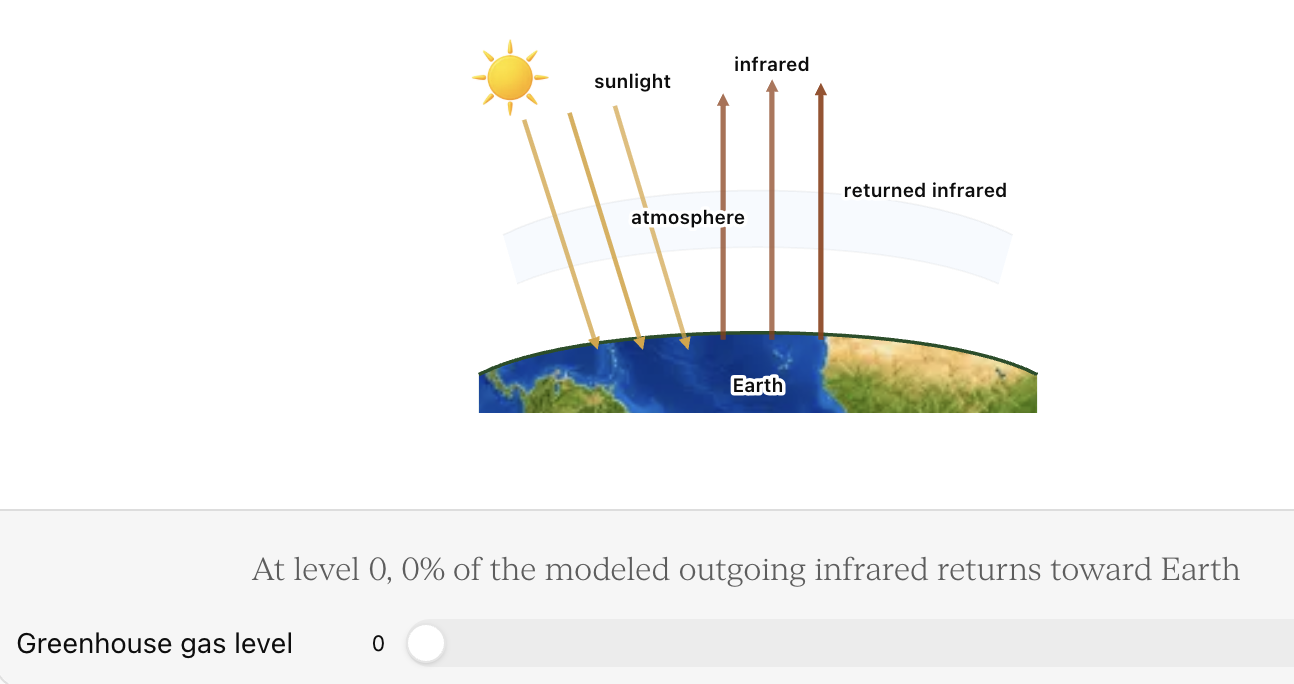
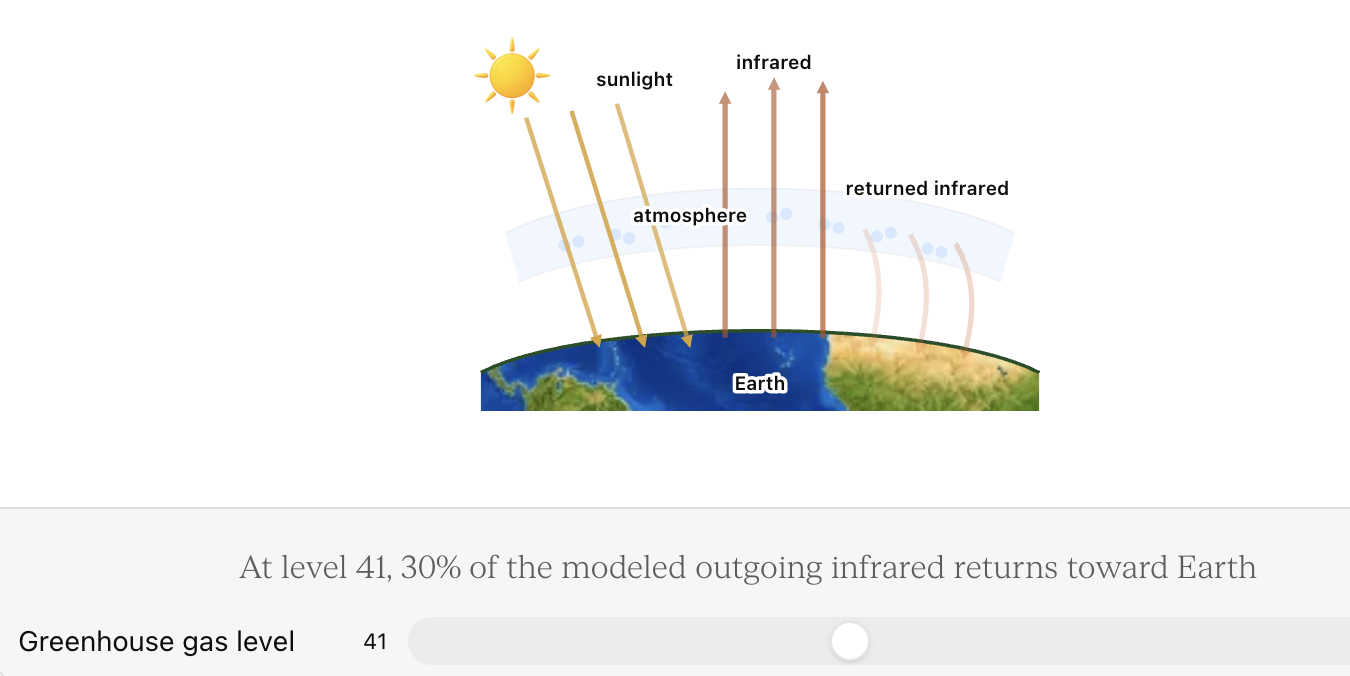
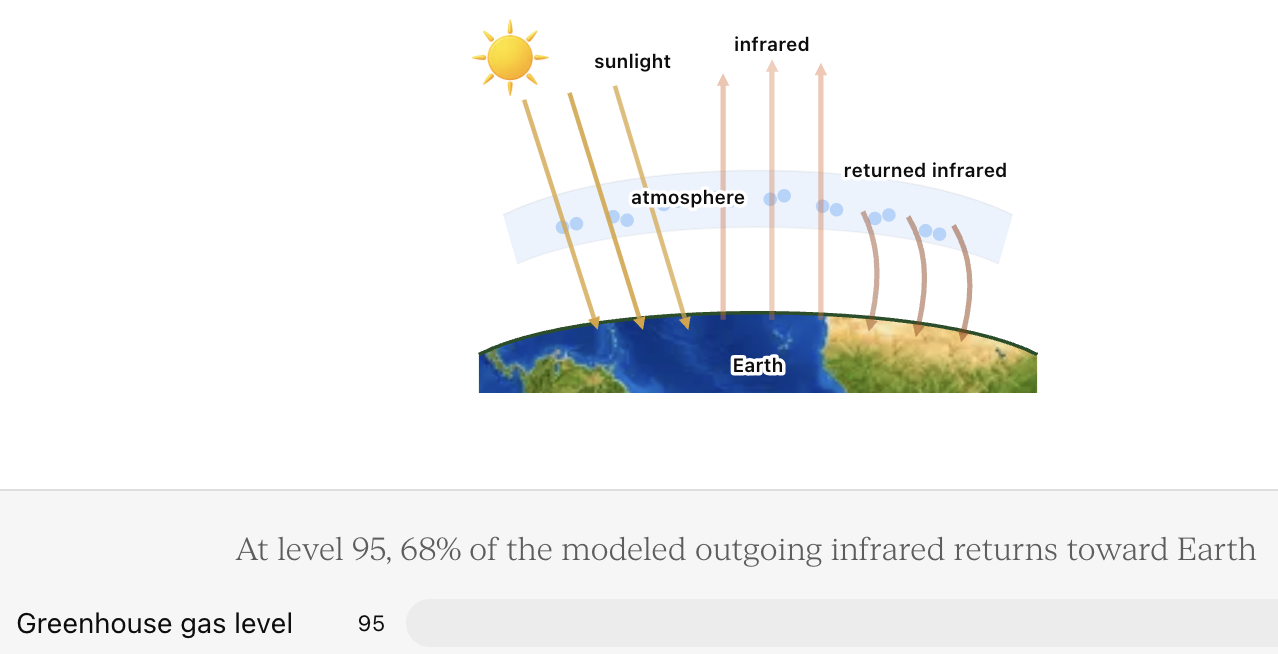
Without the natural greenhouse effect, Earth's average surface temperature would be much lower.
The greenhouse effect itself is therefore not pollution and is not inherently harmful.
The current concern is the enhanced greenhouse effect caused by increasing greenhouse gas concentrations.
Greenhouse Gases
Important greenhouse gases include:
- Carbon dioxide.
- Methane.
- Nitrous oxide.
- Water vapor.
- Ozone.
These gases interact with infrared radiation emitted by Earth's surface and atmosphere.
Different greenhouse gases differ in:
- Atmospheric concentration.
- Ability to absorb infrared radiation.
- Atmospheric lifetime.
- Sources and sinks.
Carbon dioxide is especially important in current human-caused climate change because human activities release very large quantities and some of the resulting increase persists for a long time.
The Enhanced Greenhouse Effect
Human activities have increased concentrations of greenhouse gases in the atmosphere.
More greenhouse gases change Earth's energy balance.
In simplified terms:
More greenhouse gases
→ more interaction with outgoing infrared radiation
→ less energy escapes to space initially
→ Earth's climate system warms
→ the warmer Earth emits more energy
→ a new energy balance is eventually approached at a higher temperature.
This human-driven strengthening of the greenhouse effect is called the enhanced greenhouse effect.
Carbon Dioxide
Carbon dioxide, or CO₂, is released naturally through processes such as:
- Respiration.
- Decomposition.
- Volcanic activity.
It is also absorbed naturally through processes including:
- Photosynthesis.
- Dissolution into oceans.
Human activities add additional CO₂ to this natural carbon cycle.
Major human sources include:
- Burning coal.
- Burning oil.
- Burning natural gas.
- Cement production.
- Deforestation and other land-use changes.


Fossil Fuels and Climate Change
Coal, oil, and natural gas contain carbon that has been stored underground for millions of years.
When fossil fuels burn, carbon combines with oxygen and forms carbon dioxide.
For example:
Hydrocarbon fuel + oxygen → carbon dioxide + water + energy
The released carbon dioxide enters the atmosphere.
Large-scale fossil-fuel use for electricity, transportation, heating, and industry has therefore transferred large amounts of carbon from geological stores into the atmosphere.
Deforestation
Forests influence the carbon cycle.
Trees:
- Absorb carbon dioxide through photosynthesis.
- Store carbon in wood and other tissues.
- Contribute carbon to soils.
When forests are removed, two effects can occur:
Less vegetation
→ less potential carbon uptake.
And when vegetation is burned or decomposes:
Stored carbon
→ released back into the atmosphere.


Protecting and restoring forests can therefore contribute to climate-change mitigation, although forests cannot substitute for reducing fossil-fuel emissions.
Methane
Methane, or CH₄, is another important greenhouse gas.
Human-related sources include:
- Livestock.
- Rice cultivation.
- Landfills.
- Fossil-fuel extraction and transport.
- Waste management.
Methane remains in the atmosphere for less time than carbon dioxide on average, but molecule for molecule it has a stronger warming effect over commonly considered time periods.
Reducing methane emissions can therefore contribute to limiting warming.
Nitrous Oxide
Nitrous oxide, or N₂O, is a powerful greenhouse gas.
Human activities that increase emissions include:
- Agricultural fertilizer use.
- Manure management.
- Some industrial processes.
- Fuel combustion.
Agriculture is therefore connected with climate change through several different greenhouse gases.
Water Vapor
Water vapor is Earth's most abundant greenhouse gas.
However, in current climate change it acts mainly as a feedback rather than the initial human forcing.
The basic relationship is:
Greenhouse gas increase
→ warming
→ warmer air can contain more water vapor
→ additional greenhouse effect
→ further warming.
This is an example of a positive feedback.
Evidence for Climate Change
Scientists do not rely on a single measurement.
Evidence comes from many independent observations, including:
- Surface temperature records.
- Ocean temperatures.
- Glacier retreat.
- Ice-sheet changes.
- Arctic sea ice.
- Sea-level rise.
- Changes in snow cover.
- Changes in species distributions.
- Changes in seasonal biological events.


When independent measurements show consistent patterns, confidence in the overall conclusion becomes stronger.
Rising Global Temperature
Temperature measurements collected from thousands of locations show that Earth's average surface temperature has increased.
Scientists combine measurements from:
- Land weather stations.
- Ships.
- Ocean buoys.
- Satellites.
- Other observing systems.
Individual locations vary considerably from year to year, but the global long-term trend shows warming.
Warming Oceans
Oceans absorb much of the additional heat accumulating in Earth's climate system.
Scientists measure ocean temperature at different depths using instruments including floats, ships, and satellites.
Ocean warming provides important evidence because oceans store enormous quantities of thermal energy.
Warmer oceans can also affect:
- Marine ecosystems.
- Sea level.
- Ocean circulation.
- Coral reefs.
Melting Glaciers
Many glaciers around the world have lost mass over recent decades.


Scientists can monitor glaciers using:
- Historical photographs.
- Field measurements.
- Aircraft.
- Satellites.
Although individual glaciers can temporarily advance or retreat because of local conditions, the widespread long-term loss of glacier mass provides evidence of a warming climate.
Sea Ice and Ice Sheets
Climate change also affects frozen regions.
Observed changes include:
- Declining Arctic sea-ice extent and thickness over the long term.
- Loss of ice from Greenland.
- Loss of ice from Antarctica.
It is important to distinguish between sea ice and land ice.
Melting floating sea ice has relatively little direct effect on sea level.
Melting land-based glaciers and ice sheets adds water to the oceans and raises sea level.
Sea-Level Rise
Global average sea level is rising mainly because of two processes.
Thermal Expansion
Water expands as it warms.
Warmer ocean water therefore occupies slightly more volume.
Melting Land Ice
Melting glaciers and ice sheets transfer water stored on land into the oceans.


Sea-level rise increases risks for low-lying coastal environments and communities.
Evidence from the Past
Scientists can investigate climates that existed before modern instruments.
Sources of evidence include:
- Ice cores.
- Tree rings.
- Sediments.
- Corals.
- Fossils.
These are called climate proxies because they provide indirect information about past environmental conditions.
Ice Cores
Ice sheets contain layers of ice accumulated over thousands of years.
Tiny bubbles trapped within the ice preserve samples of ancient atmosphere.
Scientists can analyze these bubbles to estimate past concentrations of gases such as carbon dioxide and methane.
Ice chemistry can also provide information about past temperatures and environmental conditions.


Ice cores allow scientists to compare greenhouse gas concentrations with climate conditions far into Earth's past.
Human Activities and Climate Change
Human activities contributing to greenhouse gas emissions include:
- Electricity generation from fossil fuels.
- Transportation.
- Industry.
- Building heating and cooling.
- Agriculture.
- Deforestation.
- Cement production.
- Waste management.
Different sectors contribute different gases and therefore require different solutions.
Climate Change and Ecosystems
Climate influences:
- Temperature.
- Rainfall.
- Water availability.
- Growing seasons.
- Ocean conditions.
- Seasonal cycles.
Changing climate can therefore alter the conditions to which organisms are adapted.


Species may respond by:
- Changing behavior.
- Changing seasonal timing.
- Moving to new locations.
- Adapting over generations.
- Declining if they cannot respond quickly enough.
Shifting Species Distributions
As temperatures change, suitable environmental conditions can move geographically.
Some species have shifted:
- Toward higher latitudes.
- To higher elevations.
- Into deeper or cooler water.
However, movement may be prevented by:
- Cities.
- Roads.
- Agricultural land.
- Mountains.
- Coastlines.
- Habitat fragmentation.
A species may therefore lose suitable habitat faster than it can move.
Worked Example: Mountain Species
Imagine a species adapted to cool mountain temperatures.
As temperatures rise:
Suitable temperature zone moves uphill
→ population moves higher
→ available habitat becomes smaller
→ eventually the species approaches the summit
→ no higher habitat remains.
This can greatly increase extinction risk, particularly for species restricted to mountaintops.
Changes in Seasonal Timing
Many organisms use environmental cues to time biological events.
Examples include:
- Flowering.
- Migration.
- Breeding.
- Hibernation.
- Egg laying.
- Insect emergence.
Climate change can shift the timing of these events.
Different species may respond at different rates.
This can produce a phenological mismatch.
Worked Example: Birds and Insects
Suppose a bird normally times reproduction so its chicks hatch when insects are most abundant.
Warming causes the insects to emerge earlier.
If bird breeding does not shift by the same amount:
Insects peak earlier
→ chicks hatch later
→ less food available
→ chick survival may decrease.
Climate change can therefore disrupt ecological relationships even without directly killing organisms.
Coral Reefs
Coral reefs are particularly sensitive to changes in ocean temperature.
Corals live in association with microscopic algae that provide much of their energy.
When seawater becomes unusually warm, corals can lose these algae.
This causes coral bleaching.


Bleached coral is still alive initially, but prolonged or repeated stress can cause death.
Because coral reefs provide habitat for many species, widespread coral loss can reduce biodiversity.
Ocean Acidification
Climate change and ocean acidification are related consequences of increasing atmospheric carbon dioxide, although they occur through different mechanisms.
The ocean absorbs some atmospheric CO₂.
This changes seawater chemistry and decreases pH.
This process is called ocean acidification.
It can affect organisms that build calcium carbonate structures, including some:
- Corals.
- Mollusks.
- Plankton.
Changes in these organisms can influence marine food webs.
Drought
Climate change can alter rainfall patterns and increase drought risk in some regions.
Drought can:
- Reduce plant growth.
- Reduce freshwater availability.
- Increase wildfire risk.
- Reduce food supplies.
- Change habitats.


Species adapted to consistently moist environments may be particularly vulnerable.
Wildfire
Fire is a natural and important part of some ecosystems.
However, hotter and drier conditions can increase fire risk or severity in some regions.
More severe or frequent fires can alter:
- Vegetation.
- Habitat structure.
- Soil.
- Food availability.
- Animal populations.
Climate change is one factor affecting wildfire risk alongside land management, vegetation, ignition sources, and local weather.
Extreme Weather
A warmer climate can influence the probability or severity of some types of extreme events.
These can include:
- Heatwaves.
- Heavy rainfall.
- Drought.
- Some intense storms.
It is important to distinguish between individual weather events and long-term changes in their likelihood or intensity.
Scientists use observations and climate models to investigate how climate change affects particular types of events.
Positive Feedback
A positive feedback amplifies an initial change.
Consider Arctic ice.
Ice reflects a large proportion of incoming sunlight.
Dark ocean water absorbs more solar energy.
Therefore:
Warming
→ ice melts
→ darker surface exposed
→ more energy absorbed
→ additional warming
→ more ice melts.
 k437R3r_LaKAw0iigajgskNrHPUgTSVxN8Kxtp13NfnNWeMdyepov60UKiGZmWB5RoEjv48qthYTg6qpAfp3JXwedi2INEKyJ8j1-sYhN_8ZrqXc4WYlUXqK6hfqA-W4RIvJ6JD29xwg?purpose=inline" alt="https://images.openai.com/static-rsc-4/YytoQG75NIejv7ODtoA0pzWuMSBKQeE3ueGSYuui989YbFDFBjDmx4ZbQ6mp15xoyPMmCsu1dC2Jsvo8KeL4HgR5EpBsB0qTHdE4VuLRzIFrlouQj7WI3C4RbMpfS1bf4f3AY_cKW7DX_RKiatCMNygOL5s3u7zf2LXo6owWRHmOBDrWas-xtD3WGkRvyD-2?purpose=fullsize">

This is called the ice-albedo feedback.
Carbon-Cycle Feedbacks
Warming can also influence natural carbon stores.
For example, thawing permafrost can expose previously frozen organic matter to decomposition.
Microorganisms can then release greenhouse gases.
This creates another potential feedback:
Warming
→ permafrost thaw
→ decomposition
→ greenhouse gas release
→ additional warming.
Feedbacks can therefore amplify climate changes.
Climate Change and Biodiversity
Climate change can affect biodiversity by:
- Changing habitats.
- Altering food availability.
- Shifting species distributions.
- Changing breeding seasons.
- Increasing heat stress.
- Changing rainfall.
- Increasing some disturbance risks.
- Altering ocean conditions.
Species already threatened by habitat loss, pollution, invasive species, or overexploitation may have less ability to respond to additional climatic changes.
Multiple threats can therefore interact.
Mitigation and Adaptation
Responses to climate change are often divided into two broad approaches.
Mitigation
Mitigation aims to reduce the causes of climate change.
Examples include:
- Reducing greenhouse gas emissions.
- Protecting carbon stores.
- Increasing energy efficiency.
Adaptation
Adaptation aims to reduce harm from climate changes that occur.
Examples include:
- Coastal flood defenses.
- Drought-resistant crops.
- Heat-management plans.
- Wildlife corridors.
Both approaches can be important.
Reducing Fossil-Fuel Emissions
A major mitigation strategy is reducing carbon dioxide emissions from fossil-fuel combustion.
Possible approaches include:
- Renewable electricity.
- Nuclear energy.
- Energy efficiency.
- Electrification.
- Public transportation.
- Lower-emission industrial processes.


Different technologies have different costs, benefits, limitations, and environmental impacts.
Renewable Energy
Renewable energy sources include:
- Solar.
- Wind.
- Hydroelectric.
- Geothermal.
These generally produce much lower operational greenhouse gas emissions than fossil-fuel electricity generation.
However, renewable technologies still require:
- Materials.
- Land.
- Manufacturing.
- Infrastructure.
Their complete environmental impacts should therefore be evaluated using life-cycle analysis rather than assuming that any technology has zero impact.
Energy Efficiency
Another strategy is reducing the amount of energy required to provide the same service.
Examples include:
- Better building insulation.
- Efficient appliances.
- Efficient industrial equipment.
- Improved transportation systems.
If less energy is required, fewer emissions may be produced when that energy would otherwise come from fossil fuels.
Efficiency can therefore reduce emissions without necessarily reducing the useful service provided.
Transportation
Transportation emissions can be reduced through combinations of:
- Public transportation.
- Walking and cycling infrastructure.
- Electric vehicles.
- More efficient vehicles.
- Reduced unnecessary travel.
- Lower-carbon fuels in applications that are difficult to electrify.
The effectiveness of electric vehicles depends partly on how their electricity is generated.
Protecting Forests
Forests remove carbon dioxide from the atmosphere through photosynthesis and store carbon.
Strategies include:
- Reducing deforestation.
- Protecting existing forests.
- Restoring degraded forests.
- Reforestation.


Protecting existing mature ecosystems can also conserve biodiversity and ecosystem services.
Carbon Capture
Some technologies attempt to capture carbon dioxide before it enters the atmosphere or remove carbon dioxide directly from the air.
Captured carbon may then be stored underground or used in certain products.
Potential approaches include:
- Carbon capture at industrial facilities.
- Direct air capture.
- Biological carbon storage.
These technologies may contribute to emission reduction strategies, but their cost, energy requirements, storage durability, and achievable scale must be considered.
Reducing Methane Emissions
Methane emissions can sometimes be reduced by:
- Detecting leaks from oil and gas systems.
- Improving waste management.
- Capturing landfill gas.
- Changing some agricultural practices.
- Improving livestock and manure management.
Because methane has a relatively short atmospheric lifetime compared with carbon dioxide, reducing methane emissions can affect the rate of warming relatively quickly.
Evaluating Climate Strategies
No climate strategy should be evaluated using only one characteristic.
Useful questions include:
- How much greenhouse gas does it reduce?
- How quickly can it be implemented?
- What does it cost?
- Is the technology reliable?
- What infrastructure is required?
- What environmental impacts does it have?
- Can it operate at a large enough scale?
- Does it create other benefits or problems?
For example, an energy technology might reduce carbon emissions but require substantial land or mineral resources.
Scientific evaluation considers these trade-offs.
Worked Example: Comparing Electricity Sources
Imagine a community currently generates electricity from coal.
It considers replacing some electricity with solar power.
A useful evaluation would compare:
- Greenhouse gas emissions.
- Construction requirements.
- Land use.
- Cost.
- Reliability.
- Energy storage requirements.
- Grid infrastructure.
- Environmental impacts.
The question is therefore not simply:
"Does solar produce carbon dioxide?"
Instead, scientists consider the full life cycle and overall system.
Individual and System-Level Actions
Individuals can contribute to reducing emissions through choices involving:
- Energy use.
- Transportation.
- Food.
- Consumption.
- Waste.
However, large-scale emission reductions also involve:
- Electricity systems.
- Transportation infrastructure.
- Industry.
- Agriculture.
- Building design.
- Technology.
- Government policy.
Climate change is therefore both an individual and a system-level challenge.
Analyzing Climate Evidence
When examining evidence for climate change, ask:
- Is this weather or climate?
- How long is the record?
- How large is the geographic area?
- Is there a long-term trend?
- Are several independent measurements consistent?
- What mechanism could explain the observations?
- Are alternative explanations supported by the evidence?
Climate science relies on patterns from multiple independent lines of evidence rather than one isolated observation.
Common Mistakes
Thinking Weather and Climate Are the Same
Weather describes short-term conditions. Climate describes long-term patterns.
Thinking the Greenhouse Effect Is Entirely Human-Caused
The natural greenhouse effect existed long before humans and makes Earth habitable. Human activities are enhancing it.
Thinking Greenhouse Gases Simply "Trap Heat"
A more accurate explanation is that greenhouse gases absorb and emit infrared radiation, altering Earth's energy balance.
Thinking the Ozone Hole Causes Global Warming
Ozone depletion and climate change are different environmental problems, although there are some interactions between atmospheric chemistry and climate.
Thinking Carbon Dioxide Is the Only Greenhouse Gas
Methane, nitrous oxide, water vapor, ozone, and other gases also contribute.
Thinking One Cold Winter Disproves Climate Change
Climate trends are measured over long periods and large geographic areas.
Thinking Melting Sea Ice Directly Causes Most Sea-Level Rise
Sea-level rise is mainly caused by thermal expansion of seawater and melting land-based ice.
Assuming Every Extreme Weather Event Is Caused Only by Climate Change
Individual events usually have multiple causes. Climate change can alter the probability or intensity of certain types of events.
Thinking Renewable Energy Has No Environmental Impact
All energy systems have environmental costs. Their impacts should be compared across their complete life cycles.
Check Your Understanding
1. Distinguish between weather and climate.
2. Explain the natural greenhouse effect.
3. Why is the greenhouse effect necessary for life on Earth?
4. What is meant by the enhanced greenhouse effect?
5. Identify four greenhouse gases.
6. Explain how burning fossil fuels increases atmospheric carbon dioxide.
7. Explain how deforestation can contribute to climate change.
8. Give four independent types of evidence that Earth's climate is warming.
9. Explain why warming oceans contribute to sea-level rise.
10. Why does melting land ice raise sea level more directly than melting floating sea ice?
11. Explain how climate change can cause species distributions to shift.
12. What is a phenological mismatch?
13. Explain how increasing ocean temperatures can affect coral reefs.
14. Explain the ice-albedo feedback.
15. Distinguish between climate-change mitigation and adaptation.
16. Describe three strategies that could reduce greenhouse gas emissions.
17. Explain why protecting forests can contribute to both climate mitigation and biodiversity conservation.
18. Why should the complete life cycle of an energy technology be considered when evaluating its environmental impact?
19. A student says, "It was unusually cold yesterday, so global warming cannot be happening." Explain the problem with this reasoning.
20. A country wants to reduce its greenhouse gas emissions. Identify three different sectors it could target and propose one strategy for each.
Key Terms
- Climate – long-term pattern of atmospheric conditions.
- Climate change – long-term change in climate patterns.
- Greenhouse effect – warming caused by greenhouse gases absorbing and emitting infrared radiation.
- Greenhouse gas – atmospheric gas that interacts with infrared radiation and contributes to the greenhouse effect.
- Enhanced greenhouse effect – strengthening of the greenhouse effect caused by increased greenhouse gas concentrations.
- Carbon dioxide (CO₂) – important greenhouse gas released by fossil-fuel combustion and other processes.
- Methane (CH₄) – powerful greenhouse gas produced by natural and human processes.
- Nitrous oxide (N₂O) – greenhouse gas associated with processes including agriculture and industry.
- Infrared radiation – electromagnetic radiation emitted strongly by Earth's surface and atmosphere.
- Climate proxy – indirect evidence used to reconstruct past climate.
- Thermal expansion – increase in volume as a substance warms.
- Coral bleaching – loss of symbiotic algae from stressed corals.
- Ocean acidification – reduction in ocean pH associated with absorption of atmospheric carbon dioxide.
- Phenological mismatch – disruption in the timing of ecological interactions.
- Positive feedback – process that amplifies an initial change.
- Albedo – proportion of incoming radiation reflected by a surface.
- Mitigation – action that reduces the causes of climate change.
- Adaptation – adjustment intended to reduce harm from climate change.
- Carbon capture – collection of carbon dioxide for storage or use.
- Life-cycle analysis – evaluation of environmental impacts throughout a product or technology's life.
Key Takeaways
- Climate describes long-term patterns, while weather describes short-term atmospheric conditions.
- The natural greenhouse effect keeps Earth warm enough to support life.
- Greenhouse gases absorb and emit infrared radiation, influencing Earth's energy balance.
- Human activities have increased greenhouse gas concentrations and strengthened the natural greenhouse effect.
- Fossil-fuel combustion is a major source of human-produced carbon dioxide.
- Deforestation can release stored carbon and reduce carbon uptake.
- Methane and nitrous oxide also contribute significantly to climate change.
- Evidence for climate change comes from multiple independent observations, including temperature records, ocean warming, glacier loss, ice-sheet changes, sea-level rise, and ecological changes.
- Sea level rises because seawater expands as it warms and because melting land ice adds water to the oceans.
- Climate change can alter habitats, species distributions, seasonal timing, food webs, and biodiversity.
- Coral reefs are particularly vulnerable to ocean warming.
- Positive feedbacks such as ice-albedo feedback can amplify warming.
- Mitigation addresses the causes of climate change, while adaptation addresses its consequences.
- Emissions can be reduced through cleaner energy systems, improved efficiency, lower-emission transportation, forest protection, methane reduction, and other approaches.
- Every mitigation strategy has benefits, limitations, costs, and potential environmental impacts that should be evaluated using evidence.
- Climate change is best understood using long-term trends, multiple independent measurements, and established physical mechanisms, rather than individual weather events.