Speciation and Conservation
2. Speciation
Learning outcomes
- I can explain how new species form.
- I can describe the role of isolation in speciation.
- I can identify factors that contribute to speciation.
- I can compare different speciation scenarios.
- I can relate speciation to evolution.
How Do New Species Form?
Speciation is the evolutionary process through which new species form.
A population does not suddenly become a new species in a single generation. Speciation usually occurs over many generations as populations accumulate genetic differences.
A simplified sequence is:
One population → Isolation → Reduced gene flow → Genetic divergence → Reproductive isolation → Separate species


Speciation is one of the major processes responsible for Earth's enormous biodiversity.
Populations Are the Starting Point
A population consists of organisms of the same species living in the same area at the same time.
Members of a population usually share a gene pool.
When individuals reproduce, alleles can move through the population.
This movement of genetic information is called gene flow.
As long as substantial gene flow continues between groups, it tends to reduce genetic differences between them.
For speciation to occur, gene flow between populations often needs to become greatly reduced or interrupted.
Isolation
Isolation occurs when groups within a species become separated in a way that reduces gene flow.
Isolation can occur because of:
- Geographic barriers.
- Different habitats.
- Different breeding times.
- Different mating behaviors.
- Different ecological niches.
- Genetic or chromosomal changes.
Once gene flow is reduced, populations can begin evolving more independently.
Geographic Isolation
Geographic isolation occurs when a physical barrier separates populations.
Possible barriers include:
- Mountains.
- Rivers.
- Oceans.
- Deserts.
- Glaciers.
- Islands.
- Large distances.


Suppose one population is divided when a river forms.
Before separation, individuals can reproduce throughout the population.
After separation, individuals on opposite sides may no longer reproduce with one another.
Gene flow between the populations decreases.
What Happens After Isolation?
Isolation alone does not automatically produce a new species.
Once populations are separated, several evolutionary processes can cause them to become increasingly different.
These include:
- Mutation.
- Natural selection.
- Genetic drift.
- Sexual selection.
Different environments can also expose the populations to different selection pressures.
Over many generations, genetic differences can accumulate.
Mutation
Mutations produce new genetic variation.
Mutations occur randomly with respect to what an organism needs.
Once populations become isolated, different mutations may arise and spread in each population.
For example:
Population A may acquire allele X.
Population B may acquire allele Y.
Over many generations, many such genetic differences can accumulate.
Natural Selection
Isolated populations may experience different environmental conditions.
For example:
Population A lives in a dry environment with hard seeds.
Population B lives in a wet environment with soft fruits.
Different traits may provide reproductive advantages in each environment.
Natural selection can therefore cause the populations to become increasingly different.


Genetic Drift
Genetic drift is a random change in allele frequencies.
Its effects can be especially important in small populations.
Suppose only a few individuals colonize an island.
By chance, those individuals may carry only part of the genetic variation present in the original population.
The new island population may therefore have different allele frequencies from the original population from the beginning.
The Founder Effect
The founder effect is a form of genetic drift that occurs when a new population is established by a small number of individuals.
For example:
A storm carries several insects from the mainland to an island.
These insects establish a new population.
Their alleles may not represent the frequencies found in the original mainland population.
The island population may then evolve independently.
Different Selection Pressures
Different environments can favor different characteristics.
Imagine two isolated populations of birds.
Population A has access mainly to:
Large, hard seeds
Birds with larger, stronger beaks may have an advantage.
Population B has access mainly to:
Small, soft seeds
Different beak characteristics may be advantageous.
Over many generations, natural selection can increase differences between the populations.
Genetic Divergence
As isolated populations accumulate differences, they undergo genetic divergence.
This means their gene pools become increasingly different.
Genetic divergence can result from:
- Different mutations.
- Different selection pressures.
- Genetic drift.
- Sexual selection.
Eventually, the populations may become sufficiently different that they can no longer successfully exchange genes.
Reproductive Isolation
Reproductive isolation occurs when populations can no longer successfully exchange genes through reproduction.
This is a critical stage in speciation.
Even if previously separated populations come back into contact, reproductive barriers may prevent them from merging back into a single population.
At this point, they may be recognized as separate species.
Reproductive Barriers
Reproductive barriers can be divided into:
Prezygotic barriers
and
postzygotic barriers.
Prezygotic barriers operate before fertilization.
Postzygotic barriers operate after fertilization.
Both can contribute to speciation.
Prezygotic Barriers
Prezygotic barriers prevent mating or fertilization.
Examples include:
- Habitat isolation.
- Temporal isolation.
- Behavioral isolation.
- Mechanical isolation.
- Gametic isolation.
These barriers reduce gene flow before a zygote forms.
Behavioral Isolation
Behavioral isolation occurs when populations develop different courtship or mating behaviors.
For example, two bird populations may develop different mating songs.
Females from Population A respond mainly to Song A.
Females from Population B respond mainly to Song B.
Even if the populations meet again, they may rarely mate.


Temporal Isolation
Temporal isolation occurs when populations reproduce at different times.
For example:
Population A breeds in March.
Population B breeds in July.
Although they might live in the same location, their reproductive periods do not overlap.
Gene flow between the populations is therefore greatly reduced.
Habitat Isolation
Habitat isolation occurs when populations use different habitats or resources within the same geographic region.
For example:
One insect population may live and reproduce on one plant species.
Another population may use a different host plant.
Because individuals spend their time in different habitats, they may rarely encounter one another for reproduction.
Mechanical and Gametic Isolation
Mechanical isolation occurs when reproductive structures become incompatible.
Gametic isolation occurs when sperm and egg, or pollen and ovule, cannot successfully interact.
Both prevent successful fertilization.
Postzygotic Barriers
Sometimes individuals from different populations can mate and fertilization occurs.
However, the resulting hybrids may experience problems.
Examples include:
- Hybrid embryos failing to develop.
- Hybrids having poor survival.
- Hybrids being sterile.
- Later hybrid generations having reduced reproductive success.
These are postzygotic barriers.
Hybrid Sterility
A familiar example is the mule.
A horse and donkey can reproduce to produce a mule.
However, most mules are sterile.


This means gene flow cannot normally continue through the hybrid.
Hybrid sterility therefore helps maintain reproductive separation between the parental species.
Allopatric Speciation
Allopatric speciation occurs when populations become geographically separated.
This is one of the easiest speciation processes to visualize.
A simplified sequence is:
Original population
↓
Geographic barrier forms
↓
Gene flow decreases
↓
Populations evolve independently
↓
Genetic differences accumulate
↓
Reproductive isolation develops
↓
Two species
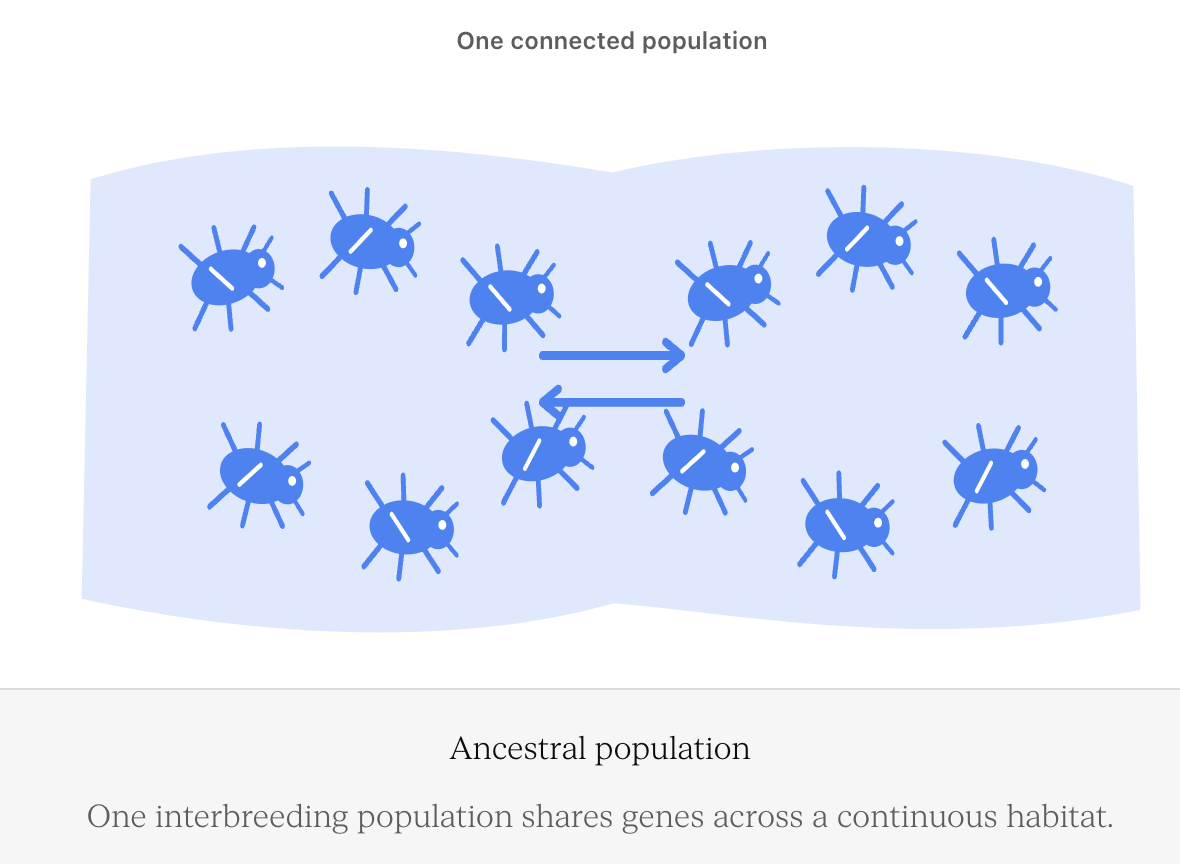
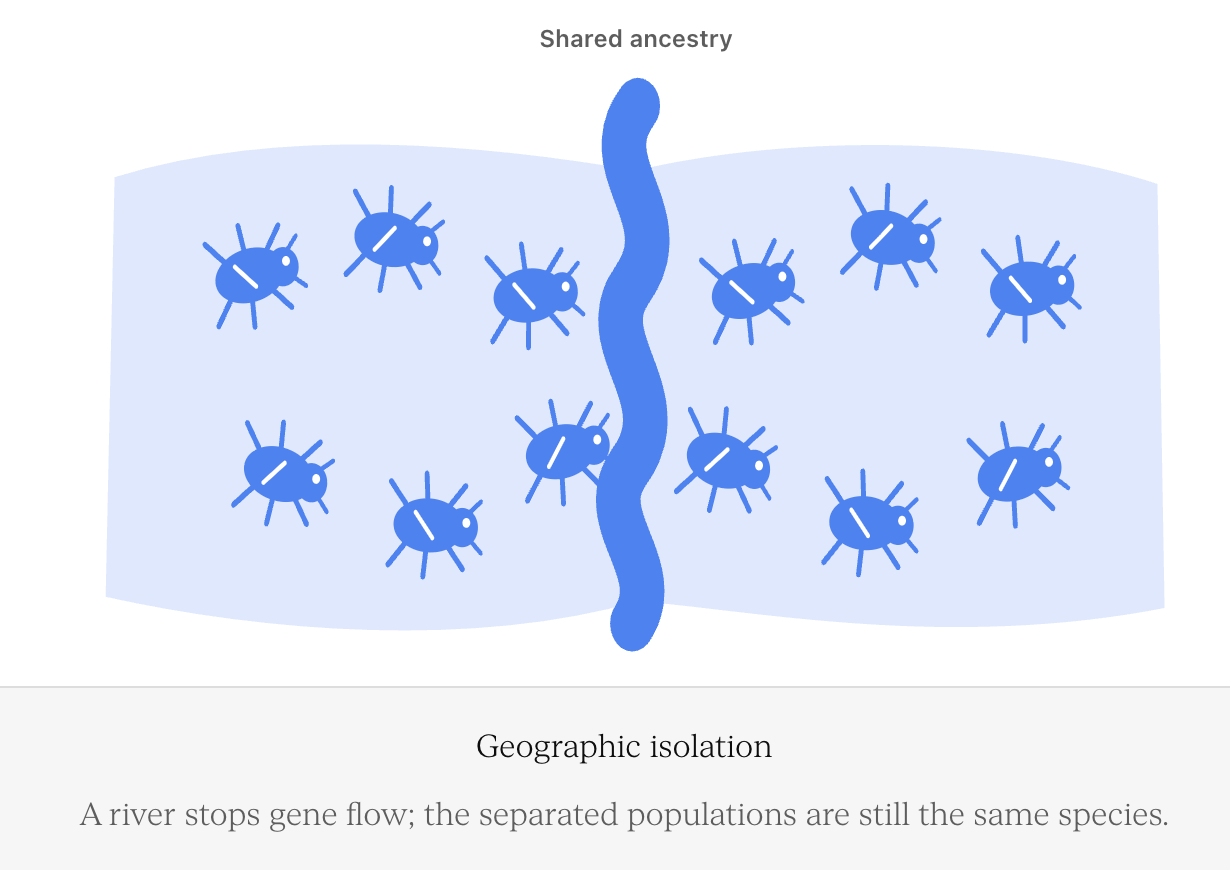
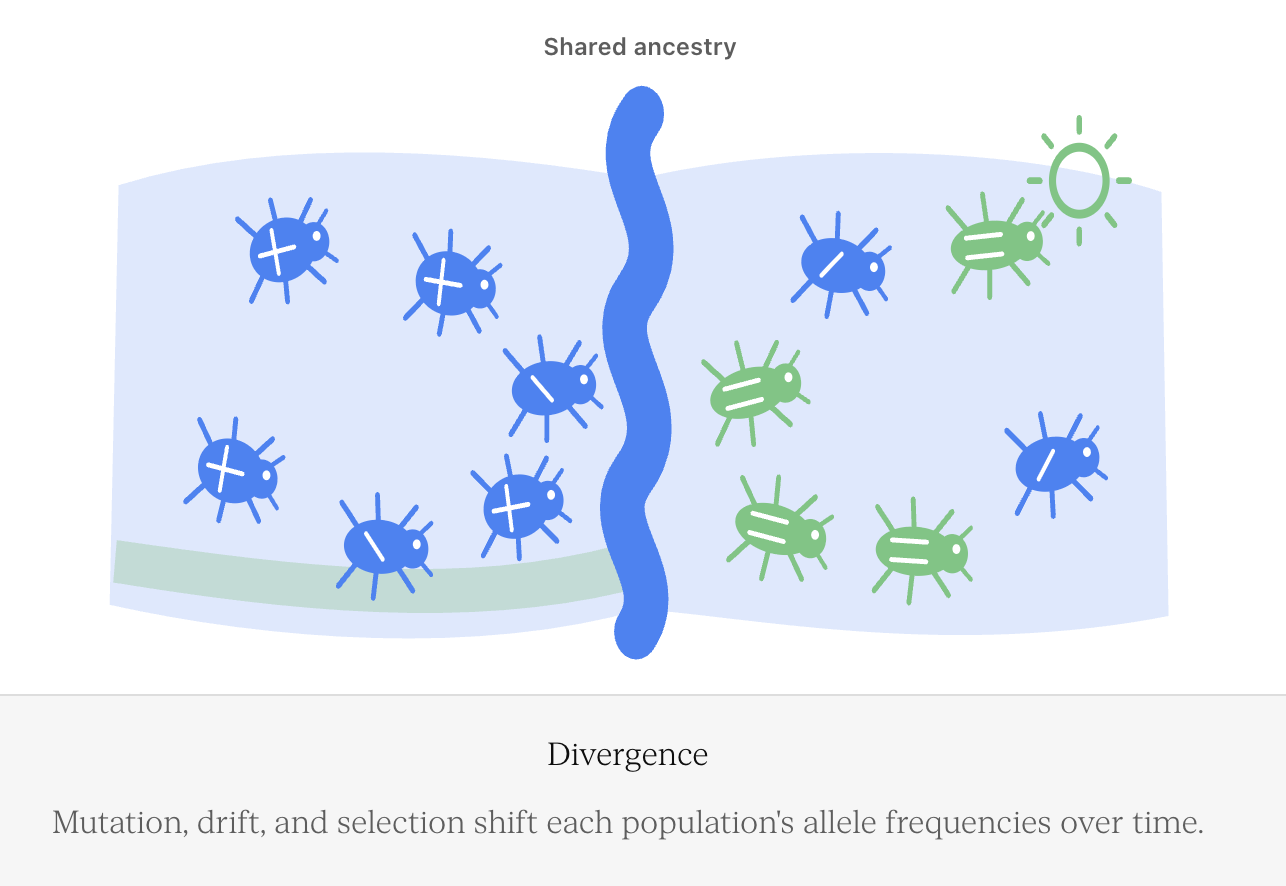
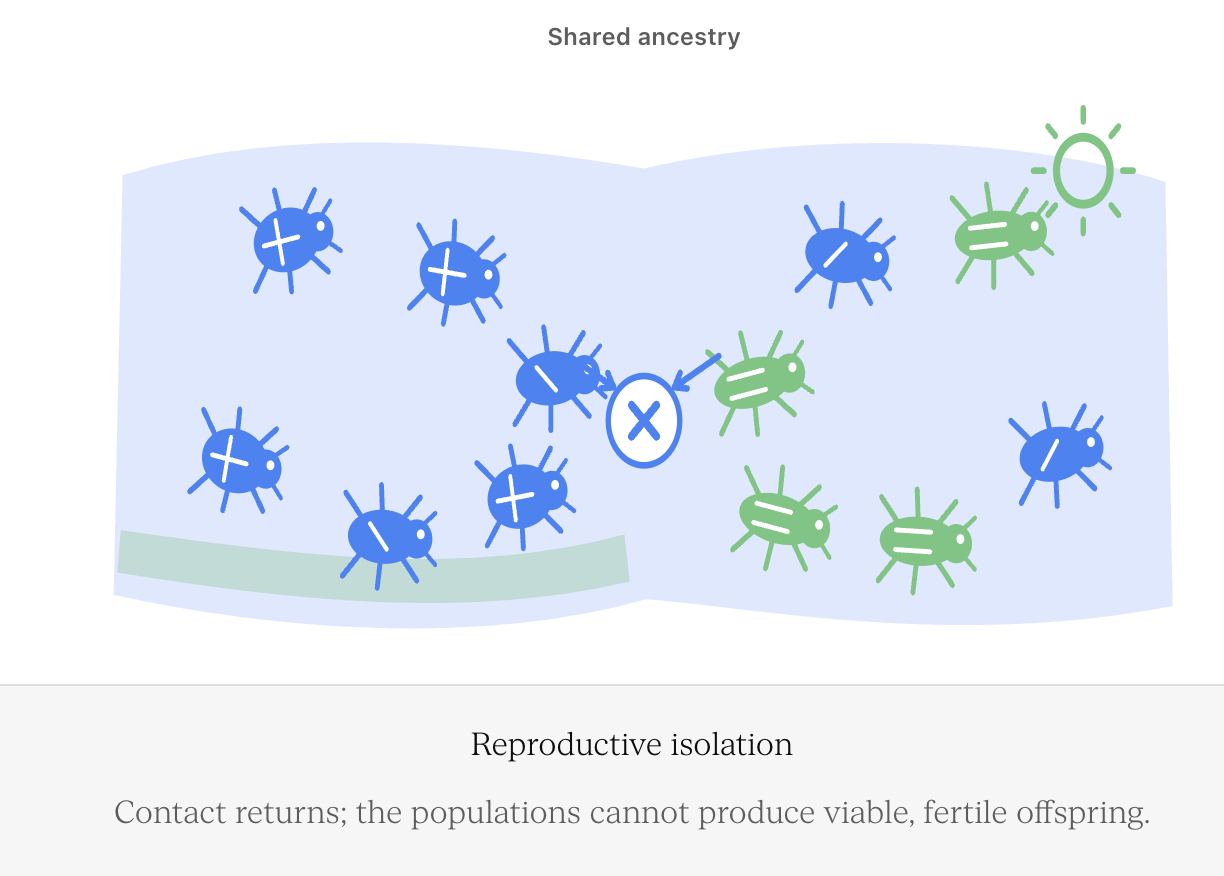
The important point is that the geographic barrier begins the separation, but the populations must subsequently diverge.
Worked Example: A River Forms
Imagine a population of small mammals living throughout a forest.
A large river gradually divides the habitat.
The animals cannot cross the river.
Population A lives west of the river.
Population B lives east of the river.
Initially, the populations may still be biologically very similar.
However, gene flow has stopped.
Over thousands of generations:
- Different mutations occur.
- Different alleles become common through drift.
- Different environmental conditions produce different selection pressures.
- Mating behaviors change.
Eventually, individuals from A and B may no longer successfully reproduce.
Speciation has occurred.
Geographic Isolation Does Not Automatically Mean Speciation
Suppose two populations become separated for 50 years.
They develop small genetic differences.
The barrier disappears.
Individuals from the two populations meet and reproduce freely.
Gene flow resumes.
In this case, they have not necessarily become separate species.
Geographic isolation is often the beginning of allopatric speciation, not proof that speciation has been completed.
Sympatric Speciation
New species can sometimes form without a geographic barrier.
This is called sympatric speciation.
"Sympatric" means occurring in the same geographic area.
Gene flow can be reduced because groups begin:
- Using different resources.
- Occupying different ecological niches.
- Reproducing at different times.
- Choosing different mates.
- Experiencing chromosomal changes.
The populations can therefore diverge even though they live in the same general region.
Worked Example: Host-Plant Change
Imagine an insect species whose members normally:
- Feed on Plant A.
- Mate on Plant A.
- Lay eggs on Plant A.
Some individuals begin using Plant B instead.
They now:
- Feed on Plant B.
- Mate mainly with insects on Plant B.
- Lay eggs on Plant B.
Individuals associated with the two plants meet less frequently.
Gene flow decreases.
Over many generations, the two groups may become reproductively isolated.
This can contribute to sympatric speciation.
Polyploidy and Speciation
Polyploidy occurs when an organism has additional complete sets of chromosomes.
It is particularly important in plant evolution.
A chromosome-number change can sometimes create immediate reproductive barriers between the polyploid organism and the original population.


Polyploidy has contributed to the evolutionary history of many plant groups.
Sexual Selection and Speciation
Sexual selection can also contribute to population divergence.
Suppose females in one population prefer males with bright red coloration.
Females in another population prefer males with darker coloration.
Over generations, these preferences can influence:
- Appearance.
- Courtship behavior.
- Mate choice.
If individuals increasingly choose mates from their own population, gene flow may decrease.
Ecological Speciation
Different environments can expose populations to different selection pressures.
This can produce ecological divergence.
For example:
One population lives at high altitude.
Another lives at low altitude.
They experience differences in:
- Temperature.
- Oxygen availability.
- Food.
- Predators.
- Breeding conditions.
Natural selection may favor different adaptations in each environment.
If these differences eventually contribute to reproductive isolation, speciation can result.
Allopatric Versus Sympatric Speciation
The major difference is whether geographic separation is involved.
Allopatric speciation
- Geographic separation occurs.
- Gene flow is reduced by a physical barrier.
- Populations evolve independently.
Sympatric speciation
- Populations remain in the same geographic region.
- Gene flow decreases for other reasons.
- Ecological, behavioral, reproductive, or chromosomal differences can drive divergence.
Both can eventually produce reproductive isolation.
Worked Comparison
Consider two scenarios.
Scenario A
A mountain range separates a population of rodents.
The populations evolve independently and eventually become reproductively isolated.
This is:
Allopatric speciation
Scenario B
Two insect populations live in the same region but begin using different host plants and mate mainly on those plants.
Gene flow decreases and reproductive isolation develops.
This could lead to:
Sympatric speciation
Speciation and Natural Selection
Natural selection does not intentionally create new species.
Instead:
- Variation exists.
- Environmental conditions create selection pressures.
- Some characteristics increase reproductive success.
- Allele frequencies change.
- Isolated populations may experience different selection pressures.
- Differences accumulate.
If these differences eventually result in reproductive isolation, speciation has occurred.
Speciation and Evolution
Evolution is change in the inherited characteristics of populations across generations.
Speciation is therefore an evolutionary process.
A population evolves.
If populations diverge sufficiently and become reproductively isolated, one evolutionary lineage can split into two.
Therefore:
Evolution within populations can eventually produce new species.
Branching Evolution
Speciation helps explain why evolutionary history is represented as a branching tree.
Imagine one ancestral species.
It divides into two species.
Later, one of those divides again.
The result is a branching pattern.


Each branching point represents divergence from a common ancestral population.
Over millions of years, repeated speciation can produce enormous biological diversity.
Common Ancestors
When two species are closely related, they share a relatively recent common ancestor.
For example, Species A and Species B may have formed when an ancestral population split into two reproductively isolated lineages.
Neither modern species necessarily evolved from the other.
Instead:
Ancestral population
↓
Population divergence
↙︎ ↘︎
Species A Species B
This is an important principle when interpreting evolutionary relationships.
Adaptive Radiation
Sometimes one ancestral species gives rise to several new species relatively rapidly in evolutionary terms.
This is called adaptive radiation.
Adaptive radiation can occur when organisms encounter many available ecological niches.
For example, colonization of islands can provide populations with:
- Different foods.
- Different habitats.
- Different predators.
- Different environmental conditions.
Different populations can become adapted to different niches.


Darwin's Finches
The Galápagos finches are a well-known example used to study evolutionary diversification.
Different finch species have beaks adapted to different feeding strategies.
Food sources include:
- Seeds.
- Insects.
- Cactus resources.
Differences in ecology, natural selection, geographic history, and reproductive behavior contributed to diversification among finch lineages.
Speciation Increases Biodiversity
Every successful speciation event increases the number of distinct evolutionary lineages.
Therefore, speciation contributes to:
- Species richness.
- Ecosystem diversity.
- Evolutionary diversity.
However, species are also continually becoming extinct.
Biodiversity at any time reflects the combined effects of:
Speciation and extinction.
Speciation Can Take Different Amounts of Time
There is no single time required for speciation.
The rate depends on factors such as:
- Strength of isolation.
- Generation time.
- Population size.
- Mutation.
- Selection pressures.
- Genetic drift.
- Strength of sexual selection.
- Chromosomal changes.
Some lineages may remain similar for very long periods.
Others may diverge more rapidly.
Gene Flow Can Slow Divergence
Gene flow generally transfers alleles between populations.
If two populations regularly exchange genes, this tends to reduce genetic differences between them.
Therefore:
High gene flow
generally makes divergence more difficult.
Reduced gene flow
allows populations to evolve more independently.
This is why isolation is so important in many speciation scenarios.
Worked Example: Gene Flow
Population A and Population B live in neighboring forests.
Every generation, many individuals move between the forests and reproduce.
Genes continually move between the populations.
This makes it more difficult for the populations to diverge genetically.
Now a highway and urban development greatly reduce movement.
Gene flow decreases.
The populations can now evolve more independently.
This does not guarantee speciation, but it creates conditions that may allow greater divergence.
Natural Selection Is Not the Only Cause
A common mistake is to assume that speciation happens only because of natural selection.
Other evolutionary processes can contribute.
These include:
- Mutation.
- Genetic drift.
- Sexual selection.
- Chromosomal changes.
- Changes in gene flow.
Speciation often results from several processes acting together.
Evidence for Speciation
Scientists can investigate speciation using:
- Fossils.
- DNA sequences.
- Geographic distributions.
- Comparative anatomy.
- Reproductive behavior.
- Hybridization studies.
- Phylogenetic trees.
- Observations of populations changing over time.
DNA evidence is especially useful for reconstructing relationships among populations and species.
DNA and Speciation
Scientists can compare DNA from different populations.
If two populations have been separated for a long time, genetic differences may accumulate.
DNA comparisons can help scientists investigate:
- How closely populations are related.
- How much genetic divergence has occurred.
- Approximate patterns of common ancestry.
- Whether gene flow has occurred.


DNA evidence is usually interpreted together with ecological, reproductive, and other biological evidence.
Speciation Is Usually Gradual
Species boundaries do not always appear instantly.
During divergence, populations may pass through intermediate stages.
For example:
Stage 1
One interbreeding population.
Stage 2
Gene flow decreases.
Stage 3
Genetic differences accumulate.
Stage 4
Populations sometimes interbreed but hybrids have reduced success.
Stage 5
Strong reproductive isolation.
This means scientists may sometimes disagree about whether two populations should already be considered separate species.
Speciation Is Not a Goal
Evolution does not plan to create new species.
There is no predetermined goal.
Speciation occurs because populations change over generations and sometimes become reproductively isolated.
Natural selection favors characteristics that increase reproductive success under particular conditions.
It does not work toward a future objective.
Common Mistakes
Thinking Isolation Immediately Creates a New Species
Isolation can begin divergence, but reproductive isolation generally requires evolutionary change.
Thinking Geographic Isolation Is the Only Form of Isolation
Behavioral, temporal, ecological, mechanical, gametic, and genetic differences can also reduce gene flow.
Thinking All Speciation Requires a Physical Barrier
Sympatric speciation can occur without geographic separation.
Thinking Individuals Evolve Into New Species
Evolutionary change occurs in populations across generations.
Thinking Natural Selection Is the Only Process Involved
Mutation, genetic drift, sexual selection, gene flow, and chromosomal changes can also contribute.
Thinking Two Modern Species Evolved Directly From One Another
Related modern species usually descended from a shared ancestral population.
Thinking Geographic Separation Guarantees Speciation
Populations may reunite before reproductive isolation develops.
Thinking Speciation Has a Fixed Time Scale
The time required varies greatly.
Thinking Evolution Intentionally Produces New Species
Evolution has no predetermined goal.
Check Your Understanding
1. Define speciation.
2. Why is gene flow important when considering speciation?
3. What is geographic isolation?
4. Give four examples of geographic barriers.
5. Why does geographic isolation not automatically mean that two new species have formed?
6. Name four evolutionary processes that can cause isolated populations to diverge.
7. What is genetic divergence?
8. What is reproductive isolation?
9. Explain the difference between prezygotic and postzygotic barriers.
10. What is allopatric speciation?
11. Describe the major stages of allopatric speciation.
12. What is sympatric speciation?
13. Explain how different host plants could contribute to sympatric speciation in insects.
14. Why is polyploidy particularly important in plant speciation?
15. Explain how natural selection can cause isolated populations to diverge.
16. How can genetic drift contribute to speciation?
17. Why can gene flow prevent populations from becoming very different?
18. Explain how reproductive isolation connects speciation to evolution.
19. What is adaptive radiation?
20. Explain how repeated speciation can increase biodiversity.
Key Terms
- Speciation – evolutionary process through which new species form.
- Population – members of the same species living in the same area at the same time.
- Gene pool – collection of genetic variants present within a population.
- Gene flow – movement of genetic information between populations through reproduction.
- Isolation – separation that reduces gene flow between populations.
- Geographic isolation – separation of populations by physical barriers or distance.
- Genetic divergence – accumulation of genetic differences between populations.
- Reproductive isolation – inability of populations to successfully exchange genes through reproduction.
- Prezygotic barrier – reproductive barrier operating before fertilization.
- Postzygotic barrier – reproductive barrier operating after fertilization.
- Allopatric speciation – formation of species following geographic separation.
- Sympatric speciation – formation of species without geographic separation.
- Genetic drift – random change in allele frequencies.
- Founder effect – genetic drift caused when a small number of individuals establish a new population.
- Sexual selection – selection resulting from differences in mating success.
- Polyploidy – possession of additional complete sets of chromosomes.
- Adaptive radiation – evolutionary diversification of an ancestral lineage into multiple species associated with different ecological opportunities.
- Common ancestor – ancestral population from which later evolutionary lineages descended.
Key Takeaways
- Speciation is the evolutionary formation of new species.
- Speciation begins with populations of an existing species.
- Reduced gene flow allows populations to evolve more independently.
- Isolation can be geographic, ecological, behavioral, temporal, or genetic.
- Mutation introduces new genetic variation.
- Natural selection can cause populations experiencing different environments to diverge.
- Genetic drift can produce random differences between populations.
- Sexual selection can contribute to reproductive divergence.
- Genetic divergence accumulates across generations.
- Reproductive isolation is a critical step in the formation of separate species.
- Prezygotic barriers prevent fertilization.
- Postzygotic barriers operate after fertilization.
- Allopatric speciation involves geographic separation.
- Sympatric speciation occurs without geographic separation.
- Polyploidy can produce reproductive isolation, particularly in plants.
- Geographic isolation alone does not guarantee speciation.
- Continued gene flow tends to reduce differences between populations.
- Speciation is one component of evolutionary change.
- Repeated speciation creates branching evolutionary relationships.
- Adaptive radiation can produce several species from an ancestral lineage.
- Speciation contributes to Earth's biodiversity.
- New species form when populations diverge sufficiently that they become distinct, reproductively isolated evolutionary lineages.