Speciation and Conservation

Site: Young Education
Course: Evolution and Biodiversity
Book: Speciation and Conservation
Printed by: Người dùng khách
Date: Monday, 5 October 2026, 4:04 AM

1. What Is a Species?

Learning outcomes
  • I can define a species.
  • I can explain how species are identified.
  • I can distinguish between species and populations.
  • I can describe reproductive isolation.
  • I can explain why species concepts are important.

Organizing Life into Species

One of the most important tasks in biology is identifying and grouping living organisms.

The basic unit used for this is the species.

A species is a group of organisms that share important characteristics and form a distinct evolutionary lineage.

For many sexually reproducing organisms, a species is commonly defined as:

A group of organisms that can reproduce with one another under natural conditions and produce fertile offspring.

This definition is known as the biological species concept.

https://images.openai.com/static-rsc-4/lwWnSbJEqP-D8MOh2Xf2FJilzx-BdyfhmXm3GKIXQRyo__CC7vUp8kCmaha0z6vC2xc2k36UCJITJQRrpZexZqkiZKbHBuekbihh8gAb5DAjnhbweaMkc7Yx-3rjhomPG-4HUX1Ry3ogSmsdowcQcPDIIQ1HqaUU0X_ZGT3-M5uLFYJa3Xhk3hneLyrZD4Pp?purpose=fullsize
 
https://images.openai.com/static-rsc-4/_Lc5A3o9a5NtOLHc0RyGnEaoyioplcg-Xr7L6C5Dwx3tIHoOukWQBCUFO7sOXioBooEQIKdMg9q228vKXigUKvGfzLBZpLW0_hxw1rVy0dzb-v_zN6MFhzZDNsikzx9WgMHrzPPjKQyn4zXLR-2J0ajDYm--ebkxe6VgDaGaYerRBUSkwobqhb5I-ur64JDm?purpose=fullsize
 
https://images.openai.com/static-rsc-4/2YgfvXFmMI8AWkE16PZVS0N02TZFjXlAVA3FL71CykpSjVwoRIuls5SUl5QgPQvoMLSAzTCuElxffjOcexxIaftXa5h4ZVPlhUhEez8EqB75Zw-41YDFHm-knfNDzQiZmN-15rCQMnu-sD9MjSLhKyX6mP-IUU8mEwmqmrIVtHlw_v2WcQp9dBE7dAL6me5b?purpose=fullsize
 
5

The Biological Species Concept

The biological species concept focuses on reproduction.

Members of the same species:

  • Can potentially reproduce with one another.
  • Share a common gene pool.
  • Can produce viable offspring.
  • Can normally produce fertile offspring.
  • Are reproductively isolated from other species.

For example, two individuals do not have to actually reproduce to belong to the same species. They must belong to populations that are potentially capable of exchanging genes under natural conditions.


Fertile Offspring

Fertile offspring are offspring that can themselves reproduce.

This is important when applying the biological species concept.

Consider two organisms that mate and produce offspring.

If those offspring can successfully reproduce, this can provide evidence that the parents belong to the same species.

However, if hybrid offspring are sterile, this indicates a reproductive barrier between the parental species.


A Familiar Example: Horses and Donkeys

A horse and a donkey are different species.

Horse:

Equus caballus

Donkey:

Equus asinus

They can sometimes reproduce together and produce a mule.

https://images.openai.com/static-rsc-4/6w15rKJ_gv-s9J-oZPZhODbPNdjzaecF2lg4T0g3bmXsTL939az2J0KtOG9OIm7CRKgLyWqUulx3kkjgbCUvYC4opgmzTTAtBCTx1-VT6vVxoWkySsmuhbeN7-ov_3xChkGQ9XwhDL_uj58Pj5A_jFi7y90ps3gDcaR0gmVTVapEgo6yytYdy_WrCWYW0Jwg?purpose=fullsize
 
https://images.openai.com/static-rsc-4/TPtDiRUZojIIRznrWWsRPOKfctdyWVWJSBy0eGaE8bzj5tXpdRVlGBpzFGFArwbrE-BBdr5eW7QqNbCjCIaKXua4NnBJqdFZNd1R49-61opVVs4cE_y8B7tDbK0YUvbLaqFbAitQwsaJO9fRNRQbdVw6zswKvYYPMpyCK2l5MouWvlaLa32c54ADCCda0RQ_?purpose=fullsize
 
https://images.openai.com/static-rsc-4/fk7WxOKd2Snlx_k34os7p6sd7huIZVRucbyHraFqQw_g7JnflN7TvfMrUqTGu3R5cGMyG5gTYmmricz1SvJ-t6GE5B81HJkZPGdS6xnZuvbMdNEb_sBf52-cKEJT_WAY_TTHcjboW0GfOJffl-sex9MyLaOqXpFWD8dDGGjV6jijWbzfGDpvWg6_zTX6iGJ0?purpose=fullsize
 
5

Most mules are sterile.

This means they cannot normally produce offspring of their own.

The sterility of the hybrid is evidence of reproductive isolation between horses and donkeys.


Species Are Not Defined Only by Appearance

Organisms that look similar are not necessarily members of the same species.

Two species may appear almost identical but be:

  • Genetically different.
  • Behaviorally different.
  • Reproductively isolated.

These are sometimes called cryptic species when distinct species are difficult to distinguish by appearance alone.

Scientists therefore use more than appearance when identifying species.


Different Appearance Does Not Always Mean Different Species

The opposite can also occur.

Members of the same species can look very different.

Differences may result from:

  • Sex.
  • Age.
  • Genetic variation.
  • Environmental conditions.
  • Seasonal changes.

For example, males and females of some species have dramatically different appearances.

https://images.openai.com/static-rsc-4/wet-gk3fjAjRvr2WCDd4bKucaXG6jQ-NqDIQ5a0PfIGcAW583VIBGpaY8W36MvSVoDJFmWS_rQE2NvndLL6yWgQmQZRpvlwToiUZAWPrmAFAWl2SMKywhNGoCZYt7qJu1wETBWMUuqGSpsqczsEfLFqP6TTAVgIF8B6myP-2aU7lw26mmtt6faOqaWLhikxE?purpose=fullsize
 
https://images.openai.com/static-rsc-4/YuHLYXH015PO-LdIEIwPC3GtRQdQhKmcgPSMqqs9r4Ro46dYJSo-AzCCuxIKCJyBakmz2Wi429LQFPt-PdTkFiwYCn5t8GUZRVj4uguzcjhlQf7i9fmN9NrAPArSDSRop3VOX7PcDELVtQl3iTLvPGl_SChmfJ50RqjU6UibjeiQewgpBrqX4HVUdwAPD9qt?purpose=fullsize
 
https://images.openai.com/static-rsc-4/xva50t8qzTuSRkGQD5sGAeNT9yu6K_pjynejD44L1qSydtjjTaFfS0lzIkbIeLiS-sQZ9oL1uD0FBk_3HHYDPUoJd0hPn43S8c-O0w9u4o-n1t34pzadFuzhbOra2Kc-y-08jxZ-D6umAQvsk9Z3TObsDFSIKuOciABspqjDdsrRVASRTRS9LOpmq4I_hbvR?purpose=fullsize
 
6

Appearance alone is therefore not always enough to determine whether organisms belong to the same species.


How Scientists Identify Species

Scientists can use several types of evidence to identify species.

These include:

  • Physical characteristics.
  • Anatomy.
  • Behavior.
  • Reproduction.
  • DNA sequences.
  • Biochemistry.
  • Ecology.
  • Geographic distribution.
  • Evolutionary relationships.

Modern species identification often combines several lines of evidence.


Morphological Evidence

Morphology refers to the form and structure of an organism.

Scientists may compare:

  • Body shape.
  • Skeletons.
  • Flowers.
  • Leaves.
  • Reproductive structures.
  • Teeth.
  • Feathers.
  • Scales.
  • Internal anatomy.

Morphological evidence is particularly useful when organisms can be directly observed.


The Morphological Species Concept

The morphological species concept identifies species based largely on consistent differences in physical characteristics.

This can be useful when:

  • Reproductive behavior cannot be observed.
  • Fossils are being studied.
  • Organisms reproduce asexually.

However, morphology has limitations.

Members of different species can look very similar, while members of the same species can look quite different.


DNA Evidence

Modern scientists frequently compare DNA when identifying species.

Closely related organisms usually have many similarities in their DNA.

Scientists can compare particular DNA sequences to determine whether populations are genetically similar or distinct.

https://images.openai.com/static-rsc-4/u6pnWoLVPHsNC9a8VArZEUrxDti6UFQadlug4-VmCQe_fyCWvpD3zeHgy_bqSu747vRiP1LQf5KRdJoaCIURC3ZtuIuRSwwEz55oW9LrdrIcG1plGV2T7nBTbvGjmbg8-fLMlNquQdKuWYLuvaoY_TTq0IeYdlfd-aG8hw35ZbS-x3FIG3Td4gEbD3w-VMC0?purpose=fullsize
 
https://images.openai.com/static-rsc-4/0UBvLVpsR4ZOW-qpYCNe4BaECrkzy5H5BKOffRqqg2su1ioAMlKU_BcVognQ2NRg2nGVcQxYHr3Bu_jgo69cIkiWq_bPzOUEZD2gplmAnGIPiDV9Epm-QLAvPDIdPBWmffKxptf2lddl9xnOa2gXvOXP-W8sMezNbe9Di9dsf0cR-GshUfuOyayR8t1kmYFV?purpose=fullsize
 
https://images.openai.com/static-rsc-4/Uc0OwUr5scBJNHAjTqDnEkuLuWBmOF3Z9HBPyApWppisni1-BYh-3QYCAv1WrxGfBBiPP1HLpFSdhfIgIz_o_axTNw5YYuvKPtfUnEmMypXl_VoOQAW-tp_OW84n_3TRiSQegSCsUsVMM9pOWLcd4_2OFjgGF6RtI-jJp2BLqJTfcqihzpG_KvCY7q_nKqCo?purpose=fullsize
 
5

DNA evidence is particularly useful for identifying organisms that are difficult to distinguish by appearance.


DNA Barcoding

DNA barcoding uses a selected region of DNA to help identify an organism.

The DNA sequence can be compared with sequences from known species.

This technique can help scientists:

  • Identify unknown specimens.
  • Detect cryptic species.
  • Identify immature organisms.
  • Study biodiversity.
  • Monitor wildlife trade.
  • Identify organisms from small tissue samples.

DNA barcoding does not replace all other evidence, but it can be a powerful identification tool.


Behavioral Evidence

Behavior can help separate species.

Closely related animals may differ in:

  • Courtship behavior.
  • Mating calls.
  • Songs.
  • Displays.
  • Chemical signals.
  • Breeding times.

These differences may prevent individuals from recognizing one another as suitable mates.

https://images.openai.com/static-rsc-4/7byzpLuSlfQ6mv6ivPwLM2Tz2Ix4_gQsSBhHJmwlVq2zBroVuULzn0cTJos7fhKHiZl1ik2zY1AY6UVj53GhHJ77tr48vkH7XN1JJ4MpTKhI5UQlH5BYEMz9ww7gQNV1GL7dY1R_-0XEU0gbXDFUo1w1yKBDfvLUqfOlivCzK64p2XdnfFeGnSume11lz3Ip?purpose=fullsize
 
https://images.openai.com/static-rsc-4/m2tUptx2JCqeOCg0WUVYjGw-tPvWzIONqRIIOWlI7ZnDV7tHmsZ2hwgNM7-GPV4u2y13qxqa9CWndw1ExV40uc2z51w6oY7A-NXT3pjK3BCb7abl0oFJKU0bc3LsmN-KmXefepFSpxt_BXNDi_3TSSSFLbXs44JqhgfaDBuMdnCf_A9bQGBDKeOCszZsjaUh?purpose=fullsize
 
https://images.openai.com/static-rsc-4/ODuBLdwwn2JT_ROyymMdtiYvH7CTmnPs5ldMBeeQBOYK0myiIdyUdtl8EHQuHCUkwSxyg8W2nQgm09D4wCR_L4HqINf3VNBS94TJ6JrkqjLyTX1kIgxCIsir75JjbVag16aIutyJJ73GRAmQP3sjLPbgXPF4I-KdSZ20cy_h7g5EGXlhCeN-rnDw1Z2KUAgu?purpose=fullsize
 
6

Behavior can therefore contribute to reproductive isolation.


Species and Populations

A species and a population are not the same thing.

A species may include many populations.

A population is a group of organisms of the same species living in the same area at the same time.

For example, a species of bird might occur across an entire continent.

Birds living in one forest could form one population.

Birds of the same species living hundreds of kilometers away could form another population.

Both populations can still belong to the same species.


Worked Example: Species Versus Population

Imagine a deer species living across a large country.

One group lives in a northern forest.

Another group lives in a southern forest.

These groups are geographically separated.

Northern group:

Population A

Southern group:

Population B

If they remain members of the same reproductively connected species, both populations belong to the same species.

Therefore:

Population ≠ Species

A species can contain multiple populations.


What Is a Gene Pool?

A gene pool is the total collection of genetic variants present within a population or reproductively connected group.

When individuals reproduce, genes move between individuals and populations.

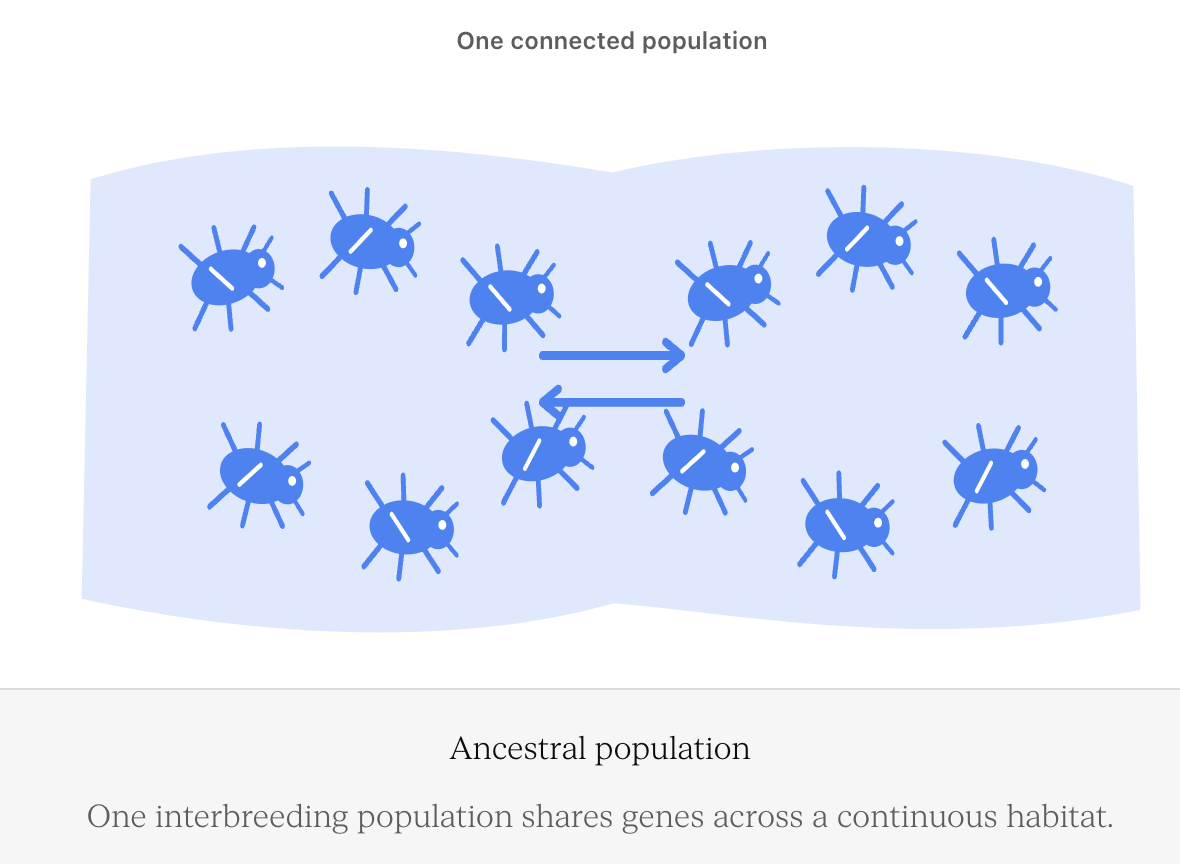
This movement of genetic information is called gene flow.

Gene flow tends to keep populations genetically connected.

If gene flow stops for long periods, populations may begin evolving independently.


Reproductive Isolation

Reproductive isolation occurs when populations cannot successfully exchange genes through reproduction.

Reproductive isolation is central to the biological species concept.

Barriers to reproduction can occur:

Before fertilization

or

after fertilization.

These are called:

  • Prezygotic barriers
  • Postzygotic barriers

Prezygotic Barriers

Prezygotic barriers prevent fertilization from occurring.

"Pre" means before.

These barriers operate before a zygote forms.

Examples include:

  • Geographic separation.
  • Different habitats.
  • Different mating behaviors.
  • Different breeding seasons.
  • Incompatible reproductive structures.
  • Gametes that cannot successfully fuse.

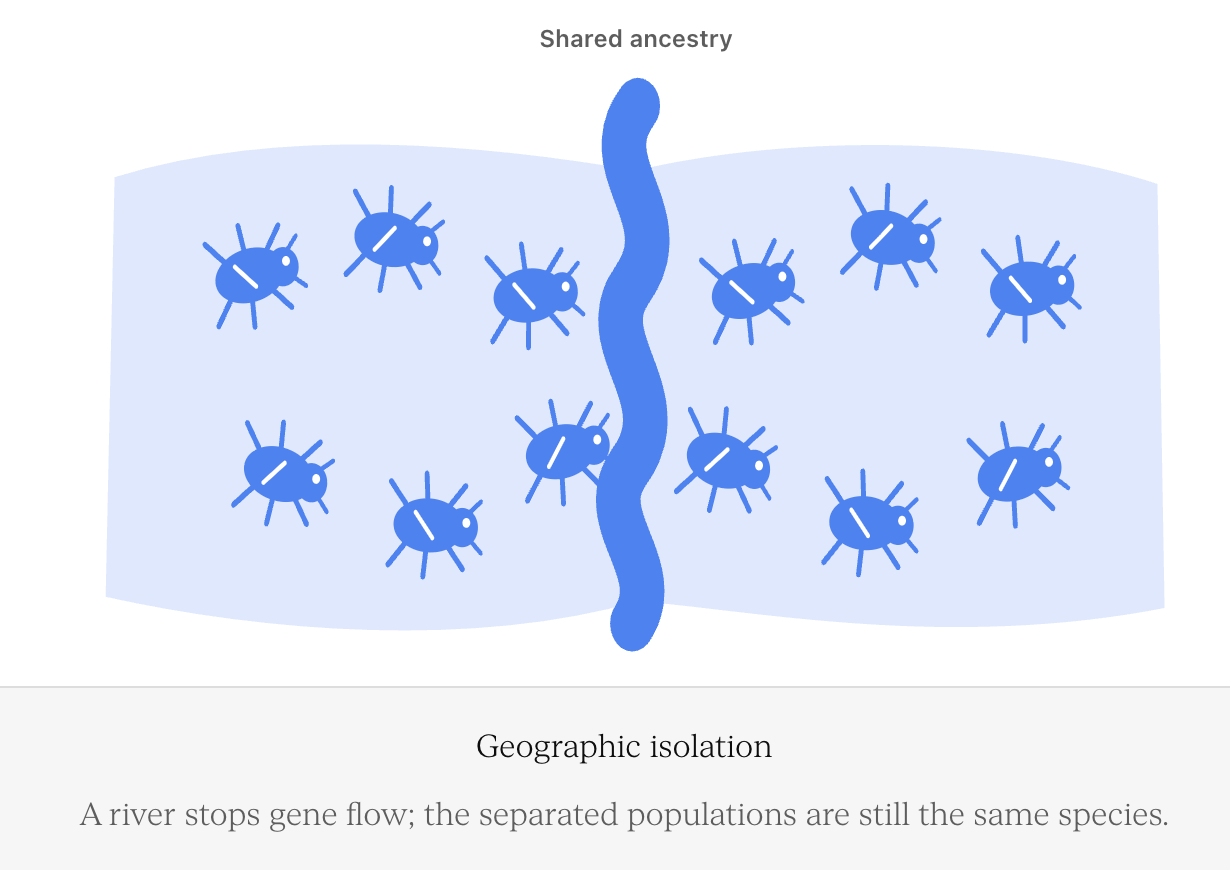
Geographic Isolation

A physical barrier can separate populations.

Examples include:

  • Mountains.
  • Rivers.
  • Oceans.
  • Deserts.
  • Glaciers.
  • Islands.
https://images.openai.com/static-rsc-4/huFtwrRN1QrMcNIBUU30QwKGl0NnRvywdatIkG7lkcADX5wPDa3ohzO9jeAJCwmjU0YeVXUeh8uRhDMTPK1dx3qvdkRm9s_UuVmmK-FRkI156dGQG-9pbwRhjriC5VkEzlnczZr-esydaU8CWZiIPO7mp67vA5H8p08ZoXeAehPtFg1gcN6YNwZp7vmEIqFo?purpose=fullsize
 
https://images.openai.com/static-rsc-4/EA1zj62MDGUo1EpnsSaDbR_JoEcDimUgp_lL3sICVcluL6Sg3hVfHbMnfIsLdBvAq14CYIppATdnE_OMuJ93pKAS_98yAZgbxhMjJJAyfEtELcLa_3ybGHob6B5Sdnea18oNFyPY3UC9tdTJSoicbLAuKS7l1UoNlZljQUj20Kae1jyD_KSO0OwPybCr6N55?purpose=fullsize
 
https://images.openai.com/static-rsc-4/W7Z58G-yiTD8AD1n5qava05CS6rNU_GWhMaXl_5PBGj5WtPNi4ANGdpuUoUc2nGgN2bzEaZJj_ijOlV3eyPwgBwMEVzLWmYBgBCLU5xzAGEnwCP8bxZqdExe6mvR4YMfNA98Lp1bYImC8PPqVeLg8SGS5ATUbW0CLN0KY8M0mjT2f-aCM1ee97gMbu_Snhpg?purpose=fullsize
 
6

Once populations are separated, gene flow between them may decrease or stop.

Over many generations, the populations may accumulate genetic differences.


From Isolation to New Species

Consider one population of organisms.

A new river forms and divides the population.

The two groups can no longer regularly reproduce with one another.

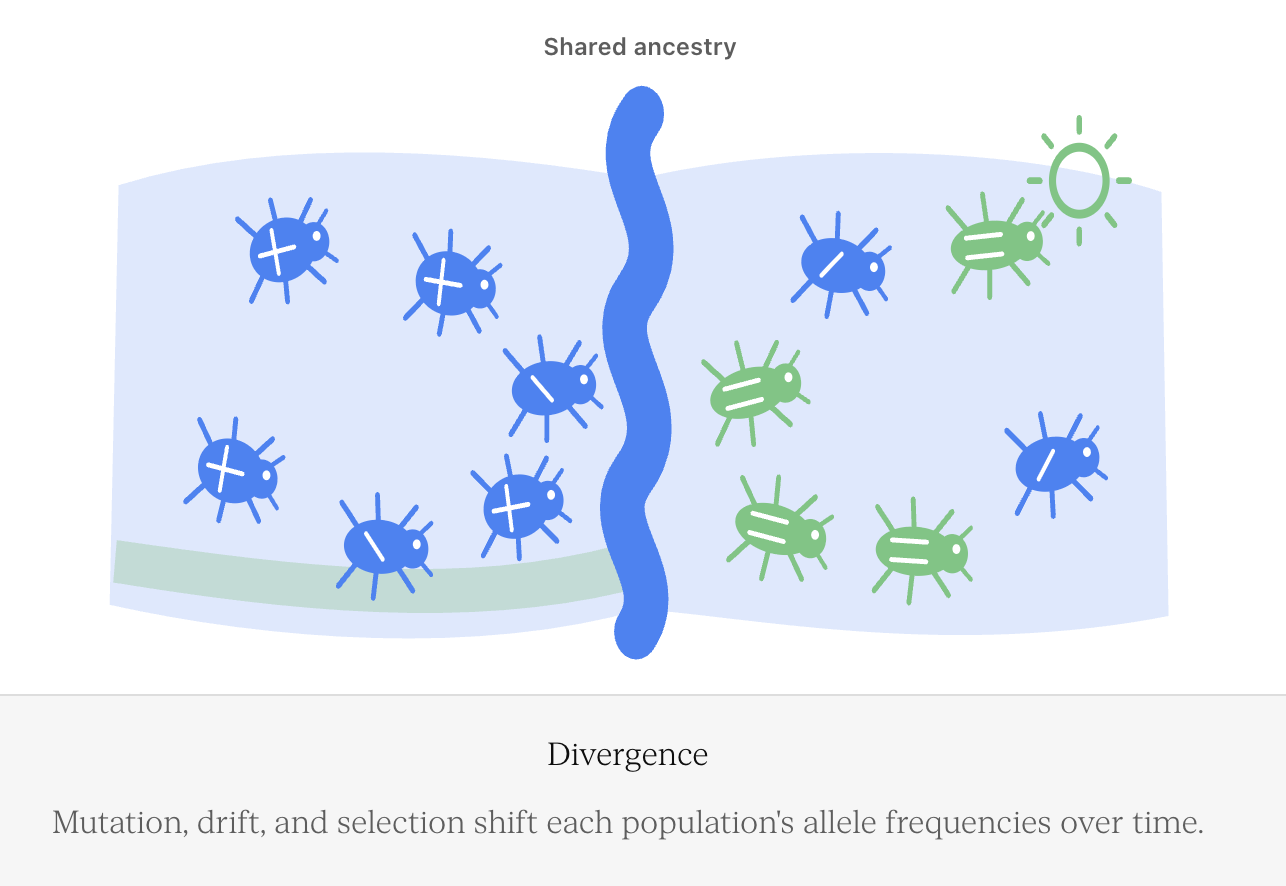
Different:

  • Mutations.
  • Selection pressures.
  • Environmental conditions.
  • Genetic drift.

cause the populations to change over generations.

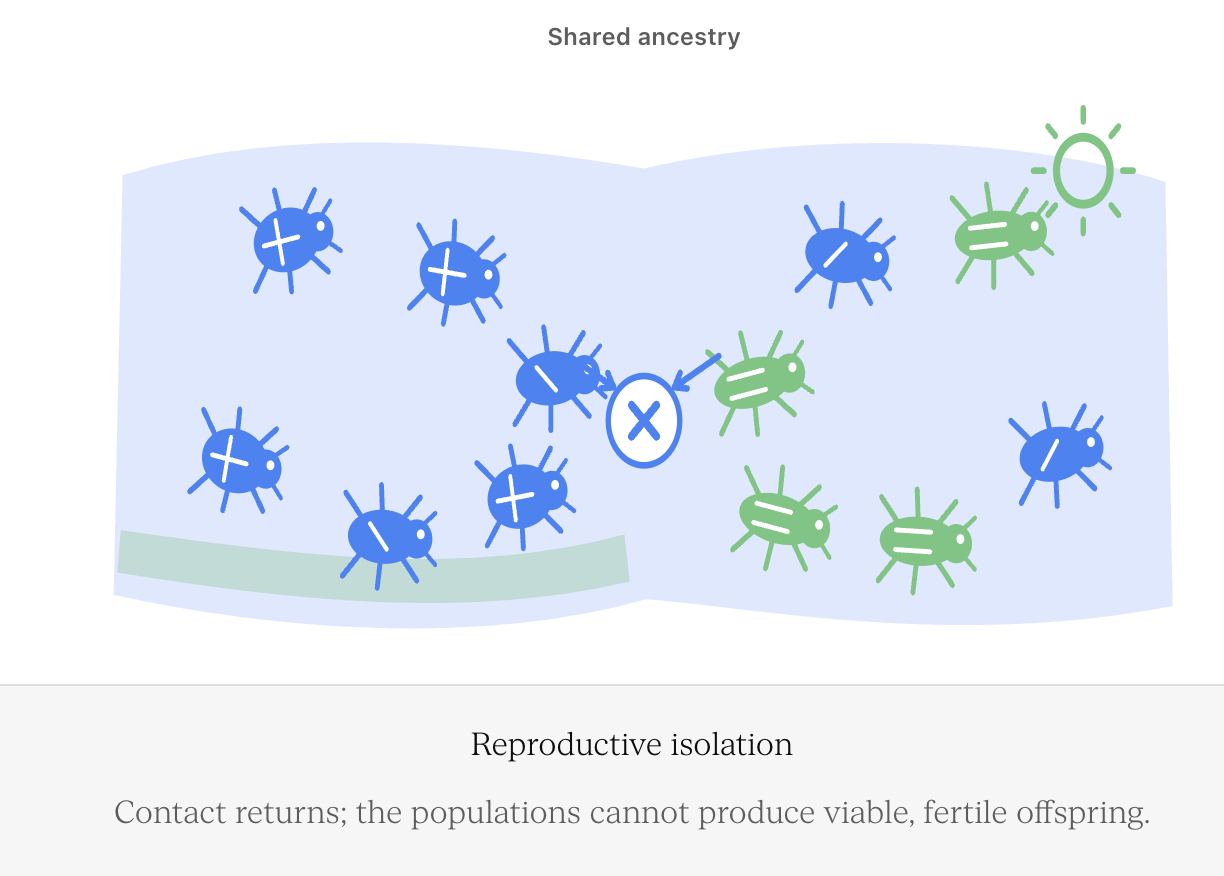
Eventually, the differences may become large enough that they could no longer successfully interbreed even if they came back into contact.

At this point, reproductive isolation has evolved.

This process can result in the formation of new species.


Speciation

The formation of new species is called speciation.

A simplified sequence is:

One population

↓

Isolation

↓

Reduced or absent gene flow

↓

Genetic differences accumulate

↓

Populations diverge

↓

Reproductive isolation develops

↓

Separate species

Geographic separation is one important pathway through which this can occur.


Behavioral Isolation

Populations may become reproductively isolated because of different mating behaviors.

For example, two closely related bird species may have different:

  • Songs.
  • Courtship dances.
  • Visual displays.

Individuals may only respond to the mating signals of their own species.

Even if the species live in the same area, they may rarely mate.

This is behavioral isolation.


Temporal Isolation

Temporal isolation occurs when populations reproduce at different times.

For example:

Species A breeds in early spring.

Species B breeds in late summer.

Even if they occupy the same habitat, they are unlikely to reproduce with one another.

Differences could also involve:

  • Time of day.
  • Season.
  • Yearly reproductive cycles.

Habitat Isolation

Two populations may occupy different habitats within the same geographic area.

For example:

One insect population lives and reproduces on one host plant.

Another closely related population uses a different host plant.

If individuals rarely encounter one another for reproduction, gene flow can decrease.


Mechanical Isolation

Mechanical isolation occurs when reproductive structures are incompatible.

This can occur in both animals and plants.

For example, the shapes of flowers may be adapted to particular pollinators.

Structural differences can therefore reduce reproduction between populations.


Gametic Isolation

Sometimes mating or pollen transfer occurs, but the gametes cannot successfully fuse.

For example:

  • Sperm may be unable to fertilize an egg.
  • Pollen may fail to fertilize an ovule.

This is called gametic isolation.

It prevents formation of a zygote.


Postzygotic Barriers

Postzygotic barriers operate after fertilization has occurred.

A hybrid zygote may form, but problems occur later.

Examples include:

  • Hybrid embryos failing to develop normally.
  • Hybrid offspring having reduced survival.
  • Hybrid offspring being sterile.
  • Later generations of hybrids having reduced fitness.

Hybrid Sterility

The horse and donkey example demonstrates hybrid sterility.

A horse and donkey can produce a mule.

However, most mules cannot reproduce.

Therefore, genes cannot normally continue flowing between the two parental species through the hybrid.

This maintains reproductive isolation.


Prezygotic Versus Postzygotic Isolation

A useful distinction is:

Prezygotic barrier

Prevents fertilization.

Examples:

  • Different mating behavior.
  • Different breeding season.
  • Mechanical incompatibility.

Postzygotic barrier

Acts after fertilization.

Examples:

  • Hybrid does not survive.
  • Hybrid is sterile.
  • Hybrid has reduced reproductive success.

Both types of barriers can maintain separation between species.


Worked Example: Frog Calls

Two frog populations live around the same pond.

Population A males produce one mating call.

Population B males produce a different mating call.

Females respond only to males producing the call associated with their own population.

This is:

Behavioral isolation

It is also:

Prezygotic isolation

because it prevents mating and fertilization from occurring.


Worked Example: Flowering Times

Two closely related plant populations live in the same field.

Population A flowers in March.

Population B flowers in August.

Their reproductive periods do not overlap.

This is:

Temporal isolation

It acts as a prezygotic barrier.


Worked Example: Hybrid Offspring

Two animal species mate.

Fertilization occurs and healthy offspring develop.

However, the offspring cannot produce functional gametes.

This is:

Hybrid sterility

It is a postzygotic reproductive barrier.


Reproductive Isolation and Evolution

Reproductive isolation allows populations to evolve independently.

Without regular gene flow, populations can accumulate different:

  • Mutations.
  • Alleles.
  • Adaptations.

Natural selection may also act differently if the populations experience different environments.

Over many generations, their genetic differences may increase.

This connects reproductive isolation directly with evolution and speciation.


A Classic Example: Island Populations

Imagine birds from a mainland population colonize two separate islands.

Island A has:

  • Large, hard seeds.

Island B has:

  • Small, soft seeds.

Variation already exists in beak characteristics.

Different feeding conditions create different selection pressures.

Over many generations:

  • Allele frequencies change.
  • Populations become genetically different.
  • Courtship behavior may also change.
  • Reproductive isolation may eventually develop.

The populations may ultimately become separate species.


Species Concepts

The biological species concept is useful, but it does not work perfectly for every organism.

Scientists therefore use several different species concepts.

These include:

  • Biological species concept.
  • Morphological species concept.
  • Phylogenetic species concept.
  • Ecological species concept.

Each emphasizes different evidence.


Limitations of the Biological Species Concept

The biological species concept is difficult to apply to some organisms.

Asexual Organisms

Bacteria and many other organisms reproduce without mating.

We cannot test whether they can interbreed.

Fossils

We cannot observe whether extinct organisms reproduced with one another.

Geographically Separated Populations

Two populations may never naturally encounter one another.

It can therefore be difficult to determine whether they would successfully interbreed.

Hybridization

Some distinct species can occasionally produce hybrids.

Species boundaries are not always completely simple.


The Morphological Species Concept

The morphological species concept identifies species using differences in physical form and structure.

This is particularly useful for:

  • Fossils.
  • Museum specimens.
  • Organisms whose reproduction cannot easily be observed.

However, appearance can sometimes be misleading.

Cryptic species may look almost identical despite being genetically distinct.


The Phylogenetic Species Concept

The phylogenetic species concept focuses on evolutionary relationships.

Scientists use evidence such as:

  • DNA.
  • Shared characteristics.
  • Evolutionary ancestry.

A species can be recognized as a distinct evolutionary lineage.

This approach has become increasingly useful as DNA sequencing technology has improved.


The Ecological Species Concept

The ecological species concept emphasizes an organism's ecological role or niche.

Populations occupying different ecological niches may experience different selection pressures and evolve independently.

Ecological information can therefore contribute to decisions about species boundaries.


Why Do We Need Different Species Concepts?

Nature does not always fit perfectly into simple categories.

Different organisms reproduce and evolve in different ways.

For example:

The biological species concept works well for many sexually reproducing animals.

The morphological concept can be useful for fossils.

Genetic and phylogenetic approaches can be especially useful for microorganisms and cryptic species.

Scientists choose evidence appropriate to the organisms being studied.


Species Concepts and Classification

Correctly identifying species is essential for biological classification.

The taxonomic hierarchy includes:

Domain

Kingdom

Phylum

Class

Order

Family

Genus

Species

Species form the most specific major level in this hierarchy.

Scientific names identify species using binomial nomenclature.

For example:

Panthera leo

identifies the lion.

Panthera tigris

identifies the tiger.

Both belong to the same genus but are separate species.


Species Concepts and Biodiversity

Species definitions are also important when measuring biodiversity.

Suppose scientists believe a forest contains one widespread frog species.

DNA analysis later reveals that the frogs actually belong to four distinct evolutionary lineages recognized as separate species.

The estimated species richness of the forest changes.

Correct species identification therefore affects biodiversity measurements.


Species Concepts and Conservation

Conservation programs need to know what species exist and where they occur.

Imagine that one apparent species actually contains two distinct species.

Species A:

Large population and wide distribution.

Species B:

Small population restricted to one forest.

If scientists incorrectly treat them as one species, the conservation risk to Species B could be overlooked.

https://images.openai.com/static-rsc-4/_39SjM3ogA6Q_wJnCjbznWu0XMXutW9YJAKz8VPwva90yCFWSmbBtS2NtBWE8vOSufMj5JD0Yn-xjuOHCJMN-raXE7lkO6BOTEn-YBwjlnhR9Lx8vK6vHmsnmVCNb_14rAJqqbJw9-uy52VZsmQ3HbPlh2erc6OJLvU14t1BUFd9OwE_tiAxyKaYuswzKltL?purpose=fullsize
 
https://images.openai.com/static-rsc-4/1oOlxqSXnlG4N0U--RHrxOQ4lhmdu29VyzOJHY0Z4-Ql_TUHrjyee78PTmX6sQBsGfBm_Ufi9MQJGhTYg8GHx1tC3C_epqXBY_4LVU_4iRs4BX1Kp40ZIYKei63POfPWkF4k-vvY-JlUhcU5djEtfcsJ__2457SzDk9mvvj0Wbgndew_Jqc8ESVha0HGVMd_?purpose=fullsize
 
https://images.openai.com/static-rsc-4/MSj7buq-B57eORmfyCgCRB1datqoCwpJ8IN6pZIyaaDizbnz6z8KByBpLbe0Wvx9NGLYyeccPQBYxCYVuMkNzvcvL-scR2TPbm9Rm-y-7ksg63qYCdXzwo7KGKAPTzxq5T2exLTeSILthebtt0pYevtcVH9CcHI85Gt3h4HiAXGBW-4Y1ccShJwGKtNl8VTA?purpose=fullsize
 
6

Species concepts therefore have practical consequences for conservation.


Species and Evolution

Species are not permanent, unchanging categories.

Populations evolve.

Over evolutionary time:

  • Species can split into new species.
  • Species can become extinct.
  • Populations can diverge.
  • Hybridization can occur.
  • Geographic distributions can change.

The boundaries between species can therefore sometimes be complex.


Species Versus Population

Remember the distinction:

Species

A broader biological group containing organisms belonging to the same evolutionary and reproductive lineage.

Population

Members of one species living in the same area at the same time.

For example:

All members of a particular bird species worldwide belong to the species.

The members living on one island may form a particular population.


Population Versus Community

Another useful distinction is:

Population

One species in an area.

Community

All the populations of different species living and interacting in an area.

For example, a forest might contain populations of:

  • Oak trees.
  • Deer.
  • Foxes.
  • Beetles.
  • Fungi.

Together, these populations form part of the forest community.


Common Mistakes

Thinking Organisms Must Look Identical to Belong to the Same Species

Members of one species can show considerable variation.

Thinking Similar-Looking Organisms Must Be the Same Species

Cryptic species can look extremely similar while being genetically and reproductively distinct.

Thinking a Population Is the Same as a Species

A species may contain many populations.

Thinking Two Species Can Never Produce Offspring

Different species can sometimes produce hybrids. The fertility and reproductive success of those hybrids are important considerations.

Thinking Geographic Separation Automatically Creates New Species

Geographic isolation can begin the process, but populations must diverge sufficiently for reproductive isolation to develop.

Thinking All Reproductive Barriers Prevent Mating

Some barriers act after fertilization.

Confusing Prezygotic and Postzygotic Barriers

Prezygotic = before fertilization.

Postzygotic = after fertilization.

Thinking the Biological Species Concept Works for Every Organism

It cannot easily be applied to asexual organisms or fossils.

Thinking Species Are Completely Fixed Categories

Species and populations change through evolutionary time.


Check Your Understanding

1. Define a species using the biological species concept.

2. What does "fertile offspring" mean?

3. Why does appearance alone not always identify a species?

4. Give four types of evidence scientists can use to identify species.

5. What is DNA barcoding?

6. Define a population.

7. Explain the difference between a species and a population.

8. What is gene flow?

9. Define reproductive isolation.

10. What is the difference between prezygotic and postzygotic barriers?

11. Give three examples of prezygotic reproductive barriers.

12. Give two examples of postzygotic reproductive barriers.

13. Two frog populations use different mating calls. What type of reproductive isolation could this produce?

14. Two plant populations flower during different months. What type of reproductive isolation is this?

15. Why are horses and donkeys considered different species even though they can produce mules?

16. Explain how geographic isolation can eventually contribute to speciation.

17. Why is the biological species concept difficult to apply to bacteria?

18. Why are fossils difficult to classify using the biological species concept?

19. How can identifying species incorrectly affect biodiversity measurements?

20. Explain why scientists sometimes need more than one species concept.


Key Terms

  • Species – distinct biological lineage; under the biological species concept, a group capable of interbreeding under natural conditions and producing fertile offspring.
  • Population – members of the same species living in the same area at the same time.
  • Biological species concept – species concept based largely on reproductive compatibility and reproductive isolation.
  • Morphology – physical form and structure of an organism.
  • Morphological species concept – identification of species based largely on consistent structural differences.
  • Phylogenetic species concept – species concept emphasizing distinct evolutionary lineages.
  • Ecological species concept – species concept emphasizing ecological roles and niches.
  • Gene pool – collection of genetic variants within a population or reproductively connected group.
  • Gene flow – movement of genetic information between populations through reproduction.
  • Reproductive isolation – barriers preventing successful gene exchange between populations.
  • Prezygotic barrier – reproductive barrier acting before fertilization.
  • Postzygotic barrier – reproductive barrier acting after fertilization.
  • Behavioral isolation – reproductive separation caused by differences in mating behavior.
  • Temporal isolation – reproductive separation caused by differences in reproductive timing.
  • Hybrid – offspring resulting from reproduction between genetically distinct populations or species.
  • Speciation – evolutionary formation of new species.
  • DNA barcoding – use of selected DNA sequences to help identify species.
  • Cryptic species – distinct species that are difficult to distinguish using appearance alone.

Key Takeaways

  • A species is a fundamental unit of biological classification.
  • Under the biological species concept, members of a species can potentially interbreed and produce fertile offspring.
  • Scientists use morphology, behavior, reproduction, ecology, and DNA to identify species.
  • Appearance alone is not always reliable for identifying species.
  • A species may contain many different populations.
  • A population consists of members of the same species living in the same area at the same time.
  • Gene flow connects populations genetically.
  • Reproductive isolation reduces or prevents gene flow between populations.
  • Prezygotic barriers act before fertilization.
  • Postzygotic barriers act after fertilization.
  • Geographic, behavioral, temporal, mechanical, and gametic isolation can reduce reproduction between populations.
  • Hybrid sterility is an example of a postzygotic barrier.
  • Reproductive isolation can allow populations to evolve independently.
  • The formation of new species is called speciation.
  • The biological species concept has important limitations.
  • Asexual organisms and fossils cannot easily be classified using reproductive compatibility.
  • Scientists therefore use several different species concepts.
  • Species identification is important for classification, biodiversity studies, evolutionary biology, and conservation.
  • Species are evolutionary lineages, and their boundaries can change or become clearer as new evidence is discovered.


2. Speciation

Learning outcomes
  • I can explain how new species form.
  • I can describe the role of isolation in speciation.
  • I can identify factors that contribute to speciation.
  • I can compare different speciation scenarios.
  • I can relate speciation to evolution.

How Do New Species Form?

Speciation is the evolutionary process through which new species form.

A population does not suddenly become a new species in a single generation. Speciation usually occurs over many generations as populations accumulate genetic differences.

A simplified sequence is:

One population → Isolation → Reduced gene flow → Genetic divergence → Reproductive isolation → Separate species

https://images.openai.com/static-rsc-4/lu9aDVxmQb5Yz9PWZ81AZZxAwBJ2qbl-qhuF03kL5dSK6rLnAzWbY_X1ArjVCscKmppILbcQ8veB6lbad3SN63f8w01kCM3vCYDkaO9yIrxge2OdSVkQDCxS_wziGY1T6mWoa5vLmRzDg1jhX7-CvlxI8EwE2A_dTmnBlgmWKX33o9sbhKtbHwCixmGs_Qif?purpose=fullsize
 
https://images.openai.com/static-rsc-4/jEmS2nogGb3V--Fdg5CIA64pu1uY25hAK_KnYCGs9AoFIlrj6UzTSPIhvv3nYP3qWDCdmYlPINdapXKEFn8gJg3uaWrsr_NYRdxx9K0Frh5AFKzqvsjSloZP_c5n60NpDrPBDJRvItW-i9U-wSITm963x8s5nhhv2gJk-1-nRrjJWKCw4APi239f95IGIzD_?purpose=fullsize
 
https://images.openai.com/static-rsc-4/Jh1bsoiELHt_ZesFyvC22mVMB-Z7Fz-npR-XCXt4bd_De6l6PRFA4jNvu0B9deqQbTx6JswwA8ASH_ob02b90K8IU0fyuPHAPsE9hWrzYmq9udJdT5M23CB21QUtzKIc5BUdjrONugg-j2x7jfOKNXeILVlfwWMsPhXCUmq2hLyR16dRkygTSn7Rj058ET3V?purpose=fullsize
 
6

Speciation is one of the major processes responsible for Earth's enormous biodiversity.


Populations Are the Starting Point

A population consists of organisms of the same species living in the same area at the same time.

Members of a population usually share a gene pool.

When individuals reproduce, alleles can move through the population.

This movement of genetic information is called gene flow.

As long as substantial gene flow continues between groups, it tends to reduce genetic differences between them.

For speciation to occur, gene flow between populations often needs to become greatly reduced or interrupted.


Isolation

Isolation occurs when groups within a species become separated in a way that reduces gene flow.

Isolation can occur because of:

  • Geographic barriers.
  • Different habitats.
  • Different breeding times.
  • Different mating behaviors.
  • Different ecological niches.
  • Genetic or chromosomal changes.

Once gene flow is reduced, populations can begin evolving more independently.


Geographic Isolation

Geographic isolation occurs when a physical barrier separates populations.

Possible barriers include:

  • Mountains.
  • Rivers.
  • Oceans.
  • Deserts.
  • Glaciers.
  • Islands.
  • Large distances.
https://images.openai.com/static-rsc-4/Veg-X5lFOt2JjylAC-th2R1_Y-8xAoidN3VM1b3Lgwr6SjUEErTzgpVnfqCO09BaeeRx-Bvo_T6f7iopOFPLSLbz8Ilf1R66Lbc3MElm7UFYmGA2l1O0qxAmraLl2EYzaOCrxrA0a_Pfq5qT9Q-1YBge1COVWGIk2TpNcXtfUmUpBNQuq1wWAVMSKBmpsFo7?purpose=fullsize
 
https://images.openai.com/static-rsc-4/PpHV5UXlWhoxGcIzju3_a4xqp0xG2OIYeqMjcnPiqL9dQVpLrHK-mBaJuhgfw8ygW68AG9YaQTw30K6vcsinN-xgfmf0lHXO0o3r1HVi0YJqyU3ZyfE_YwKD_zsvGXgB0o1sq1j542GrVMlHCFCxeNPuOmoN96lzS1hDv1MvPQ2e5n8qOScrlQcEtSh1swpq?purpose=fullsize
 
https://images.openai.com/static-rsc-4/pBNBnIFKeyqZRheml7AHigigL296avFez5nhx_40uK-NAtIJwB4Eh1PyHHLYQsz1LElYKbfxvAdfyVU_M4EeJSLyq8YUxo-b_-_U41hEBoKU17OOQoKGPeA2_8HzvX9q5VSQuOCVC2vB9DJP9tVdWJaA66MmYASxXM364JA_4IeXZ-aI42BwMVCkLamSy6RD?purpose=fullsize
 
5

Suppose one population is divided when a river forms.

Before separation, individuals can reproduce throughout the population.

After separation, individuals on opposite sides may no longer reproduce with one another.

Gene flow between the populations decreases.


What Happens After Isolation?

Isolation alone does not automatically produce a new species.

Once populations are separated, several evolutionary processes can cause them to become increasingly different.

These include:

  • Mutation.
  • Natural selection.
  • Genetic drift.
  • Sexual selection.

Different environments can also expose the populations to different selection pressures.

Over many generations, genetic differences can accumulate.


Mutation

Mutations produce new genetic variation.

Mutations occur randomly with respect to what an organism needs.

Once populations become isolated, different mutations may arise and spread in each population.

For example:

Population A may acquire allele X.

Population B may acquire allele Y.

Over many generations, many such genetic differences can accumulate.


Natural Selection

Isolated populations may experience different environmental conditions.

For example:

Population A lives in a dry environment with hard seeds.

Population B lives in a wet environment with soft fruits.

Different traits may provide reproductive advantages in each environment.

Natural selection can therefore cause the populations to become increasingly different.

https://images.openai.com/static-rsc-4/7lEdEAdQQgzO4-SO2i-Gr2k7hm-IfXicWRBZL-4TcvNwaZw9sV8y1GSvguRpH3H3YXggwMlxNVselBP1B66ysum0jniy74NWwxy5hiZLm6kDbfp4pDnwojuqr6GBOS85YcAP2SI2h5M92dhSCrGNOv4wMcwUMczKVb_6DUJkGeDWEO_1ASfYxqB2U8sZ_OIr?purpose=fullsize
 
https://images.openai.com/static-rsc-4/MukpjHDp8fhECdSZ6vkstyTXoTY8rA4k5PZvDtdUU-xjdJV7oIJps6V89yFc-u64u1lISbaIBO0pQYvc7URBSQMduk3ZB8yBnaAz0SYtLbZ6j1rB1UKLDgkT6fMke370QHoBIOuis0T0z0U__H6x1VOzpwrYf4CBKTEt6RBDihCobfKmpDQArLHH1DmSVQU6?purpose=fullsize
 
https://images.openai.com/static-rsc-4/RNve9n--IgdAM1334U5yk3-X938ODG4xEHj6vlOz-Brc2Yqq_XPb0naTMVThQ0NzoMa92INhvr1RhMGNOw3Gx6lqTF8Pw4rzsp6yV5goOy7CjtofCFa7AaKD_KrbKxLufznGPYGsFWOPqjuWovvteoE9sXidxvg9-FvVy7BnMWNutN329a8b6XJtWT67xXus?purpose=fullsize
 
6

Genetic Drift

Genetic drift is a random change in allele frequencies.

Its effects can be especially important in small populations.

Suppose only a few individuals colonize an island.

By chance, those individuals may carry only part of the genetic variation present in the original population.

The new island population may therefore have different allele frequencies from the original population from the beginning.


The Founder Effect

The founder effect is a form of genetic drift that occurs when a new population is established by a small number of individuals.

For example:

A storm carries several insects from the mainland to an island.

These insects establish a new population.

Their alleles may not represent the frequencies found in the original mainland population.

The island population may then evolve independently.


Different Selection Pressures

Different environments can favor different characteristics.

Imagine two isolated populations of birds.

Population A has access mainly to:

Large, hard seeds

Birds with larger, stronger beaks may have an advantage.

Population B has access mainly to:

Small, soft seeds

Different beak characteristics may be advantageous.

Over many generations, natural selection can increase differences between the populations.


Genetic Divergence

As isolated populations accumulate differences, they undergo genetic divergence.

This means their gene pools become increasingly different.

Genetic divergence can result from:

  • Different mutations.
  • Different selection pressures.
  • Genetic drift.
  • Sexual selection.

Eventually, the populations may become sufficiently different that they can no longer successfully exchange genes.


Reproductive Isolation

Reproductive isolation occurs when populations can no longer successfully exchange genes through reproduction.

This is a critical stage in speciation.

Even if previously separated populations come back into contact, reproductive barriers may prevent them from merging back into a single population.

At this point, they may be recognized as separate species.


Reproductive Barriers

Reproductive barriers can be divided into:

Prezygotic barriers

and

postzygotic barriers.

Prezygotic barriers operate before fertilization.

Postzygotic barriers operate after fertilization.

Both can contribute to speciation.


Prezygotic Barriers

Prezygotic barriers prevent mating or fertilization.

Examples include:

  • Habitat isolation.
  • Temporal isolation.
  • Behavioral isolation.
  • Mechanical isolation.
  • Gametic isolation.

These barriers reduce gene flow before a zygote forms.


Behavioral Isolation

Behavioral isolation occurs when populations develop different courtship or mating behaviors.

For example, two bird populations may develop different mating songs.

Females from Population A respond mainly to Song A.

Females from Population B respond mainly to Song B.

Even if the populations meet again, they may rarely mate.

https://images.openai.com/static-rsc-4/WEYRSqyBP6d6TRni676IdVDoJntNRIHsam9YFLgENaa5RSHqxd1sMqcPbdKOzGJCn2DPUpBEWSShpsBXrJe_QGj90cAgNPFHpR0hDZmuzeze2NS8k2XiviVe1ApU6o3qbR0MLeKxn6H_HLnWIuweJVk1AstjVxFrXXcAB52S3I4GtLLHVZviw2G2VlkujMHC?purpose=fullsize
 
https://images.openai.com/static-rsc-4/FXfPwdZ9RJDzENyJXDTHWKuMvA_VzuRU0cDIa6TtEaOlamkhDmlJDV99-DI11_vUwYi35El_N9DB37S0h0WZZ3eTYQDudPkFvY9ti8I068F9_K_YEcejLsccjXihBw6lDhsN813szuufZkEZNyMGFkxk6AC2glMFIVlsKJl-sScDLPz5r5D8k1Kth28DHZ3_?purpose=fullsize
 
https://images.openai.com/static-rsc-4/NIaMoEivNDmsk3uoIcBOtzm07JMUsoIKpfQXNwHM05Q1mFVIptitZuavsPAhPbX0ieGZxFfrzKOYz8m5aM5pMrpXfF8m5ODTWVb0YZtS6nCC-WzkNJZQlzUwyWvESMEaHFyc-XSnUbAYpPFAAPnGYN3lY0QuhIenDBXzsHGpblbHLp7lCDo5QuVMHOV7StWw?purpose=fullsize
 
5

Temporal Isolation

Temporal isolation occurs when populations reproduce at different times.

For example:

Population A breeds in March.

Population B breeds in July.

Although they might live in the same location, their reproductive periods do not overlap.

Gene flow between the populations is therefore greatly reduced.


Habitat Isolation

Habitat isolation occurs when populations use different habitats or resources within the same geographic region.

For example:

One insect population may live and reproduce on one plant species.

Another population may use a different host plant.

Because individuals spend their time in different habitats, they may rarely encounter one another for reproduction.


Mechanical and Gametic Isolation

Mechanical isolation occurs when reproductive structures become incompatible.

Gametic isolation occurs when sperm and egg, or pollen and ovule, cannot successfully interact.

Both prevent successful fertilization.


Postzygotic Barriers

Sometimes individuals from different populations can mate and fertilization occurs.

However, the resulting hybrids may experience problems.

Examples include:

  • Hybrid embryos failing to develop.
  • Hybrids having poor survival.
  • Hybrids being sterile.
  • Later hybrid generations having reduced reproductive success.

These are postzygotic barriers.


Hybrid Sterility

A familiar example is the mule.

A horse and donkey can reproduce to produce a mule.

However, most mules are sterile.

https://images.openai.com/static-rsc-4/mELDYiBqEq11-_RyuNQLP-iLonUBln4JSsFP2wYhvh2tLDASZIGTFnPqbEu1ITdGpKSWMGiawf6YyuKF4WB-O29JnvrIJXHo1tBuMzHqy24EJcRYvKbyzBmlb8mGRYW60fJisifvst0QEeyNhAvXtco80Mbd6J7el1LPXaLDwIvw8_5t9j_crD35ysDy-YCQ?purpose=fullsize
 
https://images.openai.com/static-rsc-4/E9rCLDW2CUsILQGJwpcaBqsyrf7ME_sTkYcyMnVmVNEYDTziFQ66x2IbbhGszbKd93Rzm3dbU0VNR5mSUIPMGOjQeCE4FlS-esCwH3neu_--kNaQpkCJwtf54D5xlO--2EgzE3w4sPO8mT74pGxMaoZAd1GnInghYw6_zSVQDnJviB2Xeu0J8dvXjOOPBop_?purpose=fullsize
 
https://images.openai.com/static-rsc-4/AQyaGuIOtmpeZSmY6XZXjmrxG0Fj8EjZC2rOIuvIBnOcHoEqKnBA5uFzIXahnD5oYN3VkPGqibLA4suclG_IDH7Lo2SJs3PMEsEOJLj1ahnUE2TE_KLwhWQWvpfQ0Q_B4WKKgvZa7uS-ujFYhnZVasqZrDm7jtNjkCSWAt_hovA9DdaxRNczNrcPfOD5MQiu?purpose=fullsize
 
6

This means gene flow cannot normally continue through the hybrid.

Hybrid sterility therefore helps maintain reproductive separation between the parental species.


Allopatric Speciation

Allopatric speciation occurs when populations become geographically separated.

This is one of the easiest speciation processes to visualize.

A simplified sequence is:

Original population

↓

Geographic barrier forms

↓

Gene flow decreases

↓

Populations evolve independently

↓

Genetic differences accumulate

↓

Reproductive isolation develops

↓

Two species
The important point is that the geographic barrier begins the separation, but the populations must subsequently diverge.


Worked Example: A River Forms

Imagine a population of small mammals living throughout a forest.

A large river gradually divides the habitat.

The animals cannot cross the river.

Population A lives west of the river.

Population B lives east of the river.

Initially, the populations may still be biologically very similar.

However, gene flow has stopped.

Over thousands of generations:

  • Different mutations occur.
  • Different alleles become common through drift.
  • Different environmental conditions produce different selection pressures.
  • Mating behaviors change.

Eventually, individuals from A and B may no longer successfully reproduce.

Speciation has occurred.


Geographic Isolation Does Not Automatically Mean Speciation

Suppose two populations become separated for 50 years.

They develop small genetic differences.

The barrier disappears.

Individuals from the two populations meet and reproduce freely.

Gene flow resumes.

In this case, they have not necessarily become separate species.

Geographic isolation is often the beginning of allopatric speciation, not proof that speciation has been completed.


Sympatric Speciation

New species can sometimes form without a geographic barrier.

This is called sympatric speciation.

"Sympatric" means occurring in the same geographic area.

Gene flow can be reduced because groups begin:

  • Using different resources.
  • Occupying different ecological niches.
  • Reproducing at different times.
  • Choosing different mates.
  • Experiencing chromosomal changes.

The populations can therefore diverge even though they live in the same general region.


Worked Example: Host-Plant Change

Imagine an insect species whose members normally:

  • Feed on Plant A.
  • Mate on Plant A.
  • Lay eggs on Plant A.

Some individuals begin using Plant B instead.

They now:

  • Feed on Plant B.
  • Mate mainly with insects on Plant B.
  • Lay eggs on Plant B.

Individuals associated with the two plants meet less frequently.

Gene flow decreases.

Over many generations, the two groups may become reproductively isolated.

This can contribute to sympatric speciation.


Polyploidy and Speciation

Polyploidy occurs when an organism has additional complete sets of chromosomes.

It is particularly important in plant evolution.

A chromosome-number change can sometimes create immediate reproductive barriers between the polyploid organism and the original population.

https://images.openai.com/static-rsc-4/VyETbcGeuSJwBVy_Epyc0fZ_wtAseTcaS_41p5Y4nBWCa0vovKNqY6b8-h13dBsM6zOLw8zjQJko_i_IqQJK6gSP4lFKJ68yoH3gfOckZEwHpogzwSFAB2D3MOQfqx0ty31_lxtMfek5SoHTSBIFpE7d4NOjrkT0JUuEMygSS_vKXUtoqw4dU_IWx_t86LSB?purpose=fullsize
 
https://images.openai.com/static-rsc-4/iABgfhbygqansFShOIDNOlujT_mO3tl5APV5hWIzKVzQwbVZOcGglWl5pP3N3OwT0StWNfRFy17VmHuVIVqFz32ttZETQUeYqmy5pJb684Vq4Kgc2TPmhoL-hB09xjbCL3t4aqkCtfy7j7HMyPTCZNU4a3kALnIPBmi20hQII9cNtHDBtSP6WOlsE5OsJdz_?purpose=fullsize
 
https://images.openai.com/static-rsc-4/OtVQiATmB_ELZ6TeHzX2G4rTsoHgZ4NFaoN8l-GZrKBZYX0Cex21mZztgPE4HqbcxbPI4tsB_6CariqxjnkXfgQi2QsR55dliVM7YaF8GbIM9snVjPIeZH1Pt3Dfea8Ui9HhveZSDrqGy-Xvl-CcgDtg-_tKugxHKo5aXgAyVq48s8MRIc-eDQOdYzr5xluA?purpose=fullsize
 
4

Polyploidy has contributed to the evolutionary history of many plant groups.


Sexual Selection and Speciation

Sexual selection can also contribute to population divergence.

Suppose females in one population prefer males with bright red coloration.

Females in another population prefer males with darker coloration.

Over generations, these preferences can influence:

  • Appearance.
  • Courtship behavior.
  • Mate choice.

If individuals increasingly choose mates from their own population, gene flow may decrease.


Ecological Speciation

Different environments can expose populations to different selection pressures.

This can produce ecological divergence.

For example:

One population lives at high altitude.

Another lives at low altitude.

They experience differences in:

  • Temperature.
  • Oxygen availability.
  • Food.
  • Predators.
  • Breeding conditions.

Natural selection may favor different adaptations in each environment.

If these differences eventually contribute to reproductive isolation, speciation can result.


Allopatric Versus Sympatric Speciation

The major difference is whether geographic separation is involved.

Allopatric speciation

  • Geographic separation occurs.
  • Gene flow is reduced by a physical barrier.
  • Populations evolve independently.

Sympatric speciation

  • Populations remain in the same geographic region.
  • Gene flow decreases for other reasons.
  • Ecological, behavioral, reproductive, or chromosomal differences can drive divergence.

Both can eventually produce reproductive isolation.


Worked Comparison

Consider two scenarios.

Scenario A

A mountain range separates a population of rodents.

The populations evolve independently and eventually become reproductively isolated.

This is:

Allopatric speciation

Scenario B

Two insect populations live in the same region but begin using different host plants and mate mainly on those plants.

Gene flow decreases and reproductive isolation develops.

This could lead to:

Sympatric speciation


Speciation and Natural Selection

Natural selection does not intentionally create new species.

Instead:

  • Variation exists.
  • Environmental conditions create selection pressures.
  • Some characteristics increase reproductive success.
  • Allele frequencies change.
  • Isolated populations may experience different selection pressures.
  • Differences accumulate.

If these differences eventually result in reproductive isolation, speciation has occurred.


Speciation and Evolution

Evolution is change in the inherited characteristics of populations across generations.

Speciation is therefore an evolutionary process.

A population evolves.

If populations diverge sufficiently and become reproductively isolated, one evolutionary lineage can split into two.

Therefore:

Evolution within populations can eventually produce new species.


Branching Evolution

Speciation helps explain why evolutionary history is represented as a branching tree.

Imagine one ancestral species.

It divides into two species.

Later, one of those divides again.

The result is a branching pattern.

https://images.openai.com/static-rsc-4/mAvoHAwQWdLOX-CJuKoxvT_3ZD9aZH-4ZyXV8utFst4IQsJ6o5bmXxOil06vUnNyu9ulYjiLDkV3rQ8OYOD0-kAyBRpNNA_vXEiJvjPhbIzTH5Cg7EaDDjRyFwI0rCODB1OtrGXxEHBXTsjpd1nrkBUqRi02Kn0QbSCh4-ObaWAdwwfwc8KJxS081757x31x?purpose=fullsize
 
https://images.openai.com/static-rsc-4/8k4U1ieXrSWrr1wkBAFiUahH7czwZno_vyo6WbPJQElwGpWszSanJcuGZUrzZK2L-mJH93VJIVNzchegIUKsk_qkCZs7jIN3bIwkNf1G4eB2uSA3kpn2bT1LoX7JVNh0ScSWv7-EZkaSDeVnMrTwhG6fRAnUyVqQOwjJpDNSaaFT5ziLtHRM9mrDLl4e_LZa?purpose=fullsize
 
https://images.openai.com/static-rsc-4/yaAB_Eutt_-wYLWnO9o-Xw7Ln7tnPqMCPWp6Icp38sTMQM28XWRIXA_TTa39AVmENhORp_iCjaNhLfFu79lYruGjmm5otl3IQGw2N7FLNI_u3adB_ngso1Kn4risOZC1cL87Uo6xc6SEHD2C5sWfjdhPKDtZMOlKSVQJa07Mwexmzaz7xigPZhqE-eoPN_sn?purpose=fullsize
 
5

Each branching point represents divergence from a common ancestral population.

Over millions of years, repeated speciation can produce enormous biological diversity.


Common Ancestors

When two species are closely related, they share a relatively recent common ancestor.

For example, Species A and Species B may have formed when an ancestral population split into two reproductively isolated lineages.

Neither modern species necessarily evolved from the other.

Instead:

Ancestral population

↓

Population divergence

↙︎ ↘︎

Species A Species B

This is an important principle when interpreting evolutionary relationships.


Adaptive Radiation

Sometimes one ancestral species gives rise to several new species relatively rapidly in evolutionary terms.

This is called adaptive radiation.

Adaptive radiation can occur when organisms encounter many available ecological niches.

For example, colonization of islands can provide populations with:

  • Different foods.
  • Different habitats.
  • Different predators.
  • Different environmental conditions.

Different populations can become adapted to different niches.

https://images.openai.com/static-rsc-4/Kn3i9d43uDAZRy9k1IgkUmZz8Paix0nJBndl2QsvodB_ZyKfIIGWD1HpbLv9d6cbcUqqdJADwp2A9UzPxeDyOkKJLbD121Xx8xPLL9u9FaFUrMwX_ymEH-NDbRHkHSqXNtkyluhQEzcURu6SfpwM09FstnJu5aVhfnSXpafSiJM5V48zsSE1OmXVenq-OMZr?purpose=fullsize
 
https://images.openai.com/static-rsc-4/Jh1bsoiELHt_ZesFyvC22mVMB-Z7Fz-npR-XCXt4bd_De6l6PRFA4jNvu0B9deqQbTx6JswwA8ASH_ob02b90K8IU0fyuPHAPsE9hWrzYmq9udJdT5M23CB21QUtzKIc5BUdjrONugg-j2x7jfOKNXeILVlfwWMsPhXCUmq2hLyR16dRkygTSn7Rj058ET3V?purpose=fullsize
 
https://images.openai.com/static-rsc-4/HL4wzGY5ebHQQj6Fr_u708mtVs4PG4NTCbAHszqS3m4gSJcN4VRRfLF81mpAXUxhkIdwGdiQ51VlCcGMW1C0BrycFD01X6LPybtuzHx0KmnqL9YWBHAUG5U6do045FW7FAtfQlE3pwZG0geiX4wwi8driYwH8lq83UMAyyATUHMPIsJQPrNv1AkLkjxYfAfP?purpose=fullsize
 
5

Darwin's Finches

The Galápagos finches are a well-known example used to study evolutionary diversification.

Different finch species have beaks adapted to different feeding strategies.

Food sources include:

Differences in ecology, natural selection, geographic history, and reproductive behavior contributed to diversification among finch lineages.


Speciation Increases Biodiversity

Every successful speciation event increases the number of distinct evolutionary lineages.

Therefore, speciation contributes to:

  • Species richness.
  • Ecosystem diversity.
  • Evolutionary diversity.

However, species are also continually becoming extinct.

Biodiversity at any time reflects the combined effects of:

Speciation and extinction.


Speciation Can Take Different Amounts of Time

There is no single time required for speciation.

The rate depends on factors such as:

  • Strength of isolation.
  • Generation time.
  • Population size.
  • Mutation.
  • Selection pressures.
  • Genetic drift.
  • Strength of sexual selection.
  • Chromosomal changes.

Some lineages may remain similar for very long periods.

Others may diverge more rapidly.


Gene Flow Can Slow Divergence

Gene flow generally transfers alleles between populations.

If two populations regularly exchange genes, this tends to reduce genetic differences between them.

Therefore:

High gene flow

generally makes divergence more difficult.

Reduced gene flow

allows populations to evolve more independently.

This is why isolation is so important in many speciation scenarios.


Worked Example: Gene Flow

Population A and Population B live in neighboring forests.

Every generation, many individuals move between the forests and reproduce.

Genes continually move between the populations.

This makes it more difficult for the populations to diverge genetically.

Now a highway and urban development greatly reduce movement.

Gene flow decreases.

The populations can now evolve more independently.

This does not guarantee speciation, but it creates conditions that may allow greater divergence.


Natural Selection Is Not the Only Cause

A common mistake is to assume that speciation happens only because of natural selection.

Other evolutionary processes can contribute.

These include:

  • Mutation.
  • Genetic drift.
  • Sexual selection.
  • Chromosomal changes.
  • Changes in gene flow.

Speciation often results from several processes acting together.


Evidence for Speciation

Scientists can investigate speciation using:

  • Fossils.
  • DNA sequences.
  • Geographic distributions.
  • Comparative anatomy.
  • Reproductive behavior.
  • Hybridization studies.
  • Phylogenetic trees.
  • Observations of populations changing over time.

DNA evidence is especially useful for reconstructing relationships among populations and species.


DNA and Speciation

Scientists can compare DNA from different populations.

If two populations have been separated for a long time, genetic differences may accumulate.

DNA comparisons can help scientists investigate:

  • How closely populations are related.
  • How much genetic divergence has occurred.
  • Approximate patterns of common ancestry.
  • Whether gene flow has occurred.
https://images.openai.com/static-rsc-4/gZi_wZFOfxdk9r7IG_3hHwLx8Ff6aB4bwtsZt_WqAsHHfqnlWbsRnSJdNWpU5vr5V13N7mpTyBxfLpJvvc5oDKWQbnOeDDiqE2NUIeq9VlmVZTjYMrHyKDJsdh7I06ZsF8r4OQn0erR5O-Ew4SPoRT8tUT6BTEcx1VGGWPRWgjWRJn7Lkbrd8ZBdyWc4lk3U?purpose=fullsize
 
https://images.openai.com/static-rsc-4/ugWWT77gZmVnzN4lDvpohN9dV5jJYv9n1jpMPBAP4PQsVkqJvdYXe6j0ZfaNKGK0i3_urdCnFWMLL7Ti-Mx063G-_2dh_vQvAbqU1w9_Umnm4fzd2WfNG0fWJ5XtuNkvrFrrijtfnLa_cflLkWyxxxt6p4_koqYfxyBlbSxpe6qzB75ljSTuRpMyFXq_eQqB?purpose=fullsize
 
https://images.openai.com/static-rsc-4/tSZQr3wQG0x4tYZL3vTugVkCezXBj2LQ8pMfnFYJZyuLGWyv7rN9y8luny-GgCANA2o4KUDYeh6p8obgE8j74zZU_NoQm46jkMMF_sf4b5Xb28e22-Jo_H2hzKjKpLkfqoe0UXuqK-Blj8JxNzTdMdiHyQsyvECWzv1PhAZcdNWMyZ-p7mivqUsU4Tf_EFHC?purpose=fullsize
 
5

DNA evidence is usually interpreted together with ecological, reproductive, and other biological evidence.


Speciation Is Usually Gradual

Species boundaries do not always appear instantly.

During divergence, populations may pass through intermediate stages.

For example:

Stage 1

One interbreeding population.

Stage 2

Gene flow decreases.

Stage 3

Genetic differences accumulate.

Stage 4

Populations sometimes interbreed but hybrids have reduced success.

Stage 5

Strong reproductive isolation.

This means scientists may sometimes disagree about whether two populations should already be considered separate species.


Speciation Is Not a Goal

Evolution does not plan to create new species.

There is no predetermined goal.

Speciation occurs because populations change over generations and sometimes become reproductively isolated.

Natural selection favors characteristics that increase reproductive success under particular conditions.

It does not work toward a future objective.


Common Mistakes

Thinking Isolation Immediately Creates a New Species

Isolation can begin divergence, but reproductive isolation generally requires evolutionary change.

Thinking Geographic Isolation Is the Only Form of Isolation

Behavioral, temporal, ecological, mechanical, gametic, and genetic differences can also reduce gene flow.

Thinking All Speciation Requires a Physical Barrier

Sympatric speciation can occur without geographic separation.

Thinking Individuals Evolve Into New Species

Evolutionary change occurs in populations across generations.

Thinking Natural Selection Is the Only Process Involved

Mutation, genetic drift, sexual selection, gene flow, and chromosomal changes can also contribute.

Thinking Two Modern Species Evolved Directly From One Another

Related modern species usually descended from a shared ancestral population.

Thinking Geographic Separation Guarantees Speciation

Populations may reunite before reproductive isolation develops.

Thinking Speciation Has a Fixed Time Scale

The time required varies greatly.

Thinking Evolution Intentionally Produces New Species

Evolution has no predetermined goal.


Check Your Understanding

1. Define speciation.

2. Why is gene flow important when considering speciation?

3. What is geographic isolation?

4. Give four examples of geographic barriers.

5. Why does geographic isolation not automatically mean that two new species have formed?

6. Name four evolutionary processes that can cause isolated populations to diverge.

7. What is genetic divergence?

8. What is reproductive isolation?

9. Explain the difference between prezygotic and postzygotic barriers.

10. What is allopatric speciation?

11. Describe the major stages of allopatric speciation.

12. What is sympatric speciation?

13. Explain how different host plants could contribute to sympatric speciation in insects.

14. Why is polyploidy particularly important in plant speciation?

15. Explain how natural selection can cause isolated populations to diverge.

16. How can genetic drift contribute to speciation?

17. Why can gene flow prevent populations from becoming very different?

18. Explain how reproductive isolation connects speciation to evolution.

19. What is adaptive radiation?

20. Explain how repeated speciation can increase biodiversity.


Key Terms

  • Speciation – evolutionary process through which new species form.
  • Population – members of the same species living in the same area at the same time.
  • Gene pool – collection of genetic variants present within a population.
  • Gene flow – movement of genetic information between populations through reproduction.
  • Isolation – separation that reduces gene flow between populations.
  • Geographic isolation – separation of populations by physical barriers or distance.
  • Genetic divergence – accumulation of genetic differences between populations.
  • Reproductive isolation – inability of populations to successfully exchange genes through reproduction.
  • Prezygotic barrier – reproductive barrier operating before fertilization.
  • Postzygotic barrier – reproductive barrier operating after fertilization.
  • Allopatric speciation – formation of species following geographic separation.
  • Sympatric speciation – formation of species without geographic separation.
  • Genetic drift – random change in allele frequencies.
  • Founder effect – genetic drift caused when a small number of individuals establish a new population.
  • Sexual selection – selection resulting from differences in mating success.
  • Polyploidy – possession of additional complete sets of chromosomes.
  • Adaptive radiation – evolutionary diversification of an ancestral lineage into multiple species associated with different ecological opportunities.
  • Common ancestor – ancestral population from which later evolutionary lineages descended.

Key Takeaways

  • Speciation is the evolutionary formation of new species.
  • Speciation begins with populations of an existing species.
  • Reduced gene flow allows populations to evolve more independently.
  • Isolation can be geographic, ecological, behavioral, temporal, or genetic.
  • Mutation introduces new genetic variation.
  • Natural selection can cause populations experiencing different environments to diverge.
  • Genetic drift can produce random differences between populations.
  • Sexual selection can contribute to reproductive divergence.
  • Genetic divergence accumulates across generations.
  • Reproductive isolation is a critical step in the formation of separate species.
  • Prezygotic barriers prevent fertilization.
  • Postzygotic barriers operate after fertilization.
  • Allopatric speciation involves geographic separation.
  • Sympatric speciation occurs without geographic separation.
  • Polyploidy can produce reproductive isolation, particularly in plants.
  • Geographic isolation alone does not guarantee speciation.
  • Continued gene flow tends to reduce differences between populations.
  • Speciation is one component of evolutionary change.
  • Repeated speciation creates branching evolutionary relationships.
  • Adaptive radiation can produce several species from an ancestral lineage.
  • Speciation contributes to Earth's biodiversity.
  • New species form when populations diverge sufficiently that they become distinct, reproductively isolated evolutionary lineages.

3. Extinction

Learning outcomes
  • I can define extinction.
  • I can identify causes of extinction.
  • I can explain how extinction affects ecosystems.
  • I can analyze examples of past extinctions.
  • I can evaluate the impact of human activities on extinction rates.

What Is Extinction?

Extinction occurs when the last living individual of a species dies.

Once a species becomes extinct, it no longer exists anywhere on Earth.

Extinction is a natural part of evolutionary history. Species have appeared, changed, and disappeared throughout Earth's history.

However, extinction rates can increase dramatically when environmental conditions change rapidly or when human activities place intense pressure on populations.

https://images.openai.com/static-rsc-4/d-A2R94tVmB6ZUH4n5p-Kxc1tkA5nH87ef06M8isniA0WJVSe4ME4CuMe6kK1MSKZBCt9QevjPmICqDRiFbfb4uqwVCmRV_PLXDeujV6Lb-qz-zJbHUG1Yw3WacjBrNdg4N3honKEDnTZcgvatoUSrsIaCx6ytqtLRAjRTXG_mqdLEypH6NWW0WSg9CoIhRq?purpose=fullsize
 
https://images.openai.com/static-rsc-4/7G2b1iOT5tJfRs7UJoopgNTQdaSDvTjusOdoujBaWLyk_lQF0XaluSwrGWvLEDU6UiZcQ2EIHClEu83VMjSNyDifGjplZGMnjI2xCekzZOHGo0jo6V5lHci2U2Rs_vZu5DOQX7Py4oVlrFhyo9cAy-SPSEGDBw4oWboKip98Dhvome17ikVharXsqcxMx1Z5?purpose=fullsize
 
https://images.openai.com/static-rsc-4/4RoGRuIrkZYnCoWWToAteUj68RcGZXHrvzGECbB1XAbFHDFeU7VEsmJAx1uNA3VjhopJJsRW3KCyewTrcd3ha7XYmNmsjPy_Bigwv7ij8q-mkbWeDeXe9bbIE9MPIiDxx-CAYWM2jtfkau5WjYx2hkHhWoJM_wqKSowfotiTdyCE_KH4V714zJoyu-CpL88H?purpose=fullsize
 
5

Extinction and Evolution

Species do not exist forever.

Over geological time:

  • New species form through speciation.
  • Existing species evolve.
  • Some species become extinct.

The diversity of life at any particular time therefore depends partly on the balance between:

Speciation

and

Extinction

If extinction occurs faster than new species form, biodiversity decreases.


Local Extinction and Global Extinction

It is useful to distinguish between local extinction and complete extinction.

A local extinction, sometimes called extirpation, occurs when a species disappears from one particular area but survives elsewhere.

For example, a species might disappear from one forest while populations survive in neighboring regions.

Global extinction occurs when the species disappears everywhere.

Once the final individual dies:

the species is extinct.


Why Small Populations Are Vulnerable

Species with very small populations are particularly vulnerable to extinction.

Small populations may experience:

  • Difficulty finding mates.
  • Reduced genetic diversity.
  • Inbreeding.
  • Greater effects of genetic drift.
  • Greater vulnerability to disease.
  • Greater vulnerability to environmental disasters.

A single event such as a fire, storm, or disease outbreak can have a much larger effect on a small population than on a large, widespread population.


Causes of Extinction

Extinction can have many causes.

Natural causes include:

  • Climate change.
  • Volcanic eruptions.
  • Asteroid impacts.
  • Changes in sea level.
  • Disease.
  • Competition.
  • Predation.
  • Environmental change.

Human activities can also contribute through:

  • Habitat destruction.
  • Habitat fragmentation.
  • Overexploitation.
  • Pollution.
  • Introduction of invasive species.
  • Human-driven climate change.

Often, several factors act together.


Environmental Change

Species are adapted to particular environmental conditions.

If conditions change, a population may:

  • Move to another suitable habitat.
  • Adapt through evolutionary change over generations.
  • Decline.
  • Become extinct.

The outcome depends partly on:

  • Speed of environmental change.
  • Available genetic variation.
  • Population size.
  • Ability to migrate.
  • Availability of suitable habitat.

Rapid environmental change can be especially difficult for species to survive.


Climate Change and Extinction

Climate has changed many times throughout Earth's history.

Changes in:

  • Temperature.
  • Rainfall.
  • Ocean conditions.
  • Ice cover.
  • Sea level.

can alter habitats and food webs.

Species unable to tolerate new conditions, migrate, or adapt may decline.

Today, human-driven climate change is adding substantial pressure to many ecosystems.

https://images.openai.com/static-rsc-4/jfDxF3ZiJF0edPGUfXrg081aMhrehcEZBcsNob29xeY4oUGWWs_wySyCUoWl6SPGUEGbYvnjRGPE3U-KID8qtjslkAcHEKro3qgVK9XCBeFLvJZ_c7k69Qx7E1bFzfeBR1zhx2nFnPD1rcu0NYDyvndY4vIjoTQ2MUdD8H9xbJD5F4CiQ9Plq5s1IUYvU8Ld?purpose=fullsize
 
https://images.openai.com/static-rsc-4/SbdvXzoiyAMla9C6G6dR1mo91zQAooVqvsljhe3ZBmHdiJtFk7uZNCyjhX6FgUXjd1CEiEee_UUWm_mdyGVpwAN7G1z_m5dq9g0YP47FE16hduWnObXOLneEpUC8w9lFM5LfQly0itw4VJR1tl1iqdJksev2Hg6X6l7V80QtJ0qyb1XPPmXgrjMzeqSVojzp?purpose=fullsize
 
https://images.openai.com/static-rsc-4/uyh4m0j2lL1LHnO9vaWxYZig-lHT-O-UuVi8Ib2XP1egPCLGV9Lqjejh719gzGuAHruEZGchbHKjTkOh8q1eQPJPIeYQeCi64wDevukOTVTeOK0tCzeMsegEHvGpsrA5oJ1iRU3s6aesxLElV1FyaMHOQ0fDPdR-4gTi74naGs_aaS3cVD2mes0vLiagRAXH?purpose=fullsize
 
6

Habitat Destruction

Habitat destruction occurs when natural habitat is removed or changed so severely that species can no longer use it successfully.

Examples include:

  • Deforestation.
  • Wetland drainage.
  • Urban development.
  • Mining.
  • Agricultural expansion.

Habitat destruction can remove:

  • Food.
  • Shelter.
  • Nesting areas.
  • Breeding sites.
  • Hunting grounds.

It is one of the major pressures affecting biodiversity today.


Habitat Fragmentation

Habitat does not have to disappear completely to cause problems.

Habitat fragmentation occurs when a large continuous habitat is divided into smaller isolated patches.

https://images.openai.com/static-rsc-4/0O33pyXlfaKf4a9U8Pb3Q63_bvNAjo1evJH7xGKAxekBm3PFiZnv3h7u0ccDCB4AbrhnVLUmr9gMS2qx1-KJKWpvGXb9Tx-KvBpWHEHzBQnco_FXYiH1kFWECQm92HNyPsgHBySdO-ilhaOoapLpS2nKklk7KJdlq1U9kgR08bz2vsNYE9sqH0w6QY9wQYNk?purpose=fullsize
 
https://images.openai.com/static-rsc-4/n14Wo1DUslAb82wy_9SCMSLvn9YmXF8-ZDRta1M56IV-PMgtb0_Zn-f1VqKDlx66QB0DhEUWd7O0D5sAn3brogYcW6MXrL6SAdSRF_N4EdqPygBCRngSZdDKqW68Vsk1sMxgJTbxUzz9tKzWOQK5TOTYki_qdTYb7unIQrA91Yc8n-j5j2-C4u_DPGQJXcHp?purpose=fullsize
 
https://images.openai.com/static-rsc-4/dkSJBF8LhogKYC1f7U46VrBj9zcNWMTtMsorAXxMsA-ZXYV_l8YypVCj-iKoRJ9cP2VZSJ3Qh8UB1S9eRXyEju97dKAO4LCFF8bZBHUc_n3FlxnmKFxURKg26AxnLd0RBDdDt39mvv6IKdFP5RI_KeA5X5Y-srtvE-1RjN12nqCSsTAx7qU35aLGfRSgfVes?purpose=fullsize
 
6

Fragmentation can:

  • Isolate populations.
  • Reduce movement.
  • Reduce gene flow.
  • Make finding mates more difficult.
  • Increase edge effects.
  • Produce smaller populations.

Small isolated populations may have a greater risk of local extinction.


Overexploitation

Overexploitation occurs when organisms are removed from populations faster than those populations can replace themselves.

Examples include:

  • Overfishing.
  • Excessive hunting.
  • Wildlife collection.
  • Unsustainable logging.

If mortality consistently exceeds reproduction, the population declines.

If this continues far enough, extinction can result.


Worked Example: Population Decline

Suppose a fish population contains:

20,000 fish

Each year:

3,000 new fish survive to join the population

but:

5,000 fish are removed by fishing

Ignoring other factors, the population experiences a net decrease of:

5,000 - 3,000 = 2,000 fish per year

If this pattern continues, the population will decline.

This demonstrates why harvesting rates must be considered relative to population reproduction and survival.


Invasive Species

An invasive species is a non-native species that spreads and causes significant harm.

Invasive species can threaten native populations by:

  • Competing for resources.
  • Eating native species.
  • Spreading disease.
  • Altering habitats.
  • Disrupting food webs.
https://images.openai.com/static-rsc-4/R9LSuZwob-q9uV63VH2rvt4m7Lmlc_7YVQCQqbpc_0Y9neOa6SLgC0AaA8z3R-wUCfV00ShnriAKSpJRuvB8WLiz1jIGzeTl3kej7jss6uaEZ36NM57xlZ223wXaxKcLg0Uo2VAiSVSn3MCYTVvbKfH6RyQyjYzmGHsAecdtTpRB-fZJbR1h94idyg4q8vmv?purpose=fullsize
 
https://images.openai.com/static-rsc-4/R2Td5W8dw9kc8RZ9i4S17DNVvNKUnsOGDi6bkcwMNq3XcUd1zCaOwv-vLxuWJGZBFpDmRDF2ah-JpUp4mHWwG3-8oqwbwGNDbvxChnYg_kOAc_yln3xoRehkq1n8P1__beUWIXWCInw6T2pIEdPt3ZzIjwfYe8u40teUIEXCZsJ-ERglWmAvdZexRY_ZWc0-?purpose=fullsize
 
https://images.openai.com/static-rsc-4/gWQPIleRBz6V42Kd-qQgjVSMiSZzBPqlGUBp53cYGYY2Cg4ROWZw5ITR-QLwzXvElJ_5nQVvKWojfhGr7IJuoHXaZR7BrX0gFKpVmFa5HMBc_jWcZU20ngS8qT8YCVyv-RvwTNWhcqwdtpu22IaKoKikkKGfupjMs1rdgSxS97piG9z--WWbpJ9EIPPzwOuR?purpose=fullsize
 
5

Island species can be particularly vulnerable because they may have evolved without certain predators or competitors.


Pollution

Pollution can reduce survival and reproduction.

Important forms include:

  • Water pollution.
  • Air pollution.
  • Soil contamination.
  • Pesticides.
  • Plastics.
  • Oil pollution.
  • Heavy metals.
  • Excess nutrients.

Some pollutants can accumulate in organisms and move through food webs.

Sensitive species may decline or disappear from polluted environments.


Disease

Disease can sometimes contribute to extinction, particularly when:

  • Populations are already small.
  • Species have little resistance.
  • A new pathogen is introduced.
  • Individuals are concentrated into small habitats.

Disease often interacts with other pressures such as habitat loss and climate change.


Competition

Species compete for limited resources such as:

  • Food.
  • Water.
  • Space.
  • Light.
  • Nesting sites.

If environmental conditions change or a new competitor enters an ecosystem, a species may be placed at a disadvantage.

Competition alone does not automatically cause extinction, but it can contribute to population decline.


Predation

Changes in predation can also affect populations.

For example, introducing a new predator to an island can have severe consequences for native species that lack defenses against it.

Ground-nesting birds can be particularly vulnerable to introduced mammals such as rats or cats.


The Dodo

The dodo lived on the island of Mauritius.

It became extinct during the seventeenth century following human arrival.

Factors associated with its disappearance included:

  • Hunting.
  • Habitat changes.
  • Introduced animals.
  • Predation on eggs and competition associated with introduced species.
https://images.openai.com/static-rsc-4/loqlKNTugCkXPTiBLkIQxjJeaWTtkWYO0QZpRMHgO6BZk8d2j_e9I4LX7EdRstRCT1dppGKbpjFVQ2eVSDL1IMb98L_Ueos1mbJ5T0_9HIzFCfE68pp0l9EZgSHIXO3s_YoLXKzURXujKie-8LAz2KhGzCUaXFbrbpyhxqD7DccIIzzG4U8UKj6ofMmAhPru?purpose=fullsize
 
https://images.openai.com/static-rsc-4/W8Teij_Fp9pZJVBrkc4ovAdIGJ2ITb53rNOtbYk1mlpY48TDohpWwQV7uLjXhYm5HR6PF5AWEUA6iCcJ6mwQQxjIgnkIr0aIgxiZUFBueN3kUewVfe7yAIVrH0rfJSLiSuzuOKZZWQ1uiIiuBOpGTpb4FfNdMnLBDl32LxIOmfms8wT8_fc_hk40uN6ViS25?purpose=fullsize
 
https://images.openai.com/static-rsc-4/OoDO_w9VdCf50ZvxFJLp69E0GyXP1q_oTMc9alntbWyMwF-qQI5G94XWhhA777ONEIBlUS0m0zczCk9NnUGOBi2wIU0k95LjbAu3LuAyXiWMJ0VFWF2NdOSfiMxylIG6nhTEoPIukBtSiWY0uGugGDxKMu3IGBuCwoZsIhqbWJKnqtszIclV_ywbGPL9ULjX?purpose=fullsize
 
6

The dodo illustrates how island species can be particularly vulnerable to rapid environmental changes associated with human arrival.


The Passenger Pigeon

The passenger pigeon once occurred in enormous numbers in North America.

During the nineteenth century, its population collapsed.

Major pressures included:

  • Large-scale hunting.
  • Habitat loss.

The last known passenger pigeon, named Martha, died in captivity in 1914.

https://images.openai.com/static-rsc-4/PRYNzr590aXG_F7_TMWRQoz441Ks4RL0gU-Sj1SdkUD-lySloD7wwJ_2kImyjefgRyVYE4R9XiwTiLJmvctb5mha2gi_5QJu_56SCb5P94jd624vX8GtYDLSj8c9VYJsbaxyPtMB2navdsEwtlCWsQc1J70W8zmeVRgRUS7fYT5hX6NSAImzh11dflYWev3Y?purpose=fullsize
 
https://images.openai.com/static-rsc-4/OwVOEZXc2-Dc1rVsAUbYWSlYfQ-1vAzr_6_oWxcBmZvREqjTy26J_maL7t0NnCklJ8M6R44lLPhdZmXjbD7pUQ4iRA43DDy8NzlrFBIkk68iYGqnfWfZ2VfRH4qKRmfSZPJpZIxMvOpPVFmCiL3vKfw3oM99n8ou4BbLIoJSMpSSrHLZioiGSzso7uRgPwOo?purpose=fullsize
 
https://images.openai.com/static-rsc-4/7diLSl_Vqd1jNWOKmbhCT4ObOQ4Xflyk_Ym-Df0qEfI7DCvLpbMHxMWj_gQcLWeCSfdeZNHWl1UkSei0r8G3qeSnCFl45FtqiWSJ5tAMYtpONHyT5OTZVb-bFfIk-1NN57xkff7sr3mJyuvSbboSKJlsERpwk6MN-L-n9r3-wyTP9hqLyctVfA2swsRGQI00?purpose=fullsize
 
6

Its extinction demonstrates that even a species with an extremely large population can disappear if pressures become sufficiently intense.


The Thylacine

The thylacine, sometimes called the Tasmanian tiger, was a marsupial predator.

The last known captive individual died in Tasmania in 1936.

Factors associated with its decline included:

  • Human persecution.
  • Habitat changes.
  • Reduced prey availability.
  • Small remaining population size.
https://images.openai.com/static-rsc-4/V7khvO0JHuXBRrXqrJrotYHfgzfP5243bJDrN5XMQTHs-hw9np7Q0Hwr3gJZEnenCmBdPQg0FZpcKnwUwF67QqPDIKO0rFc779WSt5HF5TwFE0VLpBvVe3MGUgBZe9LDJoK85gLRfgEtz6r8PuNlaamEjfWM4J3xwyxpmBQ1sjMRxXBP2bYu9g9Qf8sW3NfN?purpose=fullsize
 
https://images.openai.com/static-rsc-4/hFqWtgeZSyYEfAH5wDdTvJ3SovzfBRtyli8F9N0koviD57dvaonwlEbHtubIadrDFT4iM-LSYWAi0LGHg3hYKie0qApR31nyTiH9lvzQQaA2P-rzUcoteRpgCpZgUUQXJ8gP7QhsSrCY1sOw6Yigm1IohvJFs36YQRRTeM7P4tSpdueGioPQqIBkXq1CBlwO?purpose=fullsize
 
https://images.openai.com/static-rsc-4/Kf61RrKswcDgy4XL1bWNE7eoh4Y8CZmPWZX5it5p61gMFKRu2q5IYTkOKTwCy0CPNX61SrPZFt8aJijYuqEo9pbNwDlJZuUMnDwd2VSfqVA1sDFhj4CmLaLfJxDm4n6FGMeMnAXm0mlqC6DfBtJ-3fx1N6Mjqc8JNqz6EWuw7GEWMdmydmFmGlQpvayqF3MY?purpose=fullsize
 
5

The thylacine is an example of a relatively recent human-associated extinction.


Extinction Before Humans

Extinction existed long before modern humans.

The fossil record contains countless organisms that no longer exist.

Examples include:

  • Trilobites.
  • Ammonites.
  • Non-avian dinosaurs.
  • Many prehistoric marine reptiles.
  • Numerous ancient plant groups.

Scientists estimate that the overwhelming majority of species that have existed throughout Earth's history are now extinct.

Extinction is therefore a normal component of evolutionary history.


Background Extinction

Background extinction refers to the relatively continuous extinction of species that occurs during ordinary evolutionary history.

Possible causes include:

  • Environmental change.
  • Competition.
  • Predation.
  • Disease.
  • Habitat changes.

These extinctions occur without a global catastrophic event.


Mass Extinction

A mass extinction is an interval during which an unusually large proportion of Earth's species disappears over a geologically short period.

Scientists commonly recognize five major mass-extinction events during the Phanerozoic Eon.

https://images.openai.com/static-rsc-4/lAzCyL796nuYFpLUm3DQnPM6xv_Rv_nduKHGJmSgyjavN5r56RMQIWb3j-VbAuRBZPXPTGKm96QxmA_iqlN_BCxYKFP1KnfTTMrdQbtccXcBEPG12BPhTr2QAw9-JWCHm6T4aoYHmY7Ps6R5qkERvE_WPzvhGYJT_WtUg9yRH_gp98L4vPRJWWgiyKdZDR-B?purpose=fullsize
 
https://images.openai.com/static-rsc-4/YSBR88dvAGuGtxPuGAjZ7bMIQHG2xCkeN-nI6HUph1kkTLkXrMi-6MaK7uA-VqD5vQBDklm2etl-GgLyDDa1TSD_8spevG47NauwyG9Dgq2mvQygO5qMCZ6FxBpLlR5u6TT6yiY11jG7CA-2h1-uml7rTNOwRXpF5EnfoCT_IBlrch9mDsg5rmr7XsjByGH6?purpose=fullsize
 
https://images.openai.com/static-rsc-4/Wn0wlcQQh8MqjoY3wEunUCySoehFatFFMZ6Ictf0JYRcqYxy-bGAiPG3uH-uLwK94SKxUGWrqpI4e07JALAKIILwJUkNpE7ij9tb-tzSnAnlnEgQ8YwnIc1WdQhYpqnPytV_Wg4WwVZtkeqAP1d00SJvqrclmk8nApkuIF_gxrNNAm9Ma_5zGVrjyNc-2bac?purpose=fullsize
 
5

These events dramatically changed the course of evolution.


The End-Permian Mass Extinction

The largest known mass extinction of the Phanerozoic occurred about 252 million years ago, at the end of the Permian Period.

A very large proportion of marine species disappeared, along with major losses on land.

Evidence links the crisis to enormous volcanic eruptions in the Siberian Traps and resulting environmental changes.

These included:

  • Global warming.
  • Ocean acidification.
  • Changes in ocean oxygen levels.
  • Disruption of carbon cycles.

This event profoundly altered Earth's ecosystems.


The End-Cretaceous Mass Extinction

About 66 million years ago, a major mass extinction occurred at the end of the Cretaceous Period.

This event eliminated the non-avian dinosaurs along with many other organisms.

Strong evidence connects the extinction to the impact of a large asteroid near what is now the Yucatán Peninsula of Mexico.

https://images.openai.com/static-rsc-4/fPoAagdbHA8Vpj2ZhlBkD4VHui8UxPsYjhweC14AdEM_d1xmCU6Z799xh3ag_jWu11xZacTvesf5nGetYrDQJQj1LGrQI6i-sYH1jQCK0YsItjorIUdFjs6YlUPCoQWfGl8jcK5-jCkqRT7dARINiANyjugoPtNVwxLdG-7jjsjQNp_xTeADTs0gSyg-CttG?purpose=fullsize
 
https://images.openai.com/static-rsc-4/Z1dAFIz-bOL3tc8Cg5drvWXPjqD7FA-hPnJoBwSwaCg5K6NKUz07pYtHNRGFkJrcRwuIjVoHNarCkoZNkHfonsPevYr75xmxqoEH32cc8T0YpOylMNtLMkYoOQLzPixJ4slDhhrarGNz8Z7pXy77ESl8uV5ZGTXNUUUEzuwqK4v06c8KsoEv9w1_PNFz2IVW?purpose=fullsize
 
https://images.openai.com/static-rsc-4/uFg2adA8IANuqy6P4lwAG0MreEcFM1TObQZoXmSdbDVH84ov24NWC-QhfDi_D6Mr5FwQyKanqECUKXYsAV-8x6z3zMNMrKHnwDO4dIHv_wIUOPoeZv1jSH_GH3sUTpRIabBPznB9e1z72lKacmwSovu0jvhuMhnyHysZnOqijH0ohe8Zc76PeFJxqFS8os9o?purpose=fullsize
 
5

The impact caused major environmental disruption, including material entering the atmosphere and reducing sunlight reaching Earth's surface.

Food webs were severely affected.


Dinosaurs Did Not Completely Disappear

It is common to say:

"The dinosaurs became extinct."

More precisely:

Non-avian dinosaurs became extinct.

Birds evolved within the dinosaur lineage and survived the end-Cretaceous extinction.

Modern birds are therefore living dinosaurs in the evolutionary sense.


Evidence for Past Extinctions

Scientists investigate past extinction events using several forms of evidence.

These include:

  • Fossils.
  • Rock layers.
  • Isotopes.
  • Sediments.
  • Impact craters.
  • Volcanic deposits.
  • Changes in fossil abundance.

A sudden disappearance of many fossil species from younger rock layers can provide evidence of a major extinction event.


Fossil Evidence

Suppose Species A appears throughout many rock layers.

At a particular boundary, its fossils suddenly disappear.

If the pattern occurs consistently at many locations, scientists may infer that the species became extinct around that time.

If many unrelated species disappear around the same geological boundary, this can provide evidence of a larger extinction event.


Extinction Changes Ecosystems

Every species interacts with other parts of its ecosystem.

A species may act as:

  • Predator.
  • Prey.
  • Pollinator.
  • Seed disperser.
  • Decomposer.
  • Competitor.
  • Habitat-forming organism.

Removing a species can therefore affect many others.


Food-Web Effects

Consider:

Plants → Rabbits → Foxes

If rabbits disappeared:

Foxes would lose an important food source.

Some plants might experience reduced grazing.

Other herbivores might face altered competition.

The effects could spread through the food web.

This type of indirect ecological effect is sometimes called a trophic cascade.


Keystone Species

A keystone species has an ecological effect that is disproportionately large relative to its abundance.

If a keystone species disappears, the structure of an ecosystem can change dramatically.

For example, losing an important predator could allow prey populations to increase greatly.

This might then reduce plant populations and affect many other species.


Pollinator Loss

Many flowering plants depend on animals for pollination.

If an important pollinator becomes extinct:

  • Plant reproduction may decline.
  • Plant populations may decrease.
  • Animals depending on those plants may lose food.
  • Other ecological relationships may change.

One extinction can therefore have consequences for many species.


Coextinction

Coextinction occurs when the extinction of one species contributes directly to the extinction of another species that depends strongly upon it.

This could involve:

  • Parasites and their hosts.
  • Specialized pollinators and plants.
  • Organisms dependent on one particular food species.

Highly specialized ecological relationships can therefore create linked extinction risks.


Extinction and Ecological Niches

When a species disappears, its ecological role may become vacant.

Other species may eventually:

  • Expand into the available niche.
  • Increase in abundance.
  • Evolve to exploit available resources.

However, ecological replacement is not necessarily immediate or complete.

The extinction of a species permanently removes its unique evolutionary history.


Human Activities and Modern Extinction

Humans now alter ecosystems on a global scale.

Major human-related pressures include:

  • Habitat conversion.
  • Overexploitation.
  • Pollution.
  • Invasive species.
  • Climate change.

These pressures frequently interact.

For example:

A species may already have a small population because of habitat loss.

Climate change then reduces suitable habitat further.

An invasive predator may place additional pressure on the remaining population.

The combined effects can be much greater than any single pressure.


Extinction Risk

Not every species faces the same extinction risk.

Species can be especially vulnerable if they have:

  • Small populations.
  • Small geographic ranges.
  • Highly specialized diets.
  • Specific habitat requirements.
  • Low reproductive rates.
  • Low genetic diversity.
  • Limited ability to disperse.

Species found only in one small geographic region are called endemic species and may be particularly vulnerable if that habitat is damaged.


Worked Example: Island Bird

Imagine a bird species that:

  • Lives on one small island.
  • Nests on the ground.
  • Produces one chick each year.
  • Has never encountered mammalian predators.

Humans introduce rats to the island.

The rats eat eggs and chicks.

This species may have high extinction risk because:

  • Its entire range is small.
  • It reproduces slowly.
  • Its nests are vulnerable.
  • It has little evolutionary history with the introduced predator.

Extinction and Genetic Diversity

As a population becomes smaller, genetic diversity may decline.

This can cause problems because low genetic diversity may reduce a population's ability to respond to:

  • Disease.
  • Environmental change.
  • New selection pressures.

Small populations can also experience increased inbreeding.

This can increase the chance that harmful recessive alleles are expressed.


The Extinction Vortex

A declining population can sometimes enter a cycle known as an extinction vortex.

A simplified sequence is:

Small population

↓

Reduced genetic diversity

↓

Inbreeding and genetic drift

↓

Reduced survival or reproduction

↓

Even smaller population

↓

Greater vulnerability

This feedback can make recovery increasingly difficult.


Humans Can Also Prevent Extinction

Human activities can increase extinction risk, but conservation actions can also help populations recover.

Strategies include:

  • Habitat protection.
  • Habitat restoration.
  • Wildlife corridors.
  • Legal protection.
  • Sustainable harvesting.
  • Control of invasive species.
  • Captive breeding.
  • Seed banks.
  • Reintroduction programs.
https://images.openai.com/static-rsc-4/qDcFoIzysu45oBVNF887TD5myNBziwwqJnbIbduTCsdGLk4kBSjFX_noqW2El-cbynaE-KsuYzdyl1lmQNn_ika3wJPBaeAZJxVF4eBuA0PiTG4VT_ULsytVhwhzFP3fArdQEk_Agm6APQgMD3CjVfZRzPRbrHd13MT6GdBlAnFNVkX4V3fYbzK-9tdK_v2i?purpose=fullsize
 
https://images.openai.com/static-rsc-4/seSUYOusZPDn0esm4hqVMaGTaXXGocG87UZT4R6s3VskTGt88Can-VSnd9ehjKAX3wP91YxX-KIqottdmjwJcX47BInUaPX5tFJ48hV9gmgBXDKlq9k1vxviqQ2QaJqgMS9xMtfDqrCQvMuQ1S-hBPKwHl5oYBQyPnQHSjYZVZ1QuZx5HgqnPMo8GHra9ATM?purpose=fullsize
 
https://images.openai.com/static-rsc-4/dh1KL_18ovO0BolSflDON7xKdjYHS-Oz0YLmUCFSjRdlBd-ZGwFGupOTDd5S9cHahbZW2TiGEPaqpl4L-Y9k_bMy8bTe4w1p5lp2EUVqLAyBBx6f3c7CmKkSen7PBuKybsjyRkIydKE7sHwHpL4wt_LMcigzhbvDaYe4YmmSqyXbzWblHjXD75fJeGwjmnaV?purpose=fullsize
 
7

Successful conservation requires identifying the specific pressures affecting a species.


Extinction and Natural Selection

Natural selection does not guarantee that a species will survive.

Natural selection can only act on existing heritable variation.

If environmental change is:

  • Too rapid.
  • Too severe.
  • Outside the range of available variation.

a population may decline faster than evolutionary adaptation can occur.

Therefore:

"Adapt or go extinct" is an oversimplification.

Migration, ecological interactions, population size, genetic variation, and the rate of environmental change also matter.


Extinction Is Permanent

Individual organisms die naturally.

Populations may disappear locally and later return.

But global extinction is different.

When the last individual of a species dies, the species' unique evolutionary lineage ends.

Its particular combination of genetic information is lost from living biodiversity.

This is why preventing extinction is an important goal of conservation biology.


Worked Example: Interpreting Population Data

Scientists monitor a species:

2000: 12,000 individuals

2005: 9,500

2010: 6,200

2015: 3,800

2020: 2,100

2025: 1,200

The data show a strong population decline.

However, the species is not yet extinct.

Scientists would need to investigate:

  • Cause of decline.
  • Reproductive rate.
  • Geographic distribution.
  • Genetic diversity.
  • Habitat condition.
  • Whether other populations exist.

Declining population size indicates increased concern, but extinction occurs only when no living individuals remain.


Worked Example: Ecosystem Effects

Suppose an important predator disappears.

Before extinction:

Predators control herbivore numbers.

After extinction:

Herbivore populations increase.

Greater herbivory reduces vegetation.

Reduced vegetation affects insects, birds, and soil conditions.

This demonstrates how extinction can produce indirect effects throughout an ecosystem.


Comparing Past and Present Extinctions

Past extinction events resulted from causes including:

  • Asteroid impacts.
  • Massive volcanism.
  • Climate change.
  • Ocean chemistry changes.

Modern extinctions can also involve environmental change, but human activities are now major drivers of biodiversity loss.

This includes direct pressures such as habitat destruction and overexploitation, as well as indirect pressures such as climate change.


Extinction and Biodiversity

Extinction reduces species diversity.

It can also reduce:

Genetic diversity

because the extinct species' genetic information disappears.

Functional diversity

because the ecological roles performed by that species may be lost.

Evolutionary diversity

because an entire evolutionary lineage may disappear.

Extinction therefore represents more than simply removing one name from a species list.


Common Mistakes

Thinking Extinction Means a Species Is Rare

A rare species still exists.

Extinction means no living members remain anywhere.

Confusing Local Extinction With Global Extinction

A species may disappear from one area while surviving elsewhere.

Thinking Extinction Is Always Caused by Humans

Extinction occurred for billions of years before humans existed.

Thinking Extinction Is Always Caused by One Factor

Multiple interacting pressures often contribute.

Thinking Only Small or Weak Species Become Extinct

Even extremely abundant species can become extinct.

Thinking Natural Selection Always Allows Species to Adapt

Environmental change may occur faster than populations can adapt.

Thinking All Dinosaurs Became Extinct

Non-avian dinosaurs disappeared, but birds survived as part of the dinosaur lineage.

Assuming Extinction Affects Only the Species That Disappears

Species interact within food webs, so extinction can affect many other organisms.


Check Your Understanding

1. Define extinction.

2. What is the difference between local extinction and global extinction?

3. Why are small populations particularly vulnerable to extinction?

4. Give four natural causes of extinction.

5. Give five human activities that can increase extinction risk.

6. Explain how habitat destruction can lead to extinction.

7. What is habitat fragmentation?

8. Explain how invasive species can threaten native species.

9. What is overexploitation?

10. Why can rapid environmental change increase extinction risk?

11. What is background extinction?

12. What is a mass extinction?

13. What evidence connects the end-Cretaceous extinction with an asteroid impact?

14. Why is it more accurate to say that non-avian dinosaurs became extinct?

15. Describe two factors associated with the extinction of the dodo.

16. How can the extinction of one species affect a food web?

17. What is coextinction?

18. Why can low genetic diversity increase extinction risk?

19. Explain how human activities can combine to increase extinction risk.

20. Explain how extinction and speciation together influence biodiversity.


Key Terms

  • Extinction – permanent disappearance of a species when its last individual dies.
  • Local extinction – disappearance of a species from a particular area while it survives elsewhere.
  • Extirpation – another term for local extinction.
  • Background extinction – ongoing extinction occurring during normal evolutionary history.
  • Mass extinction – unusually large loss of species over a geologically short interval.
  • Habitat destruction – severe removal or alteration of natural habitat.
  • Habitat fragmentation – division of continuous habitat into smaller isolated areas.
  • Overexploitation – removal of organisms faster than populations can replace themselves.
  • Invasive species – non-native species that spreads and causes significant harm.
  • Endemic species – species naturally restricted to a particular geographic area.
  • Keystone species – species with a disproportionately large ecological effect relative to its abundance.
  • Coextinction – extinction linked to the loss of another species upon which a species depends.
  • Extinction vortex – feedback process in which declining population size increases factors that cause further decline.
  • Genetic diversity – genetic variation within a population or species.
  • Speciation – evolutionary formation of new species.

Key Takeaways

  • Extinction occurs when the last member of a species dies.
  • Local extinction means a species disappears from one area but survives elsewhere.
  • Extinction has occurred naturally throughout Earth's evolutionary history.
  • Background extinction occurs continuously at relatively low rates.
  • Mass extinctions involve unusually widespread species loss.
  • The fossil record provides evidence of past extinctions.
  • The end-Permian extinction was the largest major mass extinction of the Phanerozoic.
  • The end-Cretaceous extinction occurred about 66 million years ago and is strongly associated with the Chicxulub asteroid impact.
  • Non-avian dinosaurs became extinct, while birds survived.
  • Habitat destruction, fragmentation, overexploitation, pollution, invasive species, and climate change can increase extinction risk.
  • Human pressures often interact rather than acting independently.
  • Small and geographically restricted populations are particularly vulnerable.
  • Low genetic diversity can make populations less able to respond to environmental change.
  • Extinction can alter food webs and ecosystem processes.
  • Loss of keystone species can have particularly large ecological consequences.
  • One extinction can sometimes contribute to other extinctions.
  • Natural selection does not guarantee survival when environmental change is rapid or severe.
  • Conservation can reduce extinction risk through habitat protection, restoration, invasive-species management, sustainable resource use, and species recovery programs.
  • Speciation adds new evolutionary lineages while extinction removes them.
  • The balance between speciation and extinction is one of the major processes shaping biodiversity through time.


4. Threats to Biodiversity

Learning outcomes
  • I can identify major threats to biodiversity.
  • I can explain how habitat loss affects species.
  • I can describe the effects of pollution and climate change.
  • I can analyze human impacts on ecosystems.
  • I can evaluate strategies for reducing biodiversity loss.

Biodiversity Under Pressure

Biodiversity is the variety of life at the genetic, species, and ecosystem levels.

Earth's biodiversity has always changed through evolution, speciation, environmental change, and extinction. However, human activities can change ecosystems rapidly and place strong pressures on species.

Major threats to biodiversity include:

  • Habitat loss and degradation.
  • Habitat fragmentation.
  • Overexploitation.
  • Pollution.
  • Invasive species.
  • Climate change.

These threats often interact, making their combined effects greater than the effect of any one threat alone.

https://images.openai.com/static-rsc-4/-rUfUkA5V72lF4c2Xnxa-p62Y4xp-Jc9eBEG_d8CrHZN5bEK-APTMbqc0BQEEK9rRTNj_jShxQU5Eg6n3_vWNjOfx_P2mbQ7cL2gdvHlJ16m4YkflGIV9m2M_UM01MiQpbxHJBJLksRbXzVHo9dbZLBi8dKKj471Us-Ia87hF--BhYQFV5XBzjJtMPtopL10?purpose=fullsize
 
https://images.openai.com/static-rsc-4/IcbjOIftam8vZOv8GTAn1hob3u4tUNOucbI9dD3cW1UebGFEmGozEHEc1tFIRQs9uyfP8x6Qa7xqgZIpSBFPE_bjEaqxoOrf8w-kyK7QNjuqDN5xWBh8uWVyVsoq2SVIB7s1xtqrS7M1vtdV1z7cdcxF29DGh1eyZo7FrGAuEhHVeMIZrjgPDoz-rkVdlCgn?purpose=fullsize
 
https://images.openai.com/static-rsc-4/RYvuyGyY4WLYT2OARdqLelmyqk_T0-_ZonMID3NpLrsjFpeR7Bn-v6pk2MYof7RxSjfisNXGACZg7DhYA-fd4i6nhkViigGcOPHB09GOhJyTre1MEDuavi3g2P8Y4GOj7WY68ldJ8ozTgzLtqwvWeA4rDxMwj8D8JScM0_9pqfpQ6ggCFWhNPjcvVuZE2dIW?purpose=fullsize
 
6

Habitat Loss

Habitat loss occurs when a natural habitat is destroyed or changed so extensively that organisms can no longer live there successfully.

Examples include:

  • Forests cleared for agriculture.
  • Wetlands drained for development.
  • Grasslands converted to farmland.
  • Coastal habitats replaced by buildings.
  • Rivers altered by dams.
  • Natural areas removed for roads or mining.

When habitat disappears, organisms may lose the resources they require for survival and reproduction.


Why Habitat Matters

A habitat provides much more than simply a place to live.

Organisms depend on their habitats for:

  • Food.
  • Water.
  • Shelter.
  • Nesting sites.
  • Breeding areas.
  • Protection from predators.
  • Suitable temperature and moisture.
  • Access to mates.

Removing or altering habitat can therefore affect many aspects of an organism's life.


Deforestation

Deforestation is the large-scale removal of forests.

Forests may be cleared for:

  • Agriculture.
  • Timber.
  • Roads.
  • Mining.
  • Settlements.
  • Infrastructure.
https://images.openai.com/static-rsc-4/TwLqndtaWLX_fqaZkEGpett73m-7ljeR8s_1Rr07sJpJCsoA0n65yhoJmRpQFHTB46wZB0bl2a_4HNPHk_VpSqxS4v_jFbyX8wbeEK-jLD5by2bq0uYLETU-yq2QLgIPJ_uyPEK0lDGPeFgK8AN9xYvtHvJ9EBs4vyYTJUsATHhf7keKmbWBAB7jUncA6sgh?purpose=fullsize
 
https://images.openai.com/static-rsc-4/iyFLP7lFznNEke0Y7Y3BPijrRhg-4iS17rJLkUpJ3Ma89egmrYK2KF8XTNCGjkDZdymrfB5eKOPP85aARwthr_fDDt4L0gx23wz97ZlQOMu6msfATRAJ0Zpxv86vO3jzi1hipXmtpRpVbA7PM3OtCi2grTrcG2zQSyCnPx7GQerMLhGyFORMJMnimwINk4Am?purpose=fullsize
 
https://images.openai.com/static-rsc-4/xy65yaU6ICpL9A1DUhpmBd65C8nsRxoAIxvFJJpFLLRWykGSJPWbE3Mv0uzyt03Ui46A87dr-BdxZH31AXtRS5KIiuwphLegKGNCpwKsS8g3Y5CpeHXWAZy5_Jq0sNzYc1IpjB7JjHtosr5bGcHZpQ_vFawWcNek1DYXzfRAu--Fa4h-b_RcARAtnmqMcJRS?purpose=fullsize
 
6

Forests contain complex communities of organisms.

Removing trees can affect:

  • Plants.
  • Mammals.
  • Birds.
  • Reptiles.
  • Amphibians.
  • Insects.
  • Fungi.
  • Soil microorganisms.

The effects can therefore spread throughout the ecosystem.


Habitat Degradation

A habitat does not need to disappear completely to become less suitable.

Habitat degradation occurs when habitat quality decreases.

Examples include:

  • Pollution entering a river.
  • Heavy grazing damaging grassland.
  • Removal of vegetation.
  • Soil erosion.
  • Changes in water flow.
  • Noise and light pollution.
  • Introduction of invasive species.

A degraded habitat may support fewer individuals and fewer species.


Habitat Fragmentation

Habitat fragmentation occurs when a large continuous habitat is divided into smaller, isolated patches.

For example, a forest may be divided by:

  • Roads.
  • Farms.
  • Cities.
  • Railways.
  • Industrial development.
https://images.openai.com/static-rsc-4/a92Ct1uZLfFvePPVvCzksuxGnEPU4cFKhM8Yv8l1wkzq1E6NW8reiihJRbsZ1Q6uZLwZWRuFqiZWKb8oBzhCX26s8bJbsJqbyPyAKElOO1Jj4xJi9Wd0OVyDQSylQPZdySHnz2SsC05PgxDNjxRVxpSNUsWOs95OOz_-uebgwwXEEy5PrbFFpaiRcCs5xwti?purpose=fullsize
 
https://images.openai.com/static-rsc-4/JHW0UAzBFaadjbY6jbe6fbnd1ZxG-brbuaNu2mboBSZjaQGVrKui3ukNxUAm6mcWDfGHGgH8T8NU8zVSbn3Ru3D5hHIa3deIHP3BaQy5OdP2ZynAOHAhOS5dYSo9sxN_OIfYOsp7w1LxbcFmGIm4ChTA0_t_uLEsbdu9FGEHmDuIZQ_yfdganPe0LPfc0iG6?purpose=fullsize
 
https://images.openai.com/static-rsc-4/0vKXltppGpMbHGVmWyrKRAF__hXzg9s060yIIVK4CcV35BBkAv3e1HyhJWqbMCfBeV1fxHoLuBxa3FDRO8iSKvoQxxws43na6x2sMiPy6Z18p8rjFzt0gMrdWylqgH236rf6uqYV5nhAXKiSmW9bwxXaBGLJeXjDysCxCqxer6scZ1PJ7rmWSyEHjNfeDQoQ?purpose=fullsize
 
6

Even if some habitat remains, fragmentation can create serious ecological problems.


Effects of Habitat Fragmentation

Fragmentation can:

  • Reduce available habitat.
  • Divide populations.
  • Reduce gene flow.
  • Make finding mates more difficult.
  • Restrict migration.
  • Increase exposure to predators.
  • Increase contact with humans.
  • Produce smaller populations.

Small isolated populations may also experience reduced genetic diversity and increased risk of local extinction.


Edge Effects

Fragmentation creates more edges between habitats.

Conditions near the edge of a forest can differ from conditions deep inside it.

Forest edges may experience:

  • More sunlight.
  • Higher temperatures.
  • Lower humidity.
  • Stronger winds.
  • Greater human disturbance.
  • Different predators.

These changes are called edge effects.

Species adapted to the interior of a forest may decline even if some forest remains.


Worked Example: A Fragmented Forest

Suppose a continuous forest supports a population of 2,000 animals.

A highway divides the forest into several isolated patches.

The animals now experience:

  • Reduced movement between patches.
  • Fewer available mates.
  • Smaller local populations.
  • Reduced gene flow.
  • Increased road mortality.

The total amount of forest may not immediately fall to zero, but the population can still become much more vulnerable.

This demonstrates why habitat fragmentation can reduce biodiversity even when habitat remains.


Overexploitation

Overexploitation occurs when organisms are removed from an ecosystem faster than their populations can replace themselves.

Examples include:

  • Overfishing.
  • Excessive hunting.
  • Unsustainable logging.
  • Wildlife collection.
  • Harvesting plants faster than they regrow.

If removal continually exceeds reproduction, populations decline.

https://images.openai.com/static-rsc-4/9-6C6AbdQroPBhtYaDWpoPzJs01iNlXQGpVtYqSkEzRKeJQ3OWraKnwI9NohgA8j5b0n-uRlQqlQ_KoeOCxcqXIx6nJdcC2-p66-P2BO__ZzzAyN7G4Q7fRwb5-GTsnMtMzXTCcMDV5jQPcgLJl6NosJPVbovWuNpnVlezwA2AC5-o6YvPYYXit__JyvATfG?purpose=fullsize
 
https://images.openai.com/static-rsc-4/U7mqgy9iImsEXd8dIUiU2_MnGMVzBcPyCO_hldjfRJQbdE8f0Mm96h3nvMlCLJ0OlPfu0CTNwCH8pRWGNFFOCl7S1oJ-1G7XPRfKcehlCB7NaKBLSbxqrB44MySYVRShU0TIh1A5HlR9sYTW9sQfaurG1PAlLvJ8sjc1lJMBYD2Xo-ncxR9K6ExYlokRTFKS?purpose=fullsize
 
https://images.openai.com/static-rsc-4/o8z42C87MZxdMj7qeae7rPV0YYvTPjE58jBJ2gCEIt35wAnGK1nepI5e7RkNnGREY-uYntt1pzf811sW56pbcVgBdYgUc5JmeyCmPTX14sJ-vwxWalqAlYiCdYD21zK1-HhRdJ-CbfIIYn4Fdw4_RKT08wvzzmldhOT_GZ7awUzMOS_kh5LbTZpPVz_1WqN3?purpose=fullsize
 
7

Overfishing

Fish populations can reproduce and replace individuals that die.

However, if fish are caught faster than the population can reproduce, numbers decline.

Overfishing can also alter marine food webs.

For example:

A major predatory fish declines.

Its prey may increase.

Those prey organisms may consume more organisms at lower trophic levels.

The effects can therefore spread through the ecosystem.


Unsustainable Harvesting

Harvesting natural resources is not automatically harmful to biodiversity.

The important question is whether removal is sustainable.

Sustainable harvesting attempts to ensure that:

rate of removal does not exceed the population's ability to recover over the long term.

This requires information about:

  • Population size.
  • Reproductive rate.
  • Age structure.
  • Habitat quality.
  • Natural mortality.

Pollution

Pollution occurs when harmful substances or forms of energy enter the environment.

Major types include:

  • Air pollution.
  • Water pollution.
  • Soil pollution.
  • Plastic pollution.
  • Chemical pollution.
  • Nutrient pollution.
  • Noise pollution.
  • Light pollution.
https://images.openai.com/static-rsc-4/Nzrzg0E-L3M2lZ1JK-jj0Lv2Y_Osu1jcCPF-eiv7rgc2jwUgInRsBzWrBRTHpfIrOdBKiCqYSWpjVKBP_yNPjgPQc97IQfpShVs1G9Tco8180cdLtpJTbd-9ABskM_WDDoF7rgBpBONgGwOcbT5_eh7UqOWAr6z2l8NF-Gp1NYo3KxYRl6ubmvav5lzM7HhA?purpose=fullsize
 
https://images.openai.com/static-rsc-4/9v8rpuNQv7elvkU26vd5GyEpZfTF4d3LvIDXD851fqwqHwEYcnqTErE9KFoHg1hiJLxZvivIPWrZe2e6ka_RdXDkRsmKzH70N0-ggj5Q7csoR23JHJAO1oXXVKtNcLFc5zvDPzk97PC6hDbCfhHoFUDSK6wXuOfYvFYsfcL_i4ku9sJKIQZIW8jfC405q4rE?purpose=fullsize
 
https://images.openai.com/static-rsc-4/efpDvY8MZ8bS8OYSqgVeldrxRdt12Nt5DkBUEJ7Tz0GHNZB9N48zLW_KYuYNBks35ArRSFq-MWLewCglysD_tZ_kSb0smy9KMfinYt-8DfnHHAh4JysDKYpXE4xnLST187p8VcoIeKQo1bzVpKwaqGUeF3UrTOLbMtjuFfI5LDYAah33R1RfO8eIX2fzRK2c?purpose=fullsize
 
7

Different pollutants affect organisms in different ways.


Water Pollution

Water pollution can result from:

  • Sewage.
  • Fertilizers.
  • Pesticides.
  • Industrial chemicals.
  • Oil.
  • Plastics.
  • Heavy metals.

Aquatic organisms may be affected directly by toxic substances or indirectly through changes in oxygen, food availability, or habitat quality.


Eutrophication

Excess nutrients entering lakes and rivers can cause eutrophication.

Nutrients such as nitrates and phosphates may enter water from fertilizers or sewage.

A simplified sequence is:

Excess nutrients enter water

↓

Rapid algal growth

↓

Large algal bloom

↓

Algae and other organisms die

↓

Decomposers break down dead material

↓

Respiration by decomposers uses dissolved oxygen

↓

Oxygen levels fall

↓

Aquatic animals may die

This can greatly alter aquatic biodiversity.

https://images.openai.com/static-rsc-4/7IiXoGcFb7H4DMNlwExYSP0PV-hkDi0AcEqpZEboc4DVxBdNJjrQgdVDnJ40tOJtKBMrERRomPP5q-A3JbVosXhg3ths3QVg8juMP7Ypb3VQMRKRioxrc60AaopI2lgCVd4T-okrMJwFGx0FYm6P56n-z_Kk8DQCQ0KuodQbxXQww6vnbBJKOyRfTvUYWkUf?purpose=fullsize
 
https://images.openai.com/static-rsc-4/bDxcVKG56CAI6MmNTBa8bxj2SgPxDj1fVbjT1CnonQkhRA_unET9oLxdNtu0mnkgdu4LnXbIM-okqd1j76IYVOaOiRmOYAHI9_bwxwh6kfEciiU2lj6I1SLHfCc7ssyBFuSesS2Cgy8ln9c72CFYmIQgeU3qBcpy63msD1_rSGEb-eq0uafyXBgQdGlmBr0l?purpose=fullsize
 
https://images.openai.com/static-rsc-4/ssPJvv_JZmKYuTgEe3MxHwcZh5Fc4E4QQZBqZnTlDe1yRJhWfOE1n6ASbGnu2ZdskRAnX_mnK4xTyt2f9e2n07BlZs__33d1H1hOs6oVf_MzikI6yn50bWkQ6MZixEV4FDa9vXOpgUXnqUmnRl04xXZ3_0W4GHaeus7bMf8XhDtaRtWSro7fKvDOGTi_nHTB?purpose=fullsize
 
5

Bioaccumulation

Some pollutants are difficult for organisms to break down or remove.

They may gradually accumulate inside an organism's tissues.

This is called bioaccumulation.

An organism exposed repeatedly to a pollutant can therefore develop increasing concentrations over time.


Biomagnification

The concentration of some persistent pollutants can increase at higher trophic levels in a food chain.

This is called biomagnification.

For example:

Water → Plankton → Small fish → Large fish → Bird of prey

A predator consumes many contaminated prey organisms.

As a result, organisms near the top of the food chain can receive particularly high doses.


Plastic Pollution

Plastic can remain in ecosystems for long periods.

Wildlife may:

  • Become entangled.
  • Swallow plastic.
  • Mistake plastic for food.
  • Be exposed to microplastics.

Marine ecosystems are particularly affected because plastics can be transported over enormous distances by currents.

https://images.openai.com/static-rsc-4/OY9pAtHA8C69c_Go4xquZZ-q6_z8fltVvDic0KfFsNbjvhcDW6s6D_RUqS47QIPNVUHzPyMJ-bJmiixkzeQKS4NTkRA68E5GkOml5H7F_q_Jjm2K61IINJtj3i2a32dlJoDW5M7TEvKIpBg5Pu_71fz__PL0EsPLf4h7F3oSGOCCctzcvS9Mpo7br6kCJZyv?purpose=fullsize
 
https://images.openai.com/static-rsc-4/6IR5fK1wzVam_kiaqUC79cYPAp-CX9XnzLCMh1WV8-0GqmKU6mb7AHc5O-LV0XLwcaCUqXN9uKn8ee23Qvsn3K5lxjSrr8xD42pl9bM-g4u3fi0g5hNXqQKmhg9KbpDujsSiuhLyYMr_5l2ALj6l6f1Qui98aEKWpK8Fowy-Q5zRtaw7OQEQ_U9l3bjDamIc?purpose=fullsize
 
https://images.openai.com/static-rsc-4/9nTe88mUtclz-5v5SQOcqh89gnhlEHfltGRt6VkSriIGXlOvSnkyQdMse5lGvSw2x1uFDnoP-4jS3yFf-9nM6mfXvQp-fc5w_-tdhyDsdOMI3hnxZ24d451gREKMoUKHJI5i3PGxrgJK5lGhFlVpioAii7RvkpDgLP3DLwXTocmfYNBhdxFzNLjW2zP3NDc8?purpose=fullsize
 
6

Invasive Species

An invasive species is a non-native species that spreads and causes significant ecological, economic, or other harm.

Humans can move organisms between regions:

  • Intentionally.
  • Through shipping.
  • Through agriculture.
  • Through trade.
  • Through travel.
  • Through the pet trade.

Some introduced organisms establish populations and spread rapidly.


How Invasive Species Affect Biodiversity

Invasive species may:

  • Compete with native organisms.
  • Prey on native species.
  • Introduce diseases.
  • Alter habitats.
  • Change nutrient cycles.
  • Disrupt food webs.
https://images.openai.com/static-rsc-4/j3W13lnL2r7ngVqCu1oMCNfS7JSthU_f9YzEwQ89uWiGJcAJ4DNxahiccTOzsqv8yFROOKRCkuYbnciJNN4NVhT-2g552DREl_uR4QcI33r1lwyIP4eDwXBMSQIsvaSTjI4G1MPj7OsATMZIei3RydM60bbBmIafFSE0pV_g0Zj9CVmXYfpismU8p6CLOmnK?purpose=fullsize
 
https://images.openai.com/static-rsc-4/e9nbjpOms9Kh2Aj9iHs3zxnnoFAoPyXkmIr-_cUTo56qKjIp3TOUmP34Uw69YvF9zz6IDV-CIx3kYHqvsEEir5-gh4oMYfPmgIIw1SyrJH6SDijurM2rmmRHqylJTfIpmmE00D7He_foIu3nx5b7bUL2C4eIjO9fipHA9bRgCus8R_NnNn2gqmaeHZ85m2pB?purpose=fullsize
 
https://images.openai.com/static-rsc-4/GDEvkZWX9upePktY835j5AxtBFphgrruzSs2H4bqKvN5j1vtqVZInNi8aUw0pqOL5ntlSSoRnyjGg3V_ptFsgrqRHmIYuw9W7cf5eJ1_UZK2s9YAcjYu43MeALjcoAzTHfFEs1-1wM0hIMvPTwlrkU99Kmz0a0GB_onA25XMCn5zxEwooqGzYVrDX0kIrkSy?purpose=fullsize
 
6

Native species may be particularly vulnerable if they have not evolved defenses against the introduced organism.


Worked Example: Introduced Predator

Imagine an island containing ground-nesting birds.

The birds evolved without mammalian predators.

Humans accidentally introduce rats.

The rats eat:

  • Eggs.
  • Chicks.
  • Food used by the birds.

Bird reproduction declines.

Populations become smaller.

Some bird species may eventually disappear from the island.

This demonstrates how one introduced species can affect several parts of an ecosystem.


Climate Change

Earth's climate naturally changes over long periods, but current global warming is primarily driven by human emissions of greenhouse gases.

Important greenhouse gases include:

  • Carbon dioxide.
  • Methane.
  • Nitrous oxide.

Human activities increasing greenhouse gas concentrations include:

  • Burning fossil fuels.
  • Deforestation.
  • Agriculture.
  • Industrial processes.

The Greenhouse Effect

Earth naturally retains some thermal energy because greenhouse gases absorb and re-emit infrared radiation.

This natural greenhouse effect keeps Earth warm enough for life as we know it.

Increasing greenhouse gas concentrations strengthens this effect and changes Earth's climate.

The problem is therefore not the existence of the greenhouse effect itself.

It is the rapid human-driven enhancement of it.


Climate Change and Biodiversity

Climate change can affect:

  • Temperature.
  • Rainfall.
  • Drought frequency.
  • Wildfire conditions.
  • Ocean temperatures.
  • Sea level.
  • Seasonal timing.
  • Species distributions.
https://images.openai.com/static-rsc-4/joQDgk5PUnti_sTInuXGu_a7Zyyw9UA9jmpxPeqXUR0QN4USchgMcmtLzOIsdZ-II9CGnz4SDE0e9h2FEhJ7vUVNkR6WyWYIueqLjXh0pKdxQYJ0dJJNYSMb29ttoRnOMguDQDdnXgHXmWHy7Dd3SRnfVIgcQT4gXCfB-k1-aJQ4mAHqILH-6jLMODKOztQq?purpose=fullsize
 
https://images.openai.com/static-rsc-4/SbdvXzoiyAMla9C6G6dR1mo91zQAooVqvsljhe3ZBmHdiJtFk7uZNCyjhX6FgUXjd1CEiEee_UUWm_mdyGVpwAN7G1z_m5dq9g0YP47FE16hduWnObXOLneEpUC8w9lFM5LfQly0itw4VJR1tl1iqdJksev2Hg6X6l7V80QtJ0qyb1XPPmXgrjMzeqSVojzp?purpose=fullsize
 
https://images.openai.com/static-rsc-4/YMl7R7OoJTBSM2ugxuPivrRG9_bsfmzxEvsQw35RF5VbNUZFqFeZAFf7qYe_b03SmMpJqQc0yWF718Il37mbC4xVBK2ND2mR_Dn6Wx6d-aJNUgIWkZfFIruzSVsmh4nVriCBBIesuFVeGKolCc2oB-53gKP1ICHkf1KYlY-372hQBJxXDhqOiA47LnfF4aNU?purpose=fullsize
 
6

Species may respond by:

  • Moving to new areas.
  • Changing migration timing.
  • Changing breeding times.
  • Experiencing population decline.
  • Adapting over generations.

Some species cannot move or adapt quickly enough.


Changing Species Distributions

As temperatures change, suitable habitats can shift.

Some species have moved:

  • Toward higher latitudes.
  • To higher elevations.
  • Into deeper or cooler water.

However, movement is not always possible.

Species may encounter:

  • Cities.
  • Farmland.
  • Mountains.
  • Coastlines.
  • Fragmented habitats.

Habitat loss and climate change can therefore interact.


Coral Reefs and Climate Change

Coral reefs support extremely high biodiversity.

When ocean temperatures become unusually high, corals can lose the photosynthetic algae living within their tissues.

This produces coral bleaching.

https://images.openai.com/static-rsc-4/yc5EWdaq8kG9ESFV95L5MeIMEdew7CmNlgjfkaJZxFpbuWNygwq3GoUYYKe57iHG_O7BbQHaxX9SF86wlaiCh8CepOTNDoL5CI8a1A8lUSYp5lgjRAyimBarSttjHzcPO6b6Rms_EzLPIRQIyzlVGMhuJh94EAC3bp5hHeCFeqdpdT3MNI--7Ajx0rojFuJG?purpose=fullsize
 
https://images.openai.com/static-rsc-4/9vNInYnT-9HoGZB77r8dZMOw840NPAwTXkdn7wiF1YC-b9BTQKxZ8pT_pqkh4vKjk5IOBlr-06yKW5jdG8V9kfZnhAUEs5VUc1xQJZ1-ZtXIzN9huszlhxVRdjcZyTSzNg_5nZJbQj1fEpSOtYU4JoZWd-HQ33Bh6stw2XKEpKhsg2hl58Jm5QZGDQ3kOnxE?purpose=fullsize
 
https://images.openai.com/static-rsc-4/2cJmqnFCVhTQng0VaoN6n7Qyi1kER4iAsrAQMsJXfkmzmu-eNXe5rLTBHDk6G1G1YdN5b78_Gpl2o45KKjL89jEWZ1V5SmZS-AdHm1KrjP56SLAyzKn-EB_fAIX8XClgfvJUBUfnLed44MZxT7mVZQil6jI-4Q5OIbFauTzbpzirHZlfFVq5RpBCuHJ6lQ_1?purpose=fullsize
 
5

Bleached coral is not necessarily immediately dead, but prolonged or repeated heat stress can cause coral mortality.

Loss of reef structure can then affect many organisms that depend on reefs for food and shelter.


Ocean Acidification

Oceans absorb some atmospheric carbon dioxide.

When carbon dioxide dissolves in seawater, chemical reactions reduce ocean pH.

This process is called ocean acidification.

It can affect organisms that build calcium carbonate structures, including some:

  • Corals.
  • Mollusks.
  • Plankton.

Climate change and ocean acidification therefore create multiple pressures on marine ecosystems.


Changes in Seasonal Timing

Many biological events depend on seasonal cues.

Examples include:

  • Flowering.
  • Migration.
  • Breeding.
  • Insect emergence.

Climate change can alter the timing of these events.

If interacting species respond differently, an ecological mismatch may occur.

For example, birds may arrive at breeding areas after the seasonal peak in their insect food supply.


Human Population and Resource Demand

Increasing human consumption can increase pressure on ecosystems through demand for:

  • Food.
  • Water.
  • Energy.
  • Timber.
  • Minerals.
  • Land.
  • Transportation.

The environmental effect depends not only on population size but also on:

  • Consumption patterns.
  • Technology.
  • Resource management.
  • Waste production.

Human impacts therefore vary greatly between societies and activities.


Multiple Threats Can Interact

Species rarely experience only one environmental pressure.

Consider a frog population experiencing:

  • Habitat loss.
  • Pollution.
  • Increasing temperatures.
  • An introduced predator.

Each pressure could reduce the population.

Together, their effects may be particularly severe.

This is why conservation scientists often investigate multiple interacting threats rather than searching for only one cause.


Worked Example: A Wetland Ecosystem

A wetland is located near expanding farmland and a growing city.

Changes include:

  • Part of the wetland is drained.
  • Fertilizer enters the remaining water.
  • A non-native fish is introduced.
  • Summer temperatures increase.

Possible effects include:

Habitat loss

Less wetland is available.

Eutrophication

Nutrient runoff causes algal growth and oxygen depletion.

Invasive species

Native aquatic organisms face new competition or predation.

Climate change

Higher temperatures alter water conditions.

The combined effect may cause a substantial decline in biodiversity.


Measuring Human Impact

Scientists use many types of evidence to investigate human effects on ecosystems.

They may measure:

  • Species richness.
  • Species abundance.
  • Population size.
  • Water quality.
  • Air quality.
  • Forest cover.
  • Habitat area.
  • Genetic diversity.
  • Temperature.
  • Pollution levels.

Long-term monitoring is particularly valuable because it reveals changes over time.


Indicator Species

Some organisms are especially sensitive to environmental conditions.

These can sometimes be used as indicator species.

For example, certain aquatic invertebrates are sensitive to pollution.

If sensitive species disappear while pollution-tolerant species remain, this may provide evidence of declining water quality.

Scientists normally combine biological indicators with physical and chemical measurements.


Reducing Biodiversity Loss

There is no single solution to biodiversity loss.

Different threats require different strategies.

Major approaches include:

  • Protecting habitats.
  • Restoring damaged ecosystems.
  • Connecting fragmented habitats.
  • Controlling invasive species.
  • Reducing pollution.
  • Managing harvesting sustainably.
  • Reducing greenhouse gas emissions.
  • Protecting threatened species.
  • Monitoring populations.

Protected Areas

Protected areas can conserve important habitats and species.

Examples include:

  • National parks.
  • Nature reserves.
  • Marine protected areas.
  • Wildlife sanctuaries.
https://images.openai.com/static-rsc-4/lpYfiMrCyk95CCT91C8DYAgH8CcS-Dp_lCrVFfzaLKUMwL-hMMdwRlrFY1IGaI8-W4_1C8sH5WR6KG6u2sCywCSQ2JshHlIRqoE5mP6Zd9aorJEGDKXYO2gvqw9mF3s-TbdCwTOALe4dDSJIZXnZvR3eQ-rFYfKX5v7OfUigSd_J6gJH9aQQ8bhA1maAxVQq?purpose=fullsize
 
https://images.openai.com/static-rsc-4/3bHZoN15PnJrupHddj5RsrZ6cYDFCo1a8EJmHVLFoXoaCaUNzqG0fjkJHiBc2s8f4zH7z13uSd3hn_-pkloJRVIIGNVSRCCXtsSWZB55p1YQMyRM-uyThtvEXX4tyJSQ0HJrTkGrmMl_3WfE0a887IQ5MtAQlO4y1iSGXv-CNF7zo1wZC04LZ4Z7JXbp36eR?purpose=fullsize
 
https://images.openai.com/static-rsc-4/D01cWp3hzsq2hc9T5T3Inqdr5SWZEcZUndzSlFoWI0doE6m49aCDHAnI8tuMpjPH77gIRwuWeHeg-CM-8_R1xTvYJhMOXq5sYRpTPELtR9hCxIdNHJEgDh6k3l07YCKXu-itJubLpixWOSLtHZusdxcNHq5mp-ag9Cd5EBAMSi1NbpigMlwWsSjpu2adpJrm?purpose=fullsize
 
5

Protected areas can reduce pressures such as:

  • Habitat destruction.
  • Hunting.
  • Logging.
  • Development.

However, protection must be effectively managed to produce conservation benefits.


Wildlife Corridors

Wildlife corridors connect separated habitat patches.

Corridors can allow organisms to:

  • Move between populations.
  • Find mates.
  • Migrate.
  • Access resources.
  • Maintain gene flow.

For example, forest corridors can connect forest fragments separated by farmland.

Wildlife crossings can also reduce the effects of roads.

https://images.openai.com/static-rsc-4/D_HTZBe3PxJbDfGYsIxAAwNkIaCc6Qg4fQ_lg-VsQUKt7NMomRw4SRsZpAFql7WIHnl4ot9Dd-iNVuVxZ6FO6rzkMvbouQtXt09H_i-v6zyZfKPPDDEjyXo8tnzmcMw5uIXIAw-i0yKM-Bguk1gB9qy9v7SDcOEFcTiuNpO79SQEpitseH_Gzv9Y-aQdx3f8?purpose=fullsize
 
https://images.openai.com/static-rsc-4/NTy9pdM7-_BpKxQN2eZUGiXvXq7pnM6bxeXZIwAT82PrmhqBdsliPmvO_xp-qs0_hd27FAFpcCFOhla7D7V6mMmkkDpCJd64GR1tyTSlk9fg8-MT5SDXpS6dOZC8ZyZF9wPKjaa3VEsZAKPJ0xjKfHVEtYc_0KgGVEs6oxp6wQC6e5HqmhNxZrybo1qGORYJ?purpose=fullsize
 
https://images.openai.com/static-rsc-4/uwGr33vWGySgdVWu6QuNhtjvdn7-JRLHR7SIOTyFtB7YneJ9TL8mM8PbRlyjNWigrME4Srx0pPmR6ZatlLf8TXAp07nJGcrJCPh3pauUrxa8hXVoi1nDfkDwTm85AvdvKfRZj3jm4mIiIgSMQ7KN4RUTrhD7pY2W5opPfHLSvipPBfH3LjuApHW7KfDg76eS?purpose=fullsize
 
6

Habitat Restoration

Habitat restoration attempts to repair damaged ecosystems.

Examples include:

  • Replanting native vegetation.
  • Restoring wetlands.
  • Removing invasive species.
  • Restoring natural river channels.
  • Rebuilding coral or oyster habitats.
  • Reintroducing native species.

Restoration can improve ecosystem function and increase suitable habitat.

However, preventing severe damage is often easier than completely recreating a complex ecosystem afterward.


Reducing Pollution

Strategies include:

  • Treating sewage.
  • Reducing fertilizer runoff.
  • Limiting harmful pesticides.
  • Improving industrial waste treatment.
  • Reducing plastic waste.
  • Preventing oil spills.
  • Recycling materials.

The best strategy depends on the type and source of pollution.


Sustainable Resource Use

Resources can sometimes be harvested while maintaining populations.

Strategies may include:

  • Fishing quotas.
  • Seasonal restrictions.
  • Protected breeding areas.
  • Minimum catch sizes.
  • Sustainable forestry.
  • Monitoring population sizes.

A sustainable system must consider the rate at which populations can recover.


Managing Invasive Species

Invasive species management can include:

  • Preventing introduction.
  • Early detection.
  • Rapid removal.
  • Biological control.
  • Physical removal.
  • Habitat management.

Prevention is particularly important because removing a widespread invasive species can be extremely difficult.


Reducing Climate-Related Threats

Long-term reduction of climate-related biodiversity pressures requires limiting greenhouse gas emissions.

Strategies include:

  • Increasing energy efficiency.
  • Expanding low-carbon energy.
  • Protecting carbon-storing ecosystems.
  • Reducing deforestation.
  • Improving transportation systems.

Conservation can also help species adapt by protecting connected habitats through which populations may move as environmental conditions change.


In-Situ Conservation

In-situ conservation protects species in their natural habitats.

Examples include:

  • National parks.
  • Nature reserves.
  • Marine protected areas.
  • Habitat restoration.
  • Wildlife corridors.

An important advantage is that species remain within their ecological communities and continue interacting with other organisms.


Ex-Situ Conservation

Ex-situ conservation protects organisms outside their natural habitats.

Examples include:

  • Zoos.
  • Aquariums.
  • Botanical gardens.
  • Seed banks.
  • Captive breeding programs.
  • Frozen genetic material.
https://images.openai.com/static-rsc-4/llGpw6pkdFIVLuOdJGp64Vsa4MojVZ6XZQX96Cenq1U2iES5Zy-e0CpF4QeC-4ITemh3PCdKJQfkAjE3ya9fqQnY2Nt-BCbOwPfXnRBykk4xlSx0IciABrZQd3UKRUFWSjKrwwessRfepHcBYgLl5Gh3kjWviq9_Q8zSuGWh1WqaXHPF3kg3LFdAjdzKeu12?purpose=fullsize
 
https://images.openai.com/static-rsc-4/JrltpKSjHvX9krx3Y22OTa_yb-sUjpjm0YIsQslTz3gFVlMjuTJSGdIJMUmYjA2VMNdy36QVS9BLTg8Wu-AM5nzFnHqR_lrWeJNWGw7c40ANrt4hQAvlKC8a1vDiACGIKL8KhqcLYiCBoiqNKuPieN6x4HzHai24iD3yyUlKtoUF3bT7xmLCoJWYJRDHbHz4?purpose=fullsize
 
https://images.openai.com/static-rsc-4/FuaLdhqA38DrZPoLB5MTGVx1XMePHlUiOwE9tYburhmTyKwqQbgEZNWrFFjU4kjXHork4nqMF3mh9BRztNHBvKJf8JxKXDTyFKfcEMuTl7Y6PEbIAFqmhJ1tf1dQzoY3XYcJKjuI91UIUuAJx3wNUWzpYug76ijf1kRucotKOeIVI8rBxe7ude2pP0MWNy3r?purpose=fullsize
 
5

Ex-situ conservation can be particularly useful when wild populations become extremely small.

However, it does not replace the need to protect functioning natural ecosystems.


Evaluating Conservation Strategies

A conservation strategy should not simply be described as "good" or "bad."

Scientists can evaluate it using evidence.

Questions include:

  • Does it address the main threat?
  • Does the target population increase?
  • Does habitat quality improve?
  • Does genetic diversity remain adequate?
  • Are other species negatively affected?
  • Is the strategy sustainable over time?
  • Can it operate over a sufficiently large area?
  • Can results be monitored?

Different ecosystems may require different combinations of strategies.


Worked Evaluation: Wildlife Corridor

Suppose two forest populations have become isolated by farmland.

A wildlife corridor is created between the forests.

After several years, scientists observe:

  • Animals using the corridor.
  • Increased movement between populations.
  • Greater gene flow.
  • Reduced genetic differences between populations.

These observations provide evidence that the corridor is improving habitat connectivity.

However, scientists should continue monitoring the populations to determine whether these changes improve long-term survival.


Worked Evaluation: Marine Protected Area

Suppose fishing is restricted within part of a marine ecosystem.

Scientists monitor fish populations before and after protection.

They find:

  • Increased abundance of several fish species.
  • More large breeding adults.
  • Increased species richness.

These results would provide evidence that the protected area is contributing to recovery.

However, scientists should also compare protected and unprotected locations and consider other environmental changes.


Prevention Versus Restoration

Preventing biodiversity loss can often be more effective than attempting to reverse severe damage later.

For example:

Preventing introduction of an invasive species

may be easier than removing it after it spreads.

Protecting an intact forest

may preserve ecological relationships that are difficult to recreate through reforestation.

Preventing extinction

preserves genetic information that cannot be recovered once the species disappears.

This is why conservation often combines prevention with restoration.


Biodiversity and Ecosystem Services

Protecting biodiversity can also protect ecosystem services.

These are benefits humans receive from functioning ecosystems.

Examples include:

  • Pollination.
  • Water purification.
  • Soil formation.
  • Nutrient cycling.
  • Carbon storage.
  • Food production.
  • Flood regulation.

Protecting biodiversity therefore has ecological and human benefits.


Common Mistakes

Thinking Habitat Loss Means Only Complete Habitat Destruction

Habitat degradation and fragmentation can also reduce biodiversity.

Thinking Pollution Only Kills Organisms Directly

Pollution can alter oxygen levels, reproduction, food webs, and habitat quality.

Confusing Bioaccumulation and Biomagnification

Bioaccumulation occurs within an organism over time.

Biomagnification involves increasing concentrations through trophic levels.

Thinking Every Introduced Species Is Invasive

An introduced species is considered invasive when it spreads and causes significant harm.

Thinking the Greenhouse Effect Is Entirely Harmful

The natural greenhouse effect is essential for maintaining Earth's temperature. Human-driven increases in greenhouse gases are intensifying the effect.

Thinking Climate Change Only Means Higher Temperatures

It also affects rainfall, oceans, sea level, extreme conditions, seasons, and species distributions.

Thinking One Conservation Strategy Can Solve Every Problem

Different threats require different approaches.

Thinking Protected Areas Automatically Solve Biodiversity Loss

Protected areas require appropriate location, size, connectivity, management, and enforcement.

Ignoring Interactions Between Threats

Habitat loss, pollution, invasive species, overexploitation, and climate change can act simultaneously.


Check Your Understanding

1. Name five major threats to biodiversity.

2. Define habitat loss.

3. Explain how habitat fragmentation differs from complete habitat destruction.

4. Why can fragmented populations experience reduced genetic diversity?

5. What are edge effects?

6. Define overexploitation.

7. Explain how overfishing can affect a food web.

8. Describe the process of eutrophication.

9. Explain the difference between bioaccumulation and biomagnification.

10. How can invasive species reduce native biodiversity?

11. Explain how increasing greenhouse gas concentrations affect climate.

12. How can climate change alter species distributions?

13. What is coral bleaching?

14. Explain why multiple environmental threats can be more serious than one threat acting alone.

15. What is a wildlife corridor?

16. Compare in-situ and ex-situ conservation.

17. Give three strategies for reducing pollution.

18. Explain how sustainable harvesting can help conserve biodiversity.

19. Why is preventing habitat destruction often preferable to restoring an ecosystem afterward?

20. Describe how scientists could determine whether a conservation program is successfully protecting biodiversity.


Key Terms

  • Biodiversity – variety of life at genetic, species, and ecosystem levels.
  • Habitat loss – reduction or destruction of habitat available to organisms.
  • Habitat degradation – decline in habitat quality.
  • Habitat fragmentation – division of continuous habitat into smaller isolated patches.
  • Edge effect – environmental and ecological changes occurring near habitat boundaries.
  • Overexploitation – removal of organisms faster than populations can replace themselves.
  • Pollution – introduction of harmful substances or forms of energy into the environment.
  • Eutrophication – nutrient enrichment of water that can lead to excessive algal growth and oxygen depletion.
  • Bioaccumulation – accumulation of a substance within an organism over time.
  • Biomagnification – increase in concentration of certain substances at higher trophic levels.
  • Invasive species – non-native species that spreads and causes significant harm.
  • Climate change – long-term change in climate conditions.
  • Coral bleaching – loss of symbiotic algae from coral tissues, commonly associated with environmental stress such as unusually high water temperatures.
  • Ocean acidification – reduction in ocean pH caused mainly by absorption of atmospheric carbon dioxide.
  • Protected area – region managed to conserve biodiversity and natural resources.
  • Wildlife corridor – habitat connection allowing organisms to move between separated populations.
  • Habitat restoration – process of repairing damaged ecosystems.
  • In-situ conservation – conservation of species within their natural habitats.
  • Ex-situ conservation – conservation outside natural habitats.
  • Ecosystem services – benefits humans receive from functioning ecosystems.

Key Takeaways

  • Biodiversity is threatened by several interacting environmental pressures.
  • Major threats include habitat loss, overexploitation, pollution, invasive species, and climate change.
  • Habitat destruction removes resources required for survival and reproduction.
  • Habitat fragmentation separates populations and can reduce gene flow.
  • Edge effects can change environmental conditions within remaining habitat.
  • Overexploitation occurs when organisms are removed faster than populations can recover.
  • Pollution can affect organisms directly and indirectly.
  • Nutrient pollution can cause eutrophication and oxygen depletion.
  • Persistent pollutants can bioaccumulate and biomagnify.
  • Invasive species can compete with, prey upon, or spread disease to native species.
  • Human-driven greenhouse gas emissions are changing Earth's climate.
  • Climate change can alter habitats, species distributions, seasonal timing, and ecological interactions.
  • Ocean warming can contribute to coral bleaching.
  • Ocean acidification can affect marine organisms that build calcium carbonate structures.
  • Environmental threats often interact.
  • Protecting habitats is a major strategy for conserving biodiversity.
  • Wildlife corridors can reconnect fragmented populations.
  • Habitat restoration can improve damaged ecosystems.
  • Sustainable harvesting can reduce pressure on wild populations.
  • Invasive-species prevention and management can protect native ecosystems.
  • In-situ and ex-situ conservation provide complementary approaches.
  • Conservation strategies should be evaluated using measurable evidence.
  • Protecting biodiversity also helps maintain ecosystem services.
  • Reducing biodiversity loss requires addressing the causes of decline as well as protecting and restoring species and ecosystems.


5. Conservation Strategies

Learning outcomes
  • I can describe methods used to conserve biodiversity.
  • I can explain the purpose of protected areas.
  • I can evaluate captive breeding programs.
  • I can analyze conservation case studies.
  • I can justify the importance of biodiversity conservation.

What Is Conservation?

Conservation is the protection and careful management of biodiversity, species, habitats, and natural resources.

Conservation does not necessarily mean preventing all human use of nature. Many conservation strategies aim to balance human needs with the long-term survival of species and functioning ecosystems.

Conservation can operate at several levels:

  • Protecting entire ecosystems.
  • Protecting habitats.
  • Protecting individual species.
  • Maintaining genetic diversity.
  • Restoring damaged environments.
  • Managing natural resources sustainably.
https://images.openai.com/static-rsc-4/NZ_2941jd4a0EL0RJrBOn4xERs2jilsJypAWK9ualjHMTWETqw2dMjBhnK3Cg4SGOiifW81cVi6sCyu5DseVWfR87RaVCvJboHvB-gRv-ge2c84a3YM9fnLx13Ig_5FqZKBP1P8UFUgbYoZeL3pued5o6peLaAvcwTkzcfTem8uJ5S3BZJM9yAjaU2VeRnQy?purpose=fullsize
 
https://images.openai.com/static-rsc-4/lWZdlj_Y19RG82LAar9T7X5zlJOoPrril2YRSwFzS45filesmtuif4hPS1eFRFG8SMEdIe9OUcIKs_NW-YRK6nOAPlA68SLp9mSoGiZuDCenPPZSShazLGCQc__4BdkK4wiVA0o9pBjOWdljn8pOJYQqm8YFE7_zM28e_ZbuPpXM3LD2chEVhOjlUGPfppBq?purpose=fullsize
 
https://images.openai.com/static-rsc-4/pS1fJeEhtwC6P9IB6C3jRLefPvmI44-iMOT68pIWPc3AwGkx5LmGn8lBuzlxt5VXyQs0R79nRu_7j_ItLAxJzE3HNE7Yasm7nCN6qaTJ9QIyA-15vJoVASlBdcOVFxugh3aZNFZYEVehoF3h_ykDS17RCFk4u78Q6Sn5frDAonFL1xWM_HP9SNsBQwZ1CeWh?purpose=fullsize
 
6

Why Conserve Biodiversity?

Biodiversity has ecological, economic, scientific, cultural, and ethical importance.

Healthy ecosystems depend on interactions among many organisms.

Different species contribute to processes such as:

  • Pollination.
  • Decomposition.
  • Nutrient cycling.
  • Soil formation.
  • Water purification.
  • Food-web stability.
  • Carbon storage.

Losing species can alter these processes and affect other organisms.


Genetic Diversity

Conservation is not only about preventing species from becoming extinct.

It is also important to maintain genetic diversity within species.

Genetic diversity provides variation on which natural selection can act.

A genetically diverse population may have a greater chance of containing individuals able to survive:

  • New diseases.
  • Environmental changes.
  • Changing temperatures.
  • New predators.
  • Changes in food availability.

Very small populations often lose genetic diversity through genetic drift and inbreeding.


Ecosystem Services

Humans receive many benefits from functioning ecosystems. These are called ecosystem services.

Examples include:

  • Crop pollination.
  • Clean water.
  • Fertile soil.
  • Flood protection.
  • Carbon storage.
  • Fisheries.
  • Timber and other materials.
  • Medicines and potential medical compounds.

Protecting biodiversity can therefore benefit both ecosystems and human societies.


Two Major Approaches

Conservation strategies are often divided into:

In-situ conservation

and

ex-situ conservation.

In situ means "in place."

Ex situ means "outside the place."

These approaches are often used together rather than as alternatives.


In-Situ Conservation

In-situ conservation protects organisms within their natural habitats.

Examples include:

  • National parks.
  • Nature reserves.
  • Marine protected areas.
  • Wildlife sanctuaries.
  • Habitat restoration.
  • Wildlife corridors.

A major advantage is that organisms remain part of their natural ecosystem.

They continue interacting with:

  • Predators.
  • Prey.
  • Competitors.
  • Parasites.
  • Pollinators.
  • Environmental conditions.
https://images.openai.com/static-rsc-4/nQ1RWbQwtEP7_ZhspKt9pIa0xs5ZpPJ9cfsouO6Lw34FKyqIwRGxncMc56TTA5FTotG3zyz8QpguahtS2S_EUa-QJrX_NNb7sU8a7gtauNbJzxBmy-ImOAxbjc6sAZYQ9hBFVzBWhRi7_9dsBvlnrmlukAq-VT6bPL34qBlJ7MU-yEQtp1DWlua8C59h_KvM?purpose=fullsize
 
https://images.openai.com/static-rsc-4/DmRFDhu1jSgipreWiGG6QjfiXd_BB7lWWw2ADcAUD_3v1wtZeeS7Wv1RpTevdkAg_Wkwzf_s9RBypUdITPpaHVW7Dg8AeqZxRRWKK3Wcg3VIzIgnGp-nscNEnHuOYOnKw2mBH1LuACuCYQE-LA8eNhBHzId6MtB894NRk-zeqHKMukjguNrytI5gp-RjNg50?purpose=fullsize
 
https://images.openai.com/static-rsc-4/mfGnRmaVhFAW3KDFkUSi7O-73IPFBKmhnWS76f2REKvsfvV6wxQ2PaeUyVJY_KM2wqGXTAKesC3cHwXKEfP6oPP_5FhVcYhVLyhjBYVVk6z-GoRBobIj9bnNqS_XTcxW4ovAEMf5LX0sk3njGla0Z8ZlmUOyS-rY4Gd4xkg1-bm_e-XclzzGqOzBSh-H9rv9?purpose=fullsize
 
6

Protected Areas

A protected area is a region managed partly or primarily to conserve nature.

Protected areas can include:

  • Forests.
  • Wetlands.
  • Grasslands.
  • Mountains.
  • Coral reefs.
  • Coastal habitats.
  • Marine environments.

Their purpose is to reduce damaging pressures while maintaining habitats and ecological processes.


What Can Protected Areas Protect?

A well-managed protected area can protect:

  • Multiple species simultaneously.
  • Breeding grounds.
  • Feeding areas.
  • Migration routes.
  • Genetic diversity.
  • Food webs.
  • Natural ecological processes.

This is an important advantage over conservation strategies focused on only one species.


Protected Areas and Habitat Loss

Suppose a forest contains hundreds of species.

Protecting only one endangered bird may help that bird.

Protecting the forest itself can potentially benefit:

  • The bird.
  • Trees.
  • Mammals.
  • Reptiles.
  • Amphibians.
  • Insects.
  • Fungi.
  • Microorganisms.

Habitat protection can therefore conserve biodiversity at the ecosystem level.


Protected Areas Are Not Automatically Successful

Simply drawing a boundary around an area does not guarantee conservation.

Protected areas require effective:

  • Management.
  • Monitoring.
  • Enforcement.
  • Funding.
  • Community involvement.

Threats may continue through:

  • Illegal hunting.
  • Logging.
  • Pollution.
  • Invasive species.
  • Climate change.
  • Development around the reserve.

The effectiveness of a protected area must therefore be evaluated using evidence.


Size of Protected Areas

Larger protected areas can often support:

  • Larger populations.
  • More habitats.
  • Greater species diversity.
  • Greater genetic diversity.

Larger populations are generally less vulnerable to random events than very small populations.

However, size is not the only important factor.

The location, habitat quality, connectivity, management, and ecological requirements of species also matter.


Wildlife Corridors

Protected habitats can become isolated from one another.

A wildlife corridor connects separated habitat patches.

https://images.openai.com/static-rsc-4/qRQIvakpmtvAIj6M5tqNKNO7KYmDvWOIjMu_FD5JVi2xHhlFe4e39BcfLsUOMfFxNhOneah9mM1OhUPHqBFlfZzoxfzY8G-4PvGzEi0yz26OyWTMCJGrIiP6H0Du_TdwbJojd0-ggGJxuTTWUF8mzqfTN4_tyC9HwYEiwcV_38pFvet0KomTv7S2Panx9h3r?purpose=fullsize
 
https://images.openai.com/static-rsc-4/NTy9pdM7-_BpKxQN2eZUGiXvXq7pnM6bxeXZIwAT82PrmhqBdsliPmvO_xp-qs0_hd27FAFpcCFOhla7D7V6mMmkkDpCJd64GR1tyTSlk9fg8-MT5SDXpS6dOZC8ZyZF9wPKjaa3VEsZAKPJ0xjKfHVEtYc_0KgGVEs6oxp6wQC6e5HqmhNxZrybo1qGORYJ?purpose=fullsize
 
https://images.openai.com/static-rsc-4/m-6Z-GK1hlBnv53IG5YA-oPjnFChJWzsYckjLyZmFb89zp2x6Kl6WzwdFJoNAo41S7RGdd_5UH6O4nPO0wuqlZv9HzsdUWwv6xOiq7nJggvF5G7PEbQV2Otd3i1bvRa_ksA35COjBvUjPeUmRmmWqNvLPZi8v1_kJ-TWpw_8nIG4hKX5_rks2PxgQHx3QHWZ?purpose=fullsize
 
6

Corridors can allow organisms to:

  • Move between habitats.
  • Find mates.
  • Migrate.
  • Access food.
  • Escape disturbances.
  • Maintain gene flow.

This can reduce some of the effects of habitat fragmentation.


Worked Example: Connecting Two Forests

Imagine two forest reserves separated by farmland.

Each contains a small population of the same mammal species.

Without a corridor:

  • Movement is difficult.
  • Populations are isolated.
  • Gene flow is reduced.

A forest corridor is planted between the reserves.

Animals begin moving between them.

This may increase:

  • Access to mates.
  • Gene flow.
  • Effective population size.

Scientists could monitor animal movement and genetic diversity to determine whether the corridor is effective.


Marine Protected Areas

Marine protected areas protect parts of oceans and coastal ecosystems.

Depending on their rules, activities such as:

  • Fishing.
  • Mining.
  • Anchoring.
  • Tourism.
  • Coastal development.

may be restricted.

https://images.openai.com/static-rsc-4/zzOlgrK3r5IvD46Fo5GHp1MgRxTk0-t55-212h8hyWgky7QSWDLlgfi-h6vHVO7cn6AaehJXwJZ-HHcrZ9IVBXXCGNHxV-2qYtgRY4Pq0MhGauTLzp2e7nnsiQjaQMmwVxXFNMiyUEZjmoA-dg0OnwpIsYCRMcpRdxTzzJU66pLw3CDBMB_nxF_zqRAGDApz?purpose=fullsize
 
https://images.openai.com/static-rsc-4/YfgsgEHt4F5bclWUVpzS2cKqyNSwJiT1-wafq1ZjA32pxvv2PBycFIZ85sa6mURMW7XYwxYVQOAy8h78Q3kLXeOMZd2Db6f1cu7tqaN1y_g4d-8ZAf7fZouUIheTZLBR-9sl9n-612wO7Vt1EPQkYAFNV_9G2XbmmBT6DpDtn2EHpTqm9ETD6RZgoSAwEJ7U?purpose=fullsize
 
https://images.openai.com/static-rsc-4/8beWeXVUAX8bKyxZaDJV3ZKRv3tnOR0f6txrz9qRtJn3xGWe31OXgoQIP8SvorbOSXP58-u7olhR7zAKMaY8HYd6_9HRhn7TOKHNz5wZgTs1lGSt7kRTui6PEdXbfwvruDP5bwpIU_Q-ZmX_-iO1MBFgqwQDbPNZt3FCdBzTumgrekj89puUPuHhsR_JelAO?purpose=fullsize
 
6

Marine protected areas can protect breeding grounds, coral reefs, seagrass beds, and other important habitats.


Habitat Restoration

Some ecosystems have already been damaged.

Habitat restoration attempts to repair ecological conditions.

Examples include:

  • Replanting native forests.
  • Restoring wetlands.
  • Removing invasive plants.
  • Reintroducing native species.
  • Restoring river channels.
  • Rebuilding coastal vegetation.

Restoration aims to recover ecosystem structure and function.


Reforestation

Reforestation involves restoring trees to areas where forests have been removed.

Using appropriate native species can:

  • Restore habitat.
  • Stabilize soil.
  • Improve water cycles.
  • Store carbon.
  • Reconnect habitat fragments.

However, planting trees does not instantly recreate a mature natural forest.

Complex forest ecosystems can take many years to develop.


Wetland Restoration

Wetlands provide important habitat and ecosystem services.

Restoration may involve:

  • Restoring natural water flow.
  • Removing drainage systems.
  • Replanting native vegetation.
  • Controlling invasive species.
https://images.openai.com/static-rsc-4/61Jme-N9XBNfQ0EqdOfDudyum2dL5Oyy9fEZJijdlk5hY6HHXUx3AawTsyavG4m0zEi6YCUTl1WH4KkfssO_crQAeyeR6zlfY4cgsNB3FsnKpt0OevVoansPhhqB0j-TZTAqOvd_OGRGis7bq36CM74bITEQPHNLRV1wY4MZqWmdNOGa6s7F7svpB6HJrwd5?purpose=fullsize
 
https://images.openai.com/static-rsc-4/dh1KL_18ovO0BolSflDON7xKdjYHS-Oz0YLmUCFSjRdlBd-ZGwFGupOTDd5S9cHahbZW2TiGEPaqpl4L-Y9k_bMy8bTe4w1p5lp2EUVqLAyBBx6f3c7CmKkSen7PBuKybsjyRkIydKE7sHwHpL4wt_LMcigzhbvDaYe4YmmSqyXbzWblHjXD75fJeGwjmnaV?purpose=fullsize
 
https://images.openai.com/static-rsc-4/eU97hskdNdCPhRnpQyLegEiEu0U3zHQnBe-Bupbwozwwj9kPGgZI0qiVzi62vGofM1cf0Uzo2eI6PXio0EvgVLm4UhyhLO_wrPVIN42thuHFgHM_veMiLV7RXdCiAWR0one_LCsSQ8JGXqsXlvKwo4bUfosydetRqv8uWIznCvNNyAEsCxvFsGWl4U4mw5ne?purpose=fullsize
 
7

Healthy wetlands can provide habitat while also helping with water purification and flood regulation.


Sustainable Resource Management

Conservation can also involve using biological resources at rates that allow populations to recover.

Examples include:

  • Sustainable forestry.
  • Fishing quotas.
  • Seasonal fishing restrictions.
  • Hunting regulations.
  • Protected breeding seasons.
  • Limits on harvesting.

The goal is to prevent:

rate of removal > rate of population recovery


Ex-Situ Conservation

Ex-situ conservation protects organisms outside their natural habitats.

Examples include:

  • Zoos.
  • Aquariums.
  • Botanical gardens.
  • Seed banks.
  • Gene banks.
  • Captive breeding programs.
https://images.openai.com/static-rsc-4/X0UcksF-5w_FYU8wVKOpgnCmbjR37KB03fJShYUF5KLRCKgjjSkP-3sY2RNZpZjWACr1AlRGghNRuQsSsJbtlIzBtE629nVmPz42fbKP0CUIENrqJERVghNhd-cK_SCckhugvy0AANtEZoNPuEbWuKSA-ZVS70oviG-GX7uBKMz2_xJ5nuQ9A_QWiakgUD3Z?purpose=fullsize
 
https://images.openai.com/static-rsc-4/h7AitQbx9Z8OHm6reW4q-h_OfurP7KSes6pt1oAmLSIAuRseZAYGQ5zlxuElJItEfGRKfBKsCDuf6iF3xlZGUXfqdR8ReXl8TpRHVScKXJK0m1Eev06QFyYMLayVGUVnFPNjidhcrYi0bhtOBNE-ZRzc6WO4AH-cB3OwOmLuyagwmGcN-CzPDZp1EMPcxAGE?purpose=fullsize
 
https://images.openai.com/static-rsc-4/3cHffdMhJ52AYrJC5g3GvqUhlAN39NKfNysfvlglEL68-tJ09ttX241CoMWrTkpo5Xz2YbGaeGC779b8KnWCu0Ukf7tF-n-x9dMK_McdmeyGjMDReOEUMh-SH-m0wbjKIYNDJV-wmJR3-0BKBHavi1sGgyDelqnIAnfOBkICSxL_nAysMflp4GjpJu52QAhy?purpose=fullsize
 
6

Ex-situ conservation can become particularly important when wild populations are extremely small or face immediate threats.


Captive Breeding

A captive breeding program breeds threatened animals under controlled conditions.

Its goals may include:

  • Increasing population size.
  • Preventing extinction.
  • Maintaining genetic diversity.
  • Studying reproduction.
  • Producing individuals for reintroduction.

Captive breeding is most useful when it is connected to a broader recovery plan.


How Captive Breeding Works

A simplified program may involve:

Identify threatened population

↓

Select breeding individuals

↓

Plan genetically appropriate pairings

↓

Breed animals in captivity

↓

Increase population

↓

Prepare individuals for natural conditions

↓

Reintroduce animals

↓

Monitor the released population

The final goal is often a self-sustaining wild population, rather than simply maintaining animals permanently in captivity.


Managing Genetic Diversity

One major challenge is avoiding excessive inbreeding.

If a captive population begins with only a few individuals, genetic diversity may already be limited.

Conservationists can maintain records of ancestry and carefully select breeding pairs.

The aim is to:

  • Avoid mating close relatives.
  • Preserve rare alleles.
  • Maintain genetic variation.
  • Reduce harmful effects of inbreeding.

Studbooks

A studbook records ancestry and reproductive information for animals in a managed population.

It can help conservationists decide which individuals should reproduce.

Modern conservation programs may also use genetic analysis to measure relatedness.

This allows breeding decisions to be based on both ancestry and genetic evidence.


Advantages of Captive Breeding

Captive breeding can:

  • Protect animals from immediate threats.
  • Increase very small populations.
  • Allow controlled breeding.
  • Support genetic management.
  • Provide opportunities for research.
  • Produce animals for reintroduction.

For a species with only a few individuals remaining, captive breeding may provide an important temporary safeguard.


Limitations of Captive Breeding

Captive breeding also has important limitations.

It can be:

  • Expensive.
  • Difficult.
  • Limited by available space.
  • Limited by small founder populations.

Animals may also lose behaviors needed in the wild.

Problems can include reduced:

  • Predator avoidance.
  • Foraging skills.
  • Migration behavior.
  • Appropriate social behavior.

Most importantly, captive breeding does not automatically solve the original reason the species declined.


The Habitat Problem

Suppose a species became endangered because its forest habitat was destroyed.

Scientists successfully breed 500 individuals in captivity.

Where should they be released?

If suitable habitat has not been restored or protected, releasing the animals may simply expose them to the original threat again.

Therefore:

Captive breeding + habitat protection

is often much more useful than captive breeding alone.


Reintroduction

Reintroduction is the release of a species into an area where it previously lived.

Before reintroduction, conservationists need to consider:

  • Is suitable habitat available?
  • Has the original threat been reduced?
  • Is enough food available?
  • Are predators manageable?
  • Are released individuals healthy?
  • Is sufficient genetic diversity present?
  • Can the population be monitored?

Reintroduction requires long-term planning.


Case Study: Arabian Oryx

The Arabian oryx disappeared from the wild in the early 1970s.

Animals maintained in captivity became part of coordinated breeding programs.

Captive-bred animals were later reintroduced into protected areas.

https://images.openai.com/static-rsc-4/ALza2dMqGjZF042kbHG7_ZfSXZOWrtCRgw4Fg8y-Fur0mnpuVCwQMT25EqUKh-c_3YPLcMpG_0xpCL5EJ2FCFKCGlS0TW8aIHCsNjUv7eCEYlpjBBYUArzeFk9tBBU85oKSrbSehbiOk7S3_D4tUyri4j4JVVvXgLalt0ZEgbHpe80sbS0_g7MY_KkSoCrIZ?purpose=fullsize
 
https://images.openai.com/static-rsc-4/kHuKWPCottprEPyOPSE9_iDW6b0Pjn1Z1o5Oq5CDkGog1tiAoBCCAxnHVzkoNokpksFkR3_blpsoVh1l6H5_3FgPqTgSUdLC7ps2afTcgqAYimpl6Hnxs6mVvS41IxtAMT316YWAYjgNGQmdVbDNeuwmyRWh0Gg8IATQd7z6jvUv1QLI0g_vNkM_HSwijvbG?purpose=fullsize
 
https://images.openai.com/static-rsc-4/Sgk_WLJKq6HGASWe1HQkpRSTLR5gbcwbWcmjdbfhxuoEuU3fVNWpEHFMJvELSnoUqkXR0lphBDu5f5wGNYKiN31aVT8LTZPakV0dfz59awWxHi4hLnIZD1mbYjmDw50Px7xqS-fubm55_MSiQy6ttlzcbGnnGUnXxcVWzAe1vSSZpFJot1cV-nAZGcqn9Nna?purpose=fullsize
 
5

The case demonstrates how captive breeding, protected habitat, reintroduction, and long-term management can work together.


Evaluating the Arabian Oryx Strategy

The strategy involved more than breeding animals.

Important components included:

  • Captive breeding.
  • Genetic management.
  • Protected areas.
  • Reintroduction.
  • Population monitoring.

This illustrates an important conservation principle:

Successful species recovery usually requires addressing both population size and habitat conditions.


Case Study: California Condor

The California condor experienced an extreme population decline during the twentieth century.

The remaining wild birds were brought into captivity for a breeding program.

Captive breeding increased the number of individuals, and condors were subsequently released into the wild.

https://images.openai.com/static-rsc-4/pBaEDn0v4OQqJcKPTiQTwVGFTjjyFYfMAX1VJbOpGFqKcBhtmsgWgPkzwR8TFSOK1fB_gX-myKilALZZn7tKYCbcBhscMnk8J2cfN5EuAZ43ORqlhNQe7Yg7ZunRKaNPDvu_Z4JJtG_F5z0eENnjGGik4vxYLfTeUv9_m0BOZPPYcuFImUhgptCFicJP2WKX?purpose=fullsize
 
https://images.openai.com/static-rsc-4/uD5oaUUoHIIUIX1syvaurbJAgfELcoDigqyYZ3NOScR1MQAhs5b3v9ReIVErWGqlj2q-_ktJeivS-LwFan9dIDEKq8e3Ll3O1h7E2VvHfx7HfRXv9ExeYTzMWofTPU1rnvuSx6UNpa_h3vfcc7I7I-319bBvs_PWNw7VpcpLEsKEbzQtUMHUCOd97SbdPQJj?purpose=fullsize
 
https://images.openai.com/static-rsc-4/t9buUaoVjljofjp0_b_QRIPTzZp1s2p49z3n3twlCmxsGcy7Z-BbB7twlY8XQM9jv1C-O0eA3N2ja9N_YjlbSSMSWIuZf7R5yHVQKey-Cnqq3PsMOYNCtxVok60IDptugo8qXGRmh_Qigq2et7gqWM1tGC9QXdQqGs9BPu8ZTl3pVEDQ6N_PqvaLKMdoXzbh?purpose=fullsize
 
6

The population requires continued conservation management because threats remain.


Lessons from the California Condor

Captive breeding helped prevent the immediate loss of the species.

However, recovery also requires management of threats in the environment.

This demonstrates that:

Increasing population size is only one part of conservation.

The conditions causing the original decline must also be addressed.


Case Study: Mauritius Kestrel

The Mauritius kestrel experienced a severe population decline during the twentieth century.

Conservation actions included:

  • Captive breeding.
  • Nest management.
  • Habitat protection.
  • Reintroduction.
  • Monitoring.
https://images.openai.com/static-rsc-4/x7f8DL8yhorGszxX01TrioICVl-2s5L9xFyaDSLZm7rIn88dDBCRCdAYvbShKDRCeNjs7XMPl6UMosVZ6QYjJUmJvrH6eNZmpQq2XrPuFf2M-F6SpUv2NgyUXfOqC8pSI2WSTPxdZftZJphggASiiuFRLfC9Lh1KdzH-a8RwglXbOX9vXfLcRfi_7n-kf-lq?purpose=fullsize
 
https://images.openai.com/static-rsc-4/ppvv530yy7Gl-8HkZ9my0OMh877d5hsHq60bOWXiPcVxufynLKpMjL7r41aJJyCKDJejeWueCUKFJf0NUjCyyfPlCwEa6_PlekT3_GS3fC2sl_dbowBr5wzS3Y1wcMzh2oT3uIw2HBlVQzCOce45CQiFHJP_n7uXtflzDlrDb50u_tCsE2kszD9xLUhA2SEJ?purpose=fullsize
 
https://images.openai.com/static-rsc-4/RDTr86w0j6iyWNRGPQn01xQb4ag2K4w49qmHW0t4fjPGNZnLE6wBGUWve6GuZ9xddTW8Lq-IArjTYnJHQmISCnmUO7h5RktlQqgDpSOKARr5JRzeG40Ym0mAP8n3ZO3lMiDBsZ_Qh6KZZkWlSqMzhgsVmeh4-HOPhQOf9Vv29r7bTvHAaRDFCRyHQp_jhTPu?purpose=fullsize
 
6

Its recovery became an important example of how intensive conservation can help a species recover from extremely low numbers.


Case Study: Giant Panda

Giant panda conservation has included:

  • Habitat protection.
  • Nature reserves.
  • Habitat corridors.
  • Captive breeding.
  • Research.
  • Population monitoring.
https://images.openai.com/static-rsc-4/25YsGDxrkx_n2q8KkPUUksjbUx7R6AlwEiX6qXPexVfZQuT1OrvMwhu0D4f2n41FQ9u3-uQeu2VXu5-vtmfYZdI0_zgPOmwnIlKBug6DDADUy2OxdzdfIMvXCrjO1LlPb39ExCN7r15XpZl_sf0hUZfUjyglhEf8185NFJIcdyQCR-CstwL6efutGTAr9rwV?purpose=fullsize
 
https://images.openai.com/static-rsc-4/9Hdjjfq5CbvqS1EOM87YIHhAAqkFb-HSlR2C-Nl-f7_iUUUhXDzLaKEsEbRP8SlEDmXu5_rNoedyKQlmbM0YGZ1hZUlhrWhb79ZLVvv0pYldEw87euw3bRVNF6BZo3lYnhm-dmR7fHa4kAgToo6dMj0xrPHExHb2HtjqGAe_InwfBR7uAou90YllPCHAqoBN?purpose=fullsize
 
https://images.openai.com/static-rsc-4/UD6_nDVuGtY7IuXrh6ea2h0VLpk2TKuwZBZfhWH0JFJhvMuQcu-kUHAf82gxt694ko8p4n7VaZ3ykTntWbnXNze0LADX7TPJ4IySQuMnTo7KLbx8BC0oLYwFf6bfEzqoSDLxymuPWCmiOOF_w_1xkGrp6fspDUtUnjV26BnhyNrbdF3RchFJ80EpWL3xf2MF?purpose=fullsize
 
7

This example demonstrates the value of combining in-situ and ex-situ conservation.

Captive breeding alone would not preserve the forest ecosystem on which wild pandas depend.


Seed Banks

Plants can also be conserved outside their natural habitats.

A seed bank stores seeds under controlled conditions.

Seeds may be kept:

  • Dry.
  • Cold.
  • Protected from pests and disease.

This slows biological processes and can allow seeds to remain viable for long periods.


Why Store Seeds?

Seed banks can preserve:

  • Plant species.
  • Genetic diversity.
  • Crop varieties.
  • Wild relatives of crops.

Stored seeds may eventually be used for:

  • Research.
  • Habitat restoration.
  • Crop breeding.
  • Reintroduction.
https://images.openai.com/static-rsc-4/DwlPOujGPBo45E-cgIhPoF2XPQ_6H1B1b0FNbrw9OjUqKVWSx4YJUjTf8CeHkyYiWijxXtfY3dKG_nTtxiNW-aG3AHzPqY5onF5BTYXjwYTM2Z2pa_w7v14h3t37NQ0nfHLLy6TJI2A2CL0pl_MaRpwPtTWJjOxsckaYKsGUDhOCa7ky_2vWsEjG7OJafZnR?purpose=fullsize
 
https://images.openai.com/static-rsc-4/IInu_mP3wHgtkl-X04XvCsg2EjEAx-Ii05QxCTIyElpqfSw241nOshG-sM9mw5RL7bOuaVFBYNROU6BjeyWNqPxw79wtgukWS9Hi2_FsaeUr4S0Qi0SNl0KGzddYTqg4nSN62Mjqdf1CLvKvlFZGuHLk41QdUaUQ0oIhJMkMAl3eU9rgJ0_YKCrvZ_mTOG7A?purpose=fullsize
 
https://images.openai.com/static-rsc-4/VNiNYGdZ-dJaRNreWNZLbTPgOyfwqsbwzNXMuECEoSyjQ2sPaTmjHQ7gLyGWQcECOlKehysAc5Mg2JtcvoIlh5pHiVRxkhTTJJvSdJcq1dJo6fxBmsuTHuxZlRmE74l3D8I6SxxT1zZ-ieL4PsTok6vkB9WRvR0rNm1OXX9F8DqNelLrJWvJQFNL-V0g8zlP?purpose=fullsize
 
5

Gene Banks

Conservationists can also preserve genetic material such as:

  • Seeds.
  • Pollen.
  • Sperm.
  • Eggs.
  • Embryos.
  • Tissue samples.

These collections are sometimes called gene banks or biobanks.

They can preserve genetic information even when living populations are difficult to maintain.


Botanical Gardens

Botanical gardens can maintain living collections of:

  • Rare plants.
  • Endangered plants.
  • Economically important plants.
  • Wild relatives of crops.

They can contribute to:

  • Research.
  • Education.
  • Propagation.
  • Reintroduction.
  • Genetic conservation.

Controlling Invasive Species

Removing or controlling invasive species can protect native biodiversity.

Possible approaches include:

  • Physical removal.
  • Trapping.
  • Biological control.
  • Habitat management.
  • Preventing further introductions.

Prevention and early detection are often particularly valuable because widespread invasive species can be extremely difficult to remove.


Reducing Pollution

Conservation also involves reducing environmental pressures.

Strategies include:

  • Treating sewage.
  • Reducing fertilizer runoff.
  • Reducing harmful pesticide use.
  • Improving waste management.
  • Reducing plastic pollution.
  • Controlling industrial emissions.

Removing the source of a problem can sometimes benefit many species simultaneously.


Conservation and Climate Change

Climate change creates additional challenges because suitable habitats may shift geographically.

Conservation strategies can include:

  • Protecting large areas.
  • Connecting habitats.
  • Restoring ecosystems.
  • Protecting climate refuges.
  • Reducing greenhouse gas emissions.

Connectivity becomes especially important when species need to move as environmental conditions change.


Conservation Case Studies

When analyzing a conservation case study, consider four questions:

What was the problem?

Identify the species, habitat, or ecosystem under threat.

What caused the problem?

Identify the major threats.

What conservation action was taken?

Identify the strategy.

What evidence shows whether it worked?

Look for measurable changes.

Examples include:

  • Increased population size.
  • Increased breeding success.
  • Increased habitat area.
  • Increased genetic diversity.
  • Reduced mortality.
  • Successful reintroduction.

Worked Case Study

A bird population falls from 5,000 individuals to 300 because forest clearing destroys nesting habitat.

Conservationists:

  • Protect the remaining forest.
  • Restore nearby habitat.
  • Install nest boxes.
  • Establish a captive breeding program.

Ten years later, the population reaches 1,200 individuals.

Analysis

Original threat:

Habitat loss.

In-situ strategies:

Forest protection, restoration, and nest management.

Ex-situ strategy:

Captive breeding.

Evidence of improvement:

Population increased from 300 to 1,200.

However, scientists should continue monitoring whether the population can survive without intensive intervention.


Evaluating Conservation Success

Population increase is important, but it is not the only measure of success.

Scientists can also investigate:

  • Genetic diversity.
  • Reproductive success.
  • Survival rates.
  • Habitat quality.
  • Geographic distribution.
  • Ecosystem function.
  • Dependence on continued human intervention.

A conservation program is stronger if populations become self-sustaining.


Cost and Resources

Conservation programs have limited:

  • Money.
  • Staff.
  • Land.
  • Equipment.
  • Time.

Conservation decisions may therefore involve difficult choices.

Scientists and conservation managers can use evidence to determine:

  • Which threats are most serious.
  • Which strategies are most likely to work.
  • Which habitats are most important.
  • Whether interventions are producing measurable improvements.

Why Biodiversity Conservation Matters

Biodiversity conservation protects more than individual species.

It protects:

  • Genetic variation.
  • Evolutionary history.
  • Ecological interactions.
  • Ecosystem processes.
  • Potential future resources.

Once a species becomes globally extinct, its unique evolutionary lineage cannot be restored through ordinary conservation.


Ecological Importance

Species are connected through ecological relationships.

These include:

  • Predation.
  • Competition.
  • Pollination.
  • Seed dispersal.
  • Decomposition.
  • Parasitism.

Removing one species can affect others.

The loss of a particularly influential species can cause changes throughout an ecosystem.


Economic Importance

Biodiversity contributes to economic activities including:

  • Agriculture.
  • Fisheries.
  • Forestry.
  • Tourism.
  • Medicine.

Wild species also contain genetic variation that may become valuable in the future.

For example, wild relatives of crops may contain alleles for:

  • Disease resistance.
  • Drought tolerance.
  • Heat tolerance.

These may become useful in crop breeding.


Scientific Importance

Biodiversity provides opportunities to understand:

  • Evolution.
  • Genetics.
  • Ecology.
  • Physiology.
  • Behavior.
  • Medicine.

Species that disappear before they are studied may take biological information with them that cannot be recovered.


Ethical and Cultural Importance

Many societies value species and ecosystems for reasons beyond direct economic benefits.

Nature can have:

  • Cultural importance.
  • Spiritual significance.
  • Recreational value.
  • Aesthetic value.

There are also ethical arguments that humans have responsibilities toward other species and future generations.

These values may differ among individuals and societies, so conservation decisions often involve both scientific evidence and social considerations.


Conservation and Future Generations

Environmental decisions made today can affect biodiversity far into the future.

Extinction is irreversible.

Protecting biodiversity maintains more options for future generations, including:

  • Ecosystem services.
  • Genetic resources.
  • Scientific discoveries.
  • Food resources.
  • Medicines.
  • Cultural and recreational benefits.

In-Situ Versus Ex-Situ Conservation

In-situ conservation

Protects organisms in their natural environment.

Advantages:

  • Protects habitats.
  • Protects many species simultaneously.
  • Maintains ecological interactions.
  • Allows natural selection to continue under natural conditions.

Challenges:

  • Threats may be difficult to control.
  • Large areas may be required.
  • Very small populations may remain vulnerable.

Ex-situ conservation

Protects organisms outside their natural environment.

Advantages:

  • Provides controlled conditions.
  • Can protect extremely small populations.
  • Allows managed breeding.
  • Can preserve genetic material.

Challenges:

  • Can be expensive.
  • Usually protects fewer species.
  • Captive organisms may lose important behaviors.
  • Does not protect the original habitat.

The two approaches can therefore complement one another.


Worked Evaluation: Captive Breeding

Suppose only 30 individuals of a species remain.

A captive breeding program increases the population to 250.

Is the program successful?

There is evidence of success because population size has increased.

However, further questions are needed:

  • Is genetic diversity being maintained?
  • Can the animals survive in the wild?
  • Does suitable habitat remain?
  • Has the original threat been removed?
  • Can a wild population reproduce independently?

Therefore, conservation success should be evaluated using multiple forms of evidence, not just the number of animals produced.


Common Mistakes

Thinking Conservation Means Preventing All Human Activity

Many conservation strategies involve sustainable management rather than complete exclusion of people.

Thinking Protected Areas Automatically Protect Biodiversity

Effective management, enforcement, connectivity, and monitoring are also important.

Thinking Captive Breeding Solves the Entire Problem

The original causes of population decline must also be addressed.

Thinking More Captive Animals Always Means Greater Genetic Diversity

A large population descended from very few founders can still have low genetic diversity.

Thinking Reintroduction Means Simply Releasing Animals

Habitat suitability, threats, genetics, behavior, and monitoring must all be considered.

Thinking Ex-Situ Conservation Is Better Than In-Situ Conservation

Each has advantages and limitations. They are often most effective when combined.

Thinking Conservation Only Protects Endangered Animals

Conservation can protect plants, fungi, microorganisms, habitats, ecosystems, and genetic diversity.

Thinking Population Size Is the Only Measure of Success

Genetic diversity, reproduction, habitat quality, survival, and ecosystem function are also important.


Check Your Understanding

1. Define conservation.

2. Explain why genetic diversity is important in conservation.

3. What are ecosystem services?

4. Explain the difference between in-situ and ex-situ conservation.

5. Give four examples of protected areas or in-situ conservation strategies.

6. Why can protecting an entire habitat conserve more biodiversity than protecting one species?

7. Explain why wildlife corridors can help isolated populations.

8. What is habitat restoration?

9. Define captive breeding.

10. Give three potential advantages of captive breeding.

11. Give three limitations of captive breeding.

12. Why is genetic management important in captive populations?

13. What is a studbook?

14. Explain why captive breeding should often be combined with habitat protection.

15. What is reintroduction?

16. Describe two factors that should be considered before releasing captive-bred animals.

17. Explain how seed banks contribute to biodiversity conservation.

18. Describe the major conservation approaches used in one case study.

19. What evidence could scientists collect to determine whether a conservation program is working?

20. Explain why conserving biodiversity is important for ecosystems and human societies.


Key Terms

  • Conservation – protection and careful management of biodiversity and natural resources.
  • In-situ conservation – conservation within a species' natural habitat.
  • Ex-situ conservation – conservation outside a species' natural habitat.
  • Protected area – region managed to conserve nature and biodiversity.
  • Wildlife corridor – habitat connection allowing organisms to move between separated areas.
  • Habitat restoration – repair of damaged ecosystems.
  • Reforestation – restoration of trees to previously forested areas.
  • Sustainable harvesting – use of biological resources at rates that allow populations to recover.
  • Captive breeding – controlled breeding of threatened species outside their natural habitat.
  • Reintroduction – release of a species into an area where it previously occurred.
  • Studbook – record of ancestry and breeding history used to manage captive populations.
  • Seed bank – facility storing seeds to preserve plant genetic diversity.
  • Gene bank – collection preserving genetic material.
  • Genetic diversity – variation in genetic information within a population or species.
  • Ecosystem services – benefits humans receive from functioning ecosystems.
  • Self-sustaining population – population capable of surviving and reproducing without continuing intensive intervention.

Key Takeaways

  • Conservation aims to protect biodiversity at genetic, species, and ecosystem levels.
  • Biodiversity supports important ecological processes and ecosystem services.
  • In-situ conservation protects organisms in their natural habitats.
  • Protected areas can conserve entire habitats and many species simultaneously.
  • Wildlife corridors can reconnect fragmented populations and maintain gene flow.
  • Habitat restoration can help damaged ecosystems recover.
  • Ex-situ conservation protects organisms outside their natural habitats.
  • Captive breeding can help increase extremely small populations.
  • Genetic management is essential in captive breeding programs.
  • Captive breeding does not solve habitat loss or other environmental threats by itself.
  • Reintroduction aims to establish viable populations in suitable natural habitats.
  • Seed banks, gene banks, zoos, aquariums, and botanical gardens can preserve biological diversity.
  • Successful conservation often combines in-situ and ex-situ approaches.
  • Conservation case studies should be evaluated using measurable evidence.
  • Population size alone does not determine whether a conservation program is successful.
  • Genetic diversity, reproductive success, survival, habitat quality, and long-term independence are also important.
  • Biodiversity has ecological, economic, scientific, cultural, and ethical importance.
  • Protecting biodiversity helps preserve ecosystem services and evolutionary history.
  • Extinction is irreversible.
  • Effective conservation identifies the causes of biodiversity loss and uses evidence to determine whether actions are producing long-term recovery.