Evidence for Evolution
5. Observing Evolution Today
Learning outcomes
- I can identify examples of evolution occurring today.
- I can explain antibiotic resistance using natural selection.
- I can describe pesticide resistance in populations.
- I can analyze modern examples of evolutionary change.
- I can explain why evolution is an ongoing process.
Evolution Is Still Happening
Evolution is not something that happened only in the distant past. Evolution continues to occur in populations today.
Evolution can be defined as a change in the inherited characteristics of a population over generations. More specifically, scientists can measure changes in the frequencies of genes or alleles within populations.
Evolution can sometimes be observed over relatively short periods, especially in organisms that:
- Reproduce quickly.
- Produce many offspring.
- Have large populations.
- Experience strong selection pressures.
- Have short generation times.
Bacteria, insects, viruses, weeds, and other rapidly reproducing organisms can therefore provide particularly clear modern examples of evolutionary change.


Evolution Occurs in Populations
An important idea is that individual organisms do not evolve during their lifetimes.
Instead, populations evolve over generations.
For example, an individual bacterium does not deliberately develop antibiotic resistance because it encounters an antibiotic.
Instead:
Variation already exists or new mutations occur
→ some bacteria are resistant
→ antibiotics kill susceptible bacteria
→ resistant bacteria survive
→ resistant bacteria reproduce
→ resistance becomes more common in the population.
The population has evolved.
Natural Selection in Action
Natural selection requires several important conditions.
There must be:
- Variation among individuals.
- Some variation that is heritable.
- Differences in survival or reproduction.
- Environmental conditions that favor some characteristics over others.
Over generations, advantageous inherited characteristics may become more common.
A simplified sequence is:
Variation → selection pressure → differential survival and reproduction → inheritance → population change
This process can sometimes be directly observed.
Antibiotic Resistance
One of the clearest examples of evolution occurring today is antibiotic resistance in bacteria.
Antibiotics are medicines used to treat bacterial infections.
An antibiotic may kill bacteria or prevent them from reproducing.
However, bacterial populations contain genetic variation.
Some bacteria may possess mutations or resistance genes that allow them to survive exposure to a particular antibiotic.


How Antibiotic Resistance Evolves
Consider a population of bacteria.
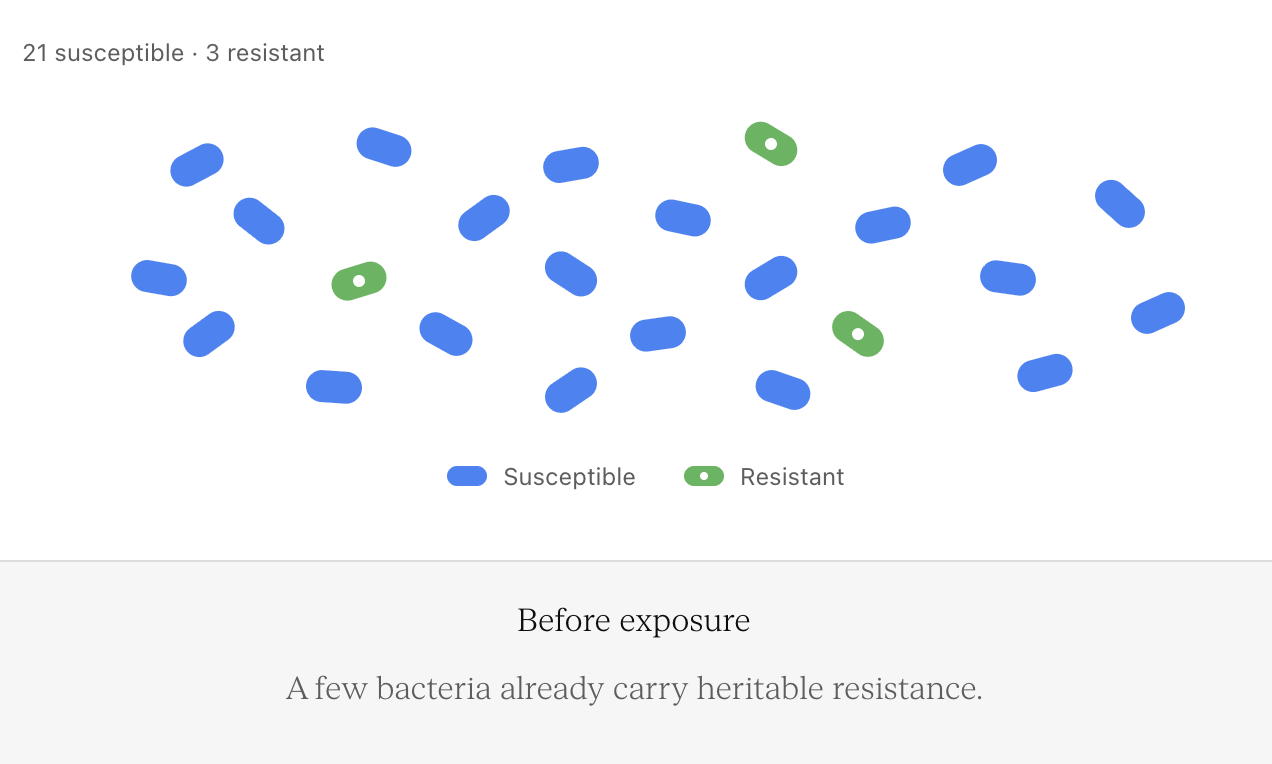
Initially, most bacteria are susceptible to an antibiotic.
A small number may already possess resistance.
Before antibiotic treatment
Many susceptible bacteria + a few resistant bacteria.
Antibiotic is introduced
Susceptible bacteria are killed or prevented from reproducing.
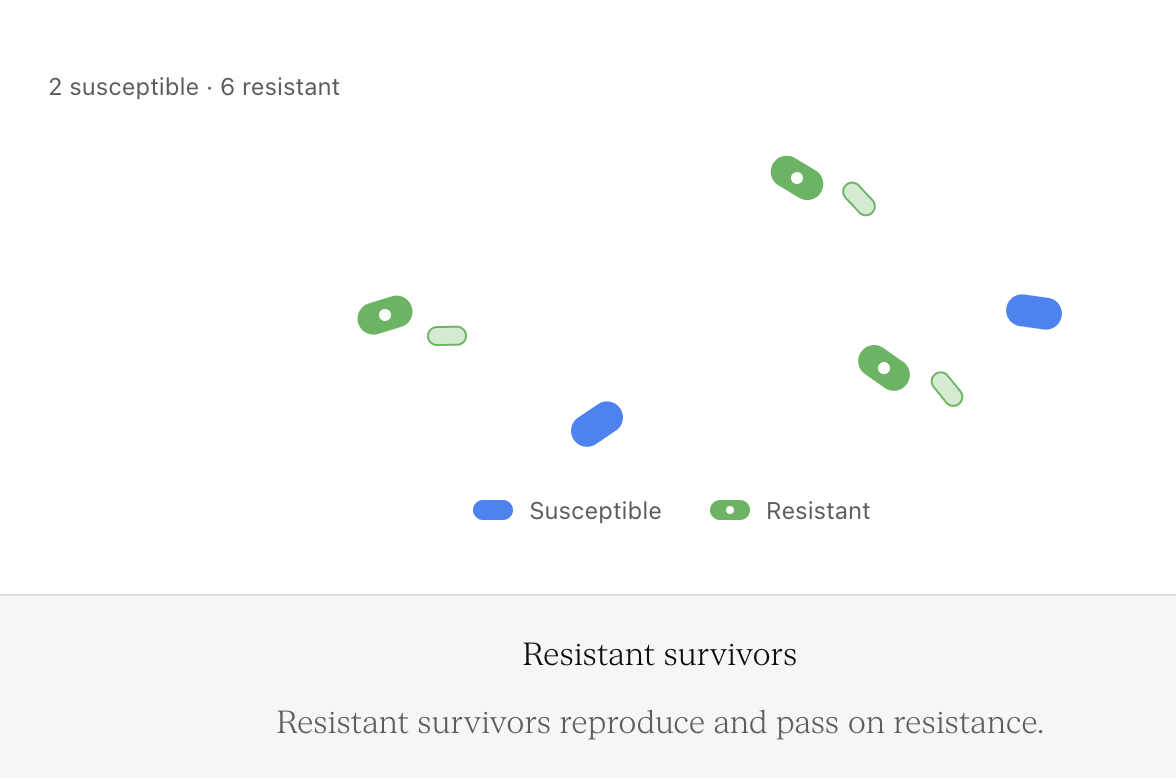
Resistant bacteria survive
They experience less competition for resources.
Survivors reproduce
Resistance genes are passed to descendants.
After many generations
A larger proportion of the bacterial population is resistant.
This is natural selection occurring in a modern population.
The Antibiotic Does Not Create Resistance Because It Is Needed
A common misconception is:
"The bacteria became resistant because they needed to survive."
This is not how natural selection works.
Resistance does not usually appear because an individual bacterium decides or tries to adapt.
Instead, genetic variation exists in bacterial populations through mechanisms including:
- Mutation.
- Transfer of genetic material between bacteria.
The antibiotic acts as a selection pressure.
It favors bacteria that already possess resistance characteristics or acquire resistance through genetic processes.
Worked Example: Antibiotic Resistance
Imagine a population containing 10,000 bacteria.
Most are susceptible to Antibiotic X.
However, a few bacteria possess a mutation that provides resistance.
Antibiotic X is introduced.
Most susceptible bacteria die.
The resistant bacteria survive and reproduce.
After many generations, the population contains a much larger proportion of resistant bacteria.
The antibiotic did not intentionally produce the resistance.
Instead:
Antibiotic X selected for resistance that was present in the population.
Resistance Is Heritable
For natural selection to cause evolutionary change, the advantageous characteristic must be heritable.
If resistance is genetically determined, resistant bacteria can pass resistance genes to descendants.
As resistant bacteria reproduce:
Resistant bacterium
→ resistant descendants
→ more resistant descendants
→ resistance becomes more common.
The frequency of resistance genes therefore increases within the population.
Bacteria Can Also Share Resistance Genes
Bacteria can acquire genetic material from other bacteria through processes known collectively as horizontal gene transfer.
Some resistance genes occur on small DNA molecules called plasmids.


Resistance genes can therefore sometimes spread through bacterial populations without waiting for every change to arise independently by mutation.
Natural selection can then increase the frequency of bacteria carrying those resistance genes.
Why Antibiotic Resistance Matters
Antibiotic-resistant bacteria can make infections more difficult to treat.
Resistance can result in:
- Fewer effective treatment options.
- Longer illnesses.
- Increased medical costs.
- Greater risk of complications.
- Increased risk of resistant infections spreading.
Antibiotic resistance is therefore both an important evolutionary example and a major public-health challenge.
Selection Pressure from Antibiotics
The antibiotic itself is a selection pressure.
Without the antibiotic, resistant bacteria may or may not have an advantage.
When the antibiotic is present:
Susceptible bacteria
→ less likely to survive and reproduce.
Resistant bacteria
→ more likely to survive and reproduce.
This difference in reproductive success drives natural selection.
Pesticide Resistance
A similar evolutionary process occurs in populations of agricultural pests.
Pesticides are substances used to control organisms that damage crops or other resources.
Pest populations contain genetic variation.
Some individuals may possess inherited characteristics that make them less affected by a pesticide.


How Pesticide Resistance Evolves
Consider a population of insects.
Initially:
Many susceptible insects + a few resistant insects
A pesticide is applied.
Many susceptible insects die.
Some resistant insects survive.
The survivors reproduce.
Their offspring inherit resistance-associated genes.
After repeated generations:
The proportion of resistant insects increases.
The pest population has evolved.
Worked Example: Insecticide Resistance
Suppose a crop field contains 100,000 insects.
Most are killed by a particular insecticide.
However, 100 insects possess an inherited characteristic that increases resistance.
After spraying:
- Most susceptible insects die.
- Resistant insects survive.
- Survivors reproduce.
If the same insecticide continues to provide a strong selection pressure, resistance may become increasingly common over generations.
Eventually, the insecticide may become much less effective against that population.
The Pesticide Does Not Teach the Insects to Adapt
Another common misconception is:
"The insects learned to resist the pesticide."
Natural selection does not work this way.
Instead:
Genetic variation exists
→ pesticide creates selection pressure
→ resistant individuals survive at higher rates
→ resistant individuals reproduce
→ resistance becomes more common.
The evolutionary change occurs across generations.
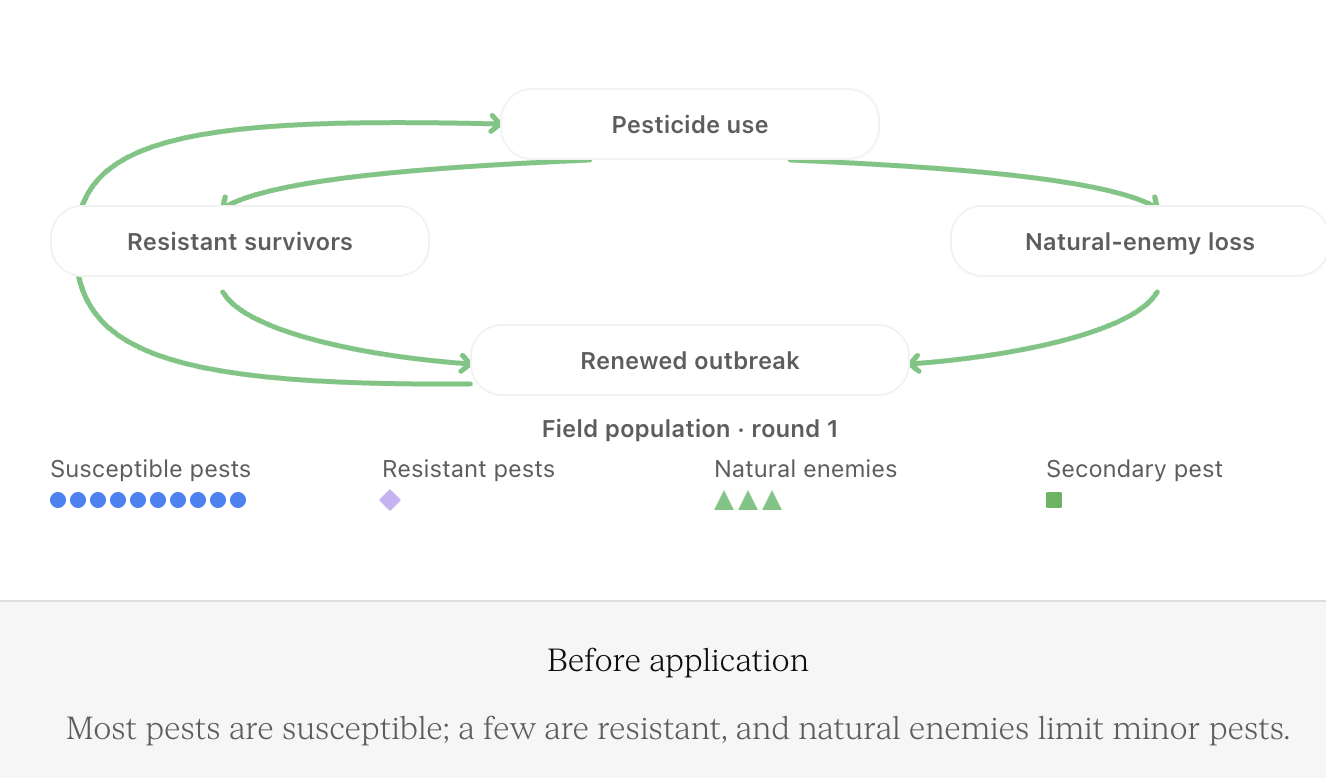
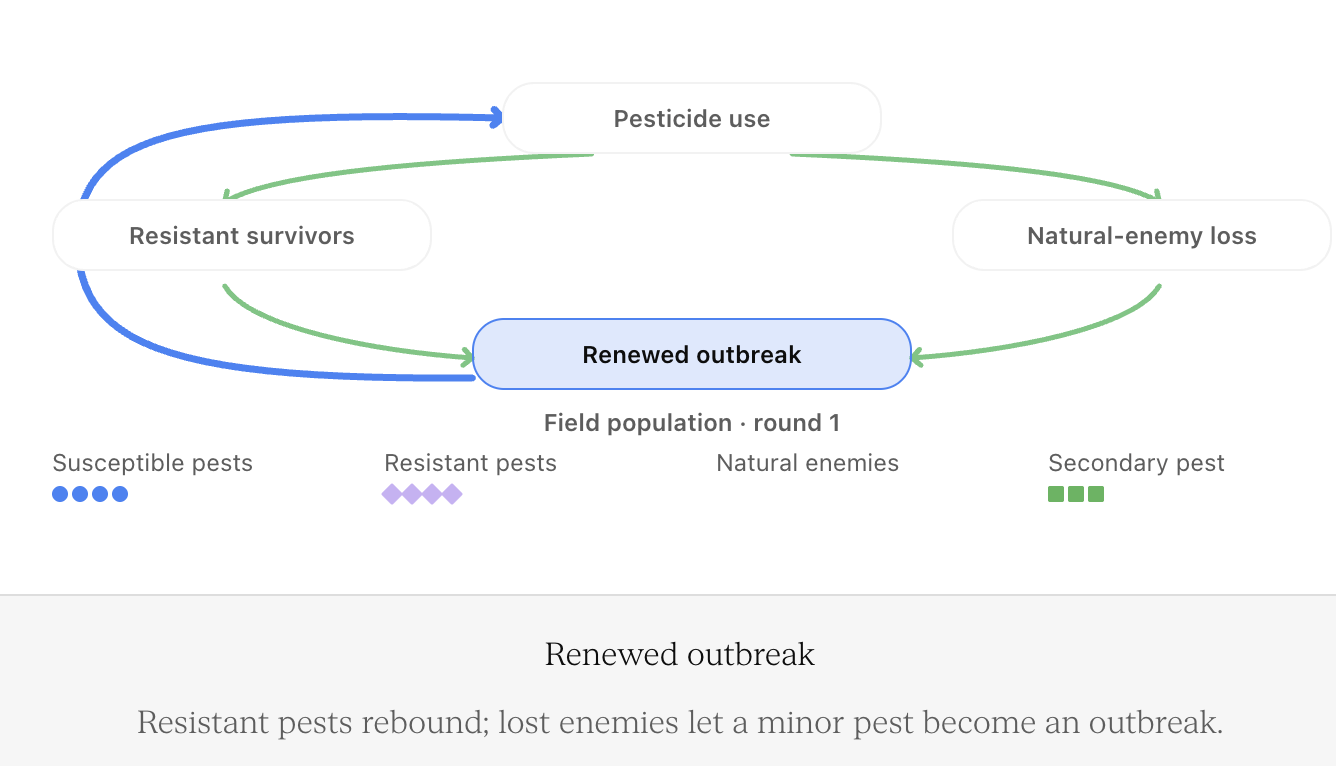
The Pesticide Treadmill
Repeated pesticide use can sometimes produce a cycle.
A pesticide is applied.
Susceptible pests die.
Resistant pests survive.
Resistance becomes more common.
The pesticide becomes less effective.
A higher dose or different pesticide may then be considered.
This can create continuing selection for resistant populations.
Herbicide Resistance
Plants can also evolve resistance.
Herbicides are chemicals used to control unwanted plants or weeds.
A weed population may contain individuals with genetic variations that allow them to survive a particular herbicide.
Repeated use of the same herbicide can strongly favor these individuals.
The sequence is similar:
Variation
→ herbicide application
→ susceptible plants die
→ resistant plants survive
→ resistant plants reproduce
→ resistance becomes more common.
This is another observable example of natural selection.
Evolution of Resistance Follows the Same Basic Pattern
Antibiotic, pesticide, and herbicide resistance all illustrate the same fundamental evolutionary process:
Genetic variation
→ selection pressure
→ differential survival
→ differential reproduction
→ inheritance
→ change in the population
The selection pressure differs, but the evolutionary mechanism is similar.
Evolution in Wild Animal Populations
Evolution can also be observed in natural populations that are not being deliberately exposed to medicines or pesticides.
Scientists can monitor populations over many generations and measure changes in characteristics.
Examples include changes in:
- Body size.
- Beak shape.
- Coloration.
- Reproductive timing.
- Resistance to disease.
- Feeding structures.


Darwin's Finches
Finches on the Galápagos Islands provide an important example.
Different finch populations have different beak characteristics.
Beak shape and size affect which foods birds can use effectively.
Environmental conditions can change the available food supply.
For example, drought conditions may reduce the availability of small, soft seeds while leaving more large, hard seeds.
Birds with beaks better suited to the remaining food may have greater survival and reproductive success.
If beak characteristics are heritable, the average characteristics of the population can change over generations.
Worked Example: Changing Beak Size
Imagine a finch population containing birds with different beak sizes.
A severe drought occurs.
Small seeds become scarce.
Large, hard seeds remain more available.
Birds with larger, stronger beaks can access these seeds more successfully.
These birds are more likely to survive and reproduce.
Their offspring inherit genes influencing beak characteristics.
The average beak size in later generations may increase.
This is natural selection producing measurable evolutionary change.
Environmental Change Can Change Selection Pressures
Selection pressures are not permanent.
Suppose rainfall increases after several dry years.
Small, soft seeds may become abundant again.
The advantage associated with larger beaks might decrease or even reverse.
Therefore, evolution does not always move continuously in one direction.
Changing environments can produce changing selection pressures.
Peppered Moths
The peppered moth is a well-known example of changes in trait frequencies associated with environmental conditions.
Peppered moths occur in lighter and darker forms.
During industrial pollution in parts of Britain, environmental changes altered the backgrounds on which moths rested.
Differences in visibility to predators contributed to changes in the frequencies of moth color forms.


As pollution levels later decreased and environments changed again, the frequencies of color forms also changed.
This demonstrates that selection can change as environments change.
Evolution in Response to Predators
Predators can create strong selection pressures.
Suppose prey individuals vary in:
- Speed.
- Camouflage.
- Defensive structures.
- Behavior.
Individuals with characteristics that improve survival may reproduce more successfully.
Over generations, these characteristics may become more common.
Predators themselves can also experience selection pressures created by their prey.
This can result in continuing evolutionary interactions between species.
Evolution in Response to Disease
Disease can also act as a selection pressure.
If individuals differ genetically in their susceptibility to a disease, individuals with greater resistance may have higher survival or reproductive success.
Over generations, alleles associated with resistance may become more common.
Pathogens can also evolve rapidly as they experience selection pressures from:
- Host immune systems.
- Medicines.
- Changes in host populations.
Evolutionary change can therefore occur on both sides of a host-pathogen relationship.
Evolution in Cities
Urban environments create new selection pressures.
City populations may encounter:
- Artificial light.
- Noise.
- Pollution.
- Buildings.
- Different food sources.
- Higher temperatures.
- Roads and traffic.
- Different predators.


Scientists study whether populations living in cities are developing inherited differences from populations of the same species living in rural environments.
Rapid Evolution
Evolution does not necessarily require millions of years.
If:
- Generation times are short.
- Selection pressure is strong.
- Heritable variation exists.
measurable evolutionary changes can occur over relatively few generations.
This is sometimes called rapid evolution or contemporary evolution.
Evolution Does Not Have a Goal
Evolution does not work toward a predetermined objective.
Populations do not evolve because they are trying to become:
- Stronger.
- More advanced.
- More complicated.
- Perfectly adapted.
Natural selection favors inherited characteristics that increase reproductive success under current conditions.
If conditions change, different characteristics may become advantageous.
Adaptation Is Environment-Dependent
A characteristic that is advantageous in one environment may be disadvantageous in another.
For example, antibiotic resistance can sometimes involve biological costs when antibiotics are absent.
Similarly:
A thick coat may be advantageous in a cold environment but disadvantageous in a hot environment.
There is therefore no universally "best" characteristic.
Fitness depends on environmental conditions.
Fitness in Evolution
In evolutionary biology, fitness refers to reproductive success.
An organism with high evolutionary fitness contributes relatively more genes to future generations.
Fitness does not simply mean:
- Strongest.
- Fastest.
- Largest.
- Healthiest.
An organism must survive sufficiently to reproduce and successfully pass genes to descendants.
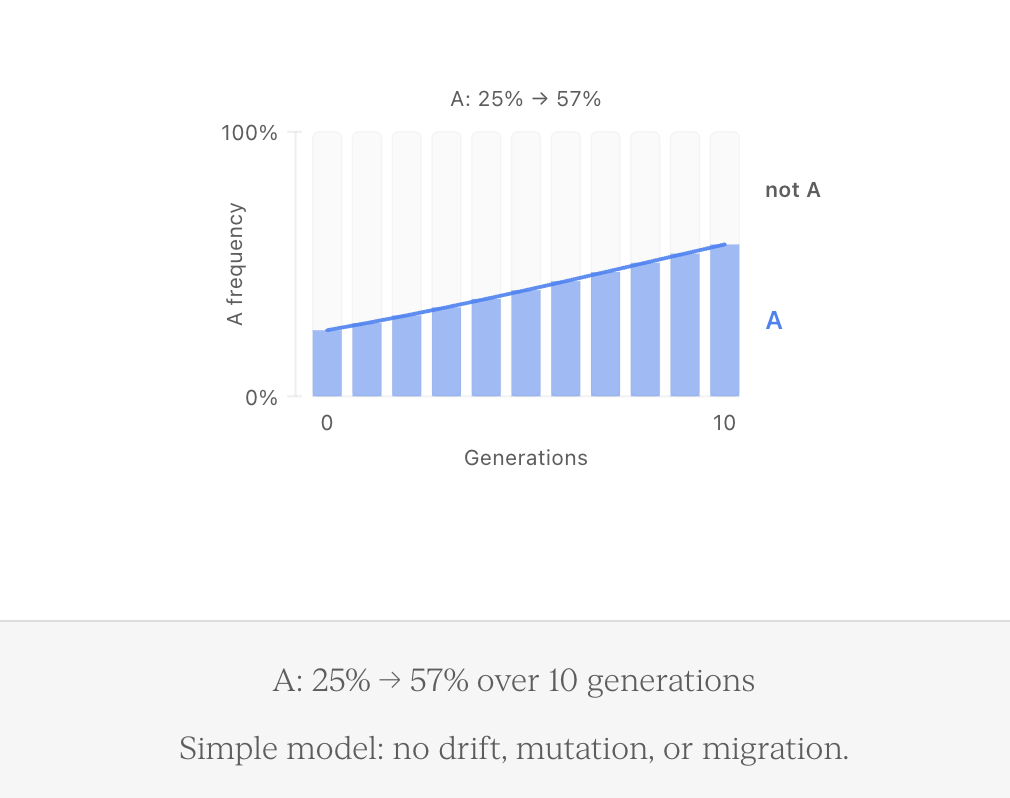
Allele Frequencies
Evolution can be measured by studying allele frequencies.
An allele is a version of a gene.
Suppose a resistance allele occurs in 5% of a population.
After several generations of strong selection, it occurs in 70% of the population.
The allele frequency has changed.
This is measurable evolutionary change.