Evidence for Evolution
| 站点: | Young Education |
| 课程: | Evolution and Biodiversity |
| 图书: | Evidence for Evolution |
| 打印: | Visiteur anonyme |
| 日期: | 2026年10月5日 星期一 05:00 |
1. Fossil Evidence
Learning outcomes
- I can explain how fossils provide evidence for evolution.
- I can describe how fossils are formed.
- I can interpret fossil sequences.
- I can identify transitional fossils.
- I can explain limitations of the fossil record.
What Are Fossils?
Fossils are preserved remains, impressions, traces, or other evidence of organisms that lived in the past.
Fossils can include:
- Bones.
- Teeth.
- Shells.
- Leaves.
- Wood.
- Pollen.
- Footprints.
- Burrows.
- Eggs.
- Feces.
- Impressions of organisms.
Fossils provide scientists with a record of organisms that lived millions or even billions of years ago.


By comparing fossils from different periods, scientists can investigate how organisms and populations have changed through Earth's history.
Fossils as Evidence for Evolution
The fossil record shows that life on Earth has changed over time.
Fossils reveal that:
- Many organisms that lived in the past are now extinct.
- Organisms found in older rocks often differ from organisms found in younger rocks.
- Groups of organisms have changed through geological time.
- Some fossils have combinations of characteristics that help connect major groups.
- Modern organisms share characteristics with organisms found in the fossil record.
Together with genetic, anatomical, and other evidence, fossils provide strong evidence for evolution.


The Fossil Record
The fossil record is the collection of fossils and their positions within rock layers and geological time.
It provides information about:
- Which organisms lived in the past.
- When organisms appeared.
- When groups became extinct.
- How organisms changed through time.
- Past environments.
- Relationships between groups of organisms.
The fossil record extends across billions of years of Earth's history.
Fossils and Rock Layers
Many fossils are found in sedimentary rock.
Sedimentary rocks form when sediments such as:
- Sand.
- Mud.
- Silt.
- Clay.
are deposited in layers.
Over time, these sediments can become compacted and cemented into rock.


Fossils trapped within these layers can provide information about the organisms living when the sediment was deposited.
Relative Age of Fossils
In an undisturbed sequence of sedimentary rocks, lower layers are generally older than layers above them.
A simplified sequence might be:
Youngest layer
Layer A
Layer B
Layer C
Layer D
Oldest layer
If a fossil is found in Layer D and another in Layer A, the fossil in Layer D is generally older, assuming the layers have not been disturbed.
This principle is called the law of superposition.
Rock Layers Can Be Disturbed
Scientists must be careful when interpreting rock layers.
Geological processes can:
- Fold rocks.
- Tilt layers.
- Break rocks along faults.
- Erode layers.
- Move sections of rock.
Therefore, scientists use multiple forms of geological evidence when determining the ages and relationships of fossils.
How Fossils Form
Fossilization is relatively rare.
Most organisms that die:
- Decompose.
- Are eaten.
- Are broken apart.
- Are destroyed by weathering.
For fossilization to occur, special conditions are usually required.
A common fossilization sequence is:
Organism dies
→ rapid burial
→ decomposition of soft tissues
→ sediment accumulates
→ minerals preserve or replace hard structures
→ sediment becomes rock
→ erosion may eventually expose the fossil


Step 1: Death
An organism dies.
If the organism remains exposed at the surface, it is unlikely to become fossilized.
Scavengers, microorganisms, weather, and physical damage may quickly destroy the remains.
Step 2: Rapid Burial
Rapid burial greatly increases the chance of fossilization.
An organism might be buried by:
- Mud.
- Sand.
- Volcanic ash.
- Sediment at the bottom of a lake or ocean.
Burial protects the remains from some scavengers and slows physical destruction.
Aquatic environments are therefore particularly important for fossil formation.
Step 3: Decomposition
Soft tissues usually decompose.
Hard structures are more likely to remain, including:
- Bones.
- Teeth.
- Shells.
- Woody tissues.
This is one reason organisms with hard body parts are better represented in the fossil record.
Step 4: Mineralization
Groundwater containing dissolved minerals can move through buried remains.
Minerals may:
- Fill spaces in bones.
- Replace original biological material.
- Preserve microscopic details.
Over long periods, the remains can become mineralized.
Step 5: Rock Formation
Additional sediment accumulates above the remains.
Pressure increases.
The surrounding sediments can eventually become sedimentary rock.
The fossil becomes preserved within the rock.
Step 6: Exposure
Millions of years later, geological processes may raise the rock toward Earth's surface.
Weathering and erosion can expose the fossil.
Scientists may then discover and study it.


Different Types of Fossils
Fossils can form in several ways.
Body Fossils
These preserve parts of an organism's body.
Examples include:
- Bones.
- Teeth.
- Shells.
- Wood.
Trace Fossils
These preserve evidence of an organism's activity.
Examples include:
- Footprints.
- Burrows.
- Bite marks.
- Nests.
- Fossilized feces.
Trace fossils can reveal how organisms behaved.
Molds and Casts
Sometimes an organism buried in sediment decomposes completely but leaves an impression.
This creates a mold.
If minerals or sediment later fill the mold, they can form a cast.
A cast reproduces the shape of the original organism or body part.
Exceptional Preservation
Under unusual conditions, more complete organisms can be preserved.
Examples include organisms preserved in:
- Amber.
- Ice.
- Very dry environments.
- Peat bogs.


These fossils may preserve structures that normally disappear during decomposition.
Dating Fossils
Scientists use several techniques to determine the ages of fossils and rocks.
Two important approaches are:
- Relative dating.
- Radiometric dating.
These methods answer slightly different questions.
Relative Dating
Relative dating determines whether something is older or younger than something else.
It does not necessarily provide an exact numerical age.
Rock layers are particularly useful.
For example:
If Fossil X occurs below Fossil Y in an undisturbed sequence:
Fossil X is generally older than Fossil Y.
Scientists can compare fossils from different layers to establish sequences through time.
Radiometric Dating
Radiometric dating uses the predictable radioactive decay of certain isotopes to estimate numerical ages.
Scientists often date:
- Volcanic rocks.
- Minerals.
- Rock layers associated with fossils.
The appropriate radioactive isotope depends partly on the age and type of material being studied.
Radiometric dating allows scientists to place many fossils within an approximate numerical timescale.
Fossil Sequences
A fossil sequence is a series of fossils from different ages that reveals patterns of change through time.
Imagine several rock layers containing fossils of related organisms.
Older layers might contain organisms with one set of characteristics.
Younger layers may contain organisms with gradually different combinations of characteristics.
Scientists can compare:
- Body size.
- Limb structure.
- Teeth.
- Skulls.
- Shells.
- Body proportions.
Patterns in these characteristics can provide evidence of evolutionary change.
Interpreting a Simple Fossil Sequence
Imagine three fossils found in successive rock layers.
Oldest fossil
Small body, short limbs, simple teeth.
Intermediate fossil
Larger body, longer limbs, modified teeth.
Youngest fossil
Large body, long limbs, highly specialized teeth.
This sequence suggests that characteristics within the lineage changed over time.
However, scientists would need additional evidence before determining the exact evolutionary relationships among these organisms.
Fossils Do Not Form a Perfect Ladder
Evolution should not be imagined as:
Species A → Species B → Species C → Species D
in a simple straight line.
Evolution usually produces branching patterns.


One ancestral population may give rise to several lineages.
Some lineages continue.
Others become extinct.
Fossils therefore represent parts of a complex evolutionary tree.
Transitional Fossils
A transitional fossil contains a combination of characteristics that helps scientists understand evolutionary changes between major groups or stages within a lineage.
A transitional fossil is not necessarily a direct ancestor of a modern species.
Instead, it may show a combination of:
- Ancestral characteristics.
- More recently evolved characteristics.
These combinations can help scientists reconstruct evolutionary relationships.
Archaeopteryx
Archaeopteryx is a famous fossil from approximately 150 million years ago.
It possessed a mixture of characteristics associated with non-avian dinosaurs and birds.
Characteristics included:
- Feathers.
- Wings.
- Teeth.
- Clawed fingers.
- A long bony tail.


This combination of characteristics makes Archaeopteryx important evidence for understanding the evolution of birds from theropod dinosaurs.
Tiktaalik
Tiktaalik is a fossil organism that lived approximately 375 million years ago.
It had a combination of characteristics associated with aquatic vertebrates and early tetrapods.
Features included:
- Fins.
- Scales.
- A flattened skull.
- A movable neck.
- Strong internal bones within the fins.


Its anatomy helps scientists understand evolutionary changes associated with the transition from primarily aquatic vertebrates toward early four-limbed vertebrates.
Whale Evolution
The fossil record also provides extensive evidence for the evolution of whales.
Early relatives of modern whales lived primarily on land.
Later fossils show increasingly aquatic characteristics.
Changes include:
- Modification of limbs.
- Reduction of hind limbs.
- Changes in the vertebral column.
- Changes in skull structure.
- Movement of the nostrils toward the top of the skull.


These fossils help scientists reconstruct the evolutionary transition from terrestrial ancestors to fully aquatic whales.
Horse Evolution
Horse fossils provide another well-studied example of evolutionary change.
Different fossil horse lineages show changes in characteristics such as:
- Body size.
- Tooth structure.
- Number of toes.
- Limb length.


These changes are associated with changing environments and diets.
However, horse evolution was a branching evolutionary history rather than a simple straight progression from one species to another.
Fossils and Extinction
The fossil record also provides evidence of extinction.
Many organisms found as fossils have no living representatives.
Examples include:
- Non-avian dinosaurs.
- Trilobites.
- Ammonites.
- Many prehistoric mammals.


The disappearance of particular fossils from later rock layers can indicate that a species or group became extinct.
Mass Extinctions
The fossil record shows several periods when unusually large numbers of species disappeared over relatively short geological intervals.
These are called mass extinctions.
After mass extinction events, surviving groups may diversify into ecological opportunities left by extinct organisms.
The fossil record therefore provides evidence not only of evolutionary change but also of major disruptions in the history of life.
Fossils and Changing Environments
Fossils can also reveal information about past environments.
For example, finding marine fossils high in mountains indicates that the rocks containing them originally formed in a marine environment.
Plant fossils can provide information about:
- Past climate.
- Rainfall.
- Vegetation.
- Temperature.
Fossils therefore help scientists reconstruct both evolutionary and environmental history.
Fossils and Common Ancestry
Similar structures found in fossils and living organisms can provide evidence of evolutionary relationships.
For example, the forelimbs of many vertebrates contain corresponding bones.
These similarities can be studied in:
- Fossils.
- Living animals.
- Embryos.
Scientists combine this anatomical evidence with genetic evidence to reconstruct evolutionary relationships.
Fossils and DNA Evidence
DNA usually does not survive for the vast periods represented by most fossils.
However, scientists can compare DNA from living species.
If fossil anatomy suggests two groups are closely related, DNA evidence from living representatives may provide additional evidence.
Modern evolutionary research therefore combines:
- Fossils.
- Comparative anatomy.
- DNA.
- Developmental biology.
- Biogeography.
- Geological evidence.
No single source of evidence is used in isolation.
Why Is the Fossil Record Incomplete?
The fossil record contains enormous amounts of information, but it is incomplete.
This is because fossilization is rare.
Most organisms never become fossils.
For fossilization to occur, several favorable conditions may be required.
Soft-Bodied Organisms Are Less Likely to Fossilize
Organisms with hard structures such as:
- Bones.
- Teeth.
- Shells.
are more likely to leave fossils.
Soft tissues usually decompose rapidly.
Therefore, organisms such as jellyfish and worms are generally less likely to fossilize than organisms with shells or bones.
Exceptional soft-tissue fossils do exist, but they are much rarer.
Habitat Affects Fossilization
Organisms living in environments where sediment accumulates rapidly are more likely to become fossilized.
For example:
- Lakes.
- River deltas.
- Ocean floors.
may provide good conditions for burial.
Organisms living in:
- Mountains.
- Forest floors.
- Dry exposed environments.
may be less likely to become fossilized.
This creates sampling bias in the fossil record.
Geological Processes Destroy Fossils
Even when fossils form, they may later be destroyed.
Rocks can be:
- Eroded.
- Melted.
- Metamorphosed.
- Crushed.
- Buried deeply.
- Altered by tectonic activity.
Millions of fossils may therefore have formed but no longer exist.
Many Fossils Have Not Been Discovered
Some fossils remain:
- Deep underground.
- Beneath oceans.
- Under ice.
- In inaccessible locations.
Others may simply not have been found yet.
The known fossil record is therefore only a portion of the fossils that currently exist.
Missing Fossils Do Not Mean Evolution Stopped
Because fossilization is rare, scientists do not expect to find fossils representing every generation or every evolutionary change.
Imagine a population existing for one million years.
Perhaps only a tiny number of individuals become fossilized.
The fossil record may therefore contain large time gaps.
This does not mean organisms suddenly disappeared and reappeared.
It reflects the incomplete nature of fossil preservation and discovery.
Preservation Bias
The fossil record is biased toward organisms that:
- Had hard body parts.
- Were abundant.
- Lived for long periods.
- Lived in environments favorable to burial.
- Lived relatively recently.
- Occurred in locations where rocks remain accessible.
Scientists account for these biases when interpreting fossil evidence.
Worked Example: Reading Rock Layers
Imagine four undisturbed sedimentary layers.
Layer A – top
Fossil species D
Layer B
Fossil species C and D
Layer C
Fossil species B and C
Layer D – bottom
Fossil species A and B
From this information we can infer:
- Layer D is the oldest.
- Layer A is the youngest.
- Species A occurs earlier in the sequence than Species D.
- Species B overlaps with Species A and Species C.
- Species C overlaps with Species B and Species D.
We should not automatically conclude that A evolved directly into B, B into C, and C into D.
More evidence would be required.
Worked Example: A Transitional Fossil
Suppose scientists discover a fossil with:
- Scales.
- Fish-like fins.
- Strong limb-like bones inside the fins.
- A movable neck.
Older fossils mainly show fish-like characteristics.
Younger fossils include early tetrapods with limbs.
The newly discovered fossil contains a combination of characteristics.
Scientists could investigate whether it represents a form close to the evolutionary transition between these groups.
The combination of ancestral and derived characteristics is what makes transitional fossils informative.
Fossil Evidence and Natural Selection
Fossils usually do not directly show natural selection occurring.
Instead, they document patterns of biological change through time.
Scientists can combine fossil evidence with information about:
- Environmental change.
- Anatomy.
- Genetics.
- Natural selection.
- Geological history.
to develop explanations for evolutionary patterns.
For example:
Environment changes
→ selection pressures change
→ populations evolve
→ descendants differ from earlier populations
→ fossils preserve some stages of that history.
Interpreting Fossils Carefully
Scientists must distinguish between:
Observation
and
Interpretation.
For example:
Observation: A fossil has both feathers and teeth.
Interpretation: The combination may provide information about evolutionary relationships between groups possessing these characteristics.
Scientific interpretations are strengthened when multiple independent sources of evidence support the same explanation.
Fossils Can Change Scientific Understanding
New fossil discoveries sometimes change our understanding of evolutionary history.
A newly discovered fossil may:
- Fill part of a previously unknown sequence.
- Reveal unexpected characteristics.
- Change estimated dates.
- Suggest a different relationship between groups.
- Reveal previously unknown biodiversity.
Science therefore continually updates explanations as new evidence becomes available.
Fossil Evidence and Evolutionary Trees
Scientists use fossils to help construct phylogenetic trees.
A phylogenetic tree represents hypotheses about evolutionary relationships.


Branches represent evolutionary lineages.
Branching points represent common ancestors or lineage divergence.
Fossils can help scientists determine when particular characteristics appeared and how different groups may be related.
Transitional Does Not Mean "Half-Finished"
A transitional organism was a complete, functioning organism adapted to its own environment.
It was not an incomplete version of a modern organism.
For example, Tiktaalik was not simply "half fish and half amphibian."
It was an organism with its own combination of characteristics.
The term transitional describes its importance for understanding evolutionary relationships.
Evolution Is Branching, Not a Ladder
A common misconception is that transitional fossils should form a perfect sequence:
fish → amphibian → reptile → mammal
Real evolutionary history is much more complex.
Evolution produces branching lineages.
Some branches:
- Diversify.
- Continue to the present.
- Become extinct.
Modern organisms are the surviving tips of this branching evolutionary history.
Limitations of Fossil Evidence
Important limitations include:
- Fossilization is rare.
- Soft-bodied organisms are underrepresented.
- Some environments preserve fossils better than others.
- Geological processes destroy fossils.
- Many fossils remain undiscovered.
- Fossils are often incomplete.
- Dating involves measurement and uncertainty.
- Fossil relationships must be interpreted rather than directly observed.
These limitations do not make fossils useless.
Instead, scientists account for them when evaluating evidence.
Why the Fossil Record Is Still Powerful Evidence
Despite its incompleteness, the fossil record contains consistent patterns.
Scientists can observe:
- Ordered sequences through geological time.
- Extinctions.
- Appearance of new groups.
- Changes within lineages.
- Transitional combinations of characteristics.
- Connections between organisms and changing environments.
These patterns can be compared with predictions from evolutionary theory.
The fossil record is therefore one of several major independent sources of evidence supporting evolution.
Common Mistakes
Thinking Every Dead Organism Becomes a Fossil
Fossilization is rare and requires favorable conditions.
Thinking Fossils Are Only Bones
Fossils can include footprints, burrows, shells, impressions, pollen, and many other forms of evidence.
Assuming Lower Rock Layers Are Always Older
This is generally true for undisturbed sedimentary sequences, but geological processes can overturn or disturb layers.
Thinking Transitional Fossils Are Direct Ancestors
A transitional fossil may be close to an evolutionary transition without being the direct ancestor of a later species.
Thinking Transitional Organisms Were Incomplete
Every fossil organism was a functioning organism in its own environment.
Expecting Fossils From Every Generation
Fossilization is far too rare to produce a continuous record of every organism or generation.
Thinking Evolution Is a Straight Line
Evolution produces branching patterns rather than a simple ladder.
Assuming a Gap in the Fossil Record Means Nothing Happened
Gaps are expected because fossilization, preservation, discovery, and sampling are incomplete.
Assuming Fossils Alone Tell the Entire Evolutionary Story
Scientists combine fossils with genetics, anatomy, geology, biogeography, and other evidence.
Check Your Understanding
1. Define a fossil.
2. What is the fossil record?
3. Why are sedimentary rocks particularly important for fossils?
4. Describe the major stages involved in fossil formation.
5. Why does rapid burial increase the chance of fossilization?
6. Why are bones and shells more likely to fossilize than soft tissues?
7. Distinguish between a body fossil and a trace fossil.
8. What is the law of superposition?
9. Distinguish between relative dating and radiometric dating.
10. How can a fossil sequence provide evidence for evolution?
11. What is a transitional fossil?
12. Why is Archaeopteryx considered important evolutionary evidence?
13. What characteristics make Tiktaalik useful for studying vertebrate evolution?
14. Explain how whale fossils provide evidence for evolutionary change.
15. Why is the fossil record incomplete?
16. Give three factors that create bias in the fossil record.
17. Why should evolution be represented as a branching tree rather than a ladder?
18. Why should scientists be cautious about claiming that one fossil species was the direct ancestor of another?
19. Explain why gaps in the fossil record are expected.
20. Explain how fossil evidence, geological evidence, and genetic evidence can work together to support evolutionary explanations.
Key Terms
- Fossil – preserved remains, impression, trace, or other evidence of an organism from the past.
- Fossil record – collection of known fossils and their positions through geological time.
- Fossilization – processes through which evidence of organisms becomes preserved.
- Sedimentary rock – rock formed through deposition, compaction, and cementation of sediments.
- Mineralization – preservation process involving minerals filling or replacing biological material.
- Body fossil – fossilized remains of part of an organism's body.
- Trace fossil – preserved evidence of an organism's activity.
- Mold – impression left after an organism or body part disappears.
- Cast – three-dimensional copy formed when a mold fills with material.
- Law of superposition – principle that lower layers in an undisturbed sedimentary sequence are generally older than layers above them.
- Relative dating – determining whether something is older or younger than something else.
- Radiometric dating – estimating age using predictable radioactive decay.
- Transitional fossil – fossil containing a combination of characteristics informative about evolutionary transitions.
- Common ancestor – ancestral population from which different evolutionary lineages descended.
- Phylogenetic tree – branching representation of hypotheses about evolutionary relationships.
- Extinction – permanent disappearance of a species.
- Preservation bias – unequal likelihood that different organisms or environments will be represented in the fossil record.
Key Takeaways
- Fossils are preserved remains, traces, impressions, or other evidence of organisms from the past.
- The fossil record provides evidence that life has changed through geological time.
- Fossils are commonly preserved in sedimentary rocks.
- Rapid burial increases the chance of fossilization.
- Hard structures such as bones, teeth, and shells are more likely to fossilize than soft tissues.
- Trace fossils such as footprints and burrows provide evidence about organism behavior.
- In undisturbed sedimentary sequences, deeper layers are generally older than layers above them.
- Relative dating establishes sequences, while radiometric dating can provide numerical age estimates.
- Fossil sequences allow scientists to investigate changes in organisms over time.
- Transitional fossils contain combinations of ancestral and more recently evolved characteristics.
- Archaeopteryx, Tiktaalik, and fossils documenting whale evolution are important examples.
- Evolutionary history is branching rather than a simple ladder.
- Fossils also provide evidence of extinction and environmental change.
- The fossil record is incomplete because fossilization is rare.
- Soft-bodied organisms and organisms from poorly preserving environments are underrepresented.
- Geological processes can destroy fossils.
- Many fossils remain undiscovered.
- Gaps in the fossil record are therefore expected.
- Scientists interpret fossils alongside evidence from genetics, anatomy, geology, and biogeography.
- Despite its limitations, the fossil record provides powerful evidence for evolutionary change over Earth's history.
2. Comparative Anatomy
Learning outcomes
- I can compare anatomical structures among organisms.
- I can identify homologous structures.
- I can identify analogous structures.
- I can explain how anatomy provides evidence for evolution.
- I can infer evolutionary relationships from anatomical evidence.
What Is Comparative Anatomy?
Comparative anatomy is the study of similarities and differences in the body structures of different organisms.
Scientists compare structures such as:
- Bones.
- Limbs.
- Wings.
- Fins and flippers.
- Skulls.
- Teeth.
- Organs.
- Body plans.
These comparisons can provide evidence about how organisms are related and how structures have changed during evolution.


Organisms that appear very different externally can sometimes have remarkably similar underlying anatomical structures.
Anatomy as Evidence for Evolution
Evolution predicts that organisms descended from a common ancestor may retain modified versions of structures inherited from that ancestor.
As populations evolve in different environments, these structures can become adapted for different functions.
Scientists can therefore compare anatomical structures to investigate:
- Common ancestry.
- Evolutionary relationships.
- Adaptations.
- Changes in function.
- Divergence between groups.
Anatomical evidence becomes especially powerful when combined with evidence from fossils, DNA, embryology, and biogeography.
Homologous Structures
Homologous structures are structures in different organisms that share a similar underlying anatomical pattern because they were inherited from a common ancestor.
Their functions may be different.
A classic example is the forelimbs of vertebrates.
Compare:
- A human arm.
- A dog's foreleg.
- A bird's wing.
- A whale's flipper.
Although these limbs perform very different functions, they contain many of the same basic bones arranged in a similar pattern.
The shared arrangement provides evidence that these organisms inherited the basic limb structure from a common ancestor.
The Vertebrate Forelimb
A typical vertebrate forelimb contains corresponding bones including:
- Humerus.
- Radius.
- Ulna.
- Wrist bones.
- Hand or foot bones.
- Digits.
These bones can be modified considerably in different species.
For example:
Human
→ grasping and manipulating objects.
Dog
→ walking and running.
Bird
→ flight.
Whale
→ swimming.
The function differs, but the underlying structural pattern remains recognizable.


Why Homologous Structures Matter
Homologous structures are important evidence for common ancestry.
If several species possess the same complex arrangement of bones but use them for different purposes, a strong evolutionary explanation is that the basic structure was inherited from a common ancestor and modified in different lineages.
The pattern can be summarized as:
Common ancestor
→ descendants inherit similar structure
→ populations experience different selection pressures
→ structures become modified
→ different functions develop.
This process is called divergent evolution.
Divergent Evolution
Divergent evolution occurs when related populations become increasingly different.
Imagine an ancestral vertebrate with a basic forelimb structure.
Different descendant populations encounter different environments and ways of life.
Over many generations:
Shared ancestral limb
→ different selection pressures
→ different adaptations
→ different limb forms.
One lineage might develop limbs suited to running.
Another might develop wings.
Another might develop flippers.
The structures remain homologous because they originated from the same ancestral structure.
Worked Example: Human Arm and Whale Flipper
A human arm and whale flipper look very different externally.
Their functions are also different.
The human arm is adapted for:
- Reaching.
- Grasping.
- Manipulating objects.
The whale flipper is adapted for:
- Steering.
- Stability.
- Movement through water.
Yet both contain corresponding bones, including the humerus, radius, ulna, wrist bones, and digits.


The similarities in underlying structure provide evidence of common ancestry.
Homologous Does Not Mean Identical
Homologous structures do not have to look exactly alike.
They may differ greatly in:
- Size.
- Shape.
- Proportion.
- Function.
What matters is their underlying anatomical relationship and evolutionary origin.
For example, a whale flipper and human arm are clearly different in appearance and function, but their skeletal patterns reveal their shared evolutionary history.
Analogous Structures
Analogous structures perform similar functions but evolved independently in different evolutionary lineages.
They may look similar because organisms experience similar environmental challenges.
However, they do not share the same evolutionary origin as that particular structure.
A classic example is:
Bird wing
and
insect wing.
Both are used for flight, but they have very different structures and evolutionary origins.


Similar Function Does Not Always Mean Close Relationship
It can be tempting to assume that two organisms with similar structures must be closely related.
This is not always true.
For example:
- Birds have wings.
- Bats have wings.
- Insects have wings.
All three can fly, but flight evolved differently in these groups.
Similar environmental challenges can result in structures with similar functions even when the organisms are not closely related.
Convergent Evolution
Convergent evolution occurs when distantly related organisms independently evolve similar characteristics because they experience similar selection pressures.
For example, sharks and dolphins both have:
- Streamlined bodies.
- Fins or fin-like structures.
- Body shapes suited to efficient swimming.


However:
- Sharks are fish.
- Dolphins are mammals.
Their streamlined body forms evolved independently as adaptations to moving efficiently through water.
This is an example of convergent evolution.
Homologous vs Analogous Structures
The distinction is important.
Homologous structures
- Share an evolutionary origin.
- Have similar underlying anatomy.
- May perform different functions.
- Provide evidence of common ancestry.
Example:
Human arm and whale flipper.
Analogous structures
- Evolved independently.
- Often perform similar functions.
- May look superficially similar.
- Do not indicate close ancestry based on that structure alone.
Example:
Bird wing and insect wing.
An Important Complication: Bird and Bat Wings
Bird wings and bat wings provide an interesting example.
As wings for powered flight, they evolved independently and can be considered analogous in that functional sense.
However, the underlying forelimbs are homologous because birds and bats inherited the basic tetrapod forelimb pattern from a distant common ancestor.


This demonstrates why scientists examine structures carefully rather than simply deciding whether two organs "look similar."
Worked Example: Bird Wing and Insect Wing
Consider a bird and a butterfly.
Both possess wings used for flight.
However, their wings have very different structures.
A bird wing:
- Contains bones.
- Contains muscles.
- Is covered with feathers.
- Is a modified vertebrate forelimb.
An insect wing:
- Contains no vertebrate bones.
- Develops from the insect body covering.
- Has a completely different evolutionary origin.
Therefore, bird and insect wings are analogous structures.
Worked Example: Whale and Fish
Whales and fish both live in aquatic environments.
Both may possess:
- Streamlined bodies.
- Structures used for swimming.
However, whales are mammals.
Their ancestors were terrestrial vertebrates.
Fish belong to different evolutionary lineages.
Similar aquatic selection pressures favored similar body forms.
This is another example of convergent evolution.
Structural Similarity and Common Ancestry
When scientists compare anatomical structures, they look beyond superficial appearance.
They examine:
- Position of structures.
- Arrangement of bones.
- Connections between structures.
- Development.
- Relationships to surrounding tissues.
- Fossil evidence.
- Genetic evidence.
A complex shared structural pattern can provide strong evidence of common ancestry.
Comparing Vertebrate Skeletons
Many vertebrates share the same general skeletal organization.
For example, mammals typically possess:
- A skull.
- A vertebral column.
- Ribs.
- Shoulder and pelvic structures.
- Forelimbs.
- Hind limbs.


The structures have been modified extensively in different groups, but their shared organization reflects evolutionary relationships.
Vestigial Structures
A vestigial structure is a reduced or modified structure inherited from ancestors in which it had a larger or different function.
Vestigial does not necessarily mean completely useless.
A structure may retain a smaller or altered function.
Examples often discussed include:
- Pelvic bones in whales.
- Reduced hind-limb structures in some snakes.
- Wings in some flightless birds.


These structures can provide clues about an organism's evolutionary history.
Whale Pelvic Bones
Modern whales do not walk on land, but they retain reduced pelvic structures.
These structures are related to the pelvis of their terrestrial ancestors.
Fossil evidence shows that early whale relatives possessed functional hind limbs.
Over evolutionary time, whale bodies became increasingly adapted to aquatic life.
Their reduced pelvic structures therefore provide anatomical evidence consistent with their terrestrial ancestry.
Vestigial Does Not Mean "Badly Designed"
Vestigial structures should not be interpreted as simply defective structures.
They are products of evolutionary history.
A structure may:
- Lose its original major function.
- Become smaller.
- Develop a new function.
- Remain because there is little selection pressure to eliminate it.
Evolution modifies existing structures rather than designing organisms from scratch.
Comparative Anatomy and Natural Selection
Comparative anatomy can show the results of natural selection acting over long periods.
Suppose related populations enter different environments.
They begin with similar inherited structures.
Different selection pressures favor different modifications.
For example:
Ancestral forelimb
→ swimming environment → flipper
→ flying environment → wing
→ terrestrial running → leg
→ manipulation → arm and hand.
The resulting structures can remain anatomically homologous even after becoming highly specialized.
Anatomy and Adaptation
Anatomical differences often reflect adaptations.
For example, mammal teeth differ according to diet.
Carnivores
Often possess:
- Sharp canine teeth.
- Cutting teeth.
Herbivores
Often possess:
- Broad grinding teeth.
- Large surfaces for processing plant material.
Omnivores
Often possess:
- A combination of cutting, tearing, and grinding teeth.


These differences can provide information about both evolutionary relationships and ecological adaptations.
Anatomy Can Reveal Function
Scientists can often use anatomical structures to infer how an organism lived.
For example:
Long, powerful hind limbs might suggest:
- Jumping.
- Rapid running.
Sharp curved claws might suggest:
- Capturing prey.
- Climbing.
Broad grinding teeth might suggest:
- A plant-based diet.
This is especially useful when studying extinct organisms known only from fossils.
Comparative Anatomy and Fossils
Comparative anatomy is particularly powerful when combined with fossil evidence.
Scientists can compare:
Older fossil structures
with
younger fossil structures
and
structures in living organisms.
This allows them to investigate how anatomical characteristics changed through time.


Inferring Evolutionary Relationships
Suppose Species A and Species B share many detailed homologous structures.
Species C shares fewer of those structures.
Anatomical evidence may suggest that Species A and B share a more recent common ancestor with each other than either does with Species C.
However, scientists do not normally use anatomy alone.
Modern evolutionary relationships are investigated using multiple sources of evidence, including:
- DNA sequences.
- Proteins.
- Fossils.
- Embryology.
- Biogeography.
- Comparative anatomy.
Shared Derived Characteristics
Scientists can use shared derived characteristics to help reconstruct evolutionary relationships.
A derived characteristic is a feature that evolved in a lineage and was inherited by its descendants.
If several species share a derived characteristic, it can provide evidence that they share a common ancestor in which that characteristic evolved.
This information can be used to construct phylogenetic trees.
Phylogenetic Trees
A phylogenetic tree is a branching diagram representing a hypothesis about evolutionary relationships.
A simplified tree might look like this:
Common ancestor
→ Lineage A
→ Common ancestor of B and C
→ Lineage B
→ Lineage C
Species B and C share a more recent common ancestor with each other than either shares with A.
Anatomical evidence can help scientists determine these relationships.


Similarity Does Not Always Mean Close Relationship
This is one of the major challenges of comparative anatomy.
Two species can look similar because of:
Common ancestry
or
Convergent evolution.
Scientists therefore need to determine whether similarities are homologous or analogous.
For example:
Whale and shark
→ similar streamlined shape
→ similar environmental pressures
→ convergent evolution.
Whale flipper and human arm
→ different functions
→ same underlying bone arrangement
→ homologous structures and common ancestry.
Worked Example: Four Vertebrate Limbs
Suppose you compare:
- Human arm.
- Cat foreleg.
- Whale flipper.
- Bat forelimb.
All contain corresponding:
- Humerus.
- Radius.
- Ulna.
- Wrist bones.
- Digits.
Yet they perform different functions.
Human
Manipulation.
Cat
Walking and running.
Whale
Swimming.
Bat
Flight.
The most useful explanation is that the basic structure was inherited from a common ancestor and modified through divergent evolution.
Worked Example: Shark and Dolphin
A student observes that sharks and dolphins both have streamlined bodies and dorsal fins.
The student concludes:
"Sharks and dolphins must be very closely related."
This conclusion is not supported by these similarities alone.
Sharks and dolphins belong to very different vertebrate groups.
Their similar external shapes are largely adaptations to similar aquatic conditions.
Therefore, these similarities illustrate convergent evolution rather than close ancestry.
Worked Example: Whale Pelvis
A whale possesses small pelvic bones even though it does not walk.
Why?
Whales evolved from ancestors with functional hind limbs.
The pelvis was inherited from those ancestors and became greatly reduced as whale lineages became adapted to aquatic life.
This structure therefore provides anatomical evidence of evolutionary history.
Anatomical Evidence and DNA
Anatomical evidence was extremely important in developing early classifications of organisms.
Today, scientists can also compare DNA.
Sometimes DNA evidence confirms relationships suggested by anatomy.
Sometimes genetic evidence causes scientists to revise earlier classifications.
The strongest evolutionary explanations generally use multiple independent sources of evidence.
Comparative Anatomy and Classification
Historically, organisms were classified largely according to visible characteristics.
Scientists compared:
- Body structures.
- Reproductive structures.
- Skeletons.
- Organs.
Modern classification still uses anatomy but increasingly combines it with molecular evidence.
This produces classifications that more accurately represent evolutionary relationships.
Convergent Evolution Can Be Misleading
Convergent evolution can make unrelated organisms appear surprisingly similar.
Examples include:
- Sharks and dolphins.
- Birds and insects as flying organisms.
- Streamlined marine animals from different groups.
- Similar body forms in unrelated desert plants.


This is why scientists examine underlying structures and evolutionary history rather than relying only on appearance.
Divergent and Convergent Evolution
These two processes produce different patterns.
Divergent Evolution
Common ancestor
→ different environments
→ different selection pressures
→ structures become increasingly different.
This commonly produces homologous structures.
Convergent Evolution
Different evolutionary lineages
→ similar environments
→ similar selection pressures
→ similar adaptations evolve independently.
This commonly produces analogous structures.
Anatomy as Evidence, Not Absolute Proof by Itself
Anatomical similarities provide evidence that scientists can use to develop hypotheses about evolutionary relationships.
However, one similar structure alone may not be enough to establish a relationship.
Scientists strengthen conclusions by comparing:
- Many anatomical characteristics.
- Fossil evidence.
- DNA sequences.
- Development.
- Geographic distribution.
Scientific conclusions become stronger when independent evidence points toward the same evolutionary relationship.
Applying Comparative Anatomy
When comparing two structures, ask:
What does each structure do?
Compare their functions.
How are they constructed?
Look at the underlying anatomy.
Do they share the same basic structural pattern?
This may indicate homology.
Could the similarity result from similar environmental pressures?
This may indicate analogy.
What other evidence supports the relationship?
Consider fossils and DNA.
A Useful Comparison Framework
When analyzing anatomical evidence, use:
Structure
What structures are being compared?
Anatomy
What underlying features are shared or different?
Function
Do they perform the same or different functions?
Evolutionary origin
Is the similarity inherited from a common ancestor or independently evolved?
Conclusion
Does the evidence suggest homology, analogy, divergent evolution, or convergent evolution?
Common Mistakes
Assuming Similar Function Means Homology
Structures performing the same function can evolve independently.
Assuming Different Functions Mean Structures Are Unrelated
Homologous structures can perform very different functions.
Thinking Homologous Means Identical
Homologous structures can become highly modified while retaining the same underlying anatomical pattern.
Thinking Analogous Structures Mean the Organisms Are Closely Related
Analogous structures often result from convergent evolution.
Thinking Vestigial Means Completely Useless
Vestigial structures are reduced or modified relative to their ancestral form and may retain secondary functions.
Assuming Similar Appearance Always Indicates Common Ancestry
Similar environmental pressures can produce similar adaptations in unrelated lineages.
Treating Evolution as a Straight Line
Evolution produces branching relationships.
Using Anatomy Alone
Comparative anatomy is most powerful when combined with genetic, fossil, developmental, and geographic evidence.
Check Your Understanding
1. Define comparative anatomy.
2. What is a homologous structure?
3. Give an example of two homologous structures.
4. Why do homologous structures provide evidence for common ancestry?
5. What is an analogous structure?
6. Give an example of analogous structures.
7. Distinguish between homologous and analogous structures.
8. Explain why a human arm and whale flipper are homologous.
9. Explain why a bird wing and insect wing are analogous.
10. What is divergent evolution?
11. What is convergent evolution?
12. Explain why sharks and dolphins have similar streamlined bodies despite belonging to different evolutionary lineages.
13. What is a vestigial structure?
14. Why are whale pelvic bones useful evidence for evolution?
15. Why does vestigial not necessarily mean useless?
16. Explain how homologous structures can be used to infer evolutionary relationships.
17. Why can convergent evolution make classification difficult?
18. A bat wing and whale flipper contain the same basic forelimb bones but perform different functions. Explain what this suggests about their evolutionary history.
19. Two unrelated animals possess similar streamlined bodies because both live in water. Is this more likely to represent homologous or analogous characteristics? Explain.
20. Why should anatomical evidence be combined with fossil and genetic evidence when reconstructing evolutionary relationships?
Key Terms
- Comparative anatomy – study of similarities and differences in anatomical structures among organisms.
- Homologous structures – structures sharing an evolutionary origin and underlying anatomical pattern, although their functions may differ.
- Analogous structures – structures with similar functions that evolved independently.
- Common ancestor – ancestral population from which two or more evolutionary lineages descended.
- Divergent evolution – evolutionary process in which related lineages become increasingly different.
- Convergent evolution – independent evolution of similar characteristics in different evolutionary lineages.
- Vestigial structure – reduced or modified inherited structure that had a larger or different function in ancestors.
- Shared derived characteristic – characteristic that evolved in a lineage and is shared by its descendants.
- Phylogenetic tree – branching representation of hypotheses about evolutionary relationships.
- Adaptation – inherited characteristic that increases reproductive success under particular environmental conditions.
- Natural selection – process through which inherited characteristics affecting reproductive success become more or less common over generations.
Key Takeaways
- Comparative anatomy examines similarities and differences in the structures of organisms.
- Anatomical evidence can help scientists reconstruct evolutionary relationships.
- Homologous structures share an evolutionary origin.
- Homologous structures may perform very different functions.
- Human arms, whale flippers, and other vertebrate forelimbs share the same basic anatomical pattern.
- Homologous structures provide evidence of common ancestry.
- Divergent evolution can modify homologous structures for different functions.
- Analogous structures evolved independently but perform similar functions.
- Bird and insect wings provide an example of analogous structures used for flight.
- Convergent evolution occurs when different lineages independently evolve similar adaptations.
- Sharks and dolphins illustrate how similar environments can produce similar body forms.
- Vestigial structures can provide evidence about ancestral anatomy.
- Vestigial does not necessarily mean completely functionless.
- Similar appearance does not automatically indicate close evolutionary relationships.
- Scientists examine underlying anatomical patterns rather than superficial appearance alone.
- Evolutionary history is branching rather than linear.
- Comparative anatomy is most powerful when combined with fossil, genetic, developmental, and biogeographic evidence.
3. Embryology
Learning outcomes
- I can describe similarities among embryos of different species.
- I can explain how embryological evidence supports evolution.
- I can compare stages of embryonic development.
- I can identify shared developmental features.
- I can relate embryology to common ancestry.
What Is Embryology?
Embryology is the study of how organisms develop from fertilization through their early stages of life.
An embryo is an organism during an early stage of development.
Scientists can compare the embryos of different species to investigate:
- Similarities in development.
- Differences in development.
- Shared anatomical structures.
- Developmental patterns.
- Evolutionary relationships.


Similar developmental patterns among different species can provide evidence that those species inherited aspects of their developmental programs from common ancestors.
Embryonic Development
In sexually reproducing animals, development usually begins when a sperm cell fertilizes an egg cell.
This produces a zygote.
The general sequence is:
Fertilization → zygote → cell division → embryo → further development → fetus or juvenile stage
The exact terminology and developmental stages vary among groups of organisms.
During development, cells:
- Divide.
- Move.
- Change shape.
- Differentiate.
- Form tissues.
- Form organs.
- Become increasingly specialized.
From One Cell to Many
A fertilized egg begins as a single cell.
Through mitosis, this cell divides repeatedly.
One cell becomes:
2 cells → 4 cells → 8 cells → many cells
These cells eventually become organized into tissues and organs.
The instructions controlling much of this process are contained within the organism's DNA.
Because related species inherited many genes from common ancestors, similarities in their developmental processes can provide evidence of evolutionary relationships.
Comparing Embryos
Comparative embryology examines development in different organisms.
Vertebrate embryos are particularly useful for comparison.
Vertebrates include:
- Fish.
- Amphibians.
- Reptiles.
- Birds.
- Mammals.
Despite the large differences between adult members of these groups, their embryos share several important developmental features.


These similarities reflect the shared evolutionary history of vertebrates.
Early Developmental Similarities
During development, vertebrate embryos share several broad features.
Examples include:
- A basic body axis.
- A developing nervous system.
- A post-anal tail during some developmental stages.
- Pharyngeal arches.
- Segmented structures called somites.
- Similar early patterns of organ development.
The structures may later develop into very different adult forms.
The Basic Vertebrate Body Plan
Vertebrates share a basic body organization.
During development, structures appear in corresponding positions.
For example:
- The nervous system develops along the dorsal side.
- The digestive system develops through the body.
- Repeated blocks of tissue called somites appear.
- Pharyngeal arches develop in the head and neck region.
These similarities reflect inherited developmental patterns.
Pharyngeal Arches
Vertebrate embryos develop structures called pharyngeal arches in the head and neck region.


These structures develop differently in different vertebrate groups.
In fish, structures associated with the pharyngeal region contribute to structures supporting the gills.
In mammals, including humans, related embryonic structures contribute to parts of the:
- Jaw.
- Ear.
- Throat.
- Neck.
The important point is that corresponding embryonic structures can develop into different adult structures.
Humans Do Not Have Embryonic "Fish Gills"
A common oversimplification is to say that human embryos have gills.
This is inaccurate.
Human embryos develop pharyngeal arches, which are structures shared in the development of vertebrates.
They do not function as fish gills.
The similarity is important because the structures have related developmental origins, not because a human embryo passes through a fish stage.
The Embryonic Tail
Many vertebrate embryos develop a post-anal tail, meaning that part of the body extends beyond the developing anus.
In many vertebrates, this develops into a functional adult tail.
In humans, much of the embryonic tail regresses during development.
The remaining structures contribute to the coccyx, or tailbone.


The presence of corresponding developmental structures among vertebrates provides evidence of shared ancestry.
Somites
Somites are repeated blocks of embryonic tissue that form along the developing body.
They contribute to structures including:
- Vertebrae.
- Skeletal muscles.
- Parts of the skin.
Somites appear during the development of many vertebrates.
Their shared pattern provides another example of similarities in vertebrate development.
Similarity Does Not Mean Identical
Embryos of different species are not identical.
Differences can exist from very early stages of development.
However, related species often share developmental patterns and corresponding structures.
Therefore, embryological evidence should not be described as:
"All vertebrate embryos are the same."
A better statement is:
Vertebrate embryos share important developmental features because they inherited developmental programs from common ancestors.
Development Changes Over Time
As development proceeds, embryos become increasingly specialized.
For example, early vertebrate embryos may share several recognizable structural patterns.
Later:
Fish embryos
→ develop characteristics suited to aquatic life.
Bird embryos
→ develop bird-specific structures.
Mammalian embryos
→ develop mammalian characteristics.


The shared structures are modified differently as development continues.
Comparing Developmental Stages
When scientists compare embryos, they must compare equivalent developmental stages.
Simply comparing embryos of the same age in days can be misleading because different species develop at different rates.
Scientists examine features such as:
- Number of somites.
- Limb development.
- Organ development.
- Body shape.
- Developmental landmarks.
This allows more meaningful comparisons between species.
Shared Developmental Features
Examples of developmental features that may be compared include:
- Pharyngeal arches.
- Somites.
- Limb buds.
- Tails.
- Developing eyes.
- Nervous systems.
- Hearts.
- Body segmentation.
Scientists examine how these structures:
- Appear.
- Develop.
- Change.
- Become modified.
Patterns of similarity and difference can help reconstruct evolutionary relationships.
Limb Development
Tetrapods — vertebrates descended from ancestors with four limbs — share important developmental processes involved in forming limbs.
Early limbs begin as limb buds.


These structures can later become:
- Human arms.
- Bird wings.
- Whale flippers.
- Dog legs.
The adult structures may look very different, but similarities in their development support their homologous relationship.
Embryology and Homologous Structures
Comparative anatomy identifies homologous structures in adults.
Embryology can help explain how those structures are related.
For example:
Human arm
Bat forelimb
Whale flipper
all develop using related developmental pathways inherited from common vertebrate ancestors.
Embryology and comparative anatomy therefore provide complementary evidence for evolution.
Embryology and Common Ancestry
Evolution predicts that related organisms inherit genes and developmental processes from their ancestors.
Therefore:
Common ancestor
→ descendants inherit developmental genes
→ developmental patterns are modified over generations
→ related species retain some similarities
→ embryological similarities can reveal evolutionary relationships.
The closer the evolutionary relationship, the more developmental similarities scientists may expect to find, although the pattern is not always simple.
Developmental Genes
Embryonic development is controlled by networks of genes.
Some developmental genes are extremely ancient and are shared across very different groups of animals.
One important group is the Hox genes.
Hox genes help determine where different body structures develop along the body axis.
Related Hox genes occur in many animals.


The widespread conservation of developmental genes provides molecular evidence supporting common ancestry.
Evolution Can Modify Development
Evolutionary changes can occur when mutations affect:
- When a developmental gene becomes active.
- Where it becomes active.
- How strongly it is expressed.
- How long it remains active.
Small changes in developmental processes can sometimes produce substantial differences in adult anatomy.
This helps explain how organisms with similar developmental foundations can eventually develop very different adult forms.
Worked Example: Vertebrate Forelimbs
Consider:
- A human.
- A bat.
- A whale.
Their adult forelimbs perform very different functions.
However, each begins development as a limb bud.
Related developmental processes produce the same basic arrangement of limb bones.
Later development modifies:
- Bone lengths.
- Digit proportions.
- Overall shape.
The result is:
Human arm → manipulation
Bat wing → flight
Whale flipper → swimming
Shared development supports the conclusion that these structures are homologous.
Worked Example: Pharyngeal Arches
Consider fish and mammals.
Both develop pharyngeal arches as embryos.
In fish, structures associated with this region contribute to the gill-supporting apparatus.
In mammals, corresponding embryonic tissues contribute to structures in the:
- Jaw.
- Ear.
- Throat.
- Neck.
The structures develop differently but originate from related embryonic structures.
This pattern supports common ancestry.
Embryology and Evolution
Embryological evidence supports evolution because evolutionary history can leave traces in developmental processes.
A useful sequence is:
Common ancestry
→ inherited developmental genes
→ shared early developmental structures
→ evolutionary modification
→ different adult structures.
Embryology therefore helps scientists understand both similarities and differences among organisms.
Evolution Does Not Mean Embryos Repeat Evolutionary History
An older idea suggested that an embryo literally passes through the adult stages of its evolutionary ancestors.
For example:
fish stage → reptile stage → mammal stage
This is not an accurate description of development.
Human embryos do not become fish and then reptiles before becoming human.
Instead, related organisms share inherited developmental processes that have themselves evolved.
Developmental Similarities Can Reveal Hidden Relationships
Adult organisms may become extremely different through evolution.
Their embryos can sometimes reveal underlying similarities that are less obvious in adults.
For example, whales have highly modified bodies adapted for swimming.
Their developmental patterns still reveal their relationship to other mammals.
This makes embryology useful for studying evolutionary relationships.
Embryology and Whale Evolution
Modern whales do not have functional hind limbs for walking.
However, whale embryos temporarily begin developing hind-limb buds.
These structures later regress.


This developmental evidence is consistent with fossil and anatomical evidence showing that whales evolved from ancestors with functional hind limbs.
Development Can Preserve Evolutionary Clues
Some structures appear during embryonic development but are:
- Reduced.
- Modified.
- Reabsorbed.
- Incorporated into other structures.
These developmental patterns can provide clues about ancestry.
However, scientists interpret them alongside other evidence rather than treating every temporary embryonic structure as a direct picture of an ancestor.
Comparing Closely Related Species
Closely related species often share many developmental characteristics.
For example, mammals share developmental features associated with:
- Vertebrate body organization.
- Limb formation.
- Nervous system development.
- Organ formation.
Differences develop as species-specific genes and regulatory processes influence later development.
Comparing More Distantly Related Species
More distantly related organisms may still share basic developmental genes and processes.
For example, very different animals can share genes involved in:
- Body organization.
- Limb or appendage development.
- Eye development.
- Nervous system development.
These deep similarities provide evidence that modern animal groups inherited parts of their developmental systems from ancient ancestors.
Embryology and DNA Evidence
Modern embryology is closely connected to genetics.
Scientists can compare:
- Embryonic structures.
- Developmental genes.
- Gene expression.
- DNA sequences.
If two species share similar developmental structures and related genes controlling those structures, the combined evidence can strongly support an evolutionary relationship.
Embryology and Fossil Evidence
Fossils show changes in anatomy across geological time.
Embryology shows how anatomical structures develop.
Together they can provide a more complete evolutionary picture.
For example, whale evolution is supported by:
Fossils
→ show increasingly aquatic ancestors with changing hind limbs.
Comparative anatomy
→ reveals homologous mammalian structures.
Embryology
→ shows temporary hind-limb development.
DNA
→ confirms that whales are mammals closely related to particular groups of hoofed mammals.
Independent evidence can therefore support the same evolutionary explanation.
Inferring Evolutionary Relationships
When using embryological evidence, scientists ask:
- Which structures appear?
- When do they appear?
- How do they develop?
- Which developmental genes are involved?
- Are the structures homologous?
- How does the evidence compare with DNA and fossil evidence?
Species sharing detailed developmental patterns may share inherited developmental mechanisms from a common ancestor.
Worked Example: Two Unknown Species
Suppose Species A and Species B have very different adult appearances.
Scientists study their embryos and discover that both develop:
- Similar limb buds.
- Corresponding pharyngeal arches.
- Similar somite patterns.
- Similar developmental genes.
These similarities suggest that the species may share evolutionary ancestry despite their different adult appearances.
Scientists would then compare genetic and anatomical evidence to test this hypothesis.
Developmental Timing
Evolution can change not only what develops but also when development occurs.
Changes in developmental timing can affect:
- Body size.
- Limb proportions.
- Skull shape.
- Sexual maturity.
- Adult appearance.
Changes in the timing or rate of development are sometimes called heterochrony.
Such changes can contribute significantly to evolutionary differences between species.
Embryology and Natural Selection
Natural selection can influence developmental characteristics when genetic variation affects development.
Suppose a mutation changes the timing of limb development.
If the resulting adult structure increases reproductive success:
Developmental variation
→ different adult characteristic
→ reproductive advantage
→ greater inheritance of the genetic variant
→ population changes over generations.
Evolution can therefore occur partly through changes in developmental processes.
Why Embryological Evidence Is Powerful
Embryology provides a different kind of evidence from adult anatomy.
Adult structures show the final result of development.
Embryology reveals how those structures form.
Shared developmental pathways can reveal relationships that may not be obvious from adult appearance alone.
Limitations of Embryological Evidence
Embryology must be interpreted carefully.
Important limitations include:
- Embryos of different species are not identical.
- Development occurs at different rates in different species.
- Similar structures can become very different adult structures.
- Development itself evolves.
- Superficial resemblance alone does not establish ancestry.
- Equivalent developmental stages must be compared.
Scientists therefore combine embryology with other evidence.
A Useful Embryology Comparison Framework
When comparing embryos, consider:
Developmental stage
Are equivalent stages being compared?
Shared structures
What features occur in both embryos?
Development
What do these structures become?
Developmental genes
Are similar genetic pathways involved?
Evolutionary interpretation
Could the similarities have been inherited from a common ancestor?
Supporting evidence
Do fossils, anatomy, and DNA support the same relationship?
Common Mistakes
Saying Embryos of Different Vertebrates Are Identical
They share important features but are not identical.
Saying Human Embryos Have Fish Gills
Human embryos have pharyngeal arches, not functioning fish gills.
Saying Humans Have a "Fish Stage"
Humans develop as humans throughout development. Shared embryonic structures reflect common ancestry.
Assuming Similar Embryos Prove a Direct Ancestor-Descendant Relationship
Similarities indicate shared evolutionary history, not necessarily that one modern species descended from another modern species.
Comparing Embryos Only by Age
Different species develop at different rates, so equivalent developmental stages should be compared.
Assuming Development Perfectly Replays Evolution
Embryonic development does not literally repeat the adult forms of evolutionary ancestors.
Using Embryology Alone
Embryological evidence is strongest when combined with genetics, comparative anatomy, fossils, and other evidence.
Check Your Understanding
1. Define embryology.
2. What is an embryo?
3. Why can embryonic development provide evidence for evolution?
4. Name four developmental features that can be compared among vertebrate embryos.
5. What are pharyngeal arches?
6. Why is it inaccurate to say that human embryos have fish gills?
7. What is a post-anal tail?
8. What are somites?
9. Explain why embryos of different vertebrates share some developmental characteristics.
10. Why do embryos become increasingly different as development proceeds?
11. Explain how limb development provides evidence for common ancestry among tetrapods.
12. How can embryology support evidence from comparative anatomy?
13. What are Hox genes?
14. Why are shared developmental genes important evidence for evolution?
15. Explain how changes in developmental gene activity could contribute to evolution.
16. Why should equivalent developmental stages be compared rather than simply embryos of the same age?
17. Explain how whale embryology provides evidence about whale ancestry.
18. Why is it incorrect to say that embryonic development completely repeats evolutionary history?
19. Two species look very different as adults but have similar embryonic structures and developmental genes. What might this suggest?
20. Explain how embryological, fossil, anatomical, and genetic evidence can work together to support common ancestry.
Key Terms
- Embryology – study of the development of organisms during embryonic stages.
- Embryo – organism during an early stage of development.
- Zygote – cell produced by fertilization.
- Differentiation – process through which cells become specialized.
- Common ancestor – ancestral population from which different evolutionary lineages descended.
- Pharyngeal arches – embryonic structures in the head and neck region shared among vertebrates and modified into different adult structures.
- Post-anal tail – embryonic or adult body structure extending beyond the anus.
- Somites – repeated blocks of embryonic tissue contributing to structures including vertebrae and skeletal muscles.
- Limb bud – early embryonic structure from which a limb develops.
- Homologous structures – structures sharing an evolutionary origin.
- Hox genes – developmental genes involved in determining body organization along the body axis.
- Heterochrony – evolutionary change involving the timing or rate of developmental processes.
- Comparative embryology – comparison of developmental patterns among different organisms.
- Common ancestry – evolutionary relationship resulting from descent from shared ancestral populations.
Key Takeaways
- Embryology is the study of how organisms develop during early life.
- Embryos of different species can share important developmental features.
- Vertebrate embryos share aspects of a common basic developmental pattern.
- Shared features include pharyngeal arches, somites, limb buds, and post-anal tails during particular stages.
- Embryos of different species are similar in some ways but are not identical.
- Human embryos do not have functioning fish gills; they develop pharyngeal arches.
- Corresponding embryonic structures can develop into very different adult structures.
- Shared developmental patterns can provide evidence of common ancestry.
- Related organisms inherit developmental genes and processes from their ancestors.
- Hox genes are important examples of ancient developmental genes shared across many animals.
- Evolution can modify the timing, location, and activity of developmental genes.
- Adult homologous structures often share related developmental pathways.
- Embryological evidence can reveal relationships that are difficult to see from adult appearance alone.
- Development does not literally repeat evolutionary history.
- Whale hind-limb development provides an example of embryological evidence consistent with fossil and anatomical evidence.
- Equivalent developmental stages must be compared carefully.
- Embryology is strongest as evolutionary evidence when combined with comparative anatomy, fossils, genetics, and other independent evidence.
4. Molecular Evidence and DNA
Learning outcomes
- I can explain how DNA provides evidence for evolution.
- I can compare DNA sequences among organisms.
- I can describe how proteins can be used to infer relationships.
- I can explain why closely related species have similar DNA.
- I can interpret simple molecular evidence.
What Is Molecular Evidence?
Molecular evidence is evidence for evolutionary relationships obtained by comparing biological molecules among organisms.
Important molecules include:
- DNA.
- RNA.
- Proteins.
- Amino acid sequences.
All living organisms use DNA to store genetic information and use broadly shared molecular processes to express that information. These fundamental similarities are important evidence for the common ancestry of life.


Modern molecular biology allows scientists to compare organisms at the level of individual DNA bases and amino acids.
DNA and Evolution
DNA, or deoxyribonucleic acid, contains genetic information.
A DNA molecule consists of sequences of four bases:
- Adenine (A).
- Thymine (T).
- Cytosine (C).
- Guanine (G).
A short DNA sequence might look like:
A T G C C A T G A A C T
Another organism might have:
A T G C C A T G G A C T
Scientists can compare these sequences to investigate evolutionary relationships.
Why DNA Provides Evidence for Evolution
DNA is inherited from parents.
When populations separate and evolve independently, changes gradually accumulate in their DNA.
These changes can result from:
- Mutations.
- Natural selection.
- Genetic drift.
- Other evolutionary processes.
Therefore, species that share a relatively recent common ancestor generally have more similar DNA sequences than species whose common ancestor lived much further in the past.


DNA Is Inherited
The connection between inheritance and molecular evidence is important.
Consider an ancestral population.
Its DNA is passed to its descendants.
If the population separates:
Common ancestral population
→ Population A
→ Population B
The two populations initially have very similar DNA.
As generations pass, mutations and other genetic changes accumulate independently.
Eventually:
Population A DNA
and
Population B DNA
become increasingly different.
The amount and pattern of molecular difference can therefore provide information about evolutionary relationships.
Mutations Produce DNA Differences
A mutation is a change in DNA.
Mutations can occur when DNA is:
- Copied.
- Damaged.
- Repaired.
Mutations may involve:
- Substitution of one base for another.
- Addition of bases.
- Removal of bases.
- Larger rearrangements of DNA.
Mutations provide new genetic variation.
If mutations are inherited, they can become part of the evolutionary history of a population.
Comparing DNA Sequences
Scientists can compare corresponding DNA sequences from different organisms.
Consider these simplified sequences:
Species A
A T G C C A T G A A
Species B
A T G C C A T G G A
Species C
A C G T T A C C G A
Species A and B differ at only one position.
Species A and C differ at several positions.
Based only on this short sequence, A and B show greater molecular similarity.
This would be consistent with A and B sharing a more recent common ancestor with each other than either shares with C.
Worked Example: Counting DNA Differences
Consider the following DNA sequences:
Species A
A T G C C A T A
Species B
A T G C C G T A
Compare each position.
A and B are identical except at one position:
Species A: A
Species B: G
Therefore:
Number of differences = 1
Now compare Species A with Species C:
Species C
G T A C T G T C
There are several differences.
The smaller number of differences between A and B suggests a closer evolutionary relationship, assuming the sequences being compared are homologous and suitable for the comparison.
Sequence Alignment
DNA sequences cannot always be compared simply by placing them beside each other.
Mutations can add or remove DNA bases.
Scientists therefore perform sequence alignment.
Alignment arranges corresponding parts of sequences so that meaningful comparisons can be made.
For example:
Species A: A T G C C A T G
Species B: A T G - C A T G
The dash represents a gap introduced during alignment.
 oBG5rZq9lKV_ymszxy5wZz5yCbmVyIcZt-E33PXkxioHf_Woz2HFvKD18lgQM206FLMobQFHOrzHzABCvMGHgt28DiXDtkNypvqvtnE2cjoF?purpose=fullsize">

Computer programs are commonly used to align long DNA sequences.
Percentage Similarity
Scientists may calculate the percentage of positions that match between sequences.
Suppose two DNA sequences contain 100 comparable positions.
If 96 positions match:
Similarity = 96%
If another pair matches at only 78 positions:
Similarity = 78%
All else being appropriate for the comparison, the first pair shows greater molecular similarity.
However, percentage similarity alone does not tell the complete evolutionary story. Scientists consider which genes are being compared and use statistical evolutionary models.
Worked Example: DNA Similarity
Suppose scientists compare the same gene in four species.
Species A and B: 98% similarity
Species A and C: 91% similarity
Species A and D: 76% similarity
This evidence suggests:
- A and B have the greatest molecular similarity.
- A and D have the least similarity among these comparisons.
The evidence would support a hypothesis that A and B share a more recent common ancestor than A and D.
Closely Related Species
Closely related species usually have similar DNA because they inherited much of their DNA from a relatively recent common ancestor.
Consider two populations that separated recently.
Only a limited number of generations have passed.
There has therefore been less time for genetic differences to accumulate.
Compare this with populations that separated millions of years earlier.
More genetic changes may have accumulated in the separate lineages.
The general pattern is:
More recent common ancestor → usually greater DNA similarity
More distant common ancestor → usually greater accumulated molecular differences
DNA Similarity Does Not Mean DNA Is Identical
Closely related species can still contain many genetic differences.
Even members of the same species have genetic variation.
Therefore, scientists do not expect:
related species = identical DNA
Instead, they examine patterns of similarity and difference across corresponding DNA sequences.
Shared Genes
Different species can possess related versions of the same genes.
This is especially common for genes controlling fundamental cellular processes.
Examples include genes involved in:
- Cellular respiration.
- DNA replication.
- Protein synthesis.
- Cell division.
- Development.
The widespread presence of related genes across different organisms provides evidence of common ancestry.
Very Different Organisms Can Share Genes
Humans, plants, fungi, and microorganisms appear extremely different.
Yet many basic cellular processes are shared.
All cellular organisms use:
- DNA.
- RNA.
- Ribosomes.
- Proteins.
- ATP as a major energy-transfer molecule.
This deep molecular similarity is consistent with the idea that living organisms share ancient evolutionary ancestry.


The Genetic Code
Cells use information in DNA to build proteins.
DNA information is first used to produce RNA, which can then guide protein production.
A simplified sequence is:
DNA → RNA → protein
Most organisms use essentially the same genetic code to translate nucleotide information into amino acids.
The widespread similarity of the genetic code among organisms is important molecular evidence for common ancestry.
Proteins as Evolutionary Evidence
Proteins are made from chains of amino acids.
The order of amino acids in a protein depends on genetic information.
Therefore:
DNA changes
can sometimes lead to
changes in amino acid sequences.
Scientists can compare the same protein in different species.
Similar protein sequences can provide evidence of evolutionary relationships.


Comparing Protein Sequences
Imagine a protein containing the following simplified sequences:
Species A
Met – Gly – Val – Leu – Ala
Species B
Met – Gly – Val – Leu – Ser
Species C
Met – Lys – Ile – Phe – Ser
Species A and B differ at only one amino acid.
Species A and C differ at several positions.
The greater similarity between A and B would be consistent with a closer evolutionary relationship.
Why Protein Comparisons Work
Proteins are encoded by genes.
Related organisms inherit related genes from common ancestors.
As DNA changes through evolutionary time, protein sequences can also change.
Therefore:
Common ancestor
→ inherited gene
→ mutations accumulate
→ DNA sequences diverge
→ protein sequences may diverge.
Scientists can compare these molecular differences when reconstructing evolutionary relationships.
Not Every DNA Change Changes a Protein
An important point is that a mutation in DNA does not always change the amino acid sequence of a protein.
The genetic code contains some redundancy.
Different DNA codons can sometimes specify the same amino acid.
Therefore:
DNA sequences may differ
while
the resulting protein sequences remain identical.
DNA comparison can therefore reveal evolutionary differences that protein comparison may not detect.
Conserved Proteins
Some proteins change very slowly during evolution because their functions are extremely important.
These are often described as highly conserved.
Changes that seriously disrupt their function may reduce reproductive success and therefore remain uncommon.
Conserved proteins can be particularly useful for comparing organisms that diverged a long time ago.
Cytochrome c
Cytochrome c is a protein involved in cellular respiration.
Versions of cytochrome c occur in many organisms.
Scientists can compare its amino acid sequence among species.
Species with fewer sequence differences generally show greater molecular similarity.
Historically, comparisons of proteins such as cytochrome c provided important molecular evidence for evolutionary relationships.
Hemoglobin
Hemoglobin is another protein that can be compared among vertebrates.
Hemoglobin carries oxygen in red blood cells.
Comparisons of hemoglobin genes and protein sequences can reveal similarities and differences among species.
These patterns can contribute to hypotheses about evolutionary relationships.
DNA Usually Provides More Information Than Protein Alone
DNA sequences often provide more detailed information than protein sequences.
This is partly because:
- Not all DNA mutations change proteins.
- Large amounts of non-protein-coding DNA can also be compared.
- Many different genes can be analyzed.
- Entire genomes can now be compared.
Modern evolutionary biology therefore relies heavily on DNA and genome sequencing.
Molecular Phylogenetics
Molecular phylogenetics uses molecular information to investigate evolutionary relationships.
Scientists may compare:
- Individual genes.
- Many genes.
- Whole genomes.
- Protein sequences.
The resulting evidence can be used to construct a phylogenetic tree.


Reading a Phylogenetic Tree
A phylogenetic tree represents hypotheses about evolutionary relationships.
A branching point represents a common ancestor or divergence of evolutionary lineages.
Suppose a tree shows:
Species A and Species B joining at one recent branching point.
Species C joins their lineage at an earlier branching point.
This suggests:
A and B share a more recent common ancestor with each other than either shares with C.
Similar DNA Can Help Build Evolutionary Trees
Imagine the following DNA differences:
A and B: 2 differences
A and C: 9 differences
B and C: 8 differences
The molecular evidence suggests that A and B are more similar to each other.
Scientists can combine information from many DNA sequences to determine which branching patterns are best supported by the data.
Worked Example: Three Species
Scientists compare a gene from three species.
Species A
A T G C C A A T
Species B
A T G C C G A T
Species C
G C A T T G C A
Species A and B differ at one position.
Species A and C differ at many positions.
Species B and C also differ at many positions.
A reasonable interpretation is:
A and B show evidence of a closer evolutionary relationship than either does with C.
Worked Example: Protein Evidence
Scientists compare a protein consisting of 50 amino acids.
Species X and Y differ at:
2 positions
Species X and Z differ at:
14 positions
Species Y and Z differ at:
13 positions
The molecular evidence suggests that X and Y are more similar.
This would support the hypothesis that X and Y share a more recent common ancestor.
Mutations Accumulate Over Time
When two populations become separated, their DNA begins accumulating changes independently.
Imagine:
Ancestral population
↓ separation
Population A | Population B
Over thousands or millions of generations, mutations occur in both lineages.
The longer the populations remain separated, the more molecular differences may accumulate on average.
This principle forms part of the basis for using molecular evidence to investigate evolutionary history.
Molecular Clocks
Scientists sometimes use genetic changes to estimate when evolutionary lineages diverged.
This approach is called a molecular clock.
The basic idea is:
More accumulated molecular differences may indicate more time since divergence.
However, mutation rates are not perfectly constant.
Different:
- Genes.
- Species.
- Genomic regions.
- Time periods.
can have different rates of change.
Molecular clocks therefore require calibration and statistical analysis.
Fossils Can Help Calibrate Molecular Clocks
Fossil evidence can provide approximate minimum ages for evolutionary events.
Scientists can combine:
Fossil evidence
with
molecular differences
to estimate rates of genetic change.
This allows molecular and fossil evidence to complement each other.
Molecular Evidence and Comparative Anatomy
Comparative anatomy examines physical structures.
Molecular biology examines DNA and proteins.
These independent sources of evidence often support similar evolutionary relationships.
For example:
Anatomy
may suggest two species share homologous structures.
DNA
may show high sequence similarity.
When independent evidence supports the same relationship, confidence in the evolutionary interpretation increases.
Molecular Evidence and Embryology
Embryology shows that related organisms can share developmental patterns.
Molecular biology helps explain why.
Development is controlled by genes.
Related organisms can share:
- Similar developmental genes.
- Similar gene sequences.
- Similar patterns of gene activity.
For example, related Hox genes help control body development in many groups of animals.
Molecular Evidence Can Reveal Unexpected Relationships
Physical appearance can sometimes be misleading.
Convergent evolution can cause distantly related organisms to develop similar structures.
DNA evidence can help scientists distinguish between:
Similarity caused by common ancestry
and
similarity caused by convergent evolution.
This has caused scientists to revise some classifications that were originally based mainly on appearance.
Example: Whales
Whales are highly adapted to aquatic life.
Their body shape can superficially resemble fish.
However, molecular evidence strongly supports their placement among mammals.
DNA evidence also helps scientists investigate which groups of mammals share the closest evolutionary relationships with whales.


This demonstrates how molecular evidence can reveal relationships that external appearance alone might obscure.
DNA Barcoding
Scientists can sometimes identify species by examining standardized regions of DNA.
This approach is called DNA barcoding.
DNA barcoding can help:
- Identify organisms.
- Distinguish similar species.
- Study biodiversity.
- Identify unknown biological samples.
- Detect potentially undescribed species.
It demonstrates how characteristic molecular differences can be used to distinguish biological groups.
Whole-Genome Comparisons
Modern technology allows scientists to sequence entire genomes.
A genome is the complete genetic material of an organism.
Instead of comparing a single gene, scientists can compare millions or billions of DNA bases.
Whole-genome comparisons can reveal:
- Shared genes.
- Mutations.
- Duplicated genes.
- Chromosomal changes.
- Evolutionary relationships.
This provides enormous amounts of evidence for studying evolution.
Shared Molecular Errors
Some particularly useful evolutionary evidence comes from shared unusual genetic changes.
Suppose two species contain the same unusual mutation at the same position in corresponding DNA.
A reasonable explanation may be that the mutation occurred in a common ancestor and was inherited by both descendant lineages.
Shared molecular characteristics can therefore help scientists identify branches within evolutionary trees.
Molecular Evidence and Common Ancestry
The molecular evidence for common ancestry includes several observations:
- Organisms use DNA as genetic material.
- Organisms share broadly similar genetic codes.
- Related species have similar DNA sequences.
- Related species share many genes.
- Related proteins have similar amino acid sequences.
- Shared mutations can reveal common ancestry.
- Molecular relationships often agree with fossil and anatomical evidence.
Together, these patterns are consistent with evolutionary descent from common ancestors.
Interpreting Molecular Evidence Carefully
More DNA similarity generally suggests a closer evolutionary relationship when appropriate homologous sequences are being compared.
However, scientists must consider:
- Which DNA regions are compared.
- Mutation rates.
- Natural selection.
- Sequence length.
- Insertions and deletions.
- Statistical uncertainty.
- Whether the sequences are genuinely homologous.
Professional phylogenetic studies therefore use much more sophisticated methods than simply counting differences.
Homologous Genes
Homologous genes are genes related through evolutionary descent.
Scientists must compare appropriate homologous sequences when reconstructing evolutionary relationships.
Two sequences may appear somewhat similar for reasons other than recent common ancestry.
Careful sequence analysis helps scientists identify meaningful comparisons.
Different Genes Evolve at Different Rates
Some genes change rapidly.
Others change slowly.
Fast-changing sequences may be useful for comparing closely related species.
Slow-changing sequences may be useful for investigating much older evolutionary relationships.
Scientists therefore select molecular evidence appropriate to the evolutionary question being studied.
Worked Example: Choosing the Closest Relationship
Suppose molecular analysis produces the following results:
Species P and Q: 99% similarity
Species P and R: 94% similarity
Species P and S: 81% similarity
Among these comparisons, P and Q have the greatest molecular similarity.
The evidence therefore supports a closer evolutionary relationship between P and Q than between P and R or P and S.
It does not mean P evolved from Q.
Instead, P and Q would be expected to share a relatively recent common ancestor.
Worked Example: DNA and Anatomy Disagree
Imagine two species look very similar.
Scientists initially classify them as close relatives.
Later, DNA analysis reveals substantial molecular differences.
Further investigation shows that their similar structures evolved independently because they occupy similar environments.
This is an example of how convergent evolution can make anatomy misleading and how molecular evidence can help clarify evolutionary relationships.
Multiple Lines of Evidence
Scientists obtain the strongest evolutionary conclusions when different evidence agrees.
For example:
Fossils
show changes through geological time.
Comparative anatomy
reveals homologous structures.
Embryology
reveals shared developmental patterns.
DNA
reveals molecular similarities.
Proteins
reveal related amino acid sequences.
When these independent observations support similar evolutionary relationships, the explanation becomes much stronger.
Common Mistakes
Thinking Closely Related Species Have Identical DNA
Closely related species usually have highly similar DNA, but differences still exist.
Assuming Similar DNA Means One Modern Species Evolved From Another
Closely related modern species generally share a common ancestor.
Thinking Every Mutation Changes a Protein
Some DNA mutations do not alter amino acid sequences.
Assuming Every Gene Evolves at the Same Rate
Different DNA regions can change at very different rates.
Thinking Protein Similarity Is Unrelated to DNA
Protein sequences are ultimately determined by genetic information, so DNA changes can affect protein sequences.
Using Percentage Similarity Alone
Scientists consider many genes, sequence quality, evolutionary models, and other evidence.
Assuming Appearance Always Shows the Closest Relationship
Convergent evolution can produce similar-looking organisms that are not close relatives.
Thinking Molecular Clocks Are Perfect Clocks
Mutation rates vary, so molecular clocks require calibration and careful analysis.
Check Your Understanding
1. What is molecular evidence?
2. Why can DNA be used to investigate evolutionary relationships?
3. Why do closely related species generally have more similar DNA?
4. What is a mutation?
5. How can mutations contribute to molecular differences between species?
6. What is sequence alignment?
7. Species A and B have 98% DNA similarity, while Species A and C have 82% similarity. What does this suggest?
8. Why should this conclusion be described as evidence rather than absolute proof by itself?
9. How can proteins provide evidence for evolution?
10. Why do similar protein sequences often indicate evolutionary relationships?
11. Why might two organisms have different DNA sequences but identical versions of a particular protein?
12. What is a conserved protein?
13. What is molecular phylogenetics?
14. What does a branching point on a phylogenetic tree represent?
15. Explain why two closely related modern species should be described as sharing a common ancestor rather than one having evolved directly from the other.
16. What is a molecular clock?
17. Why must molecular clocks be calibrated?
18. How can DNA evidence help distinguish common ancestry from convergent evolution?
19. Explain how molecular evidence complements fossil and anatomical evidence.
20. Three species have the following numbers of DNA differences: A–B = 3, A–C = 17, B–C = 16. Which pair shows the closest molecular similarity, and what evolutionary relationship might this suggest?
Key Terms
- Molecular evidence – evolutionary evidence obtained by comparing biological molecules.
- DNA – molecule containing hereditary genetic information.
- Nucleotide – basic unit of DNA containing a sugar, phosphate, and nitrogenous base.
- DNA sequence – order of nucleotide bases in DNA.
- Mutation – change in a DNA sequence.
- Sequence alignment – arrangement of DNA or protein sequences so corresponding positions can be compared.
- Gene – DNA sequence that contributes to a functional product.
- Protein – molecule made from one or more chains of amino acids.
- Amino acid – building block of proteins.
- Genetic code – system through which nucleotide sequences specify amino acids.
- Conserved sequence – DNA or protein sequence that has changed relatively little through evolution.
- Homologous genes – genes related through evolutionary descent.
- Genome – complete genetic material of an organism.
- Molecular phylogenetics – use of molecular evidence to investigate evolutionary relationships.
- Phylogenetic tree – branching representation of hypotheses about evolutionary relationships.
- Molecular clock – method using molecular differences to help estimate evolutionary divergence times.
- Common ancestor – ancestral population from which different evolutionary lineages descended.
- DNA barcoding – identification of organisms using standardized DNA regions.
Key Takeaways
- DNA provides powerful evidence for evolutionary relationships.
- DNA is inherited, allowing molecular similarities to persist between related organisms.
- Mutations cause DNA sequences to change over generations.
- After populations separate, molecular differences can accumulate independently.
- Closely related species generally have more similar DNA because they share a more recent common ancestor.
- Scientists can compare corresponding DNA sequences and count or model differences.
- Sequence alignment allows corresponding regions of DNA to be compared accurately.
- Protein sequences can also provide evidence of evolutionary relationships.
- Proteins are made from amino acids, and their sequences are determined by genetic information.
- Similar protein sequences can indicate shared evolutionary ancestry.
- Not every DNA mutation changes a protein.
- Some genes and proteins are highly conserved.
- Different genes evolve at different rates.
- Molecular evidence can be used to construct phylogenetic trees.
- Greater molecular similarity generally supports a more recent common ancestor when appropriate sequences are compared.
- Molecular clocks can help estimate divergence times but require careful calibration.
- DNA evidence can reveal relationships that are difficult to identify from appearance alone.
- Convergent evolution can make unrelated organisms look similar, while molecular evidence can help reveal their different histories.
- Whole-genome comparisons provide enormous amounts of evolutionary information.
- Molecular evidence is strongest when considered alongside fossils, comparative anatomy, embryology, and other independent evidence.
5. Observing Evolution Today
Learning outcomes
- I can identify examples of evolution occurring today.
- I can explain antibiotic resistance using natural selection.
- I can describe pesticide resistance in populations.
- I can analyze modern examples of evolutionary change.
- I can explain why evolution is an ongoing process.
Evolution Is Still Happening
Evolution is not something that happened only in the distant past. Evolution continues to occur in populations today.
Evolution can be defined as a change in the inherited characteristics of a population over generations. More specifically, scientists can measure changes in the frequencies of genes or alleles within populations.
Evolution can sometimes be observed over relatively short periods, especially in organisms that:
- Reproduce quickly.
- Produce many offspring.
- Have large populations.
- Experience strong selection pressures.
- Have short generation times.
Bacteria, insects, viruses, weeds, and other rapidly reproducing organisms can therefore provide particularly clear modern examples of evolutionary change.


Evolution Occurs in Populations
An important idea is that individual organisms do not evolve during their lifetimes.
Instead, populations evolve over generations.
For example, an individual bacterium does not deliberately develop antibiotic resistance because it encounters an antibiotic.
Instead:
Variation already exists or new mutations occur
→ some bacteria are resistant
→ antibiotics kill susceptible bacteria
→ resistant bacteria survive
→ resistant bacteria reproduce
→ resistance becomes more common in the population.
The population has evolved.
Natural Selection in Action
Natural selection requires several important conditions.
There must be:
- Variation among individuals.
- Some variation that is heritable.
- Differences in survival or reproduction.
- Environmental conditions that favor some characteristics over others.
Over generations, advantageous inherited characteristics may become more common.
A simplified sequence is:
Variation → selection pressure → differential survival and reproduction → inheritance → population change
This process can sometimes be directly observed.
Antibiotic Resistance
One of the clearest examples of evolution occurring today is antibiotic resistance in bacteria.
Antibiotics are medicines used to treat bacterial infections.
An antibiotic may kill bacteria or prevent them from reproducing.
However, bacterial populations contain genetic variation.
Some bacteria may possess mutations or resistance genes that allow them to survive exposure to a particular antibiotic.


How Antibiotic Resistance Evolves
Consider a population of bacteria.
Initially, most bacteria are susceptible to an antibiotic.
A small number may already possess resistance.
Before antibiotic treatment
Many susceptible bacteria + a few resistant bacteria.
Antibiotic is introduced
Susceptible bacteria are killed or prevented from reproducing.
Resistant bacteria survive
They experience less competition for resources.
Survivors reproduce
Resistance genes are passed to descendants.
After many generations
A larger proportion of the bacterial population is resistant.
This is natural selection occurring in a modern population.
The Antibiotic Does Not Create Resistance Because It Is Needed
A common misconception is:
"The bacteria became resistant because they needed to survive."
This is not how natural selection works.
Resistance does not usually appear because an individual bacterium decides or tries to adapt.
Instead, genetic variation exists in bacterial populations through mechanisms including:
- Mutation.
- Transfer of genetic material between bacteria.
The antibiotic acts as a selection pressure.
It favors bacteria that already possess resistance characteristics or acquire resistance through genetic processes.
Worked Example: Antibiotic Resistance
Imagine a population containing 10,000 bacteria.
Most are susceptible to Antibiotic X.
However, a few bacteria possess a mutation that provides resistance.
Antibiotic X is introduced.
Most susceptible bacteria die.
The resistant bacteria survive and reproduce.
After many generations, the population contains a much larger proportion of resistant bacteria.
The antibiotic did not intentionally produce the resistance.
Instead:
Antibiotic X selected for resistance that was present in the population.
Resistance Is Heritable
For natural selection to cause evolutionary change, the advantageous characteristic must be heritable.
If resistance is genetically determined, resistant bacteria can pass resistance genes to descendants.
As resistant bacteria reproduce:
Resistant bacterium
→ resistant descendants
→ more resistant descendants
→ resistance becomes more common.
The frequency of resistance genes therefore increases within the population.
Bacteria Can Also Share Resistance Genes
Bacteria can acquire genetic material from other bacteria through processes known collectively as horizontal gene transfer.
Some resistance genes occur on small DNA molecules called plasmids.


Resistance genes can therefore sometimes spread through bacterial populations without waiting for every change to arise independently by mutation.
Natural selection can then increase the frequency of bacteria carrying those resistance genes.
Why Antibiotic Resistance Matters
Antibiotic-resistant bacteria can make infections more difficult to treat.
Resistance can result in:
- Fewer effective treatment options.
- Longer illnesses.
- Increased medical costs.
- Greater risk of complications.
- Increased risk of resistant infections spreading.
Antibiotic resistance is therefore both an important evolutionary example and a major public-health challenge.
Selection Pressure from Antibiotics
The antibiotic itself is a selection pressure.
Without the antibiotic, resistant bacteria may or may not have an advantage.
When the antibiotic is present:
Susceptible bacteria
→ less likely to survive and reproduce.
Resistant bacteria
→ more likely to survive and reproduce.
This difference in reproductive success drives natural selection.
Pesticide Resistance
A similar evolutionary process occurs in populations of agricultural pests.
Pesticides are substances used to control organisms that damage crops or other resources.
Pest populations contain genetic variation.
Some individuals may possess inherited characteristics that make them less affected by a pesticide.


How Pesticide Resistance Evolves
Consider a population of insects.
Initially:
Many susceptible insects + a few resistant insects
A pesticide is applied.
Many susceptible insects die.
Some resistant insects survive.
The survivors reproduce.
Their offspring inherit resistance-associated genes.
After repeated generations:
The proportion of resistant insects increases.
The pest population has evolved.
Worked Example: Insecticide Resistance
Suppose a crop field contains 100,000 insects.
Most are killed by a particular insecticide.
However, 100 insects possess an inherited characteristic that increases resistance.
After spraying:
- Most susceptible insects die.
- Resistant insects survive.
- Survivors reproduce.
If the same insecticide continues to provide a strong selection pressure, resistance may become increasingly common over generations.
Eventually, the insecticide may become much less effective against that population.
The Pesticide Does Not Teach the Insects to Adapt
Another common misconception is:
"The insects learned to resist the pesticide."
Natural selection does not work this way.
Instead:
Genetic variation exists
→ pesticide creates selection pressure
→ resistant individuals survive at higher rates
→ resistant individuals reproduce
→ resistance becomes more common.
The evolutionary change occurs across generations.
The Pesticide Treadmill
Repeated pesticide use can sometimes produce a cycle.
A pesticide is applied.
Susceptible pests die.
Resistant pests survive.
Resistance becomes more common.
The pesticide becomes less effective.
A higher dose or different pesticide may then be considered.
This can create continuing selection for resistant populations.
Herbicide Resistance
Plants can also evolve resistance.
Herbicides are chemicals used to control unwanted plants or weeds.
A weed population may contain individuals with genetic variations that allow them to survive a particular herbicide.
Repeated use of the same herbicide can strongly favor these individuals.
The sequence is similar:
Variation
→ herbicide application
→ susceptible plants die
→ resistant plants survive
→ resistant plants reproduce
→ resistance becomes more common.
This is another observable example of natural selection.
Evolution of Resistance Follows the Same Basic Pattern
Antibiotic, pesticide, and herbicide resistance all illustrate the same fundamental evolutionary process:
Genetic variation
→ selection pressure
→ differential survival
→ differential reproduction
→ inheritance
→ change in the population
The selection pressure differs, but the evolutionary mechanism is similar.
Evolution in Wild Animal Populations
Evolution can also be observed in natural populations that are not being deliberately exposed to medicines or pesticides.
Scientists can monitor populations over many generations and measure changes in characteristics.
Examples include changes in:
- Body size.
- Beak shape.
- Coloration.
- Reproductive timing.
- Resistance to disease.
- Feeding structures.


Darwin's Finches
Finches on the Galápagos Islands provide an important example.
Different finch populations have different beak characteristics.
Beak shape and size affect which foods birds can use effectively.
Environmental conditions can change the available food supply.
For example, drought conditions may reduce the availability of small, soft seeds while leaving more large, hard seeds.
Birds with beaks better suited to the remaining food may have greater survival and reproductive success.
If beak characteristics are heritable, the average characteristics of the population can change over generations.
Worked Example: Changing Beak Size
Imagine a finch population containing birds with different beak sizes.
A severe drought occurs.
Small seeds become scarce.
Large, hard seeds remain more available.
Birds with larger, stronger beaks can access these seeds more successfully.
These birds are more likely to survive and reproduce.
Their offspring inherit genes influencing beak characteristics.
The average beak size in later generations may increase.
This is natural selection producing measurable evolutionary change.
Environmental Change Can Change Selection Pressures
Selection pressures are not permanent.
Suppose rainfall increases after several dry years.
Small, soft seeds may become abundant again.
The advantage associated with larger beaks might decrease or even reverse.
Therefore, evolution does not always move continuously in one direction.
Changing environments can produce changing selection pressures.
Peppered Moths
The peppered moth is a well-known example of changes in trait frequencies associated with environmental conditions.
Peppered moths occur in lighter and darker forms.
During industrial pollution in parts of Britain, environmental changes altered the backgrounds on which moths rested.
Differences in visibility to predators contributed to changes in the frequencies of moth color forms.


As pollution levels later decreased and environments changed again, the frequencies of color forms also changed.
This demonstrates that selection can change as environments change.
Evolution in Response to Predators
Predators can create strong selection pressures.
Suppose prey individuals vary in:
- Speed.
- Camouflage.
- Defensive structures.
- Behavior.
Individuals with characteristics that improve survival may reproduce more successfully.
Over generations, these characteristics may become more common.
Predators themselves can also experience selection pressures created by their prey.
This can result in continuing evolutionary interactions between species.
Evolution in Response to Disease
Disease can also act as a selection pressure.
If individuals differ genetically in their susceptibility to a disease, individuals with greater resistance may have higher survival or reproductive success.
Over generations, alleles associated with resistance may become more common.
Pathogens can also evolve rapidly as they experience selection pressures from:
- Host immune systems.
- Medicines.
- Changes in host populations.
Evolutionary change can therefore occur on both sides of a host-pathogen relationship.
Evolution in Cities
Urban environments create new selection pressures.
City populations may encounter:
- Artificial light.
- Noise.
- Pollution.
- Buildings.
- Different food sources.
- Higher temperatures.
- Roads and traffic.
- Different predators.


Scientists study whether populations living in cities are developing inherited differences from populations of the same species living in rural environments.
Rapid Evolution
Evolution does not necessarily require millions of years.
If:
- Generation times are short.
- Selection pressure is strong.
- Heritable variation exists.
measurable evolutionary changes can occur over relatively few generations.
This is sometimes called rapid evolution or contemporary evolution.
Evolution Does Not Have a Goal
Evolution does not work toward a predetermined objective.
Populations do not evolve because they are trying to become:
- Stronger.
- More advanced.
- More complicated.
- Perfectly adapted.
Natural selection favors inherited characteristics that increase reproductive success under current conditions.
If conditions change, different characteristics may become advantageous.
Adaptation Is Environment-Dependent
A characteristic that is advantageous in one environment may be disadvantageous in another.
For example, antibiotic resistance can sometimes involve biological costs when antibiotics are absent.
Similarly:
A thick coat may be advantageous in a cold environment but disadvantageous in a hot environment.
There is therefore no universally "best" characteristic.
Fitness depends on environmental conditions.
Fitness in Evolution
In evolutionary biology, fitness refers to reproductive success.
An organism with high evolutionary fitness contributes relatively more genes to future generations.
Fitness does not simply mean:
- Strongest.
- Fastest.
- Largest.
- Healthiest.
An organism must survive sufficiently to reproduce and successfully pass genes to descendants.
Allele Frequencies
Evolution can be measured by studying allele frequencies.
An allele is a version of a gene.
Suppose a resistance allele occurs in 5% of a population.
After several generations of strong selection, it occurs in 70% of the population.
The allele frequency has changed.
This is measurable evolutionary change.
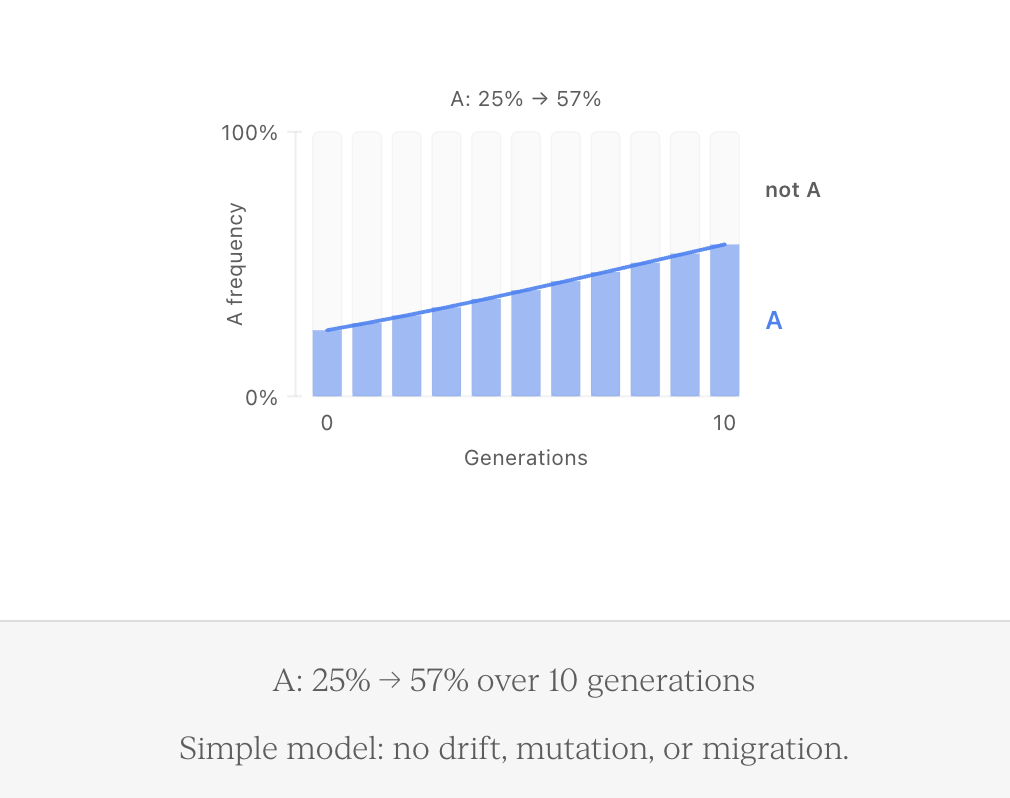
Worked Example: Changing Allele Frequency
Suppose an insect population contains two alleles:
R = pesticide resistance
S = pesticide susceptibility
Initially:
R = 10%
S = 90%
A pesticide is repeatedly applied.
Resistant insects have greater reproductive success.
Several generations later:
R = 65%
S = 35%
The population has evolved because its allele frequencies have changed.
Natural Selection Is Not the Only Cause of Evolution
Natural selection is an important mechanism of evolution, but populations can also evolve through other processes.
These include:
- Mutation.
- Genetic drift.
- Gene flow.
- Sexual selection.
Therefore, not every observed genetic change in a population should automatically be attributed to natural selection.
Scientists investigate the evidence to determine which evolutionary processes are most likely involved.
Mutation
Mutation creates new genetic variation.
A mutation can produce a new allele.
Most mutations do not appear because they would be useful.
They occur without regard to what the organism needs.
The environment then influences whether particular inherited variations affect survival and reproduction.
Genetic Drift
Genetic drift is random change in allele frequencies.
It can be especially important in small populations.
Imagine that several individuals die in a storm.
Their deaths may have nothing to do with their characteristics.
By chance, some alleles may become less common or disappear.
The population's genetic composition can therefore change even without natural selection.
Gene Flow
Gene flow occurs when individuals or their genes move between populations.
For example:
Individuals from Population A migrate into Population B and reproduce.
Their alleles enter Population B.
The allele frequencies of Population B may therefore change.
Gene flow is another mechanism through which populations can evolve.
How Scientists Observe Evolution
Scientists can investigate contemporary evolution by measuring populations over time.
They may collect data on:
- DNA sequences.
- Allele frequencies.
- Body measurements.
- Resistance levels.
- Survival.
- Reproductive success.
- Environmental conditions.
Scientists can then compare data across generations.
Laboratory Evolution Experiments
Evolution can also be studied under controlled laboratory conditions.
Organisms with short generation times are particularly useful.
Examples include:
- Bacteria.
- Yeast.
- Fruit flies.
Researchers can expose populations to controlled environmental conditions and measure changes across many generations.


These experiments allow scientists to test predictions about evolutionary processes directly.
DNA Allows Evolution to Be Measured Directly
Modern genetic technology allows researchers to compare DNA from populations collected at different times.
Scientists can identify:
- New mutations.
- Changes in allele frequencies.
- Spread of resistance genes.
- Genetic differences between populations.
Evolution can therefore be measured not only through visible characteristics but also directly at the molecular level.
Historical Samples
Museums and scientific collections can preserve biological specimens collected decades or centuries ago.
Scientists can sometimes compare these specimens with modern populations.
This can reveal changes in:
- Anatomy.
- Coloration.
- Body size.
- DNA.
- Allele frequencies.
Historical samples therefore provide valuable evidence for recent evolutionary change.
Observing Evolution Does Not Mean Watching One Animal Transform
A common misconception is that observing evolution should involve watching one organism transform into another kind of organism.
Evolution occurs across populations and generations.
Scientists observe evolution by detecting changes such as:
Generation 1
Resistance allele = 5%
Generation 20
Resistance allele = 45%
Generation 50
Resistance allele = 85%
That measurable population change is evolution.
Small Changes Can Accumulate
Many observed evolutionary changes are relatively small.
However, evolution is cumulative.
Small genetic changes can accumulate across many generations.
Over sufficiently long periods, populations can become increasingly different.
If populations become reproductively isolated, these accumulated changes can eventually contribute to the formation of new species.
Evolution Is Ongoing
Evolution continues because populations continue to experience:
- Mutation.
- Reproduction.
- Genetic variation.
- Environmental change.
- Competition.
- Predation.
- Disease.
- Migration.
- Changing selection pressures.
As long as heritable variation exists and populations reproduce, evolutionary processes can continue.
Humans Can Create Selection Pressures
Human activities can produce powerful selection pressures.
Examples include:
- Antibiotic use.
- Pesticide use.
- Herbicide use.
- Fishing.
- Hunting.
- Pollution.
- Habitat modification.
- Climate change.
These activities can alter which organisms survive and reproduce.
Human activity can therefore influence evolutionary change in other species.
Worked Example: Is This Evolution?
Suppose a population of insects becomes darker during an individual insect's lifetime because sunlight changes its body color.
Is this evolution?
No.
The change occurred within individuals and was not necessarily inherited.
Now suppose genetically darker insects survive better and produce more offspring.
After many generations, genes associated with darker coloration become more common.
Yes.
The inherited characteristics of the population have changed across generations.
That is evolution.
Worked Example: Resistance or Acclimation?
Suppose a plant survives a dry week by temporarily closing its stomata.
This is a physiological response by an individual.
It is not necessarily evolution.
Now suppose some plants possess inherited characteristics that improve survival during drought.
Those plants reproduce more successfully.
Over generations, drought-tolerance alleles increase in frequency.
That is evolutionary change.
The distinction is:
Individual response ≠ necessarily evolution
Heritable population change across generations = evolution
Common Mistakes
Thinking Individuals Evolve
Individuals can grow, develop, learn, or acclimate. Evolution occurs in populations across generations.
Thinking Antibiotics Cause Bacteria to Mutate Because They Need Resistance
Mutations do not occur because organisms need them. Antibiotics select among genetic variants.
Thinking All Bacteria Become Resistant
Susceptible bacteria may die while resistant bacteria survive and reproduce.
Thinking Pests Learn to Resist Pesticides
Resistance is associated with inherited variation and changes in population composition.
Thinking Evolution Always Takes Millions of Years
Evolution can sometimes be measured over relatively few generations.
Thinking Evolution Has a Goal
Evolution does not aim toward perfection or increasing complexity.
Thinking Natural Selection Creates Variation
Mutation and other genetic processes generate variation. Natural selection acts on heritable variation.
Thinking Every Population Change Is Natural Selection
Genetic drift and gene flow can also change allele frequencies.
Confusing Acclimation With Evolution
Acclimation occurs within an individual's lifetime. Evolution involves inherited population change across generations.
Check Your Understanding
1. What does it mean to say that evolution is occurring today?
2. Why are bacteria particularly useful for observing rapid evolution?
3. Explain how antibiotic resistance evolves through natural selection.
4. Why is it incorrect to say that antibiotics cause bacteria to become resistant because they need to survive?
5. What is the selection pressure during the evolution of antibiotic resistance?
6. Why must resistance be heritable for natural selection to produce evolutionary change?
7. How can plasmids contribute to the spread of antibiotic resistance?
8. Explain how pesticide resistance evolves in an insect population.
9. Why might repeated use of the same pesticide increase the proportion of resistant insects?
10. How is herbicide resistance similar to antibiotic resistance?
11. Explain how changing food availability could cause evolutionary changes in a bird population.
12. How can environmental change alter selection pressures?
13. What is evolutionary fitness?
14. Why does "survival of the fittest" not simply mean survival of the strongest?
15. An allele increases from 8% to 62% of a population over several generations. What does this tell us about the population?
16. Distinguish between natural selection and mutation.
17. What is genetic drift?
18. What is gene flow?
19. Explain the difference between an individual acclimating to an environment and a population evolving.
20. Explain why evolution should be considered an ongoing biological process rather than only a historical event.
Key Terms
- Evolution – change in inherited characteristics or allele frequencies of a population across generations.
- Natural selection – process in which heritable differences affect survival and reproductive success.
- Selection pressure – environmental factor influencing reproductive success.
- Antibiotic resistance – inherited ability of bacteria to survive or reproduce despite exposure to an antibiotic that would normally inhibit them.
- Pesticide resistance – inherited ability of pests to survive exposure to a pesticide.
- Herbicide resistance – inherited ability of plants to survive exposure to a herbicide.
- Mutation – change in DNA that can create new genetic variation.
- Allele – alternative version of a gene.
- Allele frequency – proportion of a particular allele within a population.
- Fitness – relative reproductive success of an organism or genotype.
- Genetic drift – random change in allele frequencies.
- Gene flow – movement of alleles between populations.
- Horizontal gene transfer – transfer of genetic material between organisms other than through parent-to-offspring inheritance.
- Plasmid – small DNA molecule found in many bacteria that can carry genes, including some resistance genes.
- Acclimation – non-evolutionary adjustment made by an individual in response to environmental conditions.
- Contemporary evolution – evolutionary change occurring over timescales short enough to be directly studied in modern populations.
Key Takeaways
- Evolution is occurring today.
- Evolution occurs in populations across generations rather than within individual organisms.
- Evolution can be measured as changes in inherited characteristics or allele frequencies.
- Bacteria provide particularly clear examples because they reproduce rapidly.
- Antibiotic resistance evolves when antibiotics favor resistant bacteria over susceptible bacteria.
- Antibiotics do not create resistance because bacteria "need" it.
- Resistant bacteria survive and reproduce, causing resistance genes to become more common.
- Resistance genes can also spread among bacteria through horizontal gene transfer.
- Pesticide resistance evolves through the same basic process of natural selection.
- Herbicide resistance provides another modern example.
- Natural populations can also undergo measurable evolutionary change.
- Changing environmental conditions can change selection pressures.
- Evolution does not have a predetermined goal.
- An adaptation is advantageous only in relation to particular environmental conditions.
- Evolutionary fitness refers to reproductive success, not simply strength or size.
- Mutation creates new genetic variation.
- Natural selection acts on heritable variation.
- Genetic drift and gene flow can also change populations.
- Scientists can observe evolution using anatomical measurements, population studies, experiments, and DNA evidence.
- Human activities can create strong selection pressures.
- Evolution remains an active and ongoing process in populations around the world.