Natural Selection and Adaptation
5. Evolution Through Natural Selection
Learning outcomes
- I can explain how natural selection leads to evolution.
- I can describe changes in populations over generations.
- I can explain why evolution occurs in populations rather than individuals.
- I can interpret examples of evolutionary change.
- I can connect variation, selection, and evolution.
What Is Evolution?
Evolution is a change in the inherited characteristics of a population over generations.
More specifically, evolution occurs when the frequencies of inherited genetic variants change within a population over time.
Natural selection is one of the major mechanisms that can cause evolution.
The basic sequence is:
Variation → selection pressure → differential reproductive success → inheritance → population change → evolution


Evolution does not mean that individual organisms transform into more advanced forms. It describes changes occurring in populations across generations.
Connecting Natural Selection and Evolution
Natural selection and evolution are closely related, but they are not exactly the same thing.
Natural selection is a process.
Evolution is population-level change across generations.
Natural selection can cause evolution when individuals with certain inherited characteristics reproduce more successfully than others.
Over many generations, the genetic variants associated with those characteristics may become more common.
The Basic Process
Consider a population containing inherited variation.
Some individuals have characteristics that provide an advantage under current environmental conditions.
The process can be described as:
1. Variation exists
Individuals within the population differ.
2. Some variation is inherited
Genetic differences can be passed from parents to offspring.
3. Selection pressures act
Environmental conditions affect survival and reproduction.
4. Reproductive success differs
Some individuals produce more surviving offspring than others.
5. Characteristics are inherited
Offspring inherit genetic variants from their parents.
6. The population changes
Advantageous variants become more common over generations.
That population-level change is evolution.
Variation Is the Starting Point
Natural selection requires variation.
Individuals may vary in:
- Size.
- Coloration.
- Speed.
- Disease resistance.
- Beak shape.
- Body structure.
- Temperature tolerance.
- Feeding ability.
- Behavior.


Without variation, individuals would respond similarly to selection pressures and natural selection would have little variation on which to act.
Heritable Variation
Not every difference between individuals contributes to evolution.
For natural selection to produce evolutionary change, the relevant variation must have a heritable component.
Heritable characteristics can be passed genetically from parents to offspring.
For example, genetic variation might influence:
- Fur color.
- Beak shape.
- Disease resistance.
- Body size.
- Enzyme function.
If a characteristic is entirely caused by an individual's environment and cannot be inherited, natural selection cannot directly cause that acquired characteristic to spread genetically through a population.
Sources of Genetic Variation
Genetic variation arises through processes including:
- Mutation.
- Sexual reproduction.
- Meiosis.
- Genetic recombination.
- Random fertilization.
A mutation is a change in DNA.
Mutations can introduce new genetic variants into populations.
Sexual reproduction reshuffles existing genetic variation, producing genetically different offspring.
Variation therefore provides the raw material on which natural selection can act.
Selection Pressures
A selection pressure is an environmental factor that influences reproductive success.
Examples include:
- Predators.
- Competition.
- Disease.
- Parasites.
- Temperature.
- Drought.
- Food availability.
- Water availability.
- Antibiotics.
- Pesticides.
- Competition for mates.
Selection pressures determine which inherited characteristics provide advantages under particular conditions.
Differential Reproductive Success
Natural selection depends on differences in reproductive success.
Suppose two individuals survive equally long.
One produces ten surviving offspring.
The other produces none.
From an evolutionary perspective, the first individual contributes more of its genes to the next generation.
Therefore, natural selection is not simply about survival.
The key idea is:
Which individuals successfully pass their genes to future generations?
Evolution Occurs in Populations
An individual organism does not evolve through natural selection during its lifetime.
Instead:
Individuals have characteristics.
Individuals survive and reproduce.
Populations evolve.
Imagine a beetle population containing brown and green beetles.
A single green beetle does not gradually become brown because brown coloration would be useful.
Instead, if brown beetles reproduce more successfully, brown coloration may become increasingly common in later generations.


Evolution is therefore a change in the population, not a transformation of individual organisms.
Evolution Across Generations
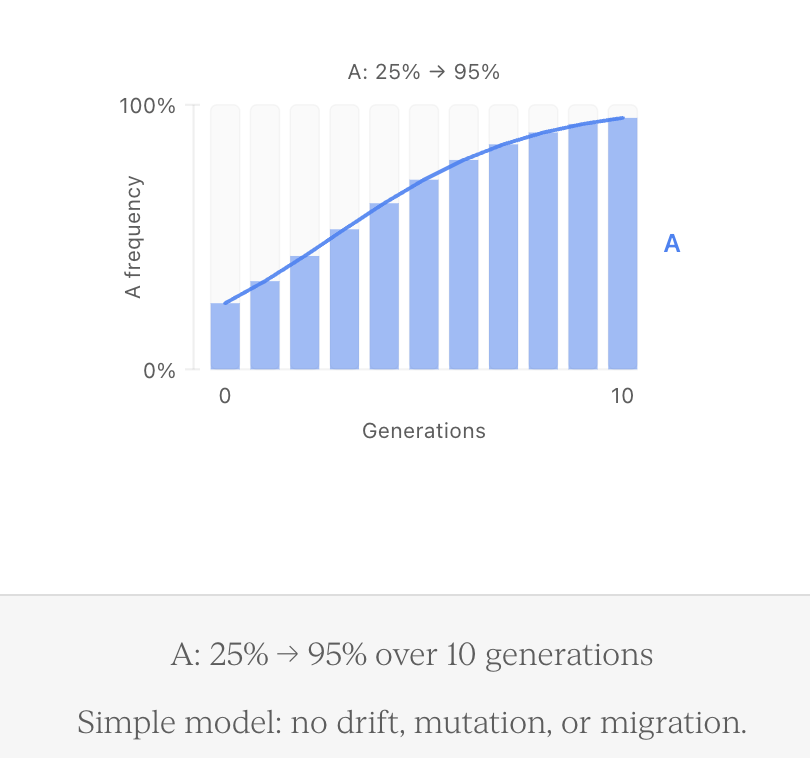
Imagine a population containing an advantageous inherited genetic variant.
At first, the variant may be uncommon.
If individuals carrying it consistently reproduce more successfully, its frequency may increase.
For example:
Generation 1: advantageous variant is uncommon.
Generation 10: advantageous variant is more common.
Generation 50: advantageous variant may be very common.
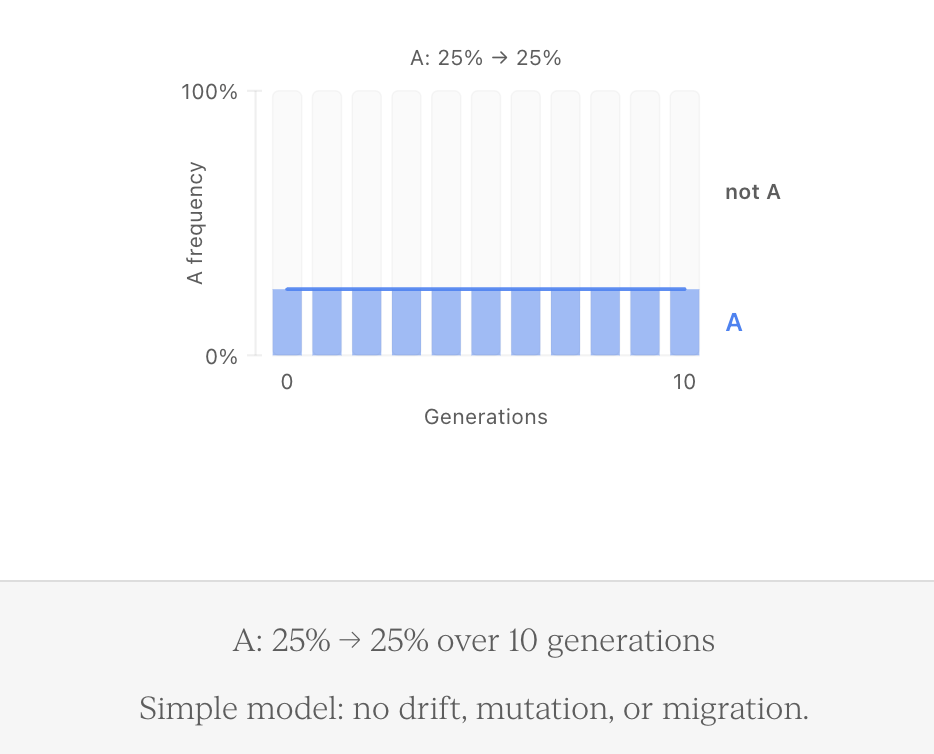
The following visualization shows this simplified process. It models how a beneficial inherited variant can increase across generations when it provides a reproductive advantage.