Natural Selection and Adaptation

站点: Young Education
课程: Evolution and Biodiversity
图书: Natural Selection and Adaptation
打印: Gastgebruiker
日期: 2026年10月5日 星期一 03:04

1. The Theory of Natural Selection

Learning outcomes
  • I can describe Darwin's theory of natural selection.
  • I can explain the role of variation in natural selection.
  • I can describe how advantageous traits become more common.
  • I can explain how populations change over time.
  • I can apply natural selection to simple examples.

What Is Natural Selection?

Natural selection is a process that causes populations to change over generations because individuals with certain inherited characteristics are more likely to survive and reproduce in a particular environment.

The theory of natural selection is strongly associated with Charles Darwin, who developed the idea during the 19th century. Alfred Russel Wallace independently developed a similar explanation.

Natural selection helps explain:

  • How populations become adapted to their environments.
  • Why populations change over time.
  • How biodiversity can arise.
  • How new species can eventually evolve.
https://images.openai.com/static-rsc-4/dg9_crumffmCaf89gG3S3SPzfHoHuIWjNtZ6GSMSCFtU6iFE3U-X0bYSiQThra-0bGT3eJ0h6Il7RFG4qPwAivKshnz-g-B5cbzhLf0mRWTdRmVBynjE5aRknwHtGQkS9lqnqEpvg7lxEs_9WYo9AhtcZhjLRtUQcLz_1duOPRyz2gl5PwxcpTJpoWsmcr8w?purpose=fullsize
 
https://images.openai.com/static-rsc-4/Ps6NSfKcCy_HjztvsoGCHUEKjkOE3ZZBNmIq_oKGUukuLHsgAjmDQXYMV9Y0nAIKtOc6g9DV_WgUNDwwXFjAheHAHYKPB9IZ0oSQ-BGGkfjH2u-3LvZQx-dUaC6QwNdwwrcrZwS_f2SuQzrY0nADjvoJHd5FfeIsFeHNhPqf_EqYB81rXwicfsUrzuaA4jGT?purpose=fullsize
 
https://images.openai.com/static-rsc-4/aVcj6quNAlRisB6z3b79-okO9wPbj5x0TomFL-Ho6yPFjqnOF38ODAuwAm7GhSrJrAnN5m8uWXo_4bXNu6bEkhTVoa29z5A0ttt7vKuEhbra8MMoBd5TOpbWetAVR3f6DnJPMTdBVTcyULCOFr6gmlTp8MZzejaPTSiddCdIei15zzQs-Yf_cC2-tlPGO9fC?purpose=fullsize
 
6

Natural selection does not mean that individual organisms deliberately change because they need to. Instead, individuals already differ, and some inherited differences affect reproductive success.


Darwin and the Development of the Theory

During the voyage of HMS Beagle from 1831 to 1836, Darwin observed organisms in many parts of the world.

His observations helped him recognize that:

  • Species show considerable variation.
  • Related organisms can differ between environments.
  • Organisms appear adapted to their surroundings.
  • Fossils show that organisms living in the past were different from organisms alive today.

His observations of organisms from the Galápagos Islands became particularly well known.

https://images.openai.com/static-rsc-4/3vSQ35uDFcoiGu-F1vkzXuwUS6uS0dXdn0yXAL62e1MWYaAqlJRbDry-n_CbY10bKbcxlPPNzOp-tlO1BaqV0MFPdf2_9DXUtJbeuxCM6aL71FRQjoNUd2u0yUCZM2lpb5DRCJ3Ae8UITtve7HOP_TM1IOhwWDTIuxfTJlwBH8msTtU-gBSwP3RAKYhYIrmW?purpose=fullsize
 
https://images.openai.com/static-rsc-4/Es1_TkHZ_i58bTUsGH2LNoqkFPjv5Tx3l083U0sBGkSmpkoX0--13PpOAwOyEqDKBCw3X9Ce8jO6zU5JBgkcqVxXzToed6h2LUTlNZBreSLEgfU4T99U8gRSLxeKIwxqSufG4Nle8RSLq9lwYBhLt2dxQQfvJ7k-AURPHHSmkh9QL4RwROKmAVWjg9nCGmqR?purpose=fullsize
 
https://images.openai.com/static-rsc-4/-zT1u5wR7R6iMHMreAgYCWOr6BvDzYDwAGhb2bulz4NxkO7pV95Zl2kuAEwcgeBXBABsCU1Bxy8FjJH-SvOaD1sbaPTMNoAAv461tKg1bqvWTeekXh2ROMwAE7zTD0OdlT9tP7a3K0OkuojmgHZDvRGVoJHR99p86303Zfm2B0udtIjpqQdZnjmVGH9u649A?purpose=fullsize
 

Darwin eventually proposed that natural selection could explain how these differences developed over many generations.


The Main Ideas of Natural Selection

Natural selection can be understood through several connected ideas:

Variation

→ inheritance

→ competition and environmental pressures

→ differences in survival and reproduction

→ advantageous inherited traits become more common

→ population changes over generations

Each part of this process is important.


Variation Within Populations

Individuals within a population are not identical.

They may vary in:

  • Size.
  • Color.
  • Speed.
  • Disease resistance.
  • Beak shape.
  • Body shape.
  • Behavior.
  • Ability to tolerate temperature.
  • Ability to obtain food.
https://images.openai.com/static-rsc-4/KZuhqQcZk6q3qVAjZjbpqSWL0d80kHb15U51vP9DbvoTzGX0NyfZqlfgcv2DbwGXmg4ZX_sGtJhr-jOHX38vst2SlqVrJgff4o_N0-oR-ajvEw6mU57g197vHlmivoi1RUSIq44UmW5XKqplkBBXhyFh1u5LBwBRPU85MPaIpjKMIfzEdvtjqB1_hFkyVkYZ?purpose=fullsize
 
https://images.openai.com/static-rsc-4/Td6CnZoe4U-Num2_BpMwsDaIcVcN4W0mJL7v8laKZcnuUk8s3tqbgILM-tlv3hyQsUsX6puGeBZVpQll0zvT4Q8pnrNJ2e99Xqo4t9Foqq1Nu5H2K8cEIIZmvecncrmnAGoTqtlTXY0KxVgbFxShsypFBQ7aW5YpEQRRUkcjtKAzshYdS-9r5T7I1dmSs1A6?purpose=fullsize
 
https://images.openai.com/static-rsc-4/xHkI4LlAotcQLkHXJZ6VOPbzEDk-nS9idKaSylbfR1jUk4wKHa1FdHhlLacErsOIsP0xl1aw0DtorLZiR79rb_C3nJ8IUfYUeV2pQ6cZKEU6pwdeZvxOxi3Nl3iHZ1HstlJEzgBM1fV_UJ4_qnDs30XM15y_LtAn5MwTW0m-dvP3i2aS48nP5IPkIf5QBJmY?purpose=fullsize
 
6

Some variation is caused by genetic differences.

Other variation can be caused by environmental conditions.

Natural selection depends particularly on heritable variation — differences that can be passed from parents to offspring.


Where Does Genetic Variation Come From?

Genetic variation can arise through processes including:

  • Mutation.
  • Sexual reproduction.
  • Recombination during meiosis.
  • Random fertilization.

A mutation is a change in DNA.

Mutations can produce new genetic variants.

Mutations occur without regard to whether they would be useful to an organism.

Most importantly:

The environment does not create a useful mutation because an organism needs it.

Variation exists first. Natural selection then acts on that variation.


Environmental Variation

Not every difference between organisms is inherited.

For example, a plant may grow poorly because it receives little water.

This does not necessarily mean its offspring will inherit genes for being small.

Natural selection can only cause evolutionary change when differences affecting reproductive success have a heritable component.


Overproduction of Offspring

Many organisms produce more offspring than can survive and reproduce.

For example:

  • Fish may produce thousands of eggs.
  • Plants may produce thousands of seeds.
  • Insects may produce hundreds of offspring.

Yet populations usually do not increase without limit.

Many offspring:

  • Are eaten.
  • Fail to find food.
  • Die from disease.
  • Experience unsuitable environmental conditions.
  • Fail to reproduce.

This creates competition and other forms of selection pressure.


Selection Pressures

A selection pressure is an environmental factor that affects survival or reproductive success.

Examples include:

  • Predators.
  • Disease.
  • Competition.
  • Temperature.
  • Drought.
  • Food availability.
  • Salinity.
  • Chemicals such as antibiotics.

Different environments create different selection pressures.

A characteristic that is advantageous in one environment may not be advantageous in another.


Differential Survival and Reproduction

Suppose a population contains individuals with different inherited characteristics.

Some individuals may possess a characteristic that gives them an advantage in their environment.

They may:

  • Survive more successfully.
  • Obtain more food.
  • Escape predators.
  • Resist disease.
  • Attract more mates.
  • Produce more surviving offspring.

The most important idea is reproductive success.

Natural selection favors traits that result in individuals contributing more offspring to future generations.


Fitness

In evolutionary biology, fitness refers to an organism's reproductive success in a particular environment.

It does not simply mean:

  • Strongest.
  • Fastest.
  • Biggest.
  • Healthiest.

An organism with high evolutionary fitness successfully passes its genes to future generations.

A smaller animal that produces many surviving offspring could therefore have greater evolutionary fitness than a stronger animal that produces none.


Advantageous Traits Become More Common

Imagine a population of insects containing two inherited color variations:

  • Green insects.
  • Brown insects.

Suppose the insects live on brown tree bark.

Birds can easily see the green insects, while brown insects are better camouflaged.

The sequence might be:

Variation exists

→ brown and green insects occur

→ birds catch more visible green insects

→ more brown insects survive

→ brown insects reproduce more successfully

→ their offspring inherit genes associated with brown coloration

→ brown coloration becomes more common over many generations.

https://images.openai.com/static-rsc-4/4j8pqdC2AfepnRZure4PJalcIyLy4pVqKTmXaX6E5iEjOHZVNeDhUYX3j8HgS5we9YnVsuIqhzVZF-G7GFN2aKaPd82479Jip1Bo8I0QGBY8_mohzDjqvlVU_a91imO5HS8JKZKoQ2sdMb2KroOPuDjszWpefXfRg5DBKAHYXq-6HfHk8XRW-IXbpmsGgxYJ?purpose=fullsize
 
https://images.openai.com/static-rsc-4/RNAhOXAQl6vaChr72JducNbYukcyKn57wFwK8Ik3h_-m46UdgxUedbhOY-P-gkB1NKYmpgqfG0VRdnln4ARrOhMLFBJq0hjf9Tu7yP7BPkCVgrkmVJ_7jV1hQCpjlm02AlAh8zyvvK7jYrjZn8ZRv4nWR8iQrzb4EEQI5fOEnS8MoVAdwy_1iZeZwGDAuiZt?purpose=fullsize
 
https://images.openai.com/static-rsc-4/J4IDK_rvt-iNS1c-vPhjhmdMFMkWL-UROn2Bl6S_M6Xsb3K5ZKCjqANpFt8z4t6hXjFhUfsTU2UKDxghRRL4nVXAULjkLEnLxldiSdyWzuv4zQ_giWvTflRK2Ar_vQuWH0OV4udyLuD_h0ZWP-XHaH-njCX-9jGNPOZUyOKSunMDid7_gdA5jRSpOvz4gLY7?purpose=fullsize
 
5

The insects did not change color because they wanted to hide.

The population already contained variation.


Populations Evolve, Not Individuals

This distinction is extremely important.

An individual organism does not evolve during its lifetime through natural selection.

Instead:

Individuals are selected

but

populations evolve.

Evolution occurs when inherited characteristics become more or less common in a population over generations.
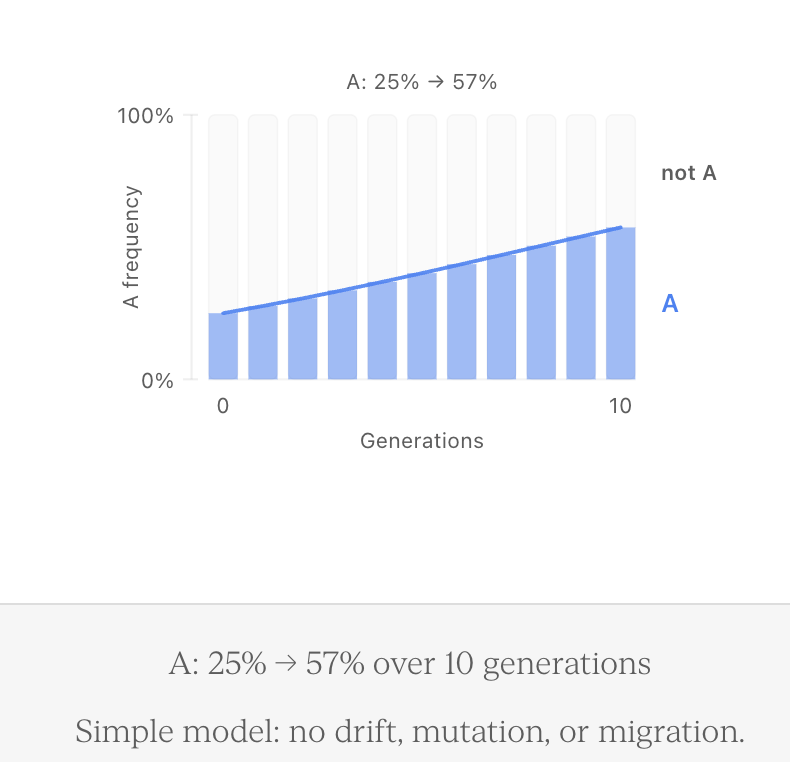
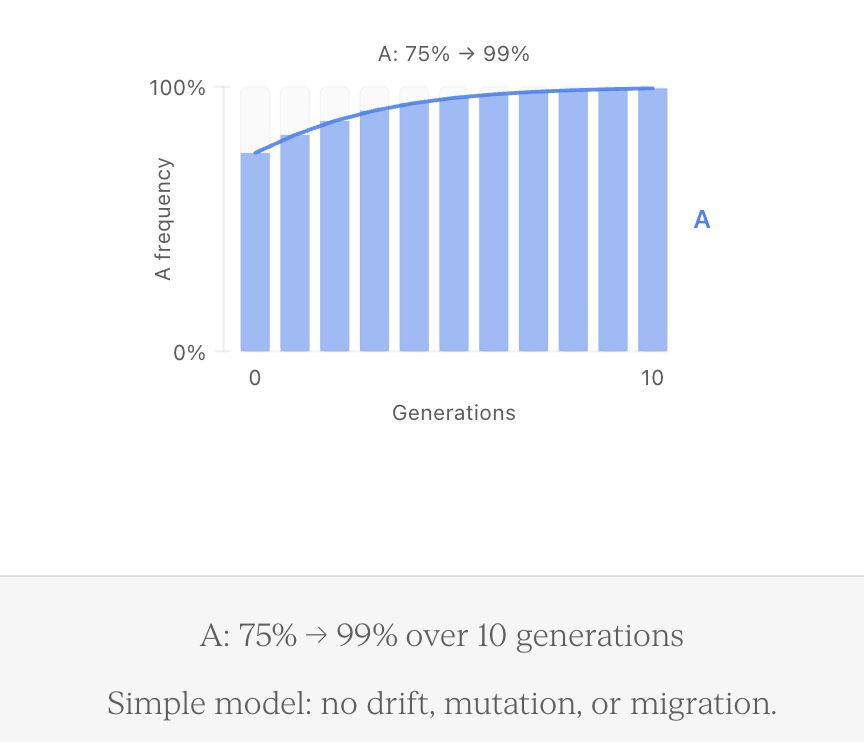
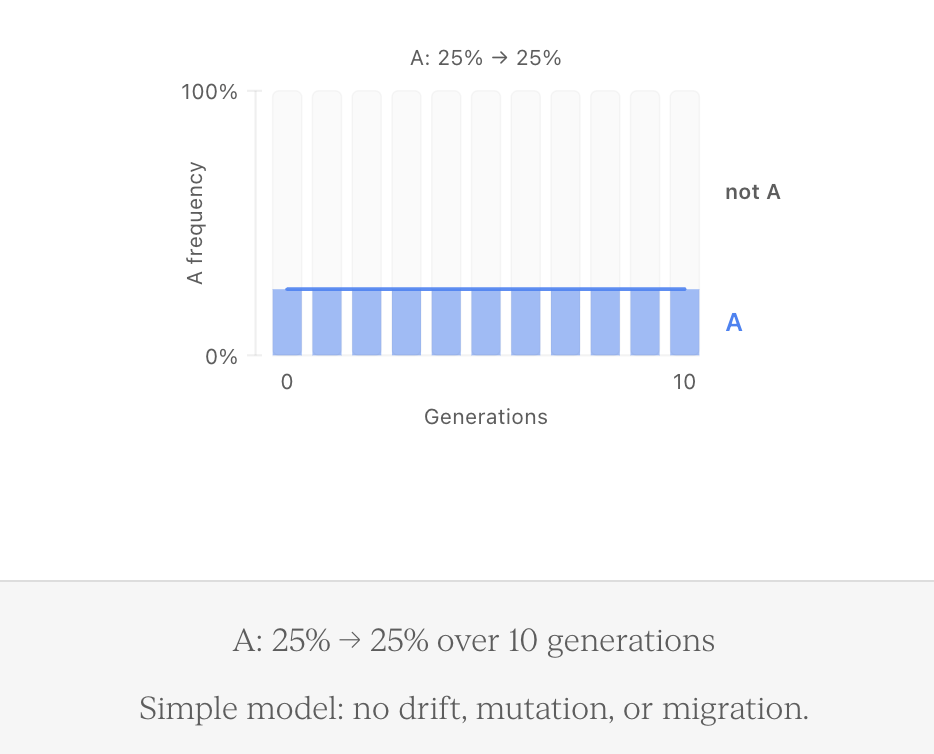
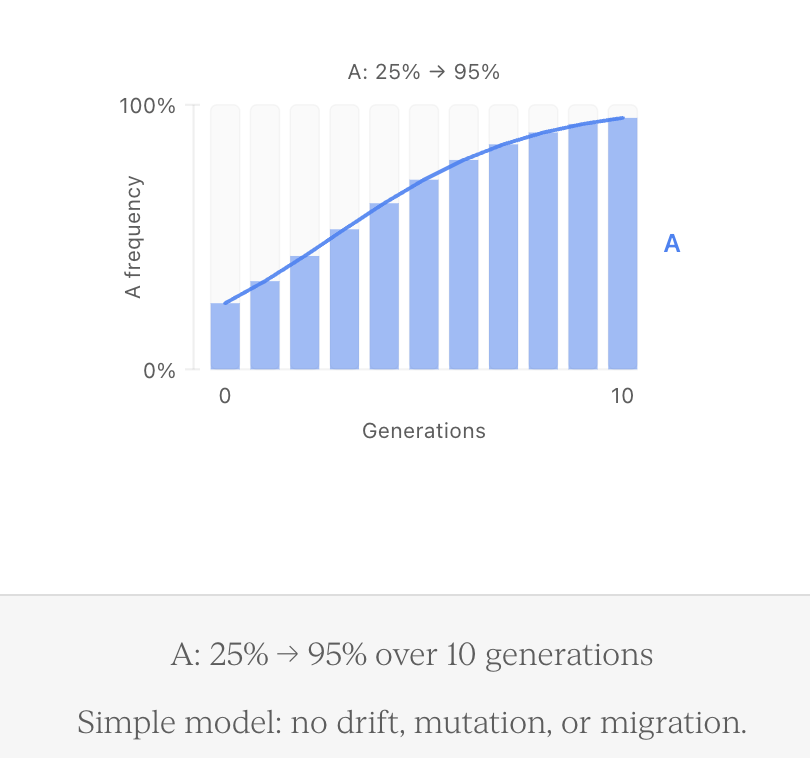
The visualization illustrates a simplified situation in which a beneficial inherited variant becomes increasingly common over generations.


Adaptations

An adaptation is an inherited characteristic that increases reproductive success in a particular environment.

Adaptations can be:

Structural

Physical features of an organism.

Examples:

  • Thick fur.
  • Camouflage.
  • Sharp claws.
  • Different beak shapes.

Behavioral

Inherited behaviors that improve survival or reproduction.

Examples can include:

  • Courtship behaviors.
  • Defensive behaviors.
  • Some migration behaviors.

Physiological

Internal biological processes.

Examples:

  • Venom production.
  • Water conservation.
  • Tolerance to unusual temperatures.
https://images.openai.com/static-rsc-4/jtfX-sm_DKSmmTUxnxlsyj1Kgb_Nn5Sqs1VJ3r14afqfw_Ojl5Y2shzMENlbEPZW_xt8gk1hDPejktM9hWNteY58n02UckjT74-mY17kDPVHP4Uje6ux-AWYwf0pnx_B0OHFAowOeYnIFbEf6qw4RBdRxUGZNK2FJ2ip89mnCYfHOedlZfAmjxEoc0phDA0w?purpose=fullsize
 
https://images.openai.com/static-rsc-4/qWLBaRiuK0NLqWOOe8Mwuf2PqxGl2wxPIWajDY902vvBxwlJt-0YKJ9SijZdJmpAzcRqWiACpALkGG5glltreEksT-2Wu9uBCQij6H0gtsGmQlfOhyKwiiVvqCThjA9WTbq3AEAvtP50-yFMd-ClEazRwB2L6GANNA2cnPCnVPGCsBIW09IgfaH0GCbL7zgF?purpose=fullsize
 
https://images.openai.com/static-rsc-4/P7NDduMx2qcW7V14-mXan9teuPMq5ZWDMO9Ds6RGtqrI85CiYBmG5_I-Zl_JXUBN9uEMirqNvlecXEdMSLPcPyJpdGT0cxzuqxsXVw09W3LerZQq4-VMkYmDd_8am3asa-XxJveUAMFigs21-T-ze8NklhZO3lJFjAXRE5pOMQlEjjTU5hO7-btVXOc74cAs?purpose=fullsize
 
5

Adaptations arise through natural selection acting across many generations.


Adaptation Is Environment-Specific

There is no universally "best" trait.

Whether a trait is advantageous depends on the environment.

For example, thick fur can be advantageous in a cold environment because it reduces heat loss.

In a very hot environment, thick fur might create disadvantages.

Therefore:

Fitness depends on environmental conditions.

If the environment changes, the characteristics favored by natural selection may also change.


Example: Darwin's Finches

The Galápagos Islands contain finches with different beak shapes.

Different beaks are suited to different food sources.

Some birds have:

  • Strong, deep beaks suitable for crushing hard seeds.
  • Narrower beaks suited to different foods.
  • Longer beaks useful for accessing particular food sources.
https://images.openai.com/static-rsc-4/fpjvtwZvFMwnZQna8GE8u2E3b-yQZvbwAzQ5XebzjU2xjjynFRAtCN3ygdnROE02HKeyXEOGk25wX08Grl6dJ1hZ3abQJFj2Dbh1Ot6XPXaL6IWjwyT-Ul2Bkmd5kCywROrCrLX0MOr0Wyob-Ma8uhuNxrFkSMmB3NeTNoUHfGj4Mz3-inxw-3DsYppix5j3?purpose=fullsize
 
https://images.openai.com/static-rsc-4/h5sGReV1pNC4YgpEBh4zZMhm2PXPBix-SFG1Bb0uxQle3ql_zFcBnRs84u5EspZL9pIBpJjcsoX8F4E6XytL4BXmGMDcpSSzd2nYBYH74uIBQ3uESBwqqQ5v6MAw8-MYtBUMZd6RszRQS4TNYjdfS1C42kTP6ep4O_adnxXUK3TrBELc6Wzog9d6BBdxsqdw?purpose=fullsize
 
https://images.openai.com/static-rsc-4/CyiXWXYLJgnlx3gM5mJSjzc0q7jkfFCODOqOFcjpw7QAS_yiOR22XCxxzJtXo_NNHL_FBp2zgWEN_6m4bgFJeBtDrHgFkS28O_wsaQPUY4i48rCPwIPhOb4dX_Y458ungPugsgZZm_v6iLCnJBnP0jHBR2WN7tvIrchEH9KmV3oHzcC_7-yPsSUM07KhSPeO?purpose=fullsize
 
5

If environmental conditions favor hard seeds, birds with stronger beaks may obtain food more successfully.

If beak characteristics are inherited:

Variation in beak shape

→ differences in feeding success

→ differences in survival and reproduction

→ advantageous beak characteristics become more common.


Worked Example: A Drought and Finch Beaks

Imagine a finch population contains birds with different beak sizes.

A severe drought occurs.

Small, soft seeds become scarce, while larger, harder seeds remain available.

Birds with larger, stronger beaks may be better able to eat the remaining seeds.

These birds may therefore:

  • Obtain more food.
  • Survive at higher rates.
  • Produce more offspring.

If beak size is heritable, the next generations may contain a greater proportion of birds with genes associated with larger beaks.

The drought did not cause individual birds to grow genetically larger beaks.

Instead, the drought changed which existing variations were advantageous.


Example: Peppered Moths

Peppered moths provide a classic example used to illustrate natural selection.

Moths vary in coloration.

In environments where tree surfaces were relatively light, lighter moths could be less visible to predators.

During periods of heavy industrial pollution, some surfaces became darker.

Darker moths could then have a camouflage advantage in affected environments.

https://images.openai.com/static-rsc-4/2HYG_JrneqAVZUbQVKgI1uf2cCaDa_Dj1JqKT5czNJREA-d0_2GTxy-bR_vKFnNMRAUTomwO5jztY3-dv7Pd57v2URM24ysSuLK35TefE_tLYfw67Xlr3PoOgy5TosAkN39qoJgV12Lf3-BgfsHqcNJCKPS0EzeJChUJ8Q65QkFPp075zk1KXPzvYWs69OH0?purpose=fullsize
 
https://images.openai.com/static-rsc-4/Hx7mb-Dwu_UaQwA4URamSmvSNXK7qAuWf-A5khojJhR8SC_yS0jvzRa_JnkWGcmsB449p0adiyKzSsrw-qTJsqqAG8HPanziZcnw4EPe-6aVWw1rjtyQDhjBhSMXLqFCNfxU4EV6sLqKoa33V7AeSfNNtZrb-2OKSBL2BnUt92AbbH7xFAIkEpz527D63QYd?purpose=fullsize
 
https://images.openai.com/static-rsc-4/-KgNxOZwfzG8Gmar_SNtLc6WCiTuvv0xfrNHkgYAbKUQwV6z20nUOdHleBUaNkFmeOKi-gC1O0L5uxu6j2zsAVIrrPkYPl25hMas28TTDjYHCYYivKliu_r4rlLULCVVkf24n2w245MaTdsV8nvA5LUu_1jcIGHzO5_fBEd2xAEX31cI3bmR6Gh5IkV6-arr?purpose=fullsize
 
5

As environmental conditions changed, the relative advantage of different inherited colors also changed.

This demonstrates an important principle:

Natural selection depends on the environment.


Example: Antibiotic Resistance

Natural selection can occur rapidly in microorganisms.

Consider a population of bacteria.

Before exposure to an antibiotic, genetic variation may mean that a small number are resistant.

When the antibiotic is used:

Antibiotic applied

→ susceptible bacteria die

→ resistant bacteria survive

→ resistant bacteria reproduce

→ resistance becomes more common in the population.

https://images.openai.com/static-rsc-4/0H8oaM8_n8pEj_GnHSd9IQpYfkWMEU3PJAbL1AnCgwL8vdrIopcw-BnEqLsOMbrbKf2-Wq55FDJaSVD-8KbD_QpNblsA8oINufKvg1WLAxRCX432mhregPoZ3hquljSkI02snVbjDKDdrIiJctdCDJ4sI1rnAXnwYKbBBWbDpG7RIPr22O0uGhzYD6hwsIZO?purpose=fullsize
 
https://images.openai.com/static-rsc-4/DNUwZ_EkOaEBi0ivv86HywU9UPXKKJ91R5bEXkg7RSZj803GUddo6_EGLbW43Bzckar8Q2N5jQqU-a6JUn9SmTMsOvwpuDIQr1nJ2Rr-wnAT1LQWe9pEQBzPun9oBTblIHh8-HDY4_zcE2gL39hHhe4LMAt2mZ9jWSutM4HBY1lzB_ZB8EDadh4gyHDUpwPT?purpose=fullsize
 
https://images.openai.com/static-rsc-4/ip2AF-PLVzj2TOwPqD8A1_rEA-WglxhXNw8RbYaGRXb4FFSosByfVUBzYb9lKCZR6RG3XQTcWNBqQnOjP18oYT9AoOtw6hxg1CoXHb9d_6x0OX6x-gmnA6aD9DlZpzDpaOh_dcBwJXpilxLDWmSFaSaF5B4zIF3iA3g9r6vkKqhHB9ClA9FHcz8jA20DRyLr?purpose=fullsize
 
5

The antibiotic does not cause bacteria to become resistant because they "try" to survive.

Instead, it creates a selection pressure favoring resistant variants.


Why Antibiotic Resistance Matters

Bacteria reproduce quickly.

This means many generations can occur in a short time.

Natural selection can therefore cause resistant strains to increase rapidly.

Unnecessary or inappropriate antibiotic use can increase selection favoring resistant bacteria.

This is an important example of evolution occurring in populations today.


Example: Insecticide Resistance

A similar process can occur in insects exposed to pesticides.

Suppose a few insects carry inherited resistance.

Pesticide applied

→ susceptible insects die

→ resistant insects survive

→ survivors reproduce

→ resistance becomes more common.

After repeated pesticide use, the pesticide may become less effective.

Again, the chemical acts as a selection pressure.


Natural Selection Over Many Generations

Natural selection is usually easiest to understand by following a population through time.

Generation 1

There is variation.

Environmental Pressure

Some variations provide an advantage.

Survival and Reproduction

Individuals possessing advantageous inherited characteristics produce more offspring.

Generation 2

Those characteristics are more common.

Continued Selection

The process continues.

After many generations, the population may look significantly different from the original population.


Natural Selection Does Not Have a Goal

Natural selection does not plan for the future.

It does not produce organisms because a particular trait will someday be useful.

Instead, selection acts on inherited variation under current environmental conditions.

This means evolution has no predetermined direction.

A trait becomes common when it contributes to greater reproductive success in the conditions experienced by the population.


"Survival of the Fittest"

The phrase "survival of the fittest" is often misunderstood.

It does not mean:

The strongest organisms always survive.

Evolutionary fitness refers to reproductive success.

A better interpretation is:

Individuals with inherited traits that improve reproductive success in a particular environment tend to contribute more genes to future generations.

Survival matters mainly because an organism generally needs to survive long enough to reproduce.


Competition

Competition occurs when organisms require the same limited resources.

They may compete for:

  • Food.
  • Water.
  • Territory.
  • Nesting sites.
  • Light.
  • Nutrients.
  • Mates.

Competition can contribute to natural selection when inherited differences affect an organism's ability to obtain these resources and reproduce.


Predation

Predators can also act as selection pressures.

Suppose prey vary in speed.

If speed has an inherited component:

Faster prey escape more frequently

→ survive more often

→ reproduce more successfully

→ genes contributing to greater speed may become more common.

At the same time, prey can exert selection pressure on predators.

Evolutionary relationships can therefore influence both populations.


Changing Environments

Environmental conditions do not remain constant.

They can change because of:

  • Climate change.
  • New predators.
  • New diseases.
  • Habitat changes.
  • Competition.
  • Human activities.

When conditions change, previously advantageous characteristics may become less useful.

Different traits may then be favored.


Worked Example: Fur Thickness

Imagine a population of mammals varies naturally in fur thickness.

In a cold climate:

Thicker fur

→ reduced heat loss

→ improved survival

→ potentially greater reproductive success.

If the climate becomes much warmer, the advantage may decrease.

Individuals with thinner fur might then have greater reproductive success.

Natural selection therefore responds to environmental conditions rather than producing permanently "perfect" organisms.


Natural Selection and Evolution

Evolution is change in the inherited characteristics of populations over generations.

Natural selection is one important mechanism of evolution.

A simplified relationship is:

Genetic variation

→ selection pressure

→ differential reproductive success

→ change in inherited characteristics

→ population evolves

Over many generations, these changes can produce substantial differences.


Natural Selection and Speciation

If populations of the same species become separated, they may experience different environmental conditions.

For example:

Original population

→ populations become geographically separated

→ different environments create different selection pressures

→ different traits become advantageous

→ populations become increasingly different.

Over long periods, genetic differences may accumulate until the populations can no longer successfully interbreed.

This can contribute to the formation of new species, called speciation.

https://images.openai.com/static-rsc-4/EA1zj62MDGUo1EpnsSaDbR_JoEcDimUgp_lL3sICVcluL6Sg3hVfHbMnfIsLdBvAq14CYIppATdnE_OMuJ93pKAS_98yAZgbxhMjJJAyfEtELcLa_3ybGHob6B5Sdnea18oNFyPY3UC9tdTJSoicbLAuKS7l1UoNlZljQUj20Kae1jyD_KSO0OwPybCr6N55?purpose=fullsize
 
https://images.openai.com/static-rsc-4/dcbPoYOkVzHN1W7R6o9HalZnxtXBiG4GUPK7xBMz5n7qBc8u4bAkw-eGzuUc31MJQaq57ZSioOEeVPYKluzowKJFantr55bgx-zB-wKB3VvYZ4Zoqfmec8BqSndgzfsAq04Q26IuVly_S8UBTJZercOxTYINjWZieEOrmj1D_8771RkFtx1__a78L5TKdalM?purpose=fullsize
 
https://images.openai.com/static-rsc-4/MB6yxw5zrbZyQgLA3ATcIgnyy2c7w7riQvbsC9T93vcBenc1J5F-7AyZaFAF9aCo_V1oO2ZEszGWdRFb4r5Kgy7JTJkl2UbbO7TOTIBhTIDms0h-3qKeGDyiN-VzQZlhp-9lwkvy8KhepNVFa0FAbcJv9VL_qwtg-f4zSBCsEo_GA7J5p7xJgB4ZM0QbsdTO?purpose=fullsize
 
5

Natural selection can therefore contribute not only to adaptation but also to biodiversity.


Natural Selection Does Not Produce Perfect Organisms

Natural selection works with the genetic variation already available.

Adaptations can also involve trade-offs.

For example:

A large body might help an animal defend itself.

But a large body may also:

  • Require more food.
  • Require more energy.
  • Reduce agility.

Natural selection therefore does not create perfect organisms.

It favors characteristics that result in greater reproductive success under particular circumstances.


Applying Natural Selection to a New Example

Suppose a population of rabbits contains variation in fur color.

Some rabbits are:

  • Light brown.
  • Dark brown.

The environment becomes darker following a change in vegetation.

Predators find light rabbits more easily.

To explain what might happen using natural selection:

1. Variation

The rabbit population already contains inherited variation in fur color.

2. Selection pressure

Predation creates a selection pressure.

3. Advantage

Dark rabbits are better camouflaged.

4. Differential survival

More dark rabbits survive.

5. Reproduction

Surviving dark rabbits reproduce and pass inherited characteristics to offspring.

6. Population change

After many generations, dark fur becomes more common.

This six-step structure can be used to explain many natural-selection examples.


A Useful Natural Selection Framework

When solving a natural-selection question, identify:

Variation

What differences already exist?

Inheritance

Which differences can be passed to offspring?

Selection pressure

What environmental factor affects survival or reproduction?

Advantage

Which variation provides an advantage?

Reproduction

Which individuals produce more surviving offspring?

Population change

Which inherited characteristic becomes more common over generations?

This framework is especially useful for unfamiliar examples.


Common Mistakes

Saying Organisms Change Because They Need To

Incorrect:

"Giraffes developed long necks because they needed to reach leaves."

Better:

Giraffes varied in neck length. If longer-necked individuals obtained more food and reproduced more successfully, inherited characteristics associated with longer necks could become more common over generations.

Saying Individuals Evolve

Individuals do not evolve through natural selection.

Populations evolve over generations.

Forgetting Variation

Natural selection requires variation within the population.

Forgetting Inheritance

A characteristic cannot become more common through natural selection unless the relevant variation has a heritable component.

Assuming "Fittest" Means Strongest

Fitness means reproductive success in a particular environment.

Saying the Environment Creates Useful Mutations

Mutations do not appear because organisms need them.

The environment selects among existing and newly arising variation.

Assuming Every Trait Is an Adaptation

Some characteristics may have little effect on reproductive success or may result from other evolutionary processes.

Thinking Evolution Has a Goal

Natural selection does not plan ahead or work toward a predetermined "perfect" organism.


Check Your Understanding

1. Define natural selection.

2. Why is variation necessary for natural selection?

3. What is meant by heritable variation?

4. Give three examples of selection pressures.

5. Explain what evolutionary fitness means.

6. Why is "survival of the strongest" an inaccurate description of natural selection?

7. Explain why populations evolve but individuals do not.

8. How can an advantageous inherited trait become more common over generations?

9. Explain how camouflage could evolve through natural selection.

10. Why can the same characteristic be advantageous in one environment but disadvantageous in another?

11. Explain how a drought could cause average beak size in a bird population to change over several generations.

12. Explain how antibiotic resistance develops through natural selection.

13. Why is it incorrect to say that antibiotics cause bacteria to develop resistance because they need it?

14. Explain how insecticide resistance can become more common in an insect population.

15. What happens to natural selection when environmental conditions change?

16. Distinguish between an inherited adaptation and a characteristic acquired during an individual's lifetime.

17. Explain how natural selection can cause a population to become better adapted to its environment.

18. Describe how natural selection can contribute to speciation.

19. A population of insects contains green and brown individuals. After a drought, vegetation becomes mostly brown. Birds hunt the insects visually. Predict how the population might change and explain your answer using natural selection.

20. A population of mammals contains individuals with different amounts of body fat. The climate becomes much colder. Apply the six-step natural-selection framework to predict how the population might change.


Key Terms

  • Natural selection – process in which inherited characteristics affecting reproductive success become more or less common over generations.
  • Variation – differences between individuals within a population.
  • Heritable variation – differences that have a genetic component and can be passed between generations.
  • Mutation – change in DNA that can introduce new genetic variation.
  • Selection pressure – environmental factor affecting survival or reproductive success.
  • Fitness – reproductive success of an organism in a particular environment.
  • Adaptation – inherited characteristic that increases reproductive success in a particular environment.
  • Evolution – change in inherited characteristics of populations over generations.
  • Population – group of organisms of the same species living in the same area.
  • Differential reproductive success – differences among individuals in their contribution of offspring to future generations.
  • Competition – interaction occurring when organisms require the same limited resource.
  • Predation – interaction in which one organism captures and consumes another.
  • Antibiotic resistance – inherited ability of bacteria to survive exposure to an antibiotic that would normally inhibit or kill them.
  • Speciation – evolutionary process through which new species arise.

Key Takeaways

  • Darwin's theory of natural selection explains how populations can become adapted to their environments over generations.
  • Natural selection begins with variation within a population.
  • Only variation with a heritable component can directly contribute to evolutionary change through natural selection.
  • Mutations and sexual reproduction contribute to genetic variation.
  • Organisms generally produce more offspring than can survive and reproduce.
  • Environmental factors create selection pressures.
  • Individuals with advantageous inherited characteristics may have greater reproductive success.
  • These individuals contribute more of their genes to future generations.
  • As a result, advantageous inherited characteristics can become more common.
  • Individuals do not evolve; populations evolve over generations.
  • Evolutionary fitness means reproductive success, not simply strength or physical fitness.
  • Whether a trait is advantageous depends on the environment.
  • Natural selection does not produce traits because organisms "need" them.
  • Natural selection has no predetermined goal.
  • Antibiotic and pesticide resistance provide observable examples of natural selection.
  • Environmental change can alter which characteristics are favored.
  • Over long periods, natural selection can contribute to adaptation, evolutionary change, and the formation of new species.
  • A useful way to explain natural selection is: variation → inheritance → selection pressure → advantage → differential reproduction → population change.


2. Competition and Survival

Learning outcomes
  • I can explain why organisms compete for resources.
  • I can identify factors that limit population growth.
  • I can describe the struggle for survival.
  • I can explain how competition affects populations.
  • I can relate competition to natural selection.

Why Do Organisms Compete?

Every organism needs resources to survive, grow, and reproduce. However, resources in an environment are limited.

Organisms may need:

  • Food.
  • Water.
  • Light.
  • Space.
  • Nutrients.
  • Shelter.
  • Territory.
  • Nesting sites.
  • Mates.

When several organisms need the same limited resource, competition occurs.

Competition is the interaction between organisms when they require the same resource and there is not enough of that resource for all organisms to obtain as much as they need.

https://images.openai.com/static-rsc-4/2ccRO_EC-dCd1r1ffAaEhrSELOq0c0BGQQIPJcwMdC2PVC51GqOWaJy1mB0iOBDP_lYJAlG-TcSbJ-EMNc7Ftwgts_uTbvWsekGEYLi2YLmRG4djIu1MeBxr0y7ZV6mSCEhGbDIuDWwnDgHcHO4sL5Nyobek1VbE90AX33FNYH_XAqmbM_gxDIJVq7J4OIPP?purpose=fullsize
 
https://images.openai.com/static-rsc-4/Ue_uEMvUUnGw2KUpv2QxxWuIU-EF9Fr2gREmPvIQvTGGV2-VGOSdbAUcOrkMH0gLPBc_bG8NXNYufRPyAmztQCXEJ6J5lbkshnLcIPr2KQnfyHTsCo8ss45pdHx4YCVyhu_wby3zElVevk7F9XiEj7iKDR55lQ26vBfpnxpO4lX2v-Q6fHPW64-zTR9I2UIk?purpose=fullsize
 
https://images.openai.com/static-rsc-4/99OeZO8Q4vqTSurOb72dP8EI6X41GY3izmHa8I7bSRSP27KcbjIX95JafHa0Z2XVZNqcBosbWHTkP_MInp6jKygt3w7-sLE0-KSVMl785EveBHNlOpMMrDWy__3NJQE5Yt5ygE7f6nlx_p4b0upzBGpi-4fnWYVtLUDzzMk5tJ_fCSxr0fTjhbzFr4ToiD5X?purpose=fullsize
 
5

Competition is an important ecological interaction because it can affect survival, reproduction, population size, and natural selection.


Resources Are Limited

No environment contains unlimited resources.

A grassland may contain only a certain amount of:

  • Grass.
  • Water.
  • Shelter.
  • Nesting space.

A forest has limited:

  • Light.
  • Soil nutrients.
  • Water.
  • Space.

Even when a resource is abundant at one time, it may become scarce later.

For example, water may be plentiful during a rainy season but scarce during a drought.


Competition Between Animals

Animals commonly compete for:

  • Food.
  • Water.
  • Territory.
  • Shelter.
  • Nesting sites.
  • Mates.

For example, several predators may hunt the same prey species.

If prey becomes scarce, competition increases.

https://images.openai.com/static-rsc-4/sjXdVmNy_MwaeRnpwDwSOzwU0WAJSRs3_lmyEyGDZ5qEfLRH_-Q3wl3sFo2HeZtxtWAixebhapCJ2hDpPEM9UX7gb8Fn0FSbdnHXEBPj7gqEpFrVojLUtd29wFgjifSq0v3UmPwSR17ybSTlk03R9bXW9mAulC5LPcbh5xCfp_TECEVNCcz9Oaz4YzzzA6Jd?purpose=fullsize
 
https://images.openai.com/static-rsc-4/dxCUd68pRY49ulqD5_TbPErww5EUd2s4EnrHsMeCxKlQi3k1an7r2wHA6gc6u6IdVNoV25wmMqnEajAKcE8AeYsKhhjuMuBSPQrWUHcgaDSm0VY-zU_05BvOzvkh8NFJYd7WNbUc4HbSt_uvd5fzcgn0pj9rGfMjeK1pwljC6vsFf-ZwZMnsjHL75s5OEKIm?purpose=fullsize
 
https://images.openai.com/static-rsc-4/3NBNa8Qfst7qHoKQHRlZIdZhrJiIOd7n5fdKqTZonBtn9guETip1jXK9zdyoAwaLX79501_tSvg3n7TGErN8z7KkPiL_YtdkR5yPp6qw9EB17HE1nrX5fkfhNrtSwmJ7SXVXd70ARfrJkFZb58bDslq43vsBBqVWsgrbzQByXPW-SfqALrsiz97i_oJ0adyC?purpose=fullsize
 

Individuals that obtain sufficient resources are generally more likely to survive and reproduce.


Competition Between Plants

Plants also compete.

Important resources for plants include:

  • Light.
  • Water.
  • Mineral nutrients.
  • Space.
https://images.openai.com/static-rsc-4/_aXQhYwR2VZ8DMnBL4S2_NfQX_a748g9aImPxSyZQTEoRyttn1oU0_i5eCzY3_fVftkQUchagSEwll3SrJ5ru4bpW9nIkAfhKNADq9ffm_DOmRi6A0bLx0nM99x005SaED0JyIb891MB1C0vPihjvj0nmcocs7KVloyXa7wadLSs0UQuSDIvEVzjZw-FYPqf?purpose=fullsize
 
https://images.openai.com/static-rsc-4/VLH9j-4kftMmCNX0F1Mk8F2ta8tDyg-GaXdnHUy67hDWMaKFlGVGVtwfNGmyG1i3nw7ys6355YXo2WcGa02Fpp_CDrwVeP3SY3T31mWZS2oq_B1y3gMsQ8lOrJQtcPo47poOHyBIeyCw_5UogHDCbVbngOa_1IXPthjvUGXaeVtmnXaCILCM5s00kjeIvg08?purpose=fullsize
 
https://images.openai.com/static-rsc-4/CEJ2few9Kio208eQKaUG0qgnQ85rlske12L0yrM7BSC5W3P-_P4OPqIBAjLmXS7hlfQtN0Pw_5aJbu-7S_5tEZv6wrEleCasulILjvRrpknlP_72azBoC9fgfX404Vu0E-u7qCAT21SzTT9mCM7xd6qIE6r6PoQm3id59xt9p29gKnFYZQrQH7hR4TOw93h3?purpose=fullsize
 
5

In a dense forest, tall trees may capture much of the available sunlight.

Plants beneath them may receive less light and therefore carry out less photosynthesis.

Below ground, plant roots compete for water and mineral nutrients.

Competition therefore occurs even though plants cannot move from place to place like animals.


Intraspecific Competition

Intraspecific competition occurs between members of the same species.

For example:

Two male deer competing for mates.

Two oak trees competing for light.

Two wolves competing for food.

Members of the same species often experience strong competition because they usually require very similar resources.

https://images.openai.com/static-rsc-4/uz4Gq8_kXkFw_WrCEosz0VbFySyX6Br5aYzL_LUPuc0vHp4qbQ2-3jyG6lsirQrjZ8FNOVbO2r4oqL5aVEN6dszs3jc8AYev1gm809-Dwji1CK2lp8yInMXxnT0UwyLKQ5Es_SMmG9r2KLwyI_F62sQELDdFMCgLPxCFze5XXC3V3YtFdfHCv7hctPq5TYWr?purpose=fullsize
 
https://images.openai.com/static-rsc-4/Y5OCx8rS10m8C-emkEY2pdsQq4pRjVlvoarIJdeW0u0L2fbVEc2QtjyE99oj0GQiaJ7h73jyffI7IAxuYgrtc_1ijJ6LXz0xSisEBoBXDlLF6cvxmG3b11M4xaIHJMOXGSOnrwwDcJRgWuDgssvzmOauqALzKPAqedtO5dGpWuJTMmwrU2-q6awwQIsvKbT2?purpose=fullsize
 
https://images.openai.com/static-rsc-4/sjor8o0K3o9CfbHYbZvyOa9ztDTRL-6Aa23NHN0suvbGxosKAZQeFEGdnsI4xTuQOmrI4-b7FQH0s4C69HcLiuzpWmS1HIle-zQZGkJKZ6Znrj3QrQSFxARZCenqVageP1MLzX3QGYtnHcS46C6hRrfP-6UCmD_i8kQubD49L2VXzL_WE2HBvNjHlJyB1F7b?purpose=fullsize
 
5

Interspecific Competition

Interspecific competition occurs between members of different species.

For example:

Lions and hyenas may compete for prey.

Different plant species may compete for light and water.

Different bird species may compete for nesting sites.

https://images.openai.com/static-rsc-4/XMnUi-264HJd_8loA8uqQNmyV7KWn3lLxjx6tD_BMH1ehlkxQi6RkVjJMynPfO3BfWp7OlkE4R32J6oxopb2uiYs8JkkjlJ6qbE_80A4LHS2gPUmCv14xQSmNWHTO58QUjVnvwV_XO5AhznVVLBAUgx4kHuSEuhpvPUc50CJ-_zenRHsEjDl0p6MF_JcjpPg?purpose=fullsize
 
https://images.openai.com/static-rsc-4/to1CIIE3GH9N4MifPFtbl-vVYF4DtKtyejrzJGHnVqNSKQeDTgnuq4ieS4E8vxtcOLOs8IpYXyrrG5_v_bL-JhrBJzikNa-v-J9UBgnwylj1ZAw93c9jeim1Vw6P_6fIIzsFiF5pJUCXjQu8abSwBA4YOzfZhs-qF6rV-AISNNX_VFxexKQ6V9Yyk3pWkS-t?purpose=fullsize
 
https://images.openai.com/static-rsc-4/tf9fgu3cehBE8MYGlsRt341kj6rcY-i0cX1wYMrHu-2EVuQ9593cRqBf1Yc0Wq0epPQnT2leUTkxvEs9sqF-EJth2QB5i0KBPzwtpWmZ5So_obGE9GDGbPZqXd55FLC3h9ysA8rgIE-21hLRf5gr3lsgAywUkZSjWuz6AG5qq0XcehRmZ302vaxXk7Cty7T0?purpose=fullsize
 
5

Both forms of competition can influence population sizes and species distributions.


What Limits Population Growth?

Populations cannot normally increase forever.

Eventually, environmental conditions limit their growth.

A limiting factor is something that restricts the size or growth of a population.

Limiting factors include:

  • Food availability.
  • Water availability.
  • Space.
  • Light.
  • Nutrients.
  • Predation.
  • Disease.
  • Competition.
  • Temperature.
  • Drought.
  • Flooding.
  • Availability of mates.

Different populations are affected by different combinations of limiting factors.


Biotic Limiting Factors

Biotic factors are living components of an ecosystem.

Biotic limiting factors include:

  • Competition.
  • Predation.
  • Disease.
  • Parasites.
  • Food availability.

For example, an increase in predators may reduce the population of a prey species.

An outbreak of disease may also reduce population size.


Abiotic Limiting Factors

Abiotic factors are non-living environmental conditions.

Examples include:

  • Temperature.
  • Water availability.
  • Light intensity.
  • Soil conditions.
  • Salinity.
  • Oxygen availability.
  • Drought.
  • Flooding.

A severe drought can reduce plant growth, which may then reduce food availability for herbivores.

Abiotic factors can therefore affect entire food webs.


Population Growth

Suppose a small population enters an environment containing abundant food and space.

Initially:

Resources are abundant

→ survival is high

→ reproduction is high

→ population increases.

As the population becomes larger:

More individuals

→ greater demand for resources

→ increased competition

→ fewer resources available per individual

→ population growth slows.

This is one reason populations do not normally increase indefinitely.


Carrying Capacity

The carrying capacity of an environment is the approximate population size that the environment can support over time under particular conditions.

Carrying capacity depends on factors such as:

  • Food.
  • Water.
  • Space.
  • Shelter.
  • Predation.
  • Disease.
  • Climate.

If environmental conditions change, carrying capacity can also change.

For example, a drought may reduce the amount of vegetation available to herbivores.

Less food means the environment may support fewer herbivores.

A population approaching carrying capacity typically experiences increasing competition and slower population growth.


Carrying Capacity Is Not Fixed

Carrying capacity can change over time.

Suppose a lake normally supports a population of fish.

If pollution reduces oxygen levels:

Less dissolved oxygen

→ fewer fish can survive

→ carrying capacity decreases.

If habitat quality later improves, carrying capacity may increase again.

Carrying capacity is therefore determined by current environmental conditions rather than being a permanent number.


Density-Dependent Factors

Some limiting factors become stronger as population density increases.

These are called density-dependent factors.

Examples include:

  • Competition.
  • Disease.
  • Parasitism.
  • Some forms of predation.

Imagine 20 rabbits living in a large field.

There may be plenty of grass.

If the population increases to 2,000 rabbits, competition for grass becomes much greater.

Competition therefore becomes stronger as population density increases.


Density-Independent Factors

Other factors can affect populations regardless of their density.

These are called density-independent factors.

Examples can include:

  • Drought.
  • Floods.
  • Fires.
  • Severe storms.
  • Extreme temperatures.

A wildfire may affect both a small population and a large population.

However, the effects of these events can still depend on habitat conditions and the characteristics of the population.


The Struggle for Survival

Darwin recognized that organisms often produce more offspring than can survive and reproduce.

For example:

  • Fish can produce thousands of eggs.
  • Plants can produce thousands of seeds.
  • Insects can produce hundreds of offspring.

If every offspring survived and reproduced, populations would increase extremely rapidly.

This usually does not happen.

Many individuals:

  • Are eaten.
  • Die from disease.
  • Fail to obtain enough food.
  • Cannot find suitable habitat.
  • Fail to reproduce.

Darwin described this general situation as a struggle for existence.


The Struggle for Survival Does Not Always Mean Fighting

The phrase "struggle for survival" can be misleading.

Organisms do not necessarily physically fight each other.

A plant growing in shade may struggle because it receives too little light.

A bird may fail to reproduce because it cannot find a nesting site.

A rabbit may die because insufficient grass is available.

Competition can therefore occur without direct contact between individuals.


Exploitative Competition

Sometimes organisms compete indirectly by consuming the same limited resource.

This is called exploitative competition.

For example:

Two plant species absorb water from the same soil.

Neither plant directly attacks the other.

However:

Plant A absorbs water

→ less water remains

→ Plant B receives less water.

The organisms affect each other indirectly through resource use.


Interference Competition

Competition can also involve direct interactions.

This is called interference competition.

Examples include:

  • Animals defending territories.
  • Birds chasing competitors away from nests.
  • Animals fighting over mates.
  • Plants releasing chemicals that affect nearby plants.

In these situations, organisms directly interfere with another organism's access to a resource.


Competition Can Affect Survival

Consider a population of deer.

Suppose food is plentiful.

Most deer obtain enough food.

Then a drought reduces vegetation.

Now:

Less vegetation

→ increased competition

→ some deer obtain insufficient food

→ survival decreases.

Individuals that are particularly effective at obtaining food may have an advantage.


Competition Can Affect Reproduction

Competition can affect reproduction even when organisms survive.

For example, male animals may compete for access to mates.

Individuals that are more successful may reproduce more often.

https://images.openai.com/static-rsc-4/8mQ6rpcfIcTB27ebUNfjUQAu5afW4XP8nTM4va2qjKDHlHeN0olclMSsq5ZUge2JJKeA5UHAiPU6GSFYDEr6pcs4SFXFQ3alxyXk0QQVHJ0kvtBnDNgpnx-V6KojgxzrZ8DOyqRuuICysmR2b_7N-siZdPpn43ZzOdJQzSlar9MhECaPmSvyksEUD5iCb3EI?purpose=fullsize
 
https://images.openai.com/static-rsc-4/_m8sDBhThOTGFvJFwqmiQDouDgajNAz8lB1D7j5c2WUrLRgsJFvSwrOmE_tgkggIk8ZPsMQ61dYgQIWTgX0eE_fYN7dDjkO014oU-JNnIIGekwJKN5y40-koAVJyPnpchPUXF1euiCUWhD21IVh_s7ZYdSxkFOmjXXevTYZL_LLr7bbgf0Ygj9sAdpS8Iz3o?purpose=fullsize
 
https://images.openai.com/static-rsc-4/792Djbo9bS57nBWjqCx_s0wWJoFNIN-eWplb7d6ZmoVWB9ldv5ICZiFB-3OTJf8bBkQu-jrhsDdcQR9pzcLU9N0Lky00vHm0Ysd-CKvBU8rOfQrWj7gCbFRWjjE1pdImN4KahVm2Tru4GZBJtKULsmwH-9e9Yoq6b80KsN5V18ZXR6qzDvOEDcnuKQt2XHO_?purpose=fullsize
 
4

Their inherited characteristics can therefore become more common in later generations.

Natural selection depends on reproductive success, not simply survival.


Competition and Population Size

Competition can help regulate population size.

Consider a rabbit population.

When the population is small:

  • Food is plentiful.
  • Competition is relatively low.
  • Reproduction may be high.

As population size increases:

  • Food becomes scarcer.
  • Competition increases.
  • Reproduction may decrease.
  • Mortality may increase.

Population growth therefore slows.

This creates a form of negative feedback.


Population Fluctuations

Real populations do not usually remain at exactly the same size.

They may fluctuate because of changes in:

  • Food.
  • Weather.
  • Predators.
  • Disease.
  • Reproduction.
  • Competition.

A population may temporarily exceed the environment's carrying capacity.

Resources then become scarce, potentially causing the population to decline.


Worked Example: Rabbits in a Grassland

Imagine 100 rabbits living in a grassland.

There is enough grass to support approximately 500 rabbits.

Initially:

Population = 100

→ abundant food

→ little competition

→ rapid population growth.

Eventually the population reaches approximately 500.

Now:

Population near carrying capacity

→ stronger competition for grass

→ reduced survival and reproduction

→ slower population growth.

The population may then fluctuate around the carrying capacity.


When Carrying Capacity Changes

Suppose a severe drought reduces grass production by half.

The environment may no longer support 500 rabbits.

The carrying capacity might fall substantially.

The rabbit population may then experience:

  • Greater competition.
  • Reduced reproduction.
  • Increased mortality.

Eventually, population size may decline toward the new carrying capacity.


Competition Can Reduce Population Growth

Competition affects population growth because individuals that cannot obtain sufficient resources may:

  • Grow more slowly.
  • Produce fewer offspring.
  • Become more vulnerable to disease.
  • Have less energy for reproduction.
  • Die.

Competition therefore influences both birth rates and death rates.


Competition Can Affect Distribution

Competition can also influence where organisms live.

Suppose two bird species require similar nesting sites.

If one species dominates the best sites, the other may be restricted to different habitats.

Competition can therefore influence:

  • Population size.
  • Habitat use.
  • Geographic distribution.

Resource Partitioning

Species can sometimes reduce competition by using resources differently.

This is called resource partitioning.

For example, different bird species might feed:

  • At different heights in a tree.
  • On different insects.
  • At different times of day.
https://images.openai.com/static-rsc-4/WqRSuCd9mSXsKCfIciyFRDnMg2Q9Jr2gNZqDxyCvK-pR2FIuXZftJZdMAqWIUFH22Rgx-0ij6RAmPVnzFH6P3OczubaIcFnMMboqGyu7CoEnz0FUf0OGjFu-L24fwq3uomSeRjsqKlC1l35XBWZvs2_KnKc7DDlaVd7HjyCJjoUBknKkbYMtcR0T2bkADILh?purpose=fullsize
 
https://images.openai.com/static-rsc-4/hwEhn2D8drL51uCXsMfIRJk8UVtZkVjfDaqbeQ4EDzr9oPweYXTgoF9ygTJaMC4bcjWAzkK13E5y6IZKW9jl7kdpQA7qDCg8_FTibAvWZjkgGPY8A7gVnXzm4Y2_MMXsu-vTrMqiaAJOymewR0m8h9Cfnfq0IgyrnHv65yQGPPIK4X5CSQIujbV8eu5sWvmw?purpose=fullsize
 
https://images.openai.com/static-rsc-4/RS-gNg_DbpLUsd3-c0pKiPmOXa_s4PIF8fLV-WIvXCNRf3V1UyAHep4OjdsK78NkmL-8aK8MBfzpu-ZWdHa4ZqFJN7HYDioBTAtw8WfLrAASRpZEo2djyw-G1PrHAWQwI2j2CXfbt7Ep34ughNIYiYqd3qkJzdDPkEl5i_T9GRHi32p8tRpIwfGNoQ2m_bDO?purpose=fullsize
 
5

By using different portions of the available resources, species may coexist more successfully.


Competition and Ecological Niches

An organism's ecological niche describes its role and requirements within an ecosystem.

This includes:

  • What it eats.
  • Where it lives.
  • When it is active.
  • What conditions it tolerates.
  • How it interacts with other organisms.

Species with very similar niches may compete strongly.

Differences in resource use can reduce competition.


Competitive Exclusion

If two species depend on exactly the same limited resources in the same way, long-term coexistence may be difficult.

One species may eventually become more successful at obtaining the resource.

The other species may:

  • Decline.
  • Move elsewhere.
  • Shift its resource use.
  • Disappear locally.

This idea is known as the competitive exclusion principle.

Real ecosystems are complex, so environmental variation and differences in resource use can allow apparently similar species to coexist.


Competition and Natural Selection

Competition is closely connected to natural selection.

Individuals within a population vary.

Some of those differences may affect how successfully individuals compete for resources.

Suppose some birds have inherited beak shapes that allow them to open hard seeds more efficiently.

When food becomes scarce:

Variation in beak shape

→ competition for limited seeds

→ some birds obtain food more successfully

→ these birds survive and reproduce at higher rates

→ inherited advantageous characteristics are passed to offspring

→ those characteristics become more common.

Competition can therefore act as a selection pressure.


Worked Example: Giraffes Competing for Food

Imagine a population of ancestral giraffes containing inherited variation in neck length.

Suppose food near the ground becomes scarce while leaves remain available higher in trees.

Individuals able to reach more food may have an advantage.

If neck length has a heritable component:

Variation

→ some individuals can reach more food

→ competition favors these individuals

→ they have greater reproductive success

→ inherited characteristics associated with greater reach become more common over many generations.

https://images.openai.com/static-rsc-4/Opv2cIRj6vJEJv0XqQwS6ibtFoxCsPp2NFWEuW_e8iAYM0AATOBcTRVUs-k2rRpKcH6KyOnE5AQ27IgIxMMDicSGH0cZ8OIghZ1qw6cJxE2UhyRMbxpaDpg8Xv64tfn_FgdMqkyKiH_-Vb5O8z1aoEPLejwUFBFRzlO46lhKIWlkLtOtwWhEwUyEKo_j8htK?purpose=fullsize
 
https://images.openai.com/static-rsc-4/FKSS-HqnnsbPGypgoktSQP4vUO7lLUClMjhFo8NfVCRdJ-3oYxy03UJEak49aTrH2TRi-QLKEPvABNEw_xZWRfBJTQp4TrHlM6cIPBwGEuOyuDj3O1esOduMa1WJSFrMkXfe4wLLz8uykbfW6jgLxbzVMDsxVBCFnbe7ZKCrU_c-6XNEtjnvav-x7HlnrQXn?purpose=fullsize
 
https://images.openai.com/static-rsc-4/6ZicNogkqwjlPBeLZLmOv3dQyEhh97OcB6IgS1ijn6S2GG6BWXMRsrdG1Z0-ocS18lUvMk-Ll5BgYwekGQgUxAGoaLgh_5KhiZQoCyZZqKcBcrXYEOmlKoH4OUy86C1ITrbEKXnwS8JgIr848v1SLDh_NKiGuXG2K1QW9PIcZIp8REjtge5K0go3RkCUhMmB?purpose=fullsize
 
5

This does not mean individual giraffes stretched their necks and passed longer necks to their offspring.

Natural selection acts on inherited variation already present in populations.


Worked Example: Plants Competing for Light

Imagine a population of plants varies genetically in height.

They grow in a crowded habitat where light is limited.

Taller plants may receive more sunlight.

More light may allow:

  • More photosynthesis.
  • Faster growth.
  • Greater seed production.

If plant height is heritable:

Variation in height

→ competition for light

→ taller plants receive more light

→ greater reproductive success

→ genes associated with advantageous height may become more common.

However, being tall also requires resources, so the advantage depends on the environment.


Competition Does Not Always Favor the Biggest

It is incorrect to assume that competition always favors:

  • The biggest.
  • The strongest.
  • The fastest.

The advantageous characteristic depends on the resource and environment.

For example:

During a drought, a smaller plant that requires less water might survive better than a larger plant.

In another environment, deep roots might provide an advantage.

Natural selection favors characteristics that increase reproductive success under the particular conditions present.


Competition Can Change When the Environment Changes

Suppose a population of birds normally eats small seeds.

After a drought:

  • Small seeds become scarce.
  • Large hard seeds remain.

Competition now occurs mainly for the remaining hard seeds.

Birds with stronger beaks may have an advantage.

If rainfall later returns and small seeds become abundant again, the selection pressure may change.

The environment therefore influences:

Which resources are limited

and

which characteristics provide an advantage.


Competition Between Predators

Predators can compete for the same prey.

Suppose two predator species eat rabbits.

If rabbit numbers decline:

Less prey available

→ stronger competition

→ predator survival or reproduction may decline.

One predator may switch to another prey species.

This can reduce competition.

Competition can therefore influence food-web relationships.


Competition and Food Webs

Competition does not affect only the organisms directly competing.

Changes can spread through food webs.

For example:

Drought

→ fewer plants

→ stronger competition among herbivores

→ herbivore population decreases

→ less prey available for predators

→ predator population may decline.

One environmental change can therefore affect several trophic levels.


Competition and Disease

High population density can increase both competition and disease transmission.

Imagine many animals crowded into a small habitat.

They may experience:

  • Less food per individual.
  • Greater competition.
  • More frequent contact.
  • Faster disease transmission.

Multiple limiting factors can therefore act simultaneously.


Competition and Invasive Species

An introduced species can sometimes compete with native species for:

  • Food.
  • Water.
  • Space.
  • Nesting sites.
https://images.openai.com/static-rsc-4/HAfXGxHa_F3tTu7ZIVKF-WiK7fI62vwbb2Jp2ThlSrMCRZdNYi-IM230wJc5_wvbdANxu0EzS0rSAaxbh9bPx3pnAEWEiEaq_Ezx5BkpsCBdyeBsONcIKCpVJRNFbr0xhyRHl724hOtsOYmlxSGGoUc2L9kjdK_n2BAGMx6rANipUFQ51mePtk24xGXFrhR2?purpose=fullsize
 
https://images.openai.com/static-rsc-4/6PkZE_dPx5kJaH2Xt-VgJNUn2JKipRwXbJxTBKr9RQhlP8ShVbriUOlpRTF7ywOZNAGWh4Wxvx4jFHFTbWKvkJkrIfJalUgImsylclD2p0bcbJwvNeXEvRppMknTWg_C_8csSxguZUR0zTfy7iGYiQ6hIFkx_0hGsup-GQyNpc_WkV1r9NBKE4CgWfZm8029?purpose=fullsize
 
https://images.openai.com/static-rsc-4/W5ohDNQk6CYaU5Bhjmri7Pyh67-pA2tHwrFF4x1R1z16hJ2y7La0xkZq_lhWLFXcChyDO2AixPBsRuWsdw-NjUob2-DnUPMlouNrv70cfjNaSUy2oE5VK76wYI2cnqT0ENhcV7EmtCnriAEsSSzm_OLi8S2O8srxqf_PTn5--C5LdXGOEWdYiVvzamAH7vFk?purpose=fullsize
 
5

If the introduced species obtains resources more effectively, native populations may decline.

Competition is therefore one mechanism through which invasive species can affect biodiversity.


Applying the Idea to Natural Selection

When asked to explain how competition could lead to natural selection, use this sequence:

1. Variation

Individuals have different inherited characteristics.

2. Limited resources

Not every organism can obtain everything it needs.

3. Competition

Individuals compete for those resources.

4. Advantage

Some inherited characteristics improve competitive success.

5. Reproductive success

Individuals possessing those characteristics produce more surviving offspring.

6. Inheritance

Offspring inherit the advantageous characteristics.

7. Population change

The characteristics become more common over generations.

This connects ecology directly to evolution.


Scenario: Birds During a Drought

A population contains birds with different beak sizes.

A drought causes soft seeds to become scarce.

Hard seeds remain available.

Birds with larger, stronger beaks can open these seeds more effectively.

The sequence is:

Drought

→ fewer available food resources

→ increased competition

→ strong-beaked birds obtain more food

→ greater survival and reproductive success

→ genes associated with stronger beaks become more common.

Over generations, the population may change.


Scenario: Plants in a Dry Environment

A plant population contains variation in root depth.

A long dry period reduces water near the soil surface.

Plants with deeper roots can access underground water.

If root depth is heritable:

Water becomes limited

→ competition increases

→ deep-rooted plants obtain more water

→ they survive and reproduce more successfully

→ inherited characteristics associated with deeper roots become more common.

This is natural selection caused partly by competition for water.


Competition Is Not the Only Selection Pressure

Competition is an important selection pressure, but it is not the only one.

Natural selection can also result from:

  • Predation.
  • Disease.
  • Temperature.
  • Drought.
  • Salinity.
  • Chemicals.
  • Mate choice.

Often several selection pressures act at the same time.

For example, an animal may simultaneously face:

  • Competition for food.
  • Predation.
  • Disease.
  • Competition for mates.

Natural selection therefore occurs within complex ecological systems.


Survival Alone Is Not Enough

Suppose an animal survives for many years but never reproduces.

Its genes make little or no direct contribution to future generations.

Another animal survives for a shorter time but produces many surviving offspring.

From an evolutionary perspective, the second animal may have greater fitness.

Natural selection therefore depends on:

Survival + successful reproduction

with reproductive success being the key evolutionary outcome.


Competition and Adaptation

Over many generations, competition can contribute to adaptations.

Examples might include:

  • Beaks suited to particular foods.
  • Roots reaching particular soil depths.
  • Behaviors used to defend territories.
  • Structures used to obtain food.
  • Characteristics involved in attracting mates.

Adaptations are not created because organisms decide they need them.

Instead, inherited variations that improve reproductive success become more common through natural selection.


A Changing Environment Changes Competition

Environmental change can alter competition.

For example:

Climate becomes drier

→ water becomes scarcer

→ competition for water increases.

New predator arrives

→ prey behavior changes

→ competition for safe habitats may increase.

New species arrives

→ competition for food may increase.

Food becomes abundant

→ competition for food may decrease.

Competition is therefore dynamic rather than constant.


Why Competition Matters

Competition is one of the major processes connecting ecology and evolution.

At the ecological level, competition can affect:

  • Population size.
  • Population growth.
  • Species distribution.
  • Community structure.

At the evolutionary level, competition can affect:

  • Reproductive success.
  • Selection pressures.
  • Adaptations.
  • Changes in populations over generations.

Understanding competition therefore helps explain both how ecosystems function and how populations evolve.


Common Mistakes

Thinking Competition Always Means Fighting

Competition can occur indirectly when organisms use the same limited resource.

Thinking Only Animals Compete

Plants compete strongly for light, water, nutrients, and space.

Thinking Organisms Compete Only With Their Own Species

Competition can be both intraspecific and interspecific.

Assuming Population Growth Continues Forever

Limiting factors prevent populations from increasing indefinitely.

Thinking Carrying Capacity Is Always Fixed

Carrying capacity changes when environmental conditions and resource availability change.

Assuming the Strongest Organism Always Wins

Competitive success depends on the particular environment and resource.

Confusing Survival With Evolutionary Fitness

Fitness is primarily about successful reproduction and contribution to future generations.

Saying Competition Causes Individuals to Develop Useful Traits

Competition acts as a selection pressure on existing heritable variation. Individuals do not develop inherited adaptations simply because they need them.

Forgetting That Several Limiting Factors Can Act Together

Food shortage, disease, predation, and environmental conditions may affect a population simultaneously.


Check Your Understanding

1. Define competition.

2. Why do organisms compete for resources?

3. Give four resources that animals may compete for.

4. Give four resources that plants may compete for.

5. Distinguish between intraspecific and interspecific competition.

6. Define a limiting factor.

7. Give three biotic limiting factors.

8. Give three abiotic limiting factors.

9. Explain what is meant by carrying capacity.

10. Why can carrying capacity change?

11. Explain why competition often increases as population density increases.

12. What is meant by the struggle for survival?

13. Why does the struggle for survival not necessarily involve physical fighting?

14. Explain how competition can affect population size.

15. Describe how resource partitioning can reduce competition.

16. Explain how competition can act as a selection pressure.

17. A drought causes food to become scarce in a rabbit population. Explain how this could affect competition and population size.

18. A population of plants varies in root depth. Water becomes scarce. Explain how competition could contribute to natural selection.

19. Two bird species use the same nesting sites. Predict what might happen if the number of available nesting sites decreases.

20. Explain the connection between variation → competition → reproductive success → natural selection.


Key Terms

  • Competition – interaction occurring when organisms require the same limited resource.
  • Resource – something an organism needs to survive, grow, or reproduce.
  • Intraspecific competition – competition between members of the same species.
  • Interspecific competition – competition between members of different species.
  • Limiting factor – factor that restricts population growth or population size.
  • Biotic factor – living component of an ecosystem.
  • Abiotic factor – non-living environmental condition.
  • Carrying capacity – approximate population size an environment can support under particular conditions.
  • Density-dependent factor – limiting factor whose effect generally becomes stronger as population density increases.
  • Density-independent factor – factor that can affect populations regardless of population density.
  • Struggle for existence – competition and other environmental challenges affecting survival and reproduction.
  • Exploitative competition – indirect competition through use of a shared resource.
  • Interference competition – direct interaction preventing another organism from obtaining a resource.
  • Resource partitioning – use of resources in different ways that can reduce competition between species.
  • Ecological niche – role, environmental requirements, and interactions of an organism within an ecosystem.
  • Competitive exclusion – principle that species occupying extremely similar niches and depending on the same limiting resources may be unable to coexist indefinitely.
  • Selection pressure – environmental factor affecting survival or reproductive success.
  • Fitness – reproductive success in a particular environment.
  • Natural selection – process through which inherited characteristics affecting reproductive success become more or less common over generations.

Key Takeaways

  • Organisms compete because environmental resources are limited.
  • Animals may compete for food, water, territory, shelter, nesting sites, and mates.
  • Plants compete for light, water, mineral nutrients, and space.
  • Intraspecific competition occurs within a species, while interspecific competition occurs between species.
  • Population growth is restricted by limiting factors.
  • Limiting factors can be biotic or abiotic.
  • As populations grow, competition for limited resources often becomes stronger.
  • Carrying capacity describes the approximate population size an environment can support under particular conditions.
  • Carrying capacity can change when environmental conditions change.
  • Competition is an important density-dependent limiting factor.
  • The struggle for survival does not necessarily involve direct fighting.
  • Competition can affect survival, reproduction, population size, and species distribution.
  • Species can sometimes reduce competition through resource partitioning.
  • Competition can act as a selection pressure.
  • Individuals with inherited characteristics that improve competitive success may produce more surviving offspring.
  • Those inherited characteristics can become more common over generations.
  • Natural selection therefore connects variation, limited resources, competition, reproductive success, and population change.


3. Adaptations

Learning outcomes
  • I can define adaptation.
  • I can identify structural adaptations.
  • I can identify behavioral adaptations.
  • I can identify physiological adaptations.
  • I can explain how adaptations improve survival and reproduction.

What Is an Adaptation?

An adaptation is an inherited characteristic that improves an organism's ability to survive and reproduce in a particular environment.

Adaptations develop in populations over many generations through natural selection.

They can help organisms:

  • Find food.
  • Avoid predators.
  • Survive difficult environmental conditions.
  • Obtain water.
  • Maintain suitable body conditions.
  • Attract mates.
  • Reproduce successfully.
  • Protect their offspring.
https://images.openai.com/static-rsc-4/FIXJBRFXH7kqaGesTjhSnaSs45tZYo-H-byqvHepkwDtnVMBcDrf5lRA2e3vA-YPUBLFkcKkduyIzeYzWVwhpqUcsPmcsKZPcjEWj30kCXzx0XgYH-Srqyrh6dtPfWReiMx6STFzYWbv-_1wZFwjj8Z53YHI2nBjjDLcC2V1irVS_e84xW5-5CJeFdmFiKJD?purpose=fullsize
 
https://images.openai.com/static-rsc-4/qWLBaRiuK0NLqWOOe8Mwuf2PqxGl2wxPIWajDY902vvBxwlJt-0YKJ9SijZdJmpAzcRqWiACpALkGG5glltreEksT-2Wu9uBCQij6H0gtsGmQlfOhyKwiiVvqCThjA9WTbq3AEAvtP50-yFMd-ClEazRwB2L6GANNA2cnPCnVPGCsBIW09IgfaH0GCbL7zgF?purpose=fullsize
 
https://images.openai.com/static-rsc-4/f0WA87aS_C4MF03wfxLH8Vif3J8bOtmJkzmh1Btbp4qgPNELOTJrcERp4b77PWCAUHJQkMgGI5qF9LrXOMPzc-P9fqWyzzVKqjgr9CB7BXdpXTp8o3ukZrN8eg11OP0IIHjwIGuA92ikpoxQo0LTPzcrvpaDco2FOMHHKiUPoKjvIW4DaJR7-XK6z0e0x1Qk?purpose=fullsize
 
6

Adaptations are closely related to an organism's environment. A characteristic that is useful in one environment may provide little advantage, or even be disadvantageous, in another.


Three Main Types of Adaptation

Adaptations can generally be grouped into three categories:

  • Structural adaptations – physical features of an organism.
  • Behavioral adaptations – inherited patterns of behavior that improve survival or reproduction.
  • Physiological adaptations – internal processes or functions that improve survival or reproduction.

Many organisms possess adaptations from all three categories.


Structural Adaptations

A structural adaptation is a physical feature of an organism that helps it survive or reproduce.

Examples include:

  • Thick fur.
  • Sharp claws.
  • Webbed feet.
  • Camouflage coloration.
  • Long roots.
  • Thorns.
  • Specialized beaks.
  • Streamlined bodies.
  • Large ears.
  • Protective shells.

Structural adaptations are parts of an organism's body.

https://images.openai.com/static-rsc-4/VVy5y2Y6EhpiRfF7aIScZKlp7Zg8PyNuJZGN4dvXjO2AtOGOQi5X5VfPC9gyKmFt4RaVUn6S4KmoYCL2Ize33JHMjPWoFZKlwpFQOHy8Dow377KZzUXbdcWTZepm0psLjsj6m7HFTZjjGeTSZ5Ahyl-TU67hb-pWJpT4Hl-0Jg6eXwTQAHPdaLb0XrEaGboh?purpose=fullsize
 
https://images.openai.com/static-rsc-4/C8TWPImAcblIan4DiM5SFKpBTZjODpsmJtEVZdTNVqjNpMs1ZZ-qGiWbRaYeZEQwR4VAx_XrdpsQu9SUlNwhLw93V5cFrfdnIdwtKe6R1SsNdZA2aj23HIF35l3htmQNx_S161nZG6p3jqYOyUShInGV3jSx3913jkNpxECfYPcS9oLnNEgl4b1LIL_bSNjk?purpose=fullsize
 
https://images.openai.com/static-rsc-4/EOuGWdAIdBaqg3Z3c1-m5j20JXDU6xdPaTlPZvIphMAo4imAk46NS7VSZ2PsVQ2ikoo5Ngpu5NMrZQuaEHebGT_tmHl4idk7kANE39C5TrYKp8izbC692AVYnJj_h_KZO5mA1dH19v4cVvxw5-9vw2dTaBKwqnMHQXEV2-hBWkWorBfxxCEZApzARzz09fpJ?purpose=fullsize
 
5

Example: Polar Bear Adaptations

Polar bears live in extremely cold Arctic environments.

Structural adaptations include:

  • Thick fur.
  • A thick layer of body fat.
  • Relatively small ears.
  • Large paws.
  • White-appearing fur.

These features provide several advantages.

Thick fur and body fat reduce heat loss.

Large paws help:

  • Spread body weight across snow.
  • Provide traction.
  • Assist swimming.

Their coloration also provides camouflage in snowy and icy environments.

https://images.openai.com/static-rsc-4/nEEEbKnocVowQcuTqZPYqbENfo4nrxoEkhc3L5_m5bGEMfkHTQSkYbfWpiynqRgJt2bAT7Tapn51EiSTrCPuh_tgS4He7sqssLazFDf5RJwDMmRVXPpIU_OAvEKwxqRvmPwnijnMEG_BYiNaNJ0_2Jvm1tbAEWp_Wg_hiaXRiA0WJHneWk1OvWwvztFXeyC1?purpose=fullsize
 
https://images.openai.com/static-rsc-4/gZgYqd3v_NL-elNK63pljCpL6I93FsGfFDe03CwPBNCqEeVXasFe-ADk2vAvv1TBwAIy2_kAI4rzUUB12k4hseCcqkJ9KufI1o5GDcxbwGz4o_jqf7eJ-CFfOl3GwimriMgcMGXSwSYWNKnZNVNpJA0N59sbnsXHuVSV6gTSOU5HWQUqZ80NRcYUIKo7egd0?purpose=fullsize
 
https://images.openai.com/static-rsc-4/4Ovx3FVwMH-ltq70giWsm1Yuz4Chg8lhTy2ZjbwlDdHse_-ts1QjdLr3gcJZQ0aiTPz2Wgyq1YrGuLPkPGIHf9aqMLBcWIAXrLCtJ13IDA6k64NmgXxss6r_1MeUsFZ9IhS179pRlTDgbW40Re7PdIwdtGBOxj7lKIHw8no8GEQIQAljpnSmVJV5u58-yudx?purpose=fullsize
 
5

Example: Desert Plants

Desert plants experience:

  • High temperatures.
  • Limited rainfall.
  • High rates of evaporation.

Many desert plants have structural adaptations that reduce water loss.

Examples include:

  • Thick waxy surfaces.
  • Reduced leaves or spines.
  • Thick water-storing stems.
  • Extensive root systems.
https://images.openai.com/static-rsc-4/9RvU2ZTC9aOi_ydIDIbi072crhclvCZ00RGSZtuqo_Zl02IBSNUHQhcZJ2rKSlzFNjH3QmTWFTXra8VicfY8EFAM5vxD-cMho-QRVXEglZeqRvQ80Jb1_DgxToXR61T9r7HTOtftieGuoODaSYFmqsbAOCOshD_lzJbOFMgD9sdRPRcT2NjdLo46Ovkw7AFt?purpose=fullsize
 
https://images.openai.com/static-rsc-4/a2fe4QGMOzNars3XQkDpMf3xwGv0sgR9t4WDi_0kKKYi3L9FDPgz1JroYdid2dxkjXG-s3TRYZWjwPFPxSmbm7UkXdSlCK6IyCY7hAPKz1-wkCX6xHA6LG4m2ZCBd8eOb0uRF1H22Id5VnBzc9F6cxL3qiRRIMYJi_hVElrol3Jg7sP5g9eriVmdfTSCvu13?purpose=fullsize
 
https://images.openai.com/static-rsc-4/C8TWPImAcblIan4DiM5SFKpBTZjODpsmJtEVZdTNVqjNpMs1ZZ-qGiWbRaYeZEQwR4VAx_XrdpsQu9SUlNwhLw93V5cFrfdnIdwtKe6R1SsNdZA2aj23HIF35l3htmQNx_S161nZG6p3jqYOyUShInGV3jSx3913jkNpxECfYPcS9oLnNEgl4b1LIL_bSNjk?purpose=fullsize
 
5

Reducing leaf surface area can reduce water loss through transpiration.


Root Adaptations

Plants living in different environments may have different root structures.

Some desert plants have:

  • Very deep roots that reach underground water.

Others have:

  • Wide, shallow root systems that rapidly absorb rainwater near the surface.

The most useful root structure depends on where water is available.

This demonstrates an important principle:

Adaptations are suited to particular environmental conditions.


Camouflage

Camouflage is an adaptation that makes an organism more difficult to detect.

Camouflage can help predators approach prey.

It can also help prey avoid predators.

https://images.openai.com/static-rsc-4/PyJujB-TUAOM73pw_GbL3Aji-v8D3Vr3SPeWL5ryX4T3K1tCl-CVakeCVXGsCQCTGBYHOzG_S1KpP_hGJXYSxXLpHr2du94TXBpqXU8x8LiKGbiyH-U27AZBfp4uQuA6jnEd7ubh5MseAbMJIFERmLcjUN4VBSXBiWBsWzRzFfN2IhQKD9pWB10SlpPZYuKv?purpose=fullsize
 
https://images.openai.com/static-rsc-4/C4D6UK_nbocCucRd_tDE7e1v5U--6hUiZbKW9diPOE5YlGg7LAcgUVJn-qaa0GeoM_yj2CyKAHKw7ANeMn7qP9iVKwJ-fMDgoKFKaGpoMRe5JyZAYNvRNV5gBNbp_nin0CIPJ72F6l-pHPiIvJVJoGriZX4PKgS_VSlwspA2Bz9rLlj0c6pGmZ4QwaZf6NKB?purpose=fullsize
 
https://images.openai.com/static-rsc-4/gJbM7zCBx1R2gT0TkSvVgvWB2kieAIT5qs1eXpmTZ9SZMliKdHvk3alZ1dnm5WQzPlZ7BvD5-X27YUhHHqyejeFxoS3_htDiUaI9iMtDUUD6h8Wbh-V4SRvy8QV7r74SjAg4slEF17xEcEUTLP2zktyP2yGMeLJtaUCnNKQTHmJTX8M_A2Nah7YgoYgH3jwC?purpose=fullsize
 
5

For example, a stick insect may resemble branches or leaves.

Individuals that are more difficult for predators to detect may have a greater chance of surviving and reproducing.


Mimicry

Mimicry occurs when one organism resembles another organism or object in a way that provides an advantage.

For example, some harmless species resemble species that are:

  • Venomous.
  • Toxic.
  • Dangerous to predators.

Predators may avoid the harmless organism because of its resemblance to the dangerous species.

Mimicry can therefore improve survival.


Warning Coloration

Some organisms use bright colors to signal that they are:

  • Toxic.
  • Venomous.
  • Dangerous.
  • Unpleasant to eat.

This is called warning coloration.

https://images.openai.com/static-rsc-4/kvAQxkLbMzUHfX2Rnt8DaS6RYCxU7m6XiQIv0jAZG6DmnyM4SxFvJgug6HQGlPKXcDOTzytn5xW-wnWhALQIoDtmpFdXOY0LKEA9d5LEW4Vu6Mp253MQLqajjfrO5JNbkLKNUTGnmNi-OESNt_iPOVkmbVAZKAZBq1_aO14gJU_cCZT14qKa6pJYOlTdzrP2?purpose=fullsize
 
https://images.openai.com/static-rsc-4/oLDklWERL7FEATlHsJcrmfH9G2recRPiSFGQnpzTxDjeFbYMbTjvBls2OYMrdq7v3oOQb_Mwq7_dr35UezNydR566B39_ZqQE9j8AFDcYGMfeFbVRCckObcyNemJhjhBJ0XcPgx7bRaB8dYfqTX5aUjgGLP6jY-_lEcQ6jP-SdAKmY18hkuvRCl1Nisbu8P9?purpose=fullsize
 
https://images.openai.com/static-rsc-4/adJY3SCeo28C_NtyrhKzKi64pmTlmLflewIQf0Zt7uAIXgrO4Pqp7O4iwknoN_vshJR9cU8wT9s7YiaCQvGEOMnt-xzPHrizXSoVeTOYRnzXikwRU2kHVK8ceuPX-SR9wq5GH5zLhA1LpbTgkKg_vHa1HXxmSoNLbYJN9zClxnY5_A-_HkKJFisz8O8xwhRS?purpose=fullsize
 
6

Predators may learn to associate these colors with an unpleasant or dangerous experience.


Feeding Adaptations

Structures used for feeding are often adapted to particular diets.

Bird beaks provide a useful example.

Different beak shapes may be suited for:

  • Cracking seeds.
  • Catching insects.
  • Tearing meat.
  • Collecting nectar.
  • Catching fish.
https://images.openai.com/static-rsc-4/xZRPV7_fjdq4ONoUgh-FBb5sEK2yWV0vE-pzfyvtmyOSSfa066_OxEov8o98kmIgVZT6B31qyD9K7W2VjTw9UpMuzpg0mmWnIIk0qTW6Bb0tE3hS9oRaqe82yaw6Obd1Bmfz7VguGhBw4ywHPoJon8kEoQKVg6e7vPvhGE9V8AltmqBax9VEuixKxcyIZ1Zz?purpose=fullsize
 
https://images.openai.com/static-rsc-4/tvzuGC_s4X5gUEoBDVCoBfOQ_qsK-3IIZVN4kxY-GS8qrJPspO6eME0JAv_i2QE001ipNy3EtvJ4_5gZp6dHHgW4Hy5DWRjscB_6CfF52vdoyo2tOQ8E4BsUJtKTcDEbAzkEVg_hpVmKhGiLWlNbg5EA8l5yqjt-qEfV7nYzfEWrE6-ur_EsXxECKtoEct3K?purpose=fullsize
 
https://images.openai.com/static-rsc-4/NDknZXz4VX1FCpZQyPE3R7CkbnS2QSytR42DaZHM8ShUabj_dH-4VZC8gwLWoAJ0zeLbztJcmV1a9Ddunic61lKBm78nU1bWya4NkKwCHjlaDl_KUv_pNuhNen7fT67JSunE9UgQd-0_RHnKt3QDwEyXwChXrXn-oRgqv8fPxw9mWV2qppregzdK62s8ni8z?purpose=fullsize
 
5

A beak that is advantageous for one food source may be poorly suited to another.


Teeth as Adaptations

Mammal teeth also reflect feeding adaptations.

Carnivores often have:

  • Sharp canine teeth.
  • Cutting teeth.

These help capture prey and tear meat.

Herbivores often have:

  • Broad grinding teeth.

These help break down tough plant material.

Omnivores usually possess teeth suited to several types of food.


Locomotion Adaptations

Body structures can also be adapted for movement.

Examples include:

  • Webbed feet for swimming.
  • Wings for flight.
  • Streamlined bodies for movement through water.
  • Powerful hind legs for jumping.
  • Claws for climbing.
  • Hooves for running.
https://images.openai.com/static-rsc-4/tJnMff-GUavdpqM4i3yGn9gMOc9oRTz7KzDW3Nuj5uqzRPYs347NiH0Kszt3TmxCgVaHRwWBwbAzJrnOFXzyo8xa7QsL_eAOZS6Cp1Q7gAc1MubNxeA1NQTlN5DLRJCljeFc7TgEfZhCOrREs0fYx9x2l6WqvfHNZsdrVx_f2-DnN_hpjNqhu7w6Iceek8rj?purpose=fullsize
 
https://images.openai.com/static-rsc-4/cRSfrvjuBJziT69CEjNB7P5_Y1_VWi3GsAahqzLedqJE7-kOUMQ8oDEK4lwvVf5BKDjoFwYGbKWhz1im-jbYgaJnRoT5YslZLH9LKw7f_m_1YHsepUIzuM_4LxYxMGbjlFgVhiqyk_S3wndgB9H78pQ_MJXFoYYfxS1MD495EUBSnsZ6W-gOFp8qfsmBiJDq?purpose=fullsize
 
https://images.openai.com/static-rsc-4/T7b1TifltM_IwERPfRxUVLUQg5JJZ8zDyCUvnrUnPbFsZ6J6LlTaAM4_zMWNj6lTqzySlWvuytzfmDSNEMnBe0HVkEmY_JJBKlGqCP6EEGFjuVigq4E4y2MOj8WPdiRxCy8WHRdfOlWjQkIL89K0zPULoYbHvMynfME6BEkEJ7_gE-gR7QKNWegAwdmceuNg?purpose=fullsize
 
5

The environment strongly influences which forms of movement provide advantages.


Behavioral Adaptations

A behavioral adaptation is an inherited behavior or behavioral tendency that improves survival or reproductive success.

Examples include:

  • Migration.
  • Hibernation.
  • Nocturnal activity.
  • Courtship behavior.
  • Territorial behavior.
  • Group hunting.
  • Herding.
  • Nest building.
  • Defensive behavior.
https://images.openai.com/static-rsc-4/N67g6H8fJJcKcznW65GN85O4nsz8i437wr8DqsStbm40P-QLe1N2moI6kgZ_l_N0q3NIcptxur3wnN2_R3PExmcPz6v4mqW-ZoCIEIC6r2x9wfoVXFZy-Mk_Y8TsS1aiXhaWY3gPQ4ObrfbB07TnCOTtTfG3Fu5OCeG1xvZxZ01lfbem8Z2jtkVn2ZF-Fkv9?purpose=fullsize
 
https://images.openai.com/static-rsc-4/S0RX63iU_b_GoiB-A1ShSFKkatvHlAYYdfM-1kEED_Y0laHJwZWTLd_YBawzQu4l4cpW0N2Gydi4eGmRXj9tX9RqLCfRpM90IVPuDcMFZFSE0YVoJQaOldooEb3h_oZGxHSmODZwfYRd6j6EEzAjvRcf3yvwsDxxkTpi46xDJsBpKAf3H0ZC_Yj4X7cqbdUF?purpose=fullsize
 
https://images.openai.com/static-rsc-4/q7lS0CTqZto8yra-mdmfrJ9dAXzvG-z2QVGWF6iVV6WXb37U7kpPnoV6VEaBcnSFUXlxEYZRW7sEfZiDzMSbHNgq9ziNHg2LXURQFeB5TQgMykf71pe_kVLNBHqH9JpSGY6_YA2bCZvYpoobohkhcoAZLZ4UdJ1QXWLd5ieJsR7i1Q0sfY2Su8k_QXPTxuVv?purpose=fullsize
 
5

Behavior can allow an organism to respond to environmental conditions without requiring major structural changes.


Migration

Migration is regular movement from one region to another.

Animals may migrate to:

  • Find food.
  • Find water.
  • Reach breeding areas.
  • Avoid harsh seasonal conditions.
  • Find suitable temperatures.

Examples include:

  • Migratory birds.
  • Whales.
  • Salmon.
  • Wildebeest.
  • Some butterflies.

Migration can involve enormous distances.


Example: Bird Migration

Some birds migrate between breeding and feeding areas.

As winter approaches:

Temperature decreases

→ food becomes less available

→ birds migrate to regions with better conditions.

Later, they may return to breeding areas when conditions improve.

https://images.openai.com/static-rsc-4/s5rgh1RdRTQnNvkjNPnYFuL_1RNZienqEOHrbtK5zXitLthbBvM2KXHEOHLwhqMJ7NHILcmioxkcSbDzyt0bJ8PdFGqZPLaXjbr3DMF-nbHrzPH4_4BB-W12xIP6Aem20A4u55NYZN1U4yJqg0qrwHheih2H2mw30_-Wpc2itfZVQV5egY745yQ95Cea-1cG?purpose=fullsize
 
https://images.openai.com/static-rsc-4/kTnSIaJ6WTdJG1KnTClhmfFBI28GAZU0pN0vCH2jCpjOta_eXByFaBMunKPSO8gVsmYpP5TBddyYBo23yjJY4I7WKjjT__o6i8e36P2CQJAvvpQmoMwvDguHBk8NBJZ_Ghy4Y4uBmWSjysLpg3MsJk14mIsiQRy1Vy7sfDvoRJB2VYn0sNGoJB1zhpozcogW?purpose=fullsize
 
https://images.openai.com/static-rsc-4/-ieIpidualMTkcqsETEmzPiS3Zup4ZohjEU_oZrQEKpaadb5D_toH27WMJagHiSgVIeEhR2vXhpMqoJuyq_6LwrG1uHlFHrHagOSPD95TNN1HCJrdvUCUjvOi5x9CTnNzTLBeX8mjrEJMixu9YagCTidgdZlJhIJyGTA8OZAodx-WPu9Yq8gdLvBjylt-Wdg?purpose=fullsize
 
6

Migration can increase survival by allowing animals to avoid periods when local resources are scarce.


Hibernation

Some animals reduce their activity during periods when environmental conditions are unfavorable.

During hibernation, animals can greatly reduce:

  • Activity.
  • Metabolic rate.
  • Energy use.

This helps them survive periods when food is scarce.

Animals often rely on stored body fat for energy.


Nocturnal Behavior

Some organisms are most active at night.

This is called nocturnal behavior.

In hot desert environments, being active at night can help animals:

  • Avoid extreme daytime temperatures.
  • Reduce water loss.
  • Avoid some predators.
  • Find nocturnal prey.

A behavioral adaptation can therefore help organisms cope with abiotic environmental conditions.


Group Behavior

Living in groups can provide advantages.

For example, groups may:

  • Detect predators more effectively.
  • Defend against predators.
  • Hunt cooperatively.
  • Protect young.
  • Locate food.
https://images.openai.com/static-rsc-4/WFibDsRyURB62wQ_6zs7VkTh6c-Ji3-uTQfn7GONQgXXllV7Ym2nqBPagoz3To-u1sfiAMAqsVAZDFJfPYU-_J2avszOOvpEenqbfipCQgRbvQD7Y6A0Gn_3ePo53M5FSG-UADbllR4IpiGKTOvSgXGGEcoxd2fmqktsOxD_6OkLrlGVziFuoBq7ytW7F2BM?purpose=fullsize
 
https://images.openai.com/static-rsc-4/fPLorOK3-wZqpCQ0EHjRkOzHl_XV0DkQ--MCQKiN1GQ6-vB8L31EeYdLgNNpbmDK1h1esBMqUuPx7ePK_m1Au0xcoyOFm44re6OYPZIrcfgCIdSM7wAPbMaHYJwLBHxaJmCIxVJL-_ubdvzmmHHYT5npRM-Zjzp1zYcq0vSfuxFbs7HAPJgyzEG-Eofhh8Yj?purpose=fullsize
 
https://images.openai.com/static-rsc-4/xQCdBg8J59vO6rTZsFsvYnxGuD-bgKlsR4PlTVbB4tkEAlEy4xQUf-3LnALfXf8OfJ5p8W4acGR7CXYWBYMSaCjGPPsRIhPstMjZZe3j5rOsOStGNRacZzFIYE3o9UqlAOuJXcZytwWEoyniiF2eD6gfytuHp56H6Qn908TmVGIwKP5r3ULSrbCR3ZuIjGmJ?purpose=fullsize
 
4

However, group living can also have costs, including:

  • Increased competition.
  • Greater disease transmission.
  • Greater visibility to predators.

Adaptations often involve trade-offs.


Courtship Behavior

Behavior can also improve reproductive success.

Animals may use:

  • Calls.
  • Displays.
  • Dances.
  • Colors.
  • Nest construction.
  • Territorial displays.

to attract mates.

For example, birds may perform elaborate displays during breeding seasons.

These behaviors increase the probability of successful reproduction.


Physiological Adaptations

A physiological adaptation is an internal biological process or function that helps an organism survive or reproduce.

Examples include:

  • Producing concentrated urine.
  • Producing venom.
  • Producing antifreeze-like substances.
  • Regulating body temperature.
  • Producing toxins.
  • Conserving water.
  • Tolerating low oxygen concentrations.

These adaptations involve how the organism's body functions internally.


Example: Water Conservation

Desert animals must conserve water.

Some desert mammals have kidneys capable of producing highly concentrated urine.

This means:

Less water lost in urine

→ more water retained in the body

→ greater chance of surviving dry conditions.

This is a physiological adaptation because it involves an internal body process.


Example: Camel Adaptations

Camels provide a useful example because they possess several types of adaptation.

https://images.openai.com/static-rsc-4/9_7awxxaqudCk9I_E9p-I5sXz58fABWqoY3bKIbKIAmfdgZuxfJ_G_Kga_HgHvOAwhT0Hy905XZ1BOHG8I2njtWcnfTv3l-c84mUYAZAMZjRzF-c1bMdGm_lxSzKCHoU7ZrUugHbbFxtscr9eGBFdseoGfklhwfoRrA7IqQ-I_3aAvRsCjebxkBXYex7VZwa?purpose=fullsize
 
https://images.openai.com/static-rsc-4/Mj1Dk-ju1SuaVHhakWdVBQIh8pQuQoRUFPQRFn6Ygfy9h-c5qh4vlm_s_r7MopyuVmEvLi8KUjImUBI9s9vCyO_6RPdVFYpnWC5nK2E6_T6GC4WnW43mvBAmkqZiU78vRBn_V6Scyf99ra3-EKG_5g77e6XW2F1pE2Qn0Z_Yv47oNUjL9T3jemhbC3h1LpeZ?purpose=fullsize
 
https://images.openai.com/static-rsc-4/rJTHZrOAiACz2yCDE_Cv6Mt82whY6Njdj2L7QcbBK0vb29x4wIDYGiTzl6wSNkWlVv3IDIaw0m3OefmVhooxO6uYyH_Ljrw0-i0vO8LAkICh3MRRBkc0f0CEawlXoqYAtZ7AqzwhIZ9-tYvJStrzEZaZh-YMhtUEC9pbc0Ln7B_JebjBm0s9hOs-XipzLXts?purpose=fullsize
 
5

Structural adaptations

  • Broad feet help movement across sand.
  • Long eyelashes help protect the eyes.
  • Closable nostrils help reduce sand entry.

Physiological adaptations

  • Ability to tolerate considerable changes in body water.
  • Production of concentrated urine.
  • Efficient water conservation.

Behavioral adaptations

Camels can adjust behavior to environmental conditions, including reducing unnecessary activity during extreme heat.

One organism can therefore have many adaptations working together.


Example: Venom

Some animals produce venom.

Examples include certain:

  • Snakes.
  • Spiders.
  • Scorpions.
  • Marine animals.

Venom can help organisms:

  • Capture prey.
  • Immobilize prey.
  • Defend themselves.

The ability to produce venom is primarily a physiological adaptation, although structures such as fangs used to deliver venom are structural adaptations.

This illustrates how several adaptation types can work together.


Example: Antifreeze Proteins

Some organisms live in extremely cold environments where body fluids could freeze.

Certain cold-water fish produce proteins that reduce the formation or growth of ice crystals in their body fluids.

This is a physiological adaptation.

It allows these fish to survive in water at temperatures that would be dangerous for many other species.


Structural, Behavioral, or Physiological?

Consider a desert fox.

Large ears

Structural adaptation

The ears are physical body structures.

Being active mainly at night

Behavioral adaptation

This involves when the animal is active.

Producing concentrated urine

Physiological adaptation

This involves an internal body process.

An organism may use all three types of adaptation to solve the same environmental challenge.


Worked Example: Surviving Cold Conditions

Consider an Arctic mammal.

Possible adaptations include:

Thick fur

→ structural

→ reduces heat loss.

Sheltering during extreme weather

→ behavioral

→ reduces exposure.

Changing metabolic activity

→ physiological

→ helps regulate energy use and body temperature.

Together, these adaptations improve survival in cold environments.


Worked Example: Surviving in a Desert

A desert organism faces:

  • High temperatures.
  • Limited water.
  • Intense sunlight.

Possible adaptations include:

Thick waxy skin

→ structural

→ reduces water loss.

Being active at night

→ behavioral

→ avoids daytime heat.

Producing concentrated urine

→ physiological

→ conserves water.

Different adaptations can therefore address the same selection pressure.


Adaptations and Survival

Adaptations can improve survival by helping organisms:

  • Avoid predators.
  • Capture prey.
  • Find food.
  • Obtain water.
  • Tolerate temperature extremes.
  • Resist disease.
  • Protect themselves.
  • Move effectively.

But survival alone is not the final evolutionary outcome.

An organism must also reproduce for its inherited characteristics to be passed to future generations.


Adaptations and Reproduction

Some adaptations primarily increase reproductive success.

Examples include:

  • Courtship displays.
  • Bright breeding coloration.
  • Calls used to attract mates.
  • Structures used in competition for mates.
  • Nest-building behaviors.
https://images.openai.com/static-rsc-4/WpydfgrUR7vfOTyyTiGcZ4vCYFySq49EVuNwnniCCyGiCHznkMv5SyXRUXFEZml3JdfwxjsGVXtK_TQrFVPnXXRzYYA-WAtERDo1-KYmIrxDA8a3bGtXlUwiWP71PMaTOLQzXFIwv0DN-Sjs9HAJapA9Gl-rvDA8W2xMVjb1qwRduwj6-gxk8SojhlQ7qHLW?purpose=fullsize
 
https://images.openai.com/static-rsc-4/aGaa-e1DnUhJa302dGjRVFKPf74_i3SaPetH7ykKZHvheWbf88AzS8lVXZ02GmKFWeuQKYdcvEePCxEKSPmd9xTGi14spj536GV87_eYYPm6e-KrlKH9KZCEacTqbw-imGdhEMNuKM5vcsjgiTm5D-n3OKlW-viYWoSGwITcPDwzImo9gA_l8iSeBTbd3zw-?purpose=fullsize
 
https://images.openai.com/static-rsc-4/r7MXsbN4rGjkPPDYBNtsmiw4cMzEoda4ty2BcQeIW3OGJd2LfpRHL6lu7fqPiVakaypapkxSKAXsvVzuUzqFJ7L139SrvArjDcMkxISNgTx8fJYTgoMG_4xLEZvDbmDG-cZIqLr3OnuuDo3iHoLbXPHEBDub_Nih6wCR7DekkYjuPGz2BzrniBt-OSQQGRDf?purpose=fullsize
 
5

A characteristic that increases mating success can be favored even if it does not directly improve survival.


Adaptations Have Costs

Adaptations are rarely perfect.

A characteristic providing one advantage may also create a disadvantage.

For example:

Large antlers may help an animal compete for mates.

However, they also:

  • Require energy and materials to grow.
  • Add weight.
  • Can interfere with movement.

Similarly, thick fur is useful in cold environments but may cause overheating in warmer conditions.

This is called a trade-off.


Adaptations Depend on the Environment

There is no adaptation that is universally "best."

Consider fur thickness.

In a cold environment:

Thick fur → reduced heat loss → advantage

In a hot environment:

Thick fur → greater difficulty losing heat → possible disadvantage

Fitness depends on the relationship between the organism and its environment.


How Do Adaptations Develop?

Adaptations arise through natural selection over many generations.

The process can be summarized as:

Variation

→ individuals have different inherited characteristics

Selection pressure

→ the environment creates challenges

Differential survival and reproduction

→ some individuals reproduce more successfully

Inheritance

→ advantageous characteristics are passed to offspring

Population change

→ the advantageous characteristic becomes more common.

Adaptations therefore develop in populations, not individual organisms.


Worked Example: Camouflage

Imagine a population of insects containing different inherited colors.

Some closely match the tree bark on which they live.

Others are more visible.

Birds hunt the insects.

https://images.openai.com/static-rsc-4/TyXBESS9rFkSBekG86jaMeVpccOie0fSjf2V9ykJTVFjj_3sh0dUuZV-p1kc5Rd9V34d4y--qt9ZcG-p0i9xkebQV_jT6Lcf6VPjMzTZIAU5Rrz5968oEDPCbp9xweRDUMI8bDYuWVEnXD50ue5Wo1oV9w3Y6DhcHGxWC6EDttKRC3q27vmB9CoIQTPQOlcV?purpose=fullsize
 
https://images.openai.com/static-rsc-4/ZEk-nHwXyxwKmWT-AvJ9Pm8zsuHntbrWNE5t6nopicoyT_DDh3B7qLzW5OKyG0rH87lzQj3Dw_hJqEJU7bB2ibgYvh7DfFW2y8IapF8sNQdkmi-JrDlJFfu3lSQ79XJnnaOPiho1f3wgzyu1J6e7HOSihu7o4YBxmvUS1AGbEKBsIiEs1X6lRqSMCUisnjt6?purpose=fullsize
 
https://images.openai.com/static-rsc-4/ZRcWkVGbhYXm6EymIJRYVBCqkZGqbaPh5bxz7xXZ3yazaNZhK5ScJRH_0KsRXKKy8xYIVEF8EIFy329fHiO97J2kq9_JEbGx71y7vNqnsEctjsYDDXs_DmL00mk7B4Zo_PcVzZLrZZQut-SQFLreNyqzDBecAIRu7oSCJgxXNl5P3B0NS21PicutBH4famR1?purpose=fullsize
 
5

The sequence could be:

Variation in coloration

→ birds detect visible insects more easily

→ camouflaged insects survive more frequently

→ camouflaged insects reproduce more successfully

→ offspring inherit genes influencing coloration

→ camouflage becomes more common over generations.

Camouflage is therefore an adaptation produced through natural selection.


Adaptations Do Not Develop Because Organisms "Try"

This is one of the most important ideas in evolution.

Incorrect:

"The animal grew thicker fur because the climate became cold."

Better:

Individuals varied in fur thickness. Those with inherited characteristics that provided an advantage in the cold reproduced more successfully. Over generations, those characteristics became more common.

Individual organisms do not deliberately develop evolutionary adaptations because they need them.


Acclimatization Is Not the Same as Adaptation

An individual organism can sometimes adjust to environmental conditions during its lifetime.

This is called acclimatization.

For example, a person living at high altitude may undergo physiological changes that help compensate for lower oxygen availability.

These changes occur within the individual's lifetime.

An evolutionary adaptation, however, is an inherited characteristic that has become established in a population across generations.

Therefore:

Acclimatization = individual change during life

Adaptation = inherited characteristic shaped across generations


Adaptations in Aquatic Animals

Aquatic animals may possess adaptations including:

  • Streamlined bodies.
  • Fins or flippers.
  • Gills.
  • Webbed feet.
  • Specialized methods of controlling buoyancy.
https://images.openai.com/static-rsc-4/zAfmJr1NC2Yr7Bi_7p7IB6nTb4MO29BX3weE-V9cBPMm-8DeUIlrzujRywWhozSrR_HeQc3G17kO7Iqz0rFqEm8GIXmw6fKzE1w-mJgErTvH8udCufkYYGWHyF3dlTF20QeRjoM5p_sHxu4TH_GDm9kOkflSR6of20aHd45w9uQTwKwMIm2DHaW4dAeWagHC?purpose=fullsize
 
https://images.openai.com/static-rsc-4/-DpEQm22qug4EMXTB4whArBprPoSY8Jaz1eNAFGqsGffOqLjmzNPlvAXG_WI7fsTEnW4mLGcsgd-t1_DyOm_IKv9tVeN-HUJ4ZIki0gKiAB_h1yF1EdazyffkKk24SZJF7-YUJrDh3VtDDJ2PbWnlJqvbEdd0oQ5nCdDXIc0-ReYBSXEpruww_gwPLx-DgAt?purpose=fullsize
 
https://images.openai.com/static-rsc-4/Z6dNozVX5055MtRSwVdwLvgRT2J_WxsiWw9CiuUHr2-SbC5knJBubPuF_VfAQBKqmc8GWUWNlV88L57hPy6k54tExcbEqUpOMRLSyIp12549IyzfRSWYbTxEqowdY2dVjsIBPukur_t7D2b7THCCgAyj5zDhWKX0-NBTD1Vf18AYbY1jXRic4MzSbyZ1zWBn?purpose=fullsize
 
5

A streamlined body reduces resistance as an animal moves through water.

Gills allow many aquatic organisms to obtain oxygen dissolved in water.


Adaptations in Predators

Predators may possess adaptations such as:

  • Sharp teeth.
  • Claws.
  • Forward-facing eyes.
  • Camouflage.
  • High speed.
  • Venom.
  • Cooperative hunting behavior.

These characteristics can increase success in capturing prey.


Adaptations in Prey

Prey species may possess adaptations such as:

  • Camouflage.
  • Warning coloration.
  • Defensive structures.
  • Speed.
  • Herding behavior.
  • Mimicry.
  • Toxins.

Predator and prey adaptations can influence each other's evolution.


Adaptations in Plants

Plants show many adaptations to their environments.

Examples include:

  • Waxy leaves.
  • Thorns.
  • Deep roots.
  • Broad leaves.
  • Climbing structures.
  • Water-storage tissues.
  • Specialized flowers.
  • Seed-dispersal structures.
https://images.openai.com/static-rsc-4/GPet0cEcceafeCXiIjR2iEVwjgESZMiz1DotB7bSD3S7vweUen7XD8r2lSPYg9U7-u0jt3YjC6uclO837_3III_tFs_h_77Dhj0O5B9WgCOUM8AS3EuRE_vqIzPLF52-LeLASZGfys5QwUhp2j3cNhALIrmIdu7x3kKYAXDxpX3o66mP0vID-dEjD_t3-ahz?purpose=fullsize
 
https://images.openai.com/static-rsc-4/zAse6mcBA8lQI9CqA5st6Rnqpgnr97kFL-J_w1MutYrO6XJxOa4jMW2lYOF6e0ebphcOjZWy7dmURKFoL-TGPLgkaooekYO0BU0W8WW7AqiwaG0u3qn7UUezkMhMrCLy37fmhDKNPhvM5aLB7oLSSMyHJo5Xml2Og4po2uRuI-QIsniP-hO6UOMRnrPqWDiT?purpose=fullsize
 
https://images.openai.com/static-rsc-4/REirFPFjCqUERqda6k1q8kNdobonUxxGvsn67ECH7LbCMnmhOzqyUV-GnnyewrA1eaW4omS-i-b9xObbA-_5axZPJLkflGJ4YIqM8hYS34qGfY9exSK4QIRAkrnB2b0PiFS2UgQWQU1WRAyfD1YO-n8EIikQwURA4RAsDMeHiqlWTlnFdahRU_HqiobB5erJ?purpose=fullsize
 
6

Plant structures often reflect challenges involving:

  • Light.
  • Water.
  • Nutrients.
  • Herbivores.
  • Pollination.
  • Seed dispersal.

Adaptations for Reproduction in Plants

Flowers themselves contain adaptations related to reproduction.

For example, some flowers have:

  • Bright petals.
  • Scents.
  • Nectar.

These can attract animal pollinators.

Other plants rely mainly on wind pollination and may produce:

  • Large quantities of lightweight pollen.
  • Exposed reproductive structures.

Different reproductive strategies therefore involve different adaptations.


Adaptations Can Change Populations

Suppose environmental conditions change.

An adaptation that was once advantageous may become less useful.

For example:

Environment becomes warmer

→ thick fur provides less advantage

→ individuals with thinner fur may have greater reproductive success

→ population characteristics may change over generations.

Natural selection therefore continually depends on current environmental conditions.


Adaptation and Extinction

Populations cannot always adapt quickly enough to environmental change.

Extinction may occur if:

  • Environmental change is too rapid.
  • Suitable genetic variation is absent.
  • Population size becomes too small.
  • Habitat disappears.
  • Reproduction cannot keep pace with mortality.

Adaptation is therefore not guaranteed.


Identifying Adaptations

When examining an organism, ask:

What environmental challenge does it face?

Then ask:

What characteristic helps it deal with that challenge?

Finally:

How could that characteristic improve survival or reproductive success?

For example:

Challenge: very little water.

Adaptation: concentrated urine.

Benefit: reduces water loss.

Result: greater survival and potential reproductive success.


A Useful Adaptation Framework

When explaining an adaptation, use:

Characteristic

What feature or behavior does the organism possess?

Type

Is it structural, behavioral, or physiological?

Environmental challenge

What problem does the organism face?

Advantage

How does the characteristic help?

Fitness

How could this increase survival or reproductive success?

For example:

Characteristic: thick fur.

Type: structural.

Challenge: low temperature.

Advantage: reduces heat loss.

Fitness: increases the chance of surviving and reproducing in cold conditions.


Common Mistakes

Saying Adaptations Develop Because Organisms Need Them

Adaptations arise through natural selection acting on inherited variation over generations.

Confusing Structural and Physiological Adaptations

Structural adaptations are physical features.

Physiological adaptations involve internal processes.

Assuming All Behavior Is an Adaptation

Some behavior is learned during an individual's lifetime. Behavioral adaptations specifically involve inherited components that affect reproductive success.

Thinking Adaptations Are Always Perfect

Adaptations often involve trade-offs and are limited by available genetic variation.

Assuming an Adaptation Is Useful Everywhere

An adaptation is advantageous only under particular environmental conditions.

Confusing Acclimatization With Adaptation

Acclimatization occurs within an individual's lifetime. Evolutionary adaptation develops in populations over generations.

Thinking Survival Is the Only Important Outcome

Natural selection ultimately depends on reproductive success.

Assuming Populations Will Always Adapt to Environmental Change

Environmental change may occur faster than a population can adapt.


Check Your Understanding

1. Define adaptation.

2. Name the three main types of adaptation.

3. What is a structural adaptation?

4. Give three examples of structural adaptations.

5. What is a behavioral adaptation?

6. Give three examples of behavioral adaptations.

7. What is a physiological adaptation?

8. Give three examples of physiological adaptations.

9. Explain how thick fur can improve survival in a cold environment.

10. Explain why nocturnal behavior can be advantageous in a desert.

11. Why is concentrated urine considered a physiological adaptation?

12. Explain how camouflage can improve survival.

13. Give one adaptation that primarily improves reproductive success rather than survival.

14. Explain why an adaptation that is useful in one environment may be disadvantageous in another.

15. Distinguish between adaptation and acclimatization.

16. Explain why adaptations do not develop simply because organisms need them.

17. A desert animal has large ears, is active at night, and produces highly concentrated urine. Classify each adaptation as structural, behavioral, or physiological.

18. A plant has thick waxy leaves and deep roots. Explain how these characteristics could improve survival in a dry environment.

19. A population of insects contains variation in coloration. Explain how camouflage could become more common through natural selection.

20. Choose an organism and identify one structural, one behavioral, and one physiological adaptation that could improve its survival or reproduction.


Key Terms

  • Adaptation – inherited characteristic that increases survival or reproductive success in a particular environment.
  • Structural adaptation – physical feature that improves survival or reproduction.
  • Behavioral adaptation – inherited behavior or behavioral tendency that improves survival or reproduction.
  • Physiological adaptation – internal biological process that improves survival or reproduction.
  • Camouflage – characteristic that reduces the likelihood of being detected.
  • Mimicry – resemblance to another organism or object that provides an advantage.
  • Warning coloration – conspicuous coloration that warns predators of danger, toxicity, or unpleasantness.
  • Migration – regular movement between regions, often associated with feeding or reproduction.
  • Hibernation – extended period of greatly reduced activity and metabolism.
  • Nocturnal – primarily active at night.
  • Trade-off – situation in which a characteristic provides an advantage but also has a cost.
  • Acclimatization – adjustment made by an individual organism during its lifetime in response to environmental conditions.
  • Natural selection – process through which inherited characteristics affecting reproductive success become more or less common over generations.
  • Selection pressure – environmental factor affecting survival or reproductive success.
  • Fitness – reproductive success in a particular environment.

Key Takeaways

  • An adaptation is an inherited characteristic that improves survival or reproductive success in a particular environment.
  • Adaptations can be structural, behavioral, or physiological.
  • Structural adaptations are physical features such as thick fur, webbed feet, specialized beaks, and thorns.
  • Behavioral adaptations include migration, nocturnal activity, courtship, and some forms of group behavior.
  • Physiological adaptations involve internal processes such as water conservation, venom production, and temperature regulation.
  • A single organism can possess all three types of adaptation.
  • Adaptations help organisms deal with environmental challenges such as temperature, predators, food availability, and water scarcity.
  • Some adaptations primarily improve survival, while others primarily improve reproductive success.
  • Adaptations often involve trade-offs.
  • Whether an adaptation is advantageous depends on the environment.
  • Adaptations arise through natural selection acting on inherited variation over generations.
  • Individual organisms do not develop evolutionary adaptations simply because they need them.
  • Acclimatization occurs during an individual's lifetime and is different from evolutionary adaptation.
  • Populations may change when environmental conditions change and different characteristics become advantageous.
  • Adaptation is not guaranteed; rapid environmental change can contribute to population decline or extinction.
  • A useful way to explain any adaptation is: characteristic → type → environmental challenge → advantage → increased survival or reproduction.

4. Selection Pressures

Learning outcomes
  • I can define selection pressure.
  • I can identify environmental factors that act as selection pressures.
  • I can explain how selection pressures influence populations.
  • I can predict how populations may respond to changing conditions.
  • I can analyze examples of selection pressures in nature.

What Is a Selection Pressure?

A selection pressure is an environmental factor that affects an organism's chances of surviving and reproducing.

Selection pressures are important because individuals within a population are not identical. They have different inherited characteristics, and some of these characteristics may provide an advantage under particular environmental conditions.

If individuals with an advantageous inherited characteristic reproduce more successfully, that characteristic may become more common over many generations.

A simplified sequence is:

Variation → selection pressure → differences in survival and reproduction → inheritance → population change

https://images.openai.com/static-rsc-4/jsItTVeTVwSG8oGBqYaSPmqnyEq1UZUEcq8XTom3A88mFMF8KWTON-whoxkf8zHIWGlUsOib-bFkQmryAQHP2xCpU9D8Qk1JDSl7vXgib2Fa7VHhdLXuNWzQD8tJlRLU1xiqPw0s8J875qx0lVZylUaYEdtehJqQELXUu-iEVujzeiH_Icwg11p3zYPe9yiH?purpose=fullsize
 
https://images.openai.com/static-rsc-4/59_oIaT_dD28MqJHkIUTRxrTqUVZJ46pnXsY-J6gnOfs72HNcJe2ZQbopZVKIofbxg_wdTus_rBocGrctK0_Lf3ijYUwn8gLsdfGy0RkYS3opIQkOdZedN-Z2joY8BYPRpDsLteZeufD8YJu2ZWoqykA11hXIWGJ8xndzm3rTOz6PkstJ1yc8UyRhnbXdCrb?purpose=fullsize
 
https://images.openai.com/static-rsc-4/Td6CnZoe4U-Num2_BpMwsDaIcVcN4W0mJL7v8laKZcnuUk8s3tqbgILM-tlv3hyQsUsX6puGeBZVpQll0zvT4Q8pnrNJ2e99Xqo4t9Foqq1Nu5H2K8cEIIZmvecncrmnAGoTqtlTXY0KxVgbFxShsypFBQ7aW5YpEQRRUkcjtKAzshYdS-9r5T7I1dmSs1A6?purpose=fullsize
 
6

Selection pressures therefore help drive natural selection and evolutionary change.


Selection Pressures Come From the Environment

A population can experience many selection pressures at the same time.

Examples include:

  • Predation.
  • Competition.
  • Disease.
  • Parasites.
  • Food availability.
  • Water availability.
  • Temperature.
  • Drought.
  • Salinity.
  • Oxygen availability.
  • Pollution.
  • Antibiotics.
  • Pesticides.
  • Competition for mates.

Some selection pressures involve other organisms, while others involve non-living environmental conditions.


Biotic Selection Pressures

Biotic selection pressures involve living organisms or biological interactions.

Examples include:

  • Predators.
  • Competition.
  • Disease-causing organisms.
  • Parasites.
  • Availability of prey.
  • Availability of mates.

Consider a population of mice hunted by birds.

If some mice are better camouflaged than others, predation may favor the better-camouflaged individuals.

https://images.openai.com/static-rsc-4/Nn5xv14wAQaA-gbU4On2gQQGD8UNmHLIM1EC5oZtKVsD52uQrcBm_yATu6wu0we5japN0-lCrgi2CtiaFs1Hy3-JR5yedZH0xxQTUCXJ7KcwIORyxPz11lPahJZVkENreEqw8P5zCu3WX-JKBdgFj5bjU_ddKH8vR58WkzsSnCeKuesGOrFdsuAEYbiegSMq?purpose=fullsize
 
https://images.openai.com/static-rsc-4/CAQGZneny7IeobKMF7iNfJdDRZO09AyvXVD75MLEheSWCbgtVtJvXrMX2PY1xIJUJEa3z_ZFKNwUv3bLzhP06seZcQdlACneYJDsK_KH6NWlDCuWl3meBQ2HPFru0rh6exKvAgmYF6-Qfdp6w_fLYpWG-hUACUW9s0zuWgz1_JOx7x6SX20R0i8TyLOesuLV?purpose=fullsize
 
https://images.openai.com/static-rsc-4/Lo5U5AT5_dW3zwLyPP415NIfinyUUHW9ubmSImn3Gd7OTKHBwbSVNqr8cbSSGOXzjngfqE8A42jY9PfYE5B2YQuZBygTRFr0-7yg5EmWYgFaPZdnHqoGwu3N8Zi5_j0-O6QLuMCc4oLUzbHBIOtunwCE5FlaYxYQv15iW4ItVJwZE7Itr9UsYderebCe13Za?purpose=fullsize
 
5

Predation is therefore acting as a selection pressure.


Abiotic Selection Pressures

Abiotic selection pressures involve non-living environmental conditions.

Examples include:

  • Temperature.
  • Rainfall.
  • Drought.
  • Light.
  • Salinity.
  • Soil conditions.
  • Oxygen concentration.
  • pH.
  • Fire.

Suppose a region becomes much drier.

Water becomes scarce.

Plants with inherited characteristics that improve water conservation may have an advantage.

Over generations, these characteristics could become more common.


Selection Pressures Do Not Affect Every Individual Equally

A selection pressure becomes evolutionarily important when individuals vary in ways that affect their response to it.

Imagine a population of insects containing green and brown individuals.

They live on brown tree bark.

Birds hunt them visually.

Brown insects may be more difficult to see.

Therefore:

Predation

→ green insects are detected more frequently

→ more brown insects survive

→ brown insects reproduce more successfully

→ genes associated with brown coloration become more common.

The predator is the selection pressure, while camouflage is the characteristic providing an advantage.


Selection Pressure and Natural Selection

Selection pressure is one part of natural selection.

For natural selection to cause evolutionary change, several conditions are important:

  • Individuals vary.
  • At least some of the variation is inherited.
  • A selection pressure affects survival or reproduction.
  • Some inherited characteristics provide an advantage.
  • Individuals with those characteristics have greater reproductive success.
  • Their offspring inherit the characteristics.

Over generations, the population changes.


Predation as a Selection Pressure

Predators can strongly influence prey populations.

Imagine a population of rabbits with inherited variation in running speed.

A new predator enters the ecosystem.

Faster rabbits may escape more successfully.

The sequence could be:

Variation in speed

→ predator creates selection pressure

→ faster rabbits escape more often

→ faster rabbits survive and reproduce more successfully

→ genes contributing to greater speed become more common.

https://images.openai.com/static-rsc-4/duHHDg8pYKF3TmC9cYOKfzyvypTJ5VEE_qQQyV-5zAVvf-3mu2fMK5uAB1a1o2l3b2HERS3924nnl2yWQL21Ll-EwM7A5QUMGnns0QSKBbc07mrIbZAZt8Pt0WLr5ExeGaXrIJ8TqH0V10NtkRRpYuXvn0HDz-SsVx8if6DXIYKME9AKO76asFcECsWN5EVu?purpose=fullsize
 
https://images.openai.com/static-rsc-4/Lwcm8bD_GpclmIhYvA33T7FDmk3Da789NIP_amwXbEV3PQ7ZML7oCUCQBPibz3cJsYVq7PVsRsSpDb0ihV5nvaI9s3igffguby-mqWOWY-C3Wo8dYVXIynsum2TQDFhH1BoInDSiF6nh867JNabNILS6zdSX-GA1-TxocWJ_a98dVMYE2LXS0aTjgA-wAIZk?purpose=fullsize
 
https://images.openai.com/static-rsc-4/Nn5xv14wAQaA-gbU4On2gQQGD8UNmHLIM1EC5oZtKVsD52uQrcBm_yATu6wu0we5japN0-lCrgi2CtiaFs1Hy3-JR5yedZH0xxQTUCXJ7KcwIORyxPz11lPahJZVkENreEqw8P5zCu3WX-JKBdgFj5bjU_ddKH8vR58WkzsSnCeKuesGOrFdsuAEYbiegSMq?purpose=fullsize
 
6

Predators can therefore influence the evolution of prey.


Prey Can Also Create Selection Pressures

Selection works in both directions.

Suppose a predator population varies in running speed.

If faster predators catch more prey:

Fast prey

→ selection pressure on predators

→ faster predators obtain more food

→ greater survival and reproductive success

→ characteristics contributing to speed may become more common.

Predators and prey can therefore exert selection pressures on each other.


Competition as a Selection Pressure

Competition occurs when organisms require the same limited resources.

Organisms may compete for:

  • Food.
  • Water.
  • Light.
  • Space.
  • Territory.
  • Nesting sites.
  • Mates.

Suppose food becomes scarce.

Individuals that can obtain food more efficiently may reproduce more successfully.

Competition can therefore act as a selection pressure.

https://images.openai.com/static-rsc-4/B0MAqdTMMSZmmb6Xw6Qvk8JH5x3UF6RzJZtMwIKB8DxJHbRo_9AJBCm8QyzMJk5pbpMDrFhIImyYiCC4Uc2Vl_iFhW6V9m_lAumyHzaix63M3jqhlOQXPPLVgIgJFZ-zfBgEfT-I9xmDlJ3K_6pUA30dW9zoNZAl7HzFAe0iOUmZbbUiN70MwVDg9D5t-xrB?purpose=fullsize
 
https://images.openai.com/static-rsc-4/RNg-SyjeW2so54Pryc2tfKZ4FZa16Mj8OLhjQVA-oQkJZe78h_1A4VsuTQuHkNBtdSAYhAoioCIp2sHKmhnn3vFLxI6Skx4LcF63zYrMQ9Zq8hmD7ILpxPuWuKmphsq_1IlSczgvsFOmlSDtcZwst05Udsh_02V3aIZKQuoHYF2mharqs9lbBMDMB6a1QFJu?purpose=fullsize
 
https://images.openai.com/static-rsc-4/IYmeOoOf1ZUS7Xnl7au-St6HPuRdZV_9leEXW-SlJNFSiVgsSem5jN7Vy-7K5bkhkligYBWXssIyH3q4LGg0ZcCXOr1Io0PxrnXL0DjQatZ5deWkEd57KSQSmnS2-6trIIgrpt3RO-QoDykG1xYSZ2rKfXnbOn3bpituW1sRMf25yS8Ui42xfysv2rp1o1Cz?purpose=fullsize
 
6

Worked Example: Competition for Seeds

Imagine a population of birds with different beak sizes.

Most birds normally eat small, soft seeds.

A drought occurs and many of the small seeds disappear.

Larger, harder seeds remain.

Birds with larger, stronger beaks may be able to open these seeds more effectively.

The sequence is:

Drought

→ fewer soft seeds

→ increased competition for food

→ stronger-beaked birds obtain more food

→ greater survival and reproduction

→ genes associated with stronger beaks become more common.

The drought and resulting change in food availability create important selection pressures.


Disease as a Selection Pressure

Disease can strongly affect populations.

Individuals may vary genetically in their resistance to a pathogen.

Suppose a disease enters a population.

Some individuals may be more resistant.

These individuals may:

  • Survive more frequently.
  • Remain healthy enough to reproduce.
  • Produce more surviving offspring.

If disease resistance has a heritable component, resistance may become more common over generations.

The disease is acting as a selection pressure.


Parasites as Selection Pressures

Parasites obtain resources from a host and usually reduce the host's fitness.

Examples include:

  • Ticks.
  • Fleas.
  • Parasitic worms.
  • Disease-causing microorganisms.

Hosts with inherited characteristics that improve resistance to parasites may have greater reproductive success.

At the same time, hosts can create selection pressures on parasites.

This can produce continuing evolutionary change in both populations.


Temperature as a Selection Pressure

Temperature can strongly affect organisms.

Suppose a climate becomes colder.

Individuals within a mammal population vary in:

  • Fur thickness.
  • Body size.
  • Metabolic characteristics.

Individuals with characteristics that reduce heat loss may survive and reproduce more successfully.

https://images.openai.com/static-rsc-4/nEEEbKnocVowQcuTqZPYqbENfo4nrxoEkhc3L5_m5bGEMfkHTQSkYbfWpiynqRgJt2bAT7Tapn51EiSTrCPuh_tgS4He7sqssLazFDf5RJwDMmRVXPpIU_OAvEKwxqRvmPwnijnMEG_BYiNaNJ0_2Jvm1tbAEWp_Wg_hiaXRiA0WJHneWk1OvWwvztFXeyC1?purpose=fullsize
 
https://images.openai.com/static-rsc-4/f34CoNUyUqcHjlPWD8OXBCWlSoZJrDd6abj_PoeZvhhFWor83aVLkYhsf3tb2bVdAL43r2_LPf17F_-EYCiCUUqcPiQX3Zg5n1y6C4AmS0UztxddadTzocJSbnyb0Yjq1lo09dOx6p8c6EX2eEpRnrLY8Ghwi_9nWbSeEkbXkNYUwr1TpgNplL2G_7YuXfJn?purpose=fullsize
 
https://images.openai.com/static-rsc-4/4Ovx3FVwMH-ltq70giWsm1Yuz4Chg8lhTy2ZjbwlDdHse_-ts1QjdLr3gcJZQ0aiTPz2Wgyq1YrGuLPkPGIHf9aqMLBcWIAXrLCtJ13IDA6k64NmgXxss6r_1MeUsFZ9IhS179pRlTDgbW40Re7PdIwdtGBOxj7lKIHw8no8GEQIQAljpnSmVJV5u58-yudx?purpose=fullsize
 
4

Over many generations, the population may become better adapted to cold conditions.


Drought as a Selection Pressure

Drought reduces water availability.

This can affect both plants and animals.

Plants may vary in characteristics such as:

  • Root depth.
  • Leaf size.
  • Waxy coverings.
  • Ability to close stomata.
  • Water-storage capacity.

Individuals that conserve or obtain water more successfully may have an advantage.

https://images.openai.com/static-rsc-4/WDkTQeAw0zNYGC-flIb-tolMUA2DmwOUjtBqlOCDm-nUWC9Jwru2NrIMCJ7dfh6csb_KUka_Kfu1bTNcULCy7pldaTQ3-_mEPbek67PkQJLgatGJwrOUpQXaALE5eie6_l_a56WSRxyquFQdtihIPfS0PzF2F17OZ64-vzQvrN7OyBfug0fSblzJYv0bUUln?purpose=fullsize
 
https://images.openai.com/static-rsc-4/LaNty36_O8vZiUUUIuKTjHwq6U9eqUF7C23ydrczRcK8kijW7kMTi-8ziIs3n6dpXO4HvgvvU9Phl_NQjlwhY4g-md66D2uEsbbrlIxjvkdGraxL2l2neYb79gG8KZ97XDyFYnLZmXXBDZCdchuOo49DWixTgDvvsFUXKjeq7c-m7WpBDwJQZv6GVY4ufg7W?purpose=fullsize
 
https://images.openai.com/static-rsc-4/7JrxXZ8YPNCSACeNlslGRODQj8jNrFOP3OzpVz4jWp8d6mfuX8ncRfRXI3HyKOhu99SiHwLHUKvhJL9XW5s5PPK9NkvIqfMiVjW2JXUB2y-n6pCSjhiHkUF1ANBnHy8sUYnB_pzIQ_7R5m6G33mTK4Ez6i50OAIYqNQo4c7XX7-fGdgimWNtebXoQHBWaWdj?purpose=fullsize
 
5

If these differences are inherited, the population may change over generations.


Salinity as a Selection Pressure

Salinity is the concentration of dissolved salts in an environment.

Organisms living in aquatic or coastal environments may experience changes in salinity.

Individuals may differ in their ability to:

  • Maintain water balance.
  • Control salt concentrations.
  • Function under high or low salinity.

If salinity changes, individuals with better tolerance may reproduce more successfully.


Food Availability as a Selection Pressure

Changes in food availability can alter which characteristics are advantageous.

For example, a bird population might normally have access to:

  • Small seeds.
  • Large seeds.
  • Insects.

If environmental change removes most small seeds, birds capable of using other food sources may gain an advantage.

Food availability can therefore influence:

  • Feeding structures.
  • Feeding behavior.
  • Competition.
  • Reproductive success.

Antibiotics as a Selection Pressure

Antibiotics provide a particularly clear example of natural selection.

A bacterial population contains genetic variation.

Some bacteria may already possess resistance to a particular antibiotic.

When the antibiotic is used:

Antibiotic applied

→ susceptible bacteria die

→ resistant bacteria survive

→ resistant bacteria reproduce

→ resistance becomes more common.

https://images.openai.com/static-rsc-4/DNUwZ_EkOaEBi0ivv86HywU9UPXKKJ91R5bEXkg7RSZj803GUddo6_EGLbW43Bzckar8Q2N5jQqU-a6JUn9SmTMsOvwpuDIQr1nJ2Rr-wnAT1LQWe9pEQBzPun9oBTblIHh8-HDY4_zcE2gL39hHhe4LMAt2mZ9jWSutM4HBY1lzB_ZB8EDadh4gyHDUpwPT?purpose=fullsize
 
https://images.openai.com/static-rsc-4/JYplLojcVHvpdoGZgoQeO-pb7ZLo-ipoEqBIBPqr5rNHz5IxryJHTjXCrZMJeZW_c5ZSempdCdfEkI6Qm4hASixvUwxy0_tfOpFQe28MOKH5YNdTxZHgMwB1WCt3Ns-mMJmb6X9MpGHO_PoIKZneZNCzqi0ySZjMTMz5DNzubhxlIkAmNrNu6WEJ9uDkbOk-?purpose=fullsize
 
https://images.openai.com/static-rsc-4/17KFjBC1GsBvJbQj9aZsRYYhQdt4Q5TCpID-zf9J74aOVj_hCGTCf7XIrm7r4c5g0-A9rujY0gO11fEXq1idi0u7MG0dvZgRTZthM3WPoOA-XcdwjpsVRVScmH70WSoPWqfepu-yqLpZBOrleE_elCdoLGfV32YiocGULUmFQG95ABF7y6rBdgSfLhDuf931?purpose=fullsize
 
4

The antibiotic acts as a selection pressure.


Antibiotics Do Not Create Resistance Because Bacteria "Need" It

This distinction is very important.

Incorrect:

"The bacteria became resistant because the antibiotic forced them to adapt."

Better:

Genetic variation already existed or arose through mutation. The antibiotic killed susceptible bacteria, while resistant bacteria were more likely to survive and reproduce.

The antibiotic selects among variants.

It does not deliberately produce the useful variation.


Pesticides as Selection Pressures

Pesticides can create similar selection pressures in pest populations.

Suppose most insects are susceptible to a pesticide, but a few possess inherited resistance.

After spraying:

Pesticide applied

→ susceptible insects die

→ resistant insects survive

→ resistant insects reproduce

→ resistance becomes more common.

Repeated pesticide use can therefore result in populations that are increasingly difficult to control.


Human Activities Can Create Selection Pressures

Humans can change environments rapidly.

Human-created selection pressures can include:

  • Antibiotics.
  • Pesticides.
  • Pollution.
  • Hunting.
  • Fishing.
  • Habitat modification.
  • Artificial light.
  • Urban environments.
  • Climate change.
https://images.openai.com/static-rsc-4/OGWGCfjv71-DX5jojWtA2lHJU_9UNvFCABGiSJoc54aLRy7t1SfEKaRQXC4yczMrP5Xc1cdsDROAMnLp3Yx5HBCygZWwQpHmgRvIUpq_ES4NtyfJCgeSWN38uvGSwF6K0a74zqgMYTRiTjoyLf88K5OnaBZEkPyakhCJOudv9Ym-MtQRfEOoOiJMRp8W4Fyg?purpose=fullsize
 
https://images.openai.com/static-rsc-4/k01c7BGRh9dsMsJDjWa8TTsRfWQA_DpYfc6OnMP03fJz8PHSDbFWOh1RNdcDiijUGr-2XUTlVhB_g41xbmdNlxSvIBpSfPl6wyHdA28IaNrNUSPmCkqPL5WVo5sGPZlR2tihGqFBeFzkZ0tiYCjhB5yH4YHl4TC7xuCzm9UnEhYg-L_E-Cyw3QgaWMiy9bok?purpose=fullsize
 
https://images.openai.com/static-rsc-4/KsvZMnHEdzDtnrgVwcHY-XIjXUIfgMR-FlS2chgIWZKqX7n3jXoRaJJymGeyUNVN_Wzx7HEmzA7llBGma5O7NpnRmqf8ZRdcwrH3KVtK2GoP5hDjCw2HfiNwm9qkxu8Y-bDFlwdePzaAZ9Rj1YYOKKvzlLnzaQPGBgF6eVdYDy10voSsTdLLtJma6DfyJdCS?purpose=fullsize
 
6

Populations may respond evolutionarily when these pressures consistently affect reproductive success and relevant variation is heritable.


Fishing as a Selection Pressure

Fishing can sometimes remove particular types of individuals from a population.

Suppose fishing methods disproportionately catch large fish.

If body size has a heritable component, smaller individuals may have a greater chance of surviving long enough to reproduce.

Over many generations, this could influence characteristics of the population.

The important sequence is:

Variation

→ selective removal

→ differences in reproductive success

→ inherited population change.


Selection Pressures Can Change

Environments are not constant.

Selection pressures can change because of:

  • Climate change.
  • Seasonal changes.
  • New predators.
  • New diseases.
  • New competitors.
  • Habitat destruction.
  • Changes in food availability.
  • Human activities.

A characteristic that was once advantageous may become neutral or disadvantageous.


Worked Example: Environmental Change

Imagine a population of insects living on green vegetation.

Most insects are green, while some are brown.

Green coloration provides good camouflage.

A prolonged drought kills much of the vegetation, leaving brown stems and soil exposed.

Now:

Before drought

Green insects may be better camouflaged.

After drought

Brown insects may be better camouflaged.

The environmental change has altered the selection pressure.

Predation may now favor a different coloration.


Selection Pressures Can Reverse Direction

Suppose thick fur is advantageous during a long period of cold weather.

If the climate becomes much warmer:

  • Thick fur may increase the risk of overheating.
  • Thinner fur may become advantageous.

The same characteristic can therefore be:

Advantageous under one condition

but

disadvantageous under another.

Natural selection depends on the current environment.


Populations Can Respond in Different Ways

When conditions change, populations do not always respond in the same way.

Possible outcomes include:

  • Evolutionary change.
  • Behavioral changes.
  • Movement to another habitat.
  • Reduced population size.
  • Local extinction.
  • Complete extinction.

Evolutionary adaptation is only one possible response.


Migration Versus Evolution

Suppose temperatures increase.

Some animals may move into cooler regions.

This is a behavioral or distributional response, not necessarily evolutionary change.

Evolution requires changes in inherited characteristics within populations across generations.

This distinction is important.


Acclimatization Versus Evolution

Individual organisms may sometimes adjust physiologically to changing conditions.

For example, an individual may adjust to:

  • Higher temperatures.
  • Lower oxygen levels.
  • Changes in light.

These changes during an individual's lifetime are not necessarily evolutionary adaptations.

For evolution to occur, inherited characteristics within the population must change across generations.


Selection Pressure Does Not Guarantee Adaptation

A population may experience a strong selection pressure but still fail to adapt.

Evolutionary adaptation requires suitable heritable variation.

If useful variation is absent, or environmental change occurs too quickly, the population may decline.

For example:

Rapid environmental change

→ insufficient useful variation

→ high mortality

→ population decline

→ possible extinction.

Natural selection therefore does not guarantee survival.


Strength of Selection Pressure

Some selection pressures have relatively small effects on reproductive success.

Others have very strong effects.

For example, if a toxin kills almost every individual lacking resistance, the selection pressure may be extremely strong.

Strong selection can sometimes cause rapid changes in populations, particularly in organisms with:

  • Short generation times.
  • Large populations.
  • High reproductive rates.

This is one reason evolutionary change can occur quickly in bacteria.


Multiple Selection Pressures

Organisms usually experience several selection pressures simultaneously.

A rabbit might experience:

  • Predation.
  • Competition for food.
  • Disease.
  • Temperature changes.
  • Competition for mates.

A characteristic that helps with one pressure might create disadvantages under another.

For example, a large body may help an animal compete for mates but require more food.

Natural selection therefore involves complex combinations of advantages and disadvantages.


Trade-Offs

An evolutionary trade-off occurs when a characteristic provides both benefits and costs.

For example, bright feathers might:

  • Increase success in attracting mates.

but also:

  • Make an animal easier for predators to detect.

The evolutionary outcome depends on the combined effect on reproductive success.


Sexual Selection

Competition for mates can also create selection pressures.

Individuals may differ in:

  • Coloration.
  • Calls.
  • Courtship behavior.
  • Body size.
  • Antlers or horns.
https://images.openai.com/static-rsc-4/G7jN8SHF7Vo0ZTZscBeI3EHALnyrv3_a3P1RNoVWRc-jJZS0KEcbTMbTiC_gzapZSQ_cCpdBYUuR8ePS3RfA7H7SshTvO6eDujO8yfw6-LAjJ8Gbuy4DIspvxmmFqUwVSwyv3CjFQv0-FiLKLZ2GMjzKOyiTGqoSEVUvUzQvGOZRhxaVRQpdwR2N-loYw-07?purpose=fullsize
 
https://images.openai.com/static-rsc-4/AsmdMzZc6jhV1_P7mbEj2pfRp1QIcP3GAPienOmjN1nPgjdOcW9ZgiTIL9xyI314lIUoKzTKQOEQvaQbibRgdF9H9fYh7Yx6xLdglmAfoMPlEVuD6ryT1uLadDkboEGezp0o-suFj-GIzEmB42WR41CZSf5oeRcJH16CdUPL3v0-9WgkU7-YESbX6oQ3xQoi?purpose=fullsize
 
https://images.openai.com/static-rsc-4/dAhIPPe5uzpFA-fSQ-DHUdq7PxmN3s8dTo9_6UBgzJA6WVhfgdFlHyOcSw4hKB2myrUTP4NUFyVHPhrMvSzFKBwthHO9_MGs6VZPBhCWedTKgBo0lwGSXNbN_h_LmX4ORj12E9ubBCGDJhyalK6x538Hb0h6Pe3OyMDJ-5f9LcgUiaeS1uG1EV2K6zamEWu_?purpose=fullsize
 
6

Characteristics that increase mating success may become more common, even when they have some survival costs.

This process is called sexual selection.


Worked Example: Deer Antlers

Male deer may use antlers during competition for mates.

Suppose larger antlers increase success in obtaining mates.

If antler characteristics are heritable:

Variation in antler size

→ competition for mates

→ some males reproduce more successfully

→ genes contributing to advantageous antler characteristics are passed on

→ these characteristics may become more common.

Competition for mates acts as a selection pressure.


Selection Pressures and Adaptations

Over many generations, selection pressures can contribute to the development of adaptations.

Examples include:

Cold temperature

→ thick insulation.

Predation

→ camouflage.

Water shortage

→ water-conserving characteristics.

Hard food

→ feeding structures capable of processing it.

Disease

→ resistance.

Antibiotics

→ antibiotic resistance in bacteria.

The selection pressure does not directly create the adaptation. Instead, it influences which inherited variants reproduce most successfully.


Analyzing Selection Pressures in Nature

When analyzing an example, ask five questions:

What is the environmental factor?

This identifies the possible selection pressure.

What variation exists?

Identify differences between individuals.

Which individuals have an advantage?

Determine which variation works better under the conditions.

How does this affect reproductive success?

Explain why those individuals contribute more offspring.

How might the population change?

Predict which inherited characteristics may become more common.


Worked Example: Arctic Rabbits

Suppose a rabbit population contains variation in fur thickness.

Temperatures become colder.

Selection pressure

Low temperature.

Variation

Some rabbits have thicker fur than others.

Advantage

Thicker fur reduces heat loss.

Reproductive success

Rabbits with thicker fur may survive and reproduce more successfully.

Population response

If fur thickness is heritable, genes contributing to thicker fur may become more common over generations.

This is how to construct a complete natural-selection explanation.


Worked Example: Changing Rainfall

A plant population contains variation in root depth.

Rainfall decreases over several decades.

Selection pressure

Reduced water availability.

Variation

Some plants have deeper roots.

Advantage

Deeper-rooted plants can access water unavailable to shallow-rooted plants.

Reproductive success

Deep-rooted plants may survive and produce more seeds.

Population response

Inherited characteristics associated with deeper roots may become more common.


Worked Example: New Predator

A lizard population contains variation in leg length and running speed.

A fast predator enters the ecosystem.

If longer legs contribute to greater running speed:

New predator

→ stronger predation pressure

→ faster lizards escape more successfully

→ greater survival and reproduction

→ inherited characteristics contributing to speed may become more common.

However, this prediction depends on whether leg length and speed actually affect reproductive success and have heritable components.


Predicting Population Responses

When predicting how a population might respond to environmental change, avoid simply saying:

"The organisms will adapt."

Instead, identify the mechanism.

A stronger answer is:

If inherited variation exists that improves survival or reproductive success under the new conditions, individuals possessing those characteristics may reproduce more successfully. Over generations, those characteristics may become more common.

This explains natural selection rather than assuming adaptation automatically occurs.


Environmental Change and Extinction

Sometimes populations cannot respond successfully.

For example:

Temperature rises rapidly

→ suitable habitat disappears

→ individuals cannot tolerate the new conditions

→ reproduction decreases

→ population declines.

If the population cannot:

  • Adapt.
  • Move.
  • Change behavior sufficiently.

it may become extinct.


Selection Pressures Can Maintain Variation

Selection pressures do not always cause one characteristic to completely replace all others.

Different environments may favor different characteristics.

For example:

  • One coloration may be advantageous in forests.
  • Another may be advantageous in grasslands.

If environments vary across an organism's range, multiple forms may remain within the species.


Selection Pressures Change Over Time

Evolution does not produce a permanently "perfect" population.

Environmental conditions continually change.

A population well adapted to today's conditions may face very different pressures in the future.

This means natural selection is an ongoing process.

https://images.openai.com/static-rsc-4/Td6CnZoe4U-Num2_BpMwsDaIcVcN4W0mJL7v8laKZcnuUk8s3tqbgILM-tlv3hyQsUsX6puGeBZVpQll0zvT4Q8pnrNJ2e99Xqo4t9Foqq1Nu5H2K8cEIIZmvecncrmnAGoTqtlTXY0KxVgbFxShsypFBQ7aW5YpEQRRUkcjtKAzshYdS-9r5T7I1dmSs1A6?purpose=fullsize
 
https://images.openai.com/static-rsc-4/9FyL8B-x9T3LaOMcQU07uULhzvtsTD0vLVUVQLdEyu4JtC3X72ViXEnedpm64iB5hXKHZEZJ_aE1Y9iSLlvAtlpZHx1F-pqv6dhuVtto_ngn7YICjLQ4E1ZA5VG_8ppkreeVE4YZ9MC-BpVMZf0-bvUufaTdEsNXB7CoEU3oTMGSqOPYU0X_Pqte720OJFhJ?purpose=fullsize
 
https://images.openai.com/static-rsc-4/jsItTVeTVwSG8oGBqYaSPmqnyEq1UZUEcq8XTom3A88mFMF8KWTON-whoxkf8zHIWGlUsOib-bFkQmryAQHP2xCpU9D8Qk1JDSl7vXgib2Fa7VHhdLXuNWzQD8tJlRLU1xiqPw0s8J875qx0lVZylUaYEdtehJqQELXUu-iEVujzeiH_Icwg11p3zYPe9yiH?purpose=fullsize
 
6

Common Mistakes

Thinking a Selection Pressure Is a Characteristic

A predator is a selection pressure.

Camouflage is a characteristic that may provide an advantage against that pressure.

Saying Selection Pressures Create Useful Mutations

Selection pressures select among genetic variation. They do not produce mutations because organisms need them.

Saying Individuals Evolve

Evolutionary changes occur in populations over generations.

Assuming Every Environmental Factor Is a Selection Pressure

An environmental factor acts as a selection pressure only when it influences reproductive success in a way that can affect population characteristics.

Assuming Organisms Always Adapt

Populations may migrate, decline, or become extinct instead.

Forgetting Reproduction

Survival matters evolutionarily because it can influence reproductive success.

Assuming a Trait Is Always Advantageous

Advantages depend on environmental conditions.

Confusing Acclimatization With Evolution

Changes occurring within an individual's lifetime are not necessarily inherited evolutionary changes.

Assuming Only Natural Factors Create Selection Pressures

Human activities can create powerful selection pressures, including antibiotics, pesticides, fishing, pollution, and habitat modification.


Check Your Understanding

1. Define selection pressure.

2. Give four examples of biotic selection pressures.

3. Give four examples of abiotic selection pressures.

4. Explain how predation can act as a selection pressure.

5. Explain how competition can act as a selection pressure.

6. How can disease influence natural selection?

7. Explain how drought could act as a selection pressure on plants.

8. Why might temperature act as a selection pressure?

9. Explain how antibiotics act as a selection pressure on bacteria.

10. Why is it incorrect to say that bacteria become resistant because they need to survive antibiotics?

11. Explain how pesticides can lead to resistant insect populations.

12. Give three examples of selection pressures created by human activities.

13. Why might a characteristic that is advantageous today become disadvantageous in the future?

14. Explain why selection pressure does not guarantee that a population will adapt.

15. Distinguish between an evolutionary response and an individual response to environmental change.

16. Explain what is meant by an evolutionary trade-off.

17. A drought causes hard seeds to become more common than soft seeds. Predict how this could affect a bird population with variation in beak size.

18. A new predator enters an ecosystem. Explain how this could influence a prey population over many generations.

19. A population of plants experiences increasing temperatures and decreasing rainfall. Identify two possible selection pressures and predict characteristics that might provide an advantage.

20. Explain the complete sequence connecting variation → selection pressure → reproductive success → inheritance → population change.


Key Terms

  • Selection pressure – environmental factor that affects survival or reproductive success and can influence which inherited characteristics become more common.
  • Biotic selection pressure – selection pressure involving living organisms or biological interactions.
  • Abiotic selection pressure – selection pressure involving non-living environmental conditions.
  • Variation – differences between individuals within a population.
  • Heritable variation – differences with a genetic component that can be passed to offspring.
  • Natural selection – process through which inherited characteristics affecting reproductive success become more or less common over generations.
  • Adaptation – inherited characteristic that increases reproductive success in a particular environment.
  • Predation – interaction in which one organism captures and consumes another.
  • Competition – interaction occurring when organisms require the same limited resources.
  • Fitness – reproductive success in a particular environment.
  • Antibiotic resistance – inherited ability of bacteria to survive exposure to an antibiotic that would normally kill or inhibit them.
  • Pesticide resistance – inherited ability to survive exposure to a pesticide.
  • Sexual selection – selection resulting from differences in success at obtaining mates.
  • Trade-off – situation in which a characteristic provides both benefits and costs.
  • Acclimatization – adjustment occurring within an individual's lifetime in response to environmental conditions.
  • Extinction – permanent disappearance of a species.

Key Takeaways

  • A selection pressure is an environmental factor that affects survival or reproductive success.
  • Selection pressures can be biotic or abiotic.
  • Predation, competition, disease, and parasites are common biotic selection pressures.
  • Temperature, drought, salinity, and other physical conditions can act as abiotic selection pressures.
  • Human activities can create powerful selection pressures.
  • Antibiotics select for resistant bacteria; they do not cause bacteria to develop resistance because they need it.
  • Pesticides can similarly select for resistant pests.
  • Selection pressures act on variation already present or arising within populations.
  • Individuals possessing advantageous inherited characteristics may reproduce more successfully.
  • These characteristics can become more common over generations.
  • Changing environmental conditions can change the direction or strength of selection.
  • A characteristic that is advantageous in one environment may be disadvantageous in another.
  • Organisms often experience several selection pressures simultaneously.
  • Adaptations can involve trade-offs.
  • Populations do not automatically adapt when conditions change.
  • Populations may instead migrate, decline, or become extinct.
  • Evolutionary change requires differences in inherited characteristics across generations.
  • A useful framework for analyzing selection pressure is: environmental factor → variation → advantage → reproductive success → inheritance → population change.


5. Evolution Through Natural Selection

Learning outcomes
  • I can explain how natural selection leads to evolution.
  • I can describe changes in populations over generations.
  • I can explain why evolution occurs in populations rather than individuals.
  • I can interpret examples of evolutionary change.
  • I can connect variation, selection, and evolution.

What Is Evolution?

Evolution is a change in the inherited characteristics of a population over generations.

More specifically, evolution occurs when the frequencies of inherited genetic variants change within a population over time.

Natural selection is one of the major mechanisms that can cause evolution.

The basic sequence is:

Variation → selection pressure → differential reproductive success → inheritance → population change → evolution

https://images.openai.com/static-rsc-4/1c6hqqSYrAHJePJ-jUihfih_Zco7Wq9UzhKD0MPFQdwyOWEICBJyjGCroBfCqKD1xpRxHpz4QJ6IC-MSRgeW_1lYXS_ejwXjvzOdrigQWyeFalqtpQ-RgPzc8zdRdKY_pTbV76xE8kRInpkzS2Hx_73aY_n9_bJnUiCAKA2p_1vvIeVq2oj2gXAHOgzKz5xL?purpose=fullsize
 
https://images.openai.com/static-rsc-4/GDxIL8M6wuy1UOAp2aQm9OCvHVrpo4UEEIa0uCV3NaQeRhaC0ifZw4kqcX4s2txdEAXoTkk0EjGNWXqnA8wHeBHg4FrVx0I0A5B3ZnnE7yFK556c6czRZ8ZvK5JAmN_iLsUE9169J8P-FcmZDp7fEtLnRFtCwgtqIDdMO9WFMBFyxch5TxEzEhnbrB44GkF1?purpose=fullsize
 
https://images.openai.com/static-rsc-4/jsItTVeTVwSG8oGBqYaSPmqnyEq1UZUEcq8XTom3A88mFMF8KWTON-whoxkf8zHIWGlUsOib-bFkQmryAQHP2xCpU9D8Qk1JDSl7vXgib2Fa7VHhdLXuNWzQD8tJlRLU1xiqPw0s8J875qx0lVZylUaYEdtehJqQELXUu-iEVujzeiH_Icwg11p3zYPe9yiH?purpose=fullsize
 
6

Evolution does not mean that individual organisms transform into more advanced forms. It describes changes occurring in populations across generations.


Connecting Natural Selection and Evolution

Natural selection and evolution are closely related, but they are not exactly the same thing.

Natural selection is a process.

Evolution is population-level change across generations.

Natural selection can cause evolution when individuals with certain inherited characteristics reproduce more successfully than others.

Over many generations, the genetic variants associated with those characteristics may become more common.


The Basic Process

Consider a population containing inherited variation.

Some individuals have characteristics that provide an advantage under current environmental conditions.

The process can be described as:

1. Variation exists

Individuals within the population differ.

2. Some variation is inherited

Genetic differences can be passed from parents to offspring.

3. Selection pressures act

Environmental conditions affect survival and reproduction.

4. Reproductive success differs

Some individuals produce more surviving offspring than others.

5. Characteristics are inherited

Offspring inherit genetic variants from their parents.

6. The population changes

Advantageous variants become more common over generations.

That population-level change is evolution.


Variation Is the Starting Point

Natural selection requires variation.

Individuals may vary in:

  • Size.
  • Coloration.
  • Speed.
  • Disease resistance.
  • Beak shape.
  • Body structure.
  • Temperature tolerance.
  • Feeding ability.
  • Behavior.
https://images.openai.com/static-rsc-4/aVcj6quNAlRisB6z3b79-okO9wPbj5x0TomFL-Ho6yPFjqnOF38ODAuwAm7GhSrJrAnN5m8uWXo_4bXNu6bEkhTVoa29z5A0ttt7vKuEhbra8MMoBd5TOpbWetAVR3f6DnJPMTdBVTcyULCOFr6gmlTp8MZzejaPTSiddCdIei15zzQs-Yf_cC2-tlPGO9fC?purpose=fullsize
 
https://images.openai.com/static-rsc-4/RhrILQPybah2dKlY7V1Q5igFuZ85H8dX7HRjZHAWEbmPjznkm4X_dki6iur-1SgSqnYz6RetTCP6nD0JXXVykFNVDuJ4czlR8PCD6Azfk0iBFUDEJKETycirouDzztQTaBSU1UbpgJHaxvA1RBRn6sx2KEuClwplcX-kmz4PEBQ7WHIexEkSHkHf1f8hNYEN?purpose=fullsize
 
https://images.openai.com/static-rsc-4/pkhqNiX7CJ2-VsGWs83U4U45cTx2xXnhhJiFl05k5iRn78fqpab8PFXP2H4ooDPdCYEZXhMi2fyZdwlxBBac-uKY1FvXKPIodrLBgFuhFAY6EKh0nDqoGrghvBZuzF4-9twdz-qMP1cwYHRs8HElMafDAR_DhKliRveLt4fIw_sAdmqn1Mm_aNCLqHMS_XHF?purpose=fullsize
 
6

Without variation, individuals would respond similarly to selection pressures and natural selection would have little variation on which to act.


Heritable Variation

Not every difference between individuals contributes to evolution.

For natural selection to produce evolutionary change, the relevant variation must have a heritable component.

Heritable characteristics can be passed genetically from parents to offspring.

For example, genetic variation might influence:

  • Fur color.
  • Beak shape.
  • Disease resistance.
  • Body size.
  • Enzyme function.

If a characteristic is entirely caused by an individual's environment and cannot be inherited, natural selection cannot directly cause that acquired characteristic to spread genetically through a population.


Sources of Genetic Variation

Genetic variation arises through processes including:

  • Mutation.
  • Sexual reproduction.
  • Meiosis.
  • Genetic recombination.
  • Random fertilization.

A mutation is a change in DNA.

Mutations can introduce new genetic variants into populations.

Sexual reproduction reshuffles existing genetic variation, producing genetically different offspring.

Variation therefore provides the raw material on which natural selection can act.


Selection Pressures

A selection pressure is an environmental factor that influences reproductive success.

Examples include:

  • Predators.
  • Competition.
  • Disease.
  • Parasites.
  • Temperature.
  • Drought.
  • Food availability.
  • Water availability.
  • Antibiotics.
  • Pesticides.
  • Competition for mates.

Selection pressures determine which inherited characteristics provide advantages under particular conditions.


Differential Reproductive Success

Natural selection depends on differences in reproductive success.

Suppose two individuals survive equally long.

One produces ten surviving offspring.

The other produces none.

From an evolutionary perspective, the first individual contributes more of its genes to the next generation.

Therefore, natural selection is not simply about survival.

The key idea is:

Which individuals successfully pass their genes to future generations?


Evolution Occurs in Populations

An individual organism does not evolve through natural selection during its lifetime.

Instead:

Individuals have characteristics.

Individuals survive and reproduce.

Populations evolve.

Imagine a beetle population containing brown and green beetles.

A single green beetle does not gradually become brown because brown coloration would be useful.

Instead, if brown beetles reproduce more successfully, brown coloration may become increasingly common in later generations.

https://images.openai.com/static-rsc-4/RNAhOXAQl6vaChr72JducNbYukcyKn57wFwK8Ik3h_-m46UdgxUedbhOY-P-gkB1NKYmpgqfG0VRdnln4ARrOhMLFBJq0hjf9Tu7yP7BPkCVgrkmVJ_7jV1hQCpjlm02AlAh8zyvvK7jYrjZn8ZRv4nWR8iQrzb4EEQI5fOEnS8MoVAdwy_1iZeZwGDAuiZt?purpose=fullsize
 
https://images.openai.com/static-rsc-4/aVcj6quNAlRisB6z3b79-okO9wPbj5x0TomFL-Ho6yPFjqnOF38ODAuwAm7GhSrJrAnN5m8uWXo_4bXNu6bEkhTVoa29z5A0ttt7vKuEhbra8MMoBd5TOpbWetAVR3f6DnJPMTdBVTcyULCOFr6gmlTp8MZzejaPTSiddCdIei15zzQs-Yf_cC2-tlPGO9fC?purpose=fullsize
 
https://images.openai.com/static-rsc-4/ZUN-Mb-w4iNm3IG-xWijtJcwYmz0PI9wNavjnGZxWU-JZbwusLykA9CW0EzFa_hGrRjc9dIjGZE8UCiCz5rebwpQyy2qJq7eltlJhSLbUxVUy-fv0-5qGuLZCqp2y9Xb2ctbNbnmM937vMN-1hoZ_e1ExIve_gSCvo0djYpm56wu8gHjPnbCNlrsqDdtVbTF?purpose=fullsize
 
4

Evolution is therefore a change in the population, not a transformation of individual organisms.


Evolution Across Generations

Imagine a population containing an advantageous inherited genetic variant.

At first, the variant may be uncommon.

If individuals carrying it consistently reproduce more successfully, its frequency may increase.

For example:

Generation 1: advantageous variant is uncommon.

Generation 10: advantageous variant is more common.

Generation 50: advantageous variant may be very common.

The following visualization shows this simplified process. It models how a beneficial inherited variant can increase across generations when it provides a reproductive advantage.

Real populations are more complicated because mutation, migration, chance events, changing environments, and other processes can also affect genetic variation.


Alleles and Evolution

An allele is a version of a gene.

Suppose a gene has two alleles:

  • Allele A.
  • Allele a.

If environmental conditions favor individuals carrying allele A, those individuals may reproduce more successfully.

Over generations:

Frequency of A increases

while

frequency of a may decrease.

A change in allele frequencies within a population is one way evolution can be measured.


Worked Example: Camouflage

Imagine a population of insects living on dark tree bark.

The insects vary genetically in coloration.

Some are:

  • Dark brown.
  • Light brown.

Birds hunt the insects visually.

Dark insects are harder to see.

The sequence is:

Variation

Dark and light insects exist.

Selection pressure

Birds prey on the insects.

Advantage

Dark insects are better camouflaged.

Differential reproductive success

More dark insects survive and reproduce.

Inheritance

Their offspring inherit genes influencing dark coloration.

Population change

Dark coloration becomes more common.

Evolution

The inherited characteristics of the population have changed across generations.


Natural Selection Does Not Create the Variation Because It Is Needed

A common misunderstanding is:

"The environment caused the organisms to develop the trait they needed."

This is incorrect.

Instead:

Variation already exists or arises through mutation.

Then:

The environment influences which variants reproduce more successfully.

For example, antibiotics do not cause bacteria to develop resistance because bacteria need it.

Resistant variants may already exist before antibiotic treatment.


Worked Example: Antibiotic Resistance

A bacterial population contains millions of bacteria.

Most are susceptible to an antibiotic, but some carry genetic variants providing resistance.

The antibiotic is applied.

Before treatment

→ resistant bacteria are uncommon.

Antibiotic applied

→ susceptible bacteria die.

Resistant bacteria survive

→ they reproduce.

Later generations

→ resistant bacteria form a larger proportion of the population.

https://images.openai.com/static-rsc-4/2Q2DeD0jt7Wx8O4vvlmAIFpIuFsbOZlr5OjGH5xltcPnqQgSOd0qTsHS-gRAb2b4DOOUwYxdWpUtdYggUi6rIO0YjuoUKLe0C1sNvN3MDvLESY3mwFp7P2S4nuLHW9gzntXWyq7hbQW4hqCGjpUWxzMAhenR5EtXVLNw3i1R4AyE54NZtlP3jx7ocUj9qe-J?purpose=fullsize
 
https://images.openai.com/static-rsc-4/6ziey4wqGRU_y8Ni4J4quvoUlEMS656W3rOiW1Zjd3bYg4zfp8b-9VyynOfiGvuRoNwteQT9AKFbj5p_ywHAH-H8KDIy5ahk748h0fDfDsdAX7iEmYLFwP56rKlFYYft3xveVInkLwQ_jCWL84pHssiVPDjCw_m3aTtdR2Dnl8mZLGMYURdSyp5RiXuxC-hb?purpose=fullsize
 
https://images.openai.com/static-rsc-4/61WyHsx-K2NH-wCno1gYnCgysD1Hf0_OiUsqtGf3_UhGTtHVxaW0ATJCqd_HGL5trx_6Gtr2OiDE1rTUMhwRpJpLdQpxf1nW_cLTjvAwkhyN_x7D-cp164GofX5TxDGt7utrDxvZ8dcipY5tf9iMTEft_UsL_wsQPIFd3kUQDK_qGE-ZCqYQ0Wl1KOltkaqT?purpose=fullsize
 
6

The bacterial population has evolved because its genetic composition has changed.


Evolution Can Occur Rapidly

Evolution is sometimes imagined as an extremely slow process.

Major evolutionary changes often take very long periods, but measurable evolutionary change can sometimes occur rapidly.

This is particularly likely in organisms that have:

  • Short generation times.
  • Large populations.
  • High reproductive rates.

Bacteria can reproduce very quickly, so many generations can occur within a relatively short period.

This allows natural selection to produce observable changes rapidly.


Worked Example: Pesticide Resistance

Consider an insect population exposed to a pesticide.

Initially:

  • Most insects are susceptible.
  • A small number carry resistance variants.

After spraying:

Susceptible insects die

→ resistant insects survive

→ resistant insects reproduce

→ resistance becomes increasingly common.

After repeated exposure, the population may contain a much greater proportion of resistant insects.

The population has evolved.


Darwin's Finches

Finches from the Galápagos Islands are a famous example used to understand natural selection and evolution.

Finches show variation in beak characteristics.

Different beak forms are useful for different foods.

https://images.openai.com/static-rsc-4/bxLFG8MvW-p3mcCBdPbmhkDl42wNn96BewQSMSzpV1MSU2WxueVnuYENpek7sOW5iQkrtLAEtjHFeEOtI6BFyasbrqVZf0dcUfcmAnebNj0ZVURhU5s3GjLYJcYPKhht6guEUuVZPmOSsHz1BNCDerz99omjDBe9uQ_r5hCBnIXIm7Ks7pxNAdjYFTl3BMX6?purpose=fullsize
 
https://images.openai.com/static-rsc-4/tvzuGC_s4X5gUEoBDVCoBfOQ_qsK-3IIZVN4kxY-GS8qrJPspO6eME0JAv_i2QE001ipNy3EtvJ4_5gZp6dHHgW4Hy5DWRjscB_6CfF52vdoyo2tOQ8E4BsUJtKTcDEbAzkEVg_hpVmKhGiLWlNbg5EA8l5yqjt-qEfV7nYzfEWrE6-ur_EsXxECKtoEct3K?purpose=fullsize
 
https://images.openai.com/static-rsc-4/33lcZs3hDgTiwQqaeiafU2KhOqfknPqUJqGZE8xfxu47dS8wB5gNUBnB-yRHOb8DDR-VftrkhxngSWJXT9hWseVk1r_wCao0udFkWfx2-1xgrED7MF4d70d9mK3ULSjEUYg_STd9MTjiIA2HbWQFfHXGeCOCrsENP_0y9PWjZb-QjEsClJTbBUa-4g0RrI3Z?purpose=fullsize
 
5

Environmental changes can alter food availability.

If hard seeds become more common, birds with beaks better suited to opening hard seeds may obtain more food.

If beak characteristics are heritable:

Environmental change

→ different food availability

→ selection favors particular beak characteristics

→ differential reproduction

→ population changes over generations.


Worked Example: Finch Population During a Drought

Suppose a population contains birds with different beak depths.

A drought occurs.

Small, soft seeds become scarce.

Large, hard seeds remain.

Birds with deeper, stronger beaks can open these seeds more effectively.

The sequence is:

Variation in beak depth

→ drought changes available food

→ stronger beaks provide an advantage

→ these birds obtain more food

→ greater survival and reproduction

→ offspring inherit characteristics influencing beak depth

→ average beak depth in the population may increase over generations.

This is evolution through natural selection.


Peppered Moths

Peppered moths are another well-known example of evolutionary change.

Moths vary in coloration.

Different colors can provide different levels of camouflage depending on the background.

https://images.openai.com/static-rsc-4/Cvr530Dswz8WvX3BMofdtbHFkxYZeO104lU1ns-OPMcAuV9OUnxagRhhEwe1Nc1vO5a68KFysTPU5fajkvYM8DOkcQnabWwR5SVbDYjgLjR6hp5SUNFVN4SHCoEgI7U-sFtAc4P_gwvcMLe-fBdxeyMfq7ZRaVzVE4mSYlNFO0eUkoNzuZvIkBz3k2kvqM_l?purpose=fullsize
 
https://images.openai.com/static-rsc-4/_4T-lTuuB00d5jvHn_SJgHDEKy27gpl0YFnodPR6UQerwY6rBPB7e3dxTDye4KGtY1Nls7JFR8_UmUrUK5Vk3Jq7bwYuwRqZFRYcOS-Aj0fhzoep1EMRr_0nnOZs3wLtDRC6uAouLj6zR4ibqIJqCN1IBnY02zzmYpJn9dbTYGhUEtsNwv0DiM33nZkxsNKF?purpose=fullsize
 
https://images.openai.com/static-rsc-4/7L-NfA43B29dLsJqe1pZN6rd--kvhtST8XJDZ4gZOuVdVGWjj1F8P6nHbC7q4YXByk7s3Tdjh1YPchMyvW35wYlO6A_PDjOzm0HRxZ_JJYE0XJJdHwQMzouMf4gYGhx-hF4ddmPEjFArZbTqic_4syGkRS1NJtr3GMMdtSxpsk5DdqORqnqhFZ4Yc5rWo1f9?purpose=fullsize
 
5

When environmental conditions change, the coloration providing the best camouflage may also change.

Predation can then alter the relative reproductive success of different color variants.

Over generations, the frequencies of those variants can change.


Environmental Change Can Change Evolutionary Direction

A characteristic is not permanently advantageous.

Suppose thick fur provides an advantage during a cold period.

If the environment becomes warmer:

Cold conditions

→ thick fur advantageous.

Later:

Warm conditions

→ thinner fur may become advantageous.

Selection pressures can therefore change direction.

Evolution depends on the relationship between a population and its current environment.


Evolution Does Not Have a Goal

Evolution does not work toward perfection.

Natural selection has:

  • No plan.
  • No intended outcome.
  • No predetermined direction.

It simply results from differences in reproductive success among inherited variants under particular conditions.

If environmental conditions change, the characteristics favored by natural selection may also change.


Evolution Does Not Always Produce "Better" Organisms

The word better is misleading in evolution.

A characteristic may be advantageous in one environment but disadvantageous in another.

For example:

Thick fur may improve survival in the Arctic.

The same thick fur could create problems in a hot desert.

Evolution therefore produces populations that may become better suited to particular conditions, rather than universally superior organisms.


Adaptation Through Evolution

An adaptation is an inherited characteristic that increases reproductive success in a particular environment.

Adaptations can become common through natural selection.

For example:

Inherited variation in fur thickness

→ cold environment

→ thicker-furred animals reproduce more successfully

→ genes contributing to thicker fur increase in frequency

→ population becomes increasingly adapted to cold conditions.

Adaptation is therefore a population-level evolutionary outcome.


Structural Evolutionary Changes

Natural selection can influence structural characteristics such as:

  • Beak shape.
  • Body size.
  • Fur thickness.
  • Coloration.
  • Limb structure.
  • Root depth.
  • Leaf shape.

These physical characteristics may become more or less common over generations.


Physiological Evolutionary Changes

Natural selection can also influence physiological characteristics.

Examples include:

  • Disease resistance.
  • Antibiotic resistance.
  • Temperature tolerance.
  • Water conservation.
  • Salt tolerance.
  • Toxin resistance.

Evolution therefore involves much more than visible physical changes.


Behavioral Characteristics Can Also Evolve

Some behavioral tendencies have inherited components.

Natural selection can influence behaviors related to:

  • Feeding.
  • Predator avoidance.
  • Migration.
  • Courtship.
  • Reproduction.
  • Territorial behavior.

If inherited differences in behavior affect reproductive success, those behavioral tendencies can evolve.


Natural Selection Can Maintain Variation

Natural selection does not always cause one characteristic to completely replace another.

Different conditions may favor different characteristics.

For example:

  • Dark coloration may be advantageous in one habitat.
  • Light coloration may be advantageous in another.

If environments vary across a species' range, several variants may remain in the population.


Evolution Is Not Always Caused by Natural Selection

Natural selection is an important mechanism of evolution, but it is not the only one.

Population genetics can also change because of:

  • Mutation.
  • Migration and gene flow.
  • Genetic drift.
  • Sexual selection.

Therefore:

Natural selection can cause evolution, but not all evolutionary change results from natural selection.


Genetic Drift

Genetic drift is evolutionary change caused by chance.

Imagine a storm randomly kills many individuals in a small population.

The survivors may not be the best adapted.

They may simply have survived by chance.

If the survivors reproduce, allele frequencies can change.

Genetic drift is especially important in small populations.

This differs from natural selection because the changes are not caused by consistent differences in reproductive success associated with particular advantageous traits.


Gene Flow

Gene flow occurs when individuals or their gametes move between populations and introduce genetic variants.

For example:

Population A

→ individuals migrate to Population B

→ they reproduce

→ their alleles enter Population B.

Gene flow can therefore change allele frequencies without natural selection being responsible for the initial change.


Mutation and Evolution

Mutations introduce new genetic variation.

A mutation can be:

  • Advantageous.
  • Neutral.
  • Disadvantageous.

Whether a mutation is advantageous depends on environmental conditions.

Natural selection can then affect how common that mutation becomes.

Mutation therefore provides new variation, while natural selection can change the frequency of that variation.


Evolutionary Change Can Be Measured

Scientists can study evolution by measuring changes in populations over time.

Evidence might include changes in:

  • Allele frequencies.
  • Average body size.
  • Beak dimensions.
  • Resistance to antibiotics.
  • Resistance to pesticides.
  • Coloration.
  • Timing of reproduction.

Scientists compare populations across generations to determine whether inherited characteristics are changing.


Interpreting Evolutionary Data

Imagine researchers measure the average beak depth of a bird population.

Before a drought:

Average beak depth = 8.5 mm

After several generations:

Average beak depth = 9.4 mm

This alone does not prove natural selection caused the change.

Scientists would also investigate:

  • Whether beak depth is heritable.
  • Whether food availability changed.
  • Whether beak depth affected survival or reproduction.
  • Whether migration affected the population.
  • Whether the difference is statistically meaningful.

Good evolutionary explanations require evidence, not simply an observed difference.


Natural Selection and Speciation

Natural selection can eventually contribute to the formation of new species.

Suppose one population becomes divided by a geographic barrier.

Examples include:

  • Mountains.
  • Rivers.
  • Islands.
  • Glaciers.

The separated populations may experience different selection pressures.

https://images.openai.com/static-rsc-4/IeWA0BoBxpvARGXqx3gbFOHcQfbCv3GpFlVKLISsdUJVyyPv35rD77FYJzDgCjsMtkoEtglqVuG7zMZh4HQFabPTxIL93TA2SVZ9MvVEiGuToKX8ceFgi5IvlehqM1TPEXU6_cCjLjXyeE2Y27qQ2JIcHNu88G7FTYnaTjh8qlye9MnAepXcCyXJVFSRZ0_g?purpose=fullsize
 
https://images.openai.com/static-rsc-4/EA1zj62MDGUo1EpnsSaDbR_JoEcDimUgp_lL3sICVcluL6Sg3hVfHbMnfIsLdBvAq14CYIppATdnE_OMuJ93pKAS_98yAZgbxhMjJJAyfEtELcLa_3ybGHob6B5Sdnea18oNFyPY3UC9tdTJSoicbLAuKS7l1UoNlZljQUj20Kae1jyD_KSO0OwPybCr6N55?purpose=fullsize
 
https://images.openai.com/static-rsc-4/tAtKSxqI8riNibP-LlY8x0QW4aCCvHnseUruqsaYU3VEcdrYkwTcKlvO2RFXXw0LBLnzqZEK9TavZpzVo7Oho9cfo1cmG3dWGdz_zqX1x1Zu8doaDOebJxMaWpx_I7U4UUMv00HYAFNpepEjGU8ytF9GTJJPjH0KXw_JUssGWx2FoTXpqy63uPk7OTLx70iN?purpose=fullsize
 
6

Over many generations:

Isolation

→ different environments

→ different selection pressures

→ different evolutionary changes

→ increasing genetic differences.

Eventually, the populations may become sufficiently different that they can no longer successfully interbreed.

This is speciation.


Worked Example: Island Populations

Imagine birds from one population reach two different islands.

Island A contains mainly hard seeds.

Island B contains mainly insects.

On Island A, strong seed-crushing beaks may provide an advantage.

On Island B, narrow insect-catching beaks may provide an advantage.

Over many generations:

Different selection pressures

→ different reproductive advantages

→ different inherited characteristics become common

→ populations become increasingly different.

If reproductive isolation eventually develops, they may become separate species.


Evolution Produces Branching Patterns

Evolution is not a ladder in which one species becomes progressively "higher."

Instead, evolution produces branching patterns.

Populations split and change in different directions.

This creates the diversity of organisms seen today.

Different modern species can share a common ancestor without one modern species having evolved directly from the other.


Common Ancestry

If two species share a common ancestor, their populations diverged from an ancestral population in the past.

Over generations, processes including natural selection, mutation, genetic drift, and isolation can cause them to become increasingly different.

Similarities between species can therefore provide evidence of common ancestry.


Fossil Evidence

Fossils provide evidence that organisms have changed through Earth's history.

https://images.openai.com/static-rsc-4/i2jrL0VrD-yQIW2f7mZKtRpb1mElZkDHqP3S7RWfiqSkWLEqP1Ck7QufW-2l7oChn-0IlT46UPPXPvbPke-L_WSdAy0yYM88I9KgGpRciyOPa6f-rTjvrvYrIQKSlEuX3wl9UMuEIoYV_VC3nSkHOt32X-RA-CA_ngBCdPM0XXa912hPGzLf3Z2i_WzaYpkE?purpose=fullsize
 
https://images.openai.com/static-rsc-4/Q87Ld0dsyaaY4ZzcB-g_OggqKCGdQLt1K1siqhR1nlWXAiB0TAmhJBm9dHbUXW97Lg2nRH65198paHBq74LMUxDYa9WcUlpx-x6D0h0N1Ja0SFeltk5DSXXiF0W8s662QPKRQqadbJcON74ZkAax7Lt62TACk0cpEecozjnHyWtZdq_JVT3yj7Ow-Rktsc98?purpose=fullsize
 
https://images.openai.com/static-rsc-4/sQUbd_ytwPgdeD3-9Ny8SRHq9Six23_101I_Yi1-ksuaYgDYJsdmg3qbRJSr-pX9-ZO-ish2USKgsEN2pvhsk5q7m3V0yhXeejpSWbNwKZemw2ncmuM9NNXpMGjNTOMH76J1YU2XIIaSVf0liqkZeU7hMapoxiMdJ1QFu9capgxScOZrQkyJ752UeWH8wWKy?purpose=fullsize
 
6

The fossil record shows:

  • Species that no longer exist.
  • Changes in groups over time.
  • Organisms with combinations of characteristics that help scientists understand evolutionary relationships.

Fossils are one important source of evidence for evolution.


DNA Evidence

Modern genetics provides powerful evidence for evolution.

Organisms share many genes.

Closely related species generally have more similar DNA sequences than more distantly related species.

Scientists can compare DNA to investigate:

  • Evolutionary relationships.
  • Common ancestry.
  • Population differences.
  • Genetic changes over time.

Evolution can therefore be studied at the molecular level as well as through visible characteristics.


Evolution and Extinction

Evolution does not guarantee survival.

If environmental conditions change rapidly, a population may not possess suitable genetic variation.

If individuals cannot:

  • Adapt through evolutionary change quickly enough.
  • Move to suitable habitat.
  • Survive through behavioral flexibility.

the population may decline.

A species may eventually become extinct.


A Complete Natural Selection Explanation

When explaining evolution through natural selection, use the following structure:

Variation

Individuals differ in inherited characteristics.

Selection pressure

Environmental conditions favor some characteristics over others.

Differential reproductive success

Individuals possessing advantageous characteristics produce more surviving offspring.

Inheritance

Those characteristics are passed to offspring.

Generational change

The advantageous genetic variants become more common.

Evolution

The inherited characteristics of the population change over generations.

This structure works for many evolutionary examples.


Worked Example: Fur Color

Imagine a population of mice containing light and dark individuals.

A volcanic eruption covers the ground with dark rock.

Variation

The population contains inherited differences in fur color.

Selection pressure

Predators hunt the mice visually.

Advantage

Dark mice are better camouflaged against the dark rock.

Reproductive success

Dark mice are more likely to survive and reproduce.

Inheritance

Their offspring inherit genes influencing dark coloration.

Population change

Dark coloration becomes more common.

Evolution

The inherited characteristics of the mouse population have changed across generations.


Worked Example: Disease Resistance

Imagine a disease enters an animal population.

Some individuals possess inherited resistance.

Variation

Resistance differs among individuals.

Selection pressure

The disease affects susceptible animals more severely.

Advantage

Resistant individuals are more likely to survive and remain healthy enough to reproduce.

Reproduction

Resistant individuals contribute more offspring.

Inheritance

Resistance-associated alleles are passed to offspring.

Evolution

Resistance becomes more common in the population over generations.


Predicting Evolutionary Change

To predict how a population might evolve, ask:

What has changed in the environment?

Identify the selection pressure.

What inherited variation exists?

Identify potentially relevant differences.

Which variants provide an advantage?

Determine which individuals may reproduce more successfully.

Can the characteristic be inherited?

Without inheritance, natural selection cannot directly increase its genetic frequency.

What will happen across generations?

Predict how the population's genetic composition may change.


Common Mistakes

Saying Individuals Evolve

Individuals do not evolve through natural selection. Populations evolve across generations.

Saying Organisms Change Because They Need To

Need does not create useful inherited characteristics.

Forgetting Variation

Natural selection requires differences among individuals.

Forgetting Inheritance

Only heritable variation can produce genetic evolutionary change through natural selection.

Thinking Survival Alone Is Enough

Reproductive success determines contribution to future generations.

Thinking Natural Selection and Evolution Mean Exactly the Same Thing

Natural selection is a mechanism that can cause evolution.

Evolution is population-level genetic change across generations.

Assuming All Evolution Is Caused by Natural Selection

Mutation, gene flow, genetic drift, and other processes can also change populations.

Thinking Evolution Has a Goal

Evolution does not work toward perfection or a predetermined outcome.

Thinking "Fittest" Means Strongest

Evolutionary fitness refers to reproductive success under particular environmental conditions.

Assuming Every Observed Change Is Evolution

A change must involve inherited population characteristics across generations to represent biological evolution.


Check Your Understanding

1. Define evolution.

2. Explain the relationship between natural selection and evolution.

3. Why is variation necessary for natural selection?

4. Why must variation be heritable for natural selection to cause evolutionary change?

5. What is differential reproductive success?

6. Explain why populations evolve but individuals do not.

7. What happens to an advantageous allele when individuals carrying it consistently reproduce more successfully?

8. Explain how predation could cause evolutionary change in a prey population.

9. Explain how antibiotic resistance demonstrates evolution through natural selection.

10. Why is it incorrect to say that antibiotics cause bacteria to become resistant because they need resistance?

11. Explain how a drought could cause evolutionary changes in a bird population.

12. Why might a characteristic that was once advantageous later become disadvantageous?

13. Explain the difference between mutation and natural selection.

14. What is genetic drift?

15. How does genetic drift differ from natural selection?

16. What is gene flow?

17. Explain how natural selection can contribute to adaptation.

18. Explain how geographic isolation and different selection pressures can contribute to speciation.

19. A population of insects contains green and brown individuals. Their habitat changes from green vegetation to mostly brown vegetation. Predict how the population might evolve if birds hunt the insects visually.

20. Explain the complete connection between variation → selection → reproductive success → inheritance → population change → evolution.


Key Terms

  • Evolution – change in inherited characteristics or allele frequencies within a population across generations.
  • Natural selection – process in which inherited characteristics affecting reproductive success become more or less common.
  • Variation – differences between individuals within a population.
  • Heritable variation – genetic differences that can be passed between generations.
  • Allele – alternative version of a gene.
  • Allele frequency – proportion of a particular allele within a population.
  • Mutation – change in DNA that can introduce new genetic variation.
  • Selection pressure – environmental factor affecting reproductive success.
  • Differential reproductive success – differences among individuals in the number of surviving offspring they contribute to future generations.
  • Fitness – reproductive success in a particular environment.
  • Adaptation – inherited characteristic increasing reproductive success in a particular environment.
  • Genetic drift – change in allele frequencies caused by chance.
  • Gene flow – movement of alleles between populations.
  • Speciation – evolutionary process through which new species arise.
  • Common ancestor – ancestral population from which two or more evolutionary lineages descended.
  • Extinction – permanent disappearance of a species.

Key Takeaways

  • Evolution is change in the inherited characteristics of populations over generations.
  • Natural selection is one mechanism that can cause evolution.
  • Natural selection requires variation among individuals.
  • The variation must have a heritable component to produce genetic evolutionary change.
  • Selection pressures affect which individuals reproduce most successfully.
  • Individuals with advantageous inherited characteristics may contribute more offspring to future generations.
  • As a result, advantageous genetic variants can become more common.
  • Individuals do not evolve; populations evolve.
  • Evolution can be observed as changes in allele frequencies or inherited characteristics across generations.
  • Antibiotic and pesticide resistance provide clear examples of evolution through natural selection.
  • Environmental changes can alter which characteristics are advantageous.
  • Evolution does not have a predetermined goal.
  • Natural selection does not create useful variation because organisms need it.
  • Mutation provides new genetic variation.
  • Gene flow and genetic drift can also cause evolutionary change.
  • Adaptations can develop when natural selection causes advantageous inherited characteristics to become more common.
  • Different selection pressures can cause separated populations to evolve differently.
  • Over long periods, evolutionary divergence can contribute to speciation.
  • Evolution does not guarantee that a population will survive environmental change.
  • The central connection is: variation → selection pressure → differential reproductive success → inheritance → population change → evolution.