Natural Selection and Adaptation
1. The Theory of Natural Selection
Learning outcomes
- I can describe Darwin's theory of natural selection.
- I can explain the role of variation in natural selection.
- I can describe how advantageous traits become more common.
- I can explain how populations change over time.
- I can apply natural selection to simple examples.
What Is Natural Selection?
Natural selection is a process that causes populations to change over generations because individuals with certain inherited characteristics are more likely to survive and reproduce in a particular environment.
The theory of natural selection is strongly associated with Charles Darwin, who developed the idea during the 19th century. Alfred Russel Wallace independently developed a similar explanation.
Natural selection helps explain:
- How populations become adapted to their environments.
- Why populations change over time.
- How biodiversity can arise.
- How new species can eventually evolve.


Natural selection does not mean that individual organisms deliberately change because they need to. Instead, individuals already differ, and some inherited differences affect reproductive success.
Darwin and the Development of the Theory
During the voyage of HMS Beagle from 1831 to 1836, Darwin observed organisms in many parts of the world.
His observations helped him recognize that:
- Species show considerable variation.
- Related organisms can differ between environments.
- Organisms appear adapted to their surroundings.
- Fossils show that organisms living in the past were different from organisms alive today.
His observations of organisms from the Galápagos Islands became particularly well known.


Darwin eventually proposed that natural selection could explain how these differences developed over many generations.
The Main Ideas of Natural Selection
Natural selection can be understood through several connected ideas:
Variation
→ inheritance
→ competition and environmental pressures
→ differences in survival and reproduction
→ advantageous inherited traits become more common
→ population changes over generations
Each part of this process is important.
Variation Within Populations
Individuals within a population are not identical.
They may vary in:
- Size.
- Color.
- Speed.
- Disease resistance.
- Beak shape.
- Body shape.
- Behavior.
- Ability to tolerate temperature.
- Ability to obtain food.


Some variation is caused by genetic differences.
Other variation can be caused by environmental conditions.
Natural selection depends particularly on heritable variation — differences that can be passed from parents to offspring.
Where Does Genetic Variation Come From?
Genetic variation can arise through processes including:
- Mutation.
- Sexual reproduction.
- Recombination during meiosis.
- Random fertilization.
A mutation is a change in DNA.
Mutations can produce new genetic variants.
Mutations occur without regard to whether they would be useful to an organism.
Most importantly:
The environment does not create a useful mutation because an organism needs it.
Variation exists first. Natural selection then acts on that variation.
Environmental Variation
Not every difference between organisms is inherited.
For example, a plant may grow poorly because it receives little water.
This does not necessarily mean its offspring will inherit genes for being small.
Natural selection can only cause evolutionary change when differences affecting reproductive success have a heritable component.
Overproduction of Offspring
Many organisms produce more offspring than can survive and reproduce.
For example:
- Fish may produce thousands of eggs.
- Plants may produce thousands of seeds.
- Insects may produce hundreds of offspring.
Yet populations usually do not increase without limit.
Many offspring:
- Are eaten.
- Fail to find food.
- Die from disease.
- Experience unsuitable environmental conditions.
- Fail to reproduce.
This creates competition and other forms of selection pressure.
Selection Pressures
A selection pressure is an environmental factor that affects survival or reproductive success.
Examples include:
- Predators.
- Disease.
- Competition.
- Temperature.
- Drought.
- Food availability.
- Salinity.
- Chemicals such as antibiotics.
Different environments create different selection pressures.
A characteristic that is advantageous in one environment may not be advantageous in another.
Differential Survival and Reproduction
Suppose a population contains individuals with different inherited characteristics.
Some individuals may possess a characteristic that gives them an advantage in their environment.
They may:
- Survive more successfully.
- Obtain more food.
- Escape predators.
- Resist disease.
- Attract more mates.
- Produce more surviving offspring.
The most important idea is reproductive success.
Natural selection favors traits that result in individuals contributing more offspring to future generations.
Fitness
In evolutionary biology, fitness refers to an organism's reproductive success in a particular environment.
It does not simply mean:
- Strongest.
- Fastest.
- Biggest.
- Healthiest.
An organism with high evolutionary fitness successfully passes its genes to future generations.
A smaller animal that produces many surviving offspring could therefore have greater evolutionary fitness than a stronger animal that produces none.
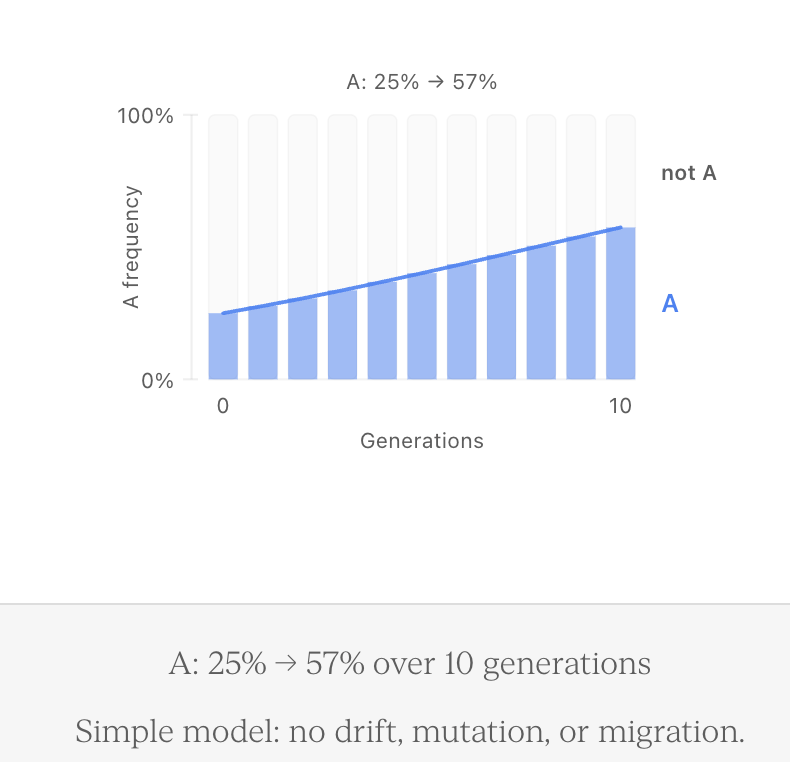
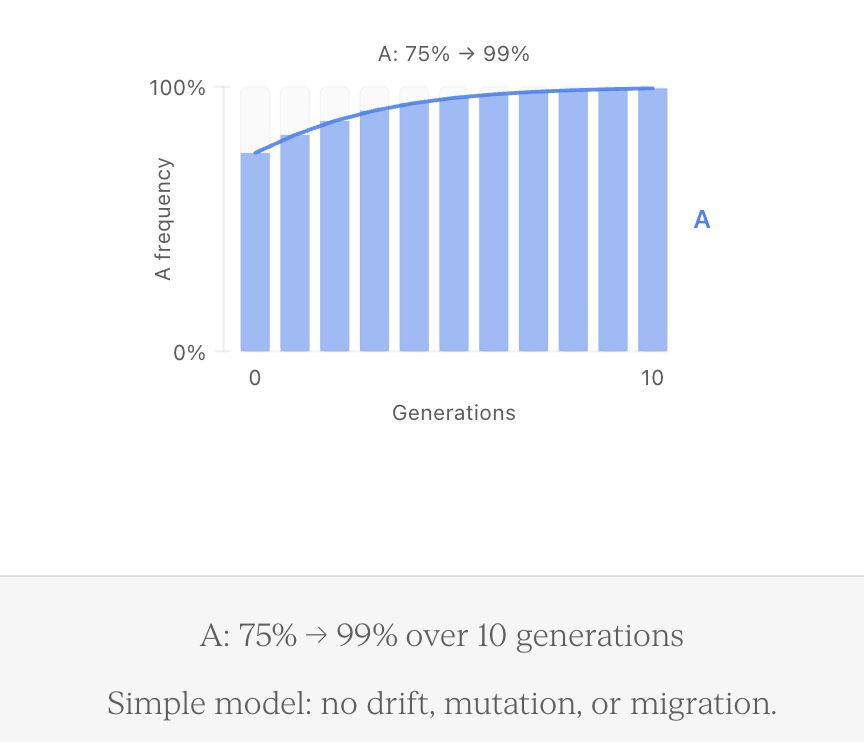
Advantageous Traits Become More Common
Imagine a population of insects containing two inherited color variations:
- Green insects.
- Brown insects.
Suppose the insects live on brown tree bark.
Birds can easily see the green insects, while brown insects are better camouflaged.
The sequence might be:
Variation exists
→ brown and green insects occur
→ birds catch more visible green insects
→ more brown insects survive
→ brown insects reproduce more successfully
→ their offspring inherit genes associated with brown coloration
→ brown coloration becomes more common over many generations.


The insects did not change color because they wanted to hide.
The population already contained variation.
Populations Evolve, Not Individuals
This distinction is extremely important.
An individual organism does not evolve during its lifetime through natural selection.
Instead:
Individuals are selected
but
populations evolve.
Evolution occurs when inherited characteristics become more or less common in a population over generations.