2. Cellular Respiration

Learning outcomes
  • I can describe cellular respiration as the process that releases energy from food.
  • I can identify glucose and oxygen as the reactants of aerobic respiration.
  • I can identify carbon dioxide and water as the products of aerobic respiration.
  • I can explain why cellular respiration is essential for life.
  • I can relate cellular respiration to energy use in cells and organisms.

What Is Cellular Respiration?

Every living cell needs a continuous supply of energy.

Cells need energy to carry out processes such as:

  • Active transport
  • Muscle contraction
  • Growth and repair
  • Protein synthesis
  • Cell division
  • Transmission of nerve impulses
  • Maintaining body temperature in mammals and birds
  • Building large molecules from smaller ones

The energy required for these processes ultimately comes from food.

Cellular respiration is the series of chemical reactions in cells that releases energy from nutrient molecules such as glucose.

Cellular respiration occurs in plants, animals, fungi, protists, and many microorganisms.

https://images.openai.com/static-rsc-4/XulIggL9MFEUul4tNKmJDEZa0L0pRxJI_lnNXftJppBbx9GoULd1ID7ccQwp-HmTFKWKNYrIkLVzymJrp8bxR8y5BRuAmpIx1tcpiVD0ttLDtbxQc2wAJAAaWF8mQ_5yNGdJMua3srdA0J0qJq9RH2cH21L1lBAllQR39CCYnqSS5ur4KUBXFbfDNhT2bk6_?purpose=fullsize
 
https://images.openai.com/static-rsc-4/GqmHlgGaWFryyp3Xwpn9yHEpSgaNVT-F6e0jA05o5l0S3kn4ppfO1HpQLT4P_aucKALZeStofOBH3PBPU6M9I3Iyq0YLfMya6BwjZQQNYjv2kRd-xaEq0VZ9arPX3-x6ViNXwl9BsSt4OUwSQJnzykJuSFanB9s-dT9wLv_oQ87XmFAaFynsgbz76ktjwUvw?purpose=fullsize
 
https://images.openai.com/static-rsc-4/MILrZ7uZldkMJH5pf-r2EgqY7OaMnHc-y4Du8K4IIFRbfebyC7VSMhhfNsph0alG_ui4rgeT3naXoTtBABae5YQMLrxCJmMTZ0IqqmRY8KCO1Kg4_Rh1S_-H6Hukn87uO61RT5LsU5nxVQv4mvtofDk0PIcW7OuHPzEk6J8ulyIW5MSWudGimAkRjHEQy1zw?purpose=fullsize
 
5

Cellular Respiration Is Not the Same as Breathing

The words respiration and breathing are sometimes confused.

Breathing is the physical movement of air into and out of respiratory organs such as the lungs.

Cellular respiration consists of chemical reactions occurring inside cells.

Breathing helps supply oxygen and remove carbon dioxide, but it is not cellular respiration itself.

For example, when you breathe in, oxygen enters your lungs. Eventually that oxygen is transported to cells, where it can participate in aerobic cellular respiration.


Aerobic Respiration

Aerobic respiration is cellular respiration that uses oxygen.

During aerobic respiration:

  • Glucose is broken down.
  • Oxygen is consumed.
  • Energy is released and transferred into forms cells can use.
  • Carbon dioxide is produced.
  • Water is produced.

The overall process can be represented in words as:

glucose + oxygen → carbon dioxide + water + energy transferred

More precisely, much of the usable energy released is captured in molecules of ATP.

https://images.openai.com/static-rsc-4/ZNFlD88PYIM3DR-fXGZluLH6KbjzS9ujFTnBO79Mjz9bREhE49mNrKjI2PsoOzPMDqxPQnRwid8NnzoiboZcP6CCrxh6jnZfEor0pk2JaHZMy0yXucaodaJif-EPA3VAiajV5FljCp_vb5hI6YOj8KDBleTRp22RaTNshLN9Xc7bk-MnMad0uWpKWpaDNiuu?purpose=fullsize
 
https://images.openai.com/static-rsc-4/dFYo3fbxVGcXTfC9IOK--2sWnfcjBnIj2ZqqvxSZs8EP6svEp2_N9Vk74FtRUj9oAXO41N3prUdsd5R7TCCxNy3YLXIlNb1cDm07KbUALy3ewE9Dk594ll2pvVs5piDbZ7MMAgpIphMGGrseuOqpNE5EVgUMymEs1gMt8-G3h1wVwi1FQySY4CzravMSG5Dn?purpose=fullsize
 
https://images.openai.com/static-rsc-4/Azgh1jqnqN6oP9gmXt9Fi18JYxoeXaBBzKdl4G2-dVfKaYyOBTypF67SYAbpKFxwpzkPlTohDxZ9wvUyO5Cl_g4ZbNXlKDGKCV_EYqBiS6KcA18xuk52Fq0kEzTN3I_KnGrl0kiLKDEeET83AhhIjHH4ozzHlXyQ7N_DPutuHJxaFpaZeBf6JZFsuGqc-e4z?purpose=fullsize
 
5

Reactants and Products

A reactant is a substance used during a chemical reaction.

A product is a substance produced by a chemical reaction.

For aerobic respiration:

Reactants

  • Glucose
  • Oxygen

Products

  • Carbon dioxide
  • Water

Energy is released during the reactions and much of the usable energy is transferred to ATP.

An important distinction is that energy is not matter. It is therefore better to describe energy as being released or transferred rather than as another chemical product.


Following the Inputs and Outputs

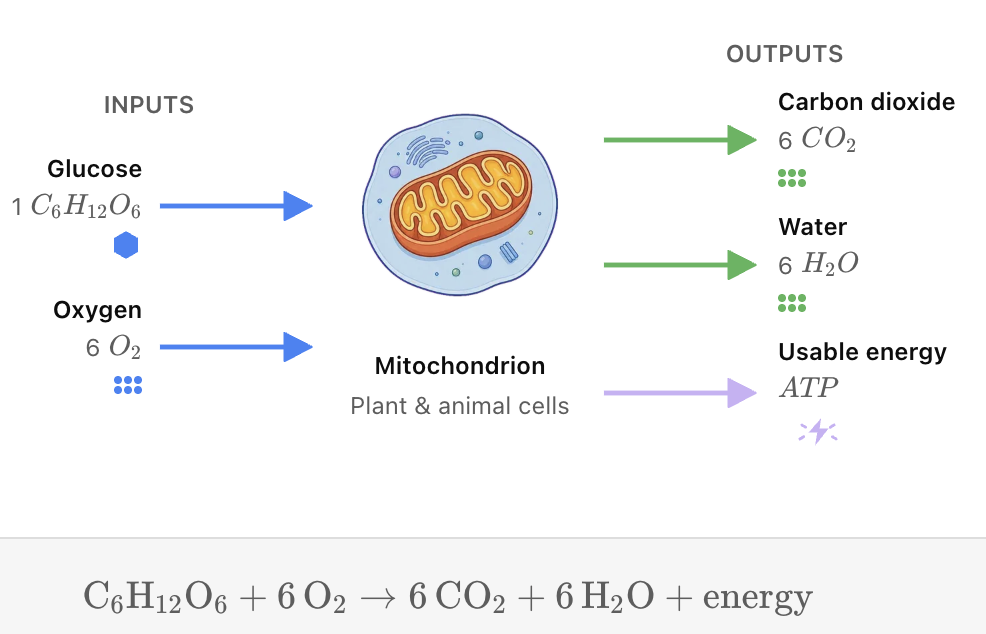
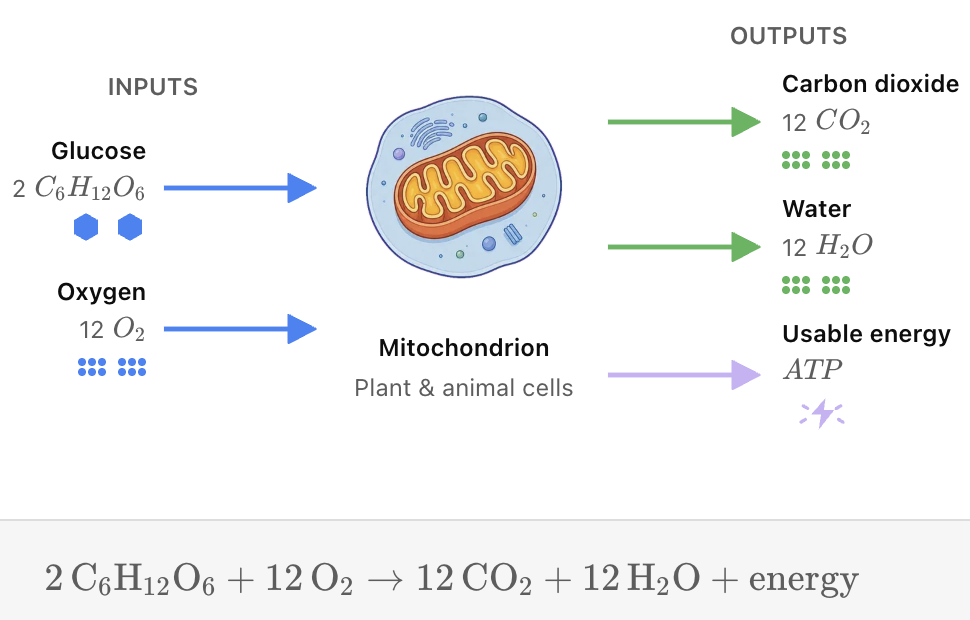
This interactive model shows the overall relationship between glucose, oxygen, carbon dioxide, water, and usable energy during aerobic respiration. Try changing the amount of glucose and observe how the other quantities change.
The Chemical Equation

The balanced chemical equation for aerobic respiration is:

C6H12O6 + 6O2 → 6CO2 + 6H2O + energy transferred

This tells us that one glucose molecule reacts overall with six oxygen molecules to produce six carbon dioxide molecules and six water molecules.

For many introductory biology problems, the word equation is the most important:

glucose + oxygen → carbon dioxide + water

The key idea is not simply memorising the equation. You should understand what happens to the materials and why the process matters to cells.


Where Does Cellular Respiration Occur?

Cellular respiration takes place inside cells.

The first stage of glucose breakdown, called glycolysis, occurs in the cytoplasm.

Most of the reactions involved in aerobic respiration then occur in the mitochondria.

Mitochondria are therefore closely associated with energy transfer in aerobic cells.

https://images.openai.com/static-rsc-4/EQbSNgwBrj9y9iTDh0IEAfcOFJuF_DXq__p6sXVCr49SugXWyM1z76FpZLTG5OrxLpvEllY9GnzBJ5zwLbYrgGR00HVefz0RjDeXxYI5Yg8C9TMJdBijweActhxwfMRRRGOo2yWSPgZzFuaSkuFzVcQ7wx4zJ3KgMDViibBnSoLh7_s73cyuhQj2BWRerERy?purpose=fullsize
 
https://images.openai.com/static-rsc-4/aOlP8JsORe54YxoBdfKPv1cHZw2PlCuWY_umAOuaSXMzlzeAseKNUsPO-b-dYaQZDOJRxdg674KjVHgksi6jGQZPPnfBgLcHL6g9GQRH1S5ZYNKQWzBuRLLxXwsVEJGRl-sr70EbQPFreMXX-ZX01Grxx5BxVsaaG5Efd0Osuo2Tb_prS5kr_axwLgQebTDS?purpose=fullsize
 
https://images.openai.com/static-rsc-4/8ULBYkKWS9ZQJ759mEfHtrEb7mSMvLbTX4GY_nMQfa-hdKRsDugxbnZ38MqRr9GOm8g3p1J-Q73pZB_wpkXhpw7wBuJKU99HblVqknA2e9J8k1unZdXIp0dJLqguT5PeMWYHOKC7yCB9e1nJhfrTKvL8A77KGRhPqCHOYPcvzU39fwFY6dc5YfGVhRZZMNJG?purpose=fullsize
 
5

Mitochondria

A mitochondrion is an organelle found in most eukaryotic cells.

Cells with high energy demands often contain many mitochondria.

Examples include:

  • Muscle cells
  • Heart muscle cells
  • Some cells involved in active transport

This demonstrates an important biological principle:

Structure is related to function.

A cell that needs large amounts of ATP generally requires substantial capacity for aerobic respiration.


Where Does the Glucose Come From?

Glucose used during respiration can come from food.

Carbohydrates such as starch are digested into smaller sugars.

For example:

starch → digestion → glucose

Glucose is absorbed through the small intestine and enters the bloodstream.

The circulatory system then transports glucose to cells throughout the body.

https://images.openai.com/static-rsc-4/g9hSbEQVI0tJiefRquk3LZTeB7Ppo-2K8xfaHRbryjZzUAomrDltVGfYyY-jyVpPbtifxpmzqNmVFlUeXCb3uoiHqAkey2gQqZ34fPvwqU0rtQcTIpMxnOd1aUWhUOEG-wYqx6v_c4dLdtrJjfh2K2QfgHASEaMdsW8bF8SrIMfUOMliQOlEEzruIijnj0lk?purpose=fullsize
 
https://images.openai.com/static-rsc-4/KJ0Eu7dnjrtsn8-0LjczBXcJhgNwO2GfWH47-a2y1WjKNZcZNAQtpMXgCoouXYEIc0M8HIXnpnYAi_71-f6H_O_WbHJt2-YZGK4yWKKUd-T-W6ipiQT07QdehTBRw5C5rQsZnGvasrAxHD4Ua1q4uxcx6R_RETiPs7xsGYPvKgTM--cn-Et_fun9Do78EMP5?purpose=fullsize
 
https://images.openai.com/static-rsc-4/EpNEpjq0mWDGMze2wmmrdgCGVPXIGRW5SHKAPAGHisnA6fKYj9MrQOmBY5R7EplukeK-9PmG5f7VPAJWQnNQCHqceS-YPJX7C2pK0xE02h8xmZxdZE3MqSulhQL8ZI-TPOZL8IYrs-VsD00CkRxwQAfW9ls1UjsVZrDowgKrKxm4v7PrjdNSF93xlq210tpi?purpose=fullsize
 
5

Glucose Can Also Be Stored

The body does not have to use every glucose molecule immediately.

In animals, excess glucose can be converted into glycogen and stored, particularly in:

  • Liver
  • Skeletal muscles

When required, glycogen can be broken down to provide glucose for metabolism.

Plants can produce glucose through photosynthesis and may store carbohydrate in forms such as starch.


Where Does the Oxygen Come From?

In humans, oxygen enters the body through the respiratory system.

A simplified pathway is:

Air → lungs → alveoli → blood → body tissues → cells

At the alveoli, oxygen diffuses into the blood.

Red blood cells transport much of this oxygen around the body.

Oxygen then moves from the blood into tissues and cells where it can be used in aerobic respiration.

https://images.openai.com/static-rsc-4/ELz6huirfGCPfX0rirBpvyLWj0pxAqSpNkUNNcDkggwZLo6vBzXhXcDEJ8sw_Wgs6BaTXAp5yYkT3DE2LP97lhxzaCVGyUho2QS_574kY6J0l9JPN1ADuqupYzMsyDpwyAxuAlTtYWM2RqXb2KlBkUOra62y4uCQfe53KJAbLhiKpGyg_RxjL1c0MxQENEQH?purpose=fullsize
 
https://images.openai.com/static-rsc-4/oe1jYeuycfGMyOGP18U5Vuvl86L_QesBEbbJzbvLC-XniCaMpGUoPGkP_3vIdiL3hLyXKqvOzu3mpQiv4SC1BjB0058FO7txjQktT00hgY4CDnwwgwEjQrCel9In3A8ghMRXCLckeRGvp_6wZQVYQCRlTYwTLulSb063oiRiLGM2qtM2hc3Ir3CYbKLXL1fd?purpose=fullsize
 
https://images.openai.com/static-rsc-4/xZxU0nf-m5Ql-olaIG7kjreZhG7sP6wxIcMWWSuLbN6FKA0dBoS3a5tJmBNnLQVfVzmUbkPNb5YCVmNmAw4jFOebBNgxkcxZ4RHj8D1geYselsDSaVmgYmtI42-J0pLDyXjm13lEgrUAPLCV87_GohVsZ-XfQr5B0tw0MbPiRwQarbkhBz437A0nUOVVx5aX?purpose=fullsize
 

Two Body Systems Working Together

Aerobic respiration demonstrates why organ systems must cooperate.

The digestive system supplies nutrients such as glucose.

The respiratory system supplies oxygen.

The circulatory system transports glucose and oxygen to cells.

Cells then use these materials during aerobic respiration.

Therefore:

Digestive system → glucose

Respiratory system → oxygen

Circulatory system → transport

Cells → respiration

The products must also be transported away.


What Happens to Carbon Dioxide?

Carbon dioxide is produced during aerobic respiration.

It must be removed because excessive accumulation would disrupt normal body chemistry.

A simplified pathway is:

Cells → blood → lungs → exhaled air

Carbon dioxide moves from cells into the blood.

The circulatory system transports it to the lungs.

It then diffuses from the blood into the alveoli and leaves the body when we breathe out.

https://images.openai.com/static-rsc-4/34gM02iVOhKj-ajaz-M89a_YbhK4Se5OdZb2XD4sjqAAwP442N_o5cKN2A9oqQeYXrlrqXFc5D3A5piaM7kWi7Cy3s_5DUh4wU9I_JvPuS3jInB0zLkUyBjpQw0tNzPyihn_CAmrKMyfxGcPDF_akw6kUKhCDGBqcDbBuqRbLs0DgI-lliWwW2bPnCziwPON?purpose=fullsize
 
https://images.openai.com/static-rsc-4/tR_rvhiz1yX5V7pwtM8K5M9RCeRgRwUNyROQtln02NqPLPftnz-2xN6NhTjAiWnqh9iTAMg42Z6gbe66322zkMfJByriIGlfUoGzo1nvVXDGsnlbpIvZQIco_AdNPn24hFIqRJeqRR4irBSq3Oq20COVwTClaT9PzWgwZ4DM8oT8uFKMif-kqz5gByoV1GjZ?purpose=fullsize
 
https://images.openai.com/static-rsc-4/tn3tqaTimeLLCZkOapkdKPfJI_-c2ojZ9ulEf4t_3ZQeSEag_kzr1Fk4gUC79gWkd1ETlmUuXsq5r4WMvWUSS60YmzuWEM3ZzrM2cKQMGQyClGNAeVV6Db4y377yAQWR4R1SDyChJDvDbtZEvBC8wAvyb93WLvlhC0gQb3Vy3vGzeWcq49sjfnP2R2drg-5C?purpose=fullsize
 
6

What Happens to the Water?

Water is also produced during aerobic respiration.

This is sometimes called metabolic water because it is produced by metabolic reactions.

Water can:

  • Become part of the body's fluids.
  • Participate in chemical reactions.
  • Be removed in urine.
  • Be lost through sweat.
  • Leave the body in exhaled air.

The amount produced by respiration is only one part of the body's overall water balance.


What Happens to the Energy?

This is the most important reason cells perform respiration.

Glucose contains chemical energy.

During respiration, some of this energy is transferred into a form that cells can use readily.

A major molecule involved in this transfer is ATP.


ATP: The Cell's Immediate Energy Carrier

ATP, or adenosine triphosphate, is a molecule used to transfer energy for cellular processes.

Energy released during respiration is used to produce ATP.

Cells can then use ATP to drive processes that require energy.

A useful simplified sequence is:

Energy in glucose → cellular respiration → ATP → cellular processes

https://images.openai.com/static-rsc-4/goV74oJEG7e8tm7ZvlCFk73Gd006C8HLQMn0YBTsCpJnVTvn7ktU1RyfB9UJ9n5VU8etfGB2RrTpr96BMn_tgeTlmq1t279G9umZKeEL5o7d-vG7pGLS_ksP7a4fKZRX3tn3T0cHGQ6AemjQnLi3XGA7TZEdQLt2o6zZ3wzJHouVF1s1UwFaWRCbE3GgierW?purpose=fullsize
 
https://images.openai.com/static-rsc-4/hkblfDJe41aSGZGbBs7L7DvJryd9vvlf4sXD51ahixP6D2XlnAoN-TdxQLT6J5591emfQvBomR9hNndCYlPvlsXfiYK70U3DjJgvnD7dLyJOghUBMKMk6JFPE9cApcgUgFyiPxgfvgnt4I7Ptu0EjcwvuLm60o8PsQo11KpIZzMQrJcAvVUVpqeUlxOafTwc?purpose=fullsize
 
https://images.openai.com/static-rsc-4/GJ9PQ3iNIvMrhIfaVSA_ySuKeSNzMKTR-7H4JhpQZrj7x1F14exU_LnAkd-sZC3LYZZRmerYBF8twvLAvAciEDyF8-5x5oML9axqWm7_2_mrPm6OFV8CsmDCn1T3JkCKpr02DC0g3eEzWWA1XgtWQbkzCk543HBVlBGadBJqLAMdw7Pe75NyJ8C60F_Td8OU?purpose=fullsize
 
5

Why Not Simply Use Glucose Directly?

Glucose contains a substantial amount of chemical energy.

Cells need to control how this energy is released and transferred.

Respiration involves many enzyme-controlled reactions rather than releasing all of the energy at once.

This allows energy to be transferred in manageable amounts and captured in molecules such as ATP.

ATP can then provide energy where and when it is needed.


How Cells Use Energy from Respiration

Muscle Contraction

Muscle cells require ATP to contract.

During exercise, muscles require more energy and therefore use ATP rapidly.

This increases the demand for respiration.


Active Transport

Cells sometimes move substances across membranes against a concentration gradient.

This process is called active transport.

Active transport requires energy supplied through ATP.

For example, cells in the small intestine and kidneys use active transport when moving certain substances across membranes.


Protein Synthesis

Cells require energy to join amino acids together to produce proteins.

Proteins are required for:

  • Growth
  • Repair
  • Enzymes
  • Cell structures
  • Some hormones

Respiration therefore indirectly supports growth and tissue repair.


Cell Division

Cell division requires substantial cellular activity.

Energy is needed to:

  • Copy and organise cellular material.
  • Move chromosomes.
  • Build new cellular structures.
  • Produce molecules required by new cells.

Respiration provides energy that supports these processes.


Maintaining Body Temperature

In mammals and birds, some of the energy transferred during metabolism ultimately contributes to heat.

This helps maintain a relatively stable internal body temperature.

Not all of the chemical energy from glucose becomes useful cellular work; some is ultimately transferred as heat.


Respiration During Exercise

Imagine beginning to run.

Your muscle cells begin contracting more frequently.

They therefore require ATP at a greater rate.

The demand for respiration increases.

This creates increased demand for:

  • Glucose
  • Oxygen

It also increases production of:

  • Carbon dioxide
  • Heat
https://images.openai.com/static-rsc-4/a4EOAh1_eksiSYJKNxCok5nCfKeWYjIhNdxh30QJphpHYgN82v9ZGStIqyTM9marpgREBzk85bUfU4h2mOuTd8zOA3BHPxf6fevPppXDU03yxdp9ZXO6Gu1ActMsdU_s88mKY7x8xR1q2xhMNTeLHyGGduPH2wdZ5ie0qrhl4oBTxnFQD1uMClqP6i7lWqdR?purpose=fullsize
 
https://images.openai.com/static-rsc-4/1AcSeFVOhBzah2rv9UCX5air69cw72YjwEsA2O9M3wzLfHk-mk6sd8mcfBLxsiK_4rpnQeaEIfGpa135fWnyGBJqS8vGZ7Sb2OsJb3RdYgQ74UaEsi7N8rXJJ-Onsnb6R2vMV0WFpnNZ9_IjHghmsvP7ZJOxKSupu7FWT_B5rm6ngY75cukDssdtnU4T5hbg?purpose=fullsize
 
https://images.openai.com/static-rsc-4/KyNBhAaaTPxbXyzz1_QdBKv5Ugfod9RPvOQ8EEGtOwRGE4aPvPfSymv4HJm9QmTHzmXAHHkzZ3fflAVAWf3a_8hjd6WIinKq9N-B1nrSz0V9GT7_9_Erlx-jxJMn4sIkb39rnYLvVR3mU092IDq0fHar7YiP_-M7iB4gRK5mqH8ny0QeIsw-bCbt6h54aLbc?purpose=fullsize
 
5

This helps explain why, during exercise:

  • Breathing rate increases.
  • Breathing becomes deeper.
  • Heart rate increases.

These responses help supply working tissues and remove metabolic products.


Worked Example: From Breakfast to Muscle Contraction

Suppose you eat a breakfast containing bread.

Digestion

Starch in the bread is digested into sugars including glucose.

Absorption

Glucose is absorbed through the small intestine into the blood.

Transport

The circulatory system carries glucose to muscle tissue.

Breathing

Oxygen enters the lungs and moves into the blood.

Oxygen Transport

Blood carries oxygen to the muscles.

Cellular Respiration

Inside muscle cells, glucose and oxygen participate in aerobic respiration.

ATP Production

Energy released from glucose is transferred into ATP.

Muscle Contraction

ATP provides energy for the processes that allow muscle fibres to contract.

This shows the connection between:

digestion → absorption → circulation → respiration → cellular activity


Respiration in Plants

Plants also perform cellular respiration.

A common misconception is that animals respire while plants only photosynthesise.

This is incorrect.

Plant cells require ATP for:

  • Active transport
  • Growth
  • Cell division
  • Protein synthesis
  • Other cellular processes

Plant cells therefore perform cellular respiration continuously.

https://images.openai.com/static-rsc-4/ALaxrFiw74uXbLPglcDh54PafJ7TIGRXlQWyJSbfDQd_R0OTw4jFjHG5jSENJoKPnh2LzRHYAH6UM_ENBXDQM2TMs8YS7A1tlf2Qfv--7OVVZEQMvwn-irLrIzmovGUJXUl4N60yjQb9kyUDk6-mXTW2sio1iPMkTLY-WRrBFAu_ABu0j5QfGYvsXd-LephC?purpose=fullsize
 
https://images.openai.com/static-rsc-4/dv8CwuvHXXLjsAJcqlkRL_shFwLeVmFeLd2fHE2EJIoAgH5NkDhmU8lOBQuXdSR8fnndxuHhntwvcNDOBv4hlC1gETY-USNZF4cFUvICYvAH7h01P68ejC-pYOrElO1yhmtsfGGbeaDJcerfo27D6K9PX79ItlDQr1KEluXwjJ70EjT9jw42bBgI2SVDKQUx?purpose=fullsize
 
https://images.openai.com/static-rsc-4/kNSm-FfZ5YReWpWK85FUlefLFcPF7loBOH4oygIUi7MuMOmLJ2ZaoGY6E599wsndCS6K4ww2pDdER-5GjAkMr3Gt7axf9PKzoJXODyDrIELkLFQ3bcfgZyR6lIySKxopyT--7qsJnwIy9Iqbggubp_PujZaLclGX4gGAQAfNNQnDqeWuvWawzIwrxVNeUHxy?purpose=fullsize
 
5

Photosynthesis and Respiration

Photosynthesis and aerobic respiration are related but distinct processes.

A simplified photosynthesis relationship is:

carbon dioxide + water → glucose + oxygen

Light energy is required.

Aerobic respiration can be represented as:

glucose + oxygen → carbon dioxide + water

Energy is released and transferred.

Photosynthesis stores energy in chemical compounds such as glucose.

Respiration transfers energy from those compounds into forms cells can use.

Plants carry out both processes.


Cellular Respiration and Food Chains

Energy relationships can also be traced through ecosystems.

Plants capture light energy through photosynthesis and store some of it as chemical energy in organic molecules.

Animals obtain organic molecules by eating plants or other organisms.

Cells then use nutrient molecules during respiration.

A simplified pathway is:

Sunlight → photosynthesis → chemical energy in food → cellular respiration → ATP → cellular processes

This helps explain why cellular respiration is central to life.


What If Oxygen Is Limited?

Cells cannot always obtain enough oxygen to meet their energy demands through aerobic respiration alone.

Under these conditions, some cells can use processes that release energy without oxygen.

These are forms of anaerobic metabolism.

Anaerobic processes release considerably less usable energy from each glucose molecule than aerobic respiration.

The exact products depend on the organism.

For now, the key distinction is:

Aerobic respiration uses oxygen.

Anaerobic pathways do not require oxygen.


Why Cellular Respiration Is Essential for Life

Living organisms are constantly carrying out processes that require energy.

Even when a person appears to be resting, cells are still:

  • Transporting substances.
  • Maintaining ion gradients.
  • Producing molecules.
  • Repairing structures.
  • Sending nerve signals.
  • Contracting the heart.
  • Maintaining internal conditions.

Respiration therefore does not occur only during exercise.

It occurs continuously in living cells.

If cells could no longer transfer sufficient energy from food into usable forms such as ATP, essential cellular processes would fail.


Common Mistakes

Saying Respiration Means Breathing

Breathing moves gases into and out of the body.

Cellular respiration consists of chemical reactions occurring within cells.

Saying Oxygen Provides the Energy

Oxygen is required for aerobic respiration, but the chemical energy being transferred ultimately comes from nutrient molecules such as glucose.

Saying Respiration Creates Energy

Energy is not created.

Respiration transfers energy from chemical stores into forms cells can use, with some ultimately transferred as heat.

Saying Respiration Occurs Only in the Lungs

The lungs exchange gases.

Cellular respiration occurs inside cells.

Saying Respiration Occurs Only in Animals

Plants, animals and many other organisms perform cellular respiration.

Saying Plants Respire Only at Night

Plant cells respire both day and night.

Photosynthesis requires light, but cellular respiration occurs continuously.

Forgetting the Products

Aerobic respiration produces:

  • Carbon dioxide
  • Water

Treating ATP as an Energy Source Like Food

ATP is better understood as an immediate energy-transfer molecule. Energy from nutrient molecules is transferred through respiration into ATP and then used for cellular processes.


Check Your Understanding

1. Define cellular respiration.

2. What is the difference between breathing and cellular respiration?

3. Name the two reactants of aerobic respiration.

4. Name the two main chemical products of aerobic respiration.

5. Write the word equation for aerobic respiration.

6. Where does most aerobic respiration occur in a eukaryotic cell?

7. Where does the glucose used in human cellular respiration come from?

8. Trace the pathway of oxygen from the atmosphere to a muscle cell.

9. What happens to carbon dioxide produced during cellular respiration?

10. What is ATP?

11. Give three cellular processes that require energy transferred through ATP.

12. Explain why breathing rate and heart rate increase during exercise.

13. Explain why muscle cells often contain many mitochondria.

14. Do plants perform cellular respiration? Explain.

15. Explain how the digestive, respiratory and circulatory systems work together to support cellular respiration.


Key Terms

  • Cellular respiration – enzyme-controlled reactions in cells that release energy from nutrient molecules and transfer it into usable forms.
  • Aerobic respiration – cellular respiration that uses oxygen.
  • Glucose – a simple sugar commonly used as a respiratory substrate.
  • Oxygen – a reactant required for aerobic respiration.
  • Carbon dioxide – a product of aerobic respiration.
  • Mitochondrion – organelle where most stages of aerobic respiration occur in eukaryotic cells.
  • Mitochondria – plural of mitochondrion.
  • ATP – adenosine triphosphate, a molecule used to transfer energy for cellular processes.
  • Reactant – a substance consumed during a chemical reaction.
  • Product – a substance formed during a chemical reaction.
  • Glycolysis – the initial stage of glucose breakdown, occurring in the cytoplasm.
  • Active transport – movement of substances across membranes using energy.
  • Metabolism – the collection of chemical reactions occurring within an organism or cell.
  • Anaerobic – occurring without requiring oxygen.

Key Takeaways

  • Cellular respiration releases energy from nutrient molecules such as glucose.
  • Aerobic respiration requires glucose and oxygen.
  • Its main chemical products are carbon dioxide and water.
  • The word equation is: glucose + oxygen → carbon dioxide + water.
  • Energy released during respiration is transferred into usable forms, particularly ATP.
  • Glycolysis begins in the cytoplasm, while most aerobic respiration occurs in the mitochondria.
  • The digestive system supplies nutrients such as glucose.
  • The respiratory system supplies oxygen and removes carbon dioxide.
  • The circulatory system transports substances between organs and cells.
  • Cells use ATP for processes including active transport, muscle contraction, growth, repair and protein synthesis.
  • Cellular respiration occurs in both plants and animals.
  • Cellular respiration is not the same as breathing.
  • Respiration does not create energy; it transfers energy from chemical stores.
  • Cellular respiration is essential because living cells require a continuous supply of usable energy to maintain life.