Food Science and Metabolism
| サイト: | Young Education |
| コース: | Biomolecules and Nutrition |
| ブック: | Food Science and Metabolism |
| 印刷者: | Người dùng khách |
| 日付: | 2026年 10月 5日(月曜日) 04:04 |
1. Food Tests for Biomolecules
Learning outcomes
- I can identify common laboratory tests used to detect biomolecules in food.
- I can perform and interpret tests for starch, sugars, proteins, and lipids.
- I can describe the expected results of positive and negative food tests.
- I can explain how indicators are used to identify specific nutrients.
- I can analyze food samples using evidence from food-test results.
What Are Food Tests?
Foods contain different biomolecules, including carbohydrates, proteins, and lipids. These substances may be present even when we cannot identify them simply by looking at the food.
Food tests are simple laboratory procedures used to determine whether particular nutrients are present in a sample.
Four commonly used tests are:
- Iodine test – detects starch
- Benedict's test – detects reducing sugars such as glucose
- Biuret test – detects proteins
- Ethanol emulsion test – detects lipids
Each test uses a particular indicator or reagent that produces an observable change when the target substance is present.


Why Do Food Tests Work?
A chemical indicator or reagent interacts with a particular substance and produces an observable result.
Usually this involves:
- A colour change
- Formation of a precipitate
- Formation of a cloudy emulsion
For example, iodine solution changes colour in the presence of starch, while Benedict's solution changes colour when heated with certain reducing sugars.
The result provides evidence that a particular type of biomolecule is present.
It does not necessarily tell us exactly which food molecule is present or precisely how much is present.
Testing for Starch
The Iodine Test
The iodine test is used to detect starch.
Iodine solution normally has a yellow-brown or orange-brown appearance.
When iodine interacts with starch, a characteristic blue-black colour appears.
Therefore:
Negative result: yellow-brown/orange-brown
Positive result: blue-black


How to Perform the Iodine Test
Place a small amount of the food sample into a test tube or spotting tile.
If the food is solid, it may first be crushed and mixed with a little water.
Add several drops of iodine solution.
Observe the colour.
Positive Result
A blue-black colour indicates that starch is present.
Negative Result
If the iodine remains yellow-brown or orange-brown, starch has not been detected.
No heating is required.
Example: Testing Bread
Suppose a small piece of bread is crushed and iodine solution is added.
The sample turns blue-black.
We can conclude:
Starch is present in the bread sample.
This makes sense because flour contains large quantities of starch.
Testing for Reducing Sugars
Benedict's Test
Benedict's test is commonly used to detect reducing sugars.
These include sugars such as glucose.
Benedict's solution begins blue.
The sample and Benedict's solution must be heated for the reaction to occur effectively.


How to Perform Benedict's Test
Place the food solution in a test tube.
Add Benedict's solution.
Place the test tube in a hot water bath for several minutes.
Observe any colour change.
Possible results include:
Blue → green → yellow → orange → brick-red
A sample remaining blue gives a negative result.
A change away from blue indicates the presence of reducing sugar.
Interpreting Benedict's Test
Benedict's test can provide a rough indication of the concentration of reducing sugar.
A simplified interpretation is:
| Observation | Interpretation |
|---|---|
| Blue | No reducing sugar detected |
| Green | Low concentration |
| Yellow | Low to moderate concentration |
| Orange | Moderate to high concentration |
| Brick-red precipitate | Higher concentration |
These colours provide an approximate comparison, not a precise measurement of sugar concentration.
Why Use a Water Bath?
Benedict's test requires heating.
In a school laboratory, a hot water bath allows the test tubes to be heated more safely and evenly than placing them directly over a flame.
This is particularly important when several samples are being compared because experimental conditions should be kept as similar as possible.
Testing for Protein
The Biuret Test
The Biuret test detects proteins by detecting peptide bonds.
Biuret reagent has a blue appearance.
If protein is present, the solution develops a lilac, violet, or purple colour.
Therefore:
Negative result: blue
Positive result: lilac/purple


How to Perform the Biuret Test
Place some food solution into a test tube.
Add Biuret reagent according to the laboratory procedure being used.
Mix carefully.
Observe the colour.
Positive Result
A lilac or purple colour indicates protein.
Negative Result
If the solution remains blue, protein has not been detected.
Example: Testing Egg White
Suppose diluted egg white is tested with Biuret reagent.
The solution changes from blue to purple.
The evidence therefore supports the conclusion:
Protein is present.
Egg white contains large quantities of protein, including albumin.
Testing for Lipids
The Ethanol Emulsion Test
The ethanol emulsion test can be used to detect lipids.
Lipids dissolve in ethanol but do not dissolve well in water.
This difference in solubility allows us to test for them.


How to Perform the Ethanol Emulsion Test
Place the food sample into a test tube.
Add ethanol.
Shake carefully so that any lipid can dissolve in the ethanol.
Add water or pour the ethanol mixture into water.
Observe the result.
Positive Result
A cloudy or milky-white emulsion forms.
Negative Result
The mixture remains relatively clear.
Why Does the Emulsion Form?
Lipids can dissolve in ethanol.
When water is added, the lipids are no longer soluble.
Tiny lipid droplets form throughout the liquid.
These droplets scatter light, making the mixture appear cloudy or milky.
Therefore, the cloudy appearance provides evidence that lipid is present.
Important Safety Note
Ethanol is flammable.
It should be kept away from:
- Flames
- Sparks
- Hot surfaces
This is particularly important if Benedict's test is being performed during the same laboratory session.
A hot water bath is safer than an open flame, and ethanol should be handled according to the laboratory's safety procedures.
Comparing the Four Food Tests
| Biomolecule | Test | Negative Result | Positive Result |
|---|---|---|---|
| Starch | Iodine | Yellow-brown | Blue-black |
| Reducing sugar | Benedict's + heat | Blue | Green/yellow/orange/brick-red |
| Protein | Biuret | Blue | Lilac/purple |
| Lipid | Ethanol emulsion | Clear | Cloudy/milky-white |
This table is particularly useful when interpreting experimental results.
Preparing Food Samples
Many foods are solid, but most food tests work more effectively with liquids or suspensions.
A solid sample can often be prepared by:
- Crushing or grinding the food.
- Adding distilled water.
- Mixing thoroughly.
- Filtering if necessary.
The resulting liquid can then be divided between test tubes for different tests.


Why Use Separate Samples?
It is usually better to divide the prepared food solution into separate portions.
One portion can be used for the iodine test.
Another can be used for Benedict's test.
Another can be used for the Biuret test.
Another can be used for the lipid test.
This prevents one reagent from contaminating the next test and affecting its results.
Using Controls
Good experiments often include controls.
A positive control contains a substance known to produce a positive result.
For example:
- Starch solution for iodine
- Glucose solution for Benedict's
- Protein solution for Biuret
- Vegetable oil for the emulsion test
A negative control contains no target biomolecule, such as distilled water.
Controls allow us to compare unknown samples with known results.
Why Are Controls Useful?
Imagine performing Benedict's test on an unknown food.
The sample remains blue.
Is reducing sugar absent, or did something go wrong with the Benedict's solution?
A known glucose sample can be tested at the same time.
If the glucose produces the expected colour change, we have evidence that the test was working correctly.
Controls therefore increase confidence in our conclusions.
Analysing an Unknown Food Sample
Suppose an unknown food gives these results:
| Test | Observation |
|---|---|
| Iodine | Blue-black |
| Benedict's | Orange after heating |
| Biuret | Purple |
| Ethanol emulsion | Milky-white |
What can we conclude?
Iodine
Blue-black means:
Starch is present.
Benedict's
Orange means:
Reducing sugar is present.
Biuret
Purple means:
Protein is present.
Ethanol Emulsion
Milky-white means:
Lipid is present.
Therefore, this food contains evidence of all four tested nutrient groups.
Worked Example: Comparing Two Foods
Suppose two foods are tested.
Food A
Iodine: blue-black
Benedict's: remains blue
Biuret: remains blue
Emulsion: clear
Food A therefore contains starch, but none of the other tested nutrients were detected.
Food B
Iodine: remains yellow-brown
Benedict's: orange
Biuret: purple
Emulsion: milky
Food B contains evidence of:
- Reducing sugars
- Protein
- Lipids
No starch was detected.
Notice that a negative result does not prove that absolutely none of the substance exists. It means that the test did not detect it under the conditions used.
Semi-Quantitative Testing
Some food tests provide more information than simply "present" or "absent."
Benedict's test is a good example.
Suppose equal volumes of three samples are tested under identical conditions:
Sample A → green
Sample B → orange
Sample C → brick-red
The evidence suggests that Sample C contains a greater concentration of reducing sugar than Sample A.
However, this is only semi-quantitative.
It gives an approximate comparison rather than an exact concentration.
Making a Fair Comparison
If food samples are being compared, important variables should be controlled.
These can include:
- Volume of food solution
- Volume of reagent
- Concentration of samples
- Heating time
- Water-bath temperature
- Size of food samples
- Method of preparation
For example, it would not be fair to compare Benedict's results if one sample were heated for 30 seconds and another for five minutes.
Indicators and Evidence
Food tests demonstrate an important principle of experimental science.
Scientists often cannot directly see the substance they are investigating.
Instead, they collect indirect evidence.
For example:
Observation: iodine turns blue-black.
Evidence: positive iodine test.
Interpretation: starch is present.
Conclusion: the food sample contains detectable starch.
Good scientific reasoning connects the observation to the conclusion.
A Food-Test Investigation
A useful investigation could compare several foods, such as:
- Bread
- Potato
- Milk
- Egg white
- Fruit juice
- Cooking oil
Students could test each sample and record the results.
A suitable table might look like this:
| Food | Iodine | Benedict's | Biuret | Emulsion | Nutrients Detected |
|---|---|---|---|---|---|
| Sample A | |||||
| Sample B | |||||
| Sample C | |||||
| Sample D |
Students can then use their observations to identify which biomolecules are present.


Food Tests and Digestion
Food testing connects directly to our understanding of digestion.
For example, starch can be tested before and after exposure to amylase.
At the beginning:
Iodine + starch → blue-black
After sufficient digestion by amylase:
Less starch remains → weaker or negative iodine result
Benedict's testing may simultaneously show an increase in reducing sugars as starch is digested.
This allows food tests to provide evidence that enzyme-controlled digestion has occurred.
Connecting Food Tests to Biomolecules
The four tests investigate substances with very different biological roles.
Starch
Starch is a carbohydrate used by plants for energy storage.
Reducing Sugars
Sugars such as glucose can be used as substrates for cellular respiration.
Proteins
Proteins have many roles, including forming enzymes, antibodies and structural components.
Lipids
Lipids can provide long-term energy storage and are important components of cell membranes.
Food tests therefore allow us to investigate molecules that have important biological functions.
Common Mistakes
Saying Iodine Tests for All Carbohydrates
Iodine is specifically used to test for starch, not carbohydrates in general.
Saying Benedict's Tests for Starch
Benedict's solution detects reducing sugars.
Iodine is used for starch.
Forgetting to Heat Benedict's Test
Benedict's test normally requires heating in a hot water bath.
Heating the Iodine Test
The iodine test does not require heating.
Saying a Positive Biuret Test Is Blue
Blue is the negative result.
A positive protein result is lilac or purple.
Saying the Lipid Test Produces a Colour Change
The important observation is the formation of a cloudy or milky-white emulsion, rather than a simple colour change.
Using an Open Flame Near Ethanol
Ethanol is highly flammable and must be kept away from ignition sources.
Treating a Negative Result as Absolute Proof
A negative test means that the substance was not detected under the conditions of the test. Very small quantities may be below the test's detection limit.
Check Your Understanding
1. What is the purpose of a food test?
2. Which reagent is used to test for starch?
3. What colour indicates a positive starch test?
4. Which test is used for reducing sugars?
5. Why must Benedict's test be heated?
6. What does a brick-red result in Benedict's test indicate?
7. Which test is used to detect protein?
8. What colour indicates a positive Biuret test?
9. Describe how the ethanol emulsion test is performed.
10. What observation indicates the presence of lipid?
11. Why should ethanol be kept away from flames?
12. Why should separate portions of a food sample be used for different tests?
13. Explain the purpose of a positive control.
14. An unknown food gives a blue-black iodine result, a blue Benedict's result and a purple Biuret result. Which nutrients have been detected?
15. Explain why Benedict's test can be described as semi-quantitative rather than fully quantitative.
Key Terms
- Biomolecule – a molecule associated with living organisms, including carbohydrates, proteins and lipids.
- Food test – a laboratory procedure used to detect particular substances in food.
- Indicator – a substance that produces an observable change under particular chemical conditions.
- Reagent – a substance used to produce or detect a chemical reaction.
- Iodine test – a test used to detect starch.
- Benedict's test – a test used to detect reducing sugars.
- Biuret test – a test used to detect proteins through the presence of peptide bonds.
- Ethanol emulsion test – a test used to detect lipids.
- Reducing sugar – a sugar capable of producing a positive Benedict's test under suitable conditions.
- Emulsion – a mixture containing tiny droplets of one liquid dispersed through another.
- Positive result – an observation indicating that the tested substance has been detected.
- Negative result – an observation indicating that the tested substance has not been detected under the test conditions.
- Positive control – a sample known to contain the substance being tested.
- Negative control – a sample known not to contain the substance being tested.
- Semi-quantitative – providing an approximate comparison of amount or concentration rather than an exact measurement.
Key Takeaways
- Food tests provide evidence about the biomolecules present in food.
- Iodine tests for starch: yellow-brown → blue-black.
- Benedict's solution tests for reducing sugars: blue can change through green, yellow and orange to brick-red after heating.
- Biuret reagent tests for protein: blue → lilac/purple.
- The ethanol emulsion test detects lipids: a cloudy or milky-white emulsion indicates a positive result.
- Benedict's test requires heating, while the iodine and Biuret tests do not.
- Ethanol is flammable and must be kept away from ignition sources.
- Controls help determine whether a food-testing procedure is working correctly.
- Fair comparisons require variables such as sample volume, reagent volume, temperature and heating time to be controlled.
- Food-test observations are evidence that must be interpreted before reaching a conclusion.
- A negative result means the substance was not detected; it does not necessarily prove that absolutely none is present.
- Food tests can also be used to investigate processes such as enzyme-controlled digestion.
2. Cellular Respiration
Learning outcomes
- I can describe cellular respiration as the process that releases energy from food.
- I can identify glucose and oxygen as the reactants of aerobic respiration.
- I can identify carbon dioxide and water as the products of aerobic respiration.
- I can explain why cellular respiration is essential for life.
- I can relate cellular respiration to energy use in cells and organisms.
What Is Cellular Respiration?
Every living cell needs a continuous supply of energy.
Cells need energy to carry out processes such as:
- Active transport
- Muscle contraction
- Growth and repair
- Protein synthesis
- Cell division
- Transmission of nerve impulses
- Maintaining body temperature in mammals and birds
- Building large molecules from smaller ones
The energy required for these processes ultimately comes from food.
Cellular respiration is the series of chemical reactions in cells that releases energy from nutrient molecules such as glucose.
Cellular respiration occurs in plants, animals, fungi, protists, and many microorganisms.


Cellular Respiration Is Not the Same as Breathing
The words respiration and breathing are sometimes confused.
Breathing is the physical movement of air into and out of respiratory organs such as the lungs.
Cellular respiration consists of chemical reactions occurring inside cells.
Breathing helps supply oxygen and remove carbon dioxide, but it is not cellular respiration itself.
For example, when you breathe in, oxygen enters your lungs. Eventually that oxygen is transported to cells, where it can participate in aerobic cellular respiration.
Aerobic Respiration
Aerobic respiration is cellular respiration that uses oxygen.
During aerobic respiration:
- Glucose is broken down.
- Oxygen is consumed.
- Energy is released and transferred into forms cells can use.
- Carbon dioxide is produced.
- Water is produced.
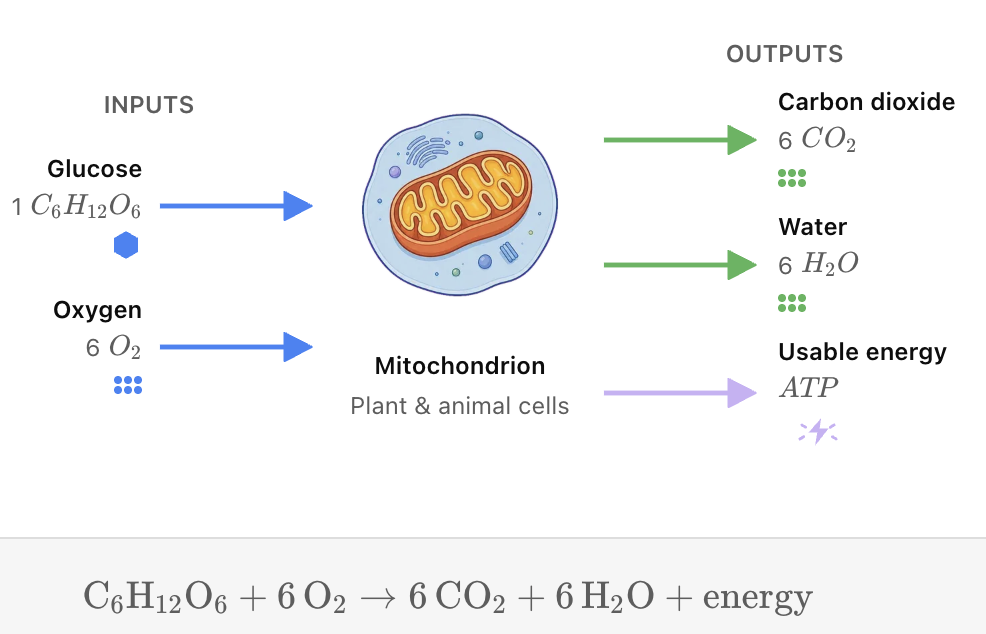
The overall process can be represented in words as:
glucose + oxygen → carbon dioxide + water + energy transferred
More precisely, much of the usable energy released is captured in molecules of ATP.


Reactants and Products
A reactant is a substance used during a chemical reaction.
A product is a substance produced by a chemical reaction.
For aerobic respiration:
Reactants
- Glucose
- Oxygen
Products
- Carbon dioxide
- Water
Energy is released during the reactions and much of the usable energy is transferred to ATP.
An important distinction is that energy is not matter. It is therefore better to describe energy as being released or transferred rather than as another chemical product.
Following the Inputs and Outputs
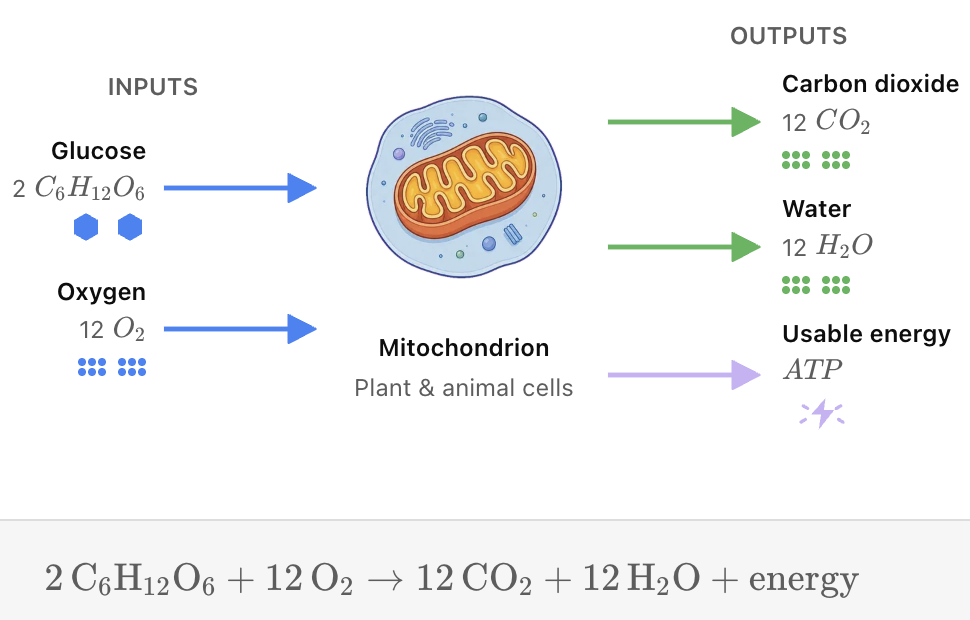
This interactive model shows the overall relationship between glucose, oxygen, carbon dioxide, water, and usable energy during aerobic respiration. Try changing the amount of glucose and observe how the other quantities change.


3. Energy Release from Food
Learning outcomes
- I can explain how carbohydrates, lipids, and proteins provide energy.
- I can compare the energy content of different biomolecules.
- I can describe how food energy is measured.
- I can relate food consumption to energy needs.
- I can evaluate factors that influence the body's energy demands.


4. Metabolism and Metabolic Rate
Learning outcomes
- I can define metabolism as the sum of all chemical reactions in an organism.
- I can distinguish between anabolic and catabolic processes.
- I can explain the concept of metabolic rate.
- I can identify factors that affect metabolic rate.
- I can interpret data related to metabolism and energy expenditure.
What Is Metabolism?
Every living organism is constantly carrying out thousands of chemical reactions.
Even when you are sitting still or sleeping, cells are:
- Breaking down nutrients.
- Producing ATP.
- Building proteins.
- Repairing damaged structures.
- Transporting substances across membranes.
- Producing new cells.
- Breaking down waste products.
- Maintaining stable internal conditions.
The term metabolism refers to the sum of all the chemical reactions occurring within an organism.
These reactions are organised into interconnected pathways and are controlled largely by enzymes.


Metabolic Pathways
A metabolic pathway is a sequence of chemical reactions in which the product of one reaction becomes the starting material for another.
A simplified pathway might look like:
Substance A → Substance B → Substance C → Substance D
Each step is usually controlled by a particular enzyme.
This allows cells to regulate their chemistry carefully rather than allowing reactions to occur randomly.
Metabolic pathways can generally be divided into two broad categories:
- Catabolic pathways
- Anabolic pathways
Catabolic Processes
Catabolism includes metabolic reactions that break larger molecules into smaller molecules.
These processes often release energy that can be transferred into useful forms such as ATP.
Examples include:
- Breakdown of glucose during cellular respiration.
- Breakdown of glycogen into glucose.
- Breakdown of stored lipids.
- Breakdown of proteins into amino acids.
A useful general pattern is:
Large molecules → smaller molecules + energy released


Cellular Respiration as Catabolism
Cellular respiration is an important example of a catabolic process.
During aerobic respiration:
glucose + oxygen → carbon dioxide + water
Energy is released and transferred into ATP.
Glucose is gradually broken down through a series of enzyme-controlled reactions.
Because a relatively complex molecule is being broken into simpler products, respiration is classified as catabolic.
Anabolic Processes
Anabolism includes metabolic reactions that build larger, more complex molecules from smaller molecules.
These reactions generally require an input of energy.
Examples include:
- Amino acids joining to form proteins.
- Glucose molecules being used to produce glycogen.
- Production of lipids.
- Synthesis of DNA.
- Formation of new cellular structures.
A useful general pattern is:
Small molecules + energy → larger molecules


Protein Synthesis as Anabolism
Proteins are built from smaller molecules called amino acids.
Cells join amino acids together in specific sequences to produce proteins.
This requires energy.
Therefore:
amino acids + energy → proteins
Protein synthesis is an anabolic process.
The proteins produced can become:
- Enzymes
- Antibodies
- Structural proteins
- Transport proteins
- Some hormones
- Muscle proteins
Comparing Anabolism and Catabolism
| Catabolism | Anabolism |
|---|---|
| Breaks molecules down | Builds molecules |
| Large → smaller | Small → larger |
| Often releases energy | Requires energy |
| Can produce ATP | Often uses ATP |
| Includes cellular respiration | Includes protein synthesis |
| Includes breakdown of energy stores | Includes formation of energy stores |
Anabolism and catabolism are not competing processes. Both occur continuously within living organisms.
Together, they form metabolism.
Connecting Catabolism and Anabolism
Catabolic and anabolic reactions are closely linked.
Catabolic pathways can release energy and transfer some of it to ATP.
ATP can then provide energy for anabolic reactions.
For example:
Glucose breakdown → energy transferred to ATP → ATP used for protein synthesis
The products of one pathway can also become the starting materials for another.
This means metabolism is better understood as an interconnected network rather than a collection of isolated reactions.

What Is Metabolic Rate?
Metabolic rate describes how quickly an organism uses energy through its metabolic processes.
A higher metabolic rate means energy is being used more rapidly.
A lower metabolic rate means energy is being used more slowly.
Metabolic rate can be expressed in units such as:
- kJ per hour
- kJ per day
- kcal per hour
- kcal per day
For example, a person expending 10,000 kJ during one day has a greater daily energy expenditure than someone expending 8,000 kJ during the same period.
However, comparisons between people may also need to consider factors such as body size and composition.
Basal Metabolic Rate
Even a person who remains completely inactive still requires energy.
Energy is needed to:
- Keep the heart beating.
- Maintain breathing.
- Support brain activity.
- Maintain ion gradients across cell membranes.
- Carry out protein synthesis.
- Maintain body temperature.
- Support kidney and liver function.
- Repair and maintain tissues.
Basal metabolic rate, or BMR, refers to the rate of energy expenditure required to maintain essential body functions under carefully defined resting conditions.


Resting Does Not Mean Zero Energy Use
Suppose someone spends an hour lying quietly on a bed.
Their skeletal muscles may be doing relatively little external work, but their cells remain highly active.
The heart continues contracting.
The brain continues functioning.
Cells maintain concentration gradients.
Proteins are continually produced and broken down.
Body temperature is regulated.
Therefore:
Resting energy expenditure is low compared with vigorous exercise, but it is never zero in a living person.
Total Energy Expenditure
A person's total daily energy expenditure comes from several components.
These include:
- Energy required for basic body functions.
- Energy used during physical activity.
- Energy associated with processing food.
- Energy required for growth or other physiological processes when applicable.
The relative contribution of each component varies between individuals and from day to day.
Physical Activity and Metabolic Rate
Physical activity can greatly increase energy expenditure.
During exercise, muscle cells require ATP at a much faster rate.
This increases metabolic activity.


For example, compare:
Sleeping → sitting → walking → jogging → sprinting
In general, energy expenditure per minute increases as the intensity of activity increases.
This happens because working muscles require more ATP.
Muscle Mass and Metabolic Rate
Body composition can influence metabolic rate.
Muscle tissue requires energy for maintenance even when it is not performing vigorous exercise.
People with greater amounts of metabolically active tissue may therefore have higher resting energy expenditure than people of the same body mass with less metabolically active tissue.
However, metabolic rate is influenced by many variables, so muscle mass is only one factor.
Body Size
Larger bodies generally require more total energy to maintain than smaller bodies.
One reason is that there is simply more living tissue requiring:
- Nutrients
- Oxygen
- Cellular maintenance
- Protein turnover
- Ion transport
This means total metabolic rate and metabolic rate relative to body mass are not necessarily the same thing.
Age and Metabolism
Metabolic rate can change throughout life.
Children and adolescents require energy for:
- Basic metabolism
- Physical activity
- Growth
- Development of new tissues
During adulthood, energy expenditure can change as body size, body composition, activity levels, and physiology change.
It is therefore too simplistic to say that age alone determines metabolic rate.
Temperature and Metabolic Rate
Temperature can influence metabolism.
Human cells rely on enzyme-controlled reactions that function effectively within a relatively narrow temperature range.
During a fever, metabolic rate may increase as body temperature rises.
Environmental temperature can also influence energy expenditure because the body must maintain its internal temperature.
For example, prolonged exposure to cold can increase energy expenditure through mechanisms that generate heat.


Hormones and Metabolism
Hormones help regulate metabolic activity.
One important example involves hormones produced by the thyroid gland.
Thyroid hormones influence metabolic activity in many tissues.
Other hormones also help regulate:
- Blood glucose
- Energy storage
- Energy mobilisation
- Growth
- Responses to exercise and stress
Metabolic rate is therefore partly controlled by the endocrine system.


Genetics and Metabolism
Genetic differences can contribute to variation in:
- Body size
- Body composition
- Hormone regulation
- Enzyme activity
- Energy expenditure
However, genes do not act alone.
Metabolism results from interactions between genetics, physiology, behaviour, diet, environment, and health.
Food and Metabolic Rate
Processing food itself requires energy.
After eating, the body uses energy to:
- Digest food.
- Absorb nutrients.
- Transport nutrients.
- Process and store nutrients.
This increase in energy expenditure associated with processing food is often called the thermic effect of food.
Different nutrients require different amounts of processing, so the effect is not identical for every meal.
Factors Affecting Metabolic Rate
Important factors include:
Body Size
Larger bodies generally have greater total energy requirements.
Body Composition
The amount and type of metabolically active tissue influence energy expenditure.
Physical Activity
Muscle activity increases ATP demand and therefore increases energy expenditure.
Age and Growth
Growth and development require additional energy.
Hormones
Hormones, particularly thyroid hormones, influence metabolic activity.
Body and Environmental Temperature
Thermoregulation can change energy expenditure.
Genetics
Inherited differences can influence metabolic characteristics.
Food Intake
Digestion and nutrient processing require energy.
Health
Illness, fever, injury, and some medical conditions can alter metabolic demands.
Measuring Metabolic Rate
Scientists can estimate metabolic rate in several ways.
One method is direct calorimetry, which measures heat released by the body.
Another is indirect calorimetry, which estimates energy expenditure using respiratory gases.
Because aerobic respiration consumes oxygen and produces carbon dioxide, measurements of gas exchange can provide information about metabolic activity.


Oxygen Consumption as Evidence
Imagine two situations.
Situation A
A person is sitting quietly.
Oxygen consumption is relatively low.
Situation B
The same person is running.
Oxygen consumption increases substantially.
The increased oxygen consumption provides evidence that aerobic metabolism has increased to meet the greater ATP demand of working muscles.
Therefore, oxygen consumption can be used as an indicator of metabolic rate under many conditions.
Interpreting Metabolic Data
Suppose a person's energy expenditure is measured during different activities.
| Activity | Energy Expenditure |
|---|---|
| Sleeping | 280 kJ/hour |
| Sitting | 360 kJ/hour |
| Walking | 900 kJ/hour |
| Cycling | 1,600 kJ/hour |
| Running | 2,600 kJ/hour |
Several conclusions can be drawn.
The lowest energy expenditure occurs during sleep.
Sitting requires somewhat more energy.
Walking produces a substantial increase.
Cycling and running require much more energy per hour.
The general pattern is:
Greater physical activity → greater ATP demand → greater energy expenditure
Reading a Metabolic Rate Graph
Graphs are commonly used to show how metabolic rate changes with activity.

When analysing such a graph:
- Identify the independent variable on the horizontal axis.
- Identify the dependent variable on the vertical axis.
- Look for the overall trend.
- Compare specific values.
- Identify unusual values or exceptions.
- Use biological knowledge to explain the pattern.
For example, if metabolic rate increases as exercise intensity increases, the explanation should connect increased muscular activity with increased ATP demand.
Worked Example: Calculating Energy Expenditure
Suppose a student walks for 2 hours at an energy expenditure of 850 kJ/hour.
Energy used:
Energy = rate × time
Energy = 850 × 2
Energy = 1700 kJ
Now suppose the same student spends one hour running at 2500 kJ/hour.
The running session uses:
2500 × 1 = 2500 kJ
Even though the running session is shorter, it uses more energy because the rate of energy expenditure is much greater.
Worked Example: Comparing Two People
Suppose two people have the following resting energy expenditures:
Person A: 6,400 kJ/day
Person B: 7,200 kJ/day
Person B has the greater measured resting energy expenditure.
The difference is:
7200 - 6400 = 800 kJ/day
However, the data alone do not tell us why Person B has the higher value.
Possible factors could include differences in:
- Body size
- Body composition
- Age
- Hormonal activity
- Physiological state
A good scientific conclusion distinguishes between what the data actually show and possible explanations.
Interpreting Percentage Changes
Suppose metabolic rate increases from 400 kJ/hour to 1000 kJ/hour during an activity.
Increase:
1000 - 400 = 600 kJ/hour
Percentage increase:
Percentage increase = (increase ÷ original value) × 100
Percentage increase = (600 ÷ 400) × 100
Percentage increase = 150%
The metabolic rate has therefore increased by 150%.
Notice that the new value is 250% of the original value, but the increase is 150%.
Metabolism and Energy Balance
Metabolism connects directly with energy intake and expenditure.
Energy enters the body through food.
Energy is used through metabolic processes and physical activity.
Over time:
Energy intake ≈ energy expenditure → energy stores tend to remain relatively stable
Energy intake > energy expenditure → energy stores tend to increase
Energy intake < energy expenditure → energy stores tend to decrease
However, the human body is a complex biological system. Appetite, hormones, body composition, activity, growth, health, and other factors can influence both intake and expenditure.
Metabolism Changes Throughout the Day
Metabolic rate is not fixed at one value.
Consider one day:
Sleeping
Energy expenditure is relatively low.
Getting ready for school
Movement increases energy expenditure.
Sitting in class
Energy expenditure decreases compared with active movement.
Physical education
Energy expenditure rises substantially.
Eating lunch
Processing food contributes to energy expenditure.
Sports practice
Muscular activity produces another major increase.
The body's metabolic rate continuously changes according to its physiological demands.
Anabolism, Catabolism and Growth
Growing organisms provide a particularly clear example of the interaction between anabolic and catabolic processes.
Food molecules can be broken down through catabolic pathways.
Some of the released energy is transferred to ATP.
ATP can then support anabolic processes that build:
- Proteins
- Cell membranes
- DNA
- Glycogen
- New cells and tissues
Therefore:
Catabolism helps provide energy and materials for anabolism.
Growth requires both.


Common Mistakes
Saying Metabolism Means Digestion
Digestion is only one part of the body's chemistry.
Metabolism includes all chemical reactions occurring in the organism.
Saying Metabolism Only Breaks Things Down
Metabolism includes both:
- Catabolism
- Anabolism
Saying Catabolism Always Means Digestion
Digestion involves catabolic reactions, but catabolism also occurs inside cells.
Cellular respiration is an example.
Saying Anabolism Releases Energy
Anabolic reactions generally require an input of energy to build larger molecules.
Saying Metabolic Rate Is Zero During Sleep
Metabolism continues continuously while an organism is alive.
Assuming a Higher Metabolic Rate Is Automatically Better
Metabolic rate reflects energy expenditure. A higher or lower rate is not inherently "good" or "bad."
Assuming Metabolic Rate Is Controlled by One Factor
Metabolic rate is influenced by many interacting factors, including body size, body composition, activity, hormones, temperature, genetics, food intake, and health.
Assuming Data Explain Their Own Cause
A graph may show that one person has a higher metabolic rate than another, but additional evidence is required to determine why.
Check Your Understanding
1. Define metabolism.
2. What is a metabolic pathway?
3. Define catabolism.
4. Give two examples of catabolic processes.
5. Define anabolism.
6. Give two examples of anabolic processes.
7. Explain how catabolic and anabolic processes are connected through ATP.
8. What is meant by metabolic rate?
9. Why does a sleeping person still require energy?
10. Identify four factors that can influence metabolic rate.
11. Explain why physical activity increases metabolic rate.
12. How can oxygen consumption provide information about metabolic rate?
13. A person walks for 3 hours at an average energy expenditure of 700 kJ/hour. Calculate the total energy expenditure.
14. Metabolic rate increases from 500 kJ/hour to 800 kJ/hour. Calculate the percentage increase.
15. Two people have different resting metabolic rates. Explain why it would be inappropriate to conclude that physical activity is responsible without additional evidence.
Key Terms
- Metabolism – the sum of all chemical reactions occurring within an organism.
- Metabolic pathway – a sequence of linked chemical reactions within a cell or organism.
- Catabolism – metabolic reactions that break larger molecules into smaller molecules, often releasing energy.
- Anabolism – metabolic reactions that build larger molecules from smaller molecules and require energy.
- Metabolic rate – the rate at which an organism uses energy through metabolic processes.
- Basal metabolic rate (BMR) – energy expenditure required to maintain essential body functions under defined resting conditions.
- ATP – a molecule used to transfer energy for cellular processes.
- Energy expenditure – the amount of energy used by the body.
- Energy intake – energy obtained from food and drink.
- Cellular respiration – a catabolic process that releases energy from nutrient molecules.
- Protein synthesis – an anabolic process in which amino acids are joined to produce proteins.
- Glycogen – a carbohydrate used for glucose storage in animals.
- Thermic effect of food – energy expenditure associated with digesting, absorbing, and processing nutrients.
- Calorimetry – measurement of energy transfer.
- Indirect calorimetry – estimation of energy expenditure using measurements such as oxygen consumption and carbon dioxide production.
Key Takeaways
- Metabolism is the sum of all chemical reactions in an organism.
- Metabolic reactions are organised into enzyme-controlled pathways.
- Catabolic reactions break molecules down and often release energy.
- Cellular respiration is an important catabolic process.
- Anabolic reactions build larger molecules and require energy.
- Protein synthesis is an example of an anabolic process.
- Catabolism and anabolism are connected through energy-transfer molecules such as ATP.
- Metabolic rate describes how rapidly an organism uses energy.
- The body continues using energy even during complete rest.
- Basal metabolic rate represents the energy required to maintain essential functions under defined resting conditions.
- Physical activity increases metabolic rate because working muscles require more ATP.
- Body size, body composition, age, growth, hormones, temperature, genetics, food intake, and health can influence metabolic rate.
- Oxygen consumption can be used to estimate metabolic activity.
- Metabolic data can be analysed using rates, comparisons, graphs, and percentage changes.
- A measured difference in metabolic rate does not by itself explain the cause of that difference.
5. Nutrition in Health and Disease
Learning outcomes
- I can explain the relationship between nutrition and overall health.
- I can identify how poor nutrition can contribute to disease.
- I can describe the role of nutrition in preventing chronic illnesses.
- I can evaluate dietary choices using scientific evidence.
- I can propose nutritional strategies that support long-term health and well-being.


