Food Science and Metabolism
2. Cellular Respiration
Learning outcomes
- I can describe cellular respiration as the process that releases energy from food.
- I can identify glucose and oxygen as the reactants of aerobic respiration.
- I can identify carbon dioxide and water as the products of aerobic respiration.
- I can explain why cellular respiration is essential for life.
- I can relate cellular respiration to energy use in cells and organisms.
What Is Cellular Respiration?
Every living cell needs a continuous supply of energy.
Cells need energy to carry out processes such as:
- Active transport
- Muscle contraction
- Growth and repair
- Protein synthesis
- Cell division
- Transmission of nerve impulses
- Maintaining body temperature in mammals and birds
- Building large molecules from smaller ones
The energy required for these processes ultimately comes from food.
Cellular respiration is the series of chemical reactions in cells that releases energy from nutrient molecules such as glucose.
Cellular respiration occurs in plants, animals, fungi, protists, and many microorganisms.


Cellular Respiration Is Not the Same as Breathing
The words respiration and breathing are sometimes confused.
Breathing is the physical movement of air into and out of respiratory organs such as the lungs.
Cellular respiration consists of chemical reactions occurring inside cells.
Breathing helps supply oxygen and remove carbon dioxide, but it is not cellular respiration itself.
For example, when you breathe in, oxygen enters your lungs. Eventually that oxygen is transported to cells, where it can participate in aerobic cellular respiration.
Aerobic Respiration
Aerobic respiration is cellular respiration that uses oxygen.
During aerobic respiration:
- Glucose is broken down.
- Oxygen is consumed.
- Energy is released and transferred into forms cells can use.
- Carbon dioxide is produced.
- Water is produced.
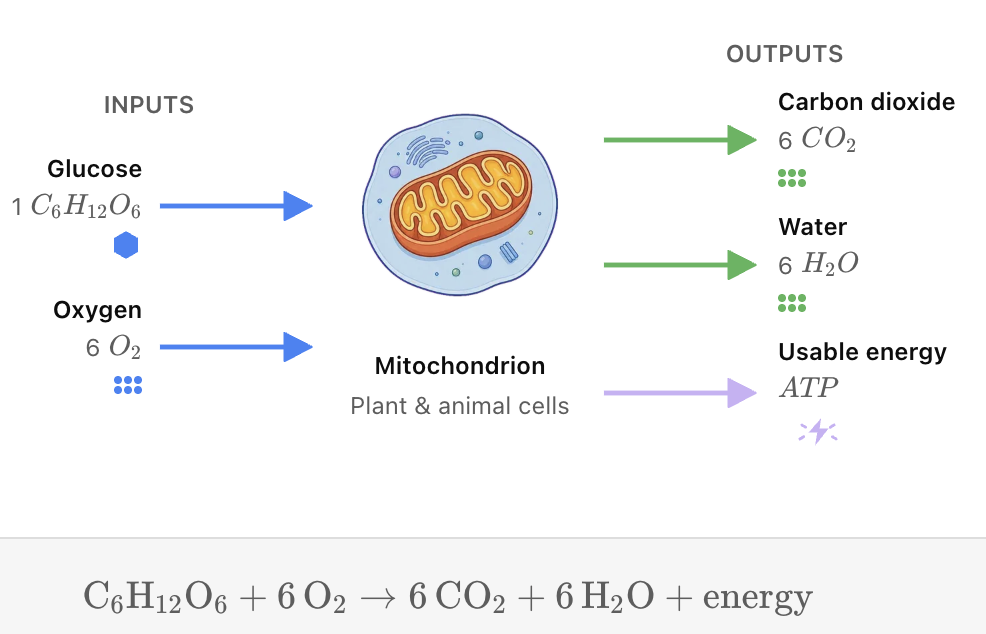
The overall process can be represented in words as:
glucose + oxygen → carbon dioxide + water + energy transferred
More precisely, much of the usable energy released is captured in molecules of ATP.


Reactants and Products
A reactant is a substance used during a chemical reaction.
A product is a substance produced by a chemical reaction.
For aerobic respiration:
Reactants
- Glucose
- Oxygen
Products
- Carbon dioxide
- Water
Energy is released during the reactions and much of the usable energy is transferred to ATP.
An important distinction is that energy is not matter. It is therefore better to describe energy as being released or transferred rather than as another chemical product.
Following the Inputs and Outputs
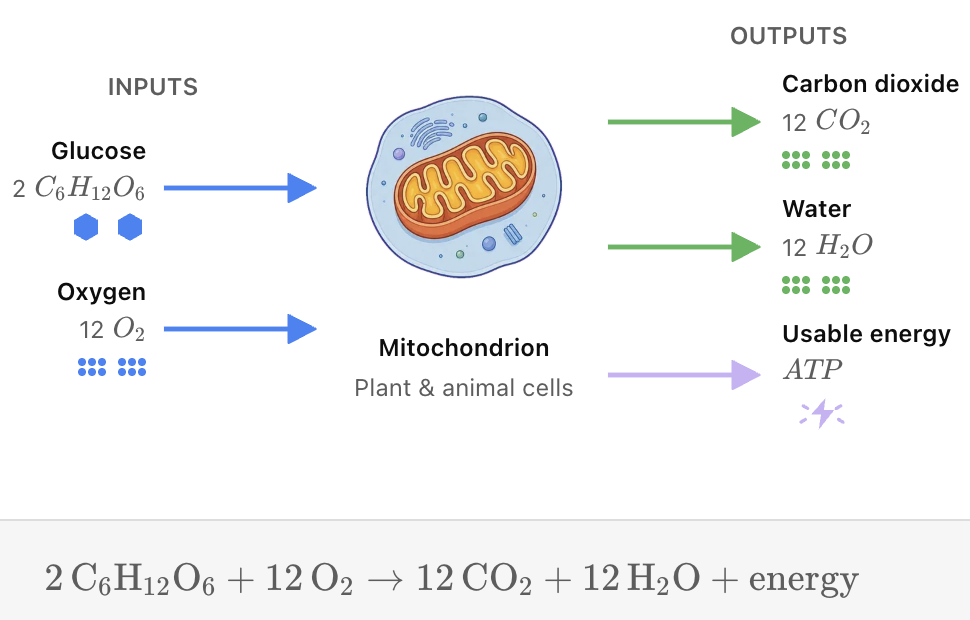
This interactive model shows the overall relationship between glucose, oxygen, carbon dioxide, water, and usable energy during aerobic respiration. Try changing the amount of glucose and observe how the other quantities change.