Enzymes and Biological Reactions
4. Enzymes in Digestion
Learning outcomes
- I can explain the role of enzymes in the digestive system.
- I can identify the functions of amylase, protease, and lipase.
- I can describe how digestive enzymes break large molecules into smaller molecules.
- I can identify where major digestive enzymes are produced and act.
- I can explain why enzymes are necessary for nutrient absorption.


Why Do We Need Digestion?
Food contains nutrients that our bodies need for:
- energy
- growth
- repair
- building new cells
- producing hormones and enzymes
- maintaining normal body functions
However, many nutrients in food are present as large molecules.
These molecules are often too large to pass through the wall of the small intestine and enter the bloodstream.
Before they can be absorbed, they must be broken into smaller molecules.
This process is called:
digestion
Mechanical and Chemical Digestion
Digestion involves both mechanical digestion and chemical digestion.
Mechanical digestion physically breaks food into smaller pieces.
Examples include:
- chewing with the teeth
- churning in the stomach
- mixing movements of the digestive tract
Mechanical digestion does not usually change the chemical identity of the molecules.
Chemical digestion breaks large molecules into smaller molecules through chemical reactions.
This is where digestive enzymes are essential.


What Do Digestive Enzymes Do?
Digestive enzymes are biological catalysts.
They increase the rate at which large food molecules are broken into smaller molecules.
A simplified pattern is:
large insoluble molecule → smaller soluble molecules
The smaller molecules can then be absorbed through the wall of the small intestine.
Three particularly important groups of digestive enzymes are:
amylases
proteases
lipases
Large Molecules Must Be Broken Down
Three major nutrient groups require digestion:
| Large Nutrient Molecule | Digestive Enzyme | Smaller Products |
|---|---|---|
| Starch | Amylase | Smaller sugars, ultimately glucose |
| Proteins | Proteases | Amino acids |
| Lipids | Lipases | Fatty acids and glycerol |
A useful way to remember this is:
Carbohydrates → sugars
Proteins → amino acids
Lipids → fatty acids + glycerol
Enzymes and Hydrolysis
Many digestive reactions are examples of hydrolysis.
Hydrolysis uses water to help break chemical bonds in large molecules.
In simplified form:
large molecule + water → smaller molecules


Digestive enzymes catalyze these reactions so that they occur rapidly enough to support the body's needs.
Carbohydrate Digestion
Carbohydrates provide an important source of energy.
Foods containing carbohydrates include:
- bread
- rice
- pasta
- potatoes
- cereals
- fruits
One common carbohydrate is:
starch
Starch is a large molecule composed of many glucose units joined together.
It must be digested before its glucose can be efficiently absorbed.
Amylase
Amylase is a digestive enzyme that breaks down starch.
A simplified reaction is:
starch → smaller sugars
Amylase begins breaking long starch molecules into smaller carbohydrates such as maltose and shorter carbohydrate chains.


Further enzymes then complete carbohydrate digestion to produce absorbable monosaccharides such as glucose.
Where Is Amylase Produced?
In humans, important sources of amylase include:
salivary glands
and:
pancreas
The salivary glands release amylase into the mouth.
The pancreas releases pancreatic amylase into the small intestine.
Amylase in the Mouth
Chemical digestion begins before food reaches the stomach.
When you chew food:
salivary glands release saliva
Saliva contains:
salivary amylase


Amylase begins breaking starch into smaller carbohydrates.
This means both mechanical and chemical digestion occur in the mouth:
teeth → mechanical digestion
amylase → chemical digestion
What Happens to Amylase in the Stomach?
Food then enters the stomach.
The stomach contains strongly acidic gastric contents.
Salivary amylase does not function effectively under these strongly acidic conditions and becomes inactive as the food mixes with stomach acid.
Therefore, significant starch digestion by salivary amylase does not continue throughout the stomach.
Carbohydrate digestion resumes strongly in the small intestine with pancreatic amylase.
Pancreatic Amylase
The pancreas produces pancreatic amylase.
This enzyme is released into the:
small intestine
There it continues the digestion of starch.


Additional enzymes in the small intestine then convert smaller carbohydrates into monosaccharides that can be absorbed.
From Starch to Glucose
A useful simplified sequence is:
Starch
↓
amylase
↓
smaller sugars such as maltose
↓
other carbohydrate-digesting enzymes
↓
glucose
Glucose is small and soluble.
It can therefore be absorbed through the intestinal wall into the bloodstream.
Protein Digestion
Proteins are large molecules made from:
amino acids
Proteins are important for:
- growth
- tissue repair
- enzymes
- antibodies
- some hormones
- cell structures
Foods rich in protein include:
- meat
- fish
- eggs
- beans
- lentils
- dairy products


Before dietary proteins can be absorbed, they must be broken down into much smaller molecules.
Proteases
Proteases are enzymes that break down proteins.
A simplified reaction is:
proteins → amino acids
In reality, protein digestion occurs through several stages:
protein → smaller peptides → amino acids
Different proteases participate in different stages.
Protease in the Stomach
One important stomach protease is:
pepsin
Pepsin begins protein digestion in the stomach.
The stomach provides acidic conditions that allow pepsin to function effectively.


Pepsin breaks proteins into smaller peptide fragments.
Why Is the Stomach Acidic?
The stomach releases:
hydrochloric acid
This produces strongly acidic conditions.
The acid has several important roles, including providing suitable conditions for pepsin activity.
Pepsin is adapted to function in this acidic environment.
This connects digestive enzymes to what we learned about:
optimum pH
Proteases from the Pancreas
The pancreas also produces proteases.
An important example is:
trypsin
Pancreatic proteases are released into the small intestine.
They continue breaking proteins and peptides into smaller molecules.


Additional peptidases associated with the small intestine help complete digestion to amino acids.
From Protein to Amino Acids
A simplified sequence is:
Protein
↓
proteases
↓
peptides
↓
peptidases
↓
amino acids
Amino acids are small enough to be absorbed through the small-intestinal wall.
They enter the blood and can be transported to cells.
What Happens to Absorbed Amino Acids?
Cells can use amino acids to produce new proteins.
These proteins may become:
- muscle proteins
- enzymes
- antibodies
- transport proteins
- structural proteins
- some hormones
This is why digesting proteins into amino acids is so important.
The body cannot simply absorb most intact dietary proteins and use them directly.
They first need to be digested.
Lipid Digestion
Lipids include fats and oils.
Lipids are important for:
- energy storage
- cell membranes
- insulation
- protection of organs
- production of some signaling molecules
Foods containing substantial lipids include:
- oils
- butter
- nuts
- seeds
- avocado
- fatty meats


Many dietary lipids are triglycerides.
Lipase
Lipase catalyzes the digestion of lipids.
At an introductory level, the reaction can be represented as:
lipids → fatty acids + glycerol
More specifically, lipases hydrolyze triglycerides.
Lipase is therefore different from:
amylase, which acts on starch,
and:
proteases, which act on proteins.
This is another example of enzyme specificity.
Where Is Lipase Produced?
An important source of digestive lipase is the:
pancreas
Pancreatic lipase is released into the:
small intestine
The small intestine is the major location for lipid digestion and absorption.
Bile Helps Lipase
Lipids present a special problem.
They do not mix well with water.
The digestive system therefore uses bile to help lipid digestion.
Bile is:
produced by the liver
and:
stored and concentrated in the gallbladder
before being released into the small intestine.


Bile is not an enzyme.
This distinction is important.
Emulsification
Bile helps break large fat globules into many smaller droplets.
This process is called:
emulsification
It does not chemically digest the lipid.
Instead, it increases the surface area available to lipase.
Imagine one large fat droplet.
After emulsification, the same amount of lipid is distributed among many smaller droplets.
More surface is exposed.
Therefore:
greater surface area → more contact with lipase → faster lipid digestion
Bile and pH
Bile also helps create conditions in the small intestine that are suitable for digestive enzymes.
Acidic material arrives from the stomach.
Bile contributes to neutralizing this acidity, helping produce more alkaline conditions in the small intestine.
These conditions are more suitable for many pancreatic enzymes.
From Lipids to Absorbable Products
The simplified pathway is:
Large fat globule
↓
bile emulsification
↓
small lipid droplets
↓
lipase
↓
fatty acids + monoglycerides/glycerol-related products
These digestion products can then be absorbed through the intestinal lining.
For introductory study, this is often simplified to:
lipid → fatty acids + glycerol
The Pancreas: A Digestive Enzyme Factory
The pancreas has a major role in chemical digestion.
It produces enzymes including:
- pancreatic amylase
- proteases
- pancreatic lipase


These enzymes are released into the first part of the small intestine, the:
duodenum
The pancreas therefore contributes to digestion of:
carbohydrates + proteins + lipids
Summary of the Major Digestive Enzymes
| Enzyme | Substrate | Main Products | Important Source | Main Site of Action |
|---|---|---|---|---|
| Amylase | Starch | Smaller sugars | Salivary glands, pancreas | Mouth, small intestine |
| Proteases | Proteins/peptides | Peptides and amino acids | Stomach, pancreas, small intestine | Stomach, small intestine |
| Lipase | Lipids | Fatty acids and glycerol-related products | Mainly pancreas | Mainly small intestine |
This table is worth learning because it connects:
enzyme → substrate → product → location
Following Food Through the Digestive System
Let's follow a meal containing bread, chicken, and oil.
The bread contains:
starch
The chicken contains:
protein
The oil contains:
lipid
Different digestive enzymes are required for each nutrient.
Stage 1: The Mouth
In the mouth:
- teeth mechanically break food apart
- saliva moistens food
- salivary amylase begins starch digestion

Protein and lipid digestion by major enzymes is not the main digestive activity here.
The food is swallowed and passes through the oesophagus.
Stage 2: The Stomach
In the stomach:
- muscular walls churn the food
- gastric contents are acidic
- pepsin begins significant protein digestion


The stomach therefore performs:
mechanical digestion
and:
chemical digestion
Stage 3: The Small Intestine
Most chemical digestion is completed in the small intestine.
The pancreas releases digestive enzymes including:
- amylase
- proteases
- lipase
The liver and gallbladder supply bile.
The intestinal lining also provides enzymes involved in completing digestion.


The result is the production of small molecules that can be absorbed.
Digestion Is Not the Same as Absorption
These two terms are closely related but different.
Digestion means:
breaking large food molecules into smaller molecules.
Absorption means:
moving digested nutrients across the intestinal wall into the body's transport systems.
Therefore:
Digestion happens first → absorption follows
Why Must Molecules Be Small?
The wall of the small intestine acts as a selective barrier.
Large molecules such as:
- starch
- most proteins
- large lipid structures
cannot simply pass efficiently through it intact.
Digestive enzymes convert them into smaller molecules.
For example:
starch → glucose
proteins → amino acids
lipids → fatty acids and related products
These smaller products can then cross the intestinal epithelium.
The Small Intestine and Absorption
The small intestine is specialized for nutrient absorption.
Its inner surface contains millions of small projections called:
villi
Each villus is covered with even smaller structures called:
microvilli


Together, folds, villi, and microvilli create a very large surface area for absorption.
How Digestion Makes Absorption Possible
This connection is one of the most important ideas in this topic.
Enzymes first break large nutrients into small molecules.
Those molecules can then cross the intestinal lining.
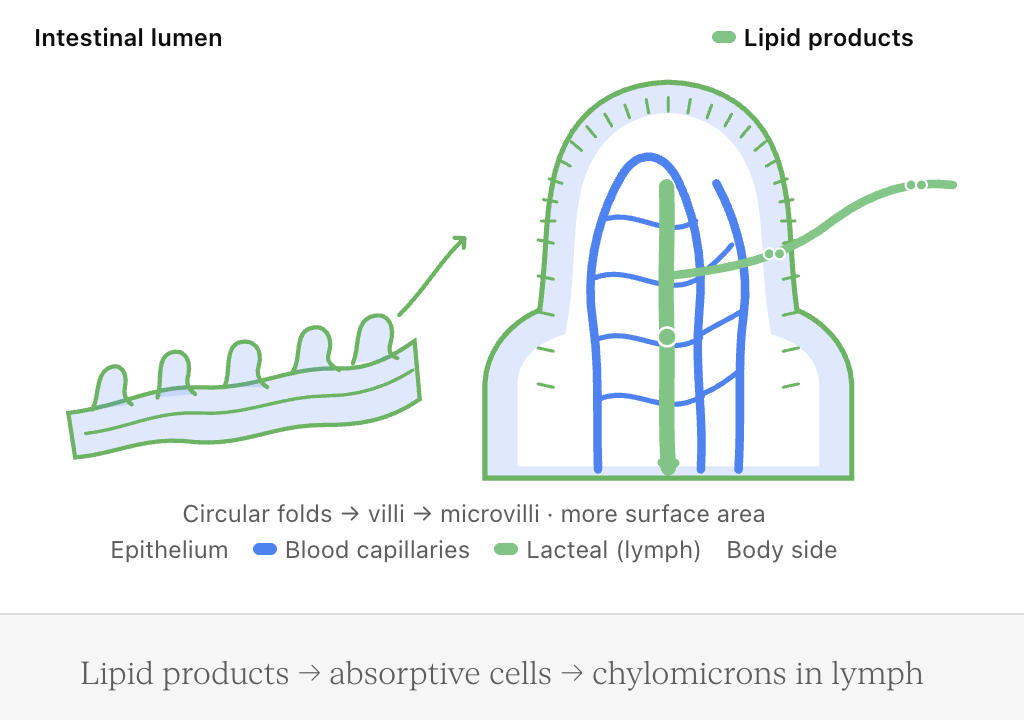
Explore how the products of carbohydrate, protein, and fat digestion move through a villus:
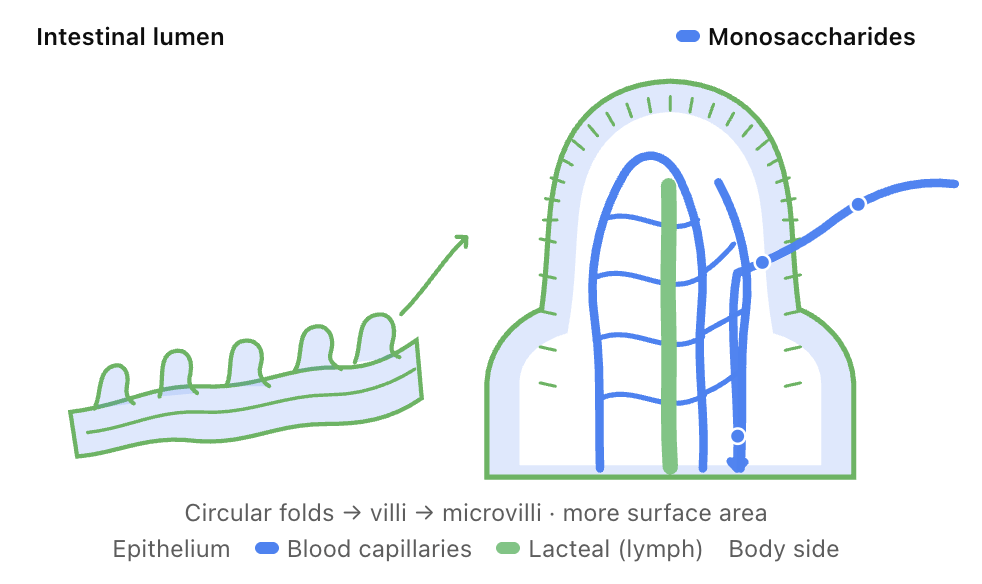
Monosaccharides → blood capillaries → portal blood
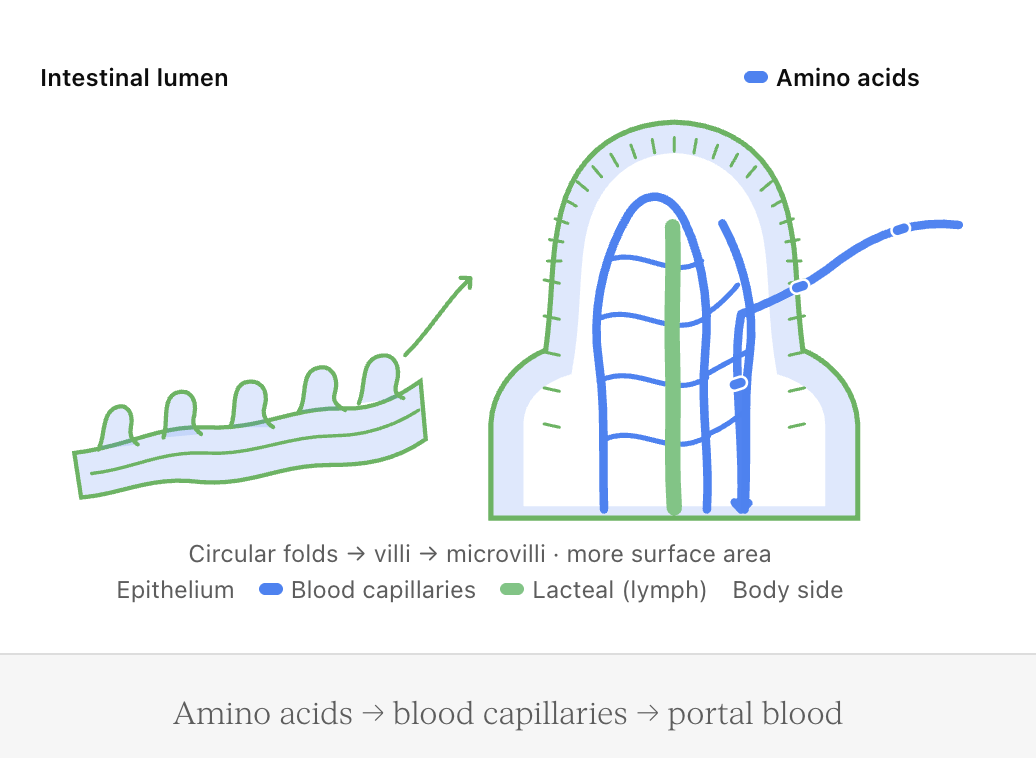
For carbohydrates:
starch → glucose → absorbed into blood
For proteins:
proteins → amino acids → absorbed into blood
For long-chain fats, digestion produces smaller lipid components that enter intestinal cells and are largely packaged for transport through the lymphatic system before eventually reaching the bloodstream.
Structure of a Villus
Each villus has several adaptations that help absorption.
These include:
- large surface area
- thin epithelial surface
- good blood supply
- lacteal for lipid transport
- many microvilli

The thin surface reduces the distance that absorbed molecules must travel.
The blood supply helps carry absorbed nutrients away.
Absorption of Glucose
Glucose is produced during carbohydrate digestion.
Once absorbed into intestinal cells, glucose enters blood capillaries.
It is transported around the body.
Cells can use glucose during:
cellular respiration
to release usable energy.
Therefore:
carbohydrate digestion → glucose absorption → transport → cellular respiration
Absorption of Amino Acids
Proteins are digested into amino acids.
Amino acids cross the intestinal lining and enter:
blood capillaries
They are transported to cells throughout the body.
Cells can use them to build new proteins.
Therefore:
protein digestion → amino acid absorption → protein synthesis
Absorption of Lipid Products
The absorption of lipid digestion products is somewhat different.
Fatty acids and monoglycerides can enter intestinal epithelial cells.
Inside these cells, many are reassembled into triglycerides and packaged into particles called chylomicrons.
These enter:
lacteals
which are small lymphatic vessels inside the villi.


They eventually reach the bloodstream through the lymphatic system.
For introductory courses, the key idea is:
lipid digestion produces smaller components that can be absorbed through the small intestine.
Why Can't Starch Simply Be Absorbed?
Imagine trying to move a huge object through a tiny doorway.
Large starch molecules are not suitable for efficient absorption through the intestinal epithelium.
Amylase and other enzymes break them into much smaller carbohydrates.
Ultimately, absorbable monosaccharides such as glucose are produced.
Therefore:
large molecule → digestion → small molecule → absorption
Why Can't Proteins Simply Be Absorbed?
Proteins are large chains of amino acids.
Most intact dietary proteins are too large for normal absorption.
Proteases and peptidases break them down.
The final amino acids are much smaller.
They can then cross the intestinal wall and enter the blood.
Why Can't Lipids Simply Mix with Digestive Fluids?
Most lipids are hydrophobic.
This means they do not mix well with water.
Digestive fluids are largely water-based.
Bile solves part of this problem by emulsifying fats into small droplets.
This allows lipase to access a much greater surface area.


Enzyme Specificity in Digestion
Digestive enzymes demonstrate enzyme specificity extremely clearly.
Amylase does not digest proteins.
Proteases do not perform the same reaction on starch.
Lipase does not digest starch.
Why?
Because each enzyme has a particular active site suited to particular substrates and reactions.
Therefore:
amylase + starch
protease + protein
lipase + lipid
Digestive Enzymes and pH
Different regions of the digestive system have different pH conditions.
This affects which enzymes work effectively.


For example:
Mouth: near-neutral conditions support salivary amylase activity.
Stomach: acidic conditions support pepsin activity.
Small intestine: neutral to mildly alkaline conditions support many pancreatic and intestinal enzymes.
This demonstrates how enzyme function is adapted to its environment.
Digestive Enzymes and Temperature
Human digestive enzymes normally operate around body temperature.
Approximately:
37°C
This provides suitable conditions for many human enzymes.
Very low temperatures would slow enzyme-controlled reactions.
Extremely high temperatures can damage protein structure and cause denaturation.
What If Digestive Enzymes Were Missing?
Suppose the digestive system could mechanically break food into tiny pieces but had no digestive enzymes.
Chewing would increase surface area, but large molecules would remain chemically large.
Starch would still largely be starch.
Proteins would still largely be proteins.
Triglycerides would remain large lipid molecules.
As a result, efficient nutrient absorption would be severely reduced.
Lactase: Another Digestive Enzyme
Another important digestive enzyme is:
lactase
Lactase acts on:
lactose
Lactose is a sugar found in milk.
The reaction is:
lactose + water → glucose + galactose


Lactase is located at the surface of cells lining the small intestine.
Lactose Intolerance
Some people produce relatively low amounts of lactase.
As a result, some lactose is not digested in the small intestine.
It can pass into the large intestine, where bacteria metabolize it.
This can contribute to symptoms such as:
- gas
- bloating
- abdominal discomfort
- diarrhea
This provides a real-world example of why digestive enzymes are important.
Digestion as a Sequence
Digestion is not one single reaction.
It is a coordinated sequence involving:
mechanical breakdown
↓
enzyme-controlled chemical digestion
↓
production of small soluble molecules
↓
absorption through the small intestine
↓
transport around the body
↓
use by cells
Each stage supports the next.
The Journey of Starch
Follow a starch molecule:
Starch in food
↓
mouth
↓
salivary amylase begins digestion
↓
stomach
↓
salivary amylase activity largely stops in acidic conditions
↓
small intestine
↓
pancreatic amylase continues starch digestion
↓
other carbohydrate-digesting enzymes
↓
glucose and other absorbable monosaccharides
↓
intestinal villi
↓
bloodstream
↓
cells
↓
used in respiration or other metabolic processes
The Journey of Protein
Follow a protein molecule:
Protein in food
↓
stomach
↓
pepsin begins protein digestion
↓
smaller peptides
↓
small intestine
↓
pancreatic proteases continue digestion
↓
intestinal peptidases
↓
amino acids
↓
intestinal villi
↓
bloodstream
↓
cells
↓
used to make new proteins
The Journey of Lipid
Follow dietary fat:
Large fat globules
↓
small intestine
↓
bile emulsifies fat
↓
smaller droplets
↓
lipase
↓
fatty acids and monoglycerides/glycerol-related products
↓
intestinal cells
↓
lipid transport pathways
↓
body tissues


Production vs Site of Action
An important distinction is:
where an enzyme is produced
is not always the same as:
where the enzyme acts
For example:
Pancreatic amylase is:
produced in the pancreas
but:
acts in the small intestine
Similarly, pancreatic lipase is:
produced in the pancreas
but:
acts mainly in the small intestine
This is a common examination question.
Enzyme Summary by Location
Mouth
Important enzyme:
salivary amylase
Main action:
starch digestion begins
Stomach
Important enzyme:
pepsin
Main action:
protein digestion begins
Conditions:
acidic
Pancreas
Produces:
- amylase
- proteases
- lipase
These enzymes are released into:
the small intestine
Small Intestine
Receives pancreatic enzymes and bile.
Produces or contains additional digestive enzymes at its lining.
Major events include:
- completion of carbohydrate digestion
- completion of protein digestion
- major lipid digestion
- absorption of digested nutrients


Common Misconception: Bile Is an Enzyme
Bile is not an enzyme.
Bile helps digestion by:
- emulsifying lipids
- increasing surface area for lipase
- helping neutralize acidic material entering the small intestine
Lipase performs the enzyme-controlled chemical digestion.
Common Misconception: The Stomach Digests Everything
The stomach is important, but most chemical digestion is completed in the:
small intestine
The small intestine also performs most nutrient absorption.
The stomach is particularly important for:
- mechanical mixing
- acidic conditions
- beginning significant protein digestion
Common Misconception: Amylase Produces Only Glucose Directly
Amylase breaks starch into smaller carbohydrates, especially maltose and shorter chains.
Other enzymes then complete carbohydrate digestion to produce absorbable monosaccharides.
A simplified school-level pathway is often written:
starch → glucose
but the more accurate sequence is:
starch → smaller carbohydrates → glucose
Common Misconception: Digestion and Absorption Are the Same
They are different.
Digestion: breaking molecules down.
Absorption: moving digested nutrients into the body's internal transport systems.
Enzymes mainly perform the chemical digestion that makes absorption possible.
Common Misconception: Chewing Is Enough
Chewing is important because it:
- physically breaks food apart
- increases surface area
- mixes food with saliva
However, chewing does not break starch into glucose or proteins into amino acids.
Chemical digestion requires enzymes.
Common Misconception: Enzymes Are Used Up
Digestive enzymes are catalysts.
They are not consumed as ordinary reactants during each reaction.
An enzyme can therefore catalyze reactions involving many substrate molecules before it is eventually degraded.
Investigating Amylase
A common digestive-enzyme experiment investigates the action of amylase on starch.
Iodine solution can test for starch.


Iodine with starch produces a:
blue-black colour
As amylase digests the starch, eventually the blue-black colour is no longer produced.
Students can investigate how factors such as:
- temperature
- pH
- enzyme concentration
affect the rate of starch digestion.
Why Digestive Enzymes Matter
Digestive enzymes connect the food we eat with the molecules our cells actually use.
Without digestion:
large nutrients remain difficult to absorb
With digestive enzymes:
large molecules → small molecules → absorption → transport → cellular use
For example:
Starch → glucose → respiration
Protein → amino acids → new proteins
Lipids → fatty acids and related products → membranes, energy storage and other functions
Did You Know?
Your small intestine is several metres long and has an enormous internal surface area because of folds, villi, and microvilli.


This illustrates how digestion and absorption work together.
Digestive enzymes produce small molecules.
The specialized surface of the small intestine then allows those molecules to be absorbed efficiently.
Key Terms
- Digestion: Breakdown of large food molecules into smaller molecules.
- Mechanical digestion: Physical breakdown of food without changing its chemical composition.
- Chemical digestion: Chemical breakdown of food molecules.
- Digestive enzyme: Biological catalyst involved in chemical digestion.
- Amylase: Enzyme that digests starch into smaller carbohydrates.
- Protease: Enzyme that digests proteins or peptides.
- Lipase: Enzyme that digests lipids.
- Pepsin: Protease that functions in the stomach.
- Trypsin: Pancreatic protease that functions in the small intestine.
- Substrate: Molecule upon which an enzyme acts.
- Hydrolysis: Reaction using water to break chemical bonds.
- Bile: Digestive fluid that helps emulsify fats and neutralize acidic material.
- Emulsification: Breaking large fat globules into smaller droplets.
- Absorption: Movement of digested nutrients across the intestinal wall into the body's transport systems.
- Villus: Finger-like projection in the small intestine that increases surface area.
- Microvilli: Microscopic projections on intestinal cells that further increase surface area.
- Lacteal: Lymphatic vessel inside a villus involved in lipid absorption.
- Pancreas: Organ that produces several important digestive enzymes.
- Duodenum: First part of the small intestine.
- Lactase: Enzyme that digests lactose.
Key Relationships
Carbohydrate digestion:
starch → smaller sugars → glucose
Important enzyme:
amylase
Protein digestion:
protein → peptides → amino acids
Important enzymes:
proteases
Lipid digestion:
lipid → fatty acids + glycerol-related products
Important enzyme:
lipase
Overall relationship:
large food molecules → enzyme-controlled digestion → small molecules → absorption → transport → use by cells
Key Takeaways
- Digestive enzymes are biological catalysts that speed up chemical digestion.
- Many nutrients in food are too large to be absorbed efficiently in their original form.
- Digestive enzymes break large molecules into smaller molecules.
- Amylase digests starch.
- Proteases digest proteins and peptides.
- Lipases digest lipids.
- Salivary amylase begins starch digestion in the mouth.
- The pancreas produces amylase that acts in the small intestine.
- Pepsin begins significant protein digestion in the stomach.
- Pancreatic proteases continue protein digestion in the small intestine.
- Lipase acts mainly in the small intestine.
- The pancreas is an important source of amylase, proteases, and lipase.
- Starch is ultimately digested into absorbable monosaccharides such as glucose.
- Proteins are ultimately digested into amino acids.
- Lipids are digested into smaller lipid components including fatty acids.
- Bile is not an enzyme.
- Bile emulsifies lipids and increases the surface area available to lipase.
- Bile also helps neutralize acidic material entering the small intestine.
- Digestive enzymes are specific to particular substrates and reactions.
- Different parts of the digestive system provide different pH conditions for enzyme activity.
- The small intestine is the main site where chemical digestion is completed and nutrients are absorbed.
- Villi and microvilli provide a large surface area for absorption.
- Glucose and amino acids enter blood capillaries in the villi.
- Many long-chain lipid products are transported through lacteals and the lymphatic system before reaching the blood.
- Digestion and absorption are different processes.
- Digestion produces molecules small enough for absorption.
- The place where an enzyme is produced may differ from the place where it acts.
- Digestive enzymes make nutrients available for respiration, growth, repair, and other cellular processes.
- A useful summary is: enzymes make large food molecules small enough for the body to absorb and use.