Enzymes and Biological Reactions
| Site: | Young Education |
| Course: | Biomolecules and Nutrition |
| Book: | Enzymes and Biological Reactions |
| Printed by: | Người dùng khách |
| Date: | Monday, 5 October 2026, 4:05 AM |
1. What Are Enzymes?
Learning outcomes
- I can define enzymes as biological catalysts.
- I can explain how enzymes speed up chemical reactions in living organisms.
- I can describe the role of enzymes in metabolism.
- I can explain why enzymes are essential for life.
- I can identify examples of enzymes involved in biological processes.


2. Enzyme Specificity
Learning outcomes
- I can explain that enzymes are specific to particular substrates.
- I can describe the lock-and-key model of enzyme action.
- I can explain how the shape of an enzyme determines its function.
- I can identify substrates and products in enzyme-controlled reactions.
- I can explain why one enzyme cannot usually catalyze many different reactions.


What Is Enzyme Specificity?
Enzymes are biological catalysts. They increase the rate of chemical reactions in living organisms without being permanently used up.
However, enzymes do not usually catalyze every possible reaction.
Instead, enzymes are specific.
Enzyme specificity means that an enzyme normally catalyzes a particular reaction or a limited group of closely related reactions involving particular substrates.
For example:
- amylase acts on starch
- lactase acts on lactose
- lipases act on lipids
- proteases act on proteins
- catalase acts on hydrogen peroxide
This specificity is closely related to the three-dimensional structure of the enzyme.
Enzymes Have Specific Shapes
Most enzymes are proteins.
Proteins consist of chains of amino acids that fold into complex three-dimensional structures.


The way the protein folds determines:
- the overall shape of the enzyme
- the shape of its active site
- the chemical properties of the active site
- which substrates can bind
- which reaction the enzyme can catalyze
Therefore:
structure → function
The shape and chemistry of an enzyme help determine what the enzyme can do.
The Active Site
Every enzyme has a region where catalysis occurs called the:
active site
The active site is a relatively small part of the entire enzyme.
It is where the substrate binds and the enzyme-controlled reaction occurs.


The active site has a particular:
- shape
- arrangement of atoms
- distribution of electrical charges
- chemical environment
These properties determine which substrates can interact effectively with the enzyme.
What Is a Substrate?
A substrate is a molecule that binds to an enzyme and is changed during the enzyme-controlled reaction.
For example:
Amylase acts on starch.
Therefore:
Enzyme = amylase
Substrate = starch
The substrate is converted into one or more products.
What Is a Product?
A product is a substance produced by a chemical reaction.
The basic enzyme-controlled reaction can be represented as:
Enzyme + Substrate → Enzyme-Substrate Complex → Enzyme + Product
Notice that the enzyme appears at both the beginning and the end.
The enzyme is not permanently consumed by the reaction.
The Enzyme-Substrate Complex
When a substrate binds to the active site, the temporary combination is called an:
enzyme-substrate complex


The process can be summarized:
1. Substrate approaches the enzyme.
2. Substrate binds to the active site.
3. An enzyme-substrate complex forms.
4. The enzyme helps the reaction occur.
5. Product or products are formed.
6. Products leave the active site.
7. The enzyme can catalyze another reaction.
Why Does the Substrate Bind?
A substrate must interact appropriately with the active site.
This depends partly on whether the substrate has a suitable:
- shape
- size
- charge
- chemical structure
A molecule with unsuitable properties will generally not bind in the correct way for the enzyme to catalyze the reaction.
This provides the basis for enzyme specificity.
The Lock-and-Key Model
A simple model used to explain enzyme specificity is the:
lock-and-key model
Imagine an enzyme as a lock.
The substrate is the key.


Only a key with the appropriate shape fits a particular lock.
Similarly, only a substrate with appropriate properties fits and interacts effectively with a particular active site.
Lock-and-Key Model Step 1
The enzyme has an active site with a particular shape.
For example:
Enzyme + Substrate
The substrate approaches the enzyme.
If the substrate is appropriate for the enzyme, it can interact with the active site.
Lock-and-Key Model Step 2
The substrate enters the active site.
The substrate and active site have complementary properties.
An:
enzyme-substrate complex
forms.
At this point, the enzyme positions the substrate in a way that helps the chemical reaction occur.
Lock-and-Key Model Step 3
The reaction occurs.
The enzyme lowers the activation-energy barrier and facilitates changes involving chemical bonds.
Depending on the reaction, bonds may be:
- broken
- formed
- rearranged
The substrate becomes product.
Lock-and-Key Model Step 4
The product has different properties from the original substrate.
It is released from the active site.
The enzyme remains available.
Therefore:
E + S → ES → E + P
where:
E = enzyme
S = substrate
ES = enzyme-substrate complex
P = product


Why Doesn't Every Molecule Fit?
Imagine three differently shaped objects approaching the same active site.
Only one may have the appropriate shape and chemical interactions needed to bind effectively.
The others may:
- be too large
- be too small
- have an unsuitable shape
- have incompatible charges
- lack the correct chemical groups
Therefore, the enzyme does not catalyze reactions involving those molecules in the same way.
Shape Alone Is Not the Whole Story
Introductory diagrams often show enzyme specificity as if it depends only on matching physical shapes.
Real enzyme-substrate interactions are more complicated.
Binding also depends on chemical interactions such as:
- hydrogen bonding
- attractions between charges
- hydrophobic interactions
- temporary molecular attractions
Therefore, it is more accurate to say:
The shape and chemical properties of the active site determine substrate binding and enzyme specificity.
The Induced-Fit Model
The lock-and-key model is useful, but enzymes are not completely rigid.
A more realistic model is called the:
induced-fit model


When the correct substrate begins interacting with the active site, the enzyme may change shape slightly.
The active site becomes more complementary to the substrate.
This helps the enzyme catalyze the reaction.
Lock-and-Key vs Induced Fit
The two models are related but slightly different.
| Lock-and-Key Model | Induced-Fit Model |
|---|---|
| Active site is represented as relatively rigid | Active site is flexible |
| Substrate fits the active site | Substrate binding causes some structural adjustment |
| Simple introductory model | More realistic description |
| Explains specificity | Explains specificity and enzyme flexibility |
For introductory enzyme studies, the lock-and-key model is extremely useful.
However, remember that actual protein molecules can move and change shape.
Example: Lactase
Lactase is an enzyme involved in the digestion of lactose.
Its substrate is:
lactose
Lactose is a sugar found naturally in milk.
Lactase catalyzes the hydrolysis of lactose into:
glucose + galactose
So:
Lactose + water → glucose + galactose


Identify the parts:
Enzyme: lactase
Substrate: lactose
Products: glucose and galactose
Why Doesn't Lactase Digest Starch?
Starch and lactose have different molecular structures.
Lactase's active site is adapted for interactions involved in binding and reacting with lactose.
Starch does not interact with lactase's active site in the required way.
Therefore, lactase does not normally catalyze starch digestion.
Another enzyme is required.
Example: Amylase
Amylase catalyzes reactions involved in breaking down starch.
Starch is therefore a:
substrate
of amylase.


Amylase does not perform the same job as lactase because the two enzymes have different structures and active sites.
Example: Catalase
Catalase catalyzes the decomposition of hydrogen peroxide.
Hydrogen peroxide can be harmful to cells when it accumulates.
The reaction is:
hydrogen peroxide → water + oxygen
Balanced equation:
2H₂O₂ → 2H₂O + O₂
Identify the components:
Enzyme: catalase
Substrate: hydrogen peroxide
Products: water and oxygen


Catalase is extremely effective at catalyzing this particular reaction.
Example: Lipase
Lipase catalyzes the digestion of lipids.
The overall digestion of triglycerides produces:
fatty acids + glycerol
So, at an introductory level:
Enzyme: lipase
Substrate: lipid
Products: fatty acids and glycerol
Lipase does not replace amylase because carbohydrates and lipids have different structures and require different reactions.
Example: Proteases
Proteases are enzymes that catalyze the breakdown of proteins.
Proteins are composed of amino acids connected by peptide bonds.
Digestive proteases help break proteins into smaller peptides and ultimately amino acids.


Examples include:
- pepsin
- trypsin
Different proteases can themselves have different specificities.
Comparing Digestive Enzymes
| Enzyme | Main Substrate | Products or Main Result |
|---|---|---|
| Amylase | Starch | Smaller sugars |
| Lactase | Lactose | Glucose + galactose |
| Proteases | Proteins/peptides | Smaller peptides and amino acids |
| Lipases | Lipids | Fatty acids + glycerol |
Each enzyme catalyzes particular reactions because each has a particular molecular structure and active site.
Enzyme Specificity in DNA Replication
Specificity is also important outside digestion.
DNA polymerase helps build DNA.
It interacts with:
- DNA templates
- DNA nucleotides
and catalyzes reactions that join nucleotides into a growing DNA strand.


A digestive enzyme such as amylase cannot replace DNA polymerase.
The enzymes have completely different structures and functions.
Enzyme Specificity in Metabolism
Cells contain thousands of different enzymes.
Why so many?
Because metabolism contains thousands of different chemical reactions.
A metabolic pathway might look like:
A → B → C → D
Different enzymes may control each step:
A → B — Enzyme 1
B → C — Enzyme 2
C → D — Enzyme 3


One enzyme usually cannot simply perform every step because each reaction involves different substrates, transition states, and chemical changes.
Why Is Specificity Useful?
Imagine if enzymes reacted randomly with many unrelated molecules inside cells.
Cellular chemistry would be extremely difficult to control.
Specificity allows cells to regulate particular reactions.
For example:
Enzyme A controls Reaction A.
Enzyme B controls Reaction B.
Enzyme C controls Reaction C.
This helps cells maintain organized metabolic pathways.
Specificity Allows Precise Control
Cells can regulate enzymes individually.
If a particular product is needed, the cell can increase or decrease activity in the pathway that produces it.
This allows organisms to control processes such as:
- respiration
- digestion
- growth
- DNA replication
- protein synthesis
- photosynthesis
- waste breakdown
Specific enzymes therefore contribute to precise control of metabolism.
Why Can't One Enzyme Catalyze Every Reaction?
Different reactions require different:
- substrates
- orientations of molecules
- chemical environments
- bond changes
- catalytic mechanisms
An active site adapted to one reaction is unlikely to have all the properties required to catalyze many unrelated reactions.


Therefore, organisms require many different enzymes.
A Useful Analogy: Tools
Think about a toolbox.
A screwdriver is useful for turning screws.
A hammer is useful for driving nails.
A wrench is useful for turning nuts and bolts.
The tools have different structures because they perform different jobs.
Similarly:
different enzyme structures → different active sites → different catalytic functions
The analogy is not perfect, but it helps illustrate specialization.
What Happens If the Active Site Changes Shape?
Because enzyme function depends on structure, changing the active site's shape or chemistry can reduce enzyme activity.
This can occur when environmental conditions change significantly.
Important factors include:
- temperature
- pH
If the enzyme's structure changes sufficiently, the substrate may no longer bind effectively.


Denaturation
When an enzyme loses the three-dimensional structure required for normal function, it may become:
denatured
Imagine an active site originally shaped appropriately for its substrate.
After significant structural change:
substrate → no longer interacts correctly
As a result:
fewer successful enzyme-substrate complexes → reduced reaction rate
Severe denaturation may cause enzyme activity to fall dramatically.
Temperature and Specificity
Increasing temperature initially increases particle motion and collision frequency.
However, excessive temperature can disrupt interactions maintaining an enzyme's three-dimensional structure.
The active site may change.
The substrate may then bind less effectively or not at all.


This demonstrates an important connection:
enzyme shape → substrate interaction → enzyme function
pH and Specificity
Changes in pH can alter charges and interactions within proteins.
If pH moves far outside an enzyme's suitable range, the active site's structure or chemical properties can change.
This can interfere with substrate binding and catalysis.
Different enzymes are adapted to different pH environments.
For example:
Pepsin functions effectively under acidic stomach conditions.
Other enzymes function best under different conditions.
Substrate vs Product
Students sometimes confuse substrates and products.
Remember:
Substrate = starts the enzyme-controlled reaction
Product = produced by the reaction
For example:
Lactose → glucose + galactose
Substrate:
lactose
Products:
glucose and galactose
Enzyme:
lactase
Identifying Substrates and Products
Consider:
Hydrogen peroxide → water + oxygen
with catalase.
Identify:
Enzyme = catalase
Substrate = hydrogen peroxide
Products = water and oxygen
Another Example
Consider:
Starch → smaller sugars
with amylase.
Enzyme = amylase
Substrate = starch
Products = smaller sugars
The enzyme's name is not written as a reactant or product because the enzyme is not permanently consumed.
Building Molecules
Not every enzyme breaks a substrate into smaller pieces.
Some enzymes help combine molecules.
A simplified reaction might be:
Substrate A + Substrate B → Product


The active site may position two substrates so that a new chemical bond can form between them.
Therefore, enzymes can catalyze:
- breakdown reactions
- synthesis reactions
- rearrangement reactions
- transfer reactions
Specificity Is Not Always Absolute
It is useful to say that enzymes are specific, but this does not always mean an enzyme acts on exactly one molecule and nothing else.
Some enzymes can act on several closely related substrates.
However, they generally do not catalyze a large range of unrelated reactions.
For introductory biology, the key principle is:
Different enzymes have different active sites and usually catalyze particular reactions involving particular substrates.
A Closer Look at Active Sites
The active site represents only a small portion of the entire enzyme.
Specific amino acids within the active site can interact with the substrate.
These interactions can:
- hold the substrate in position
- weaken particular bonds
- bring molecules together
- transfer chemical groups
- create suitable conditions for the reaction


This explains why the precise arrangement of amino acids is important.
From DNA to Enzyme Specificity
Genes contain information used to produce proteins.
Because most enzymes are proteins:
DNA → amino acid sequence → protein folding → enzyme structure → active site → enzyme function
A change in the amino acid sequence can sometimes alter the structure of an enzyme.
If the active site changes significantly, enzyme activity may also change.
This connects:
- genetics
- proteins
- enzymes
- metabolism
Testing Enzyme Specificity
Imagine an experiment with three test tubes.
Tube A: amylase + starch
Tube B: amylase + protein
Tube C: amylase + lipid
If conditions are suitable, we expect amylase to catalyze starch breakdown effectively in Tube A.
It will not perform the equivalent digestive reactions on proteins or lipids.


This provides experimental evidence of enzyme specificity.
Predicting Enzyme Action
Suppose an unknown enzyme has an active site complementary to substrate X.
Three molecules are available:
- Molecule X
- Molecule Y
- Molecule Z
If only X interacts appropriately with the active site, predict which molecule will be converted efficiently.
Answer: Molecule X
Why?
Because the enzyme's active site has the structural and chemical properties needed for effective interaction with X.
What Happens After the Product Leaves?
Once products leave the active site, the enzyme is available again.
Another suitable substrate can bind.
The cycle repeats:
substrate binds → reaction occurs → product leaves → enzyme reused
An enzyme may repeat this process many times.
Specificity remains important each time because only suitable substrates interact productively with the active site.
Common Misconception: The Substrate Changes the Enzyme Permanently
The enzyme may change shape slightly during substrate binding, particularly in the induced-fit model.
However, this does not normally mean the enzyme is permanently converted into another substance.
After product release, the enzyme generally returns to a form capable of catalyzing another reaction.
Common Misconception: The Enzyme and Substrate Must Have Identical Shapes
They do not have identical shapes.
Instead, the substrate and active site have complementary properties.
Think:
matching
rather than:
identical
Common Misconception: Any Small Molecule Can Enter an Active Site
Simply being small enough is not sufficient.
Successful binding depends on:
- shape
- orientation
- charge
- chemical interactions
Therefore, another molecule might physically approach the active site but still fail to interact productively.
Common Misconception: Products Stay Attached
Products are normally released after the reaction.
If they remained permanently attached, the active site would not be available for additional substrate molecules.
The enzyme must become available again for repeated catalysis.
Common Misconception: Enzyme Specificity Means Exactly One Substrate
Some enzymes are extremely specific.
Others can interact with a small group of structurally related substrates.
Therefore, a more accurate statement is:
Enzymes usually have high specificity for particular substrates or groups of closely related substrates and particular reactions.
Why Enzyme Specificity Is Essential for Life
A cell contains an enormous mixture of molecules.
Thousands of chemical reactions must occur in an organized way.
Enzyme specificity allows the cell to control:
which reactions occur
where they occur
how quickly they occur


Without this control, the coordinated chemistry required for life would be impossible.
A Simple Way to Remember Specificity
Think:
Shape → Fit → Function
The enzyme has a particular structure.
That creates a particular active site.
Suitable substrates interact with that active site.
This allows the enzyme to catalyze a particular reaction.
Therefore:
Enzyme structure determines enzyme function.
Did You Know?
Medicines can sometimes work by interacting with enzymes.
A molecule that blocks or interferes with an enzyme is called an inhibitor.


For example, a molecule may resemble a substrate closely enough to interact with an enzyme's active site and prevent the normal substrate from binding effectively.
This demonstrates why understanding enzyme specificity is important not only in biology but also in:
- medicine
- pharmacology
- biotechnology
- drug development
Key Terms
- Enzyme: Biological catalyst that increases the rate of a chemical reaction.
- Specificity: Tendency of an enzyme to catalyze particular reactions involving particular substrates.
- Substrate: Molecule upon which an enzyme acts.
- Product: Substance formed during a chemical reaction.
- Active site: Region of an enzyme where substrates bind and catalysis occurs.
- Enzyme-substrate complex: Temporary complex formed when a substrate binds to an enzyme.
- Lock-and-key model: Simple model in which a substrate fits a complementary enzyme active site.
- Induced-fit model: Model in which substrate binding causes the enzyme's active site to adjust its shape.
- Complementary: Having properties that allow two structures to fit and interact appropriately.
- Protein: Biological molecule made from amino acids; most enzymes are proteins.
- Denaturation: Loss of normal protein structure that can reduce or destroy enzyme function.
- Catalysis: Process of increasing the rate of a chemical reaction using a catalyst.
- Metabolic pathway: Sequence of enzyme-controlled reactions within an organism.
- Inhibitor: Substance that decreases enzyme activity.
- Hydrolysis: Reaction involving water that breaks chemical bonds in a molecule.
Key Relationships
A basic enzyme-controlled reaction:
E + S → ES → E + P
where:
E = enzyme
S = substrate
ES = enzyme-substrate complex
P = product
The central relationship behind specificity is:
amino acid sequence → enzyme structure → active-site properties → substrate interaction → enzyme function
A simpler version is:
Shape → Fit → Function
Key Takeaways
- Enzymes are generally specific to particular substrates and reactions.
- Most enzymes are proteins with specific three-dimensional structures.
- The active site is the region where substrate binding and catalysis occur.
- A substrate is a molecule acted upon by an enzyme.
- Products are substances formed during an enzyme-controlled reaction.
- A substrate temporarily forms an enzyme-substrate complex with an enzyme.
- The lock-and-key model explains enzyme specificity using complementary shapes.
- The active site and substrate are complementary rather than identical.
- The induced-fit model provides a more realistic description of enzyme action because enzymes are flexible.
- Substrate binding can cause small changes in enzyme structure.
- Enzyme specificity depends on both shape and chemical interactions.
- Different enzymes have different active sites.
- Amylase acts on starch.
- Lactase acts on lactose.
- Lipases act on lipids.
- Proteases act on proteins and peptides.
- Catalase acts on hydrogen peroxide.
- Enzymes can catalyze both breakdown and synthesis reactions.
- One enzyme usually cannot catalyze many unrelated reactions because different reactions require different active-site structures and chemical properties.
- Some enzymes can act on several closely related substrates, so specificity is not always absolute.
- Changes in enzyme structure can alter the active site and reduce enzyme activity.
- High temperatures or unsuitable pH conditions can interfere with enzyme structure and function.
- Enzyme specificity allows cells to control thousands of different metabolic reactions.
- Different steps in a metabolic pathway are often controlled by different enzymes.
- The enzyme is normally available for reuse after products are released.
- Understanding specificity helps explain enzyme inhibition and many applications in medicine and biotechnology.
- A useful summary is: enzyme structure determines active-site properties, and active-site properties help determine enzyme function.
3. Factors Affecting Enzyme Activity
Learning outcomes
- I can describe how temperature affects enzyme activity.
- I can explain how pH affects enzyme activity.
- I can identify optimum conditions for enzyme function.
- I can explain what happens when enzymes become denatured.
- I can interpret graphs showing the effects of temperature and pH on enzyme activity.


What Is Enzyme Activity?
Enzyme activity describes how quickly an enzyme catalyzes a chemical reaction.
A high enzyme activity means:
substrate is being converted into product quickly
A low enzyme activity means:
substrate is being converted into product slowly
Enzyme activity can therefore be measured using the rate of reaction.
For example, scientists might measure:
- amount of product produced per minute
- amount of substrate used per minute
- volume of gas produced per minute
- time required for a substrate to disappear
Several conditions can affect enzyme activity. Two of the most important are:
temperature
and:
pH
Why Do Conditions Affect Enzymes?
Most enzymes are proteins.
A protein folds into a specific three-dimensional structure.
This structure produces the enzyme's:
active site


The active site must have suitable:
- shape
- charge
- chemical properties
for the substrate to interact with it effectively.
Anything that changes these properties can affect enzyme activity.
Temperature and Enzyme Activity
Temperature affects how quickly molecules move.
At low temperatures, enzyme and substrate molecules have relatively low kinetic energy.
They move more slowly.
Therefore:
fewer successful enzyme-substrate interactions occur each second
and the reaction rate is relatively low.
Increasing Temperature
As temperature increases, molecules gain kinetic energy.
They move faster.
This increases the frequency of collisions between:
enzyme molecules
and:
substrate molecules
More collisions can result in successful formation of enzyme-substrate complexes.
Therefore, enzyme activity usually:
increases as temperature increases — up to a certain point.


The Optimum Temperature
The temperature at which an enzyme shows its highest activity under particular conditions is called its:
optimum temperature
At the optimum temperature:
- molecules have sufficient kinetic energy
- enzyme-substrate interactions occur frequently
- the enzyme maintains a functional structure
- reaction rate is high
Different enzymes can have different optimum temperatures.
A Typical Temperature Graph
A typical enzyme-temperature graph often looks approximately like this:
Effect of temperature on enzyme activity
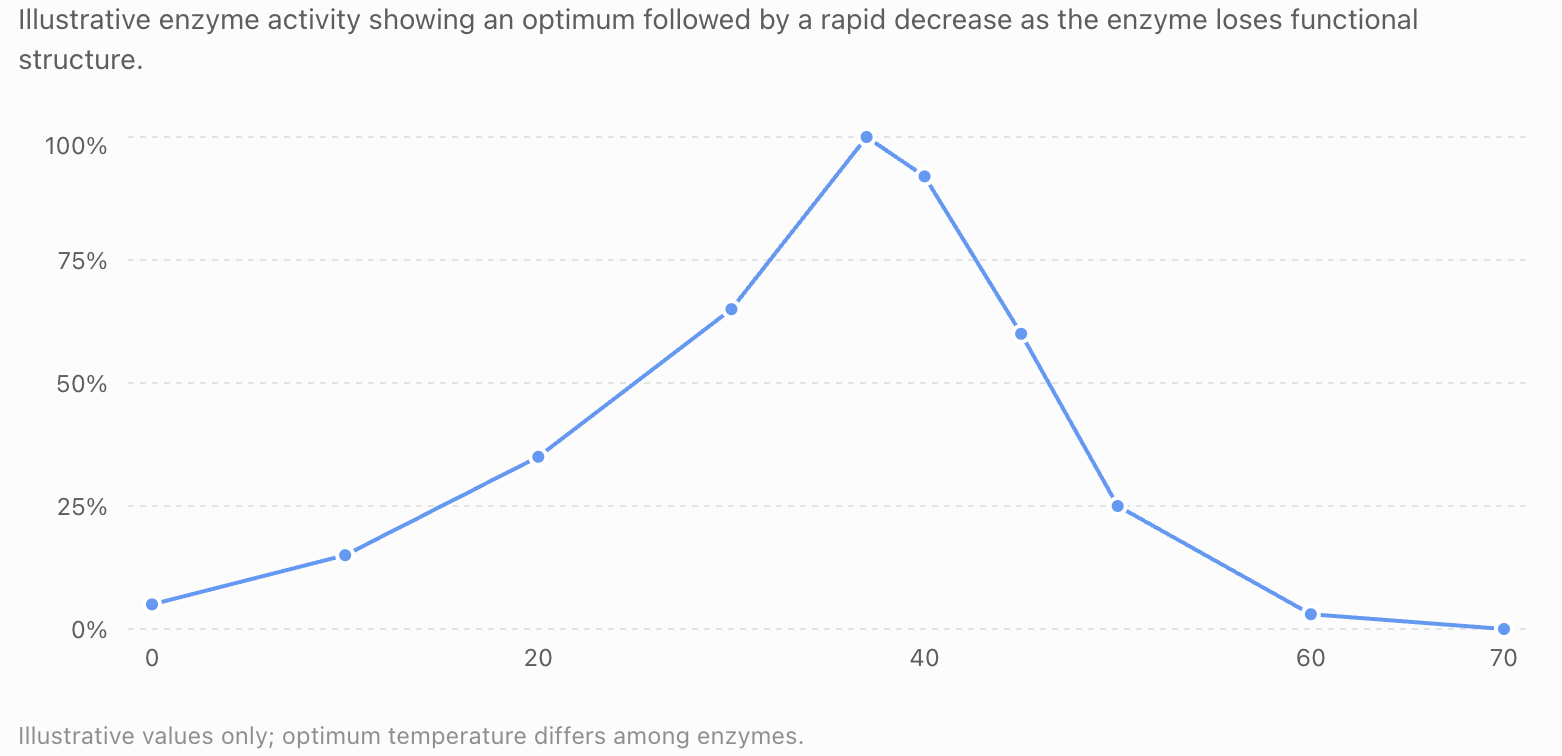
The values shown are illustrative rather than measurements for every enzyme.
The important pattern is:
low temperature → low activity
increasing temperature → increasing activity
optimum temperature → maximum activity
above optimum → rapid decrease in activity
Why Does Activity Increase Before the Optimum?
As temperature rises:
temperature increases
↓
kinetic energy increases
↓
enzyme and substrate molecules move faster
↓
collision frequency increases
↓
more enzyme-substrate complexes can form
↓
reaction rate increases
This continues while the enzyme maintains a functional structure.
What Happens Above the Optimum?
Increasing temperature beyond the optimum does not continue increasing enzyme activity.
Instead, high temperatures can disrupt interactions that maintain the enzyme's three-dimensional structure.
The protein begins to lose its normal shape.
The active site changes.

As a result, the substrate may no longer bind effectively.
Fewer enzyme-substrate complexes form.
The reaction rate decreases.
Denaturation
A significant loss of an enzyme's normal three-dimensional structure is called:
denaturation
When an enzyme becomes denatured:
- its protein structure changes
- its active site's shape and chemistry change
- the substrate may no longer bind effectively
- catalytic activity decreases or may stop
A useful sequence is:
high temperature → protein structure disrupted → active site altered → reduced substrate binding/catalysis → lower reaction rate
Denaturation Does Not Mean the Enzyme Dies
An enzyme is not a living organism.
Therefore, it is better to say:
the enzyme becomes denatured
rather than:
the enzyme dies
Denaturation is a structural change in a biological molecule.
Low Temperature Is Different from High Temperature
Low temperature and high temperature can both produce low enzyme activity, but for different reasons.
Low temperature
The enzyme generally remains structurally intact.
Molecules simply have less kinetic energy and move more slowly.
If the temperature rises again, activity can usually increase.
Very high temperature
The enzyme's structure may be disrupted.
The enzyme may become denatured.
Restoring the original temperature does not necessarily restore the enzyme's original structure or activity.
This is an important distinction.
Temperature: The Complete Pattern
At low temperature:
slow molecular movement → fewer successful interactions → low activity
As temperature increases:
faster movement → more successful interactions → increasing activity
At optimum temperature:
highest activity
Above optimum:
enzyme structure increasingly disrupted → active site changes → activity falls
At sufficiently high temperature:
extensive denaturation → little or no activity
Do All Enzymes Have the Same Optimum Temperature?
No.
The optimum temperature depends on the enzyme and the organism.
Many enzymes in the human body function effectively near normal body temperature, around:
37°C
But this does not mean every enzyme has an optimum of exactly 37°C.


Organisms live in very different environments.
Some microorganisms live in:
- hot springs
- deep-sea hydrothermal environments
- cold oceans
- polar regions
Their enzymes can be adapted to function under very different temperature conditions.
Reading a Temperature Graph
Suppose a graph shows enzyme activity against temperature.
Look for several features.
1. The x-axis
Usually represents:
temperature (°C)
2. The y-axis
Usually represents:
enzyme activity or reaction rate
3. The highest point
Represents the:
optimum temperature
4. The rising section
Shows increasing activity as temperature rises.
5. The falling section
Shows decreasing activity as high temperature increasingly disrupts enzyme structure.
Example: Interpreting a Temperature Graph
Imagine an enzyme has the following results:
| Temperature | Relative Activity |
|---|---|
| 10°C | 15% |
| 20°C | 35% |
| 30°C | 65% |
| 37°C | 100% |
| 45°C | 60% |
| 55°C | 10% |
We can conclude:
The enzyme's optimum temperature in this experiment is approximately:
37°C
At 20°C, the enzyme still functions, but more slowly.
At 55°C, activity is very low, consistent with substantial loss of functional enzyme structure.
Be Careful with the Word "Optimum"
The optimum is the condition under which the measured enzyme activity is greatest.
It does not mean:
- the enzyme cannot function at other temperatures
- every enzyme has the same optimum
- the organism itself necessarily prefers exactly that condition
For example, an enzyme may still function at 25°C even if its measured optimum is 37°C.
It simply functions more slowly under those experimental conditions.
pH and Enzyme Activity
Temperature is not the only important factor.
Enzyme activity is also strongly influenced by:
pH
pH describes how acidic or alkaline a solution is.


A simplified pH scale runs from:
0 to 14
Generally:
pH below 7 = acidic
pH 7 = neutral
pH above 7 = alkaline
Why Does pH Affect Enzymes?
Changes in pH alter the concentration of hydrogen ions in the environment.
This can affect electrical charges and interactions within proteins.
Because these interactions help maintain enzyme structure, changes in pH can alter:
- protein folding
- active-site shape
- active-site charge
- substrate binding
- catalytic activity
Therefore:
pH change → altered protein interactions → altered active site → changed enzyme activity
Optimum pH
The optimum pH is the pH at which an enzyme has its highest activity under particular conditions.
Different enzymes can have different optimum pH values.
This makes sense because enzymes operate in different parts of organisms.
For example:
- stomach enzymes experience strongly acidic conditions
- many enzymes inside cells operate near neutral conditions
- some intestinal enzymes operate under more alkaline conditions
A Typical pH Graph
A pH-activity graph often forms a peak around the enzyme's optimum.
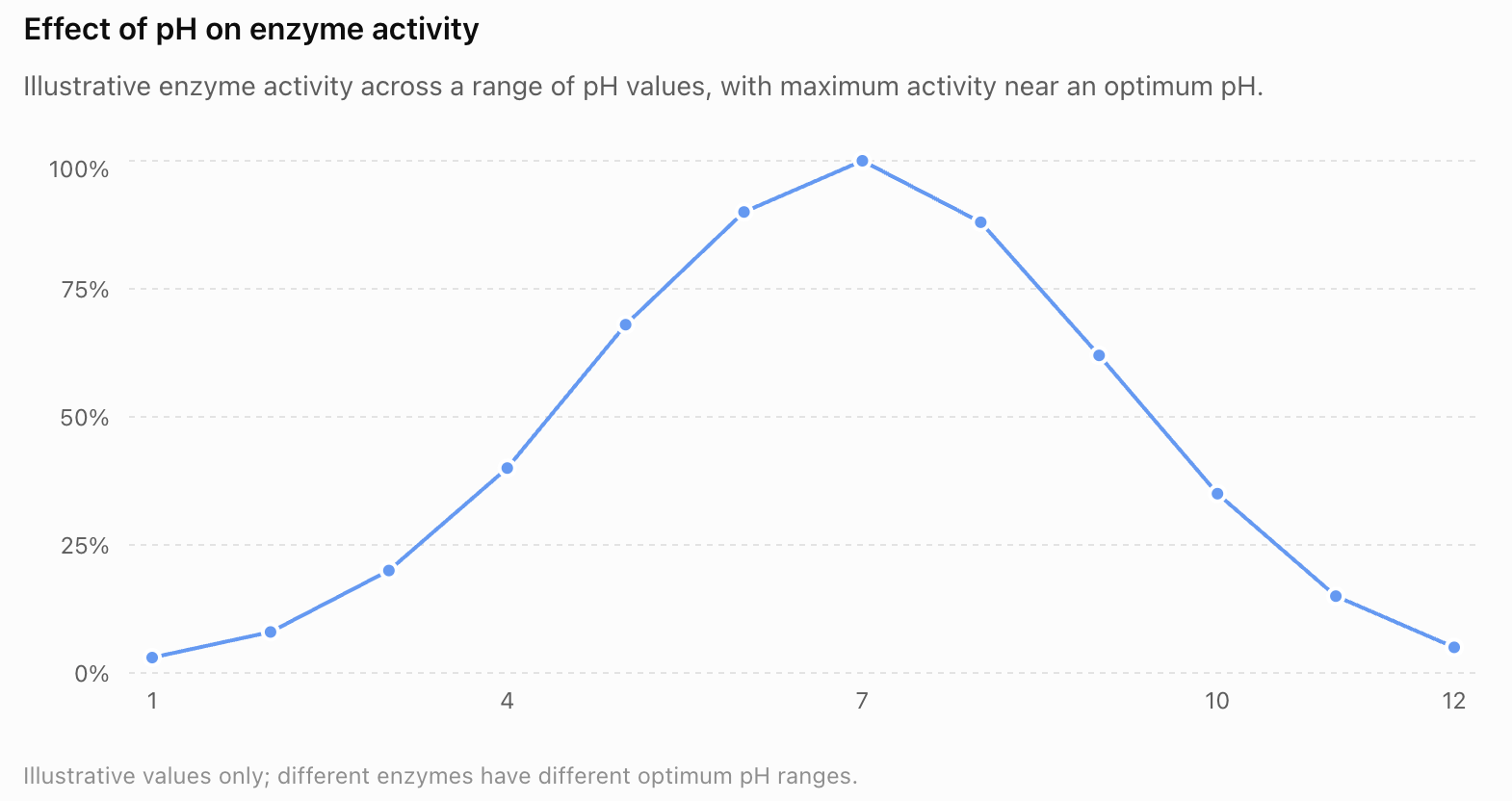
In this illustrative example, the enzyme's optimum pH is approximately:
pH 7
Activity decreases as conditions move farther from the optimum.
pH Graphs Can Have Different Shapes
Not every enzyme has an optimum near pH 7.
Consider digestive enzymes.
Pepsin functions in the stomach.
The stomach is strongly acidic.
Therefore, pepsin is adapted to function under acidic conditions.
Trypsin functions in the small intestine, where conditions are more alkaline.


Their pH-activity curves therefore peak in different regions.
Example: Pepsin
Pepsin is a protease involved in protein digestion in the stomach.
It functions effectively in acidic conditions.
A simplified pattern might show:
maximum activity around pH 2
and much lower activity near neutral or alkaline pH.
This makes biological sense because the stomach contains hydrochloric acid.
Example: Trypsin
Trypsin is another protease.
It functions in the small intestine.
Its optimum pH is typically in the alkaline range rather than strongly acidic conditions.
Therefore:
Pepsin and trypsin can catalyze protein digestion but are adapted to different environments.
Enzyme Adaptation to Location
Different regions of the digestive system have different conditions.


For example:
Mouth
Approximately neutral conditions.
Amylase begins starch digestion.
Stomach
Strongly acidic conditions.
Pepsin digests proteins.
Small intestine
More alkaline conditions than the stomach.
Several digestive enzymes function here.
Enzymes are therefore adapted to the conditions where they normally operate.
What Happens at Extreme pH?
If pH becomes too far from an enzyme's suitable range, interactions maintaining the protein's structure can be disrupted.
The active site's:
- shape
- charge
- chemical properties
may change.
The substrate may no longer bind effectively.
At sufficiently extreme pH, the enzyme may become denatured.

Temperature and pH Compared
Both temperature and pH can influence enzyme structure and activity.
| Factor | Below/away from optimum | At optimum | Extreme conditions |
|---|---|---|---|
| Temperature | Lower molecular movement and activity | Highest activity | Protein structure may be disrupted |
| pH | Active-site interactions become less favorable | Highest activity | Protein structure and active-site chemistry may be severely disrupted |
| Result | Lower reaction rate | Maximum reaction rate | Very low activity or denaturation |
What Is an Optimum Condition?
An optimum condition is a condition at which an enzyme shows its greatest activity under the conditions being tested.
Enzymes may have:
- optimum temperature
- optimum pH
- suitable substrate concentration
- suitable ionic conditions
The word optimum means:
best for maximum measured activity
not simply:
normal
Optimum Conditions Can Differ
Consider two hypothetical enzymes.
Enzyme A
Optimum temperature = 37°C
Optimum pH = 7
Enzyme B
Optimum temperature = 70°C
Optimum pH = 4
These enzymes are adapted to very different conditions.
You cannot determine optimum conditions simply from the fact that something is an enzyme.
They must be measured experimentally.
Temperature Graph vs pH Graph
Temperature and pH graphs often have different shapes.
A typical temperature graph is often asymmetrical:
- gradual increase toward optimum
- relatively steep decrease above optimum
A typical pH graph is often more peak-shaped:
- activity rises toward optimum
- activity falls as conditions move away from optimum on either side


Understanding these shapes helps when interpreting experimental results.
Why Is the Temperature Curve Often Asymmetrical?
Below the optimum, increasing temperature increases molecular motion and collision frequency.
Above the optimum, another process becomes increasingly important:
loss of functional protein structure
Once significant structural disruption begins, activity can decrease rapidly.
Therefore, the two sides of the graph do not necessarily form a symmetrical curve.
How to Interpret an Enzyme Graph
When given an enzyme graph:
Step 1: Read the x-axis.
What factor is being changed?
Temperature?
pH?
Step 2: Read the y-axis.
What is being measured?
Reaction rate?
Product formation?
Time?
Step 3: Locate the maximum.
This identifies the approximate optimum.
Step 4: Describe the pattern.
Do not simply say:
"it goes up and down."
Instead write:
Activity increases as temperature rises to approximately 40°C, reaches a maximum, and then decreases rapidly at higher temperatures.
Step 5: Explain the pattern scientifically.
Connect the graph to:
- molecular movement
- collisions
- enzyme-substrate complexes
- protein structure
- active-site shape
- denaturation
Describe vs Explain
These are different scientific skills.
Describe
State what the data show.
Example:
Enzyme activity increases from 10°C to 40°C and then decreases rapidly above 40°C.
Explain
Give the scientific reason.
Example:
Increasing temperature initially increases kinetic energy and collision frequency. Above the optimum, enzyme structure becomes increasingly disrupted, altering the active site and reducing catalytic activity.
A strong answer often does both.
Interpreting Rate of Reaction
The y-axis may not always say:
enzyme activity
Instead, it might show:
oxygen produced (cm³/min)
or:
product produced per minute
or:
substrate broken down per minute
These are still measurements of reaction rate and can therefore indicate enzyme activity.
What If the Graph Measures Time?
Sometimes an experiment measures the time required for a reaction to finish.
This changes how you interpret the graph.
If the reaction happens faster:
less time is required
Therefore:
shorter reaction time = greater enzyme activity
This is the opposite of a graph directly showing reaction rate.
Example: Catalase Investigation
Catalase breaks hydrogen peroxide into water and oxygen.
2H₂O₂ → 2H₂O + O₂


A student could investigate temperature by measuring:
volume of oxygen produced in 60 seconds
at:
- 10°C
- 20°C
- 30°C
- 40°C
- 50°C
- 60°C
The temperature producing the greatest oxygen volume per minute would indicate the highest activity under those conditions.
Designing a Temperature Investigation
Suppose temperature is the independent variable.
Change:
temperature
Measure:
reaction rate
Keep constant:
- enzyme concentration
- enzyme volume
- substrate concentration
- substrate volume
- pH
- reaction time
This creates a fair test.
Designing a pH Investigation
To investigate pH:
Change:
pH
Measure:
reaction rate
Keep constant:
- temperature
- enzyme concentration
- substrate concentration
- volumes
- reaction time
Scientists often use buffer solutions to maintain specific pH values during experiments.
Why Control Variables Matter
Suppose you change both:
temperature
and:
enzyme concentration
If the reaction becomes faster, you would not know which change caused the effect.
Therefore, when investigating one factor, other important variables should remain controlled.
This allows a valid conclusion.
Enzyme Activity and Substrate Concentration
Although temperature and pH are the focus here, other factors also affect enzyme activity.
One is:
substrate concentration
As substrate concentration increases:
- more substrate molecules are available
- collisions with active sites become more frequent
- reaction rate generally increases
Eventually, most active sites are occupied frequently.
The reaction approaches a maximum rate.


Enzyme Activity and Enzyme Concentration
Increasing enzyme concentration provides more active sites.
If sufficient substrate is available:
more enzyme → more available active sites → faster reaction
For example:
Double the amount of enzyme while maintaining excess substrate.
The reaction rate may approximately double under suitable conditions.
However, if substrate becomes limiting, adding more enzyme will have less effect.
Four Important Factors
Enzyme activity can therefore depend on:
- temperature
- pH
- substrate concentration
- enzyme concentration
Other factors can also matter, including:
- inhibitors
- activators
- ionic conditions
- availability of cofactors
But temperature and pH are especially important because they can directly affect enzyme structure and active-site properties.
Denaturation and the Active Site
Before denaturation:
active site has suitable structure → substrate interacts effectively
After substantial denaturation:
active site altered → substrate interaction reduced → catalytic activity decreases

This provides a direct connection between:
enzyme structure
and:
enzyme function
Can a Denatured Enzyme Recover?
Sometimes small structural changes can be reversible if conditions return to normal.
However, substantial denaturation is often effectively irreversible under biological conditions.
Therefore, it is safest to understand denaturation as:
a loss of the normal protein structure required for enzyme function
rather than assuming every denatured enzyme can simply return to normal.
Real-World Example: Fever
Human enzymes function within a relatively narrow physiological temperature range.
A moderate increase in temperature can influence reaction rates.
Extremely high body temperatures can disrupt normal cellular processes and damage proteins.
This is one reason maintaining body temperature within a suitable range is important for normal metabolism.
Real-World Example: Refrigeration
Why does refrigeration help preserve food?
At low temperatures:
- molecules move more slowly
- enzyme-controlled reactions slow
- microbial metabolism generally slows


Low temperature does not necessarily destroy enzymes.
Instead, it generally reduces reaction rates.
Real-World Example: Cooking
High temperatures during cooking can denature proteins, including enzymes.
Once many enzymes in food or microorganisms become denatured, they can no longer perform their normal catalytic functions effectively.
This is very different from refrigeration.
Cooling → slows enzyme activity
Strong heating → can denature enzymes
Real-World Example: Digestive System
The digestive system provides excellent examples of enzymes adapted to different pH conditions.


Salivary amylase begins functioning in the mouth.
Pepsin functions in acidic stomach conditions.
Other digestive enzymes function in the small intestine under different pH conditions.
The conditions of each location influence which enzymes function effectively there.
Comparing Two Enzymes from a Graph
Suppose a graph shows:
Enzyme A optimum pH = 2
Enzyme B optimum pH = 8
A reasonable interpretation could be:
Enzyme A is adapted to a more acidic environment than Enzyme B.
If additional biological information identifies Enzyme A as pepsin and Enzyme B as an intestinal enzyme, their different optima can be connected to their locations.
Avoid assuming the location from the graph alone unless the question provides supporting information.
Graph Question Example 1
A graph shows maximum enzyme activity at:
42°C
At 20°C, activity is much lower.
At 65°C, activity is almost zero.
What is the optimum temperature?
Approximately:
42°C
Why is activity lower at 20°C?
The molecules have less kinetic energy, so enzyme and substrate interactions occur less frequently.
Why is activity very low at 65°C?
The high temperature has likely caused substantial disruption of enzyme structure, reducing active-site function.
Graph Question Example 2
An enzyme has maximum activity at:
pH 3
Its activity is very low at:
pH 9
What can we conclude?
The enzyme functions most effectively under acidic conditions.
At pH 9, changes in charge and protein interactions make the active site less suitable for effective catalysis.
Graph Question Example 3
Two enzymes are tested.
Enzyme X:
Optimum pH = 2
Enzyme Y:
Optimum pH = 7
Can we say Enzyme Y is "better"?
No.
The enzymes may perform different functions or operate in different environments.
The graph only tells us about their activities under the tested conditions.
This is an important principle when interpreting scientific data.
Common Misconception: Higher Temperature Is Always Better
Incorrect:
higher temperature → always faster reaction
Correct:
higher temperature → faster reaction only up to an optimum
Beyond the optimum:
enzyme activity decreases as functional structure is increasingly lost
Common Misconception: Cold Denatures Enzymes
Low temperatures generally reduce enzyme activity because molecular movement is slower.
This is different from the structural disruption caused by high temperatures.
In many cases:
warming the enzyme again → activity increases
provided the enzyme has not been otherwise damaged.
Common Misconception: All Enzymes Work Best at 37°C
37°C is important because it is close to normal human body temperature.
But enzymes exist throughout the living world.
Different enzymes have different optimum temperatures.
Never assume:
optimum = 37°C
unless the data or context support it.
Common Misconception: All Enzymes Work Best at pH 7
Some enzymes function well near neutral pH.
Others do not.
Pepsin functions effectively under strongly acidic conditions.
Other enzymes function under alkaline conditions.
Therefore:
different enzymes → different optimum pH values
Common Misconception: Optimum Means the Only Working Condition
An enzyme may function over a range of conditions.
The optimum is simply where its activity is greatest under the conditions tested.
For example, an enzyme with an optimum of 40°C may still function at:
20°C
30°C
50°C
but at lower rates.
Common Misconception: Denaturation Breaks the Enzyme into Individual Amino Acids
Denaturation generally disrupts the protein's higher-level three-dimensional structure.
It does not necessarily break all peptide bonds or separate the protein completely into individual amino acids.
The critical point is that:
the functional three-dimensional structure is altered
and therefore the enzyme may no longer work properly.
A Reliable Method for Graph Questions
When interpreting enzyme graphs, use:
Identify → Describe → Explain
Identify
Find the optimum.
Example:
The optimum temperature is approximately 40°C.
Describe
State the pattern.
Activity increases between 10°C and 40°C and decreases rapidly above 40°C.
Explain
Give the biological reason.
Increasing temperature initially increases kinetic energy and collision frequency. Above the optimum, enzyme structure becomes increasingly disrupted, altering the active site and decreasing catalytic activity.
This produces a strong scientific answer.
Worked Graph Interpretation
Suppose an enzyme produces the following data:
| Temperature | Reaction Rate |
|---|---|
| 10°C | 2 |
| 20°C | 5 |
| 30°C | 9 |
| 40°C | 14 |
| 50°C | 7 |
| 60°C | 1 |
Identify the optimum.
The greatest reaction rate is:
14
at:
40°C
Therefore, the optimum temperature under these experimental conditions is approximately:
40°C
Describe the trend.
Reaction rate increases from 10°C to 40°C and then decreases rapidly between 40°C and 60°C.
Explain the trend.
Below 40°C, increasing temperature increases molecular kinetic energy and successful enzyme-substrate interactions. Above the optimum, increasing disruption of the enzyme's structure changes active-site function, causing the reaction rate to decrease.
Practical Investigation: Catalase and Temperature
Catalase provides a useful way to investigate enzyme activity.
Possible equipment:
- hydrogen peroxide
- catalase source such as potato
- test tubes
- water baths
- thermometer
- stopwatch
- gas syringe or another suitable gas-measuring method


Possible temperatures:
10°C
20°C
30°C
40°C
50°C
60°C
Measure oxygen production over a fixed time.
Then plot:
temperature vs reaction rate
The graph can be used to estimate the enzyme's optimum temperature under the experimental conditions.
Practical Investigation: Enzyme and pH
A similar experiment can investigate pH.
Possible pH values:
pH 3
pH 5
pH 7
pH 9
pH 11
Use buffer solutions to maintain each pH.
Keep temperature constant.
Measure reaction rate.
Plot:
pH vs enzyme activity
The peak of the graph indicates the approximate optimum pH under the conditions tested.
Improving Experimental Reliability
Enzyme experiments can contain random variation.
A better investigation should:
- repeat each condition several times
- calculate a mean
- control important variables
- use consistent volumes
- maintain temperature carefully
- maintain pH with buffers
- use accurate timing
- measure reaction rate quantitatively when possible
Repeated measurements help identify unusual results and improve confidence in the pattern.
Did You Know?
Enzymes can be adapted to extremely unusual environments.


For example, Taq polymerase comes from the bacterium Thermus aquaticus, originally isolated from hot-spring environments.
Taq polymerase remains functional at temperatures that would severely disrupt many ordinary enzymes.
This property makes it extremely useful in PCR, a laboratory technique used to copy DNA.
Its use demonstrates an important principle:
An enzyme's optimum conditions reflect the environment and biological role to which its structure is adapted.
Key Terms
- Enzyme activity: Rate at which an enzyme catalyzes a reaction.
- Reaction rate: Speed at which reactants are converted into products.
- Optimum temperature: Temperature at which an enzyme shows maximum activity under specified conditions.
- Optimum pH: pH at which an enzyme shows maximum activity under specified conditions.
- Denaturation: Loss of normal protein structure required for proper function.
- Active site: Region of an enzyme where substrate binding and catalysis occur.
- Substrate: Molecule acted upon by an enzyme.
- Enzyme-substrate complex: Temporary combination of enzyme and substrate.
- Kinetic energy: Energy associated with motion.
- pH: Measure related to the acidity or alkalinity of a solution.
- Acidic: Having a pH below 7 under the usual aqueous scale.
- Neutral: Approximately pH 7 under standard conditions.
- Alkaline: Having a pH above 7 under the usual aqueous scale.
- Buffer: Solution that resists changes in pH.
- Control variable: Factor kept constant during an investigation.
- Optimum: Condition producing the greatest measured activity.
- Thermostable: Able to maintain function at relatively high temperatures.
Key Relationships
For temperature:
low temperature → low kinetic energy → fewer successful interactions → low activity
increasing temperature → increasing kinetic energy → more successful interactions → increasing activity
optimum temperature → maximum activity
excessive temperature → structural disruption/denaturation → altered active site → decreasing activity
For pH:
optimum pH → active-site properties suitable for catalysis → maximum activity
pH far from optimum → altered charges/interactions → altered active-site properties → reduced activity
At extreme conditions:
loss of functional enzyme structure → greatly reduced or absent catalytic activity
Key Takeaways
- Enzyme activity describes the rate at which an enzyme catalyzes a reaction.
- Temperature affects enzyme activity by influencing molecular movement and enzyme structure.
- At low temperatures, molecules move more slowly and enzyme activity is generally lower.
- Increasing temperature increases kinetic energy and collision frequency.
- Enzyme activity generally increases with temperature until an optimum is reached.
- The optimum temperature is the temperature at which measured enzyme activity is greatest under particular conditions.
- Above the optimum temperature, enzyme activity usually decreases rapidly.
- High temperatures can disrupt the three-dimensional structure of enzymes.
- Structural changes can alter the active site and reduce substrate binding and catalysis.
- Significant loss of functional protein structure is called denaturation.
- Low temperature generally slows enzymes rather than denaturing them.
- Different enzymes can have different optimum temperatures.
- Not all enzymes have an optimum temperature of 37°C.
- pH can affect enzyme structure, active-site charge, substrate binding, and catalytic activity.
- Each enzyme has a pH range within which it functions effectively.
- The optimum pH is where measured activity is greatest.
- Different enzymes can have very different optimum pH values.
- Pepsin functions effectively in acidic stomach conditions.
- Enzymes operating elsewhere in the body may be adapted to neutral or alkaline conditions.
- Extreme pH can disrupt enzyme structure and reduce activity.
- Temperature graphs often rise toward an optimum and then fall relatively sharply.
- pH graphs often show a peak around an optimum range.
- The highest point on an enzyme-activity graph identifies the approximate optimum under the tested conditions.
- Graph descriptions should state what happens; explanations should give the biological reason.
- If a graph measures reaction time rather than reaction rate, a shorter time indicates greater enzyme activity.
- Substrate concentration and enzyme concentration can also influence enzyme activity.
- Controlled variables are important when investigating enzyme activity experimentally.
- Repeating measurements and calculating means improves reliability.
- Enzymes can be adapted to very different environmental conditions.
- Enzyme function depends strongly on maintaining the structure and chemical properties of the active site.
- A useful approach to enzyme graphs is: Identify → Describe → Explain.
4. Enzymes in Digestion
Learning outcomes
- I can explain the role of enzymes in the digestive system.
- I can identify the functions of amylase, protease, and lipase.
- I can describe how digestive enzymes break large molecules into smaller molecules.
- I can identify where major digestive enzymes are produced and act.
- I can explain why enzymes are necessary for nutrient absorption.


Why Do We Need Digestion?
Food contains nutrients that our bodies need for:
- energy
- growth
- repair
- building new cells
- producing hormones and enzymes
- maintaining normal body functions
However, many nutrients in food are present as large molecules.
These molecules are often too large to pass through the wall of the small intestine and enter the bloodstream.
Before they can be absorbed, they must be broken into smaller molecules.
This process is called:
digestion
Mechanical and Chemical Digestion
Digestion involves both mechanical digestion and chemical digestion.
Mechanical digestion physically breaks food into smaller pieces.
Examples include:
- chewing with the teeth
- churning in the stomach
- mixing movements of the digestive tract
Mechanical digestion does not usually change the chemical identity of the molecules.
Chemical digestion breaks large molecules into smaller molecules through chemical reactions.
This is where digestive enzymes are essential.


What Do Digestive Enzymes Do?
Digestive enzymes are biological catalysts.
They increase the rate at which large food molecules are broken into smaller molecules.
A simplified pattern is:
large insoluble molecule → smaller soluble molecules
The smaller molecules can then be absorbed through the wall of the small intestine.
Three particularly important groups of digestive enzymes are:
amylases
proteases
lipases
Large Molecules Must Be Broken Down
Three major nutrient groups require digestion:
| Large Nutrient Molecule | Digestive Enzyme | Smaller Products |
|---|---|---|
| Starch | Amylase | Smaller sugars, ultimately glucose |
| Proteins | Proteases | Amino acids |
| Lipids | Lipases | Fatty acids and glycerol |
A useful way to remember this is:
Carbohydrates → sugars
Proteins → amino acids
Lipids → fatty acids + glycerol
Enzymes and Hydrolysis
Many digestive reactions are examples of hydrolysis.
Hydrolysis uses water to help break chemical bonds in large molecules.
In simplified form:
large molecule + water → smaller molecules


Digestive enzymes catalyze these reactions so that they occur rapidly enough to support the body's needs.
Carbohydrate Digestion
Carbohydrates provide an important source of energy.
Foods containing carbohydrates include:
- bread
- rice
- pasta
- potatoes
- cereals
- fruits
One common carbohydrate is:
starch
Starch is a large molecule composed of many glucose units joined together.
It must be digested before its glucose can be efficiently absorbed.
Amylase
Amylase is a digestive enzyme that breaks down starch.
A simplified reaction is:
starch → smaller sugars
Amylase begins breaking long starch molecules into smaller carbohydrates such as maltose and shorter carbohydrate chains.


Further enzymes then complete carbohydrate digestion to produce absorbable monosaccharides such as glucose.
Where Is Amylase Produced?
In humans, important sources of amylase include:
salivary glands
and:
pancreas
The salivary glands release amylase into the mouth.
The pancreas releases pancreatic amylase into the small intestine.
Amylase in the Mouth
Chemical digestion begins before food reaches the stomach.
When you chew food:
salivary glands release saliva
Saliva contains:
salivary amylase


Amylase begins breaking starch into smaller carbohydrates.
This means both mechanical and chemical digestion occur in the mouth:
teeth → mechanical digestion
amylase → chemical digestion
What Happens to Amylase in the Stomach?
Food then enters the stomach.
The stomach contains strongly acidic gastric contents.
Salivary amylase does not function effectively under these strongly acidic conditions and becomes inactive as the food mixes with stomach acid.
Therefore, significant starch digestion by salivary amylase does not continue throughout the stomach.
Carbohydrate digestion resumes strongly in the small intestine with pancreatic amylase.
Pancreatic Amylase
The pancreas produces pancreatic amylase.
This enzyme is released into the:
small intestine
There it continues the digestion of starch.


Additional enzymes in the small intestine then convert smaller carbohydrates into monosaccharides that can be absorbed.
From Starch to Glucose
A useful simplified sequence is:
Starch
↓
amylase
↓
smaller sugars such as maltose
↓
other carbohydrate-digesting enzymes
↓
glucose
Glucose is small and soluble.
It can therefore be absorbed through the intestinal wall into the bloodstream.
Protein Digestion
Proteins are large molecules made from:
amino acids
Proteins are important for:
- growth
- tissue repair
- enzymes
- antibodies
- some hormones
- cell structures
Foods rich in protein include:
- meat
- fish
- eggs
- beans
- lentils
- dairy products


Before dietary proteins can be absorbed, they must be broken down into much smaller molecules.
Proteases
Proteases are enzymes that break down proteins.
A simplified reaction is:
proteins → amino acids
In reality, protein digestion occurs through several stages:
protein → smaller peptides → amino acids
Different proteases participate in different stages.
Protease in the Stomach
One important stomach protease is:
pepsin
Pepsin begins protein digestion in the stomach.
The stomach provides acidic conditions that allow pepsin to function effectively.


Pepsin breaks proteins into smaller peptide fragments.
Why Is the Stomach Acidic?
The stomach releases:
hydrochloric acid
This produces strongly acidic conditions.
The acid has several important roles, including providing suitable conditions for pepsin activity.
Pepsin is adapted to function in this acidic environment.
This connects digestive enzymes to what we learned about:
optimum pH
Proteases from the Pancreas
The pancreas also produces proteases.
An important example is:
trypsin
Pancreatic proteases are released into the small intestine.
They continue breaking proteins and peptides into smaller molecules.


Additional peptidases associated with the small intestine help complete digestion to amino acids.
From Protein to Amino Acids
A simplified sequence is:
Protein
↓
proteases
↓
peptides
↓
peptidases
↓
amino acids
Amino acids are small enough to be absorbed through the small-intestinal wall.
They enter the blood and can be transported to cells.
What Happens to Absorbed Amino Acids?
Cells can use amino acids to produce new proteins.
These proteins may become:
- muscle proteins
- enzymes
- antibodies
- transport proteins
- structural proteins
- some hormones
This is why digesting proteins into amino acids is so important.
The body cannot simply absorb most intact dietary proteins and use them directly.
They first need to be digested.
Lipid Digestion
Lipids include fats and oils.
Lipids are important for:
- energy storage
- cell membranes
- insulation
- protection of organs
- production of some signaling molecules
Foods containing substantial lipids include:
- oils
- butter
- nuts
- seeds
- avocado
- fatty meats


Many dietary lipids are triglycerides.
Lipase
Lipase catalyzes the digestion of lipids.
At an introductory level, the reaction can be represented as:
lipids → fatty acids + glycerol
More specifically, lipases hydrolyze triglycerides.
Lipase is therefore different from:
amylase, which acts on starch,
and:
proteases, which act on proteins.
This is another example of enzyme specificity.
Where Is Lipase Produced?
An important source of digestive lipase is the:
pancreas
Pancreatic lipase is released into the:
small intestine
The small intestine is the major location for lipid digestion and absorption.
Bile Helps Lipase
Lipids present a special problem.
They do not mix well with water.
The digestive system therefore uses bile to help lipid digestion.
Bile is:
produced by the liver
and:
stored and concentrated in the gallbladder
before being released into the small intestine.


Bile is not an enzyme.
This distinction is important.
Emulsification
Bile helps break large fat globules into many smaller droplets.
This process is called:
emulsification
It does not chemically digest the lipid.
Instead, it increases the surface area available to lipase.
Imagine one large fat droplet.
After emulsification, the same amount of lipid is distributed among many smaller droplets.
More surface is exposed.
Therefore:
greater surface area → more contact with lipase → faster lipid digestion
Bile and pH
Bile also helps create conditions in the small intestine that are suitable for digestive enzymes.
Acidic material arrives from the stomach.
Bile contributes to neutralizing this acidity, helping produce more alkaline conditions in the small intestine.
These conditions are more suitable for many pancreatic enzymes.
From Lipids to Absorbable Products
The simplified pathway is:
Large fat globule
↓
bile emulsification
↓
small lipid droplets
↓
lipase
↓
fatty acids + monoglycerides/glycerol-related products
These digestion products can then be absorbed through the intestinal lining.
For introductory study, this is often simplified to:
lipid → fatty acids + glycerol
The Pancreas: A Digestive Enzyme Factory
The pancreas has a major role in chemical digestion.
It produces enzymes including:
- pancreatic amylase
- proteases
- pancreatic lipase


These enzymes are released into the first part of the small intestine, the:
duodenum
The pancreas therefore contributes to digestion of:
carbohydrates + proteins + lipids
Summary of the Major Digestive Enzymes
| Enzyme | Substrate | Main Products | Important Source | Main Site of Action |
|---|---|---|---|---|
| Amylase | Starch | Smaller sugars | Salivary glands, pancreas | Mouth, small intestine |
| Proteases | Proteins/peptides | Peptides and amino acids | Stomach, pancreas, small intestine | Stomach, small intestine |
| Lipase | Lipids | Fatty acids and glycerol-related products | Mainly pancreas | Mainly small intestine |
This table is worth learning because it connects:
enzyme → substrate → product → location
Following Food Through the Digestive System
Let's follow a meal containing bread, chicken, and oil.
The bread contains:
starch
The chicken contains:
protein
The oil contains:
lipid
Different digestive enzymes are required for each nutrient.
Stage 1: The Mouth
In the mouth:
- teeth mechanically break food apart
- saliva moistens food
- salivary amylase begins starch digestion

Protein and lipid digestion by major enzymes is not the main digestive activity here.
The food is swallowed and passes through the oesophagus.
Stage 2: The Stomach
In the stomach:
- muscular walls churn the food
- gastric contents are acidic
- pepsin begins significant protein digestion


The stomach therefore performs:
mechanical digestion
and:
chemical digestion
Stage 3: The Small Intestine
Most chemical digestion is completed in the small intestine.
The pancreas releases digestive enzymes including:
- amylase
- proteases
- lipase
The liver and gallbladder supply bile.
The intestinal lining also provides enzymes involved in completing digestion.


The result is the production of small molecules that can be absorbed.
Digestion Is Not the Same as Absorption
These two terms are closely related but different.
Digestion means:
breaking large food molecules into smaller molecules.
Absorption means:
moving digested nutrients across the intestinal wall into the body's transport systems.
Therefore:
Digestion happens first → absorption follows
Why Must Molecules Be Small?
The wall of the small intestine acts as a selective barrier.
Large molecules such as:
- starch
- most proteins
- large lipid structures
cannot simply pass efficiently through it intact.
Digestive enzymes convert them into smaller molecules.
For example:
starch → glucose
proteins → amino acids
lipids → fatty acids and related products
These smaller products can then cross the intestinal epithelium.
The Small Intestine and Absorption
The small intestine is specialized for nutrient absorption.
Its inner surface contains millions of small projections called:
villi
Each villus is covered with even smaller structures called:
microvilli


Together, folds, villi, and microvilli create a very large surface area for absorption.
How Digestion Makes Absorption Possible
This connection is one of the most important ideas in this topic.
Enzymes first break large nutrients into small molecules.
Those molecules can then cross the intestinal lining.
Explore how the products of carbohydrate, protein, and fat digestion move through a villus:
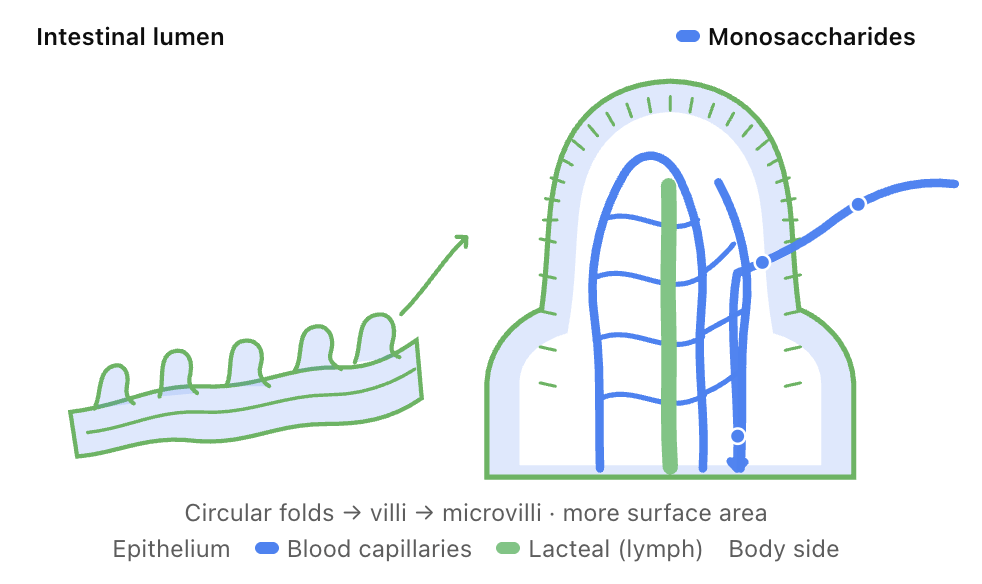
Monosaccharides → blood capillaries → portal blood
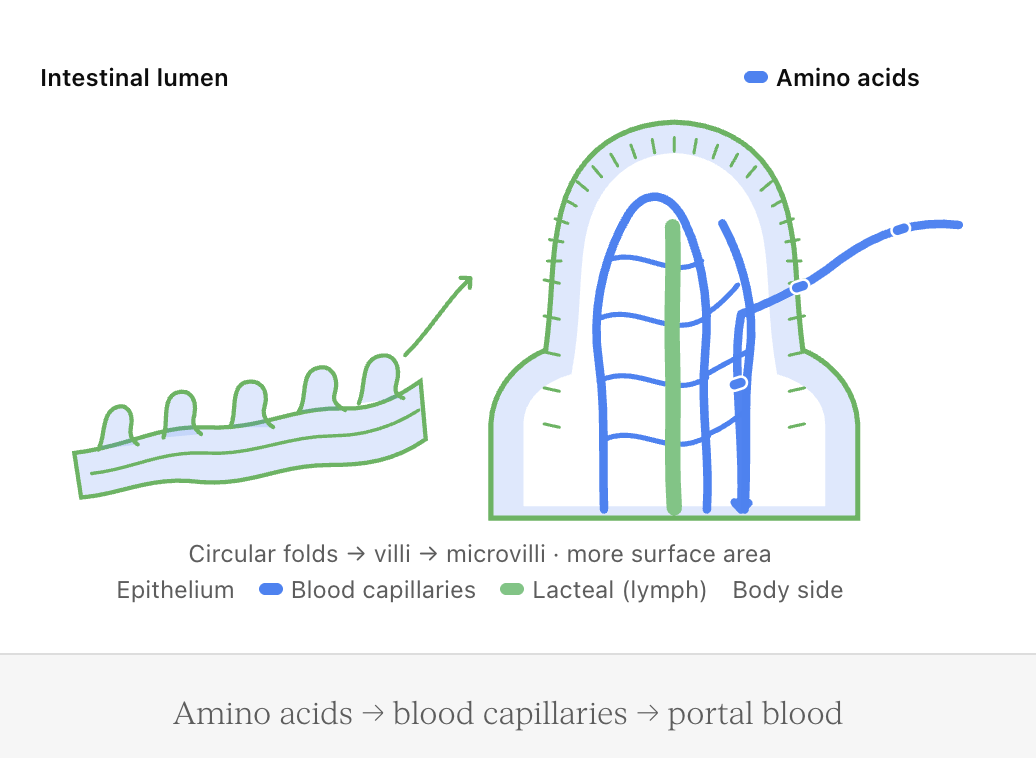
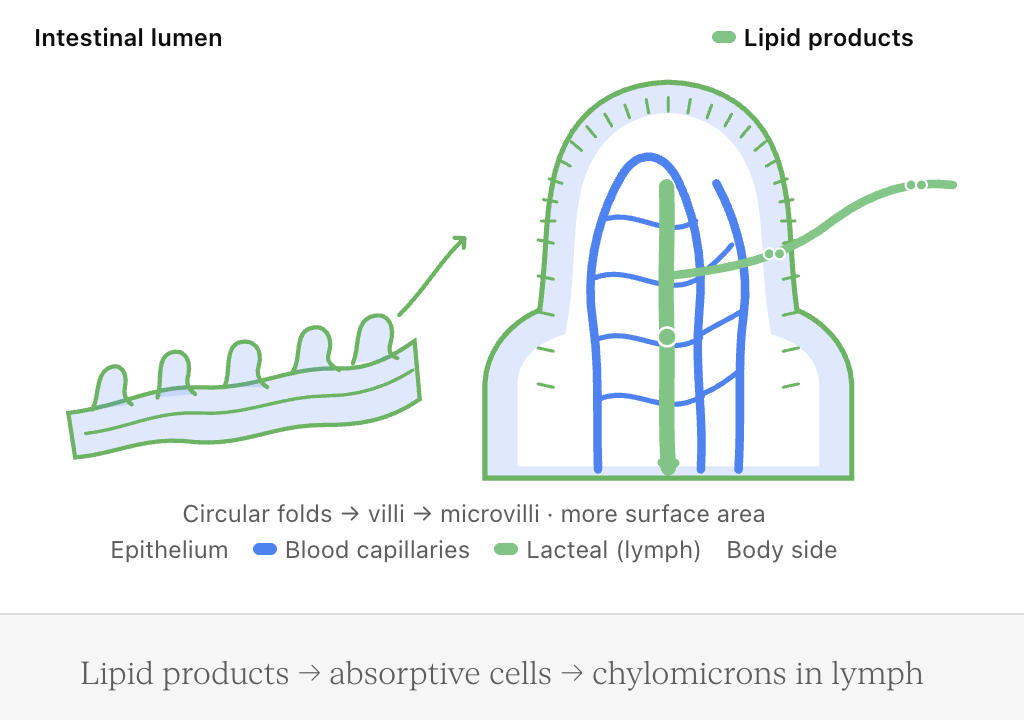
For carbohydrates:
starch → glucose → absorbed into blood
For proteins:
proteins → amino acids → absorbed into blood
For long-chain fats, digestion produces smaller lipid components that enter intestinal cells and are largely packaged for transport through the lymphatic system before eventually reaching the bloodstream.
Structure of a Villus
Each villus has several adaptations that help absorption.
These include:
- large surface area
- thin epithelial surface
- good blood supply
- lacteal for lipid transport
- many microvilli

The thin surface reduces the distance that absorbed molecules must travel.
The blood supply helps carry absorbed nutrients away.
Absorption of Glucose
Glucose is produced during carbohydrate digestion.
Once absorbed into intestinal cells, glucose enters blood capillaries.
It is transported around the body.
Cells can use glucose during:
cellular respiration
to release usable energy.
Therefore:
carbohydrate digestion → glucose absorption → transport → cellular respiration
Absorption of Amino Acids
Proteins are digested into amino acids.
Amino acids cross the intestinal lining and enter:
blood capillaries
They are transported to cells throughout the body.
Cells can use them to build new proteins.
Therefore:
protein digestion → amino acid absorption → protein synthesis
Absorption of Lipid Products
The absorption of lipid digestion products is somewhat different.
Fatty acids and monoglycerides can enter intestinal epithelial cells.
Inside these cells, many are reassembled into triglycerides and packaged into particles called chylomicrons.
These enter:
lacteals
which are small lymphatic vessels inside the villi.


They eventually reach the bloodstream through the lymphatic system.
For introductory courses, the key idea is:
lipid digestion produces smaller components that can be absorbed through the small intestine.
Why Can't Starch Simply Be Absorbed?
Imagine trying to move a huge object through a tiny doorway.
Large starch molecules are not suitable for efficient absorption through the intestinal epithelium.
Amylase and other enzymes break them into much smaller carbohydrates.
Ultimately, absorbable monosaccharides such as glucose are produced.
Therefore:
large molecule → digestion → small molecule → absorption
Why Can't Proteins Simply Be Absorbed?
Proteins are large chains of amino acids.
Most intact dietary proteins are too large for normal absorption.
Proteases and peptidases break them down.
The final amino acids are much smaller.
They can then cross the intestinal wall and enter the blood.
Why Can't Lipids Simply Mix with Digestive Fluids?
Most lipids are hydrophobic.
This means they do not mix well with water.
Digestive fluids are largely water-based.
Bile solves part of this problem by emulsifying fats into small droplets.
This allows lipase to access a much greater surface area.


Enzyme Specificity in Digestion
Digestive enzymes demonstrate enzyme specificity extremely clearly.
Amylase does not digest proteins.
Proteases do not perform the same reaction on starch.
Lipase does not digest starch.
Why?
Because each enzyme has a particular active site suited to particular substrates and reactions.
Therefore:
amylase + starch
protease + protein
lipase + lipid
Digestive Enzymes and pH
Different regions of the digestive system have different pH conditions.
This affects which enzymes work effectively.


For example:
Mouth: near-neutral conditions support salivary amylase activity.
Stomach: acidic conditions support pepsin activity.
Small intestine: neutral to mildly alkaline conditions support many pancreatic and intestinal enzymes.
This demonstrates how enzyme function is adapted to its environment.
Digestive Enzymes and Temperature
Human digestive enzymes normally operate around body temperature.
Approximately:
37°C
This provides suitable conditions for many human enzymes.
Very low temperatures would slow enzyme-controlled reactions.
Extremely high temperatures can damage protein structure and cause denaturation.
What If Digestive Enzymes Were Missing?
Suppose the digestive system could mechanically break food into tiny pieces but had no digestive enzymes.
Chewing would increase surface area, but large molecules would remain chemically large.
Starch would still largely be starch.
Proteins would still largely be proteins.
Triglycerides would remain large lipid molecules.
As a result, efficient nutrient absorption would be severely reduced.
Lactase: Another Digestive Enzyme
Another important digestive enzyme is:
lactase
Lactase acts on:
lactose
Lactose is a sugar found in milk.
The reaction is:
lactose + water → glucose + galactose


Lactase is located at the surface of cells lining the small intestine.
Lactose Intolerance
Some people produce relatively low amounts of lactase.
As a result, some lactose is not digested in the small intestine.
It can pass into the large intestine, where bacteria metabolize it.
This can contribute to symptoms such as:
- gas
- bloating
- abdominal discomfort
- diarrhea
This provides a real-world example of why digestive enzymes are important.
Digestion as a Sequence
Digestion is not one single reaction.
It is a coordinated sequence involving:
mechanical breakdown
↓
enzyme-controlled chemical digestion
↓
production of small soluble molecules
↓
absorption through the small intestine
↓
transport around the body
↓
use by cells
Each stage supports the next.
The Journey of Starch
Follow a starch molecule:
Starch in food
↓
mouth
↓
salivary amylase begins digestion
↓
stomach
↓
salivary amylase activity largely stops in acidic conditions
↓
small intestine
↓
pancreatic amylase continues starch digestion
↓
other carbohydrate-digesting enzymes
↓
glucose and other absorbable monosaccharides
↓
intestinal villi
↓
bloodstream
↓
cells
↓
used in respiration or other metabolic processes
The Journey of Protein
Follow a protein molecule:
Protein in food
↓
stomach
↓
pepsin begins protein digestion
↓
smaller peptides
↓
small intestine
↓
pancreatic proteases continue digestion
↓
intestinal peptidases
↓
amino acids
↓
intestinal villi
↓
bloodstream
↓
cells
↓
used to make new proteins
The Journey of Lipid
Follow dietary fat:
Large fat globules
↓
small intestine
↓
bile emulsifies fat
↓
smaller droplets
↓
lipase
↓
fatty acids and monoglycerides/glycerol-related products
↓
intestinal cells
↓
lipid transport pathways
↓
body tissues


Production vs Site of Action
An important distinction is:
where an enzyme is produced
is not always the same as:
where the enzyme acts
For example:
Pancreatic amylase is:
produced in the pancreas
but:
acts in the small intestine
Similarly, pancreatic lipase is:
produced in the pancreas
but:
acts mainly in the small intestine
This is a common examination question.
Enzyme Summary by Location
Mouth
Important enzyme:
salivary amylase
Main action:
starch digestion begins
Stomach
Important enzyme:
pepsin
Main action:
protein digestion begins
Conditions:
acidic
Pancreas
Produces:
- amylase
- proteases
- lipase
These enzymes are released into:
the small intestine
Small Intestine
Receives pancreatic enzymes and bile.
Produces or contains additional digestive enzymes at its lining.
Major events include:
- completion of carbohydrate digestion
- completion of protein digestion
- major lipid digestion
- absorption of digested nutrients


Common Misconception: Bile Is an Enzyme
Bile is not an enzyme.
Bile helps digestion by:
- emulsifying lipids
- increasing surface area for lipase
- helping neutralize acidic material entering the small intestine
Lipase performs the enzyme-controlled chemical digestion.
Common Misconception: The Stomach Digests Everything
The stomach is important, but most chemical digestion is completed in the:
small intestine
The small intestine also performs most nutrient absorption.
The stomach is particularly important for:
- mechanical mixing
- acidic conditions
- beginning significant protein digestion
Common Misconception: Amylase Produces Only Glucose Directly
Amylase breaks starch into smaller carbohydrates, especially maltose and shorter chains.
Other enzymes then complete carbohydrate digestion to produce absorbable monosaccharides.
A simplified school-level pathway is often written:
starch → glucose
but the more accurate sequence is:
starch → smaller carbohydrates → glucose
Common Misconception: Digestion and Absorption Are the Same
They are different.
Digestion: breaking molecules down.
Absorption: moving digested nutrients into the body's internal transport systems.
Enzymes mainly perform the chemical digestion that makes absorption possible.
Common Misconception: Chewing Is Enough
Chewing is important because it:
- physically breaks food apart
- increases surface area
- mixes food with saliva
However, chewing does not break starch into glucose or proteins into amino acids.
Chemical digestion requires enzymes.
Common Misconception: Enzymes Are Used Up
Digestive enzymes are catalysts.
They are not consumed as ordinary reactants during each reaction.
An enzyme can therefore catalyze reactions involving many substrate molecules before it is eventually degraded.
Investigating Amylase
A common digestive-enzyme experiment investigates the action of amylase on starch.
Iodine solution can test for starch.


Iodine with starch produces a:
blue-black colour
As amylase digests the starch, eventually the blue-black colour is no longer produced.
Students can investigate how factors such as:
- temperature
- pH
- enzyme concentration
affect the rate of starch digestion.
Why Digestive Enzymes Matter
Digestive enzymes connect the food we eat with the molecules our cells actually use.
Without digestion:
large nutrients remain difficult to absorb
With digestive enzymes:
large molecules → small molecules → absorption → transport → cellular use
For example:
Starch → glucose → respiration
Protein → amino acids → new proteins
Lipids → fatty acids and related products → membranes, energy storage and other functions
Did You Know?
Your small intestine is several metres long and has an enormous internal surface area because of folds, villi, and microvilli.


This illustrates how digestion and absorption work together.
Digestive enzymes produce small molecules.
The specialized surface of the small intestine then allows those molecules to be absorbed efficiently.
Key Terms
- Digestion: Breakdown of large food molecules into smaller molecules.
- Mechanical digestion: Physical breakdown of food without changing its chemical composition.
- Chemical digestion: Chemical breakdown of food molecules.
- Digestive enzyme: Biological catalyst involved in chemical digestion.
- Amylase: Enzyme that digests starch into smaller carbohydrates.
- Protease: Enzyme that digests proteins or peptides.
- Lipase: Enzyme that digests lipids.
- Pepsin: Protease that functions in the stomach.
- Trypsin: Pancreatic protease that functions in the small intestine.
- Substrate: Molecule upon which an enzyme acts.
- Hydrolysis: Reaction using water to break chemical bonds.
- Bile: Digestive fluid that helps emulsify fats and neutralize acidic material.
- Emulsification: Breaking large fat globules into smaller droplets.
- Absorption: Movement of digested nutrients across the intestinal wall into the body's transport systems.
- Villus: Finger-like projection in the small intestine that increases surface area.
- Microvilli: Microscopic projections on intestinal cells that further increase surface area.
- Lacteal: Lymphatic vessel inside a villus involved in lipid absorption.
- Pancreas: Organ that produces several important digestive enzymes.
- Duodenum: First part of the small intestine.
- Lactase: Enzyme that digests lactose.
Key Relationships
Carbohydrate digestion:
starch → smaller sugars → glucose
Important enzyme:
amylase
Protein digestion:
protein → peptides → amino acids
Important enzymes:
proteases
Lipid digestion:
lipid → fatty acids + glycerol-related products
Important enzyme:
lipase
Overall relationship:
large food molecules → enzyme-controlled digestion → small molecules → absorption → transport → use by cells
Key Takeaways
- Digestive enzymes are biological catalysts that speed up chemical digestion.
- Many nutrients in food are too large to be absorbed efficiently in their original form.
- Digestive enzymes break large molecules into smaller molecules.
- Amylase digests starch.
- Proteases digest proteins and peptides.
- Lipases digest lipids.
- Salivary amylase begins starch digestion in the mouth.
- The pancreas produces amylase that acts in the small intestine.
- Pepsin begins significant protein digestion in the stomach.
- Pancreatic proteases continue protein digestion in the small intestine.
- Lipase acts mainly in the small intestine.
- The pancreas is an important source of amylase, proteases, and lipase.
- Starch is ultimately digested into absorbable monosaccharides such as glucose.
- Proteins are ultimately digested into amino acids.
- Lipids are digested into smaller lipid components including fatty acids.
- Bile is not an enzyme.
- Bile emulsifies lipids and increases the surface area available to lipase.
- Bile also helps neutralize acidic material entering the small intestine.
- Digestive enzymes are specific to particular substrates and reactions.
- Different parts of the digestive system provide different pH conditions for enzyme activity.
- The small intestine is the main site where chemical digestion is completed and nutrients are absorbed.
- Villi and microvilli provide a large surface area for absorption.
- Glucose and amino acids enter blood capillaries in the villi.
- Many long-chain lipid products are transported through lacteals and the lymphatic system before reaching the blood.
- Digestion and absorption are different processes.
- Digestion produces molecules small enough for absorption.
- The place where an enzyme is produced may differ from the place where it acts.
- Digestive enzymes make nutrients available for respiration, growth, repair, and other cellular processes.
- A useful summary is: enzymes make large food molecules small enough for the body to absorb and use.
5. Enzymes in Industry and Biotechnology
Learning outcomes
- I can describe how enzymes are used in industrial processes.
- I can explain the role of enzymes in food production and biotechnology.
- I can identify examples of enzymes used in detergents and medicine.
- I can evaluate the advantages of using enzymes in industry.
- I can explain how enzyme technology can improve efficiency and sustainability.


From Cells to Factories
Enzymes are biological catalysts. In living organisms, they speed up reactions involved in digestion, respiration, DNA replication, and many other processes.
Humans can also use enzymes to control useful chemical reactions outside living organisms.
This is called enzyme technology.
Enzymes are widely used in:
- food and drink production
- detergents
- textiles
- paper manufacturing
- biofuels
- biotechnology
- medicine
- genetic engineering
- laboratory testing
The global use of enzymes is possible because particular enzymes can catalyze particular reactions efficiently and selectively.
Why Are Enzymes Useful in Industry?
Industrial processes often require chemical reactions to happen:
quickly
reliably
and:
economically
Traditional chemical reactions may require:
- high temperatures
- high pressures
- strong acids or bases
- large amounts of energy
- hazardous chemicals
Enzymes can sometimes perform similar tasks under milder conditions.


For example, an enzyme-controlled process might operate at:
moderate temperature + normal pressure
rather than:
very high temperature + high pressure
This can reduce energy use and operating costs.
Enzymes as Industrial Catalysts
A catalyst increases the rate of a chemical reaction without being consumed as an ordinary reactant.
A simplified enzyme reaction is:
Enzyme + Substrate → Enzyme-Substrate Complex → Enzyme + Product
In industry, the substrate might be:
- starch
- protein
- lipid
- cellulose
- lactose
- DNA
- another organic molecule
The enzyme converts it into a useful product.
Enzyme Specificity Is Extremely Useful
One major advantage of enzymes is their:
specificity
An enzyme usually catalyzes a particular reaction or group of closely related reactions.


This allows manufacturers to produce desired products while reducing unwanted side reactions.
For example:
lactase acts on lactose
while:
proteases act on proteins
and:
lipases act on lipids
Selecting the correct enzyme allows a manufacturer to target a particular substance.
Industrial Enzymes Come from Living Organisms
Many commercially useful enzymes are originally obtained from microorganisms such as:
- bacteria
- fungi
- yeasts
Microorganisms are particularly useful because they can:
- grow rapidly
- be cultured in large quantities
- produce large amounts of enzymes
- be genetically modified
- grow in controlled industrial conditions
Producing Enzymes Using Fermentation
Industrial microorganisms are often grown inside large vessels called:
fermenters or bioreactors


Inside a bioreactor, conditions can be carefully controlled.
These may include:
- temperature
- pH
- oxygen supply
- nutrient concentration
- mixing
- microorganism population
These conditions are controlled to encourage efficient growth and enzyme production.
From Microorganism to Industrial Enzyme
A simplified industrial process is:
Select microorganism
↓
Grow microorganism in bioreactor
↓
Microorganisms produce enzyme
↓
Separate enzyme from culture
↓
Purify enzyme if necessary
↓
Formulate enzyme product
↓
Use enzyme in industrial process
Some applications require highly purified enzymes, while others can use less extensively purified preparations.
Enzymes in Food Production
The food industry is one of the largest users of enzymes.
Enzymes are used in making and processing:
- bread
- cheese
- yoghurt
- juice
- syrups
- lactose-free milk
- brewing products
- confectionery
- processed foods


Different enzymes are selected for different purposes.
Amylase in Food Production
Amylases break down starch.
A simplified reaction is:
starch → smaller sugars
Amylases are used in several industrial processes.
For example, they can help convert starch into sugars for:
- baking
- brewing
- glucose syrup production
- fermentation processes
Amylase in Bread Making
Flour contains starch.
Amylases can convert some starch into smaller sugars.
Yeast can use these sugars during fermentation.


This can help influence:
- dough fermentation
- loaf volume
- texture
- crust development
- freshness
Enzymes therefore contribute to both processing and final food quality.
Lactase and Lactose-Free Milk
Lactase catalyzes the breakdown of lactose.
The reaction is:
lactose + water → glucose + galactose
Milk naturally contains lactose.
In lactose-free milk production, manufacturers add lactase to break down much of the lactose before the milk is consumed.


This allows many people with lactose malabsorption to consume the product with fewer symptoms.
Immobilized Lactase
Instead of mixing an enzyme directly into a product, manufacturers can sometimes attach enzymes to a solid material.
This is called:
enzyme immobilization
For example, lactase can be immobilized onto beads.
Milk can then flow past the beads.
Milk containing lactose
↓
immobilized lactase
↓
lactose hydrolyzed
↓
lower-lactose product
What Is an Immobilized Enzyme?
An immobilized enzyme is an enzyme held in place rather than freely dissolved in the reaction mixture.


Enzymes may be:
- attached to surfaces
- trapped inside beads
- enclosed within membranes
- bound to insoluble materials
The substrate flows past or through the immobilized enzymes.
Advantages of Immobilized Enzymes
Immobilization can provide several advantages.
The enzyme can often be:
- separated easily from the product
- reused
- kept out of the final product
- used in continuous processing
- stabilized under some operating conditions
For example:
substrate enters → enzyme reactor → product leaves
while the enzyme remains inside the reactor.
This can reduce costs because the enzyme does not need to be replaced after every batch.
Pectinase in Fruit Juice Production
Plant cell walls contain substances including:
pectin
Pectinases break down pectin.
Fruit juice manufacturers can use pectinases during juice processing.


This can help:
- release more juice
- improve juice yield
- reduce cloudiness
- improve filtration
- clarify the final product
Enzymes in Cheese Production
Enzymes are also important in cheese making.
One important enzyme is:
chymosin
Chymosin causes milk proteins to coagulate.
This helps separate milk into:
curds
and:
whey


Traditionally, chymosin was obtained from animal sources.
Today, much commercial chymosin is produced using biotechnology.
Biotechnology and Chymosin
Scientists can place a gene encoding chymosin into suitable microorganisms.
The microorganisms then produce the enzyme.
The general idea is:
identify useful gene
↓
insert gene into microorganism
↓
grow microorganism
↓
microorganism produces enzyme
↓
collect enzyme
↓
use enzyme in food production
This is an important example of genetic engineering supporting industrial enzyme production.
Enzymes in Detergents
Modern biological detergents often contain enzymes.
Common detergent enzymes include:
- proteases
- lipases
- amylases
- cellulases


Each enzyme targets particular types of stains.
Proteases in Detergents
Proteases break down:
proteins
Protein-containing stains may include:
- blood
- egg
- milk
- some food stains
Proteases break large protein molecules into smaller, more soluble molecules that are easier to remove during washing.
Lipases in Detergents
Lipases break down:
fats and oils
Greasy stains contain lipids.
Lipase helps break these lipids into smaller components that can be removed more effectively by the detergent and water.
Amylases in Detergents
Amylases break down:
starch
Starch-containing stains can come from foods such as:
- sauces
- potatoes
- pasta
- rice
- desserts
Amylase helps break starch into smaller carbohydrates that are easier to wash away.
One Detergent, Several Enzymes
A detergent may contain several different enzymes because stains contain different substances.
For example:
Protein stain → protease
Fat stain → lipase
Starch stain → amylase
This demonstrates why enzyme specificity is useful in commercial products.


Lower-Temperature Washing
Enzymes can allow effective washing at lower temperatures than some traditional high-temperature washing methods.
This can reduce the energy needed to heat water.
Potential benefits include:
- lower electricity use
- reduced household energy costs
- lower associated greenhouse-gas emissions where electricity generation produces emissions
- less thermal damage to some fabrics
However, the enzymes must be designed to remain active under detergent conditions.
Industrial Enzymes Must Be Tough
A normal biological enzyme may not work well under industrial conditions.
For example, detergent enzymes may experience:
- alkaline pH
- different temperatures
- surfactants
- mechanical agitation
- other detergent chemicals
Scientists therefore search for or engineer enzymes that remain active under the required conditions.
Enzymes in Medicine
Enzymes also have important medical uses.
They can be used:
- as medicines
- in diagnostic tests
- in laboratory analysis
- to manufacture pharmaceuticals
- in molecular biology


Enzyme Replacement Therapy
Some diseases result from the body having insufficient activity of a particular enzyme.
In certain conditions, a manufactured enzyme can be given to patients.
This approach is called:
enzyme replacement therapy
The supplied enzyme performs some of the function of the missing or deficient enzyme.
Producing therapeutic enzymes requires careful purification and quality control because they are used medically.
Enzymes in Diagnostic Tests
Enzymes are useful because of their specificity.
A diagnostic test can use an enzyme-controlled reaction to detect or measure a particular substance.
One familiar example is measuring:
glucose
Some glucose-testing systems use enzyme reactions involving glucose to produce a measurable electrical or chemical signal.


This converts:
chemical information → measurable signal
Enzymes in DNA Technology
Enzymes are essential to modern biotechnology because DNA itself is manipulated using enzymes.
Important examples include:
- DNA polymerases
- restriction enzymes
- DNA ligase
- reverse transcriptase


Each performs a different molecular task.
Restriction Enzymes
Restriction enzymes recognize particular DNA sequences and cut DNA at or near those sequences.
They can therefore act like highly specific molecular cutting tools.
Scientists can use them when:
- analyzing DNA
- constructing recombinant DNA
- cloning genes
- performing some genetic-engineering procedures
Their usefulness comes from their high specificity.
DNA Ligase
DNA ligase joins pieces of DNA together.
A simple analogy is:
restriction enzyme = molecular scissors
DNA ligase = molecular glue
The analogy is simplified, but it helps describe their roles.


Together, these enzymes have been important tools in genetic engineering.
DNA Polymerase and PCR
DNA polymerase builds new DNA strands.
A laboratory technique called:
polymerase chain reaction (PCR)
uses DNA polymerase to make many copies of selected DNA regions.
PCR is widely used in:
- biological research
- genetic testing
- medical diagnostics
- forensic science
- biotechnology
Taq Polymerase
PCR repeatedly heats and cools DNA.
Many ordinary enzymes would lose function during repeated high-temperature steps.
A thermostable DNA polymerase called Taq polymerase became important because it can withstand the temperature cycling used in PCR.


This is an excellent example of choosing an enzyme whose properties match an industrial or laboratory process.
Enzymes in Biofuel Production
Plant material contains large amounts of:
cellulose
Cellulose is a carbohydrate polymer.
Enzymes called:
cellulases
can break cellulose into smaller sugars.
These sugars can then be fermented by microorganisms to produce fuels such as ethanol.
A simplified pathway is:
plant biomass → cellulose → sugars → fermentation → ethanol


This is one example of enzymes being investigated and used in more sustainable manufacturing systems.
Enzymes in the Textile Industry
Enzymes can also be used when processing textiles.
For example, cellulases can modify cellulose fibres in cotton.
Applications can include:
- fabric finishing
- removal of surface fibres
- changing the appearance of denim
- improving some fabric properties
Enzyme-based processing can sometimes replace harsher chemical treatments.
Enzymes in the Paper Industry
Enzymes are used in parts of pulp and paper processing.
Different enzymes can assist with:
- modifying fibres
- removing unwanted materials
- improving processing efficiency
- reducing the need for some chemical treatments


The exact enzymes and processes depend on the desired product.
Advantages of Enzymes in Industry
Enzymes can provide several major advantages.
1. They speed up reactions
Enzymes increase reaction rates.
This can increase manufacturing efficiency.
2. They are specific
They often produce fewer unwanted products.
3. They can work under mild conditions
Many enzymes function at moderate temperatures and pressures.
4. They can reduce energy use
Lower operating temperatures can mean less heating.
5. They can reduce harsh chemical use
Some enzyme processes replace or reduce strong chemical treatments.
6. They can be renewable
Enzymes can be produced repeatedly using living microorganisms.
7. Some can be reused
Immobilized enzymes can remain in reactors while products are removed.
Evaluating Enzyme Technology
Enzyme technology has many advantages, but it also has limitations.
| Advantages | Limitations |
|---|---|
| Highly specific | Enzymes can be sensitive to conditions |
| Can reduce unwanted reactions | Extreme temperature can denature enzymes |
| Often work at moderate temperatures | Unsuitable pH can reduce activity |
| Can lower energy requirements | Enzyme production and purification can be costly |
| Can reduce harsh chemical use | Some processes require specialized equipment |
| Can be produced by microorganisms | Contamination must be controlled |
| Immobilized enzymes may be reused | Immobilization itself adds processing costs |
Therefore, enzymes are not automatically the best choice for every industrial reaction.
Engineers must consider the entire process.
Cost Is Important
An industrial enzyme is useful only if the overall process is practical.
Companies must consider:
- enzyme production costs
- purification costs
- enzyme lifetime
- reaction speed
- operating temperature
- equipment costs
- product value
- waste disposal
- energy consumption
- ability to reuse the enzyme
A more expensive enzyme may still save money if it greatly reduces energy or processing costs.
Enzymes and Sustainability
Sustainability involves meeting current needs while reducing unnecessary environmental impacts and protecting resources for the future.
Enzyme technology can contribute to sustainability when it allows processes to use:
- less energy
- fewer hazardous chemicals
- renewable biological materials
- less water
- fewer processing steps
- lower temperatures
- less raw material

The actual environmental benefit depends on the complete industrial process, not simply on whether an enzyme is used.
Energy Efficiency
Consider two hypothetical processes.
Process A
Operating temperature: 150°C
Process B using an enzyme
Operating temperature: 40°C
If both processes produce the same useful product, Process B may require much less energy for heating.
That can reduce:
energy consumption
and potentially:
production costs and associated emissions
This is one reason enzymes are important in green chemistry.
Reducing Waste
Because enzymes are highly specific, they can sometimes produce fewer unwanted side products.
Suppose a traditional reaction produces:
desired product + several unwanted products
An enzyme might catalyze the desired transformation more selectively:
substrate → desired product
Fewer unwanted products can mean:
- easier purification
- less waste
- better use of raw materials
- reduced disposal costs
Renewable Production
Enzymes themselves can be produced biologically.
Microorganisms can be grown using nutrients in fermenters.
After enzyme extraction, new microorganisms can continue producing more enzyme.
This differs from some catalysts that depend on scarce or non-renewable raw materials.
However, industrial fermentation still requires:
- energy
- water
- nutrients
- equipment
Therefore, its overall sustainability must still be evaluated.
Improving Enzymes
Scientists do not always have to accept naturally occurring enzymes exactly as they are.
Biotechnology can be used to develop enzymes with improved properties.
Desired improvements might include:
- greater heat stability
- activity at lower temperatures
- tolerance of extreme pH
- increased reaction rate
- altered substrate specificity
- longer useful lifetime


Protein Engineering
Because enzyme function depends on protein structure, changing an enzyme's amino acid sequence can sometimes change its properties.
Scientists can modify genes encoding enzymes.
Microorganisms can then produce modified enzyme versions.
Scientists test these enzymes and identify versions with useful properties.
This is called protein engineering.
Directed Evolution
One powerful method of developing enzymes is called:
directed evolution
A simplified process is:
Start with enzyme gene
↓
create many gene variants
↓
produce many enzyme variants
↓
test their performance
↓
select the best variants
↓
repeat
Over several cycles, scientists can obtain enzymes better suited to a particular industrial process.
Example: Better Detergent Enzymes
Suppose a detergent company wants an enzyme that works effectively at low washing temperatures.
Scientists could search for or develop an enzyme that:
- remains active at low temperature
- survives alkaline detergent conditions
- works in the presence of surfactants
- remains stable during storage
A better enzyme could allow effective washing with less hot water.
This demonstrates the connection:
biotechnology → improved enzyme → improved industrial process
Example: A Continuous Enzyme Reactor
Imagine a factory using an immobilized enzyme.
Substrate solution enters
↓
passes through enzyme-containing column
↓
enzyme converts substrate into product
↓
product solution leaves
The enzyme stays behind.


This system can potentially operate continuously rather than as separate batches.
Batch vs Continuous Processing
In batch processing, a fixed amount of material is processed at one time.
After the reaction:
- product is removed
- equipment may be cleaned
- another batch begins
In continuous processing:
- substrate continually enters
- reaction occurs continuously
- product continually leaves
Immobilized enzymes can be particularly useful in continuous systems.
Choosing an Industrial Enzyme
Engineers must consider several properties when selecting an enzyme.
They might ask:
- What substrate does it act on?
- What products does it produce?
- What is its optimum temperature?
- What is its optimum pH?
- How stable is it?
- How quickly does it work?
- Can it be immobilized?
- Can it be reused?
- How much does it cost?
- Can it be produced at large scale?
This shows how several enzyme topics connect together.
Enzyme Specificity in Industry
Suppose a factory contains a mixture of molecules:
A, B, C and D.
The manufacturer wants to convert only molecule B.
A highly specific enzyme might catalyze:
B → desired product
while leaving:
A, C and D
mostly unchanged.
This selectivity can greatly simplify manufacturing.
Why Enzyme Conditions Must Be Controlled
Industrial enzymes are affected by the same factors as enzymes inside living organisms.
Important factors include:
- temperature
- pH
- substrate concentration
- enzyme concentration
- inhibitors
Factories therefore monitor conditions carefully.


If temperature becomes too high:
enzyme may denature
If pH moves too far from optimum:
enzyme activity may decrease
Precise control improves consistency and efficiency.
Connecting the Enzyme Topics
The industrial use of enzymes depends on the same concepts we use to understand enzymes in living organisms.
Enzyme specificity
explains why particular enzymes are selected.
Active-site structure
explains how substrates interact with enzymes.
Temperature and pH
determine how effectively enzymes function.
Denaturation
explains why operating conditions must be controlled.
Immobilization
allows enzymes to be retained and reused.
Genetic engineering
allows microorganisms to produce useful enzymes.
Case Study: Lactose-Free Milk
Consider the complete industrial process.
Problem: Some consumers have difficulty digesting lactose.
Enzyme: Lactase
Substrate: Lactose
Products: Glucose + galactose
Process: Milk is treated with lactase.
Result: Lactose concentration is greatly reduced.
Possible improvement: Immobilized lactase can allow enzyme reuse.
This one example connects:
- enzyme specificity
- food production
- immobilization
- industrial efficiency
- biotechnology
Case Study: Biological Detergent
Problem: Clothes contain protein, lipid and starch stains.
Enzymes:
Protease → proteins
Lipase → lipids
Amylase → starch
Benefit: Enzymes help break stains into smaller substances that are easier to remove.
Potential sustainability benefit: Effective washing at lower temperatures can reduce energy used for water heating.
Case Study: Fruit Juice
Problem: Pectin can make juice extraction and clarification more difficult.
Enzyme: Pectinase
Action: Breaks down pectin.
Possible benefits:
- increased juice yield
- improved clarification
- easier filtration
- improved processing efficiency
This shows how an enzyme can improve both production and final-product characteristics.
Case Study: Biotechnology and DNA
Problem: Scientists need to copy or manipulate DNA.
Enzymes:
Restriction enzymes → cut DNA at specific sequences
DNA ligase → joins DNA fragments
DNA polymerase → synthesizes DNA


These enzymes allow scientists to perform precise molecular operations that would otherwise be extremely difficult.
Evaluating an Industrial Claim
Imagine a company says:
"Our enzyme-based process is environmentally friendly."
This statement should be evaluated using evidence.
Questions might include:
- Does it actually use less energy?
- Does it use less water?
- Does it produce less waste?
- Does it reduce hazardous chemicals?
- How is the enzyme manufactured?
- Can the enzyme be reused?
- What resources are required to produce it?
- What happens to the waste?
- How does the entire process compare with the alternative?
This is important because:
using an enzyme does not automatically make a process sustainable.
The complete life cycle should be considered.
Did You Know?
Enzymes are increasingly used as biocatalysts to manufacture complex chemicals.


In some pharmaceutical processes, enzyme specificity can help produce a particular molecular form while generating fewer unwanted products.
This can make purification easier and reduce waste.
The combination of:
biology + chemistry + engineering
is a major part of modern industrial biotechnology.
Key Terms
- Industrial enzyme: Enzyme used to catalyze a commercial or manufacturing process.
- Biotechnology: Use of organisms, cells, biological molecules, or biological systems to produce useful products or processes.
- Biocatalyst: Biological catalyst, often an enzyme.
- Fermentation: Controlled use of microorganisms or cells to produce useful substances.
- Bioreactor: Vessel in which biological processes occur under controlled conditions.
- Immobilized enzyme: Enzyme held in place on or within a material.
- Amylase: Enzyme that breaks down starch.
- Protease: Enzyme that breaks down proteins.
- Lipase: Enzyme that breaks down lipids.
- Lactase: Enzyme that hydrolyzes lactose.
- Pectinase: Enzyme that breaks down pectin.
- Cellulase: Enzyme that breaks down cellulose.
- Chymosin: Enzyme used to coagulate milk proteins during cheese production.
- Restriction enzyme: Enzyme that recognizes particular DNA sequences and cuts DNA.
- DNA ligase: Enzyme that joins DNA fragments.
- DNA polymerase: Enzyme that synthesizes DNA.
- PCR: Technique used to amplify selected DNA regions.
- Protein engineering: Modification of proteins to produce desired properties.
- Directed evolution: Process of generating and selecting protein variants for improved properties.
- Sustainability: Meeting needs while reducing unnecessary environmental impacts and preserving resources.
- Enzyme specificity: Tendency of an enzyme to catalyze particular reactions involving particular substrates.
- Denaturation: Loss of the functional three-dimensional structure of a protein.
Key Industrial Examples
| Industry | Enzyme | Main Use |
|---|---|---|
| Baking | Amylase | Converts some starch into smaller sugars |
| Lactose-free foods | Lactase | Breaks lactose into glucose and galactose |
| Fruit juice | Pectinase | Breaks down pectin |
| Cheese | Chymosin | Coagulates milk proteins |
| Detergents | Protease | Breaks down protein stains |
| Detergents | Lipase | Breaks down fatty stains |
| Detergents | Amylase | Breaks down starch stains |
| Biofuels | Cellulase | Helps convert cellulose into fermentable sugars |
| Biotechnology | Restriction enzymes | Cut DNA at specific sequences |
| Biotechnology | DNA ligase | Joins DNA fragments |
| Biotechnology | DNA polymerase | Synthesizes DNA |
| Medicine | Various enzymes | Therapy, diagnosis and pharmaceutical production |
Key Relationships
Food production:
starch → amylase → smaller sugars
lactose → lactase → glucose + galactose
pectin → pectinase → smaller molecules
Detergents:
protein stain → protease
fat stain → lipase
starch stain → amylase
Biotechnology:
restriction enzymes → cut DNA
DNA ligase → joins DNA
DNA polymerase → copies/builds DNA
Industrial sustainability:
enzyme specificity → fewer unwanted reactions
lower operating temperature → potentially lower energy use
immobilization → enzyme reuse
biotechnology → improved enzyme properties
Key Takeaways
- Enzymes are widely used as industrial catalysts.
- Industrial enzymes are used in food production, detergents, medicine, biotechnology, textiles, paper processing, and biofuels.
- Many industrial enzymes are produced using microorganisms.
- Microorganisms can be grown in controlled bioreactors.
- Amylase is used to break down starch.
- Lactase is used to produce lactose-reduced or lactose-free foods.
- Pectinase is useful in fruit-juice processing.
- Chymosin is used during cheese production.
- Proteases, lipases, and amylases are commonly used in biological detergents.
- Proteases help remove protein stains.
- Lipases help remove fatty stains.
- Amylases help remove starch-containing stains.
- Enzyme detergents can support effective washing at lower temperatures, reducing energy used to heat water.
- Enzymes have important applications in medicine and diagnostics.
- Restriction enzymes, DNA ligase, and DNA polymerase are important tools in biotechnology.
- PCR depends on DNA polymerase.
- Taq polymerase is useful because it tolerates the high-temperature cycles used in PCR.
- Cellulases can help convert plant biomass into sugars for biofuel production.
- Immobilized enzymes are held in place rather than freely mixed with the product.
- Immobilized enzymes can often be separated easily and reused.
- Immobilized enzymes are useful in continuous industrial processes.
- Enzyme specificity can reduce unwanted side reactions.
- Enzymes often function under milder conditions than some traditional chemical processes.
- Lower temperatures and pressures can reduce energy requirements.
- Enzyme technology can sometimes reduce the use of harsh chemicals.
- Enzymes can contribute to more sustainable industrial processes.
- Enzyme production itself still requires energy, materials, water, and equipment, so the entire process must be evaluated.
- Industrial enzymes must be selected for appropriate temperature, pH, stability, and substrate specificity.
- Protein engineering and directed evolution can produce enzymes with improved industrial properties.
- Biotechnology allows microorganisms to manufacture useful enzymes at large scale.
- The major advantages of industrial enzymes are specificity, efficiency, mild operating conditions, and the possibility of reducing energy use and waste.
- A useful summary is: enzyme technology uses the catalytic power of biology to make industrial processes faster, more selective, and potentially more sustainable.