Climate Change and Future Challenges
2. Causes of Climate Change
Learning outcomes
- I can explain the natural and human causes of climate change.
- I can identify activities that increase greenhouse gas emissions.
- I can describe how human activities alter Earth's energy balance.
- I can analyze factors contributing to modern climate change.
- I can distinguish between natural climate variability and human impacts.
Causes of Climate Change
Earth's climate has changed many times throughout its history. Some changes have been caused by natural processes, while modern climate change is strongly influenced by human activities that increase greenhouse gas concentrations in the atmosphere.
The main causes can be grouped into:
- changes in greenhouse gases
- changes in solar energy
- volcanic activity
- changes in Earth's orbit
- changes in land surfaces
- changes in aerosols
- natural ocean-atmosphere cycles
- human activities such as fossil-fuel combustion and deforestation
The key scientific question is not simply:
"Can climate change naturally?"
It can.
The more important question is:
"What factors best explain the climate changes being observed today?"


Earth's Energy Balance
Earth's climate depends on the balance between energy entering and leaving the planet.
Most incoming energy arrives from the Sun as shortwave radiation.
Some incoming sunlight is:
- reflected by clouds
- reflected by ice and snow
- reflected by Earth's surface
The remainder is absorbed by:
- land
- oceans
- atmosphere
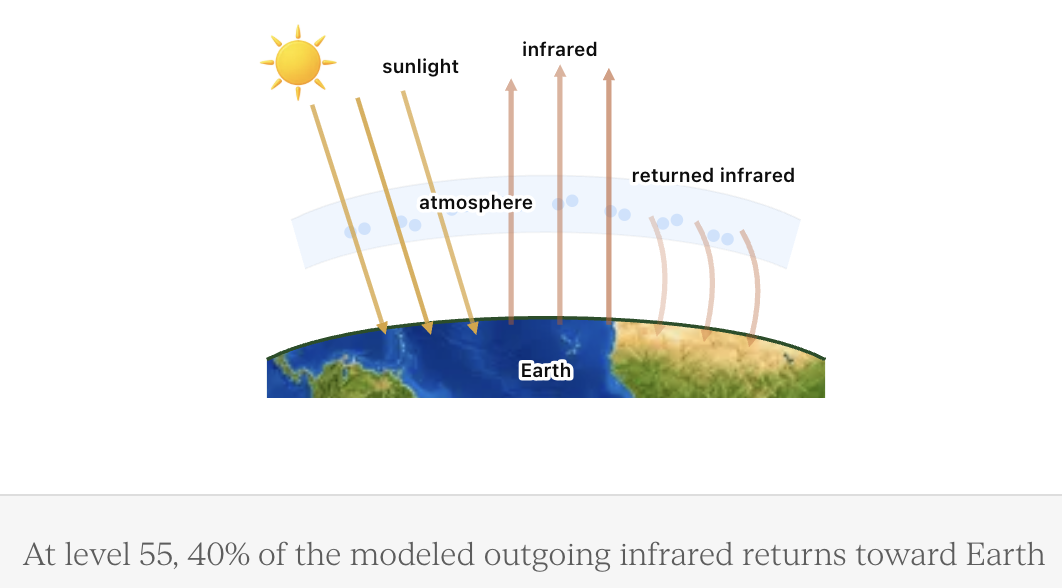
Earth then releases energy back toward space mainly as infrared radiation.
If:
energy entering = energy leaving
Earth's average temperature tends to remain relatively stable.
If:
energy entering > energy leaving
Earth gains energy and tends to warm.
If:
energy leaving > energy entering
Earth loses energy and tends to cool.
The Natural Greenhouse Effect
Earth's atmosphere naturally contains greenhouse gases.
Important greenhouse gases include:
- water vapor
- carbon dioxide (CO₂)
- methane (CH₄)
- nitrous oxide (N₂O)
- ozone
These gases absorb some of the infrared radiation emitted by Earth's surface and emit infrared radiation in different directions.
This slows the rate at which energy escapes directly to space.
The result is the natural greenhouse effect.
Without it, Earth's surface would be much colder.
The Enhanced Greenhouse Effect
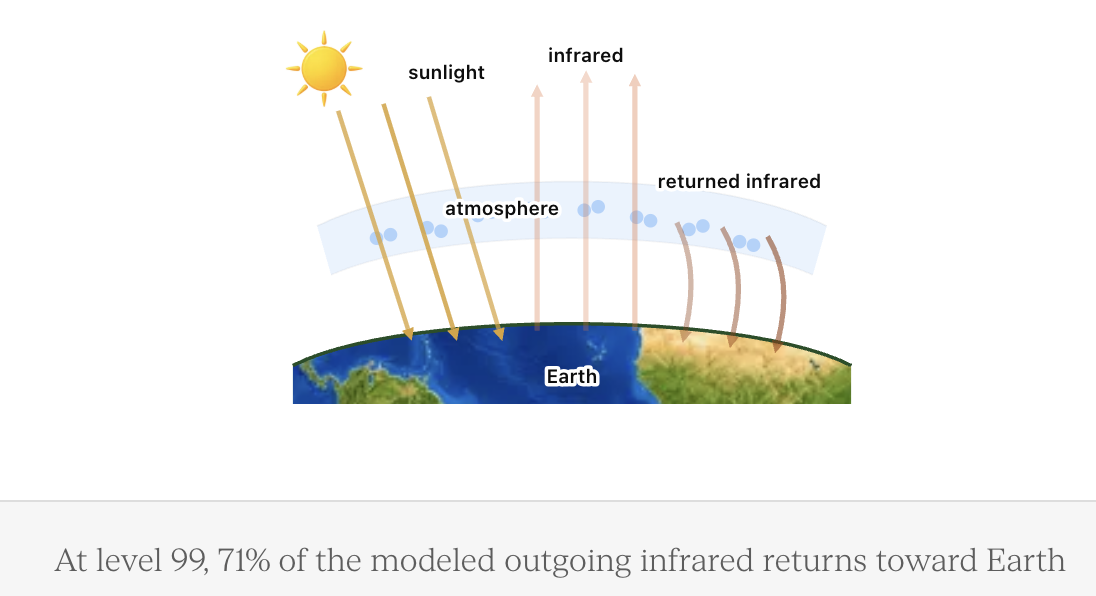
Human activities have increased the concentrations of several greenhouse gases.
More greenhouse gases cause the atmosphere to absorb more outgoing infrared radiation.
The climate system then gains energy until a new energy balance is approached.
This human-driven strengthening of the greenhouse effect is often called the enhanced greenhouse effect.
A simplified sequence is:
human activities → increased greenhouse gases → reduced rate of energy loss to space → warming of climate system
This is central to understanding modern climate change.
Carbon Dioxide
Carbon dioxide (CO₂) is one of the most important greenhouse gases affected by human activity.
Major human sources include:
- burning coal
- burning oil
- burning natural gas
- cement production
- deforestation
- other land-use changes
CO₂ can remain involved in the climate system for very long periods, so emissions can influence climate long after they occur.
Fossil Fuels
Fossil fuels formed from ancient organic material over geological timescales.
The major fossil fuels are:
- coal
- oil
- natural gas
They contain carbon.
When fossil fuels burn, carbon combines with oxygen.
A simplified equation is:
carbon + oxygen → carbon dioxide
or:
C + O₂ → CO₂
This transfers carbon that had been stored underground into the atmosphere.


Electricity Generation
Electricity itself does not necessarily produce greenhouse gases when it is used.
The emissions depend on how the electricity is generated.
Electricity produced by burning:
- coal
- oil
- natural gas
produces CO₂ emissions.
Electricity generated using sources such as:
- wind
- solar
- hydroelectric power
does not require fossil-fuel combustion during electricity generation.
However, all energy technologies have some environmental impacts across their life cycles.
Transportation
Transportation is another important source of greenhouse gas emissions.
Examples include:
- cars
- trucks
- ships
- aircraft
Gasoline and diesel contain hydrocarbons.
During complete combustion:
hydrocarbon + oxygen → carbon dioxide + water
Therefore, greater fossil-fuel consumption generally produces greater CO₂ emissions.
Industry
Industrial processes require large amounts of:
- heat
- electricity
- raw materials
Industries producing materials such as:
- steel
- cement
- chemicals
- plastics
can generate greenhouse gas emissions.
Some emissions result from burning fuels.
Others come directly from chemical reactions involved in manufacturing.
Cement Production
Cement production is an important example because CO₂ comes from both:
- energy used to heat materials
- chemical reactions during cement manufacture
Limestone contains calcium carbonate.
When strongly heated:
calcium carbonate → calcium oxide + carbon dioxide
CaCO₃ → CaO + CO₂
Therefore, even if the heat source were changed, the chemistry of conventional cement production itself can release CO₂.
Deforestation
Forests store large quantities of carbon in:
- trunks
- branches
- roots
- leaves
- soils
Plants remove CO₂ from the atmosphere through photosynthesis.
carbon dioxide + water → glucose + oxygen
When forests are removed:
- less CO₂ may be absorbed by vegetation
- stored carbon may be released through burning or decomposition
Deforestation can therefore affect climate in multiple ways.


Carbon Sources and Carbon Sinks
A carbon source releases more carbon than it absorbs.
Examples can include:
- fossil-fuel combustion
- some deforestation
- some industrial processes
A carbon sink absorbs more carbon than it releases over a given period.
Important carbon sinks include:
- oceans
- forests
- soils
Human activities can affect both sides of this balance.
For example:
burning fossil fuels → larger carbon source
while:
deforestation → potentially smaller land carbon sink + additional emissions
Methane
Methane (CH₄) is another important greenhouse gas.
Human-related methane sources include:
- livestock
- rice cultivation
- landfills
- fossil-fuel production
- natural-gas leakage
- coal mining
Methane is present at much lower concentrations than CO₂ but is an effective absorber of infrared radiation.
Livestock and Methane
Ruminant animals such as:
- cattle
- sheep
- goats
have microorganisms in their digestive systems that help break down food.
This process, called enteric fermentation, produces methane.
Agriculture can therefore contribute to greenhouse gas emissions through biological processes as well as machinery and fertilizer use.
Rice Agriculture
Flooded rice fields can create oxygen-poor conditions in soils.
Microorganisms living under these conditions can produce methane.
Therefore, some agricultural practices influence atmospheric greenhouse gas concentrations even though they do not involve fossil-fuel combustion directly.
Landfills
Organic waste in landfills can decompose under low-oxygen conditions.
This can produce methane.
Organic waste includes:
- food waste
- garden waste
- paper
- other biodegradable material
Some landfill facilities capture methane and use it as an energy source.
Capturing methane can reduce the amount released directly into the atmosphere.
Nitrous Oxide
Nitrous oxide (N₂O) is another greenhouse gas.
Human activities that increase N₂O emissions include:
- agricultural soil management
- nitrogen fertilizer use
- manure management
- some industrial processes
- fuel combustion
Nitrogen added to soils can be transformed by microorganisms.
Some of these processes release nitrous oxide.
Agriculture and Climate Change
Agriculture influences climate through several pathways.
These include:
livestock → methane
fertilizers → nitrous oxide
land clearing → carbon dioxide
farm machinery → fossil-fuel emissions
rice cultivation → methane
Agriculture is therefore connected to several different greenhouse gases.


Fluorinated Gases
Some industrial gases are also powerful greenhouse gases.
These include certain gases used in:
- refrigeration
- air conditioning
- electronics
- industrial manufacturing
Although their atmospheric concentrations may be relatively small, some have very strong warming effects per molecule.
Reducing leaks and replacing high-impact gases can therefore reduce climate effects.
Greenhouse Gas Strength
Different greenhouse gases do not have identical effects.
Their climate influence depends on factors including:
- how strongly they absorb infrared radiation
- their atmospheric concentration
- how long they remain in the atmosphere
- which wavelengths they absorb
Therefore:
1 kg of one greenhouse gas does not necessarily have the same climate effect as 1 kg of another.
Water Vapor
Water vapor is Earth's most abundant greenhouse gas.
However, in current climate change it acts mainly as a feedback rather than the primary initial driver.
The sequence is approximately:
initial warming → more evaporation → more atmospheric water vapor → stronger greenhouse effect → additional warming
This is called a positive feedback.
Climate Forcing
A climate forcing is a factor that changes Earth's energy balance.
A positive forcing tends to warm the climate.
A negative forcing tends to cool the climate.
Examples include:
| Factor | Typical Effect |
|---|---|
| Increased greenhouse gases | Warming |
| Increased solar energy | Warming |
| Large volcanic aerosol increase | Temporary cooling |
| Increased reflective aerosols | Cooling |
| Loss of reflective ice | Warming feedback |
Climate results from the combined influence of many factors.
Radiative Forcing
Scientists often describe changes in Earth's energy balance using radiative forcing.
It can be thought of as a change in the balance between incoming and outgoing energy.
For example:
increased CO₂ → less infrared energy escapes initially → positive radiative forcing
The climate system responds by warming.
As Earth warms, it emits more infrared radiation, helping move the planet toward a new energy balance.
Natural Causes of Climate Change
Earth's climate changed long before modern humans existed.
Important natural causes include:
- changes in Earth's orbit
- changes in solar output
- volcanic eruptions
- plate tectonics
- natural ocean-atmosphere variability
These natural factors remain part of Earth's climate system today.
However, the existence of natural climate change does not mean all climate change must be natural.
Changes in Earth's Orbit
Earth's orbit and orientation change gradually over very long periods.
Important variations include changes in:
- orbital shape
- axial tilt
- direction of Earth's axis
These are often called Milankovitch cycles.
They alter the distribution of solar energy reaching different parts of Earth.
Over tens of thousands of years, these changes can contribute to major climate shifts such as glacial and interglacial periods.
Eccentricity
Eccentricity describes changes in the shape of Earth's orbit.
Earth's orbit varies from being slightly more circular to slightly more elliptical.
These changes occur over very long timescales.
They influence how solar energy is distributed through Earth's climate system.
Axial Tilt
Earth's axis is tilted.
The amount of this tilt changes slowly over time.
Greater or smaller tilt affects the strength of seasonal differences, particularly at higher latitudes.
This can influence the growth and melting of large ice sheets over long periods.
Precession
Earth's axis slowly changes direction, somewhat like a spinning top.
This motion is called precession.
Precession changes the timing of Earth's seasons relative to its position in orbit.
Together, orbital changes influence long-term climate cycles.


Solar Variability
The Sun's energy output is not perfectly constant.
Solar activity changes over time.
Changes in solar energy can influence Earth's climate.
However, scientists can measure solar activity and compare its pattern with observed climate change.
This allows solar changes to be tested as a possible explanation rather than simply assumed to be the cause.
Volcanic Eruptions
Large volcanic eruptions can influence climate.
Explosive eruptions may inject sulfur-containing gases high into the atmosphere.
These can form tiny aerosol particles that reflect some incoming sunlight.
A simplified sequence is:
major eruption → aerosols → more sunlight reflected → temporary cooling


Volcanoes and Carbon Dioxide
Volcanoes also release CO₂.
However, modern human activities release much more CO₂ than volcanoes do overall.
Volcanic eruptions are particularly important for their short-term cooling influence when large quantities of reflective aerosols reach the stratosphere.
This explains why:
volcanoes can release greenhouse gases while some major eruptions still cause temporary cooling.
Plate Tectonics
Over millions of years, plate tectonics can influence climate by changing:
- positions of continents
- ocean circulation
- mountain ranges
- volcanic activity
- long-term carbon cycling
For example, changing continental positions can alter ocean currents that transport heat around Earth.
Plate tectonics is important for understanding Earth's long-term climate history, but it operates far too slowly to explain rapid changes occurring over decades.
Ocean-Atmosphere Variability
Earth's climate system naturally redistributes heat between:
- oceans
- atmosphere
An important example is the El Niño–Southern Oscillation (ENSO).
ENSO includes:
- El Niño
- La Niña
These conditions can alter temperatures, rainfall, storms, and other weather patterns around the world.
El Niño
During El Niño conditions, changes in tropical Pacific Ocean temperatures and atmospheric circulation redistribute heat.
Some years may consequently be unusually warm globally.
El Niño can temporarily increase global average surface temperature.
However, it does not create the long-term accumulation of greenhouse gases responsible for the underlying modern warming trend.
La Niña
La Niña involves a different pattern in the tropical Pacific.
Some La Niña periods can temporarily reduce global average surface temperatures relative to surrounding years.
This helps explain why:
every year does not have to be warmer than the previous year
even during a long-term warming trend.
Natural Variability Versus Long-Term Change
Imagine temperatures fluctuate like this:
warm → cool → warm → cool → warm
That represents variability.
Now imagine the entire pattern gradually shifts upward:
higher warm periods + higher cool periods
That represents a long-term warming trend occurring alongside natural variability.
Climate scientists must distinguish the two.
Aerosols
Aerosols are tiny particles or droplets suspended in the atmosphere.
Sources include:
- volcanic eruptions
- industrial pollution
- fires
- dust
- sea spray
Some aerosols reflect incoming sunlight and therefore have a cooling influence.
Others can absorb energy.
Aerosols can also affect cloud formation.
Their climate effects are therefore more complicated than simply "aerosols cool Earth."
Air Pollution and Climate
Some fossil-fuel combustion releases both:
- greenhouse gases that warm the climate
- aerosols or aerosol-forming pollutants that can produce cooling effects
Reducing air pollution is important for human health.
However, the climate system must be understood carefully because different pollutants can have different effects and atmospheric lifetimes.
Albedo
Albedo describes how strongly a surface reflects incoming sunlight.
High-albedo surfaces reflect more sunlight.
Examples include:
- snow
- ice
- some clouds
Low-albedo surfaces absorb more sunlight.
Examples include:
- oceans
- forests
- dark soils
Changes in Earth's surface can therefore alter the planet's energy balance.
Ice-Albedo Feedback
Ice provides an important climate feedback.
A simplified sequence is:
warming → ice melts → darker surface exposed → more solar energy absorbed → additional warming
This is a positive feedback because the original warming is amplified.
Likewise:
cooling → more ice → more reflection → additional cooling
Feedbacks can strengthen an initial climate change.
Positive and Negative Feedback
A positive feedback amplifies an initial change.
Examples include:
- ice-albedo feedback
- water-vapor feedback
A negative feedback reduces an initial change.
An important example is that a warmer Earth emits more infrared radiation to space.
This tends to oppose the initial warming.
Climate depends on the combined effects of multiple feedbacks.
Carbon-Cycle Feedbacks
Warming can influence natural carbon stores.
For example, changing climate can affect:
- soils
- forests
- permafrost
- oceans
If warming causes additional greenhouse gases to enter the atmosphere, this can amplify warming.
These interactions are known as carbon-cycle feedbacks.
Land-Use Change
Humans modify large areas of Earth's surface through:
- agriculture
- urbanization
- forestry
- deforestation
Land-use changes can influence:
- carbon storage
- albedo
- evaporation
- local temperatures
- water cycles
Therefore, human influence on climate extends beyond fossil-fuel combustion.
Urban Areas
Cities contain large areas of:
- concrete
- asphalt
- buildings
These surfaces often absorb and retain more heat than surrounding vegetated areas.
This contributes to the urban heat island effect.
Urban heat islands are important local climate effects.
However, they do not explain the global warming trend because warming is also measured:
- over oceans
- in rural regions
- in the atmosphere
- through many independent observing systems
Human and Natural Influences Together
Climate scientists do not choose between:
"natural causes" OR "human causes."
Both exist.
Instead, scientists estimate the contribution of each factor.
Modern climate analysis includes:
- greenhouse gases
- solar variation
- volcanic aerosols
- human-produced aerosols
- land-use changes
- natural ocean variability
The important question is:
How much does each factor contribute?
Attribution
Climate attribution is the process of determining the causes of observed climate changes.
Scientists compare:
- observations
- physical theory
- measurements of climate drivers
- climate models
- characteristic climate patterns
This allows researchers to determine which combination of influences best explains observed changes.
Testing Natural Causes
Suppose scientists hypothesize:
"Recent warming is caused mainly by increased solar output."
They can test this.
They examine:
- measurements of solar activity
- expected geographic patterns
- atmospheric temperature patterns
- timing of warming
If observations do not match the predicted pattern, the hypothesis becomes less convincing.
Scientific explanations must match multiple observations, not simply one trend.
Testing Greenhouse Gas Causes
Scientists can also calculate how increasing greenhouse gases should alter Earth's energy balance.
Expected changes can then be compared with observations.
These include changes in:
- surface temperatures
- atmospheric temperatures
- ocean heat
- outgoing infrared radiation
- geographic warming patterns
The agreement among multiple observations strengthens the conclusion that increased greenhouse gases are driving modern warming.
Climate Fingerprints
Different climate causes can produce different fingerprints.
For example, if increased solar energy were the dominant cause, scientists would expect a different atmospheric pattern than if greenhouse gases were responsible.
Greenhouse-gas-driven warming is associated with:
- warming near Earth's surface and in the lower atmosphere
- cooling higher in the stratosphere
This pattern helps distinguish greenhouse warming from increased solar output.
Why the Stratosphere Matters
If the Sun were simply becoming much stronger, additional incoming solar energy would tend to warm more of the atmosphere.
In contrast, increasing greenhouse gases alter how infrared radiation moves through the atmosphere.
The observed combination of:
lower-atmosphere warming + stratospheric cooling
is an important fingerprint of enhanced greenhouse forcing.
Fossil Carbon Evidence
Carbon exists as different isotopes.
Fossil fuels contain carbon with a characteristic isotopic composition because they originated from ancient biological material.
Scientists can measure changes in atmospheric carbon isotopes.
These measurements provide evidence that much of the additional atmospheric carbon comes from fossil carbon.
This is another independent way of identifying the source of increasing CO₂.
Oxygen Evidence
Burning fossil fuels consumes oxygen.
Scientists have detected a small decline in atmospheric oxygen alongside increasing CO₂.
The combination is consistent with large-scale combustion:
fuel + oxygen → carbon dioxide + other products
Again, scientists use multiple independent observations rather than relying on a single measurement.
Example: Comparing Possible Causes
Suppose global temperatures increase while:
- atmospheric CO₂ increases
- ocean heat content increases
- solar output does not show a matching long-term increase
- the lower atmosphere warms
- the stratosphere cools
- fossil-carbon signatures increase in atmospheric CO₂
A strong scientific explanation must account for all these observations.
Increased greenhouse gases from human activities explain this combination much better than increased solar activity alone.
Natural Climate Change in the Past
Earth has experienced:
- ice ages
- warmer periods
- abrupt regional climate shifts
Natural climate change can be caused by combinations of:
- orbital changes
- greenhouse gas changes
- plate tectonics
- volcanic activity
- ocean circulation
- feedback processes
Evidence of natural climate change in the past is not evidence against human-caused climate change today.
Instead, past climate changes help scientists understand how Earth's climate responds to different forces.
Rate of Change
When analyzing climate, scientists consider both:
how much climate changes
and
how quickly it changes.
Some natural climate processes operate over:
- thousands
- tens of thousands
- millions of years
Modern greenhouse gas concentrations have changed rapidly compared with many long-term natural processes.
The timescale of a proposed cause must therefore match the timescale of the observed change.
Example: Emissions Calculation
Suppose a vehicle burns 50 L of fuel per week.
If a more efficient vehicle reduces fuel use to 35 L per week:
Fuel reduction:
50 − 35 = 15 L/week
Percentage reduction:
15 ÷ 50 × 100 = 30%
The vehicle uses 30% less fuel.
If the same type of fuel is used, lower fuel consumption generally means lower direct CO₂ emissions.
Example: Forest Carbon
Suppose a forest absorbs:
2,000 tonnes of CO₂ per year
After part of the forest is cleared, absorption falls to:
1,200 tonnes per year
Reduction:
2,000 − 1,200 = 800 tonnes/year
Percentage reduction:
800 ÷ 2,000 × 100 = 40%
The carbon-removal capacity has decreased by 40%.
This illustrates how land-use change can influence the carbon cycle even before considering carbon released by the removed vegetation.
Common Mistakes
Thinking All Climate Change Is Human-Caused
Earth's climate has always experienced natural changes.
The scientific conclusion is that human activities are the dominant cause of the recent global warming trend, not that natural climate processes no longer exist.
Thinking Natural Climate Change Means Humans Cannot Affect Climate
Both natural and human influences can affect Earth's energy balance.
One does not exclude the other.
Thinking the Greenhouse Effect Is Entirely Harmful
The natural greenhouse effect makes Earth warm enough for life as we know it.
The concern is the additional greenhouse effect caused by increasing greenhouse gas concentrations.
Thinking CO₂ Is the Only Greenhouse Gas
Important greenhouse gases also include:
- methane
- nitrous oxide
- water vapor
- ozone
- fluorinated gases
Thinking Water Vapor Is the Main Human Cause of Current Warming
Water vapor is primarily an important feedback in modern climate change.
Thinking Volcanoes Explain Modern CO₂ Increases
Volcanoes emit CO₂, but human activities currently emit much more overall.
Thinking El Niño Causes Long-Term Global Warming
El Niño redistributes heat and influences individual years.
It does not explain the persistent long-term accumulation of energy in the climate system.
Thinking the Sun Cannot Affect Climate
Solar variations can affect climate.
However, measurements allow scientists to test whether solar changes explain observed modern warming.
Thinking Climate Models Ignore Natural Causes
Climate models include natural influences such as solar variability and volcanic activity alongside human influences.
Confusing Feedback with Initial Cause
Ice loss and increasing water vapor can amplify warming, but they do not need to be the initial cause of that warming.
Check Your Understanding
- What is Earth's energy balance?
- Explain the natural greenhouse effect.
- What is meant by the enhanced greenhouse effect?
- Name four greenhouse gases.
- Give three human activities that increase atmospheric CO₂.
- Explain how burning fossil fuels changes the carbon cycle.
- How can deforestation increase atmospheric CO₂?
- Give three important human sources of methane.
- How can fertilizer use contribute to climate change?
- Explain why water vapor is considered mainly a feedback in modern climate change.
- What is radiative forcing?
- Name four natural causes of climate change.
- How can large volcanic eruptions temporarily cool Earth's climate?
- What are Milankovitch cycles?
- Explain the difference between climate variability and a long-term climate trend.
- How can El Niño affect global temperatures without causing the long-term warming trend?
- Explain the ice-albedo feedback.
- Why do scientists compare the observed climate with the expected fingerprints of different causes?
- Why does stratospheric cooling provide evidence about the cause of modern warming?
- A student says, "Earth's climate changed naturally before humans existed, so modern climate change must also be natural." Explain why this reasoning is scientifically incomplete.
Key Terms
Climate change — Long-term change in Earth's climate patterns or average conditions.
Energy balance — Balance between energy entering and leaving Earth's climate system.
Greenhouse effect — Warming caused when greenhouse gases absorb and re-emit infrared radiation.
Enhanced greenhouse effect — Strengthening of the greenhouse effect caused by increased greenhouse gas concentrations.
Greenhouse gas — Atmospheric gas capable of absorbing and emitting infrared radiation.
Carbon dioxide (CO₂) — Greenhouse gas released by processes including fossil-fuel combustion, cement production, respiration, and decomposition.
Methane (CH₄) — Powerful greenhouse gas released by natural processes and human activities including agriculture, waste decomposition, and fossil-fuel production.
Nitrous oxide (N₂O) — Greenhouse gas associated with processes including soil microbial activity and fertilizer use.
Fossil fuel — Carbon-rich fuel such as coal, oil, or natural gas formed from ancient organic material.
Carbon source — System or process that releases more carbon than it absorbs.
Carbon sink — System that absorbs more carbon than it releases over a given period.
Radiative forcing — Change in Earth's energy balance caused by a climate influence.
Climate forcing — Factor that causes a change in Earth's energy balance.
Feedback — Process that amplifies or reduces an initial climate change.
Positive feedback — Process that strengthens an initial change.
Negative feedback — Process that opposes an initial change.
Albedo — Fraction of incoming radiation reflected by a surface.
Ice-albedo feedback — Amplification of warming caused when melting reflective ice exposes darker surfaces that absorb more solar energy.
Aerosol — Tiny solid particle or liquid droplet suspended in the atmosphere.
Milankovitch cycles — Long-term variations in Earth's orbit and orientation that influence climate.
Eccentricity — Variation in the shape of Earth's orbit.
Axial tilt — Angle between Earth's rotational axis and its orbital plane.
Precession — Slow change in the direction of Earth's rotational axis.
ENSO — El Niño–Southern Oscillation, a natural pattern of ocean-atmosphere variability in the tropical Pacific.
Climate variability — Natural fluctuations in climate conditions over time.
Climate attribution — Scientific process of determining the causes of observed climate changes.
Climate fingerprint — Characteristic pattern expected from a particular climate influence.
Land-use change — Modification of Earth's surface through activities such as agriculture, forestry, and urbanization.
Key Takeaways
- Earth's climate can change because of both natural and human influences.
- Climate changes when factors alter the balance between incoming and outgoing energy.
- The natural greenhouse effect is essential for maintaining Earth's habitable temperature.
- Increasing greenhouse gas concentrations strengthen the greenhouse effect.
- Human activities have substantially increased atmospheric concentrations of CO₂, methane, and nitrous oxide.
- Burning coal, oil, and natural gas transfers fossil carbon into the atmosphere as CO₂.
- Electricity generation, transportation, industry, agriculture, buildings, and land-use change contribute to greenhouse gas emissions.
- Deforestation can both release stored carbon and reduce carbon uptake by vegetation.
- Agriculture contributes methane and nitrous oxide as well as CO₂.
- Water vapor primarily acts as a feedback that amplifies initial warming.
- Natural climate drivers include orbital variations, solar changes, volcanic activity, plate tectonics, and ocean-atmosphere variability.
- Large volcanic eruptions can cause temporary cooling by increasing reflective aerosols in the atmosphere.
- Milankovitch cycles help explain major natural climate changes over very long timescales.
- El Niño and La Niña create short-term climate variability but do not explain the long-term modern warming trend.
- Changes in snow and ice can amplify warming through the ice-albedo feedback.
- Scientists distinguish natural and human influences by comparing observations with the expected effects of different climate drivers.
- Solar activity, volcanic activity, greenhouse gases, aerosols, and natural variability can all be measured and analyzed.
- Atmospheric temperature patterns provide fingerprints that help identify the causes of climate change.
- Carbon isotope evidence helps identify fossil fuels as a major source of increasing atmospheric CO₂.
- Natural climate change in Earth's past does not contradict modern human-caused climate change.
The central causal chain for modern warming is:
FOSSIL-FUEL USE + LAND-USE CHANGE + AGRICULTURE + INDUSTRY
↓
INCREASED GREENHOUSE GAS CONCENTRATIONS
↓
CHANGE IN EARTH'S ENERGY BALANCE
↓
MORE ENERGY RETAINED IN THE CLIMATE SYSTEM
↓
GLOBAL WARMING
↓
CHANGES THROUGHOUT EARTH'S CLIMATE SYSTEM
Natural variability continues at the same time, but the evidence allows scientists to distinguish these shorter-term fluctuations from the long-term human influence on Earth's climate.