Climate Change and Future Challenges
| 站点: | Young Education |
| 课程: | Environmental Chemistry |
| 图书: | Climate Change and Future Challenges |
| 打印: | Гість-користувач |
| 日期: | 2026年11月24日 星期二 00:49 |
1. Evidence for Climate Change
Learning outcomes
- I can identify scientific evidence for climate change.
- I can interpret trends in climate data.
- I can explain how scientists study past climates.
- I can describe observed changes in Earth's climate system.
- I can evaluate evidence supporting climate change conclusions.


2. Causes of Climate Change
Learning outcomes
- I can explain the natural and human causes of climate change.
- I can identify activities that increase greenhouse gas emissions.
- I can describe how human activities alter Earth's energy balance.
- I can analyze factors contributing to modern climate change.
- I can distinguish between natural climate variability and human impacts.
Causes of Climate Change
Earth's climate has changed many times throughout its history. Some changes have been caused by natural processes, while modern climate change is strongly influenced by human activities that increase greenhouse gas concentrations in the atmosphere.
The main causes can be grouped into:
- changes in greenhouse gases
- changes in solar energy
- volcanic activity
- changes in Earth's orbit
- changes in land surfaces
- changes in aerosols
- natural ocean-atmosphere cycles
- human activities such as fossil-fuel combustion and deforestation
The key scientific question is not simply:
"Can climate change naturally?"
It can.
The more important question is:
"What factors best explain the climate changes being observed today?"


Earth's Energy Balance
Earth's climate depends on the balance between energy entering and leaving the planet.
Most incoming energy arrives from the Sun as shortwave radiation.
Some incoming sunlight is:
- reflected by clouds
- reflected by ice and snow
- reflected by Earth's surface
The remainder is absorbed by:
- land
- oceans
- atmosphere
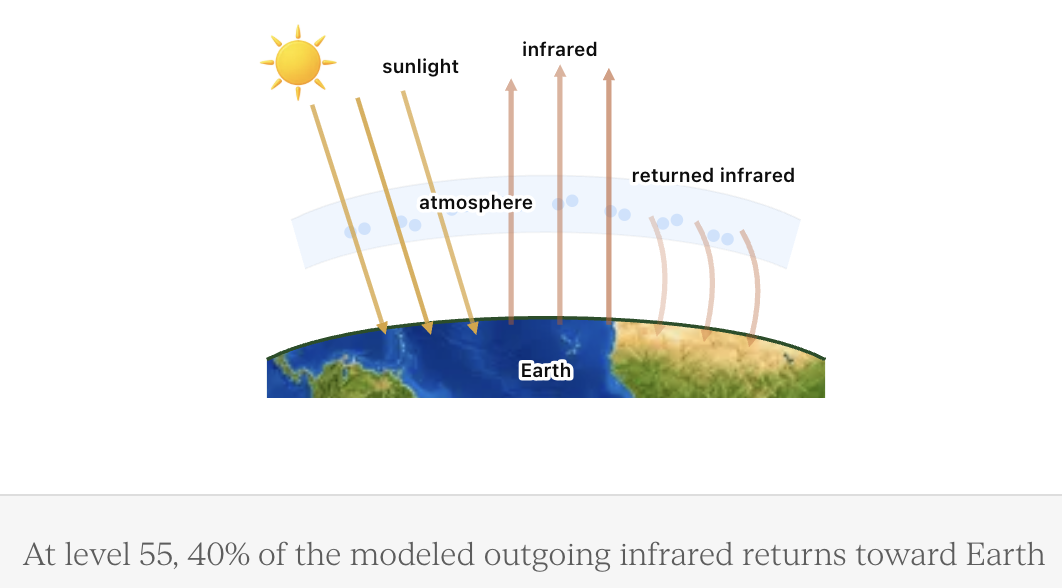
Earth then releases energy back toward space mainly as infrared radiation.
If:
energy entering = energy leaving
Earth's average temperature tends to remain relatively stable.
If:
energy entering > energy leaving
Earth gains energy and tends to warm.
If:
energy leaving > energy entering
Earth loses energy and tends to cool.
The Natural Greenhouse Effect
Earth's atmosphere naturally contains greenhouse gases.
Important greenhouse gases include:
- water vapor
- carbon dioxide (CO₂)
- methane (CH₄)
- nitrous oxide (N₂O)
- ozone
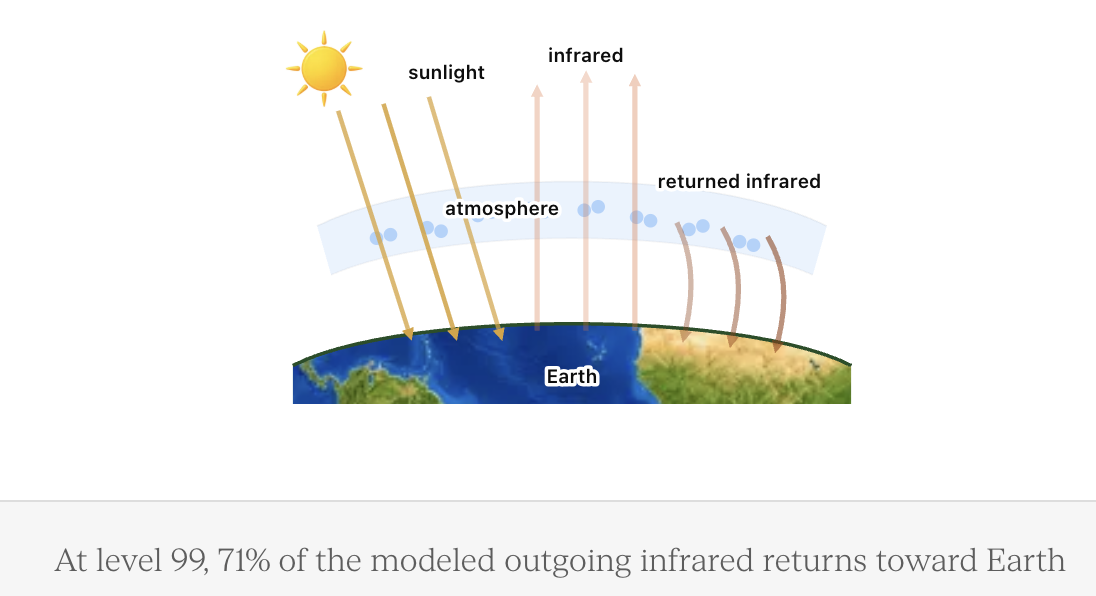
These gases absorb some of the infrared radiation emitted by Earth's surface and emit infrared radiation in different directions.
This slows the rate at which energy escapes directly to space.
The result is the natural greenhouse effect.
Without it, Earth's surface would be much colder.
The Enhanced Greenhouse Effect
Human activities have increased the concentrations of several greenhouse gases.
More greenhouse gases cause the atmosphere to absorb more outgoing infrared radiation.
The climate system then gains energy until a new energy balance is approached.
This human-driven strengthening of the greenhouse effect is often called the enhanced greenhouse effect.
A simplified sequence is:
human activities → increased greenhouse gases → reduced rate of energy loss to space → warming of climate system
This is central to understanding modern climate change.
Carbon Dioxide
Carbon dioxide (CO₂) is one of the most important greenhouse gases affected by human activity.
Major human sources include:
- burning coal
- burning oil
- burning natural gas
- cement production
- deforestation
- other land-use changes
CO₂ can remain involved in the climate system for very long periods, so emissions can influence climate long after they occur.
Fossil Fuels
Fossil fuels formed from ancient organic material over geological timescales.
The major fossil fuels are:
- coal
- oil
- natural gas
They contain carbon.
When fossil fuels burn, carbon combines with oxygen.
A simplified equation is:
carbon + oxygen → carbon dioxide
or:
C + O₂ → CO₂
This transfers carbon that had been stored underground into the atmosphere.


Electricity Generation
Electricity itself does not necessarily produce greenhouse gases when it is used.
The emissions depend on how the electricity is generated.
Electricity produced by burning:
- coal
- oil
- natural gas
produces CO₂ emissions.
Electricity generated using sources such as:
- wind
- solar
- hydroelectric power
does not require fossil-fuel combustion during electricity generation.
However, all energy technologies have some environmental impacts across their life cycles.
Transportation
Transportation is another important source of greenhouse gas emissions.
Examples include:
- cars
- trucks
- ships
- aircraft
Gasoline and diesel contain hydrocarbons.
During complete combustion:
hydrocarbon + oxygen → carbon dioxide + water
Therefore, greater fossil-fuel consumption generally produces greater CO₂ emissions.
Industry
Industrial processes require large amounts of:
- heat
- electricity
- raw materials
Industries producing materials such as:
- steel
- cement
- chemicals
- plastics
can generate greenhouse gas emissions.
Some emissions result from burning fuels.
Others come directly from chemical reactions involved in manufacturing.
Cement Production
Cement production is an important example because CO₂ comes from both:
- energy used to heat materials
- chemical reactions during cement manufacture
Limestone contains calcium carbonate.
When strongly heated:
calcium carbonate → calcium oxide + carbon dioxide
CaCO₃ → CaO + CO₂
Therefore, even if the heat source were changed, the chemistry of conventional cement production itself can release CO₂.
Deforestation
Forests store large quantities of carbon in:
- trunks
- branches
- roots
- leaves
- soils
Plants remove CO₂ from the atmosphere through photosynthesis.
carbon dioxide + water → glucose + oxygen
When forests are removed:
- less CO₂ may be absorbed by vegetation
- stored carbon may be released through burning or decomposition
Deforestation can therefore affect climate in multiple ways.


Carbon Sources and Carbon Sinks
A carbon source releases more carbon than it absorbs.
Examples can include:
- fossil-fuel combustion
- some deforestation
- some industrial processes
A carbon sink absorbs more carbon than it releases over a given period.
Important carbon sinks include:
- oceans
- forests
- soils
Human activities can affect both sides of this balance.
For example:
burning fossil fuels → larger carbon source
while:
deforestation → potentially smaller land carbon sink + additional emissions
Methane
Methane (CH₄) is another important greenhouse gas.
Human-related methane sources include:
- livestock
- rice cultivation
- landfills
- fossil-fuel production
- natural-gas leakage
- coal mining
Methane is present at much lower concentrations than CO₂ but is an effective absorber of infrared radiation.
Livestock and Methane
Ruminant animals such as:
- cattle
- sheep
- goats
have microorganisms in their digestive systems that help break down food.
This process, called enteric fermentation, produces methane.
Agriculture can therefore contribute to greenhouse gas emissions through biological processes as well as machinery and fertilizer use.
Rice Agriculture
Flooded rice fields can create oxygen-poor conditions in soils.
Microorganisms living under these conditions can produce methane.
Therefore, some agricultural practices influence atmospheric greenhouse gas concentrations even though they do not involve fossil-fuel combustion directly.
Landfills
Organic waste in landfills can decompose under low-oxygen conditions.
This can produce methane.
Organic waste includes:
- food waste
- garden waste
- paper
- other biodegradable material
Some landfill facilities capture methane and use it as an energy source.
Capturing methane can reduce the amount released directly into the atmosphere.
Nitrous Oxide
Nitrous oxide (N₂O) is another greenhouse gas.
Human activities that increase N₂O emissions include:
- agricultural soil management
- nitrogen fertilizer use
- manure management
- some industrial processes
- fuel combustion
Nitrogen added to soils can be transformed by microorganisms.
Some of these processes release nitrous oxide.
Agriculture and Climate Change
Agriculture influences climate through several pathways.
These include:
livestock → methane
fertilizers → nitrous oxide
land clearing → carbon dioxide
farm machinery → fossil-fuel emissions
rice cultivation → methane
Agriculture is therefore connected to several different greenhouse gases.


Fluorinated Gases
Some industrial gases are also powerful greenhouse gases.
These include certain gases used in:
- refrigeration
- air conditioning
- electronics
- industrial manufacturing
Although their atmospheric concentrations may be relatively small, some have very strong warming effects per molecule.
Reducing leaks and replacing high-impact gases can therefore reduce climate effects.
Greenhouse Gas Strength
Different greenhouse gases do not have identical effects.
Their climate influence depends on factors including:
- how strongly they absorb infrared radiation
- their atmospheric concentration
- how long they remain in the atmosphere
- which wavelengths they absorb
Therefore:
1 kg of one greenhouse gas does not necessarily have the same climate effect as 1 kg of another.
Water Vapor
Water vapor is Earth's most abundant greenhouse gas.
However, in current climate change it acts mainly as a feedback rather than the primary initial driver.
The sequence is approximately:
initial warming → more evaporation → more atmospheric water vapor → stronger greenhouse effect → additional warming
This is called a positive feedback.
Climate Forcing
A climate forcing is a factor that changes Earth's energy balance.
A positive forcing tends to warm the climate.
A negative forcing tends to cool the climate.
Examples include:
| Factor | Typical Effect |
|---|---|
| Increased greenhouse gases | Warming |
| Increased solar energy | Warming |
| Large volcanic aerosol increase | Temporary cooling |
| Increased reflective aerosols | Cooling |
| Loss of reflective ice | Warming feedback |
Climate results from the combined influence of many factors.
Radiative Forcing
Scientists often describe changes in Earth's energy balance using radiative forcing.
It can be thought of as a change in the balance between incoming and outgoing energy.
For example:
increased CO₂ → less infrared energy escapes initially → positive radiative forcing
The climate system responds by warming.
As Earth warms, it emits more infrared radiation, helping move the planet toward a new energy balance.
Natural Causes of Climate Change
Earth's climate changed long before modern humans existed.
Important natural causes include:
- changes in Earth's orbit
- changes in solar output
- volcanic eruptions
- plate tectonics
- natural ocean-atmosphere variability
These natural factors remain part of Earth's climate system today.
However, the existence of natural climate change does not mean all climate change must be natural.
Changes in Earth's Orbit
Earth's orbit and orientation change gradually over very long periods.
Important variations include changes in:
- orbital shape
- axial tilt
- direction of Earth's axis
These are often called Milankovitch cycles.
They alter the distribution of solar energy reaching different parts of Earth.
Over tens of thousands of years, these changes can contribute to major climate shifts such as glacial and interglacial periods.
Eccentricity
Eccentricity describes changes in the shape of Earth's orbit.
Earth's orbit varies from being slightly more circular to slightly more elliptical.
These changes occur over very long timescales.
They influence how solar energy is distributed through Earth's climate system.
Axial Tilt
Earth's axis is tilted.
The amount of this tilt changes slowly over time.
Greater or smaller tilt affects the strength of seasonal differences, particularly at higher latitudes.
This can influence the growth and melting of large ice sheets over long periods.
Precession
Earth's axis slowly changes direction, somewhat like a spinning top.
This motion is called precession.
Precession changes the timing of Earth's seasons relative to its position in orbit.
Together, orbital changes influence long-term climate cycles.


Solar Variability
The Sun's energy output is not perfectly constant.
Solar activity changes over time.
Changes in solar energy can influence Earth's climate.
However, scientists can measure solar activity and compare its pattern with observed climate change.
This allows solar changes to be tested as a possible explanation rather than simply assumed to be the cause.
Volcanic Eruptions
Large volcanic eruptions can influence climate.
Explosive eruptions may inject sulfur-containing gases high into the atmosphere.
These can form tiny aerosol particles that reflect some incoming sunlight.
A simplified sequence is:
major eruption → aerosols → more sunlight reflected → temporary cooling


Volcanoes and Carbon Dioxide
Volcanoes also release CO₂.
However, modern human activities release much more CO₂ than volcanoes do overall.
Volcanic eruptions are particularly important for their short-term cooling influence when large quantities of reflective aerosols reach the stratosphere.
This explains why:
volcanoes can release greenhouse gases while some major eruptions still cause temporary cooling.
Plate Tectonics
Over millions of years, plate tectonics can influence climate by changing:
- positions of continents
- ocean circulation
- mountain ranges
- volcanic activity
- long-term carbon cycling
For example, changing continental positions can alter ocean currents that transport heat around Earth.
Plate tectonics is important for understanding Earth's long-term climate history, but it operates far too slowly to explain rapid changes occurring over decades.
Ocean-Atmosphere Variability
Earth's climate system naturally redistributes heat between:
- oceans
- atmosphere
An important example is the El Niño–Southern Oscillation (ENSO).
ENSO includes:
- El Niño
- La Niña
These conditions can alter temperatures, rainfall, storms, and other weather patterns around the world.
El Niño
During El Niño conditions, changes in tropical Pacific Ocean temperatures and atmospheric circulation redistribute heat.
Some years may consequently be unusually warm globally.
El Niño can temporarily increase global average surface temperature.
However, it does not create the long-term accumulation of greenhouse gases responsible for the underlying modern warming trend.
La Niña
La Niña involves a different pattern in the tropical Pacific.
Some La Niña periods can temporarily reduce global average surface temperatures relative to surrounding years.
This helps explain why:
every year does not have to be warmer than the previous year
even during a long-term warming trend.
Natural Variability Versus Long-Term Change
Imagine temperatures fluctuate like this:
warm → cool → warm → cool → warm
That represents variability.
Now imagine the entire pattern gradually shifts upward:
higher warm periods + higher cool periods
That represents a long-term warming trend occurring alongside natural variability.
Climate scientists must distinguish the two.
Aerosols
Aerosols are tiny particles or droplets suspended in the atmosphere.
Sources include:
- volcanic eruptions
- industrial pollution
- fires
- dust
- sea spray
Some aerosols reflect incoming sunlight and therefore have a cooling influence.
Others can absorb energy.
Aerosols can also affect cloud formation.
Their climate effects are therefore more complicated than simply "aerosols cool Earth."
Air Pollution and Climate
Some fossil-fuel combustion releases both:
- greenhouse gases that warm the climate
- aerosols or aerosol-forming pollutants that can produce cooling effects
Reducing air pollution is important for human health.
However, the climate system must be understood carefully because different pollutants can have different effects and atmospheric lifetimes.
Albedo
Albedo describes how strongly a surface reflects incoming sunlight.
High-albedo surfaces reflect more sunlight.
Examples include:
- snow
- ice
- some clouds
Low-albedo surfaces absorb more sunlight.
Examples include:
- oceans
- forests
- dark soils
Changes in Earth's surface can therefore alter the planet's energy balance.
Ice-Albedo Feedback
Ice provides an important climate feedback.
A simplified sequence is:
warming → ice melts → darker surface exposed → more solar energy absorbed → additional warming
This is a positive feedback because the original warming is amplified.
Likewise:
cooling → more ice → more reflection → additional cooling
Feedbacks can strengthen an initial climate change.
Positive and Negative Feedback
A positive feedback amplifies an initial change.
Examples include:
- ice-albedo feedback
- water-vapor feedback
A negative feedback reduces an initial change.
An important example is that a warmer Earth emits more infrared radiation to space.
This tends to oppose the initial warming.
Climate depends on the combined effects of multiple feedbacks.
Carbon-Cycle Feedbacks
Warming can influence natural carbon stores.
For example, changing climate can affect:
- soils
- forests
- permafrost
- oceans
If warming causes additional greenhouse gases to enter the atmosphere, this can amplify warming.
These interactions are known as carbon-cycle feedbacks.
Land-Use Change
Humans modify large areas of Earth's surface through:
- agriculture
- urbanization
- forestry
- deforestation
Land-use changes can influence:
- carbon storage
- albedo
- evaporation
- local temperatures
- water cycles
Therefore, human influence on climate extends beyond fossil-fuel combustion.
Urban Areas
Cities contain large areas of:
- concrete
- asphalt
- buildings
These surfaces often absorb and retain more heat than surrounding vegetated areas.
This contributes to the urban heat island effect.
Urban heat islands are important local climate effects.
However, they do not explain the global warming trend because warming is also measured:
- over oceans
- in rural regions
- in the atmosphere
- through many independent observing systems
Human and Natural Influences Together
Climate scientists do not choose between:
"natural causes" OR "human causes."
Both exist.
Instead, scientists estimate the contribution of each factor.
Modern climate analysis includes:
- greenhouse gases
- solar variation
- volcanic aerosols
- human-produced aerosols
- land-use changes
- natural ocean variability
The important question is:
How much does each factor contribute?
Attribution
Climate attribution is the process of determining the causes of observed climate changes.
Scientists compare:
- observations
- physical theory
- measurements of climate drivers
- climate models
- characteristic climate patterns
This allows researchers to determine which combination of influences best explains observed changes.
Testing Natural Causes
Suppose scientists hypothesize:
"Recent warming is caused mainly by increased solar output."
They can test this.
They examine:
- measurements of solar activity
- expected geographic patterns
- atmospheric temperature patterns
- timing of warming
If observations do not match the predicted pattern, the hypothesis becomes less convincing.
Scientific explanations must match multiple observations, not simply one trend.
Testing Greenhouse Gas Causes
Scientists can also calculate how increasing greenhouse gases should alter Earth's energy balance.
Expected changes can then be compared with observations.
These include changes in:
- surface temperatures
- atmospheric temperatures
- ocean heat
- outgoing infrared radiation
- geographic warming patterns
The agreement among multiple observations strengthens the conclusion that increased greenhouse gases are driving modern warming.
Climate Fingerprints
Different climate causes can produce different fingerprints.
For example, if increased solar energy were the dominant cause, scientists would expect a different atmospheric pattern than if greenhouse gases were responsible.
Greenhouse-gas-driven warming is associated with:
- warming near Earth's surface and in the lower atmosphere
- cooling higher in the stratosphere
This pattern helps distinguish greenhouse warming from increased solar output.
Why the Stratosphere Matters
If the Sun were simply becoming much stronger, additional incoming solar energy would tend to warm more of the atmosphere.
In contrast, increasing greenhouse gases alter how infrared radiation moves through the atmosphere.
The observed combination of:
lower-atmosphere warming + stratospheric cooling
is an important fingerprint of enhanced greenhouse forcing.
Fossil Carbon Evidence
Carbon exists as different isotopes.
Fossil fuels contain carbon with a characteristic isotopic composition because they originated from ancient biological material.
Scientists can measure changes in atmospheric carbon isotopes.
These measurements provide evidence that much of the additional atmospheric carbon comes from fossil carbon.
This is another independent way of identifying the source of increasing CO₂.
Oxygen Evidence
Burning fossil fuels consumes oxygen.
Scientists have detected a small decline in atmospheric oxygen alongside increasing CO₂.
The combination is consistent with large-scale combustion:
fuel + oxygen → carbon dioxide + other products
Again, scientists use multiple independent observations rather than relying on a single measurement.
Example: Comparing Possible Causes
Suppose global temperatures increase while:
- atmospheric CO₂ increases
- ocean heat content increases
- solar output does not show a matching long-term increase
- the lower atmosphere warms
- the stratosphere cools
- fossil-carbon signatures increase in atmospheric CO₂
A strong scientific explanation must account for all these observations.
Increased greenhouse gases from human activities explain this combination much better than increased solar activity alone.
Natural Climate Change in the Past
Earth has experienced:
- ice ages
- warmer periods
- abrupt regional climate shifts
Natural climate change can be caused by combinations of:
- orbital changes
- greenhouse gas changes
- plate tectonics
- volcanic activity
- ocean circulation
- feedback processes
Evidence of natural climate change in the past is not evidence against human-caused climate change today.
Instead, past climate changes help scientists understand how Earth's climate responds to different forces.
Rate of Change
When analyzing climate, scientists consider both:
how much climate changes
and
how quickly it changes.
Some natural climate processes operate over:
- thousands
- tens of thousands
- millions of years
Modern greenhouse gas concentrations have changed rapidly compared with many long-term natural processes.
The timescale of a proposed cause must therefore match the timescale of the observed change.
Example: Emissions Calculation
Suppose a vehicle burns 50 L of fuel per week.
If a more efficient vehicle reduces fuel use to 35 L per week:
Fuel reduction:
50 − 35 = 15 L/week
Percentage reduction:
15 ÷ 50 × 100 = 30%
The vehicle uses 30% less fuel.
If the same type of fuel is used, lower fuel consumption generally means lower direct CO₂ emissions.
Example: Forest Carbon
Suppose a forest absorbs:
2,000 tonnes of CO₂ per year
After part of the forest is cleared, absorption falls to:
1,200 tonnes per year
Reduction:
2,000 − 1,200 = 800 tonnes/year
Percentage reduction:
800 ÷ 2,000 × 100 = 40%
The carbon-removal capacity has decreased by 40%.
This illustrates how land-use change can influence the carbon cycle even before considering carbon released by the removed vegetation.
Common Mistakes
Thinking All Climate Change Is Human-Caused
Earth's climate has always experienced natural changes.
The scientific conclusion is that human activities are the dominant cause of the recent global warming trend, not that natural climate processes no longer exist.
Thinking Natural Climate Change Means Humans Cannot Affect Climate
Both natural and human influences can affect Earth's energy balance.
One does not exclude the other.
Thinking the Greenhouse Effect Is Entirely Harmful
The natural greenhouse effect makes Earth warm enough for life as we know it.
The concern is the additional greenhouse effect caused by increasing greenhouse gas concentrations.
Thinking CO₂ Is the Only Greenhouse Gas
Important greenhouse gases also include:
- methane
- nitrous oxide
- water vapor
- ozone
- fluorinated gases
Thinking Water Vapor Is the Main Human Cause of Current Warming
Water vapor is primarily an important feedback in modern climate change.
Thinking Volcanoes Explain Modern CO₂ Increases
Volcanoes emit CO₂, but human activities currently emit much more overall.
Thinking El Niño Causes Long-Term Global Warming
El Niño redistributes heat and influences individual years.
It does not explain the persistent long-term accumulation of energy in the climate system.
Thinking the Sun Cannot Affect Climate
Solar variations can affect climate.
However, measurements allow scientists to test whether solar changes explain observed modern warming.
Thinking Climate Models Ignore Natural Causes
Climate models include natural influences such as solar variability and volcanic activity alongside human influences.
Confusing Feedback with Initial Cause
Ice loss and increasing water vapor can amplify warming, but they do not need to be the initial cause of that warming.
Check Your Understanding
- What is Earth's energy balance?
- Explain the natural greenhouse effect.
- What is meant by the enhanced greenhouse effect?
- Name four greenhouse gases.
- Give three human activities that increase atmospheric CO₂.
- Explain how burning fossil fuels changes the carbon cycle.
- How can deforestation increase atmospheric CO₂?
- Give three important human sources of methane.
- How can fertilizer use contribute to climate change?
- Explain why water vapor is considered mainly a feedback in modern climate change.
- What is radiative forcing?
- Name four natural causes of climate change.
- How can large volcanic eruptions temporarily cool Earth's climate?
- What are Milankovitch cycles?
- Explain the difference between climate variability and a long-term climate trend.
- How can El Niño affect global temperatures without causing the long-term warming trend?
- Explain the ice-albedo feedback.
- Why do scientists compare the observed climate with the expected fingerprints of different causes?
- Why does stratospheric cooling provide evidence about the cause of modern warming?
- A student says, "Earth's climate changed naturally before humans existed, so modern climate change must also be natural." Explain why this reasoning is scientifically incomplete.
Key Terms
Climate change — Long-term change in Earth's climate patterns or average conditions.
Energy balance — Balance between energy entering and leaving Earth's climate system.
Greenhouse effect — Warming caused when greenhouse gases absorb and re-emit infrared radiation.
Enhanced greenhouse effect — Strengthening of the greenhouse effect caused by increased greenhouse gas concentrations.
Greenhouse gas — Atmospheric gas capable of absorbing and emitting infrared radiation.
Carbon dioxide (CO₂) — Greenhouse gas released by processes including fossil-fuel combustion, cement production, respiration, and decomposition.
Methane (CH₄) — Powerful greenhouse gas released by natural processes and human activities including agriculture, waste decomposition, and fossil-fuel production.
Nitrous oxide (N₂O) — Greenhouse gas associated with processes including soil microbial activity and fertilizer use.
Fossil fuel — Carbon-rich fuel such as coal, oil, or natural gas formed from ancient organic material.
Carbon source — System or process that releases more carbon than it absorbs.
Carbon sink — System that absorbs more carbon than it releases over a given period.
Radiative forcing — Change in Earth's energy balance caused by a climate influence.
Climate forcing — Factor that causes a change in Earth's energy balance.
Feedback — Process that amplifies or reduces an initial climate change.
Positive feedback — Process that strengthens an initial change.
Negative feedback — Process that opposes an initial change.
Albedo — Fraction of incoming radiation reflected by a surface.
Ice-albedo feedback — Amplification of warming caused when melting reflective ice exposes darker surfaces that absorb more solar energy.
Aerosol — Tiny solid particle or liquid droplet suspended in the atmosphere.
Milankovitch cycles — Long-term variations in Earth's orbit and orientation that influence climate.
Eccentricity — Variation in the shape of Earth's orbit.
Axial tilt — Angle between Earth's rotational axis and its orbital plane.
Precession — Slow change in the direction of Earth's rotational axis.
ENSO — El Niño–Southern Oscillation, a natural pattern of ocean-atmosphere variability in the tropical Pacific.
Climate variability — Natural fluctuations in climate conditions over time.
Climate attribution — Scientific process of determining the causes of observed climate changes.
Climate fingerprint — Characteristic pattern expected from a particular climate influence.
Land-use change — Modification of Earth's surface through activities such as agriculture, forestry, and urbanization.
Key Takeaways
- Earth's climate can change because of both natural and human influences.
- Climate changes when factors alter the balance between incoming and outgoing energy.
- The natural greenhouse effect is essential for maintaining Earth's habitable temperature.
- Increasing greenhouse gas concentrations strengthen the greenhouse effect.
- Human activities have substantially increased atmospheric concentrations of CO₂, methane, and nitrous oxide.
- Burning coal, oil, and natural gas transfers fossil carbon into the atmosphere as CO₂.
- Electricity generation, transportation, industry, agriculture, buildings, and land-use change contribute to greenhouse gas emissions.
- Deforestation can both release stored carbon and reduce carbon uptake by vegetation.
- Agriculture contributes methane and nitrous oxide as well as CO₂.
- Water vapor primarily acts as a feedback that amplifies initial warming.
- Natural climate drivers include orbital variations, solar changes, volcanic activity, plate tectonics, and ocean-atmosphere variability.
- Large volcanic eruptions can cause temporary cooling by increasing reflective aerosols in the atmosphere.
- Milankovitch cycles help explain major natural climate changes over very long timescales.
- El Niño and La Niña create short-term climate variability but do not explain the long-term modern warming trend.
- Changes in snow and ice can amplify warming through the ice-albedo feedback.
- Scientists distinguish natural and human influences by comparing observations with the expected effects of different climate drivers.
- Solar activity, volcanic activity, greenhouse gases, aerosols, and natural variability can all be measured and analyzed.
- Atmospheric temperature patterns provide fingerprints that help identify the causes of climate change.
- Carbon isotope evidence helps identify fossil fuels as a major source of increasing atmospheric CO₂.
- Natural climate change in Earth's past does not contradict modern human-caused climate change.
The central causal chain for modern warming is:
FOSSIL-FUEL USE + LAND-USE CHANGE + AGRICULTURE + INDUSTRY
↓
INCREASED GREENHOUSE GAS CONCENTRATIONS
↓
CHANGE IN EARTH'S ENERGY BALANCE
↓
MORE ENERGY RETAINED IN THE CLIMATE SYSTEM
↓
GLOBAL WARMING
↓
CHANGES THROUGHOUT EARTH'S CLIMATE SYSTEM
Natural variability continues at the same time, but the evidence allows scientists to distinguish these shorter-term fluctuations from the long-term human influence on Earth's climate.
3. Impacts on Ecosystems and Society
Learning outcomes
- I can describe how climate change affects ecosystems.
- I can explain impacts on biodiversity, agriculture, and water resources.
- I can analyze social and economic consequences of climate change.
- I can identify vulnerable populations and regions.
- I can evaluate the challenges created by a changing climate.


4. Mitigation Strategies
Learning outcomes
- I can explain the difference between mitigation and adaptation.
- I can identify strategies for reducing greenhouse gas emissions.
- I can evaluate renewable energy and energy-efficiency solutions.
- I can analyze policies aimed at addressing climate change.
- I can propose actions that support climate-change mitigation.
Mitigation Strategies
Climate-change mitigation means taking action to reduce the causes of climate change. This primarily involves reducing greenhouse gas emissions and increasing the removal or storage of carbon dioxide from the atmosphere.
Mitigation can involve changes to:
- energy production
- transportation
- buildings
- industry
- agriculture
- forests and land use
- waste management
- consumer behavior
- government policy
The overall goal is to reduce the amount of additional greenhouse gases entering the atmosphere.
A useful summary is:
REDUCE EMISSIONS + PROTECT CARBON SINKS + INCREASE CARBON REMOVAL


Mitigation and Adaptation
Mitigation and adaptation address different parts of the climate-change problem.
Mitigation addresses the causes of climate change.
Examples:
- replacing fossil fuels with lower-carbon energy
- improving energy efficiency
- reducing methane emissions
- preventing deforestation
Adaptation addresses the impacts of climate change.
Examples:
- building flood defenses
- developing drought-resistant crops
- improving storm drainage
- creating heat-warning systems
A simple way to remember the difference is:
Mitigation = reduce the change
Adaptation = manage the change
Both can be necessary.
Example: Coastal City
Suppose a coastal city faces increasing flood risk.
Mitigation
The city:
- improves public transportation
- increases renewable electricity
- makes buildings more energy efficient
These actions reduce greenhouse gas emissions.
Adaptation
The city:
- builds flood barriers
- improves drainage
- raises vulnerable infrastructure
These actions reduce damage from climate impacts.
The same city can therefore pursue mitigation and adaptation simultaneously.
Why Mitigation Matters
Greenhouse gases can remain in the climate system for long periods.
Continuing to add greenhouse gases increases their atmospheric concentrations and changes Earth's energy balance.
Mitigation attempts to slow this process.
A simplified sequence is:
lower emissions → slower increase in greenhouse gases → less additional warming → lower future climate risks
Mitigation cannot instantly reverse all climate changes already occurring, but it can strongly influence the amount of future change.
Sources of Greenhouse Gas Emissions
Major human activities producing greenhouse gases include:
- electricity generation
- transportation
- industrial production
- buildings
- agriculture
- deforestation
- waste disposal
Different sectors require different mitigation strategies.
There is therefore no single technology that can solve the entire problem.
Decarbonization
Decarbonization means reducing the carbon dioxide emissions associated with an economy, activity, or energy system.
This can involve:
- using less fossil fuel
- improving efficiency
- electrifying technologies
- using lower-carbon electricity
- changing industrial processes
- protecting carbon sinks
For example:
gasoline car → electric car
provides greater climate benefits when the electricity used to charge the vehicle comes increasingly from low-carbon sources.
Renewable Energy
Renewable energy comes from sources that are naturally replenished.
Major renewable energy sources include:
- solar
- wind
- hydroelectric
- geothermal
- sustainably managed biomass
Renewable energy can replace some fossil-fuel use and reduce greenhouse gas emissions.


Solar Energy
Solar photovoltaic panels convert sunlight directly into electricity.
Advantages can include:
- no direct CO₂ emissions during electricity generation
- modular systems
- installation on buildings or larger solar farms
- renewable energy source
Challenges include:
- variable sunlight
- land requirements for some large installations
- energy storage or grid management
- material extraction and manufacturing
- recycling equipment at end of life
Solar power therefore has environmental impacts, but its life-cycle greenhouse gas emissions can be much lower than fossil-fuel electricity.
Wind Energy
Wind turbines convert kinetic energy from moving air into electricity.
Advantages include:
- no direct fuel combustion
- no direct CO₂ emissions during operation
- renewable energy
- relatively low operational emissions
Challenges can include:
- variable wind
- transmission requirements
- visual impacts
- wildlife impacts
- material requirements
Careful site selection can reduce some environmental effects.
Hydroelectric Power
Hydroelectric systems use moving or falling water to generate electricity.
Advantages can include:
- renewable electricity
- low direct fossil-fuel use
- ability of some reservoirs to help balance electricity supply and demand
Challenges can include:
- flooding land
- changing river ecosystems
- blocking fish migration
- displacement of communities
- methane emissions from some reservoirs
This illustrates an important principle:
low-carbon does not mean zero environmental impact.
Geothermal Energy
Geothermal energy uses heat from within Earth.
It can provide:
- electricity
- direct heating
Potential advantages include:
- reliable energy production
- relatively low greenhouse gas emissions in suitable systems
- small land footprint in some applications
However, geothermal resources are geographically limited, and projects may have local environmental impacts.
Biomass
Biomass energy uses biological materials such as:
- wood
- agricultural residues
- organic wastes
Biomass can be renewable if resources are replaced sustainably.
However, burning biomass releases CO₂.
Its climate impact depends on factors such as:
- where the biomass comes from
- how quickly vegetation regrows
- land-use changes
- processing
- transportation
Therefore:
renewable biomass ≠ automatically carbon neutral
Nuclear Energy
Nuclear energy is not renewable in the same sense as wind or solar because it uses finite nuclear fuels.
However, nuclear power produces electricity with low operational CO₂ emissions.
Potential advantages include:
- large quantities of electricity
- low direct greenhouse gas emissions
- reliable generation
Challenges include:
- radioactive waste
- high construction costs
- long construction times
- accident risk management
- decommissioning
- uranium mining
For climate mitigation, nuclear energy is generally considered a low-carbon energy source, rather than a renewable source.
Comparing Electricity Sources
When evaluating energy technologies, useful criteria include:
| Criterion | Questions |
|---|---|
| Emissions | How much greenhouse gas is produced across the life cycle? |
| Reliability | Can electricity be supplied when needed? |
| Cost | What are construction and operating costs? |
| Land | How much land is required? |
| Materials | Which resources are required? |
| Ecosystems | What environmental impacts occur? |
| Waste | What waste products are generated? |
| Scalability | Can the technology supply large amounts of energy? |
A scientifically strong evaluation considers several criteria rather than declaring one technology "good" or "bad."
Intermittency
Solar and wind electricity depend on environmental conditions.
Solar output changes with:
- day and night
- clouds
- seasons
Wind output changes with wind speed.
This variability is often called intermittency or variable generation.
Electricity systems can manage variability using combinations of:
- energy storage
- transmission networks
- flexible demand
- diverse generation sources
- grid interconnections
- dispatchable electricity sources
Energy Storage
Energy storage allows electricity generated at one time to be used later.
Technologies include:
- batteries
- pumped-storage hydroelectricity
- thermal storage
- compressed-air systems
- hydrogen in some applications
For example:
solar electricity during daytime → battery → electricity used after sunset
Storage can help electricity systems use larger amounts of variable renewable energy.


Electricity Grids
Increasing renewable electricity may require improvements to electricity grids.
These can include:
- new transmission lines
- stronger distribution networks
- smart-grid technologies
- energy storage
- connections between regions
For example, one region may have excess wind electricity while another has high electricity demand.
Transmission systems can move electricity between them.
Energy Efficiency
Energy efficiency means providing the same useful service using less energy.
Examples include:
- LED lighting
- efficient appliances
- building insulation
- efficient motors
- heat pumps
- improved industrial equipment
Energy efficiency is often one of the fastest ways to reduce energy consumption and emissions.
Example: Efficient Lighting
Suppose:
Old bulb = 60 W
LED = 10 W
Both provide similar useful lighting.
Power reduction:
60 − 10 = 50 W
Percentage reduction:
50 ÷ 60 × 100 ≈ 83%
The LED uses approximately 83% less power while providing a similar service.
If the electricity would otherwise come partly from fossil fuels, this can reduce emissions.
Energy Conservation
Energy efficiency and energy conservation are related but different.
Energy efficiency:
same service using less energy
Example:
efficient air conditioner
Energy conservation:
reducing unnecessary energy use
Example:
turning off air conditioning in an empty room
Both can contribute to mitigation.
Buildings
Buildings consume energy for:
- heating
- cooling
- lighting
- appliances
- hot water
Mitigation strategies include:
- better insulation
- efficient windows
- passive building design
- LED lighting
- efficient appliances
- heat pumps
- rooftop solar
- smart controls


Passive Building Design
Buildings can be designed to reduce heating and cooling needs.
Strategies may include:
- orientation
- shading
- insulation
- natural ventilation
- daylighting
- reflective surfaces
For example, reducing direct solar heating in a hot climate can lower air-conditioning demand.
Good design can reduce energy consumption before additional technology is required.
Heat Pumps
A heat pump transfers thermal energy rather than producing all heat directly from fuel combustion.
Heat pumps can provide:
- heating
- cooling
They can be highly energy efficient.
When powered by increasingly low-carbon electricity, they can reduce emissions associated with building heating.
Transportation
Transportation mitigation can include:
- public transportation
- walking
- cycling
- electric vehicles
- more efficient vehicles
- rail transport
- improved urban planning
- lower-carbon fuels for difficult-to-electrify transport
The most effective combination depends on location and transportation needs.


Electric Vehicles
Electric vehicles (EVs) use electric motors rather than conventional gasoline or diesel engines.
They produce no tailpipe CO₂ emissions.
However, their overall environmental impact depends on:
- electricity source
- battery manufacturing
- mineral extraction
- vehicle size
- vehicle lifetime
- battery recycling
As electricity generation becomes lower-carbon, EV operation generally becomes lower-carbon as well.
Public Transportation
Public transportation can reduce emissions when many passengers share the energy used for transportation.
Examples include:
- buses
- trains
- subways
- trams
A full bus generally uses much less energy per passenger than many separate cars carrying one person each.
However, benefits depend on:
- ridership
- vehicle efficiency
- energy source
- route design
Walking and Cycling
For suitable trips, walking and cycling can:
- reduce transportation emissions
- reduce traffic congestion
- reduce air pollution
- provide health benefits
Safe infrastructure such as:
- sidewalks
- protected bicycle lanes
- connected routes
can make these options more practical.
Industry
Industrial mitigation can involve:
- energy efficiency
- electrification
- renewable electricity
- improved recycling
- material efficiency
- alternative chemical processes
- low-carbon fuels
- carbon capture
Industries such as:
- steel
- cement
- chemicals
can be particularly challenging because some emissions arise directly from chemical reactions.
Material Efficiency
Reducing the amount of material needed for a product can reduce:
- extraction
- manufacturing
- transportation
- waste
Examples include:
- lighter vehicles
- efficient building design
- reduced packaging
- longer-lasting products
This connects climate mitigation with sustainable materials and green chemistry.
Circular Economy
A circular economy attempts to keep materials in use longer through:
- repair
- reuse
- remanufacturing
- recycling
A simplified pathway is:
MAKE → USE → REPAIR → REUSE → RECOVER → MAKE AGAIN
rather than:
EXTRACT → MAKE → USE → DISCARD
Reducing demand for new materials can reduce emissions associated with extraction and manufacturing.
Agriculture
Agricultural mitigation strategies can include:
- improving fertilizer efficiency
- reducing methane emissions
- improving manure management
- reducing food waste
- improving soil management
- protecting forests from agricultural expansion
The best strategies vary by region and farming system.
Fertilizer Management
Nitrogen fertilizers can contribute to nitrous oxide emissions.
Farmers can improve efficiency by applying:
- the correct amount
- at the correct time
- in the correct location
The goal is:
more nitrogen absorbed by crop → less nitrogen lost to environment
This can reduce both environmental pollution and greenhouse gas emissions.
Methane Reduction
Methane emissions can be reduced in several sectors.
Possible strategies include:
- detecting natural-gas leaks
- repairing pipelines
- capturing landfill methane
- improving manure management
- modifying some agricultural practices
Because methane has a relatively short atmospheric lifetime compared with CO₂, reducing methane emissions can have important effects on the rate of near-term warming.
Food Waste
Food production requires:
- land
- water
- fertilizer
- energy
- transportation
When food is wasted, many of these resources are wasted as well.
Food decomposing in oxygen-poor landfill conditions can also produce methane.
Reducing food waste can therefore reduce emissions at several stages of the food system.
Forest Protection
Forests remove CO₂ through photosynthesis and store carbon in:
- vegetation
- soils
Preventing deforestation can:
- avoid releasing stored carbon
- preserve future carbon uptake
- protect biodiversity
- protect water systems


Reforestation and Afforestation
Reforestation means restoring forest to land that previously supported forest.
Afforestation means establishing forest on land that has not recently been forested.
Both can increase carbon storage.
However, successful projects require consideration of:
- appropriate species
- biodiversity
- water availability
- land ownership
- food production
- long-term forest protection
Simply planting trees is not automatically an effective long-term climate strategy.
Soil Carbon
Soils contain large amounts of carbon.
Some agricultural and land-management practices can help maintain or increase soil carbon.
Examples may include:
- maintaining vegetation cover
- reducing soil erosion
- adding organic matter
- restoring degraded land
The amount of carbon that can be stored depends on:
- soil type
- climate
- vegetation
- land-management practices
Wetlands and Peatlands
Wetlands and peatlands can store substantial quantities of carbon.
Draining or damaging them can release stored carbon.
Protection and restoration can therefore provide both:
- climate mitigation
- ecosystem conservation
Wetlands can also provide adaptation benefits by storing floodwater.
Carbon Capture and Storage
Carbon capture and storage (CCS) involves capturing CO₂ before it enters the atmosphere and storing it for long periods.
A simplified pathway is:
industrial source → CO₂ capture → transport → underground storage
Potential applications include:
- cement production
- chemical manufacturing
- some power generation


Advantages and Challenges of CCS
Potential advantages:
- reduces emissions from some industrial processes
- may help address difficult-to-eliminate emissions
- can potentially use existing industrial infrastructure
Challenges:
- cost
- energy requirements
- transportation infrastructure
- suitable storage locations
- long-term monitoring
CCS is generally considered one potential mitigation tool rather than a replacement for reducing avoidable emissions.
Carbon Dioxide Removal
Some strategies attempt to remove CO₂ that is already in the atmosphere.
Examples include:
- reforestation
- soil-carbon enhancement
- ecosystem restoration
- direct air capture
These approaches vary greatly in:
- cost
- scale
- permanence
- environmental effects
Reducing emissions remains essential because removing very large quantities of CO₂ after emission can be difficult and expensive.
Direct Air Capture
Direct air capture (DAC) uses chemical processes to remove CO₂ directly from ambient air.
The captured CO₂ could then be:
- stored underground
- used in certain products
Challenges include:
- high energy requirements
- cost
- infrastructure
- storage capacity
DAC illustrates the difference between:
avoiding an emission
and
removing CO₂ after it has entered the atmosphere.
Individual Actions
Individuals can contribute to mitigation through decisions involving:
- transportation
- energy
- food
- consumption
- waste
Examples include:
- using public transport
- walking or cycling when practical
- reducing unnecessary energy use
- choosing efficient appliances
- reducing food waste
- repairing and reusing products
Individual choices can contribute, but large-scale mitigation also requires changes in infrastructure, technology, industry, and policy.
Systems Matter
Consider someone who wants to commute without using a car.
Their choices depend partly on whether their community provides:
- safe sidewalks
- cycling infrastructure
- reliable public transportation
- nearby housing and workplaces
Therefore, mitigation is not simply about telling individuals to make different choices.
Governments, businesses, engineers, communities, and individuals all influence the systems within which choices are made.
Climate Policy
Governments can influence emissions using different policy approaches.
These include:
- regulations
- standards
- carbon pricing
- subsidies
- public investment
- research funding
- infrastructure development
- information programs
Different policies can be combined.
Emissions Standards
Governments can establish standards for:
- vehicles
- buildings
- appliances
- industrial equipment
- power generation
For example, an efficiency standard might require new appliances to use less electricity.
This can reduce energy demand without requiring consumers to understand every technical detail.
Renewable Energy Policies
Governments may encourage renewable energy through:
- tax incentives
- grants
- competitive auctions
- renewable-energy requirements
- grid investment
- research funding
These policies can help lower financial or infrastructure barriers to new technologies.
Carbon Pricing
Carbon pricing assigns a financial cost to greenhouse gas emissions.
The basic idea is:
more emissions → greater cost
This creates an incentive to:
- use less fossil fuel
- improve efficiency
- develop lower-carbon technologies
Two common approaches are:
- carbon taxes
- emissions trading systems
Carbon Tax
A carbon tax places a price on greenhouse gas emissions or the carbon content of fossil fuels.
For example:
Higher-emission activity → higher tax
Lower-emission activity → lower tax
Businesses and consumers then have an economic incentive to reduce emissions where doing so costs less than paying the tax.
Cap-and-Trade
A cap-and-trade system establishes a limit on total emissions.
Emission permits can then be traded.
A simplified system is:
government sets emissions cap
↓
permits are issued
↓
companies must hold permits for emissions
↓
permits can be traded
The total cap can be reduced over time.
Carbon Tax vs Cap-and-Trade
A simplified comparison:
| Carbon Tax | Cap-and-Trade |
|---|---|
| Sets the carbon price | Sets the emissions limit |
| Emissions can vary | Permit price can vary |
| Creates price incentive | Creates market for allowances |
Both approaches attempt to incorporate the environmental cost of emissions into economic decisions.
Subsidies and Incentives
Governments can reduce the cost of low-carbon technologies through:
- grants
- tax credits
- rebates
- low-interest financing
Examples might support:
- solar panels
- electric vehicles
- building insulation
- heat pumps
- industrial efficiency
However, subsidies cost public money and should be evaluated for effectiveness and fairness.
Removing Fossil-Fuel Subsidies
Some governments financially support fossil-fuel production or consumption.
Reducing these subsidies can remove incentives that encourage fossil-fuel use.
However, policy changes can affect:
- energy prices
- industries
- employment
- lower-income households
Governments may therefore combine reforms with measures that protect vulnerable populations.
Research and Innovation
Governments and businesses can support research into:
- batteries
- renewable energy
- low-carbon cement
- low-carbon steel
- carbon capture
- hydrogen
- advanced electricity grids
- sustainable fuels
Technological improvements can lower the cost of mitigation over time.
International Cooperation
Greenhouse gases mix throughout Earth's atmosphere.
An emission released in one country contributes to global atmospheric concentrations.
Climate change therefore requires international cooperation.
Countries may cooperate through:
- emissions commitments
- technology transfer
- climate finance
- research
- monitoring
- international agreements
The Paris Agreement
The Paris Agreement is an international climate agreement adopted in 2015.
Countries submit climate plans describing actions they intend to take.
The agreement aims to strengthen global efforts to limit climate change while recognizing that countries have different:
- circumstances
- resources
- emissions histories
- development needs
Mitigation therefore involves both science and international policy.
Evaluating Mitigation Strategies
No strategy should be evaluated using only one criterion.
Useful questions include:
Effectiveness
How much greenhouse gas can it reduce?
Cost
How expensive is implementation?
Speed
How quickly can it reduce emissions?
Scalability
Can it operate at a sufficiently large scale?
Reliability
Will it work consistently?
Environmental Effects
Does it create other environmental problems?
Social Effects
Who benefits and who bears the costs?
Feasibility
Are the required technologies, infrastructure, skills, and resources available?
Example: Solar Farm
A proposed solar farm may:
Benefits
- produce low-carbon electricity
- reduce fossil-fuel use
- have low operational emissions
Challenges
- require land
- require transmission infrastructure
- produce electricity variably
- require materials
A strong evaluation weighs these factors rather than listing only advantages or disadvantages.
Example: Electric Buses
Suppose a city replaces diesel buses with electric buses.
Potential benefits:
- lower direct urban air pollution
- no tailpipe CO₂
- potentially lower greenhouse gas emissions
The climate benefit depends partly on:
how the electricity is generated.
If the electricity grid becomes increasingly low-carbon, the mitigation benefit can increase.
Example: Building Retrofit
An older building uses:
100,000 kWh/year
After insulation and efficiency upgrades:
70,000 kWh/year
Energy saved:
100,000 − 70,000 = 30,000 kWh/year
Percentage reduction:
30,000 ÷ 100,000 × 100 = 30%
The building's energy use has decreased by 30%.
If its energy supply produces greenhouse gases, emissions will also decrease.
Example: Comparing Policies
Suppose a government is considering:
Policy A
Subsidize electric vehicles.
Policy B
Build public transportation.
Policy C
Require more efficient buildings.
Each targets a different source of emissions.
A strong mitigation plan may combine several strategies because emissions come from many sectors.
Co-Benefits
A co-benefit is an additional benefit produced by a climate policy.
For example:
Cycling infrastructure
Climate benefit:
- lower transportation emissions
Co-benefits:
- improved health
- reduced traffic
- reduced air pollution
Forest protection
Climate benefit:
- carbon storage
Co-benefits:
- biodiversity protection
- water protection
- soil conservation
Policies with strong co-benefits can address several problems simultaneously.
Trade-Offs
Mitigation strategies can also involve trade-offs.
For example:
Hydroelectric dam
Benefit:
- low-carbon electricity
Possible costs:
- habitat disruption
- land flooding
Biofuel
Benefit:
- renewable fuel
Possible costs:
- land use
- water consumption
- competition with food production
Electric vehicle
Benefit:
- reduced fossil-fuel use during operation
Possible costs:
- mineral extraction
- battery manufacturing
A scientifically sound evaluation recognizes both benefits and costs.
Avoided Emissions
Often, the most effective approach is to prevent emissions before they occur.
For example:
insulate building → less energy needed → less fuel burned → emissions avoided
This can be preferable to:
emit CO₂ → attempt to capture it later
Both strategies may have roles, but preventing unnecessary emissions can often be simpler.
The Mitigation Hierarchy
A useful way to think about mitigation is:
AVOID
Avoid unnecessary energy and material use.
↓
REDUCE
Improve efficiency.
↓
REPLACE
Replace high-carbon technologies with lower-carbon alternatives.
↓
REMOVE
Remove some remaining CO₂ from the atmosphere.
This helps prioritize actions.
Common Mistakes
Confusing Mitigation and Adaptation
Mitigation reduces the causes of climate change.
Adaptation reduces the harm caused by its impacts.
Assuming Renewable Means Zero Impact
Renewable energy systems still require:
- materials
- manufacturing
- land
- infrastructure
Their overall environmental impacts must still be evaluated.
Assuming Renewable Means Carbon-Free
Some renewable sources, particularly biomass, can release greenhouse gases.
Calling Nuclear Energy Renewable
Nuclear energy is generally classified as low-carbon, not renewable.
Assuming Electric Vehicles Have No Environmental Impact
EVs still require electricity, materials, manufacturing, and batteries.
The correct comparison is usually their overall life-cycle impact relative to alternatives.
Thinking Tree Planting Can Replace Emission Reductions
Forests can store carbon, but land and storage capacity are limited.
Forest protection and restoration complement rather than eliminate the need for emissions reductions.
Assuming Individuals Alone Can Solve Climate Change
Individual actions matter, but large-scale mitigation also requires changes to:
- infrastructure
- energy systems
- industry
- technology
- government policy
Assuming One Technology Will Solve Everything
Climate emissions come from many sectors.
Effective mitigation requires multiple strategies.
Check Your Understanding
- Define climate-change mitigation.
- Explain the difference between mitigation and adaptation.
- Give four examples of mitigation strategies.
- How can renewable electricity reduce greenhouse gas emissions?
- Give two advantages and two challenges of solar energy.
- Why are wind and solar described as variable energy sources?
- How can energy storage support renewable electricity?
- Define energy efficiency.
- Explain the difference between energy efficiency and energy conservation.
- A building reduces annual energy consumption from 80,000 kWh to 60,000 kWh. Calculate the percentage reduction.
- Give three strategies for reducing transportation emissions.
- Explain why the climate impact of an electric vehicle depends partly on the electricity supply.
- How can reducing food waste contribute to mitigation?
- Explain how forest protection can reduce climate change.
- What is carbon capture and storage?
- Explain one advantage and one challenge of CCS.
- What is carbon pricing?
- Explain the difference between a carbon tax and cap-and-trade.
- What is a co-benefit? Give one example.
- Why should mitigation strategies be evaluated for social and environmental impacts as well as greenhouse gas reductions?
- Explain why renewable energy does not necessarily have zero environmental impact.
- Why is international cooperation important for climate mitigation?
- Explain the mitigation hierarchy: avoid, reduce, replace, remove.
- Propose three actions your school could take to reduce its greenhouse gas emissions.
- Choose one mitigation strategy and evaluate its effectiveness, cost, environmental effects, social effects, and feasibility.
Key Terms
Mitigation — Action that reduces the causes of climate change by lowering greenhouse gas emissions or increasing carbon removal.
Adaptation — Adjustment to climate impacts in order to reduce harm or take advantage of changing conditions.
Decarbonization — Reduction of carbon dioxide emissions associated with an activity, sector, or economy.
Renewable energy — Energy from sources that are naturally replenished.
Low-carbon energy — Energy source that produces relatively low greenhouse gas emissions across its life cycle.
Energy efficiency — Providing the same useful service using less energy.
Energy conservation — Reducing unnecessary energy use.
Electrification — Replacing technologies that directly burn fossil fuels with technologies powered by electricity.
Intermittency — Variation in energy production because of changing environmental conditions.
Energy storage — Technology that stores energy for use at another time.
Heat pump — Device that transfers thermal energy for heating or cooling.
Circular economy — System designed to keep products and materials in useful circulation and reduce waste.
Carbon sink — System that absorbs more carbon than it releases.
Reforestation — Re-establishment of forest on previously forested land.
Afforestation — Establishment of forest on land not recently covered by forest.
Carbon capture and storage (CCS) — Capture of CO₂ followed by transport and long-term storage.
Carbon dioxide removal — Process that removes CO₂ already present in the atmosphere.
Direct air capture (DAC) — Technology that chemically removes CO₂ directly from ambient air.
Carbon pricing — Policy that assigns a financial cost to greenhouse gas emissions.
Carbon tax — Tax based on greenhouse gas emissions or fossil-fuel carbon content.
Cap-and-trade — System that limits total emissions and allows emission permits to be traded.
Co-benefit — Additional positive outcome resulting from a policy or action.
Paris Agreement — International agreement aimed at strengthening the global response to climate change.
Avoided emissions — Greenhouse gas emissions prevented from occurring.
Key Takeaways
- Mitigation addresses the causes of climate change, while adaptation addresses its impacts.
- Effective mitigation requires substantial reductions in greenhouse gas emissions.
- Renewable electricity can reduce dependence on fossil fuels.
- Solar, wind, hydroelectric, geothermal, and sustainably managed biomass can contribute to lower-carbon energy systems.
- Nuclear power is a low-carbon energy source but is not generally classified as renewable.
- Renewable and low-carbon technologies still have environmental impacts that should be evaluated.
- Energy storage and improved electricity grids can help integrate variable renewable energy.
- Energy efficiency can reduce emissions while providing the same useful services.
- Buildings can reduce energy demand through insulation, efficient equipment, heat pumps, and passive design.
- Transportation emissions can be reduced through electrification, public transport, walking, cycling, efficiency, and improved planning.
- Industrial mitigation requires efficiency, cleaner energy, material efficiency, recycling, and new production processes.
- Agriculture can reduce methane and nitrous oxide emissions through improved management.
- Reducing food waste can lower emissions across the food system.
- Protecting forests, wetlands, peatlands, and soils can preserve important carbon stores.
- Reforestation can increase carbon storage but cannot substitute for reducing fossil-fuel emissions.
- CCS and direct air capture may help address some remaining emissions but involve costs and technical challenges.
- Individuals can contribute to mitigation, but infrastructure, industry, technology, and government policy are also essential.
- Governments can use regulations, standards, subsidies, carbon pricing, investment, and research to reduce emissions.
- International cooperation is important because greenhouse gases affect the global atmosphere.
- Strong mitigation strategies consider effectiveness, cost, speed, scalability, environmental effects, social impacts, and feasibility.
A useful mitigation hierarchy is:
AVOID unnecessary emissions
↓
REDUCE energy and material demand
↓
IMPROVE efficiency
↓
REPLACE high-carbon technologies
↓
PROTECT natural carbon stores
↓
REMOVE some remaining CO₂
The goal is not to find one perfect solution. Effective climate mitigation combines technology, efficiency, renewable and low-carbon energy, land management, policy, infrastructure, and individual and collective action to reduce the total human impact on Earth's climate system.
5. Future Energy and Environmental Technologies
Learning outcomes
- I can identify emerging technologies designed to address environmental challenges.
- I can explain how innovation contributes to sustainability.
- I can evaluate future energy technologies and their potential impacts.
- I can analyze the role of science and engineering in environmental solutions.
- I can assess opportunities and challenges associated with future technologies.


