Water and Water Quality
3. Water Treatment
Learning outcomes
- I can describe the stages of water treatment.
- I can explain how contaminants are removed from water.
- I can compare drinking-water treatment and wastewater treatment.
- I can identify common treatment technologies.
- I can explain the importance of water treatment for public health.
Water Treatment
Water treatment is the process of removing unwanted substances, harmful microorganisms, and other contaminants from water so that it is suitable for a particular use.
Water may be treated so that it is safe for:
- drinking
- cooking
- washing
- agriculture
- industry
- release back into the environment
Two major types of treatment are:
Drinking-water treatment — treats water from sources such as rivers, lakes, reservoirs, or groundwater so that it is safe for people to use.
Wastewater treatment — treats used water from homes, businesses, and industries before it is released into the environment or reused.
Although both processes involve cleaning water, they begin with very different types of water and have different goals.


Why Water Must Be Treated
Natural water is not necessarily safe to drink.
Water from a river, lake, or groundwater source may contain:
- soil and sediment
- microorganisms
- organic matter
- dissolved minerals
- chemicals
- agricultural pollutants
- industrial contaminants
Some contaminants affect the appearance, smell, or taste of water.
Others can cause disease or long-term health problems.
Water treatment therefore protects public health by reducing contaminants to safe levels.
Drinking-Water Treatment
A typical drinking-water treatment process may involve:
SOURCE → SCREENING → COAGULATION → FLOCCULATION → SEDIMENTATION → FILTRATION → DISINFECTION → STORAGE → DISTRIBUTION
The exact process varies depending on the water source and local treatment system.
Groundwater, for example, may require less treatment than highly turbid river water but may contain dissolved minerals requiring additional treatment.
Water Sources
Drinking water may come from:
- rivers
- lakes
- reservoirs
- springs
- groundwater
- desalinated seawater
The untreated water entering a treatment plant is often called raw water.
Before treatment begins, the water source is usually monitored for characteristics such as:
- turbidity
- microorganisms
- pH
- dissolved substances
- chemical contaminants
Understanding the source helps determine which treatment methods are required.


Screening
The first stage often removes large objects from the water.
Screens may capture:
- sticks
- leaves
- plastic
- rubbish
- other large debris
Screening protects pumps and other equipment later in the treatment process.
It does not make the water safe to drink.
It simply removes relatively large materials.
Coagulation
Very small particles can remain suspended in water and may not settle easily.
During coagulation, treatment chemicals called coagulants are added.
These chemicals help neutralize electrical charges that keep tiny particles separated.
The particles can then begin sticking together.
Common suspended materials may include:
- clay
- fine sediment
- organic particles
- microorganisms
Coagulation prepares these small particles for removal.
Flocculation
After coagulation, the water is mixed slowly.
Small particles collide and combine to form larger clusters called flocs.
This process is called flocculation.
The sequence is:
tiny suspended particles → coagulation → collisions → larger flocs
The flocs are large enough to be removed more easily during later stages.


Sedimentation
Water then enters a settling tank or basin.
Because the flocs are denser than the surrounding water, gravity causes many of them to sink.
This process is called sedimentation.
The settled material forms a layer of sludge at the bottom.
Clearer water remains above it.
Sedimentation removes a large amount of suspended material before filtration.
Filtration
After sedimentation, water usually passes through filters.
Filters may contain materials such as:
- sand
- gravel
- activated carbon
- specialized filter media
Filtration can remove smaller particles that remain suspended.
Depending on the technology, filtration can also help remove:
- microorganisms
- organic compounds
- unpleasant tastes
- odors


How Sand Filtration Works
A sand filter is more sophisticated than simply pouring dirty water through beach sand.
Water moves through carefully designed layers of filtering material.
Particles can be removed through:
- physical trapping
- attachment to filter grains
- settling within spaces in the filter
Over time, filters accumulate material and must be cleaned or replaced.
Large treatment plants may clean filters using backwashing, where water is moved through the filter in the opposite direction to remove trapped material.
Activated Carbon
Activated carbon has a very large internal surface area.
Many dissolved substances can attach to its surface through a process called adsorption.
Activated carbon can help remove:
- some organic chemicals
- compounds causing unpleasant tastes
- compounds causing odors
Notice the word:
adsorption
This means substances attach to a surface.
It is different from absorption, in which a substance enters the interior of another material.
Disinfection
Even after filtration, harmful microorganisms may remain.
Disinfection reduces or destroys disease-causing microorganisms.
Common disinfection methods include:
- chlorine
- ozone
- ultraviolet (UV) radiation
Disinfection is one of the most important stages for protecting public health.


Chlorination
Chlorine is widely used to disinfect drinking water.
It can kill or deactivate many harmful microorganisms.
One important advantage is that a small amount of chlorine can remain in the water as it travels through distribution pipes.
This residual disinfectant can help protect the water from microbial contamination after it leaves the treatment plant.
However, the amount added must be carefully controlled.
UV Disinfection
Ultraviolet radiation can damage microorganisms so that they can no longer reproduce effectively.
Advantages include:
- effective microorganism control
- no need to add a persistent disinfectant chemical
- rapid treatment
However, UV treatment does not provide the same type of lasting disinfectant residual in the distribution system as chlorination.
Water also needs sufficient clarity for UV treatment to work effectively.
Ozone
Ozone is another strong disinfectant and oxidizing agent.
It can:
- destroy many microorganisms
- oxidize certain contaminants
- improve some taste and odor problems
However, ozone must generally be produced at the treatment plant and does not provide a long-lasting disinfectant residual in pipes.
Storage and Distribution
After treatment, drinking water may be stored in:
- reservoirs
- tanks
- water towers
It then travels through a network of pipes to:
- homes
- schools
- hospitals
- businesses
- industries
Treatment does not end with producing clean water at the plant.
The distribution system must also prevent contamination before the water reaches consumers.
Monitoring Drinking Water
Water quality is tested throughout the treatment process.
Tests may monitor:
- microorganisms
- turbidity
- pH
- disinfectant levels
- dissolved chemicals
- metals
- other contaminants
Monitoring helps operators determine whether treatment is working properly.
Water treatment therefore combines:
physical processes + chemical processes + biological monitoring + engineering
Wastewater
After people use water, it becomes wastewater.
Wastewater can come from:
- toilets
- showers
- sinks
- washing machines
- restaurants
- hospitals
- businesses
- industries
Wastewater may contain:
- human waste
- food particles
- oils and grease
- microorganisms
- nutrients
- detergents
- suspended solids
- organic matter
- chemicals
It must usually be treated before being returned to the environment.


Wastewater Treatment
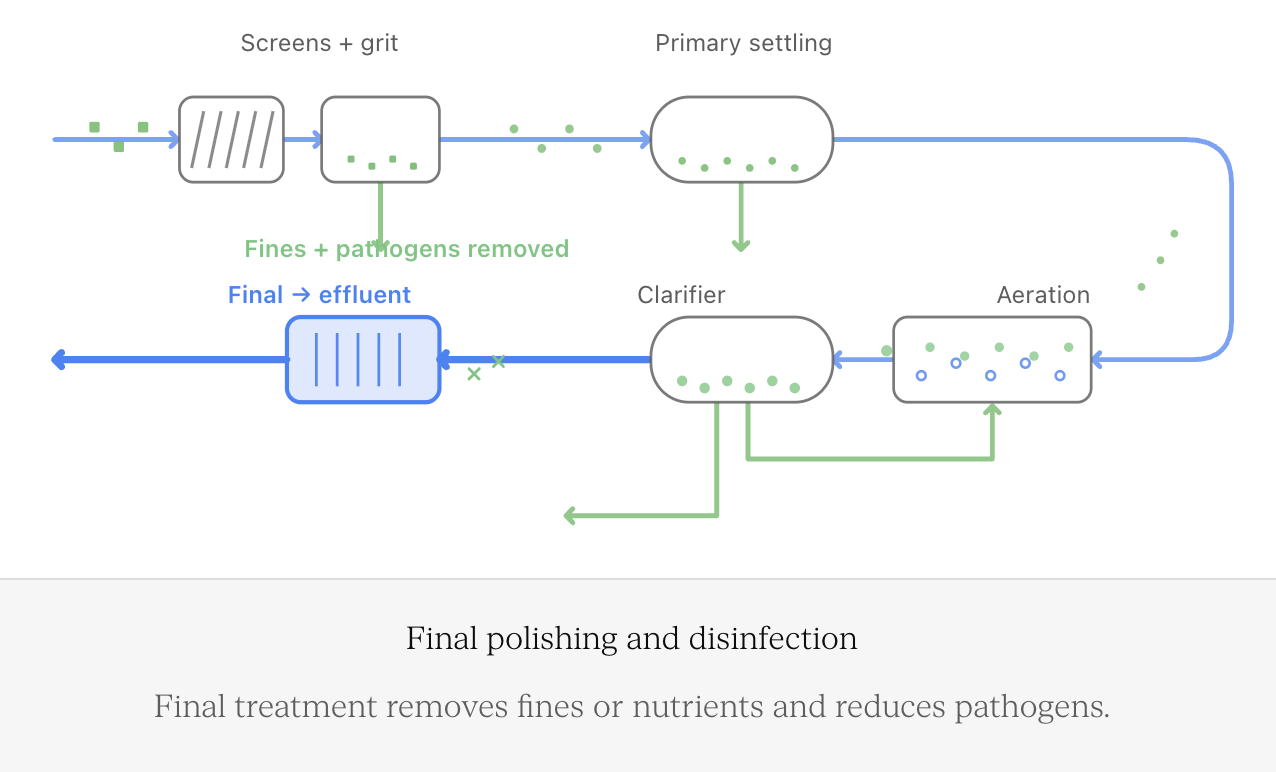
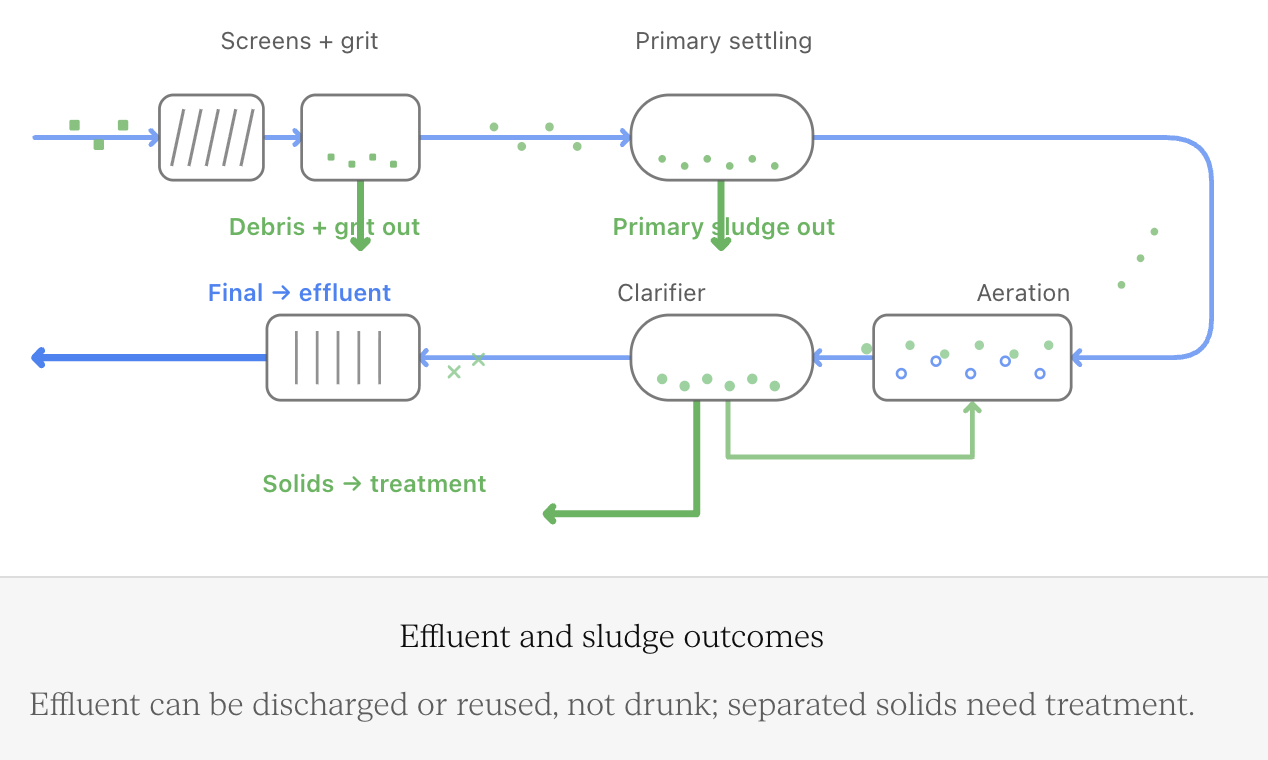
A conventional municipal wastewater treatment process often includes:
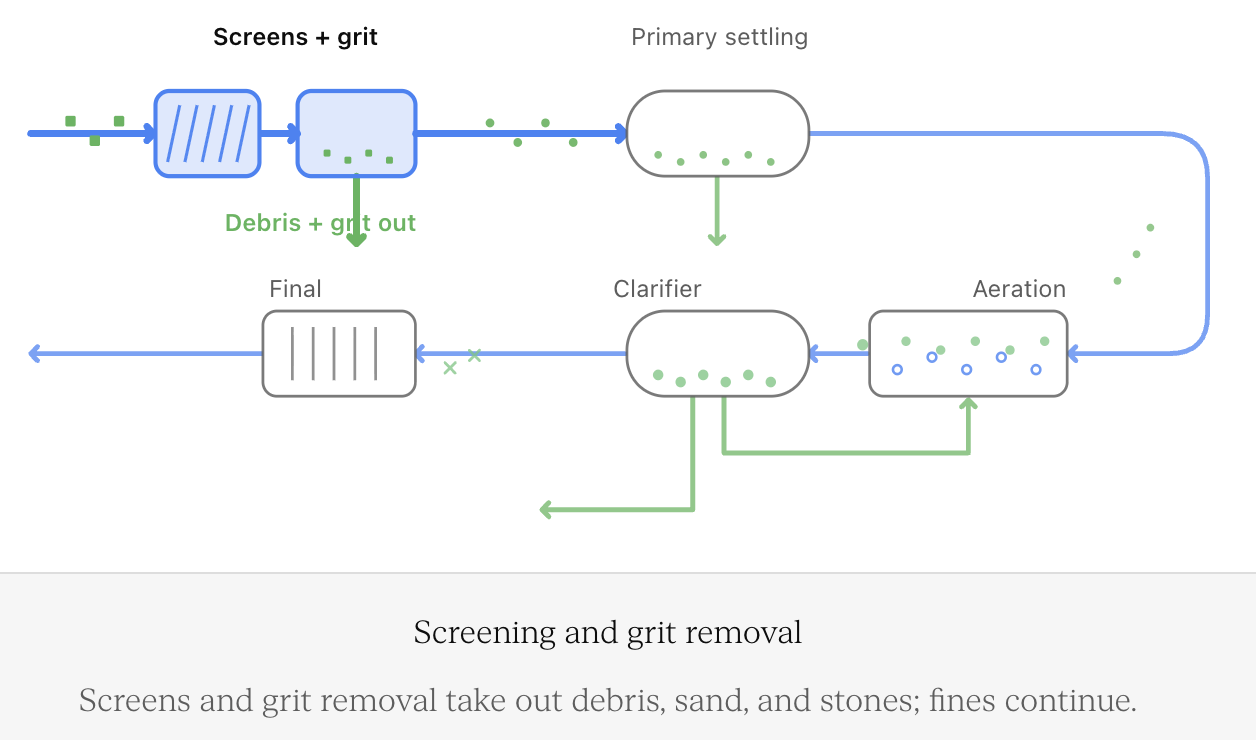
SCREENING → GRIT REMOVAL → PRIMARY TREATMENT → SECONDARY TREATMENT → CLARIFICATION → DISINFECTION
Additional advanced treatment may also be used.
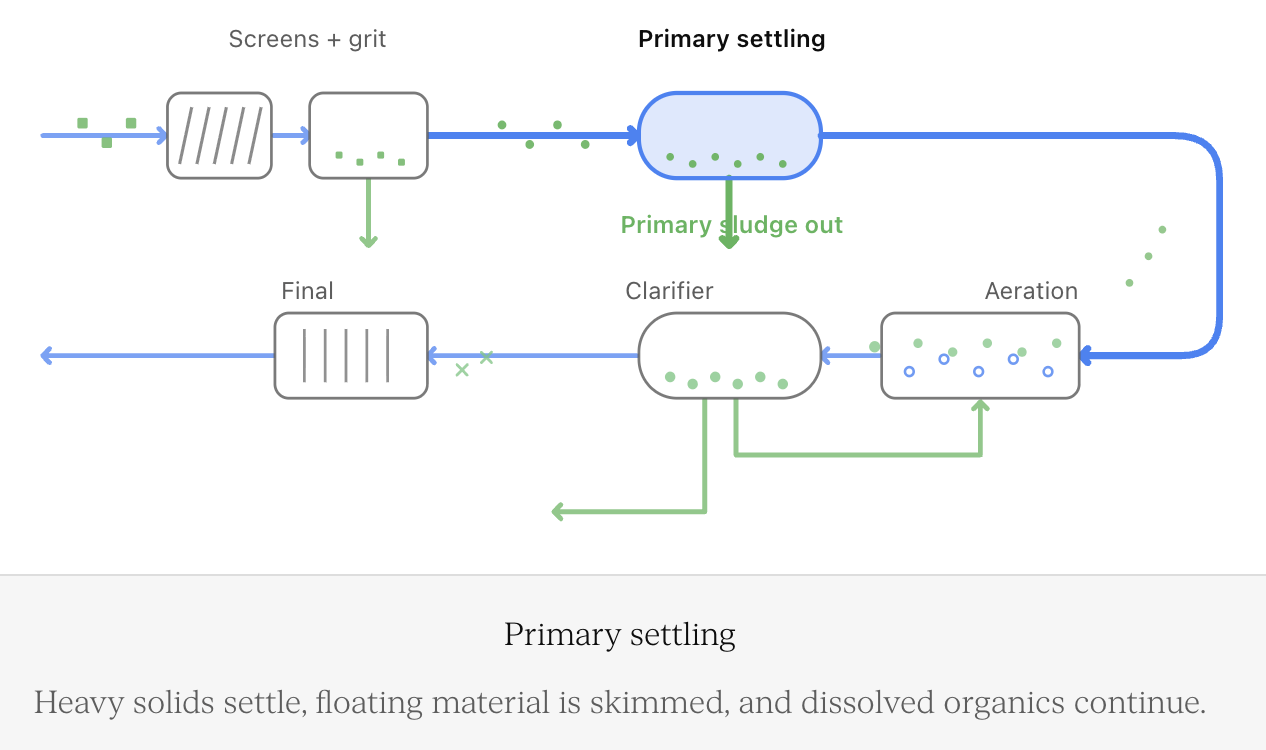
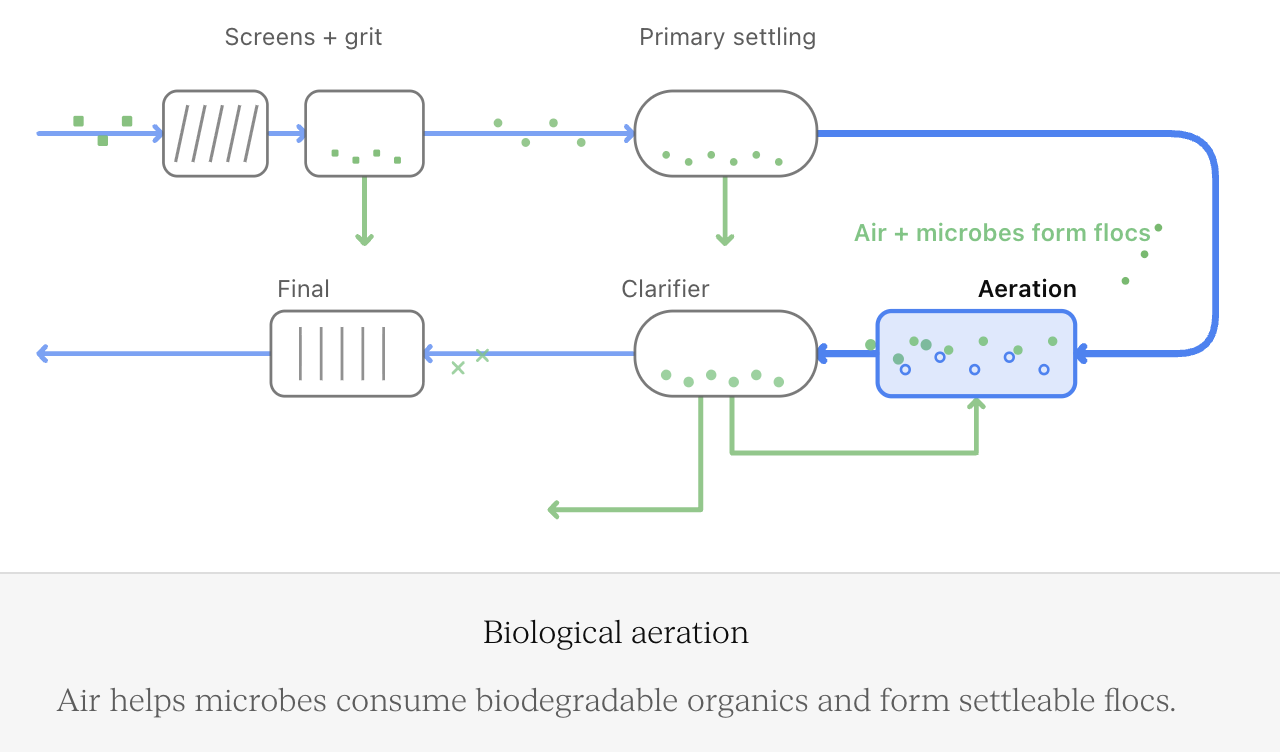
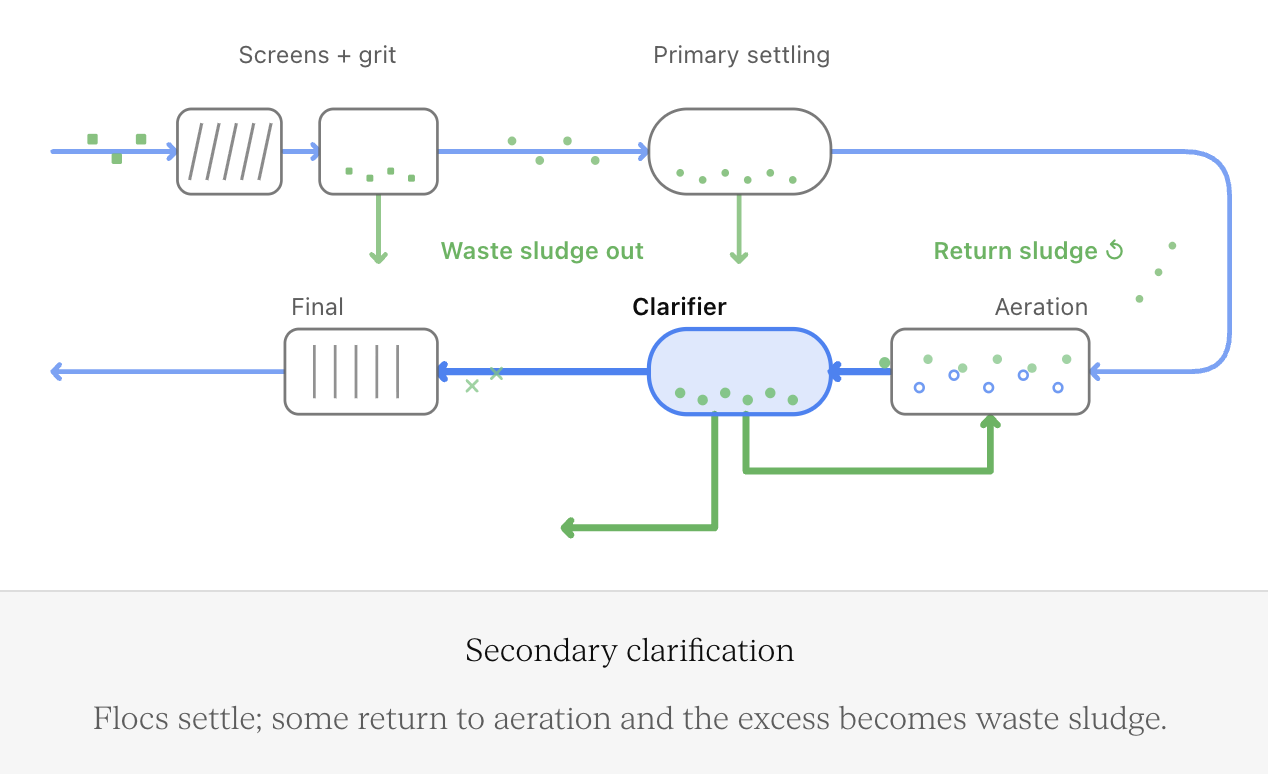
The following model lets you trace the main wastewater-treatment stages and see where water and sludge move through the system:
Preliminary Treatment
The first stages remove materials that could damage equipment or interfere with later treatment.
Screening
Screens remove larger objects such as:
- wipes
- plastics
- sticks
- rags
- other debris
Grit Removal
Sand, gravel, and other dense particles can be removed in grit chambers.
Removing these materials helps protect pumps and equipment from abrasion and blockages.
Primary Treatment
During primary treatment, wastewater is allowed to settle in large tanks.
Gravity separates materials according to density.
Heavier solids settle to the bottom.
These solids contribute to sludge.
Oils, grease, and other floating materials may rise to the surface and be removed.
Primary treatment therefore relies mainly on physical separation.
Secondary Treatment
Primary treatment cannot remove all dissolved and suspended organic material.
Secondary treatment uses microorganisms to break down biodegradable organic matter.
This is a biological process.
One common method is the activated-sludge process.
Activated Sludge
In an activated-sludge system, wastewater enters an aeration tank containing microorganisms.
Air or oxygen is supplied.
The microorganisms consume biodegradable organic matter.
A simplified relationship is:
organic waste + oxygen → microbial activity → simpler substances + more microbial biomass
The microorganisms effectively help clean the water.


Why Oxygen Is Added
Many microorganisms involved in wastewater treatment require oxygen for aerobic respiration.
Aeration:
- supplies oxygen
- keeps wastewater mixed
- supports microbial activity
Without sufficient oxygen, the biological treatment process would become much less effective.
Secondary Clarification
After biological treatment, the water enters a secondary clarifier.
Microbial biomass and other solids settle.
Some settled microorganisms may be returned to the aeration tank.
This is called return activated sludge.
Other sludge is removed for further treatment.
The clarified water continues to later treatment stages.
Tertiary and Advanced Treatment
Some wastewater requires additional treatment beyond primary and secondary stages.
This may be called:
- tertiary treatment
- advanced treatment
Processes can remove additional:
- nitrogen
- phosphorus
- suspended solids
- microorganisms
- specific chemicals
Technologies may include:
- filtration
- nutrient removal
- activated carbon
- membrane filtration
- advanced oxidation
- additional disinfection
The required level depends on how the treated water will be used or where it will be released.
Removing Nitrogen and Phosphorus
Nitrogen and phosphorus are important nutrients, but excessive amounts entering natural water can contribute to eutrophication.
Advanced wastewater treatment may therefore remove nutrients before discharge.
This can help reduce:
- algal blooms
- oxygen depletion
- ecosystem disruption
Water treatment and pollution prevention are therefore closely connected.
Wastewater Disinfection
Before treated wastewater is released, it may be disinfected.
Possible methods include:
- chlorine
- UV radiation
- ozone
This reduces the number of potentially harmful microorganisms entering natural water systems.
The treated water leaving the plant is called effluent.
Sludge Treatment
Wastewater treatment does not make contaminants simply disappear.
Many removed materials become concentrated in sludge.
Sludge may contain:
- organic matter
- microorganisms
- nutrients
- water
- contaminants
It therefore requires additional management.
Treatment may involve:
- thickening
- digestion
- dewatering
- drying
Proper sludge management is an important part of wastewater treatment.
Anaerobic Digestion
Some treatment plants use anaerobic digestion to treat sludge.
Anaerobic microorganisms break down organic matter in the absence of oxygen.
This can produce biogas, which contains methane.
Biogas can sometimes be used as an energy source.
This allows some wastewater-treatment facilities to recover useful energy from waste.
Drinking Water vs Wastewater Treatment
Although the two systems share some technologies, their purposes are different.
| Drinking-Water Treatment | Wastewater Treatment |
|---|---|
| Begins with natural source water | Begins with used water |
| Produces water suitable for drinking | Produces water suitable for discharge or reuse |
| Often uses coagulation and flocculation | Often relies heavily on biological treatment |
| Uses sedimentation and filtration | Uses primary and secondary clarification |
| Disinfection is essential | Disinfection may occur before discharge or reuse |
| Protects consumers | Protects people and receiving ecosystems |
Both systems may use:
- screening
- settling
- filtration
- disinfection
- chemical treatment
But the treatment sequence and technologies depend on the contaminants present.
Physical Treatment
Physical treatment removes contaminants without fundamentally changing their chemical identity.
Examples include:
- screening
- sedimentation
- filtration
- flotation
These methods separate materials according to properties such as:
- size
- density
- physical state
Chemical Treatment
Chemical treatment uses chemical reactions or chemical interactions.
Examples include:
- coagulation
- pH adjustment
- chlorination
- oxidation
- precipitation
Chemical treatment can:
- destabilize suspended particles
- destroy microorganisms
- convert contaminants into removable forms
- change water chemistry
Biological Treatment
Biological treatment uses living organisms, especially microorganisms.
It is particularly important in wastewater treatment.
Microorganisms can break down biodegradable organic matter and help remove certain nutrients.
This makes wastewater treatment partly an engineered ecosystem.
Membrane Filtration
Some treatment systems use specialized membranes.
Depending on the membrane, extremely small particles and dissolved substances can be separated from water.
Types include:
- microfiltration
- ultrafiltration
- nanofiltration
- reverse osmosis
The smaller the membrane openings or effective separation scale, the smaller the substances that can be removed.
Reverse Osmosis
Reverse osmosis, often abbreviated RO, uses pressure to force water through a membrane that blocks many dissolved substances.
RO can remove:
- salts
- many dissolved ions
- some organic contaminants
- microorganisms
It is particularly important in:
- desalination
- advanced water treatment
- water reuse


Desalination
Desalination removes dissolved salts from seawater or salty groundwater.
One major technology is reverse osmosis.
A simplified process is:
seawater → pretreatment → reverse osmosis → freshwater + concentrated brine
Desalination can provide freshwater in regions where conventional freshwater supplies are limited.
However, it has challenges, including:
- energy requirements
- cost
- management of concentrated brine
Water Reuse
Treated wastewater does not always have to be discharged and forgotten.
It can sometimes be treated to a high standard and reused.
Possible uses include:
- irrigation
- industrial processes
- landscaping
- groundwater recharge
- other municipal uses
With sufficiently advanced treatment and appropriate safeguards, water reuse can reduce pressure on freshwater supplies.
Natural Treatment Systems
Some treatment systems use natural or engineered ecosystems.
Constructed wetlands, for example, can use:
- plants
- microorganisms
- soil
- sedimentation
to help remove pollutants.
Wetlands can slow water movement, trap particles, and support biological processes that remove or transform contaminants.


Why One Treatment Method Is Not Enough
Water can contain contaminants with very different properties.
For example:
- screens remove large debris
- sedimentation removes settleable solids
- filters remove smaller particles
- activated carbon can remove certain dissolved compounds
- microorganisms break down biodegradable waste
- membranes can remove very small particles and dissolved substances
- disinfectants control pathogens
Therefore, treatment plants use a treatment train — several processes operating one after another.
Each stage targets different contaminants.
Example: Treating Muddy River Water
Imagine water entering a drinking-water plant from a muddy river.
It contains:
- leaves
- clay particles
- microorganisms
- organic matter
Possible treatment:
Screening
removes leaves and large debris.
↓
Coagulation and flocculation
combine tiny suspended particles.
↓
Sedimentation
allows flocs to settle.
↓
Filtration
removes smaller remaining particles.
↓
Disinfection
reduces harmful microorganisms.
↓
Storage and distribution
deliver treated water to consumers.
No single step performs every job.
Example: Treating Sewage
Imagine wastewater entering a treatment plant from a city.
It contains:
- human waste
- food waste
- microorganisms
- suspended solids
- organic material
- nutrients
Possible treatment:
screening → grit removal → primary settling → biological treatment → secondary clarification → advanced treatment if required → disinfection
The resulting effluent may then be released or reused, depending on its quality and local requirements.
Water Treatment and Public Health
One of the greatest benefits of water treatment is the prevention of waterborne disease.
Contaminated water can transmit disease-causing organisms.
Safe water systems reduce exposure through:
- treatment
- disinfection
- monitoring
- protected storage
- safe distribution
Water treatment therefore supports:
- public health
- sanitation
- hospitals
- food production
- schools
- communities
- economic development
Protecting the Source
Water treatment is important, but protecting the original water source is also valuable.
Preventing contamination can:
- reduce treatment requirements
- lower costs
- protect ecosystems
- reduce health risks
Examples include:
- controlling agricultural runoff
- treating industrial discharges
- protecting watersheds
- preventing sewage leaks
- reducing litter
- protecting groundwater recharge areas
A useful principle is:
Protect the source first, then treat what remains.
Monitoring After Treatment
Water that looks clear is not necessarily safe.
Treated water must be tested.
Monitoring can detect problems involving:
- microorganisms
- chemical contamination
- treatment failure
- excessive turbidity
- incorrect disinfectant levels
Safe water treatment therefore depends on both treatment technology and continuous monitoring.
Common Mistakes
Thinking Clear Water Is Automatically Safe
Clear water may still contain:
- microorganisms
- dissolved chemicals
- metals
- other invisible contaminants
Appearance alone cannot determine water safety.
Thinking Filtration Removes Everything
Filters remove many contaminants, but ordinary filtration does not necessarily remove all:
- dissolved substances
- microorganisms
- salts
- chemicals
Other treatment stages are required.
Confusing Coagulation and Flocculation
Coagulation destabilizes tiny suspended particles.
Flocculation brings those particles together into larger flocs.
Thinking Sedimentation and Filtration Are the Same
Sedimentation uses gravity to allow particles to settle.
Filtration passes water through material that removes particles.
Thinking Chlorine Removes Dirt
Chlorine is primarily used for disinfection.
It does not replace screening, sedimentation, or filtration.
Thinking Wastewater Is Simply Filtered
Modern wastewater treatment often depends heavily on microorganisms that break down organic waste.
Biological treatment is a major part of the process.
Assuming Removed Pollutants Disappear
Treatment transfers many pollutants into:
- sludge
- concentrated waste
- filter material
- brine
These materials still require proper management.
Thinking Drinking-Water and Wastewater Treatment Are Identical
They share some processes, but their:
- starting water
- treatment goals
- technologies
- final requirements
are different.
Key Terms
Water treatment — Processes used to remove contaminants and make water suitable for a particular use.
Raw water — Untreated water entering a drinking-water treatment system.
Screening — Removal of large debris using screens.
Coagulation — Chemical treatment that destabilizes small suspended particles.
Flocculation — Gentle mixing that causes small particles to form larger flocs.
Floc — A cluster of suspended particles formed during treatment.
Sedimentation — Removal of particles by allowing them to settle under gravity.
Filtration — Removal of particles by passing water through filtering material.
Activated carbon — Highly porous carbon used to adsorb certain contaminants.
Adsorption — Attachment of substances to a surface.
Disinfection — Reduction or destruction of disease-causing microorganisms.
Wastewater — Water that has been used and contains waste materials.
Primary treatment — Mainly physical removal of settleable solids from wastewater.
Secondary treatment — Mainly biological treatment used to remove biodegradable organic matter.
Activated sludge — A wastewater-treatment process using aerated microorganisms to break down organic waste.
Clarifier — A settling tank used to separate solids from water.
Effluent — Treated water leaving a wastewater treatment system.
Sludge — Concentrated solids removed during wastewater treatment.
Tertiary treatment — Additional treatment used to remove remaining contaminants after secondary treatment.
Reverse osmosis — A pressure-driven membrane process that removes many dissolved substances.
Desalination — Removal of dissolved salts from saline water.
Water reuse — Using treated wastewater again for beneficial purposes.
Key Takeaways
- Water treatment removes contaminants and makes water suitable for a particular purpose.
- Drinking-water treatment protects people from contaminants and disease-causing microorganisms.
- A typical drinking-water process may include screening, coagulation, flocculation, sedimentation, filtration, and disinfection.
- Coagulation and flocculation help small suspended particles form larger flocs.
- Sedimentation removes many flocs using gravity.
- Filtration removes smaller remaining particles.
- Activated carbon can adsorb certain dissolved contaminants.
- Chlorine, UV radiation, and ozone can be used for disinfection.
- Wastewater treatment cleans used water before release or reuse.
- Primary wastewater treatment mainly uses physical separation.
- Secondary treatment uses microorganisms to break down biodegradable organic matter.
- Advanced treatment can remove nutrients and other remaining contaminants.
- Sludge must be treated and managed separately.
- Reverse osmosis can remove many dissolved substances and is widely used in desalination and advanced treatment.
- Drinking-water and wastewater treatment share some technologies but have different purposes.
- Water treatment combines physical, chemical, and biological processes.
- Multiple treatment stages are necessary because different contaminants require different removal methods.
- Treatment and monitoring are both essential for maintaining safe water.
- Preventing pollution at the source can reduce the amount of treatment required.
- Reliable water treatment is essential for public health and healthy ecosystems.
A useful summary is:
SOURCE → REMOVE LARGE MATERIAL → REMOVE PARTICLES → REMOVE DISSOLVED/ORGANIC CONTAMINANTS → DISINFECT → MONITOR
Check Your Understanding
Basic Concepts
1. Define water treatment.
2. Explain why natural water is not automatically safe to drink.
3. What is raw water?
4. Give four examples of contaminants that may be present in untreated water.
5. Explain why several treatment stages are normally required instead of one.
Drinking-Water Treatment
6. What is removed during screening?
7. Explain the purpose of coagulation.
8. What happens during flocculation?
9. Explain how sedimentation removes contaminants.
10. What is the purpose of filtration?
11. Explain how activated carbon can improve water quality.
12. Why is disinfection necessary even after filtration?
13. Name three methods of disinfecting water.
14. Give one advantage of chlorination.
15. Give one limitation of UV disinfection compared with chlorination.
Wastewater Treatment
16. Define wastewater.
17. Give four substances commonly found in wastewater.
18. What is the purpose of grit removal?
19. Describe what happens during primary treatment.
20. Explain how secondary treatment differs from primary treatment.
21. What role do microorganisms play in wastewater treatment?
22. Why is oxygen supplied during activated-sludge treatment?
23. What happens in a secondary clarifier?
24. What is effluent?
25. What is sludge?
Comparing Treatment Systems
26. State the main goal of drinking-water treatment.
27. State the main goal of wastewater treatment.
28. Identify two processes that may be used in both systems.
29. Explain why biological treatment is particularly important in wastewater treatment.
30. Explain why drinking-water and wastewater treatment cannot simply use identical treatment processes.
Treatment Technologies
31. Explain how reverse osmosis works.
32. Give two situations in which reverse osmosis may be useful.
33. What is desalination?
34. Give one advantage and one challenge of desalination.
35. Explain how constructed wetlands can help treat water.
Application and Analysis
36. A river supplying a town becomes very muddy after heavy rainfall. Which treatment stages would be especially important for removing the suspended particles? Explain.
37. Water leaving a filter appears perfectly clear. Explain why it may still require disinfection.
38. A wastewater treatment plant releases water containing high concentrations of nitrogen and phosphorus. Explain why additional treatment may be necessary.
39. Compare treating a polluted water source with preventing the pollution from entering the source in the first place.
40. Trace water through either a drinking-water or wastewater treatment plant and explain the purpose of each major stage.